




Abstract
Although violin/viola pedagogues who use the third position as the home position in beginning-level teaching have reported positive experiences, school curricula and most pedagogues’ repertoires remain limited to method books that use the first position. The reasons for this preference have not been adequately addressed in string pedagogy and music education research. This study therefore aimed to examine the opinions of violin/viola trainers on the use of the third position as home position through a survey. A questionnaire sent to various music associations, schools, and violin/viola educators internationally yielded a sampling of 160. The results showed that 73.1% of the participants hold the opinion that the third position is not widely used in beginning-level training, and 63.5% think that method books that employ the technique are insufficient. However, 53.1% of the participants believe that using the third position as the home position may have benefits; 61.1% think that the left hand takes the ideal shape in the third position; and 68.3% think that a wider availability of method books would increase the number of trainers who use the technique to teach. The study found that further research of the technique is necessary, especially for educators who are interested in using it.
Violin/viola teachers in many different educational institutions generally prefer starting their students with their hand in the first position. However, there are different pedagogical approaches in choosing a home position, and the third-position-beginning technique (TPBT) is one of them. This study aimed to explore an alternative method in violin/viola training by obtaining the opinions of contemporary educators about the use of the TPBT, and also to help narrow the gap in the literature concerning this technique. Although violin/viola beginners’ training can be provided at different institutions with different educational goals, the fundamental pedagogical principles should remain the same. Since educators can simultaneously be either violinists or violists, as well as music teachers, the results of this study are as relevant to music education as they are to performance and string pedagogy. As the fundamental playing and training principles are the same for both the violin and viola, the word violin will be generically used throughout the remainder of the article for brevity.
Besides being a home position, the third position is considered an advantage for learning some basic violin techniques because the heel of the left hand at the base of the thumb touches the right rib of the violin. Accordingly, this encourages a natural shape, which we will refer to as right-rib-rest in the rest of the article. Gruenberg (1919), like many other pedagogues, referred to the right-rib-rest when describing the basic left-hand position in the third position (Appendix A).
One of the most frequently mentioned advantages of the third position is that the left arm is closer to the body than it is in the first position, resulting in a less tense, more flexible arm that more comfortably bears the instrument (Menuhin, 1977). Thus, the left wrist can maintain its proper shape despite the weight of the violin (Krakenberger, 2010). The third position may spontaneously facilitate correct shaping of the left hand, leading to proper intonation, which may provide an advantageous beginning for children with small hands due to closer spacing of their fingers in the higher positions (Mishra, 2000). Right-rib-rest helps beginners achieve correct hand placement and facilitate some technical exercises. Whereas Galamian (1962) used the third position in vibrato exercises, Alapınar (2005) preferred to practice shifting first between the first and third positions because of the benefits of right-rib-rest. In his essay, Yankelevich (2016) stated that pedagogues like Louis Sphor, Charles de Bériot, Ferdinant David, Joseph Joachim, and Andreas Moser mentioned the use of right-rib-rest to facilitate intonation and shifting between first and third positions.
Cowden (1969) examined the opinions of Altimari (1937), Koutzen (1951), Angus (1950), Rotili (1950), Rolland (1952), and Cavallaro (1950) on the benefits of beginning violin training using the third position. He then summarized them in his article (1972) as follows:
(a) The half steps and whole steps lie closer together, (b) the fourth finger is used immediately, (c) much of the fatigue resulting from holding the instrument in the first position is circumvented, (d) the body of the violin serves as a reminder when the heel of the left hand is getting out of position, (e) it is possible to test intonation by placing the first finger on all strings except G, because the first finger in this position is one octave higher than the next lower open string, (f) the instrument can be held more easily, (g) the tonic of the key falls on the first finger, and (h) some useful rote playing tricks are made possible because the fingers and the tones of the key are called by the same number (p. 505).
The advantages that Cowden listed are in accordance with the reasons why Shattuck (1933), Massau (1934), Koutzen (1951), and Angus (1950/1961) wrote method books using the TPBT. The left wrist naturally takes shape because the right-rib-rest is the leading reason, while Massau preferred the TPBT to eliminate the problems and basic flaws at the beginning level that he thought were caused by the first position. Pedagogues taught from method books using the TPBT in the classroom and reported positive outcomes as a testimony of sorts for the usefulness of the technique.
Some believe that the TPBT has certain disadvantages. The most emphasized one is the inability to use the open strings in the third position, which facilitates scale exercises in the first position (Applebaum & Lindsay, 1986). The scarcity of materials, stiffness of the left hand, placement of the wrist rather than the thumb (to bear the pressure of the strings), and the difficulty in obtaining tone because of the shortness of the strings are also noted as disadvantages of the third position (Rolland, 1952). Moreover, there is an entirely different pedagogical approach concerning right-rib-rest. Yankelevich (2016) indicated that, according to Rezvetsov and Lesman, the left hand should not touch the body of the violin in the third position. Regarding this matter, he declared that right-rib-rest causes the shape of the wrist to change, and thus the angle of the fingers on the fretboard to change as well, therefore adversely affecting both finger movement and intonation. He further noted that because right-rib-rest requires an extra wrist movement in positions higher than the third, it could have a negative effect on shifting.
Currently, there are two internet forums hosted on www.violinist.com (Arıca, 2016; Hastings, 2011) where the TPBT is discussed; one of them was initiated as a result of this study’s call for a survey. The opinions expressed in these forums regarding the advantages and disadvantages of the TPBT coincide with those previously mentioned by pedagogues and researchers such as Cowden, (1969, 1972), Rolland (1952), and Yankelevich (2016).
Altimari (1937) proposed a new beginning-level method in his thesis, which was the first academic work on the TPBT. As he considered the first position neither natural nor comfortable for the left hand and arm, he used the third position as the home position. The first experimental study is Cowden’s (1969) dissertation, which was conducted in two public schools, and investigated 37 fourth-grade students divided into two groups to compare the first and the TPBTs. The evaluation showed no significant differences in performance achievement. Sievers (2005) conducted a survey to canvass the opinions of string teachers on shifting. She found that among the 229 participants, 75% of them negatively responded to the statement “Third position should be taught before first position.” Furthermore, 84.7% affirmatively responded to the statement “Third position should be taught after first position . . .” Forty-six years after Cowden’s work, an embedded case study was conducted by Baker (2015) with five students aged 7 to 11 years to compare the first- and the third-position techniques. There was no significant difference between the two positions in terms of the beginning technique; however, considering the views of students/participants the results also showed that the choice of beginning technique might vary depending on the student.
The Comments section (Part 4) of the survey that the author of this study initiated in 2016 has been published as a separate article (Arıca, 2019). The results of the study, which gathered the views of 94 participants, indicate the existence, albeit fewer, of trainers who find TPBT advantageous, tried the technique, or want to try it in the 21st Century, besides those who prefer the first position and are either reserved or against the TPBT. It is also evident that the inadequacy of method books creates a barrier for utilization of the technique. Some participants indicated that they had not heard of or given much thought to the technique but that they found the survey interesting and were curious about its results. Furthermore, the view that the technique could prove to be an advantage in terms of size and weight in the case of viola was expressed, while the opposite opinion was also mentioned.
Clearly, research directly related to the TPBT is noticeably scarce. In fact, only two experimental/scientific works exist regarding this technique. Cowden was the first researcher who ran his studies on an experimental basis and revealed the historical process of the technique. Baker’s thesis is important in that it was the only experimental study 46 years after Cowden. At the same time, it also revealed the incompleteness of academic studies on this technique.
Even when the experiences of pedagogues and researchers do not constitute a scientific criterion, they are nevertheless important data worthy of note, suggesting that the technique is in use and can be used whenever necessary. As Neumann (1952) states, if there were a single correct way of playing, it would have been identified and the differences across methods would diminish. However, even the scientific validation of the superiority of one method over another should not necessarily mean that the need or necessity for using the other method has ceased to exist. Even though the first-position-beginning technique has been in use as a proven technique for many years, investigations, research, and dissertations with various perspectives are still being done on pedagogues and method books using it, and new method books are written with the technique. Nevertheless, it is not possible to say that research and method books on the TPBT receive the same amount of interest. As a result, the absence of contemporary violin curricula of method books using the TPBT—even as an option—seems to be associated with the insufficiency of scientific/experimental studies.
In recognition of the importance of alternative techniques in instrument training, this study focused on the TPBT to draw attention to the wide gap in the literature and to encourage other studies about the technique. The goal was to investigate whether the technique is in widespread use, or whether a trend exists for its use in the 21st century. This would be accomplished by obtaining the views of violin and viola instructors. Another goal was to investigate whether the method books using the technique are adequate and whether further research on it is needed. No other survey study designed to glean the views of violin and viola instructors on the TPBT could be identified from a literature review.
Comparisons of the first and third positions in terms of starting technique, or superiority of one technique over another, are beyond the scope of this study. Similarly, although discussions of advantages and disadvantages were addressed as a natural part of the study, comparisons of the two techniques were excluded. No assertion has been made in terms of which starting technique is preferable, or whether one is more advantageous than the other.
Methodology
Design
A survey was formulated for this study to explore violin teachers’ opinions on the TPBT. It was reviewed by a psychologist with a PhD in arts and sciences and experience in designing and delivering tests; moreover, one violin and one violin/viola instructor who have studies on violin pedagogy, also inspected it. It consisted of the following four parts:
According to Preston and Colman’s (2000) study, 7-point scales are among those with the highest validity and reliability value. Lozano et al. (2008) pointed out that “as the number of response alternatives increases,” so do reliability and validity, and concluded that the ideal number of choices is between four and seven. Based on these findings and with the wish to collect information on pedagogical attitudes in instrument training in the most unrestrictive manner for the respondents as possible, a 7-point scale was used. The comment section was designed to gather additional details about the participants’ views on the TPBT. It was published as a separate work, as stated in the introductory section.
Participants and Procedure
A link was posted on www.onlineanketler.com for the survey from May 15 to August 15, 2016. To draw out the opinions of educators from different educational backgrounds and experiences, who taught lessons in different fields with different aims, the only criterion set for the sampling was that the educator was currently teaching violin/viola. Accordingly, three different methods were used to define the sample. In the first method, violin educators who were personally contacted were invited by email to take the survey, which yielded 54 participants. For the second method, a survey link was added to a forum initiated on www.violinist.com for this study, and the www.viola.com survey link was sent to members by mass email. In addition, a request was sent to the journal Strad to invite its readers to participate in the survey; consequently, these invitations yielded 24 participants. In the third method (Appendix B), invitations and the survey link were sent by email to various randomly selected associations and directors of music schools/universities involved in string instruments and music training. The directors shared the link with their staff members through their institutional social media accounts or by email, thus yielding 82 participants. As was the case in forming the sample, the only criterion used in selecting the institutions to be invited to participate in the survey was the existence of violin teachers within their membership, with the purpose of reaching educators from different platforms. Invitations were sent to a large number of institutions; the entire list of responding entities is shared in this report. For those who were invited to participate personally, a single specific survey link was used. Participants who preferred to respond to the survey by email sent in their answers as Microsoft Word documents. Separately recorded data were merged during the analysis.
Some of the respondents were eliminated during sampling based on the following criteria:
As the objective of the study was to reach violin/viola educators, those who did not mark the violin and/or the viola choice for the question, (Q) “Your instrument/instruments that you play and teach is/are” were excluded. Two exceptions were made based on the respondents’ answers to the questions about education and teaching level.
Respondents who failed to answer both the teaching level and education questions, which were significant in terms of their appropriateness for the study, were excluded. Two respondents with no formal violin/viola training, but who taught violin/viola and provided information on their teaching experience, were included in the sample. As a result of the survey and elimination criteria, a sample group of 160 people emerged.
Data Analysis
The Number Cruncher Statistical System (NCSS) 2007 software was used for the statistical analyses. Descriptive statistical methods were used to evaluate the study data of frequency, percentage, mean, standard deviation, median, and minimum and maximum. The analysis of answers to the Other choice in Part 1 of the questionnaire was handled as follows: responses/statements that were found to be common among 12% or more of the respondents were treated under a specific heading; responses with a frequency of less than 12% were collectively evaluated under the heading of Other. Two exceptions to this generalization were made for Q7 in P1.
Results
The total number of participants was 160. A high response rate was achieved, with 90% representing the question with the lowest participation rate.
The questions in P1 were designed to obtain information on the participants’ professional status as violinist, violist, and music teacher along with the instrument they taught (Q1, Q2) and their educational background (Q3), current employment status (Q4), and teaching/performance experience (Q5, Q6). Moreover, the participants’ outlook on the TPBT was evaluated by asking them which position they themselves started to learn violin/viola (Q7). This section involved seven questions.
P1, Q1, and Q2
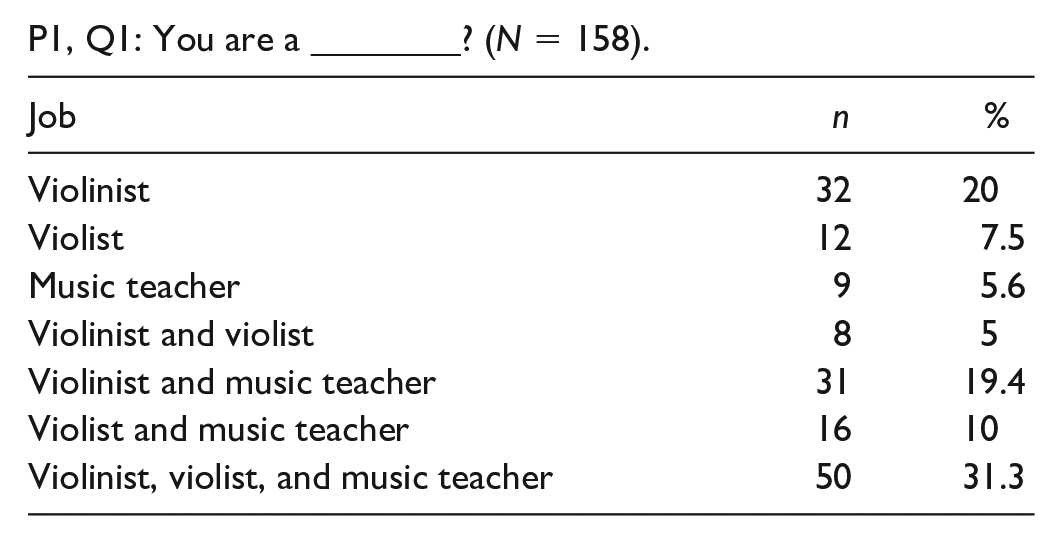
From the responses to these two questions, participants’ area/areas of expertise and instrument/instruments they taught were determined. 20% of the respondents were violinists, 7.5% were violists, and 5.6% were music teachers. Distribution of those who marked more than one choice is as follows: 5.0% respondents were both violinists and violists, 19.4% were violinists and music teachers, 10.0% violists and music teachers. 31.3%. respondents marked all three choices of violinist, violist, and music teacher (Appendix C). On the other hand, 34.4% of the respondents taught violin; 11.3%, viola; and 53.1%, both violin and viola (Appendix D).
It can be clearly seen that two-thirds of the participants were music teachers (Appendix C). Their high participation rate showed that violin/viola training is an important part of basic musical education for music teachers and that they monitor new studies in this area. Furthermore, approximately one-third of the participants marked violinist, violist, and music teacher choices simultaneously is significant in terms of reflection of the opinions of teachers experienced in these three disciplines on the study results (Appendix C). In addition, more than one-third of the participants (Appendix C) were both violinists and violists, and more than half (Appendix D) were both violin and viola teachers. Even though the basic principles of violin and viola training are the same, having reached participants who are proficient in both instruments is a positive indicator of the study’s results.
P1, Q3, Q4, Q5, and Q6
These questions reflected the educational background, current employment status, and teaching and performance experiences of the participants. The participant profile mainly consisted of individuals who had received an education in the fields of violin, viola, or music education; who mostly gave private lessons; and who worked in preschools, elementary schools, and high schools (Appendix E). As this study is concerned with beginning-level violin training, the participants’ median length of experience in beginning-level violin instruction, which is more than 10 years, clearly indicated that a suitable participant profile was achieved (Appendix F). Moreover, the fact that a high percentage of participants were 5 years old or more with orchestral performance experience (Appendix G) showed that the target population of people with a high degree of experience in training as well as performance was reached.
P1 and Q7
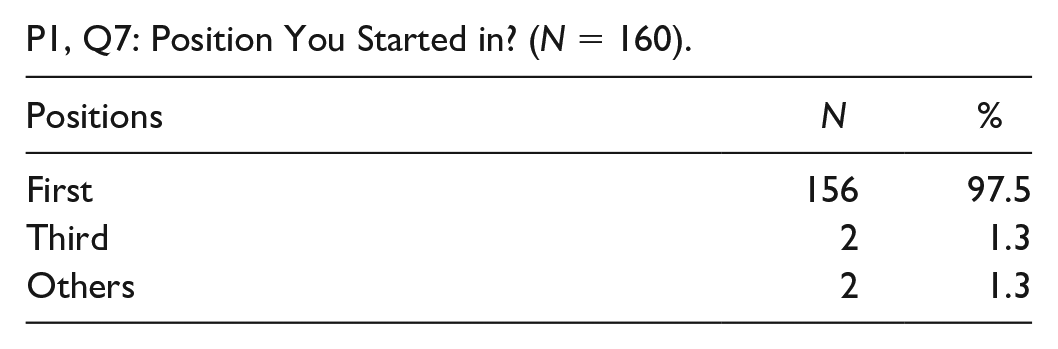
The responses to this question determined with which position the participants themselves started their own violin/viola training. The number of respondents who began violin/violin education in the first position was 97.5%. Another 1.3% began in the third position, while the remaining two 1.3% marked the “Other” choice (Appendix H). It can be clearly seen that almost all of the participants started learning with the first position.
P2
The questions in P2 were designed to obtain the participants’ opinions on general pedagogical approaches for the beginning stage (P2, Q2, Q4); inclination to use the TPBT (Q3); opinions on and awareness of the prevalence of the TPBT (Q6); and on the advantages of right-rib-rest in general and special cases (Q1, Q5). Participants responded to six questions using the responses Yes, No, and No opinion (Table 1).
P2 Questions and Answers.

P3
The questions in P3 were designed to obtain the participants’ opinions on general pedagogical approaches for inclination to use the TPBT (Q3 and Q4), opinions on and awareness of the prevalence of the TPBT (Q2), and on the advantages of right-rib-rest in general and special cases (Q1, Q5, Q6, Q7). Participants responded to seven questions using a 7-point Likert-type scale from 1 = Strongly agree to 7 = Strongly disagree (Table 2).
P3 Questions and Descriptive Statistics.

Discussion
Achieving an educational system based on the principle that each student is unique is possible only by producing and developing alternative teaching techniques. In this study, the TPBT, which is one of the alternative methods in beginning violin and viola instruction, was explored along with the opinions of current educators, and the technique’s usability in the current system was investigated. In fact, regardless of whether the literature gap and dearth of related materials leaves the impression that there is no interest in the TPBT or that it is not used, the results of the study indicated that there are those among current educators who find the TPBT advantageous from different angles and want to use or try it. Unlike Cowden (1969) and Baker (2015), this study did not compare the advantages of the first and third positions in beginning-level teaching; notably, it only featured a situation analysis of the TPBT’s applicability. Whether the third position is considered advantageous or disadvantageous, it is nevertheless important to conduct research on it so that it can be used when the teacher deems it necessary or when the student’s circumstances require it.
The high rate of participation of music teachers in this research (Appendix C) is evidence that music teachers are interested in research and findings related to the pedagogical methods of violin/viola education. In fact, beginner instrument training is provided, without concern for professional gain, by music teachers in preschools, elementary schools, and high schools, where the study’s participants mostly worked (Appendix E). Thus, the results of the study are meaningful for musical instrument training in schools because of the inclusion in the sample of quite a few music teachers who taught violin/viola to children and youths in schools. The fact that Cowden (1969) conducted his TPBT study in two public schools, and in a group-lesson format, is consistent with this view.
Although almost all of the participants had started their violin/viola education in the first position (Appendix H), slightly more than half of them thought that the TPBT might provide an advantage (Table 1). In addition, more than three-quarters of the participants began to train their students in the first position; however, nearly half of them had considered using the TPBT (Table 1). These results show that the TPBT still attracts interest in the 21st century and that there are instructors who either want to use it, or who are considering using it. On the contrary, a disparity exists between the results of this study and the findings of Sievers’s (2005) study, which obtained negative responses to the questions about the TPBT. These two conflicting findings are compatible with the existence of different approaches within the essence of education. As Baker’s study showed (2015), different beginning positions are appropriate for different students.
The advantage of the TPBT is that it is based on right-rib-rest. The results of P3, Q1 show that like Massau (1934), and Koutzen (1951), some educators today believe that right-rib-rest facilitates the left hand taking the ideal shape (Table 2). In contrast, this finding differs with the opinions of Yankelevich, Rezvetsov, and Lesman (Yankelevich, 2016), who do not consider the left hand’s contact with the violin as being in the third position. From Neumann (1952) to date, not only is the superiority of a single method unacceptable, but the existence of school and pedagogic differences is a natural feature of education. Certainly, what is considered the pedagogical norm should not stand in the way of innovative or diverse approaches.
Despite the existence of educators from Shattuck (1933) to Krakenberger (2010) who used the third position as the home position, the results for P3, Q2 (Table 2) show that the TPBT has not expanded. In addition, according to the results in P3, Q3–Q4, two-thirds of participants thought that if more method books for the technique were written, the number of educators/trainers who use the third position as the home position would increase, and that more than half would also consider using the third position during beginning-level training for their students (Table 2). The scarcity of method books noted both in the first half of the 20th century (Rolland, 1952) and at present (Arıca, 2016; Hastings, 2011), despite pedagogues such as Koutzen (1951) and Angus (1950/1961) who have written violin method books using the TPBT, appears to be related to a lack of research. The same problem is also underscored in the comments section of this survey (Arıca, 2019).
The positive result in P3, Q7 (Table 2) which shows that the third position can be used for rehabilitation purposes corresponds with the opinions of Massau (1934), who preferred the third position to prevent the pitfalls that can occur at the beginning stage if the first position is the home position. This opinion, when assessed alongside the results obtained from this study, indicates that the third position can also be remedial for beginners who have developed incorrect approaches.
It appears that the participants in general thought that the TPBT might be useful; however, the results regarding its use in group classes were neutral (Table 2). The scarcity of research and materials might, once again, add to reservations related to group training, which was also mentioned in the Comments section (Arıca, 2019). Contrarily, one of the greatest difficulties in instrument training are situations where only group classes are possible because of limited means, and where individual lessons are not feasible. As right-rib-rest spontaneously gives the left hand its natural shape, the TPBT may be useful to teachers in crowded group lessons by facilitating the students’ mastery of correct positioning. Therefore, the development of alternative methods such as the TPBT is especially important.
Mishra (2000) mentioned the particular advantage of the TPBT for children with small hands. Similarly, in this study, approximately one-third of participants had a positive attitude toward the use of TPBT for children aged 5 years and younger (Table 1). The high response rate of No opinion in this heading might be due to shortcomings in the exchange of research and findings related to the use of the third position. On the contrary, the results from P2, Q4 show that the vast majority of participants disregard the shape of a student’s hand in determining the home position (Table 1). This finding conflicts with Mishra’s view and may be attributed to the positive results that educators obtained from applying the technique of their choice in beginning-level training. However, it would be prudent to consider that alternative techniques may have advantages as much for the size of hands as for physical differences. On the contrary, the scarcity of method books that involve the use of different positions may restrict educators from applying alternative methods.
Menuhin’s (1977) view that the third position is favorable because the instrument’s weight is reduced in this position, resulting in a relaxed left hand, was also mentioned for viola in the Comments section (Arıca, 2019). It is possible that reduced instrument weight, resulting in a relaxed left hand, might help eliminate the difficulties caused by right hand–left hand asynchrony as well as some neuromuscular disorders. From this point of view, the participants’ response to P3, Q6 which covered this issue, was Neutral. On the contrary, the low rate of disagreement and positive responses from one-third of participants represents an outcome that warrants further investigation (Table 2).
Some participants stated in the Comments section (Arıca, 2019) that they had not heard of or given much thought to TPBT. It is believed that deficiencies in scientific studies are reflected in the lack of awareness of the technique. The high percentages of Neutral and No opinion answers received in this study also seem to be associated with this finding. In fact, those participants who had not heard of or given much thought to TPBT also indicated that they were keen on learning about the results of this research and that they might consider using the technique (Arıca, 2019). Even these opinions are evidence of the importance of studies to be conducted on alternative techniques. In contrast, awareness of the TPBT and preferences for its use by the participants may be associated with the education they received and their professional experiences. In fact, the formation gained by education and job performance affects the individual’s preferences.
In this study, the TPBT was questioned from the perspective of present-day violin/viola educators. It was conclusively determined that despite the literature gap and scarcity of materials, the advantages this technique offers are of interest to educators as much in the 21st century as it was in the 20th century. Notably, there are educators who want to use it, and furthermore, its advantages and disadvantages are under discussion. The results of this study, which was primarily concerned with beginner violin/viola training, need to be specifically evaluated in terms of basic instrument training regardless of the type of institution providing it. Therefore, the study’s purpose is to help narrow the literature gap on the TPBT as an alternative pedagogical approach while triggering new studies, gains importance.
Conclusion
The results above demonstrate that the interest present-day violin/viola educators have shown in the TPBT merits further related work and the production of materials to enable access to the technique by those who prefer it. In particular, scientific research on this technique is highly inadequate. This gap in the literature was determined to have a negative impact on the awareness and expansion of the technique—but more importantly, on the production of educational materials, which directly affects educators.
Accordingly, experimental studies that specifically focus on pedagogical methods and method books designed for the TPBT, might be useful. Detailed comparative analyses could be based on trainers who specialize in the fields of string pedagogy, music education, and performance, as well as on their students. A comparative study of how educators’ professional experience and type of education impact on their preference and awareness of the TPBT could also be useful in terms of examining the string education system.
The inclusion of an orthopedic specialist on the study team who could compare beginner techniques in different positions could add a new and fresh perspective to the research. Correspondingly, studies on the therapeutic effects of the TPBT for students with neuromuscular disorders or asynchrony between their hands could also be conducted. It is clear that group lessons for instruments are an important part of music education in public schools and need to be improved all over the world—especially for students who cannot afford to take private lessons. It might therefore be beneficial to explore the use of the TPBT in beginner group classes as well.
Footnotes
Appendix A
Appendix B
The list of associations, institutes, and schools that shared the survey with their faculty members and teachers through email or social media as well as the distribution of the respondents are as follows:
Appendix C
P1, Q1: You are a ________? (N = 158).
| Job | n | % |
|---|---|---|
| Violinist | 32 | 20 |
| Violist | 12 | 7.5 |
| Music teacher | 9 | 5.6 |
| Violinist and violist | 8 | 5 |
| Violinist and music teacher | 31 | 19.4 |
| Violist and music teacher | 16 | 10 |
| Violinist, violist, and music teacher | 50 | 31.3 |
Appendix D
P1, Q2: Your Instrument/Instruments Which You Play and Teach is/are? (N = 160 a ).

| Instrument | N | % |
|---|---|---|
| Violin | 55 | 34.4 |
| Viola | 18 | 11.3 |
| Violin and viola | 85 | 53.1 |
Two of the respondents failed to mark the violin or viola choices in the second question, although they chose instruments other than violin and viola in the survey. Since no meaningful data were obtained for this study and due to 12% threshold specified in the method section, the list of other instruments is not shared.
Appendix E
P1, Q3: Education? (N =155) and P1, Q4: Current job as a teacher? (N = 152).
Appendix F
P1, Q5: Level of Teaching Experience? (N: 150).

| Teaching level | n | M ± SD | Mdn | Min.–Max. |
|---|---|---|---|---|
| School teacher | ||||
| Beginner | 85 | 14.93 ± 11.84 | 12 | 1.0–47.0 |
| Intermediate | 80 | 15.50 ± 11.11 | 15 | 1.0–47.0 |
| Advanced | 65 | 15.91 ± 10.98 | 14 | 1.0–47.0 |
| Private lesson/studio | ||||
| Beginner | 88 | 16.83 ± 12.75 | 15 | 1.0–47.0 |
| Intermediate | 79 | 17.23 ± 12.12 | 15 | 1.0–47.0 |
| Advanced | 58 | 17.40 ± 11.86 | 14.5 | 2.0–47.0 |
| Pre-university teacher | ||||
| Beginner | 28 | 15.71 ± 11.90 | 15 | 1.0–40.0 |
| Intermediate | 32 | 15.53 ± 11.42 | 15 | 1.0–40.0 |
| Advanced | 30 | 15.47 ± 13.10 | 11 | 1.0–46.0 |
| College | ||||
| Beginner | 16 | 16.19 ± 12.46 | 17 | 1.0–40.0 |
| Intermediate | 24 | 13.67 ± 12.21 | 8.5 | 2.0–50.0 |
| Advanced | 45 | 13.84 ± 14.05 | 7 | 2.0–50.0 |
Appendix G
P1, Q6: Performing Experience? (N = 155).

| Performing as: | Duration (years) | n | % |
|---|---|---|---|
| Orchestra member performing | 1–5 | 26 | 16.3 |
| 5–10 | 24 | 15 | |
| >10 | 86 | 53.8 | |
| Soloist performing | 1–5 | 14 | 8.8 |
| 5–10 | 9 | 5.6 | |
| >10 | 38 | 23.8 | |
| Chamber music performing | 1–5 | 21 | 13.1 |
| 5–10 | 22 | 13.8 | |
| >10 | 72 | 45 | |
| Others | 1–5 | 0 | 0 |
| 5–10 | 2 | 1.3 | |
| >10 | 9 | 5.6 |
Appendix H
P1, Q7: Position You Started in? (N = 160).
| Positions | N | % |
|---|---|---|
| First | 156 | 97.5 |
| Third | 2 | 1.3 |
| Others | 2 | 1.3 |
Acknowledgements
I would like to express my gratitude to Muzaffer Çorlu, PhD, for his invaluable support and advice throughout the entire process, to Lynne Denig and Mary Alice Rich for their insightful comments and contributions to the preparation of my survey, to Meliha Lila İsen for her linguistic support and suggestions, to the volunteers who participated in my survey, to Dr. Cora Cooper for her help with a reference and, last but not least, to editors of Sage.
Declaration of Conflicting Interests
The author(s) declared no potential conflicts of interest with respect to the research, authorship, and/or publication of this article.
Funding
The author(s) received no financial support for the research and/or authorship of this article.
