Abstract
Haydn Wood (1882–1959) was an English composer raised on the Isle of Man. His compositional strengths lay in melodic writing and scoring, and he is best remembered as a composer of British light music. Haydn Wood has also been credited with composing works for wind band, most notably, Mannin Veen: A Manx Tone Poem. Given the lack of research on Haydn Wood, his compositions and his homeland, this article focuses on the transcribed wind work Mannin Veen as it relates to Manx folksongs and legends from the Isle of Man. In this article, comprehensive research on Haydn Wood, The Isle of Man, and Mannin Veen is provided. For the analysis, original source materials are provided that can be used by conductors to better prepare and perform these works.
The tradition of using folksongs in works for orchestras and wind bands developed out of the nationalism movement in music in the 19th century where composers were looking inward to their own cultures, stories, and heritages to define their art. Through careful study of the original folk songs, stories, and histories depicted by these folksongs, conductors can gain a deeper understanding of the compositions and relate this to performers and audiences alike. The following is an extensive look into the history of composer Haydn Wood and his native homeland, The Isle of Man, to facilitate a deeper understanding into all his folk song-based compositions as well as to provide the original source material for his composition Mannin Veen, “Dear Isle of Man”: A Manx Tone Poem.
Mannin Veen, “Dear Isle of Man”: A Manx Tone Poem
Mannin Veen, “Dear Isle of Man”: A Manx Tone Poem was originally written by Haydn Wood (1933) for orchestra and published by Boosey and Hawks in 1933. The BBC orchestra premiered the work in 1933 (Scowcroft, 1977). In 1936, Boosey and Hawkes published a transcription of this work for wind band by James William Duthoit. Duthoit was born in England in 1885 and from 1938 to 1964 became chief arranger for the Chappell Army Journal. Duthoit was a well-known arranger for wind band who was published under the pseudonyms W.J. Duthoit and W.J. Dawson. Sir William Walton’s Crown Imperial March is Duthoit’s most well-known arrangement, although he transcribed hundreds of orchestral, Broadway, and popular works for band. Many of his arrangements, including Mannin Veen, were originally published with only the composer’s name on the scores and parts, these works so often are not credited to him (Rehrig, 1991).
Since Mannin Veen’s publication, the work has been performed numerous times around the world as noted by the Haydn Wood Music society that tracks live performances of his works (Cullerne, 2018). Listed as a grade 5 level work by GIA Publications, the work is considered difficult mainly due to scoring and instrumentation of the transcription (Robinson, 2009). Currently, this notable work appears on over 20 state festival lists (see Appendix A) and through careful consideration of the historical and folk origins of the key themes as well as an understanding of the original folksong vocal phrasing, conductors may gain a deeper understanding of the nuisances that make this transcription a classic for wind bands.
There is limited research on this work with only two published sources: Interpreting Wood’s “Mannin Veen” by Barry Kopetz (1994) and Mannin Veen by David D. Robinson (2009). Kopetz describes the compositional elements of the piece but does not detail the history of the work or the sources for the folksongs. The article also states the work is an original piece for wind band; however, Haydn Wood composed no original works for that medium.
In 2009, David D. Robinson contributed a chapter on Mannin Veen in Volume 7 of Teaching Music Through Performance in Band. This chapter did mention some of the text for the original folksongs which inspired the work, but, the primary focus was a performance guide focusing on technical considerations, stylistic considerations, musical elements, and form and structure.
What follows is a more in-depth look at the historical, cultural, and biographical elements of this long-standing instrumental work and its composer. With two strong resources by Kopetz and Robinson already published for performance guidance on this work, this current study enriches the story of this piece looking deeper into the history of the composer and his composition. The Isle of Man has a rich heritage and culture steeped in folk stories and songs that influenced other composers such as Edward Elgar, Ralph Vaughan Williams, and Arnold Foster. Yet, there are limited publications detailing Haydn Wood, his compositions, The Isle of Man, and the specific folk elements that inspired the work, Mannin Veen.
Biography of Haydn Wood
Haydn Wood was born on March 25, 1882 at the Lewisham Hotel in Slaithwaite, Yorkshire, England. When Haydn was 2 years old, he and his family moved to Douglas, the capital city on the Isle of Man. Most of Wood’s family were musical. Haydn’s father was an amateur musician who conducted the Slaithwaite British Brass Band. His older brother, Harry, was an orchestra conductor known as “Manxland’s King of Music,” and he was Haydn’s first violin teacher (Cullerne & Gouset, 2010). In 1895, Haydn and his family returned to Slaithwaite and performed together at the Liberal Hall. In 1898, 1902, and 1913, Wood returned to Slaithwaite to perform with his family.
When Haydn was 15, he entered the Royal College of Music (RCM) in London. At the RCM, Wood studied violin with Enrique Fernández Arbósc and composition with Sir Charles Villiers Stanford. In January 1898, The Musical Times and Singing Class Circular published an article about the students at the college and stated that The College possesses a real live prodigy in young Haydn Wood, a bright-looking little lad, all smiles and collar, who plays the fiddle as if it were the easiest thing in the world, as easy as eating jam tarts. Seriously the boy is quite exceptionally gifted, for he played Vieux-temps’s difficult Air Varie in D with an assurance and ease that seemed almost uncanny. (RCM, 1898)
In 1901, he was a soloist at a special concert commemorating the opening of the RCM’s Concert Hall. From this performance, Wood was chosen to go to Brussels to study violin with César Thomson. After leaving Brussels, he embarked on an 8-year world tour for as a violinist with Canadian soprano Emma Albania and her Concert Party.
Wood stopped touring with Albania in 1909 and married Dorothy Court, a soprano from the RCM. Wood and his wife toured the British music halls from 1913 until 1926, performing two or three shows a day, six days a week, spending their day off Sunday driving to the next town. Their act consisted of songs and ballads of his own composition and well-loved violin gems (Cullerne & Gouset, 2010). After coming off tour in 1926, Wood settled in London with his wife and worked as a professional composer and conductor. Often, he would conduct his own music in concert and for British Broadcasting Corporation (BBC) productions.
In 1934, Wood returned to his birth city, Slaithwaite, to perform and conduct a concert with the Slaithwaite Philharmonic. On this concert were many of his own compositions, including the folksong-based piece A Manx Overture. Wood also continued to work as an advocate for the music from the Isle of Man. Over the years, he wrote many letters to the BBC staff requesting performances of Manx music. One of these letters that Wood wrote after the BBC rejected his request for a Manx program states, . . . It is not the first time I have tried to get the BBC to broadcast [Manx music] during this important occasion in the life of the Island [Tynwald Day]. No other composer has tried to further the cause of Manx Folk music as much as I have . . . (Wood, 1945)
Finally, in 1952, the BBC aired an hour of Manx music called “Music for Tynwald Day”. Wood also supported the island in 1951 when he wrote the music for the Isle of Man Festival of Britain Pageant.
On March 11, 1959, Wood died in a nursing home in London. Wood’s works, both published and unpublished, found at his flat after he died are kept in the BBC Music Library.
Haydn Wood’s Compositions
During his life, Wood composed 180 songs and ballads as well as three musical plays. He published 80 orchestral works including a piano concerto, violin concerto, and a set of variations for cello and orchestra. Wood also composed works for piano solo, violin and piano, flute and piano, oboe and piano, string quartet, and accordion. His final work was a symphony that was never published. Although Wood was best known for his lighter orchestral works and original songs, his string quartet Phantasie won a Walter Wilson Cobbett Prize for chamber music. His most famous work still today is his original song, Rose of Picardy, which became extremely popular during World War I.
Several of his works were inspired by his childhood home, The Isle of Man. These included many orchestral works plus a collection of Manx folk songs set for solo voice and piano and a set of 21 Manx airs published for piano (Scowcroft, 1977). Wood’s orchestral works, Manx Country Dance, Manx Countryside Sketches, Manx Overture, Mannin Veen, and King Orry Rhapsody, were all inspired by the Isle of Man. When composing these works, Wood based them on actual Manx folksongs or used that style to influence his original melodies. In the instance of King Orry Rhapsody, for example, Wood used one of the most famous folk legends from the isle to create a programmatic work. This nationalist compositional style was extremely popular in the early 20th century influencing other composers such as Gustav Holst, Ralph Vaughan Williams, and Percy Grainger.
Although Haydn Wood did not compose any music specifically for wind band, he did have some interaction with the British tradition of brass bands. Throughout his life, Wood and his family stayed musically connected to his birth city, Slaithwaite, and their father’s old brass band. In 1925, Wood’s brother Harry presided over the formal opening of the band’s new rehearsal room and in 1948, Wood composed an original work for the Brass Band, a march entitled Merridale (see Figure 1).

Excerpt from the piano reduction of Merridale in Haydn Wood’s own manuscript (Cullerne & Gouset, 2010).
The first performance of this piece was in December 1948, and the band broadcast the work for the BBC North Regional Station on July 4, 1949.
At least two dozens of Wood’s works have been arranged or transcribed for wind band (see Appendix B). Wood was aware of many of these transcriptions and did not seem to disapprove. He wrote conductor Bertram Walton O’Donnell after a performance of A Manx Rhapsody saying, I am writing to thank you for playing A Manx Rhapsody. . . . I thought the introduction and the 6/8 movements most effective on the military band (Cullerne & Gouset, 2009). B.W. O’Donnell replied, “We enjoyed [performing A Manx Rhapsody] very much indeed, and I shall look forward to putting it on again in the not far distant future. (Cullerne & Gouset, 2009)
However, Wood was not aware of all of his pieces that were transcribed for wind band. On May 1, 1940, Wood wrote to Major Percy O’Donnell, Thank you for an excellent broadcast of my May-Day Overture this afternoon. I do not think I have ever heard this work on a military band before . . . I would like to hear you play my suite Frescoes one day. I do not know which of my compositions are arranged for military band, but I know this is. It is a great disappointment to me that Ascherberg cannot see their way to publish my suite Paris for military band. It is a very expensive business I know, but the march from it, Montmarte, is crying out for a military band edition. (Cullerne & Gouset, 2009)
Many of Wood’s works are based on the Manx heritage from the Isle of Man, and there is considerable research on the history and traditions of Manx music. In the 1920s, Douglas and Gills independently published many articles describing the folk music from the Isle of Man, including musical examples. Several other articles were published on Manx folklore. However, there are no published writings that tie this history of Manx folk song and folklore to the compositions of Wood, although he based numerous works on these sources.
History of the Isle of Man and Manx Folk Traditions
The Isle of Man is a self-governing, British Crown Dependency located in the Irish Sea between Great Britain and Ireland. Often the island is referred to as Mann, pronounced in the Manx language as Mannin. The history of this island is linked to the lands that surround it, as well as settlers from other nations. Throughout its history, music and folklore have played a strong part in the traditions of the Isle of Man (Figure 2).
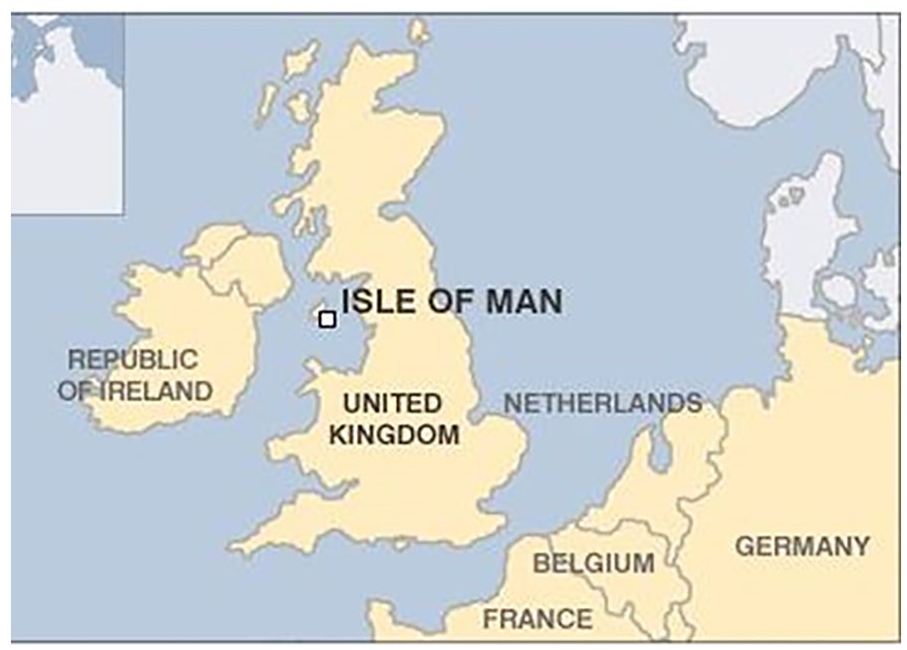
Map of the Isle of Man and the United Kingdom (World Atlas, 2010).
Records indicate that the Isle of Man was inhabited as early as 6500 BC. The first influence of the Gaelic culture from the Scottish and North Irish came around 400 AD (W. H. Gill, 1898). The national Manx language on the island developed out of this Gaelic influence. At the end of the 8th century, it was the Scandinavian Vikings from Iceland who invaded. Then, during the 10th century, the island was invaded by the Danes under the rule of King Orry (W. H. Gill, 1896). It was King Orry that established the Parliament, Tynwald, for the island (W. H. Gill, 1896). Beginning around 1300, the Isle of Man spent many years, struggling to maintain power as England, Scotland, and Ireland fought for control (The History of the Isle of Man, 2010). The island continued to have its own government but came under stronger British rule in 1765 (Callow, 1899). By 1829, the British Government had almost complete control over the island; however, they appointed a Lieutenant Governor in 1866 to control the affairs of the island. From that point, the Isle of Man became mostly self-governing, but the British Government still runs its external and international affairs. Currently, the head of state is Queen Elizabeth II, and she holds the title, Lord of Mann.
Manx Legends and Beliefs
Although the Manx are predominantly Christian, their culture has a strong history in legend and folklore. Many of these legends are drawn from connections to the Irish and other nations who have inhabited the island. Throughout history, the people from the island have believed in magic, fairies, and other mythical creatures, and this has greatly influenced their culture and music.
To this day, the island continues to be impacted by folklore. Many of the landmarks and features of the island are named after different mythical characters. One example of the influence of these legends is a common belief in fairies. Locally, they are known as “the little folk” or “themselves” (Douglas et al., 1927). There is a bridge on the island known as “Fairy Bridge.” It is still said to be bad luck if you fail to say good morning to the fairies after crossing, and it is tradition to leave a coin on the bridge for the fairies (Douglas et al., 1927). Fairies also play a part in the legend Yn Bollan Bane which may have been the influence for the Manx Fiddler’s Tune used by Haydn Wood in Mannin Veen and A Manx Rhapsody. Other creatures and animals play a large part in Manx folklore, from the “Fairy Hound” to the “Glashtin” (water horse; Gilchrist et al., 1926). Together all these legends are used to recall history, tell stories, and teach lessons to children. One of the oldest and most well-known stories is of Mannanan and King Orry. This legend has been a topic for many Manx folksongs, and it is the story on which Haydn Wood’s King Orry Rhapsody is based.
Music on the Isle of Man
Before the 18th century, limited music survived from the Isle of Man. The majority of this early music was recorded by churches and tied to religion. Early instrumental and secular music was taught and learned aurally. However, in the late 19th and early 20th centuries, music historians went to great lengths to preserve these traditions, collecting music and history from local Manxmen and women.
Church Music
By the 1800s, three distinct styles of religious music co-existed on the Isle of Man. In remote country areas, Gaelic psalm singing was still practiced. In these churches, worshipers sang using the Manx language well into the 19th century. At other churches, they changed to bilingual singing at that time. Metrical psalm singing was the second style of sacred music. It existed in the larger parish churches on the island and was used throughout the British Isles. On occasion, musicians would provide instrumental accompaniment, performing from manuscript books (Bazin, 2010). The third style of music practiced in the churches was choral music accompanied by organs. This generated the need for printed collections of hymns for the Manx churches.
In 1799, the first collection of hymns in Manx was printed in the capitol city, Douglas (Douglas, 1928). This same hymnal was republished in 1839 and 1846. However, none of these contained any music of Manx origin (Bazin, 2010). A Selection of Psalm and Hymns Chiefly Designed for the Use of Congregations in the Isle of Man was then published in 1835, but again no original Manx music was used. The first published songbook including Manx music was The Methodist Hymn Book in 1846. It contained some traditional tunes, most notably William H. Gill’s, Manx Fisherman’s Evening Hymn which was later used by Haydn Wood in his work Mannin Veen (Bazin, 2010).
Instrumental Music
Two crosses carved around 1400 BC show the earliest record of instrumental music on the Isle of Man (Bazin, 2010). On these crosses, there is a harpist and a lur player (a lur is essentially a long trumpet bent into a curve, so the bell is raised above the head of the player). Written sources from the 15th to 19th centuries state that the fiddle became the most popular instrument on the Isle of Man. There is a large body of music for the fiddle that survived from the island including broadside ballads as well as dances like jigs and reels. String bands and formal orchestras became popular around 1870. These have strengthened since 1970, particularly because of new education policy which allows the Manx Youth Orchestra, Choir, and Manx Youth Brass Band to flourish.
It is the folk music from the Isle of Man that is the most distinct and nationalistic. Most of this music existed only in Manx, and it is through the efforts of collectors like Dr. John Clague, Arthur W. Moore, William H. Gill, Ann G. Gilchrist, and Mona Douglas that translations into English, as well as arrangements of the tunes, exist to be used by modern musicians.
Mona Melodies in 1820 was the first publication of Manx tunes arranged for voice and piano (Bazin, 2010). In 1896, Arthur W. Moore published a collection of folksongs in Manx Ballads and Music. He divided his collection of folksongs by (1) mythical, semi-historical, and historical ballads; (2) children’s songs; (3) ballads connected with customs and superstitions; (4) love songs; (5) patriotic ballads; (6) nautical ballads; and (7) miscellaneous ballads. Moore described each song and includes the English translation when available. At the end, he included the piano music for the lyrics used throughout the book.
Also, in 1896, William H. Gill published a collection of arrangements of traditional Manx folksongs called Manx National Song Book (W. H. Gill, 1896). This anthology became the most widely used for traditional Manx songs. It was so popular that a second volume edited and compiled by Charles Guard was published in 1979 (W. H. Gill, 1979). Gill described the folk music in his Manx National Song Book in more general terms than Moore. He noted them as being influenced by locality, history, language, or the temperament (physical, intellectual, and moral) of the people. In the forward, he described in great detail these influences and then provided 51 of his arrangements of traditional Manx folksongs. He included Manx and English translations when available. Gill also described typical forms for these folksongs in Manx Music; A Sketch (W. H. Gill, 1898). He notes the prevalence of the Dorian mode in Manx folk music as well as the four-line structural forms used, primarily A B B A or A A B A.
Manx folk music includes songs and ballads as well as music for dancing. The Journal of the Folk Song Society published three collections of Manx folksongs (Gilchrist et al., 1926). These collections were the result of Ann G. Gilchrist’s collecting on the Isle of Man and were divided by topic. Topics ranged from a section entitled Gods, Sprites and Fairies to Songs of Occupation and a section of Dance Tunes. These articles included the music and lyrics for the songs in Manx and English when available as well as commentary as to the legends behind the songs or the Manxmen and women who sang them. In entirety, all three collections totaled almost 300 pages.
Dance music was included in many of these collections, but the majority of the research completed in this area came from Mona Douglas. She worked to collect and publish folk music and folk stories in the early 20th century. In one article, “A Chiel’ amang ‘em,” she described the difficulties she encountered collecting dance music. As a woman, she was not allowed into the pubs where the majority of this was being performed. Consequently, she had to resort to other methods like one-on-one meetings to collect songs. Douglas also mentioned stigmatisms about dance on the island, writing that it was often considered wicked by religious influences. Therefore, reels and jigs were often referred to as “games.” Even with these challenges, Douglas managed to collect Manx dance music as well as the choreography involved in performing these dances, and she published many articles with this information.
This folk music collected has been used by many composers. English composers Edward Elgar, Ralph Vaughan Williams, and Arnold Foster all used different folk tunes from the Isle of Man in their works, although they were not from the island (Bazin, 2010). Haydn Wood is widely considered the most famous Manx composer. Much of his work was influenced by the music from the island, including Mannin Veen, A Manx Overture, King Orry Rhapsody, and A Manx Rhapsody.
Mannin Veen: Folksong Source Material
Mannin Veen is based on four Manx folksongs. These tunes are noted in the score as The Good Old Way, The Manx Fiddler, Sweet Water in the Common, and The Harvest of the Sea. As with much folk song music, there are often multiple versions of these tunes, but included below are the original sources closest to the tunes in Mannin Veen and representing the stories told in these songs (see Appendix C).
Folksong Uses and Keys in the Overall Form.

The Good Old Way is the first folk song used in the piece. In the preface to the score, Haydn Wood writes that it “is an old and typical air written mostly in the Dorian mode. The major portion of this tune was probably added about 1882, following on the introduction on Primitive Methodism into the Isle of Man” (Wood, 1936).
Figure 3 shows the original English version of this folk song from 1896. The vocal phrasing for the text of the verse is notable in that small internal phrases (i.e., bars 1, 2, and 6) happen after the running eighth notes before beat 4. This is contrary to many instrumental performances which put the phrase at each bar line (see Figure 4). Consideration for the original text and this phrasing can bring new light to the opening of this piece.

Source material for Good Old Way William H. Gill’s Manx national song book; volume 1, 1896.

Traditional band phrasing for Good Old Way m. 1–5 (Simmons, 1999).
For the second folksong, The Manx Fiddler, the preface in the score states, The second tune, which introduces the lively section of the work, is a reel, The Manx Fiddler. Chaloner, writing in the middle of the seventeenth century, remarked that the Manx people were “much addicted to the music of the violyne, so that there is scare a family in the Island, more or less can play upon it; but as they are ill composers, so are they bad players. (Wood, 1936)
Unfortunately, the exact melody used by Wood for this folksong could not be found in any of the collections from the Isle of Man. This is not surprising, however, given that it is a reel, and many of these tunes were not documented in the same manner as the ballads or songs. Being a violinist himself, it could have been that Wood learned the tune by rote at some point in his childhood, found it in another version, or freely composed the melody. It is also important to note the overwhelming similarities between the B section of Wood’s folksong The Manx Fiddler and the original melody for The Good Old Way. Whether Wood chose these tunes because they were linked or he freely composed the B section of The Manx Fiddler to connect to The Good Old Way is unknown (Figure 5).

Manx Fiddler B section compared to The Good Old Way.
Sweet Water in the Common is known as Ushtey Millish ‘sy Garee in Manx. In the preface to the score it states, The third tune, Sweet Water in the Common, relates to the old practice of summoning a jury of twenty-four men, comprised of three men from each of the parishes in the district where the dispute took place, to decide questions connected with watercourses, boundaries, etc. (Wood, 1936)
Wood, through including the preface in the score, wanted to draw attention to the story of the folk song. It is political in context but also draws to the importance of water which plays song a strong role in the history and folk traditions of the isle. Wood’s lyrical but forward moving style chosen for the entrance of the folk song depicts the constant movement of water that surrounds the Isle of Man while the narration quality of the solo trumpet seems to be telling the story of this event (see Figure 6 for the full English translation of the original folksong story).

Source material and lyrics for Sweet Water in the Common Deemster Gill et al.’s Manx national songs with English words.
The final folksong used in Mannin Veen is The Harvest of the Sea. This folksong is also called Manx Fishermen’s Evening Hymn and is referred to under both titles at different points in the score. It is also written in the preface that “the fourth and last tune is a fine old hymn, The Harvest of the Sea, sung by the fisherman as a song of thanksgiving after their safe return from the fishing grounds” (Wood, 1936).
The following figures are samples of the original source material for the folksongs used by Haydn Wood in Mannin Veen. The vocal phrasing in these original works is also notable in the last four measures of the hymn. In the first, second, and fourth verses, it is clearly written for a phrase to exist after beat 2 measure 13 (after “lord” verse 1; “help” verse 2; or “join” verse 4). The phrase here is also emphasized by the crescendo, decrescendo that peaks at this spot. This phrasing for the conclusion of the hymn and could be adapted to emphasize the spot in the instrumental version as well compared to the traditional phrasing seen in Figure 8.

Source material for The Harvest of the Sea also known as Manx Fisherman’s Evening Hymn. William H. Gill’s Manx national song book; volume 1, 1896.

Traditional band phrasing for the end of The Harvest of the Sea m. 187–190 (Simmons, 1999).
Overall, through studying the history of the Isle of Man and Haydn Wood, as well as detailed analysis of these works, a better understanding can be gained by conductors to help them prepare and perform this work.
Footnotes
Appendix A
List of State and Festival Lists That Include Mannin Veen.

| • Alabama: AL Band Class AA |
| • Arkansas: Grade 5 |
| • Florida: FBA Band Grade 5 |
| • Georgia: GA Band Grade 6 |
| • Indiana: ISSMA SENIOR BAND GROUP I |
| • Iowa: IA HS MUSIC ASSOC BAND GRADE 5 |
| • Kansas: KS HSAA BAND LEVEL 5 |
| • Louisiana: LA BAND GRADE 5 |
| • Maryland: Concert Band Grade 6 |
| • Michigan: Senior High Band Class A |
| • Minnesota: Category 1 |
| • Minnesota: MN HS LEAGUE BAND CATEGORY 1 |
| • Mississippi: MS Band Class 6A |
| • New York: 20 05 CONCERT BAND LEVEL 5 |
| • North Carolina: Concert Band Grade 6 |
| • Oklahoma: CONCERT BAND CLASS 5A |
| • South Carolina: SC Band Grade 6 |
| • Southern California School Band and Orchestra: Band Music List Grade 4 |
| • Tennessee: Concert Band Grade 6 |
| • Virginia: CONCERT BAND GRADE 6 |
Appendix B
List of Transcribed Works by Haydn Wood for Wind Band.

| Title | Publication |
|---|---|
| An American Rhapsody | Boosey & Hawkes |
| A Brown Bird Singing | Chappell Army Journal |
| Dear Love Selection | Chappell Army Journal |
| Elizabeth of England | Chappell Army Journal |
| Fleurette I Shall Never Forget, | Chappell Army Journal |
| Frescoes- Suite | Boosey & Hawkes |
| I Love Your Eyes of Gray, | Chappell Army Journal |
| King Orry Rhapsody | Boosey & Hawkes |
| Love in Arcady Serenade | Boosey & Hawkes |
| Mannin Veen “Dear Isle of Man”, A Manx Tone Poem | Boosey & Hawkes |
| A Manx Overture | Boosey & Hawkes |
| A Manx Rhapsody | Chappell Army Journal |
| Overture A May-Day | Boosey & Hawkes |
| Overture- Apollo | Boosey & Hawkes |
| Roses of Picardy (cornet solo) | Chappell Army Journal |
| Roses of Picardie Fox-trot | Chappell Army Journal |
| Roses of Picardy Valse | Chappell Army Journal |
| Selection on Popular Songs | Chappell Army Journal |
| Silver Clouds | Chappell Army Journal |
| Snapshots of London | Chappell Army Journal |
| The Seafarer, A Nautical Rhapsody (on Halliard, Capstan and Hauling Shanties) | Boosey & Hawkes |
| Suites London Landmarks | Chappell Army Journal |
| Suite Paris-march | Chappell Army Journal |
| You Gave Me All My Sunshine | Chappell Army Journal |
Appendix C
Form and Structure of Mannin Veen (Robinson, 2009).

| Unit 7: Form and Structure |
| SECTION MEASURE EVENT AND SCORING |
| 1–16 Complete statement of the tune in D Dorian mode by solo clarinet and clarinet 1 with D minor harmonies in low woodwinds and low brass |
| 17–32 Melodic development of “The Good Old Way” theme using chromatic harmonies; tempo quickens gradually through all sixteen measures |
| 33–40 Melodic development continues, builds to climax with tutti forces in a four-octave tessitura at m. 37 |
| 41–46 Variation of “The Good Old Way” theme with chromatic harmony against a C pedal point |
| 47–50 Slurred five-note motive from “The Good Old Way” theme is introduced in clarinet, bassoon, and euphonium as a transition into next section; accelerando begins |
| 51–54 Accelerando ends while transition continues in cut time; articulation changes from legato to staccato “The Manx Fiddler” |
| 55–62 Complete statement of “The Manx Fiddler” in F major by solo clarinet and clarinet 1 |
| 63–70 Staccato treatment of “The Good Old Way” theme by cornet and upper woodwinds in D minor |
| 71–76 Partial restatement of “The Manx Fiddler” in F major by clarinet and flute |
| 77–80 Phrase extension |
| 81–88 Tutti statement of developmental theme based on fragments of “The Good OldWay” and “The Manx Fiddler” in D minor; developmental theme immediately restated in F major |
| 89–96 Solo fragments of initial theme made by flute, clarinet, and cornet in various keys |
| 97–104 Restatement of “The Manx Fiddler” by solo clarinet and clarinet 1 in C major with legato accompaniment; restatement continues in flute and solo cornet with staccato accompaniment |
| 105–106 Phrase extension “Sweet Water in the Common” |
| 107–122 Complete statement of “Sweet Water in the Common” by cornet 1; thin accompaniment in low woodwinds and tuba with legato articulations |
| 123–136 Complete statement of “Sweet Water in the Common” by solo clarinet; accompaniment is staccato |
| 137–140 Phrase extension |
| 141–152 Melodic development of both “The Manx Fiddler” and “Sweet Water in the Common” themes in low woodwinds and euphonium |
| 153–164 Further development of “The Manx Fiddler” and “Sweet Water in the Common” themes |
| 165–170 Incomplete statement of “Sweet Water in the Common” theme in G major with chromatic harmony |
| 171–174 Phrase extension “Manx Fisherman’s Evening Hymn” |
| 175–188 Complete statement of “Manx Fisherman’s Evening Hymn” by clarinets, saxophones, low woodwinds, and low brass in G major |
| 189–196 Phrase extension |
| 197–206 Variation of “Manx Fisherman’s Evening Hymn” in F major by oboe soloist, then joined by clarinets, cornets, and euphoniums |
| 207–212 Re-transition back to “The Manx Fiddler” theme “The Manx Fiddler” |
| 213–220 Complete “The Manx Fiddler” theme in F major in solo clarinet and clarinet 1 |
| 221–228 Staccato treatment of “The Good Old Way” theme by cornet and upper woodwinds in D minor |
| 229–236 Partial restatement of “The Manx Fiddler” in F major by clarinet and flute |
| 237–238 Phrase extension |
| 239–246 Tutti statement of developmental theme based on fragments of “The Good Old Way” and “The Manx Fiddler” in D minor; developmental theme immediately restated in G major |
| 247–254 Solo fragments of initial theme made by flute, cornet, clarinet, and oboe in various keys |
| 255–264 Restatement of “The Manx Fiddler” by solo clarinet and clarinet 1 in B-flat major with legato accompaniment; restatement continues in flute and solo cornet with staccato accompaniment “Sweet Water in the Common” |
| 265–278 Complete “Sweet Water in the Common” theme returns in B-flat major by flutes, oboes, and solo cornet; clarinet sixteenth note pattern |
| 279–282 Phrase extension |
| 283–286 Fragments of “The Good Old Way” with tutti sustained harmonies and C pedal point in bass voices |
| 287–294 Melodic development of “The Good Old Way” theme “Manx Fisherman’s Evening Hymn” |
| 295–308 Complete “Manx Fisherman’s Evening Hymn” theme stated in tutti voices (with organ); “The Manx Fiddler” countermelody continues in clarinet |
| 309–312 Phrase extension |
| 313–324 Variation of “Manx Fisherman’s Evening Hymn” theme stated in tutti voices (with organ) with prominent countermelodic line in bass clarinet, horn 1–3, trombone 1, and euphonium |
| 325–334 Coda based on fragments of “The Manx Fiddler” theme; builds to overall climax at m. 331 |
Declaration of Conflicting Interests
The author(s) declared no potential conflicts of interest with respect to the research, authorship, and/or publication of this article.
Funding
The author(s) received no financial support for the research, authorship, and/or publication of this article.