




Abstract
The regional public galleries in the Czech Republic belong to the most important and the biggest institutions of their kind. The article deals with the assessment of the technical and allocation efficiency of 19 regional public galleries for the period between 2011 and 2015 from the perspective of the static as well as the dynamic efficiency. For the estimation of the efficiency according to the specific inputs and outputs, the Data Envelopment Analysis model and the Malmquist Index were used. In 2015, four galleries were fully technically efficient, and the average efficiency of the set being assessed was 70%. In 2015, in comparison with 2011, 11 public galleries improved their productivity. In 2015, seven galleries reached the full allocation efficiency, and the average efficiency was 90%. In 2015, in comparison with 2011, 12 public galleries improved their efficiency.
Introduction
Public services in the field of culture fulfill a specific and often a multilevel social mission at the boundary of the public and private interests and goals. The institutions providing the public services in the culture—besides the continuous services for the direct external users, especially the visitors—perform other activities that fulfill the society-wide goals within the field of science and research, education, public property administration, and the preservation of the cultural heritage of the nation. The mission of the public galleries is thus broader and less commercial in comparison with the private galleries.
The Cultural Policy of the Czech Republic for the period between 2015 and 2020 with the prospect for the year 2025 accentuates the cultural services in their diversity and declares higher economic and social priorities for this field (Ministry of Culture Czech Republic, 2018). However, this does not change the fact that public galleries (museums of the fine arts), same as other types of museums or cultural facilities, should be fulfilling their missions not only in an economic and purposeful way but in an efficient way as well. This is supported by the fact that the abovementioned Cultural Policy of the Czech Republic plans to gradually increase the public expenditures in this sector.
Within the conditions of the public services, the expression of efficiency is limited by the number of specific factors, including the absence of competition, of the full service price, motivation for higher performance, and the responsibility of the management for the outcomes. These factors deform and complicate the assessment of efficiency (Dooren et al., 2010; Lane, 2000; Leibenstein, 1966; Niskanen, 1971). Nevertheless, the theories offer a range of approaches enabling the measurement and assessment of the efficiency of the inputs and outputs of the production processes. In the majority of cases, these approaches are based on the ex post assessment that allows the estimation of the course and effects of specific processes and programs in the public sector. These approaches include the multiple-criteria economic models, such as the Data Envelopment Analysis (DEA).
The issues of the technical and allocative efficiency with the application of convex and nonconvex production models of the multiple-criteria decision-making within the conditions of museums, including galleries, have been accentuated by the number of scientific works. Mairesse and Eecaut (2002) used the nonconvex Free Disposable Hull model to assess 64 local public museums in Belgium. Basso and Funari (2004) used a convex production DEA model to assess 15 Italian public museums. Del Barrio and Herrero (2014) used the Malmquist Index (MI) to assess the productivity of Spanish regional museums. Plaček, Ochrana, et al. (2017) used the DEA model and the regression analysis to assess the relationship between the income self-sufficiency of municipalities and the efficiency of the museums established by them within the conditions of the Czech Republic. Blanco and Álvarez (2018) focused on the assessment of the technical and allocative efficiency of a particular Spanish nonprofit organization operating in the field of culture for the period between 1988 and 2012, using the Stochastic Frontier Analysis production function.
Numerous authors studying the issues of the strategic and operation performance including the efficiency of museums generally point out their high degree of heterogeneity. Therefore, they recommend including comparable institutions in the assessment of performance, in terms of the subject matter of their mission and production as well as the size and regional importance (Gstraunthaler & Piber 2012; Plaček, Půček, & Šilhánková, 2017; Zorloni, 2010).
Within this article, only the public galleries established by the self-governing regions (further referred to also as the regional public galleries) are being assessed. The total number of public galleries established by the regions and by the capital city—Prague—in the Czech Republic was 23 (to the date of December 31, 2015). Thus, the research cohort represents 82% of the total number of regional public galleries in the Czech Republic.
The article reacts to the rigidness of the management of public institutions in culture and their low level of willingness to search for new funds and opportunities being signaled by the demand. The abovementioned approaches of the management are then necessarily reflected in the efficiency achieved, the technical as well as the allocative one. Lukáč and Mihálik (2018) study the efficiency of Slovak museums and point out the fact that cultural organizations are under the “umbrella of the public”; therefore, the motivation of the managers for a change in the mind-set is low. This statement is corroborated by the low efficiency of the Slovak museums’ marketing.
The structure of the article is as follows. The section “The Theoretical Basis of the Efficiency in the Public Sector” describes the theoretical background of the concept of the economic efficiency in the public sector. The section “Method and Data” contains the aims and hypotheses, the methodology of the evaluation of the technical and allocative efficiency, the characteristics of the DEA model and of the MI, statistical analysis of the data being studied—the inputs and the outputs, and the analysis of the financial self-sufficiency and dependency of the researched public galleries. The section “Results” presents the acquired results of the static and dynamic technical and allocative efficiency of 19 regional public galleries of the Czech Republic, including the recommendations for the improvement of the efficiency and determination of direct and indirect gaps of the efficiency within the conditions of public galleries. The section “Conclusion and Discussion” is dedicated to the conclusion and discussion, in relation to the results and knowledge of other authors. The article contains an appendix with the results of calculations of the static and dynamic efficiency of 19 public galleries of the Czech Republic.
The Theoretical Basis of the Efficiency in the Public Sector
The organizations providing the cultural services that are being continually, fully, or partially funded from the public budgets and managed by the public administration belong to the public sector. In the public sector, same as in the private (commercial) sector, the efficiency is a key performance determinant of the economic activities using and transforming the rare resources for the production of useful goods. Nevertheless, the measurement and assessment of the efficiency in the public sector is not elastic because it is being affected by many economic and noneconomic factors.
The economic efficiency has two components—the technical and allocative efficiency. The economic efficiency is primarily an inherent part of the economic performance. In the public sector, it is being linked with the 3E model (economy, efficiency, effectiveness) or with the 4E model (economy, efficiency, effectiveness, equity) and with the concept of New Public Management, later also with the New Public Service (Bovaird & Löffler, 2009; Denhardt & Denhardt, 2000; Dooren et al., 2010; Lane, 2000; Lynn, 2007).
The economic efficiency of production units or of a particular part of the public sector (e.g., the culture) or the public service can be analogically deduced from the production process where, based on the process principle, the inputs incentivized by the public assignment are being transformed within certain conditions into the outputs of an organization or a program (Vrabková & Friedrich, 2017). Nevertheless, the final parameter of the performance of the public production is not the output but the outcome, which is being confronted with the original intention (public assignment, initial social need, and the impact on the environment). An alternative to the performance is represented by the realized public value (Dooren et al., 2010).
In the process-oriented evaluation models, the inputs and outputs are expressed in the physical or monetary units in the absolute terms or in the relative expression (per one unit of the performance, for example, per person, hour, km). The inputs are the spent personnel, material, operation, capital, and financial resources of the given production unit for the production of the outputs. The outputs represent the amount of production that was created by the production unit via the inputs being considered. The outputs are not only the number of users, the scope and number of the programs implemented, operations and services but also the monetary income of the users, receivers, and principals of the public services. The outputs are being achieved by the transformation of the inputs within the logically bound activities that are being performed in the given organization in a continuous or an exclusive way.
The efficiency, or the economic efficiency, puts the value of the outputs into relation with the value of the inputs, and it has the allocation and technical form. The effectiveness monitors the effects of the outcomes and their economic value which considers their economic and efficient achievement.
The theory of the technical and allocative efficiency is in general based on the microeconomic postulates, especially on the production possibilities of the economy, marginal degree of substitution in the consumption and production (Musgrave, 1959; Musgrave & Musgraveová, 1994; Samuelson, 1954), and Pareto’s concept of efficiency. The basic measurement and assessment of the efficiency was first introduced in the works created by the authors of the first generation of the technical efficiency theory (Debreu, 1951; Farrell, 1957; Koopmans, 1951). Then, they were developed by the knowledge of other authors (e.g., Charnes et al., 1978; Kumbhakat & Lovell, 2000). The input-output models represent a unique evaluation tool for the public sector, able to express the degree of the relative efficiency of the production units and public programs, and to evaluate the success of the allocation policy. The results of the assessment of the efficiency of public services must be confronted with the existence of internal and external factors that affect them. The efficiency of public services is often in a conflict with the political interests and with the motivation of the management of public institutions. Within this context, Leibenstein (1966) introduced the term X-Efficiency. The X-Efficiency is related to the impact and willingness of the organization’s management to reduce the production costs. The level of the production costs of an organization is influenced not only by the technology and the competition pressure but also by the willingness and motivation of the organization itself to reduce the costs and to produce the maximal possible output using the minimal amount of resources.
The decomposition of the efficiency distinguishes the input-oriented efficiency and the output-oriented efficiency. The input-oriented efficiency is based on the assumptions of minimization, that is, while maintaining the value of outputs, the inputs are being reduced for the improvement of the efficiency. On the contrary, the output-oriented efficiency is based on the assumption of maximization when the value of outputs is being increased while maintaining the value of inputs.
The production function in the form of an abstract input–output model of production as a process of the technical transformation of inputs (production factors) into outputs (goods—products and services) captures via the mathematical expression only the most substantial attributes of the production process. The inputs x = (x1, . . ., xN)

The attributes of such a model of the production process are so general that they capture the fundamental attributes of the polymorphous reality. The real organizations (production units) can significantly vary from the modeled production unit. Nevertheless, a theoretical model can be used as a basis, but it must be analyzed which assumptions of the theory are violated, and what consequences this have (Jablonský & Dlouhý, 2015).
Method and Data
The aim of this article is to assess the static and dynamic technical and allocative efficiency of 19 regional public galleries for the period between 2011 and 2015 and to detect the gaps in efficiency.
The technical efficiency is estimated via the selected physical outputs and inputs according to Model I. The allocation efficiency is estimated via the monetary inputs and outputs according to Model II. The calculation is performed according to the DEA model and the MI.
Two hypotheses were formed to support the aim set:
The above-listed H1 is based on the concept of the X-(in)efficiency, which is typical for the conventional public organizations funded mostly from the public budgets, where the income from the public budgets is dominant (Frantz, 2013; Lane, 2000). The degree of the income self-sufficiency of the public galleries is very low. Therefore, it can be assumed that the public galleries tend to a similar behavior, and they spend the most of their incomes on the payroll and operation expenditures.
The above-listed H2 is based on the assumption that the models based on the technical inputs and outputs more accurately determine and distinguish the efficiency achieved among the individual public galleries than the models based only on the monetary inputs and outputs that are not supported by the actual results.
For the needs of the assessment, the institutions homogeneous in terms of production were selected—19 regional public galleries (PG1–PG19, the names can be found in the appendix), according to the unifying factors:
Subject matter—fine arts,
Form of funding—multiple sources, with the dominant participation of the public budgets,
Form of management and organization—the establisher represented by a self-governing region and the capital city—Prague, legal form of a contributory organization.
The technical efficiency (Model I) and the allocative efficiency (Model II) of 19 public galleries is being assessed individually for the years 2011 and 2015 according to the Data Envelopment Analysis model with constant returns to scale (DEA CRS). The technical efficiency (Model I) and the allocative efficiency (Model II) are being assessed in 2015 against 2011 according to the Malmquist Index with constant returns to scale (MI CRS).
Model I is input-oriented, and it includes two inputs (x1 the number of employees, x2 the number of collection items) and two outputs (y1 the number of visitors, y2 the number of exhibitions). The input-oriented Model I is based on minimization, and it works with the assumption that the inefficient entities should lower their inputs x1 and x2 with regard to the amount of their outputs y1 and y2. Model II is output-oriented, and it includes two inputs (x1 the expenditures on wages, x2 the expenditures on the operation) and three outputs (y1 the income from the public resources, y2 own income, y3 other income). The output-oriented Model II is based on maximization, and it works with the assumption that the inefficient entities should increase their outputs (y1, y2, and y3) with regard to the amount of their inputs (x1, x2). The logical procedure of the assessment is depicted in the scheme in Figure 1.

The conceptual scheme of the efficiency assessment of the public galleries.
Basic DEA Models and the MI
DEA models’ solution brings empirical production function. DEA models are based on premise that the production possibility set exists for the solved task, and this set is formed with all possible combinations of inputs and outputs. DEA models compare decision-making unit (DMU) with the best ones for the defined set of DMUs and derive thus the relative efficiency of these units. DEA method enables to evaluate units set through the input-oriented and output-oriented models. The output-oriented model CCR (according to Charnes, Cooper, and Rhodes) with CRS is to evaluate the efficiency of the supply of the public galleries. Input-oriented models are based on minimize assumption—volume of inputs is decreasing when the given volume of outputs is respected. Output-oriented models are based on maximization assumption—volume of outputs is increased when the given scope of inputs is respected.
Fundamental DEA models do not allow to evaluate efficiency in time. They estimate static technical efficiency. However, this shortage is solved by the MI and its decomposition. To evaluate the efficiency of DMUs in time, the MI was adjusted by Färe, Grosskopf, Lindgren, and Ross who based their approach on DEA models, with the modification of the radial DEA models. For the dynamic evaluation of the technical efficiency (considering its changes in time), MI enables to recomposite it into two components: (a) changes of the DMU’s relative efficiency in relation to all other units, and (b) production frontier shifts (FSs) due to the changes in technology (Cooper et al., 2007; Zhu & Cook, 2013).
The input-oriented CCR model assumes CRS according to the linear Charnes-Cooper transformation, and the calculation is according to the following formula:


The evaluated DMU (uq) lies at the production FS and is fully efficient when z = 1, and DMU is inefficient, when it lies under the production FS and z < 1 (Jablonský & Dlouhý, 2004, 2015).
The output-oriented CCR model assumes CRS according to the linear Charnes-Cooper transformation, and the calculation is according to the following formula:



The evaluated DMU (uq) lies at the production FS and is fully efficient when g = 1, and DMU is inefficient, when it lies under the production FS and g > 1 (Jablonský & Dlouhý, 2015).
The MI is based on the assumption that the subject of evaluation is represented by the DMUs during a period of time t = 1, 2, . . ., T. The calculation of MI is based on DEA models according to the procedure of Fare et al. (1994).
The input-oriented MI (Mq), which measures the change of the technical efficiency of a DMU q between periods t and t + 1, is according to the following formula:

where Eq is the change of relative efficiency of the DMU (q) between evaluated periods, and Pq is the change of the production possibility frontier caused by the development of technology between evaluated periods.
The decomposition of the MI includes two components (the efficiency change [EC] and the FS), where MI is multiple of EC (Eq) and FS (Pq).
The results of the input-oriented MI, EC, and FS are being interpreted this way:
Improves: MI, Eq, Pq < 1; remains unchanged: MI, Eq, Pq = 1, declines: MI, Eq, Pq > 1.
The results of the output-oriented MI, EC, and FS are being interpreted this way:
Improves: MI, Eq, Pq > 1; remains unchanged: MI, Eq, Pq = 1; declines: MI, Eq, Pq < 1 (Zhu & Cook, 2013).
Data: Inputs and Outputs
For the needs of the assessment of the technical and allocative efficiency of the regional public galleries, two sets of inputs and outputs were selected. Tables 1 and 2 list the selected inputs with their subject and statistical characteristics. There are also the data sources according to Model I (physical inputs and outputs, numbers) and according to Model II (monetary inputs and outputs, in thousands of CZK).
The Subject and Statistical Characteristics of the Inputs and Outputs of Model I.

Source. Our computation on data—Annual reports of the regional galleries for the years 2011 to 2015 (Czech Association Museums and Galleries, 2015).
Subject and Statistical Characteristics of the Inputs and Outputs of Model II.

Source. Our computation on data provided by the Ministry of Finance of the Czech Republic (MONITOR).
From the perspective of the recalculated number of employees (x1), 23 persons are employed in the studied galleries on average. The minimum was nine employees (PG5) and the maximum was 85 employees in PG19. During the studied period from 2011 to 2015, the number of employees of PGs was not changing considerably.
The number of collection items (x2) significantly varies among the individual PGs. Within the studied sample, the average value was 8,782 pieces of the registered items. PG14 has the lowest number of collection items (1,310), and PG1 has the highest number (22,348). The comparison of the inputs and outputs showed that the galleries with a higher number of collection items usually report higher attendance as well. This is the case of the galleries PG1, PG17, and PG19. A negative exception is PG4 which has the third highest number of the collection items, but the number of visitors is only average. A positive extreme is PG18 where the number of collection items is below average, but the number of visitors is above average.
The number of visitors (y1) of the regional public galleries represents the most important performance indicator. The average annual attendance of 19 regional public galleries for the period from 2011 to 2015 is 30,500 visitors. The highest attendance is reported by four PGs (PG1, PG17, PG18, and PG19) that were in total visited by 61% of visitors of all 19 PGs. The significantly highest number of visitors in all studied years is reported by PG19 (192,000 visitors per year on average). The second highest number of visitors is reported by PG1 (95,000 visitors per year on average). The third highest number of visitors is reported by PG17 (46,000 visitors per year on average). An extremely low attendance (less than 5,000 visitors per year) is reported by three galleries—PG6, PG9, and PG3.
The number of exhibitions organized per year (y2) shows the variety and the size of the yearly offering of the regional public galleries. On average, the galleries offered 18 specific exhibitions. The lowest number of exhibitions was offered by PG18, which was caused by the ongoing reconstruction of the exhibition building. The highest number of exhibitions was offered for the visitors by PG1—31 exhibitions per year on average.
The expenditures on wages (x1) represent the most important expenditure item within the total expenditures of the regional public galleries, on average they represent 52% of the total expenditures of the public galleries being assessed. Lower values (below 40%) are reached by four galleries—PG18, PG10, PG15, and PG19. The highest share of the payroll expenditures in the total expenditures is reported by PG2 (68%) and PG3, PG5, PG9, and PG12 (above 60%). These galleries have a common feature in being rather smaller galleries within the set being studied.
The second most important expenditure item of the regional public galleries is represented by the expenditures on the operation (x2) that include the expenditures on the consumption of material and services. On average, these represent a 13% share in the total expenditures. The minimal value of 7% was reported by PG2, PG5, and PG9. The share of the operating expenditures in the total expenditures above 20% was reported by two galleries—PG8 and PG10.
From the perspective of the income of the regional public galleries, the most important item is the income from the public resources (y1), especially from the region’s budget. The existential importance of the income from the public budgets is supported by the percentage share of the public resources in the total income (i.e., the degree of dependence) of the organizations being assessed, which is above the 85% boundary in all of the organizations being assessed, with an exception for PG18 (Kutná Hora). The importance of the public income is also corroborated by the revealed values of the own and other income. These values are low, with an exception for PG18, and they are expressed by an aggregate indicator of the income self-sufficiency. The degree of the income self-sufficiency is the result of dividing the income from the public budgets by the total noninvestment expenditures. Using this indicator, also the share of the own income (the sale of own production and services, usually in the form of income from the entrance fee) and other income (gifts, interests on deposits, renting of the space, other) can be studied. The opposite to the degree of self-sufficiency is the degree of the expenditure dependence on the funds from the public resources (not only from the funds of the establisher). The calculation of the degree of expenditure dependence is the result of dividing the noninvestment income from the public resources by the total noninvestment income.
The revealed state of the degree of self-sufficiency and the degree of dependence of the regional public galleries being assessed in percentage for the period from 2011 to 2015 is depicted via a chart in Figure 2. The lowest value of the degree of self-sufficiency and also the highest degree of dependence was reported by the galleries PG6, PG10, and PG12. These are very dependent on the provided public funds. In the listed galleries, the income from the entrance fee is below 3% of the total amount of income.
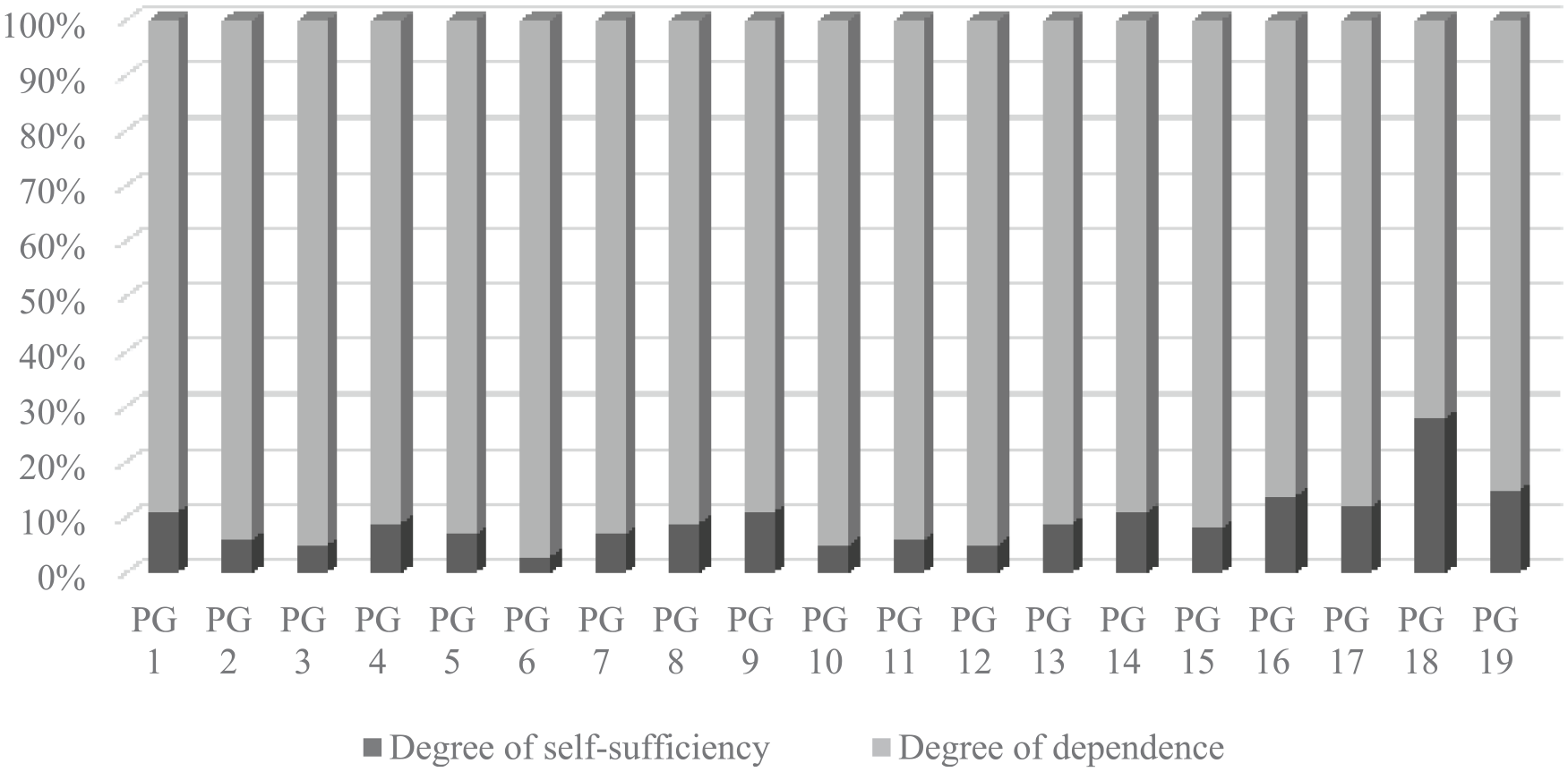
The average degree of financial self-sufficiency and dependence of public galleries, for the period from 2011 to 2015.
The chart (Figure 2) shows that within the degree of self-sufficiency in the sample of galleries being studied between 2011 and 2015, the gallery PG18 differs positively with the degree of self-sufficiency at 28%. The self-sufficiency above 10% was then reported by PG19, PG16, PG17, PG14, PG9, and PG1. These galleries had higher attendance, thus also a higher share of own income. The highest income from the entrance fee (87% of own income) was reported by PG19.
The degree of self-sufficiency of organizations, besides the number of visitors and the prices of the entrance fee (revenues from the entrance fee), depends on the range of other services offered (e.g., the offering of restoration for private entities, renting of the space, other). The self-sufficiency is being affected not only by the nature of the short-term exhibitions, permanent expositions, preference of the visitors and the institution’s orientation, location within the Czech Republic and the region but also by the organization management’s ability to gain additional income in the form of renting of the free space (e.g., for a café, restaurant) or from the gifts from the patrons of art, or from getting the funds from the European projects.
The degree of dependence then shows that without the public funds (subsidies), the organizations would not be able to offer the public services in the range a number of citizens of the Czech Republic are used to, or, they would have to increase the entrance fee, which would be reflected in the low attendance of some galleries.
Results
Static Efficiency of Public Galleries
The static technical efficiency of 19 PGs is estimated for 2 years—2011 and 2015, for Model I (technical efficiency) and for Model II (allocative efficiency). Table 3 summarizes the results for both models and both years according to the selected five-level scale of the reached result of the degree of efficiency or inefficiency (a gallery is efficient when e = 1, i.e., 100%) expressed in percentage.
The Scale of the Static Efficiency in Percentage.

Source. Our computation.
In Model I, in 2011, four PGs were efficient, the average efficiency was 0.642 (64%), and six PGs were very strongly inefficient. In Model I, in 2015, again four PGs were efficient, the average efficiency was 0.704 (70%), and two PGs were very strongly inefficient, specifically PG11 (0.235, 20%) and PG8 (0.075, 1%).
In Model II, in 2011, five PGs were efficient, the average efficiency was 1.231 (77%), one gallery—PG8—was very strongly inefficient (1.631, 37%). In Model II, in 2015, seven PGs were efficient; the average efficiency was 1.096 (90%). No PG reached the efficiency lower than 60%.
The comparison of the results of individual 19 PGs in both models and both years is shown in charts in Figure 3 (2011) and Figure 4 (2015). Because Model I estimates the input-oriented efficiency, the values of the inefficient PGs are lower than one (e < 1). On the contrary, in Model II, the inefficient PGs have the values higher than one (e > 1). For both models, the efficient PGs have the values equal to one (e = 1).
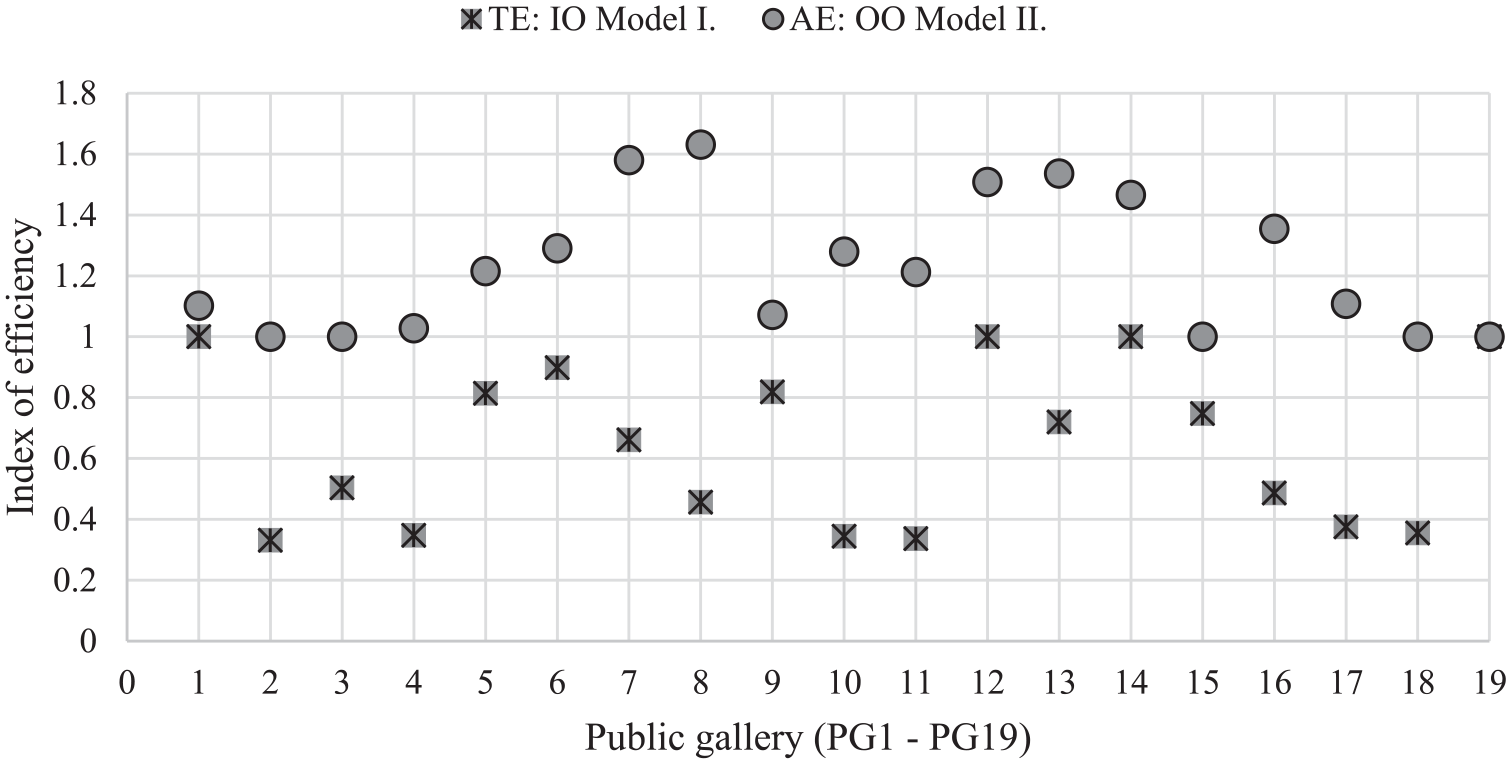
Comparison of the technical and allocation efficiency of the public galleries for 2011.

Comparison of the technical and allocation efficiency of the public galleries for 2015.
Based on the results gained in Model I, the benchmarking groups of PGs that are connected via a particular efficient PG in the given year and model can be predicted.
In 2011, in Model I, four PGs were efficient (PG1, PG12, PG14, and PG19). These PGs are the so-called leaders for the potential performance benchmarking among galleries. The most significant leaders are PG1 and PG12:
PG1 (Gallery of Fine Arts in Ostrava) is a benchmarking comparing example for eight other PGs (PG4, PG5, PG7, PG8, PG10, PG11, PG13, and PG1),
PG12 (Gallery of Modern Art in Roudnice nad Labem) is a benchmarking leader for six other PGs (PG2, PG3, PG6, PG9, PG15, and PG18).
The Gallery of Fine Arts in Cheb—PG14—is comparable only for PG16, and the gallery PG19 (Prague City Gallery) is efficient, but it is not a comparable unit for other galleries in the set being studied (it has twice as many visitors as other galleries in the set, and it is located in the cultural center of the Czech Republic—the capital city Prague).
In 2015 in Model I, there were four efficient PGs as well. In the case of PG1, PG6, and PG15, the efficiency is affected by the number of visitors and also by the number of exhibitions. In the case of PG14, the efficiency was affected by the increase of the collection items that the gallery started to gather after moving into a new, bigger building.
The most significant benchmarking leader for 2015 is as follows:
PG1 (Gallery of Fine Arts in Ostrava), for galleries PG2, PG4, PG5, PG7, PG8, PG10, PG11, PG12, PG13, PG17, and PG19.
Other efficient PGs represent a benchmarking example only for one or two other galleries.
In 2011 in Model II, five PGs were fully efficient (PG2, PG3, PG15, PG18, and PG19), and in 2015, seven PGs were fully efficient (PG2, PG5, PG8, PG10, PG17, PG18, and PG19). The division of results of efficiency according to the scale (Table 3) indicates that in Model II, the results in both years are better than in Model I, especially than in 2015.
Dynamic Efficiency of Public Galleries
The results of the computation of the dynamic efficiency according to the MI and its decomposition into the EC and the FS are interpreted for each model separately (Figures 5 and 6). The aggregate results are listed in Table 4. Here is also the number of PGs that in 2015 in comparison with 2011 improved (↑), maintained (→), or worsened (↓) their situation, plus the values of average

Decomposition of the Malmquist Index for Model I.

Decomposition of the Malmquist Index for Model II.
Aggregate Results of the Dynamic Efficiency for the Period From 2011 to 2015.

Source. Own computation.
Note. PGs = public galleries; MI = Malmquist Index; EC = efficiency change; FS = frontier shift.
According to Model I that estimates the technical efficiency based on the input-oriented MI in 2015 in comparison with 2011, positive and negative trends were detected. In the case of the EC, the stagnation was detected by two PGs. In the first case, the stagnation of EC was accompanied by the improvement of FS, which led to the overall improvement of the productivity of MI of the given PG1. In the second case, the stagnation of EC was accompanied by a decrease of the FS, which led to the worsening of the productivity of the given PG14. The improvement of productivity was detected by 11 PGs (58% of PGs) and the decrease of productivity was detected by eight PGs (42%). In general, the galleries rather slightly worsened their situation. Nevertheless, the overall negative trend of MI and EC was affected by really poor results of PG8 (see Figure 5). The PG8 had a limited operation during the studied years due to the reconstruction of the gallery’s building, and it reported a very low attendance. The value of the standard deviation for the whole set was also affected by the low values of PG8. Nevertheless, the set of public galleries without PG8 shows comparable and balanced, rather positive trends in all the parameters of the dynamic efficiency (MI, EC, and FS). Here, the improvement of productivity is generally more affected by the improvement of efficiency than by the shift of the production possibility frontier.
According to Model II that estimates the allocative efficiency based on the output-oriented MI in 2015 in comparison with 2011, positive and negative trends were detected. In the case of EC, the stagnation was detected by three public galleries. In the first case, PG2’s stagnation of EC was accompanied by the improvement of FS, which led to the overall improvement of productivity of the MI. In the second and third case, PG18’s and PG19’s stagnation of EC was accompanied by the decrease of FS, which led to the overall worsening of the productivity in the form of the MI.
Positive changes—improvement of productivity—were detected by 12 PGs (63% of PGs), and negative changes—decrease of productivity—were detected by seven PGs (37%). In general, the galleries rather worsened their situation. The set of PGs reports comparable and rather positive trends in all parameters of the dynamic efficiency (MI, EC, and FS), where the improvement of productivity is generally more influenced by the improvement of efficiency than by the shift of the production possibility frontier (see Figure 6). The most significant improvement of the MI was reported by the galleries PG8 (due to the reconstruction of the building there was a decrease of the payroll costs), PG3 (the income from public resources rose, the subsidy rose), and PG5 (the income from the public resources rose, the operating costs decreased).
Summarization of Results and Recommendations
The assessment of the static and dynamic efficiency of public galleries (19 PGs) includes two models encompassing specific inputs and outputs.
The first model (Model I) estimates the technical efficiency according to the input-oriented CRS model for the year 2011 and 2015. The static Model I shows which PG is able to generate the most efficient output in the form of the number of visitors and the number of exhibitions organized per given year via its available inputs—the number of employees and the number of collection items. The inefficient galleries should decrease the number of employees and the number of collection items because they do not achieve efficient outputs in the form of the number of visitors and the number of exhibitions. The results of the static efficiency for 2015 show that PG8 and PG11 are very strongly inefficient in comparison with other galleries. While in the case of PG8 the inefficiency can be explained by the reconstruction of the building and by the decrease of the number of visitors due to this to one fifth of the original state, in the case of PG11, the inefficiency is caused by a high number of employees and a low number of visitors. The galleries PG16, PG17, and PG18 should also deal with the decrease of the number of employees and the number of collection items or with the increase of outputs. The dynamic Model I estimates the change in time, thus the productivity that consists of the change of the technical efficiency and the change of the production frontier. The results show that 58% of the regional public galleries improved their productivity in 2015 when compared with 2011. However, this does not mean that these galleries were fully efficient in 2015.
The second model (Model II) estimates the allocative efficiency according to the output-oriented CRS model for 2011 and 2015. The static Model II tests which regional public gallery spent its income (in the form of outputs) in the most efficient way on its inputs (wages and operating expenditures). The inefficient galleries should increase their outputs—three types of income (income from the public budgets, from own services, and other income) if they want to maintain the current level of their inputs. The five least efficient galleries in 2015 (PG4, PG11, PG1, PG6, and PG14) in comparison with other galleries spent all or the majority of the income on the payroll expenditures and on their operation in the form of the payments for energy and material. Because the highest portion of the galleries’ income comes from the public budgets, which is supported by the low financial self-sufficiency or the high degree of financial dependence, it can be stated that the inefficient galleries spent the public funds inefficiently in comparison with other galleries in the set in the same year. The dynamic Model II, as it was in the case of the dynamic Model I, tests the change of productivity and the change of efficiency and of the production frontier within it. The results show that 63% of the public galleries improved their productivity in 2015 when compared with 2011. However, this does not mean that these galleries were fully efficient in 2015.
According to the results, the most jeopardized gallery seems to be PG11 that had the worst results in both models (Models I and II).
In relation to the hypotheses set, it can be stated as follows:
More comparable (more balanced) results of the static efficiency are achieved by the regional public galleries in the allocation model (Model II) than in the technical model (Model I) in both studied years 2011 and 2015. H1 was corroborated:
Dynamic changes of efficiency—the improvement and decrease—are being achieved by the regional public galleries more, but not significantly more, in Model I than in Model II. H2 was not corroborated.
Based on the performed analysis of the inputs, outputs, and on the assessment of the static and dynamic efficiency, the direct gaps in the efficiency of the public galleries can be detected. The direct gaps in the efficiency are limited by the selected inputs and outputs and by the nature of the set of regional public galleries being studied. The technical gaps are related to the performance parameters (Model I) and the allocative gaps are related to the financial parameters (Model II). Based on the data, reports disclosed (see the annual reports of the public galleries) and the published results of empirical analyses (e.g., Basso & Funari, 2004; Brida et al., 2016; Camarero et al., 2011; Cuffe, 2018; Prinz et al., 2015; Tubadji et al., 2015), the indirect factors influencing the efficiency of the regional public galleries can be identified. These factors were not included in the models being assessed as the inputs and outputs, but they explain their size and trends. Thus, they are also limited by the selected inputs and outputs. In Table 5, the direct and indirect gaps of a technical and allocative nature are determined, influencing the efficiency of the public galleries.
The Gaps in the Efficiency of the Public Galleries.

Conclusion and Discussion
The issue of the efficiency of cultural institutions—public galleries—can be dealt with from two perspectives—the technical and allocation, as it is supported by this article. Although both perspectives work with the same set of the public galleries in the same period of time, they bring different results. It is caused by the nature of the selected inputs and outputs that limit the expression of the efficiency this way. Nevertheless, they differentiate the gaps in the efficiency of a technical and allocation (financial) nature.
The technical efficiency estimates the actual performance of the public galleries, especially from the perspective of visitors—direct users of the services of the public galleries, and the offering in the form of the expositions organized. Within the set of 19 public galleries being assessed, only four galleries were fully efficient in 2015, and the average efficiency of the set being assessed was 70%. In 2015 when compared with 2011, 11 public galleries improved their productivity. The results of the technical efficiency also reveal the leaders (the fully efficient galleries) in the given set that are the suitable benchmarking examples for other, inefficient public galleries. For comparison, Basso and Funari (2004) were evaluating the technical efficiency of 15 museums in Italy. These authors focused their attention on the efficiency of the museum’s area in square meters and of the employees of the museum in relation to the achieved revenues from the entrance fee, number of short-term exhibitions and other museum’s activities. The result of their evaluations was that the total efficiency of museums was significantly influenced by the size of the exhibition area of the museum in square meters. The museums with smaller areas were more efficient. The size of the exhibition area of the museum cannot be altered by the management in a short-term, or sometimes it cannot be altered at all. Therefore, the inclusion of this parameter in the input-oriented models for a strongly differentiated set from the perspective of the museum’s area size is misleading.
The results of the technical efficiency indirectly corroborate, similarly to the knowledge of the authors (Brida et al., 2016; Ochrana et al., 2018; Plaček, Půček, & Šilhánková, 2017), that the higher attendance of the individual galleries can be influenced by the active approach of the gallery’s management that flexibly reacts to various preferences of visitors and can better utilize the collection items available, not only via permanent expositions but also mainly via the short-term exhibitions organized. A higher number of exhibitions with various orientations has the potential to attract a higher number of visitors (this is related to their individual preferences and interests in a particular field of art, for example, the Baroque period, modern art, creative photography, and other), and they are more likely to visit the gallery repeatedly. A key factor of the technical efficiency of public galleries is the number of visitors. The question is “Who is a visitor of a public gallery?” but also “When is a public gallery visited the most?” Is it during vacations, holidays, and festivals or during a specific season of the year, or in a particular weather? Cuffe (2018) researched the relationship between the attendance of museums and rainy weather. Based on empirical analysis, he proved that the number of visitors of museums was 3 times higher during the rainy days in comparison with ordinary days. It is being revealed that not just the local residents but also the tourists prefer visiting a museum during the days of bad weather.
The allocative efficiency estimates the income efficiency of galleries, thus the efficiency of the utilization of the public funds. Within the set of 19 public galleries being assessed, seven galleries were fully efficient in 2015 and the average efficiency was 90%. In 2015, in comparison with 2011, 12 public galleries improved their productivity. Nevertheless, it is necessary to emphasize that the public galleries spend 80% of the public income on average on the payroll expenditures and common operating expenditures that they are designated for as well. For this reason, the results of the allocation efficiency were less differentiated than the results of the technical efficiency. The public galleries are not being sufficiently motivated by the public administration to perform other activities that would increase their other income. Blanco and Álvarez (2018) also came to a conclusion that the cultural organization was using the expenditures on the workforce and on the administration of the public property inefficiently for a long time. Nevertheless, it was reporting an improvement of the technical and allocation efficiency within the studied period.
The results of allocative efficiency of public galleries at the level of regions in the Czech Republic are indirectly but significantly affected by the possibilities of regional public budgets, by the structure of demand for public services, and by the preferences of the regional government within the field of culture. This is proved by the research work of Ochrana et al. (2018) as well as by the high rate of financial dependency or low self-sufficiency of public galleries in the Czech Republic. Another proof was found in the foreign research work of Hakosen and Loyland (2016) who researched how the Norwegian municipalities allocated their free budget funds into the services within the field of culture. The above-mentioned authors also came to a conclusion that the Norwegian municipalities differ in the allocation of public funds into the culture in relation to the demographics of the region. The demand for services within the field of culture is often being pushed out by the demand for educational, health, and social services.
Overall, the results gained are in concord with the general social trends and with the conclusions of other authors. Johnson and Thomas (1995, 1998)—similar to Del Barrio and Herrero (2014)—state that the public galleries and museums positively influence the income of other culturally oriented institutions and other entities in their vicinity. This trend is strengthened by the increase of leisure time of the potential customers and their growing demand for the adventure city tourism. Johnson and Thomas (1998) were right to assume the emergence of new, specialized museums that will have to flexibly react to the technology advances in the field of information and communication technology, but to the more diverse market as well. The above-listed assumptions defined within the conditions of the United Kingdom 20 years ago are fully reflected in the content of the current Cultural Policy of the Czech Republic for the period from 2015 to 2020, which clearly reacts to this with a delay.
A question for a broader discussion is whether, regarding the social benefit and interest, the inefficiency of public galleries is less significant than the positive externalities being produced by them in the form of accessible cultural services. This is discussed by Vavrek and Bečica (2020) within the context of public theaters, and by Vrabková (2019) in relation to public libraries. Another perspective to be applied to the above-stated situation is that if positive externalities of galleries or other cultural services being supported from the public budgets cannot be exactly measured, then the most reliable indicator of their efficiency as well as the level of positive externalities is represented by the number of visitors (users) of these cultural services.
Footnotes
Appendix
Table Results of the Static Efficiency (2011, 2015) and the Dynamic Efficiency for the Period of 2011 to 2015.

| Static efficiency DEA CRS | Dynamic efficiency |
|||||
|---|---|---|---|---|---|---|
| Model I, input-oriented | Model II, output-oriented | Model I, input-oriented | Model II, output-oriented | Model I, input-oriented | Model II, output-oriented | |
| PGs | 2011 | 2011 | 2015 | 2015 | 2011/2015 | 2011/2015 |
| PG1 | 1.000 | 1.102 | 1.000 | 1.210 | 0.923 | 0.831 |
| PG2 | 0.331 | 1.000 | 0.668 | 1.000 | 0.469 | 1.546 |
| PG3 | 0.503 | 1.000 | 0.655 | 1.008 | 0.786 | 1.183 |
| PG4 | 0.347 | 1.028 | 0.746 | 1.362 | 0.479 | 0.743 |
| PG5 | 0.814 | 1.215 | 0.779 | 1.000 | 1.077 | 1.450 |
| PG6 | 0.898 | 1.291 | 1.000 | 1.217 | 0.903 | 0.906 |
| PG7 | 0.661 | 1.580 | 0.882 | 1.119 | 0.780 | 1.394 |
| PG8 | 0.456 | 1.631 | 0.075 | 1.000 | 4.125 | 1.592 |
| PG9 | 0.819 | 1.072 | 0.771 | 1.005 | 1.077 | 1.320 |
| PG10 | 0.344 | 1.279 | 0.901 | 1.000 | 0.347 | 1.317 |
| PG11 | 0.337 | 1.212 | 0.235 | 1.287 | 1.147 | 0.846 |
| PG12 | 1.000 | 1.508 | 0.802 | 1.156 | 1.195 | 1.273 |
| PG13 | 0.719 | 1.536 | 0.644 | 1.153 | 1.167 | 1.189 |
| PG14 | 1.000 | 1.465 | 1.000 | 1.210 | 1.869 | 1.120 |
| PG15 | 0.748 | 1.000 | 1.000 | 1.066 | 0.582 | 0.827 |
| PG16 | 0.486 | 1.355 | 0.499 | 1.033 | 0.784 | 1.131 |
| PG17 | 0.375 | 1.108 | 0.465 | 1.000 | 0.655 | 1.128 |
| PG18 | 0.355 | 1.000 | 0.539 | 1.000 | 0.532 | 0.793 |
| PG19 | 1.000 | 1.000 | 0.715 | 1.000 | 1.104 | 0.897 |
Source. Own computation.
Note. PG identification: PG1 Galerie výtvarného umění v Ostravě, Moravian-Silesian Region; PG2 Krajská galerie ve Zlíně, Zlín Region; PG3 Galerie výtvarného umění v Hodoníně, South Moravian Region; PG4 Východočeská galerie v Pardubicích, Pardubice Region; PG5 Galerie výtvarného umění v Havlíčkově Brodě, Vysočina Region; PG6 Horácká galerie v Novém Městě na Moravě, Vysočina Region; PG7 Oblastní galerie vysočiny v Jihlavě, Vysočina Region; PG8 Galerie moderního umění v Hradci Králové, Hradec Králové Region; PG9 Galerie výtvarného umění v Náchodě, Hradec Králové Region; PG10 Oblastní galerie v Liberci, Liberec Region; PG11 Severočeská galerie výtvarného umění v Litoměřicích, Ústí nad Labem Region; PG12 Galerie moderního umění v Roudnici nad Labem, Ústí nad Labem Region; PG13 Galerie umění Karlovy Vary, Karlovy Vary Region; PG14 Galerie výtvarného umění v Chebu, Karlovy Vary Region; PG15 Galerie Klatovy-Klenová, Plzeň Region; PG16 Západočeská galerie v Plzni, Plzeň Region; PG17 Alšova jihočeská galerie, South Bohemian Region; PG18 Galerie Středočeského kraje, Kutná Hora, Central Bohemian Region; PG19 Galerie hlavního města Prahy, Prague, the Capital City. PGs = public galleries; DEA = Data Envelopment Analysis; CRS = constant returns to scale.
Declaration of Conflicting Interests
The author(s) declared no potential conflicts of interest with respect to the research, authorship, and/or publication of this article.
Funding
The author(s) disclosed receipt of the following financial support for the research, authorship, and/or publication of this article: SP2021/18 Performance evaluation of public service providers in the Czech Republic.
