




Abstract
The COVID-19 pandemic will change China’s macroeconomic environment in terms of total demand and total supply in the next one to two quarters. The article compares the economic environment at present and that of severe acute respiratory syndrome (SARS) to define the potential influence of the new coronavirus (COVID-19). The potential impact on the macroeconomy includes the slower growth of consumption and investment, fluctuation of prices, and the contraction of export and import. The policy environment will also change in terms of monetary and fiscal policy, which will affect firms’ financing and tax paying. The impact on the consumer economy will be large. First, three modes of the influence on different types of retail industries include moderate, positive, and negative. The epidemic accelerates the revolution of business patterns in China, since the no-man delivery, sinking market, and indoors economy have emerged as the new powers in changing the business models. In general, although the impact of the epidemic on consumption seems comparatively the largest, the “compensatory consumption” can alleviate it to some extent.
Introduction
The novel coronavirus virus outbreak was declared a pandemic by the World Health Organization (WHO) on March 12, 2020. By the middle of April 2020, COVID-19 had infected more than 2 million people in 210 countries worldwide, with over 150,000 deaths. Countries around the globe have been increasingly taking strict public health measures to respond to the epidemic (Novel Coronavirus [2019-nCoV] Situation Reports, 2019; “WHO Director-General’s Opening Remarks,” 2020). The novel coronavirus epidemic swept across the territory of China in late January 2020, and its spread was far more substantial than the market expectations. The sudden outbreak has strongly affected normal life of people and the stable operation of the economy, and uncertainty has spread in the market.
How is COVID-19 affecting and how will it affect the macroeconomy and consumer economy? How will the epidemic accelerate the retail business model? Will the “home economy” rise? This article discusses the 2003 severe acute respiratory syndrome (SARS) outbreak and analyzes the effect of the new coronavirus outbreak on the macroeconomic environment. The explosion coincides with China’s traditional consumption season, the Spring Festival, so its impact on the consumer economy is also one of the focuses of the market. This article studies the year-on-year growth rate of sales in various consumer sectors during the 12 months of 2003. It analyzes the impact of the SARS epidemic on different consumer sectors, which provides a reference for us to examine the effect of the new coronavirus epidemic on various consumer sectors. Research shows that the new coronavirus pandemic has a more significant impact on the macroeconomic than the SARS epidemic in the short term, which inevitably leads to a shrinking of short-term consumption and investment demand and a decline in service and industrial production activities. But in the long run, China’s economic fundamentals remain stable and improving, and the impact of the epidemic can be controlled in the first quarter. We predict that this epidemic will become a catalyst for more active fiscal and monetary policies; the central government has already issued a series of counter-cyclical adjustment policies.
Novel coronavirus pneumonia will change the macro environment of China’s economy in the next 3 months from two aspects of total demand and total supply, including the measurable effects of the epidemic, such as the decline of the aggregate retail market, the slowdown in investment, and the fluctuation of consumer price index (CPI). As of February 28, 2020, the number of newly confirmed cases has continued to decrease, and the epidemic situation is in a controllable and stable state. However, according to the judgment of all parties, the future evolution of the epidemic situation is still weak, so we should be prepared for a long-term war. Overall, the epidemic will increase the difficulty of economic stabilization in the short term. According to market forecasts, gross domestic product (GDP) will substantially be affected in the first quarter. The growth rate will be in the range of −3.6% to 2.8%; that is, there is the possibility of negative growth.
Literature Review
The Impact of the Epidemic on Total Demand
SARS-2003 and COVID-19 are similar in terms of the disease caused by the virus and the evolution of the epidemic. Through the impact assessment of SARS, retail and service industries were eventually affected, and the implications for infrastructure, transportation, and other fields were not small. First, the year-on-year growth rate of total retail sales of consumer goods representing consumption continued to decline significantly to 4.1% in the first quarter of months, the lowest point in the previous few years; second, transportation activities fell sharply, and the added value of the transportation industry increased. The speed dropped to 2.3% in May 2003, the lowest point in the years before and after.
Three Major Differences Between COVID-19 and SARS-2003 on Demand
First, the detection and control of the epidemic were earlier the news media spread more points than before, and the government’s emergency response capacity was significantly enhanced; however, timely control measures are likely to cause additional adverse effects on the economy, and federal restrictions on the flow of people and large-scale isolation will cause other impacts on the demand side in the areas of consumption, service industry, and transportation.
Second, if the COVID-19 epidemic does not end in a short period, the phenomenon of delayed rework of returning groups will continue, and the construction period of infrastructure, real estate, and other projects will be significantly affected in the first quarter. In the bleak future, the consumption, aviation, and other transportation sectors will be further hit (“Is Coronavirus (COVID 19) a Black Swan Scenario for the World Economy?,” 2020). In the future, the growth rate of these sectors will likely decline, and it is difficult to recover in the short term.
Third, after the COVID-19 epidemic, it will be more challenging to find a breakthrough in fixed-asset investment. Infrastructure, the only bright spot of investment before, is likely to bottom out due to the epidemic, and the strength and effect of fiscal stimulus such as particular debt need further assessment.
The Impact of the Epidemic on Total Supply
After the resumption of SARS, the supply side was affected by the epidemic from February to April 2003, the construction period and enterprise affected mostly, showing a weak trend, and the year-on-year growth rate of industrial added value decreased by 1.6 percentage points in the first quarter.
The impact of COVID-19 on the supply side is higher than it was with SARS, which is mainly reflected in two aspects: the delay of reemployment and the confidence of enterprises. On February 10, 2020, most of the provinces in China were back to work; however, the actual rate of work will be determined by the “horseshoe nail effect” of reduced mobility and concentration of personnel, traffic interruption and supply gap of masks needed for resuming work (Q. Li & Feng, 2020). In particular, many provinces and cities across the country have imposed substantial restrictions on the flow of people, making the whole of China seem to stop in an instant, which has a significant impact on the recovery rate. From the comparison of the number of returned workers after the festival in 2020 and 2019, a total of 205 million passengers were sent by railways and airlines from January 1 to January 17, 2019. Considering that these data include the number of returned students from colleges and universities (11 million) and the travel demand for regular work and life (20%), the number of returned workers 17 days after the removal of this part is still about 155 million people (Z. Wu & McGoogan, 2020). The number of returned workers in the 17th day after the festival of 2020 is only 444 million. It seems 110 million people have not yet returned. In 2020, Baidu Spring Transport Migration Scale Index declined significantly, which also verified this trend.
On the other hand, the epidemic hit consumer services such as catering, tourism, and the confidence of the majority of small and medium-sized enterprises. A large number of service-oriented enterprises were not able to operate their business operations. The shutdown of one link may have a “bottleneck effect” on the entire industry chain, and the long-term closure may harm the whole manufacturing ecosystem.
Development Trend: Long-Term Impact and Policy Responses
To stabilize the fundamentals of economic growth and rebuild confidence is the main direction of current response policies. On the whole, the epidemic will become a catalyst for more active fiscal and monetary policies.
Acceleration of Monetary Policy Relaxation
The central government has issued several policies in time to ensure liquidity and credit supply, especially for enterprises significantly affected by the epidemic (Lu et al., 2020). At present, there are many monetary policy tools in China. Furthermore, the policy means can be more flexible, such as reducing interest rates on a small scale, guiding the loan prime rate (LPR) interest rate to minimize social financing cost, and so on.
Smart and Active Fiscal Policy
Fiscal policy can play a more significant role. In 2003, the monetary policy adopted the way of “reducing revenue and expenditure” to reduce the tax burden of some industries, which is in the same line with the idea of taking tax reduction and fee reduction as the main starting point of the active fiscal policy in recent years. In 2020, the central government’s deficit target is likely to be adjusted to exceed the 3% level (K. Li, Qin, et al., 2020). Besides, we should make use of the low-cost financing advantages of national debt to raise funds further to increase tax reduction and fee reduction (Adda, 2016). At the same time, a large-scale local government bond issuance quota will be issued in advance shortly, and the corresponding infrastructure project construction will launch after the effective resumption of work in the second quarter.
Adequate Support for SMEs
At least 25 provinces and cities have issued nearly 90 relevant policies to support the small and medium-sized micro-enterprises affected by the epidemic (Wong et al., 2020). Plans include financial support, innovation support, public support, legal support, and so on; among them, the most frequent support measures are increasing credit intensity, maintaining credit scale, reducing financing cost, giving a financial discount, delaying tax payment, reducing rent, tax-free fee, stabilizing subsidy, and so on (Li, Qin, et al., 2020). These policies will improve the viability of SMEs to a certain extent and then ensure the micro vitality of the economy.
Impact of COVID-19 Pandemic on Consumer Economy
Considering the similarities between COVID-19 and SARS-2003, we can get a better understanding of the consumption situation before and after the epidemic. The SARS epidemic started in December 2002, spread gradually at the turn of winter and spring in the first quarter of 2003, then reached its peak in April and May in the second quarter, then continuously controlled in June, and finally basically ended after the third quarter.
Based on this, we will focus on the economic operation and consumption situation before and after this period. In consideration of the wide variety of sub-industries included in the big consumption plate, and each sub-industry has unique characteristics, with significant differences between them. It is also necessary to understand the change of the year-on-year growth rate of retail sales of various sub-industries in the same month during the “SARS” period. By collecting and sorting out the relevant statistical data of each month in 2003 in the wind database, we can find that the growth rates of different industries in April and May of the outbreak are quite different: those with stable growth, those with declining growth, and those against the trend (see Table 1).
Retail Sales in Different Sectors During the Month of “SARS” (%).

Source. Calculated based on Wind database.
Note. The outbreak starts in April and ends in June.
Types of Steady Growth
It mainly focuses on necessities, such as meat, poultry and eggs, drinks, tobacco, and alcohol commodities that people eat and drink every day. Although the growth rate of meat, poultry, and eggs dropped in April and May, compared with the data in the following months, it is still in a good range of growth, so we define it as “steady growth” rather than “Weakening growth.” Also, cosmetics and communication equipment products did not seem to be affected by the epidemic to a large extent but still showed good momentum.
Types of Weakening Growth
Including clothing, shoes and hats, gold and silver jewelry, sports and entertainment, books, newspapers and magazines, cultural office, furniture and automobile products, among which clothing, shoes and hats, gold and silver jewelry, and furniture products all showed negative year-on-year growth. The reason is that most of the transactions of these commodity categories need to be completed by people’s offline stores, so it is not difficult to understand the impact of the epidemic.
Upward Trend Growth
It is interesting to note that some of the categories of commodities also exhibit reliable “defensive epidemic” attributes, and their growth rate is even higher in the market, including daily products, household appliances and audio equipment, Chinese and Western medicines, and so on. In the early days of the outbreak, people purchased large numbers of daily necessities, household appliances with a disinfectant in large quantities.
According to the Research Report of Guotai Junan Securities (LI, 2003), in the first three quarters, the revenue growth of industries “leisure service” and “commercial retail” was 17.09%, −46.18%, and −20.42% (LI, 2003). Among which, the second and third quarters were all negative growth, and the second quarter showed a pronounced precipice decline. In contrast, the business retail did not show negative growth, even in the second quarter of the peak of the “non-classic” epidemic (see Figures 1–4). It sufficiently proves that the impact of the epidemic on service-oriented consumption such as tourism, catering and hotels with individual travel and crowd attributes is far more significant than that of physical use (Tian et al., 2020; J. T. Wu et al., 2020). The “SARS” epidemic has indeed brought some impact on residents’ consumption. Still, these reflected in the short term with the gradual controllable and thorough past of the effect of the epidemic, the consumption areas with declining growth rate will rebound significantly and return to the regular track in the long term. Besides, during the SARS epidemic, the consumption structure was much divided, with stable growth, growth decline, and adverse rise coexisting; from the perspective of short-term impact, service-oriented consumption was more affected (Qiu et al., 2018).

The growth rate of retail sales of consumer goods and the transport industry during “SARS.”
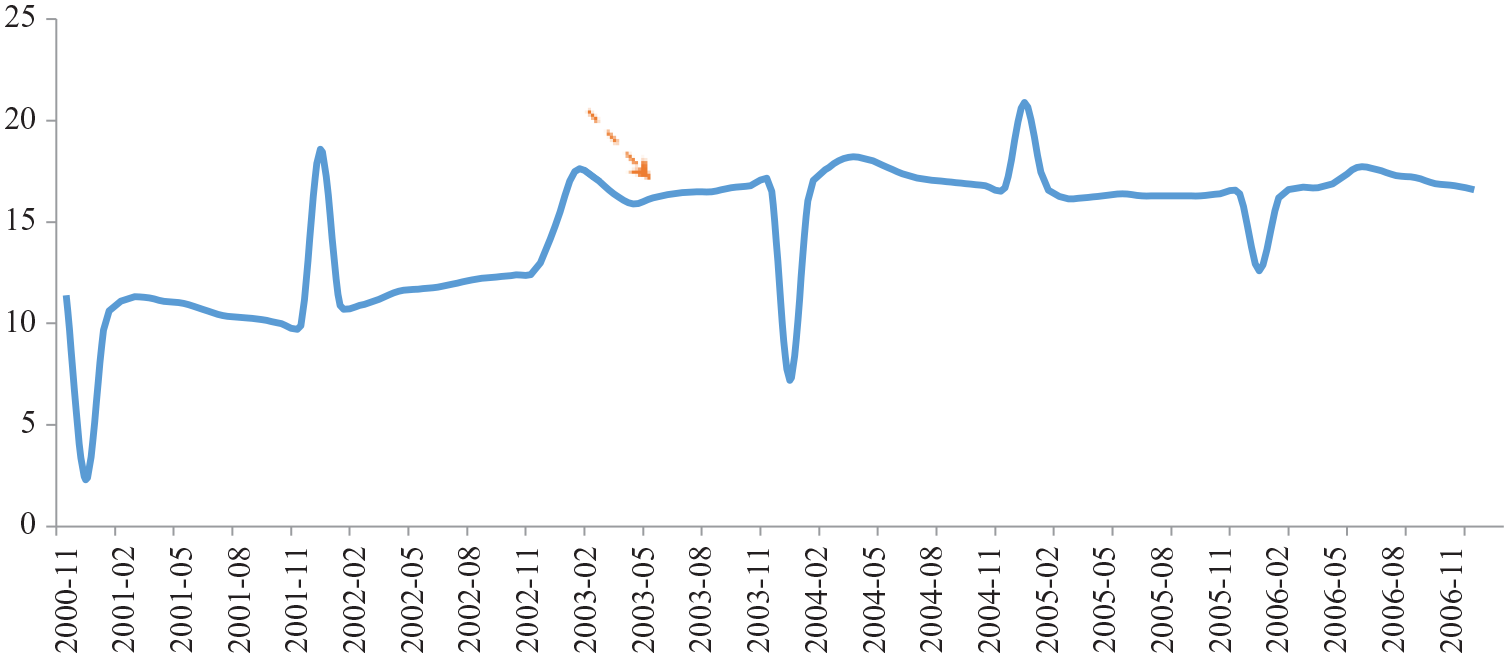
The growth rate of industrial added value dropped sharply during the period of SARS.

Migration Scale Index of Spring Festival in 2019 and 2020.

Industrial growth rate during “SARS” epidemic period.
The consumption patterns and trends in COVID-19 pandemic are quite similar with SARS-2003. For example, offline catering, tourism, hotels, Karaoke Television (KTV), cinemas, and other places are more affected; however, online consumption has benefited from this (Li, 2020). The turnover rate of various alcoholic beverages, leisure snacks, maternal and infant products, personal care and cleaning, grain and oil seasoning, and household department stores has increased significantly compared with the same period last year, and the market of fresh products such as vegetables and fruits demand has increased dramatically. The pan-entertainment field also soared, due to the superimposition of the Spring Festival holiday and the epidemic, online mobile games have become the choice of many residents to pass the time. The number of mobile game users has surged, and the consumption scale has skyrocketed. With a turnover of about 2 billion yuan on the 30th day of the New Year, far exceeding 1.3 billion yuan in the same period last year replaced the online consumption demand of offline theaters (H. Chen et al., 2020; Fang et al., 2020). The movie “Lost Mom” became the first free online premiere movie of the Chinese New Year file. The total number of broadcasts on the 3 days of the launch exceeded 600 million, and the total number of viewers was 180 million.
The number of transmissions in Hubei alone exceeded 25 million. Besides, online medical consultation, online education, and other fields also perform well (Leung et al., 2020). Based on the above ideas, we can further explore the overall growth of the retail industry and the changes in retail formats during the SARS period.
During the SARS pandemic, the supermarket’s revenue performance was the best, and its single-quarter growth rate was far higher than the industry as a whole, followed by professional chain stores and multi-business retail (Lee & McKibbin, 2004). After the epidemic, the performance of department stores recovered the fastest, and its growth rate showed an increasing trend quarter by quarter as a whole; the quarterly growth rate of other formats showed a decreasing or fluctuating trend. (See Table 2)
Single Quarter Revenue Growth Rate of Commercial and Retail Industries (%).

Source. Calculated based on Wind database, Guotai Junan Securities, and Suning Financial Research Institute.
After analyzing the revenue, let us look at the net profit during the SARS epidemic period, the net profit of multi-industry retail was the best; the profitability index of the supermarkets was the most significant, and the general property management and department stores were also ideal (see Table 3).
Single Quarter Net Profit of Commercial and Retail Industries (%).

Source. Calculated based on Wind database, Guotai Junan Securities, and Suning Financial Research Institute.
In terms of revenue, the most solid retail formats during the SARS epidemic were supermarkets, professional chains, and multi-format retail. After the outbreak, the department stores and general property management performed more quickly. The best performance in terms of net profit during the epidemic period is multi-format retail business; after the epidemic, the supermarket is the fastest improvement in profitability, and the general property management is also relatively stable. The retail formats today are much richer compared with 2003 and the situation is more complicated. However, there are no core differences in the underlying forms.
It is worth noting that when online shopping and distribution cannot meet the needs of consumers in time due to an epidemic outbreak and limited human resources, people’s preferences for community and near life circle store. The reason is that people’s travel and activity radius are limited, and people in need are often willing to solve problems nearby, which makes the community and near life circle stores become a centralized area for customers’ consumption.
Besides, the epidemic has once again aroused the public’s attention to the safety of food supplies, and customers will prefer retailers with reliable quality. In particular, the increasing importance of fresh products, its quality, safety, freshness, richness, performance room, cost performance, and so on, will have a more significant impact on consumer choice.
Coronavirus (COVID-19) Pandemic and Accelerating Change of Retail Business Models
From another point of view, while the epidemic brings challenges, it can also promote people’s self-examination and social reflection from many aspects, which leads to a series of business and economic changes. The novel coronavirus pneumonia is also an opportunity for many industries (Wang & Wang, 2020). Because of the epidemic outbreak, the delivery boy cannot deliver goods to his home, so he needs the user to go downstairs and pick up himself, but people are reluctant to go out because they are afraid of “contact with people” and cherish the mask, which is a scarce resource. At the same time, the number of express delivery personnel is insufficient during the epidemic period, and the timeliness of distribution significantly reduced. Also, with the aggravation of distribution demand, the increase of user experience and human cost, as well as some remote areas and particular circumstances of the end of the distribution demand is challenging to meet, the upgrading of traditional logistics has been the general trend, so the opportunity of impotent distribution comes. Traditional logistics and distribution, simultaneous interpreting can not only avoid direct contact between people and people during the epidemic but also has the following two advantages: First, the timeliness of distribution business is enhanced. Traffic congestion and other constraints; it can even break through the topographical limitations, Cross Mountains and rivers for distribution (Fitriasari, 2020; Li & Wang, 2020). It will not only expand the scope of service space and greatly improve the freedom of transportation but also significantly improve efficiency and reduce labor costs. Second, it will enhance the user experience in remote areas with underdeveloped logistics infrastructure. Impotent distribution can effectively solve the end demand of “the last kilometre” so that residents there can also enjoy the pleasure of delivering goods to their homes.
It is a consensus in the industry that there is a massive potential in the sinking market, and any business sees it as the next growth point. All along, people in the sinking market have “acquaintance social attributes” and “leisure entertainment attributes” (Huang et al., 2020). Among them, the former makes visiting relatives and friends the normal life of the sinking crowd, while the latter makes the sinking group have plenty of time for leisure and entertainment. But affected by the epidemic, all the daily activities that you came and went to between relatives were canceled, even the bustling square dance pressed the “pause” key. Therefore, they can only find entertainment content from the line, from gossip news and health care content to short videos and games, all of which have become their favorite objects. The internet penetration rate of the sinking market is not very high before. The epidemic will undoubtedly accelerate the online process of the sinking population, especially those who are not internet users and will probably get the title of “netizens” during this period (Duan et al., 2020).
The “housing economy” is rising sharply with the continuous introduction of measures such as home-based epidemic prevention. Extension of the Spring Festival holiday, delay of returning to work and school, and the demand for “housing economy” have gradually increased. In the relatively closed home environment, many people choose to move offline entertainment, listen to songs on the website, keep fit, or learn through online courses and so on, which become the urgent real demand at present. It can say that the crisis is quietly changing people’s life, entertainment mode, and bringing new changes to people’s lifestyle (Fitriasari, 2020). According to the data of prospective industry research institute, the scale of the foreign market economy is about 27.1 billion yuan in 2019 and expecting 48.6 billion yuan in 2024, with a compound growth rate of 12.4%; the scale of the online education market is estimating to exceed 300 billion yuan in 2020. For another example, on January 31, 2020, Nintendo released its financial report for the third quarter of the fiscal year 2020, in which the expected sales volume increased in this fiscal year from 18 million to 19.5 million (“China: Coronavirus COVID-19 Effect on FMCG Prices Online,” 2020).
Post Epidemic “Compensatory Consumption”
The novel coronavirus epidemic situation is similar to the SARS epidemic in 2003 in many aspects. Therefore, the consumption situation is identical in the time axis of the pandemic, which started in December 2002 and spread in the first quarter of 2003 (February 1, 2003, in the Spring Festival), reaching the peak in April and May.
The outbreak was gradually controlled in March and ended in the third quarter. In the long run, novel coronavirus pneumonia affects business mode and consumption habits, but in the short term, the epidemic mainly affects consumption in the first quarter of 2020. As the consumption demand is depressed during the pandemic, there will be “compensatory consumption” (compensation rather than outbreak) in the short term (within 0–3 months after the epidemic).
Research Implications, Conclusion, Limitations, and Future Research Direction
Theoretical and Practical Implications
The study contributed both theoretically and practically in the management and bussiness research arena. Theoretically, a wider concept and holistic picture about stable consumption of essential products has been investigated which contributes to the existing literature. The result of this study is drawn from existing literature and empirical resuts. Also, result from date wise data analysis contributes to the present theory in a unique manner. For example, from the perspective of industry segmentation (see Table 1), in the short run after the epidemic, the stable consumption of essential products, such as meat, poultry, eggs, cosmetics, and daily necessities; the use of medicine and other medical protection increased significantly, but kept a slow growth in the long run; significant compensatory use occurred after the epidemic, especially in clothing, shoes and hats, gold, silver and jewelry, and cultural office, sports entertainment, furniture, communication equipment, and other subcategories. As a result, this study opens up the black box of consumer economic situation during severre market turbulance such as COVID-19. To adopt appropriate strategy, this research is consistent with the attribution theory in terms of purchase intention.
This study also has some practical implications. It also indicates why certain sectors are badly affected due to market turbulance. Based on the result of this study, managers and decesion makers should be aware of the following aspects:
First, during the epidemic period, the impact of leisure services is more significant than commercial retailing, and the rebound will be more rapid after the epidemic. Second, after the epidemic, cinema and other theatrical productions appeared explosive consumption. Arranging to show the missed blockbusters during the pandemic, relaxing after isolation, and other factors will attract a large number of audiences to return to the cinema. Third, although the home appliance industry is generally stable, the consumption of home appliances with anti-virus and sterilization concepts has risen gradually. After the epidemic isolation, baby goods and entertainment consumption rates will be increasing. Fourth, there will be periodic peaks in short-distance outdoor tourism, especially short-distance travel on weekends will be significantly increased. Finally, the strong demand mainly will come from the fitness industry after the epidemic isolation period because physical exercise is the requirement of enhancing resistance and immunity. Managers and policy makers should handle all these aspects with extra care due to market turbulance because the study discovered that the international market and external influences are relevant with economic trend.
Conclution and Limitations
Based on the result of the study, the study investigated numerous aspects which has not discovered before. First of all, from the perspective of retail industry (see Table 4), during the “SARS” period, the most influential retail sectors were supermarkets, professional chains, and multi-format retail. After the epidemic, the fast recovery was in general merchandise business, and the performance of the multi-format retail business and general property management was also remarkable. Second, from the perspective of consumption habits, supermarkets will gradually replace the farmers’ market. During the epidemic period, people tend to reduce the number of purchases, while “one-stop” supermarkets and stores are more able to provide long-term stable, safe, and reliable products with luxurious categories for the people. Third, compared with the agricultural trade market, they are more able to meet consumer demand (Li & Mutchler, 2020). They will replace the original agricultural trade market in the consumption status of low-end cities in the future. However, the consumption demand squeezed out from the farmer’s market may increase the penetration rate of supermarkets in low-end cities in the long run. From the perspective of consumption channels, the demand for offline home service has increased. Online social interaction, interactive KOL marketing mode will continue to catalyze the GMV performance of E-Commerce (J. Chen & Li, 2020). Consumption area will influence by the social and income factors (Jappelli & Pistaferri, 2010). Third and fourth-tier cities’ consumption will be faster than the first and second-tier cities. Furthermore, the consumption pattern also shows a robust negative sensitivity to the severity of the public health crisis. The analysis thus highlights the importance of policymakers using prompt and adequate interventions for the countermeasure to mitigate the negative impact and, particularly on the more affected sectors such as retail and some service industries. This study utilized day wise data from a single source which is complex to analyze. This may affect the generalizibility of the result.
Quarterly Revenue Growth of Commercial Retail Industries (%).

Source. Calculated based on Wind database, Guotai Junan Securities, and Suning Financial Research Institute.
Future Research Direction
Due to time limitation, this research was limited to the data on retail sales in different sectors during the month of “SARS.” Future research can investigate the same during COVID-19 period with the help of larger sample size and big data. A comparative analysis among different parts of the world may further deepen the phenomenon. Researchers may consider mixed methodology approach for COVID-19 related research in the future.
Footnotes
Declaration of Conflicting Interests
The author(s) declared no potential conflicts of interest with respect to the research, authorship, and/or publication of this article.
Funding
The author(s) received no financial support for the research, authorship, and/or publication of this article.
