




Abstract
We adapted/developed and examined the test–retest reliability and internal consistency of eight parent-report measures of home and neighborhood environmental correlates of physical activity appropriate for Chinese preschool-aged children and their parents/primary caregivers living in densely populated urban environments. This study consisted of a qualitative (cognitive interviews) and a quantitative (test–retest reliability) component. Chinese versions of the measures were pilot-tested on 20 parents of Hong Kong preschool-aged children using cognitive interviews. Measures were then administered to 61 parents twice, 1 week apart. Test–retest reliability and internal consistency were computed. Except for two items, the test–retest reliability of items and scale summary scores ranged from moderate to excellent. The internal consistency of the measures exceeded recommended minimal values (Cronbach’s α > .70). The parent-report measures examined in this study are potentially appropriate for use in investigations of environmental correlates of the physical activity of Chinese preschool-aged children living in densely populated urban environments. However, their predictive validity with respect to Chinese preschool-aged children’s physical activity needs to be assessed in future studies.
The benefits of regular physical activity (PA) to children’s and adolescents’ well-being are well-documented (Jimenez-Pavon, Kelly, & Reilly, 2010; Timmons, Naylor, & Pfeiffer, 2007). It is particularly important to establish an active style in early childhood because activity patterns acquired in this life period track over time (Jackson et al., 2003). Yet, epidemiological studies indicate that many preschool-aged children fail to meet the recommended PA levels (Hinkley, Salmon, Okely, Crawford, & Hesketh, 2012b). Insufficient levels of PA have been found in Western as well as Eastern countries (Hinkley et al., 2012b). For example, only 16% of Hong Kong preschoolers have been reported to engage in adequate amounts of PA when excluding preschool physical education classes (Department of Health, Hong Kong SAR, 2009). It is, thus, important to identify modifiable factors that promote PA in early childhood (Hinkley, Salmon, Okely, Crawford, & Hesketh, 2012a).
Social-ecologic models describe children’s PA as developing within an ecological niche with the immediate home and neighborhood environments playing a major role in this process through the provision of opportunities or creation of barriers for engagement in PA (Sallis & Glanz, 2009). Figure 1 depicts a simplified model of home and neighborhood environmental influences on preschool-aged children’s PA based on socio-ecologic theories. Several studies have provided initial support for elements of the proposed model. Specifically, preschoolers’ PA was found to be positively associated with time spent outdoors (Kneeshaw-Price et al., 2013), access to places for PA, and the availability of active-play equipment in the neighborhood (Farley, Mariwether, Baker, Rice, & Webber, 2008; Potwarka, Kaczynski, & Flack, 2008). Conversely, there is some evidence that passive-play equipment, such as video games and computers, may have a negative effect on children’s PA by providing attractive and affordable opportunities for passive activities that replace more active pursuits (Ross, Dowda, Saunders, & Pate, 2013).
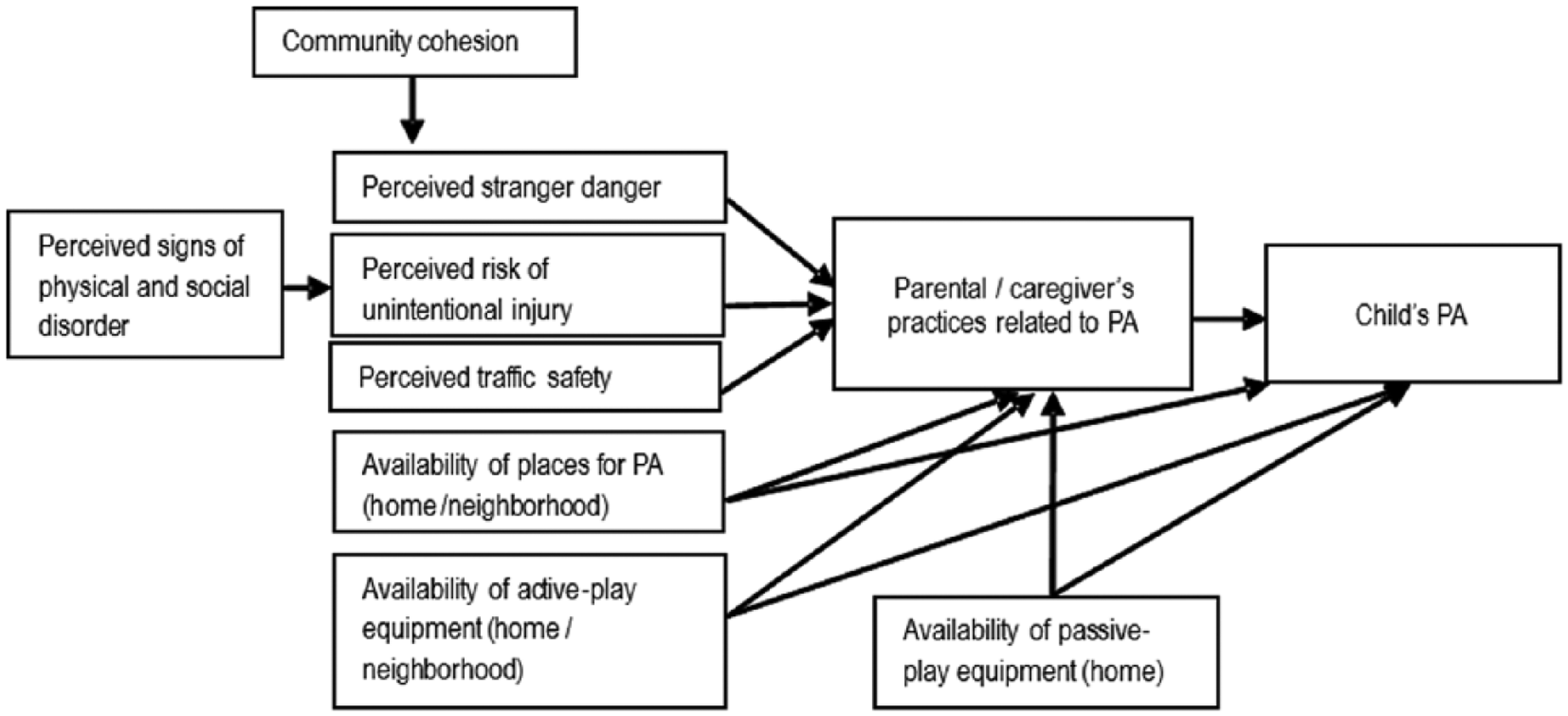
A simplified model of home and neighborhood environmental influences on preschool-aged children’s PA.
The neighborhood environment can also affect children’s PA through its impact on parental perceptions of neighborhood safety (Burdette, Whitaker, & Daniels, 2004; Carver, Timperio, & Crawford, 2008; O’Connor et al., 2014; Suen, Cerin, & Wu, 2015), including risk of crime (Burdette et al., 2004; Suen et al., 2015), stranger danger (Carver et al., 2008; Suen et al., 2015), risk of unintentional injury (Bruce, Lake, Eden, & Denney, 2004), and traffic hazards (Bringolf-Isler et al., 2010; Suen et al., 2015). In other words, parental safety concerns based on unfavorable perceptions of the neighborhood environment may lead to parental restrictions of active play in the neighborhood. These safety concerns may be buffered by higher levels of perceived community cohesion (Durand, Dunton, Spruijt-Metz, & Pentz, 2012).
Relationships of neighborhood characteristics with preschool-aged children’s PA depicted in Figure 1 are relatively understudied and restricted to Western populations. Consequently, they may not be applicable to populations of parents and preschool-aged children living in other geographical locations and cultures, such as ultra-dense Chinese metropolises which, unlike most Western cities, are typified by high levels of air pollution and a shortage of appropriate outdoor play space (Cerin, Chan, Macfarlane, Lee, & Lai, 2011). To study environment–PA behavior relationships in preschool-aged children of ultra-dense Chinese metropolises, relevant measures of environmental characteristics that are culturally appropriate and specific to the target population (Chinese parents and their preschool-aged children) are needed. Although parent-report measures of aspects of the neighborhood environment relevant to preschool-aged children’s PA are available in English, they have not been translated and validated/adapted for a Chinese population (Hinkley et al., 2012a).
Thus, the aim of this study was to translate, adapt or develop, and examine the reliability of parent-report measures of home and neighborhood environmental correlates of preschool-aged children’s PA appropriate for use with parents/primary caregivers of preschool-aged children living in Hong Kong, an ultra-dense Chinese metropolis (Cerin et al., 2011). Specifically, we report on the translation/adaptation and repeatability of measures of perceived (a) community cohesion, (b) signs of physical and social disorder, (c) traffic safety and pedestrian infrastructure, (d) stranger danger, (e) availability of active-play equipment, (f) availability of passive-play equipment, and (g) places for child’s PA (see Figure 1). We also report on a newly developed measure of perceived risk of unintentional injury.
Method
This study consisted of a qualitative, adaptation stage involving cognitive interviews and refinement of measures translated from their English original versions into Chinese and a quantitative, test–retest reliability stage.
Participants
In 2011-2012, two convenience samples of Chinese-speaking parents/primary caregivers of Hong Kong preschool-aged children were recruited from kindergartens, preschool playgroup centers, and Maternal Care and Health Clinics of the Department of Health. Twenty participants participated in the qualitative stage of the study, whereas 61 participants participated in the quantitative, test–retest reliability stage of the study. Inclusion criteria were being the parent/primary caregiver of at least one 3- to 5 year-old Chinese-speaking child living in Hong Kong. Exclusionary criteria were parents/primary caregivers of children with a disease affecting their PA behavior or cognitive functioning and those who were unable to read and write in Chinese. Eligible participants completed a demographic survey prior to participating in the study. Table 1 reports the socio-demographic characteristics of the samples.
Participants’ Characteristics.
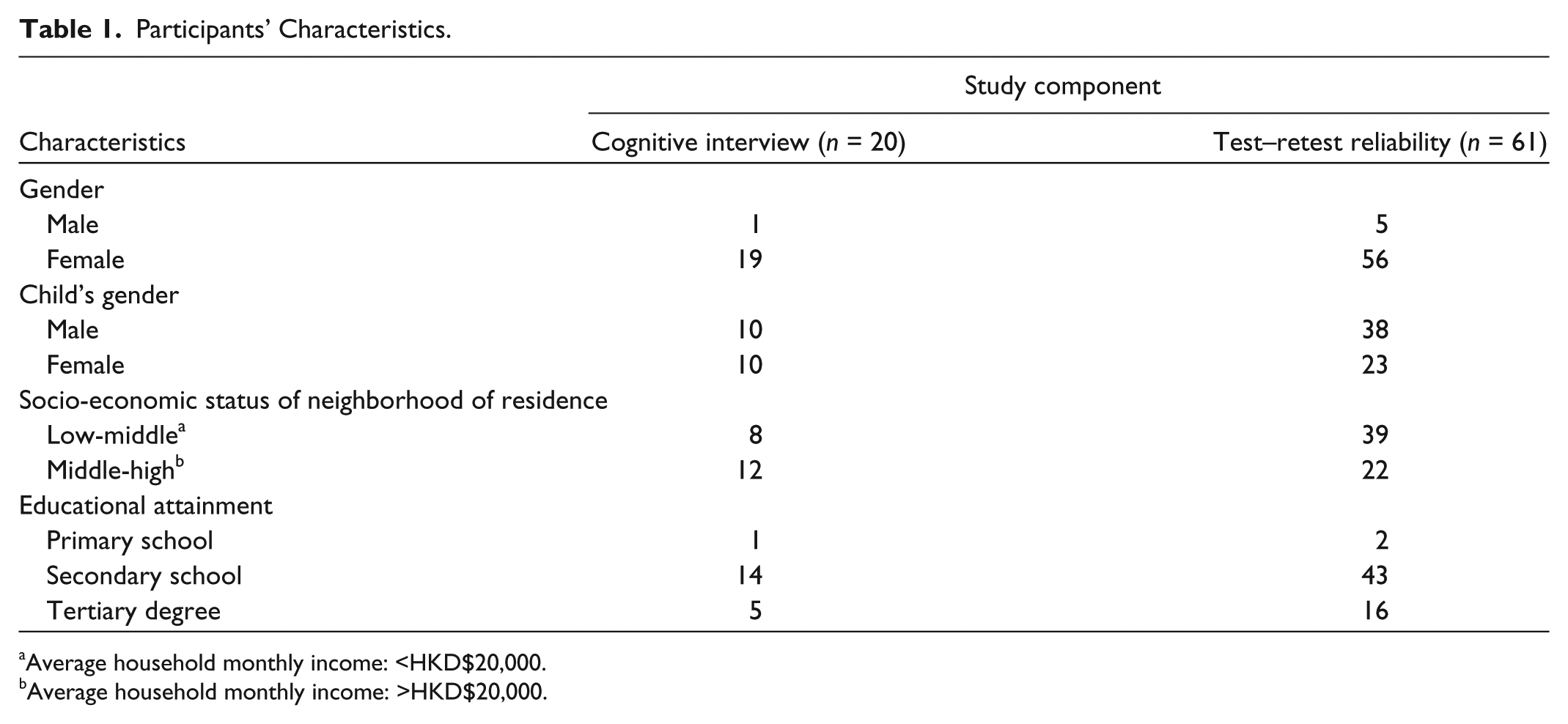
Average household monthly income: <HKD$20,000.
Average household monthly income: >HKD$20,000.
Procedures
The study was approved by Human Research Ethics Committee for Non-Clinical Faculties of the University of Hong Kong #EA560310 and the Ethics Committee of the Department of Health (Hong Kong SAR) # L/M 80/2011. Informed consents were obtained from the participants prior to data collection. In the qualitative stage of the study, the original English versions of seven extant parent-report measures (see “Measures” section) included in this study were reviewed by a panel of experts including two psychologists, two researchers in public health, an exercise scientists, and a pediatrician. In addition, the panel of experts originated five items gauging perceived risk of unintentional injury in the neighborhood. The English versions of the eight measures were translated into Chinese, back-translated into English, and re-reviewed by the panel of experts. This process resulted into the Chinese working versions of the eight measures.
The Chinese working versions of the set of measures were tested on a sample of Chinese-speaking parents of Hong Kong preschool-aged children. Standardized cognitive interviews (~40 min each) examined participants’ interpretations of the items. The information gathered during these interviews was used to modify the wording of the items or add new items (when necessary). The modified measures were used in the test–retest reliability stage of the study. In the quantitative stage (test–retest reliability) of the study, participants were asked to complete the Chinese version of the measures (first assessment T1). The measures were re-administered 7 to 10 days following the first administration (T2).
Measures
Seven items from the Perceived Neighborhood Scale (Martinez, 2000) were used to measure community cohesion. The measure was originally devised to test the participants’ feelings of membership, trust, mutual influence, and shared socio-emotion ties with neighbors. Respondents rated each item using a 5-point Likert-type scale. The original scale was found to have excellent reliability and validity (Martinez, 2000; Martinez, Black, & Starr, 2002) and internal consistency (Cronbach’s α = .85; Martinez et al., 2002). No substantive content changes were made to this scale by the panel of experts or as a result of cognitive interviews.
Fourteen items measuring perceived signs of physical and social disorder were taken from the Disorder Scale developed by Coulton (Coulton, Korbin, & Su, 1996) and measuring perceptions of deleterious conditions in the neighborhood that are salient to caregivers of young children. Participants were asked how frequently a particular event/condition occurred in their neighborhood (e.g., How often do you see litter or trash on the footpaths and streets in your neighborhood?) and provided responses on a 5-point frequency scale (from never to frequently). Three new items were added to this measure, 2 of which were suggested by a panel of experts (There are stray dogs around and Public open spaces, parks, green/dirt strips and sidewalks are not kept up) as they were deemed to represent relevant environmental hazards in some areas of Hong Kong. One item was added as a result of the cognitive interviews (Burning joss sticks and paper). Cronbach’s alpha of the original measure was .95 (Coulton et al., 1996).
Perceived risk of unintentional injury in the neighborhood was measured with a five-item scale constructed by the above-mentioned panel of experts, including items related to risk of injury due to stray animals; littered and disorderly neighborhood streets, footpaths, or open spaces; falling objects from high-rise buildings; and falls during play (e.g., I’m afraid of my child being attacked by a dog or other stray animals in my neighborhood). Respondents provided their answers on a 4-point Likert-type scale.
To measure perceived neighborhood traffic safety and pedestrian infrastructure, six items were taken from an extant survey (Grow et al., 2008) and two items were suggested by the panel of experts (The traffic makes it unsafe for my child to play outdoors in my neighborhood and The traffic makes it unsafe for my child to walk or ride a bike on the road in my neighborhood). Respondents rated each item on a 4-point Likert-type scale. The test–retest reliability of the original items ranged from .28 to .73 (Joe, Carlson, & Sallis, 2008).
Four measures were taken from the Neighborhood Impact on Kids Survey (http://www.nikproject.org/index.htm). Perceived stranger danger in the neighborhood was gauged using 4 items rated on a 4-point Likert-type scale. No substantive, content changes were made to this scale by the panel of experts or as a result of the cognitive interviews. Test–retest reliability of these items in a previous study was .87 (Rosenberg et al., 2009). Availability of active-play equipment within or outside the neighborhood was assessed using 8 items. Response options were at or around the home, in the neighborhood (~15 min from home), and outside the neighborhood. Test–retest reliability of these items ranged from .53 to .85 (Joe et al., 2008). Seven items were used to measure availability of passive-play equipment at home (prior test–retest reliability intra-class correlation coefficient [ICC] = .51-.96; Joe et al., 2008). Respondents were asked how many of the listed functioning devices were available at home (from 0 to more than 3). Places for child’s PA in the neighborhood (defined as an area 15-min walk from home) were assessed using 11 out of 14 available items. Only items deemed relevant to preschoolers were selected. The test–retest reliability of the original items ranged from .42 to .85 (Joe et al., 2008).
Data Analyses
We computed the test–retest reliability of each item included in the measures. Test–retest reliability of items with frequency or Likert-type response scales were estimated using ICCs based on absolute agreement two-way mixed effects models. Responses of items gauging availability of active-play equipment and places for child’s PA were categorical. Hence, their test–retest reliability was assessed using kappa coefficients. ICCs and kappa coefficients ≥.80 were considered excellent, values between .60 and .79 were considered substantial, values between .40 and .59 moderate, and ICCs < .40 were considered poor (Landis & Koch, 1977). Mean, minimum and maximum item ICC or kappa coefficients were computed for each measure with and without items showing poor repeatability (ICC or kappa < .40).
We then computed means and standard deviations of summary scores of each measure for each of the two assessments. The summary scores were based on items that showed an acceptable level of repeatability (first step in the analyses). We also computed the internal consistency (Cronbach’s α) of measures representing multi-item unidimensional scales (e.g., community cohesion, perceived signs of social and physical disorder, perceived risk of unintentional injury) for each assessment. Cronbach’s alphas exceeding .70 suggest an acceptable level of internal consistency (Nunnally, 1978). Finally, we estimated test–retest reliability (ICC) of the summary scores of each measure. Data were analyzed using the SPSS statistical software package version 20.0.0.
Results
Participants tended to report relatively high levels of community cohesion, low levels of perceived signs of social and physical disorder and moderate levels of perceived risk of unintentional injury, traffic hazards, and stranger danger (Table 3). The test–retest reliability of items gauging community cohesion was moderate. Item-specific test–retest reliability of other measures ranged from moderate to substantial, with the exception of a poorly performing item gauging perceived signs of physical and social disorder and an item gauging perceived traffic safety and pedestrian infrastructure (Table 2). The level of internal consistency of the scales was acceptable (Table 3). Test–retest reliability of the summary scores of the examined instruments ranged from moderate to excellent, with the single-item perceived traffic safety–not many cul-de-sacs showing the lowest test–retest reliability and availability of passive-play equipment the highest.
Repeatability (ICC and Kappa) of Scale Items Measuring Social and Physical Environmental Correlates of Urban Chinese Preschool-Aged Children’s Physical Activity.

Note. ICC = intra-class correlation based on a two-way mixed model.
Computed excluding items with low repeatability (ICC or kappa < .40).
Descriptive Statistics, Internal Consistency, and Repeatability of Summary Scores of Measures of Social and Physical Environmental Correlates of Urban Chinese Preschool-Aged Children’s Physical Activity.
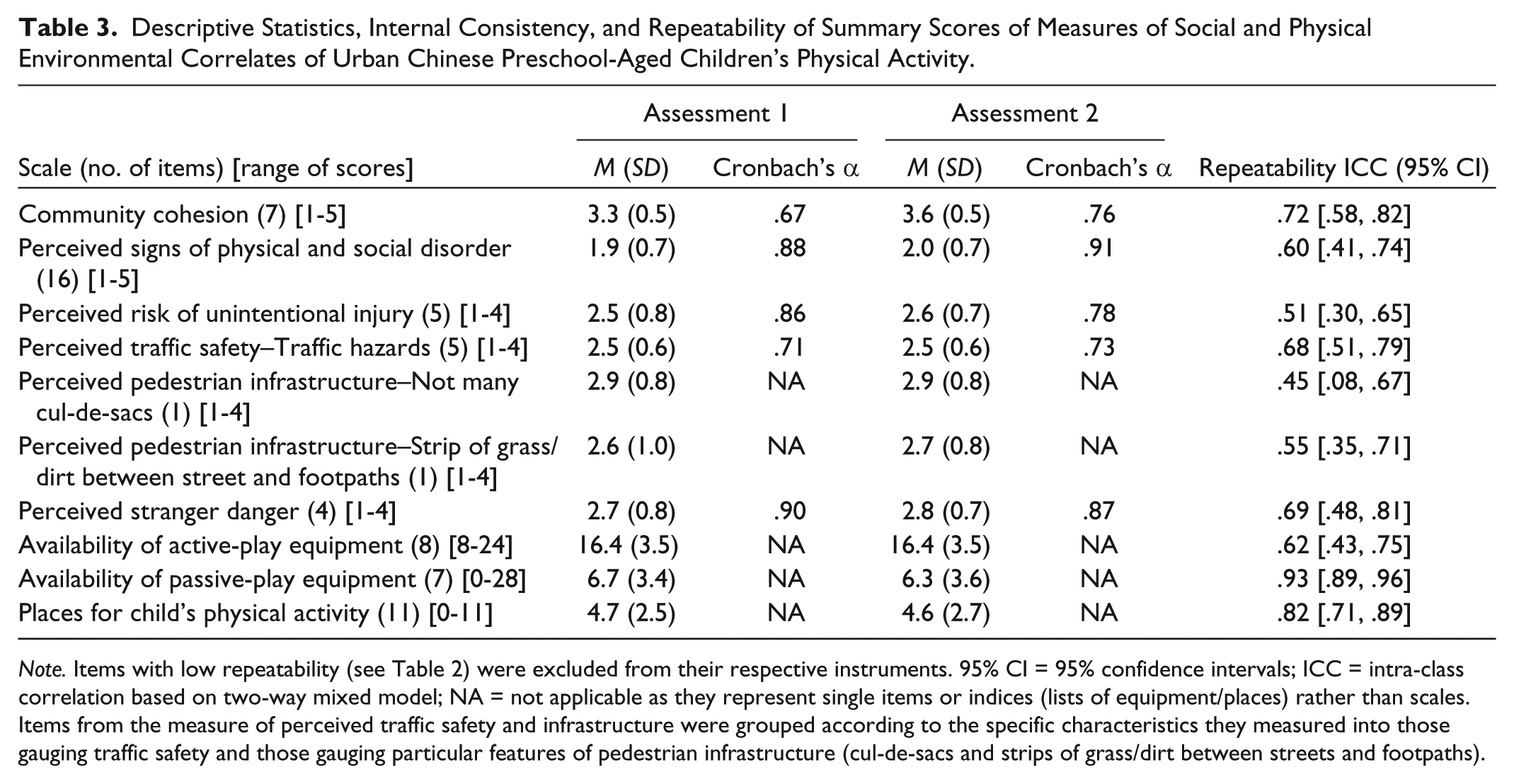
Note. Items with low repeatability (see Table 2) were excluded from their respective instruments. 95% CI = 95% confidence intervals; ICC = intra-class correlation based on two-way mixed model; NA = not applicable as they represent single items or indices (lists of equipment/places) rather than scales. Items from the measure of perceived traffic safety and infrastructure were grouped according to the specific characteristics they measured into those gauging traffic safety and those gauging particular features of pedestrian infrastructure (cul-de-sacs and strips of grass/dirt between streets and footpaths).
Discussion
We adapted and examined the reliability of seven extant parent-report measures of home and neighborhood environmental correlates of young children’s PA for use with Chinese parents or primary caregivers of preschool-aged children living in Hong Kong, a Chinese ultra-dense metropolis. We also developed and examined the reliability of a new measure of perceived risk of unintentional injury in the neighborhood appropriate for the same target population.
Input from a multi-disciplinary panel of experts and parents indicated that five out of seven extant measures did not require any substantive changes to the items. These included community cohesion, perceived stranger danger, places for child’s PA, and availability of passive and active-play equipment. The first two measures describe, respectively, feelings of community interconnectedness and parental protection of children that may be common to all humans, regardless of their cultural background, which would explain why no amendments to the measures were suggested. As to the other two measures, it appears that the types of play equipment and places to play available to Hong Kong children are similar to those found in Western countries. This is not surprising given that Hong Kong is a highly developed, global trade center with a high level of availability of goods and facilities. This situation is likely to be similar in other Chinese metropolises (McKinsey Global Institute, 2012).
Two items were added to the extant measure of traffic safety and pedestrian infrastructure, both of which depicted situations of traffic hazards associated with parents preventing their children from engaging in PA outdoors. It was deemed necessary to include these items because traffic volume and hazards are relatively high in Hong Kong (Cerin et al., 2013), as they are in other Chinese cities (Pucher, Peng, Mittal, Zhu, & Korattyswaroopan, 2007), and only under certain circumstances they may be perceived as sufficiently serious to warrant parental intervention (prevent children from playing outdoors).
Three items were added to the measure of perceived signs of physical and social disorder. These included the presence of stray dogs; un-kept open spaces, parks, and footpaths; and burning joss sticks and paper. Stray dogs are the top safety hazards affecting children’s outdoor PA, an environmental correlate of PA in other age groups in Hong Kong (Cerin et al., 2013), and an acknowledged environmental “hazard” in many other Chinese cities (Hou, Jin, & Ruan, 2012). An item about un-kept public open spaces, parks, and footpaths was included in the measure because Hong Kong has large expanses of open spaces (e.g., country parks). However, most of these spaces are too steep or overgrown to be suitable for children’s play. “Burning joss sticks and paper” was added to the measure of signs of physical and social disorder because it is a rather dangerous practice unique to the Chinese culture.
In general, the translated/adapted versions of extant self-report measures of the home and neighborhood environments showed moderate to excellent levels of test–retest reliability. The results are consistent with those found (when available) for the English original versions (Joe et al., 2008; Rosenberg et al., 2009). Two items were found to have poor test–retest reliability. One of these items belonged to the measure of perceived signs of physical and social disorder and pertained to the presence of “Disorderly or misbehaving groups of young children.” Respondents might have been unsure as to whether misbehaving young children should be classified as a sign of social disorder. As this type of occurrence is unlikely to be a sign of social disorder and represent a real threat to the community, we propose the item be excluded from the scale. Another poorly performing item was “There are crosswalks and signals on busy streets.” We maintain that this item could also be omitted because it measures an aspect of the environment that is relevant to walking for transportation, which preschool-aged children are unlikely to engage in when unaccompanied.
Of note is that measures of places for child’s PA and availability of passive-play equipment at home showed the highest levels of test–retest reliability, possibly due to the more objective nature of these features as compared with those involving affective judgments (e.g., threat posed by strangers) and a greater level of respondents’ knowledge about these features (equipment at home as opposed to equipment in the neighborhood). It is also noteworthy that all measures had an acceptable level of internal consistency indicating that they gauged unidimensional features of the perceived environment.
We developed a preliminary measure of perceived risk of unintentional injury appropriate for Chinese parents of preschool-age children. This is an understudied aspect of the neighborhood environment that is unrelated to crime and traffic hazards but that can be an important source of concern for parents of young children (Bruce et al., 2004). During formative work, five main threats of unintentional injury in the neighborhood were identified. Mirroring the newly added items to the scale of perceived signs of physical and social disorder, the presence of stray animals and littered and un-kept outdoor spaces, streets, and footpaths were identified as possible sources of injury. Falling objects from high-rise buildings were also identified as a significant danger to young children playing outdoors. This is in line with a previous study on Hong Kong older adults (Cerin et al., 2010) and highlights the nature of the built environment of Hong Kong and other Chinese metropolises typified by a large number of compactly located, residential high-rise buildings with opens spaces, small parks, and playgrounds within close proximity. Of note was the fact that the mere act of playing outdoors was identified as a potential source of unintentional injury (falling while playing). The test–retest reliability of this new scale was moderate and its level of internal consistency acceptable.
Establishing whether the metric properties of the measures examined in this study are generalizable to other Chinese populations is warranted. Future studies will also need to establish the construct validity of the examined measures by conducting confirmatory factor analyses (where appropriate) and estimating associations of the individual measures with preschool-aged children’s PA behavior.
Conclusion
We adapted and translated in Chinese seven extant measures of various perceived aspects of the home and neighborhood environments deemed to be relevant to urban Chinese preschool-aged children’s PA and appropriate for their parents/primary caregivers. We also developed a new measure of perceived risk of unintentional injury in the neighborhood and examined the test–retest reliability and, where applicable, the internal consistency of all eight measures. This study suggests that all measures have adequate levels of test–retest reliability and internal consistency and can be potentially used in studies of environmental correlates of urban Chinese preschool-aged children’s PA. Yet, the measures’ factorial validity and predictive validity as actual correlates of Chinese preschool-aged children’s PA need to be assessed in future studies.
Footnotes
Acknowledgements
The authors thank all primary caregivers for their participation. They also thank the staff of all kindergartens, preschool playgroup centers, and Maternal and Child Health Centers (MCHC) of the Department of Health of Hong Kong for their coordination and cooperation which made it possible to successfully complete this project.
Declaration of Conflicting Interests
The author(s) declared no potential conflicts of interest with respect to the research, authorship, and/or publication of this article.
Funding
The author(s) disclosed receipt of the following financial support for the research and/or authorship of this article: This study was supported by Grant 201001159011—Seed Funding Program for Basic Research (The University of Hong Kong) awarded to Ester Cerin. Ester Cerin is supported by an Australian Research Council Future Fellowship (FT #140100085).