




Abstract
Since MTB has been deemed as the business model of 21st century but its long-term sustainability depends on level of consumer satisfaction with its applicability in their everyday life. Therefore, current research aims to highlight factors which could shape consumers’ satisfaction and further trigger their intuition to recommend it in their circle of influence. Unified theory of acceptance and use of technology 2 (utaut2) was modified and extended to fit the purpose. Data were collected from prevailing MTB users and analyzed in PLS-SEM. Results reveal that utaut2 factors signify their effects on consumer satisfaction which further trigger their instinct to recommend MTB. Current research modified utaut2 with mediating role of consumer satisfaction with MTB which further stimulates their instinct to recommend it. The modified framework adds value to the theoretical horizon of utaut2 and further extends its applicability in a novel setting like MTB. The study offers insightful implications to MTB companies for effective design and implementation of future strategies. Moreover, limitations and suggestions for future researchers are also discussed.
Introduction
Mobile-app-based services for booking taxis have reshaped transportation industry. Such applications not only provide personalized transport service to the individuals but also save taxi drivers’ energy, time, and expenses consumed in search of passengers (Weng et al., 2017). Personalized transport services enhance consumers’ experience which increases their level of satisfaction in the service (Keong, 2015); 24/7 availability of taxis through cell phones has eliminated disparity among taxi demand and supply (Shen et al., 2015) which has overcome major hassle for booking a taxi. GPS and 4G have redefined transport industry by equipping system with ability to access drivers’ personal information and passenger rating history (Buhalis & Foerste, 2015), the mechanism of consumer review plays a very important role in building credibility of drivers, consumer feedback also adds value to the design and future preferences of users which in turn helps companies to enhance their business and this innovation has significantly declined unpleasant travel experiences of customers (Guo et al., 2016).
MTB has brought taxi drivers into an organizational structure. It has also enhanced their efficiency to locate passengers from their real time location and drop off through the least traffic routes (Santos & Xavier, 2015). While using MTB customers also enjoy the facilitations like payments through credit/debit cards, in addition their ride can be tracked by friends and family (Ooi et al., 2018). Moreover, to be on safer side, customers can also retrieve basic identity of drivers (Weng et al., 2017).
Existing body of knowledge mainly focuses on the technological perspectives like adaptation of online taxi application by drivers (Keong, 2015), problems incurred while sharing rides (Lin et al., 2012), conversion of taxis into parcel carriers (Li et al., 2014) or paratransit services for declining operating costs (Gupta et al., 2010), selection of cab services (P. K. Kumar & Kumar, 2016), their GPS positioning (Voon & Yow, 2010), and traffic influence (Lee et al., 2004). Consumer perspectives have largely been neglected which are evidenced by scarce research carried out to only explore adoption of mobile applications (Harris et al., 2016; Keong, 2016; Peng et al., 2014). Owing to the dearth of research in the post adoption domain consumer loyalty has emerged as a major concern for M-taxi companies (Hsiao et al., 2016). Current research studies factors which stimulate users’ satisfaction to recommend MTB within their circle of influence.
Present research contributes to the existing body of knowledge by proposing a framework that predicts consumer satisfaction leading toward recommendation of MTB services. Originality of framework is based on the extension of utaut2 (unified theory of acceptance and use of technology) into mediation of consumer satisfaction of mobile-app-based services which stimulate recommendation within their circle of influence. All the prime predictors of utaut2 significantly mediate their effect on MTB recommendation through level of consumer satisfaction of mobile-app based services. The phenomenon like MTB has redefined personalized transport services. As a result, several service providing companies have been established which have overall restructured and reshaped taxi hiring mechanism. Novel technologies besides saving time, money, and efforts give a feeling of fulfillment, comfort, and updated lifestyle to the consumers. Therefore, this research aims to explore factors which could trigger satisfaction among consumers and further incline them to recommend MTB within their circle of influence.
The remainder of this article is structured as follows. Section “Conceptual Framework” refers to the conceptual model and development of hypotheses. Section “Research Methodology” presents methodology of research and results derived from SmartPLS. Research findings, theoretical and practical implication are discussed in section “Discussions.”Finally limitations and conclusions are presented in sections “Limitations and Future Directions” and “Conclusions,” respectively.
Conceptual Framework
Different theories based on psychological and sociological aspects have been devised to predict individuals’ acceptance and use of latent technologies but utaut2, among them, is the most prominently used. While investigation this model explained 74% variance in the behavioral intention and 52% in use behavior (Venkatesh et al., 2012). According to the conclusions of Haryoto (2015), this ratio of prediction in acceptance and use of novel technologies in consumer context is deemed efficient. The powerful and efficient level of prediction enables utaut2 to better explain consumers’ acceptance and use behavior in new technologies. Gradually utaut2 is being adopted to explore various issues in different technologies like TV streaming platforms (Haryoto, 2015), technology choice by elder age group people (Moura et al., 2017), e-hailing applications (Soares et al., 2020), consumer intention for online flight booking (Jeon et al., 2019), and Alipay user adoption (Cao & Niu, 2019). Recently, Tamilmani et al. (2020) conducted a literature review on applicability and extension of utaut2 and found that extensions came up with promising venues for future researchers. They further classified utaut2 extensions into seven diverse segments like new exogenous, new endogenous, new moderating, new outcome, new mediating, new external, and new internal mechanisms. The robustness of theory is witnessed by the utaut2 extensions with context-specific variables in most dimensions which have emerged as a popular utilization category. This motivated authors to extend the theory with context-specific antecedents and test mediation effects of all the prime factors of utaut2. Figure 1 refers to the conceptual model of the study.

Conceptual model.
Performance Expectancy
When a new technology has ability to provide its consumers with relative benefits along with a certain level of ease, it is said to be enhancing their performance (Venkatesh et al., 2012). Adoption of m-devices allows consumers to inquire irrespective of any temporal or spatial limitations (Tan & Ooi, 2018). Earlier research has witnessed that if consumers find the technology as useful they become inclined to use it (Venkatesh et al., 2012; Verkijika, 2018). Recently, Siyal, Ding, and Siyal (2019) and Siyal, Donghong, et al. (2019) established that enhancement of performance by using a new technology retains users satisfaction and loyalty. Moreover, stimulus role of Performance Expectancy (PE) has been witnessed in various aspects like booking of air tickets (Jeon et al., 2019), social networks (Herrero & San Martín, 2017), and mobile payments (Morosan & Defranco, 2016b). Meta-analysis conducted by Jeyaraj et al. (2006) established PE as a prime factor leading toward consumer satisfaction. Therefore, authors assume that in the context of mobile app–based services PE stimulates consumer satisfaction to use MTB.
Effort Expectancy
When a new technology has the capability to be applied with least efforts consumers prefer to use that technology (Siyal, Donghong, et al., 2019; Wong et al., 2015). Salimon et al., 2017 in their study about e-banking; established positive impact of effort expectancy (EE) with consumer motivation. Similarly, Alajmi (2019) explored decisive role of EE while choosing a novel technology. Recently, Weng et al. (2017) in their study about using m-taxi concluded that least efforts required to operate a new technology retain consumer satisfaction and loyalty toward that system. Earlier studies have witnessed significant impact of EE on consumer satisfaction in various domains like social networking sites (Ernst et al., 2013), multimedia (Liao et al., 2008), mobile applications in tourism (Tan et al., 2017), and mobile banking (Afshan & Sharif, 2016). Henceforth, authors assume the following hypothesis.
Social Influence (SI)
When individuals feel pressure or encouragement from their important others to apply a new technology then they are being impacted by their social influence (SI; Ooi et al., 2018; Venkatesh et al., 2003). Social circles of individuals play a significant motivational role in developing high perception of technology usefulness (Okazaki, 2009). Olasina, 2019 also witnessed that SI acts as an energized form of motivation for a new technology. (Zhou et al., 2010) found that when individuals see their friends and family using new technologies they too become inclined to use such technologies. Similarly, individuals get motivated and satisfied to use MTB when they see their peers using the same technology (Weng et al., 2017). Earlier research has established the substantial role of SI in recommending new systems (Alalwan et al., 2017; Baptista & Oliveira, 2015). Moreover, MTB, being a novel technology to most people requires perceptions of important others to shape motivation. Henceforth, authors assume the following hypothesis;
Facilitating Conditions (FC)
While deciding to use a new technology individuals consider resources and facilities that could be available to support their system use because technical support and infrastructure help to minimize consumer barriers (Venkatesh et al., 2003) and further incline them to use it. In fact, FC could bring more satisfaction among consumers if support services are compatible with other systems used by consumers (Alalwan et al., 2017). Stimulus role of FC has already been established by various studies in different contexts like e-banking adoption (Salimon et al., 2016), e-learning (Paola Torres Maldonado et al., 2011), and online shopping (Lu et al., 2005). Current research studies FC as a motivational factor leading toward consumer satisfaction by taking into account MTB system support and infrastructure as better resources to retain consumer loyalty. Because consumers’ positive perception about MTB system resources would minimize their fear and anxiety (Yang & Forney, 2013). Henceforth, in the light of above arguments authors assume the following hypothesis:
Hedonic Motivation (HM)
Venkatesh et al. (2012) represents HM as consumers belief of deriving fun and pleasure while using an IS system. Initially, designs of IS were task oriented which included merely the utilitarian factors of a technology (Thong et al., 2006) but later designing experts realized that consumers could be more inclined and led to technology satisfaction if they perceived entertainment while using a latent technology (Morosan & Defranco, 2016a). The nonutilitarian factors like playfulness, amusement, and enjoyment attracted interest of scholars; therefore, current study uses HM to measure consumers’ level of satisfaction in using mobile-app-based applications like MTB. Poong et al. (2017) argued that learning through mobile phones enhances experiences of fun and enjoyment which positively contribute as hedonic motivation in the system use. Earlier research by Baptista and Oliveira (2016), Brown and Venkatesh (2005), Salimon et al. (2017), and Siyal, Donghong, et al. (2019) has witnessed that consumers’ motivation enhances their satisfaction in the technology and creates an instinct to accept and use new systems.
Price Value (PV)
Venkatesh et al. (2012) define PV as financial cost of technology usage, which consumers bear for using latent technologies such as MTB. Which tends consumers to compare cost of resources (e.g., 4G services, smart phones, Wi-Fi) required to use the technology (Alalwan et al., 2017). Therefore, if customers perceive that using such a technology is more advantageous and constructive in comparison with its monetary cost then they will accept it (Venkatesh et al., 2012), whereas the higher cost with lower benefits may lead customers to reject the technology. While in the case of MTB, consumers compare cost and benefits with traditional means of transportation. According to Verkijika (2018), high cost of mobile internet required to use MTB applications may tend consumers to reconsider their choice. Current study focuses PV compared to traditional mode of transportation, thereby, necessitating consumers to justify technology advantages and monetary costs. Ho and Ko (2008) proved that perceived value positively influences customers intention to accept self-service technology. Therefore, authors assume the following hypothesis:
Habit (HB)
Venkatesh et al. (2012) define habit as the extent where people repeat their learned behaviors. Such behaviors may be classified as either prior behaviors (Kim et al., 2005) or automatic behaviors (Limayem et al., 2007) which get in motion after a number of repetitions (Morosan & Defranco, 2016a). Orbell et al., 2001a concluded that when consumers repetitively use their mobile devices in different frameworks like payments, shopping, and taxi booking it shapes a form of satisfaction into their behavior that retains their loyalty. Similarly, Baptista and Oliveira (2015) found that frequency of consumers past behaviors is the prime determinant of their present behavior. Current research studies habit in the context of MTB and reasons that frequency of repetition in using MTB gives consumers a form of fulfillment and satisfaction. Current research also highlights that habit could transfer consumers’ behavior from broader to specific context. Henceforth, authors assume the following hypothesis:
Consumer Satisfaction (CS) and Their Intention to Recommend (IR)
Level of satisfaction defines consumers’ reuse intention; therefore, marketers need to focus consumer satisfaction as their satisfaction leads toward system loyalty and recommendation. This in turn results in ultimate benefit to the company (R. Kumar et al., 2020). Similarly, Hsu et al. (2010) argued that customers are more probably satisfied to re-use the service if they conveniently and easily experience its benefits.
Arguments in the preceding sections have established and strengthened relation of PE, EE, SI, FC, HM, PV, and HB with consumer satisfaction. Research conducted by Siyal, Ding, and Siyal (2019) and Siyal, Donghong, et al. (2019) has established that when consumers apprehend usefulness of systems, their level of satisfaction enhances which tends them to spread positive word of mouth. Consumers look for systems that are easy to use. Similarly, Weng et al. (2017) explored that simple and effortless mobile taxi booking applications enhance consumer satisfaction in personalized transportation. Earlier research has also established stimulus role of EE in continuance to technology use (Alajmi, 2019; Badran, 2019). Individuals in their social circles while sharing experiences of MTB give a perception of satisfaction toward technology use and recommendation. The encouraging aspect of SI has been established in the research carried out by Olasina (2019) which results into use behavior. The stimulus role of SI has already been established by Alalwan et al. (2017), Olasina (2019), and Zhou et al. (2010) in various domains. FC can substantially add value in consumer satisfaction if the system resources are aligned with contemporary technologies in use by consumers because individuals concerns about technology infrastructure affect their use behavior (Venkatesh et al., 2003).
Followed by the research of Thong et al. (2006) nonutilitarian factors were incorporated in the technology acceptance model to further incline consumers and give them a sense of pleasure while using a new technology (Morosan & Defranco, 2016a). Moreover, earlier research by Oliveira et al. (2016) and Salimon et al. (2017) has established that motivation among consumers leads to satisfaction in MTB. If customers perceive that using MTB is more advantageous and constructive in comparison with its monetary cost (e.g., comparison of fare with traditional taxi service), then they will accept it, whereas the higher cost with lower benefits may lead customers to reject the technology (Venkatesh et al., 2012). Research conducted by Baptista and Oliveira (2015) found that frequency of consumers past behaviors is the prime determinant of their present behavior. Accordingly, Morosan and Defranco (2016a) concluded that when consumers repetitively use their mobile devices in different frameworks like payments, shopping, and taxi booking it shapes a form of satisfaction into their behavior that retains their loyalty and inclines them to recommend it.
The mediating affect of consumer satisfaction has been recently established by (De Oña, 2021) in the context of public transportation. Similarly, Abedi and Jahed (2020) established that consumer satisfaction is an essential mediator between consumer experience and brand attachment. Another study conducted by Shah et al. (2020) in the context of airline service quality and passenger intentions revealed that passenger satisfaction substantially mediated the impact between service quality and behavioral intentions. Aforementioned arguments attempt to construct mediating relation of consumer satisfaction among PE, EE, SI, FC, HM, PV, and HB with consumer satisfaction to use and recommend MTB. Henceforth, in the light of these arguments, authors assume following hypotheses:
Research Methodology
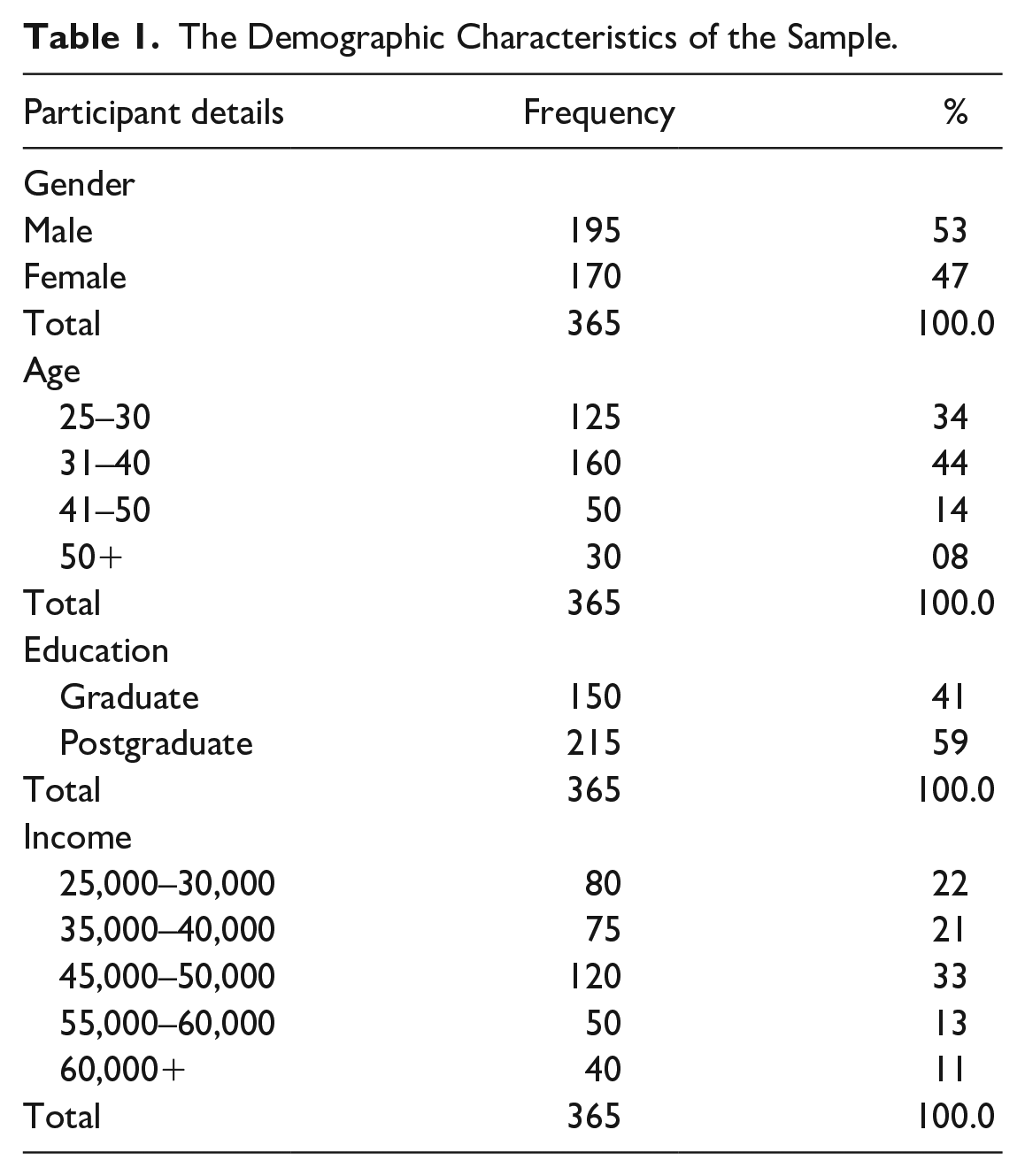
The purpose of our research was to highlight factors that could retain satisfaction among existing MTB users and trigger their instinct to recommend it. To align our aim, we only targeted existing MTB users in Karachi, Pakistan. We adopted convenience sampling method to collect the data. Having attached a cover letter which explained the survey purpose, we distributed 500 questionnaires through Facebook. The participants were aged above 24 years as they all were working in different professional fields. To ensure our purpose of research we started with a filtering question inquiring participants’ prior experience with MTB. It took 6 weeks to collect data; 365 responses were returned, out of which 10 responses were incomplete and 14 participants did not have any prior experience with MTB. This led to removal of 24 responses from data set. Finally, we had 341 responses to continue with data analysis with the response rate of 73% which is considered to be high. According to Weng et al. (2017), high response rate ensures perfection and minimal response bias in the interviews. Refer Table 1 for detailed demographic information.
The Demographic Characteristics of the Sample.
Instrument Validity
The survey instrument comprised two parts: the first part inquired participants about their demographic information and prior experience with MTB. The second part contained item scales adapted from utaut2 factors (Venkatesh et al., 2012) to assess PE with 4 item scales, EE with 4 item scales, SI with 3 item scales, Facilitating Conditions with 4 item scales, Hedonic Motivation with 3 item scales, Price Value with 3 item scales, and Habit with 4 item scales. Similarly we adapted 3 item scales for consumer satisfaction from Bhattacherjee (2001) and 3 item scales for intention to recommend from Verkijika (2018). All the items scales went through a minor modification to fit the context and were measured on 5-point Likert-type scale by “1 strongly disagree to 5 strongly agree.” Before launching formal survey, we also conducted a pilot test with a random sample of 36 participants. After getting satisfactory results, we launched the formal survey. Table 2 explains the measures and factor loadings.
Main Statistics.

Note. PE = performance expectancy; EE = effort expectancy; SI = social influence; FC = facilitating conditions; HM = hedonic motivation; PV = price value; HB = habit; CS = consumer satisfaction; IR = intention to recommend.
Data Analysis and Results
To proceed with data analysis, we utilized two-step approach (see, for example, Nikbin et al., 2015; Yusof et al., 2016). At first, we assessed measurement model, and then, we estimated structural model to test the hypotheses and evaluated predictive capacity of the framework. We evaluated factor loadings to assess inter-item reliability. Next we examined average variance extracted to check convergent liability. Then, we estimated composite reliability and Cronbach’s alpha to check internal consistency of item scales. We also carried out IPMA to assess performance of each construct. Table 2 represents the main statistics achieved.
To assess multicollinearity issues, we examined variance inflated factor (VIF). The achieved stats for all the variables are in line with standard threshold suggested by (Hair et al., 2011). Therefore, multicollinearity was not a concern in this study, refer Table 3.
Inner VIF Values.

Note. VIF = variance inflated factor.
Common method variance
To determine common method variance (CMV), we followed the guidance provided by Kock (2015; Siyal et al., 2020) who recommended that if all the inner and outer variance inflated factor stats are below the threshold of 3.3, then CMV issues do not exist in the model. The achieved stats presented in Tables 3 and 4 are in line with the above guidelines. Second, we used Harman’s single-factor test to examine CMV (Podsakoff & Organ, 1986). Our assessment indicated a cumulative of 18.29% variance, with the first (largest) factor explaining only 4.19% of the total variance which is less than 50% (B. Kumar, 2012). Moreover, the results depict that not even a single factor accounted for the majority of covariance in the predictor and criterion constructs (Podsakoff et al., 2012). It therefore suggests that the common method bias is not a major problem in this study.
Outer VIF Values.

Note. VIF = variance inflated factor.
Discriminant validity
Furthermore, in Table 5, we have compared the square roots of the AVE with correlation coefficients to investigate discriminant validity where all the studied factors appeared with greater intensity as compared to their correspondent correlation coefficients (Barclay et al., 1995; Fornell & Larcker, 1981).
Discriminant Validity.

Note. Values in boldface indicate square root AVE. EE = effort expectancy; FC = facilitating conditions; HB = habit; HM = hedonic motivation; IR = intention to recommend; PE = performance expectancy; PV = price value; SI = social influence.
Hypotheses Test
To assess significance of path coefficients, we followed guidelines of Nikbin et al. (2015), Yusof et al. (2016), and Henseler et al. (2009). We used bootstrapping procedure with 5,000 samples method (Hair et al., 2011) through SmartPLS 3.2.8 software (Saudi et al., 2019). Achieved results indicate empirical support for all the hypotheses presented in Figure 2 and Table 6.

Structural model results.
Path Coefficients and Significances.

Note. CS = consumer satisfaction; IR = intention to recommend; PE = performance expectancy; EE = effort expectancy; SI = social influence; FC = facilitating conditions; HM = hedonic motivation; PV = price value; HB = habit.
Predictive power of the model
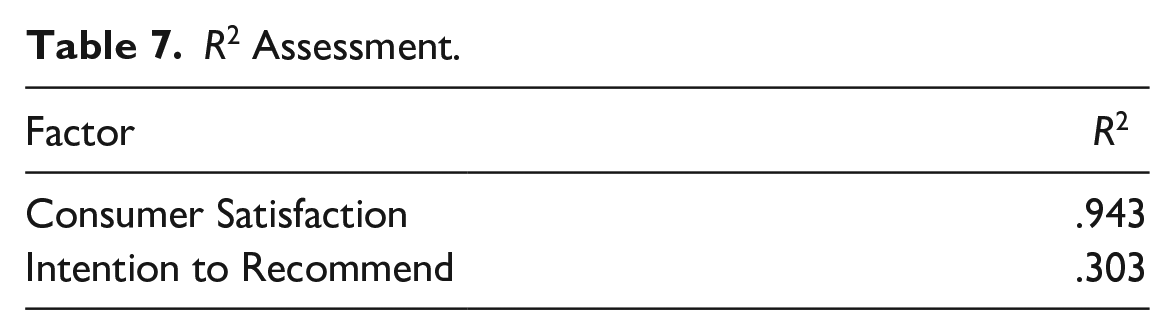
The framework’s prediction capability was determined by examining R2 in SmartPLS. PLS Algorithm was used to calculate R2 and obtained r2 values of 0.943 for consumer satisfaction and 0.303 for intention to recommend MTB. According to the suggestions of Falk and Miller (1992), r 2 values exceeding 0.010 are acceptable in social science research. However, our achieved results presented in Table 7 are above the suggested threshold.
R2 Assessment.
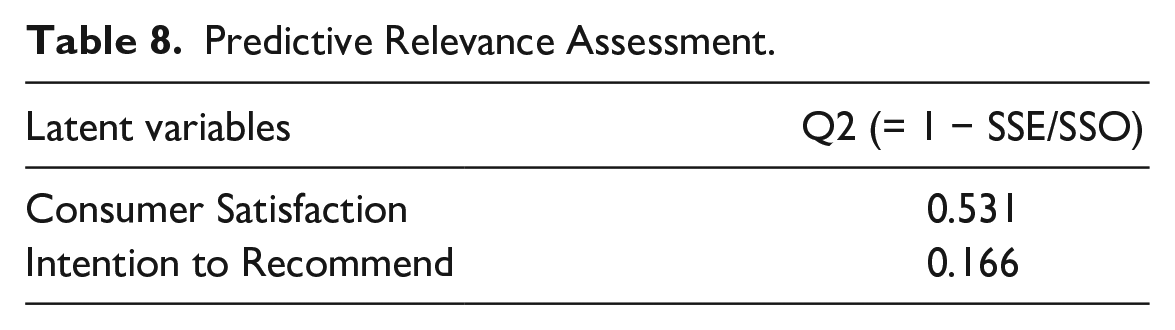
Finally, to assess the relevance of endogenous constructs, we estimated Q2 (Fornell, 1994). We performed assessment of Q2 via blindfolding procedure by determining cross-validated redundancy (Fornell, 1994). According to the recommendations of Chin (1998), if obtained Q2 values of endogenous variables are greater than zero, then the model denotes predictive relevance. However, the results presented in Table 8 exceed the suggested threshold. Hence, our model successfully demonstrates predictive relevance.
Predictive Relevance Assessment.
Discussions
Current research aimed to determine factors that could enhance consumer experience for using MTB. For enhancing consumer experience, MTB companies provide various features to retain loyalty of existing consumers and attract new ones. Being a relatively new arena of research MTB has not been widely explored, there are a few studies that have looked at initial adoption of MTB whereas factors enhancing consumer satisfaction and loyalty that could lead them to recommend have been largely ignored. Current study has extended utaut2 with mediating role of consumer satisfaction leading to consumer recommendation of MTB. Statistical results prove that the framework is acceptable and adds substantial contribution to prevailing knowledge. We adopted bootstrapping mechanism to test the hypotheses. Except H10 all the hypothesized relations were supported.
H1 substantially supported the relation between PE and CS to enhance consumer satisfaction for using MTB. Our finding conceptualizes that MTB usefulness increases the travel experience of consumers which appeals their inner satisfaction and retains their loyalty. Our finding further explains that consumers’ enjoyable experience while using a site such as MTB increases their satisfaction toward its use. Many other studies conducted by Herrero and San Martín (2017), San Martín and Herrero (2012), and Siyal, Donghong, et al. (2019) have validated stimulus impact of PE on consumer satisfaction. H2 estimated positive effects of EE on CS to use MTB. Our finding explains that consumers prefer MTB apps which are easy to use or require least efforts. Our finding further explains that user friendly apps cognitively attach consumers with reuse tendencies. This finding is congruent with the results of Bruner and Kumar (2005), Ernst et al. (2013), Salimon et al. (2017), and van der Heijden (2004). H3 positively supports relation of SI with CS to use MTB. Our finding explains that social ambiance like family and friends create a desire among individuals to use new technologies like MTB and give them a satisfactory exposure to stay connected with those systems. Our finding is in line with the conclusions of Weng et al. (2017; Zhou et al., 2010).
H4 supported the relation between FC and CS to use MTB. Our finding explores that appropriate and timely support from technical team and infrastructure enhances consumers’ level of satisfaction within the system and retains their loyalty. Our finding emphasizes that the compatibility of MTB with contemporary technologies would further enhance consumer experience and serve as a motivational factor to remain connected with MTB. Our findings are congruent with the results of Alalwan et al. (2017), Paola Torres Maldonado et al. (2011), Salimon et al. (2017), and Weng et al. (2017). H5 well connected the impact of HM on CS to use MTB. Our finding explores that if consumers derive pleasure, entertainment, and fun while using the system it would incline their satisfaction within the technology. Our finding further explores that utilitarian factors like playfulness and amusement act as motivators and boost consumers’ level of satisfaction in using MTB. Our findings are congruent with the conclusions of Morosan and Defranco (2016a), Siyal, Donghong, et al. (2019), and Thong et al. (2006b).
H6 well estimated the positive effects of PV on CS to use MTB. Our finding explains that monetary cost of technology use tends consumers to compare with contemporary systems available in the market. Therefore, if consumers perceive that using MTB is comparatively beneficial and more useful they would retain it. Our finding further explains that high cost of system use may trigger dissatisfaction and rejection of MTB among consumers. Our findings are in line with the conclusions of Alalwan et al. (2017), Venkatesh et al. (2012), and Verkijika (2018). H7 positively supports the impact of HB on CS to use MTB. Our finding explores that when individuals repeat their learned behaviors, this course of repetition formulates their satisfaction in the technology use. Our finding further explains that the frequency of repetition triggers a sense of fulfillment among consumers and retains their choice of using MTB. Our findings are in line with the conclusions of Baptista and Oliveira (2016), Kim et al. (2005), Limayem et al. (2007), and Venkatesh et al. (2012). H8 well defined effects of CS on IR to recommend MTB. Our finding explores that technology satisfaction creates system loyalty among consumers. Our finding further explains that consumers’ loyalty with MTB further triggers their intention to recommend it. Our findings are congruent with the conclusions of Hsu et al. (2010) and R. Kumar et al. (2020).
H9 substantially supported mediation impact of CS between PE and IR to recommend MTB. Our finding explains that when consumers begin to enjoy system efficiency and pleasure, they are more inclined to recommend it. Our finding further explains that when consumers apprehend technology utilitarian, they begin to spread positive word of mouth. Our finding is congruent with the conclusions of Baptista and Oliveira (2016), Saber Chtourou and Souiden (2010), and Salimon et al. (2017). The statistical results did not support for mediation effects of CS between EE and IR; henceforth, H10 was rejected. H11 significantly supported mediation impact of CS between SI and IR to recommend MTB. Our finding explores that satisfied consumers of MTB while sharing their experiences about MTB give a perception of recommendation in their social circles. Our finding further explains that such positive word of mouth from social circles motivates individuals to use MTB. Our findings are in line with the conclusions of Alalwan et al. (2017), Olasina (2019), and Zhou et al. (2010). H12 supported the mediation effects of CS between FC and IR to recommend MTB. Our finding suggests that if MTB resources are aligned with contemporary technologies, it would add value to the satisfaction level of consumers and further incline them to spread positive word of mouth in their area of influence. Our finding is in line with the conclusions of McInerney et al. (2005), Venkatesh et al. (2003), and Yang and Forney (2013).
H13 well supported the mediation impact of CS between HM and IR to recommend MTB. Our finding explains that nonutilitarian factors give consumers a sense of pleasure while using MTB and further increases their level of satisfaction within the system which tends them to recommend it. Our finding is congruent with Morosan and Defranco (2016a), Oliveira et al. (2016), Salimon et al. (2017), and Thong et al. (2006). H14 positively supported the mediation effects of CS between PV and IR to recommend MTB. Our finding suggests that when consumers find that the use of MTB is cheaper than the traditional mode of transportation they would retain their loyalty with the system and further spread positive word of mouth in their circle of influence. Our finding is in line with the conclusions of Salimon et al. (2017), Siyal, Ding, and Siyal (2019), and Venkatesh et al. (2012). H15 estimated positive support for mediation impact of CS between HB and IR to recommend MTB. Our finding explains that frequency of consumers past behavior determines their present and future behavior. Our finding further explains that repetition of MTB use formulates consumers’ satisfaction within the system, retains their loyalty, and further inclines them to recommend it. Our findings are congruent with the conclusions of Baptista and Oliveira (2015) and Morosan and Defranco (2016b).
Current study aims at redefining impact of consumer satisfaction in retaining existing users and inclining them to spread a positive word of mouth in their circle of influence by enhancing their experience of MTB. Various studies have established consumer satisfaction as an essential mediator between consumer experience and brand attachment (Abedi & Jahed, 2020); service quality and behavioral intentions (De Oña, 2021); and airline service quality and behavioral intentions (Shah et al., 2020). However, our study has opted to modify utaut2 with mediating potential of consumer satisfaction leading consumers to recommend MTB.
Theoretical Contributions
Current research study has modified utaut2 with mediation potential of consumer satisfaction in MTB leading toward consumer intention to recommend it. The modification represents significant direction in technology management domain like MTB which has so far remained under evaluated. Our conceptual framework based on theoretical foundation comprises significant contribution by proposing mediation effects of all prime factors of utaut2 through consumer satisfaction toward intent to recommend MTB. Henceforth, our study substantially contributes to the theoretical horizon of utaut2. Since utaut2 was devised to test technology management in consumer context, this study opted to mold its applicability in new setting like MTB, a new perspective like consumer satisfaction which retains consumer loyalty and inclines their intention to recommend it.
Implications to Practice
Current research offers implications for various stakeholders in transportation industry such as MTB service providers, application developers, network operators, and smartphone manufacturing companies. The statistical results support significant role of all the prime factors of utaut2 model with consumer satisfaction in MTB and their intention to recommend it. The results identify factors that could shape consumer satisfaction and further inclination for recommendation. The findings will provide insight to service providers to understand post adoption issues and identify attributes that could mold consumer loyalty. The findings encourage companies to enhance their focus on improving utilitarian aspects as it has been statistically proved that performance and efficiency form consumer satisfaction toward MTB. Existing consumers could be offered a bonus mileage or a discounted ride as a motivational tool to reuse MTB. Social media platforms could play a vital role to promote such campaigns. Qualitative and user friendly interface could further add hedonic values to the system and motivate consumers to stay connected with MTB. Moreover, induction of local languages in MTB applications could appropriately lead consumers to their comfort zones.
Cultural aspects play an important role to promote satisfaction among consumers; therefore, MTB service providers should utilize social media platforms for providing their existing and prospect customers with tutorial videos in both national and international languages. The companies should reward their existing customers for recommending MTB in their circle of influence such incentives could help to retain their satisfaction and loyalty. Service providers are recommended to launch promotional campaigns led by their extroverted consumers as they could be the right potential to permeate positive word of mouth. Furthermore, infrastructure of a novel technology should be compatible with the contemporary technologies, in addition round the clock technical support should be available in national and international languages to ensure consumer comfort level.
Application content also creates hedonic values among consumers; therefore, companies should develop more fun, joy, happiness, and satisfaction within MTB use to create bonding among consumers. Such consumer bonding from a satisfactory past experience will result in a habit to use MTB again because habit plays an essential role in reuse of a novel technology. Therefore, to further strengthen consumer habit companies need to provide consumers with distinct personalized services capable of influencing consumer likings. It is also noticed that besides perception of possible gain and performance financial cost incurred on technology use effects consumers’ intent to use MTB. Henceforth, strategies toward economical prices should be prioritized to enhance consumer satisfaction in MTB use. Consumers should periodically be educated on how to use new features included in MTB through popular social media platforms. Likewise improving perception of performance and efficiency of MTB, companies can add value to consumer satisfaction and trigger their instinct to recommend it.
Limitations and Future Directions
While examining factors that could enhance consumers satisfaction in using MTB, current study faced several limitations. First, authors only examined existing users of (Cream and Uber) at a certain point of time through cross sectional framework while the non-users were not taken into account. Second, majority of the survey respondents were graduates which alarms to predict use of MTB in general as the literacy rate in Pakistan is quite low. Third, current research was conducted in an emerging economy which limits the generalizability of results with developed societies. Henceforth, authors recommend future scholars to conduct a longitudinal survey to find out consumer variations over time.
Conclusion
MTB is an area of interest to be explored these days; particularly, the level of its consumer satisfaction which retains their loyalty and creates an instinct to recommend it further. Since consumer satisfaction in MTB has seldom been examined in an emerging setting like Pakistan with a theoretical foundation that could better explain the antecedents adding value to the satisfaction level of MTB consumers leading them to recommend it. Henceforth, utaut2 was modified and extended to fit purpose of current study which was to find factors that could form consumers’ satisfaction and further trigger their instinct to recommend it. The statistical results validated the motivational impact of utaut2 prime factors in shaping consumer satisfaction with MTB and arousing their intuition to recommend in their circle of influence.
Footnotes
Appendix
Declaration of Conflicting Interests
The author(s) declared no potential conflicts of interest with respect to the research, authorship, and/or publication of this article.
Funding
The author(s) received no financial support for the research, authorship, and/or publication of this article.
