




Abstract
While previous studies show that risk perceptions vary across populations and domains, there is little empirical evidence on the interplay between individual-level characteristics and risk domains in shaping perceived social risks in a country such as China. This study examines empirically the effects of individual-level characteristics on risk perceptions across different domains. Based on a large sample survey data from 31 provincial capitals in China, our analysis demonstrates that risk perceptions fall into four domains: contingencies, health threat, natural hazards, and social security. The multilevel model estimates indicate that confidence in local government responsible for risk management and being a male are uniformly and significantly correlated to less risk perceptions among all risk domains. Education presents a consistent pattern in amplifying risk perceptions, with only some effects on perceived health threat and contingencies displaying statistical significance. Also, age and income exhibit mixed associations with risk perceptions, only with age significantly attenuating perceived contingencies. The results also demonstrate that religious faith, party membership, and Hukou are related to risk perceptions. We discuss the theoretical and policy implications of our findings and conclude with research limitations and future research avenues.
Introduction
The transformation from an industrial society to a modern society symbolizes the coming of a “risk society,” in which people live with both conventional risks and new, man-made uncertainties (Beck, 1992). Urban areas appear to be increasingly affected by natural and man-made hazards (Joffe et al., 2013; Singh, 2015), and the side effects of urbanization directly trigger crises or evolve into potential hazards (Ewing et al., 2016; Frumkin, 2016; Johnson, 2001; Power, 2001). Urban areas are not only victims but also producers of risks (Kraas, 2008). The dynamic coupling of urban systems can reshape conventional hazards and generate new risks (Organization for Economic Co-operation and Development, 2003). As coevolution of sharp social transition and intensified urban sprawl, various Chinese cities, mega cities, in particular, are confronting the upsurge of social risks and crises, which present great challenges for local governments (Jinhua, 2018). The lingering of heavy city smog (Cheng et al., 2017), controversial environmental protests against controversial facility siting (Y. Li, 2018) indicate that Chinese urban residents are living in a high environmental hazards context. The persistent and rampant food safety scandals, such as the case of toxic Sanlu milk powder, vividly display that the Chinese are exposed to growing food-related health risks (Yan, 2012). The seasonal pluvial floods—occurred recently in large cities—seriously disrupt critical infrastructures, such as electricity and transportation systems and people’s daily life, which is regarded as one of severe natural hazards in urban China (Yin et al., 2015). The salience of social risks and high incidence of various crises in urban China have induced widespread public concerns and undermined public confidence in governments’ capacity. It is imperative to understand how residents perceive social risks in the context of urban China and to inform effective risk mitigation and regulation policies.
How the public perceives social risks matters for it is an indispensable input when designing risk-reducing and crisis handling strategies (Renn, 1998, 2017; Slovic et al., 1982). Otherwise, communication and management efforts cannot achieve desired outcomes (Buchecker et al., 2013), and even lead to social unrest (Hung & Wang, 2011). How the public perceives risks also affects the judgments they make and the actions they take to respond to these risks (Cheng et al., 2017; T. Feng et al., 2014; Lindell & Hwang, 2008). In the literature, risk perception research has surveyed a vast array of hazardous substances (Bickerstaff, 2004; Dosman et al., 2001; Hung & Wang, 2011; Peacock et al., 2005). Previous studies have well documented that perceptions of risks vary across individual factors, such as age, gender, education, income, attitudes toward governments, and so on (Andersson, 2011; Hakes & Viscusi, 2004; Olofsson & Öhman, 2015; Palmer, 2003; Siegrist et al., 2000; Sundblad et al., 2007). However, the majority of the existing studies overlook the importance of domain-specific nature of risks in explaining risk perception heterogeneity.
To close this gap, the present study aims to combine individual-level characteristics with risk domains to investigate variability in risk perception among Chinese urban residents. It does so using data from public safety survey in 31 Chinese provincial capital cities to examine the effects of the interplay of individual characteristics and risk domains on risk perceptions. More specifically, the study examines the effects of confidence in government and individual attributes on risk perceptions across the risk domain. This study contributes to the risk perception literature in three ways. First, the results of this study illustrate that the risk perception of Chinese provincial capitals’ residents can be classified into four categories: social security, natural hazards, health threat, and contingencies. It is of practical importance to partition social risks for risk governance and communication in different situations (Slovic, 1987). Second, following recent calls in the literature (Bickerstaff, 2004; Ng & Rayner, 2010), the article introduces the domain-specific nature of risks to explain the risk perception heterogeneity over individual-level characteristics. Combing individual characteristics and risk domains to decompose perception of risks is a theoretical contribution to studies of risk perception. Third, the study contributes to the literature by directly assessing how confidence in government impacts perceptions of social risks. As one key dimension of trust, confidence has been paid less attention in affecting risk perceptions (Siegrist, 2021).
The next section reviews the literature and develops the hypotheses to be tested in this study. This is followed by an introduction to the survey data, the variables to be used, and the analytic method. Then, we present the results of the statistical analyses. Finally, the theoretical contribution and policy implications are discussed.
Literature Review and Hypotheses
Risk Perception
Risk perception refers to the processing of observations or information concerning hazardous activities and technologies, and the formation of judgments about seriousness, likelihood, and acceptability of the respective activity or technology (Renn, 2017; Slovic, 1987; Slovic et al., 1980). Given the considerable divergence between the general public’s risk judgments and experts’ risk assessments, risk perception is widely held to be crucial in communicating and governing risks (Fischhoff et al., 1993; Pidgeon, 1998; Renn, 1998). Previous studies have highlighted that considering the general public’s risk perceptions when assessing risks for policy development can enhance policy legitimacy and compliance (Peacock et al., 2005; Sjöberg, 2001). To date, risk perception research has examined a wide array of potentially harmful events including natural (e.g., earthquake, floods), technical (e.g., waste incinerators, nuclear power plants), and environmental hazards (e.g., lingering smog, polluted rivers; Ho et al., 2008) and well documented that perceptions of risks vary across individual factors such as age (Rolison et al., 2017), gender (Gustafsod, 1998), income (Olofsson & Öhman, 2015), ethnicities and race (Macias, 2016), education (Sund et al., 2017), and attitudes toward governments (Ma & Christensen, 2019). Over the past decades, the psychometric paradigm and cultural theory have evolved to be two dominant and diverging approaches in studies of risk perceptions. Assuming risk characteristics as the principal shaper of risk perception (Bickerstaff, 2004; Kraus & Slovic, 1988), the psychometric paradigm dedicates to address the research question of “why various hazards are perceived differently” (Siegrist, Keller, & Kiers, 2005, p. 211). Founded upon the constructivist perspective of risks (Renn, 1998), the cultural theory of risks provides a theoretical underpinning to understand “why different people perceive the same hazard differently” (Viklund, 2003, p. 728).
Along with the suggestion of studying risk perception with an integrative perspective (Bickerstaff, 2004; Ng & Rayner, 2010), recent studies seek to explain risk perceptions with a combination of individual and risk characteristics. Some studies show that individual-level characteristics’ effects on risk perception vary across risk domains (Cullen et al., 2018; Cummings et al., 2013; Räsänen et al., 2012; Rodionova et al., 2009; Sund et al., 2017). For instance, the analysis of national survey data from American households shows that education and blog usage for risk information are significant predictors of agentic risks and emerging technological risks, while political ideology is the sole significant predictor of manufacturing risks (Cummings et al., 2013). Further, some other studies document that risk perceptions can be better explained with the interplay of both personality dimensions and the domain of risks appraised (Bouyer et al., 2001; Chauvin et al., 2007; Nicholson et al., 2005; Weller & Tikir, 2011). All these studies corroborate the observation that risks are highly domain-specific (Nicholson et al., 2005; Weber et al., 2002; Yue et al., 2018). It is, therefore, important to take both domain-specific nature of risks and personal factors into consideration when examining heterogeneity in risk perceptions.
In contrast to the generalization of social risks in China in general and urban communities in particular, inadequate attention has been paid to Chinese risk perception studies. To our knowledge, relevant studies mainly focus on individual hazards with the case-by-case approach, which can be divided into three categories. The first cohort of studies presents a brief overview for the public perceptions of some salience hazards, such as environmental hazards (J. Zhang, 1994), Blue-Algae Bloom (Huang et al., 2010), genetically modified (GM) food (L. Lü & Chen, 2016), and p-xylene projects (L. Zhang et al., 2013). A central theme of these studies is to describe the participant’s degree of concern or severity concerning hazards or activities. The second group of studies attempts to explore the pivotal role of social and individual factors on risk perceptions to present an in-depth analysis of the risk perception interested (Ban et al., 2017; Huang et al., 2018; D. Liu et al., 2018; Tian et al., 2014). The last group of studies explores public perceptions of hazards and substances that may modify respondents’ behaviors to avoid potential consequence in various contexts (T. Feng et al., 2014; Liao et al., 2009; X. Lu et al., 2015; F. Wang et al., 2018; S. Wang, Wang, et al., 2019; W. Zhu & Yao, 2019). However, only two studies are explaining risk perceptions by risk characteristics with Xie et al. (2003) displaying societal risk perceptions among Chinese by classification of personal life, natural hazards, and social development issues, and Ma and Christensen (2019) tackling the effects of social trust, government trust, and other personal attributes on perceived emergencies and health threat. In the ensuing subsections, we will review the impacts of confidence in government and sociodemographic factors on risk perceptions, respectively, and propose corresponding hypotheses.
Confidence in Government and Risk Perceptions
Scholarly efforts with regards to the influence of confidence in the government on perceived risks mainly stem from the discussion of how trust shapes public risk perception. The faith that trust is of help to gain a better understanding of risk perceptions has spurred growing studies to test the influences of trust over various perceived risks, such as natural hazards (Wachinger et al., 2013), GM food (X. Lu et al., 2015; Siegrist et al., 2008), and controversial facilities (Chung & Kim, 2009; Terwel et al., 2009). Literature reviews suggest that the effect of trust on risk perception depends on how trust is conceptualized and measured (Earle, 2010; Earle et al., 2007; Siegrist, 2021). In the extant literature, few studies address the relationships between different dimensions of trust and risk perceptions (Allum, 2007; Earle et al., 2007; X. Lu et al., 2015; Siegrist, Gutscher, & Earle, 2005). Distinguishing confidence from social trust is indeed a great effort to move beyond the loose conceptualization of trust (Siegrist, 2021; Siegrist et al., 2003; Terwel et al., 2009). Social trust is described as “the willingness to make oneself vulnerable to another based on a judgment of similarity of intentions or values,” whereas confidence refers to “the belief, based on experience or evidence, that certain future events will occur as expected” (Siegrist et al., 2003, p. 706). Put simply, social trust is based on value similarity; in contrast, confidence is based on performance or evidence. However, social trust conditions the interpretation of confidence (de Jonge et al., 2008; Siegrist, 2021), whose role in explaining perceived risks somehow attracts less attention.
Confidence in government bonds the interaction between authority and society, which demonstrates a general positive orientation toward a given set of authorities’ capacity and legitimacy (Easton, 1975; Newton & Norris, 2000). Given the crisis of confidence in government arising from proliferating hazards and their profound consequences, an increasing number of researchers dedicate to examine the role of confidence in government in risk communication and management. Some studies document that confidence in government charged with risk or crisis management significantly increases the probability of taking preparedness actions (Basolo et al., 2009; Wei et al., 2019). Interestingly, a study from Dutch citizens presents that the confidence in flood protection reduces citizens’ perceived flood likelihood, which in turn impedes their flood preparedness intention (Terpstra, 2011). Some other studies find that confidence in government plays a critical role in eliciting citizens’ compliance and cooperation with governments (Kim & Oh, 2015; Mesch & Schwirian, 2014; van der Weerd et al., 2011). For instance, residents’ confidence in the government managing risks of hazardous facilities significantly increases their support for the siting of such facilities (Jenkins-Smith et al., 2011). All these studies suggest that confidence in government plays a critical role in shaping risk perceptions.
Access to risk-related information can eliminate the degree of unknownness and thereafter alleviate one’s cognitive uncertainty in the face of risks. Faced with hazardous events or crises, the government as a risk regulator has the responsibility to communicate hazards-related information to the public promptly and transparently (Frewer, 2003). Risk information from reliable agencies is readily internalized by the public to appease their fear and, as a result, mitigate their risk perceptions (Trumbo & McComas, 2003). If government agencies deliver distorted information or even cover up the truth and facts (e.g., Chinese local government’s practice in the scandal of Sanlu milk powder; local governments’ manipulation on information disclosure in controversial facilities siting), then governments will face a crisis of confidence, which in turn exaggerates the public’s concerns toward hazards. Moreover, the recreancy theorem argues that people perceive risks based upon their perceptions of institutional responsibility and performance (Cope et al., 2016; Freudenburg, 2003). More specifically, governments’ failures in carrying out their duties in risk management and recovery efforts engender public confidence in governments and may intensify the public’s negative reaction to the hazards they have been or are facing. For example, the government’s neglect and misconduct in managing technological disasters amplify the public’s awareness of risk and even fuel perceptions of community damage and affective judgments and consequently elevate their perceived risks (Beamish, 2001; Ritchie et al., 2013). Based on the aforementioned empirical studies and theoretical underpinnings, we hypothesize as follows:
Sociodemographic Factors and Risk Perceptions
Cross-national studies have displayed that perceptions of specific risks vary across sociodemographic factors, such as age (Andersson, 2011; Lazo et al., 2000), gender (Gustafsod, 1998; Olofsson & Öhman, 2015), education (Hakes & Viscusi, 2004; Sundblad et al., 2007), income (Palmer, 2003; Trumbo et al., 2014), ethnicity and race (Burger & Greenberg, 2006), and religious faith (Billig, 2006), though their explained variances prove to be low (Sjöberg, 2003). However, studies testing the influences of sociodemographic factors on risk perceptions are sporadic and fragmented. This study attempts to integrate them to explain perceptions of social risks.
Previous studies have confirmed age is a significant predictor of risk perceptions, presenting that older individuals have higher perceptions of risk compared with younger ones. Slimak and Dietz (2006) found older respondents are likely to concern more biological, ecological, and chemical risks. Similar results have been found for earthquakes, city smog, food additives, pesticides, influenza, nuclear waste (Armaş, 2006; Cheng et al., 2017; Commodari, 2017; Dosman et al., 2001; Sjöberg, 2004), and hazards from different risk domains (Ma & Christensen, 2019; Siegrist, Gutscher, & Earle, 2005). As people age, their physical conditions are progressively inhibiting their risk reduction and self-protection abilities, which lead older people to be more vulnerable and worried about social hazards. Furthermore, older generations in urban China are more integrated into the urban transition and development, and they have experienced relatively more complexities and risks throughout their lives. Thus, given older individuals vulnerability to social hazards and their unpleasant experience, we hypothesize as follows:
Gender differences in perceptions of social risks have attracted considerable attention in the literature. Accumulating studies document that females are inclined to express higher concern toward environmental hazards (Davidson & Freudenburg, 1996; Flynn et al., 1994), alcohol and drug use (Spigner et al., 1993), nuclear radiation (Morioka, 2014), earthquake (Kung & Chen, 2012), and food (P. Liu & Ma, 2016). According to the sexual division of labor, females’ responsibilities usually are confined to regular activities in and around the home, which is a more prevalent phenomenon in Confucius societies such as China. In line with this rationale, women have to funnel their energies into food making, housekeeping, and child-rearing, which lead them to be more sensitive to risks related to household affairs (Gustafsod, 1998; Morioka, 2014). Working women combining work outside of the home with the responsibilities of homemaking and child caring are affected by risks from both in and out of the home and consequently are exposed to more risks. Moreover, unequal power relations profoundly reveal women are more vulnerable than men across social threats. Females are always reduced into a disadvantaged sociopolitical position due to gender inequality or discrimination (Flynn et al., 1994; Satterfield et al., 2004), suggesting that risks are always triggered and managed by men and that men feel risks as more acceptable than women for they may benefit more from the risk-takings. Therefore, we hypothesize as follows:
Risk perception research has also highlighted the differences in risk perceptions across ethnic groups with findings that racial and minority groups incline to view higher risks than the Whites over natural hazards (Fox Gotham et al., 2017; Lindell & Hwang, 2008; Senkbeil et al., 2014), environmental hazards (Campbell, 2009; Chakraborty et al., 2017; Macias, 2016), petrochemical threat (Cutchin et al., 2008), and nuclear power (Vaughan & Nordenstam, 1991). A recent study of the perceived hot weather and coping behavior among rural residents of ethnic minority regions in China finds that Han Chinese perceives warm temperatures and associated health risks lower than minor ethnicities (H. Li et al., 2019). Compared with Han people, ethnic minorities in urban China are to some extent marginalized by education attainment and economic activities (Hasmath & Ho, 2015; Hong, 2010), which suggests less social resources can be leveraged by ethnic minorities to alleviate the possible consequences of crises and risks. Also, due to disparities in lifestyle, minorities may face segregation problems that harm their local identity and ultimately restrain their psychological adaptability to social hazards (Tan et al., 2019). On this basis, we hypothesize as follows:
It is generally accepted that people with higher socioeconomic status (SES), such as income and education, possess higher self-efficacy in protecting themselves from, or adapt to social hazards; thus, people with higher SES appear to perceive lower social risks (Dosman et al., 2001; Russo et al., 2013; Slimak & Dietz, 2006). Some recent studies from China find that education is positively related to risk perception (Wu et al., 2017; Xiao et al., 2013), though negative correlation has been corroborated in studies of other countries (Rowe & Wright, 2001; Slimak & Dietz, 2006). People with higher income possess more available resources to protect themselves from harmful incidents and to accelerate the recovery (Bubeck et al., 2012). Individuals with higher income, therefore, appear to be considerably self-efficient, which decreases their risk perception. Knowledge and information on social risks (via training, media reporting, personal reading, etc.) are accessible to highly educated people and give rise to greater knowledge and insight about the nature and consequences of social dangers. Moreover, people attaining more education tend to be more critical of government authorities (L. Li, 2004), which may make them hold a more cynical mood to the risk regulation systems and perceive higher risks. We, therefore, hypothesize as follows:
Method
Data and Sample
The data utilized in this study are drawn from the 2017 Public Safety National Survey of Chinese Urban Residents, which is an annual survey program across Mainland China. The survey program is initiated and administered by the Center for Public Safety Innovative Research affiliated with China University of Mining & Technology (CUMT). The data collection was conducted across 31 provincial capital cities in China from July to August 2017. These cities include four municipalities (Beijing, Tianjin, Shanghai, and Chongqing), five capital cities of autonomous regions (Lhasa, Urumqi, Hohhot, Yinchuan, and Nanning), and 22 provincial capital cities (e.g., Guangzhou), which can be regarded as desirable context to examine residents’ propensity toward various risks (Ma & Christensen, 2019).
The survey questionnaire consisted of a cover letter, individual characteristics, perceptions of societal risks, and views about safety awareness and behavioral responses. A sample size of 300 was planned to be obtained in each city (31 provincial capital cities, 9,303 responses). A multistage stratified random sampling was developed to recruit potential respondents. First, subdistricts (Jiedaos) were randomly chosen in each of the 31 cities. The second stage of random sampling generated a sample of residential neighborhoods (Juweihuis) or villages (Cunminweiyuanhuis) from the chosen subdistricts. This was ensued by the equidistant sampling of households in each of the selected residential communities or villages. Finally, one person aged 18 years and above from each household was randomly asked to complete the questionnaire. In sum, 9,309 people answered the questionnaire, and 589 responses were excluded in our analysis due to the missing data. There are 18 research assistant teams with each one equipped with teaching staff and 10 undergraduate students. All the survey staff is well-trained and could sophistically answer questions, which could enhance the validity and reliability of the responses. Appendix A displays sample distribution in each city. To ensure sample representativeness, we compared the selected demographics (age, gender, and education) with the corresponding demographics of national census data (N. Feng, 2012). Survey sample demographics showed no statistically significant differences with overall city demographics.
Risk Perception
There are 32 items in the questionnaire employed to investigate respondents’ perception of risks from nine fields: natural hazards, environment and ecology, public health, food safety, transportation safety, the safety of public utilities, public order, social welfare, and information security. For each item, the respondents were asked to “Please indicate the degree of your concern about the following hazards and risks in your daily life.” The responses were measured with a 10-point Likert-type scale, ranging from 1 (“very concerned”) to 10 (“not concerned”). Each presented item is evaluated from the perspective of how the respondents perceive specific risks, which could map a general picture of risk perceptions and can be employed to discern the structure of perceived risks. The risk perception scale was inverted for a better interpretation of the results, with higher scores indicating higher levels of risk perceptions.
We performed an exploratory factor analysis with principal component factoring and varimax rotation technique to identify the underlying dimensions of risk perceptions. In the initial analysis, we obtained four components, with all their Eigenvalue above 1 (Table). The factor-loading matrix of the initial analysis is presented in Appendix B. Repetitive exploratory factor analyses with the same techniques were conducted to refine the potential constructs, and 12 items with cross-loadings greater than 0.4 were discarded. Finally, the result of four common factors proved to be the best choice, which accounts for 72.6% of the total variance (see Table 1). Factor loadings of all the retaining items ranged from 0.608 to 0.842, exceeding the 0.5 threshold level (Hair et al., 2006).
Descriptive Statistics and Factor Analysis of Risk Perception.

Note. Principal component factoring and varimax rotation technique were utilized in factor analysis. Factor loadings less than 0.4 were omitted. Explained variance = 72.6%, N = 8,720.
Traffic accidents, emergency events or incidents in population-condensed places, collapse of critical infrastructures, public disorder, and personal safety when traveling alone at night loaded on Factor 1, which was labeled contingencies. Antibiotic abuses, contaminated meals, and food-related substances (e.g., additives, pesticide residues) were clustered into Factor 2, which was named health threat. Losses incurred by natural hazards, critical infrastructure fragility to natural disasters, and availability of natural-disaster relief were allocated to Factor 3, which was called natural hazards. Long-term care in old age, affordability of the medical treatments, and availability of government-sponsored relief to unemployment and serious illness were clustered in Factor 4, which was labeled social security. All the extracted factors present desirable internal consistency (α = .943 for contingencies, .898 for health threat, .847 for natural hazards, and .874 for social security). The average values of items loaded on the same factor were calculated to measure the four factors for further analysis.
Individual-Level Independent Variables
Confidence in government in the survey questionnaire is represented by three items. Item samples are as follows: “How satisfied are you with your local governments’ risk management performance?” “How confident are you in your local governments’ ability to handle potential social risks?” “How much do you trust the information that your local governments give about various safety accidents?” All three items were gauged with 5-point Likert-type scales, ranging from 1 (“not at all”) to 5 (“a great deal”).
The exploratory factor analysis was employed to ensure internal consistency in gauging confidence in the government. Factor analysis with principal factor analysis and varimax rotation technique showed that all the three items were clustered into one factor, whose eigenvalue exceeds 1. Reliability analysis with Cronbach’s alpha (α = .789) indicated that this scale possessed acceptable internal consistency.
Age was measured with a four-staged ordinal scale: 1 (18–29 years old), 2 (30–44 years old), 3 (45–59 years old), and 4 (above 60 years old). To identify the subtle differences across age categories, we utilized the group aged between 18 and 29 years as the reference category and created three dummies for the other categories.
Gender was gauged as a categorical variable with 1 and 2 in the original survey, embodying male and female, respectively. In the statistical analysis, this variable was transformed into a binary one with the male as the reference group.
Ethnicity was recorded with 11 categories in the original survey, including Han people, nine specific minorities with a relatively large population, and others. China is a multiethnic society. There are now 56 officially recognized ethnic groups (Minzu) in China. Among the various ethnic groups, Hans (Han people) constitute the majority, accounting for around 92% of the total Chinese population. We reclassified the categories into two new categories—Hans and minorities and used minorities as the reference category.
The income of the respondents was represented by their income per month. This ordinal variable consists of six categories and ranges from 1 (“less than RMB 2,000 Yuan”) to 6 (“more than RMB 12,500 Yuan”). To show the nuanced differences across income categories, we utilized less than RMB 2,000 Yuan as the reference category and created five dummies for the other categories.
Education attainment was gauged as an ordinal variable with five categories: 1 (“primary school and below”), 2 (“middle school”), 3 (“high school and technical secondary school”), 4 (“university”), and 5 (“graduate”). In the same manner, we used primary school and below as the reference group and constructed four dummies for the other categories.
Based on previous findings, religious faith, political orientation, and household status (Hukou) are expected to be relevant to perceptions of social risks. Religious faith generally suggests more community cohesion, which will cultivate more social capital by reciprocal interaction of actors and provide more spiritual and material resources in coping with potential risk and crises (Schipper et al., 2014). Religious belief acts as a nudged role to lessen human being’s concerns toward social risks. A survey from the Gaza region shows religious people perceive the region as less risky than that of the secular people (Billig, 2006). A national survey from China reveals that residents attending more religious activities are less likely to be concerned with health threat (Ma & Christensen, 2019). Thus, we expect that religious believers perceive social hazards as less risky than do non-believers. Religious faith was recorded into Buddhism, Taoism, Christianity, Islam, Catholicism, folk religions, and none. A dummy of the religious believer was created by merging the first six categories, as the majority of the responses (84.4%) were non-believers.
Moreover, political orientation (or ideology) differences in perceptions of specific risks have been confirmed in studies of West societies (Safi et al., 2012; Van der Linden, 2015). Holding the membership of the Chinese Communist Party (CCP), the ruling party of China, suggests having the privileged channel to government and probably enjoying various social benefits. A recent study showed that being a member of the CCP, the ruling party of China, possesses more knowledge and information on risks, and holds more confidence and trust around governments’ regulatory capacity in nuclear power (He et al., 2014). These lead us to expect party members tend to concern less about social risks. The political orientation of the respondents was measured by party membership and recorded into the CCP, Democratic Parties, Communist Youth League (CYL), and none. We constructed a party membership dummy by merging the first three categories.
The household registration system (known as “Hukou”) is a particular institutional design in China, by which Chinese citizens are labeled as urban versus rural population in terms of Hukou type, and outsiders versus insiders in terms of Hukou location. Hukou status now is regarded as one of the common demographic factors in modifying individual behaviors among social science studies of China (Chan & Buckingham, 2008) because it tremendously influences Chinese citizens in various aspects, including access to education, social welfare, and employment opportunities (Song, 2014). A study situated in 20 cities of the Pearl River Delta area, China, finds that having a local Hukou in the places where one works is closely related to adaptation capability to urban flooding (Liang et al., 2017). We, therefore, expect having a local urban Hukou is less likely to perceive social risks. Hukou status was operationalized into four types: local urban Hukou, local rural Hukou, nonlocal urban Hukou, and nonlocal rural Hukou. We used local urban Hukou as the reference category and constructed three dummies for the other categories.
Apart from individual-level variables, this study also incorporated several city-level variables that may shape people’s perceptions of social hazards. First, we included permanent resident population to gauge cities’ size, as large cities have large population at hazards, and are likely to subject to more risks and crises. Second, we controlled for gross domestic product (GDP) per capita to measure cities’ economic development, for cities with more affluence are more capable of reducing and adapting to risks. The data on permanent resident population and GDP per capita are from statistical communiqué on the national economic and social development issued by each city, averaged across 5 years from 2012 to 2016 before the survey. The two variables for Harbin and Lassa, however, are only drawn from the data in 2015 and 2013, respectively, due to availability constraints. Third, we included administrative rankings or levels of the cities, which indicates cities’ political resources and fiscal power in governing social risks. We set prefecture-level cities as the reference group and constructed two dummies for the four municipalities (e.g., Beijing) and 10 sub-provincial cities (e.g., Guangzhou). Finally, considering social vulnerability to hazards varies across geographic locations of cities (Gao, 2003; Zhou et al., 2014), all cities were categorized into three regions—eastern, central, and western. We utilized central cities as the reference group and created dummies for eastern and western cities.
Analytical Methods
A multilevel model was employed to examine the effects of individual-level characteristics on the cross-domain risk perceptions. This analyzing strategy was used in that the individual observations of the survey data were embedded within the city context. Individual observations in such a nested structure are usually not independent from each other, which violates the required assumptions of ordinary least squares (OLS) regression. Given the advantage in simultaneously estimating individual- and context-level effects, the multilevel model is increasingly adopted in risk perception studies (Knuth et al., 2014; Poortinga, 2005; Russo et al., 2013).
A two-level regression model was constructed to estimate the impacts of individual-level characteristics on perceptions of social risks while simultaneously considering city-level influences. More specifically, the two-level model consists of individual-level characteristics and the dependent variable—the perception of social risks at Level 1 and city-level variables at Level 2. We conducted four separate sets of the multilevel model to explore the effects of individual-level characteristics on the four cross-domain risk perceptions. Multilevel modeling was conducted using Proc Mixed (SAS Version 9.4).
Results
Descriptive Statistics
According to Table 2, the respondents are relatively concerned over food contaminants, such as additives, residues, gutter oil, and so on (M = 6.47), unsanitary foods from restaurants (M = 6.26), followed by non-fresh food ingredients (M = 6.15), and antibiotic abuses (M = 6.09), which all are related to public health. They are slightly worried about the affordability of medical treatments (M = 5.97), availability of government-sponsored relief (M = 5.96), traffic accidents (M = 5.89), the collapse of critical infrastructures (M = 5.68), personal safety when traveling alone at night (M = 5.68), and emergency events or incidents in population-condensed places (M = 5.63), all pertinent to social security and contingencies, respectively. Finally, they are least concerned about the vulnerability of civil infrastructure to natural hazards (M = 5.48), availability of natural disaster relief (M = 5.25), and losses incurred by natural hazards (M = 5.24). Put differently, as shown in Table 2, health threat is perceived as the riskiest domain by the respondents (M = 6.24), ensued by social security (M = 5.86), contingencies (M = 5.64), and natural hazards (M = 5.32).
Descriptive Statistics for Variables.

Note. GDP = gross domestic product.
The descriptive statistics of the variables used in this study are presented in Table 2. High standard deviations (SD = 2.41, 2.34, 2.25, and 2.10) reveal large variations in risk perceptions across all risk domains though similar values occur according to the 10-point Likert-type scale (Mostafa, 2016). The distributions of risk perceptions across the four domains are presented in Figure 1. In terms of confidence in government, the respondents are relatively confident in local government about risk management (M = 3.28), with only 23.4% of respondents indicating “a modest amount” or “a great deal” of confidence. The bivariate analysis finds that confidence in government is significantly and negatively related to perceived social security (r = –.23, p < .005), natural hazards (r = –.22, p < .005), health threat (r = –.18, p < .005), and contingencies (r = –.26, p < .005).
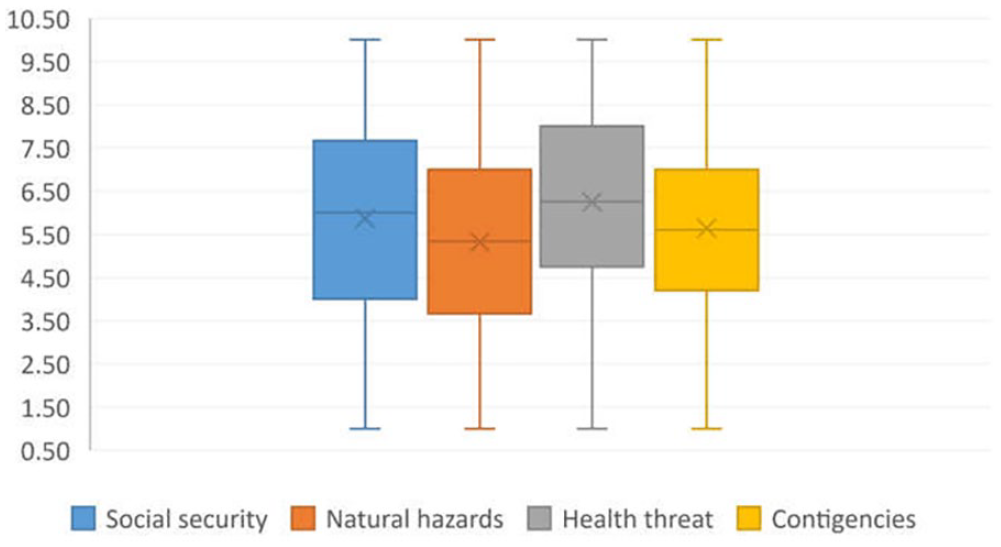
Risk perception across domains (N = 8,720).
Multilevel Models Estimates
Before the hypotheses testing, we used a null model without any predictors to identify whether there were city-level significant variances in perceptions of social risks (Poortinga, 2005). The results of the null models showed that the intraclass correlation coefficient (ICC) was 0.154, 0.170, 0.140, and 0.130, which suggests 13.0% to 17.0% of the total variance in risk perceptions within each domain could be attributed to city-level variance. The likelihood ratio (LR) statistics for each null model (χ2 = 571.9, p < .0001; χ2 = 527.6, p < .0001; χ2 = 444.6, p < .0001; χ2 = 851.6, p < .0001) justify that the between city variances are statistically significant and sufficient and that it is very appropriate to employ the multilevel model to accommodate the nested nature of the data. Having confirmed this, we then turn our attention to test the hypotheses by estimating the random intercept and fixed slope model (RIFSM).
The final “full” models consisting of all variables both at individual and city levels are presented in Table 3. As shown in Table 3, respondents who had a higher level of confidence in local government are likely to perceive low social security (β = –.75, p < .0001), natural hazards (β = –.66, p < .0001), health threat (β = –.56, p < .0001), and contingencies (β = –.74, p < .0001), lending support to H1. Compared with the reference category of age 18 to 29 years, the respondents aged 30 to 44 years, 45 to 59 years, and more than 60 years tend to perceive less health threat and contingencies whereas only the effects over perceived contingencies display statistical significance, respectively (β = –.13, p < .05; β = –.21, p < .005; β = –.19, p < .1). Moreover, age differences in perceptions of social welfare and natural hazards show mixed results whereas only respondents aged 30 to 44 years are significantly more likely to be concerned about social security than respondents aged 18 to 29 years (β = .27, p < .005). In a word, H2 is generally not supported by the results. In line with H3, female respondents are more consistently and significantly concerned about social security (β = .26, p < .0001), natural hazards (β = .38, p < .0001), health threat (β = .39, p < .0001), and contingencies (β = .57, p < .0001) than male respondents.
Multilevel Models Estimates.

Note. GDP = gross domestic product. AIC = Akaike information criterion; BIC = Bayesian information criterion.
p < .1. *p ≤ .05. **p ≤ .01. ***p ≤ .001.
In contrast to H4, there are significant differences in risk perceptions across ethnic groups with Han people perceiving more social security (β = .26, p < .01) and health threat (β = .16, p < .1) than minority peoples. As for H5, we find that respondents with higher levels of personal income do not significantly perceive less social risks and reject H5 as a result. Consistent with H6, respondents obtaining higher education are more likely to be concerned about social risks. But only the differences in perceptions of health threat between respondents with high school education (β = .28, p < .05), respondents with university education (β = .38, p < .001), and those with graduate education (β = .50, p < .01), on one hand, and the reference category of respondents with primary school education and below, on the other hand, are statistically significant. And the differences over perceptions of contingencies between respondents with university education (β = 0.20, p < .1) and those with graduate education (β = .29, p < .1), on one hand, and the reference category, on the other hand, also reach statistical significance.
A summary of hypothesis testing is displayed in Table 4. To check the robustness of our findings, hierarchical OLS regression models were formulated to estimate the four risk groupings by the same independent variables and the key results were substantially similar. To summarize, most hypotheses are not very well backed by our data. Although it is difficult to explain the lack of anticipated results in any one study (Ahmad & Cheng, 2018), we can offer two explanations. First, the hypotheses developments in our study are mainly based on risk perception literature from Western, non-Chinese contexts, which may not hold in China due to cultural differences. Second, this study is situated in 31 Chinese provincial capital cities, which reflects the broader context compared with studies employed to propose hypotheses. The characterized sample of the present study indicates considerable disparities in social contexts, such as demographics, SES (Che et al., 2009; Ji et al., 2009), and thus generates discrepant results. This further implies that local governments from these cities should develop and impose policies adapted to local social safety conditions.
Summary Report of Hypothesis Testing.

We also find some other individual characteristics are related to perceptions of social hazards. Religious believers tend to perceive less social risks than their counterparts though the significant difference only exists over perceptions of health threat. We find that being a member of CCP, democratic parties, or CYL is positively and significantly correlated with perceptions of social security. In terms of Hukou status, nonlocal rural residents are more concerned about social security, health threat, and contingencies than local urban respondents. Local rural respondents tend to perceive higher natural hazards than local urban residents. However, there is no significant difference between nonlocal urban residents and their local urban counterparts across risk perceptions of all domains. Contrary to our expectation, all city-level variables entered in the models are not significantly related to perceived social risks.
Discussion and Conclusion
The upsurge of social risks and crises in contemporary China has attracted growing academic attention, but much of the focus has been on individual hazards with the case-by-case approach, neglecting the domain-specific nature of risks. This study contributes to risk perception research in the following ways: First, we present a holistic overview of risk perceptions in the Chinese urban context, in particular among residents from Chinese provincial capitals, and find that risk perceptions fall into four domains: social security, natural hazards, health threat, and contingencies. Second, by comparing the correlates of perceptions across the four risk domains, we demonstrate that individual-level characteristics’ influences on risk perceptions vary across risk domains, which suggests combining individual-level characteristics with the domain-specific nature of risks can better explain variability in risk perceptions. And third, we highlight the pivotal role of confidence in government, one key dimension of trust, in reducing risk perceptions.
The identification of structured risk perceptions provides a macro-level framework to understand and discern social risks in the Chinese urban context, which wins support from a recent study in the Chinese context. When examining the effects of government trust and social trust on risk perceptions, Ma and Christensen (2019) reveal two similar categories: emergency and health threat. Furthermore, the confirmation of social security and natural hazards in our analysis provides a theoretical basis to understand citizens’ attitudes toward extra social risks. The partition of the four categories of perceived social risks among urban residents rightly maps the various risks and potential hazards that Chinese mega cities are currently confronting. To begin with, rampant scandals pertinent to food safety such as the 2008 melamine milk scandal, persistent public health incidents such as 2003 SARS, 2009 H1N1, and the heavy city smog to some extent vividly display the pressing public health issues in China, providing pieces of evidence for the public’s concerns over health threat. Second, inequality in welfare coverage among various populations (Ye, 2011) and the rigid welfare provision (London, 2014) somehow undermine the legitimacy of the current social security system in China and consequently raise citizens’ concerns over welfare services. Third, the finding that contingencies are perceived as a prominent concern among the respondents could be justified with the successive traffic accidents, toxic gas leakage, stampede, and public disorder, and so on, in the past decades along with Chinese urbanized development. Fourth, the low occurrence of natural disasters in urban areas may explain why respondents in the survey perceive natural hazards as less risky.
Contributing to the risk perception literature, this study confirms that confidence in local government responsible for risk management is of crucial importance in attenuating residents’ perceptions of risks. Although presenting nuanced differences in the magnitudes of the regression coefficients, the negative relationships between confidence in government and risk perceptions of all domains are consistently significant, which suggests the attenuation effect of confidence in the government on risk perceptions may be generalizable across risk domains. This finding is consistent with a study of food-related risks, from which trust by institutional performance is found to be significantly and negatively related to perceived risks over both two groupings of food risks (Meagher, 2019). However, in the same study, honesty-based trust in government authority shows relatively low validity in attenuating respondents’ perceptions of the two types of risks. This suggests performance-based trust probably has stronger strength than honesty-based trust in lessening people’s perceived risks. In contrast, a recent study exploring the influences of trust in governments, both central and local, on social perceptions of risks displays that central government trust and local government trust only significantly work on perceived emergencies while not perceived health threat (Ma & Christensen, 2019). Interestingly, central government trust is in a negative relation to perceived emergencies while local government trust is in positive relation with perceived emergencies. This could be attributed to the different dimensions applied and actors assessed in gauging trust. The comparative analyses of these contrasting results further reinforce the observation that how trust affects risk perception is contingent on how trust is conceptualized and to which actor the “trust” is assessed (Meagher, 2019). The effort to examine how and to what extent different dimensions of trust assigned to various actors shape the public’s attitudes to social risks can offer new insights.
As for sociodemographic correlates of risk perception, we find that the only gender is a significant predictor for perceived risks across all domains, where females tend to perceive higher risks than males. This finding corroborates the comment “perhaps the most widely demonstrated demographic factor related to risk perception is that of gender” (Rowe & Wright, 2001, p. 348). Also, this finding suggests gender effects on risk perceptions override the function of risk domains or types, which is consistent with studies from the United States and Europe (Cullen et al., 2018; Dosman et al., 2001; Meagher, 2019; Savage, 1993; Sund et al., 2017).
The unexpected result that older individuals are less likely to concern about contingencies than younger individuals is still in line with some studies (Knuth et al., 2014; Knuth et al., 2015). Three possible clues can be employed to explain this result. First, younger generations are inclined to be sensitive toward the daily emergencies for their lack of knowledge while older individuals that have been exposed to various crises and uncertainties are more familiar with these risks and as a result, perceive these risks as more acceptable and less threatening. A possible cohort effect might also be reasonable with younger generations in their adolescent hood or early adulthood having been through successive emergent accidents with explosive urbanization development in China since the early 1990s, and therefore they consider emergencies as more threatening. And finally, individuals of older age exhibit higher safety cautiousness and are more responsive to the warnings concerning potential emergencies than their younger counterparts, thus are well-prepared and view the possible contingencies as less risky (Rolison et al., 2017).
To our surprise, Han people perceive greater risk with regards to social security and health threat than ethnic minorities. The hierarchy of needs theory could help us understand the unexpected findings. Compared with the Han people, ethnic minorities in urban China reside around the outskirts area and are disadvantaged in income, employment opportunities, and social services (H. Zhu & Zheng, 2017). In this case, the basic and survival needs, such as shelter, food, and economic security, are their main preoccupations before they can turn their attention to “higher-order” needs, for instance, health conditions and social security. Prior studies of China have presented that minority people possess more subjective well-being (Asadullah et al., 2018) and satisfactory attitudes to their current life than Han people (Chen et al., 2015), which is of great help in relieving their concerns with regards to social security and public health. Considering three of four items gauging perceived health threats are related to food hazards, we infer the lower perceived health threat among ethnic minorities may arise from religious scrutiny on food safety.
The results show that highly educated residents are likely to concern more perceived social risks with statistically significant correlations for perceptions of health threat and contingencies, which suggest the effects of education vary across risk domains. This is in line with Cullen et al. (2018), who find that people attaining at least 1 year of education tend to express more concern overall risk domains, but only the correlations for community relationships, debt, and a lack of buyers exhibit statistical significances. The results also present that individuals with higher personal income are not necessarily concerned with less social risks, which is in contrast to the conclusion drawn by Dosman et al. (2001). One plausible explanation for this finding might be that personal income mediates risk perceptions through actual hazard mitigation actions. However, previous studies using China data demonstrate that income is not necessarily in positive relation to hazard mitigation actions (Cheng et al., 2017; F. Wang et al., 2018; J. Wang et al., 2017).
The city-level variables entered in the models are not significant, suggesting their correlations with perceptions of social risks are not well supported. Such results are in line with a recent study where the city-level characteristics, including GDP per capita, population size, migration, administrative rank, and geographic location, had no significant effects on public risk perceptions (Ma & Christensen, 2019). There are three possible explanations. First, Chinese city leaders are placed in political tournaments, in which their advancements are evaluated by the city’s economic performance, which may incentivize urban spatial expansion by sacrificing social welfare and sustainable urban development (Z. Wang, Zhang, & Zhou, 2019). The city-level variables may indicate a city’s economic performance while not the resources invested into social safety. Second, according to the Objective Problem and Subjective Value (OPSV) theory (Brechin, 1999), public risk perceptions are primarily determined by harsh objective social problems that trigger threats and uncertainties. The city-level variables employed in the present study do not represent unsafe and insecure social conditions. Third, based on social interactions and social networks, individuals from a wider urban context are always confined to certain smaller geographic or social spaces, which heavily shape their subjective values, such as subjective well-being and environmental concerns (Dang et al., 2019; Zia et al., 2014). We, therefore, argue that the nonsignificant effects of the city-level variables in this study may be crowded out by their counterparts of the fine-grained spatial forms, that is, district and neighborhood levels.
Our findings generate insightful policy implications for risk management practices. First, our findings highlight the necessity to disaggregate the heterogeneity in risk perception across risk domains and subpopulations for risk communication and management. Our study shows the heterogeneous perceptions of risk across domains with public health and social security as salient concerns among residents. This suggests the formulation of policy programs should differ across risk domains and more attention should be paid to mitigate perceived public health and social security. The finding that the interplay of risk domains and individual-level characteristics can well explain variances in individual risk perceptions implies risk perceptions are socially situated (Masuda & Garvin, 2006). Sociodemographic differences in risk perception are closely connected to social exclusion, marginalization, and institutional mechanisms (Fox Gotham et al., 2017). Thus, the effective measures to mitigate public risk perception should take both sociodemographic factors and sociocultural bases of certain communities into consideration.
Second, our results imply that confidence in local governments responsible for risk management can be leveraged to relieve the public risk perceptions. Local governments are at the forefront of responding to risks and handling crises and perform their relevant duties effectively and legitimately, and this can boost risk management confidence among their citizens. Unfortunately, as the slightly modest level of confidence displayed in our study (M = 3.28), China’s local government is confronting the “crisis of confidence” for the failure in regulating food and drug safety, environmental hazards, and maladministration in governing unexpected accidents. To reduce public risk perceptions, policymakers should focus attention on addressing the “crisis of confidence” in local governments by strengthening risk management systems’ governance capacity and legitimacy.
Limitations should be acknowledged, which warrants future research. First, risk perception measurements used in this study are not well supported theoretically. It is encouraged for future studies to draw on theoretically refined instruments to capture how respondents perceive social risks and bridge for cross-cultural risk perception research between China and other countries. Second, some variables such as marital status, occupation status, and media consumption are omitted in this study, which may offer additional explanations for perceptions of various social risks. Future studies should incorporate these variables and strive to examine and explain the underlying mechanisms behind them. Third, the sample in our study is only the representative of the population of Chinese provincial capital cities, results from which may not be generalizable to the population elsewhere in China. The inclusion of more diverse cities is encouraged in future studies. Fourth, the cross-sectional data utilized in this study cannot untangle causal relationships among variables. Future researchers should employ longitudinal data to explain the causal effects of these variables.
Footnotes
Appendix A
Sample Distribution.

| City | Valid responses | Proportion (%) |
|---|---|---|
| Beijing | 262 | 3.00 |
| Changchun | 299 | 3.43 |
| Chengdu | 300 | 3.44 |
| Chongqing | 296 | 3.39 |
| Changsha | 259 | 2.97 |
| Fuzhou | 273 | 3.13 |
| Guiyang | 294 | 3.37 |
| Guangzhou | 284 | 3.26 |
| Harbin | 290 | 3.33 |
| Hefei | 299 | 3.43 |
| Hohhot | 299 | 3.43 |
| Haikou | 264 | 3.03 |
| Hangzhou | 286 | 3.28 |
| Jinnan | 284 | 3.26 |
| Kunming | 289 | 3.31 |
| Lhasa | 238 | 2.73 |
| Lanzhou | 268 | 3.07 |
| Nanchang | 273 | 3.13 |
| Nanjing | 297 | 3.41 |
| Nanning | 243 | 2.79 |
| Shanghai | 292 | 3.35 |
| Shijiazhuang | 291 | 3.34 |
| Shenyang | 279 | 3.20 |
| Tianjin | 292 | 3.35 |
| Taiyuan | 291 | 3.34 |
| Wuhan | 266 | 3.05 |
| Urumqi | 291 | 3.34 |
| Xian | 300 | 3.44 |
| Xining | 256 | 2.94 |
| Yinchuan | 276 | 3.17 |
| Zhengzhou | 289 | 3.31 |
| Total | 8,720 | 100.00 |
Appendix B
Results From Initial Exploratory Factor Analysis.

| Items | Factors | |||
|---|---|---|---|---|
| 1 | 2 | 3 | 4 | |
| 34 | 0.715 | |||
| 26 | 0.702 | |||
| 35 | 0.700 | |||
| 28 | 0.693 | |||
| 31 | 0.684 | |||
| 32 | 0.665 | |||
| 27 | 0.662 | |||
| 30 | 0.654 | |||
| 29 | 0.651 | |||
| 33 | 0.610 | 0.405 | ||
| 25 | 0.591 | 0.454 | ||
| 21 | 0.729 | |||
| 23 | 0.721 | |||
| 22 | 0.716 | |||
| 24 | 0.444 | 0.631 | ||
| 19 | 0.597 | |||
| 18 | 0.535 | |||
| 20 | 0.465 | 0.528 | ||
| 17 | 0.459 | 0.451 | ||
| 11 | 0.750 | |||
| 10 | 0.724 | |||
| 12 | 0.711 | |||
| 14 | 0.446 | 0.662 | ||
| 13 | 0.660 | |||
| 15 | 0.441 | 0.629 | ||
| 16 | 0.455 | 0.602 | ||
| 39 | 0.744 | |||
| 40 | 0.723 | |||
| 41 | 0.701 | |||
| 37 | 0.668 | |||
| 38 | 0.405 | 0.654 | ||
| 36 | 0.463 | 0.563 | ||
Note. Principal component factoring and varimax rotation technique were utilized in exploratory factor analysis. Factor loadings less than 0.4 were omitted.
Acknowledgements
The authors acknowledge Xing Gao, a PhD student from University College London, and Liang Ma, professor at the Renmin University of China for their constructive comments on the earlier drafts or revisions of this paper. The authors thank also the editor and reviewers for their constructive comments.
Declaration of Conflicting Interests
The author(s) declared no potential conflicts of interest with respect to the research, authorship, and/or publication of this article.
Funding
The author(s) disclosed receipt of the following financial support for the research, authorship, and/or publication of this article: This research was supported by the China University of Mining & Technology’s funding on World-Class Universities and Disciplines Special Projects (2018WHCC02).
