




Abstract
Game-based vocabulary learning that is well documented to improve students’ vocabulary learning outcomes is gaining increasing attention. However, no consensus has been reached regarding the impact of game-based vocabulary learning application (APP) on the vocabulary learning achievement, motivation, and self-confidence among Chinese EFL (English as a foreign language) students, so large a population that should never be neglected. To address the issues, a total of 70 college students in two groups participated in a quasi-experiment. One is the experimental group in which students received the game-based vocabulary learning; the other is the control group in which students received the conventional paper-based wordlist learning. Each group consisted of 35 students. The experiment was carried out to evaluate how the implementation of game-based vocabulary learning influences students’ vocabulary learning achievement, motivation, and self-confidence. In addition, a regression analysis was exploited to examine the influence of motivation and self-confidence on vocabulary achievement. Results demonstrated that the game-based vocabulary learning APP benefited students in vocabulary achievement, motivation, and self-confidence. Furthermore, learning self-confidence and motivation did not predict learning achievement. Implications of the study were also given.
In China, a typical issue with which Chinese EFL (English as a foreign language) students have to confront is that they need to make a sufficient preparation for an important Chinese national standardized English proficiency test, that is, College English Test Band 4 (CET-4; Zheng & Cheng, 2008), which has often been taken as a crucial indicator to issue diploma in some universities and to improve Chinese universities ranking nationwide (F. Huang et al., 2018). To learn English well, students have to grasp vast amount of necessary lexical items by adopting the conventional paper-based wordlist approach with the aid of vocabulary books (Malone, 2018). Learning vocabularies in the conventional paper-based wordlist approach is a frequently used method, which is found to benefit students not only in the vocabulary growth but also in the depth of overall vocabulary knowledge (Griffin & Harley, 1996; Yamamoto, 2014).
Although these studies have been helpful in affording insights into the effectiveness of paper-based wordlist approach, Chinese college students’ sustained enthusiasm and affective perceptions, such as vocabulary learning motivation and self-confidence, might be easily frustrated in this approach (Alsaif & Milton, 2012; C. M. Chen & Chung, 2008; M.-H. Chen et al., 2018; Y. Huang & Huang, 2015), given the thick paper-based vocabulary books and painstaking process of passive learning. Vocabulary learning motivation is defined as “the driving force” of vocabulary learning (Dörnyei & Ryan, 2015, p. 72), which directly impacts learning outcomes (Zhang et al., 2016). On the contrary, vocabulary learning self-confidence is about learners’ certainty and confidence of the ability to master vocabularies (Hong et al., 2014), which indirectly impacts learning outcomes mediated by other factors, such as anxiety (Ardasheva et al., 2018) and learning strategy (H. J. Liu et al., 2014). However, it remains largely unclear whether motivation and self-confidence altogether have an impact on vocabulary learning outcomes.
Considering the boring conventional paper-based wordlist learning approach, researchers have begun to apply mobile game-based vocabulary learning APPs by incorporating vocabulary learning contents into serious games to improve students’ vocabulary learning achievement, motivation, and self-confidence (e.g., Hong et al., 2014; Y. Huang & Huang, 2015; Hung et al., 2018; Kabilan et al., 2010; Papi, 2018; Tsai & Tsai, 2018; T. Wu, 2018), and they have obtained some rudimentary findings. For instance, Q. Wu (2015) compared a mobile game-like APP with the conventional paper-based wordlist learning approach. The results revealed mobile game-based approach outperformed the paper-based approach in terms of learning achievement. Likewise, Y. Huang and Huang (2015) and T. Wu (2018) compared the effects of a game-based vocabulary learning system and the paper-based learning approach, and obtained the improved vocabulary learning achievement and motivation for the game-based learning approach. Besides, Hong and colleagues (2014) and T.-H. Huang (2014) also found that students’ vocabulary self-confidence and achievement can be improved using the game-based learning approach. On the contrary, other researchers (e.g., deHaan et al., 2010; Jalali & Dousti, 2012) investigated the effects of game-based vocabulary learning approach in empirical studies, but obtained limited effects of such approach on learning outcomes.
Taken together, currently there is no consensus regarding the effects of game-based vocabulary learning. Besides, to gain a more comprehensive understanding, existing studies that examined vocabulary learning affective perceptions have neither explored the effects on vocabulary learning achievement, motivation, and self-confidence altogether, nor investigated the effects of students’ affective perceptions on vocabulary learning achievement, which suggests an urgent need to revisit the effects of game-based vocabulary learning with a particular eye on learning achievement, motivation, and self-confidence. Importantly, although the improved learning outcomes have been well recorded in the existing game-based studies (Papi, 2018; Tsai & Tsai, 2018; T. Wu, 2018), whether the improved vocabulary learning achievement is facilitated by game-based approach per se or is mediated by students’ improved affective perceptions with the game-based approach remains open for debate. Given the aforementioned, this study aims to examine the effects of Baicizhan (http://www.baicizhan.com/user/index), a popular Chinese game-based vocabulary learning APP, on Chinese college students’ vocabulary achievement, motivation, and self-confidence, adding to our understanding of how game-based vocabulary learning APP can be implemented in Chinese EFL context. To this end, a quasi-experiment design was conducted to compare the impact of a game-based vocabulary learning APP with the conventional paper-based wordlist learning approach on students’ vocabulary learning achievement, motivation, and self-confidence. Furthermore, if the improved vocabulary learning achievement, motivation, and self-confidence were confirmed, the fact regarding whether the improved achievement is influenced by students’ improved affective (i.e., self-confidence and motivation) perceptions or by the game-based vocabulary learning APP itself needs to be further examined. In doing so, a regression analysis was calculated in the game-based learning approach to ascertain the effects of students’ vocabulary learning motivation and self-confidence on achievement. The research questions to be addressed are developed as follows.
Background of English Vocabulary Teaching in Chinese Higher Education
The rapid growth of Chinese higher education has led to an increase in university enrollment (Z. Li & Rubie-Davies, 2017; Rao & Lei, 2014). As a result, a huge number of Chinese EFL students are required to attend the compulsory college English courses for four academic semesters. According to Wang (2009), college English teacher–student ratio is 130:1 in 2001, and the ratio has increased to 163:1 in 2008. Due to the dilemma between a limited number of English teachers and an increasing number of students, Chinese college English courses, more often than not, take place in the classroom with a teacher-centered fashion (Rao & Lei, 2014).
As such, students are usually instructed to learn English vocabularies of each unit of the textbook in the classroom. Besides, students are assigned with some vocabulary exercises for reviewing and reinforcing vocabulary retention and growth after class. Apart from the classroom instruction, to pass the important English test, for example, CET-4, students often give rise to the conventional paper-based wordlist learning approach to intentionally learn CET-4 vocabularies with some vocabulary books available (e.g., Q. Wu, 2015). In this way, any explicit information (e.g., spelling, lexical interpretations, textual/pictorial presentation of usages, and semantic associations) will be compiled in the wordlist of the vocabulary books (Gu & Johnson, 1996; Yamamoto, 2014).
Related Studies of Game-Based Vocabulary Learning
The rapid development of computer-assisted language learning (CALL) has led to tremendous changes in language teaching (R. Li, Meng, Tian, Zhang, Ni, & Xiao, 2019; R. Li, Meng, Tian, Zhang, & Xiao, 2019). In response to the changes that enable to transform the boredom of conventional vocabulary learning approach into an active and interesting learning process, researchers (e.g., Castañeda & Cho, 2016; M.-H. Chen et al., 2018) have attempted to adopt the game-based vocabulary learning approach by incorporating vocabulary learning contents into a digital and playful activity that includes game rules, social interactions, challenges, and instant feedbacks.
To date, an emergent body of recent studies (M.-H. Chen et al., 2018; Franciosi, 2017; R. Li, Meng, Tian, Zhang, & Xiao, 2019; Tsai & Tsai, 2018; T. Wu, 2018; Zou et al., 2019, 2020) has examined the technological affordances of game-based vocabulary learning and obtained some facilitative effects on students’ learning outcomes or affective perceptions. For instance, from a systematic review, Zou and colleagues (2019) found that the research on game-based vocabulary learning is on the rise in the recent 5 years, and half of these studies were found to be more effective than traditional approaches in terms of vocabulary learning outcomes. Besides, other recent studies (Calvo-Ferrer, 2017; Müller et al., 2018; Wei et al., 2018; Zou et al., 2020) also argued that game-based vocabulary learning could lead to higher learning motivation than traditional approaches. In a more recent empirical study, drawing on flow theory, R. Li, Meng, Tian, Zhang, and Xiao (2019) posited that game-based vocabulary learning helps facilitate EFL students’ affective perceptions with respect to intrinsic motivation, balance of skill and challenge, playability, enjoyment, satisfaction, and perceived learning. While findings of these studies may contribute to advancing our understanding of pedagogical benefits of game-based vocabulary learning, there are some limitations that warrant further consideration. Particularly, these studies did not address what effects students’ other affective perceptions have on their vocabulary learning outcomes, nor whether the game-based vocabulary learning itself has a beneficial effect on vocabulary learning achievement.
On the contrary, Hung et al. (2018) summarized eight game types, that is, immersive games, tutorial games, exer-games, simulation games, adventure games, music games, board games, and alternate reality games, among which immersive games and tutorial games are the most frequently occurring types. The immersive games refer to “games that provide narrative experiences for the player to assume a character role and interact with other players via avatars in immersive gaming worlds,” whereas the tutorial games are defined as “games that include an identifiable teaching presence for improving learning through drill and practice, question and answer, quizzes, or puzzles” (Hung et al., 2018, p. 96). As far as vocabulary learning is concerned, this study will seek for the tutorial games rather than the popular immersive games for numerous reasons. First, compared with the tutorial games that have identifiable teaching presence, immersive games are more associated with role-playing that require learners to immerse into the gaming worlds, which might potentially arouse students’ curiosity and attention into the entertainment factors of games rather than learning contents (R. Li, Meng, Tian, Zhang, & Xiao, 2019). Second, the current study considers the influence of learner age, because learner age is deemed as the crucial factor for game design and application (M.-H. Chen et al., 2018). After a thorough check of learner age for the immersive games and the tutorial games in the existing studies (e.g., Hung et al., 2018; Hwang et al., 2017), it was found that those students in young age favor the immersive games as opposed to the tutorial games. Consequently, it would be appropriate to adopt the tutorial games, given that participants of the current study are college students rather than young children (R. Li, Meng, Tian, Zhang, & Xiao, 2019). Third, considering the manipulation of quasi-experiment, because the immersive games involve designing the complex immersive gaming worlds, the tutorial games would be easier to parallel the learning contents between the experiment group (i.e., the game-based learning approach) and the control group (i.e., the paper-based wordlist learning approach) with unambiguous learning objectives. It would then be more operationally plausible to incorporate CET-4 vocabularies into the tutorial games in a game-like way (Castañeda & Cho, 2016).
The Present Study
To solve the research questions, as one of the popular game-based vocabulary learning APP representatives favored by Chinese college students, Baicizhan was adopted, among others, in the study for the following three considerations. First, compared with other game-based vocabulary APPs, Baicizhan owns the advantaged feature that tends to help students understand word meanings by associating word candidates with the pictorial presentations (Zou et al., 2018). Second, given the high ownership rate of smartphones among Chinese college students and the high compatibility among other APPs, Baicizhan can be easily installed on phones with either Apple iOS or Android operating systems (R. Li, Meng, Tian, Zhang, & Xiao, 2019). Third, compared with other APPs, Baicizhan did quite well in support of peer interaction and competition; in other words, it enables users to add friends to share and compete their leaning progresses with each other (R. Li, Meng, Tian, Zhang, & Xiao, 2019; Zou et al., 2018).
During vocabulary learning with Baicizhan (see Figure 1 for the screenshot), EFL students can first autonomously propose a vocabulary learning plan and then can execute self-paced vocabulary learning activities (I. Interface of vocabulary learning in Figure 1). When it comes to gameplay, they can interact with each other and face challenges with peers by competing with the randomly distributed peers, those nearby or WeChat friends. Meanwhile, they can also be rewarded if they keep logging on and learning with Baicizhan, because their vocabulary learning activities are well scheduled in the calendar (II. Interface of peer interactions in Figure 1; R. Li, Meng, Tian, Zhang, & Xiao, 2019). It is noteworthy that game-based vocabulary learning in this study aims at facilitating Chinese college EFL students’ CET-4 vocabulary learning as opposed to replacing the traditional classroom instructions.

Screenshot of the game-based vocabulary learning APP.
Experiment Design
The current study endeavored to compare the effects of control group with the conventional paper-based wordlist learning approach and the experimental group with the game-based vocabulary learning approach on Chinese EFL students’ vocabulary learning achievement, motivation, and self-confidence. A quasi-experiment, which was defined as the manipulation “over the kinds of comparison groups with which treatment groups are compared in many natural social settings” (Shadish et al., 2002, p. 14), was conducted to ascertain the effectiveness of game-based vocabulary learning APP for Chinese EFL students.
Participants
In a preliminary enrollment stage, 119 participants (all are college freshmen, aged: 19.34 ± 0.78) volunteered to participate in the experiment by signing the consent forms and attended the vocabulary pre-test. To keep the homogeneous distribution of participants, a further sifting procedure (R. Li et al., 2017, 2018) based on their pre-test score was executed by trimming the outliers of M ± 1 SD (Q. Wu, 2015); thus, a total number of 70 EFL students remained with 20 boys (aged: 19.45 ± 0.89) and 50 girls (aged: 19.46 ± 0.81). Those 70 students were then equally and randomly divided into two groups (10 boys + 25 girls for each group): experimental group (n = 35, aged: 19.51 ± 0.13) and control group (n = 35, aged: 19.40 ± 0.15). It was indicated that there was neither significant difference of mean scores between the experimental group (M score: 74.09 ± 6.15) and the control group (M score: 74.23 ± 6.12), t(68) = –0.097, p = .923; nor was significant difference of motivation between the experimental group (M score: 4.57 ± 0.45) and the control group (M score: 4.72 ± 0.38), t(68) = –1.468, p = .147; nor was significant difference of self-confidence between the experimental group (M score: 4.62 ± 0.48) and the control group (M score: 4.59 ± 0.53), t(68) = 0.239, p = .812. The mean score of the 119 participants and the frequency of homogeneity pre-test results were reported in Tables 1 and 2, respectively.
Descriptive Statistics of Mean Score in the Pre-Test.

Frequency and Distributional Percentage of the Homogeneity Pre-Test Results.

Instruments
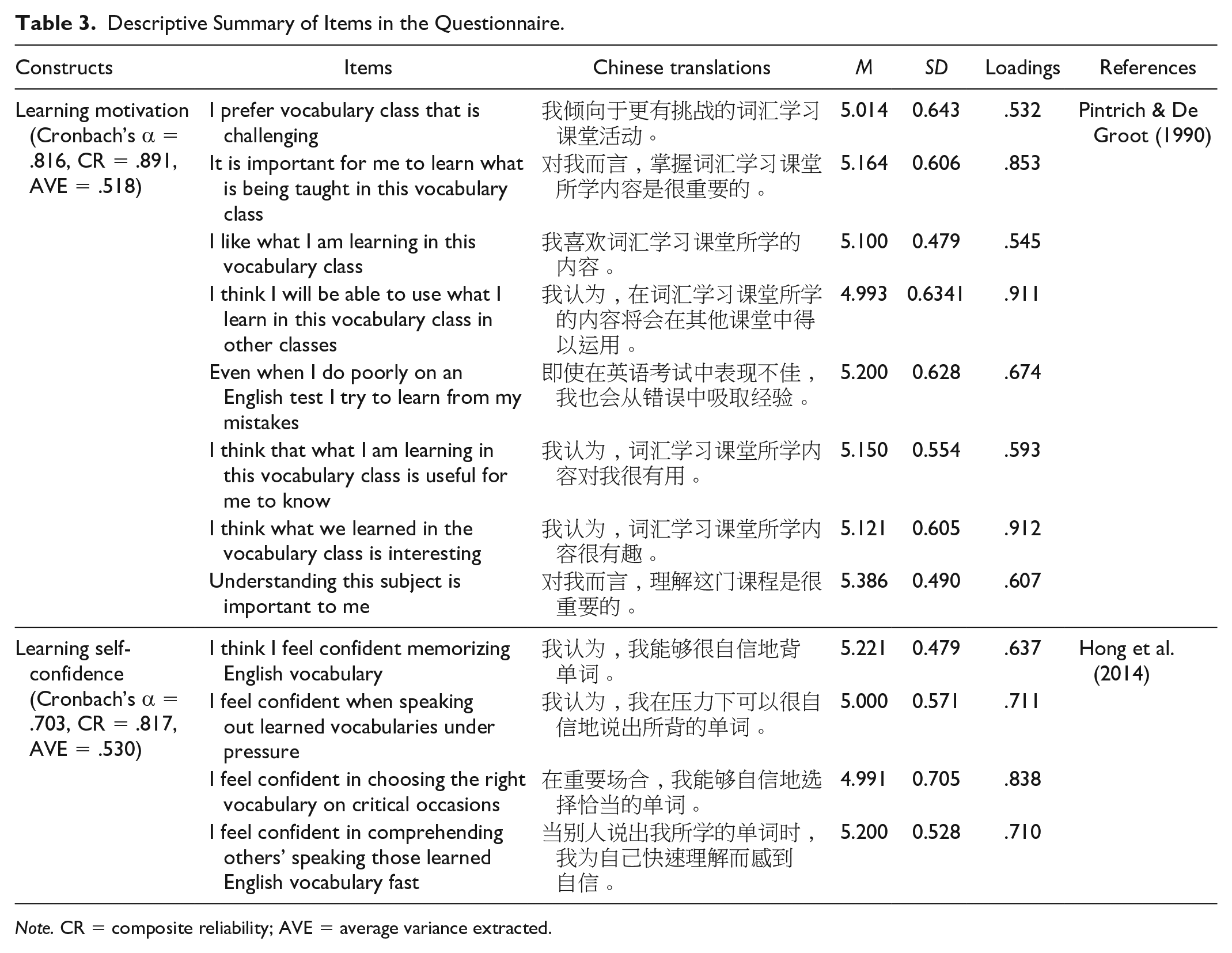
The instruments included the pre-test, post-test of vocabulary learning achievement, and the pre- and post-questionnaires of learning motivation and self-confidence. There are two parts in the questionnaire surveys: One is about demographic information, such gender and age. The other is the aforementioned specific questionnaires, such as motivation and self-confidence. For the development and adaptation of questionnaire items, forward–backward translation (Brislin, 1986) was used and participants were required to rate on the Chinese version (see column of “Chinese translations” in Table 3 for details) based on existing studies (Hong et al., 2014; Pintrich & De Groot, 1990), as both authoritative questionnaires of learning motivation and self-confidence deal with the topic of EFL learning, which could shed some light on Chinese EFL students’ vocabulary learning motivation and self-confidence in this study as well.
Descriptive Summary of Items in the Questionnaire.
Note. CR = composite reliability; AVE = average variance extracted.
As vocabulary recognition task was commonly applied in effectively scoring vocabulary learning retention (e.g., Hu & Nassaji, 2016; Mainz et al., 2017; Q. Wu, 2015), it was also utilized in the pre- and post-tests to evaluate students’ vocabulary learning achievement in the current study. During both tests, students were asked to write down the Chinese definitions of each word. Two hundred words from the pool of 739 words were randomly chosen for both tests; each test contains 100 words to make the full score of 100 (e.g., Q. Wu, 2015). To ensure the random distribution of word candidates in the pre- and post-test, two selections are consecutively taken. First, the wordlist of 739 English words was put into Office Microsoft Excel by applying random function “= RAND()” twice to extract two groups of random data for each word. Second, the randomized word candidates were selected by ascending two groups of random data extracted twice, that is, 100 candidates in ascending order of the first group and the other 100 candidates in ascending order of the second group were chosen as the pre- and post-test materials (see Supplemental Material). Third, to balance the difficulty of materials and ensure the content validity in the pre- and post-test, the materials were checked by two experienced teachers who negotiated with each other and replaced the word candidates with unbalanced difficulty when discrepancies occurred (MacLeod et al., 2018). The item discrimination of pre-test, t(26) = –25.601, p =.000, and post-test, t(26) = –19.863, p = .000, was satisfactorily obtained from the significant difference between 27% upper–lower item average comparisons (Meral & Fidan, 2014). Besides, Pearson’s correlation (r = .86, p = .000) of mean scores between pre- and post-test is significant and positively high, which suggests that pre- and post-test are parallel with each other in terms of difficulty level (Hwang et al., 2017).
To be specific, learning motivation questionnaire was revised based on Pintrich and De Groot’s (1990) “intrinsic motivation” of the Motivated Strategies for Learning Questionnaire (Table 3). Eight items were included with a 7-point Likert-type scale (anchored on 1 = “strongly disagree” and 7 = “strongly agree”) such as “It is important for me to learn what is being taught in this vocabulary class” and “Even when I do poorly on an English test I try to learn from my mistakes.” As shown in Table 3, the reliability (Cronbach’s α = .816, composite reliability [CR] = .891) and the construct validity (average variance extracted [AVE] = .518) of learning motivation questionnaire could be validated according to the suggested criteria (e.g., Fornell & Larcker, 1981; Hair et al., 2009).
On the contrary, learning self-confidence questionnaire was taken from Hong et al.’s (2014) self-confidence in learned vocabularies with a 7-point Likert-type scale (Table 4). To modify the expressions of the questionnaire, four items of the original questionnaire were modified by excluding the wording of “after using . . . , . . . more . . . ,” such as “I think I begin to feel confident memorizing English vocabulary” and “I feel confident comprehending others’ speaking those learned English vocabulary fast.” As shown in Table 3, the reliability (Cronbach’s α = .703, CR = .817) and the construct validity (AVE = .530) of learning self-confidence questionnaire also met the suggested criteria (Fornell & Larcker, 1981; Hair et al., 2009).
One-Way ANCOVA Result for the Post-Test Vocabulary Learning Achievement Between the Two Groups.

Note. ANCOVA = analysis of covariance.
p < .001.
Experiment Procedure
As shown in Figure 2, two groups of EFL students (N = 70) took part in the experiment. One is the experimental group in which students received the game-based vocabulary learning; the other is the control group in which students received the conventional paper-based wordlist learning. Treatments of this study were achieved by having the same teacher of each class monitor the vocabulary learning class in the morning every day. To ensure that participants strictly follow the experiment instructions and learn the target words exactly according to the learning plan, both groups gathered in the classroom were required to learn approximately 15 words in a self-paced way, namely, 15 words each day for the first 48 days, and 10 and nine words for the last 2 days to make up a total of 50 days for the treatment durations without any repetition, which is reported to be the appropriate intervention durations in a meta-analysis (Sung et al., 2016). Before the treatments, two groups of students were first instructed to some basic arrangements of the vocabulary learning class, and then they were asked to take the pre-test of vocabulary learning achievement, pre-questionnaires of learning motivation, and learning self-confidence.

Diagram of experiment procedure.
During the treatments, the experimental group learned the daily planned vocabularies with the game-based vocabulary learning APP installed in their smartphones, while those in the control group used the paper-based wordlist in the conventional wordlist approach. To parallel the experiment group, the contents of paper-based wordlist were the same as the APP (same 739 CET-4 word contents, fond size, color and type, and spacing), including all the same textual and pictorial interpretations of the words. Moreover, to ensure the same learning pace between both groups, the daily planned words were first printed by teacher who was responsible for the distribution and collection of wordlists to the control group.
After finishing learning the 739 CET-4 words, two groups of students took the post-test, post-questionnaires of learning motivation and learning self-confidence. It is transparent to note that, apart from the difference of treatments between two groups, no any other external intervention that might confound the experiment was executed.
Data Analysis
To solve Research Questions 1, 2 and 3, ANCOVA (one-way analysis of covariance), rather than ANOVA (one-way analysis of variance), was calculated by using the pre-test scores that might confound our results as the covariant, including pre-test vocabulary learning achievement, pre-questionnaire of vocabulary learning motivation, vocabulary learning motivation, and self-confidence. For Research Question 4, as suggested by Calvo-Ferrer (2017), a regression analysis was applied to examine the influence of motivation and self-confidence on vocabulary achievement. The statistical analyses were performed using the SPSS 26.0 statistical software with the significance level set at .05.
Results
In our quasi-experiment, results corresponding to the four research questions were reported in the remainder of this section. More specifically, ANCOVA results were first presented for Research Questions 1, 2, and 3. Furthermore, results of a regression analysis were reported to examine the influence of motivation and self-confidence on vocabulary achievement.
Vocabulary Learning Achievement
To examine the effectiveness of game-based vocabulary learning APP on vocabulary learning achievement, one-way ANCOVA was calculated by using the pre-test learning achievement as the covariant. Results were presented in Table 4, including number (n), mean and standard deviation, adjusted mean, standard error, ANCOVA results (F), and effect sizes (η2).
As a prerequisite for ANCOVA, Levene’s test of equality of error variances was first reported. Results of Levene’s test suggested that two groups were homogeneous, F(1, 68) = 2.562, p = .114, warranting a further ANCOVA. Results of ANCOVA indicated that the post-test vocabulary learning achievement in the experimental group (M achievement: 80.17 ± 5.55) was significantly higher than that of the control group (M achievement: 77.11 ± 6.28), F(1, 67) = 24.230, p = .000. The findings suggested that game-based vocabulary learning APP was more effective than conventional wordlist learning approach in that students of the experimental groups improved their vocabulary achievement significantly higher than those of the control group. Moreover, the effect size (η2) of learning approach in this study was 0.27, showing a moderate effect size (Cohen, 1988).
Vocabulary Learning Motivation
To compare the post-questionnaire of vocabulary learning motivation between experimental and control groups, one-way ANCOVA was employed to take the pre-questionnaire of vocabulary learning motivation as covariant. Results were presented in Table 5, including number (n), mean and standard deviation, adjusted mean, standard error, ANCOVA results (F), and effect sizes (η2).
One-Way ANCOVA Result for the Post-Questionnaire Learning Motivation of the Two Groups.

Note. ANCOVA = analysis of covariance.
p < .001.
As a prerequisite of ANCOVA, Levene’s test of equality of error variances was first executed, and it suggested that two groups were homogeneous, F(1, 68) = 0.135, p = .715, warranting a further ANCOVA. A significantly higher post-questionnaire result of the experimental group (M rating: 5.729 ± 0.431) than that of the control group (M rating: 5.343 ± 0.480) was found, F(1, 67) = 34.304, p = .000, η2= .339, suggesting that students’ vocabulary learning motivation was significantly improved for students of the experimental group who used the game-based vocabulary learning APP.
Vocabulary Learning Self-Confidence
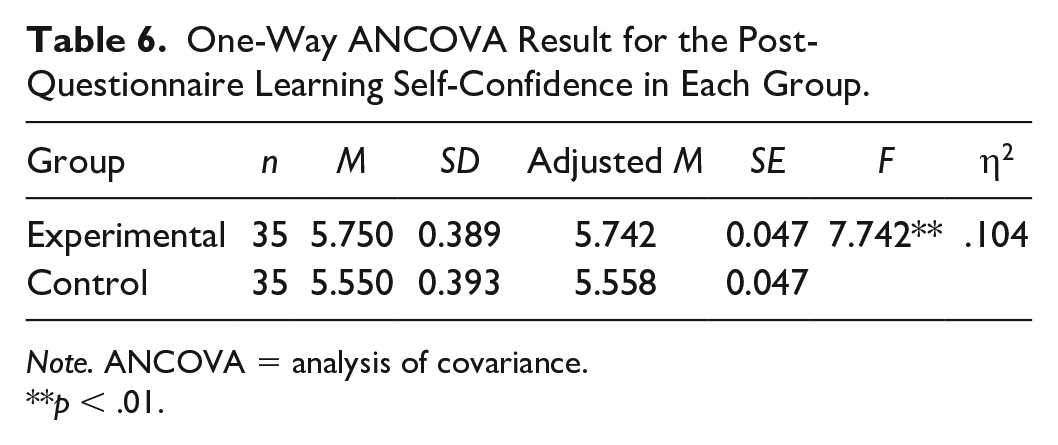
To investigate the effectiveness of game-based vocabulary learning APP on vocabulary learning self-confidence, one-way ANCOVA for the post-questionnaire of vocabulary learning self-confidence between experimental and control groups was conducted, and the results were presented in Table 6, including number (n), mean and standard deviation, adjusted mean, standard error, ANCOVA results (F), and effect sizes (η2).
One-Way ANCOVA Result for the Post-Questionnaire Learning Self-Confidence in Each Group.
Note. ANCOVA = analysis of covariance.
p < .01.
Levene’s test of equality of error variances suggested that two groups were homogeneous, F(1, 68) = 2.479, p = .120, warranting a further ANCOVA. A significantly higher post-questionnaire result of the experimental group (M rating: 5.750 ± 0.389) than that in the control group (M rating: 5.550 ± 0.393) was found, F(1, 67) = 7.742, p = .007, η2= .104, illustrating that students’ vocabulary learning self-confidence was significantly improved with the game-based vocabulary learning APP.
Influence of Vocabulary Learning Motivation and Self-Confidence
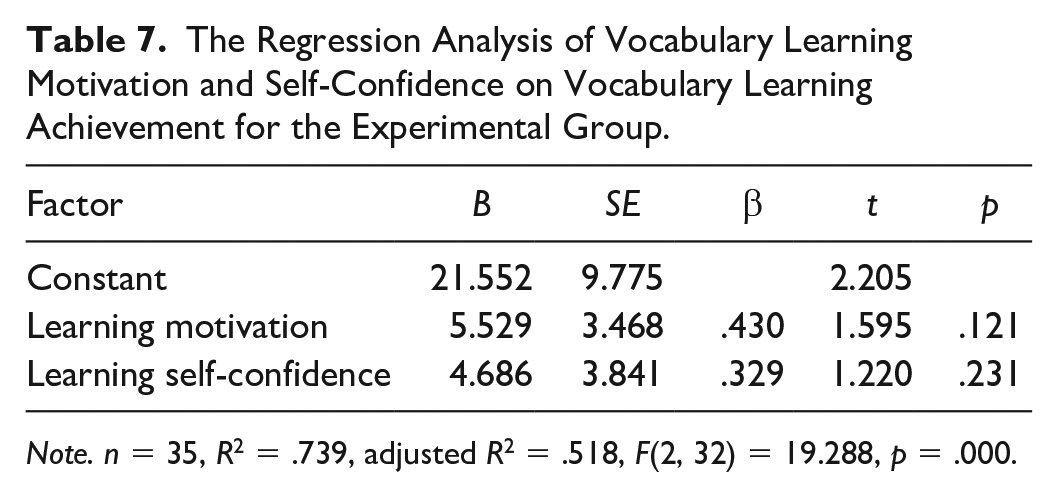
To ensure whether vocabulary learning motivation and self-confidence in the game-based learning influence students’ vocabulary learning achievement, a linear regression for the experimental group was conducted with the post-questionnaire of vocabulary learning motivation and self-confidence as independent variables, and the post-test vocabulary learning achievement as dependent variable. Table 7 indicated that 35 participants for the experimental group were involved. The regression results of learning motivation and learning self-confidence on vocabulary learning achievement were reported: R2 = .739, adjusted R2 = .518, F(2, 32) = 19.288, p = .000.
The Regression Analysis of Vocabulary Learning Motivation and Self-Confidence on Vocabulary Learning Achievement for the Experimental Group.
Note. n = 35, R2 = .739, adjusted R2 = .518, F(2, 32) = 19.288, p = .000.
To interpret the regression results, overall, the regression model, which explained 73.9% of the variance, F(2, 32) = 19.288, p = .000, indicated that both vocabulary learning motivation (t = 1.595, p = .121) and vocabulary learning self-confidence (t = 1.220, p = .231) had no significant effect on vocabulary learning achievement.
Discussion and Implications
The purpose of the current study is to compare the effects of both methods—namely, the game-based vocabulary learning approach versus the conventional paper-based wordlist learning approach—on students’ vocabulary learning achievement, motivation, and self-confidence. In addition, the influence of motivation and self-confidence on learning achievement with the game-based learning approach was also calculated in a regression analysis. Results demonstrated that Chinese EFL students who used the game-based vocabulary learning APP showed the higher vocabulary learning achievement, motivation, and self-confidence than those using the conventional wordlist learning approach. Furthermore, both vocabulary learning motivation and self-confidence did not play a significant role in students’ improved learning achievement.
Research Questions 1, 2 and 3 refer to the impact of game-based vocabulary learning APP on the students’ vocabulary learning achievement, motivation, and self-confidence. As such, ANCOVA was calculated by using the pre-test scores that might confound our results as the covariant, including pre-test vocabulary learning achievement, pre-questionnaire of vocabulary learning motivation, vocabulary learning motivation, and self-confidence. It was found that students using the game-based vocabulary learning APP outperform those using the conventional paper-based wordlist approach in terms of vocabulary learning achievement, motivation, and self-confidence, suggesting the pedagogical benefits of game-based vocabulary learning approach. The findings are in line with numerous studies (e.g., Butler, 2015; Calvo-Ferrer, 2017; T. Liu & Chu, 2010; Tsai & Tsai, 2018; T. Wu, 2018; Zou et al., 2019) that applied the game-based learning approach. The improved vocabulary achievement, motivation, and self-confidence might be attributed to different vocabulary learning approaches per se for three possible reasons. First, the presentation types between two vocabulary learning approaches are distinctively different from each other, which is likely to invoke different loads of working memory (Lee et al., 2020). Compared with the unimodal presentation of the conventional paper-based wordlist learning approach, students who used the game-based vocabulary learning APP can first set up a vocabulary learning goal and then enjoy the game playing by making full use of multimodal presentation types (Mayer, 2009). According to the Dual Coding Theory (DCT) proposed by Paivio (1991), working memory consists of two channels, namely, verbal and non-verbal, which process information independently from one another. When the verbal and non-verbal channels are interconnected, cognitive load on working memory will be decreased, which improves the learning outcomes in turn. Second, learning styles between the two approaches are different from each other. Compared with the drab, monotonous, and tedious paper-based wordlists, the diversity of learning styles provided by the game-based learning APP increases the enjoyment of learning (Al-Shara, 2015), which might play a role in improving students’ vocabulary learning motivation to a large extent (Hwang et al., 2017). Third, the interactions between two approaches also differ from each other. It seems that those using the paper-based wordlist approach do not have interaction at all; rather, they must learn vocabulary by rote (Yamamoto, 2014). In contrast, those who used the game-based learning approach are able to share their vocabulary learning achievement records or even compete with peers via information communication tools (e.g., WhatsApp, QQ, or WeChat) as the game-based learning account is directly linked to their accounts during registration (R. Li, Meng, Tian, Zhang, & Xiao, 2019). The active interaction, in this sense, increases vocabulary learning self-confidence, because a clear cognitive interaction process allows learners to achieve the common learning goals (T.-H. Huang, 2014).
Research Question 4 refers to the influence of students’ learning motivation and self-confidence on vocabulary learning achievement in the game-based vocabulary learning. In doing so, a regression analysis was applied to examine the influence of motivation and self-confidence on vocabulary achievement. Regression result indicated that vocabulary learning motivation and self-confidence did not play a significant role in students’ improved learning achievement. According to some researcher (e.g., Calvo-Ferrer, 2017; Costabile et al., 2003), although the improved learning achievement is obtained, game-based approach per se may not be a facilitative factor. Rather, students’ affective perceptions may be the essential predictors to the improved learning results. As such, a regression analysis was carried out to disentangle the influence of affective perceptions (i.e., learning motivation and self-confidence) on learning achievement in the game-based learning (Calvo-Ferrer, 2017). Intriguingly, the results that both vocabulary learning self-confidence and motivation have no significant effect on vocabulary achievement tend to disapprove such an argument, suggesting that students’ improved learning achievement might only be related to the employment of game-based learning approach rather than their affective perceptions. The discrepancies between the two studies might be due to different age ranges of participants recruited. Specifically, Costabile et al. (2003) investigated a sample of 9- to 10-year-old children and found children’s affective perceptions, rather than game-based approach, predict their learning results, whereas R. L. recruited 17- to 21-year-old young adults who might not care too much about the entertainment feature of games that tend to arouse their affective perceptions, implying learner age might be an important moderator in the application of game-based learning (M.-H. Chen et al., 2018).
With respect to the findings, some implications are summarized as follows. First, game-based vocabulary learning APP can be adopted in vocabulary learning, because its effectiveness is verified in the study (Tsai & Tsai, 2018; Zou et al., 2019). In doing so, teachers can provide students some appropriate and specific training, guidance, and recommendation to increase the use of game-based APP (R. Li, Meng, Tian, Zhang, Ni, & Xiao, 2019). Importantly, clear goals and challenges are important to increase learner motivation, self-confidence, and ensure their active engagement in the game-based vocabulary learning, CALL providers or producers should strive to improve the interactivity of game design by providing learners with challenging opportunities to compete and interact with peers (Zou et al., 2019). Second, in view of learner age, teachers should take students’ age range into account to renew their curriculum design and integrate the game-based learning approach into their pedagogical activities (M.-H. Chen et al., 2018). Specifically, younger generations might benefit more from playing the immersive games (Costabile et al., 2003), while it would be more appropriate to adopt the tutorial games for those college students (R. Li, Meng, Tian, Zhang, & Xiao, 2019). Third, to increase the easy-to-use functionalities, APP producers or providers should also pay particular attention to students’ personalized needs by integrating students’ curriculum into the functionalities of APP. To do so, students’ flow experiences could be aroused by seeking for the game-based learning APPs that directly associate the learning content with their lessons in a personalized, challenging, and enjoyable way (e.g., Cojocnean, 2016; R. Li, Meng, Tian, Zhang, & Xiao, 2019; Q. Wu, 2015).
Conclusion
The findings of this study revealed that students’ vocabulary learning achievement, learning motivation, and self-confidence could be improved by using the game-based vocabulary learning APP. In addition, students’ learning motivation had a positive impact on vocabulary learning achievement, while learning self-confidence and motivation did not predict learning achievement.
Apart from some meaningful findings, this study presented certain limitations. First, although Baicizhan is a representative of game-based vocabulary learning APP most favored among Chinese EFL students, generalizability of the findings that were developed based on only one APP might be limited. To avoid this, further attempts on more game-based APPs thus should be done. Second, the participants employed in the quasi-experiment are all college students with limited population size. It remains largely unclear whether the findings can be generalized to larger or other populations. Further attempts can be adopted by using the game-based vocabulary learning APP among larger or other populations to further ensure its effectiveness. Third, this study is a quasi-experimental study rather than a (lab-based) true experimental study. In a quasi-experiment, there are many natural social settings in which the research person can introduce something like experimental design into his scheduling of data collection procedures, even though he lacks the full control over the scheduling of experimental stimuli which makes a true experiment possible. (Shadish et al., 2002, p. 14)
Although learning contents between two approaches are kept as consistent as possible, some potential confounding effects remain unavoidable. Specifically, compared with the conventional paper-based wordlist learning approach that involves textual and pictorial interpretations of given words, the game-based vocabulary learning adopted in the current study contains the multimedia information about the given words that might play some roles in the learning outcomes. As such, future study should avoid the potential effects in this regard. Finally, the game-based vocabulary learning used in the study is only about the tutorial game in a game-like fashion as opposed to the immersive games. It remains uncertain whether the findings obtained in this study can be true of the immersive games or other game types. Future study regarding the game-based vocabulary learning can extend our findings by making the comprehensive comparison between different game types.
Supplemental Material
sj-xlsx-1-sgo-10.1177_21582440211003092 – Supplemental material for Does Game-Based Vocabulary Learning APP Influence Chinese EFL Learners’ Vocabulary Achievement, Motivation, and Self-Confidence?
Supplemental material, sj-xlsx-1-sgo-10.1177_21582440211003092 for Does Game-Based Vocabulary Learning APP Influence Chinese EFL Learners’ Vocabulary Achievement, Motivation, and Self-Confidence? by Rui Li in SAGE Open
Footnotes
Declaration of Conflicting Interests
The author(s) declared no potential conflicts of interest with respect to the research, authorship, and/or publication of this article.
Funding
The author(s) disclosed receipt of the following financial support for the research, authorship, and/or publication of this article: This research was supported by the project funded by the Fundamental Research Funds for the Central Universities, Hunan University and the Social Science Foundation of Hunan Province (grant number 20ZDB005).

Supplemental Material
Supplemental material for this article is available online.
References
Supplementary Material
Please find the following supplemental material available below.
For Open Access articles published under a Creative Commons License, all supplemental material carries the same license as the article it is associated with.
For non-Open Access articles published, all supplemental material carries a non-exclusive license, and permission requests for re-use of supplemental material or any part of supplemental material shall be sent directly to the copyright owner as specified in the copyright notice associated with the article.
