




Abstract
Despite postgraduates’ struggles to master English academic writing, the fulfilment of postgraduates’ motivational needs in classes of English academic writing has been scarcely researched. This study examines the motivational practices of teachers of postgraduate English academic writing, the perceived effectiveness of the adopted strategies, and possible ways to further enhance their effectiveness. Reflective writing was collected from 59 doctoral students who spoke English as a foreign language (EFL) and were enrolled in a thesis writing course. The major findings are: (1) The reported motivational strategies correspond fairly closely to those endorsed in Dörnyei’s influential framework, yet some appear to be common teaching techniques; (2) the majority of the reported positive effects pertain to enhanced knowledge, performance, and confidence; and (3) the participants called for increased use of motivational strategies, more student engagement, and diverse facilitative input from the English teacher. The findings confirm the need to extend studies on the use and perceptions of motivational strategies to postgraduate language teaching contexts.
Introduction
Postgraduate students need to have a good mastery of English academic writing in order to complete their studies and enhance their employability (Odena & Burgess, 2017). As motivation plays a pivotal role in language learning (Dörnyei, 1994), it is essential that postgraduates’ motivation to acquire English academic writing skills be maintained and strengthened. This is particularly true for non-native English speaking postgraduates, who tend to face greater challenges in their writing experiences than their native English speaking counterparts (Wang & Li, 2008). However, there has been little research investigating the use and perceptions of motivational strategies in postgraduate English academic writing courses. This study draws mainly on research literature on postgraduates’ motivation to learn English as a foreign language (EFL), the difficulties they face in mastering English academic writing, and the motivational effects of language teaching across various educational contexts. It aims to (1) uncover some regularly adopted motivational strategies in postgraduate EFL academic writing courses, (2) examine students’ evaluation of the strategies’ effectiveness, and (3) elicit from students suggestions for improved strategy implementation. This study serves as an important extension of research on language teachers’ motivational interventions. It also contributes to the area of EFL postgraduates’ academic writing development.
Following this introduction, Section 2 reviews briefly research literature related to postgraduates’ English learning motivation, motivational strategies in language classrooms, and postgraduates’ need for motivational support in English academic writing courses. Section 3 describes the research site, participants, and data collection and analysis procedures. Section 4 reports findings corresponding to the abovementioned three research objectives. Section 5 summarizes the key findings, discusses some limitations, and offers recommendations to both researchers and teachers.
Literature Review
Importance of English Learning Motivation to Postgraduate Students
One major challenge faced by non-native English speaking students who are pursuing postgraduate studies is English language proficiency (Son & Park, 2014). In particular, academic writing is probably the most important tool for postgraduates to communicate their ideas, complete their degrees, and seek employment. However, neither standardized English tests nor test preparation courses can ensure that postgraduates possess sufficient academic writing skills to complete their studies (Kuo, 2011).
To foster the development of academic writing skills among postgraduates, universities worldwide have designed EAP (English for academic purposes) courses which help postgraduates write fluently, accurately, and critically with appropriate academic language (Storch & Tapper, 2009). Thesis writer circle programs and other writing groups have been run to allow postgraduates to regularly discuss thesis-writing issues and explore discourse features and strategies under the guidance of an experienced facilitator (Cahusac de Caux et al., 2017). There have also been self-access resources available both in hard copy and online (Harris & Ashton, 2011). While the primary aim of these measures is to consolidate academic writing skills, ideally they should also raise postgraduates’ motivation to learn such skills. Copious research has found motivation to be a crucial factor in language learning, which can help learners attain higher proficiency when other factors are equal (Guilloteaux & Dörnyei, 2008). Postgraduates’ success in mastering English academic writing, therefore, may be heavily predicated on this factor. This assumption conforms to Son and Park’s (2014) finding that motivation is a major factor affecting international postgraduates’ academic success.
Despite the importance of motivation to postgraduates’ acquisition of academic English writing skills, studies on the English learning motivation of this learner group have been scarce. Ozuturk (2012) found international postgraduates at a UK university to be mainly instrumentally motivated, having goals such as getting a well-paid job and excelling in IELTS or TOFEL. Kafipour et al. (2011) found that Iranian postgraduates who were integratively motivated used more varied English learning strategies than the instrumentally-motivated counterparts. Ali et al. (2015) used factor analysis to determine Pakistani postgraduates’ orientations for English learning. A total of 11 factors were identified, and the frequently researched integrative orientation appeared inapplicable because the participants did not regard mingling with native speakers as a meaningful goal. Instead, an indigenous integrative orientation that “relates to using L2 for local purposes” (Ali et al., 2015, p. 77) was probably more relevant. Hajar (2021) found that Arab postgraduates at a UK university were initially motivated by a distant and somewhat unrealistic goal of achieving native-like English mastery, yet they did not undertake much strategic behavior. They eventually shifted to more proximal goals and embraced some appropriate learning strategies.
Research on Motivational Strategies in Language Classrooms
The studies reviewed in the previous section have provided insights into the characteristics of postgraduates’ English learning motivation. Teachers of postgraduate academic writing courses, however, are probably more concerned about practical in-class motivational interventions and their effectiveness. Motivational strategies in language classrooms—broadly defined as teachers’ attempts to enhance language learners’ motivation and sustain their goal-oriented behavior (Dörnyei, 2001)—have drawn increasing attention from researchers in the last three decades. Dörnyei and Csizér’s (1998) pioneering study on Hungarian EFL teachers’ use and perceptions of motivational strategies, which contributed the frequently cited Ten Commandments for Motivating Language Learners, heralded a series of studies examining and then recommending motivational strategies in specific educational settings. Other examples include Al-Mahrooqi et al. (2012), Alrabai (2016), Guilloteaux (2013), and Tavakoli et al. (2018). One influential collection of motivational strategies, among all the recommendations, is Dörnyei’s (2001) framework. It comprises over 100 individual strategies which can be employed in the following four stages:
Creating basic motivational conditions
Generating initial motivation
Maintaining and protecting motivation
Encouraging positive retrospective self-evaluation
A major strength of this framework, in addition to high comprehensiveness and practicality, is its close association with Dörnyei and Ottó’s (1998) process model. This model proposes that language learners’ motivational process is composed of three phases: (a) the preactional stage, when goals are set and the motivation is formed, (b) the actional stage, when the learner is committed to actions which enhance and sustain motivation, and (c) the postactional stage, when the learner reflects on the outcomes and makes inferences for future learning. Owing to these merits, Dörnyei’s (2001) framework has constituted the foundation of numerous studies worldwide on the motivational effects of language teaching (see Lamb, 2017 for a comprehensive list of such studies).
The aforementioned studies on motivational strategies have made recommendations based mainly on language teachers’ behavior and comments. Another line of enquiry, which is probably of great value to teachers of postgraduate academic writing, focuses on the student-perceived effectiveness of motivational strategies. Various methods, including questionnaires (Bernaus & Gardner, 2008; Sugita McEown & Takeuchi, 2014), interviews (Astuti, 2016), observations (Guilloteaux & Dörnyei, 2008), reflective writing (Lee, 2017; Lee et al., 2020), and quasi-experiments (Alrabai, 2016) have been adopted to evaluate the outcomes of strategy implementation. These studies provide evidence that motivational strategies can often arouse motivated behavior and positive attitudes, and on some occasions they can raise achievement levels. This confirms the worthiness of motivational strategies in language classrooms.
Need for Motivational Interventions in Postgraduate English Academic Writing Courses
In light of the encouraging findings yielded by recent research on the motivational effects of language teaching, it seems plausible to assume that motivational strategies are regularly employed in postgraduate English academic writing courses. The motivational dynamics in this particular instructional setting, however, has been underexplored. The findings obtained from mainstream academic institutions may not be applicable to postgraduates, who face unique difficulties and challenges (Son & Park, 2014). Another noteworthy gap is an abundance of studies conducted in general proficiency language courses, as opposed to a dearth of studies examining the motivational impacts of EAP and ESP (English for specific purposes) teaching. Given these two limitations, it is apparent that further work is required to verify the usefulness of motivational strategies in postgraduate English academic writing courses.
There is a pressing need to extend research on the use and effectiveness of motivational strategies to postgraduate English academic writing courses for not only theoretical but also practical purposes. Despite the common perception that postgraduates are highly motivated (Kuo, 2011), research has shown that their motivation to learn English academic writing is constantly under threat, which necessitates motivational interventions from the English teacher. While supervisors are often expected to correct syntactic and spelling mistakes in their students’ works, they may regard assisting their students’ development of English academic writing skills as beyond their role (Larcombe et al., 2007). The English teacher, therefore, needs to provide the largest share of motivational support for postgraduates. Postgraduates’ motivation to improve English academic writing may be meager because they believe that English plays only a secondary role in scientific research, and have little confidence in the academic writing curriculum (Huang, 2010). These problems can be tackled by motivational strategies which stress the instrumental values of English, explain the purpose and utility of a learning task, and help students set personalized goals. Some postgraduates, at early stages of their studies, may underestimate their weaknesses in English writing, and consequently suffer from anxiety and diffidence (Felix & Lawson, 1994). These students are likely to benefit from motivational strategies which address erroneous learner beliefs, ensure successful task completion, and create a supportive atmosphere. Coping with both language and academic demands simultaneously can be taxing and frustrating to postgraduates (Cheng et al., 2004), so the English teacher should also employ other motivational strategies such as showing care and acceptance, listening intently, and indicating availability, all of which pertain to developing a trusting relationship. It is worth noting that all the aforementioned motivational interventions are included in Dörnyei’s (2001) framework, and have been empirically examined in diverse educational settings. In postgraduate academic writing courses, however, the use and perceived effectiveness of motivational interventions remain unexplored.
The utmost importance for postgraduates to acquire English academic writing skills and the enormous difficulties involved mean that the motivational support from the English teacher is vital. The present study hence attempts to address the dearth of research undertaken to examine the use and effectiveness of motivational strategies in postgraduate academic writing courses. It is guided by the following research questions:
RQ1: What motivational strategies are adopted by teachers of postgraduate English academic writing (especially thesis writing) courses to EFL postgraduates?
RQ2: Do EFL postgraduates find the adopted strategies effective?
RQ3: In EFL postgraduates’ view, how can the effectiveness of the adopted strategies be further enhanced?
Methods
Research Site and Participants
The present study was part of a project conducted at a government-funded university in Hong Kong, in which a compulsory but non-credit-bearing thesis writing course is offered to postgraduates. The course is run over a 13-week semester, and enrolled students attend a 3-hour session every week. A class usually consists of 15 to 18 students. The structure of the course generally follows that of a thesis, so students are expected to learn the common characteristics of each part and chapter of a conventional thesis. Within this structure, the teacher also introduces students to the essences of English academic writing, such as the proper use of voices and tenses, reporting verbs, hedging, paraphrasing and summarizing, cohesion and coherence, and effective incorporation of citations. The teacher, at his or her discretion, can spend additional time on any of these elements if students have difficulty mastering them. To pass the course, students need to complete two in-class quizzes and several reflective essays.
The investigators, who were not teaching this course during the study, sent an invitation email to 17 classes of students enrolled to the course. A total of 59 doctoral students (27 males and 32 females) responded to the investigators’ call for participation. They all spoke English as a foreign language. Among them, 46 were from China and Hong Kong, 9 from other countries in Asia, and 4 from Africa. Their research areas included Engineering (23), Applied Sciences and Textiles (18), Health and Social Sciences (7), Construction and Environment (4), Business (4), and Humanities (3). Informed consent was obtained from all participants. Participation was voluntary and would not affect course completion in any way.
Data Collection and Analysis
In this study, motivational strategies are defined as any teacher behavior which learners believe can potentially maintain or strengthen their motivation. This is similar to the somewhat loose definition from Dörnyei (2001), which continues to be adopted in recent studies. This also reflects the investigators’ position that what constitutes a motivational strategy should be determined collectively by researchers, teachers, and learners, and that motivational and instructional strategies are not mutually exclusive. The definition, as part of the invitation email, was read by every participant before data collection began.
The data of this study consisted of 59 pieces of reflective writing written by the participants. A guide (see Appendix 1) was provided for each participant to prompt him or her to reflect on two motivational strategies which had been regularly used by his or her English teacher. In brief, each participant described two motivational strategies, explained why they were motivating or not, and suggested ways to further improve strategy implementation. Since this study centers on students’ perspectives and does not merely aim to verify the usefulness of Dörnyei’s (2001) taxonomy in postgraduate academic writing courses, it allowed the participants to report and reflect on any teacher behavior which they believed was intentionally motivational. This differentiates the present study from previous ones which often invited learners to evaluate either teacher-reported motivational strategies or strategies from Dörnyei’s (2001) influential framework. The guide was given to the participants in the last 2 weeks of the semester to ensure that when the participants started writing, they had experienced a substantial number of motivational strategies in the thesis writing course, and would be able to choose two to reflect on. The participants completed their reflection within 3 weeks after receiving the guide. All the collected reflection was written in English, and almost every piece was within the range of 300 to 400 words. To ensure part of the trustworthiness of the students’ self-reported data, the teachers of the thesis writing course were asked whether they had used the strategies reported by their students. Confirmation was received from all the teachers.
The collected reflective writing was managed using NVivo 12, which is specialist software for developing category construction in qualitative data analysis and substantiating researchers’ claims (Odena, 2013). In accordance with the three research questions, the inductive analysis of the data focused on the types of motivational interventions, the ways they had raised the participants’ motivation to learn academic writing, and the suggested methods to enhance the interventions’ effectiveness. The coding was conducted following the guidelines in A. Strauss and Corbin (2015): tagging repeated ideas with codes, grouping codes into concepts and categories, and using the categories as the basis for new theories. In other words, the coding process did not involve matching the data with any existing theoretical frameworks. In the initial stage of analysis, the investigators read the reflective writing line-by-line, marked interesting and potentially relevant parts, and coded them accordingly. The codes which appeared to be related were grouped and given a conceptual name, and the tentative categories gradually emerged. This stage yielded large numbers of categories (17 macrostrategies, 13 effects, and 15 suggestions) for the three research foci. In the next stage, the investigators reread the reflective writing to recursively revise and merge categories in accordance with salient or recurrent patterns. As a result, the final categories were reduced to 10 macrostrategies, 7 effects, and 8 suggestions. Following the finalization of the categories, the investigators complied with the guidelines of Hak and Bernts (2009) and coded the data independently. Whenever coding to multiple categories was possible, only the most plausible one was selected. The two sets of coded data yielded an acceptable interrater reliability of 86%. The investigators resolved the remaining differences by having further discussion and, whenever possible, seeking confirmation via email from the participants.
Results and Discussion
Reported Motivational Strategies
The 59 participants reported 126 individual motivational strategies. The number was higher than anticipated (118) because eight of the participants reported three strategies instead of two. The 126 strategies were grouped into 10 macrostrategies as shown in Table 1. The two macrostrategies which were mentioned most frequently were using games and group work (23) and using additional materials (16).
Reported Motivational Macrostrategies.

While the present study does not intend to validate Dörnyei’s (2001) framework in postgraduate language teaching contexts, the list of macrostrategies does exhibit noticeable similarity to the framework. In particular, Macrostrategies 1, 5, and 9 (using games and group work, using own experience, and paying attention to every student) bear a close resemblance to the following motivational strategies recommended by Dörnyei:
Regularly use small-group tasks where students can mix
Include activities that lead to the successful completion of whole-group tasks
Share your own personal interest in the L2 with your students
Show students that you value L2 learning as a meaningful and satisfying experience
Pay attention and listen to each of them
Although no individual strategy in Dörnyei’s (2001) framework contains the terms “additional materials” or “authenticity,” the following strategies can be viewed as possible manifestations of Macrostrategies 2 and 7 (using additional materials and increasing authenticity), implying that these two macrostrategies are also compatible with Dörnyei’s recommendations.
Promote contact with cultural products
Reiterate the role the L2 plays in the world,
Encourage students to apply their language proficiency in real-life situations
Relate the subject matter to students’ backgrounds and everyday experiences
Adapt task content to students’ interests
It should be noted that the 10 reported macrostrategies may represent only a portion of the English teachers’ motivational interventions. Still, the considerable similarity between the reported macrostrategies and Dörnyei’s (2001) framework suggests that the universality of this influential framework extends to classes of postgraduate English academic writing.
In comparison, Macrostrategies 4, 6, 8, and 10 (giving more practice, highlighting and correcting mistakes, providing a summary, and using samples) may be regarded by some as quotidian instructional techniques, yet some participants believed that their English teachers used these techniques with the intention of enhancing learner motivation. While the majority of previous studies on motivational strategies have adopted Dörnyei’s (2001) framework, a few have investigated the use of ordinary English instruction as motivational interventions. For instance, Bernaus and Gardner (2008) looked into the motivating effects of exercises, memorization, dictation, and translation, and Sugita McEown and Takeuchi (2014) included demonstrating proper pronunciation, speaking clearly and loudly, and explaining textbook content as motivational strategies. The findings of these two studies and the present study suggest that doctoral students tend to perceive some of their English teachers’ routine instructional behavior as intentional attempts to motivate them.
Reported Effects
All of the 126 individual motivational strategies were perceived as effective by the participants who reported them, suggesting that all the strategies under investigation had successfully maintained or strengthened some components of the participants’ English learning motivation. The 184 comments on the positive effects of the adopted strategies were classified into seven types (see Table 2). Among them, the most overwhelmingly common was new or deepened knowledge, accounting for one-third of all the comments (64). Another one-third of the comments were on improved performance (33) and enhanced confidence (29).
Reported Positive Effects of Motivational Strategies.
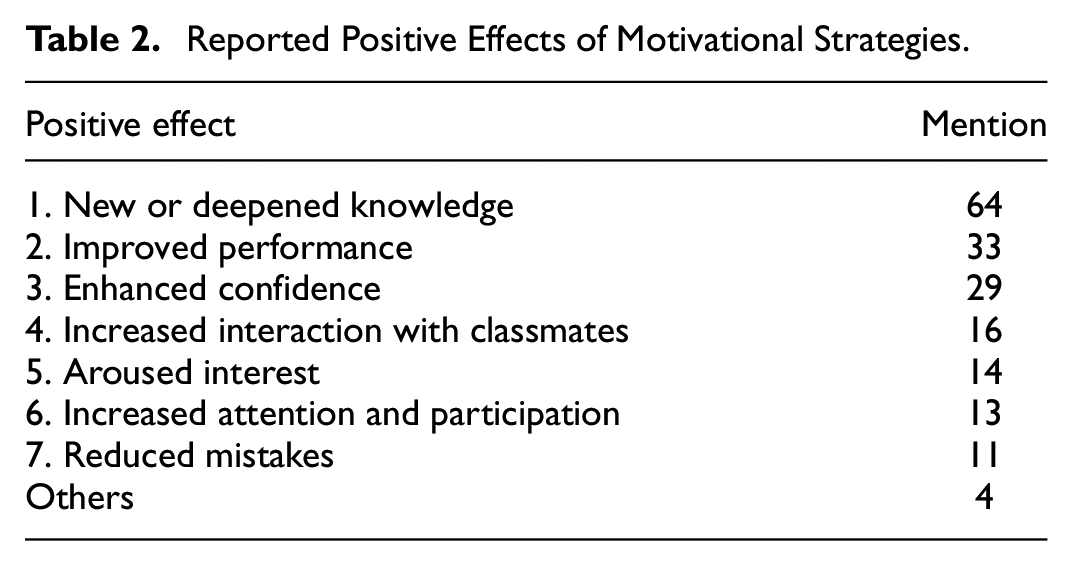
These reported positive effects are largely predictable because they correspond closely to prominent theories and frameworks of general and language learning motivation. Learners can be motivated by new knowledge intake both intrinsically and extrinsically (Deci & Ryan, 1985); a desire to improve language performance is a typical manifestation of the instrumental orientation of language learning motivation (Gardner & Lambert, 1972); confidence, interaction and group cohesiveness, and interest are important components in Dörnyei’s (1994) situational framework of language learning motivation; and reducing mistakes can be viewed as avoidance of poor performance and failure according to Achievement Motivation Theory (Atkinson & Raynor, 1974). The multitudinous positive comments suggested that the participants’ motivational needs had been satisfactorily met in the English academic writing course.
The two most frequently cited benefits were enhanced knowledge and performance (see Excerpts 1–3). This might be an indication that the participants were aware of the enormous academic and linguistic demands imposed by English academic writing (Blicblau et al., 2009), and perhaps the discrepancy between their current academic writing proficiency level and the one required for academic success (Langum & Sullivan, 2017). The participants’ urge to reduce this discrepancy might have led them to see more motivational value in routine teaching activities and hence report them as motivational strategies. This means dispersing rich knowledge to doctoral students and polishing their performance in an English academic writing course can potentially fulfill both practical and motivational needs. In contrast, interest was less frequently cited as a desirable effect. This is congruent with the previous research findings that boredom and tediousness are not major impediments to postgraduates’ acquisition of academic writing skills.
Excerpt 1: If we just go through a long list of words that are not connected to a subject or story, it is easy to forget them. My teacher taught vocabulary in context to give us deeper impression of the words. Also, she distinguished some similar words in different contexts to give us more comprehensive understanding of these words. (Macrostrategy 2)
Excerpt 2: It helps to improve students’ ability to complete the literature review. After these exercises, we know better how to summarize or criticize the work from others. (Macrostrategy 4)
Excerpt 3: I think it is an effective way to help student consolidate the essential skills…With these skills, students can conduct research more efficiently and improve the quality of their academic articles. (Macrostrategy 10)
Enhanced confidence, as a positive effect, was ranked third. This lends support to Storch and Tapper’s (2009) finding that low confidence in academic writing is a recurring obstacle faced by postgraduates. However, reduction of mistakes, which by intuition can improve performance and confidence, was rated low by the participants as a positive effect. One possible reason is that highlighting and correcting mistakes, as one of the reported macrostrategies, was not used very frequently (see Table 1). Another is that the participants’ confidence had been hampered by problems more complex than common grammatical and mechanical mistakes (see Excerpts 4 and 5). Compared with language-related mistakes, unfamiliarity with the writing conventions of “the university culture and disciplinary subcultures” and failure to meet academic readers’ expectations probably pose a greater challenge to postgraduates (Al-Zubaidi, 2012, p. 49). Postgraduates may hence find feedback on content and organization more helpful than on language (East et al., 2012). Their confidence in academic writing is more likely to benefit from deepened understanding of institutional and disciplinary writing conventions, as well as improved organizational, analytical, and argumentative skills (Cahusac de Caux et al., 2017).
Excerpt 4: I think it is a very useful method for research students…Many of us do not know how to begin the introduction, and have no confidence to begin it either. After analyzing some existing examples, we know better how to write our own introduction part and how to avoid some common problems. (Macrostrategy 10)
Excerpt 5: I am really interested in English but I always feel that the sentences I write are too simple and similar…I am very grateful to my teacher who provided us with very practical websites for writing papers, which was like opening a new window for my writing and boosting my confidence. (Macrostrategy 2)
Suggestions for Better Strategy Implementation
Although the participants acknowledged the effectiveness of all the adopted motivational strategies, they suggested numerous ways to further enhance the strategies’ effectiveness. A total of 128 suggestions were collected and divided into eight categories (see Table 3). The top two categories were increasing the frequency or durations of the adopted strategies (29), and arousing more engagement from students (21).
Suggestions for Enhancing Effectiveness of Motivational Strategies.
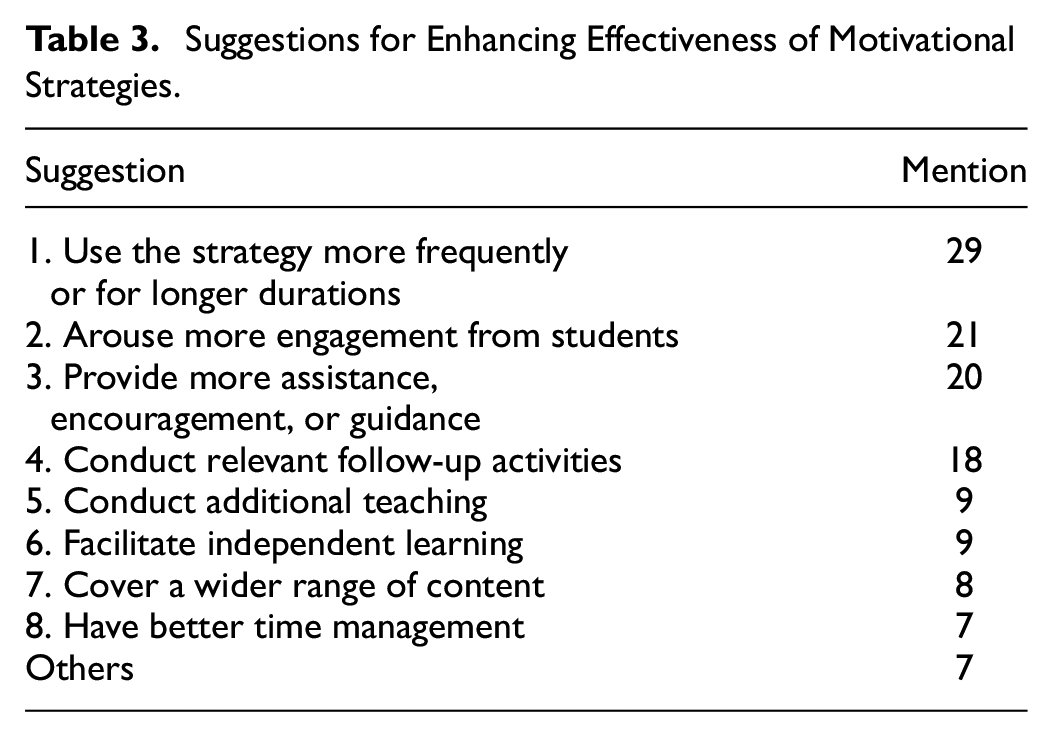
Despite the paucity of research on postgraduates’ motivation to learn English academic writing, the enormous difficulties they face imply that they need constant motivational support. The highest-ranked suggestion—using certain motivational strategies more frequently or for longer durations—corroborates this need. This finding showed that the participants found their English teachers’ motivational interventions helpful but somewhat insufficient (see Excerpts 6–8). This also cautions against the common assumption that postgraduates are “very motivated” (Kuo, 2011, p. 38). Some participants also suggested conducting additional teaching to supplement the adopted strategies (Suggestion 5), or using the adopted strategies to cover a wider range of content (Suggestion 7). These findings echo the substantial motivational effects the participants attributed to new or deepened knowledge, and perhaps serve as further explanation for the participants’ perception of certain ordinary teaching practice as motivational behavior.
Excerpt 6: The teacher should keep on doing it. It should be used throughout the whole course. (Macrostrategy 6)
Excerpt 7: I think this strategy should be practiced more regularly so that students will develop interest in raising and answering questions. (Macrostrategy 1)
Excerpt 8: The teacher should use this strategy longer to give students more time to speak up their mind, so that he will have more chance to understand their problems and assist them. (Macrostrategy 1)
The second most frequent suggestion was to arouse more engagement from students. Some participants would like their teachers to pay specific attention to less active students (see Excerpt 9). This is comparable to Dörnyei’s (2001) strategy of paying attention and listening to every student. A few participants, however, appeared more concerned about even participation from every student (See Excerpt 10). It is hence advisable that teachers of postgraduate academic writing monitor closely students’ levels of engagement and participation, as insufficient participation or cooperation from classmates can indeed be a detriment to language learners’ motivation (Lee, 2017).
Excerpt 9: The teacher should focus more on students who are less active and seldom express their ideas in class. Encourage them to contribute more in group work and answer questions afterwards. Actually, these students probably have very good ideas to contribute but are limited by their introverted personality. (Macrostrategy 3)
Excerpt 10: The report of discussion results should be done by different students in different lessons. This will ensure that everyone has to do the report and contribute to the discussion in class. (Macrostrategy 7)
The participants’ call for more assistance, encouragement, or guidance (Suggestion 3) underlines the undisputed role of the English teacher in the maintenance of postgraduates’ English learning motivation (see Excerpts 11–13). Although postgraduate writing groups are common in universities, whether they can continually provide ample support hinges on several factors. The maturity and expectations of members may differ; some members may drop away because of substantial family, academic, and professional responsibilities; and a competent facilitator can be hard to find (Aitchison, 2010). Neither are postgraduate supervisors a reliable source of such support because few of them have had sufficient training to develop in their students the essential academic writing skills (Guerin et al., 2017), and some choose to assist with only data collection and reject reading thesis chapters until they are close to completion (P. Strauss, 2012). All these indicate that the English teacher is an influential, if not irreplaceable, motivator to postgraduates.
Excerpt 11: I think the teacher can provide more guidance and be more critical sometimes to better urge students to make progress. (Macrostrategy 9)
Excerpt 12: I would be grateful if the teacher could give more encouragement to students. (Macrostrategy 3)
Excerpt 13: The teacher can refer to her own experiences more to guide us because we may feel confused after watching the videos. (Macrostrategy 2)
Suggestion 3 confirms the participants’ perception of the English teacher as the primary motivator, yet interestingly some participants also yearned for more facilitation of independent learning (Suggestion 6). These participants might realize that they had to bear increasing responsibility for their own English learning and motivation, however caring and resourceful their English teachers had been (see Excerpts 14 and 15). Notwithstanding the widespread expectation that postgraduates are independent learners and researchers, the long transition toward higher independence can sometimes engender feelings of isolation, depression, and hostility (Coates & Dickinson, 2012). Although there are a few motivational strategies in Dörnyei’s (2001) taxonomy which aim at promoting learner autonomy and increase students’ self-motivating capacity, no participant reported such strategies. Further investigation is required to determine if the importance of independent and autonomous learning is underplayed in postgraduate English academic writing courses.
Excerpt 14: It would be better if the lecturer could tell us where and how she found those useful online resources. This would enable us to identify appropriate online resources on our own to support our studies in broader areas. (Macrostrategy 2)
Excerpt 15: The teacher should share the ways she used in the past to keep herself motivated as an English learner. We will need to do the same when the course is over. (Macrostrategy 9)
Various relevant follow-up activities were suggested by the participants to complement the adopted motivational strategies (Suggestion 4, see Excerpts 16–18). Coincidentally, these suggested follow-up activities are either identical or highly similar to several motivational strategies endorsed by Dörnyei (2001). This signals a possible compound effect of a few complementary motivational strategies on postgraduates. In other words, teachers of postgraduate academic writing may try using related strategies in combination, which probably is more productive than using a large number of strategies in isolation.
Excerpt 16: I think the teacher can talk to every individual student to check their understanding after using this strategy (if time allows). (Macrostrategy 1)
Excerpt 17: When using this strategy, the teacher can also describe the struggle she went through when she was trying to write a good academic article…It is the supportive spirit that encourages students to keep learning. (Macrostrategy 6)
Excerpt 18: She can let us do some discussion of the points after the strategy is finished. This can help us learn more. (Macrostrategy 10)
Conclusion
This study has looked into the motivational strategies employed by teachers of postgraduate English academic writing, the strategies’ effectiveness perceived by EFL postgraduate students, and students’ suggestions for better strategy implementation. The motivational strategies reported by the 59 EFL doctoral students are generally in line with Dörnyei’s (2001) influential framework, yet some appear to be merely routine teaching activities which the participants considered motivating. Surprisingly, 100% of the reported motivational strategies were regarded as effective by the participants. One possible cause of this unusual phenomenon was that strategies which were effective to the participants were more memorable, so they were more likely to be chosen for evaluation in the participants’ reflection. It was also possible that the participants deliberately discussed only effective strategies in their reflection to show appreciation for their teachers’ effort. In view of these common shortcomings of self-reported data and the limited sample size, it seems advisable for researchers to invite postgraduate academic writing teachers to report their motivational practices and also conduct classroom observation to capture a wider array of regularly used strategies. This can help determine whether ordinary instructional practices doubling as motivational strategies is a common phenomenon in postgraduate English academic writing courses. This can also reduce the likelihood of less effective motivational strategies going unnoticed.
The most frequently reported effects of the adopted motivational strategies were new and deepened knowledge and enhanced performance. An assuring implication is that the coverage of sufficient knowledge can perhaps cater for a significant part of postgraduates’ English learning motivation. In contrast, interest, which has been believed to be a fundamental motive to language learners on all educational levels, was mentioned sparingly by the participants. This again signifies that the use and perceptions of motivational strategies in postgraduate language learning settings deserve their own line of research. The fairly frequent comments on enhanced confidence as a positive effect imply that confidence is an integral component of postgraduates’ English learning motivation. They also imply that English teachers’ impact on postgraduates’ confidence in their writing development can be as robust as that of supervisors. Still, English teachers should realize that to strengthen postgraduates’ confidence, interventions more sophisticated than simply reducing grammatical and mechanical mistakes are required.
Two main suggestions from the participants were increased frequency or durations of motivational interventions, and more assistance, encouragement, or guidance from the teacher. This accentuates the paramount importance of continual motivational support for postgraduates, and the indispensable role played by the English teacher in this endeavor. However, postgraduates will eventually need to embrace more responsibility for their English learning and motivation beyond the classroom. The finding that no motivational strategies pertaining to learner independence or autonomy were reportedly used is therefore concerning. Admittedly, teachers of English academic writing, within a short course period, can hardly follow postgraduates’ academic development as closely as supervisors do. These teachers may hence have lower awareness of the need to gradually increase the “autonomy and ownership” (Odena & Burgess, 2017, p. 578) of postgraduates’ English learning. This suggests that English academic writing teachers who are eager to foster autonomy in class need more communication with supervisors to be better informed of the enrolled postgraduates’ progresses and learning needs. This also calls for further research which examines whether the underutilization of autonomy-related motivational strategies is prevalent in other postgraduate English teaching contexts.
Footnotes
Appendix 1
Author Contribution
Both authors participated in all major stages of the study, including participant recruitment, data collection and analysis, and manuscript writing and editing.
Declaration of Conflicting Interests
The author(s) declared no potential conflicts of interest with respect to the research, authorship, and/or publication of this article.
Funding
The author(s) disclosed receipt of the following financial support for the research, authorship, and/or publication of this article: This work was supported by the Faculty of Humanities of The Hong Kong Polytechnic University under Grant 1.75.xx.8ACH.
Ethical Approval
Ethical approval was granted by the Human Subjects Ethics Sub-committee of The Hong Kong Polytechnic University (approval number HSEARS20170226001).
