




Abstract
Depression is a complex psychological disorder. Although psychological counseling and traditional Western art therapy have obtained robust results in the diagnosis and treatment of depression, they are not well accepted in China due to cultural differences. Chinese flower and bird painting has been favored in China and beyond. It is of considerable significance to studying the auxiliary treatment of depression by using Chinese flower and bird painting. First of all, during observation of the painting style and works of patients with different severities of depression, such phenomena as broken strokes, roughness at the end of the painting brush, stroke discontinuity, and uneven breath are noted. These signs reflect impatience and lack of control in patients with depression. Subsequently, a three-stage Chinese flower and bird painting art therapy intervention focusing on breathing training to improve ink brush control is established, and this adjuvant art therapy was applied to 56 people with mild and moderate depression. Experimental results show that, via a 24-week Chinese flower and bird painting art therapy intervention, the observation group has a greater decline in Hamilton Rating Scale for Depression (HAMD) scores than the control group (p < .05). The study on electroencephalogram (EEG) shows that The normal rate of brain waves of the observation group in the middle and late stages of treatment and after treatment is 73%, significantly higher than 32% in the control group. This research shows that Chinese flower and bird painting can be used as a new and effective adjuvant treatment for depression in line with Chinese characteristics and is worthy of in-depth research.
Introduction
In modern society, urbanization is intensified. Due to the lack of physical labor and increased psychological pressure, the incidence of depression is increasing year by year, seriously affecting social progress and human development (Moussavi et al., 2007). It is predicted that by 2030, depression will become the most severe disease in developed countries (Lau & Mak, 2017). Depression is characterized by high recurrence and disability rates, even leading to suicide (Jacobs, 2003), and lifetime prevalence of depression could reach 15.7% (Keller & Berndt, 2002). The preferred treatment is medication, especially selective serotonin reuptake inhibitors (Zhao et al., 2019), such as fluoxetine (Macías-Cortés et al., 2013), paroxetine (Li et al., 2020), and sertraline (Padmapriya et al., 2020), which are mainstream antidepressants. However, antidepressants are prone to drug resistance and side effects (Högberg, 2014; Howland, 2007), and long-term treatment has limited effectiveness accompanied by a high recurrence rate (Fond, 2015), which can easily lead to patient non-compliance. Therefore, a combination of psychological counseling (Tao, 2007), Western painting, music and dance (Ugur et al., 2016), and other adjuvant treatments with medication has become the mainstream approach to depression treatment in Western developed countries. Currently, a complete theory has been formed, and various treatment methods have been developed, such as supportive psychotherapy (Ashman et al., 2014; Gabbay et al., 2017), psychodynamics (Seidler et al., 2017), and cognitive-behavioral therapy for depression (Clarke et al., 2020). However, psychotherapy was launched late in China (Ng et al., 2016), and psychotherapy bears a strong stigma in Chinese culture, which limits its effectiveness in solving the depression-related social problems in China.
Chinese flower and bird painting, as the essence of Chinese culture, has been widely favored in China and even throughout the world. It is a painting form closest to the Chinese people’s aesthetic and cultural ideals. Being under chronic stress may have a seriously negative impact on a person’s overall health (Beerse et al., 2019). Whether for an artist or a beginner, appreciation for and creation of Chinese flower and bird paintings can bring lasting euphoria and physical fitness, which are conducive to fostering a strong and optimistic attitude. The life experience of Qi Baishi (Wang, 1996), is an example of their physical and mental regulations . Based on the above fact, Chinese flower and bird painting is a mental adjustment tool most suitable for Chinese culture and closest to the psychological needs of Chinese people. Research on non-verbal art therapy for depression with Chinese flower and bird painting as its core will provide new ideas for non-verbal adjuvant therapy for depression, meanwhile forming the basis for exploring the treatment model for depression in China. An analysis and explanation from the perspective of art therapy will be made in the following part. A large number of experiences and examples have shown (Derman & Deatrick, 2016) artistic creation and appreciation of fine arts, music, and dance can positively influence people’s emotions (Carroll, 2016). Through the recognition and evaluation system of the human brain, combined with the needs of individuals, art has a direct or indirect stimulating effect on creators’ brains, bringing them a variety of moods and thereby stimulating brain activity and neurohormonal secretion. Using art as a way of spiritual healing can help relieve depressive emotions (Altay et al., 2017), relax muscles, and fortify immune function. Therefore, art therapy in various forms provides a new method for regulating mental disorders and sub-health status. It is widely used as the adjuvant therapy for depression (H. Jang & Choi, 2012), insomnia (Street et al., 2014), autism (Perron, 2014), cancer (Robb et al., 2017), and chronic diseases, and significant results have been achieved. Nowadays, in Western developed countries, art therapy has been listed as an important component of psychotherapy. Art creation is the core of art therapy, but the role of art creation in psychology and emotion remains controversial in the following two aspects (Hagood, 1990; Males, 1980; Politsky, 1995). (a) Some think that art can be directly involved in psychological treatment, because when someone is fully engaged in creativity, physical and mental ego integrity will naturally occur, which can gradually influence emotion and psychology. (b) Others hold that art is only a means and tool of treatment and that art therapy is still a kind of psychotherapy in essence. Related studies have found that art therapy using different art forms serves both as a treatment tool and a separate method for physical and mental regulations. For example, for simple and casual types of art, such as stick figures (Amini et al., 2013), used as healing tools, the purpose of painting is only to replace language to describe mental thoughts. Creation itself plays an insignificant role in treatment. However, when using therapeutic art forms that require advanced techniques and aesthetic appreciation, such as oil painting, watercolor, and sculpture (Bae & Kim, 2018), patients’ thoughts about the work and the control of painting techniques become particularly important. Patients devote themselves to creation, relaxing muscles, lowering blood pressure, changing brain waves, easing emotions, forgetting about distress, and immersing themselves in the world of creation, so as to obtain the effect of treatment. Thus, the above research and discussion fully explain that the form of art therapy, the content of the creation, and the ideas and culture embodied therein are the basis for its role of physical and mental regulations. However, art is rooted in regional culture, and different civilizations nurture different art forms (Young, 2013). If art is to be used directly as an effective tool for psychological adjustment, then the art form should be in good harmony with patients’ conceptions and regional culture. Chinese flower and bird painting is rooted in traditional Chinese culture and is thus a perfect art form combining traditional Chinese Confucianism and Taoism with nature, reflecting ancient artists’ imagination of nature (Mao, 2008). Chinese painters give moral character to plants to preserve health through painting, forming an artistic health preservation concept with Chinese characteristics. For example, Taoism takes the concept of “Tao (It represents the balance of opposites in the universe)” as its core and makes a systematic theoretical induction of the essential attributes and functional mechanisms of bamboo. It additionally integrates into bamboo creation, humanistic images, such as integrity and indifference to fame and fortune, highlighting the cultural and spiritual nature of Chinese flower and bird painting. Depression originates from depressed and anxious moods. Chinese flower and bird painting is an effective way for artists to place emotions on scenes and to reveal emotions through scenes. Chinese flower and bird painting can be used as the main visual art form in treatment aimed at replacing language with pictures containing humanistic intentions, thus bypassing patients’ left brains, which govern logical thinking ability. Instead of conversing with the right brain, they can produce normal or even better image processing abilities than that of ordinary people. This form of therapy can directly touch patients’ hearts, and their deeper feelings and emotions can be expressed through artistic images, which is meaningful for the treatment and rehabilitation of depression. The attempt to lead art therapy with Chinese flower and bird painting that is in line with the Chinese people’s appreciation and creative enthusiasm is of great significance for the development and induction of art therapy suitable for Chinese people. This article extends past research in the creation of Chinese flower and bird painting (W. Xu et al., 2018) through scientific investigation to present a new form of Chinese flower and bird painting art with Chinese characteristics and to explore its therapeutic effects.
Materials and Methods
Selection of Research Subjects
A total of 110 people with depression treated in the Hangzhou Seventh People’s Hospital (HSPH) from January 2017 to February 2019 were selected, including 58 males and 52 females, aged 43.1 ± 10.2 years old. They were evenly divided into an observation group (56) and a control group (54). The selection criteria were as follows: (a) meeting diagnostic criteria for depression in the International Classification of Diseases, 10th Revision (ICD-10; Dunn, 1958); 24-item Hamilton Rating Scale for Depression (HAMD; Snaith, 1977), ≥20 points; (b) excluding other psychiatric symptoms; (c) age > 18 years old, informed consent for this study; and (d) no history of antidepressant medication within 2 months. The exclusion criteria were as follows: (a) women during pregnancy or lactation, (b) those with substance abuse or dependence, (c) those with suicidal tendencies, and (d) those with severe physical diseases. The differences in general information, such as gender ratio, age, education, and marital status between the observation group and the control group, are not statistically significant (p > .05); demographic information of subjects was shown in Table 1.
Demographic Information of Subjects.

Research Methods
Medication
All subjects with depression take the conventional antidepressant, paroxetine (GlaxoSmithKline, brand name: Seroxat), according to their physicians’ advice. The initial dose is 20 mg/day, which will be increased to the therapeutic dose within 2 to 3 weeks, depending on the condition and individual differences. The highest dose is 40 mg/day. Art therapy is applied once weekly to the observation group with the treatment plan, as described in the following section.
Art therapy
People in the observation group receive a 6-month collective art therapy program in the art treatment room near the hospital. Regarding the characteristics and requirements of Chinese flower and bird painting, art therapy will be divided into the following three stages and carried out in the following manner.
Stage 1: 2 months
Regarding impatience and difficulty concentrating for people with depression, Chinese ink flower and bird painting was selected as the material, with ink bamboo and orchids as objects, including works by ancient masters and requiring a painting style with high tip coherence and stroke control. The therapist explained the emotions contained in the orchid and bamboo and their creative methods and imitates those works. Then patients started creation independently. The therapist guided and encouraged re-creation according to the problems in the creation.
Stage 2: 3 months
Regarding the pessimistic mental state and feelings of loss in people with depression, colorful flowers were taken as the object of creation, bright magenta and gamboge combined with high contrast ink were used, and peony, hibiscus, and chrysanthemum were selected as painting objects. While explaining and imitating famous calligraphy and painting works, patients were required to create independently, using brilliant colors. The therapist guided and encouraged re-creation according to the problems in the creation.
Stage 3: 1 month
For the therapist to focus on the root cause of depression, patients were motivated to discover natural beauty and to deepen their own experience through creation. They were instructed to include natural plants in their sketches. The therapist observed their creative attitudes and collected and organized their works.
Depression assessment
Three trained psychiatrists gave independent scores. A 24-item HAMD was given to all patients, and HAMD scores for all patients were assessed before treatment and at 4, 8, 12, 16, 20, and 24 weeks.
Electroencephalogram (EEG) tests
A CMS-4000 Electroencephalogram recorder provided by CONTEC was used to conduct EEG tests. The electrodes were placed according to the international 10/20 system for tracing. Open-eye, closed-eye, and overventilation tests were performed with time points recorded. EEG examinations were conducted before and at 12 and 24 weeks of treatment. Traces were obtained for 30 to 60 min in a quiet and awake state, with frequency ranges of 0.5 to 30 Hz. The EEGs and their abnormal rates were analyzed.
Statistical methods
The SPSS 22.0 software was used for statistical analysis. Measurement data were expressed by mean ± standard error. A comparison between groups was conducted by a t test. Correlation between items was analyzed using the Pearson correlation coefficient. Results were considered significant at p < .05.
Ethical Issues
Finally, the ethical issues of this study are accurate to ensure the confidentiality and anonymity of information. Participants have been informed that if they wish to withdraw from the study, their data will not be included in the analysis and will be deleted. This study meets the requirements of ethical standards.
Results
Characteristics of People With Depression in Creating Chinese Flower and Bird Painting
By observing and inducing the state of painting, and the characteristics of works, of patients with different HAMD scores during the creation of Chinese flower and bird paintings, it is found that tension, hesitation, and impatience are completely reflected in both the works and the creative processes of people with depression (Table 2). Their works show a clear sense of impatience. They have trouble waiting for the last drop to dry and immediately start to draw again. They also consistently pause in drawing the branch joint. Therefore, ink smudges caused by hesitation are usually spotted at the branch joint of the works of people with depression, along with an abnormal branch structure. It can also be found through observing patients’ creation states that patients hold the handle much closer to the brush than ordinary people and that people with severe depression almost hold the bottom of the handle. These conclusions provide important references for establishing an art therapy plan (Figure 1).
An Analysis of the Creative State and Works of People With Depression.

Note. HAMD = Hamilton Rating Scale for Depression.

Painting gesture and Chinese flower and bird painting made by patients with HAMD = 3 (A), HAMD = 22 (B), and HAMD=32 (C).
Effects of Chinese Flower and Bird Painting on Depression
Compared with the before-treatment scores, the HAMD scores of the observation group and the control group at 4, 8, 12, 16, 20, and 24 weeks of treatment both show a downward trend, with a greater decline in the observation group than in the control group. The HAMD score of the observation group at 12 weeks of treatment is significantly lower than that of the control group (p < .05), as shown in Figure 2 and Table 3. During this art therapy process, more than 90% of the 110 cases participating in the treatment manage to complete the treatment process, with five cases quitting for various reasons, indicating that the art therapy can be highly accepted in China and is easy to conduct.
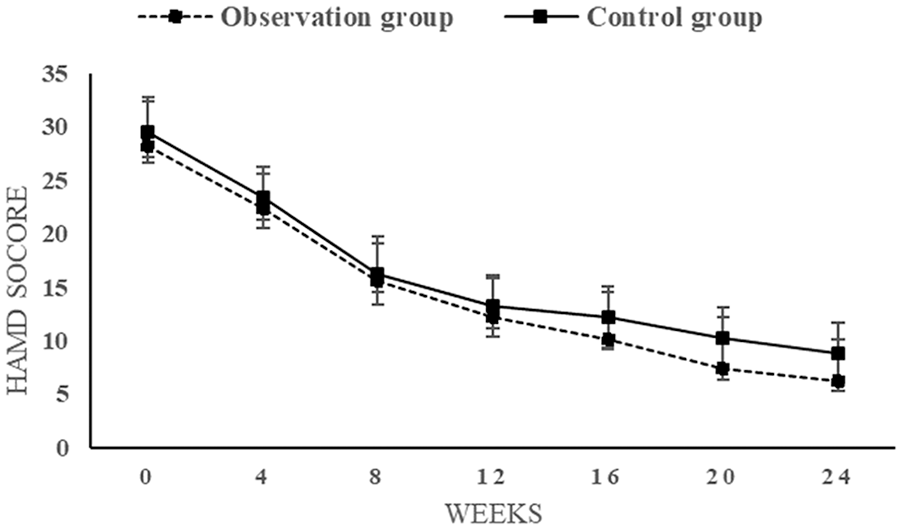
Comparison of HAMD scores between observation and control groups during the whole time of Chinese flower and bird painting therapy.
HAMD Scores of Observation and Control Groups Before and After 4, 8, 12, 16, 20, and 24 Weeks of Chinese Flower and Bird Painting Therapy.

Note. HAMD = Hamilton Rating Scale for Depression.
After 12 weeks of treatment, the effectiveness of the total HAMD scores in the observation group and the control group is examined. The difference between the effective groups before and after treatment in the two groups is less than .05 (p < .05). That is, the difference in the effectiveness of the total HAMD scores of the two groups is statistically significant. With the extension of treatment, the treatment effect in the observation group gradually increases over that in the control group.
Effects of Chinese Flower and Bird Painting Art Therapy on Patients’ EEG
From the perspective of the distribution of EEG changes, the abnormal rate of EEG at different stages of treatment has reduced to varying degrees. For patients with θ waves, their EEG changes after medication are insignificant. According to the EEG distribution table, the total decrease is classified as normal and abnormal, and the results are compared in Table 4.
Abnormal Rate in EEG of Observation and Control Groups During Chinese Flower and Bird Painting Therapy.

Note. EEG = electroencephalogram.
Experimental results show that the normal rate of EEG of patients treated with Chinese flower and bird painting art therapy is significantly higher than that in the control group after 24 weeks of treatment. The EEG results show that the influence of depression treatment on EEG mainly includes decreased α activities and increased θ activities, especially in frontal and central areas. However, in the control group, the antidepressant has a clear impact on the EEG in the early treatment stage. As treatment prolongs, the impact gradually decreases, indicating that the body has gradually adapted to drug stimulation and that the effect of long-term medication on depression has gradually weakened. However, in the observation group, due to the adjuvant therapeutic effect of Chinese flower and bird painting, the entire treatment process has an impact on the EEG, indicating a long-term influence on brain electrical signals.
Cases Study of Chinese Flower and Bird Painting Art Therapy
Li, male, 53 years old, had his first counseling session on December 10, 2017. He was diagnosed with depression by an HAMD score of 23, which was within the medium level. The patient participated in a 24-month Chinese flower and bird painting art therapy treatment alongside medication. At the beginning of the treatment, the patient showed low interest in painting and obvious impatience and hesitation during painting. His work had noticeable ink smudges on branch joints, and the entire creative process showed a clear tendency toward depression (Figure 3A). After the first stage of learning and imitation, his drawing skills and ability to control ink strokes improved; and fewer smudges and less shape loss were spotted. Measured by HAMD, the severity of his depression decreased (Figure 3B). After the second stage of treatment, using bright colors such as eosin and cinnabar, his daily mood stabilized, and he became euphoric to the painting. In addition, his sleep quality improved, his HAMD score dropped from 23 to 15, and his depression symptoms were thoroughly reduced. The color of his works became brighter, and the patient was more proficient in controlling the ink brush, with less hesitation before painting (Figure 3C). In the third stage of treatment, patients are inspired to appreciate and capture the beauty of nature through sketching. After the treatment, the patient’s HAMD score further reduced to 7. According to this statement, he did not feel obvious discomfort, and he had cultivated his passion for Chinese flower and bird painting. Compared with his previous works loaded with hesitation, broken lines, and dark color, those after treatment gradually carried bright colors and smooth strokes (as shown in Figure 3D). After the treatment, the patient was still passionate about the creation of Chinese flower and bird paintings, and painting had been internalized as a part of his life. Overall, the treatment effect in this case was more than satisfactory.

Paintings made by patient in medical case before (A) and after 8 (B), 20 (C), and 24 (D) weeks of Chinese flower and bird painting therapy.
Discussion and Conclusion
There are many previous studies on art therapy depression, which suggests that art therapy has positive effects on improving depression in women with breast cancer (Li et al., 2020). Women can generate difficult emotions by using images and colors. Painting helps them visualize these emotions and become catalysts for healing processes. Another meta-analysis (Tang et al., 2019) suggests that art therapy helps alleviate depression and anxiety symptoms in patients (S. H. Jang et al., 2016; Puig et al., 2006), and also suggests that painting-based art therapy can alleviate depressive symptoms. However, few researches focused on depression therapy especially for flower and bird painting. Past research shows that Chinese painting has a significant intervention effect in promoting positive mood preventing chronic distress symptoms worsening especially by improving collateral distress symptoms (Xiu et al., 2020).
People with depression are often extremely dissatisfied with themselves and impatient to complete anything. Feeling upset and lacking energy often lead to the abandonment of earlier hobbies and leisure-time activities, leading to a vicious cycle (Hänninen & Valkonen, 2019). In the creation of Chinese flower and bird paintings, this manifests in hesitative brushstrokes, broken lines, and abnormal proportions and structure. Therefore, the Chinese flower and bird painting art therapy designed in accordance with the characteristics of people with depression is used to guide patients to improve their psychological state and confidence during creation. Painting colors and materials are regulated step by step to assist in the treatment. The experimental conclusions show that after 24 weeks of treatment, 56 people with different severities of depression in the observation group experience significant improvement and marked reduction in recurrence rates than the control group during treatment, especially in the middle and late stages. Following treatment, most patients have optimistic enthusiasm for creativity and the ability to express their feeling through Chinese paintings. The creation of Chinese flower and bird paintings helps the painters to focus and cultivates patience. With the continuous creation of paintings, their moods become peaceful and stable, and they can stay positive and optimistic for more extended periods of time, which is conducive to stress release. After half a year of treatment, patients in the observation group have been able to independently perform basic Chinese flower and bird painting art creation, and patients develop a habit of regulating emotions through Chinese flower and bird painting creation. According to EEG analysis, the creation of Chinese flower and bird paintings combined with medication can increase the normal rate of patients’ brain waves, thereby improving treatment. The above research shows that Chinese flower and bird painting art therapy can improve the effectiveness of medication for depression and reduce its recurrence. In addition, Chinese flower and bird painting is closely linked to Chinese culture, which is highly familiar to patients, facilitating enthusiasm about learning and creation. Only five patients give up during the treatment experiment, and the overall acceptance rate was more than 90%, indicating that this therapy can be widely promoted in China.
Footnotes
Declaration of Conflicting Interests
The author(s) declared no potential conflicts of interest with respect to the research, authorship, and/or publication of this article.
Funding
The author(s) received no financial support for the research, authorship, and/or publication of this article.
