




Abstract
College students are exposed to daily stressors throughout their academic careers, which can have lasting consequences to their health and well-being. Mindfulness practices, art therapy, and the simple act of manipulating clay have independently demonstrated positive effects on stress and anxiety, but there is little research on the feasibility of incorporating these into an online resource for students to proactively address their mental health. In this pilot study, full-time university students (N = 15) were randomly assigned to a mindfulness-based art therapy (MBAT) program that used clay for all art directives or an unstructured, undirected neutral clay-manipulating task (NCT) for 10 weeks. Anxiety symptoms, salivary cortisol concentrations, and perceived levels of stress were assessed. Within-group analysis demonstrated significant decreases in anxiety symptoms and cortisol concentrations for MBAT participants, with no significant decrease in perceived stress. NCT participants experienced a significant decrease in cortisol concentrations on Week 1 but not on Week 10, with no other statistical significance in outcomes detected. Between-group analysis generated no significant interactions between variables. Based on these results, the structure of a therapist-directed online MBAT program using clay has the capacity to elicit anxiety-reducing benefits and may produce a trained biofeedback response for combating stress, offering a feasible strategy for addressing the mental health crisis on college campuses.
Introduction
To address the ever-growing prevalence of mental health issues, researchers across the globe are looking into feasible strategies for enhancing individuals’ access to services. Web-based interventions are increasing in popularity and importance as digital natives are coming of age and making up a larger part of the affected demographic.
Data collected from 86 institutions’ counseling centers (CCs) from 2010 through 2015 reflected a significant increase in college students reporting symptoms of generalized anxiety, depression, and overall distress (Xiao et al., 2017). CC utilization increased by 30% over the course of those 5 years, while institution enrollment only increased by 5.5%, suggesting that the stigma surrounding mental health is declining. However, many students still prefer to seek support from peers or family rather than through formal clinical counseling services (Eisenberg, Hunt, Speer, & Zivin, 2011). Even with the influx in students using university counseling services, 64% of college dropouts in a 2012 survey stated their reason for dropping out was related to mental health issues, and half (50%) of those who dropped out never accessed mental health services or support (National Alliance on Mental Illness [NAMI], 2012).
Unmanaged anxiety and stress can have devastating consequences to a student’s academic career, as depression and anxiety have strong correlations with lower grade point average and increased risk of dropout (Eisenberg, Golberstein, & Hunt, 2009; López-Bárcena, González-de Cossío Ortiz, Avila-Martínez, & Teos-Aguilar, 2009; NAMI, 2012), but consequences extend beyond academic success. Being in a state of chronic stress can have a severe negative impact on a person’s overall well-being. The stress response is a natural, biological mechanism that is integral to survival. Stress hormones like cortisol and adrenaline allow the body to remain alert in dangerous situations. When daily stressors induce this stress response on a regular basis, preventing the individual from returning to homeostasis, they begin to shift the mental and physical health statuses of that individual (McEwen, 2006; Sterling & Eyer, 1988). Chronic stress can lead to the development of anxiety, depression, and suicidal ideation (Sareen et al., 2005; Schneiderman, Ironson, & Siegel, 2005). It can also elevate blood pressure, increase risk of cardiovascular disease (Cohen, Edmondson, & Kronish, 2015), lead to the development of an autoimmune disease, or even exacerbate the symptoms of a preexisting disease like rheumatoid arthritis or multiple sclerosis (Schneiderman et al., 2005).
Web-based interventions and online programs are being explored with other populations that are experiencing heightened levels of stress. A web-based holistic stress reduction intervention was piloted with certified nurse-midwives, who are at risk of secondary traumatic stress, posttraumatic stress disorder, and burnout. Participation in holistic exercises 4 times a week for 4 weeks effectively improved their stress levels and coping (Wright, 2018). In Switzerland, Germany, and Austria, a therapist-guided online stress management program was offered to newly diagnosed cancer patients to help them with the psychological distress that comes with adjusting to a cancer diagnosis. The 8-week program consisted of self-directed stress management modules and patients received guidance from a trained psychologist in the form of weekly feedback and individual support through a secure chat function. Program participants experienced improved quality of life and significant decreases in distress when compared with the waitlist-control group, further supporting this concept of web-based minimal contact mental health support (Grossert et al., 2016; Urech et al., 2018).
Technologies like HIPAA (Health Insurance Portability and Accountability Act)-compliant web servers have made the digital streamlining of psychological screenings and assessments possible, changing components of mental health services. And now, news articles like Top 25 Best Mental Health Apps of 2018 (Shelton, 2018) suggest that mental health apps have become commonplace, but many professionals stress that these apps do not serve as an alternative to therapy. Instead, they can be used as a supplement, or at least provide a space for people who are still reluctant to seek traditional mental health support, or perhaps lack the resources to get to face-to-face therapy.
Few of the apps have been validated by peer-reviewed studies, and online programs such as the ones mentioned above solely rely on self-report measures to evaluate efficacy. Therefore, we developed a research design to assess both psychological and physiological outcomes, to fortify study results and acknowledge the strong relationship between mental and physical health. The Perceived Stress Scale 10-item (PSS-10) and the Generalized Anxiety Disorder 7-item (GAD-7) were used to assess psychological outcomes while concentrations of the stress hormone cortisol in saliva samples were tested, as reductions in concentrations have been observed in mindfulness and art therapy research (Brand, Holsboer-Trachsler, Naranjo, & Schmidt, 2012; Kaimal, Ray, & Muniz, 2016).
Method
Overview of Intervention Program
Art therapy is a mental health profession that integrates the creative process with applied psychological theory (American Art Therapy Association, 2017). Art therapists are trained psychotherapists with more specified training in the therapeutic properties of art materials and creative processes. Art therapy researchers are gaining a better understanding that in addition to the therapist–client relationship and the directives used in session, the art material itself can affect a client down to neurological and physiological levels (Kaimal et al., 2017; Kaimal et al., 2016; Kimport & Robbins, 2012; Kruk, Aravich, Deaver, & deBeus, 2014; Lorenzo de la Peña, 2016; Sandmire, Gorham, Rankin, & Grimm, 2012; Scholt & Gavron, 2011). Findings from previous studies suggest that the material properties of clay complement mindfulness practices, as even brief clay sculpting is associated with increased gamma and theta power, brain waves linked to information-processing and deep meditative states, respectively (Budzynski, 2006; Kruk et al., 2014). In addition, clay tasks can facilitate expression of emotions (Scholt & Gavron, 2011) and promote stress reduction (Kimport & Robbins, 2012).
The research exploring the therapeutic properties of clay offers a promising role in anxiety and stress reduction among college students. Noticeably, if clay manipulation alone could elicit sufficient positive psychological and physiological outcomes, then the most feasible program for college students would be a campaign to get clay in the hands of each entering freshman. We set out to determine whether clay alone was indeed sufficient to produce positive outcomes, or if more structure and direction is needed.
The program was developed as a mindfulness-based art therapy (MBAT) program using clay that can be facilitated over an online platform with a minimal contact approach from the art therapist/researcher. It is made up of one “challenge” that the researcher facilitates, in-person, with participants on the first and last week of the program, and eight “self-care challenges.” These self-care challenges are brief, 15-min, MBAT directives. The directives are each made up of a brief mindfulness practice like yoga or meditation with a complementary clay-based art directive. The meditation audio files in the program were adapted by Dr. Sean Sullivan from Limbix, Inc.© and were free for our use. The first author produced all the yoga sequence videos.
Procedure
This study was reviewed and approved by the university’s institutional review board. The researchers used an experimental-comparison research design with a convenience sample of college students enrolled at a public university full-time. Participants were randomized into the experimental MBAT group condition or a neutral clay-manipulating task (NCT), which served as the comparison group condition. The study was conducted over the course of 10 weeks within a single academic semester and used a minimal contact, technology-assisted approach. Both group conditions were asked to complete a brief self-care task once a week; these techniques were dubbed “self-care challenges” and were designed to only take 15 min. The experimental group’s self-care challenges consisted of a 5-min mindfulness practice and 10 min of intentional art making with earth-based clay. Table 1 provides a brief overview of the modules. The NCT group’s self-care challenges were identical from week to week, and consisted of a NCT, where they were given the same clay as experimental participants and told to “manipulate the clay in any way you wish for 15 minutes.” The primary researcher met with the groups separately on Weeks 1 and 10, during which time quantitative data were collected in the form of self-report measures and pre- and post-challenge saliva samples. For the 8 weeks in between face-to-face meetings, participants checked in through the study’s online platform, a learning management system, to complete the self-care challenges. Qualtrics© was used to administer the self-report assessments remotely. To demonstrate their continued participation in the study, participants were asked to upload images of their artwork each week within the online platform.
Breakdown of Mindfulness-Based Clay Art Therapy Modules.

The procedure of this study (see Figure 1) was informed by the research question: can MBAT, facilitated to college students using a minimal contact technology-assisted approach, decrease cortisol levels, decrease levels of perceived stress, and reduce symptoms of anxiety more effectively than an unstructured and undirected clay task? The researchers hypothesized that participants of the experimental group condition would experience statistically significant decreases in all three measures while the comparison group would not.
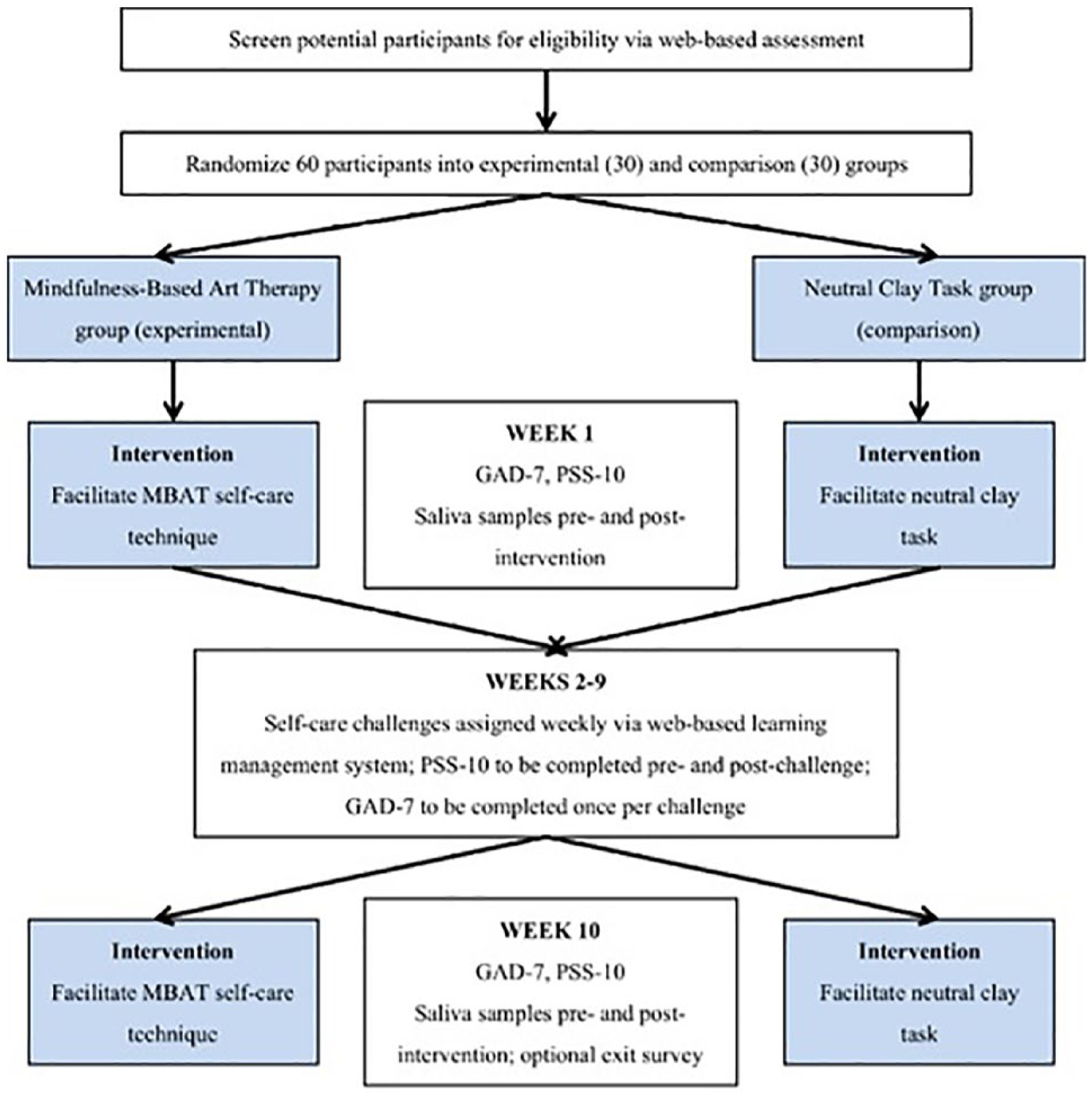
Sequence of procedures.
Participants
Students with a full-time enrollment status at the university were recruited through posted advertisements, classroom announcements, and social media. Inclusion criteria were 18 to 65 years old with a full-time enrollment status at a public university. Smokers were excluded from this study because nicotine can compromise the salivary cortisol data.
A total of 25 students expressed interest in participating, 17 qualified for the study, and 15 attended their first face-to-face meeting (N = 15). Informed written consent was obtained by all participants at the first meeting. Eleven participants identified as female (73%), three identified as male (20%), and one participant preferred not to disclose (7%). Participants’ ages ranged from 18 to 23 years old (M = 19.87 years, SD = 1.51). Sixty percent of participants identified as White, 14% as Hispanic or Latino, 13% as Black or African American, and 13% identified themselves as more than one race. It was required in the inclusion criteria that participants were enrolled full-time at the university. Participants were enrolled in at least 12 and up to 16 credit hours (M = 13.67 credit hours; SD = 1.45 hr). They were randomized into the experimental (n = 7) and comparison group (n = 8) conditions.
Data Analysis
Generalized Anxiety
To measure severity of general anxiety symptoms, the GAD-7 self-report measure was used. The GAD-7 is brief and able to distinguish symptoms of anxiety from depressive symptoms (Spitzer, Kroenke, & Williams, 2006). Scores can range from 0 to 21 and cutoffs are 5, 10, 15, and 21 for determining whether anxiety is insignificant, mild, moderate, or severe, respectively. It has a sensitivity score of 89% and specificity of 82% for diagnosing generalized anxiety disorder. It has been found to be valid and reliable for the general population (Lowe et al., 2008; Spitzer et al., 2006), making it a relevant instrument for the sample of this study. All data analysis was conducted using GraphPad Prism 7.01 data analysis software. Within-group paired-samples t tests were conducted to compare severity of anxiety from the first week to the 10th week and determine whether any significant changes were observed. Between-group comparison of scores from Week 1 to Week 10 was conducted using a two-way analysis of variance (ANOVA) to evaluate any significant interaction between group condition and week of assessment.
Perceived Stress
Perceived stress levels were assessed pre- and post-self-care challenges each week using the Sheldon Cohen PSS-10. The PSS-10 is a 10-item questionnaire with a two-factor structure measuring perceived helplessness and perceived self-efficacy and is both valid and reliable with U.S. college students (Roberti, Harrington, & Storch, 2006). The weekly pretest–posttest design of its administration was used to assess whether any of the self-care challenges in the experimental program were more effective than others and analyzed by conducting within-group paired-sample t tests. Within-group paired-sample t tests of Week 1 prechallenge scores and Week 10 postchallenge scores were also conducted to determine whether any overall change in perceived stress was observed from the beginning to the end of the study.
Salivary Cortisol Concentrations
A physiological measure of stress was also collected through saliva samples and processed as enzyme-linked immunosorbent assays (ELISA). The ELISA samples measured the concentration of the stress hormone cortisol in the participants’ saliva. This biological measure provides an additional facet of empirical data that is harder to manipulate compared with self-report measures. Collecting saliva samples before and after the tasks on Weeks 1 and 10 also provided the researchers with the ability to measure rate of change in cortisol concentrations to assess for any possible biofeedback response. A two-way ANOVA was conducted to analyze the variance between the MBAT group’s pre- and postchallenge cortisol concentrations from Week 1 to Week 10. In addition to two-way ANOVA, the researcher also conducted paired-sample t tests of each group’s pre- and postchallenge cortisol concentrations for Weeks 1 and 10, independently. This was done to determine whether any within-group significance took place.
Saliva samples were analyzed using the Salimetrics© Expanded Range High Sensitivity Salivary Cortisol Enzyme Immunoassay Kit (Item No. 1-3002 [Single] 96-Well Kit; 1-3002-5 [5-Pack] 480 Wells). Participants were asked to avoid alcohol consumption for 12 hr and to not consume food for at least 1 hr prior to sample collection. Water was provided to participants to rinse their mouths thoroughly 10 min before each saliva sample was collected. Saliva samples were collected by unstimulated passive drool. Participants were instructed to tilt their heads forward, allowing the saliva to pool on the floor of the mouth and then pass the saliva through their lips into a collection vial. Time and date of sample collections were recorded, and samples were collected between 7:30 a.m. and 8:30 a.m. due to the diurnal variation in cortisol levels. Samples were immediately placed on wet ice and then transported to the lab within 3 hr of collection and frozen below –20°C.
On days of assays, saliva samples were thawed completely, vortexed, and centrifuged at 1500g for 15 min using the Model TJ-6 Centrifuge to remove mucins and other particulate matter. Twenty-five microliter of standards, controls, and triplicates of saliva samples were pipetted into appropriate wells on a 96-well microtiter plate and 25 µL of assay diluent was pipetted into two wells to serve as the zero and two nonspecific binding (NSB) wells. Conjugate solution was prepared by diluting the enzyme conjugate 1:1600 into the assay diluent and 200 µL of the solution was added to each well using a multichannel pipette. The plate was covered, rotated for 5 min at 500 rpm, and then incubated for 1 hr at room temperature. After incubation, the plate was washed by adding 200 µL of 1× Wash Buffer to each well, discarding the liquid over the sink, and then thoroughly blotted with paper towels. This wash process was repeated 4 times. After the plate was washed and blotted dry, 200 µL of TMB substrate solution was added to each well using a multichannel pipette. The plate was then covered, rotated for 5 min at 500 rpm again, and incubated in the dark at room temperature for 25 min. Fifty microliter of stop solution was added to each well using the multichannel pipette before being covered and mixed on the plate rotator for 3 min at 500 rpm. The bottom of the plate was wiped with a water-moistened Kimwipe and read at 450 nm using Gen 5 1.11 Microplate reading software to determine optical density. From these data, the researcher computed the percentage of cortisol bound and conducted a regression analysis to establish cortisol concentrations. Cortisol concentrations were measured in micrograms per deciliter (μg/dL) and used to run the two-way ANOVA and within-group paired-sample t tests.
Additional questionnaires
Information collected through questionnaires was not used for formal analysis, but used to understand the characteristics of the study sample and their overall experience as research participants. Qualtrics© was used to administer several questionnaires created for the purpose of this research study. Students who contacted the primary researcher with interest in participating were asked to complete an online preliminary screening through Qualtrics© to determine their eligibility. A brief demographic questionnaire was administered at Week 1 meeting to gather demographic data, average hours of sleep a night, caffeine intake, exercise routine, and last day of menstruation for female participants, as menstruation can affect the production of the stress hormone cortisol.
Participants who attended the Week 10 meeting also had the option to take an anonymous exit survey. In this exit survey, participants were asked questions regarding whether they found it helpful, whether it was convenient and easy to use, and they had the opportunity to provide open-ended comments/feedback about their overall experience.
Results
Retention
Of the initial sample size of 15, nine participants attended both face-to-face meetings (MBAT, n = 4; NCT, n = 5), but only five students completed all 10 self-care challenges (MBAT, n = 2; NCT, n = 3). The researcher used the n = 9 data set of retained participants for data analysis to maximize sample size. The researchers acknowledge that these results are measurement estimates due to the small sample size, and need to be investigated further with a larger sample.
Generalized Anxiety
Within-group paired-sample t tests showed that the MBAT group (n = 4) demonstrated a statistically significant decrease in anxiety from Week 1 to Week 10, t(4) = 6.789, p = .006, while the NCT group (n = 5) did not demonstrate any statistical significance from Week 1 to Week 10, t(4) = 1.783, p > .05. Although the NCT group did not have any statistically significant difference in GAD-7 scores from Week 1 to Week 10, it did exhibit a general decrease in average scores (see Figure 2). Two-way ANOVA (Table 2) showed no statistical interaction was identified between group condition and week of assessment: F(1, 14) = 0.046, p > .05. Sample sizes were small, making data analysis far from conclusive, but results from within-group paired-sample t tests do suggest that MBAT has some anxiety-reducing benefits when compared with a NCT condition.

Average GAD-7 scores with standard deviation bars of MBAT and NCT groups from Week 1 to Week 10.
Two-Way ANOVA Between-Group Comparison of MBAT and NCT Group GAD-7 Scores From Week 1 to Week 10 demonstrating no significant interactions between groups and time periods.

Note. ANOVA = analysis of variance; MBAT = mindfulness-based art therapy; NCT = neutral clay-manipulating task; GAD-7 = Generalized Anxiety Disorder; SS = sum of squares; MS = mean squares; dfn = degrees of freedom numerator; dfd = degrees of freedom denominator.
Perceived Stress
Participants were asked to complete the Sheldon Cohen PSS-10 as their pre- and postchallenge assessment of perceived stress. The normal distribution of PSS-10 scores for 18- to 29-year-olds is a mean of 14.2 with a standard deviation of 6.2, based on a normed sample of N = 645. A score of at least 20 is considered high levels of perceived stress. For the MBAT group, paired-sample t-tests generated no statistically significant difference in Week 1 prechallenge scores and Week 10 postchallenge scores: t(3) = 1.809, p > .05. The same conclusion was made for the NCT group, as they did not demonstrate any statistical difference between Week 1 pre- and Week 10 postchallenge scores either: t(4) = 1.757, p >.05 (see Figure 3).
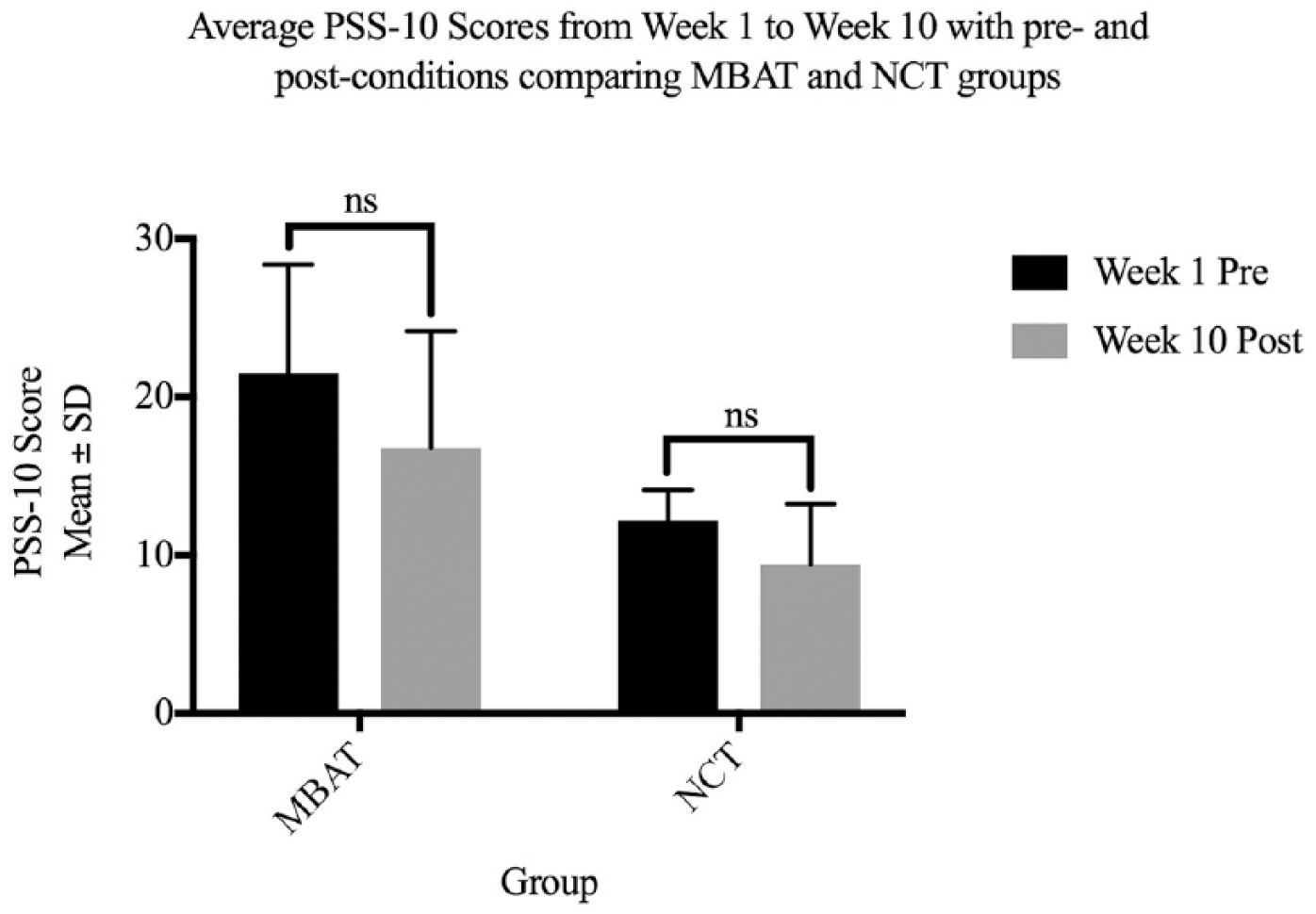
Average PSS-10 scores with standard deviation bars from Week 1 to Week 10 with pre- and postconditions comparing MBAT and NCT groups.
Weekly paired-sample t tests were run using all of the MBAT participants’ PSS-10 scores from each week, not just the retained subjects data set to maximize sample size and minimize a Type I error. Only Week 8 (see Figure 4), “Restoration,” demonstrated a statistically significant reduction in PSS-10 scores pre- and post-self-care challenge, t(2) = 10, p = .009. The paired-sample t test of Week 5, Module 4: “Harnessing Gratitude,” PSS-10 scores pre- and postchallenge generated a nearly statistically significant decrease in perceived stress: t(3) = 2.611, p = .0796 (see Figure 5). The small sample size prohibits any conclusions being made from such results, but they suggest that certain modules may be more effective at reducing levels of perceived stress than others.
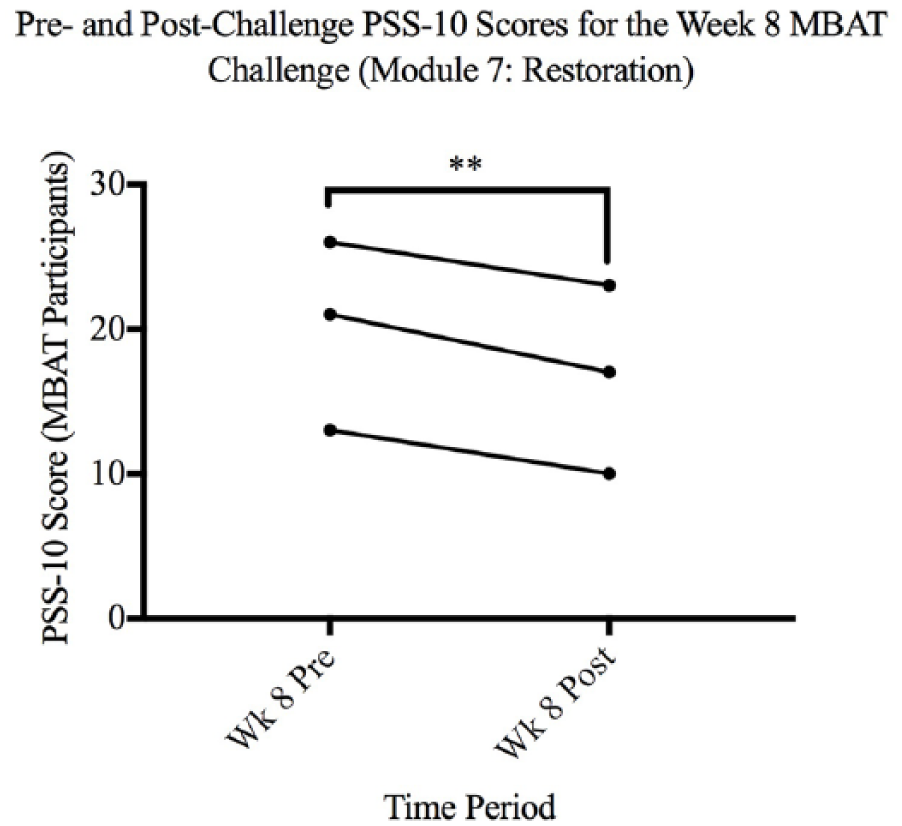
MBAT participants’ plotted PSS-10 scores before and after Module 7: Restoration.

Demonstration of near statistical significance in plotted PSS-10 scores for MBAT participants before and after Module 4: Harnessing Gratitude.
Cortisol Analysis
Regression analysis of optical density and percent bound was conducted using a four-parameter nonlinear regression curve fit to generate cortisol concentrations (µg/dL) of standards, high and low controls, and saliva samples. The r2 obtained for Plate 1 was 99.15% (R2 = .992) and 99.23% for Plate 2 (R2 = .992), ensuring accuracy of cortisol data. Two saliva samples collected were too low to analyze and had to be excluded from analysis. A two-way ANOVA between the MBAT group’s pre- and postchallenge cortisol concentrations from Week 1 to Week 10 and the NCT group’s concentrations was conducted. There was no significant interaction between group condition and salivary cortisol collection period on cortisol concentration: F(1, 14) = 0.012, p = .915 (see Table 3).
Two-Way ANOVA of Group Conditions and Saliva Collection Period Interaction With Cortisol Concentration (µg/dL) demonstrating no significant interactions between groups and time periods.
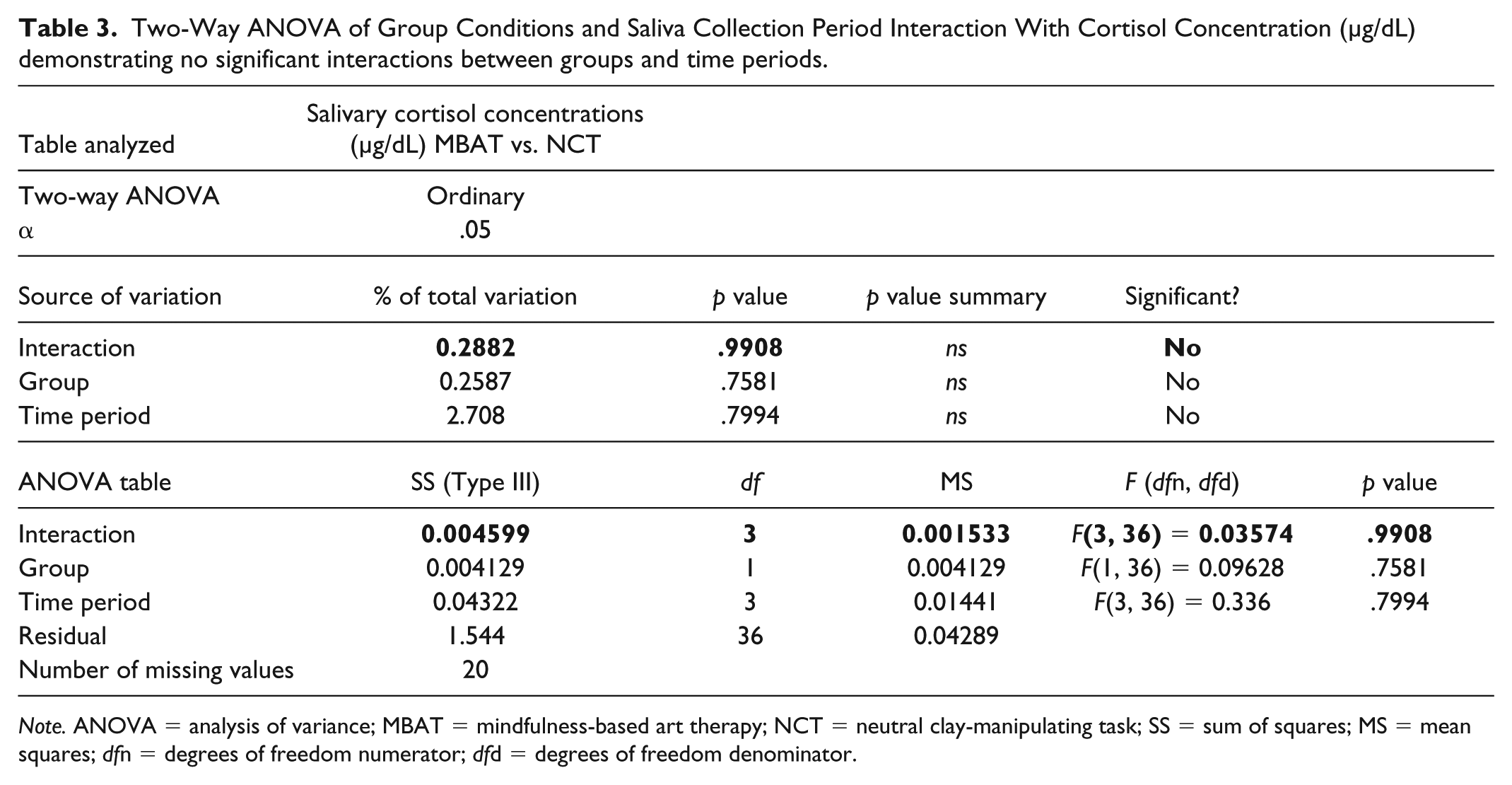
Note. ANOVA = analysis of variance; MBAT = mindfulness-based art therapy; NCT = neutral clay-manipulating task; SS = sum of squares; MS = mean squares; dfn = degrees of freedom numerator; dfd = degrees of freedom denominator.
Paired-sample t tests (see Figure 6) of each group’s pre- and postchallenge cortisol concentrations for Weeks 1 and 10 produced inverse results for each group condition. The MBAT group showed no statistical difference in cortisol concentrations from before the challenge to after on Week 1, t(4) = 0.272, p = .799, but did show a statistically significant decrease in cortisol concentrations on Week 10, t(3) = 13.01, p = .001. The opposite happened for the NCT group, as they experienced a statistically significant decrease in cortisol on Week 1, t(7) = 3.208, p = .015, but not on Week 10, t(4) = 0.132, p = .902.

Pre- and postchallenge cortisol concentrations with standard deviation bars for MBAT and NCT group conditions Week 1 and Week 10.
Exit Surveys
Participants who attended the second meeting (Week 10) had the option to complete an anonymous exit survey. All nine participants opted into completing it at the conclusion of the final meetings. The survey asked them five questions regarding satisfaction with participating, level of helpfulness with their own stress and anxiety, convenience and usability, and an open-ended component for any comments and/or feedback relating to their experience. Eight out of nine participants (89%) either agreed or strongly agreed that they were very satisfied with their experience as a participant in the study and one participant somewhat disagreed. Six out of nine participants found it helpful with reducing levels of perceived stress, one person somewhat disagreed, one disagreed, and one neither agreed nor disagreed. Four out of nine participants somewhat agreed that the study was helpful in reducing their levels of anxiety, one participant disagreed, one somewhat disagreed, and three neither agreed nor disagreed. Seven out of nine participants found the online platform convenient and easy to use while two participants somewhat disagreed, explaining that “the [online] app glitched often and made it frustrating to submit photos” and “the . . . page wasn’t set up in the best way.”
Other feedback received through the exit survey included suggestions for changing the day of the week that self-care challenges were “due” from Saturday night to Sunday night, as most respondents explained it was difficult to remember to complete them before a Saturday deadline. Respondents also described positive outcomes from participating. One respondent “enjoyed the study” and “learning new techniques.” Another respondent said, “I loved the challenge, and found myself practicing the breathing exercises even outside of the study. I love the clay too, really fun.” Overall, participants were open to providing honest feedback of their experience and offered valuable suggestions for altering the research design to enhance usability and retention rates in the future.
Discussion
This study’s purpose was to address an elemental gap in research relating to proactive mental health programs for college-level students. Perceived stress, generalized anxiety, and salivary cortisol concentrations of participants were measured and compared. Within-group and between-group analysis was conducted to test the effectiveness of each group condition.
MBAT and Its Impact on Anxiety
The hypothesis that the MBAT group would experience more significant reduction in GAD-7 scores from Week 1 to Week 10 was accepted. The MBAT group had a statistically significant reduction in GAD-7 scores from Week 1 to Week 10 while the NCT group did not. The average GAD-7 score of the retained subjects from the MBAT group on Week 1 was M = 9.0 and the average for the retained subjects of the NCT group was M = 9.2. This reinforces that the significant decrease in scores on Week 10 for MBAT participants is unlikely attributable to more severe initial symptoms of anxiety but rather to the group condition itself.
The initial GAD-7 scores of participants supported a high prevalence of anxiety among college-level students. Ninety-three percent of the research participants had GAD-7 scores of at least mild levels of generalized anxiety, and 47% scored moderate or severe levels. It is possible that we do not yet truly understand the extent to which college students are affected by anxiety and stress. Participants who scored high on the GAD-7 were monitored throughout the study and would be referred to additional mental health support if decreases in anxiety were not observed. The inflated prevalence among the sample size of this study could be influenced by the phenomenon of self-selection, as potential participants knew that the study’s focus was about addressing anxiety and stress.
Perceptions of Stress
The hypothesis that the MBAT group would experience greater reductions in perceived levels of stress on Week 10 compared with the NCT group was rejected. Neither group produced a statistically significant decrease from Week 1 to Week 10, but the NCT group condition had near-statistically significant decrease in scores pretest to posttest on Week 10 (p = .071), coinciding with literature that identifies clay work as having stress-relieving benefits (Kimport & Robbins, 2012).
Weekly PSS-10 scores, however, suggest some of the challenges were more effective at lowering levels of perceived stress than others. Week 8’s self-care challenge, “Restoration,” elicited statistically significant reduction in PSS-10 scores for the MBAT group participants: t(2) = 10, p = .0099. This challenge consisted of a simple yoga sequence of three poses followed by a mindful art-making session where participants were asked to create a clay work response to how they were feeling in the present moment.
The Week 5 challenge, “Harnessing Gratitude,” elicited reductions in PSS-10 scores that were near statistical significance: t(3) = 2.611, p = .0796. Gratitude, which constitutes having “a more positive and appreciative outlook toward life” (Wood, Maltby, Gillett, Linley, & Joseph, 2008, p. 854), has been identified as having a lasting protective effect against stress and depression among college-level students (O’Leary & Dockray, 2015). Gratitude also requires some awareness of the present moment, similar to mindfulness and likely complements the characteristics of this study. In the Week 5 MBAT challenge, participants listened to a brief guided meditation about gratitude and were then asked to create an art piece representing the thing they were grateful for through the meditation.
Cortisol Concentrations
The hypothesis that the MBAT group would experience reductions of salivary cortisol concentrations pretest to posttest at a faster rate than the NCT group by Week 10, indicating the presence of a biofeedback response, was rejected. The MBAT group did experience a statistically significant reduction in salivary cortisol concentrations on Week 10 after experiencing no significant reduction on Week 1, but there was no statistical significance when compared with the NCT group.
The NCT group experienced the opposite of the MBAT group. The NCT group demonstrated statistically significant reductions in salivary cortisol concentrations on Week 1 pretest to posttest, but not on Week 10. The significant reduction in the NCT group’s concentrations on Week 1 could be attributed to the natural reduction in cortisol concentrations that occurs when just sitting quietly (Pawlow & Jones, 2005), but there are several other variables that can affect salivary cortisol concentrations. Potential contributing factors to salivary cortisol concentrations range from differences in sex, food and alcohol intake, genetic predispositions, environmental factors, menstruation, caffeine intake, exercise activity, medication, and more (Clements, 2012; Stephens, Mahon, McCaul, & Wand, 2016). It is recommended for future research that data on these possible variables be collected more vigorously while also incorporated into analysis. While some of these data were collected with the initial demographic questionnaire, corresponding posttest data were not collected at the end of the study to assess the presence of any additional benefits to participation, such as sleeping patterns, caffeine intake, or exercise routines.
Notwithstanding the other variables, the results of the cortisol paired-sample t tests align with research regarding mindfulness, meditation, and working with clay. Research emphasizes that it is the ongoing practice of mindfulness that enhances physical and mental benefits (Brand et al., 2012; Henderson et al., 2013; Hofmann, Sawyer, Witt, & Oh, 2010; Kabat-Zinn, 2003; Prazak et al., 2012; Schure, Christopher, & Christopher, 2008), while a brief single-session clay task can affect cortisol concentrations (Kaimal et al., 2016).
Accessibility and Feasibility
Participants had access to the research facilitator through email and cell phone while they were completing Weeks 2 through 9, remotely. Some participants took advantage of this and communicated with the researcher when they had questions, issues with the online platform, or missed a deadline. This allowed the researcher to support participants as needed even though they were not meeting face-to-face each week. Participants who did reach out throughout the study chose text messaging or email as their method of communication with the researcher; no participants chose to call the researcher, suggesting that college students feel more comfortable communicating through digital avenues.
Regarding the online platform, some participants found it confusing while others liked that they already regularly accessed the web-based application, which is also the university’s adopted learning management system, and therefore they found it convenient. It is possible that using the same platform that students use to turn in assignments, check grades, and communicate with their professors made the self-care challenges feel more like homework rather than self-care. Each self-care challenge would go live on the website/app for a week at a time, starting at midnight on Saturdays and they would be due the following Saturday at midnight. Most participants completed their self-care challenges late on Saturday evenings, and the inconvenient “due dates” could have contributed to the high attrition rate of the study.
Results of this study imply that further research is needed on the concept of using MBAT through an online platform as a proactive mental health program for college-level students and that current findings are reassuring. The differences in effects of the two group conditions support the current research on mindfulness practices, art therapy, and the intrinsic therapeutic benefits of working with an art medium. The high attrition rate, in spite of the minimal time requirement asked of participants, suggests that there is less of an issue of students lacking access to mental health resources but rather that the student population fails to use such resources. Further research into understanding how students are motivated to proactively address their mental health is necessary for the development of a university program that is not only evidence-based, but also maximizes student involvement.
Limitations
There are several significant limitations of this study. The small sample size of nine retained participants prevents any generalizations to be made about the results. In addition, the study sample was a majority of female participants and therefore not reflective of the general student population.
Another limitation of the study was the issue of self-screening. The researcher used a convenience sample and relied on students to respond to recruitment flyers. It appears that students who already identify themselves as more stressed and anxious are more likely to express interest in a study such as this one. The average PSS-10 score pre-challenge at the first face-to-face meeting was M = 19.53 (SD = 7.367), closer to the higher range of perceived stress rather than the normed average score of M = 14.2. Similarly, the average GAD-7 score of all participants on Week 1 was M = 10.87 (SD = 4.96), which is considered a moderate level of generalized anxiety. The participants of this study were not necessarily displaying subclinical levels of anxiety and stress, but moderate levels that needed addressed and may not be reflective of the general student population at large.
Conclusion
Future studies can expand on this research by facilitating the program with a much larger sample size, and efforts are already under way to replicate this study at the same institution on a larger scale. Alternative outcome measures could also be incorporated into future studies to gather different information. Acceptance and participation could be considered, as well as other physiological measures or external variables, like the program’s effect on academic performance, sleeping habits, exercise routine, and sociability.
Reviewers of the preexisting mental health apps have noted that the best apps will have mental health professionals taking on active roles to ensure safety and support for their consumers (Shelton, 2018). The structured and directed nature of the program’s self-care challenges was more effective than the simple nondirected task of manipulating clay, coinciding with this ideal of a therapist-directed program. The program, facilitated by an art therapist through a minimal contact approach, could offer college students a place to learn skills for managing stress and experience anxiety reduction, all while the ongoing practice impacts them down to the physiological level.
Footnotes
Acknowledgements
A sincere thank you to Lisa Anderson of the Stanwood Lab for her contributions to the project and to Jonathan Sockell, Dr. Sean Sullivan, and the rest of the Limbix© team for providing the meditation audio files incorporated into the MBAT modules.
Declaration of Conflicting Interests
The author(s) declared no potential conflicts of interest with respect to the research, authorship, and/or publication of this article.
Funding
The author(s) disclosed receipt of the following financial support for the research, authorship, and/or publication of this article: This project was supported by the Florida State University Council on Research and Creativity (Project ID 041680).
