




Abstract
This paper explores factors associated with intergenerational differences in home-based acculturation (HBA) and the attitude of Chinese college students and their parents toward intercultural marriage with a focus on China’s cultural context where parents have a strong influence on child’s decisions. In two related studies, we recruited a total of 749 Chinese college students and parents (387 in Study 1 and 362 in Study 2; all are living in China) to participate in the survey. The results indicate that (a) online intercultural contact is positively associated with HBA; (b) HBA is a strong predictor of attitude of intercultural marriages by Chinese parents and college students and the socioeconomic status has a divergent effect on the two groups; and (c) Chinese college students and parents differ in terms of their HBA and online intercultural contact. Findings from the research add knowledge to our understanding of the impact of globalization and digitalization on acculturation and Chinese residents’ perspectives on intercultural marriage.
Keywords
Globalization and digital technology have led to frequent intercultural and cross-cultural contact among people. This is partly responsible for a worldwide increase in the number of intercultural marriages (Daneshpour & Fathi, 2016; Piper & Ball, 2001; Zhou, 2017). In terms of China, the trend of intercultural marriages has increased largely because of globalization and digitalization (Zhou, 2017). From 1978 to 2012, the registered cross-national marriages have increased from none to approximately 53,000 in mainland China, and this number does not include the ones that have been registered overseas (China Ministry of Civil Affairs, 1992, 2012). With the increasing movement of people between China and the United States, a growing number of Chinese and Americans have become acquaintances, friends, and couples. The U.S. Census Bureau (2013) American Community Surveys estimated that in 2013, the number of Chinese immigrants in the United States was approximately 3.58 million. Thirty-three percent of Chinese immigrants were in the United States as spouses, children, and parents of U.S. citizens (U.S. Department of Homeland Security, 2014).
The three aims of this research are (a) exploring Chinese generational differences in intercultural marriage expectations and acculturation in their home cultural context, (b) investigating how these expectations interact with home-based acculturation (HBA) and other individual and contextual factors, and (c) examining how the interactions highlight and have an impact on China’s cultural and social practices. Previous studies on intercultural marriages have certain limitations. First, they often focus on marriage itself, and view it as a separate and independent entity, rather than considering it as stages of relationships that could be influenced by certain factors that existed prior to the marriage and will lead to different outcomes. Second, these studies are often set in a context where one spouse leaves the home culture and enters an unfamiliar new culture. Third, few studies focus on the impact of cultural values on intercultural marriages. Building upon and extending the findings of previous studies on cultural adaptation and acculturation theories, this study investigates how acculturation could happen in a person’s home cultural context and how it is associated with intercultural marriage expectations and online intercultural contacts. Even before visiting the United States, the youth have a substantial amount of virtual cultural exposure. Consequently, they form some expectations, which are not always accurate, regarding their future intercultural interactions and relationships. This pre-departure intercultural exposure is an important link that is missing in cultural adaptation theory to make it applicable in today’s globalized and networked world.
Furthermore, in response to the call for “intra-cultural” research (Miike, 2019; Shuter, 2013), this study focuses on the distinctive Chinese contexts and explores factors associated with intercultural marriage expectations from the perspective of children and parents. China’s widespread economic development and the accelerating globalization process have widened the wealth gap between the social classes in the past decades (Dollar, 2007, June 1). Over time, intercultural marriages have become an acceptable and practical means of gaining upward social mobility (Hu, 2016). However, intergenerational value gaps based on economic development may result in potential conflicts, because according to the Chinese Confucian tradition, parents are regarded as the gatekeepers of their child’s marriage, and young couples are often economically dependent on their parents. Some East Asian countries, such as Taiwan, Japan, and South Korea, have also been influenced by the Confucian tradition that lay emphasis on the importance of parents’ roles in families, therefore, exploring intergenerational differences would provide a deeper insight regarding the practices of intercultural marriages not only in terms of the Chinese population, but for other East Asian populations as well (T. Kim, 2009; Schmidt, 2018; Y. B. Zhang et al., 2005).
This study uses intercultural marriage as a lens through which some of China’s current social issues could be examined. Discussions about marriage-related concerns in mainland China are often associated with the social issues arising from dramatic changes that the country has undergone over the last few decades, such as the increased importance of material wellbeing, difficulty in cross-class movement, and an increased gap between the value systems of the different generations (Zavoretti, 2016; Y. Zhao et al., 2017). Therefore, by studying factors that influence the attitude toward intercultural marriage and the intergenerational differences in culture orientations, this paper explores the implications of the widespread social transitions on the Chinese population.
The paper begins with a review of relevant studies to formulate the research questions. Following that, the methods used for the study are discussed and the results are reported. To conclude, the key findings and limitations are stated.
Literature Review
Factors Influencing Intercultural Marriages
A major difference between intercultural and within-culture marriages is that partners have to deal with factors associated with multiple dimensions of cross-cultural differences that influence the level of satisfaction in the relationship, such as differences in food, religion, social class, male-female roles, and cultural values (Barker & Cornwell, 2019; Y. H. Chen, 2006; Cools, 2015, 2006; Hiew et al., 2015; Romano, 2008; Tili & Barker, 2015). The importance of foreign language skills is often highlighted during the development and maintenance of intercultural relationships as scholars (Cools, 2006; Jandt, 2015; Romano, 2008) indicate that knowing a partner’s native language not only facilitates effective communication, but also contributes toward a better understanding of the partner’s home culture. Cools (2006) interviewed six heterosexual intercultural couples living in Finland and found that communication competence is a cultural issue that has an influence on their relationship. Similarly, Jandt (2015) stated that a lack of foreign language proficiency creates barriers in family communication. Differences in communication styles also have an impact on intercultural relationships. Hiew et al. (2015) found that Chinese-Western couples demonstrated more negative and less positive communication behavior as compared to Western couples, and this is significantly associated with their relationship satisfaction. Tili and Barker (2015) interviewed nine Caucasian-Asian couples and stated that language fluency and the differences between high- and low-context communication styles greatly influences the communication between intercultural couples.
Perception and an understanding of the partner’s culture is another important factor in this context. Intercultural partners and couples encounter conflicts in daily issues such as raising children, female-male roles, and cultural traditions (Cools, 2006). A study conducted by Tili and Barker (2015) reveals that different perceptions and practices regarding open-mindedness, mindfulness, showing respect, self-disclosure, and face support result in conflicts between Chinese or Caucasian American partners. It has been observed that the more a person understands the partner’s culture, the better they are prepared and the more likely they are to understand the perspective of the partner and address conflicts constructively. Cools (2015) viewed parenting and child-raising as a challenge and an opportunity for intercultural couples to renegotiate traditions and value systems during which mutual understanding is a “generator for support and a means to capture the essence of an intercultural relationship” (p. 154).
Literature indicates that socioeconomic status is a major concern that encourages or discourages a person to “marry out” (Y. H. Chen, 2006; Renalds, 2011; Romano, 2008). Y. H. Chen (2006) investigated intercultural marriages and their impact on fertility in Taiwan and found that economic status is a primary factor when Taiwanese decide when and who to marry. Renalds (2011) interviewed 18 individuals married to and living with a spouse who is culturally different and found that material benefits were one of the elements that had an impact on communication and conflict within intercultural marriages.
A factor that has not been explored yet in intercultural marriage studies is the attitude toward these marriages. Although marital attitudes have been widely discussed in family studies (S. S. Park & Rosén, 2013), intercultural marriage literature often focuses on the after-marriage stage and does not take into consideration the importance of pre-marriage attitudes and intercultural contact expectations. A positive attitude regarding the partner’s culture contributes toward more effective and successful intercultural contacts (Gut et al., 2017; Mak et al., 2014). Applying this to intercultural marriages, Skowroński et al. (2014) found a significant association between marital attitude and satisfaction among intercultural couples in Western countries. Similarly, Jung and Cho (2016) found that acceptance of intercultural marriage could influence the life satisfaction of married female immigrants and their Korean husbands in South Korea. However, there is a lack of research on attitude in the pre-marriage stage even though it is more of a predictor, than an outcome, of the relationship.
The context of Chinese marriages and the family also has to be highlighted in terms of influencing factors in intercultural marriages. Literature indicates that Chinese marriages and family display two primary characteristics. First, socioeconomic status plays an indispensable role in marriage decisions. After studying Chinese social stratification and mobility, Bian (2002) discovered that in the post-Mao period, socioeconomic inequalities have altered with the growing market-oriented economy, and therefore, marriage has become a primary means of upward mobility. In the post-reform era, Chinese tend to emphasize more on material wealth than before, and therefore choose a spouse with similar or higher socioeconomic status (Bian, 2002; J. Liu, 2004; Yu & Xie, 2015). Second, Chinese parents are strongly involved in their child’s marriage and family life. They influence the child’s decision regarding their choice of mate or spouse not only in terms of parent-child value transmission, but also as a continuum of their close Guanxi (Hynie et al., 2006; Xu, 2012; Ying et al., 2015) suggested that the close relationship between Chinese parents and children could be attributed to their mutual need for emotional support. Parents’ involvement in decision making is considered beneficial for both the parties. On one hand, married young adults may need their parents’ to intervene when marital conflicts arise, while on the other hand, it is a traditional way in which children show respect and let parents know and choose the person who would help to take care of them in future. Therefore, when it comes to intercultural relationships and marriages involving Chinese individuals, parental influence has to be taken into consideration as a significant factor.
Home-Based Acculturation
Intercultural marriages are regarded as part of the assimilation and acculturation process, and research indicates that individuals with a higher degree of acculturation are more likely to have satisfying intercultural relationships (Barker & Cornwell, 2019; Lee et al., 2017; Sandel & Liang, 2010). Lee et al. (2017) found a significant association between acculturation and marriage satisfaction in the United States among Asian intercultural couples. This has also been observed among intercultural couples in the non-western contexts (Sandel & Liang, 2010). However, limited research has been conducted to investigate acculturation in the pre-marriage stage, that is, how acculturation influences the beginning and development of this intercultural relationship.
Acculturation is the process of cultural and psychological changes resulting from contact between or among different cultural groups and members (Berry, 1990, 2005, 2019). Berry (2001) and a few other scholars (Y. Y. Kim, 2017; Nguyen & von Eye, 2002) conceptualized acculturation as a bi-dimensional process in which an individual’s orientation associated with two or more cultures (i.e., home culture vs. host culture), can coexist and interact. According to Berry (2005, 2019), an individual could be highly oriented with the host and home cultures (i.e., integration), low on both cultures (i.e., marginalization), more inclined toward the home culture (i.e., separation), or more oriented toward the host culture (i.e., assimilation).
When taking globalization and information and communication technology (ICT) into account, there may be new insights regarding when and where acculturation begins. In fact, the acculturation process could begin even before the arrival of a new culture. Although literature has focused on immigrants situated in host cultures (Lee et al., 2017), rarely do individuals have previous knowledge and cultural exposure before they arrive at the host country. Berry (2008) states that the acculturation process could begin as early as when intercultural contact first takes place, leading to cultural and psychological changes in both the parties. Globalization contributes to an increased number of intercultural contacts in terms of cross-national travel, foreign cultural product consumption, international communication, and so on. S. X. Chen et al. (2008) established a distinction between immigration-based acculturation and the emerging globalization-based acculturation. This paper propagates that acculturation could happen even when people encounter different cultures while they are physically situated within their own cultural context or, in other words, are home-based. Based on previous studies on acculturation (Berry, 2005; S. X. Chen et al., 2008; Ferguson et al., 2017), this study defines HBA as a process of individual-level cultural and psychological changes that result from intercultural contact in one’s home culture.
The impact of ICT on the acculturation process has to be further explored. ICT could help in increasing the opportunities for intercultural contact. Even without being physically present in an area that has another culture, people can have access to multiple cultures at their fingertips. As Y. Y. Kim (2000, 2017) stated, previous research on acculturation from an intercultural communication approach has primarily focused on mass media and interpersonal channels through which one’s acculturation either enhanced or reduced. There is a lack of research regarding the role that internet could play in the process of acculturation (Shuter, 2012). With the prevalence of internet-based communication technologies, taking new media into consideration is not only practical but also urgent (Dey et al., 2020; Shuter, 2012). Croucher (2011) states that the use of social networking sites (SNS) would affect acculturation by increasing the odds of within-group or between-group communication. This study focuses on new media as a channel of communication and explores its impact on the acculturation process.
Literature indicates that there is an association between globalization and generational differences in intercultural contact and cultural orientation among the Chinese. China’s socioeconomic context has undergone dramatic changes after the launch of the Economic Reform and the Open-Door policy in 1979. In 40 years, China has seen an increase of more than 8,000% in gross domestic product (GDP), and gross national income (GNI) per capita has risen from $200 to $10, 410 (World Bank, 2019). A rising number of foreign corporations have entered China with the total economic size increasing from $.9 billion in 1983 to $111.7 billion in 2012 (China Ministry of Civil Affairs, 2012). Elevated socioeconomic status and growing opportunities for intercultural contacts have resulted in differences in cultural orientation between the younger and older generation. Studies reveal that the younger generation is more “westernized” than the previous generations (Egri & Ralston, 2004; Shuai et al., 2015). J. Zhang and Shavitt’s (2003) study indicates an increasing trend of TV commercials that promote western cultural values and lifestyle in China. Shuai et al. (2015) compared people who were born in the 1990s, 1980s, and 1970s and observed that the younger generation has a broader acceptance of individualism. However, few studies elaborate on how the usage of ICT impacts generational differences and the acculturation process.
Research Questions
The above discussion sheds light on the research on HBA and the attitude of the Chinese population toward intercultural marriage in several aspects. First, in response to scholars (Croucher, 2011; Y. Y. Kim, 2000, 2017; Shuter, 2012) calls for studying how new media serve as communication channels in the acculturation process, this study attempts to extend the findings of existing studies on acculturation by taking into consideration the potential interaction between HBA and the use of the internet.
Second, a significant correlation exists between the attitude of a person and the development of intercultural relationships (Gut et al., 2017; Mak et al., 2014). However, intercultural marriage literature does not take into account marital attitude as often as family and marriage studies (S. S. Park & Rosén, 2013). This study focuses on exploring Chinese marital attitude and the influence of the same. Scholars (Berry, 2005; Nguyen & von Eye, 2002) argue that acculturation influences people’s attitude toward intercultural relationships, and this study attempts to analyze if this statement holds true in terms of marital attitude and when acculturation happens in one’s home culture. Moreover, the importance of language competence and socioeconomic status in intercultural marriages has been recognized by scholars across disciplines (Cools, 2006; Jandt, 2015; M. Y. Park, 2020; Romano, 2008). However, not many studies have been conducted where the home culture is prevalent and dominant. Studies have to be conducted to explore how the younger Chinese generation in their home culture could have different perceptions of the importance of these factors. Therefore, the second research question is as follows:
While discussing Chinese marriages, it has to be taken into consideration that Chinese parents’ involvement in their child’s marriage and family affairs is common and sometimes decisive (Hu, 2016; Hynie et al., 2006; Xu, 2012). Therefore, when discussing college students’ attitude toward intercultural marriage, it is imperative to consider the parents’ views and motivations. Moreover, parent–child differences may shed light on a more holistic understanding of the Chinese family and marriage contexts across generations. The third research question is as follows:
This article attempts to explore the impact of China’s social transition on generation gaps related to acculturation (e.g., cultural values in Egri & Ralston, 2004), by examining and comparing differences in cultural orientations toward Chinese and American culture, English proficiency, and online intercultural communication between the younger (i.e., the millennials) and older generation (i.e., parents of the millennials). Thus, the fourth research question is as follows:
Study 1
Participants
The participants included 189 (male = 71, female = 114, 4 unspecified) full-time undergraduate students from a large public university in Midwestern China and 198 (male = 101, female = 97) parents of children studying at the same university. College students ranged in age from 18 to 21 (M = 19.39, standard deviation [SD] = .91). None of the college students stated that they are married. Parents ranged in age from 39 to 50 (M = 43.09, SD = 2.71).
Procedures and Measures
For college students, the questionnaires were distributed and collected by two researchers during the class sessions. For the parents, the questionnaires were distributed and collected online and two researchers monitored the entire process. To ensure independence of data collection, one parent was invited to participate from every family. Permission from the school authorities was obtained before the survey. The participants were given monetary rewards for valid responses.
Participants were asked to provide information on several aspects. HBA toward U.S. culture (HBA-US) was assessed based on seven items that have been adopted from the Vancouver Index of Acculturation (VIA) (Ryder et al., 2000), each using a 7-point Likert-type scale from 1 (strongly disagree) to 7 (strongly agree). The VIA is a bi-dimensional scale that assesses the extent to which participants identify with their home and host culture. Literature indicates that VIA is robust and applicable to Chinese samples (Huynh et al., 2009). Seven items were adopted from the VIA to measure home culture orientation (i.e., Chinese culture orientation, CCO). The results indicate good internal reliability for HBA-US (a = .85) and CCO (a = .74). College students’ and parents’ intercultural marital attitudes were measured by the statement, “I am okay with marrying an American in future” or “If my child gets married to an American in future I would be willing to accept it.”
Online communication with Americans was measured by rating the statement, “I often communicate with Americans online (1 = strongly disagree, 7 = strongly agree).” English communication proficiency was measured by asking participants if they have the experience of engaging in communication in English and how well could they use the language while communicating with others (i.e., 1–7; 1 = totally incompetent, 7 = no problem at all). One hundred and eighty-four (97.4%) participants reported that they had communicated in English previously, and were moderately proficient in the language (M = 3.93, SD = 1.46). Socioeconomic status was assessed by asking participants to report the annual household income, and it has been assumed that this is closely related to the family’s socioeconomic status (Galobardes et al., 2006; Hoff & Tian, 2005). In this study, a 7-point scale (1= less than ¥1,000, 7 = more than ¥1,000,000) was adopted based on a nationwide survey conducted by the China Household Finance Research Center by the Southwestern University of Finance and Economics (Gan et al., 2014). There was no significant difference in annual household income between college students (M = 3.68, SD = 1.18) and the parents (M = 3.74, SD = 1.14), t(363) = -.50, p = .62.
Multiple statistical procedures were employed to explore the research questions. Relevant pre-assumptions (e.g., lack of multicollinearity) were examined prior to the analysis.
Results
The results showed that HBA-US and the frequency of online interaction with Americans were positively correlated (r =.50, p < .01). The large effect size suggests a potentially strong interrelation between online cross-cultural experiences and cultural orientation. This correlation was significant for the younger generation (r = .40, p < .01) and the parents (r =.62, p < .01).
There was a significant linear relationship between students’ attitude toward intercultural marriage with Americans and the three predictors, F(3, 162) = 20.68, p < .001. The model could explain 26% variance of Chinese college students’ attitude toward intercultural marriage with Americans in the population. A closer look revealed that HBA-US was a significant predictor, t(162) = 7.74, B = .96, p < .001. English proficiency was not a statistically significant predictor, t(162) = -.52, B = .04, p = .60, and neither was the annual household income, t(162) = .74, B = .06, p = .46. English proficiency and family wealth did not predict students’ attitude toward intercultural marriage.
There was a significant linear relationship between Chinese parents’ attitude toward their child’s future intercultural marriage with Americans and the three predictors, F(3, 164) = 21.36, p < .001. The model could explain 27% variance of Chinese parents’ attitudes toward their child’s intercultural marriage in the population. HBA-US, t(163) = 7.50, B = .81, p < .001, and annual household income, t(163) = -3.13, B = -.32, p = .002, significantly predicted the parents’ attitude toward intercultural marriage. The higher the parents’ annual household income, the less willing they would be if their child married an American. English proficiency was not significant, t(163) = .70, B = .05, p = .49.
Regression Analysis Results.
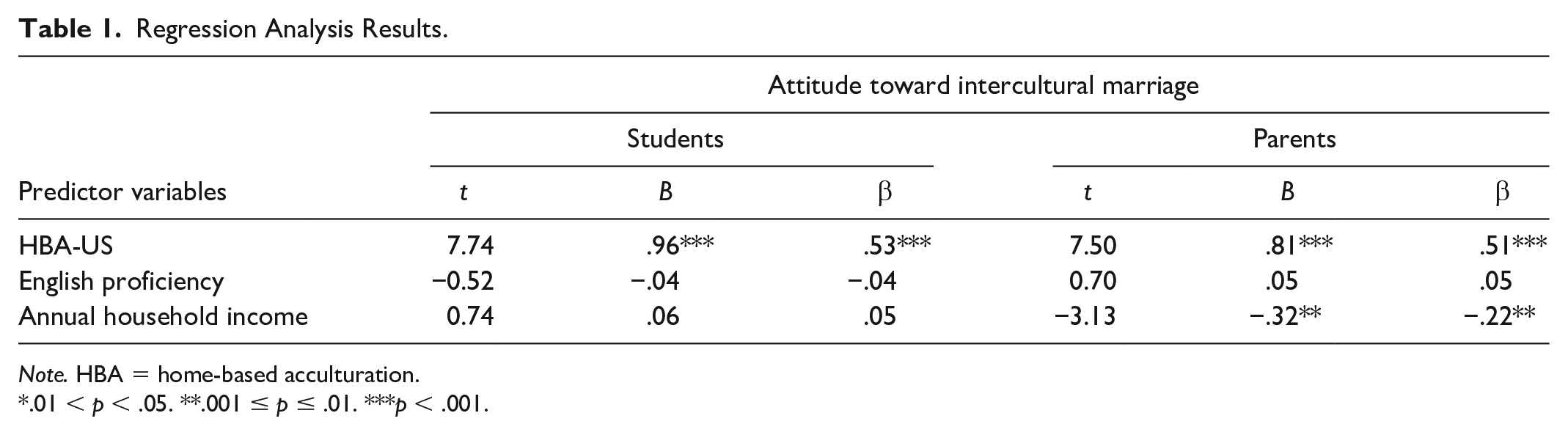
Note. HBA = home-based acculturation.
.01 < p < .05. **.001 ≤ p ≤ .01. ***p < .001.
Compared with the parents, the younger Chinese generation scored higher on HBA-US, t(330) = - 4.03, p < .001. There was no significant difference in the Chinese culture orientation between the two generations. Chinese college students had more confidence in their English proficiency than the older generation, t(350) = - 9.11, p < .001, although there was no significant difference in the frequency of online interaction with Americans.
Comparison Between Chinese College Students and Parents.

Note. Standard deviations appear in parenthesis below means. HBA = home-based acculturation; CCO = Chinese culture orientation.
.01 ≤ p < .05. **.001 ≤ p < .01. ***p < .001.
Study 2
The first study tentatively explored how Chinese’ attitude toward intercultural marriage associate with HBA and other factors. As a preliminary study, however, it examined only limited latitude for some factors (e.g., English proficiency). Therefore, a second study was conducted in order to validate findings from study 1 as well as unpacking more dimensions of the interactions.
Participants
The participants included 199 (male = 77, female = 122) full-time students from a large public university in Northwestern China and 163 (male = 68, female = 95) parents whose children were studying at the same university. College students ranged in age from 18 to 26 (M = 21.30, SD = .91). None of the college students stated that they are married. Parents ranged in age from 40 to 55 (M = 47.93, SD = 3.05).
Procedures and Measures
The questionnaire had two versions (i.e., student’s and parent’s), and was distributed and collected online and two researchers monitored the entire process. Students from six classes were recruited to participate on a voluntary basis. In the meantime, like in study 1, we invited one parent per family to fill in the “parent’s” questionnaire. Permission from the school authorities was obtained before the survey. The participants were given monetary rewards for valid responses.
Participants were asked to provide information on several aspects. HBA-US and CCO were assessed by 18 items (9 items each). Twelve items were adopted from VIA (Ryder et al., 2000) and were employed in study 1. In addition, we adopted six new items from Stephenson Multigroup Acculturation Scale (SMAS, Stephenson, 2000) regarding food, news watching, and knowledge about history. Results indicate good internal reliability for HBA-US (a = .85) and CCO (a = .81). Nevertheless, although VIA and SMAS are robust acculturation instruments (Huynh et al., 2009), the “culture” they refer to are more generalized than specialized. Therefore, to focus on unique characteristics of American culture, we employed a 5-item scale regarding participant’s perception of U.S. cultural values (PCV-US). U.S. Department of State (n.d.) and literature (e.g., Mason, 1955; Y. S. Park & Kim, 2008; Stewart & Bennett, 2011; Triandis, 2010) indicate these five items (i.e., individualism, independence, power distance, directness, and consumerism) in part represent American mainstream cultural values, and are often characterized as cultural differences between United States and China.
HBA-US and CCO Descriptive Statistics.

Note. HBA = home-based acculturation; CCO = Chinese culture orientation.
Attitude toward intercultural marriage was measured by 6 items adopted from the General Attitudes toward Marriage Scale (GAMs, S. S. Park & Rosén, 2013). We have examined positive attitudes (3-item, a = .84) and fear/doubts (3-item, a = .78) regarding intercultural marital attitude. Online intercultural contact was assessed based on 5 items regarding direct online contact, indirect online contact, and online cultural product contact. The items were developed on and adopted from Kormos and Csizér’s (2007) and Peng and Wu’s (2016) studies on types of intercultural contact. To measure English proficiency, we employed a 5-item scale from Butler’s (2004) revised version of the Stanford Foreign Language Oral Skills Evaluation Matrix (FLOSEM, Padilla et al., 1997). The revised scale (a = .97) examined participants’ capability in English listening, speaking, grammar, reading, and writing. Socioeconomic status was assessed by the same scale on annual household income employed in study 1.
Attitude Toward Intercultural Marriage, Perception of U.S. Mainstream Cultural Values, Online Intercultural Contacts, English Proficiency, and Annual Family Income Descriptive Statistics.

Moreover, we collected information about participants’ perceptions of parental involvement, perceptions of the important qualities of partners (5-item, i.e., financial capability, appearance, relationship satisfaction, personality, profession, and family background), face to face and mass media intercultural contact experience, and demographics (e.g., age). Multiple statistical procedures were employed to explore research questions. Relevant pre-assumptions (e.g., lack of multicollinearity) were examined prior to the analysis.
Results
Multiple Pearson’s rs were employed to explore the linear relationship between online intercultural contact and HBA-US. Results indicate significant correlation between online intercultural contact and HBA-US for both college students (r = .44, p < .001) and parents (r = .48, p < .001). A closer look revealed that most indirect, direct, and cultural product online contacts were significantly positively correlated with HBA-US except students’ online video/voice chatting, r = .11, p = .12. PCV-US significantly associated with students’ online intercultural contact (r = .19, p < .05), but not parents’ (r = .12, p = .12). Among parents’ online intercultural contacts, only consuming cultural products was significantly correlated with PCV-US, r = .21, p < .05.
Intercultural Contact and HBA-US Correlation Matrix.

Note. HBA = home-based acculturation.
.01 ≤ p < .05. **.001 ≤ p < .01. ***p < .001.
Multiple regression analysis results indicate that HBA-US, t(194) = 2.55, p < .05, and PCV-US, t(194) = 2.96, p < .05, significantly predict student’s positive attitudes toward intercultural marriage. English proficiency, t(194) = 1.87, p = .06, and annual household income, t(194) = -.61, p = .54, are non-significant predictors. Regarding parents’ positive attitudes toward children’s intercultural marriage, only HBA-US was a significant predictor, t(158) = 4.30, p < .001. Annual household income significantly predicts parents’ fears/doubts, t(158) = 2.02, p < .05. As parents’ annual household income increases, their fears/doubts about intercultural marriage also increase.
Multiple Regression Results.

Note. HBA = home-based acculturation.
.01 ≤ p < .05. **.001 ≤ p < .01. ***p < .001.
Compared to their parents, the younger generation cohort had higher HBA-US, t(360) = 9.26, p < .001, and higher PCV-US, t(360) = 9.26, p < .001, but lower CCO, t(358) = -8.10, p < .001. The younger Chinese generation cohort tended to be more “westernized” than their parents. Moreover, the younger generation cohort had higher English proficiency, t(360) = 26.93, p < .001, and had more frequent online contacts with Americans and American cultural products, t(360) = 11.32, p < .001.
Comparison Between Chinese College Students and Parents.

Note. Standard deviations appear in parenthesis below means. HBA = home-based acculturation; CCO = Chinese culture orientation.
.01 ≤ p < .05. **.001 ≤ p < .01. ***p < .001.
Discussion
In response to scholars’ (Croucher, 2011; Y. Y. Kim, 2000, 2017; Shuter, 2012) calls for the need for research on the influence of the internet on acculturation, this study examines Chinese college students’ and their parents’ online intercultural contacts. Results from two studies indicate that online intercultural contacts are positively correlated with HBA. This finding supports Berry’s (1990, 2008) concept of acculturation and its research scope and may contribute to a better understanding of the acculturation process in a globalized and networked world. Three things need to be noted here. First, the use of internet had significant influence on HBA. During our research we also collected data on participants’ intercultural contact through face-to-face (M = 1.52) and foreign mass media channels (M = 1.59). Overall, participants were more frequently did intercultural contact through online (M = 2.03). For those who have limited offline exposure to foreign cultures, social media provides an important and convenient access, and consequently plays a more prominent role in their acculturation process (Shuter, 2012). Second, Chinese college used the internet more frequently for intercultural contact than their parents, indicating different uses of the internet for HBA between two generation cohorts. Third, college students and their parents more frequently participated in indirect online intercultural communication and consuming cultural product than did direct online contact. Although indirect contact may help with the language barrier and contribute to higher motivation in intercultural communication, it may raise a concern for the cultural shocks they may experience in direct communication, since they had limited exposure to contextual cues (Kormos & Csizér, 2007; Peng & Wu, 2016). Therefore, the findings of this study lead to a new approach to investigate the internet’s influence on acculturation, where nuances in effect among different channels should be examined.
In the current study, we examined both students’ and parents’ attitude toward intercultural marriage because literature indicates significant influence of Chinese parental involvement in their children marriage decisions (Hynie et al., 2006; Xu, 2012; Ying et al., 2015). As additional information, in study 2 we collected participates’ perception of the role and effectiveness of parental involvement based on Walker et al.’s (2005) framework. On average, Chinese college students and parents held positive attitude toward parental involvement, and often had such experiences when making important decisions (see Table 8). Results indicate that HBA-US is a strong predictor for Chinese college students’ and their parents’ intercultural marital attitude. On one hand, it suggests the importance of HBA on intercultural marriages in the pre-departure phase. Enhancing intercultural contacts that take place abroad would increase the chances of intercultural marriages. However, on the other hand, HBA may have some negative effects. The way a culture is communicated and represented may alter as it travels across the world (S. X. Chen et al., 2008). HBA may result in a Utopian or Dystopian imagination about a foreign culture. Alternatively, it may foster false confidence and mislead people to assume that acculturation and adaptation would be as easy in a foreign culture as is in their home culture. Further research should be conducted to continue the exploration of HBA and its influence on intercultural marriage.
Perceptions of Parental Involvement.
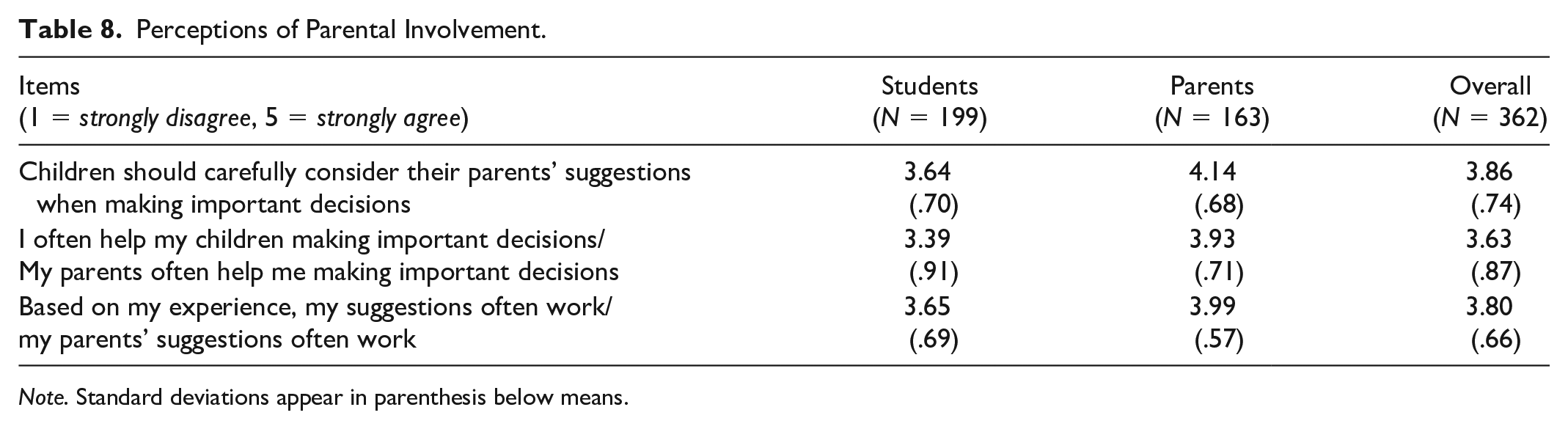
Note. Standard deviations appear in parenthesis below means.
Interestingly, our two studies identify that the higher the Chinese parents’ annual household income, the more their fears and doubts for children’s intercultural marriage. This finding is in line with literature (Y. H. Chen, 2006; Renalds, 2011), which indicates that motivations for intercultural marriage are influenced by the person’s financial status. Material benefits impact the selection of spouses as well as the communication within intercultural marriages. In the Chinese society, financial status plays a more important role as socioeconomic inequalities have increased with the growing market-oriented economy and marriage has become an important means of elevating socioeconomic status (Bian, 2002; Yu & Xie, 2015). During study 2 we asked participants to rate the importance of their (children’s) partners’ qualities, and financial capability is among those highly rated (see Table 9). In the case of people with lower socioeconomic status, intercultural marriages offer an opportunity to marry out-group members who come from a richer country and who may not care about the economic status to the same extent as the Chinese do, and, therefore, an acceptable and practical means to gain social upward mobility (Hu, 2016). According to the World Bank (2014), in 2014, the GNI per capita of China was $7,510, ranking 91st among the 213 countries included. The U.S. ranked 14th on the same list, with a GNI per capita of $55,860. On average, Americans have a higher GNI per capita than Chinese; thus, Chinese parents with lower socioeconomic status may see intercultural marriages with Americans as a pathway for their children, and sometimes for themselves as well, to live better lives.
Perceptions of the Importance of Partner’s/Child’s Partner’s Qualities.

Note. Standard deviations appear in parenthesis below means.
It should be noted that unlike the parents, Chinese college students’ attitude toward intercultural marriage is not significantly influenced by the annual family household income. A reason for this could be that some Chinese college students may not realize the difficulties posed in earning money and the significance of money for a family. Born after the implementation of economic reforms and the one-child policy, Chinese college students have grown up in an environment with a better economy and more financial support from their parents and grandparents, as compared to their parents’ generation (Curtis et al., 2015; Yu & Xie, 2015). Another explanation could be that college students are optimistic about their future as they are young, energetic, and educated; thus, they do not consider the current financial status as a decisive factor for a future marriage. As shown in Table 9, relationship satisfaction and partner’s personality are among the most important partner’s qualities from college student’s perspective.
Contrary to the expectations, college students’ attitude toward marrying Americans is not significantly influenced by their English proficiency. This could be based on the fact that they do not understand the importance of language ability for proper communication as they are not in an actual relationship. The import and popularization of foreign cultures is usually accompanied by localization. As a part of the HBA process, many Chinese are able to access U.S. culture and establish contacts with Americans even without knowing how to properly communicate in English. However, when it comes to intercultural marriages, neglecting the importance of foreign language skills can lead to serious communication problems. Relevant studies (Cools, 2006; Jandt, 2015; M. Y. Park, 2020; Romano, 2008) point out that a lack of foreign language proficiency would not only impede communication between couples but also result in family conflicts due to miscommunication and misunderstanding. Therefore, for those who are open to the possibility of marrying Americans, enhancing English communication proficiency as well as the spouse’s Chinese language skills is imperative.
The research results indicate that both Chinese parents and the younger generation have an overall positive orientation toward American culture and strong ties with Chinese culture. Although they might not participate frequently in American cultural activities or socializing with Americans, they appreciate the American way of humor and exhibit interest in American cultural products. The college students are significantly more “Americanized” than their parents. This finding is supported by the literature that economic reform and globalization help popularize western culture and are associated with the increasing participation in western cultural practices. This implies that the younger generation has more exposure and is more accustomed to western culture and cultural values than their predecessors (Shuai et al., 2015; J. Zhang & Shavitt, 2003). While Chinese college students (i.e., the younger generation) have a more positive attitude toward American culture, they still strongly inclined toward Chinese cultural orientation. In two studies, we observed distinct patterns of CCO differences between generation cohorts from different sampling locations. The results indicate a regional difference in Chinese cultural orientations. Being characterized by Chinese President Jinping Xi (Ministry of Education of People’s Republic of China, 2016, December 8) as the lovely, reliable, and prosperous youth, the cultural orientations of the younger generation reflects the status quo of China’s effort in promoting Chinese cultural legacy in a globalized and networked world, which would influence China’s future development.

Cultural orientations of Chinese college students and parents.
This research contributes and extends the existing acculturation studies by presenting an example of acculturation that happens at a person’s home site. Acculturation is not just a post-arrival phenomenon (Berry, 2008). Rather, it is an ongoing and continuous process that could begin when the individual is still in the home culture, where they are empowered by social resources and support, and the acculturation is usually in the form of entertainment. Consequently, for future immigrants, the experiences of HBA may not be as stressful and painful as those of immigration-based acculturation, and may help them form a positive attitude toward cultural interactions and adaptation in foreign environments.
Previous research centered more on the acculturation and adaptation of people who were already in an intercultural relationship. However, since globalization could be considered as the first step of the acculturation process (Arnett, 2002; S. X. Chen et al., 2008), it is worth exploring how the early stage of acculturation could influence attitudes toward and further cultural adaptations in intercultural marriage. In addition, scholars often perceive acculturation as a product of intercultural relationships (Jung & Cho, 2016) inattentive to the fact that acculturation could occur long before the relationship begins and would consequently impact people’s impact on individuals’ expectation of further intercultural contact and relations. Simply put, acculturation is not only the outcome but also a predictor of intercultural relationships.
This study also examines factors influencing intercultural marriage from the college students’ and the parents’ perspectives. In China, parents’ involvement in marriage and family affairs is acknowledged and, in many circumstances, welcomed by children and is sometimes decisive (Xu, 2012; Ying et al., 2015). Therefore, when taking into consideration the young people’s attitude toward intercultural marriage, it is important to also garner an understanding of the parents’ opinions. This study shows that HBA is positively related to the attitude of both, the parents and the children, toward intercultural marriage. Placing this in the Chinese context and taking into consideration that the parents’ opinions matter, if the child’s intercultural marriage is not supported by parents, they could help parents enhance their foreign culture orientation (e.g., engaging in more foreign culture-related activities and making more foreign friends) to form a more positive attitude and contribute to the harmony of the family life. This study also identifies a discrepancy in the impact of socioeconomic status on the attitude of the parents and children toward intercultural marriages, and this may negatively influence the parent and child’s relationship in the future and calls for further discussion embedded in China’s social context. This study should contribute to the understanding of the factors that influence the attitude toward intercultural marriage and the importance of the parent and child relationships in Chinese intercultural marriage. It should also help intercultural couples improve their communication with each other. In addition, since some other Asian countries, such as South Korea, Japan, and Singapore, have been influenced by traditional Confucian family values (T. Kim, 2009; Y. B. Zhang et al., 2005), this paper also has exploratory value for studies on intergenerational differences in intermarriages in these cultures.
Limitations and Future Directions
One constraint for the current study is that it only examines participants’ HBA and attitude toward intercultural marriage before the actual marriage takes place. It is beyond the scope of this paper to analyze how immigration-based acculturation and other factors would affect those who have already stepped into intercultural or interracial marriages. Future research may investigate how acculturation, English proficiency, and socioeconomic status could predict the attitude and behavior within actual intercultural-marriages, and collect longitudinal data to compare differences among intercultural couples at different stages of relational development.
Furthermore, the recent resurgence of gender inequality, especially the prevalent social stigmatization of unmarried young women as “leftovers” in China (Fincher, 2014), has led to drastic changes in Chinese women’s willingness to marry. This study, however, does not investigate the possible impact of gender inequality on female college students’ attitude toward intercultural marriages. Future studies would have to address the relevant issues and the question, would Chinese women become more reluctant to marry, or would they be more willing to “marry out” in such situations?
Future research should explore more into the interaction between Chinese college students and their parents. How would parents’ acculturation and attitude toward intercultural marriage influence their child’s attitude? This would be a very interesting question as relevant research (Xu, 2012) indicates that in many marriages, Chinese parents have considerable influence over decision making and their involvement is welcomed by their children. The next step for researchers would be to collect dyadic data and examine the partner effect of parents on a child’s willingness to engage in an intercultural marriage.
Despite these limitations, this research extends the acculturation theory by examining HBA and its correlation with the use of the internet, and adds to the knowledge base about intercultural marriages in special contexts where parental influence is strong. Interested researchers should further investigate the influence of globalization and digitalization on acculturation from both the intercultural and intracultural perspectives.
Conclusion
In this paper, we explored how acculturation could happen in a person’s home cultural context and how it is associated with intercultural marriage expectations and online intercultural contacts. In two different but related studies, we recruited samples from two large public universities in Midwestern and Northwestern China, respectively. In study 1, we observed significant associations between online interactions and HBA, and generational similarities and differences in factors influencing intercultural marital attitudes. Study 2 validated findings from study 1 and unpacked more dimensions of the interactions. We found that HBA was positively associated with online intercultural contacts through indirect and direct communication and cultural product consuming. While HBA was a strong predictor for intercultural marital attitudes by Chinese parents and college students, socioeconomic status had a divergent effect on fears/doubts of the two groups. Both studies indicated that Chinese college students had higher HBA, more frequent online intercultural contacts, and higher English proficiency than parents. Future research should further investigate the influence of globalization and digitalization on acculturation from both intercultural and intracultural perspectives.
Footnotes
Acknowledgements
The author(s) would like to sincerely thank the anonymous reviewers for their insightful comments which improved this manuscript.
Declaration of Conflicting Interests
The author(s) declared no potential conflicts of interest with respect to the research, authorship, and/or publication of this article.
Funding
The author(s) received no financial support for the research, authorship, and/or publication of this article.
