




Abstract
The aim of this study was to examine the perspective of school administrators with regard to teachers from different generations. In this study, the strengths, weaknesses, opportunities, and threats of each generation were examined. This study was conducted as a Strength, Weakness, Opportunity, and Threat (SWOT) analysis. The study group consisted of 26 school administrators from the Dilovası district of Kocaeli province, Turkey. According to the school administrators, the Baby Boomer generation shows their strengths with discipline and experience, Generation X with determination, and Generation Y with their abilities in technology. As for the weaknesses of each generation, Baby Boomers are against innovation and disobedient of the management, Generation X claims to know everything, and Generation Y is inexperienced. What creates opportunities for schools is that Baby Boomers manage crises and transfer experience, Generation X acts as a bridge between the generations, and Generation Y applies new methods in education. For the threats of different generations to the school, the school administrators stated that Baby Boomers hinder innovation, Generation X is disloyal, and Generation Y is inexperienced and against the system.
Introduction
In today’s schools, as in other workplaces, more people from different generations are working together due to increased life expectancy with the developments in the health care field, increased labor requirements because of decreasing population growth, a rising retirement age, and changes of perspective toward aging.
In the working environment of today, there are often three different generations working at the same time in the same unit. This multigenerational workforce leads to differences among employees. Individuals differ in their attitudes toward authority and the organization, as well as having differences in their expectations and needs for work, marriage, and family responsibility (Jurkiewicz & Brown, 1998; Kupperschmidt, 2000; Smola & Sutton, 2002). People from different generations come to the workplace with different experiences, perspectives, anticipations, work styles, and strengths. This in turn presents today’s managers with a range of opportunities and challenges.
In Turkey, detailed studies have been limited on subjects like the “generation” concept and taking the characteristics of generations into account in managing organizations. The current research is considered important in terms of qualitatively describing the views of school administrators toward teachers from different generations. The purpose of the research is to examine the views of school administrators working in different school types on the strengths, weaknesses, opportunities, and threats of the teachers working in their schools from each generation. The aim is therefore to contribute to the school administrators’ abilities to better manage the differences that teachers from different generations bring to the school work environment.
Theoretical Background
A generation is defined as people of a certain age group, or grouped based on where they live and thereby share important life events in their critical stages of development (Kupperschmidt, 2000). Each generation has their own experience, expertise, and expectations. It is thought that their similarities in terms of working values, attitudes, choices, expectations, perceptions, and behaviors consist of the same or similar historic, economic, and social experiences (Smola & Sutton, 2002; Zemke, Raines, & Filipczak, 2000). As it is difficult to determine which years a generation covers, there are different generation classifications that cover different time periods and sometimes under different names. The commonly used classifications referred to in the current study are as follows: Silent Generation (Veterans): 1925-1944, Baby Boomers: 1945-1964, Generation X: 1965-1980, and Generation Y: 1981-2000 (Eisner, 2005; Hart, 2006). Today, workplaces often have Baby Boomers, Generation X, and Generation Y working together.
The Baby Boomers generation consists of people born between 1945 and 1964, so from the period immediately following the end of World War II, and they are defined as contented, emotional, loyal, and possess an attachment to authority, traditions, and culture (Arslan & Staub, 2015). This generation lives to work and are considered workaholics, self-motivated, resistant to change (Gursoy et al., 2008), loyal to their employer, idealists, optimists, and ambitious in their work life (Hart, 2006). They believe that better living standards are possible through hard work and live to an ethos of “work hard now, get due in the future” (Acılıoğlu, 2015). Baby Boomers are very hardworking and motivated by their position, income, and reputation in the workplace (Harber, 2011). Other characteristics of this generation are that they are considered great mentors and have an expectation to work in the same place throughout their career (Hart, 2006).
In education, members of this generation are today’s elder teachers. They are considered to have greater experience and substantive understanding of their subject areas. They also have a stronger commitment to teaching as a vocation, as a civic duty, and as a reflection of their personal values. Due to their level of personal and professional commitment, they may have greater passion for working long hours (Strauss, 2005).
Generation X consists of people who were born between 1965 and 1980. They prioritize individualism and are considered sensitive to social problems, contentious, global thinkers, and committed to working. They try to balance their work life and private life, and have a respect for different lifestyles and cultural diversity (Aka, 2018). Members of this generation give significant importance to keeping a work–life balance, and search for a balance between family commitments and work (Gursoy et al., 2008). They believe it is important to spare time for themselves and see themselves as “free-agents” within their careers, instead of committing themselves to a single place of employment (Hart, 2006). As a result, they tend to leave their jobs in return for a higher salary or better facilities (Hays, 1999). Unlike Baby Boomers, they “work to live.”
Teachers from Generation X are more dedicated to lifelong learning and have an ability to adapt to new conditions. They are willing to collaborate with other teachers and can accept and apply advice received from a school administrator or their peer teachers. Also, Generation X teachers are considered better than Baby Boomers in dealing with their students’ Generation X parents (Strauss, 2005).
Generation Y consists of those born between 1981 and 2000, and has therefore grown up with technology; as a result, they place significant importance on technology in their lives (Hart, 2006). The first thing that comes to mind about this generation is their tendency toward technology. They use their technological skills creatively to improve their assignments and to reach the desired results (Behrstock-Sherratt & Coggshall, 2010). This generation was named after the word “Why” in English, because they are known to question and scrutinize every aspect of life, and also to criticize their obligations (Aka, 2018). This generation represents a wide range of social habits, including teamwork, success, humility, and good social behaviors (Howe & Strauss, 2000).
The elements that motivate this generation are different from the others. Members of Generation Y are more focused on factors that will satisfy them morally such as social benefits or flexible working hours, rather than the salary they receive from their jobs (Çetin Aydın & Başol, 2014). They value family life and sacrifice monetary values for familial relationships. They are, however, ambitious and focused on success in business. They have high expectations of their employers, enjoy challenges and difficulties, and are not afraid of questioning authority (Ropes & Ypsilanti, 2012).
Generation Y opts for digital work and learning opportunities, teamwork, and opportunities related to technology and social networks (Edge, 2014). This group, which is predominantly successful in group activities and communication, expects to receive feedback from individuals in their workplace (Gursoy et al., 2008).
As shown in Table 1, each generation has its own personal characteristics, as well as work values and preferred working methods. Significant differences can be seen between each of the generations.
Work Values and Preferences of Generations (Hernaus & Vokic, 2014).

As can be seen in Table 1, Baby Boomers are seen as workaholics because they live to work and find their identity in their work. Although they are good at human relationships, they are sensitive to feedback. As they consider their work as the most important thing, they seek out status symbols like title or money and public recognition.
Generation X differs from Baby Boomers on work value. They are not workaholics; instead, they look for work–life balance and they work to live. They are disloyal to authority and reluctant to commit themselves to their work. Also, they seek flexible work conditions in order that they can have a life outside of their work.
Generation Y is considered to be the most educated and technologically savvy generation. They have multitasking abilities and look for a meaningful work. If they are satisfied with what they do at work, they are loyal. If not, they can seek to change their jobs. This makes them loyal to their own careers. Like Generation X, they also seek flexibility in their workplace and aspire to having work–life balance.
For the first time in the history of modern labor, as Zemke et al. (2000) pointed out, many people from different generations are working side-by-side and closely with people as young as their children and as old as their parents. An important aspect of the problems experienced in today’s organizations, where three different age groups work together, is due to differences between the generations in their perceptions, methods, practices, and communication (Keleş, 2011). The most important factor in overcoming these problems is that managers should be aware of each generation’s characteristics and working methods. Managers can do more to improve productivity, morale, and employee retention by understanding every generation and conveying to employees what they need to accomplish (Kogan, 2001).
Considering the characteristics, work values, and working methods of each generation, generational differences among teachers in schools influence the school culture (Paniale, 2013). Teachers of different generations have different kinds of knowledge. While younger teachers are mostly seen as a knowledge source for their information and communications technology (ICT) skills and new teaching methods, older teachers at the age of 50 years or more are seen as a source for subject-matter knowledge and classroom management. These knowledge domains play a significant role in shaping the school culture and also in teachers’ daily practices (Geeraerts, Vanhoof, & Van den Bossche, 2018).
Each generation brings something new and important to teaching and learning. That is why it is so important for school administrators to understand, respect, and address the generational differences in today’s schools. Administrators who adequately understand how to handle differences among their workforce leverage the strengths of all generations of teachers. This understanding can enable teachers and students to be successful in the classroom, build collaborative teams, and help others better prepare for future challenges (Hayes, 2013). When administrators cannot resolve discords between teachers from different generations, this leads to biases, dysfunctional relationships, and miscommunication, which as a result presents a significant impediment to achievement. Therefore, administrators who focus on their human capital as the blueprint for success can help bridge the gap through knowledge of what makes their employees tick (Lovely & Buffum, 2007).
This study has the following research questions:
Method
Research Design
This study was conducted as a qualitative research. Dey (1993) explained that qualitative research explains how people perceive and qualify the things around them. As this study aims to explore how administrators perceive different generations of teachers at their school, a phenomenological approach was used. Phenomenology is described as an approach to understand the hidden meanings and essences of an experience (Grbich, 2007). The research was conducted with a SWOT analysis technique. SWOT analysis was first revealed by Prof. Heinz Weihrich (1982) in his article, “The TOWS matrix—A tool for situational analysis.” SWOT analysis is a technique that is used to determine the strengths and weaknesses of the technique, process, or situation and to determine the opportunities and threats arising from the external environment for the organization (Gürlek, 2002).
SWOT analysis is an analysis technique that allows the evaluation of the internal and external environment of the organization. SWOT analysis involves the analysis of organizational and environmental factors with both positive and negative aspects.
SWOT is an acronym formed from the initials of the following words (Cebecioğlu, 2006): S Strength (identifying the strong/superior aspects of the organization) W Weaknesses (identifying weak aspects of the organization) O Opportunities (expressing the opportunities of the organization) T Threats (expressing the threats and dangers that the organization faces).
In this study, SWOT analysis was used to investigate the perspectives of school administrators on teachers from different generations (Baby Boomers, Generation X, and Generation Y) and to discover the strengths, weaknesses, opportunities, and threats that different generations create in schools.
Participants
The participants of this study consisted of 26 school administrators who work in the Dilovası district of Kocaeli province, Turkey (see Table 2).
Demographic Characteristics of Participants.

The criteria used in determining the school administrators were that they work as an administrator in schools from different levels (kindergarten, primary school, elementary school, or high school) and to have different professional seniorities (years served). To provide diversity in terms of education level, professional seniority, and school type among the participants, the maximum variation sampling method was employed, which is one of the purposeful sampling techniques. With this method, a small sample is generated, and the diversity of the participants is reflected at the maximum level (Yıldırım & Şimşek, 2006). Table 2 details the varied characteristics of the school administrators who participated in the study.
Data Collection and Analysis
In this study, the data were collected using a SWOT analysis form which the participants were handed and asked to complete. In the SWOT analysis form, the participants needed to write the strengths, weaknesses, opportunities, and threats of three different generations (Baby Boomers, Generation X, and Generation Y) as they saw them in the school atmosphere. Interviews were then held with the school administrators. The interview questions were determined by the researchers based on the research questions. The following interview questions were asked to each of the school administrators:
According to your experiences and observations, what are the strengths of teachers from the Baby Boomer Generation, Generation Y, and Generation X at your school?
According to your experiences and observations, what are the weaknesses of teachers from the Baby Boomer Generation, Generation Y, and Generation X at your school?
According to your experiences and observations, what are the opportunities that teachers from the Baby Boomer Generation, Generation Y, and Generation X at your school create for the school?
According to your experiences and observations, what are the threats that teachers from the Baby Boomer Generation, Generation Y, and Generation X at your school pose for the school?
The collected data were then analyzed with descriptive analysis. The administrators’ perspectives of the different generations (Baby Boomers, Generation X, and Generation Y) were collated under subdimensions as strengths, weaknesses, opportunities, and threats.
Each of the participants was assigned a pseudonym such as Ali, Hasan, or Fatih. In the direct citations, the participants’ pseudonyms are used to assure their anonymity.
Findings
As a result of the SWOT analysis, school administrators’ perspectives on teachers from the Baby Boomer Generation, Generation X, and Generation Y were collated under subdimensions of strengths, weaknesses, opportunities, and threats.
Administrators’ Perspectives on Strengths of Different Generations
The school administrators’ perspectives on the strengths of the different generations are presented in Table 3.
Administrators’ Perspectives on Strengths of Different Generations.
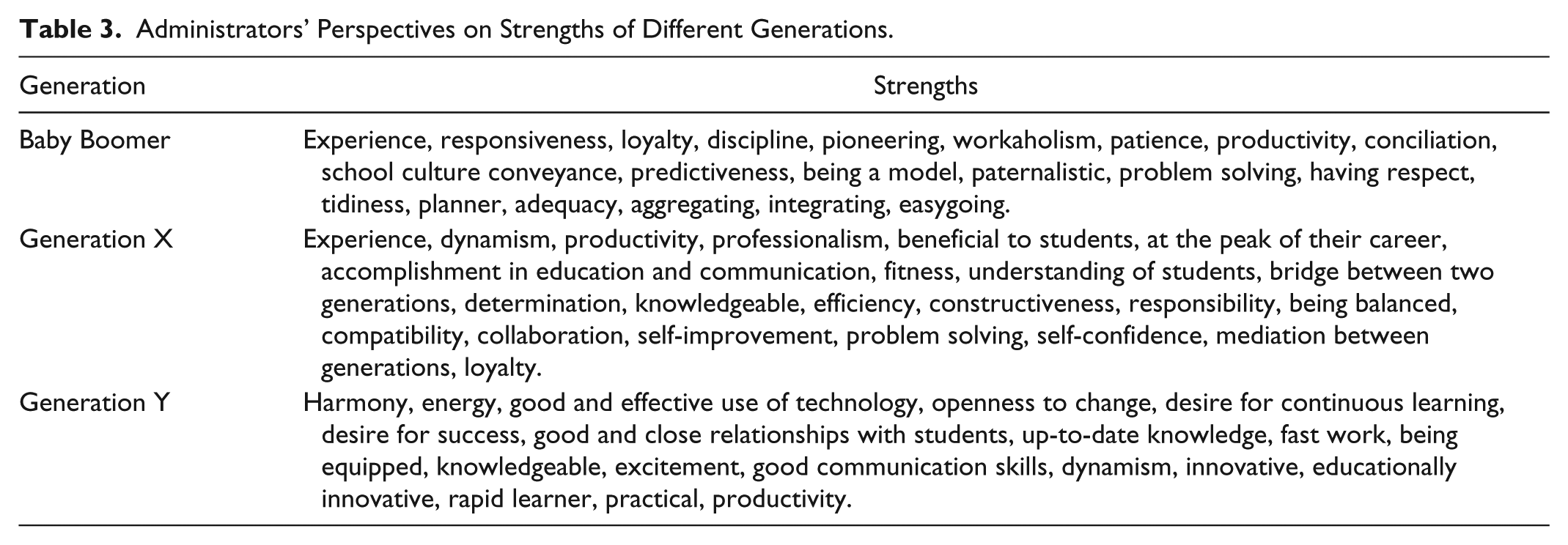
According to the school administrator, the strengths of Baby Boomer generation teachers are that they are experienced, responsive, loyal, disciplined, pioneering, workaholics, patient, productive, conciliatory, school culture conveyers, predictive, model teachers, paternal, problem solvers, respectful, tidy, planned, adequate, aggregators, integrators, and easygoing. The school administrators see teachers from the Baby Boomer generation as a source of experience because they are the eldest generation working in the current situation. Teachers of this generation act as models and examples for the younger generations with the experience they have to offer as well as their predisposition toward responsibility, discipline, order, and planning. They transfer their experiences to other teachers, take a lead in the school, and assume the task of transferring the school culture on to the next generation. Also, with their discipline, ability to solve problems, and benignant behaviors, they create an integrated atmosphere in the school, which enables them to work in harmony with other teachers. Some of the school administrators perspectives on the strengths of Baby Boomer generation teachers are as follows: Headmaster Fatih defined them as “experienced and powerful in problem solving,” while Headmaster Ali stated that they are “exemplary to other teachers and loyal to their duties.” In addition, Deputy Headmaster Mustafa said that “with past experiences, they help prevent inconveniences that may arise before they occur.”
The strengths of Generation X teachers are that they are experienced, dynamic, productive, professional, beneficial to students, at the peak of their career, accomplished in education and communication, fit, understanding of students, a bridge between two generations, determined, knowledgeable, efficient, constructive, responsible, balanced, compatible, collaborative, self-improving, problem solvers, self-confident, a mediator between the generations, and loyal. Some of the school administrators’ perspectives on the strengths of Generation X teachers are as follows: Headmaster Ahmet said that “They are at the peak of their career, successful in education and in dialogue with the parents of students,” and Headmaster İlker stated that “They are a bridge between the old and the young generation.”
The strengths of Generation Y teachers are that they are harmonious, energetic, use technology effectively, open to change, desire continuous learning, desire success, have good and close relationships with their students, up-to-date in their knowledge, the ability to work fast, equipped, knowledgeable, excited, have good communication skills, are dynamic, open to innovation, educationally innovative, rapid learners, practical, and productive. The administrators described these teachers as energetic and good with technology due to their young age. As for their strengths, the administrators stated that the noticeably small age gap between these teachers and their students better enabled them to understand their students. Some of the school administrators’ perspectives on the strengths of Generation Y teachers are as follows: Headmaster Ali said, “They use the technology well. They are open to change. They have a desire for continuous learning.” Deputy Headmaster Gökhan mentioned that “They catch the innovation. They seek out more opportunities with technology. They follow different practices from around the world and are innovative in their students’ education. They listen to their students, offer them concrete materials, and are student-centered,” while Deputy Headmaster Fikret said, “They are energetic, practical, eager to learn and able to use technology well.”
Administrators’ Perspectives on Weaknesses of Different Generations
The school administrators’ perspectives on the weaknesses of teachers from the different generations are presented in Table 4.
Administrators’ Perspectives on Weaknesses of Different Generations.

The weaknesses of Baby Boomer generation teachers are that they are technologically inadequate, physically inadequate, nonprogressive, hypercritical, have a negative attitude to technology, lack motivation, monotonous, arrogant, vane, liable for burnout, hardliners, authoritarian, conservative, biased, stubborn, prim and proper, closed to communication, intolerant, and perfectionist. The school administrators stated that the teachers from this generation are hard shell and against innovation, resulting in negative attitudes toward technology, and also that they exhibit technological inadequacies. Some of the school administrators’ perspectives on the weaknesses of Baby Boomer generation teachers are as follows: Headmaster Şakir mentioned that they “lack motivation, and are anxious, incompatible, and arrogant,” while Headmaster Hasan said that they are “hard shell, conservative, bored, and nonchalant.” Deputy Headmaster Selçuk stated his thoughts as “hypercritical, not open to innovation, technology, or learning.”
The weaknesses of the Generation X teachers are that they are closed to learning, selfish, have a know-it-all ego, are technologically inadequate, unable to keep up with other generations, criticize ruthlessly, stuck between, desire to get out of their generation, prim, unable to take risks, nonchalant, renewing themselves less, disloyal, constantly complain, not responsible, slow down operations, get bored quickly, and are excessively authoritarian. Some of the school administrators’ perspectives on the weaknesses of Generation X teachers are as follows: Headmaster Serhat said that “They have an ‘I have learned everything. I know the best’ attitude,” while Headmaster Önder has expressed their weaknesses as their “desire to get out of their own generation.”
When we look at the weaknesses of the Generation Y teachers, their lack of experience emerges as the most emphasized feature as they are teachers at the beginning of their careers. In addition to their lack of experience, other weaknesses of this generation are that they find it difficult to adapt, are lacking in communication, take part in conflict groups, lack a sense of belonging, question everything, feel abandoned, have a lack of formalism, a weak sense of responsibility, are rebellious, feel discomforted, dissatisfied, hypercritical, make sudden decisions, ignore legislation, hinder paperwork, experience difficulties in student control, are selfish, have excessive self-esteem, a unilateral view of events, are weak in classroom management, weak in human relations, frail, vulnerable, lack work discipline, neglect work, become bored, and have low social relations. In addition to Headmasters Mert, Recep, Fatih, and İlker, who mentioned about the lack of experience of Generation Y teachers, Deputy Headmaster Fikret stated his perspective on the weaknesses of this generation as “They want everything to be immediate and appreciated. They are impatient and have trouble with hierarchy,” while Deputy Headmaster İsmail said, “They are selfish, extremely self-confident and they think they do not make mistakes.”
Administrators’ Perspectives on Opportunities of Different Generations
The school administrators’ perspectives on the opportunities offered by the different generations are presented in Table 5.
Administrators’ Perspectives on Opportunities of Different Generations.

The opportunities offered by Baby Boomer generation teachers are that they can contribute to schools through crisis management, transferring experience, the creation of outsourcing, modeling for young teachers, leadership, guidance in problem solving, transferring school culture, and being an example in taking lessons from the past. Some of the school administrators’ perspectives on the opportunities offered by Baby Boomer generation teachers for the school are as follows: Headmaster Hasan said, “Their experiences can be used to resolve conflicts in human relations. They can be effective in transferring traditional values.” In addition, Deputy Headmaster Engin said, “They play an active role in communication with students’ parents. They teach young people to stay calm under difficulties.”
The administrators mentioned the features of Generation X teachers that can create opportunities for the school as their transference of experience, fulfilling their duties, taking responsibility, being an example to young teachers, working harmoniously, as a bridge between the generations, guiding younger teachers, creating intergenerational balance, problem solving, a desire for success, their assertiveness, practicality, and that they are good communicators with the parents. As they are the middle of the three generations working in current business life, Generation X teachers are seen as the bridge between the Baby Boomers and Generation Y in the school. Some of the school administrators’ perspectives on the beneficial aspects for the school of Generation X teachers are as follows: Deputy Headmaster Mustafa said that “They act as an intergenerational bridge,” while Headmaster Coşkun said, “They bring younger and older generations together,” and Headmaster Halil mentioned that “Their presence is important for intergenerational communication. They keep the balance.”
It can be said that from the school administrators’ point of view on the opportunities that Generation Y teachers offer schools, their strengths in fact present opportunities. Generation Y teachers afford opportunities to schools through the provision of new instructional programs, better communication with students, discipline of schools, productivity through ideas and projects, keeping students up to date, analyzing students well, providing innovative learning, rehabilitating schools, establishing educational opportunities, supporting technology in schools, actively taking part in projects, collaborating, participating in activities, increasing students’ commitment to the school, solving students’ problems, facilitating family participation, planning social activities, and contributing to the creation of school culture. Some of the school administrators’ perspectives on the opportunities that Generation Y teachers offered schools are as follows: Headmaster Coşkun spoke of their contributions as “They keep the school up to date,” while Deputy Headmaster Emin said, “They can increase the design and use of current education methods and materials.” In addition, Headmaster Burak mentioned their positive relations with students, “Since their age is close to that of the students, they can analyze them better,” and Deputy Headmaster Levent said, “They can know students better and solve problems better.”
Administrators’ Perspectives on Threats of Different Generations
The school administrators’ perspectives on the threats to schools of the different generations are presented in Table 6.
Administrators’ Perspectives on Threats of Different Generations.

For the threats toward schools of the Baby Boomer generation teachers, the school administrators mentioned the negative and harmful effects that teachers in this generation can create in school. In addition, they are considered as a source for generational conflict, undisciplined, unable to take risks, disobedient, exaggerate their age and its significance, being against innovation, inefficient, create a negative culture, are a negative example, discourage the younger generations, and they slow down the work. On the school administrators’ perspectives as to the threats that Baby Boomer generation teachers can present to harm the school, Deputy Headmaster Sinan stated that “Their opposing to new developments can have a negative impact on the development of the school.”
The threats that Generation X teachers may introduce to create negative situations for schools are their criticism of other generations, intergenerational conflict, feeling torn between the two other working generations, their desire to be continuously appreciated, lack of innovation, obstinance, set a bad example due to their own dissatisfaction, desire to be a determinant in school, infidelity, desire to do everything, and their seeking out of inadequacies. Besides contributing to the school, Generation X teachers being situated “between” Baby Boomer generation and Generation Y can create negative situations according to the school administrators. Some of the school administrators’ perspectives on the threats that Generation X teachers pose to schools are as follows: Headmaster Ufuk expressed their “being in intergenerational conflict,” Headmaster Serhat mentioned them being “torn between generations,” while Headmaster Önder used the term “torn between old and new,” and Headmaster Mert said they are known for “criticizing the previous and next generation.”
From the school administrators’ point of view, Generation Y teachers also possess certain features that can create negative and threatening situations for school. These features are problems related to their inexperience, intergenerational conflict, problems with relativity, poor communicators with students and parents, disrupting the institutional harmony, their lack of potential, they get bored quickly, make system working difficult, harm the school culture, criticizing the established order, lack an authority gap with students, are in conflict with values, and subvert the school order. According to the school administrators, the fact that these teachers are still at the beginning of their profession can reflect negativities in the school system and school culture. Some of the school administrators’ perspectives on the threats that Generation Y teachers present to the school are as follows: Headmaster Önder expressed an opinion that “They make the order and the operation of the system difficult,” while Deputy Headmaster Cenk said that “Because their classroom management is weak, there can be problems in the school discipline.” Their inadequacies in communication can be seen in statements such as by Headmaster İlker, who stated that “They may have trouble in terms of dialogue with the administration and students,” and Headmaster Savaş said, “There can be problems with their communications with parents.”
Discussion and Conclusion
The perspectives of school administrators on teachers from different generations working in their schools are discussed under three groups: “Administrators’ Perspectives on Teachers from the Baby Boomer Generation,” “Administrators’ Perspectives on Teachers from Generation X,” and “Administrators’ Perspectives on Teachers from Generation X.”
Administrators’ Perspectives on Teachers From the Baby Boomer Generation
As the Baby Boomer teachers are now the eldest generation working in state schools in Turkey, school administrators see members of this group as a source of experience, and as an example to colleagues from other generations and to school culture. The school administrators consider that this generation are workaholics and have a responsibility but that they resist change. These opinions overlap with the research of Gursoy et al. (2008). The views of the school administrators in the current study, as well as Gibson, Greenwood, and Murphy (2009), indicate that the weaknesses of this generation are negative attitudes toward technology, as well as being conservative and perfectionist.
With regard to the opportunities that Baby Boomer teachers can create within a school, the administrators stated they are an example to the young, transferring their experience, and attracting out-of-school funding. The Baby Boomer generation can benefit the school through their experience, and at the same time, the school administrators also identified ways in which they can be seen as a threat to the school. According to the administrators, this eldest generation of today’s teachers exaggerates their ages and can ruin discipline within the school, disobey the administration, and prevent innovation in the school. This negative example is seen by other employees and may therefore create a negative environment for younger generations in the school.
Administrators’ Perspectives on Teachers From Generation X
As to the strengths of Generation X teachers, the school administrators mentioned that they are considered to be experienced, dynamic, and professional. Teachers in this group are thought of as knowledgeable, productive, and at the peak of their career based on their age and profession. Generation X teachers are known to be determined, responsive, collaborative, loyal, and problem solvers, according to the school administrators, which are powerful features that can be positive for schools.
When looking at the weaknesses of Generation X teachers, their positioning as “in-between the generations” was emphasized by the school administrators. As pointed out by Crumpacker and Crumpacker (2007), Generation X is skeptical about the workplace, and unlike the Baby Boomers, they are considered unfaithful to their place of work. These attitudes are also indicated by the school administrators. Moreover, it is seen as selfish and pseud by school administrators that this generation is individualistic and focused on their own career rather than the organization they work for (Sayers, 2007).
The prominent feature of Generation X in the subtheme of opportunities is that they act in school as a bridge between the other generations (Baby Boomers and Generation Y). Administrators think that Generation X teachers guide younger teachers and provide a degree of intergenerational balance within the school through their experience. The self-confidence of this generation (Gursoy et al., 2008; Murphy, Gibson, & Greenwood, 2010) makes them assertive, practical, and seek to achieve success in their work. According to the school administrators, they are the bridge between the two generations.
Generation X teachers can sometimes create negative situations for the school. They may find themselves in generational conflict due to their being stuck between their peers from the younger and older generations, and this leads to feelings of in-betweenness. As stated by Gursoy et al. (2008) in their research, and by the school administrators who participated in the current research, people from Generation X want immediate and constant praise for what they do.
Administrators’ Perspectives on Teachers From Generation Y
Many of the school administrators emphasized the effective use of technology as well as the familiarity of technology, often referred to as the strength of Generation Y and the most important feature of this generation in the field (Gursoy et al., 2008; Keleş, 2011; Sharma, 2012; Spiro, 2006). Because of being the youngest generation in the workplace, and for being energetic, dynamic, and open-minded, Generation Y teachers have good communication skills and are good team players in the eyes of school administrators (Gursoy et al., 2008; Murphy et al., 2010). Other features of this generation that can be positive for schools are the teachers having up-to-date information, as well as being considered practical, productive, and quick learners.
Under the subtheme of weaknesses of this generation, the school administrators stated that these teachers are inexperienced by their age. However, in addition, they lack working discipline, neglect their work, have a disregard for legislation, and lack a sense of responsibility and ownership. These stated features match with those identified by the research of Gursoy et al. (2008) such as this generation questions every rule, they prefer not to stay within the strict limits of their job description, and they challenge the workplace rules including uniform requirements, the flexibility of a standard working day, and the worker–supervisor relationship. Unlike other generations, those from Generation Y tend to question authority (Chen & Choi, 2008). Also, according to the school administrators in the current study, the teachers in this generation are impatient, fragile, vulnerable, rebellious, and selfish.
The feature most emphasized by school administrators for this generation is that they can apply new curricula at school and support the technological direction of the school because of their ability to use technology well and effectively. They are considered to be active collaborators and team players (Sharma, 2012), and become actively involved in the planning of social activities within the school and in the production and implementation of projects. Due to the limited age gap between Generation Y teachers and their students, they are able to analyze the students well, help them solve problems, and increase their loyalty to the school. The school administrators also stated that these features are also useful in disciplining the school.
As to the subtheme of threats, criticizing the school order and making school regulation difficult are the main reasons seen by school administrators for Generation Y teachers creating problems within the school. This is due to their skepticism of institutional loyalty (Chen & Choi, 2008). Teachers in this generation face problems such as communication with students and parents due to their inexperience, lack of authority over the students, and their inability to apply their potential effectively.
Implications
In today’s workplace, administrators in schools are faced with dealing with generational diversity among their staff. Currently, there are teachers from three different generations working in many schools, those being from the Baby Boomer generation, from Generation X, and from Generation Y. This study revealed that there are important differences among these generations. Therefore, it would be beneficial for school administrators as managers to take these differences into consideration to create an effective school atmosphere.
School administrators should be aware of the generational diversity within their school personnel and look carefully toward generational awareness. If they fail to deal with generational differences, there may be misunderstandings and miscommunication between them and the teachers, or among teachers from different generations. When school administrators better understand the generational similarities and differences of their personnel and manage them accordingly, it may lead to increased productivity, improved collegiality, and eventually, greater success and better student achievement.
As all generations have their own attributes of strength, it is considered advisable to ensure there is a mix of generations on institutional committees or educational work groups. In this way, together they can create a wider perspective with different opinions sourced from the different generations. When administrators provide clear organizational vision for all generations in their employ, they can increase performance. Also, providing mentoring, including reverse mentoring, to all generations is an effective way to bridge any gaps between teachers of different generations. Administrators can assign different generations to work together to tackle generational prejudice, which can facilitate intergenerational learning among teachers. As examples, Baby Boomers can transfer their experience with classroom management or how to deal with students’ problems onto their Generation Y colleagues, while Generation Y can help Baby Boomers in using today’s technology in the classroom more effectively.
Another way to bridge gaps and communication between Baby Boomers and Generation Y can be utilizing Generation X in the process. As Generation X has certain characteristics similar to both their predecessor and successor generations, teachers from Generation X can help create a better understanding between the older and younger generations.
If the administrators accept the generational differences of teachers at schools, and use them effectively as leverage for the effective application of technology, communication, mentoring and motivation, and to bridge the generational gaps, they can positively influence their teaching staff and manage the school in a more coherent way.
Limitations
In this study, the strengths, weaknesses, opportunities, and threats affecting schools for each generation of today’s teachers (Baby Boomers, Generation X, and Generation Y) were determined from the school administrators’ point of view. The study was limited, however, by the views of participant administrators managing schools in the Dilovası district of Kocaeli province, Turkey. Similar studies could also be conducted in the future with administrators from different geographical regions or countries. Also, the view of other school stakeholders (teachers, students, and parents) could be included in future studies.
The SWOT analysis methodology, which was applied in the current study to collect data, has certain drawbacks such as its lack of clarity, detail, and prioritization. In this research, all of the answers were analyzed in detail to make answers clear and detailed. Although the study used qualitative methods and provided certain insights about the school administrators’ perspectives, future studies could be designed using quantitative or mixed research methods to provide more in-depth information and for more generalizable research results.
Footnotes
Declaration of Conflicting Interests
The author(s) declared no potential conflicts of interest with respect to the research, authorship, and/or publication of this article.
Funding
The author(s) received no financial support for the research, authorship, and/or publication of this article.
