




Abstract
Ε-petitions, the digital version of printed petitions, are increasingly being used as complimentary means of nonconfrontational, online citizen mobilization/protest. They attract considerable research interest because they provide (big) data to study e-petitioning and the political and other aspects of socio-spatial issues. E-petition studies lack discussion of ontology, of “what is an e-petition,” implicitly treating e-petitions as “systems-as-a-whole” or, seldom, as relational formations. Acknowledging the foundational role of ontology, Assemblage Thinking (AT) is argued to beget a more judicious approach when e-petitions are employed as research instruments to study the “who-what-when-where-and-how” of a socio-spatial issue and, concurrently, their situated contribution to issue-related decision-making. After presenting the reductionist/essentialist and the nonreductionist/relational approaches to the study of e-petitions and introducing ΑΤ, an assemblage-based framework is proposed that conceptualizes e-petitions as multiplicities comprising assemblages, dynamic compositions emerging from processes of heterogeneous components coming together to serve a purpose. A concomitant methodology is outlined and an illustrative example is offered. The advantages of assemblage-based over reductionist/essentialist approaches for the situated co-analysis of socio-spatial issues and e-petitions are discussed, indicating how they address prominent concerns of the literature, and future research directions are suggested.
Introduction
The development and widespread use of digital media have rendered communication a prominent component of the civil sphere and have transformed the nature, logic, and practice of collective action (Bennett, 2012; Christensen, 2011). Digital tools of political communication and participation, some of which are digitalized versions of traditional tools, have been institutionalized and integrated into the administrative apparatus of several, mostly western, democratic states. A hybrid media system is developing (Chadwick, 2013) where digital coexist, supplement, and interact with traditional tools of practicing (representative) democracy (Bochel, 2012; Bochel & Bochel, 2017; Lindner & Riehm, 2009).
Petitions are millennia-old tools of political communication that have been employed across the globe since the Pharaonic times (van Voss, 2002). Their character, content, uses, significance, and role have undergone important transformations over space and time. Since the 17th century, when printed petitions importantly contributed to the development of the public sphere in Western Europe (Zaret, 2000), petitions have been characteristic features of political and social movements (Calhoun, 2012; Carpenter, 2016b; Carpenter & Moore, 2014). In several cases, they have evolved into an institution (van Voss, 2002). The right to petition is written in the First Amendment of the US Constitution (Carpenter, 2016b; Zaret, 2000) and the European Parliament established the right to petition in the 1992 Treaty of Maastricht (Lindner & Riehm, 2011). Numerous studies highlight the role of historical petitions in bringing about social, economic, and political change (Calhoun, 2012; Carpenter, 2016b; Carpenter & Brossard, 2019; Zaeske, 2003; Zaret, 2000).
A petition is: “ . . . a request for redress of grievances sent from a subordinate (whether an individual or a group) to a superior (whether a ruler or a representative)” (Zaeske, 2003, p. 3); “ . . . a formal written request or application made to one vested with authority, or to a legislative or administrative body, soliciting a favor, grant, right, or act of mercy . . . ” (Böhle & Riehm, 2013, citing Collier’s New Encyclopedia, 1921); “a formal request to a higher authority, e.g., parliament or other authority, signed by one or a number of citizens” (Macintosh et al., 2002, p. 139). The European Parliament defines petitions “as all complaints, requests for an opinion, demands for action, reactions to Parliament resolutions or decisions by other Community institutions or bodies forwarded to it by individuals and associations” (Berg, 2017a, p. 1). More figuratively, Carpenter (2016b, p. 349) defines petitions as “a technology mapping human pain and experience into a set of symbolic (textual) grievances.”
Since the early 2000s, online or e-petitions have superseded the traditional printed petitions, being increasingly used as nonconfrontational communicative practices, one of four tactics and tools of online citizen mobilization, to protest government and private sector decisions and actions (Earl & Kimport, 2008; Karpf, 2010; Wright, 2016). They are initiated by individuals and/or groups; address a state/public agency and/or individual, or, less often nonpublic entities (e.g., corporations); concern particular environmental, social, economic, political, or composite issues (e.g., human rights, social and economic justice, criminal justice, environment, health, education); span the local to global spectrum; and last from a few days to several years. Depending on platform ownership (private or state-owned), formal/institutionalized and informal/noninstitutionalized e-petitions are distinguished (Cruickshank & Smith, 2011; Wright, 2015). The latter remain the dominant type (Berg, 2017b).
Despite skepticism paralleling them to slacktivism, 1 e-petitions are thought to represent complimentary forms of political participation (Bennett, 2012; Berg, 2017a; Wright, 2016), an institutional technology (Carpenter, 2016a) used to raise awareness, recruit and mobilize supporters, communicate public views to elected representatives, protest the government, capture media attention, shape political agendas, influence policy implementation, deliver useful information, educate petitioners, and serve as political indicators. They, thus, perform several functions such as defending individual rights, interests, and the possibilities of active participation in political decision-making; serving as communicative linkages between represented and representatives; supporting political integration and legitimacy; and, thus, promoting collaborative, participatory e-democracy (Berg, 2017b; Bochel, 2012; Bochel & Bochel, 2017; Böhle & Riehm, 2013; Carpenter, 2016a; Cruickshank & Smith, 2011; Earl & Kimport, 2008; Lindner & Riehm, 2011; Macintosh et al., 2002; Ranchordás, 2017; Wright, 2015).
The study of e-petitions has attracted considerable interest because the data they provide 2 enhance learning and support the study of, on one hand, the political and other aspects of socio-spatial issues (e.g., political behavior and preferences, online political participation and mobilization/protest, collective emotions, social needs, policy impacts and effectiveness) and, on the other hand, the contribution of e-petitions to issue-related decision-making. Studies of traditional printed petitions have also been and are undertaken for similar reasons (e.g., Carpenter, 2016a; Carpenter & Brossard, 2019; Zaeske, 2003; Zaret, 2000).
The approaches to the study of e-petitions broadly follow those employed in political communication and participation studies, roughly grouped here into reductionist/essentialist and nonreductionist/relational. The former produce aggregate, static analyses of single or, more often, groups of e-petitions. The latter produce disaggregate analyses of single e-petitions emphasizing the heterogeneity, hybridity, processuality, and contextuality of political engagement and the constitutive role of the media. Their application to the study of e-petitions is comparatively limited to date.
Both groups of approaches emphasize theory, methodology, and empirical applications, but they offer limited or no discussion of ontology, that is, of “what is an e-petition.” Reductionist/essentialist approaches implicitly, at least, subscribe to a “system-as-a-whole” ontology, where “the linkages between components form logically necessary relations which make the whole what it is” (DeLanda, 2006, p. 11). More specifically, they treat e-petitions as reified essences, clearly defined entities with distinct components (e.g., initiators, signees, platform), separate from their context, fixed, homogeneous classes of measurable characteristics (number of signatures, types of signees, “success,” etc.) and fixed functional relationships among them. Nonreductionist/relational approaches allude to loose relational ontologies.
Ontology, however, plays a fundamental role in guiding the formulation of theory, the design of research methodology, and the choice of analytical techniques as they all depend on the constituents of the object of analysis and the relationships among them (Chadwick, 2013; Hall, 2003; Jessop, 2005; Sayer, 1984). Setting the ontology right first is particularly critical in the study of a particular socio-spatial issue, where e-petitions are used as research instruments for the situated analysis of the issue, 3 and, concurrently, of the e-petitions’ situated contribution to issue-related decision-making. In this case, a “system-as-a-whole” ontology does not adequately render the multicomponent, complex, processual, contextual, performative, and dynamic nature of e-petitions and, thus, cannot articulate the wealth of information an e-petition potentially engenders. Consequently, the need for an alternative, a relational conceptualization arises.
The “ontological void” in the study of e-petitions, the paucity of studies following nonreductionist/relational approaches, and the need for an alternative conceptualization provided the impetus for this article that negotiates the ontology of e-petitions from the relational perspective of Assemblage Thinking (AT). More specifically, it suggests to conceptualize them not as clearly defined, aggregate systems-as-a-whole but as multiplicities constituted by assemblages, that is, dynamic, revisable compositions emerging from processes of diverse, heterogeneous co-functioning components coming together, or assembling, to serve an overt or covert purpose in a milieu (Anderson & McFarlane, 2011; DeLanda, 2006, 2011). After briefly presenting the approaches to the study of e-petitions and the main elements of ΑΤ, it outlines an assemblage-based framework for e-petition analysis and research that may, conceptually and methodologically, better render their situated and hybrid nature, and offers an illustrative example. In conclusion, the advantages of AT-based over reductionist/essentialist approaches for the situated co-analysis of e-petitions and socio-spatial issues are discussed and future research directions to address open issues of both the e-petitions literature and the AT-based approach are suggested.
Approaches to the Study of E-Petitions
For the present purposes, over 50 theoretical and applied pieces of literature 4 discussing e-petition-related and broader digital politics issues, chosen from a larger and diverse universe of pertinent studies, were reviewed. Based on their implicit or explicit epistemological foundations, theoretical underpinnings, and methodological and analytical approaches, the approaches followed in these studies were broadly grouped into reductionist/essentialist and nonreductionist/relational although the boundaries between the two are sometimes difficult to draw. 5
Reductionist/essentialist approaches, grounded in positivism and post-positivism, assume fixed, uniform, functional categories and dichotomies; are informed by universal, hierarchical, aggregate, and static theories; and employ formal, quantitative methodologies mostly. These approaches hitherto dominate the e-petition literature and are used to study general and specific aspects of e-petitions and e-petitioning more generally (Table 1).
Reductionist/Essentialist Approaches: Topics, Theories, Methodologies.
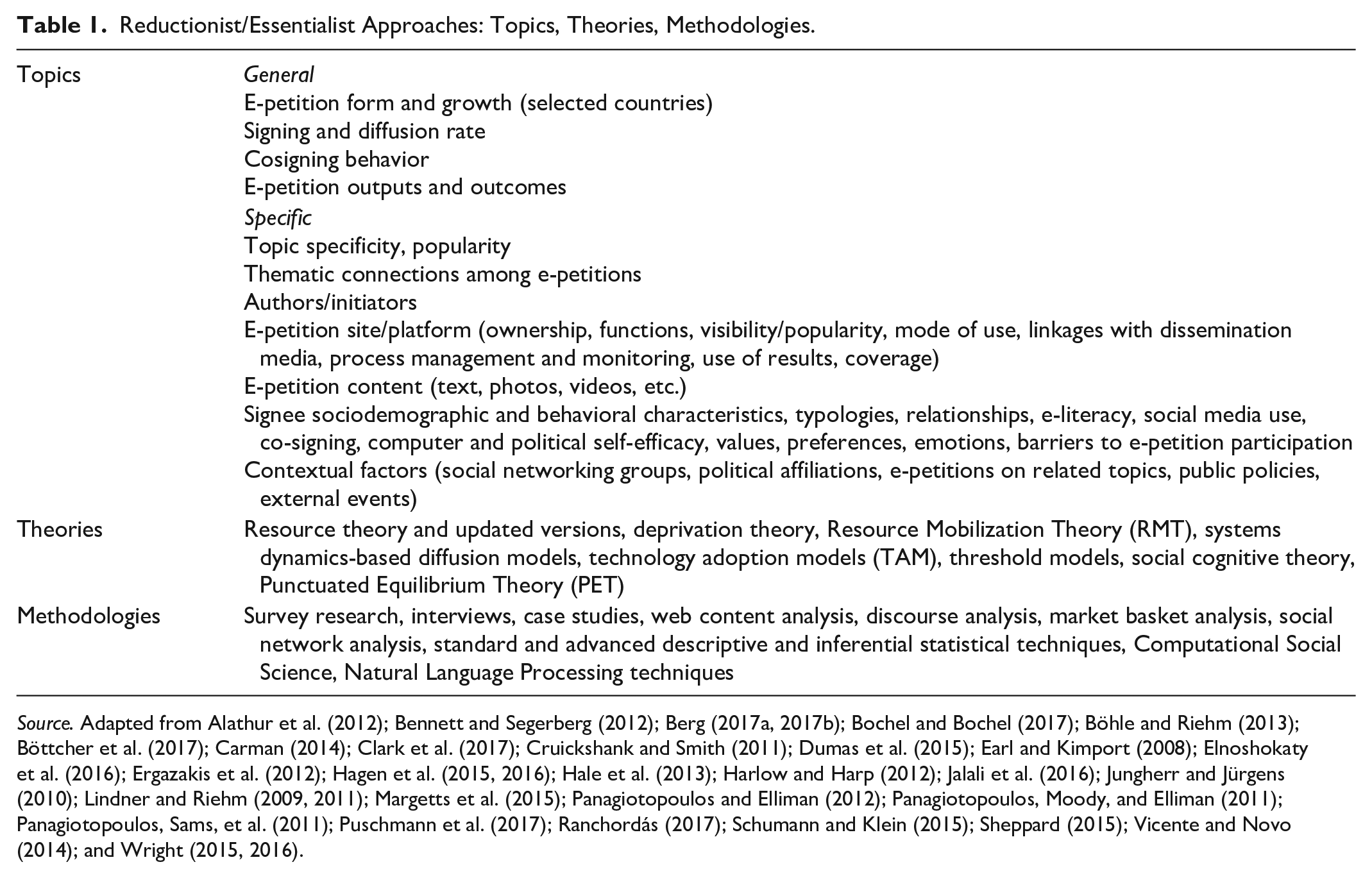
Source. Adapted from Alathur et al. (2012); Bennett and Segerberg (2012); Berg (2017a, 2017b); Bochel and Bochel (2017); Böhle and Riehm (2013); Böttcher et al. (2017); Carman (2014); Clark et al. (2017); Cruickshank and Smith (2011); Dumas et al. (2015); Earl and Kimport (2008); Elnoshokaty et al. (2016); Ergazakis et al. (2012); Hagen et al. (2015, 2016); Hale et al. (2013); Harlow and Harp (2012); Jalali et al. (2016); Jungherr and Jürgens (2010); Lindner and Riehm (2009, 2011); Margetts et al. (2015); Panagiotopoulos and Elliman (2012); Panagiotopoulos, Moody, and Elliman (2011); Panagiotopoulos, Sams, et al. (2011); Puschmann et al. (2017); Ranchordás (2017); Schumann and Klein (2015); Sheppard (2015); Vicente and Novo (2014); and Wright (2015, 2016).
The output of e-petitions (number of named and anonymous signatures, comments provided) remains a constant research topic. The main, steadily addressed outcomes are the “success” and, more broadly, the effectiveness of e-petitions. Although “success” is commonly measured by the e-petition output, other conceptualizations, definitions, and measures have been proposed depending on the point of view, expectations of e-petitioners, and other factors; for example, achieving official responses and contributing to issue resolution and policy change (Bochel, 2012; Wright, 2015, 2016). “Success”/effectiveness remain central research topics, despite the difficulties to assess them. Other outcomes include slacktivism, citizen empowerment, “reaching in” local authorities, maintaining existing inequalities, offline participation effects, educating/informing about local democracy, awareness raising, knowledge generation, and diffusion (Alathur et al., 2012; Bochel & Bochel, 2017; Christensen, 2011; Cruickshank & Smith, 2011; Lindner & Riehm, 2011; Macintosh et al., 2002; Panagiotopoulos, Moody, & Elliman, 2011; Ranchordás, 2017; Schumann & Klein, 2015).
The theoretical models adopted (Table 1) implicitly draw on Olson’s (1965) classical theory of collective action founded on the rational choice model that assumes hierarchical formal institutions, bounded by mission and territory, relatively known and countable membership groups, considerable organizational resources, and formation of collective identities (Bennett & Segerberg, 2012). Punctuated Equilibrium Theory (PET)-informed studies depart from the rigid reductionist/essentialist approaches, as they heed the events associated with tipping points, but retain several of their features. 6 Several studies adopt an instrumentalist approach, that is, they hypothesize selected variables, elicited from various theories, as influencing the variable of interest (Berg, 2017a; Böttcher et al., 2017; Carman, 2014; Panagiotopoulos, Moody, & Elliman, 2011). Quantitative and qualitative methodologies are employed for data collection, analysis, and interpretation (Table 1) depending on the theoretical framework and types of e-petition data. Quantitative methodologies dominate so far.
Nonreductionist/Relational Approaches
The relational, communicative, argumentative, cultural practice and other turns that transpired in the Social Sciences in the 1980s and 1990s questioned the assumptions of reductionist/essentialist approaches and precipitated changes toward nonreductionist/relational approaches, echoing the changes in socio-spatial phenomena, including political engagement. E-petition-related studies following nonreductionist/relational approaches are comparatively few, dating since the early 2000s. With one exception (McNeill & Thornton, 2017), e-petitions are usually treated within broader digital collective action, political communication, and participation studies 7 that theorize the rise of multimodal and multidirectional mass self-communication, driven by new communication technologies, within the network society and social movements discourse in the information age (Castells, 2000, 2015). The lowered information costs and barriers to identification afforded by the digital media have effectuated new spaces of discussion, deliberation, and issue-based constituencies transcending administrative boundaries and rendered individuals important catalysts of collective action processes (Coleman & Freelon, 2015; Ranchordás, 2017; Sandover et al., 2018). Digital political engagement is less hierarchical and top-down, more horizontal, bottom-up, simultaneously local and global, crowd-sourced, personalized, interactive, participatory, all-time, and invulnerable to strong legal regulation. It is decentered, often lacking a formal leadership, command-and-control center, aiming at self-government by the people in the movement (Castells, 2015). It is channeled through dense, open-ended, fluid digital social networks that do not merge, constantly reconfiguring themselves according to the level of public involvement, help users achieve flexibility of communication and autonomy vis-a-vis formal institutions, and feature diversity, inclusiveness, tolerance for different viewpoints, and often atypical issues (Bennett, 2012; Bennett & Segerberg, 2012; Castells, 2015; Coleman & Freelon, 2015; Ranchordás, 2017).
Nonreductionist/relational approaches, founded in post-structuralism and social constructivism mostly, adopt disaggregate theoretical models. The theory of connective action (TCA) (Bennett, 2012; Bennett & Segerberg, 2012) and the theory of hybrid media systems (THMS) (Chadwick, 2013) address digital politics and collective action issues. TCA contrasts the classical theory of collective action, where the introduction of digital media does not change the core action dynamics and the ability of organizations to mobilize resources for social movement success. Embracing a network mode, it explains the rise of digitally networked action in the contemporary era of personalized politics where digital communication technologies become important parts of the organizational structure obtaining the role of established political organizations (Bennett & Segerberg, 2012). McNeill and Thornton’s (2017) study of e-petitions challenging proposed transcontinental Alberta Oil Sands pipelines supported TCA.
Chadwick (2013), positing the fundamental necessity of ontology and drawing on hybrid regime theory, introduced THMS that, like TCA, recognizes the hybridity of digitally mediated organization. THMS emphasizes ongoing construction, co-production, and co-distribution, the intermeshing processes and practices that connect heterogeneous human and nonhuman, material and immaterial “actors,” constitute political phenomena, and drive their changes within contemporary volatile political environments. TCA and THMS acknowledge the co-occurrence of collective and connective action and the emergence of various formations within particular ecologies of action. Bennett’s and Chadwick’s studies invoke Latour’s (2005) Actor-Network Theory (ANT) and the ontology of assemblage 8 from Assemblage Theory (DeLanda, 2006; Deleuze & Guattari, 1987).
Nonreductionist/relational studies employ qualitative and mixed-method (interviews, participant observation, ethnomethodology, thematic and textual document analysis) methodologies. Specialized methodologies, for example, the Socio-Technical Interaction Network (STIN) modeling framework, also exist (McNeill & Thornton, 2017; Schneider et al., 2019; Taylor-Smith & Smith, 2019).
Studies of printed petitions undertaken in Historical Sociology, Political Science, and other fields, although not acknowledging the above theories, have a nonreductionist/relational orientation, providing disaggregate analyses of petitions employing qualitative and mixed-method methodologies. In contrast, the majority of e-petition studies have a reductionist/essentialist orientation, focusing on aggregate analysis of performance and effectiveness.
The discussion of ontology is absent from both reductionist/essentialist and nonreductionist/relational approaches with the exception of Chadwick (2013). Reductionist/essentialist approaches implicitly treat e-petitions as reified essences; clearly pre-defined “systems-as-a-whole,” of varying degrees of openness, separated from their context (external factors), with distinct components (e.g., initiators, signees, platform), uniformly interpreted topic and purpose, fixed, measurable characteristics (number of signatures, types of signees, “success”/“failure,” etc.) and relationships to other e-petitions. The practices actualizing e-petitioning, for example, setting up the e-petition, disseminating, soliciting, recruiting, signing, and feeding back, are not addressed. The notions of “petition system” (comprising the various actors, their interactions, the technical means of communication, and germane rules and procedures) (Böhle & Riehm, 2013) and “e-petitions system” (Bochel & Bochel, 2017) signal a change from an aggregate to a disaggregate conception of e-petitions but retain the system ontology.
Nonreductionist/relational approaches allude to fluid, social/historical, nonreductionist ontologies that echo the main tenets of the TCA and THMS. More importantly, they underline the materiality of phenomena as exemplified by Actor-Network Theory’s (ANT) actor-network and the Deleuzoguattarian assemblage ontology. Their use is still in embryonic stage in political engagement and e-petition studies.
The bias toward the system ontology and the consequences of its limiting foundational assumptions on the results of mainstream, reductionist/essentialist empirical studies may partly explain several criticisms against e-petitions that draw on these results, namely, their limited effectiveness to achieve political goals, participatory governance, and policy change; their elusive, ephemeral, and reactionary nature; the lowering of political participation; the disengagement from institutional politics; and the amplification of existing socioeconomic inequalities (Christensen, 2011; Lindner & Riehm, 2011; Ranchordás, 2017; Wright, 2015). These issues call into question the system ontology and raise the need for an alternative conceptualization of e-petitions. The rest of this article explores the capacity of the assemblage ontology to deliver a fitting conceptualization of e-petitions and of ΑΤ to frame a fitting methodology to meaningfully analyze e-petitions aiming to extract reliable quantitative and qualitative data to comprehend and interpret the focal issue and assess the effectiveness of e-petitions in applied studies of contentious politics.
Assemblage Thinking 9
Rooted in the philosophy of Gilles Deleuze and his colleague Felix Guattari, AT, 10 a stream of post-structuralist thinking, assents to critical realism, as it accepts the mind-independence of reality, but also acknowledges the social construction of socio-spatial phenomena (DeLanda, 2006). Unlike other relational approaches, it prioritizes ontology over epistemology, a mark of Deleuzean philosophy (Briassoulis, 2019).
Assemblage, a not-quite-satisfactory translation of Deleuzean “agencement” (Briassoulis, 2019), is an ontology of becoming, denoting the coming together of diverse, heterogeneous, human and nonhuman components into dynamic, decomposable but irreducible, provisional wholes to serve a purpose (Anderson et al., 2012; DeLanda, 2006). Desire, the unconscious drives per Deleuze (Smith, 2007), moves this process and creates agency (Anderson & McFarlane, 2011).
The heterogeneous components, such as people, artifacts, trees, organizations, beliefs, texts, technology, are relatively autonomous, have multiple memberships, variable spatiotemporal reach, and play material and symbolic/expressive roles (Anderson et al., 2012; DeLanda, 2006; McCann, 2011). Contingently obligatory relationships of exteriority link the components in contrast to logically necessary relationships of interiority that characterize and “make the whole what it is” (DeLanda, 2006, p. 11). Deleuze and Guattari (1987) distinguish nonhierarchical, a-centered, horizontal (rhizomatic) from hierarchical, centralized, vertical (arborescent) linkages among components (Bonta & Protevi, 2004). Rhizomatic structures are self-organizing 11 while arborescent structures are centrally organized; both coexist in practice. The composition, form, and duration of assemblages are not predetermined and constant; they remain intentionally open (Anderson & McFarlane, 2011; DeLanda, 2006, 2011).
The processes of assembly include territorialization/coding and deterritorialization/decoding. Territorialization/coding processes involve habitual, routine practices (e.g., internet use, communication, cooperation), which hold components together, produce assemblages, and secure their internal coherence, underscoring the constant labor needed to (re)connect heterogeneous components (Anderson & McFarlane, 2011). Deterritorialization/decoding processes modify the capacities and thresholds of components, break down their relationships, and disrupt the coherence of assemblages (Anderson et al., 2012; DeLanda, 2002, 2006).
Assemblages have properties (e.g., potential, robustness, diversity, connectedness), which result from contextual and contingent, complex interactions among components, which exercise their capacities, that is, the powers they possess to affect and be affected (“affects” per Deleuze). Properties are actual, known, or knowable. Capacities are unpredictable and open because it cannot be presaged how components may affect or be affected by the countless components with which they associate (Anderson et al., 2012; DeLanda, 2006).
The possibility space of an assemblage (phase/state space of nonlinear systems) is the set of capacities of its (critical/limiting) components (DeLanda, 2002, 2006) within which basins of attraction develop around attractors (Figure 1). Attractors are final (minimum) states toward which a system spontaneously tends in the long run in the absence of constraints. They represent patterns of behavior and suggest the long-term tendencies of an assemblage (DeLanda, 2002). Α point (state) in a basin represents an actual assemblage, an individual singularity (DeLanda, 2006, 2011). Movements within a basin represent gradual changes (adaptation) of assemblages. When thresholds of critical components (tipping points between basins) are crossed, sudden changes trigger transitions to another basin (transformations) governed by other attractors and populated by assemblages with a different identity (DeLanda, 2006).

Schematic depiction of a basin of attraction.
The repetition of territorialization/coding and deterritorialization/decoding processes generates multiplicities, that is, populations of assemblages, of unique, historically contingent individuals that “define . . . and progressively specify the nature of a multiplicity as they unfold” (DeLanda, 2002, p. 12). The multidimensional possibility spaces of socio-spatial milieus have complex distributions of attractors and multidimensional basins of attraction comprising co-functioning, spatiotemporally overlapping assemblages. The possibility space, tendencies, and mechanisms implicated in processes of assembly are empirically identified only (DeLanda, 2011).
Once assemblages emerge, they are real, immanent, 12 and establish a territory (Anderson & McFarlane, 2011), linking the micro, disaggregate (molecular per Deleuze) with the macro, average behavior (molar per Deleuze) (Bonta & Protevi, 2004; DeLanda, 2006). They possess agency, because they act back on their components enabling or constraining their relationships, characteristic identity, and flat ontology; that is, they are unique individuals, differing in spatiotemporal scale but not in ontological status (DeLanda, 2006). 13
The agency and identity of assemblages are multiple, composite, and distributed, shaped by the capacities of their heterogeneous components. Power is multiple, composite, and decentralized; there is not one but many interacting sources of power (Anderson & McFarlane, 2011). Causality is emergent, nonlinear, distributed, immanent, and overdetermined (many equivalent explanations are possible) (Anderson et al., 2012; DeLanda, 2006).
Finally, assemblage is a means to enunciate concepts. Deleuze and Guattari (1984) brilliantly explain, “Concepts . . . are never created from nothing” (p. 19); (they) “are only created as a function of problems which are thought to be badly understood or badly posed . . . without which they would have no meaning and which can themselves only be isolated or understood as their solution emerges” (p. 16). “Every concept has components and is defined by them. It therefore has a combination [chiffre] . . . ” (p. 15). Each component can be also conceived as a concept with its own components.
Concepts have endoconsistency, their heterogeneous components are inseparable, and exoconsistency, they relate to other concepts, because “in any concept there are usually bits or components that come from other concepts, which corresponded to other problems . . .” (p. 18). Thus, concepts have a history and a becoming: In fact, having a finite number of components, every concept will branch off toward other concepts that are differently composed but . . . answer to problems that can be connected to each other, and participate in a co-creation. A concept requires not only a problem through which it recasts or replaces earlier concepts but a junction of problems where it combines with other coexisting concepts. (p. 18)
Although “a concept is defined by its consistency . . . it is self-referential; it posits itself and its object at the same time as it is created” (p. 22). Therefore, “positional enunciation is strictly immanent to the concept because the latter’s sole object is the inseparability of the components that constitute its consistency and through which it passes back and forth” (p. 23). Overall, “concepts are concrete assemblages, like the configurations of a machine” (p. 36); “a concept is what the assemblage determines it to be” (p. 229).
Becoming E-Petition: An Assemblage-Based Framework for Analysis and Research
Although ΑΤ is sparingly employed in e-petition analysis, studies that problematize assumptions of the reductionist/essentialist approaches provide early signs alluding to features of the assemblage ontology. Puschmann et al. (2017) mention tacit assumptions of extant analyses that limit their usefulness, for example, the treatment of e-petitioners as homogeneous despite their different traits, motives, roles, and political activities. Alathur et al. (2012, p. 394) note “an e-petition is more engaging and habit-forming as the process is continuous, with feedback, clarifications, deliberations, and even counter petitions.” Böttcher et al. (2017) concluded that e-petition signing is nonhomogeneous over time; synchronized external factors and contagion importantly influence the process. Studies of e-petition effectiveness underline the importance of the social and institutional context (Karpf, 2010), a feature that is common to traditional petitions as well (Carpenter, 2016).
Cruickshank and Smith (2011) characterize the EuroPetition consortium as a trans-European local authority service that facilitates distributed citizen engagement. Ranchordás (2017, p. 42) observes that crowdsourcing “ . . . consists of the distributed problem solving and production model that leverages the collective intelligence of online communities for specific purposes set forth by a crowdsourcing organisation.”
Böhle and Riehm’s (2013) “petition system” accounts for material components and interactions. Sandover et al.’s (2018) ANT-based study of Twitter contended that digital media platforms are performative, participating in the formation of emergent heterogeneous “issue publics.” Wright (2016, p. 843) underlines that people “have a nuanced approach to considering ‘success’ that is not captured by traditional measures,” seeing many benefits from e-petitions (cf. Carpenter, 2016b; Zaeske, 2003, for the case of historic petitions).
Some recent studies of political engagement employ the notion of assemblage as a descriptor mostly. Taylor-Smith and Smith (2019) conceive (ANT-inspired) “participation spaces” as socio-technical assemblages and model them as Socio-Technical Interaction Networks. Schneider et al. (2019) refer to ethno-epistemic assemblages denoting the entanglement of laypeople and experts.
Despite these signs of latent recognition, the assemblage ontology and the wealth of ΑΤ have yet to be fully employed in situated studies of political engagement and, particularly, of e-petitions. To demonstrate that AT begets a more judicious engagement with the “who-what-where-when-how-and-why” of e-petition issues, an assemblage-based conceptualization of e-petitions, a concomitant AT-based methodology and an illustrative example are discussed next.
Becoming E-Petition: The Concept and its Components
Not unlike printed petitions, an e-petition is born after an issue/problem and the need for political mobilization arise. An author/initiator decides to launch an e-petition on a public or private platform and composes a text (the “prayer,” see, Carpenter, 2016a) presenting the issue and the request, those supporting its cause sign (and, occasionally, comment) it, all acting out of desire to help achieve the purpose of engaging with the issue. E-petitioning engages numerous material “instruments” (computers, networks, various devices, software, etc.) and is subject to diverse tangible and intangible contextual influences (discourses, narratives, values, germane e-petitions, policy decisions, socioeconomic and environmental conditions, and historical events).
Each time a signature is added, an “instance” of an e-petition materializes and the e-petition changes quantitatively and qualitatively. Signees have different sociodemographic and e-skills profiles, perception of the issue, beliefs, values, signing practices, and live under particular material conditions, among others. At the time of signing, concurrent events and contextual influences may importantly affect their decision to sign. Each instance of an e-petition expresses the state of collective awareness and support to its cause. When the e-petition “closes,” its output, the number of signatures, enunciates its overall appeal and its diverse outcomes reveal its contribution to issue resolution. If these are studied in isolation, as if they automatically occur at the end of the process instead of gradually unfolding over its course, the role of various components and diverse issue-related, e-petition-related, and other influences are obscured and sidelined.
An e-petition then is not a uniform entity but a multiplicity unfolding over time, comprising the succession of individual instances, as many as the signatures submitted. Each instance, an e-petition assemblage, denotes the provisional, situated, unique composition produced from heterogeneous components coming together for the purpose of supporting the e-petition cause. Its composition and the processes of assembly are discussed below.
An e-petition comprises heterogeneous, human, material and immaterial, mobile, and fixed components that are assembled to serve its purpose (Table 2). Several components (e.g., issue, addressee, issue framing) directly concern the “who-what-where-when-how-and-why” of the e-petition topic. “Present absences” (McCann, 2011) are also included, components that do not conspicuously participate but play a role in the e-petition. 14 In the AT perspective, several factors that reductionist/essentialist approaches dub “context” (social media, policy decisions, historical events) are assemblage components.
Indicative List of E-Petition Components.
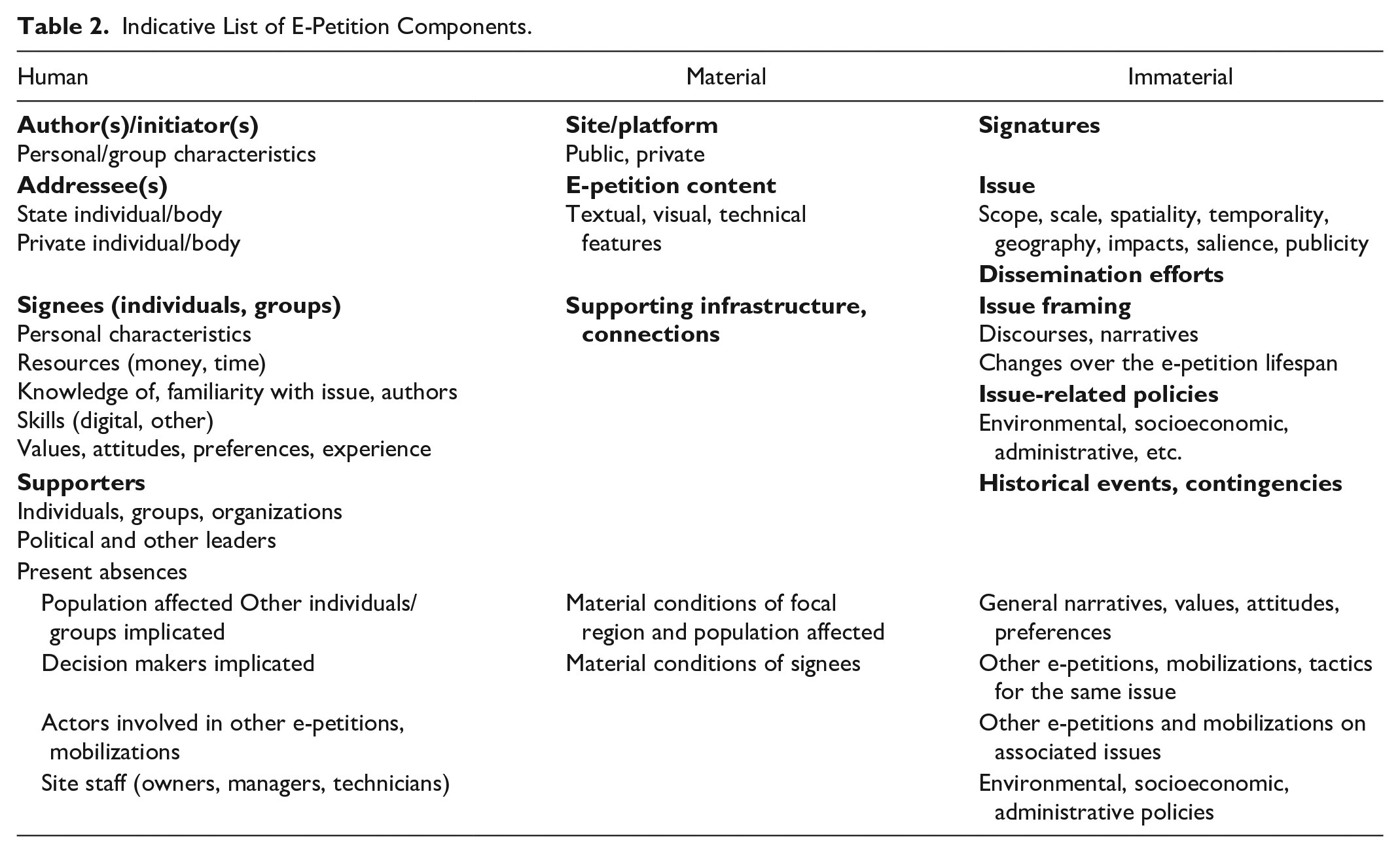
The components are relatively autonomous with multiple memberships, simultaneously belonging to several assemblages serving other purposes. For example, signees are family members, belong to professional groups, and may sign other e-petitions. The platform hosts several e-petitions. Depending on the issue, the components have variable spatial and temporal reach. Signees may be drawn from many countries if local issues have global importance (e.g., threats to protected areas, health issues, sexual and racial violence). The mass and the social media pay varying attention to the issue and the e-petition. The scope, scale, spatiotemporal features, geographical profile, and impacts of the issue change over the course of the e-petition, contracting or expanding to cover several affected groups and places.
The components play material and expressive roles, affecting the e-petition functions. The number of signatures makes the e-petition grow signifying the level of broad agreement with the e-petition text. The e-petition text informs prospective signees and foregrounds critical aspects of the issue while prominent signees signify its importance. The mass and the social media help disseminate and simultaneously express popular solidarity to the e-petition cause. Issue-related policy changes or other e-petitions and mobilizations accelerate or decelerate the signing process, signifying its importance and the responsiveness of the competent addressee.
Contingently obligatory relationships of exteriority develop among the e-petition components because they are relatively autonomous. For example, the signees use the platform only to sign the e-petition, communicate via social media to pass e-petition-related information, and are influenced by the information provided and current contingencies. Current or new issues relate to the e-petition issue but do not determine it. The number of signatures influences decision makers and so on.
Horizontal (rhizomatic) relationships develop among components; for example, among signees, between them and various communication media, among authors of e-petitions on related issues, between them and the populations affected, and decision makers. Vertical (arborescent) relationships develop between authors, signees, and addressees dictated by the rules of the e-petition, especially the institutionalized, platforms.
Interactions among e-petition components reveal their variable and modifiable capacities. Authoritative e-petition authors and/or signees; informative, powerful, and emotionally balanced texts; and site/platform upgrading may attract more (especially the hesitant) signees and boost the signing rate (Elnoshokaty et al., 2016; Hagen et al., 2016; Hale et al., 2013; Margetts et al., 2015). Present absences, for example, the population affected, engaging in larger mobilizations, may foreground the e-petition and amass signatures. Changes in beliefs, values, and preferences, for whatever reason, including the e-petition text, may have similar effects.
The capacities of e-petition critical components determine its possibility space, defined by one or more characteristic attractors and the associated basins of attraction, each basin being populated by e-petition assemblages. Attractors stand for the long-term tendencies of an e-petition, that is, the final number of signatures it will receive in the absence of constraints. The thresholds of critical components determine whether an e-petition will remain within a basin, with the number of signatures growing smoothly, gradually adapting to changes, or will move (transform) into another basin governed by other attractors, implying sudden increases of signatures, when the thresholds of one or more components are modified and crossed. Prominent personalities may transform a slow-growing into a fast-growing, and perhaps “successful,” e-petition. External events may raise the prominence of the issue, thus, precipitating a fast and steady increase of signatures. Declining interest in the issue keeps the e-petition within its current basin. “Thresholds” (Hale et al., 2013; Margetts et al., 2015; McNeill & Thornton, 2017; Schumann & Klein, 2015) help explain the temporal variability of e-petitions as well as their changes from slow to fast-moving.
The whole effort of starting, managing, and bringing an e-petition to success requires labor on the part of several components (author(s), signees, site staff, technology, institutions, etc.). Territorialization and coding processes bring and hold the e-petition components together within a basin, such as communication, offline and online participation and mobilization, e-petition institutionalization, civic engagement and socialization and, no less important, technical processes (e.g., infrastructure set up and maintenance). Habitual, customary discursive practices, overtly and covertly, code e-petition issues; namely, define their scale and importance, promote suitable discourses, develop narratives, raise the need for mobilization, target addressees, and so on. Material and discursive practices are employed to start and disseminate the campaign, reach, mobilize, network and keep supporters informed, communicate with authorities and other petitioners, secure resources, maintain the infrastructure, monitor the process, and so on.
Deterritorialization and decoding processes include site hacking, false signing, changing definition and importance of the issue, changes in access of signees to e-resources, technical infrastructure breakdown/upgrading, rival e-petitions, and so on. These may break existing relationships, altering the coherence of an e-petition, changing the thresholds of certain components, accelerating, decelerating, or even bringing signing to a final stop, thus, pushing the e-petition to another basin.
The repetition of territorialization/coding and deterritorialization/decoding processes generates populations of e-petition assemblages, unique individuals possessing flat ontology, 15 which constitute the e-petition as it grows, and enunciate its functions, effectiveness, and role in addressing an issue. Identifying and describing the e-petition assemblages is critically important because whatever an e-petition represents at each particular moment is immanent to it; it is what the assemblage determines it to be.
The properties of e-petition assemblages (e.g., potential, robustness, diversity, connectedness, modularity, vibrancy, appeal) result not from summing the properties of individual components but from their situated interactions as signatures are being added. Reductionist studies discuss certain properties—for example, speed and temporal variability of signing, diversity of signees, bursty, leptocurtic, and popular e-petitions—but for the petition as a whole (Böttcher et al., 2017; Clark et al., 2017; Hagen et al., 2016; Hale et al., 2013).
Once e-petition assemblages emerge, they possess agency and characteristic identity. E-petitions signed fast by many, especially prominent, signees urge others to sign compared to those drawing a few signatures slowly (Hale et al., 2013). Agency and identity are multiple, composite, and distributed, co-determined by all components, their relationships, processes of assembly and, importantly, the particular practices generating the assemblages.
Similarly, the causality of e-petition assemblages is multiple, composite, distributed, not pre-determined. Their output and outcomes cannot be explained, and/or generalized, by reference to a few known components and certain fixed relationships. 16 They emerge from complex interactions among all components, where historical contingencies and geographic context play important roles (Carpenter, 2016b; Lindner & Riehm, 2009, 2011; Vicente & Novo, 2014; Wright, 2016). Several e-petitions have a slow start, even followed by a stasis (owing, for example, to inadequate dissemination), resuming speed later to gather many signatures and perhaps make a noticeable impact on decision-making. Outputs and outcomes are, thus, uncertain and situated, determined by the unique, emergent e-petition assemblages that reflect its history and link the microbehavior (molecular) of individual signing to the macro- (molar) behavior of the e-petition. Changes in the importance of critical components 17 may modify the attractors and the basins of attraction (e.g., lowering or raising thresholds for signing), eventually judging the signing rate and final number of signatures.
E-petition assemblages have special notable features. They are continuously revisable, cumulative and unidirectional, growing sequentially over time, and rendering path dependence unavoidable. Signees interact through various media and signatures are interrelated (not independent). Each e-petition assemblage encompasses old and new components (signees, events, technologies) which cannot be re-arranged to form a different e-petition. Territorialization/coding are more important than deterritorialization/decoding processes compared to other genres of assemblages. Deterritorialization/decoding processes become important when signing decelerates and/or ceases.
Outline of an AT-Based Methodology for E-Petition Studies
The conceptualization of e-petitions as multiplicities comprising assemblages underlies the AT-based methodology for applied studies outlined below. The methodology can be used to study both open, ongoing e-petitions (and open issues obviously) and closed e-petitions (for open or closed issues). Informed by DeLanda (2002, 2006, 2011) and the AT literature, the methodology comprises four main stages linked by continuous feedbacks among them.
Stage 1: General description of the focal milieu, focal issue, and e-petition;
Stage 2: E-petition evolution; detailed description of phases;
Stage 3: Analysis of selected e-petition assemblages in each phase;
Stage 4: Guidance—focal issue and e-petition.
Stage 1, based on a thoroughly elaborated timeline and deep knowledge of the e-petition case, describes the spatial and temporal characteristics of the focal milieu (focal area and the associated socio-spatial hierarchy), the focal issue, and the main e-petition components (Table 1) over the entire study period. This period encompasses the pre-e-petition history of the issue and extends beyond the e-petition termination given the time lag before its effects materialize. Potential associated issues, and any related e-petitions or other forms of public protest/mobilization, are identified.
Stage 2 details the evolution of the e-petition and the assemblages formed over the study period. More specifically, the thick description of this stage aims to:
Identify and describe the main phases of the e-petition using as criterion the characteristic identity of the e-petition over a period of time (Cummings & Collier, 2005);
For each phase, identify the basins of attraction developed around particular attractors and describe the possibility space of the assemblages, that is, the capacities and thresholds (that may have been reached or crossed) of the critical/limiting components 18 defining the basins, and other important components and contingencies;
Within each basin, identify and describe characteristic e-petition assemblages (see below), associated with particular instances of the e-petition; and, if possible, identify assemblages of associated e-petitions;
Identify the relationships among the components of current and associated e-petition assemblages;
Identify and explain adaptations (movements within basin) and transformations (movements between basins) of the e-petition that have taken place over the study period.
For each assemblage, its open and revisable composition, processes of assembly, and evolution are described/assessed to help determine its place and movements within a basin of attraction. This description explicates the old and new components from all levels and times and the contingently obligatory, arborescent and rhizomatic, relationships among them. Special attention is paid to the practices 19 through which components come to relate to one another within the same and across assemblages.
Stage 3 deepens into the situated assessment and explanation of the state and changes of the properties of the assemblages and the outputs (provisional “end” states) and outcomes obtained in each phase in terms of the capacities of their components. This helps reveal the distributed, contextual, and contingent nature of the e-petition output, effectiveness, and outcomes and draw preliminary conclusions regarding the focal issue and the multiple contributions of the e-petition.
Stages 2 and 3 reveal who (which combinations of components) have shaped what—the output and properties of the assemblages, the e-petition tendencies, and particular outcomes in each phase—why (capacities of components) and how (which practices). The assemblages described enunciate the support received, the communicative linkages between represented and representatives and the e-petition functions performed. The description and analysis of the multiplicity of e-petition assemblages is not a one-off but a continuous process; the initial descriptions and assessments are revised whenever new information becomes available. E-petition data collection ideally requires close monitoring of the e-petition and synchronized recording of all e-petition assemblage components over time. Alternatively, or supplementally, past data may be collected on as many components as possible. 20 Mixed methods approaches, combining quantitative and qualitative techniques, are most suitable for their analysis.
Stage 4 builds on the preceding analysis to offer summative (for closed e-petitions and past or current issues) and formative (for open e-petitions and issues) guidance for (a) handling the focal issue—for example, support its resolution or a particular form of resolution enjoying high popularity—and (b) fine-tuning the current (open) e-petition to improve its impact and effectiveness. Although the situated nature of the findings does not permit generalizations to similar issues and/or e-petitions, it may be possible to identify persistent relationships and combinations of particular e-petition components that, if properly manipulated, may produce desirable outputs and outcomes. 21 An illustrative example of the proposed methodology is offered in the next section.
An E-Petition Protesting Planned Intensive Development in a Protected Area in the Northern Mediterranean
The following hypothetical (but not unreal) case illustrates the proposed methodology.
Stage 1: General description of the focal milieu, focal issue, and e-petition
Focal milieu and issue: a unique, world-known, environmentally, and culturally high-value protected area—henceforth, PA—and its surrounding region in Northern Mediterranean enjoying agricultural, forest, and mild recreational-tourism uses (hiking, mountaineering, archeological sight-seeing) for decades. Amid fiscal austerity, upscale tourism and/or energy development was proposed that was bound to unsettle its pristine character, cultural identity, and appeal. A strong, locally organized group launched an e-petition calling for a stop to the government’s intensive development plans, tightening the protection status of the PA, and promoting mild development.
The e-petition received wide domestic and international publicity, last 13 months and gathered 22,150 signatures, a significant number for the size of the country. Table 3 shows its main components.
Illustrative E-Petition Main Components.

Critical components: salience and publicity of the issue, e-petition text, related documentation, authors, dissemination efforts, number and profile of signees and supporters, historical events, and contingencies.
Important milestones included the following:
Support from prominent individuals (scientists, professionals, politicians), nongovernmental organizations (NGOs), and other organizations;
Changes in communication practices; media attention to the issue (foregrounding adverse effects of proposed commercialization plans);
Protests on similar contentious issues; linkages among e-petition authors, signees, supporters, and populations affected;
Changes in economic climate and government priorities;
Changes in local government attitudes (withdrawing support to the plans);
Changes in environmental and general national and supra-national legislation.
Territorialization processes: political engagement, communication and networking practices (especially those founded on familiarity among e-petition authors, signees, supporters, and the media), solidarity practices based on common values and common threats, and dissemination practices (conventional and digital social media).
Stage 2: E-petition evolution; detailed description of phases
Figure 2 suggests three phases. Phase 1 last around 6 months, received many signatures during the first 4 months, and started to stabilize after month 5. The signees were familiar with e-petition signing, agreed with the text and issue-related proposals, and had low participation thresholds. The characteristic basin of attraction, which developed around the first attractor (revealing a tendency toward 12,000 signatures), was determined by components with considerable capacities and high thresholds—authors, salience of issue, e-petition text, publicity/dissemination efforts, interest, and familiarity of signees and supporters with the PA.

E-petition 13-month period evolution.
E-petition assemblages started forming since the launch of the e-petition. Τerritorialization processes brought together their components. Contingently obligatory relationships developed mostly horizontally (rhizomatic), owing to contemporaneous networking and linkages among components during signing. Certain vertical (arborescent) relationships stemmed from e-petition site rules and supporter starter/follower linkages. Concurrently, signees, supporters, and networking and communication channels were shared with other e-petitions on related issues.
Phase 2 was a transition phase lasting from month 6 to 8. Although intensive dissemination/networking activities and support from prominent international and domestic, scientific, and political figures boosted the number of signatures, they did not stabilize. An upward shift in the signing rate and number of signatures occurred because of rapidly improving digital skills and access to the internet of the population, self-reinforcing, endogenous e-petition dynamics (positive feedbacks) that was continuously drawing signees (hesitant or late-informed), concurrent local pressures, dedicated conferences and meetings, and broader worries about the loosening of protected area legislation.
Assemblages formed comprising old and new components, possessing enhanced capacities (additional signees, supporters, dissemination practices, events), linked by contingently obligatory relationships, and remaining critical for the transition to Phase 3.
Phase 3 last from month 9 to month 13 when the proposed plans were withdrawn. The characteristic basin of attraction, which developed around the second attractor (revealing a tendency toward 22,000 signatures), was determined by components with enhanced capacities and higher thresholds—dissemination practices, historical contingencies and events, and significant present absences (digital skills of the population, access to the internet and digital devices, general beliefs, policies, etc.).
As in the previous phases, assemblages formed comprising old and new components bound with contingently obligatory relationships and shared with e-petition assemblages of concurrently escalating e-petitions on related topics.
Within all three phases, the e-petition assemblages adapted to changes in the components, capturing the particularities of each instance of the e-petition’s evolution. Αt the junction of month 6, the enhanced capacities of the critical components led the e-petition into a transition phase and, in month 8, it entered a new basin (transformed) developing around the second attractor (higher level of signatures).
Stage 3: Analysis of selected e-petition assemblages in each phase
The following analysis is based on the author’s educated judgment because research on properties, outputs, and outcomes of e-petition assemblages is lacking.
Phase 1
The assemblages possessed considerable potential and robustness owing to the high capacities of the critical components. Diversity was relatively low (low variability of components), connectedness relatively high (signees were initially limited to those very familiar/networked with the issue and the authors), modularity low (undeveloped yet), vibrancy intense, and appeal high (owing to the salience of the PA). Consequently, a high number of signatures and significant, diverse outcomes resulted (awareness raising, support/mobilization around the issue, protesting the government, expressing political preferences, agenda setting). These are noteworthy results given the fiscal austerity context and the clashing pro-development versus pro-environment interests.
Phase 2
The assemblages exhibited augmented potential and robustness because of the enhanced capacities of several components (supporters, dissemination efforts, issue framing, rising digital skills, precarious protection status of PAs, etc.). Diversity increased, connectedness remained high (linkages among authors, signees, supporters), modularity took shape (signees/supporters, following distinctive mobilization practices, clustered around particular aspects of the issue), and vibrancy and appeal remained high. Despite the unfavorable broader fiscal and political context, the number of signatures increased further and diverse outcomes ensued.
Phase 3
The assemblages retained their high potential and robustness because of the high capacities of critical components. Diversity, connectedness, vibrancy, and appeal remained high and modularity developed further before the e-petition coming to a stop. The combined knock-on effects of the various components over time bolstered the momentum and shaped the properties of the e-petition that recorded large numbers of signatures and multitudinous outcomes despite unfavorable contextual influences.
Stage 4: Guidance—focal issue and e-petition
During its lifespan, this e-petition revealed important information regarding the local and supra-local actors involved, the socioeconomic problems of the local population, and the environmental value and development issues of the PA, among other pieces of information. These helped further refine the understanding of the focal issue and of the needed interventions.
Although the decision to withdraw the proposed plans and retain the present status of the PA was shaped by broader forces, especially the European Union environmental/protected areas policies, the high profile of this e-petition may have importantly influenced the final outcome. The assemblages formed over its lifespan enunciated the situated, multiple, and distributed popular support offered to the focal issue, the policy preferences of signees and supporters, their will to communicate with competent officials, and actively participate in pertinent decision-making on this and associated issues. They also enunciated the situated strong linkages among various components and, thus, a not-insignificant level of integration of the country’s representative institutions.
The preceding analysis offers instructive lessons for designing future e-petitions. Effective e-petition assemblages emerge and persist from the constant labor of critical components, the authors, and their capacities (dissemination practices in particular), not only to bring and keep all components together but also to enhance their capacities to generate desirable outputs and outcomes. Favorable prevailing cultural and institutional conditions, changes in technology, and numerous present absences critically contribute to achieving this goal. These should be duly considered when designing and running e-petitions as well as when interpreting their outputs and outcomes.
Conclusion
E-petitions, like printed petitions, are co-constituted with their focal issue. This article has proposed an AT-based framework for analysis and research that conceptualizes e-petitions as multiplicities being continuously constituted by assemblages, an ontology that inevitably entails the co-analysis of the e-petition and the focal issue. It has been argued that this is a fitting analytical framework for case studies that aim to use e-petitions as research instruments for the situated analysis of a particular socio-spatial issue and, concurrently, assess their situated contribution to issue-related decision-making. In this context, the advantages of AT-based over reductionist/essentialist approaches on conceptual/theoretical, methodological, practical, and guidance grounds are summarized below, indicating how they address prominent concerns of the e-petitions literature.
The AT conceptual lexicon offers a unifying, but not totalizing, template for pulling together different aspects of e-petitions into a cohesive framework enabling a synthesis of pertinent theoretical models and providing germane methodological orientation in empirical applications. It focuses on the emergent unique assemblages that enunciate the actual, place- and time-specific e-mobilization enacted to serve an issue-related purpose. Unlike the reductionist system ontology, the integrative assemblage ontology and analytic enables a veritable rendering of e-petitions-in-context, that is, their co-constitution with the focal issue, enunciates the situated importance of and support to the issue, and reveals the political preferences of those signing out of desire to contribute to issue resolution.
This last point is emphasized because, sensu stricto, an e-petition represents those politically active persons with access to the internet, digital skills, awareness of, and trust in e-petition systems who have chosen this form of political mobilization/support, along with other forms perhaps. The greater and sharper the differences among signees and with the general population, regarding these and other traits, are, the more biased a reductionist analysis will be. Moreover, generalizing from a however heavily signed e-petition will not be valid.
In contrast, an AT-based approach explicates those differences because the assemblage ontology expressly renders the multiplicity, materiality, hybridity, complex dynamics and flat ontology of e-petitions, and the focal issue. It emphasizes the centrality of purpose and actual practices 22 in the “becoming” of an e-petition and accounts for the capacities, thresholds, multiple roles, memberships, interrelatedness, and co-functioning of their heterogeneous components originating in different spatial levels anytime, several of which are shared with the focal issue (Table 2). It addresses the co-constitution, inseparability, and situated combinations of the pertinent “who-what-where-when-how-and-why,” linking the molecular (micro) with the molar (macro/statistical) behavior. The resulting diverse, issue- and e-petition-related outputs and outcomes continuously adapt to changes in the constitution of e-petition assemblages, being spatiotemporally entangled and co-produced with those of several other assemblages. Consequently, the AT-based approach facilitates the assessment and interpretation of the contribution of individual components to these outputs and outcomes. It stresses that these are what the unique issue-related e-petition assemblages determine them to be, showing how politics and power shape them, an issue that system-based, reductionist/essentialist approaches 23 commonly ignore.
Contrary to reductionist/essentialist system-based approaches, AT-based approaches are historical, experimental, and processual bearing important similarities to aforementioned historical-institutional approaches employed in the analysis of printed petitions. Taxonomies, binaries, typologies of actors, goals, outputs, outcomes, and formal spatial and temporal levels are rejected. The focal issue, the e-petition, and the socio-spatial milieu (context) are not treated separately; they are all co-constituted and determined in the space of the emergent assemblages. The AT-based situated analysis does not generate an aggregate assessment and evaluation of the e-petition as a whole but a detailed history of its becoming, thus, openly acknowledging the inherent selection (and interest) bias of e-petitions and rendering pointless general charges against them that mostly flow from the use of reductionist analytical approaches.
Employing the AT-based methodology demands attention to the delineation of the focal milieu and study period and to data availability and quality. The latter is a serious consideration because e-petition data suffer from self-selection bias (signing is voluntary) (Ranchordás, 2017). Detailed, often overlooked, issue-specific, and other longitudinal data for all assemblage components for the thick description of the issue and the e-petition have to be painstakingly collected. 24 Besides hidden/anonymous signatures, several personal data may be unavailable to the e-petition author or the analyst for confidentiality, security, and privacy reasons, necessitating the use of indirect ways to acquire necessary information. Data availability, cost (money, time, know-how), and the tension with research ethics (Berg, 2017a; Briassoulis, 2010) critically determine the effective and meaningful application of the proposed AT-based methodology.
In contrast to reductionist/essentialist approaches that offer one-size-fits-all (OSFA), summative, portable recommendations regarding the e-petition (but not the focal issue) mostly, an AT-based approach may offer focal issue-tailored formative and summative guidance based on the empirically determined properties and tendencies of the e-petition assemblages and the capacities and relationships among their (critical) components over the course of an e-petition. This issue- and e-petition-specific information, combined with other pieces of information, may indicate how to modify which components to better achieve issue-related goals and e-petition performance.
Future research is called to explore a variety of open issues of the e-petitions literature and of the application of the AT-based approach. A thorough engagement with the rich AT conceptual lexicon may help rethink/reformulate extant political communication and participation theoretical models by dropping system-related assumptions and conceptualizing e-petitions as multiplicities constituted by assemblages. In this light, the examination of PET is particularly interesting given certain affinities with AT, such as the focus on the mechanisms behind punctuations (begetting transformation of an e-petition). The AT lexicon may also enable syntheses of various (reformulated) social and political theories to construe the genesis and evolution of e-petitions for a more integrated understanding of how different factors combine to produce mobilizations and, consequently, e-petition politics. Several debates concerning e-participation and e-petitions, such as the tension between nonconfrontational, citizen-led means of protest and representative democracy, barriers to participation, and several others (Bochel & Bochel, 2017; Carman, 2014; Karpf, 2010; Ranchordás, 2017; Wright, 2015, 2016), may be more meaningfully explored in context.
Future research may also compare ANT and AT. Both approaches draw on the Deleuzoguattarian philosophy but differ on epistemological grounds. ANT, adopting social constructivism, endorses the actor-network ontology where the network dominates over the autonomy of components. AT, adopting (critical) realism that underlines the mind-independence of reality, endorses the assemblage ontology that may conceptually and analytically better support e-petition analysis.
Further elaboration of the proposed methodology will deliver an integrated analytical AT-based apparatus for applied e-petition studies. Guided by the aforementioned theoretical developments, suitable combinations of quantitative and qualitative techniques, data-driven Computational Social Science methods and the analytical resources of Differential Geometry will help refine Stages 2 and 3. This is a demanding but necessary research challenge to confront the analysis of new concepts emerging in novel socio-spatial milieus and the availability of new types of (big) data. Empirical applications of the AT-based approach in various geographical contexts, issues, and kinds of e-petitions will test its applicability, performance, and value in producing reasonable, well-informed analyses and judicious decision support in the context of multimethod studies of political engagement.
Finally, it may be worthwhile to analyze the similarities and differences between printed and e-petitions and explore the application of the proposed AT-based framework to the analysis of printed petitions. The detailed studies of historical e-petitions mentioned before suggest that they may be re-worked using the rich information already compiled to test the potential of the AT-based framework to describe and explain the contribution of printed petitions to the understanding of the focal issue and their effects on issue-related decision-making.
Footnotes
Declaration of Conflicting Interests
The author(s) declared no potential conflicts of interest with respect to the research, authorship, and/or publication of this article.
Funding
The author(s) received no financial support for the research, authorship, and/or publication of this article.
