




Abstract
The connective approach is developed by Sir Peter Strawson, emeritus professor of philosophy at Oxford University, as an effective way to understand the fundamental structure of human thinking in the field of analytical philosophy. This article provides insights for extending the work of Strawson, Tay, and Tay et al. to education, in particular, how we can equip students with the requisite knowledge, skills, and dispositions for answering science questions. The connective approach uses three dimensions, namely, ontology, epistemology, and logic. The scaffolding strategy that we have developed, consisting of DINE (whereby “D” is describe, “IN” is interpret, “E” is evaluate), the logic dimension; Bite-Size Teaching, the epistemological dimension; and focal lesson, the ontological dimension, is an integrated network of connected concepts that enable students to construct arguments and explanations needed for phenomena at a higher level of complexity. This article also extends the use of the connective approach to learning in social constructivist classrooms.
Introduction
This article is based on a study done by a team of Biology and Lower Secondary Science teachers of a public secondary school in Singapore with a student population of about 1,120. The Lower Secondary Science course is offered to Secondary 1 and Secondary 2 (Grades 7 and 8 equivalent) students. A major component of the Lower Secondary Science course is designed around developing inquiry through engaging in scientific investigations and processes (Ministry of Education, Singapore, 2012). Besides engaging in hands-on science laboratory work, most pen-and-paper science questions are crafted along experiments (Figure 1).

Example of pen and paper science question.
A core facet of science is the ability to construct explanations from interpreting evidences or texts and assessing claims (Driver, Newton, & Osborne, 2000). The ability to derive proper scientific explanations encompasses the goal of inquiry learning because it involves understanding the phenomena and convincing others of the same understanding (Sandoval & Reiser, 2004). Students’ engagement in construction of scientific explanation may promote a positive outlook on science as well as increase their understanding of scientific content (Bell & Linn, 2000; Zohar & Nemet, 2002).
We noticed that our lower secondary students find it challenging to interpret experimental data. Generally, students have a few challenges in answering data-based questions: (a) inability to describe the data (Figure 2) and (b) inability to infer and interpret the data (Figure 3).

Generalization in describing data.

Inability to understand intention of data provided.
For the first challenge (Figure 2), our students tend to generalize loosely and prematurely in their written answers. Most students fail to put in effort to describe the pattern(s) offered by the data in a given question (Sandoval, 2003). Instead of using the data provided, students often rely on their personal views, textbook knowledge, and beliefs to draw conclusions (Hogan & Maglienti, 2001). For instance, as depicted in Figure 2, the student answered by using “affects” to describe the effect of increasing water temperature on the amount of solute that can be dissolved in the water without clear mention of what exactly the effect was.
In the case of the second challenge, our students were unable to understand the intention of the data. As illustrated in Figure 3, the student was neither able to provide a reasoning nor make a reference to a taught theory; the student failed to link the question to the concept of air pressure in the inner and outer ear. As pointed out by Chinn and Brewer (2001), our students’ understanding of content knowledge and data evidence in question affects whether they are able to provide appropriate evidence for a particular task. Students are also likely to ignore data that contradict the theoretical knowledge they already know, and they are more likely to take data into account if they can visualize the concept behind the data pattern. Therefore, the need for stronger content knowledge and exposure to data patterns may help students improve their understanding for the underlying intention of a given science question.
Scaffolding, as described by Wood, Bruner, and Ross (1976), consists of an adult manipulating the elements of task that are beyond the learner’s ability, so that the learner is able to focus on and achieve competence in the fundamentals within his or her capacity. A number of researchers (Brown & Palincsar, 1987; Stone, 1993) have made the connection that scaffolding allows learners to reach a higher level of understanding for task within their zone of proximal development (ZPD). According to Vygotsky’s (1978) theory, the ZPD defines the area where a learner is able to solve problems independently and attain a potential level of problem-solving capabilities with guidance. For a scaffold to serve its function well, it should reside within the learner’s ZPD. If the scaffold provides too much assistance, the learner will not be challenged to inquire more. Hence, the scaffold should provide just enough assistance so that the learner will be able to progress independently and achieve a higher level of understanding (Vygotsky, 1978).
In the past, we have tried to explain the answering of experimental-based questions on a question-by-question basis. This may have led to some students memorizing answers to specific questions. There are studies indicating that the ability to craft scientific explanations does not come naturally to most individuals; instead, it is mostly assimilated through practice (Osborne, Erduran, & Simon, 2004). Therefore, students should be explicitly taught the skill on how to craft accurate scientific explanations, and this should be practiced regularly in science lessons.
Connective Approach in Construction of Scientific Explanations
The connective approach is developed by Sir Peter Strawson, emeritus professor of philosophy at Oxford University, as an effective way to understand the fundamental structure of human thinking in the field of analytical philosophy. At the heart of the connective approach are the three distinct dimensions of ontology, epistemology, and logic (Strawson, 1992; Tay, 2003; Tay et al., 2010). These dimensions are identified by Strawson (1992) as the three dimensions of a unified enquiry. Figure 4 shows how epistemology, ontology, and logic can be represented.

Connective approach.
The meaning of the three dimensions is described by Tay et al. (2010) as follows:
Ontology [sic] is defined by Reber (1995) and Zuber-Skerritt (2001) as an aspect of metaphysical inquiry concerned with the question of existence apart from specific objects and events. It is one’s assumptions about the nature of being and reality. As pointed out by Nita (1999), ontology takes on two meanings. The first meaning takes reference to the real world, where experience is characterized in terms of what is “out there.” The second meaning includes belief in the existence of the things in question such that these things are separated and related in time and space. (p. 2) Epistemology [sic] is defined by Reber (1995) and Zuber-Skerritt (2001) as the branch of philosophy that is concerned with the origins, nature, methods and limits of human knowledge. It is our assumptions about the nature of knowledge and knowing. As pointed out by Nita (1999), epistemology is either something objective, to be accumulated independently of the perceptions of any particular observer or something subjective, a product created by the observer. In other words, epistemology is the use of concepts in judgement or belief. It refers to the personal and subjective phenomenon. The experience is characterized in terms of what is “in the head” of humans. (p. 2) In Strawson’s view [sic], logic is the study of the general forms of the proposition and of their relations of logical dependence and independence. It has no concern with the internal structure of uncompounded propositions that enter into its compounds. It has nothing to say about the content of logically simple propositions. It has nothing to do with an ontological order. According to Bench-Capon (1990), the main concern of logic is with the soundness and unsoundness of arguments. Its goal is to represent an argument in such a way that it will be uncontroversial as to whether that argument is acceptable or not. (p. 3)
The above literature prompts us to develop an adopted collective approach consisting of aspects to the three domains: ontology, epistemology, and logic. The ontological dimension can be represented by experiential focal lessons. The epistemological dimension can be represented by the set of pre-requisite knowledge taught to students in class. The logic dimension refers to the instructional method to scaffold students in crafting scientific explanations.
In addition, as pointed out by Strawson (1992), the concepts to be included in the connective approach must be highly general, irreducible, and non-contingent.
First, the term “general” is described by Reber (1985/1995) and Tay (2003) as a judgment or decision that is applicable to an entire class or category of objects, events, or phenomena. For example, the word “flower” can be used as a general term to refer to the bud, the stalk, the leaves, and the root. The three dimensions adopted in this research study are general in nature. The experiential “Focal Lesson” is based on the general theory of being. It applies the notion of ontology by ensuring all its phenomena take reference to the real world. All the phenomena observed by students must be found in the physical setting associated with that focal lesson. The set of pre-requisite knowledge adopts the general theory of knowledge. It represents the collective body of information where students can use the underlying nouns, verbs, phrases, or sentences to construct their concepts or explanations. The instructional method uses the general theory of proposition. It is concerned with what is true or false.
Second, as pointed out by Tay (2003), the term “irreducibility” does not mean or imply “simple.” A concept may be complex, in the sense that its elucidation requires the establishment of its connections with other concepts. At the same time, it is also irreducible, in the sense that it cannot be defined away, without circularity, in terms of those other concepts to which it is necessarily related. All the three dimensions in this research study are irreducible. This is based on the fact that against judgments or beliefs derived from pre-requisite knowledge is the natural world or the physical setting associated with a respective focal lesson to which the judgments or beliefs relate. To determine whether the judgments or beliefs are true or false, the instructional method is required by students to process the states gathered from the relations of judgments or beliefs derived from pre-requisite knowledge with that of the natural world associated with the focal lesson.
Third, the term “non-contingency” is defined by Reber (1985/1995) and Tay (2003) as something strengthened by an event. It is considered to be the learned response of a bond between that response and stimulus. It occurs independently of any behavior. It has a role to play in the development and maintenance of that behavior. Beyond that, the very concept of experience itself would be lost. The adopted three dimensions are non-contingent. Each element contains a distinct feature that is non-contingent. The focal lesson is concerned with things that are “out there.” A pre-requisite knowledge is concerned with things that are “in the heads” of humans. The instructional method is only concerned with the reasoning process. It interprets neither the content of the things in a focal lesson nor the concepts derived from pre-requisite knowledge.
Therefore, during the processing of applying our derived approach, the students traverse through an elaborate network of connected objects and concepts that enables students to construct an explanation concisely and comprehensively and also to be able to interpret observed phenomena systemically and at higher level of complexity.
This article focuses on the feasibility of implementing the connective approach in helping lower secondary science students construct scientific explanations for experimental-based questions in science. The concepts and theories relevant to this study are presented in the following sections:
Derivation of Scaffolding Strategy
Intervention of Scaffolding Strategy
Data Collection and Interpretation
Expanded Understandings of Connective Approach in Social Constructivist Classrooms
Future Directions
Derivation of Scaffolding Strategy
First Aspect: Developing the Appropriate Instructional Method for Crafting Scientific Explanations
Prior to our research study, the art curriculum in Singapore has already adopted Feldman’s (1967) method of art criticism as a simple four-step method for evaluating a work of art. It comprises the following:
Description: Listing what an art object seems to include
Formal analysis: Describing the relationship among the things that were listed
Interpretation: Deciding what all your earlier observation means
Judgment: Deciding the value of an art object
We noticed the similarities behind the Feldman thinking model of art criticism and constructing scientific explanations. Hence, we decided to adapt Feldman’s model instead of using it directly, with a view to make it more accessible to lower secondary students for learning science. Besides, we also intentionally reduced the complexity of experimental-based questions for students with a view that students can collaborate among themselves in deriving valid scientific explanation (Wood et al., 1976).
As a result, we created an instructional model (DINE) consisting of three elements for thinking:
Describe—State what you have observed (adapted from 1 of Feldman’s method). For example, what general trends does the graph show? What are the highest and lowest points on the graph? What changes were seen in the set-up?
Interpret—What does your observation mean? (adapted from 2 and 3 of Feldman’s method). For example, explain the relationship between the variables. How does the dependent variable (y-axis) vary with the independent variable (x-axis)? How does one variable affect the other variables to cause changes?
Evaluate—How does your observation relate to theory/scientific concepts? (adapted from 4 of Feldman’s method). For example, justify the decision, or explain the concept using theories you have learnt. Why does the graph show such a trend? Why do the changes happen in the setup? Are the results expected according to concept?
In addition, a DINE poster (Online Appendix A) was printed for every science classroom and exhibited on the classroom walls. It is a step toward making DINE more visible in classrooms that hopefully increases the frequency of its use. Students were taught the use of DINE directly in classrooms through exemplars of experimental-based questions (Online Appendix A).
Second Aspect: Preparation of Bite-Size Notes for Teaching Pre-Requisite Knowledge
Student epistemology influences the learning experiences students have and affects student learning (Hogan & Maglienti, 2001). As such, we took into consideration the prior knowledge of our target students who had just graduated from primary school and incorporated additional information on a “need-to-know” basis, with focus on context that can help students move forward in their inquiry during the scaffolding lesson. For example, pre-requisite knowledge for Focal Lesson 1 includes the concept of osmosis, relevant practical skills, laboratory safety procedures, and use of an online platform like Google documents for collaboration.
Third Aspect: Design of Focal Lessons
We designed two laboratory-based science experiments as focal lessons where students were able to collect their own data and derive their explanations to data. We were mindful that the tasks in the focal lessons were pitched at the right level for the students—tasks that are too difficult are outside the students’ ZPD, and tasks that are too easy will leave the students unmotivated. The core difference between the two focal lessons is that the first focal lesson is a laboratory experiment largely based on a scientific concept of osmosis where students develop explanations based on divergence from accepted scientific theory, while the second focal lesson allows students to design their own experiment and develop their own scientific explanations. These lessons will be elaborated in the next section.
Fourth Aspect: Developing Domain Pre-Test and Post-Test
Pen-and-paper assessment tests based on domain knowledge were developed and administered to students before the administration of DINE instructional strategy and after the administration of DINE instructional strategy, respectively. These assessments included data-based questions in both multiple-choice questions and structured questions (Figures 1-3). Through this, we wanted to assess how the preparation and teaching of domain knowledge together with the logic dimension, DINE instructional strategy, affect learning science.
Fifth Aspect: Adaptation of University of New South Wales (UNSW) Non-Domain Pre-Test and Post-Test
We adapted 10 multiple-choice questions extracted from the International Competitions and Assessments for Schools (ICAS) science papers administered by the UNSW from years 2000, 2001, 2002, 2003, and 2007 (Online Appendix B). The ICAS questions were chosen because the questions assess students’ skills in the key scientific areas of interpreting data, applying data, and higher order skills (http://www.eaa.unsw.edu.au/forms/pdf/icas/subjects/science-framework.pdf). We administered this test before the explicit teaching of DINE to understand their pre-analytical ability for experimental data-based questions and administered the same test after the DINE implementation period to check for improvement in their post-analytical ability. It is important to note that we did not conduct any pre-knowledge lessons to students for these extracted UNSW questions. This fifth aspect was introduced to find out whether students were able to use DINE alone to analyze scientific data beyond their epistemological and conceptual knowledge.
Intervention of Scaffolding Strategy
The two focal lessons were carried out accordingly in chronological order and administered to all four Secondary 1 express stream classes comprising of 40 students each (total 160 students), over a period of 8 months.
Stage 1: Conduct UNSW non-domain pre-test and domain pre-test before DINE is taught to students.
Stage 2: Students were taught directly and explicitly the use of DINE prior to focal lessons in the following format: Describe—What do you observe? Interpret—What does your observation mean? Evaluate—How is your observation related to theory/scientific concepts? Guiding slides on DINE and examples can be found in Online Appendix A.
Stage 3: Conduct of Focal Lesson 1 (Online Appendix C).
Stage 4: Conduct of Focal Lesson 2 (Online Appendix D).
Stage 5: Conduct UNSW non-domain post-test and domain post-test after the implementation of DINE and focal lessons.
The activities of Stages 3 and 4 are described in detail in the remaining parts of this chapter.
Stage 3: Focal Lesson 1
In the selected laboratory experiment on diffusion and osmosis (Online Appendix C), students were tasked to carry out the experiment and obtain their own tabular data through the practical session. Via Google document, students worked in groups of four and used DINE to answer the two questions posed in the practical session.
Step 1: Students participated in the practical session and collected the tabular data on their own (Figure 5). Practical skills and laboratory safety were taught prior to this focal lesson.
Step 2: After completing the practical and clearing up the laboratory benches, students worked collaboratively in groups of four and used DINE to answer the two questions at the end of the practical exercise: Explain what happens to the potato strip when placed in distilled water? And explain what happens to the potato strip when placed in 20% sucrose solution? They answered the questions in a Google document that was created and shared among classmates. The Google document allowed students to collaborate and share answers with a view to help each other develop a better understanding of construction of scientific explanation.
Step 3: Each student was allocated one part of explanation done by another group to critique; that is, Student A critiqued on the “Describe” statement done by Group 1, Student B in turn would critique on the “Interpret” statement done by Group 1. Some students were observed to have gone on to critique the entire explanation (D, IN, E parts) done by a group (Online Appendix E).
Step 4: Teacher does a general feedback for the class.

Student tabular data collected in focal lesson 1.
Stage 4: Focal Lesson 2
The second focal lesson was carried out in two separate lesson periods—exploration of school eco-garden and generating inquiry questions (Part 1) and using DINE strategy to construct scientific explanations to the students’ inquiry questions (Part 2; Online Appendix D).
Step 1: In Focal Lesson 2 Part 1, students worked in groups of four. They were brought down to the school eco-garden to observe the biodiversity there and came up with their own inquiry questions and hypotheses using the worksheet provided. In groups, they designed a simple experiment to test out their hypotheses and included the type of data they were collecting. At the end of the Focal Lesson 2 Part 1, the teacher collected the worksheets.
Step 2: The teacher looked at each experiment and hypothesis selected by each group and came up with fictitious data in tabular form for the groups to analyze. The fictitious data were customized to the hypotheses and experiments of each group (Figure 6). This fictitious data generation was performed between Parts 1 and 2 of Focal Lesson 2.
Step 3: In Focal Lesson 2 Part 2, the teacher returned to the classroom with fictitious data generated for each group. Using the guided worksheet (Online Appendix D), students worked in their own groups and used DINE instructional strategy to construct scientific explanations for their hypotheses. During the session, each group had to use the data provided to Describe, “What are the highest and lowest readings?” Interpret, “What do these readings signify? Is the trend of the data increasing, decreasing, or constant and what does it mean?” and Evaluate—“Give a conclusion to your hypothesis, stating whether it was possibly true or possibly false, and why.” The teacher collected the worksheets and assessed students’ ability to construct scientific explanations.

Ficticious data customized to student hypotheses.
Data Collection and Interpretation
Quantitative Analysis of Domain Pre-Test and Post-Test
We conducted a paired-sample t test to understand if there is a significant improvement in students structuring scientific explanations using DINE, in assessment tests that require domain knowledge.
The null hypothesis (H0) is that DINE instructional strategy has no impact in improving students’ understanding and construction of scientific explanations in content-based scientific concepts. With regard to the test results listed in Figure 7, the p value obtained for a one-tail t test is .027 (p < .05), and the null hypothesis can be rejected. Therefore, we can conclude that DINE has a significant impact on students’ ability to construct scientific explanations if scaffolding occurs within their ZPD.

Mean percentage marks for domain pre-test and post-test.
Comparing the individual classes in Figure 8 using a paired-sample t test as above (null hypothesis [H0] is that DINE has no impact in improving students’ construction of scientific explanations), the p values obtained and respective implications are collated in Figure 9.

Graph showing mean marks per class for domain pre-test and post-test.

Paired-sample t test results per class and their respective implications.
A possible explanation to qualitatively explain why DINE may not have a positive impact on Class S will be the English language ability of the class. A comparison of the English language examination scores in the same time frame of this project showed that Class S had the lowest mean score among all four classes. The command of the English language may have an important role to play in helping students understand what Describe, Interpret, and Evaluate entail and the science concepts taught during the period. This would be in line with Jacob, Alexander, and Shola (2013) who found that there was a correlation between proficiency in English language and academic performance of students in science and technical education.
However, as depicted in Figure 8, Class P that performed the best in the domain pre-test among the four express classes obtained a slightly lower overall mean for the domain post-test. Our act of “intentional reduction of complexity of experimental based questions” may have caused some students to lose their interest during the focal lessons. This offers the explanation on why the null hypothesis for Class P is not rejected.
Therefore, the results in Figure 9 explicate two important facts: The weaker Class S needs pre-knowledge teaching, and the stronger Class P needs a more complex ZPD.
Besides, the positive results offered by Figures 7 and 9 explicate the fact that we need to apply three aspects collectively for our scaffolding strategy.
Quantitative Analysis of UNSW DINE Pre-Test and Post-Test
One mark was allocated per correct answer, with a maximum scoring of 10 marks. We conducted a paired-sample t test to examine whether there is a significant improvement in the mean marks of post-test compared with the mean marks of pre-test of all the four classes (Figure 10).
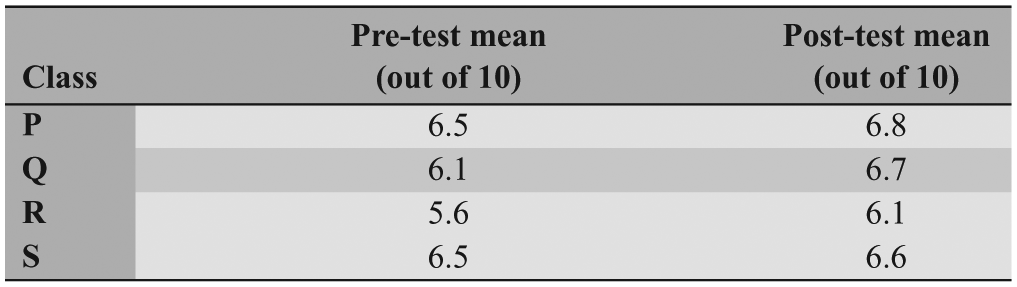
Mean marks of DINE pre-test and post-test per class.
Only for Class Q, the absolute value of the t stat was smaller than the t critical two-tail and the probability that the null hypothesis is true is smaller than alpha (p = .0012). For Classes P, R, and S, there was no significant statistical difference between the mean pre-test and post-test scores.
The adapted UNSW pre-test and post-test assesses students’ ability to analyze data-based questions without a common understanding of the assessed scientific concepts and domain knowledge (usually taught by the teacher). With these findings, we realized that equipping students with just DINE approach alone is not sufficient for students to learn science; instead, it reinforces that learning science occurs in context, and students need to have a connected epistemological and ontological domain that functions in tandem with the logic dimension. These results also provide the grounding for the need of shared epistemologies and ontologies that can be achieved through proper argumentation when learning in groups.
Qualitative Feedback of Student Survey
Using an online survey platform, we created a survey for the students after the implementation of DINE instructional strategy to gather feedback on the usefulness of the strategy. The following questions were asked:
Question 1: Do you find the DINE method (Describe, INterpret, Evaluate) taught to you earlier to answer structured or essay questions effective?
—Yes
—No
Question 2: What can be improved on for DINE?
For Question 1, on the effectiveness of DINE instructional strategy in constructing scientific explanations for data-based questions, the results are shown in the graph below (Figure 11). In all, 85% majority of students do see the need for a structured approach to help train skills for construction of scientific explanations.

Survey findings of the effectiveness of DINE.
For Question 2 on the possible improvements for the DINE action strategy, the students’ comments are collated and listed in Figure 12 below.

Student comments on DINE strategy.
Comparative Observations of Students’ Products in Focal Lessons 1 and 2
Focal Lessons 1 and 2 were two different approaches that allowed students to use DINE to construct their scientific explanations. Both lessons enabled students to work collaboratively in groups where spaces were provided for argumentation. The approach for Focal Lesson 1 focused more on students’ ability to construct scientific explanations to explain their data coherence to or divergence from the accepted scientific theory of osmosis that was taught prior in lessons. The approach for Focal Lesson 2 enabled students in groups to formulate their own scientific explanations and theories based on the given data. Focal Lesson 1 also allowed for both individual and shared expressions of their understanding in constructing scientific explanations; Focal Lesson 2 allowed for a shared expression of their understanding.
Focal Lesson 1
In Focal Lesson 1, where groups collaborate in discussing explanations of data divergence to accepted theory (osmosis) using DINE, their answers showed a more complete analysis of data as seen in (a), as compared with answers in (e) and (f) discussed below.
a. “The potato strip increased in length. The water molecules had moved from the water which has higher water potential to the potato which has lower water potential of water molecules through osmosis through the partially permeable membrane.” (Online Appendix E)
It was also noticed that when students were given the ownership to critique the work of their peers, it seems that individually, they were better at pointing out the missing gaps.
b. “ . . . although all three statements are correct, the whole explanation does not make sense. In the ‘E’ column, how did the process of osmosis cause the potato strip to increase in length? The group only provided the definition of osmosis and even the explanation is incomplete (what does the water molecules pass through?). They also did not explain how the process relates to the potato strip’s increase in length.” (Online Appendix E)
In the above comment (b) from a student on a group’s answer, he or she accurately pinpoints the mistakes that students have been making over the years—they are able to reproduce theoretical knowledge, but unable to link that domain knowledge to the context in the question given.
c. “You should be more specific and state it as ‘potato strip’ instead of potato as there’s a difference between a whole potato and just a strip.” (Online Appendix E)
d. “The definition is incomplete, they should have mentioned “osmosis” in their answer as it is a key word . . . ” (Online Appendix E)
In the critiques (c) and (d) above, individual students echo the common mantra of teachers for students to be more specific in writing their scientific explanations—students tend to be careless with keywords and use of scientific terms in their daily work.
Focal Lesson 2
In Focal Lesson 2 where there is no evident or shared understanding of a scientific theory to evaluate coherence to, or divergence of theory from, data, it was observed that students were more general in their scientific explanations.
e. “The readings signify that the water quality is bad . . . If there are dead fishes in the water, it means that the water quality is not good. Our hypothesis is possibly false. As stated in the reading that when the pH level is high, there are dead fishes, when the pH level is low, there are lesser dead fishes.” (Online Appendix F)
f. “The readings signify that the plant grow taller with support than without support. The trend of the data is increasing. The support enable the plant to grow taller. Thus, enables the plant to get more sunlight and make food. So the plant will grow healthily. Our hypothesis is true. The plant without support grew slower than the plant with support even though they were given the same amount of time.” (Online Appendix F)
In Example (e), the students used vague words, “bad” and “not good,” to describe the water quality when data on pH were provided. It implies that not only are the students unclear about how pH can affect water quality for fish survival, it also shows that they do not comprehend the scientific measurement of pH. Their conclusions implied that as the pH level increases, the number of dead fish increases although the readings given ranged between pH = 2 and pH = 3.
In Example (f), the students were able to describe that “the support enable the plant to grow taller” and added the consequence of how height “enables the plant to get more sunlight and make food.” The consequence did not explain how the support enabled the plant to grow taller. These examples fully support the importance of role of domain knowledge in applying scaffolding strategies as substantiated by Vygotsky (1978). Without sufficient domain knowledge, the scaffolding is not within their ZPD; hence, it is not effective, and it does not help to extend their potential of constructing proper scientific explanations. The difference between Focal Lessons 1 and 2 is that domain knowledge is shared by the teacher in Focal Lesson 1 but common domain knowledge has to undergo group processes of argumentation in Focal Lesson 2 before there is a shared understanding.
In Focal Lesson 1, where data were interpreted based on divergence from theory, students were taught the pre-requisite theoretical knowledge of osmosis prior, and their argumentation in groups was based on a similar shared understanding among students. This could possibly have led to more constructive argumentation and refinement of their construction of scientific explanations. In Focal Lesson 2, where students had more space to develop their own theories and consequently scientific explanations, we observed that there was more variation in quality of responses to construction of explanations. This could be due to the lack of a strong shared epistemology of theoretical knowledge among the group members due to weak argumentation skills in group work. Because of the lack of a common theoretical understanding, students have to rely more on the argumentation process that occurs in collaborative group work to create a shared understanding to construct better scientific explanations for their theories.
These observations have led to an expanded understanding of the use of the connective approach in constructing scientific explanations. From the quantitative analysis of domain scores and UNSW non-domain test scores and the qualitative feedback of the student survey, it is evident that the collective use of epistemology, ontology, and logic is necessary in developing scientific explanations in students. However, the observations of the group processes in constructing shared understandings of scientific explanations may point to an expanded understanding of the connective approach, where learning occurs both in context and in creating shared understandings in groups.
Expanded Understandings of the Connective Approach
Because learning occurs in context and within communities of practice (Lave & Wenger, 1991), it is necessary to look at the connective approach in social learning environments. The individual cognitive aspects of the connective approach have expanded meanings when studied in the perspective of learning in social classroom settings where knowledge is socially constructed. Ontology has expanded meanings in “realist ontology” where scientific knowledge is socially constructed but restricted by ontology of natural phenomena (as cited in Driver, Asoko, Leach, Scott, & Mortimer, 1994, p. 6); individual epistemology can be re-conceptualized as epistemology as a social practice (Kelly, McDonald, & Wickman, 2012) where sociocultural norms can affect one’s conceptions; individual logic can be viewed as shared logic formation through argumentation that can be affected by persuasive goals and ethnographic norms (Bricker & Bell, 2008). Building on to Hewson and Hewson’s (1984) work that focused on the cognition aspects of conceptual change, Pintrich, Marx, and Boyle (1993) pointed out the motivational constructs of the learner that can affect the state of conceptual change. This perspective takes into account the idea that teachers teach learners with complex goals, values, and beliefs, not just the logical subject matter. Factoring the inclusion of both individual motivational and social constructs that are present in learning based on current understandings, Figure 13 aims to represent how the connective approach looks like in social constructivist classrooms.

Connective approach in social constructivist classrooms.
Ontology
Driver et al. (1994) contend that it is important to realize that scientific knowledge is “both symbolic in nature and also socially negotiated” (p. 5). What we know are constructs of phenomena of nature that are interpreted and accepted by the scientific community (Driver et al., 1994). Yet, a view that scientific knowledge is socially constructed does not equate to relativism. Harre (as cited in Driver et al., 1994, p. 6) proposed a realist ontology, where scientific knowledge though socially negotiated, is still constrained by natural phenomena in the world and the empirical data that scientists gather from it. Pickering (as cited in Lehrer, Schauble, & Lucas, 2008) describes science as a process that “forms a dialectic of resistance (by nature) and accommodation (by humans)” and the “outcome of this dialectic cannot be determined a priori” (p. 515). Driver et al. (1994) continue to argue that learning science is more than just extension of an individual’s knowledge about natural phenomena, more than challenging prior conceptions through discrepant events, more than a reorganization of “commonsense reasoning” (p. 8); learning science had to involve learners in ways of thinking and explaining the world by becoming socialized into the ways of the scientific community.
Epistemology
From a psychological perspective, an individual can have more than one epistemology; for instance, formal and practical epistemologies (Sandoval, 2005), personal epistemology, and epistemology as social practice (Kelly et al., 2012). The study of students’ epistemology helps us comprehend the origins, scope, nature, and limitations of their understandings of scientific knowledge. Epistemology as social practice sees “epistemology as constituted through situated interaction” (Kelly et al., 2012, p. 285). Social practices in classrooms like ethnography and sociocultural norms can affect how learners participate in learning and meaning-making. In this view of sociocultural epistemology, “knowledge is seen as a competent action in a situation rather than as correct, static representations of the world” (Kelly et al., 2012, p. 286). Knowledge is continually generated and enacted upon rather than being absorbed. Through discourse and interactions in classrooms, a teacher or a more knowledgeable other can influence the conversations to what is valued as knowledge.
Logic
One of the science practices central to the study of science is engagement with argument from evidence. Formal logic ignores the power of scientific persuasion; social construction of scientific facts through history, anthropology, and sociology (Latour & Woolgar, 1979); the cultural milieu of the scientific community; and effects of ethnography and cognitive psychology in the formation of arguments (Bricker & Bell, 2008). Conceptualizations of argumentation show the gradual shift of viewing logic formation internally in the minds of individuals, to shared logic formation expressed externally that takes social and cultural factors into account and is developed together in communities. For instance, argumentation theory focuses on the persuasive goal of arguments. Here, argumentation is “social” (as cited in Bricker & Bell, 2008, p. 477) and “rational” (Bricker & Bell, 2008, p. 477) because it involves two or more people often aimed at defending their personal standpoints until it becomes acceptable to one another. “Reasonableness” (as cited in Bricker & Bell, 2008) is dependent on context and can be judged by “target audiences” or “criteria specific to specific groups” (p. 478) like scientists. Argumentation can appear in various forms like verbal, written, and visual argumentation (Bricker & Bell, 2008).
Summary and Future Directions
At the end of this research study, it became apparent that there are three factors that must converge to affect the development of an individual student’s ability to construct scientific explanations and consequently, better understanding of scientific concepts. They are as follows:
DINE instructional strategy (Logic)
Domain knowledge through bite-size classroom teaching (Epistemology)
Focal lessons within ZPD (Ontology)
Statistical results through the measurement of domain pre-test and domain post-test scores have shown a significant improvement in student performance in two out of four classes. This means that to develop a successful scaffolding strategy for answering experimental-based questions, we need a collective approach of “DINE,” “Bite-size Learning,” and “Focal Lesson” via the connective approach. From our student survey feedback, most of the students have found the DINE instructional strategy helpful in the construction of scientific explanation.
The observations of student products derived from the different approaches in Focal Lessons 1 and 2 also suggested that the connective approach can be and should be applied to learning within social contexts. They are as follows:
Argumentation (Logic)
Epistemology as a social practice (Epistemology)
Realist/personal ontologies (Ontology)
The ontology, epistemology, and logic of students’ thinking and learning of science in social contexts should be understood together because of the relatedness to each domain. The understanding of personal ontologies relies on an understanding of students’ epistemologies; the logic of scientific argumentation in classroom relies on an understanding of students’ epistemologies; different epistemologies can elicit different reasons that will modify an ontological view (Gupta, Hammer, & Redish, 2010). An understanding of epistemologies alone is incomplete to guide science teachers in developing “reality” within natural phenomena, conceptual changes, and scientific argumentation in classrooms. These three domains each have expanded views that include ideas of socially constructed knowledge that is consistent with current science education understandings of learning in classrooms.
The interplay of the three domains of connective approach in socially negotiated spaces can also be observed in scientific modeling practices (Passmore & Svoboda, 2012) and other science pedagogies like project-based science instruction. The role of teacher in social constructivist classrooms is important. The teacher not only facilitates students’ co-construction of shared knowledge, but he or she also needs to have a well-structured classroom environment that provides space for development of the three domains. These include taking into account group dynamics for argumentation, scaffolding structures to elicit epistemic aims of models, and experiential learning experiences. Structures in managing group dynamics need to be in place to engage the silent learner, provide room for individual accountability (Barron et al., 1998), and prevent a marginalization of the alternative, to have full participation and co-construction of knowledge while satisfying all three domains in each student. Assessment of learning is needed to provide feedback to students on epistemic, ontological, and logic dimensions for development (Duschl, 2008). The conclusions from this research study have benefited our teachers in understanding how students learn via the dimensions of the connective approach and will allow us to direct our future studies on learning science in social constructivist classrooms.
Footnotes
Declaration of Conflicting Interests
The author(s) declared no potential conflicts of interest with respect to the research, authorship, and/or publication of this article.
Funding
The author(s) received no financial support for the research and/or authorship of this article.