




Abstract
Drawing on Deleuze and Guattari’s theory of body and assemblage, this article examines the body-self of the anti-new normal protesters during the COVID-19 pandemic. It focuses on the expressive and material components that constitute the anti-new normal protest events that occurred in several countries during the first half of 2020 and further explores the forces or lines of life that produce the distinct bodies of the protesters. The initial qualitative content analysis of the visual protest repertoires generates three levels of themes, which reveal the primary constituent elements of the expressive assemblages of the anti-new normal protest and articulate the protesters’ demands, fears, anger, and imaginative relations. A further discussion and interpretation within Deleuze and Guattari’s conceptual framework illuminate how the protesters’ bodies become a territory where biological/physical and socio-cultural forces contend with one another; in other words, how the assemblages of enunciations temporarily capture the body of the protesters.
Introduction
The coronavirus continues to spread and evolve in our lives since the first case was officially reported in Wuhan in December 2019. It has brought about incalculable harm to the world and forced us to confront an uncertain future. At the early stage of the COVID-19 pandemic, the public health authorities and medical experts around the globe consistently provided general health advice, which calls for frequent handwashing, masking up, and social distancing in the hope that the public would endeavor to protect themselves and decrease the virus transmission in their communities. The governments of the suffering countries issued mandates of varying levels of strictness, imposing restrictions on individual behaviors. However, numerous individuals in various countries loosely followed, ignored, or resisted against the protection and restriction measures (Pressman & Choi-Fitzpatrick, 2021; Taylor, 2020; Zaidi, 2020). In the early April of 2020, intensive or sporadic protests against the mandatory measures broke out in United States, Canada, Britain, and Australia. The Americans who felt a growing frustration with the “new normal” were among the most active participants in these protests. The anti-new normal demonstrations swept rapidly across the country. From April to early May 2020, an estimated 245 rallies occurred nationwide within less than a month, involving approximately 40,000 demonstrators (Zaidi, 2020).
The conflicts between supporters of the “new normal” measures and protesters point to more than a political or “cultural war,” as some scholars suggest (Peters, 2020; Williams, 2023). The body and ill-health identity outstand at the center of the public debates as well as the conflicts over the coronavirus and the new-normal measures. The individual protesting body, to wit, the body under the threat of coronavirus and the body restricted within the lockdown measures, has become the locus where various rival forces and desires intermingle and clash vis-à-vis (Colebrook, 2002).
In Deleuze and Guattari’s (1987) conception, the anti-new normal protest, as a type of social encounter, can be interpreted as a temporary “assemblage,” which constitutes many heterogeneous material and expressive elements. The material components refer to the extrinsic relations that a protesting body has with its natural and social environment. These mainly consist of the physical bodies assembling in the space, the protest artefacts, and the transmission of invisible virus. The material relations of the body are supplemented with numerous expressive relations deriving from the use of abstract social constructs to think, reflect upon, and communicate linguistically about experiences and sensations (De Landa, 2006). The expressive components specifically refer to the “visual protest repertories”– to borrow the concept developed by Brown et al. (2017)– that are employed by the protesters. The protest assemblages create dynamics and tensions between physical/natural and social environments and run across the surfaces of protesting bodies. The protesting body as a “body-without-organs” (henceforth BwO) (Deleuze & Guattari, 1987, p. 150) comes into being within the chaotic and dynamic networks of a variety of biological and social forces in multiple forms, including the coronavirus infection, the disease prevention measures, and the protest practices, all of which are situated within the lingering pandemic.
This study purports to unfold the temporary and idiosyncratic assemblages of the anti-new normal protests and reveal the protesters’ embodied self or “body-self,” to borrow from Fox’s (2002) conception. To be more specific, the current research examines how protesters code the coronavirus disease, the restrictive policies and measures, as well as their bodies, lives, and health through the lens of “visual protest repertoires,” which encompass the expressive components that constitute the protest assemblages within the anti-new normal movements during the pandemic. To achieve this objective, the study adopts the method of qualitative content analysis and further employs the interpretive framework of Deleuze-Guattari’s assemblage. A qualitative content analysis is conducted to identify various strata of themes emerging from the visual protest repertoires, which include not only verbal and visual messages, but also body gestures and protest artefacts, to convey protesters’ standpoints and demands. Furthermore, the study interprets the themes by using Deleuze and Guattari’s conceptual framework of assemblage. It examines the visual protest repertoires within the biological, social, cultural, and political milieus and explores how the protest repertoires capture or fix the protesters’ body (BwO). From the unique perspective of Deleuze-Guattari’s theory, this study shines light on the protest practices and the human bodies involved.
A review of the existing literature on the subject of protest associated with the Covid-19 indicates that the majority of studies published over the past 2 years have concentrated on the political dimensions of these protests (Neumayer et al., 2023; Pfaff et al., 2023; Rohlinger & Meyer, 2022; Askanius et al., 2024). However, there is a dearth of research focusing on the visual protest repertoires that were employed in the protest and the protesters’ embodied self that emerges from the protest assemblage. Individuals live through the processual assemblages, wherein the dominant forces or power relations are open to becoming (Currier, 2003; Fox, 2011). Unpacking the protesters’ assemblages can help us better understand their experiences and behaviors related to the body and health.
Notably, the theoretical and methodological contributions of this study are at least threefold. First, previous studies of protest repertoires have predominantly focused on the body as a medium of political expression (Fuentes, 2015; Pabst, 2011). This study, informed by Deleuze and Guattari’s conceptual framework, considers the protester’s body as a site and a process of experimentation and proposes an inverted perspective for examining how expressive components in social movements fix the protester’s body-self. In doing so, it enriches the existing literature on the body especially within the context of large-scale cultural protests. Second, the analysis of visuals in contemporary social movements is primarily concerned with interpreting the meanings that protesters intend to convey. This study conceptualizes them as a collective assemblage of expressions that are not only articulated by protesters, but also constitute a distinctive milieu with a machinic assemblage of things and continuously territorialize bodies. In this sense, the study contributes to the theorization of visuals used in social movements, which is a relatively new field of study (Brown et al., 2017; Doerr & Teune, 2012). Third, the study attests to the analytical strength of Deleuze-Guattari’s interpretive framework, which has received scant scholarly attention, probably because of its conceptual sophistication and linguistic density. Beyond its scholarly contributions, the study provides insight at the practical level. Those engaged in public health policy and communication may recognize the emergence of diverse body-self within the virus-health assemblages and recognize the complexity and fluidity of bodies within such assemblages.
Literature Review
The Visual Repertoires of Modern Social Movements
Brown et al. (2017) introduce the term of “visual protest repertoires” to capture all forms of protest practices, including protest visuals (i.e., statements, images, and artefacts), performative acts, and embodied actions of the body (p. 71). It has become a prevalent and critical practice for modern demonstrators and protesters to materialize their contentions and struggles into a series of visual messages, artefacts, and practices. The visual repertoires provide them with the most powerful and straightforward way to showcase their protests in an attention-catching manner in public spaces. As a universal language, visuals help to build a shared identity and address the global audience in transnational protest events (Doerr & Teune, 2012). A recent study on the COVID-19 protest reveals that the dominant protest repertoires during the pandemic in the US have remained the same (Pressman & Choi-Fitzpatrick, 2021).
Among the visual protest repertoires, visual symbols have become a focal point of investigation in existing research (Bloomfield & Doolin, 2012; Doerr & Teune, 2012). One significant visual element is the body, which has also garnered academic attention. A protest movement is fundamentally a visually embodied political practice (Malafaia et al., 2024). As Pabst (2011) indicates, it is“a thinking through the body” (p. 193). The typical protest practices, such as assembling, marching, performing, and fashioning, not only utilize the body as a medium of political articulation and performance, but also shape and transform the body into the protesting body during the process (Fuentes, 2015; Pabst, 2011). Through public gatherings, the protesting individual bodies coalesce into an intimidating collective body that intensifies the visuality of a collective identity (Doerr & Teune, 2012).
The visual dimension of modern social movements and protests has long been neglected in the existing literature (Brown et al., 2017; Doerr et al., 2013). Recent years have witnessed a slowly increasing interest in the visual expressions of social movements. Previous literature has primarily focused on examining how visual imagery, symbols, and artefacts are created and used in small-scale protests such as those on social media. The research methods range from semiotic analysis, rhetorical analysis, discourse analysis, to content analysis (Al-Naimat, 2020; Bloomfield & Doolin, 2012; Wetzstein, 2017). Undoubtedly, a visual lens magnifies various aspects of social movements (Doerr & Teune, 2012; Porta & Diani, 2015).
Deleuze-Guattari’s Concept of Assemblage
According to Deleuze and Guattari (1987), an “assemblage” (or a “territory”) is a provisional whole, which is composed of a set of heterogeneous elements that contingently interrelate with or affect one another. The components can be classified into two autonomous categories – the material components (or as the form of content) and the expressive components (or as the form of expression). The form of content refers to a machinic assemblage of bodies and things and expresses the corporeal transformations (or modifications) of assemblages or events. The form of expression refers to a collective assemblage of enunciations and brings about the incorporeal transformations of events. The material and expressive components combine and interweave with one another in multiple ways. Deleuze and Guattari (1987) conceptualize the relationship between the material and expressive components as two dynamically intersecting multiplicities: the discursive multiplicities of expression and the non-discursive multiplicities of content. It is important to emphasize that these two collections are independent of one another. The form of content cannot be reduced to a singular entity, just as the form of expression cannot be confined to a single word. The form of content cannot be defined as a signified, while the form of expression does not serve, in any respect, as a signifier. Deleuze and Guattari maintain that these two forms should not be interpreted as a direct correlation between things and words, nor as a conforming relationship between signifieds and signifiers.
De Landa (2006), one of the major interpreters of the Deleuze-Guattari’s conception of assemblage defines the relationship between the components of an assemblage as extrinsic and contingently obligatory. It means that “a component part of an assemblage may be detached from it and plugged into a different assemblage in which its interactions are different” (De Landa, 2006, p. 10). Thus, the identity of any assemblage is always unstable and precarious, depending on the ceaselessly varying components and their non-determinant intersections (Currier, 2003; De Landa, 2006).
Deleuze and Guattari (1987) elaborate on the degrees of two types of processes operating directly on the territoriality of assemblage. The process of territorialization and deterritorialization refers to how the spatial boundaries of an assemblage whole are made and unmade and how an assemblage homogenizes and heterogenizes its composing material or non-linguistic components (i.e., physical bodies). The process of coding and decoding explains how expressive or language-based components (i.e., words, symbols, discourses, gestures, etc.) fix or shift the identity of an assemblage whole (De Landa, 2006; Deleuze & Guattari, 1987).
Deleuze-Guattari’s Concept of BwO
Closely related to the notion of “assemblage” is the concept of BwO (body-without-organs), which contrasts a body-with-organs in the traditional biomedical discourse. A body-with-organs or organism is a holistic entity constituted by its internal organic parts, functions, and processes. A body-with-organism, as a closed unity, is a regularized, unified, and hierarchized body with predetermined purposes and prescribed functions (Smith, 2018). Deleuze and Guattari’s concept of BwO distinguishes itself from the biomedicalized organism. A body (BwO) is never an empty or dead body devoid of psychic interiority, but a machinic whole that is produced alongside the parts and added to them “as a new, really distinct part” (Deleuze & Guattari 1983, p. 326). Deleuze and Guattari attempt to denaturalize human bodies and liberate them from the instinctual organization (Grosz, 1994; Holland, 2013). A body (BwO) is no longer understood through its given forms and functions, but rather through its relations with other bodies and its capacities to affect and be affected by other bodies, both human and non-human (Duff, 2023; Potts, 2004). Deleuze and Guattari (1987) compare a BwO to an egg that a person always carries with him/herself as the associated “milieu” of experimentation. Each body has its own distinctive milieu, which is defined by the idiosyncratic relational patterns of its composed elements.
The body (BwO) exists at the intersections of various sizes of assemblages of relations, such as events, organizations, communities, and societies. It is created through temporary assemblages that may involve all kinds of flows or relations, including material and expressive relations. The body can be viewed as a territory or site where dynamic physical, social, cultural, and political forces compete or contend with each other to territorialize and deterritorialize (Fox & Ward, 2008). Thus, the body-self is determined by both the material relations that a body has with other bodies or things in social assemblages and the myriad expressive relations that derive from the socially constructed concepts and discourses (De Landa, 2006; Fox, 2011). Interpreting Deleuze and Guattari’s theory, De Landa defines “coding” as the way in which the collective assemblage of enunciations fixes the body.
Deleuze and Guattari’s theory is further developed by some researchers to better understand the processes associated with illness and health (Buchanan, 1997; Duff, 2023; Fox, 2002, 2011; Fox & Ward, 2008; Potts, 2004). From Deleuze-Guattari’s perspective, health and illness are no longer the states or attributes of an organic body. As Buchanan (1997) argues, a healthy body is not about the body itself, but about the body’s relations with other bodies or things. Health or illness is arguably a “disseminated effect” or a “wider ecological phenomenon,” which emerges from a body’s myriad connections with the biological, psychical, social, and political contexts (Fox, 2011, p. 360). Thus, the ill-health assemblage constructs the body and shapes its capacities and affects (Fox, 2002, 2011; Fox & Ward, 2008).
Research Questions
Previous empirical interpretations of protest repertoires seem to establish a rigid linear relationship between protesters’ identities and their expressions. Specifically, the protesters’ identities are viewed as static entities that exist prior to their expressions, which can, in turn, predict those expressions. Their expressions serve as a reflection of their identities. This relationship implies a semiotic structure between the corporeal/material components and the incorporeal/expressive components, suggesting a representational relationship between the two.
This study employsDeleuze and Guattari’s (1987)conceptual framework to analyze the visual protest repertoires in the anti-new normal protest events and shine light on the protesters’ body-self, thereby challenging the traditional understanding of protest repertoires and embodied protest in at least three ways. First, this study considers the protest event as a contemporary assemblage or territory where heterogeneous components, whether material or expressive, come together, interconnect with each other, and allow for diverse and evolving expressions of identity. The protesters’ body-self in these events, as one aspect of identity’s multiplicity, is the product of this temporary assemblage, which runs throughout and across the surfaces of the protesting bodies (Grosz, 1994). Therefore, this study challenges the previous linear understanding of protesters’ identities and their expressions and emphasizes how the protesters experience and express their bodies and identities in the anti-new normal protest events. Second, the protesters’ bodies are also regarded as temporary territories where dynamic material and expressive components interact and contend with each other to territorialize and deterritorialize them. It is a constant becoming in response to various forces. This study, thus, diverges from a fixed or static viewpoint on the protesters’ identities and examines the temporary becoming of the protesters’ body-self during the initial stage of the world pandemic. Third, the visual protest repertoires, as expressions, do not function to represent or describe a corresponding content (Deleuze & Guattari, 1987). They work in conjunction with the content as independent and heterogeneous components and operate on the same level as the content. In this sense, this study argues that visual protest repertoires go beyond straightforward representation and can create new meanings and identities, which may disrupt conventional categorization and modes.
Based on the foregoing reviews and discussions of the existing literature, this study raises the following important questions: What themes emerge from the visual protest repertoires during the protests against COVID-19 restrictions? What are the dominant expressive interrelations among the protesters, the coronavirus, and the restrictive measures, as the themes reveal? What constitutes the protesters’ body-self through the confluence of the expressive and material relations that the protesting bodies have developed within the physical, socio-cultural, and political contexts?
Methodology
A Combined Analytical and Interpretative Approach
To address the research questions, this research employs a mixed-method approach that integrate qualitative content analysis with Deleuze-Guattari’s assemblage theory. First, the method of qualitative content analysis is used to identify the different levels of themes emerging from the visual protest repertoires, which constitutes the collective assemblage of enunciations within the protest assemblage. Second, the Deleuze-Guattari’s concept of assemblage, along with related concepts, provides as a framework for further interpretation of the results derived from the initial phase of the research.
Research Samples
The research sample was collected between April and August 2020 from English-language news reports and online posts relevant to the anti-new normal protests in four countries: the United States, Canada, the UK, and Australia. In response to the rapid spread of the virus during the initial phase of the pandemic, these countries enacted a range of measures with varying degrees of strictness that gave rise to social protests. Due to the geographic restriction and the anti-virus measures, it was not feasible for the authors to physically visit and observe the sites of protests. However, the local and global protests were extensively covered by mainstream news media and were vividly documented by the protesters themselves as well as the witnesses through social media platforms. The study, therefore, capitalizes on the opportunity to collect the visual resources from the internet.
The authors carried out a three-step procedure to collect the research data consisting of the following: a) the pictures and videos of protests that were published or posted online during and after the protest events by mainstream news media (such as The New York Times and The Times); b) those by the local news media online (such as The Denver Post and The Seattle Times), and c) those on the popular social media platforms (such as twitter, Facebook, and YouTube). The authors initially paid close attention to the media’s ongoing reports of anti-new normal protests in various locations. Subsequently, the authors tracked the posts and threads related to specific events. Using search engines (i.e. Google Search), the authors further gathered the relevant texts about specific events and downloaded the pictures and videos that represent both body performances and visual materials including posters, flags, placards, T-shirts and so on. All the snapshots featuring visual protest materials are captured as individual pictures. Finally, based on the principle of saturation sampling, the authors halted the collection when no new materials pertaining to specific protest events emerged. This process yielded a total of 501 pictures. Further, the verbal and visual messages were extracted from the sample pictures. As a result, the study identified a total of 683 different pieces of verbal texts, 45 different visual images and symbols, and 17 different types of body gestures and protest artefacts. This study’s distribution of message types is consistent with the previous findings about visual protest repertoires (Philipps, 2011).
It is important to acknowledge the potential bias arising from the data collection process. Firstly, due to the travel restrictions resulting from the coronavirus pandemic, the researchers have had to depend on visual protest repertoires obtained from media images instead of performing on-site observations and interviews with protesters. As a result, the comprehensiveness and depth of the data may be somewhat affected. Secondly, the study partially depends on images produced by the news media, which tend to emphasize spectacular and noteworthy events, as well as prominent and sensational individuals and artifacts associated with those occurrences. Thirdly, the study collects the image data on popular social media platforms, where the structures of production and dissemination inherently lack geographical and cultural equality, prioritizing information from prominent countries and regions while favoring content that achieves higher rates of clicks, shares, and positive reactions. It renders certain information more visible to both viewers and data collectors. These factors may compromise the representativeness of the data; however, the researchers have made efforts to diversify the sources of news and to increase the sample size to address potential biases.
The Qualitative Content Analysis Process
The method of qualitative analysis is used to identify the major themes emerging from the visual protest repertoires. The method has been effectively applied in various research areas to analyzing various forms of textual data (Given, 2008; Mayring, 2004). A typical qualitative content analysis embraces a variety of procedures or techniques. Because of the unique visual repertoires that stand out from the anti-new normal protests apparently diverging from conventional social movements, this study designs a three-step approach.
The initial step is a close reading and rereading of all the sampled protest repertoires, including verbal messages, visual images, and body performances. It allows the researchers to engage hermeneutically and critically with the texts and uncover the hidden content (Given, 2008).
The second step is a summarizing content analysis, which condenses the original verbal and visual materials into manageable key ideas or core messages (Mayring, 2004). The techniques of paraphrase, generalization, and reduction are adopted to analyze the materials (Flick, 2009). The researchers looked through each sample multiple times and made notes.
The final step entails forming coding frame. The researchers did not rely on the predetermined categories but identified the underlying themes and sub-themes within texts (Altheide & Schneider, 2013). To fulfill the task, the researchers engaged in a recurrent movement and comparison between the original textual messages, the key ideas, and the theme development.
The Deleuze-Guattari’s Approach of Assemblage
As explained earlier, the researchers analyze the anti-new normal protests as assemblages composed of a set of co-functioning heterogeneous material and expressive elements. The research findings from the qualitative content analysis reveal the expressive components in the protest assemblage. A further in-depth interpretation of the expressive components is conducted under Deleuze-Guattari’s theorization of assemblage. Specifically, the researchers reflexively appraise and interpret the visual protest repertoires, particularly the representative samples, within their social, cultural, and political contexts. The purpose is to develop a theoretical understanding of how the protest assemblages are territorialized and codified by the expressive components, further revealing the expressive relations in which the protesters are engaged and explicating the ways in which the protesting body-self is coded by these relations (De Landa, 2006; Fox, 2011). In the discussion section, the researchers delve into these assemblages through the theoretical lens of Deleuze and Guattari’s (1987).
The Findings From the Qualitative Content Analysis
The Protest Assemblages: The Themes and Sub-Themes in the Verbal and Visual Messages
The expressive components, which comprise both verbal and visual messages, contribute to the construction of the identity of protest assemblages. As shown in Table 1, the qualitative content analysis of 683 verbal messages and 45 visual messages yields these four primary themes: 1) “what the protesters want”; 2) “what the protesters are against”; 3) “what the protesters seek to construct”; and 4) “whom the protesters blame.” The emerging themes correspond to the typical emotions and motivations that drive protest and demonstration activities, which include desire or demand, fear or anxiety, imagination, and anger. Figure 1 illustrates several examples pertaining to each theme. The primary themes are supported by 14 sub-themes that highlight the nuance and complexity of the anti-new normal protests. As the diverse and contrasting messages conjure up a panoramic picture of the global protests, the sub-themes that emerge from the research data warrant more subtle and detailed classification and discussion. By identifying keywords, the researchers further classified these sub-themes into the third-leveled categories. The following section provides an overview and a detailed discussion of the subthemes.
The Three-Level Themes of the Verbal and Visual Protest Messages.


Examples of the primary themes.
Under the primary theme “what the protesters want,” which reflects the protesters’ profound desires in the context of restrictive measures, three corresponding sub-themes emerge: “freedom and rights,”“reopening,” and “COVID-19 facts/truth.” As outlined in Table 1, the messages categorized under the sub-theme of “freedom and rights” can be further subdivided into three distinct groups. Most messages advocate for individual bodily freedom, as illustrated by phrases such as “my health, my choice,”“free people make their own risk assessments,” and “I will not be pushed, filed, stamped, indexed, briefed, debriefed or numbered.” In contrast, certain messages, such as “my constitutional rights are essential” and “no to unconstitutional mandates” underscore the declaration of institutional rights. The remaining group of messages is imbued with religious values, as exemplified by claims such as “God-given rights,”“God keep our land glorious and free,” and “free to breathe God’s air,” for example. The messages surrounding the sub-theme of “reopening” can be categorized into three distinct groups: 1) reopening work or unlocking economy (e.g., “we need to work,”“poverty kills more than COVID”); 2) reopening other normal activities (e.g., “I want my hair curls,”“open our bars”); and (3), putting an end to the land/state restrictions (e.g., “end the lockdown,”“unlock Kentucky”). Additionally, the protesters demand “COVID-19 facts/truth,” as reflected in slogans such as “numbers of infection or death” and “the data for mask mandate.”
The second primary theme of “what the protesters are against,” which reveals the protesters’ anxiety and fear, comprises two sub-themes: “anti-new normal” and “anti-tyranny/oppression.” The protestors’ complaints regarding the new normal measures and restrictions are further categorized as “against the new normal measures in general,”“anti-mask” (e.g., “mask off”), “anti-social distancing,”“anti-quarantine,” and “anti-vaccine” (e.g., “no forced vaccines”). The protestors exhibit strong resistance to wearing a mask, employing straightforward visual expressions to oppose mask mandates. As a case in point, Figure 2 depicts a banned mask or a destroyed mask, which is one of the common images among similar visual messages. The subtheme “anti-tyranny/oppression” indicates that the protestors perceive the government’s new normal restrictions as tyrannical and oppressive policies. For instance, the protesters employ the symbolic Gadsden flag to articulate their strong appeals for limiting government power, as illustrated in Figure 3. The flag features a coiled and ready-to-strike timber rattlesnake over the slogan “don’t tread on me” against a yellow field. The symbol was believed to have originated during the American Revolution and has gained popularity in recent tea party movements in the US. Although the political meanings of the symbol vary across historical and political contexts, its current usage in social movements is intended challenge government overreach and to protect citizens’ liberties.
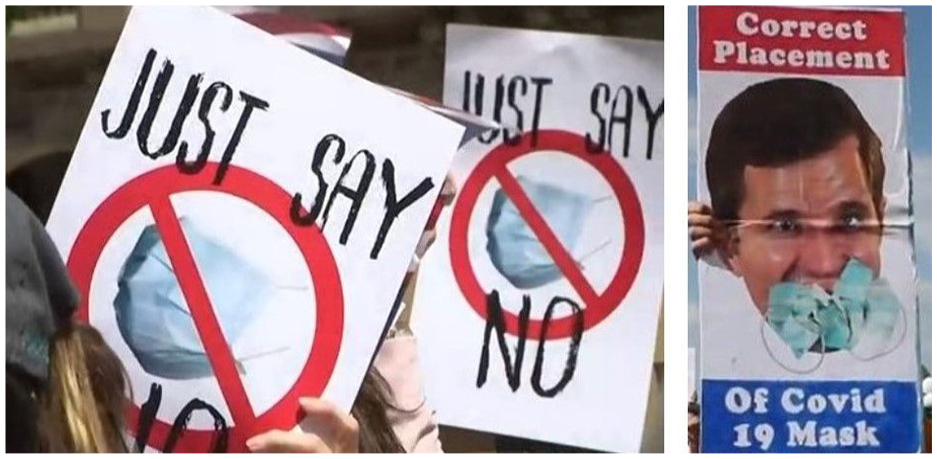
Damn face masks.
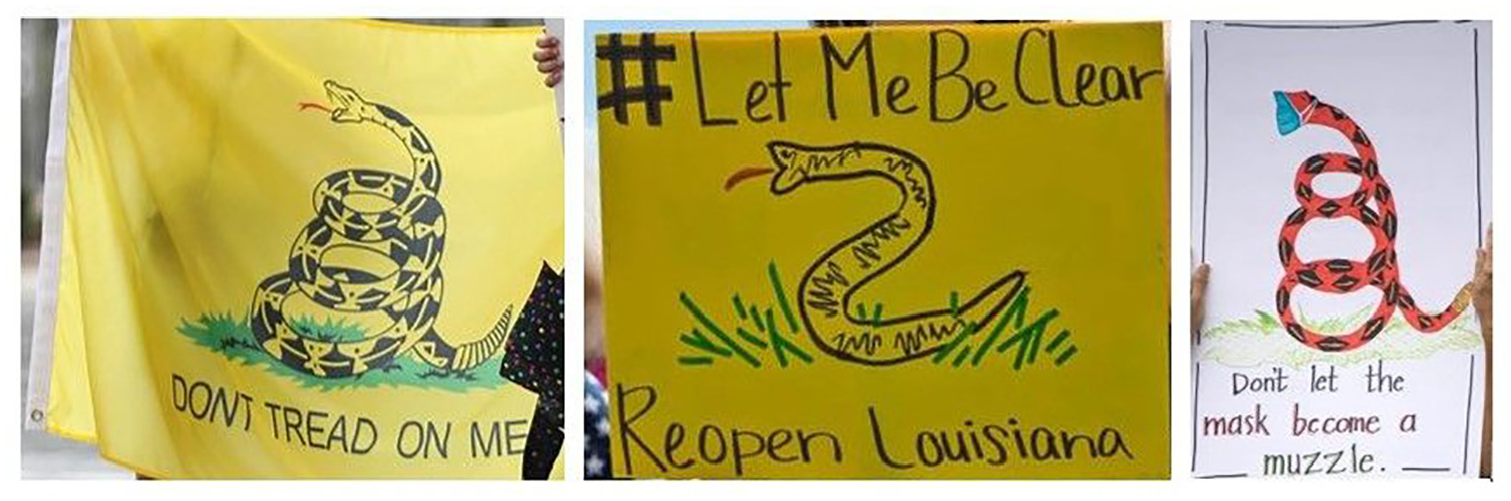
Don’t tread on me.
The protesters strive to construct their reality regarding the COVID-19 pandemic, which generates the third primary theme: “what the protesters seek to construct,” primarily reflecting their beliefs and imaginations concerning the situation. It is composed of four sub-themes. First, the protesters fabricate their own “fake COVID-19 facts” (e.g., “vitamin D, vitamin C, vitamin A – protein treatment”) as evidence against the restrictions. Second, the sub-theme of “essentials of life” articulates how the protesters define their life experiences and choices. This is exemplified by slogans such as “life is risk” and “life is too short to live in fear.” Third, the sub-theme of “conspiracy theory” further shows that the demonstrators’ belief in conspiracy theory regarding the COVID-19 virus is manifested in three major ways. Some protestors claim that the COVID-19 virus is completely harmless, a lie, and a fake pandemic, as they allege that “COVID is no more deadly than seasonal flu” and that “shutdown is based on lies.” Others believe that the pandemic is a de facto “plan-demic” as well as a mind-control plan. And they use a variety of metaphors to convey their thoughts and fears. For instance, some compare the current socio-political environment to the fictional authoritarian ambient in George Orwell’s “1984.” The statement “big brother is watching you” is a notable allusion to an imminent threat of manipulation from political authorities who impose lockdown measures. Others apply the long-developed 5G conspiracy theory to the coronavirus pandemic and spread the rumor that 5G poses health risks, for instance, claiming “your godless 5G masts away from my baby’s bedroom.” Fourth, the sub-theme of “harmful masks” reveals that face masks have been rejected by the protesters for various self-proclaimed reasons: 1) deemed as “useless” in fighting the virus (e.g., “masks do not work”); 2) taken as “harmful” to people’s physical health (e.g., “face masks can harm: reduce oxygen; increase CO2; cause acidosis of blood; harbor bacteria; cause respiratory infection; encourage more hand to face contact”); and 3) considered as symbolically “silencing” people (e.g., “your voice to me silenced by the forced wearing of a mask”).
The fourth primary theme “whom the protesters blame” is further categorized into five sub-themes, elucidating the targets of the protesters’ blame, or whom they are truly angry with. These targets include government/governor, science/scientists/experts, China, the mainstream media, and ordinary people who support and adhere to the new normal policies. As illustrated in Figure 4, the governors who implement strict Covid-19 rules were mocked and compared to Nazis and Communists. For instance, a group of Wisconsin protestors carried a caricature of Governor Tony Evers dressed in Mao’s communist outfit, while marching to the State Capitol in July 23, 2020. Their blatant sign and slogan give a glimpse of how the opponents denounce the new-normal measures as tyrannical, lacking democratic values, and destroying the economy. One of the rally’s organizers stated the governor’s measures would cause damage to small businesses from which they might not recover. The demonization of others is an oft-adopted blaming strategy in social movements (Sripokangkul et al., 2020). This situation lends the protesters a political mission and becomes a convenient tool for swiftly mobilizing them to defend their political ideology. Science, scientists, experts, and authorities have also become the targets of the protesters’ harsh criticism. The protesters not only reproach science itself but also individuals such as Anthony Fauci, Bill Gates, WHO, CDC, and others, who represent the authorities of various public organizations. For example, demonstrators in Australia gathered outside the Victorian parliament to protest tracking apps, lockdowns, and vaccines, which have been the primary targets of conspiracy theorists during the pandemic.

The demonization of governors.
The Protest Assemblages: The Artefacts and Body Gestures
Besides the verbal and visual messages discussed above, human bodies and material artefacts constitute important expressive tools in the anti-new normal protest. It is necessary to scrutinize the protest artefacts and the body gestures as separate categories of texts because of the complex meanings they convey.
The most popular artefacts used by the protesters are face masks, intentionally destroyed, falsely positioned, and written with various slogans. As shown in the images juxtaposed in the first two rows of Figure 5, the verbal messages on the masks code them as fascist and tyrannical symbols. The protesters deliberately expose their mouth and nose through wearing a mask incorrectly in a satirical manner, or by cutting a big hole in it. The uncovered mouth undoubtedly embodies the most powerful and assertive tool in the repertoires of protest against mask-related measures.

The unmasked face and the naked body.
The bottom three pictures in Figure 5 illustrate the anti-mask protesters’ sporadic employment of the “grotesque” protest strategies, as discussed in the existing literature on social movements (see, Bivens & Cole, 2018; Fanghanel, 2020; Halfmann & Young, 2010). The grotesque can manifest as a distorted body, an exaggeration of bodily element, or a body deviating from its “normal” state. As a metaphorical tool of protests, it can effectively demand gaze, provoke strong and mixed emotions, transgress boundaries, and challenge existing social structures (Bivens & Cole, 2018; Fanghanel, 2020; Halfmann & Young, 2010). The naked body has long been a popular mechanism for protest in public spaces and often represents a grotesquery (Fanghanel, 2020). Unsurprisingly, the naked bodies of male and female protesters comprise part of the visual texts of the anti-lockdown movement.
The middle picture in Figure 5 depicts an anonymous man walking around London’s famous Oxford street during the daytime on July 25, 2020. He is nearly completely unclothed, except for a surgical mask covering his genital (Saxena, 2020). During the pandemic, the masked face quickly became a healthy and caring new “somatic norm” in public space (Puwar, 2004). The man’s physical appearance embodies a silent yet explicit resistance, as his body language conveys an unambiguous statement of “fucking the mask.” His body undergoes double exposure – the nearly naked body and the unmasked face – both of which captivate immediate attention while remaining memorable. When most of the global population is obliged to wear masks in public, an unmasked face indeed becomes a marked body due to its high visibility. In a similar vein, the picture in the right bottom corner of Figure 5 depicts a female protester in the act of covering the lower half of her face, nonetheless the “mask” being her black transparent thong underwear. The proponents of the new-normal are rhetorically dehumanized as tamed sheep, as portrayed in the grotesque image in the bottom left corner of Figure 5, where a protester wears a plastic costume shaped like a sheep’s head, complete with a facemask on its mouth and a vaccine syringe positioned on its head.
As the above analysis discloses, the expressive components (mainly in the forms of verbal messages, visual symbols, protest artefacts, and body gesture) bespeak the collective assemblage of enunciations within the protest assemblage. Through the theoretical lens of Deulez-Guatarri, the protester’s body is a human body (BwO) in the sense that it is a socio-historical product driven by all kinds of forces or desires of life and captured by various assemblages (Colebrook, 2002; Currier, 2003). The protesting body (BwO) is temporarily captured or fixed by the collective assemblage of enunciations. The following sections explore deeper into the expressive assemblage that codes the protesting body in comparison with the new-normalized body.
The Expressive Virus-Health Relations
A body is an uncharted territory wherein physical, psychological, and social-cultural forces fight against one another and form new relations and affects (Fox, 2011; Fox & Ward, 2008). During the pandemic, individual human bodies are confronted with the shared threat of the coronavirus. The de-/re-territorialization of the virus upon human bodies and the social whole occurs and reoccurs. However, the expressive virus-health assemblage that capture individual bodies differ to varying extents due to how individuals respond to the virus and encode its meaning at the early stage of the pandemic. Hence, the different behaviors and interactive modes between the supporters and protesters are primarily shaped by their divergent expressive assemblages (De Landa, 2006).
Those who comply with the new normal measures mostly admit that the virus can seriously jeopardize their physical health, and their bodies can remain homeostatic only through the new measures when there are no effective drugs or vaccines. Therefore, their bodies stand out from the virus-health assemblage that is dominantly territorialized through the biomedical elements and relations associated with the virus. Their body (BwO) is mainly fixed by the expressive assemblage, at its simplest level, constituted by the coronavirus, the respiratory system, the immune system, symptoms, infection, illness, and/or death.
How do the protesters code the coronavirus? The previous discussion (see Table 1) delineates the three groups of new normal opponents who refuse to believe in the existence of the newly discovered coronavirus. Some protesters compare the COVID-19 to “a seasoned flu” and decline to acknowledge its severity and fatalness. From Deleuze and Guattari’s theoretical perspectives, these protesters behaviors reveal that they perceive the coronavirus as a small change, which affects human bodies and society within the original territory. A plethora of messages indicate the belief that the deterritorialization of the virus is momentary and negligible and that the real or absolute deterritorialization of the ensemble of physical and social relations is unlikely to occur. These protesters’ bodies are also shaped by the biomedically contingent virus-health assemblage, which comprises an array of components including the flu-like virus, the respiratory system, flu symptom, infection, medicine, and health.
Some other protestors deny the existence of the coronavirus and view it as part of a mind-control plot brewed by their tyrannical federal or state governments. For example, an anti-mask protester at the Hyde Park demonstration in July 2020 held up a sign stating that face coverings were part of a mind-control plan. For this group, the material virus-health assemblage is translated into as a political assemblage, which indicates a notably overcoding, as the human body transcends the biomedical discourse and is articulated instead through the ready-made languages and discourses in a democratic society. They provide a political framework for interpreting the pandemic and the new normal orders. This political assemblage is laden with the belief that the fear and panic surrounding the virus are fabricated with the evil purpose of depriving the human of social ties, normal life, body freedom, and human rights. The natural and biological forces that comprise the virus-health assemblage are excluded and replaced with the political forces. The denial of the physical relations between the body and the virus accounts for the protesters’ resistance against the reterritorialization of political power imposed onto their bodies.
The remaining group of protesters appears to acknowledge the real existence and potential risks of the virus. However, they code the coronavirus as a biochemical weapon and a kind of “bioterrorism” rather than a natural occurrence. From this perspective, the 5G network is deemed as a device of transmitting the virus. The expressive assemblage that shapes their body is likely to consist of invisible virus creators, the techno-organic virus, the new network technology, infection, illness, and/or death. Such an expressive assemblage engages their body with imaginary relations between the biological or organic elements and the information technology. For the latter two groups of protesters, their body has become a politically reterritorialized site where they struggle against what they imagine as “mind-controller.”
The Expressive Mask-Body Relations
Whether people support or oppose the new normal measures, they tend to resist an absolute deterritorializaiton of the “coronavirus,” whether real or imaginary, in their body and social life through introducing different new components to their virus-health assemblages. Being the most contentious of all mandates, the mask order exemplifies how a mask plays a role in both the followers and protesters’ heterogeneous and contested assemblages revolving around the body.
The protesters and supporters differ significantly in their understandings of how a mask functions and what constitutes a healthy respiratory system and process. For those who opt for wearing a mask, a mask is incorporated into the material virus-body assemblage to resist the de-/re-territorialization of the coronavirus upon the organic body. As a material component, a mask functions to reterritorialize human bodies and society into a new pattern, within which the biological relationships between human bodies are restricted. Based on the given scientific evidence, a mask can effectively reduce the likelihood of exchanging biological elements (specifically referring to respiratory substances carrying the coronavirus) between human bodies. It helps human’s respiratory system and body escape the territorialization of the virus and keep them in a state of order and normality. The mask-assisted/-restricted breathing bodily movements subvert the habitual respiratory practices and reshape the body relations. The organic body that engages with the virus-mask-body assemblage is possible to keep biomedical homeostatic and balanced, thereby entering the transformative modes of social life. Hence, the mask supporters’ practices are along the line of biomedical normative construction of a functioning organic body.
By contrast, the mask opponents fiercely refuse to wear a mask. The mask is condemned as useless and dangerous to the organic body. The research data reveal many opponents’ claim that wearing a mask makes it hard for them to breathe. They associate the face mask with some non-existent factors to prove its harmfulness. The mask is presumed as “a symbol of false security,” unable to stop the virus. The masked breathing is believed to be unnatural and hence unhealthy. To illustrate, in May 2020, at the Harrisburg State Capitol complex in Pennsylvania, anti-lockdown protesters rejected the naturalness of both air the immune system. They assert that they have the right and freedom to “breathe God’s air” and that their immune system is a gift from God. From these protesters’ perspective, the air we breathe and the human body are therefore religiously sanctified and purified. The expressive God-given body, under the belief of being adaptable to any changing environment and naturally immune to any virus, effectively escapes the de-/re-territorialization of the coronavirus.
Besides the religious discourse, social and political discourses are also integrated into the virus-mask-body assemblage. The protesters assert that both masking up and social distancing are unnatural and unfavorable to social life, as they wish to “show the smile” and “hug loved ones.” For those who believe that the coronavirus is a mind-control device, the mask becomes part of the “political game” with the sinister purpose of silencing people. Masking is overcoded as a tyrannical order in the name of medical needs, not only depriving people of breathing freedom but violating the indefeasible constitutional right of speech freedom.
A healthy body possesses the capacity to establish new relations and experience various affects (Buchanan, 1997; Fox, 2002; Grosz, 1994). In other words, it remains open to possibilities of becoming. Against the sweeping epidemic, wearing a mask or not determines the limits of human bodies, to wit, what the bodies can or cannot do. When the supporters accept the mask, they not only try to keep the organic body in a state of healthy equilibrium and predictability, but also aspire to open up possibilities for becoming others and inventing a new body. By contrast, the unmasked protesters give up the opportunity of rallying new components into their material relations with other people and things and therefore lose the opportunity of escaping from the territorialization of the virus upon the organic body. The virus-territorialized unmasked body, which resists the non-normative breathing experimentation and body relations, cannot help but stepping into another type of non-normative breathing practices and body relations.
The “Normal Life” of the Protesters
According to Deleuze and Guattari (1987), individuals are categorized by the rigid or molar lines in three manners, including the binary segmentarity, the circular segmentarity (i.e., taking everything into the orbit around me), and the linear segmentarity. The rigid lines are associated with the marco-processes in society as a whole, such as dominant ideologies, authoritative discourses, and normative knowledge. Along the rigid lines, the free flow of desire is channeled into predetermined patterns (Potts, 2004). An examination of the protesters’ expressions of the supposedly “essential” life and activities shed light on the rigid segmentations that dominate and organize the modern human body and social life.
The protesters demand the reopening of work/business, school, and other normal activities, including personal grooming services (i.e., doing their hair, cosmetology), recreations (i.e., sunbathing, going to the beach), and other personal and social tasks (i.e., peaceable assembling, having an abortion), all of which are asserted to be “essential” to their life. The multiplicities of personal life and society are dichotomously segmented into the normal and the abnormal.
The protesters treat the routine, habitual, and ideal life activities that they have experienced or feel familiar with as the given normal life, whereas other life activities as abnormal. The identity of social life as an assemblage is the product of a “becoming” process, wherein an array of forces constantly deterritorializes and recodes it (De Landa, 2006). Therefore, social life never has a fixed identity with its given capacities. Its precarious identity always emerges from the contingent interactions among the material and expressive elements that compose the social assemblage. In this regard, the supposedly “normal or essential life” that the protesters request to restore turns out to be illusory. When the protesters rally during the pandemic, their bodies have already undergone an experimentation with the new-normal reterritorialized by the coronavirus.
The protesters declare that they themselves rather than the central or state governments should decide what is essential for their life and determine their own destiny. As the visual repertoires show, the protesters get everything organized around “me.” The pronoun “my” appears everywhere in the protest expressions. All along the rigid line of circular segmentarity are the body parts (i.e., my mouth, my respiratory system, my immune system), the personal existence and development (i.e., my life, my work, my choice, my risk, my ignorance), and the familial and social life (i.e., my child, my rights). The individual’s subjectivity emerges from the interactions among sub-personal diverse components and the interactions among individuals that compose different levels of social assemblages, such as families, communities, institutional organizations, and society as a whole, as De Landa (2006) notes. No person can sustain his/her identity without the ongoing interactions at multiple levels and scales. What “my” body and body parts can do is not only limited by the internal compositions of my body but also constrained by all the biological and social assemblages, of which the body is a part of. The protesters take a reductionist approach to view the social assemblages and the complex part-to-whole relations. Using slogans such as “my choice not yours,”“hands off my ignorance,” and “selfish and proud,” the protestors nevertheless overlook that their self-proclaimed choice, ignorance, and selfishness affect others and that these effects will bring about repercussions in return. Indeed, one’s body (BwO) comes into being from the variegated whole.
Conclusion
This study explicates the anti-new normal protest assemblages during the COVID-19 pandemic and analyzes the material and expressive forces of life that produce the distinct bodies of the protesters. The qualitative content analysis of the visual protest repertoires generates three levels of themes to disclose the protesters’ demands, fears, anger, and imaginary relations and further reveal the expressive flow in the protest events. The in-depth discussion under the Deleuze and Guattari’s (1987) conceptual framework illuminates the protesters’ body-self, which primarily arises from the interactions and effects of the expressive components that compose the protest assemblages.
Above all, this study suggests that the protesters perceive the forces and powers that shape their lives hinge on an essentialized or normalized existence, which is often laden with values and ethics. Such an illusory belief becomes the major justification for their resistance against the new normal measures and their conspiracy theories regarding the COVID-19 pandemic. In contrast to the new-normal supporters whose organic body is primarily inscribed by the biomedical discourse, the protesters’ organic body is overcoded by the dominant religious, political, social, and cultural discourses. Their body is religiously sanctified, politically empowered, and culturally essentialized, but somehow unrelated to the biomedical functioning.
Moreover, the protesters refuse to acknowledge the reality of the virus and fail to establish the new compositions with the new normal components such as masks, social distancing, and vaccines. While they reject embracing new possibilities, their body has become an “involuted body” (Buchanan, 1997). The human body must increase its capacities to engage with new physical, psychological, and sociocultural assemblages, allowing it to affect and be affected. It must maintain its capacities in a fluid state of “becoming.” Only through this means can people “compose a more powerful body” (Deleuze & Guattari, 1987).
The study enriches our post-pandemic understanding of the body-self of individuals within the complex entanglements of the coronavirus, government policy, and individual values, suspicion, and resistance. Theoretically, by employing Deleuze-Guattari’s conceptual constellation as the primary framework, the study contributes to the interpretive dimensions of literature on both visual protest repertories and the interactions between protesters and political power.
The research has some practical implications for the politicians, public health experts, and other relevant stakeholders who determine public health policies, restrictive measures, and promotional strategies. First, even within a pandemic, the material relationship between the virus and health may not be the dominant factor. Instead, individuals tend to code the virus with a variety of expressive components, thereby defining their own expressive relationship with it. It is insufficient for health practitioners to focus solely on treating the infected individuals or attempting to eradicate the virus. Policymakers and practitioners should recognize the expressions of protesters and the underlying emotions and motivations. Second, both the advocates of the new normal and the protesters have their own identity assemblages in which a variety of physical, psychological, socio-cultural, and political elements are involved. Their body-self emerges from the dynamic and complex interconnection among these elements. It is not feasible to implement a universal health policy and set of recommendations. Therefore, the authors encourage the health professionals to consider individualistic uniqueness in the process of prioritizing public health. Third, the identity assemblage of protesters, as shown in this analysis, is continuously subject to territorialization and deterritorialization by both emergent material and expressive elements, as well as the evolving relationships between them. Such complexities call for the health practitioners’ special attention to monitoring public responses to the evolving virus and the associated health policies, and adapting their strategies for effective policy implementation.
It should be noted that the present study has its methodological limitations. The bodies of protesters that have been created through the protest assemblages emerge from their material and expressive relations within their milieu. Due to the travel restrictions imposed during the coronavirus pandemic, the researchers were constraint to the extent of relying on the visual +++protest repertoires collected from the media images, rather than conducting on-site observations and interviews with protestors. It is therefore possible that the depth of the data may be to some extent compromised. The encounter between the researchers and the protesters and their protest repertoire within the research also constitutes a temporary assemblage or territory, wherein the researchers’ the socio-cultural and geographic-political background, as well as their attitudes towards the virus-health relationship and restrictions policies may influence the process of data analysis and interpretation. Furthermore, previous empirical studies have mostly employed Deleuze and Guattari’s theory of assemblage to conduct analyses of the dynamic nature of assemblages in specific cases or instances. Notably, the conceptual constellation surrounding the notion of assemblage has yet to develop into a full theory. This study’s exploration into this dynamic yet somewhat ambiguous framework points to a significant challenge to its application, especially within the context of an empirical research that focuses on examining multiple snapshots of a social movement.
As many scientists indicate, the coronavirus has become a permanent material component in our social assemblages at all scales. We, as human beings, need to constantly reflect upon the body, the virus-health relationships, and our society that has been and continues to be reterritorialized by the coronavirus and other similar viruses. This study represents a small nevertheless important step toward this self-reflexivity that demands further explorations in future research.
Footnotes

Funding
The research is funded by Macau University of Science and Technology Foundation (FRG-25-006-FA).
The author(s) received no financial support for the research, authorship, and/or publication of this article.
Declaration of Conflicting Interests
The author(s) declared no potential conflicts of interest with respect to the research, authorship, and/or publication of this article.
Data Availability Statement
The data supporting the results of this study are not publicly available for copyright reasons. The corresponding author can provide additional information upon reasonable request.