



Abstract
Servant leadership has been proposed as a highly relevant approach to leadership in the higher education context. However, little is known about its contribution to desirable organizational outcomes in academic settings, and even less is known about the role that servant leadership’s multidimensionality plays. Consequently, our study aims to investigate the impact of servant leadership’s two dimensions (creating value for the community and conceptual skills) on academics’ job satisfaction and work motivation. Specifically, we focus on polytechnics due to their significant contribution to the community and industry in developing economies. We applied partial least squares structural equation modeling (PLS-SEM) to analyze the data collected from 228 academics affiliated with Malaysian polytechnics. Our analysis shows that both dimensions of servant leadership are relevant predictors of academics’ job satisfaction and work motivation. In addition, while a robustness check confirms the linearity between the variables in our model, the model exhibits a high out-of-sample predictive power, thereby making assumptions about the model relationships’ generalizability feasible. We also identified job satisfaction as the most important area of improvement that managerial activities should address.
Keywords
Introduction
Fostering the application of knowledge in the economy and society, and serving the needs of a flexible, sustainable, and knowledge-based economy at different levels are two of the main objectives of the higher education sector (Dearing, 1997). Consistent with these objectives, higher education institutions (HEIs) were established to serve the public (Latif et al., 2021). Given that higher education is expected to become more accessible to the wider population (Wan, 2018), the new mass higher education system has faced many challenges in its emerging context; simultaneously, public institutions as a whole faces a leadership crisis (Sirat et al., 2012). Specifically, managing universities and colleges can be overwhelming and challenging during transformation periods, requiring relevant leadership principles (Timiyo, 2016). This indicates that the changing global economic environment (higher education in our case) requires a new organizational leadership model that differs from the traditional models and emphasizes the moral, emotional, and relational dimensions of leadership behavior (Franco & Antunes, 2020).
Given the challenges that leaders in academic settings face, Wheeler (2012) argued that institutions of higher learning should practice servant leadership to make significant progress in their administrations and governance. Servant leadership (Greenleaf, 1970, 2007) comprises the required aspects that inherit high utility in HEIs. One of HEIs’ main functions is to provide service and to educate people (Taylor et al., 2007). Servant leadership leads institutions of higher learning effectively, due to its emphasis on the common good, empowerment, and involvement of, as well as on service to individuals and beyond (Wheeler, 2012). In addition, Panaccio et al. (2015) found that servant leadership has the capability to provide employees with career development guidance, and to increase and enhance desirable organizational outcomes. Despite its importance, there is evidence that many academics fail to serve their communities. Machado-Taylor et al. (2017) specifically found that, in the context of Portuguese public universities and polytechnics, academics have little motivation to serve their community and to participate in their institutions’ governing bodies.
Institutions and academic leaders who do recognize and appreciate the complex tapestry of organizational culture should therefore tap into their multiple available resources and manage academics’ job satisfaction and motivation more effectively (de Lourdes Machado-Taylor et al., 2016). When appropriately supported, highly motivated academics could build a national and international reputation for themselves and their universities (Capelleras, 2005) with regard to, for example, professional areas, research, and publication. While educational studies are paying considerable attention to teacher motivation (Ansyari et al., 2019), surprisingly little is known about the motivation for teaching in higher education (Gunersel et al., 2016).
This finding also applies to job satisfaction, which, in general, is a well-researched construct in many domains, but it seems that there is still room for improvement, especially with regard to the higher education sector. A reason for taking a closer look at this attitude is that satisfied academics are proud of their institutions and appreciate their positions, while dissatisfied academics withdraw or disengage from their academic community, intend to leave their institution, and, ultimately, intend leaving academia (Hagedorn, 2000). Higher education academics’ motivation is therefore a topic that requires urgent attention, which is notable from the increasing interest in their job satisfaction (e.g., Ghasemy, Mohajer et al., 2020; Ghasemy, Sirat et al., 2021; Mgaiwa, 2021; Park, 2018). Most of the studies refer to US academics’ satisfaction (e.g., August and Waltman 2004; Bozeman & Gaughan, 2011; Mamiseishvili & Rosser, 2010), with far less research dedicated to those from East Asian countries.
The higher education system in Malaysia, as a well-established educational hub (Knight & Morshidi, 2011; Lee, 2014), is divided into two major sectors: the public and the private. The Malaysian government recognized the leadership issue in higher education as important, which led the Higher Education Leadership Academy (AKEPT in the Malay language) being established in January 2008. This academy has a wide range of objectives, such as strengthening the governance and organization of Malaysian institutions, and generating a culture of creative and innovative solutions to critical issues regarding academic leadership.
Nonetheless, while, in the academic context, numerous studies have explored different leadership styles’ theory and practice (e.g., Fullan & Scott, 2009; Ghasemy et al., 2018; Scott & McKellar, 2012; Scott et al., 2012; Timiyo, 2016; Wheeler, 2012), and, a review of higher education literature finds insufficient empirical evidence of leadership behaviors related to ethics and the serving of communities. This applies even more true to research on servant leadership’s associated dimensions.
Consequently, we investigated the higher education system’s leadership issue by means of a Malaysian sample aimed at improving academics’ work motivation and job satisfaction in this setting and beyond. Our research question is: To what extent do “conceptual skills” and “creating value for the community,” two dimensions of servant leadership, influence academics’ work motivation and job satisfaction? We selected these two dimensions of servant leadership, since both are related to higher education’s two objectives: knowledge development and serving the economy’s needs (Dearing, 1997).
Our study is a quantitative inquiry based on a post-positivism worldview. This approach is built on a deterministic philosophy, according to which causes (probably) determine effects or outcomes, and it therefore involves empirical observations and theory verification (Creswell & Creswell, 2018). We used partial least squares structural equation modeling (PLS-SEM) to investigate the relationships in our model, finding that both these servant leadership dimensions explain and predict the work motivation and job satisfaction of academics with a polytechnics background. Furthermore, we find that job satisfaction has an influence on work motivation. Our study therefore makes the following contributions to the literature: (1) It enhances the general understanding of servant leadership in higher education, (2) it identifies the two servant leadership dimensions’ unique contributions to our model’s organizational outcomes, and (3) it highlights the role that academics with a polytechnic background play with regard to contributing to the community and industry.
The article is organized as follows: The next section focuses on the servant leadership theory and the formulation of our hypotheses. Thereafter we introduce our methodology. We subsequently present our results and discuss our findings. We then outline our findings’ implications. Finally, we address the study’s limitations, and, in our conclusion, provide recommendations for future research.
Theoretical Framework and Hypotheses Development
Greenleaf (1970, 1977) first coined the term servant leadership, which emphasizes the ‘first serve then lead’ philosophy. This concept is an other-oriented approach to leadership, prioritizing followers’ needs and interests by means of, at its core, its concern for others within and beyond the organization (Eva, Robin et al., 2019). In other words, servant leadership’s function is steered toward humanity’s development (Franco & Antunes, 2020). As a holistic approach to leadership, it engages followers by means of various aspects, which allow them to become empowered and develop to their highest possible capacity (Eva, Robin et al., 2019). This leadership style therefore focuses on a wide scope of followers’ developmental issues, such as their ethical, rational, emotional, relational, and spiritual dimensions (Eva, Newman et al., 2019; Sendjaya, 2015). It can also prevent undesirable organizational outcomes, because servant leaders, for example, organize work groups in such a way as to discourage social loafing (Stouten & Liden, 2020).
With respect to the servant leadership’s dimensions, Liden et al. (2008) identified seven dimensions, namely helping followers grow and succeed, behaving ethically, putting followers first, emotional healing, empowering, creating value for the community, and conceptual skills. Focusing on higher education contexts, Wheeler (2012) introduced 10 principles of servant leadership, including service to others is the highest priority, facilitate meeting the needs of others, foster problem solving and taking responsibility at all levels, promote emotional healing in people and the organization, the means are as important as the ends, keep one eye on the present and one on the future, embrace paradoxes and dilemmas, leave a legacy to society, model servant leadership, and develop more servant leaders. With this brief introduction to servant leadership, our study aims to verify the theoretical model presented in Figure 1, which defines the relationships between two servant leadership dimensions and two organizational outcomes.

Theoretical framework.
Notably, while there is research on servant leadership in different contexts, such as those of business and higher education, research on servant leadership dimensions is scarce. We therefore focus on servant leadership as one concept of our hypotheses’ development, while keeping servant leadership’s multidimensionality in mind. Given the moderate level of correlations between servant leadership’s dimensions (Liden et al., 2008), it should, in the interest of parsimony, be possible to infer from earlier servant leadership research findings on the concept’s subdimensions as part of a larger idea. More specifically, creating value for the community is in line with the idea of serving communities and industries, which this article’s title also highlights. In addition, creating value for the community is highly correlated with community citizenship behaviors and organizational commitment (Liden et al., 2008). Furthermore, the conceptual skills construct focuses on academics’ problem-solving skills and cognitive capabilities, which are essential for effective performance (Fullan & Scott, 2009; Ghasemy et al., 2016). Moreover, these servant leadership dimensions are aligned with higher education’s purposes (Dearing, 1997).
Servant Leadership and Job Satisfaction
Job satisfaction, as an attitude, is an individual’s judgment about a job, although experienced emotions might influence this judgment (Weiss & Cropanzano, 1996). Academics’ job satisfaction has peaked higher education scholars’ interest (for recent examples, see Ghasemy et al., 2019; Ghasemy, Jamil et al., 2021), while many other studies have shown servant leadership’s contribution to job satisfaction. For example, the study by Amah (2018) revealed that, at the individual level, job satisfaction is an indirect outcome of servant leadership. In another study, Neubert et al. (2016) showed that servant leadership is directly related to nurses’ helping and creative behavior, as well as to their job satisfaction. Moreover, the results of a study by Yavas et al. (2015) in the banking sector context, outlined that servant leadership is a significant predictor of bank employees’ job satisfaction and organizational commitment. Furthermore, by means of a multilevel study in the higher education context, Ghasemy, Akbarzadeh et al. (2021) found evidence that behaving ethically and helping subordinates grow and succeed are two dimensions of servant leadership that impact academics’ job satisfaction and community citizenship behaviors. Finally, a study by Latif et al. (2021) on China, Pakistan, and Spain’s academic settings found empirical evidence of servant leadership being a positive and significant predictor of career and life satisfaction. In line with servant leadership theory and with the previous findings, we postulate the following two hypotheses:
H1: Conceptual skills have a positive impact on job satisfaction.
H2: Creating value for the community has a positive impact on job satisfaction.
Servant Leadership and Work Motivation
Work motivation describes an individual’s drive when approaching tasks and actions (Sharma & Srivastava, 2019); consequently, motivation might nurture the greater good (Pinder, 2014). Many researchers have explored servant leadership’s contribution to work motivation. A study by Bande et al. (2016) in an industrial sales setting showed a significant effect running from servant leadership to salespeople’s intrinsic motivation. Given that work motivation is considered an attitude, the longitudinal multi-level study by Ling et al. (2017) found that compared with authentic leadership, servant leadership has a stronger direct effect with respect to increasing employees’ positive work attitudes. Barbuto and Wheeler (2006) showed that compared with other servant leadership dimensions, self-reported organizational stewardship correlates more strongly with organizational outcomes, such as employee satisfaction, a perception of organizational effectiveness, and motivation to do extra work. Last, as an example in the higher education context, Aboramadan et al. (2020) found evidence of the impact of academics’ servant leadership behavior on their intrinsic motivation. Consequently, we formulate the following two hypotheses based on the theory and practice of servant leadership:
H3: Conceptual skills have a positive impact on work motivation.
H4: Creating value for the community has a positive impact on work motivation.
Servant Leadership’s Impact on Work Motivation Through Job Satisfaction
Many studies in organizational research support job satisfaction’s influence on work motivation. Although job satisfaction is considered a positive predictor of motivation (Sledge et al., 2008), it is viewed as essential for stimulating staff motivation and keeping their enthusiasm alive (de Lourdes Machado-Taylor et al., 2016). Moreover, mentorship, which is a construct highly related to servant leadership (Lapointe et al., 2013; McKibben et al., 2018), has been shown to lead to higher job satisfaction, resulting in higher motivation, and, ultimately, better performance (van der Weijden et al., 2015). On the grounds of these findings, and in line with the reviewed literature in the previous subsections, we propose the following two hypotheses:
H5: Job satisfaction mediates the relationship between conceptual skills and work motivation positively.
H6: Job satisfaction mediates the relationship between creating value for the community and work motivation positively.
Method
Research Design and Analytic Procedure
We chose PLS-SEM, which is a multivariate data analysis methodology, to evaluate the proposed relationships in our model. PLS-SEM allows for testing a theoretical framework from a prediction perspective (Ghasemy, Teeroovengadum et al., 2020). Furthermore, there is an inherent need for latent variable scores for follow-up analyses (e.g., quadratic effects evaluation and importance-performance map analysis, or, in short, IPMA). In addition, this method is recommended for mediation analysis (Nitzl et al., 2016; Sarstedt, Hair et al., 2020) and explanatory research (Henseler, 2018). With respect to the analytic procedures, we followed the guidelines by Hair et al. (2019), and the latest recommendations by Ghasemy, Teeroovengadum et al. (2020) for PLS-SEM analysis in higher education. We employed the SmartPLS 3 software package (Ringle et al., 2015) to analyze the data.
Sampling Procedure and Participants
The participants in our study are academics from Malaysian public polytechnics. Based on the statistics that the Malaysian Qualifications Agency (MQA) published in August 2021, there are 36 polytechnics in the Malaysian public higher education sector. As highlighted in the Malaysian Education Blueprint Higher Education (MEBHE) 2015 to 2025, polytechnics, along with vocational and community colleges, are viewed as being premier higher education technical and vocational education and training (TVET) providers that develop skilled talent to meet the industry’s growing and changing demands, and promote individual opportunities for career development.
Based on and due to these reasons, we created a database comprising 3,988 email addresses of academics at such institutions, and using it to administer our survey via the SurveyMonkey platform. Overall, we received 229 completed surveys through a simple random sampling method (response rate = 5.7%). For reasonable limits (e.g., less than 5% values missing per manifest variable), the missing value treatment methods lead to only slightly different PLS estimations (Hair et al., 2017). Since there were less than 5% values missing per indicator, we replaced them with the median values. Next, as recommended by Ghasemy, Teeroovengadum et al. (2020), we focused on detecting multivariate outliers in PLS-SEM analysis by evaluating the squared Mahalanobis distances (Byrne, 2016), which resulted in identifying one extreme outlying case. This outlier was therefore removed from the dataset, which reduced the normalized multivariate kurtosis statistic (Mardia, 1970, 1974) from 62.98 to 59.15, a value greater than 5 and, therefore, indicative of the data’s multivariate non-normality (Bentler, 2006). This is a further motivation for choosing PLS-SEM as the method of estimation, because it allows the analysis of non-normal data (Ghasemy, Teeroovengadum et al., 2020; Hair et al., 2019). The demographic profile of the 228 remaining Malaysian academics is presented in Table 1.
Demographic Profile of Malaysian Polytechnics’ Academics (N = 228).

Source. Own calculations.
Finally, although we had considered procedural remedies to diminish common method bias (CMB) (Podsakoff et al., 2012), we ran a full collinearity assessment (Kock, 2015; Kock & Lynn, 2012) to investigate whether CMB affects our proposed model. Our results, displayed in Table 2, show that all the variance inflation factor (VIF) values are smaller than 3.3, and, in line with Kock (2015), indicating no cause for concern.
Full Collinearity Assessment Results.

Source. Own calculations.
Measures and Covariates
We collected data on creating value for the community and on conceptual skills, the two servant leadership behaviors dimensions in our study, using the four-item scales that Liden et al. (2008) developed. With respect to job satisfaction, we employed the generic 10-item scale by Macdonald and MacIntyre (1997). The respondents rated these three measures’ items using a 5-point symmetric and equidistant Likert scale ranging from 1 (totally disagree) to 5 (totally agree). Last, we measured work motivation using the 11-item scale that Robinson (2004) developed, and provided the respondents with another 5-point symmetric and equidistant Likert scale to rate the items ranging from 1 (totally demotivated) to 5 (totally motivated). Our constructs were all measured reflectively. The final validated model’s items and their descriptive statistics are presented in Appendix A.
We introduced the age group and tenure as two control variables for our proposed model in order to handle possible endogeneity issues (Hult et al., 2018) in our predictive-explanatory study. These control variables were chosen due to their relevance and extensive use in a wide range of social science research studies (Bernerth & Aguinis, 2016).
Results
Measurement Model Assessment
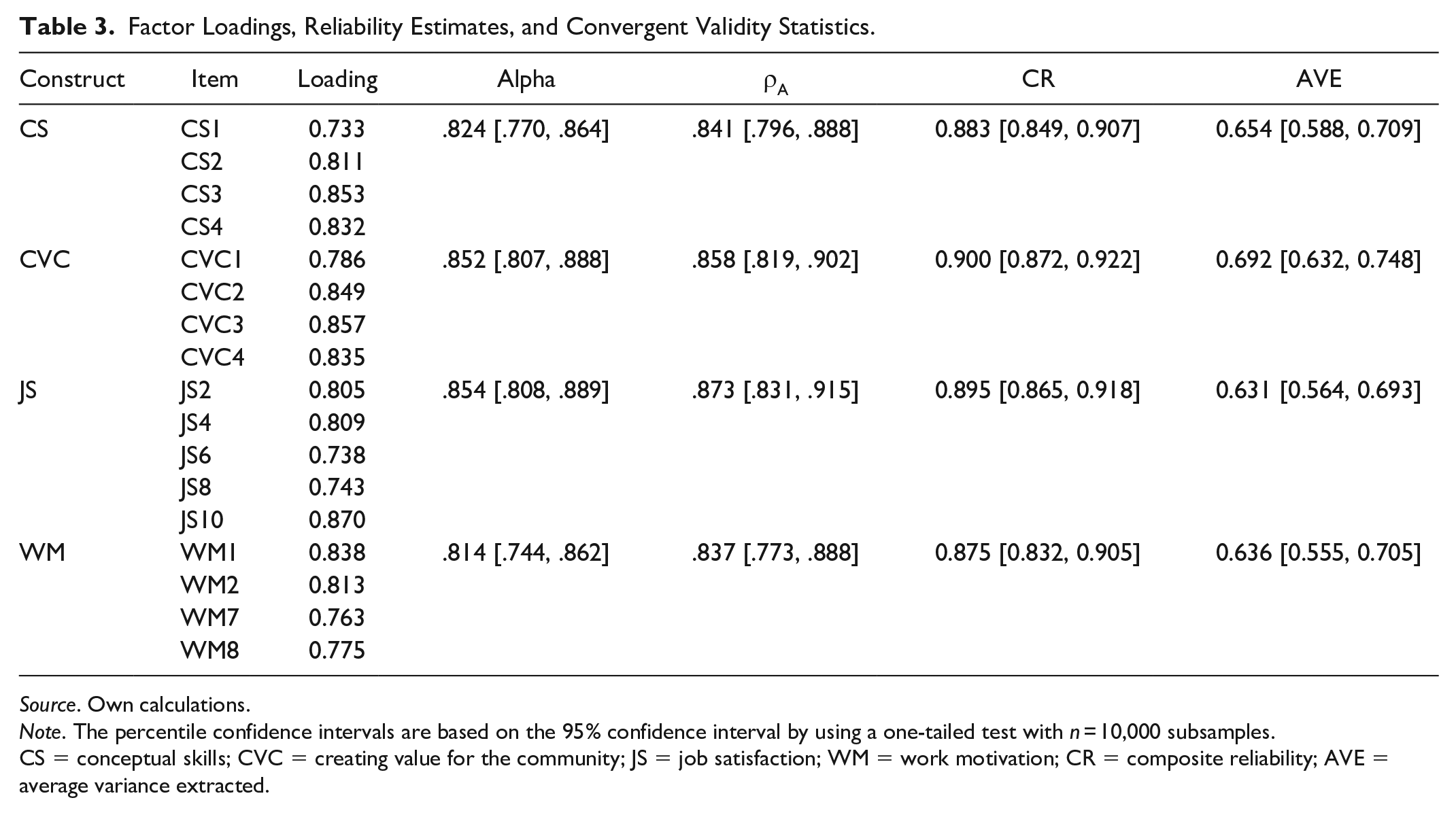
We focused on the factor loadings and the reliability estimates, including Cronbach’s alpha as a more conservative measure, and ρA and composite reliability as more liberal measures, to evaluate the measurement models. In addition, we examined the average variance extracted (AVE) values as the measure of convergent validity, and the hetrotrait-monotrait (HTMT) values (Franke & Sarstedt, 2019; Henseler et al., 2015) as the discriminant validity measure. We performed a one-tailed percentile bootstrapping test with 10,000 subsamples to provide additional evidence of our estimates’ appropriateness.
After removing the noncontributing items with loadings below λ = .7, we observed that all the AVEs and their one-tailed confidence intervals’ lower bounds were above the .5 threshold. In addition, all the three reliability measures and their one-tailed confidence intervals’ lower and upper bounds were within the .7 to .95 range (see Table 3).
Factor Loadings, Reliability Estimates, and Convergent Validity Statistics.
Source. Own calculations.
Note. The percentile confidence intervals are based on the 95% confidence interval by using a one-tailed test with n = 10,000 subsamples.
CS = conceptual skills; CVC = creating value for the community; JS = job satisfaction; WM = work motivation; CR = composite reliability; AVE = average variance extracted.
Table 4 presents the HTMT values with the confidence intervals, implying that the HTMT values and their one-tailed confidence intervals’ upper bounds are below the more conservative threshold value of 0.85, therefore confirming the discriminant validity based on the HTMT0.85 criterion.
Discriminant Validity Based on the HTMT0.85 Criterion.

Source. Own calculations.
Note. The percentile confidence intervals are based on the 95% confidence interval by using a one-tailed test with n = 10,000 subsamples.
CVC = creating value for the community; CS = conceptual skills; JS = job satisfaction; WM = work motivation.
Structural Model Assessment
Consistent with the recommendations made by Ghasemy, Teeroovengadum et al. (2020), we focused on the VIF values to assess collinearity issues between the predictor variables, the path coefficients’ statistical significance (and practical relevance), the outcome variables’ R2 values as the measure of the model’s explanatory power, the decomposition of R2 values, and the f2 effect sizes to assess the structural model. Our results are displayed in Table 5.
The Structural Model’s Evaluation Results.

Source. Own calculations.
Note. Bootstrapping based on n = 10,000 subsamples; direct and indirect effects assessed by applying a one-tailed test at a 5% significance level [5%, 95%]; effects of covariates assessed by applying a two-tailed test at a 5% significance level [2.5%, 97.5%].
PCI = percentile confidence interval; VIF = variance inflation factor; CVC = creating value for the community; CS = conceptual skills; JS = job satisfaction; WM = work motivation.
We found that collinearity is not a concern, since all the VIF values were below 3, which is ideal. The model’s explanatory power with respect to job satisfaction was weak (R2 = .245), and relatively moderate (R2 = .402) with regard to work motivation. Nevertheless, our R² values are similar to the ones mentioned in earlier studies. With regards to job satisfaction, Paik et al. (2007), for example, report R2 values of .239. Based on the results of the one-tailed percentile bootstrapping routine with 10,000 subsamples, all the direct paths were statistically significant and practically relevant, due to the path coefficients’ size. We found that conceptual skills (β = .165) and creating value for the community (β = .342) have a positive influence on job satisfaction. Conceptual skills (β = .220) and creating value for the community (β = .184) also had a positive influence on work motivation. This indicated that our study supported H1 to H4. Job satisfaction has a significant direct effect of β = .377 on work motivation. In addition, we found that conceptual skills (β = .062) have a significant indirect effect on work motivation via job satisfaction, as has creating value for the community (β = .129), implying that H5 and H6 were also supported. Both mediating effects were found to be complementary partial mediations (Nitzl et al., 2016).
To summarize the issues on path coefficients and model’s explanatory power, our results showed that creating value for the community is a better predictor of job satisfaction than conceptual skills. Regarding the relationships to work motivation, job satisfaction was a better predictor than both the servant leadership behavior dimensions. Furthermore, we found job satisfaction to be a mediating variable between the servant leadership dimensions and work motivation.
In terms of the f2 effect sizes and following the standards (f2 = 0.02 [small effect size], f2 = 0.15 [medium effect size], and f2 = 0.35 [large effect size]) that Cohen (1988) set, our results showed that the effect sizes of conceptual skills and creating value for the community on job satisfaction were small (f2 = 0.025) and rather medium (f2 = 0.106), respectively. In addition, the effect sizes of conceptual skills and creating value for the community on work motivation were small (f2 = 0.054 and f2 = 0.035), while the effect size of job satisfaction on work motivation was rather large (f2 = 0.179).
Focusing on the R2 decomposition values, creating value for the community uniquely explained a large part of the variation in job satisfaction. We found that, with regard to the variation in work motivation, job satisfaction played the main role.
Figure 2 shows the final model with factor loadings, path coefficients, and the R2 values of the endogenous constructs within the proposed model.

The final model.
We use the PLSpredict method to assess our model’s out-of-sample predictive power (Shmueli et al., 2019). We did so by running the PLSpredict analysis with 10 folds and 10 repetitions and focused on work motivation as the key target construct in our proposed model. As displayed in Table 6, all the Q²predict values were above zero, denoting the model’s superiority over a naïve benchmark. In the next step, the root mean square error (RMSE) statistics of the PLS model and the linear model (LM) were compared. For all items in the PLS results section, the RMSE prediction errors were smaller than the RMSE values under the LM results, thereby inferring the proposed model’s high out-of-sample predictive power (Shmueli et al., 2019).
PLSpredict Results.

Source. Own calculations.
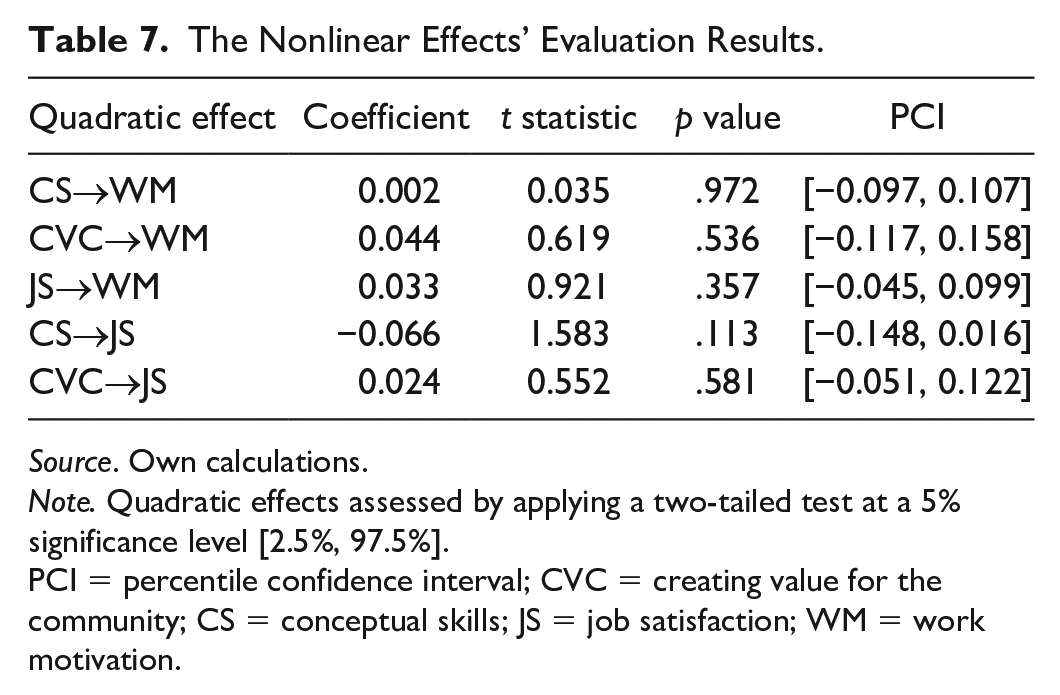
In the PLS-SEM analysis, we examined the relationships between the constructs in terms of the linearity as a robustness check (Sarstedt, Ringle et al., 2020). We specifically focused on the quadratic effects between the latent variables in our proposed model, adding the quadratic effects based on the two-stage approach (Hair et al., 2018). The results of our two-tailed test at a 5% significance level and with 10,000 bootstrap subsamples are displayed in Table 7, which denotes our model’s robustness, since none of the quadratic effects were statistically significant.
The Nonlinear Effects’ Evaluation Results.
Source. Own calculations.
Note. Quadratic effects assessed by applying a two-tailed test at a 5% significance level [2.5%, 97.5%].
PCI = percentile confidence interval; CVC = creating value for the community; CS = conceptual skills; JS = job satisfaction; WM = work motivation.
Discussion and Implications of the Findings
Theoretical Implications
From a theoretical standpoint and given the scarce number of studies on the practice of servant leadership in academic settings, we expanded the literature by developing and validating a model that explains the relationships between two dimensions of servant leadership (conceptual skills and creating value for the community) and two important organizational outcomes, namely job satisfaction and work motivation. This process confirmed our hypotheses H1 to H6. We therefore substantiated our understanding of conceptual skills and creating value for the community, as two of the servant leadership dimensions (Liden et al., 2008), that influence academics’ job satisfaction and work motivation. Specifically, our finding with respect to servant leadership’s contribution to job satisfaction is in line with that of Neubert et al. (2016) and Yavas et al. (2015). Regarding servant leadership’s impact on work motivation, our findings are similar to those of Aboramadan et al. (2020) and Barbuto and Wheeler (2006). Further, in terms of the relationship between job satisfaction and work motivation, our findings are consistent with those of Sledge et al. (2008) and Aldaihani (2019).
Arguably, given the relationship between conceptual and problem-solving skills, our findings are promising in a sense that they link conceptual skills, as a servant leadership dimension, with “foster[ing] problem solving and taking responsibility at all levels” as one of the servant leadership principles for higher education (Wheeler, 2012). Notably, Dean (2014) proposed this principle, which examines the benefits of distributing leadership across the organization, as the most practical servant leadership principle for higher education.
Practical Implications
Leadership in institutions of higher learning differs from being a leader in other organizations. We collected data from the faculty members of Malaysian public polytechnics as TVET providers, due to the important roles they play in addressing society and industry’s needs. Our study indicates that servant leadership should be emphasized in HEIs, and that public polytechnics should therefore ensure they have relevant policies in place to do so. More precisely, our results in terms of conceptual skills have important implications for HEIs, in that creating and sharing knowledge, as well as building capacities, all require certain competencies and skills (Latif et al., 2021). Moreover, since servant leaders understand the importance of building a sense of community among followers (Spears, 1995) and given servant leadership’s impact on commitment (Dahleez et al., 2021), this study’s findings could serve as guidelines for HEIs’ leaders in terms of ensuring that they have good policies that will increase academics’ organizational commitment and promote the quality of their service within the sector. Nevertheless, our study shows that job satisfaction is a better predictor of work motivation than our two servant leadership dimensions, which suggests that new and relevant policies need to be made in this regard.
To provide more profound insights, we considered the IPMA (Hair et al., 2018) to identify the areas in which managerial improvements should be implemented. Appendix B and Appendix C show the IPMA results with work motivation as the key target construct and its preceding latent variables. The performance and importance of work motivation’s predictors were above average; consequently, management activities should focus on maintaining, or even increasing, the three predictors’ performance level. However, given job satisfaction’s higher importance level compared with conceptual skills and creating value for the community, managerial activities, and policy formulations should mainly focus on this aspect.
Conclusion and Further Research Recommendations
Practicing effective leadership is crucial in academic settings and therefore an important area to explore. In this study, we focused on servant leadership’s influence on job satisfaction and work motivation in HEIs. We found that the two selected servant leadership’s dimensions, namely conceptual skills and creating value for the community, have positive impacts on job satisfaction and work motivation. We further found that job satisfaction is a mediator in the relationship between the servant leadership dimensions and work motivation. In our analysis, we focused on a Malaysian sample of academics affiliated with polytechnics as TVET providers, since such academics have a high impact on the society and the industry.
Our study is not without limitations. First, since our model showed a high level of out-of-sample predictive power, this is a first indicator of it being generalizable to other samples. In this study, we only focused on Malaysian public polytechnics. Researchers should therefore examine servant leadership’s outcomes in other higher education sectors and in other countries to provide the next steps toward generalizing our findings. Second, while servant leadership’s main principle is that servant leaders influence organizational outcomes by fostering followers’ growth and well-being (Liden et al., 2008), this principle has not been empirically well explored (Donia et al., 2016). In addition, there is a dearth of empirical research on servant leaders’ behaviors in university settings and their impact on employees’ feelings and attitudes (Aboramadan et al., 2021). Consequently, we recommend investigating the extent to which different servant leadership dimensions contribute to desirable organizational outcomes in academic settings. Third, while according to Dean (2014), “promote emotional healing in people and the organization” is the least practical principle of servant leadership for higher education proposed by Wheeler (2012), there are recent studies indicating the importance of academics’ emotions in achieving desirable organizational outcomes (e.g., Ghasemy, Erfanian et al., 2020; Ghasemy, Rosa-Díaz et al., 2021). We therefore recommend higher education researchers to focus on academics’ emotions in future research to provide a more accurate picture of these emotions’ impact on different outcomes. Fourth, other analytical and methodological approaches, such as multilevel modeling (Garson, 2013; Yuan & Bentler, 2007) and longitudinal designs (Grimm et al., 2017; Little, 2013; Newsom, 2015), are recommended to provide insights into servant leadership’s contribution to organizational outcomes in the higher education domain. Finally, we recommend that researchers build theoretical models and test them by using, the robust parametric PLSe2 methodology (Bentler & Huang, 2014; Ghasemy, Jamil et al., 2021; Huang, 2013) in order to enjoy the benefits and advantages of both PLS and maximum likelihood methodologies (Ghasemy, Jamil et al., 2021).
Footnotes
Appendix
The Importance and Performance of the Latent Variables.

| Construct | Importance (unstandardized total effect) | Performance (latent variable score) |
|---|---|---|
| CS | 0.321 | 72.619 |
| CVC | 0.341 | 78.424 |
| JS | 0.383 | 75.656 |
Source. Own calculations.
Note. CVC = creating value for the community; CS = conceptual skills; JS = job satisfaction.
Acknowledgements
This article is dedicated to Narjes Khanalizadeh, a true servant leader and the first nurse to succumb to the new coronavirus who died in February 2020 after contracting the disease from patients being treated at the Lahijan hospital in Iran. The article is based on a research project related to the theory and practice of servant leadership in academic institutions led by Majid Ghasemy with co-researcher Hazri Jamil.
Declaration of Conflicting Interests
The author(s) declared no potential conflicts of interest with respect to the research, authorship, and/or publication of this article.
Funding
The author(s) disclosed receipt of the following financial support for the research, authorship, and/or publication of this article: This study was funded by the Universiti Sains Malaysia (Short Term Grant # 304/CIPPTN/6315200).
Ethical Issues
All procedures performed in this study were consistent with the ethical standards of the institutional research committee of the lead author and with the 1964 Helsinki declaration and its later amendments or comparable ethical standards. Data have been collected based on the consent of the participants and on the voluntary basis.
