




Abstract
This study explored the relationships between Facebook self-disclosure and personality traits in a sample of Italian users. The aim was to analyze the predictive role of Big Five personality traits on different parameters of breadth and depth of self-disclosed behaviors online. Facebook users, aged between 18 and 64 years of age (Mage = 25.3 years, SD = 6.8; N = 958), of which 51% were female, voluntarily completed an online survey assessing personality traits and Facebook self-disclosure. Results at a series of hierarchical regression analyses significantly corroborated the hypotheses that high extroverted and openness people tend to disclose on Facebook a significant amount of personal information, whereas high consciousness and agreeableness users are less inclined to do it. Furthermore, more extroverts and agreeableness people develop less intimacy on Facebook, differently from those with high levels of openness. Results also corroborated the hypothesis of a full mediation of time usage in the relationship between personality factors such as extroversion and conscientiousness with breadth of Facebook self-disclosure. Overall, according to the findings of the current study, personality traits and Facebook self-disclosure become central both as predictive variables for depicting the different profiles of potential addicted and as variables to help educators, teachers, and clinicians to develop training or therapeutic programs aimed at preventing the risk of Internet addiction. Limitations of the study are discussed, and directions for future research are suggested.
Introduction
Self-disclosure is the process of voluntary and intentionally revealing any personal information to others, exposing to intimate relationships with them (Archer, 1980; Misoch, 2015). To interact with each other, people have to self-disclose. In this study, we defined self-disclosure as “any message about the self that a person communicates to another” (Wheeless & Grotz, 1976, p. 338). More specifically, self-disclosure comprises two different dimensions that are breadth and depth, respectively. The first refers to the number of details or topics people share during their social relations. The latter is the level of intimacy that guides discussions (Posey, Lowry, Roberts, & Ellis, 2010). The grade of breadth and depth of self-disclosure grow during the process of relationship development from sheer and shallow ties to more intimate ones (Altman & Taylor, 1987). Prior work has compared self-disclosure in offline and online social environments. Some scholars have focused on the differences between the face-to-face communication and the computer-mediated communication and have suggested that self-disclosure is more typical of face-to-face relationships because of the higher interdependence of breadth and depth dimensions in such communicative context (e.g., Cummings, Butler, & Kraut, 2002; Mesch & Talmud, 2006). They have also suggested that individuals have less self-disclosive behaviors with their online contacts than to their face-to-face friends because of the lack of nonverbal and contextual cues in computer-mediated social environments. Differently, other authors have followed the hyperpersonal model of Walther (1996) and have affirmed that individuals counterbalance the limits of computer-mediated communication by hyper-personalizing their interactions and so disclose on computer-mediated environment more than they do face-to-face (e.g., Derlega, Metts, Petronio, & Margulis, 1993; Eftekhar, Fullwood, & Morris, 2014; Tow, Dell, & Venable, 2010). Specifically, scholars have demonstrated that self-disclosure is high not only when aided by the anonymous environment of the Internet (Chiou, 2006; Taddei, Contena, & Grana, 2010) but also on today’s social web (Błachnio, Przepiórka, & Rudnicka, 2013; Johnston, Tanner, Lalla, & Kawalski, 2013) pushing “nonymity”—that is, the opposite of anonymity (Caci, Cardaci, Tabacchi, & Scrima, 2014). Internet users tend to self-disclose themselves for developing new online friendships (B. Chen & Marcus, 2012; Van Der Heide, D’Angelo, & Schumaker, 2012), or during the creation of personal weblogs (G. M. Chen, 2012; Hollenbaugh, 2010; D. Lee, Im, & Taylor, 2008). On Facebook, people inform friends continuously about their ongoing activities, thoughts, and emotions (Koohikamali, Gerhart, & Mousavizadeh, 2015), and disclose themselves by describing their interests and hobbies or by showing how many groups and pages they follow. Moreover, they display pictures of themselves in online albums, list friends, or otherwise upload text and messages in their profiles (Zhao, Grasmuck, & Martin, 2008).
In the debate about self-disclosure on Facebook, scholars have assigned a primary role to personality traits. Studies based on the well-known Big Five Factors model (Costa & McCrae, 1992) have shown that personality traits interrelated with Facebook self-disclosure, but results provided by prior work are mixed. Generally, there is accordance about extroversion and openness as positive predictors of Facebook self-disclosure as well as about consciousness as a negative one. Extroverts, who tend to be sociable, actively engage in Facebook self-disclosure, upload photos, and status or write comments more frequently than introverts (Tsai, Chang, Chang, & Chang, 2017; Wang & Stefanone, 2013). Similarly, high opened people, who generally are curious and disposed toward new events, share their experiences on Facebook (Amichai-Hamburger & Vinitzky, 2010).
On the contrary, high conscientiousness people, who tend to be efficient or diligent at work, disclose on Facebook less information about them (Ryan & Xenos, 2011). Results concerning both agreeableness and neuroticism are quite controversial. Some studies have affirmed that people with high level of agreeableness, who tend to be cooperative and optimistic toward and trusting of the others, disclose on Facebook a large number of photos and information about their locations (Amichai-Hamburger & Vinitzky, 2010; Bachrach, Kosinski, Graepel, Kohli, & Stillwell, 2012; Ryan & Xenos, 2011). Moreover, high agreeableness individuals are well-socialized on Facebook and use it to maintain their social interaction (Tsai et al., 2017). Vice versa, Hollenbaugh and Ferris (2014) have evidenced that U.S. Facebook users scoring low on agreeableness disclosed more information on Facebook than those scoring high. There are also mixed results for neuroticism. On one hand, scholars have found that Facebook users scoring high on neuroticism, who are emotionally unstable, disclose higher amounts of personal information, feelings, and thoughts on their profile than those with moderate scores (Amichai-Hamburger & Vinitzky, 2010; W. Chen, Xie, Ping, & Wang, 2017; Seidman, 2013). On the other hand, users scoring high on neuroticism are also depicted as people who use Facebook passively posting fewer photos (Ross et al., 2009) or self-presentational information on Facebook (E. Lee, Kim, & Ahn, 2014).
However, the studies mentioned above have mainly analyzed Facebook self-disclosure as a whole concept, without considering the specific effect of the two dimensions of breadth and depth that compose it. Hence, the primary goal of the present article is to examine how personality traits affect the different dimensions of breadth and depth of self-disclosed behaviors on Facebook. It is worth to be noted that we test the effect of each of the Big Five dimensions without considering the combined effect of the different traits over the proposed dependent variables to clarify better the mixed results reported by prior work.
Specifically, we addressed the following two research questions:
To answer RQ1 and RQ2, the present study stated the following hypotheses:
Extroversion refers to sociability, assertiveness, positive emotions, warmth, and activity (McCrae & Costa, 1999) and it is typical of friendly individuals (Bansal, Zahedi, & Gefen, 2010; Carlo, Morris, George, Maria, & de Guzman, 2005). As extroverts recruit more Facebook contacts with friends, they also disclose self-related information about themselves (Gosling, Augustine, Vazire, Holtzman, & Gaddis, 2011; Ong et al., 2011). Thus, we hypothesize that extroverts who tend to initiate more contacts with friends would be more inclined to Facebook self-disclosure in breadth (H1a) and depth (H1b).
Neuroticism refers to individuals’ level of emotional instability. People who feel nervous and emotionally unstable, also evidencing a sort of surveillance function in Facebook usage (Joinson, 2001, 2008), might try more to control what is going on online as often as they can rather than disclose information about themselves. Thus, we hypothesize that individuals with high levels of neuroticism would show less to Facebook self-disclosure in breadth (H2a) and depth (H2b).
Conscientiousness refers to discipline in daily activities and devotion to work or family (Wolfradt & Doll, 2001). Hence, individuals who are less involved in Facebook usage may be, as a consequence, less prone to self-disclosure (Ryan & Xenos, 2011). Therefore, we hypothesize that individuals with high levels of conscientiousness would show less Facebook self-disclosure in breadth (H3a) and depth (H3b).
Agreeableness is the personal disposition toward social engagement, and the tendency to be compassionate and cooperative with others (McCrae & Costa, 1999). More agreeable individuals who desire to meet new people online disclose on Facebook information of greater breadth and depth (Bachrach et al., 2012; Hollenbaugh & Ferris, 2014; Ryan & Xenos, 2011). Thus, we hypothesize that individuals with high levels of Agreeableness would show more Facebook self-disclosure in breadth (H4a) and depth (H4b).
Individuals high on openness are curious, have a diversity of interests and imagination and also have more friends (John & Srivastava, 1999). Thus, in line with the findings of Amichai-Hamburger and Vinitzky (2010) and those of Seidman (2013), to maintain their social engagement, we hypothesize that individuals with high levels of openness would show more Facebook self-disclosure in breadth (H5a) and depth (H5b).
Another variable deeply investigated both by literature on self-disclosure and personality traits is the time people spend on interacting together both face-to-face and on Facebook. As pointed out by the social penetration theory (Altman & Taylor, 1973), the time people spend together in face-to-face communication modulates both the number of information people share with others and the intimacy of the social relationships they develop each other. The successive hyperpersonal model of Walther (1996) has extended the importance of time on computer-mediated communication as a factor that improves self-disclosive behaviors between people (Walther, 1996; Walther & Burgoon, 1992). Empirical studies on computer-mediated communication have shown that the longer people know each other, as well as the more time they spend together, the more they self-disclose to each other (Chan & Cheng, 2004; Sheldon, 2013). Associations between personality traits and the time people spend on Facebook are reported too. Scholars have shown that extroversion (Wilson, Boe, Sala, Puttaswamy, & Zhao, 2009), as well as openness (Wehrli, 2008), positively affects time usage on Facebook, whereas conscientiousness (Ryan & Xenos, 2011; Seidman, 2013) and agreeableness (Landers & Lounsbury, 2006) affect negatively. Contradictions among studies are about neuroticism as it seems to be both positively (Amichai-Hamburger, Wainapel, & Fox, 2002; Amiel & Sargent, 2004) and negatively (Wilson et al., 2009) related to the time people spend on Facebook.
Thus, a second goal of the present article is to deepen the reciprocal influences among personality factors, the two dimensions of self-disclosure (i.e., breadth and depth) and the time usage. Specifically, we addressed a further research question:
As a consequence, we stated another hypothesis:
The time people spend on Facebook correlates with personality factors (e.g., Amichai-Hamburger & Ben-Artzi, 2003; Landers & Lounsbury, 2006; Ross et al., 2009; Ryan & Xenos, 2011; Wehrli, 2008; Wilson et al., 2009) and contributes also to the development and maintenance of self-disclosure (Chan & Cheng, 2004; Sheldon, 2013). Hence, it is plausible to hypothesize an effect of time on the relationship between personality traits and Facebook self-disclosure. Specifically, we hypothesize that personality traits indirectly moderate the individuals’ levels of Facebook self-disclosure through the effect of the time people spend on Facebook.
Materials and Methods
Participants
The total sample consisted of 958 Italian Facebook users, aged between 18 and 64 years of age (Mage = 25.3 years, SD = 6.8), of which 51% were female. The majority of participants were students (70%) with a college degree (63%), equally distributed in the North, Central, and South of Italy. Everybody affirmed to have a Facebook personal profile; 40% of them reported to use Facebook for more than 3 hr per day, and access Facebook more than 5 times per day.
Measures
Self-disclosure checklist
To avoid limits related to self-report measures of self-disclosure (e.g., Joinson, Paine, Buchanan, & Reips, 2008), no information related to self-perceived self-disclosure as well as on motives that lead people to disclose information on Facebook was requested to participants. On the contrary, the breadth and depth of Facebook self-disclosure were measured with an objective checklist developed ad hoc for the present article and filled by participants of the study.
In line with prior works (e.g., Hollenbaugh & Ferris, 2014), we operationalized the breadth of Facebook self-disclosure (i.e., BFSD) from the number of information people share on Facebook. Specifically, we requested participants to report the number of information they display on their profile (i.e., How many information do you show on your Facebook profile?). The answer asks participants to rate how many option (from one to 32) they make visible to others (e.g., date of birth, residence, telephone number, personal address, email, own website, other social networking accounts, instruction level, occupation). We also requested participants to sign in the additional checklist information visible in their profiles, considering each of them as further indicators of BFSD. Specifically, participants checked a series of self-disclosed actions they act on Facebook, reporting the number of groups and pages they follow; the number of photos and albums they show in their Facebook profiles; and the number of friends (or contacts). We then computed a total score by averaging the scores obtained by participants for each of the indicators mentioned above. Higher scores meant the higher BFSD.
As well, in line with studies based on theory of planned behavior that suggested the importance of privacy disclosure for regulating the user’s intention to disclose private information online (Xu, Michael, & Chen, 2013), we measured the depth of Facebook self-disclosure (i.e., DFSD) by asking participants to rate the privacy setting of their profile (i.e., Who can follow your Facebook profile?). For instance, items regarded their privacy setting (i.e., Custom, Friend, Public) and the restriction of visibility of their Facebook profile in the last month. We then computed a total score by averaging the scores obtained by participants for each of the indicators mentioned above. Higher scores meant the higher DFSD. The Facebook Self-disclosure Check-List is reported in the Appendix.
Personality Inventory
The 20-item Personality Inventory (PI; Caci et al., 2014) that measures personality traits as defined by the Big Five model (Costa & McCrae, 1992) was used. PI has five subscales, each consisting of four items related to one of the personality factors (i.e., Extroversion, Conscientiousness, Neuroticism, Openness, and Agreeableness). Each item scored on a 5-point scale with anchors from 1 = strongly disagree to 5 = strongly agree. For each subscale, we computed the total score by averaging the scores obtained by the participants for each of the items of the scale. In the present study, standardized Cronbach’s α coefficients of PI were .70 for Extroversion, .68 for Conscientiousness, .75 for Neuroticism, .74 for Agreeableness, and .71 for Openness, and they were found similar to those reported by Caci et al. (2014) in the first validation study.
Procedure
This study adopted the ethical guidelines approved by the Ethical Principles for Conducting Research with Human Participants and the Italian Data Protection Authority. According to the goals of the research and considering that no data related to health or medical issue were gathered, data collection procedures did not need to be approved by the Human Research Ethics Committee of the research institution. Nevertheless, all participants gave written consent after reading a study information sheet and consent form about the anonymity of data handling. Potential participants had access to a flyer with a brief explanation of the study and a URL link. The link allowed access to the participant information sheet and a confidential online survey via the University’s website. The flyer was made available on the researchers’ University’s Facebook page, and on other Facebook groups of Italian undergraduates to recruit participants. Then, they click a “proceed” button, thus starting the online survey. This last one commenced with demographic questions (i.e., gender, age, instruction), followed by questions about the Facebook usage (i.e., daily time and frequency of access) and by the two previously described measures, which were presented in random order to reduce potential priming and order effects. At the conclusion of the survey, participants were thanked for their voluntary participation and invited to click a “send” button to transmit data to our servers automatically.
Results
Preliminary Analysis
Preliminary analyses were conducted to identify outliers in the distributions of scores for personality, and Facebook self-disclosure measures, as well as cases with missing data. A violin plot of the scores’ distribution for all the five personality traits and the two dimensions of Facebook self-disclosure (i.e., BFSD, DFSD) split for Gender is reported in Figure 1. Data for 18 participants were identified as outliners on neuroticism and agreeableness scores’ distributions. For reducing the impact of these outliners related to continuous variables, we assigned the mean of the group to which the outlier belongs (Rousseeuw & Leroy, 2003). Doing so, it helped almost all cases to survive in the sample without threatening the reliability and precision of successive statistical analyses. Because of the automatized data handling we used in the present survey, our dataset had no missing data.
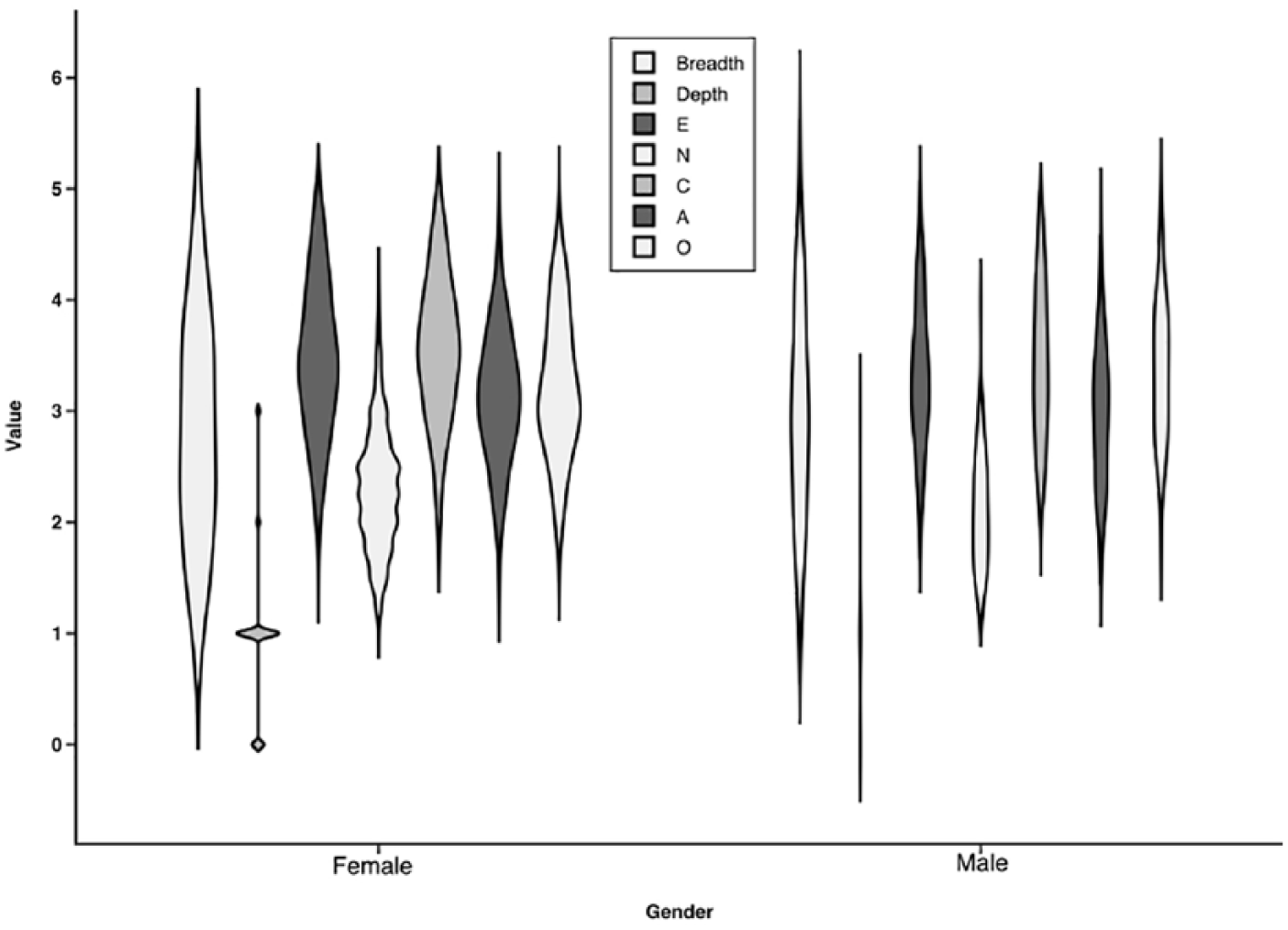
Scores’ distribution for the variables of the study.
Descriptive Statistics, Spearman’s Rank Correlation, Gender, Age, and Personality Differences
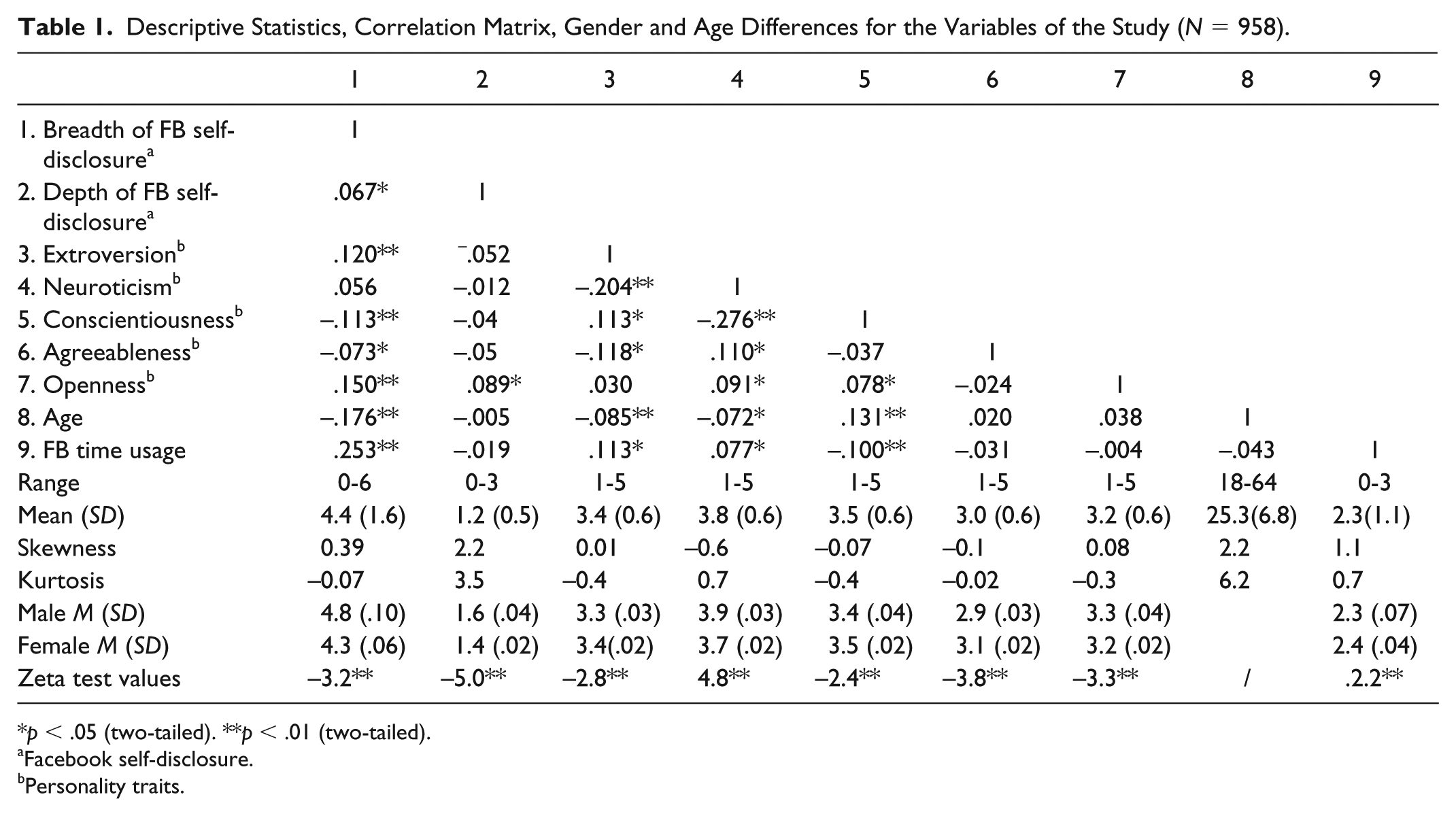
Descriptive statistics and Spearman’s rank correlation coefficients for scores on personality subscales, Facebook self-disclosure dimensions (i.e., BFSD, DFSD), and age are summarized in Table 1.
Descriptive Statistics, Correlation Matrix, Gender and Age Differences for the Variables of the Study (N = 958).
p < .05 (two-tailed). **p < .01 (two-tailed).
Facebook self-disclosure.
Personality traits.
On average, participants in the whole sample reported high scores on BFSD and low scores on DFSD, so evidencing to be more inclined to disclose a high number of details during their social relations instead than developing intimacy. Besides, Facebook users showed average total mean scores on the five PI subscales ranging from 3.0 to 3.8 points.
Results at Spearman’s rank correlation analysis showed that scores on BFSD correlate significantly and positively with scores on extroversion and openness, as well as significantly and negatively with scores on conscientiousness and agreeableness. A significant positive correlation has emerged between scores on DFSD and those on openness, too.
Significant intercorrelations among scores on the five PI subscales evidenced that high scores on extroversion correlated negatively with high scores on neuroticism or agreeableness and positively with high scores on conscientiousness. Results showed significant positive correlations between high scores on neuroticism and high scores on agreeableness and openness as well as negative associations between high scores on neuroticism and high scores on conscientiousness. High scores on conscientiousness were also positively associated with high scores on openness.
With concerns to Facebook time usage, we found significant positive associations both with scores on BFSD and with those on extroversion and neuroticism as well as significant negative associations with scores on conscientiousness.
Gender differences were analyzed performing Mann–Whitney U tests on scores at BFDS, DFSD, PI subscales, and Facebook time usage. Results showed gender differences in all the variables of the study. More specifically, male obtained higher scores than female on BFDS, DFSD, neuroticism, openness, and Facebook time usage, whereas females showed higher scores than male on extroversion, conscientiousness, and agreeableness PI subscales. A trend for age differences in the Spearman’s rank correlations was observed concerning scores both on personality and Facebook self-disclosure dimensions. Specifically, results evidenced a significant negative association between age and BFSD, showing young reporting higher scores than adults. Age was also negatively correlated with scores on extroversion and neuroticism, and positively with scores on conscientiousness, showing young as more introvert, emotionally stable, and conscientiousness than adults (see Table 1).
To better depict our sample, we analyzed the impact of individual differences on personality traits on BFDS and DFSD scores and on Facebook time usage. We split participants into two groups having HIGH versus LOW scores in each of the PI subscales by the median value and then performed a series of factorial 2 × 2 univariate analysis of variance (ANOVA) on scores obtained by participants on BFSD, DFSD, and time usage.
As shown in Table 2, results evidenced that all personality traits affected BFSD, but not DFSD. More specifically, extroverted and opened people disclose on Facebook a higher amount of information than introverts and low opened ones. Vice versa neurotic people, as well as high conscientiousness and agreeable people, disclose on Facebook a lower amount of information than their counterparts. There are no differences as about the impact of individual differences on personality for the level of intimacy people develop on Facebook. Finally, we found that personality factors have an impact also on time usage showing that extroverts and high opened people spend a higher amount of time on Facebook than introverts and low opened individuals. Differently, neurotics, high conscientiousness, and agreeable people spend less time on Facebook than their counterparts.
ANOVA Summary Table for Individual Differences on Personality Traits for Breadth and Depth of Facebook Self-Disclosure and Time Usage (N = 958).
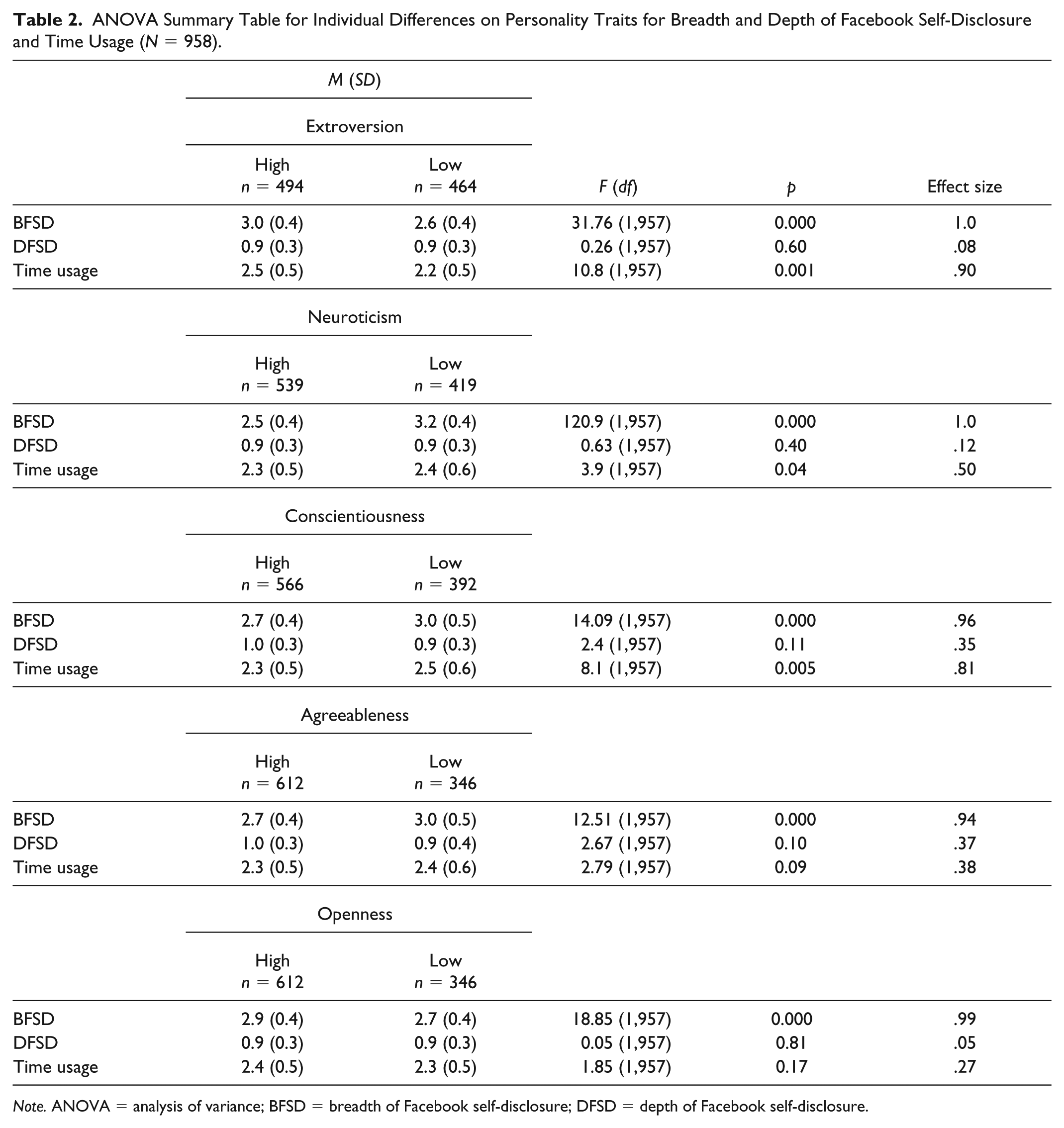
Note. ANOVA = analysis of variance; BFSD = breadth of Facebook self-disclosure; DFSD = depth of Facebook self-disclosure.
Hierarchical Regressions Analyses
A series of hierarchical regressions analyses examined the predictive role of personality traits on parameters of breadth and depth of Facebook self-disclosure. Personality traits were entered as the block of predictors, allowing us to examine the direct effect on the dependent variables. In line with Roberts and Martin (2009), we used bootstrap as a robust method to improve statistical estimations of regression analyses and to contain the effect of outliners data for neuroticism and agreeableness scores’ distributions.
The first hierarchical regressions analysis aimed to explore the personality traits that lead Facebook users to disclose large amounts of personal information on their profile (RQ1). In line with our hypotheses, results show a significant direct positive effect of extroversion and openness as well as a significant direct negative effect of conscientiousness on the breadth of FB self-disclosure. More extroverted and opened people tend to disclose more information about them on Facebook; vice versa, high consciousness individuals, are less prone to self-disclose themselves online. Contrarily to our expectation, agreeableness is a negative precursor of breadth of Facebook self-disclosure, and the impact of neuroticism was not significant. The total model explained 5% of the breadth of FB self-disclosure variance, F(5, 952) = 10.9, p < .001. Hence, all the hypotheses connecting the personality factors to the breadth of Facebook self-disclosure were verified except for H2a and H4a (see Table 3).
Summary of Simple Regression Analyses for Variables Predicting Breadth and Depth of Facebook Self-Disclosure (N = 958).

Note. CI = confidence intervals for bootstrapping samples (n = 1000); LB = lower bounds; UB = upper bounds.
p < .05. **p < .01.
The second hierarchical regressions analysis aimed to explore the personality factors that influence Facebook users to develop intimate relationships with others during the process of self-disclosure (RQ2). Results showed a significant direct positive effect of openness as well a direct negative effect of extroversion and agreeableness. The total model explained 2.2% of the variance for the depth of self-disclosure, F(5, 952) = 4.2, p<.001. Hence, our data supported only for H4b and H5b (see Table 2).
The effect of time usage on the relationships among personality factors, breadth and depth of Facebook self-disclosure
To investigate the hypothesis that the time people spend on Facebook mediates the effect of personality traits on self-disclosure, we performed a series of regression analyses, using SPSS macro PROCESS (Preacher & Hayes, 2008). As showed in Figure 2, personality factors were put in the model as independent variables (X), breadth and depth of self-disclosure as dependent variables (Y), and age and gender as covariates. We followed a four-step procedure to test our models. Step 1 was aimed at confirming the relationship between each of the independent variables and the dependent ones (X→Y; c path). Step 2 was aimed at confirming the relationship between each of the independent variables and the moderator (X→M; a path). Step 3 was aimed at confirming the relationship between the mediator and the dependent variable in the presence of the independent variables (M|X→Y; b path), and Step 4 was aimed at confirming the meaningful reduction in effect of the relationship between each of the independent variables and the dependent ones in the presence of the mediator (X|M→Y; c′ path).

The mediation model for the effects of personality traits on Facebook self-disclosure via the time usage.
As showed on Table 4, mediation analyses based on 5,000 samples using bias-corrected and accelerated 95% confidence intervals (Preacher & Hayes, 2004) showed that controlling for the covariates, only extroversion and conscientiousness had a significant indirect effect on the Facebook self-disclosure via the time usage. Hence, high extroverted people, as well as low conscientiousness ones, tend to disclose more information on their profile and spend most of their time online; the Facebook time usage, in turn, enhances the development and maintenance of a large number of information people share with others. No mediational effect of time usage on the depth of Facebook self-disclosure has emerged for all personality traits.
Summary of Mediation Analyses for Variables Predicting Breadth and Depth of Facebook Self-Disclosure Through the Effect of Time Usage (N = 958).

Note. E = extroversion; TU = time usage; FSD = Facebook self-disclosure; N = neuroticism; C = conscientiousness; A = agreeableness; O = openness.
p < .05. **p < .01. ***p < .001.
Discussion
The main purpose of the present article was to verify if Big Five personality traits (Costa & McCrae, 1992) are significant precursors of breadth and depth of Facebook self-disclosure. As expected, the results of the present study corroborated our hypotheses about the relationship between personality traits and Facebook self-disclosure. Overall, these findings of the impact of extroversion, openness, and conscientiousness on Facebook self-disclosure are coherent with previous research showing that user profiles reflect users’ offline personality traits (Back et al., 2010; Gosling et al., 2011). More specifically, we found that people high on extroversion (H1a) and openness (H5a), who have personality traits like friendliness, energy, assertiveness, and curiosity (e.g., McCrae & Costa, 1999), disclose a significant amount of personal information on Facebook as measured by the breadth of Facebook self-disclosure. Moreover, they explore the multiple possibilities offered by Facebook for being in contact with their friends, and positively afford Facebook private and public communication services to maintain their social engagement, also creating most in-depth relationships with their contacts. We might interpret these results by their theoretically foundation on the hyperpersonal model of Walther (1996) because they corroborate the idea that people behave on Facebook similarly to their face-to-face social environment. Extroverts and open individuals adapt to the technical features of the computer-mediated environment their self-disclosive behaviors to convey affection, sociability, information, or personal life events. Results also fit the traditional views of the role of self-disclosure in intimate relationship development (Altman & Taylor, 1973; Shih, Hsu, & Lee, 2015). As well, we found that people low on conscientiousness (H3a), who tend to neglect work or family (e.g., Wolfradt & Doll, 2001), join a lot of Facebook groups and share interests on the Facebook pages, upload links, notes, or photos in their profile, and also have a lot of Facebook friends.
Along with the more predictable findings, our results make several new contributions to the literature. Contrary to our hypotheses about the relationship between agreeableness and BFSD (H4a), results of the resent study provide empirical evidence that high agreeable individuals are less inclined to disclosive behaviors on Facebook. Such a result is in contrast with Tsai et al. (2017) Findings, but it might depend on the fact that Facebook is not a cooperative environment but more a competitive one (Caci et al., 2014). While disclosing themselves on Facebook, people compare their lives with those of the others, also feeling quite depressed (Baker & Algorta, 2016). As a consequence we retain that this process of social comparison might lead people with high levels of agreeableness, who tend to be sympathetic and compassionate toward the others, to disclose less information on their Facebook profile.
Similarly, in contrast with H5b related to DFSD, we found that people with a high level of agreeableness generate less intimate relationships with others on Facebook. Relationship development and maintenance is a core function of Facebook (Sheldon, 2008), so people use it for contacting long-distance friends, family members, or romantic partners (Johnson, Haigh, Becker, Craig, & Wigley, 2008). Nevertheless, the effectiveness of intimate self-disclosive behaviors depends on the method used by individuals to disclosing their data (Bazarova, 2012). Private disclosures shared between two users using instant messaging or chat options, which cannot be seen by others, were perceived to be more intimate than public disclosures. Also, great closeness messages disclosed via public methods posting information to another user’s “timeline” and public status updates were considered less appropriate than all other kinds of disclosures (Bazarova, 2012). More agreeableness people usually tend to have harmony relationships in their face-to-face communications (Graziano, 1994; Graziano & Eisenberg, 1997), thus we retain that in the case of the Facebook self-disclosure, people high on agreeableness might be negatively affected by the public computer-mediated features of the Facebook (e.g., posting in the timeline, status updating) to disclose information about them and develop intimacy with others.
Another quite surprising finding of the present study was the lack of a significant relationship between neuroticism and BFSD (H2a) or DFSD (H2b). The role of neuroticism as a positive or negative precursor of Facebook self-disclosure remains still unclear as our data showed no significant correlations. However, analyzing means differences between high versus low scoring people on neuroticism in our sample, we found that neurotics engage less in self-disclosive behaviors and also tend to spend less time on Facebook. Coherently with research on personality that has showed that people high on neuroticism tend to complain a lot (Buss, 1991), and that neuroticism predisposes people to experience more stressful (Bolger & Schilling, 1991) and adverse events (Magnus, Diener, Fujita, & Payot, 1993), it might be deduced that on Facebook neurotic people are more inclined to self-disclose selectively expressing their trait-relevant insecure and anxious behavior (Frederickx & Hofmans, 2014).
The present study offers another novelty in the previous literature suggesting not only that personality factors contribute directly to explain the variance in the number of information people disclose on Facebook but also indirectly by the mediational effect of time usage. Previous studies have evidenced that extroverts and low conscientiousness individuals usually tend to spend most of their time on Facebook (E. Lee et al., 2014; Ross et al., 2009; Ryan & Xenos, 2011) and show also addictive tendencies for the high amount of time spent on social networking sites (Wilson et al., 2009). Consistently, we found that extroverts and low conscientiousness people are susceptible to increase the amount of information they disclose on Facebook for the effect of the time they spend online. We also found that the time spent on Facebook is a crucial variable for modulating the number of information people disclose on Facebook and the intimacy they develop during self-disclosive behaviors with others. People who are usually friendly in their real life tend to search social contacts also in the virtual environment of Facebook to share with them information about themselves. Doing that, they spend much time using Facebook, and this, in turn, leads them to develop and maintain their levels of Facebook self-disclosure. As well, people low on conscientiousness, who neglect working and family (Hughes, Rowe, Batey, & Lee, 2012), are more prone to reveal themselves on the Facebook, so using more this social networking site and getting stuck their process of self-disclosure. In sum, the present article offers an explanation about a sort of “disclosive circuit” that emerges between personality traits, Facebook self-disclosure, and time usage. Personality traits predispose individuals to self-disclose on Facebook, modulating the amount of information people offer to share with others; at once, people spend more or less time on Facebook because of their individual differences. As a consequence, the time people spend on Facebook modulates the number of information people disclose online, reinforcing or inhibiting the process of self-disclosure itself.
Limitations
Although the research has reached its aims, there are some intrinsic limitations for interpreting results. First, data of the present study refers to a convenience sample of Italian Facebook users. However, convenience samples play a valuable role in social science research (Mullinix, Leeper, Druckman, & Freese, 2015) so we retain that findings of the present study are not very affected by this limitation. Despite this, future studies should be performed in a cross-cultural domain so contributing to overcome this limitation and corroborating the present results. Second, self-reports measures for personality traits might have influenced participants’ disclosure of some sensitive information. Because the measure of personality traits was self-reported, it was possible that method variance played a role in the findings observed. Future studies should add a social desirability scale to measures of personality traits and Facebook self-disclosure to reduce these biases. As well, further research should simultaneously employ multiple informants and multiple methods to collect data to reduce the potential effects of shared method variance and to improve internal validity. Finally, as reported above, personal levels of Facebook self-disclosure rely on the use of specific tools that Facebook provides to people (Bazarova, 2012). Thus, further studies should also consider how parameters of Facebook self-disclosure are affected by the specific private (e.g., chat) or public (e.g., the wall) Facebook applications people use for disclosing themselves.
Conclusion
In conclusion, the present study attempted to expand on previous Facebook self-disclosure and personality research by highlighting specific and direct predictive effect for each of the Big Five traits on each of the different parameters of breadth and depth of self-disclosed behaviors, also exploring the mediational effect of time usage. The present article showed that breadth and depth of Facebook self-disclosure correlated with high levels of extroversion and openness as well as with low levels of agreeableness and conscientiousness. Furthermore, personality traits like high levels of extroversion and low levels of conscientiousness interplay with time usage in modulating the development and maintenance of self-disclosive behaviors on Facebook. If we discuss results of the present study by focusing more on the counterparts of personality traits, for instance, introversion, and also reflect to the pivotal role of time as a mediator of self-disclosure, it is plausible to hypothesize that Facebook self-disclosure might play a critical role also in addictive behaviors online, such as Internet addiction. Prior researches have shown that Internet addiction is associated both with personality traits like introversion and with the amount of time people spend online (Caci, Cardaci, Scrima, & Tabacchi, 2017; Casale & Fioravanti, 2018; de Palo et al., 2018). Besides, scholars have evidenced that less self-disclosive people tend to be lonely and shy (Sprecher & Hendrick, 2004) and that as long as the loneliness level increases the Internet addiction also increases (Morahan-Martin & Schumacher, 2003). According to the findings of the current study, personality traits and Facebook self-disclosure become central both as predictive variables for depicting the different profiles of potential Facebook addicted and as variables to help educators, teachers, and clinicians to develop training or therapeutic programs aimed at preventing the risk of Internet addiction.
Footnotes
Appendix
Declaration of Conflicting Interests
The author(s) declared no potential conflicts of interest with respect to the research, authorship, and/or publication of this article.
Funding
The author(s) received no financial support for the research, authorship, and/or publication of this article.
