




Abstract
This article contributes to the debate on the social and economic impacts generated by tourism activities using a methodology that is still insufficiently explored in the field of tourism and the impacts that this causes: social return on investment (SROI). Using the analysis of a case as a guiding thread, this article shows how the application of this methodology allows one to know in depth the social value that an emblematic palace (one of the main tourist attractions of a city in the south of Spain that was designated as a United Nations Educational, Scientific, and Cultural Organization [UNESCO] World Heritage Site) brings, the changes experienced by the interest groups that interact with it, and the theory of change that promotes the very existence of the palace. Its results and conclusions can also inform policies and strategies of these other actors related to the intervention.
Keywords
Introduction
The study of the positive and negative effects of tourism on local populations and destination areas is not a new field of study in tourism literature (antecedents can be traced to Ap, 1992, or Mathieson & Wall, 1982). However, in the past few decades, the tourism boom experienced in some cities and regions of the world has renewed the attention on the topic, mainly focusing on the attitudes and perceptions of residents toward the impacts of tourism. Today, this field of study gathers an eclectic range of authors who apply a wide variety of methodologies and approaches to determine both the positive and negative impacts of tourist activities.
Regarding the methodologies, in the arena of quantitative models, studies on the impacts of tourism are currently transiting from the most conventional econometric models (Narayan, 2004; Nisthar & Vijayakumar, 2016; Seetanah, 2011) to structural equation analysis. The latter started with pioneering studies (Ko & Stewart, 2002; Reisinger & Turner, 1999), and today can be probably considered as the go-to quantitative methodology (Ali et al., 2018; Carneiro et al., 2018; Khoshkam et al., 2016).
Despite the valuable insights provided by quantitative methodologies, the most innovative approaches seek to incorporate qualitative and hermeneutic models into the analysis of the impacts of tourism. Therefore, methodologies based on quality of life analysis (Andereck & Jurowski, 2006; Andereck & Nyaupane, 2011; H. Kim et al., 2015; K. Kim et al., 2013; Uysal et al., 2016), resident perceptions (Almeida-García et al., 2016; Andereck et al., 2005; N. Chen et al., 2018; Ouyang et al., 2017; Perdue et al., 1990; Stylidis et al., 2014; Wu & Chen, 2015; Xu et al., 2016), and stakeholder analysis (Banki & Ismail, 2014; Lundberg, 2017; Nunkoo & So, 2016) are gaining momentum and gathering the largest body of recent literature.
In this article, we introduce the contributions to the field of tourism of a yet insufficiently explored methodology: social return on investment (SROI). The SROI is a mixed-methods analysis that relies on the hermeneutic knowledge of the context and the interaction with stakeholders, while also offering the quantification of the impacts they receive. Furthermore, even if SROI provides information that is directly focused on the social value generated by the project, program, policy, or institution analyzed, it also offers indirect insights on their economic and environmental impacts.
The thesis of this research is that the point of view provided by SROI complements other traditional methods by offering a new asset that can not only enrich the approaches of other studies in the field but also open new lines of research. To share the findings of the application of SROI to a tourist activity, the rest of the article is organized as follows: The section “The Debate on Impacts of Tourism and Potential Contributions From the SROI Methodology” introduces the debate on the impacts of tourism activities and discusses the adequacy of the SROI methodology to assess this field of knowledge. In section “Objectives and Method,” we describe the objectives and methods of the article, and the case study is presented: an emblematic palace, one of the main tourist attractions of a city in the south of Spain that was designated as a UNESCO World Heritage Site (at the express request of the private foundation that owns and manages the palace, the name of which will remain anonymous). The section “Results: Application of SROI to Assess the Social Value Generated by the Palace” introduces the results obtained from application of the SROI methodology to the case study, and section “Discussion: Contributions of SROI to the Debate on the Impacts of Tourism” discusses such results and the implications derived from the application of SROI methodology to the literature on the social impacts of tourism. Finally, in section “Conclusion,” we summarize the main conclusions, while presenting the main limitations of the article and the future lines of research within the field of study in section “Limitations and Future Lines of Research.”
The Debate on Impacts of Tourism and Potential Contributions From the SROI Methodology
The State-of-the-art in Tourism Impact Literature
In later years, due to the expansion of tourism activities across the world, the literature on its impacts is witnessing a renewed attention. Traditionally, this body of literature has been addressed from three different perspectives: economic, sociocultural, and environmental. Only in the last decade, more than 100 evidence-based studies have recognized both favorable and unfavorable impacts within each of these spheres. Consequently, different systematic reviews have struggled to gather and systematize the conclusions of this increasing body of research (K. Kim et al., 2013, emerges as one of the most omni-comprehensive ones). Despite all gathered evidence, only a handful of issues have reached enough academic agreement, and most of the traditional debates still persist.
Although tourism is widely perceived as an industry with several economic benefits (Andereck et al., 2005), one of the most controversial topics is the unequal distribution of benefits and costs across different stakeholders linked to tourist activities or destinations (e.g., the research of J. M. Chen et al., 2019, shows a meta-analysis of the direct economic impacts of cruise tourism on port communities). Likewise, the meta-analysis of Gursoy et al. (2019) notes the important effects of perceived benefits and costs of tourism impacts on residents’ support for tourism development. Naidoo et al. (2016) have probed how certain activities only benefit salaried jobs linked to them, whereas costs distribute among every other stakeholder. Yolal et al. (2016) also determine how cultural activities deeply impact subjective well-being of residents as they increase psychological tension among community members.
Another hot topic deals with saturation of some areas within touristic cities or regions (Alvarez-Sousa, 2018). This is no new topic, as some countries have been taxing overnight hotel stays and Natural Parks establishing visitor limits from decades. However, the explosion of tourism and the centrality of sustainability have re-emerged the debate on carrying capacity (Coccossis & Mexa, 2017; Sood & Chougle, 2016). Whether tourist activities themselves can contribute to spread the benefits and to readjust the saturation processes is still on debate, and academic voices claim from a tourism taxation based on nonresident consumption in tourism services (García López et al., 2018) to the strengthening of synergies between the different agents involved in the tourism sector as a self-managed solution (Pérez Guilarte & Lois González, 2018). The importance of this debate is crucial in cases where tourist activity concentrates in some periods of the year (Connell et al., 2015).
The last debate refers to the management of tourist activities. Some authors (Ciolac et al., 2017; Nunkoo, 2015) are analyzing how the management of such activities by local government have a mediate effect on the distribution of costs and benefits, but the own authors admit it to be an under-researched area. No single methodology can address such complex issues, and often the results obtained are not comparable as theoretical foundations and underpinnings differ (Bateman & Fleming, 2017). However, the contributions of yet insufficiently explored methodologies such as SROI can contribute to enlighten these debates. With this scope, we introduce the methodology.
Origins, Current State, and Theoretical Foundation of the SROI Methodology
There is a common agreement among SROI academics to track the origins of the methodology back to the year 1997 in the United States of America (from Emerson et al., 2000, to Banke-Thomas et al., 2015). At that time, the Roberts Enterprise Development Fund (REDF) incorporated six levels or results of social nature into the calculation of blended value analysis. This index materialized in a ratio that related the costs of the investments with the value of the benefits generated as a modification of the characteristic cost-benefit analysis (CBA).
In 2003, in England, the New Economic Foundation redefined the methodology developed by the REDF by giving greater prominence to stakeholder participation in the development of the whole process of social value assessment. This incorporation of hermeneutic knowledge into the process is how the SROI methodology was born. However, the maturity of the methodology was only reached a few years later when Nicholls et al. (2009, 2012) established its basic principles and the different phases for its implementation.
The application of the SROI analysis looks for two main purposes. First, there is an external purpose that seeks to show the effectiveness of the use of resources to attract funding or to justify the existence of the organization itself (Rauscher et al., 2012; Rotheroe & Richards, 2007). In addition, there is an internal one that seeks to improve the allocation of resources or to legitimize the performance of the managers themselves (Maier et al., 2015; Ruiz-Lozano et al., 2020). The ultimate goal of the SROI is to demonstrate, by means of evidence, the sustainability and the social value added by interventions and organizations through the understanding, managing, and communication of their impacts in economic, social, and environmental terms (Maier et al., 2015; Millar & Hall, 2013; Rotheroe & Richards, 2007). To do so, SROI evaluates the value of the social results created by an intervention or organization by putting them in relation to the costs required to achieve such results. From this point of view, the SROI method is based on a conventional CBA (Walk et al., 2015), although it goes a step further by assigning monetary values to other impacts of a social and an environmental nature, both tangible and intangible.
To do so, the theoretical foundation of SROI relies in three theories: the grounded theory, the theory of stakeholders, and the theory of change. Grounded theory provides the epistemological approach to research methodology, which demands operating inductively in contrast to hypothetic-deductive approaches (Glaser & Strauss, 1967). As the scope is to evaluate the impacts of tourist activities, the grounded theory relies in the theory of stakeholders, which calls for take into consideration only the changes that are explicitly identified and valued by the involved stakeholder (Freeman, 1984). Finally, to track the understanding of the chain of changes produced to such stakeholders, and to justify the attribution of such impacts to the activity being evaluated, SROI relies on the elicitation of the theory of change (Weiss, 1995). Therefore, this theory is focused on analyzing how social change is obtained and what is the value created (Viganó & Lombardo, 2019). As indicated by Daye and Gill (2017), the SROI method expands the assessment beyond the outcomes that were the aim of the intervention, including not planned benefits. In this way, through the evaluation process, we can learn how changes are being generated.
As most social interventions have a genuine intention to improve the living conditions of the population, the coexistence of the grounded theory, the theory of stakeholders, and the theory of change support the attribution of impacts, or how the inputs or activities implemented can produce a series of outputs or results that in turn are able to achieve the final outcomes or impacts pursued, thereby understanding impacts as those significant changes that people experience, identify, and declare as a result of the activities carried out by an organization (Nicholls et al., 2009).
Applications of SROI to Tourism Impact Analysis
As we have seen in the previous section, the first studies applying SROI principles started less than 20 years ago. However, in this brief period, the methodology has been widely applied to an extensive range of fields of study. Main studies have pursued the quantification of social value added by health policies (Banke-Thomas et al., 2015; Dyakova et al., 2017; Knepil et al., 2017) and programs (Courtney & Baker, 2017; Kumar & Banke-Thomas, 2016; Walker et al., 2017), sport activities and facilities (Davies et al., 2016; King, 2014), and mainly social programs and policies, including those from employment interventions (Owen et al., 2015) to social capital initiatives (Arvidson et al., 2014; Vieta et al., 2015). Today, the Social Value Initiative has identified more than 800 studies using the SROI methodology in an equally wide range of contexts and levels.
In the field of tourism, and specifically regarding tourism impacts, as any other emerging science, SROI started its applications with case studies. One of the most acknowledged in the field is the impact evaluation of the Auckland Museum’s Moana—My Ocean Exhibition (Allpress et al., 2014). In the past few years, SROI studies applied to tourism impacts have been gradually incorporating new dimensions, from the impact of specific attractions (Aventia Consulting Limited, 2017) and museums (Barnett, 2011; Price WaterHouse Company [PWC], 2014) to the social value generated by museums as a whole (Whelan, 2015), even exploring the impacts generated by tourism at country level (PWC, 2015). For example, the recent research of Viganó and Lombardo (2019) about the impact generated by a museum association in Florence (Italy) revealed that workers were the most important stakeholders in aspects as welfare, work–life balance, career development, or employment stability. Other key stakeholders that receive impacts from this association were schools, elders’ institutes, hospitality businesses, tourists, and public administration. The estimated impact of applying the SROI method was 2.8, which means that for each euro invested, almost €3 are returned to society. Without a doubt, culture organizations in the tourism industry are required to evidence their impacts on society. In this sense, Jackson and McManus (2019) measured the social impact of a lifelong learning program at Turner Contemporary art gallery in Margate (England). The authors identified six groups of stakeholders: visitors, participants in formal education, participants in lifelong learning, local retailers, non-visiting residents, and local artists. In this case, the SROI ratio was 4.09 to 1. So, four pounds were returned to society for each pound invested in the program.
SROI-based studies demonstrate the contributions that the methodology can offer to the comprehension of the phenomenon, which we summarize as follows:
First, SROI calculations and justifications are strongly grounded in the theory of change. This theory means that as more evidence-based studies provide their maps of changes, we can identify and follow the path that explains how tourism activities finally impact and change the lives of the actors affected by them. The elicitation of these theories of change can help decision makers and general managers to adopt better-informed strategies and policies.
Second, in the analysis, SROI incorporates the vision of every stakeholder involved or affected by the intervention. Some of the stakeholders identified in the aforementioned case studies include visitors, staff, merchants, the local populations, or public administrations. The polyhydric impacts of tourism activities and attractions are therefore presented collectively, but the disaggregation offered actor by actor can inform specifically addressed decisions to minimize or maximize the impacts some of them that are identified.
Third, the potential escalation of the SROI analysis allows the possibility to focus on specific crosscutting issues, such as specific impacts of tourism (i.e., the concentration of tourism and the effects derived from the saturation) or innovative interventions within a larger organization or activity. This in-depth knowledge could lead to a better decision-making process based on the generation of social value that can be applied to any entity or intervention.
Objectives and Method
SROI: A Mixed-Methods Approach to Assess the Social Impact of Tourism Activities
The objective of our analysis is to assess the social impacts generated by the tourist activities performed by a representative palace located in a city in southern Spain. The methodology applied for such assessment is the SROI methodology, whose principles and theoretical surroundings have been explained in the section below. The aim of this analysis is to show how the application of the SROI methodology can complement other traditional methods of assessing the impact of tourist activities. These new insights are due to the mixed-methods nature of this approach: half qualitative and half quantitative. It relies on the hermeneutic knowledge of the context and interactions with stakeholders while also offering the economic quantification of the impacts they declare to receive.
The SROI methodology is based on a series of inspiring principles proposed by the SROI network: (a) involve stakeholders, (b) understand what changes, (c) value the things that matter, (d) only include what is material, (e) do not overclaim, (f) be transparent, and (g) verify the results. As Nadotti and Vannoni (2019) pointed out, the SROI method has the Value Chain as their theoretical framework, considering an impact as any change on society that derives from outcomes that have been achieved. The above principles are usually applied in a six-stage methodology that is carried out from the qualitative steps to the quantitative ones as follows: (a) establishing the scope and identifying key stakeholders, (b) mapping outcomes, (c) evidencing outcomes and giving them a value, (d) establishing the impacts, (e) calculating the SROI, and (f) reporting, using, and embedding (Nicholls et al., 2012).
To illustrate the contributions of the SROI methodology, in this article, we present its application to a case study: a representative palace located in a city in the south of Spain.
Case Study: An Emblematic Palace in Southern Spain
The historical palace that is the object of this analysis is a monument with more than 500 years of history and was declared a national artistic historical monument in the 1980s. It is located in a Spanish city that has an imposing architectural legacy, being that it is one of the few cities in the world that has four World Heritage appointments by UNESCO. However, despite the remarkable heritage offered by the city, a single monument monopolizes much of the tourism, something that is understandable as it is the third most visited monument in Spain after the Alhambra in Granada and the Sagrada Familia in Barcelona.
Thus, one of the main impacts of tourism in the city is the extremely high concentration of visitors in the historic center. Today, the three most visited monuments of the city are distanced no more than 500 m one from each other. This concentration of tourists in the center of the city is starting to show signs of exhaustion as the benefits and costs are unequally distributed. Although saturation affects the daily lives of some of its inhabitants, an important part of the city merchants, restaurateurs, and business owners rely on tourism. Thus, the monuments located far away from the center contribute the most by both attracting tourists to the city and also dispersing them along it. The palace is one of these monuments.
Today, the palace belongs to a private foundation owned by a bank. The foundation is the instrument through which the bank channels the social work carried out in its closest environment. For this, among other actions, the foundation uses the palace as the nerve center of its cultural activity, projecting its actions toward the exterior and linking itself more closely with the city, thereby promoting and contributing to its social and economic development.
Regarding the purpose of the palace, it contributes to safeguard the local memory through research, conservation, teaching, exhibition, and administration of the collections it houses. This private collection demonstrates the historical evolution of the city since the 15th century and is representative of the inheritance of tangible and intangible assets of its cultural heritage.
The other great attraction of the palace is its beautiful “patios” (courtyards) connected to each other by a series of galleries where a great diversity of plants abounds. Each of the 12 “patios” plus the garden has a unique personality, thus offering visitors the chance to enjoy remarkable sensations depending on the time of the year in which the visit is made.
Results: Application of SROI to Assess the Social Value Generated by the Palace
The Qualitative Share
The theory of change of the palace
One of the key elements for the SROI methodology to produce reliable and verifiable results is the identification of the theory of change that underlies it. Only by this will it be possible to understand and internalize the relationships between the different inputs, outputs, and outcomes (Nicholls et al., 2012). In our case, it is about knowing how the palace promotes certain changes in the lives of visitors, employees, the neighborhood or nearby hospitality businesses, among other interest groups, thus contributing to the fulfillment of its mission from social and economic points of view.
The theory of change clarifies and helps understand the relationship that takes place between the inputs or resources mobilized by the organization, the activities deployed—thanks to these, the outputs or products obtained from their execution, and finally, the outcomes or impacts derived from these results (Nicholls et al., 2009). From this perspective, the SROI methodology allows us to learn about what has been done to promote such changes and what would happen if the palace did not exist.
Figure 1 shows the logical model and the elements of the theory of change on which this study is based.

Theory of change of the palace.
Regarding the underlying theory of change in the palace, it should be noted that the conservation of heritage, culture, and popular traditions constitutes a core role of its identity, both individually and collectively, thus contributing to the delight of visitors and increasing the sense of pride and belonging of local citizens.
The palace generates significant impacts in the field of tourism in the Spanish context where 14.9% of gross domestic product (GDP) in 2017 came from more than 82 million international tourists (almost twice the Spanish population), which made it the second most visited country in the world behind France and ahead of the United States.
To achieve these impacts, it is necessary to rely on a series of inputs from different actors: employees, neighbors, the public administration and, of course, the private foundation (and the Bank that owns it) that finances the palace while simultaneously acting as a facilitator of its cultural activity. As Figure 1 shows, these resources allow a series of activities that through the results that are obtained will lead to a multitude of impacts. The identification of the impact chain that facilitates the enunciation of the theory of change allows it to monetize the global impact derived from the intervention, for which the SROI analysis methodology will be applied as described in the following sections.
Coestablishing scope and identifying stakeholders
To demonstrate the monetary value of the outcomes that the palace brings to society, in the present work, we carry out an SROI analysis of the entity for the year 2016. This year constitutes a milestone in the history of the palace because, after a substantial architectural remodeling of both the palace and its surroundings, it exceeded 100,000 visitors for the first time in its history.
From this moment, the palace was transformed into a cultural container where, on one hand, local memory is safeguarded, through the research, conservation, teaching, dissemination, exhibition, and administration of its property and its valuable collections (paintings, books, weapons, furniture, tapestries, etc.) and, on the other hand, it starts a full-year cultural program that connects the palace with the current cultural life of the city.
Once the objective of the analysis is established, the next step is the identification and involvement of the palace’s groups of interests. This step is an essential feature of SROI that differentiates it from other methodologies that place the focus on CBA. The participation of stakeholders in all phases of the process favors communication and learning using a language easily understood by all parties involved. In addition, it clarifies the mission and strategy of the organization (Mook et al., 2015).
In an initial phase, for the identification of the stakeholders, different interviews were carried out with personnel of the owning foundation and with the management of the palace. More specifically, we adopt the proposal of Mitchell et al. (1997), which identifies all affected stakeholders following a brainstorming methodology and assigns each of them a score: high (3 points), medium (2 points), or low (1 point) in three dimensions: (a) influence (presence of the stakeholder in the organization in such a way that it will be greater the more that the stakeholder should be considered in the setting of the policies of the company), (b) power (stakeholder capacity to intervene with authority in the organization’s decision-making, which is also the ability of a specific group of interest to impose its will), and (c) interest (degree of commitment that the stakeholder has with the organization, or vice versa, in such a way that the higher the dependency of the organization will make it higher). Adding the three partial scores gives a total score that ranges from 3 to 9 points. As can be seen in Table 1, this score is the one used to establish a priority order between the various stakeholders of the palace.
Identification of Stakeholders.
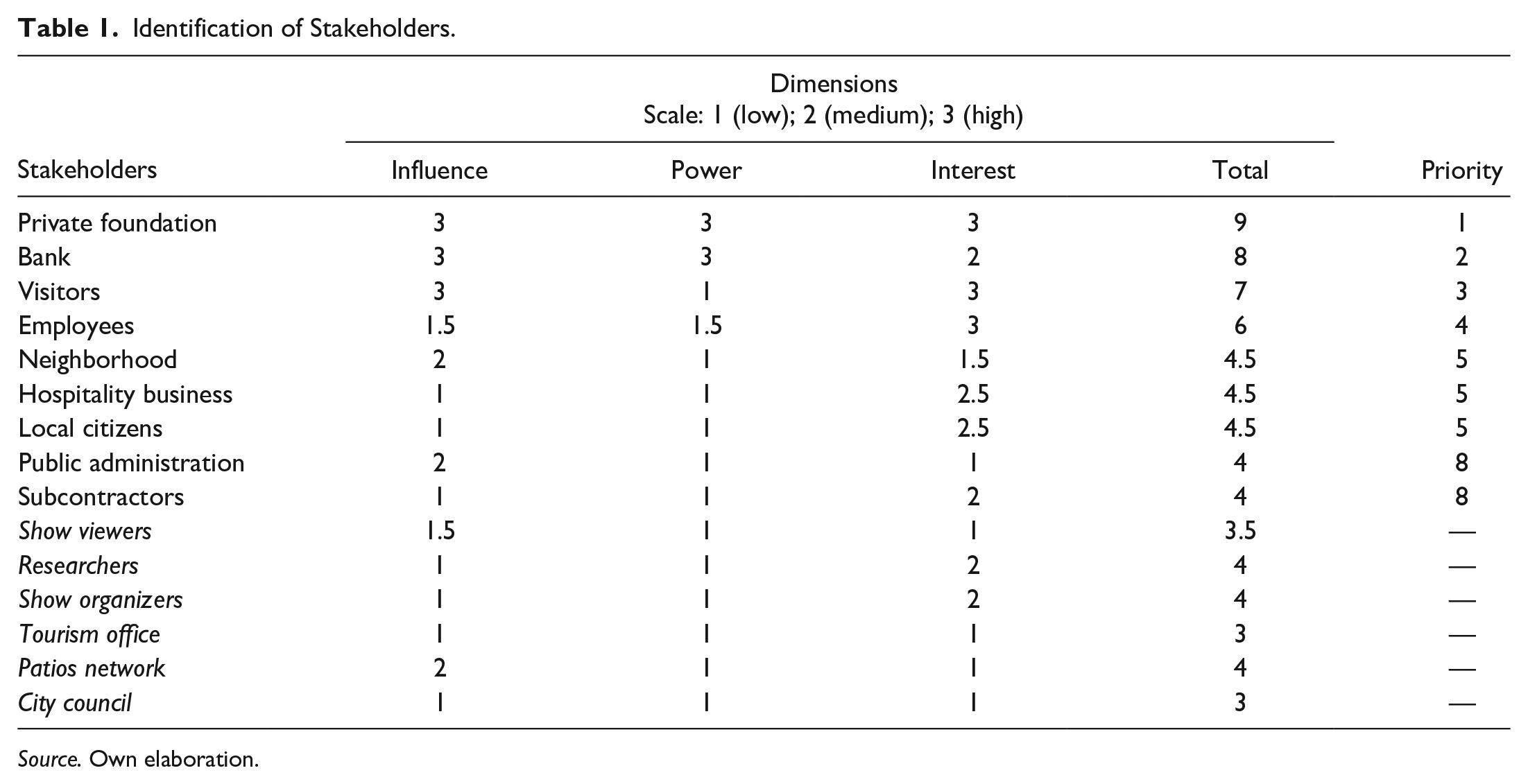
Source. Own elaboration.
Once a first approximation was made for the priority stakeholders, we carried out a brainstorming session with two purposes: review and confirm the established prioritization and determine the possible causes that advise modifying the relative position occupied by a specific stakeholder in the study.
After this process of reflection, some groups were excluded from the analysis (listed in Table 1 in italics) for different reasons that were explained in detail. For example, researchers who come to study the palace’s documentary collections were excluded due to lack of materiality because they are not considered to experience significant impacts as their relationship with the palace is sporadic, which reduces the number of researchers.
The impacts caused by the palace
For the identification of the impacts that every stakeholder receives, it is necessary to ask the following question: what changes, of a positive or negative nature, are due to the linkage of the stakeholder to the organization? Ultimately, it is a question of collecting in a motivated way the reasons why each of the groups of interest is related to the activity of the organization, which would ultimately justify the analysis of the changes they receive from it. In the case of the palace, the most relevant motivations are concentrated around its two main activities: the leisure of cultural activities and the preservation of local traditions.
Once this part is complete, the SROI methodology recommends the use of the focus group technique, which is established by the authors and the direction of the palace with each stakeholder. In these focus groups, we proceed to identify the changes that could be expected to occur in each of the affected stakeholders by subjectively assessing each of them based on a criterion of relevance (A-B-C, with A being the most relevant). The less relevant changes, noted by C, will be removed from further analysis.
Table 2 summarizes the complete proposal of the analysis of change for each of the stakeholders involved.
First Approach to the Analysis of Change.

Source. Own elaboration.
Because the private foundation is the owner of the palace and its role is to fulfill its mission, the social return on investment advises considering the social return on investment calculation as a proxy for the value of the change it receives.
The Quantitative Aspects: Evidencing and Assessing Inputs, Outputs, and Outcomes
Quantification of the impacts
For the quantification of the different changes, we agreed upon a series of indicators that represent the impacts in the most objective way possible. The measurement of these was conducted with secondary information or with surveys that were designed ad hoc for that purpose (the surveys and their results are available upon request for those researchers who wish to consult them).
An example of an item in relation to the change experienced by visitors is “Have you learned anything new about the culture and / or traditional ways of life in the city?” Another item related to the opinions that citizens have about the contribution of the palace to the culture offer of the city is “If the palace did not exist, then how do you think the cultural program of the city would be affected?”
Based on the information obtained, we determined the amount of change experienced by each stakeholder, which is called the change incidence. The impact indicators used in this research, the results obtained about the incidence of the changes, and the proxies chosen for the assessment of said impacts and their sources are presented in Table 3.
Parameters for the Quantification of Impact.

Source. Own elaboration.
Regarding the proxies, it should be noted that when dealing with the impacts of an intangible nature, with a component of subjectivity, the proxies chosen for the evaluation of the impacts can only constitute an estimate as close as possible to the social value because there is no direct measurement of it (Rauscher et al., 2012). Even when recognizing this limitation, the quantification of the value that the palace contributes to society makes it more visible to some information claimants, such as funders (Arvidson et al., 2014; Cooney & Lynch-Cerullo, 2014), using an economic language that allows for a better understanding of the aforementioned social value (Rauscher et al., 2012).
As an example, in Table 3, we can observe that to monetize the impact of the sense of belonging that employees have with the palace, the proxy that was used was “the average of the annual salary difference they would be willing to accept to change jobs.” This was an amount that amounted to €3,523 a year, according to the data collected through the surveys that were carried out.
The distilling of impacts
Following one of the core principles of the SROI methodology, a process of reflection began on changes that should not be attributed to the ordinary activity of the palace, either because they have actually been generated by others (reflected in the attribution coefficient) or because these changes would have occurred anyway, even if the palace did not exist (reflected in the deadweight coefficient).
The values of these coefficients of adjustment were obtained mostly through interviews and questionnaires. The summary of how the debugging coefficients affect each of the analyzed changes is presented in Table 4.
Summary of the Final Valuation of Changes.
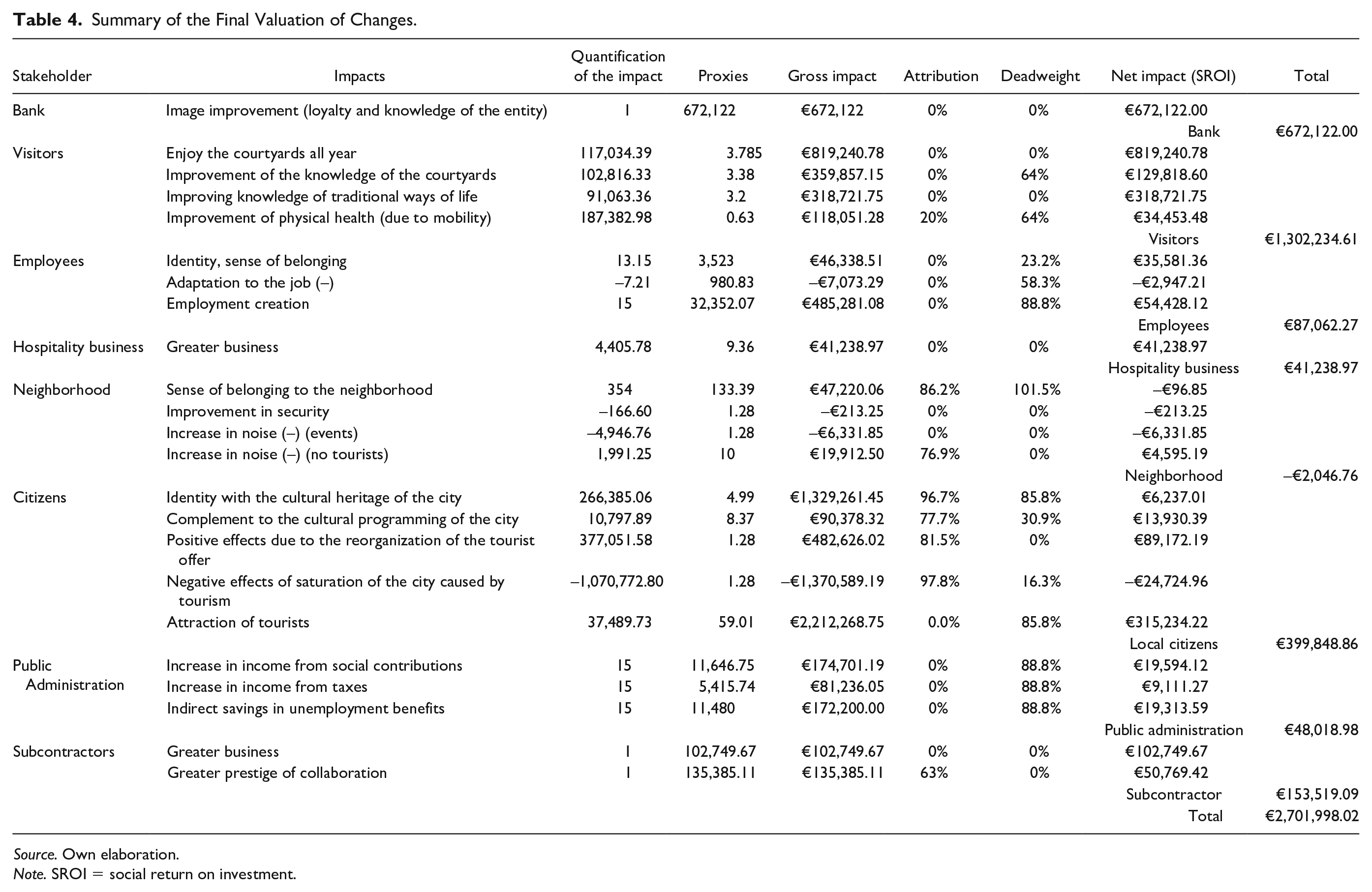
Source. Own elaboration.
Note. SROI = social return on investment.
Thus, the application of these coefficients causes a very significant reduction of some impacts either by a high attribution or by a very high deadweight.
As an example, we can highlight the change “identity with the cultural heritage of the city” corresponding to stakeholder citizenship. It is almost completely reduced (attribution of 96.7% obtained from the survey process). The reason is that the identification of citizens with their cultural heritage is mainly attributed to the presence of the aforementioned singular monument, which monopolizes the tourist and heritage attraction of the city as it is among the most visited monuments in Spain.
Another change to highlight is the case of the “improvement in security” for the stakeholder neighborhood. Although in their first impression one might think that the activity of the palace should been able to generate a greater sense of security in the neighborhood where it is located, the information obtained advises one to reduce this presumption. In fact, the results that were obtained indicate that the perception of safety is greater in the city as a whole than in the neighborhood itself (this is why the deadweight is greater than 100%) and that the improvement in safety is due to factors other than the presence of the palace, such as the rehabilitation of the neighborhood by the City Council (attribution of 86.2%).
In short, the purification coefficients fulfill the function of attributing to the palace exclusively the amount of change that is actually derived from its existence (attribution) and that could not have been produced without it because there are no alternatives in the market to cover its impacts at 100% (dead weight).
Determination of the SROI of the palace
As Table 4 has shown, the palace generates approximately 2.7 million of social and economic value distributed among different stakeholders. Comparing the value created by the palace with the inputs (expenses of the 2016 financial year) necessary for the development of its activity (€1,020,682.69), an SROI ratio of 2.65 is obtained. This result means that in the first calculation of the SROI, for every euro invested by the foundation in the palace, €2.65 of economic and social value are returned.
The visitors constitute a group of interest that receives the most impacts, which is almost half of the total and practically twice as much as the second stakeholder in order of importance. In this way, the study has brought to light the high level of satisfaction declared by visitors with the visit, to which is added the high value they give to being able to enjoy an emblematic display of what the patios represent during the whole year. The study also offers tools for the management of tourist attractions by identifying that improving the knowledge of traditional ways of life is another impact to highlight, and so it should be kept as part of the idiosyncrasy of the monument.
The second stakeholder that benefited most is the bank that owns the private foundation that manages the palace. In this sense, a relevant change is the increase in loyalty and the improvement of the entity’s knowledge. However, for various reasons, it has not been possible to quantify the effect that this activity has on the employees of the bank, on the loyalty of current customers, or on the capture of new ones. It is not a problem for the methodology, as the scope is not only to calculate the SROI but also to involve stakeholders and to understand the different impacts generated by the activity.
Employees of the palace also experience important changes in terms of job creation and satisfaction with their work. In addition, the results of the study have shown that the level of identification of the staff of the palace is very high. This result is noteworthy because it occurs despite the problems of adaptation to the positions that have arisen after the process of restructuring and the internal reorganization of the work.
All citizens are also influenced by the presence of the palace in the city (receiving 14.8% of the total impacts) because the tourist attraction of the monument complements the cultural activity and improves the identification of citizens with local heritage. In addition, given its location—away from the main tourist center of the city—the palace contributes to decongesting some areas that begin to emit signs of tourist saturation.
Finally, the neighbors should be another stakeholder that most benefits from the presence of the palace in the neighborhood. However, the results of the study bring to light some areas of improvement worthy of attention. On one hand, the identification of the neighborhood with the palace is not as close as one would expect (0.61 out of a maximum of 4, which means a value of only €4,595.19). Another issue that should be given some attention is the inconvenience caused by noise as a result of the ordinary activity of the palace, especially when events or shows are held at night. In this sense, it might be advisable to carry out neighborhood promotion campaigns aimed at involving neighbors in the programming of the palace.
Other interest groups that have experienced positive economic impacts—thanks to their relationship—with the palace are the hospitality industry (€41,238.97) and subcontractors (€153,519.09), given the boost that the presence of the palace has exercised on these businesses. Public administrations (€48,018.98) have also benefited given the increase in public revenue that occurs with the activity of the palace.
As it was already mentioned above, relativity in the quantification of impacts is one of the main criticisms attributed to SROI method. However, the credibility of this tool should not be undermined by the subjectivity in the evaluation of some of the factors that integrate it. In fact, the search for evidences about the impacts by itself is a relevant contribution. To overcome this limitation and correct potential skepticisms, sensitivity analysis was used. With this, it is expected to increase the degree of confidence in the results obtained, verifying the effect that different variations and scenarios would cause in the SROI results with respect to some of the most key data. The objective is to simulate the value that the SROI would reach in the event of possible changes in some significant variables, obtaining a confidence interval in which the SROI moves, avoiding to assign a single value for which there is no absolute certainty, resulting in a more credible and defensible calculation of the SROI rate.
In this case, the sensitivity analysis has been built based on five elements (variables and proxies) of the study according to two significant factors. On one hand, the significance of the impacts was considered, that is, those to which the SROI is potentially more sensitive. On the other hand, priority was given to those elements that could have a greater component of subjectivity. The elements evaluated were the following:
The effect of the cost of appearances in local press on the impact “Image improvement” of the Bank stakeholder. A variation of ±10% was simulated in the impact assessment, given the great diversity in the price of the communication channels (press, radio, signage . . .) used for the dissemination of the palace’s activity.
The proxy of the impact “Enjoy the courtyards all year” of the stakeholder visitors. It was simulated how a change in the price of the ticket at €5 would affect the result. This data reflect the amount of the visit only to the outdoor courtyards, whereas tourists most often visit the entire palace.
The proxy average price to assess the impacts “Improvement of the knowledge of the courtyards” and “Improving knowledge of traditional ways of life” was raised to €7, based on the fact that the price of a guided tour including the entrance to the palace is €15 (less than €8 for ticket). This value has replaced the current proxy, which is the average price of an audio guide (€3.5), a value that could be underestimating the real change achieved.
The daily tourist rate used to quantify various impacts on the neighborhood and citizenship has risen to €2.5 because this is the value that some local authorities have recently proposed for tourism in the city.
The deadweight of the impact “Attraction of tourists” on the stakeholder local citizens is extremely uncertain because it is difficult to quantify what percentage of tourism would have visited the city, even if the palace did not exist. Given the importance of the main monument that monopolizes the tourist attraction in the city, it could be thought that the proportion of tourists that would visit the city—thanks to the palace—should be smaller, and, therefore, the deadweight would have to increase. These are the reasons why it was decided to introduce in the sensitivity analysis an increase of 10% in this variable.
Finally, an additional simulation that includes the effect of a combined variation of all the elements considered was introduced. In this combined scenario, there was a slight increase in SROI to a value of 2.72. The sensitivity analysis showed that the ratio can fluctuate from 2.42 to 3.09 depending on new case values (see Table 5).
SROI Sensitivity Analysis.

Source. Own elaboration.
Note. SROI = social return on investment.
Discussion: Contributions of SROI to the Debate on the Impacts of Tourism
According to Nadotti and Vannoni (2019), the evaluation of impacts for tourism and cultural industry has become a key factor because public authorities and managers need reliable measures to decide which projects to be funded and for monitoring the efficacy of projects. Accurately, the objective of this article was to contribute to some of the debates regarding the social and economic impacts generated by tourism activities using a methodology yet insufficiently explored in the field of tourism and its impacts: SROI. Using the analysis of a case as a guiding thread, we can observe how the application of this methodology allows one to know in depth the social value that the palace brings, the changes experienced by the interest groups that interact with it, and the theory of change that promotes the very existence of the palace. In conclusion, this methodology finds out what works for whom and whose interests are being served (Daye & Gill, 2017).
Regarding the first debate identified in the state-of-the-art, one of SROI’s main contributions is that it can contribute to overcome the traditional debate between tourists and locals by explaining how the impacts (positive or negative) are distributed among the different actors involved and the causes that drive these impacts. In cities, where problems related to tourism are manifesting in many complex ways, the involvement and point of view of all stakeholders are fundamental as they can encourage the implementation of corrective or mitigating measures in certain tourism activities. This circumstance is appreciated in some way in the case study we evaluate.
On one hand, the results obtained have shown that visitors are the people who benefit the most from the activity of the palace by having a cultural container and benefiting from the tradition of the city and its courtyards open all year. However, as Table 4 shows, its impacts barely represent 48% of the value generated by the palace. This figure indicates the complexity and diversity of tourist activities and the capillarity of their impacts, which strongly support the application of participative and holistic approaches to evaluation such as SROI.
A first approach to the results shows how, consistently with most literature, the residents of the neighborhood where the palace is located are the only stakeholders in the city that receive an overall negative impact. However, the application of SROI analysis offers two valuable insights that complement this conclusion.
First, the materiality analysis provided by SROI (introduced in Table 2) shows how neighbors do not give importance to indirect impacts that a priori could be considered much relevant, like revaluation of real estate or infrastructure improvements in the neighborhood. One of the principles of SROI is that the only impacts considered and valued should be those recognized by the stakeholders experiencing that change, so maybe both private and public managers should carry out communication activities addressed to neighbors to make noticeable the benefits that tourist activities bring to their neighborhoods.
Second, the capacity of SROI to isolate each impact allows identifying the reasons of neighbors’ discontent: the noise produced by concerts and certain insecurity derived from said activity. However, it shows as well how other stakeholders also suffer punctual negative impacts, as the palace employees (because their work reorganization) or citizens (because of the saturation of the city). The identification of the exact sources of dissatisfaction for each stakeholder can help managers to implement specifically addressed measures to alleviate them.
The second debate identified in the state-of-the-art is one of the main challenges that the tourism industry faces today: the saturation that affects renowned destinations such as this one, which reflects the hidden face of tourism success. As we have witnessed this is a hot topic on tourism literature, and even if our case is unable to close the debate, it offers a complementary point of view that could enrich it.
At the municipal level, the SROI analysis has shown that the activity of the palace generates impacts in the city, both positive and negative. However, the results obtained warn that the palace’s contribution to tourist saturation represents only 5.8% of the global benefits (i.e., the sum of the positive impacts on citizenship) that are derived from the cultural and tourist activities of the palace. Both the public administration and the private sector should value and make these figures public by carrying out pedagogical work with citizens aimed at understanding the benefits that the city receives. In this way, this process will develop more tolerant behaviors with tourists, thus assuming that the small inconveniences generated by the presence of tourists in the city are a minor problem.
The third contribution derived from the SROI methodology to the state-of-the-art on impacts of tourism is related to the management of tourism activities. The hermeneutical knowledge of the needs and interests of each group of stakeholders can guide decision-making in management by establishing a channel of dialogue with its stakeholders while improving transparency and accountability. It has already been stated that the isolation of impacts is one of the strengths of the SROI methodology, as it can inform the decisions taken by managers in a more adapted way, contributing to spread benefits and cost more equally. Therefore, managers could focus their efforts with greater efficacy, addressing their activities toward the preferences revealed by their stakeholders in the materiality analysis exposed in Table 2.
Conclusion
The case study introduced in this article has allowed us to analyze both the social value generated by the tourist activities of the palace and the main impacts experienced by the stakeholders. Some generalizations can be made to inform solutions that can be provided by interested parties to deal with positive and negative social impacts from tourism activities in cities.
First, we have obtained reliable evidence of the contribution of the palace to the welfare, cultural knowledge, and development of the city. The verification of the impacts that have occurred (tangible, as is the case of employment or increased income from tax collection, and intangible, such as a greater identity with the cultural heritage of the city) is, by itself, a significant contribution toward the legitimacy of the organizations and institutions promoting and financing tourist attractions, as the foundation in our case study.
In addition, this process can become an accredited instrument for setting up managerial strategies of tourist activities of similar nature. The definition and quantification of impacts by stakeholder and by activity are elements of learning able to identify key areas for improvement. This process can also contribute to raise awareness of the truly important issues in the development of activities of similar nature, helping in this way to set priorities.
Finally, although the application of SROI is mostly applied to the evaluation of specific activities or organizations, by making a multifactor analysis, its results and conclusions can also inform policies and strategies of other actors related to the intervention. For example, the case study presented can derive the need for the city council to undertake awareness campaigns that highlight the general contributions of tourism in the face of very specific negative impacts. In addition, it can precisely show what kind of activity can be promoted to minimize the negative impacts on the groups most affected by the intervention, in our case, the neighbors.
Limitations and Future Lines of Research
Despite the undeniable virtues of the SROI method, which allows one to capture the social value that is not reflected in conventional financial accounting, this methodology also has some limitations that should be highlighted. The main limitations are the following:
The first limitation has a methodological nature and come fundamentally from the difficulty that exists in obtaining a unique value that can completely and accurately capture the total social impact of the palace.
Second, a certain degree of subjectivity has to be accepted due to the discretion in the choice and definition of the indicators to measure the outcomes. The social value obtained in this research is the result of multiple assumptions, such as the stakeholders to be included in the analysis, the outcomes to be considered, or the approximations to the financial values used to quantify these.
Third, there is a limitation regarding the method applicability because the investment and expertise required to apply an SROI analysis are substantial. This circumstance results in excessive costs of operationalization, which is also considered by managers and employees as an additional burden beyond the main mission of the project.
Fourth, the lack of comparability between different actions and organizations because of the influence of temporal aspects, resources, and capabilities or the influence of one’s own environment are limitations. Thus, each evaluated project has its own peculiarities that make comparability impossible. To overcome this limitation, future research should be directed, on one hand, to try to establish some type of benchmarking and, on the other hand, to generate repositories of proxies and a standardization of certain aspects to be considered in the process of responding. In this way, we could analyze how similar experiences evolve in dissimilar contexts or investigate the particularities of different projects in similar environments. The objective would be to isolate the effects of the intervention and the context to better understand what weights represent one and the other in the final result.
Finally, the fifth limitation of the SROI method, it is related to the monetization itself of the social impacts on how it could reinforce neoliberal arguments. One can argue that investors could actually use SROI evidence against preservationists and lobby for forms of development that bring in more SROI, without filtering or clearly explaining which the sources of social value are. This risk reinforces the idea that the SROI analysis cannot be reduced to the final ratio that relates the economic value of the inputs with the outcomes. The value of the SROI ratio must be considered with caution and always interpreted within the holistic context of the evaluation process. The monetization of the impacts is an essential element of the process, but it is not the only contribution of SROI. The methodology goes beyond obtaining a simple number because it describes the entire process of creating value and contextualizes the information that allows a correct interpretation of the ratio. What is crucial is how the methodology can contribute to extracting valuable learning to guide decision-making, based on evidence and following the theory of change. Definitely, its interpretation, communication, and analysis will allow to propose initiatives for continuous improvement and favor a more efficient use of resources to create social value in our societies.
Footnotes
Declaration of Conflicting Interests
The author(s) declared no potential conflicts of interest with respect to the research, authorship, and/or publication of this article.
Funding
The author(s) received no financial support for the research, authorship, and/or publication of this article.
