




Abstract
Sustainable investment (SI) integrates financial returns with environmental, social, and governance (ESG) considerations, contributing to societal and ecological well-being. Despite its growing importance, limited research examines how senior managers’ SI knowledge drives investment intentions. Based on social cognitive theory, this study explored how and why sustainable investment (SI) knowledge connected with SI intention via two pathways: SI self-efficacy, and SI returns perception. The study further introduced environmental awareness as a moderating variable. Three-wave data collected from 204 Executive MBA (EMBA) students at an eastern university in China using SI knowledge scale, SI self-efficacy scale, SI returns perception scale, environmental awareness scale and SI intention scale alongside demographic data collection. Multiple regression analysis showed that a positive correlation between SI knowledge and SI intention. This effect was mediated by SI self-efficacy and SI returns perception. We also demonstrated that environmental awareness modified the strength of the indirect effect of SI knowledge on SI intention through SI self-efficacy. These findings provide valuable insight for policymakers, managers, and organizations seeking to promote sustainable investing practices and contribute to the achievement of environmental and social goals.
Plain language summary
Based on social cognitive theory, this study explored how and why sustainable investment (SI) knowledge connected with SI intention.
Keywords
Introduction
In recent years, due to ecological environment degradation and global climate changes, corporations are increasingly focusing on low carbon economy and green development (Chiţimiea et al., 2021). As a potential solution to environmental issues, sustainable investment has achieved considerable market shares and growth rates during the last few years (Vanwalleghem & Mirowska, 2020). According to the data from “Global Sustainable Investment Review 2020,” for example, $35.3 trillion of assets was invested in sustainable investments, a growth of 15% compared to 2018. These trends suggested the significance importance of SI in today’s investment market.
Sustainable investment (SI) refers to the practice of investing in companies or funds that prioritize environmental, social, and governance factors alongside financial returns (Talan & Sharma, 2019). By investing in companies that prioritize sustainability, investors can help promote positive social and environmental outcomes while also generating financial returns. Given the potential social and ecological benefits of SI exhibited, scholars have begun to pay attention to the determinants of SI and a variety of factors have been identified. For example, prior studies have shown that external factors including economic factors (Kaur & Chaudhary, 2022; Vanags & Butane, 2013), financial benefits (Jansson & Biel, 2011), and environmental regulation are positively associated with SI (Drake et al., 2016; Toptal et al., 2014), while other studies suggest that personal attitudes and values such as environmental values (Berry & Yeung, 2013; Rossi et al., 2019), investor social responsibility (Brodback et al., 2019) play an important role in influencing SI decision.
However, most studies on SI neglect the role of senior managers in decision making. In fact, SI largely depends on the leaders because they are the main decision makers for firms (Galbreath, 2018; Jizi, 2017; Prado-Lorenzo & Garcia-Sanchez, 2010). Moreover, to our knowledge, there is no study available on exploring the influence of SI knowledge on sustainable investment. This is a surprising omission given that investment knowledge has been shown to be relevant to people’s financial decisions (Ademola et al., 2019; Maharani & Saputra, 2021; Yao & Xu, 2015). Consequently, in this study, we investigate how senior managers’ SI knowledge influences SI intention, filling a critical gap by focusing on decision-makers rather than general investors.
The second purpose of this study is to elucidate the mechanism through which SI knowledge affects SI intention. Previous research has focused on the theory of planned behavior (Adam & Shauki, 2014; Paetzold & Busch, 2014) to examine the attitude and intentions toward SI. The application of theory that emphasizes the link between motivations and behavior is still missing. To answer this question, we draw on social cognitive theory to develop hypotheses. Specifically, social cognitive theory stated that beliefs in self-efficacy and outcome expectations affected people’s behavior and motivation (Bandura, 1986). A high level of self-efficacy and outcome expectations can enhance people’s quality of decision-making (Anderson et al., 2007; Schwarzer et al., 1997). Besides, learning experience is widely considered as an important source of self-efficacy and outcome expectations (Lent et al., 2017), which can be enhanced by personal knowledge (Forbes & Kara, 2010). Accordingly, we anticipate that senior managers’ SI knowledge will affect their SI self-efficacy and SI returns perception, and ultimately interfere with their SI intention.
Third, we emphasize environmental awareness as a mechanism that strengthens the relationships between SI self-efficacy, SI returns perceptions and SI intention. Compared with conventional investment, SI not only consider financial returns, environmental factors are emphasized in SI decision-making as well (Du et al., 2020). According to Gutsche and Ziegler (2019), SI is one dimension of pro-environmental behavior, and environmental awareness are the main drivers for pro-environmental behavior (Fu et al., 2020; Odhiambo Joseph, 2019). However, we have found that few studies explore the impact of environmental awareness on SI indention. Thus, we propose that environmental awareness can amplify the positive impact of SI self-efficacy, SI returns perceptions on SI intention.
By doing so, we add to the theory and literature on SI in three ways. First, this study attempts to explore the relationship between SI knowledge and SI intention. Second, we explore the mediating effects of SI self-efficacy and SI returns perception on the relationship between SI knowledge and SI indention. Third, we explore the moderating effect of environmental awareness on the aforementioned relationships.
Theoretical Background and Hypotheses
Social Cognitive Theory and Sustainable Investment
Social cognitive theory emphasizes that individuals’ behavior is influenced by their expectations and beliefs about their abilities (Gist, 1987). The theory identifies some key motivational variables influencing individuals’ behavior, such as outcome expectations and self-efficacy. Self-efficacy is concerned with individuals’ beliefs about their abilities. Individuals tend to excite activities and tasks that they believe they can perform competently (Bandura, 2006). Another important source of motivation is outcome expectations. Individuals generally prefer to act in ways that they believe they can succeed or that they can gain valuable returns. The self-efficacy and outcome expectations will be influenced by individuals’ knowledge and experience. When individuals have successful experiences and knowledge, it can increase their confidence and belief in their ability to achieve positive outcomes (Zimmerman et al., 2015).
Social cognitive theory has been applied to explain individuals’ sustainability behavior. For example, Rakib et al. (2022) used social cognitive theory to explain the relationship between message framing and consumers’ sustainability behavior. Font et al. (2016) used social cognitive theory to explain the types of sustainable actions undertaken. Phipps et al. (2013) proposed a dynamic perspective of sustainable consumption by integrating the interactive nature of personal, environmental, and behavioral factors. Hsu and Lin (2015) proposed and confirmed that green consumption self-efficacy and outcome expectation are both positively associated with green consumer behavior based on social cognitive theory.
SI Knowledge and SI Intention
Investing is a complex decision-making process and investors’ investment knowledge and experience can influence their investment decisions. In this study, SI knowledge is characterized as individuals’ comprehension and understanding of SI. SI knowledge allows investors to process information more thoughtfully and thus enhances their willingness to invest. When investors understand the concept and importance of SI, they are more likely to be aware of the potential benefits to the environmental, social and governance factors, as well as the benefits to the long-term financial returns of their investment decisions (Jain et al., 2019). This increased awareness often leads to a greater willingness to make SIs. What’s more, as investors gain a deeper understanding of SI, they become more confident in their ability to identify and evaluate SI opportunities. It has been demonstrated that investors with low financial knowledge tend to be less likely to make risky investments (Bayer et al., 2017; van Rooij et al., 2012). This increased confidence often translates into a greater willingness to make SIs. Carlsson Hauff (2022), for example, found that sustainable knowledge is positively related to sustainable investing in an example of 413 Swedish retail investors. Thus, we propose that
Hypothesis 1: SI knowledge is positively related to SI intention.
SI Knowledge and SI Self-Efficacy
Self-efficacy refers to individuals’ beliefs about their ability to control their behavior and achieve goals in a particular domain (Bandura, 2006). Thus, we define SI self-efficacy as individuals’ beliefs about their ability to control their SI and achieve investing goals. Experience and knowledge are considered among the most important source of self-efficacy (Bandura, 1986). When investors gain more knowledge in investing, they are more likely to be successful in their investments. The successful experience will make them more confident in their ability to make informed decisions and achieve their investment goals. For example, Forbes and Kara (2010) found that investment knowledge was a reliable predictor of investing self-efficacy in a sample of 189 working adults. Thus, we propose that
Hypothesis 2: SI knowledge is positively related to SI self-efficacy.
SI Knowledge and SI Returns Expectation
SI knowledge increases an investor’s expectation of receiving a return on their investment. Nielsen and Riddle (2009) classified investment return expectations into three types: financial, emotional, and social. The primary objective of SI is to generate positive societal or environmental impact while also aiming for financial returns. Thus, in this study, we focus more on the financial and social return expectations from SI. When investors have sufficient investment knowledge, they can better understand investment markets and investment products and are more likely to make informed investment decisions (Maharani & Saputra, 2021). With regard to SI, when investors have enough knowledge, they can better choose projects that will achieve a blend of their own financial returns and social values. They will also expect their investments to have greater financial and social returns. Investment knowledge can also help investors identify and avoid risks in SI. This further enhances investors’ expectations of the financial and social returns from the SI products they choose. Thus, we propose that:
Hypothesis 3: SI knowledge is positively related to SI returns expectation.
Mediating Effect of SI Self-Efficacy and SI Returns Perception
Based on the theoretical foundations discussed earlier, self-efficacy and perceived returns expectations are significant motivators that drive individuals to take action (Bandura, 2006). Individuals with high self-efficacy tend to adopt a positive attitude toward responding to challenges and are more confident in their ability to handle activities that they perceive as within their capabilities (Hmieleski & Baron, 2008). Individuals with strong self-efficacy beliefs feel more confident in their skills and knowledge related to SI. They believe that they can gather and analyze relevant information about sustainability criteria and make informed investment choices aligned with their sustainability goals. Moreover, investors with high self-efficacy are more likely to overcome barriers and obstacles associated with SI. They view challenges as opportunities for growth and are more resilient in the face of setbacks. This resilience further reinforces their intention to persist in sustainable investing efforts, as they believe they have the capability to overcome difficulties and achieve their desired outcomes (Kemfert & Schmalz, 2019). Conversely, investors with low self-efficacy are afraid of making mistakes, which can reduce their choices in SI. Numerous studies have confirmed that self-efficacy enhances investors’ investment behavior (Kornilaki et al., 2019; Schutte & Bhullar, 2017).
According to the social cognitive theory, individuals are motivated to perform behaviors that they believe will lead to desired and valuable outcomes (Tamir et al., 2015). When investors anticipate higher financial and social returns from their SIs, they are more motivated to actively participate in SI practices. The expectation of favorable financial and social outcomes serves as a strong incentive for their decision-making process. The anticipation of achieving attractive financial returns from SI aligns with investors’ financial objectives and provides them with a sense of potential financial gain and security (Amabile & Khaire, 2008). Additionally, the expectation of contributing to positive social and environmental outcomes through sustainable investing aligns with investors’ values and broader societal goals, increasing their motivation to participate. Numerous studies have provided evidence supporting the positive influence of investing return expectations on investors’ investment behavior (Bazley et al., 2021; Hillenbrand & Schmelzer, 2017). Thus, we propose that:
Hypothesis 4: SI self-efficacy (a) and SI returns expectation (b) mediate the relationship between SI knowledge and SI intention.
Moderating Effect of Environmental Awareness
Environmental awareness represents an individual’s degree of concern for the environment (Lin & Chang, 2012). Individuals with strong environmental awareness tend to be more aware of the importance of environmental conservation and recognize the impact of their actions on the environment. They are motivated to take proactive measures to reduce their environmental footprint and promote sustainable development. Research has found that environmental awareness can drive individuals to change their behaviors to protect the environment (Song et al., 2012). For example, Gadenne et al. (2009) found that environmental awareness makes organizations more willing to change their business processes and environmental strategies. Li and Lv (2021) found that monopolists’ steady-state investments in cleaner production technologies innovation depend on consumers’ environmental awareness. Huang et al. (2019) found that CEOs’ environmental awareness has a significant positive impact on enterprises’ technological innovation.
Investors with a high level of environmental awareness are more concerned about the environmental impact of their investments (Flammer, 2013). When investors are aware of the environmental impact of their investments, they are more likely to choose companies that prioritize sustainability and environmental protection. They look for companies that have strong environmental records, use renewable energy sources, reduce waste, and have sustainable supply chains. This not only benefits the environment but also helps to build a sustainable economy. The companies that prioritize sustainability are more likely to be financially successful in the long run, as they are better equipped to adapt to changing market conditions and regulations (Tompkins et al., 2010). This means that SI can yield both financial returns and environmental benefits, which is a win-win situation for both investors and the planet.
Environmental awareness may strengthen the relationship between SI self-efficacy and SI intention. Investors with SI self-efficacy believe in their ability to make informed investment decisions that align with their values and beliefs. However, it is important to note that SI carries inherent risks, including market fluctuations and unexpected events that can impact project success. Environmentally conscious investors may be more motivated to invest in sustainable projects because they prioritize the environmental impact of their investments over purely financial gains (Richardson, 2009). This motivation can provide a stronger rationale for embracing the risks associated with SI. Additionally, environmentally aware investors tend to perceive SI as a means to contribute to a better future for themselves and society as a whole (Vogel, 2005). They also view these investments as being more aligned with social trends and norms, thereby increasing their appeal. Consequently, investors with self-efficacy in sustainable investing are more inclined to make SI when they possess a high level of environmental awareness. Thus, we propose that:
Hypothesis 5: Environmental awareness moderate the relationship between SI self-efficacy and SI intention.
Environmental awareness can effectively enhance the significance of social expectations in the minds of investors when considering the outcome expectations of sustainable investments. The outcome expectations of SI include not only financial returns but also social and environmental benefits (Revelli & Viviani, 2015). Investors who prioritize environmental awareness tend to place a greater emphasis on social expectations when evaluating potential investments. While financial returns remain an essential aspect of investment decision-making, investors who prioritize environmental awareness understand that the outcomes of SI extend beyond financial gains. In other words, the significance of social expectations becomes more pronounced in the minds of investors when considering the outcome expectations of SI. This means that investors who are more environmentally aware are more likely to weigh social expectations more heavily in their evaluation process. Moreover, environmental awareness can also influence the perception of risk and return trade-offs in SI (Yadav et al., 2016). Investors who are more environmentally aware may view the potential risks associated with SI differently, considering factors such as regulatory changes, environmental impacts, and reputational risks. This nuanced understanding of risk and return trade-offs allows them to make more informed investment decisions, balancing financial returns with social and environmental considerations.
Hypothesis 6: Environmental awareness moderate the relationship between SI returns expectation and SI intention.
Following the above hypotheses, SI self-efficacy and SI returns expectation mediate the relationship between SI knowledge and SI intention (Hypotheses 4a and 4b). Environmental awareness moderates the relationships between SI self-efficacy, SI returns perception and SI intention (Hypothesis 5 and 6). Taking these assumptions together, we propose a mediated moderation model in which environmental awareness moderates the overall indirect effect of SI knowledge on SI intention via SI self-efficacy and the indirect effect via SI returns perception. Therefore, we propose the following mediated moderation hypotheses:
Hypothesis 7: Environmental awareness moderates the indirect effect of SI knowledge on SI intention through SI self-efficacy (7a) and SI returns perception (7b), such that the indirect effect is stronger when environmental awareness is higher.
Drawing from the hypotheses outlined above, we created a conceptual model to clarify the mechanism through which SI knowledge affects SI intention. Based on social cognitive theory, this model positions SI self-efficacy and SI returns as two mediators linking SI knowledge with SI intention. Additionally, this model proposes that environmental awareness moderates the relationships between SI self-efficacy, SI returns and SI intention, as well as the the strength of the indirect effect of SI knowledge and SI intention. The research hypotheses structuring this model are shown in Figure 1.

The hypothesized model.
Method
Participants and Ethical Considerations
Participants were recruited by sending invitation letters through WeChat (a pop-ular messaging app in China) groups of Executive MBA (EMBA) students at an eastern university in China. The students in the EMBA program must currently be in up-per-middle or senior-level management positions, which were suitable for our study. Informed consent was obtained from all participants before they began the online survey. The introductory page outlined the study’s objectives, confirmed that participation was voluntary and anonymous, and stated that participants could withdraw at any time without penalty. Consent was indicated by participants choosing to proceed with the questionnaire. To minimize risk, the survey was fully anonymous and focused solely on professional topics, avoiding sensitive personal questions.
Procedure
To reduce common method bias, we distributed questionnaires at three time points. Participants provided information pertaining to demographics variables and SI knowledge in the first wave. Two weeks later, participants were invited to report SI self-efficacy and SI returns perception. Another 2 weeks later, participants were asked to assess environmental awareness and SI intention in the third-wave survey. A coding scheme (last 4 digits of an 11-digit mobile phone number) was used to match responses from the three waves.
We obtain 478 responses in phase 1, 389 in phase 2, 271 in phase 3. After eliminating questionnaires with missing data and unmatched responses, our final sample comprised 204 participants who completed all measures. In the sample, 67.6% were males, and 30.4% in the age group from 31 to 40 years, 40.7% in the age group from 41 to 50 years, and 27.4% in the age group from 51 to 60. For education, 4.4% completed junior college or high school education, 23.0% had a university education, and 72.5% had a graduate degree or above.
Measures
The instruments selected for this research were based on an extensive review of the literature, which is widely used for its accuracy and reliability. A 4-item scale for assessing SI knowledge was adapted from Aliedan et al. (2023). To measure SI self-efficacy, 5 items were adopted from Montford and Goldsmith (2016). 4 items for assessing SI returns perception were derived from Akhtar et al. (2018). Environmental awareness was measured by 4 items developed by Ji et al. (2012). Additionally, SI intention was measured by three 3 developed by Aliedan et al. (2023). Given that all of the items were originally developed in English, we translated into Chinese following a standard back-translation procedure. All measures used a Likert scale, with responses ranging from “1” (strongly disagree) to “5” (strongly agree).
Common Method Variance Issue
Because data in the study were obtained by self-report, Harman’s one-factor test was used to detect any issues with the common method variance (CMV). The results showed that all five factors had eigenvalues above 1.0 that accounted for 75.80% of the total variance and the first factor accounted for 32.72% of the variance. Our results confirmed that CMV was not a problem in this study.
Results
Measurement Model Analysis
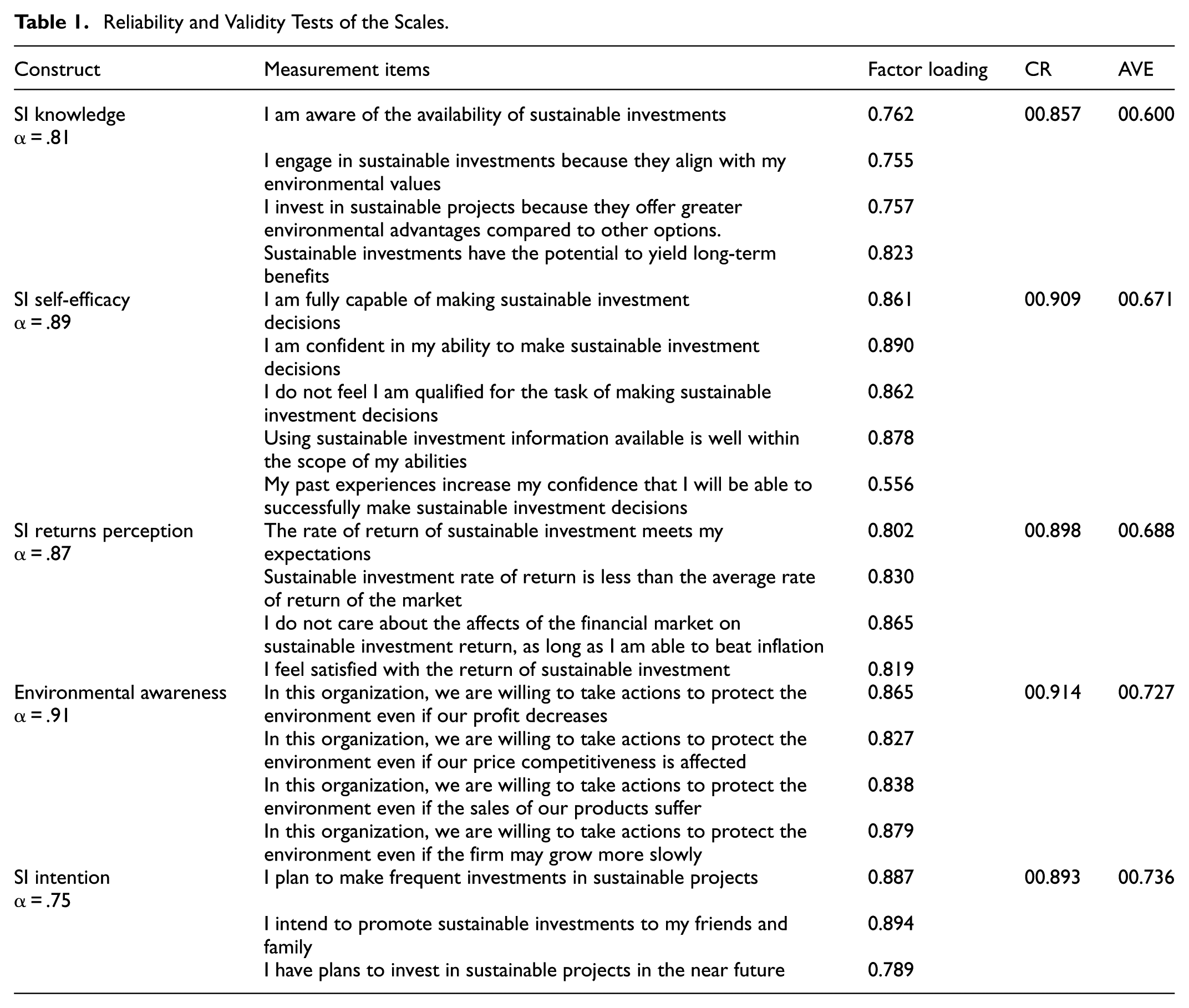
To assess the convergent validity of the scale used in this study, several indicators were examined, including Cronbach’s alpha (α), composite reliability (C.R.), factor loadings, and Average Variance Extracted (AVE). As shown in Table 1, the C.R. and α values for all the scales employed surpassed the threshold value of 0.7, indicating an appropriate level of internal reliability. These values were as follows: SI knowledge (α = .81, C.R = 0.86); SI self-efficacy (α = .89, C.R = 0.91); SI returns perception (α = .87, C.R = 0.90); environmental awareness (α = .91, C.R = 0.91); and SI intention (α = .75, C.R = 0.89).
Reliability and Validity Tests of the Scales.
To evaluate the discriminant validity of our studied variables, confirmatory factor analysis was conducted. Results showed that the five-factor model (SI knowledge, SI self-efficacy, SI returns perception, environmental awareness and SI intention) demonstrated an acceptable fit (χ2(179) = 3.57, RMSEA = 0.07, CFI = 0.92, TLI = 0.91, SRMR = 0.06) and was better than the alternative models (Table 2).
Comparison of Different Measurement Model.

Note. N = 478; K = sustainable investment knowledge; S = sustainable investment self-efficacy; R = sustainable investment returns perception; A = environmental awareness; I = sustainable investment intention; “+” = combination of the factors.
Measurement Model Analysis
Table 3 presents the means, standard deviations, and correlations for all of the studied variables.
Descriptive Statistics and Correlations.

Note. N = 204.
p < .05; **p < .01.
Tests of Hypotheses
We used multiple regression analysis to test hypotheses. The analysis results are shown in Table 3. Model 3 shows that after controlling the effect of control variables SI knowledge was positively related to SI intention (β = .23, p < .001). Thus, Hypothesis 1 was supported.
Model 1 and 2 report the relationship between SI knowledge and SI self-efficacy, as well as SI knowledge and SI returns perception. The results showed that SI knowledge was positively related to SI self-efficacy (β = .36, p < .001) and SI returns perception (β = .41, p < .001). Thus, Hypothesis 2 and 3 was supported.
When adding SI self-efficacy and SI returns perception into the Model 4, we found that SI self-efficacy and SI returns perception were both positively related to SI intention (β = .25, p < .001; β = .10, p < .05). We also calculated the indirect effects of SI knowledge on SI intention through these two mediators. The results supported the significant mediation roles of SI self-efficacy (estimate of indirect effect = 0.10, 95% CI [0.06, 0.13]) and SI returns perception (estimate of indirect effect = 0.04, 95% CI [0.01, 0.09]) in linking SI knowledge and SI intention. Thus, Hypothesis 4a and 4b were supported.
Hypotheses 5 and 6 proposed that environmental awareness will moderate the relationships of SI self-efficacy on SI intention and SI returns perception on SI intention. We added the interaction items into the Model 5, the results revealed that the interaction of SI self-efficacy and environmental awareness were significant on SI intention (β = .14, p < .01), while the interaction of SI returns perception and environmental awareness were nonsignificant on SI intention (β = .02, ns). Further, simple slopes were computed and the interactions were plotted in Figure 2. Simple slope analysis showed that the effect of SI self-efficacy and SI intention is stronger for higher levels of environmental awareness (β = .40, p < .01) than for lower levels of environmental awareness (β = .25, p < .01). As a result, hypotheses 5 was verified, however hypothesis 6 was not.

The moderating effect of environmental awareness.
Hypothesis 7a and 7b investigate whether environmental awareness moderates the indirect effect of SI knowledge on SI intention. We computed the conditional indirect effects of the independent variable (i.e., SI knowledge) at varying levels of the moderator (i.e., environmental awareness) by following the procedures recommended by Preacher and Hayes (2004) for Model 7. The results for the conditional indirect effect (see Table 4) showed that at high levels of environmental awareness, SI knowledge had a stronger indirect effect on SI intention via SI self-efficacy (β = .073, CI [0.026, 0.133]) than it did in the low environmental awareness condition (β = .064, CI [0.031, 0.103]). Thus, hypotheses 7a was verified, however hypothesis 7b was not.
Results for Mediation Effect and Moderated Mediation Effect.

p < .05; **p < .01; ***p < .001.
Discussion
Based on the social cognitive theory, this study examined the relationship between SI knowledge and SI intention through SI self-efficacy and SI returns perception, as well as the buffering role of environmental awareness. Our study of 478 senior managers in China found that SI self-efficacy and SI returns perception mediate the relationships between SI knowledge and SI intention. Moreover, we found that environmental awareness significantly moderated the indirect relationship between SI knowledge and SI intention by strengthening the relationship between SI self-efficacy and SI intention.
Theoretical Implications
This study makes several theoretical contributions. First, this study provides a relatively new perspective to understand the antecedents of sustainable investment (SI) intention. Previous research has shown that the determinants of SI encompass various economic conditions (Eyraud et al., 2013), governance (ESG) factors (Pástor et al., 2021), policy incentives (Dong et al., 2016), and investor preferences (Gutsche et al., 2021), it has largely overlooked the cognitive frameworks of the senior managers who ultimately make these pivotal decisions. This is a surprising omission given that senior managers play a critical role in investment decision-making (Hayles et al., 2010; Hsiao et al., 2019). Thus, the current study addresses this gap by introducing and empirically validating the role of senior managers’ SI knowledge. In support of our hypothesis, the findings reveal a significant and positive relationship between SI knowledge and SI intention (β = .23, p < .001). This result is crucial as it suggests that knowledge operates as a key cognitive resource, fundamentally shaping an individual’s decision-making calculus for sustainable investments. More than just possessing information, specialized knowledge appears to reduce the perceived complexity and uncertainty associated with SI, enabling managers to better recognize its strategic value and long-term opportunities. This finding extends the established link between financial literacy and general investment behavior (Ademola et al., 2019; Hani et al., 2020) into the specialized and increasingly critical context of corporate sustainability.
Second, based on social cognitive theory, this study contributes to provide a mechanisms underpinning SI knowledge on SI intention by highlighting two theoretical mechanisms: SI self-efficacy and SI returns perception. To date, scholars have largely relied on theory of planned behavior (TPB) to examine the attitude and intentions toward SI intention (Goel et al., 2022). However, making SI is a matter of both extrinsic and intrinsic motivation (Gilal et al., 2019). The theoretical framework connecting motivations with behavior has yet to be fully applied. Thus, We address this by employing social cognitive theory to study the intentions toward sustainable investment behavior. We found that the influence of SI knowledge on SI intention is significantly mediated by both SI self-efficacy (indirect effect = 0.10, 95% CI [0.06, 0.13]) and SI returns perception (indirect effect = 0.04, 95% CI [0.01, 0.09]). This is a pivotal finding because it unpacks the causal process: knowledge doesn’t just directly lead to intention; it works by first empowering managers. Specifically, greater knowledge appears to bolster a manager’s confidence in their ability to successfully execute SI initiatives (self-efficacy) while also shifting their perception of SI outcomes from mere costs to strategic, long-term returns. This work extends prior research on self-efficacy and outcome expectations in general sustainable behaviors (e.g., Font et al., 2016; Phipps et al., 2013; Rakib et al., 2022) to the critical and distinct context of senior managers’ investment decisions. In doing so, we not only confirm the importance of these two constructs but also provide a clearer theoretical story for why fostering SI knowledge among leadership is so effective.
Third, this study investigated the moderating role of environmental awareness. Previous research has indicated that stakeholders (Yuan et al., 2024) and regional factors (Yuan et al., 2022) are significant influences on final decision-making. Expanding on these findings, we explore how investors with strong environmental awareness can motivate companies to adopt sustainable practices (Zhou & Jin, 2023). As hypothesized, environmental awareness significantly strengthened the positive relationship between SI self-efficacy and SI intention (β = .14, p < .01). This suggests that pro-environmental values act as a motivational amplifier. For a manager who already feels capable of executing an SI strategy (high self-efficacy), strong personal environmental values provide the necessary normative “push” to translate that capability into a firm commitment. This is consistent with prior work indicating that environmental values are a key ingredient in activating sustainable behaviors (Berry & Yeung, 2013; Gutsche & Ziegler, 2019; Riedl & Smeets, 2017; Rossi et al., 2019). Contrary to our hypothesis, environmental awareness did not moderate the link between SI returns perception and SI intention (β = .02, ns). A plausible explanation lies in the primacy of financial logic. While sustainable investment involves environmental goals, the very consideration of “returns” likely primes a dominant economic decision-making frame. This interpretation aligns with research showing that when financial returns are at stake, investors may be less inclined to sacrifice them for non-financial benefits (Paetzold & Busch, 2014). In short, we therefore shed new insight into the boundary conditions and adds to our understanding of the relationship between environmental awareness and SI intention.
Limitations and Future Research
As with all research, the results of this study must be viewed in light of its limitations. First, our survey is a three-wave survey of self-reported data. In the future, researchers can adopt experimental designs to establish the causal relationships and longitudinal studies to track changes in sustainable investment behavior over time. The use of big data analytics and machine learning techniques is also proposed as a way to analyze large-scale datasets from real-world investment behaviors, which would complement self-reported measures. Second, this research focused on SI intention not the actual SI behavior, although it is generally believed that the behavioral intention is a good proxy for the actual behavior (Ajzen, 2020). Thus, researchers can further investigate SI behavior by tracking investigation in the future studies. Third, in the present study, we choose environmental awareness as a moderating variable, future research may consider other possible values as moderators in the relationship between SI knowledge and SI intention.
Managerial Implications
The findings of this study have important managerial implications for organizations and managers seeking to promote SI practices. Based on the results, the following implications can be derived:
First, to promote sustainable investments within organizations, senior managers should prioritize improving their knowledge of sustainability issues and environmental awareness.. This can be achieved through comprehensive training programs, workshops, and educational resources focused on SI principles, strategies, and benefits. By equipping managers with the necessary knowledge, organizations can empower them to make informed decisions and drive positive change through SI practices. Additionally, encouraging senior managers to participate in environmental conservation activities, sustainability campaigns, and partnerships with environmental organizations can enhance their environmental awareness and further reinforce their intention to engage in SI practices. In the context of policy implications, governments and international bodies can play a crucial role by incentivizing such initiatives through grants, tax breaks, or recognition programs for organizations that demonstrate leadership in sustainability.
Second, recognizing the influential role of self-efficacy and returns expectation, organizations should focus on building the confidences and managing the perception of returns and benefits of senior managers in their ability to engage in SI. This can be achieved by creating a supportive environment that encourages skill development, knowledge sharing, and provide accurate and transparent information about the potential financial and social returns. Policy recommendations could include the introduction of clearer frameworks for evaluating the social and environmental returns of sustainable investments, providing benchmarks, and ensuring that financial instruments are designed to encourage sustainable practices. Emphasizing the successful experiences of senior managers who have effectively implemented SI initiatives can inspire and motivate others to take on SI-related challenges. Demonstrating the financial viability and positive societal impact of SI can help alleviate concerns and increase managers’ motivation to engage in SI practices. Governments could support such initiatives by developing policies that ensure transparent reporting of social and environmental performance, creating a supportive regulatory environment for SI adoption.
Conclusion
In conclusion, this study explored the relationships between SI knowledge, SI self-efficacy, SI returns perception, and SI intention, with the moderating role of environmental awareness. The findings shed light on the mechanisms through which SI knowledge influences senior managers’ intention to engage in SI practices according to social cognitive theory. Furthermore, we identify a boundary condition (i.e., environmental awareness) for the relationship between SI knowledge and SI intention. The findings expend the understanding how to promote sustainable investing and offer valuable guidance for managers, policymakers, and organizations seeking to promote sustainable investing practices and contribute to the achievement of environmental and social goals.
Footnotes

Ethical Considerations
Ethical review and approval was not required for the study on human participants in accordance with the local legislation and institutional requirements. The study was conducted in accordance with the local legislation and institutional requirements. All participants were informed about the study’s purpose, the voluntary nature of their participation, and their right to withdraw at any time. Informed consent was obtained from all participants prior to their participation in the survey.
Funding
The authors received no financial support for the research, authorship, and/or publication of this article.
Declaration of Conflicting Interests
The authors declared no potential conflicts of interest with respect to the research, authorship, and/or publication of this article.
Data Availability Statement
The datasets generated and/or analyzed during the current study are available from the corresponding author on reasonable request.