




Abstract
This study aimed to investigate the impact of values and numerous other social and psychological influences on the sustainability of costume appearance. According to the ideological basis of the social values theorem, information was gathered directly through current cognitive constructs, such as an individual’s opinions. Both internal and external influences of lifestyle on costume appearance are depicted within the research framework. An empirical survey was employed to collect data, including 239 respondents from 2 Fashion design universities. The analysis exhibits that internal and external values influence the Bangladeshi young generation’s costume appearance sustainability has a positive impact. It also shows, the social media factor has high significant values within this study context. However, from the psychological perspectives of costume appearance, shopping tendency, and fashion trend would have a moderate effect. Then, several future research directions can be drawn to improve the cross-cultural ideology on social and psychological values regarding costume appearance.
Introduction
Costume appearance is a nonverbal form of sustainable communication that includes a person’s external assemblage of clothes on the body, as well as all modifications and adjustments to the body (Johnson et al., 2014; Joy et al., 2012). Hereditary features such as gender, race, and physical development are also included. On a personal level, a costume and its appearance, will reveal information about the wearer’s values, behaviors, passions, and way of life, as well as social and psychological relations (Rosenbusch et al., 2020). The consumers’ costume appearance is very visible, causing people to shape perceptions or draw various cues about the user based on psychological influences. Psychological and social ideals are intertwined with costume appearance and how a personal dress shows psychological values (Miller-Spillman et al., 2012). According to studies, values affect behavior; every person has and follows a set of principles that direct their thoughts and influence their behaviors (Kahle, 1996). The exact mechanism by which these driving principles or ideals operate is unknown. Values are the most abstract form of social cognition; they are also helpful in interpreting behaviors (Beatty et al., 1985). Values may be categorized as external or internal, as externally-oriented, or social aspects are based on human relationships and are characterized by others’ assumptions (Rose et al., 1994). External qualities include being well-liked, expressing one’s personality, being fashionable, and having a sense of belonging. Internally focused ideals are those that are concerned with the person. People who place a higher priority on inner or psychological beliefs are more likely to choose to control their lives and less concerned about others’ views (Kahle, 1983). Self-satisfaction, pleasure, rewarding, enjoyment, and a sense of success are examples of internal values. According to socio-cultural and financial studies, a change in social values, mindsets, and society is currently accompanying generation’s growth and financial strength. And current potential university or college students in the country are members of the young generation. Young attitudes and beliefs characterize this generation. It is projected to have a significant impact on consumer economies, national politics, occupations, and society, considered as the Baby Boomers did in the early 1970s (Weiss, 2003). Because of its strength and economic importance, this cohort of the growing generation is a consumer group to admire.
Bangladeshi fashion design students are well-suited to learning customer behavior, fashion, as well as costume appearance. They have had a visible impact on traditional culture’s styles (Minhus & Huie, 2021b). This group’s impact on fashion can be defined as a style strain from a social, political, and financial perspective (Maran et al., 2020). These results point out two distinct traits of Bangladesh: fashion awareness and a willingness to expend money on clothes to maintain a current appearance for sustainability. Limited information is available about Bangladeshi fashion design students’ costume appearance issues, especially when it comes to values, social, and psychological influencers. This research is significant because it will aid in understanding the impact of values, as well as numerous other social and psychological influences on the sustainability of costume appearance among Bangladeshi fashion students. And the value system adds to the image of the fashion-conscious market (Goldsmith et al., 1991). More information might help marketing experts and retailers understand the younger generation’s demands, given their awareness about specific fashion trends. (Graves, 2003; Pencarelli et al., 2020). A greater understanding of this demographic will lead to more direct and effective campaign strategies (Hur & Cassidy, 2019; Joy et al., 2012). Furthermore, a better understanding of the young generation’s values may aid sellers in providing more appealing apparel options for this fashion-conscious and financially capable group of young people (Gazzola et al., 2020).
The analysis of external and internal values is critical to the study of costume appearance because values affect people’s habits and perspectives, which are reflected in their clothing and appearance (Lianto et al., 2019; Minhus & Huie, 2021a). Additional research studies on the links between value (psychological and social) and fashion, style leadership, and consumer behavior have been proposed by researchers. Individuality, self-expression, and becoming and doing things in various forms are all illustrated in the current Bangladeshi aesthetic of costume appearance. If the focus is unquestionably on disparities, there is a need to explore both external and internal principles to understand how and why Bangladeshis, as well as consumer segments within the region need to be aesthetically distinct.
Theoretical Overview
In contrast to other self-controls, ideas of the social psychology of costumes are comparatively recent. The study of the social science of clothing has a short history. Sybers and Roach (1962) provides early documentation of leading scholars’ initiatives. When scholars sought to learn more about human habits, they became increasingly interested in the sociological aspects of clothing (Mulhern, 2009). As principles and also productive testing analysis methods progress, the social-psychological field of costume continues to evolve. Several hypotheses can be used as a framework for this type of study.
However, since it incorporates the social as well as psychological aspects of an individual’s reasoning and behavior, which helps in the formation of values; social change will undoubtedly provide the empirical basis for this research. One of psychology’s most advanced immersive ideas underpins social adjustment (Hwang & Choi, 2018). According to the definition of social adjustment, individuals transition to new life positions is partly by value advancement and satisfaction (Kusá & Urmínová, 2020). Knowledge can also assist in the strengthening of established cognitive systems as a result of expanded connectivity. The information is then organized to create new details with anticipation. This method will modify both new and old data, resulting in a more complicated mix of information. Each individual’s assimilation and particular interpretations will be remarkable. Still, commonalities in perceptions and semantic atmospheres, such as those experienced by individuals in a certain demographic group, will inevitably result in quantifiable correlations and patterns of reaction (Stern, 2011). This may also be useful for people in subcultures. People gain information by interacting with their surroundings, and their beliefs grow due to these life experiences (Figure 1).

Factors of social and psychological values for costume appearance.
Social adaptation is a cognitive psychology paradigm that fits within the context of social psychology theory that can be used to investigate the sense of costume. The study of costume concepts focuses on the relationship between costume appearance and cognition, especially social awareness. And this study of social cognition focuses on the psychological framework, or more specifically, the foundations for people’s attitudes and values while making judgments about other people (Lennon & Davis, 1989). Social awareness is related to effect production in a far more recent analysis in fashion marketing (Chung & Kim, 2020). When we look at how individuals shape views, we find that they can do so because they have formed developmental classifications to cope with the large quantities of knowledge they have acquired on one another (Johnson et al., 2002). So, psychological categories help to define facts, infer additional data, concentrate on the big picture, and simplify interpretation. The social values theories and ideas discussed are restricted to people implying knowledge about others based on their costume appearance. Just the self-perception hypothesis presented an alternative to getting insight into a personality through the person’s self-examination. This concept is part of the social values psychology context. It can also be considered a perspective within the social adjustment concept since it provides for human assessment of the other addressed or considered principles. The definition is ideal for individuals who are in a social group. Because of the exciting information that both can offer, it is necessary to concentrate on individuals as well as social issues for this analysis (Gullstrand Edbring et al., 2016). Social modification is a compelling theory to use for this analysis since it causes the individual’s structure to be analyzed, enabling everyone to self-examine themselves both internally (directly) and publicly (socially) to understand their costume appearance, sustainability and human actions (Figure 2). Thus, this study discusses internal-external values of a person’s daily life to draw a clear concept that is interconnected with social and psychological influences. Jiseul and Johnmarshall also highlighted prototypical external values in their article through aspirations for future prosperity, attractiveness, and social position (Ahn & Reeve, 2021). However, Niemiec et al. (2009) and Vansteenkiste and Ryan (2013) argued that pursuing external values directs a person’s everyday life in a course that results in psychological needs dissatisfaction or, at most, indirect demands fulfillment that is fleeting and depending on social acceptance or reinforcement.
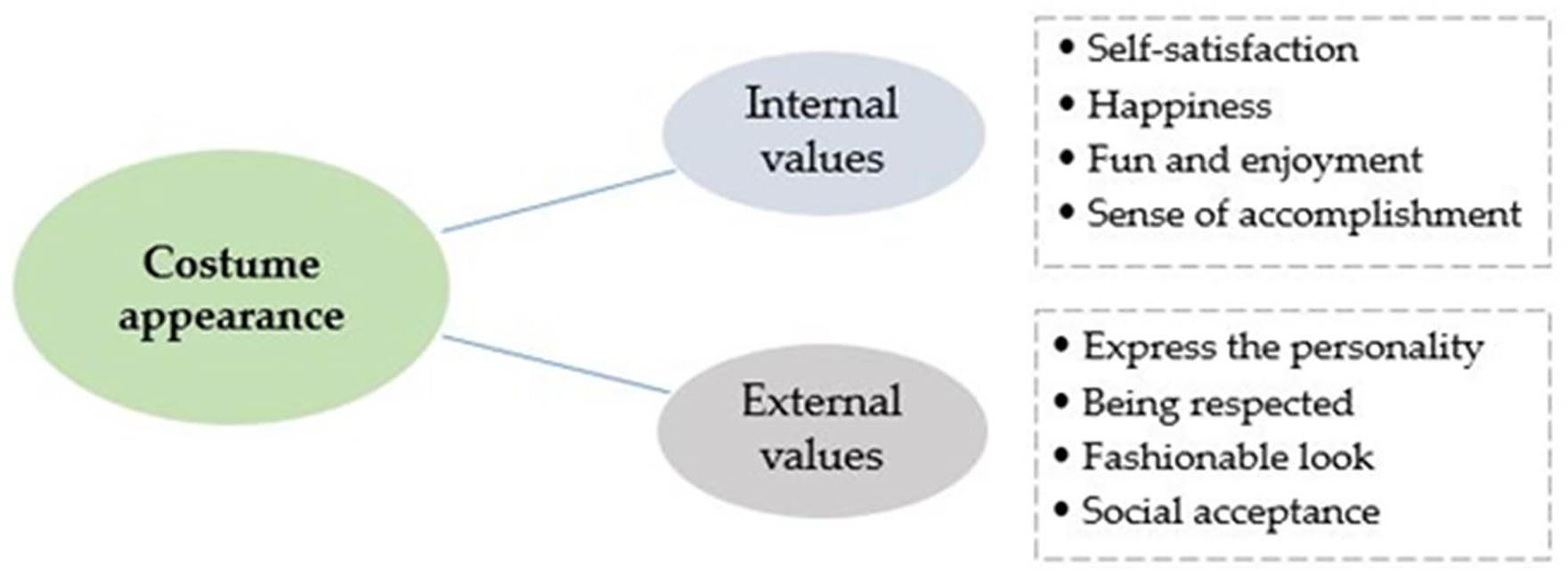
Internal and external values for costume appearance.
In addition, retaining, seeking, and even getting internal values to prepare a person for a lifestyle of regular desires fulfillment, whilst carrying, seeking, and also getting external values to prepare a person for life mostly free of demands, contentment, or even annoyance. Internal value formation was linked to psychological well-being according to observational research and meta-analyses, and this effect has been validated globally, regardless of cultural context (Kasser et al., 2014; Kim et al., 2003; Lekes et al., 2010).
Social Values
Social variables are indifferent to external values. Focus placed on an outfit as well as look by a person is influenced by social and other elements. In this research, social aspects consist of media and also referent teams such as vicinal as well as members of the family that are thought to have a direct influence on individuals’ costume appearance. Individuals usually are responsive to the numerous social influences around them.
Media can be connected to costume appearance and used as a conduit of information are often known to significantly style value structures (Bendoni, 2017; Villani, 2001). In everyday life, media helps people’s style values, ideals, and systems (Al-Obaidi et al., 2004). It has the power to teach and can have a direct or indirect effect on an individual’s appearance. In today’s world, the influence of media is enormous because media are distributors of mass culture, which encompasses costume appearance (Cusic, 2001). Every day, young generations are influenced by different forms of advertising, such as television, movies, radio/music, and music videos, magazine, websites, and the internet (Mulhern, 2009). The internet, television, music, and print media are all available to this generation, dominating their recreational habits. Family, neighbors, and friends play an essential part in influencing young people’s costume appearance through socialization (Kaplan & Haenlein, 2010). This everyday contact is referred to as socialization, and it is critical in forming a person’s social and psychological foundation for working in society.
Psychological Values
Psychological factors do not have the same effect as societal factors. Psychological factors are most closely linked to personal values and belief structures. They help to provide a description or thought about an individual’s sense of personality as a social entity. Psychological factors that help to decide appearance are generally used in costume and even appearance research. Self-consciousness, self-direction, fashion trends, shopping satisfaction, and investment behaviors are also psychological influences (Hur & Cassidy, 2019; Pencarelli et al., 2020). Positive self-image and self-consciousness are two individual characteristics that can provide insight into their relationship with themselves.
Clothing and fashion are mediums by which people can communicate their distinctive identities and visions of themselves. Fashion icons are much more fashion-forward, and they search for originality in their outfits and appearances. Internal values of individuals stress their individuality and individual desires to set themselves apart from others (Chung & Kim, 2020; Jung & Jin, 2016). An internal value-directed individual tends to be a non-conformist in clothing and fashion, as a subcultural style follower, or a style pioneer (Miller, 2007). Those who went deep to match the outfit, as well as the standards of others, are defined as an external factor. People who are guided by others perceive fashion as a means of adapting to other people’s clothing, leading them to become conformists or fashion followers. The market study as well as apparel research about shopping pleasure and finances, have shown that Bangladeshis are very involved and knowledgeable about fashion; they love purchasing and spend a large portion of their income on clothing and apparel-related goods or services. Bangladeshi university students are part of a new generation, and the provided theory is drawn from the above discussion of social and psychological principles in the direction of costume appearance sustainability.
Methodology
Sample
This research aims to explore the sustainability of costume appearance objectives of consumers within the range of the young generation. The method employing survey data has been applied in this article which is also widely used in social scientific researches as well as educational sciences. This study constitutes a non-random comfort sample of Bangladeshi Fashion Design University students enrolled at two universities. Universities selected for the analysis were ideal because of the number of students who specialized in fashion design. Due to respondent specialization in the related field, the collected data was more consistent and relevant to our research. The study is significant since the research focuses on the influence of social and psychological values on Bangladeshi costume appearance. Our sample design is similar to Susie Andretta (2012), who took participants based on their professional background (Andretta, 2012). Though it is challenging to consider this small number of individuals as the representative of Bangladeshi young generations, selected individuals have expertise about fashion trends and market demand with an aware sense of costume behavior.
Data Collection
The information collection was finished in a predominate university’s student union from February 2019 to May 2019. At first, the author was spoken to both university officials to consent for data evaluation among students. Secondly, the lecturer of those universities encourages students after lectures in various classes. They provide suggestions regarding the current style and research study process, and also this procedure took 3 months. The message was later sent to all students at the dominant university by email. The university also mandated that a representative community of students obtain the research. Appropriate University administrators were in charge of informing the student body about the study by email. The online research was set up in such a way that participants were expected to respond the questionnaire before moving on to the next. A total of 239 experiments were conducted and obtained online. Individuals sent an automatic thank-you message after the research session was completed.
For research, the semi-pre-coded SPSS data file produced from the online study was coded entirely. Detailed data and regularities were used to identify certain issues with the data processing. Data that was missing was handled on time. The aspects of modified acts and costume appearance elements were examined. For internal accuracy, integrity analyses were completed on the ranges used in the study.
Data Measurement
The survey data was used to assess both the dependent and independent variables in the sample. The costume appearance is denoted as our dependent variable. The research team developed a costume appearance scale based on the scholarly description. External components (media influence and vicinal impact), as well as psychological aspects, make up the independent variables (self-reliance, fashion trend, and shopping tendency). External values (express the personality, being respected, fashionable look, and social acceptance), as well as internal values (express the personality, being appreciated, fashion appearance, and social approval), are also included in the independent variables (self-satisfaction, fun, and also satisfaction, happiness, and also feeling of accomplishment). To extract information from the participants, a mixture of Likert-type scales and open-ended questions were used. Each study was graded on a 5-point scale, with 1 indicating strong disagreement and 5 indicating strong agreement. Demographic data was gathered. Except for the costume appearance, which was created by the researcher based on the literature, validated scales from published studies were used.
The confirmed scales used in this analysis were chosen based on three criteria. The first is their high level of dependability. Second, these criteria have been used by a host of other scholars. And finally, the measurements have been determined to be accurate and consistent indicators of the variables being tested.
Data Analysis Process
For any accumulated data, choosing an evaluation technique is required to draw an ideal conclusion from the information obtained. Prior to examining the hypothesized relationship, the researcher initially evaluated the information by screening for missing out on values and also outliers. Next, factor analysis was performed by utilizing SPSS to measure the dependability of variables, and Cronbach’s alpha was figured out to check for internal uniformity (Table 1). According to thumb rules, the acceptable values for each and every respective measurement utilized for internal uniformity evaluation are above or equal to .7 (Hair Jr et al., 2014). Cronbach alpha also called coefficient alpha, is one of the most commonly used estimators for internal consistency integrity. Nonetheless, it is referred to as an inconsistent estimator, and also it tends to assume that all the things measuring a construct are just as trustworthy. Thus, it undervalues the actual reliability of variable scores and is described as a reduced reliability limit (Henseler et al., 2016). In addition, when making use of coefficient alpha, the accepted value for indicating adequate dependability of the measurement items is .7 or higher (Hair Jr et al., 2014).
Reliability Scores for Scale Variables.

Further, in order to provide a far better view of the nature of the variables, the researcher performed a descriptive statistical analysis for all the variable scales. Nonetheless, it is necessary to evaluate if sampling information is suitable for factoring. Before performing multiple regression analysis and correlation matrix for the significance of the hypothesis, the researcher carried out exploratory factor analysis because the researcher customized the initial scales to a certain degree to suit the contextual requirements. First, factor loading was examined with principal component analysis to test the legitimacy of variables of each scale. Sampling adequacy was checked by utilizing KMO statistics and also Bartlett’s Test of Sphericity. The KMO procedure and also Bartlett’s test verified the relevance of our information set for factor analysis. The KMO value exceeds 0.5, the fundamental restriction for sampling adequacy. Hence, it is a legitimate indicator of the example sample size for factor analysis. Hypothesis analysis was performed as follows:
Method: Pearson Correlation
Method: Multiple Regression
Method: Multiple Regression.
Results
Characteristics of Participants
A total of 239 surveys were conducted and received via email. The average time it took to complete the online survey (N = 239) was 11 minutes. A total of 239 Bangladeshi university students were included in the study. Females made up 55.2% of the sample (N = 132), while men made up the remaining 44.8% (N = 107). The people in the example varied in age from under 19 to over 30. Respondents aged 20 to 22 made up 53.1% of the study, while those under 19 made up 22.2%. The rest of the people are over the age of 22. (Table 1). Only 33.9% said they were married, while 66.1% said they were single. 71.1% of the sample indicated that their hometown was Dhaka (a major city), while the remaining 28.9% indicated that they lived in a rural area. Moms and fathers, part-time jobs, and scholarships were their main sources of income. 55.6% of respondents said they still have a budget for garments, while 22.2% said they do so regularly. Surprisingly, 22.2% of the sample assign costume appearance materials only sometimes or never (Table 2).
Demographic Variables of Participants.

Descriptive Analysis and Variables
Any object on the scales used in this analysis was chosen for its high level of reliability. Because of the reliant vector, element analysis was first performed on the costume presence scale (Table 3). Since the researcher created the costume appearance selection, it had to be evaluated for internal accuracy and authenticity. For each range used in the study, reliability ratings were established (Table 1). Because of changes made to the previously validated ranges to fit them to this analysis, the vicinal effect range and the shopping tendency range were checked for validity and reliability. Since the current vicinal impact scale contained four variables, reputation screening was required. Two verified shopping tendency ranges were combined with moving for shopping pleasure, so the shopping tendency range products were tested. In the social elements effect area, the results of the variable assessment for the vicinal effect spectrum are discovered. Factor analysis results for the shopping tendency range are discovered in the psychological influence area.
Costume Appearance Scale Variables Factor Loadings.

Note. Extraction method: Principal component analysis.
Independent items were used to calculate certain factors, while scales were used to evaluate others. Descriptive analyses were conducted with single-item variables, and the findings were consistent. Factor analysis and credibility assessment were conducted on each multi-item variable, after which a variable ranking was calculated as the mean of the objects, and eventually, a thorough analysis was performed on the variable. The five-variable costume appearance scale was subjected to principal component factor analysis (Table 3). Low absolute values were assigned to one component on the scale (0.594). The aspect score measured during the variable assessment was saved as a variable and used as the costume appearance variable in the study. To verify the construct, reliability testing was performed. The alpha for the five variables dimension was .60 (N = 239).
The costume appearance protocol was discovered to consist of five-variables after variable assessments to assess comprehension of the dimensions of the costume appearance build. The scale’s standard score was .60 (N = 239; Table 3). Large scores on this scale showed that the respondents were conscious of the elements that make up their overall appearance. The majority of the participants agreed upon the factors. Students at the university decided on both factors (Table 4). Respondents agreed that they recognized their costume presentation based on the mean score measured for the whole outfit and appearance spectrum
Costume Appearance Descriptive Analysis.

Note. N = 239. Missing = 0.
Values Implication on Everyday Life
In everyday life, eight values thought to be essential to Bangladeshis for costume appearance were calculated. Internal or external values are assigned to these values. External principles include: (happiness, fun and enjoyment, self-satisfaction, and a sense of accomplishment). External values include: (express the personality, being respected, fashionable look, and social acceptance). A single object was used to calculate each value. Table 5, displays the outcomes of frequency assessments for every function. To include in a table format, the reaction types were broken down into three classes.
Rating of Values Implication on Everyday Life.

All four internal values in the list of values rated the highest possible of all values considered essential in the day-to-day life of this group of the young generation. The value thought about to be one of the most crucial in this research study every day was self-satisfaction. Self-satisfaction, an internal value was specified as being certain with who you are. Outcomes of regularity evaluations conducted to identify one of the most essential values each day are shown in Table 5. From external values, fashionable look shows up crucial by the young generation.
Analysis for Social Values (Media and Vicinal Influence)
Respondents indicated that they saw costume in the promotion and the latest fashion when it came to the social variable, media effect (Table 8). Most of them were inspired by the media celebrities’ costumes. A Likert-type scale was used to determine media use, with 1 suggesting strong disagreement, 3 indicating average, and 5 indicating strong consensus. According to the mean score computed for the entire media effect scale (N = 239), respondents had mixed feelings regarding the media’s effects, meaning that they can conclude that publishing impacts their costume appearance (Table 6). The significance of media influence for costume presentation is shown in Table 7, by KMO and Bartlett’s examination. The media influence scale had an alpha of .821 (Table 2).
Media Influence Scale Variable’s Factor Loadings.
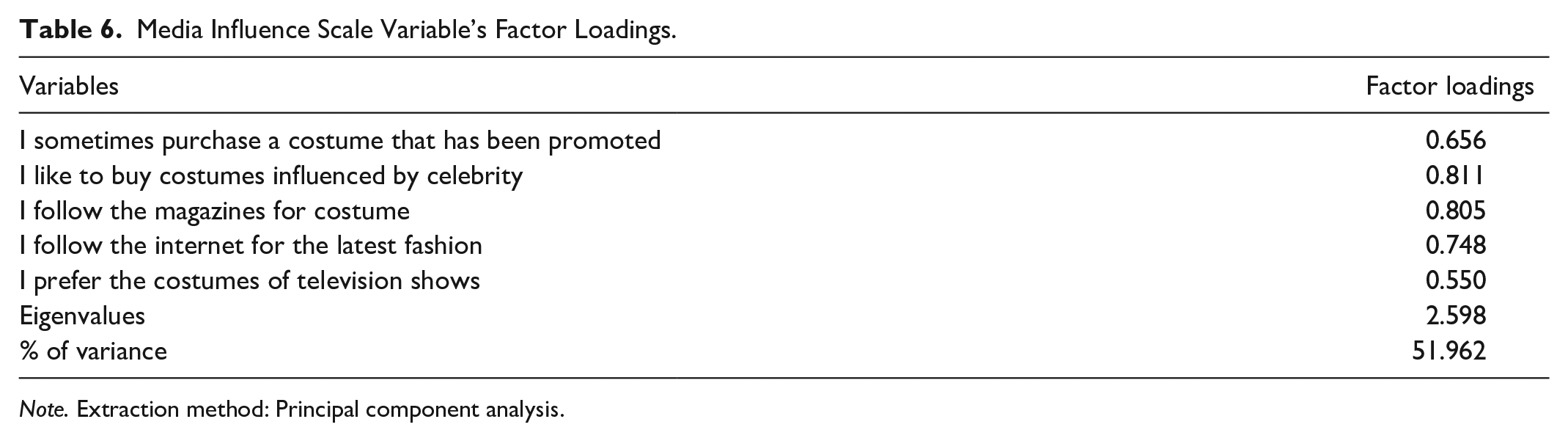
Note. Extraction method: Principal component analysis.
KMO and Bartlett’s Test for the Significant Value of Media Influence.

Media Influence Descriptive Analysis.

Note. N = 239. Missing = 0.
The four-variable vicinal effect spectrum was subjected to principal component factor analysis. For the vicinal effect factors, both of the variables have a high factor loading (Table 9). The test is discovered as a product of the factor analysis and strong inter-variable correlations of honesty. For statistical analysis, the factor score was saved as a vector and used as the vicinal effect variable. The test performed by KMO and Bartlett shows the significance of vicinal influence for costume appearance (Table 10).
Vicinal Influence Scale Variables Factor Loadings.

Note. Extraction method: Principal component analysis.
KMO and Bartlett’s Test for the Significant Value of Vicinal Influence.

Participants concurred that friends would certainly not object to their purchasing the latest styles. Nearly half of the people polled believed that their families and immediate neighbors would help their decision to purchase the latest fashions. In end, participants’ special days inspire them to purchase the new fashions (Table 11). However, in this study, the young generation assumes that their family members will help them in buying the most recent style to remain present, but will not allow students to purchase the most recent models. To measure vicinal impact, a Likert-type scale was used, with 1 indicating strongly disagree, 3 indicating average, and 5 indicating strongly agree. Based on the mean score computed for the whole vicinal impact range, respondents, in general, felt positive about vicinal impact.
Vicinal Influence Descriptive Analysis.

Note. N = 239. Missing = 0.
Analysis for Psychological Values (Shopping Tendency, Fashion Trend, and Self-Reliance)
Shopping tendency
As a result of combining all validated shopping ranges to provide one metric for reviewing shopping in this report, the shopping propensity scale was tested for validity and dependability. As a result of combining all validated shopping ranges to provide one metric for reviewing shopping in this report, the shopping propensity scale was tested for validity and dependability (Table 14). The results of the factor analysis for the shopping inclination spectrum are described in Table 12 below. Based on the KMO and Bartlett’s examination, this variable was significant and had a neutral viewpoint on shopping tendency (Table 13).
Shopping Tendency Scale Variables Factor Loadings.

Note. Extraction method: Principal component analysis.
KMO and Bartlett’s Test for the Significant Value of Shopping Tendency.

Shopping Tendency Descriptive Analysis.

Note. N = 239. Missing = 0.
Fashion trend
More than half of the participants (Table 15) were optimistic in their abilities to detect fashion patterns. On the other hand, the survey did not believe the fashion trend expressed their individuality and did not prefer to wear it for that purpose. According to the numbers, the young generation follows fashion trends and tries to buy ahead of time. The fashion pattern was measured using a Likert-type scale, with 1 indicating strongly disagree, 3 indicating average, and 5 indicating strongly agree (Table 17). According to KMO and Bartlett’s study, this variable was partly important and had a neutral view of themselves as a fashion theme (Table 16).
Fashion Trend Scale Variables Factor Loadings.

Note. Extraction method: Principal component analysis.
KMO and Bartlett’s Test for the Significant Value of Fashion Trends.

Fashion Trend Descriptive Analysis.

Note. N = 239. Missing = 0.
Self-reliance
This sample’s young generations were self-sufficient. The vast majority of respondents said that they are generally conscious of their abilities and that they are capable of making their own decisions (Table 19). However, factor loading and analysis showed that they are not substantially more self-reliant (Table 18). Overall, self-reliance was also partially significant for psychological values.
Self-Reliance Scale Variables Factor Loadings.

Note. Extraction method: Principal component analysis.
Self-Reliance Descriptive Analysis.

Note. N = 239. Missing = 0.
Hypothesis Test
H1: Both internal and external beliefs affect the Bangladeshi young generation’s costume look. Pearson’s association was used to look for links between costume presentation and internal and external values. The partnership was optimistic, implying that young people who care deeply for their looks have a proclivity toward strong internal and external ideals. As seen in Table 20, there was a strong positive association between costume appearance and external-external values (p. 01). The first hypothesis has a lot of evidence.
Correlations of Costume Appearance, Internal, and External Values. .

Correlation is significant at the .01 level (two-tailed).
H2: The most important force in costume presentation would be social media. To find the best linear combination of media and vicinal effect for predicting costume appearance, a regression analysis was conducted. Table 21 contains the means and standard deviations. F (165.267) = 2.417, p < .001, F (165.267) = 2.417, p < .001, F (165.267) = 2.417, p < .001, F (165.267) = 2.417, High scores in media impact contributed greatly to forecasting costume appearance, according to the beta weights of the variables. About .583 was the adjusted R2 value. This means that the study explained 58.3% of the difference in costume presentation. As a result, hypothesis two was verified.
Multiple Regression Analysis Summary: Means, Standard Deviations, Beta, Standard Error, and Significant Value for Costume Appearance and Predictor Variables—Media Influence and Vicinal Influence (N = 239).

R2 = .583; F (165.267) = 2.417, p < .001.
Dependent variable: Costume appearance.
H3: The most prominent psychological factor in costume presentation would be retail activity and fashion patterns. The most potent linear combination of shopping propensity, fashion pattern, and self-reliance for predicting costume appearance was analyzed using multiple regression. Table 22, contains the means and standard deviations. This set of variables significantly predicted costume appearance, F (56.824) = 2.723, p < .001, with all three variables contributing significantly to the forecast. The beta weight, which can also be seen in Table 22, indicates that high scores in shopping propensity are the most important in predicting costume appearance. In contrast, fashion trend and self-reliance appeared .42, was the modified R2 value. This meant that the study clarified 42% of the variation in costume appearance. As a result, hypothesis three was shown to be valid.
Multiple Regression Analysis Summary: Means, Standard Deviations, Beta, Standard Error, and Significant Value for Costume Appearance and Predictor Variables—Shopping tendency, Fashion trend, and Self-reliance. (N = 239).

R2 = .420; F (56.824) = 2.723, p < .001.
Dependent variable: Costume appearance.
Discussion
This study was significant since there had been limited research on the relationship between a Bangladeshi university student’s values and the sustainability of costume appearance. Furthermore, the study’s main goal was to better understand this segment of the population. Bangladeshi engagement in similar or related studies was comparatively low, and as a result, their activities were not prominently represented in the researchers’ findings and final thoughts. As a result, there was a deficit in the costume industry as well as relevant research studies that offered information on this particular category. This study of the influence of ideas and other social and psychological influences on fashion students’ costume appearance contributed greatly to filling a void in the literature and, as a result, is a perfect addition to the fields of social psychology and consumer clothing actions studies.
The research has made a substantial impact by examining a smaller sample of significant fashion students. In certain ways, members of younger generations are homogeneously categorized, inheriting the characteristics of the larger group while losing their individual characteristics. University students are used as a gain study in a variety of studies. However, they were the subject of this analysis due to their particular expertise as members of two segments with considerable purchasing power and presence in both fashion and industry for sustainable fashion (Chung & Kim, 2020; Ki & Kim, 2016). Nonetheless, learning fashion design separately from all main teams allowed for the creation of a smaller segment (consumer) profile, which has also provided valuable knowledge about people who are a big part of our society.
This young generation’s costume appearance was strongly affected by the internet. Businesses can benefit from focusing their advertisement campaigns and adapting their offerings to suit the needs of this segment of the population (Jung & Jin, 2016; Ruiz-Real et al., 2019). Young generations are prime users of media (TV, music, film, internet, etc.), and businesses can benefit by targeting their advertising projects and modifying their goods to meet the needs of this sector of the population (Bendoni, 2017; Ruiz-Real et al., 2019). Understanding the values, passions, and demands of a customer community, such as university-aged Bangladeshis, will result in increased earnings. There was evidence that the independent variables in the analysis were correlated when analyzing the literary works for this study. However, no independent variable was considered to be more significant than the other in affecting costume appearance. For this analysis, the theoretical version suggested was exact. The analytical version effectively clarified the relationship between the variables, and this is an exploratory analysis. As a result of the study, it was discovered that advertising control, fashion fad, self-direction, and buying inclination all influences costume appearance. Vicinal influences, such as friends and relatives, were not significant. One of the main goals of this study was to determine the impact of both internal and external beliefs on costume presentation. The students’ reactions to the items in the costume appearance range indicated that this group of students accepted the concept of dress and appearance. The survey supports O’Neal’s (1998) argument because Bangladeshis believe that they wear the same clothes as everyone else, it is how they use those clothing that identifies themselves.
Internal values were important in their daily lives, according to the students in this sample. Dignity as well as internal (psychological) virtues were the most important daily values. Self-reliance is described as taking pride in oneself and being secure in one’s outfit. Self-fulfillment (an intrinsic value), and being well-respected were the two most significant daily values (an external value). The principle of social adaptation establishes a social and psychological foundation for studying a particular costume appearance. It was appropriate to use in this research study when looking at how values and other social and psychological influences affect the young generation’s costume appearance for two reasons. The social adjustment concept’s fundamental foundation initially maintains that information is immediately integrated into internal cognitive constructs, such as beliefs. Second, since it takes into account all the social and personal elements of a person’s thinking.
The results of this research showed that this group of university students emphasized internal values, but that external values also had a positive connotation with their costume presentation. Furthermore, psychological (internally-driven) factors were significant predictors of costume appearance, while media exposure was the only social (externally-driven) factor that influenced the costume appearance of this group of students. According to the social adjustment hypothesis, the young generation in the sample is processing additional input from various influences and integrating it into their value base, resulting in the modification of internal principles to meet external requirements. In relation to social adjustment theory, insight is gained by communicating with surroundings, and beliefs are formed as a result of these life experiences. As a result, information is obtained by correspondence that alters current principles. The appearance of the suit is one way to show the adaptation. This indicates that the students in this sample are mindful of their costume appearance, a nonverbal form of contact, and have thereby accepted their internal values to satisfy their external demands. This statement will aid in the supervision of this young generation’s values as well as the control of their costume appearance for sustainability.
The strong positive relationship of external values with costume appearance as well as the effects of advertising indicated that with outside activities such as interaction, socializing, and media consumption, the participants in this research have become conscious of others’ values and behaviors. They have allowed external factors to form their own values and habits to satisfy the external standards of others. In this process, they are not subduing their own internal values; rather, they have adapted to their social environment while maintaining their psychological or internal values as a top priority. This habit shows that by being a member of a social group, such as a student, knowledge that may affect an individual’s values are communicated and incorporated implicitly by daily interaction with others. Nonverbal communication is a big part of social life. It is critical to note that both a person’s costume appearance and nonverbal information are forms of nonverbal communication that convey individual evidence containing both internal and external values.
The direction of costume appearance allows the young generation in this study to focus on internal values such as a sense of pride, self-esteem, happiness, and even enjoyment, as well as self-fulfillment. As a young generation, the emphasis shifts to achieving their goals (sense of success), being proud about and being confident in themselves (self-respect), seeking security and optimizing individual strengths (self-fulfillment), and leading a rewarding happy life (enjoyable as well as enjoyment). When it comes to university students, these ideals are success-oriented, and as a result, they must be regarded more highly internally than costume appearance. University is a time for many young people to reflect on themselves and demonstrate that they are committed to achieving their personal goals.
Conclusion
The study aimed to look at how values, as well as other social and psychological factors, affect the appearance of Bangladeshi university students. The knowledge of 239 university students from 2 university campuses was gathered using an email survey. The dependent variable for sustainability was costume appearance, while the independent variables were both external (being well-respected, expressing uniqueness, having a fashionable appearance, and social acceptance) and internal (self-satisfaction, sense of accomplishment, fun, and enjoyment, and happiness). External influences (media impact and vicinal influence (friends and family)) and psychological factors were also used in the independent variables (self-reliance, fashion trend, and shopping tendency). The social adaptation theory established the study’s theoretical framework.
External values were aligned with this category of the young generation’s costume presentation positively. Internal principles were crucial in their day-to-day activities. Three of the four internal principles in the sample are ranked as the most important to the young generation. A sense of achievement, self-reliance, fun, and pleasure, and a sense of accomplishment were among the values identified. The most crucial value of all virtues was self-reliance. Friends and family were far less accurate predictors of costume appearance than the media. Both of the psychological variables (self-confidence, fashion trend, and shopping tendency) had a moderately significant effect on the version and contributed to the impact of costume appearance. But shopping has the greatest psychological effect of all the psychological causes. As a result, the study was discovered to be conscious and positive about their costume appearance. They enjoyed wearing the new fashions but did not believe themselves to be trendy at a party. This generation of young people loves shopping for current fashions.
This study covers the students from fashion design universities as a representative of the young generation. Future studies can be conducted in a wide range of scope. At the same time, a comfort sampling method might be used in this research, and generalizations can be made by utilizing probabilistic tasting techniques in future research. Extensively, the research can be conducted by comparing different countries to draw the influence of cross-cultural distinctions.
Footnotes
Declaration of Conflicting Interests
The author(s) declared no potential conflicts of interest with respect to the research, authorship, and/or publication of this article.
Funding
The author(s) disclosed receipt of the following financial support for the research, authorship, and/or publication of this article: This research was funded by the Major Projects of Philosophy and Social Sciences Foundation of the Jiangsu Higher Education Institutions of China (Grant No. 2019SJZDA021).
