




Abstract
The Cognitive–Experiential Self-Theory (CEST) proposes rationality and experientiality as independent personality constructs explaining how people process information. Recent empirical studies show that some people have low scores on both of these dimensions (the so-called disengaged profile). Another model, Seeking Proxies for Internal States (SPIS), primarily proposed to explain obsessive-compulsive tendencies, provides a framework under which both rationality and experientiality can be understood as internal resources of a person. Low rationality and experientiality could thus be overcome by seeking external clues. In two subsequent studies on independent nonclinical samples (psychology students N = 268 and technical sciences students N = 549), we examined the relationship between constructs from CEST and SPIS models, and in addition, explored their patterns of interoceptive awareness (IA) in Study 2. A latent profile analysis showed that the disengaged profile was related to high SPIS and OC tendencies in both samples. In addition, rationality and experientiality had similar and more positive correlations with some IA dimensions, compared to SPIS (and OCI)—IA correlations. Thus, impaired connection to internal states together with OC tendencies might contribute to the understanding of the specific thinking style of those who do not primarily rely on either rationality or experientiality.
Keywords
Introduction
Considering the way people process information and approach the world, individual differences are usually related to rational/analytical/logical versus automatic/intuitive thinking styles (Phillips et al., 2016). Is it possible to process information in any other way? The answer to this question depends on whether the two styles are assumed to be the opposite ends of one dimension or independent dimensions. While the former assumption implies that lower rationality is followed by higher intuition and vice versa, the latter retains a possibility that different combinations of these dimensions can be identified. The empirical support is better for the latter (Hodgkinson et al., 2009; Wang et al., 2017), showing that some people use rationality and intuition equally, in a higher or lower degree (Fletcher et al., 2012; Jokić & Purić, 2019). A number of studies have explored the rational and intuitive thinking styles and their correlates (Akinci & Sadler-Smith, 2013; Branković, 2019; Broyd et al., 2019; Witteman et al., 2009), while, as far as we know, there has not been any research specifically focused on thinking styles of those who do not primarily rely on either rationality or intuition, that is, the disengaged thinking style (Fletcher et al., 2012). How do these persons process information?
In search for answers to those questions, we followed the concepts of the highly cited Cognitive-Experiential Self-Theory (CEST; Epstein, 2003, 2016; Pacini & Epstein, 1999), which proposes rationality and experientiality as independent dimensions and original personality constructs. In this article, intuition and experientiality are used as synonyms, while in later work within the CEST paradigm experiential dimension has been theoretically and empirically developed with three factors: intuition, emotionality, and imagination (Norris & Epstein, 2011).
Although the authors have discussed adaptive difficulties of people who suppress or just do not prefer either one of the two thinking styles, related difficulties in everyday functioning and the question of how these persons overcome their impairment stays open for further exploration. In the current study, we intended to examine this specific thinking style profile by relating it to the constructs from the Seeking Proxies for Internal States model (SPIS; Lazarov et al., 2010; Liberman & Dar, 2009), primarily proposed to explain obsessive–compulsive tendencies (and disorder). Relating constructs from such different paradigms might be unusual, as one (CEST) is proposed as a personality theory applied to the general population, while the other (SPIS) explains obsessive–compulsive symptoms primarily in clinical population or at least in specific categories of the general population, those that express tendencies toward clinical symptomatology. However, we have recognized certain elements in these models that might contribute to a better understanding of psychological processes, not entirely captured by either of these (or other) models separately.
Specifically, adaptive difficulties of persons who do not rely on either rationality or experientiality have been both theoretically proposed (Epstein, 2003) and empirically supported (e.g., working memory capacity limitations; Fletcher et al., 2012). These difficulties correspond to maladaptive functioning of people with OC tendencies to a certain extent (Ansari & Shahabi, 2018; Gibbs, 1996), and the SPIS model proposes relying on external clues as a possible alternative way to overcome these cognitive limitations (Lazarov et al., 2010). We strongly believe that connecting models from different paradigms as a base for empirical research may help in a profound understanding of complex psychological phenomena. In this case, not only can we come up with new insights about the disengaged thinking style but we can also provide additional empirical support for both CEST and SPIS models. Before we further elaborate on a possible relation between these two models, we will briefly present each of them, emphasizing their elements relevant to the current study.
Cognitive–Experiential Self-Theory
CEST is a personality theory with specific assumptions about experientiality and rationality, both seen as adaptive learning systems. The experiential system (ES) is preconscious, automatic, effortless, rapid, associated with affect and learns from experience, while the rational system (RS) is conscious, analytical, effortful, slower than experiential, affect-free and learns from inference (Epstein, 2003, 2016). ES is evolutionarily much older than RS and necessary for survival, but both systems have their advantages and disadvantages and neither is superior over another. The authors of CEST emphasized that their conceptualization of the RS was not novel, whereas they provided an original understanding of the ES—an organized system with heuristics as adaptive processes, which is essentially different from both the Freudian (maladaptive) unconscious system and heuristics understood as mutually unrelated cognitive shortcuts for making decisions under uncertainty (as in Tversky & Kahneman, 1974).
Over the years, CEST has been widely tested, mostly by relating the basic constructs of rationality and experientiality measured by the Rational–Experiential Inventory (REI; Pacini & Epstein, 1999) with various psychological variables, making this theory highly empirically supported and REI the most often used instrument for measuring information processing styles based on self-report measures (Phillips et al., 2016). In general, these studies have confirmed that rationality and experientiality are mutually independent, as well as that CEST constructs cannot be fully explained by classical personality traits from five- or six-factor personality models (Epstein, 2003; Jokić & Purić, 2019; Pacini & Epstein, 1999; Wang et al., 2017; Witteman et al., 2009). In addition, it was empirically shown that rationality and experientiality, as independent dimensions, form four distinct thinking style profiles at the individual level: rationally dominant (high rationality/low experientiality), experientially dominant (high experientiality/low rationality), dual preference (high experientiality/high rationality), and disengaged (low experientiality/low rationality; Fletcher et al., 2012; Jokić & Purić, 2019).
As both experientiality and rationality are adaptive learning systems, it can be inferred that persons who see themselves as having poor intuition and, at the same time, as being incapable of rational and logical thinking—are going to have some difficulties in everyday functioning. This was empirically supported: individuals with low scores on both rationality and experientiality also had low scores on the trait emotional intelligence (TEI), understood as a constellation of emotional perceptions assessed via questionnaires and rating scales (Jokić & Purić, 2019; TEI, Petrides et al., 2007). It was also revealed that the disengaged group performed poorly at some cognitive tasks—in general not significantly worse than the experientially dominant group, but still “working memory capacity” was found to be below average in the disengaged thinking profile, unlike other profiles where it was either average or above-average (Fletcher et al., 2012). Another research revealed the presence of cognitive biases, that is, the framing effect in the disengaged thinking style (as well as in the dual preference style) (Shiloh et al., 2002), but a study investigating conjunction fallacy came to the conclusion that rational thinking style was not superior compared to either experiential or the so-called “poor,” that is, disengaged (Lu, 2015). Another study revealed that the disengaged (but also experientially dominant) style had lower scores on the General Perceived Self-Efficacy scale compared to others (Wolfradt et al., 1999). To summarize, studies designed to investigate (dis)advantages of one over another thinking style on specific tasks did not provide a clear picture of the disengaged style and besides theoretical implications and empirical findings on some difficulties in everyday functioning, it is still unclear how these people overcome their impairment and approach the world.
It is worth mentioning that the disengaged thinking style seems to be significantly less frequent in the adult population compared to the adolescent (so as dual preference) in contrast to the more frequent experientially dominant style—which was interpreted as relying more and more on personal experience over the lifespan (Fletcher et al., 2012). Also, beyond the CEST paradigm, without the consensus about the precise definition and measurements of intuition, there seems to be a general recognition of the role that implicit learning and knowledge, as well as experience and expertise in general play in intuitive information processing (Hodgkinson et al., 2008). However, there are still some adults who seem to have limitations in learning from experience, and even more so have limited trust in their own rationality. Following empirical findings from another paradigm related to specific cognitive features and limited connection to internal states of people with OC tendencies (Gibbs, 1996; Liberman & Dar, 2018; Summerfeldt, 2004), we tried to extend the knowledge of the disengaged thinking style.
Seeking Proxies for Internal States
The way the SPIS model and its main constructs are defined seems to correspond well to information processing typical of the disengaged style, as SPIS describes a thinking style not only substantially different from both rationality and experientiality—but also conceptualized as a way to overcome a lack of trust in personal rationality and experientiality. At the same time, the SPIS model is primarily related to OCD or OC tendencies (Lazarov et al., 2010) so it is possible for the disengaged thinking style to be related to these tendencies as well.
The most common characteristics of OCD are obsessive preoccupations and repetitive behaviors (Diagnostic and Statistical Manual of Mental Disorders 5th ed.; DSM-5; American Psychiatric Association, 2013). Obsessive preoccupations are defined as repeated, persistent, and unwanted thoughts or urges. They are usually related to certain compulsions or rituals which serve to diminish or avoid stress or anxiety, although compulsions often have additional functions (e.g., ordering is often performed to achieve a “just right” feeling; Starcevic et al., 2011).
It is important to note that OCD models (including SPIS) usually propose obsessive-compulsive symptoms as a continuum, present also in nonclinical populations. In other words, although these models are primarily proposed to explain the OC disorder, at the same time, they provide a framework for a better understanding of the maladaptive functioning of a specific segment of the general population with pronounced OC tendencies. In fact, one of the most commonly and widely used instruments for measuring obsessive–compulsive symptoms, the Obsessive–Compulsive Inventory–Revised (OCI-R; Foa et al., 2002), has been shown to have good psychometric properties in both clinical and nonclinical populations (Foa et al., 2002; Hajcak et al., 2004). In addition, numerous research studies in nonclinical samples showed relations between OC symptoms and various psychological variables, that is, negative self/other perception (Iliceto et al., 2017), religious obsessions (Abramowitz et al., 2002), executive functioning, memory, and information processing (Gibbs, 1996), and specifically limited working memory capacity (Ansari & Shahabi, 2018), also found in the disengaged thinking style (Fletcher et al., 2012).
Pervasive doubts, a common cognitive feature of OCD (Nestadt et al., 2016), are put at the central area of the SPIS model (Lazarov et al., 2010). Cognitive biases, such as dysfunctional beliefs, memory, and attentional deficits are typical features in different empirically supported OCD models (Hezel & McNally, 2016; Shin et al., 2013); however, in the SPIS model, the authors went beyond cognitive processes by relating doubts to a much broader construct: internal states or, more precisely, a lack of connection with them. In this way, the SPIS model was built on previous OCD models which had also recognized the relevance of somatic, motivational, and other psychological processes beyond cognition (e.g., Shapiro, 1965; Summerfeldt, 2004; Szechtman & Woody, 2004). The main assumption of the SPIS model is that obsessive-compulsive tendencies are related to a lack of connection with internal states, which is followed (although, it seems to be a two-way relation) by a sense of doubt and uncertainty, and further—SPIS (Dar et al., 2016). What is particularly important for the current study is that the main concepts in SPIS are defined broadly, so they also correspond to processes closely related to rationality and experientiality: internal states refer to affect, bodily states, and sensations as well as some cognitive processes and preferences.
The authors of SPIS developed and tested their model not just in a clinical population, but also showed that SPIS is relevant in explaining obsessive–compulsive tendencies in everyday life and proposed an instrument for measuring seeking-proxies-for-internal-states in an everyday context (SPIS Inventory [SPISI]; Liberman & Dar, 2018). Proxies are operationalized as opinions of others (e.g., I turn to others to know if I acted right), inferences based on frequency (e.g., I know how close I am to someone by how often we interact) or outcomes of one’s own behavior (e.g., I am only sure I understand what I’ve studied if I receive a good grade on the exam), etc.
Although SPIS could be seen as an alternative to (not preferring) intuition (e.g., I would prefer to use a formula to solve a math problem even if I think I know the answer), the thinking style it proposes does not look like the rational one either—at least not in a sense that CEST proposes. Rational processes are supposed to be logical, analytical, and moreover, REI implies that the person trusts his or her rational abilities and enjoys hard analytical work (Pacini & Epstein, 1999). SPIS seems like an attempt to find some “mechanical” patterns to direct one’s behavior (e.g., I choose what to wear based on pre-determined criteria), and avoid thinking too much (e.g., Because I have difficulty deciding, I’ve developed fixed rules). Therefore, it does not appear to be logical, but rather irrational (e.g., To know how hungry I am, I consider what and when I’ve eaten today; for the SPIS instrument if full, see: Liberman & Dar, 2018).
Current Study
Based on the above elaboration, we proposed that SPIS could be a way of information processing different from both rationality and experientiality, and therefore, a possible answer to the question on how (at least some) people process information if they do not follow either of these thinking styles. Furthermore, if relying on external clues is significantly related to obsessive–compulsive tendencies, as the SPIS model proposes, the results could also be informative from the perspective of thinking styles of people with pronounced OC tendencies. In line with these research questions, we defined the goals of the current study, which was primarily focused on the nonclinical population, as OC tendencies are theoretically proposed as a continuum relevant to a better understanding of psychological processes beyond clinical categories (Foa et al., 2002; Hajcak et al., 2004).
Our main goal was to examine whether SPIS could be seen as a possible alternative for both experiential and rational thinking styles. To summarize the above theoretical elaboration of the relation between SPIS and the disengaged thinking style: If rationality and experientiality are understood as internal states in line with the SPIS model, then it is expected that a person with an impaired connection to her or his rationality and experientiality will rely on some external cues instead of internal resources. More specifically, we hypothesized that individuals characterized by combined low rationality and low experientiality (disengaged thinking style) would be highly likely to seek proxies for internal states to guide their everyday behavior, while those characterized by any other rationality/experientiality combination would be less likely to rely on proxies for internal states.
Our second goal was related to the role of obsessive–compulsive tendencies in understanding thinking styles. As SPIS has been developed as a model explaining OCD, it is expected that reliance on external clues will be significantly related to a high prevalence of OC symptoms. If so, the disengaged thinking style should be characterized by SPIS, as well as OC tendencies. In other words, our results could also provide a broader insight into the thinking style of people with pronounced OC tendencies—they not only rely on external proxies, but they do that as an alternative for using “typical” thinking styles, that is, rationality and experientially.
Finally, in case SPIS (and OC) is indeed shown to be the most prominent in the disengaged thinking style, we specified a third goal: To examine whether this specific relation between SPIS and CEST thinking styles (i.e., SPIS as “opposed” to both rationality and experientiality) could be further related to a different pattern of connections to internal states (understood through affect, sensation and body awareness) compared to rationality and experientiality. More precisely, in line with the SPIS model, it was expected that the disengaged thinking style would have a weaker connection to internal states compared to rationality and experientiality.
We chose the Multidimensional Assessment of Interoceptive Awareness (MAIA) model, where interoception is defined as the process by which the nervous system senses, interprets, and integrates signals coming from within the body, while interoceptive awareness is the conscious level of interoception assumed to be accessible to self-report (Mehling et al., 2012). Even though this model is quite new, compared to other models which include body-related constructs, MAIA has been systematically developed and proposed as a multidimensional construct not specifically appropriate for certain disorders, but for a wide range of psycho-physical conditions. Moreover, MAIA is supposed to trace both adaptive and maladaptive responses (self-perception) to body clues (Mehling et al., 2009), making it appropriate for use in both clinical and nonclinical populations. MAIA has already been used in studies of post-traumatic stress disorder (PTSD; Mehling et al., 2017), eating disorder (Brown et al., 2017), patients with low back pain (Mehling et al., 2013), but also beyond clinical topics testing relations between body awareness and other constructs, such as mindfulness and wellbeing (Hanley et al., 2017). Acknowledging that the psychometric features of MAIA have yet to be tested and improved, based on past studies, we estimated that it could be a helpful tool in gathering at least preliminary insights into the role of some aspects of internal states in the complex phenomenon of thinking styles we were focused on in this study.
Body awareness in the MAIA paradigm includes perceived body sensations (e.g., sensations related to distress, wellbeing or neutral sensations), quality of attention (e.g., ignoring vs. paying attention to some sensations; confidence in one’s ability to focus on a sensation; analyzing vs. immediately experiencing sensations), attitude toward body awareness (e.g., trusting body sensations vs. being worried by sensing something), and awareness of body–mind integration (e.g., relating certain sensations to emotions; sense of an “embodied” self; Mehling et al., 2012).
As MAIA has not previously been connected to either SPIS, OCI, or CEST, we did not have specific hypotheses on the relations between each of the MAIA dimensions and these constructs. However, based on the assumption of impaired connection to internal states as essential for SPIS, we did hypothesize that SPIS (and OCI) would have either negative or insignificant correlations with (at least some of) the MAIA dimensions. In addition, we expected that the pattern of correlations would indicate poorer interoceptive awareness in persons relying on SPIS, compared to persons relying on rationality and/or experientiality.
Method
As CEST and SPIS had not been related so far, we first conducted a pilot study (Study 1) on a sample of psychology students from the University of Belgrade. These students had already participated in a study in the CEST paradigm and four expected thinking profiles were reported: rationally dominant (high rationality/low experientiality), experientially dominant (high experientiality/low rationality), dual preference (high experientiality/high rationality), and disengaged (low experientiality/low rationality; Jokić & Purić, 2019). For the purpose of the current study, the same sample of students completed SPISI (Liberman & Dar, 2018) and OCI-R (Foa et al., 2002).
Study 2 was designed to cross-validate the results of Study 1 on an independent sample of students of technical sciences from the University of Belgrade. Study 2 also included one additional variable: interoceptive awareness, measured by the MAIA (Mehling et al., 2012).
Therefore, both studies could provide an answer to our primary and secondary goals (i.e., relationship of SPIS and CEST models and the role of OC tendencies in this relationship), whereas for the answer to the third goal (relating to internal states of the disengaged style) data from Study 2 could be used.
As the procedure and instruments are the same in Study 1 and Study 2 (except for MAIA), we present a general method section for both studies. The database and related materials are available on the OSF project page: https://osf.io/vybd7
Participants and Procedure
Participants for Study 1 were 268 students from the Department of Psychology at the University of Belgrade (82% females, average age M = 21.3, SD = 2.3). Sample for Study 2 consisted of 549 first-year students of a technical sciences faculty—the Faculty of Organizational Sciences, University of Belgrade (62% females, average age M = 19, SD = 0.2).
For Study 1, we used the already available sample of psychology students. The post hoc achieved power of this sample size to detect a correlation of .2, with alpha probability of .05 was .95. We also concluded this sample size to be sufficient for the latent profile analysis (LPA), as Fletcher et al. (2012) employed a sample size of N ~300 in their study identifying four latent profiles. However, as sample sizes of N > 500 are sometimes recommended (Finch & Bronk, 2011), we sought to replicate our results on a larger sample in Study 2.
The research was conducted in accordance with the Declaration of Helsinki, as well as the Serbian Psychological Society ethical guidelines. Students were asked to complete an online battery of questionnaires in exchange for partial course credit. Before filling in the questionnaires, all students provided informed consent for participating in the study and alternative activities were offered to those who opted not to take part. After the data collection phase was over, all participants were debriefed as to the goals of the study.
Instruments Inventory
Rational-Experiential Inventory-40 (REI-40; Pacini & Epstein, 1999) measures the self-reported ability and engagement in rational and experiential thinking styles. It has four 10-item subscales: Rational Ability (RA), Rational Engagement (RE), Experiential Ability (EA) and Experiential Engagement (EE). A global Rational (R) and Experiential (E) thinking style scores can also be calculated. Responses are given on a 5-point Likert-type scale (1 = definitely not true of myself to 5 = definitely true of myself). Cronbach’s alpha reliabilities for the original version of the instrument are high—α = .90 for R and α = .87 for E, and range from .79 (for EE) to .84 (for RE) for subscales. We used the Serbian translation of the scale which also showed good scale and subscale reliability—from α = .78 for RA to α = .91 for E (Purić & Jokić, 2019).
Seeking Proxies for Internal States Inventory (SPISI; Liberman & Dar, 2018) is an instrument measuring the tendency of participants to rely on proxies for internal states in everyday situations. It comprises 15 items and responses are given on a 5-point Likert-type scale (1—Not at all to 5—Very much). Reliability of SPISI was demonstrated to be good in both an Israeli, α = .87, and a Dutch sample, α = .86 (Liberman & Dar, 2018).
Obsessive-Compulsive Inventory–Revised (OCI-R; Foa et al., 2002) is an 18-item self-report instrument assessing the prevalence of OC symptoms. The responses are given on a 5-point Likert-type scale (0—Not at all to 4—Extremely). The instrument has six subscales: washing, checking, ordering, obsessing, hoarding, and neutralizing, but a total score can be calculated as well. The reliability of the OCI-R total scale is very good α = .87 and α = .88 on both a clinical and a college sample, while for indicators it ranges from .83 for checking and neutralizing in the clinical sample and .61 for hoarding in the college sample to .90 for ordering and hoarding in the clinical and .84 for ordering in the college sample (Foa et al., 2002; Hajcak et al., 2004).
MAIA (Mehling et al., 2012) is 32-item instrument assessing self-perceived body awareness in daily life. Responses are given on a 6-point scale (1—never to 5—always). MAIA has eight subscales: Noticing, Not Distracting, Not Worrying, Attention Regulation, Emotional Awareness, Self-Regulation, Body Listening, and Trusting. The reliabilities of the subscales were shown to be satisfactory—from α = .66 for Not Distracting to .87 for Attention regulation (Mehling et al., 2012). MAIA has been officially translated into 20 languages, and for the purpose of the current study, we employed the Serbian version of MAIA (“Multidimensional Assessment of Interoceptive Awareness,” 2018).
Data Analyses
The relationships between rational and experiential thinking styles and SPIS, as well as OCI-R, were assessed via correlations as well as through a LPA. In LPA, the manifest correlations between variables are assumed to stem, at least partly, from the existence of latent participant groups in the data. The main aim of the analysis is, therefore, to uncover a latent categorical variable which can explain or explain away (i.e., fully explain) the relationships between manifest variables (Goodman, 2002). Several models (with different approaches to modeling group means, variances, and covariances) can be tested for a range of solutions (number of groups) and their fit evaluated. Models with lower Akaike and Bayesian Information Criteria (AIC and BIC) and higher entropy values are considered to fit the data better, but no absolute cut-off values indicative of good model fit are defined in the literature (McCutcheon, 2002; Pastor et al., 2007). An Analytic Hierarchy Process (AHP; Akogul & Erisoglu, 2017), based on several fit indices, can also be used to determine the number of clusters to be selected. The LPA was performed using the tidyLPA package for R (Rosenberg et al., 2018).
As previous analyses have shown the variability in REI scores to be well explained by a four-profile solution (Fletcher et al., 2012; Jokić & Purić, 2019), we were specifically interested in seeing how SPIS and OCI would fit into this model. We tested a range of solutions, from a 1-profile to a 6-profile solution, with the input variables R, E, SPIS, and OCI. All solutions were tested under the varying means, equal variances, and covariances set to zero specification model which essentially implies that latent groups only differ in their average scores on variables and that covariances between the manifest variables can fully be explained by the latent group membership. This specification model is often deemed the most restrictive, but it is at the same time the most parsimonious (Pastor et al., 2007; Rosenberg et al., 2018). Our analytic strategy was thus to first evaluate the simplest model and proceed to test more complex models only in case of poor model fit for the tested solutions.
Results
Before testing the main hypotheses, we explored the means, standard deviations, distribution normality, and reliabilities of the used instruments. As can be seen in Table 1, the mean scores for most variables were close to the theoretical mean, except for the OCI-R where participants scored somewhat closer to the theoretical minimum in both samples. Even though this instrument is said to be appropriate for both clinical and nonclinical populations, it is not surprising that young student samples achieved mostly low scores. In line with this, all variables were normally distributed, save for OCI-R which was positively skewed (Sk = .82) and mesokurtic (Ku = .08) in the sample of psychology students and symmetrical (Sk = .20) but platykurtic (Ku = −.77) in the sample of technical sciences students. As the deviations from normality were not large, we used the normalized OCI-R score in all further analyses. The reliability of all scales was good, with the exception of acceptable reliabilities of the RA (in both samples) and RE (in the technical sciences student sample only) subscales.
Descriptive statistics for used measures.

Note. SPISI = Seeking Proxies for Internal States Inventory; OCI-R = Obsessive–Compulsive Inventory-Revised; K-S p = Kolmogorov-Smirnov p value; ⍺ = Cronbach’s reliability coefficient. One of the participants in Study 2 did not respond to one Experiential engagement and three OCI-R items, so reliabilities for these two scales are calculated on the sample size of 548 participants.
As a first insight into the relationships between thinking styles and SPIS and OCI, we inspected the correlation matrix (Table 2). The pattern of correlations was very similar in both samples, although, due to the larger sample size, some of the low correlations reached statistical significance in the sample of technical sciences students, but not in the psychology student sample. As expected, R, RA, and RE all correlated highly, as did E, EA, and EE, while their intercorrelations were either positive and small in magnitude or nonexistent (the only exception being two low negative correlations in the psychology sample). SPIS was negatively correlated with both rational and experiential thinking styles and their subscales and the correlations were moderately low in intensity. OCI-R was low to moderately negatively correlated with both R and E and their subdimensions in the sample of technical sciences students, while it was only negatively correlated with measures of rationality, but not experientiality in the psychology student sample. SPIS and OCI-R showed a strong positive relationship.
Correlations Between Measures for the Psychology Student Sample (Above Diagonal) and Technical Sciences Student Sample (Below Diagonal).

Note. R = Rationality; RA = Rational Ability; RE = Rational Engagement; E = Experientiality; EA = Experiential Ability; EE = Experiential Engagement; SPISI = Seeking Proxies for Internal States Inventory; OCI-R (normalized) = Obsessive-Compulsive Inventory-Revised.
p < .05. **p < .01. †p = .053.
LPA
To further examine the relationship between rational and experiential thinking style dimensions on one side and SPIS and (normalized) OCI on the other, we tested a range of latent profile models with these four variables. The fit indices of all solutions, along with the number of participants per group, can be seen in Table 3.
Model Fit for Latent Profile Analysis Solutions.

Note. AIC = Akaike Information Criterion; BIC = Bayesian Information Criterion.
In the sample of psychology students, AIC tended to decrease with an increase in the number of profiles (except for an increase in case of the 5-profile solution), whereas BIC was the lowest for the two-profile solution. This solution also had the highest entropy value, noticeably higher than any other solution and was suggested by AHP as the best solution. Therefore, we decided to choose the two-profile solution as one that fits the data best (see Figure 1).

The two-profile solution for Study 1.
For the sample of technical sciences students, AIC and BIC were the lowest for the three-profile solution, whereas entropy was the highest for the four-profile solution. However, the four-profile solution (as well as the six-profile) included a very small cluster, with less than 20 participants. AHP suggested the three profile solution as the best one, but the results were inconclusive and indicated that a solution with a smaller number of classes (e.g., the two-profile solution) might fit the data better. We, therefore, inspected the two- and the three-profile solutions; they were very similar in that both profiles obtained in the two-profile solution (which will be described in depth in the next paragraph) were also obtained in the three-profile solution, while the third profile comprised participants with average values on all four variables (rationality, experientiality, SPIS and OC tendencies). Taking the small differences in BIC and AIC as well as parsimony and interpretability into account, we chose the solution with two profiles (Figure 2) as our final model.

The two-profile solution for Study 2.
The profile solutions were almost identical across the two samples. The first profile was the disengaged profile, characterized by low rationality and experientiality, and at the same time high SPISI and OCI-R scores. The opposite pattern was characteristic of the second, dual-preference profile: students in this latent class did not express high obsessive–compulsive tendencies or relied on proxies to a large degree, but rather tended to be more rational and experiential than those with higher SPIS and OCI scores (although experientiality scores were not significantly above-average in Study 1 sample). In the psychology student sample, about a third of participants belonged to the disengaged profile, while in the technical sciences sample the two profiles seemed to be equally represented.
Thinking Styles and Interoceptive Awareness
The third aim of our study was to investigate whether SPIS was differentially related to some aspects of interoceptive awareness, compared to rationality and experientiality. We expected that the pattern of correlations would support the assumption of impaired connection to internal states as immanent to SPIS, making it different from rationality and experientiality. We tested this in Study 2 by correlating thinking styles (rationality, experientiality, and SPIS) and OC tendencies with the dimensions of interoceptive awareness (measured by MAIA). These correlations are shown in Table 4, along with means, standard deviations, deviations from normality, reliabilities for MAIA subscales, and their intercorrelations. Scale reliabilities ranged from poor (especially so for Not Distracting) to acceptable.
Descriptive Statistics and Intercorrelations for MAIA Subscales and Correlations With Rationality, Experientiality, SPISI, and OCI-R.
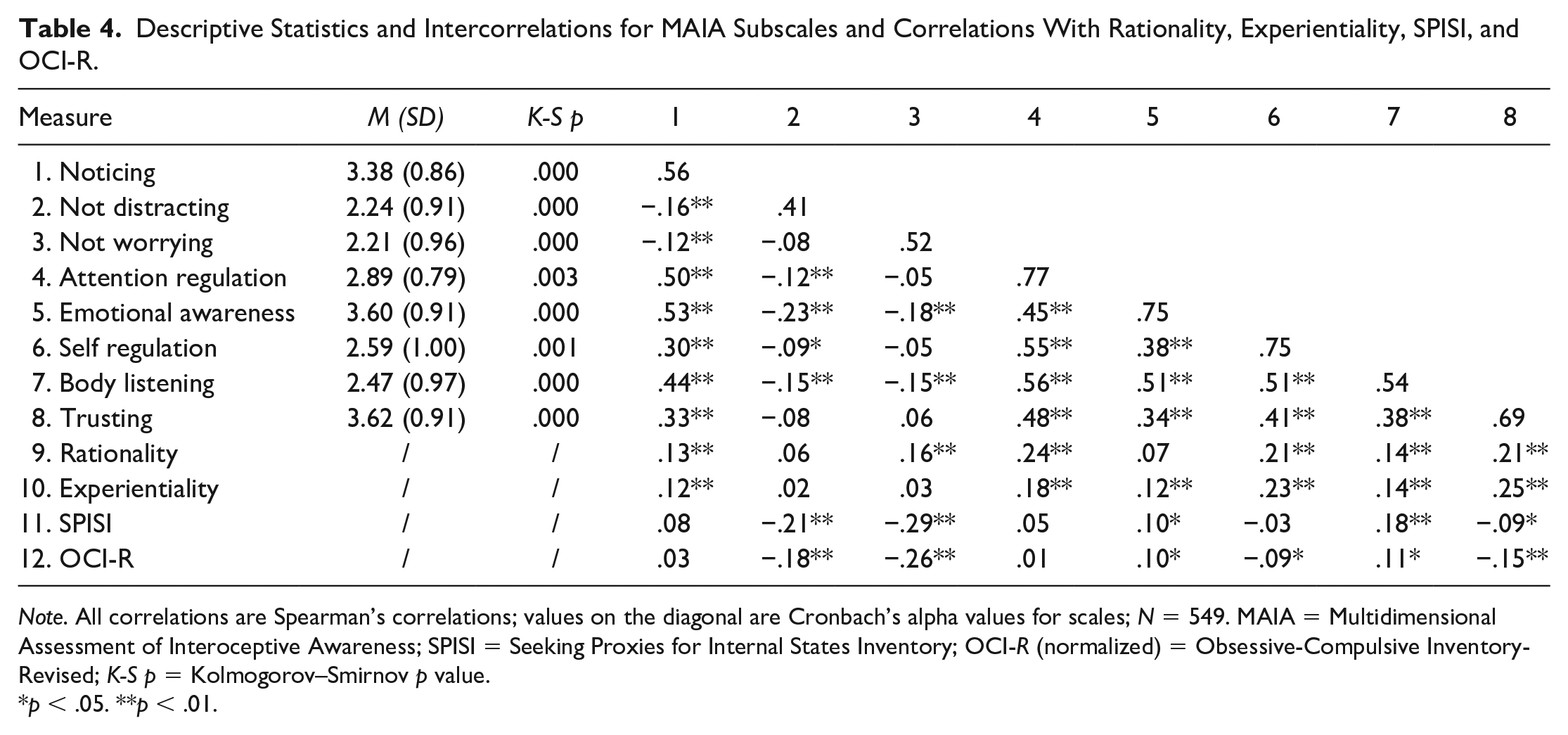
Note. All correlations are Spearman’s correlations; values on the diagonal are Cronbach’s alpha values for scales; N = 549. MAIA = Multidimensional Assessment of Interoceptive Awareness; SPISI = Seeking Proxies for Internal States Inventory; OCI-R (normalized) = Obsessive-Compulsive Inventory-Revised; K-S p = Kolmogorov–Smirnov p value.
p < .05. **p < .01.
All MAIA scale distributions deviated from normality, so instead of Pearson’s correlation coefficients, we calculated Spearman’s correlations. Correlations between different subscales were mostly positive and of moderate to high intensity. Not Distracting and Not Worrying were, however, either lowly negatively correlated or uncorrelated with all other subscales, as well as among themselves.
In line with our expectations, most MAIA subscales showed negative or null correlations with SPISI and OCI-R, whereas the correlations with rationality and experientiality were mostly positive. Only in case of Emotional Awareness and Body Listening, the correlations with SPISI and OCI-R were positive, that is, in the same direction and of similar magnitude as for both CEST thinking styles. All correlations were, however, low in intensity (likely due to the low MAIA scale reliabilities).
Discussion
In two independent samples, we demonstrated that the disengaged thinking style from the CEST model (Pacini & Epstein, 1999) can be better understood by connecting it to a different paradigm, that is, the SPIS model (Lazarov et al., 2010; Liberman & Dar, 2009). We showed that SPIS could be seen as one possible alternative to approach the world for people who do not primarily rely on either rationality or experientiality. Looking at the results from another point of view, they provide additional insights into the thinking style of people with obsessive–compulsive tendencies: they not only tend to seek proxies for internal states (as the SPIS model proposes), but it seems that they also lack trust in both their rationality and experientiality, which can be understood as internal resources of a person. Designing our study in this way, we both contributed to the accumulation of knowledge about some complex psychological phenomena (i.e., the specific disengaged thinking style as well as OC tendencies) and provided empirical testing (and support) for both SPIS and CEST models.
Except for the few studies which included it as part of a broader concern for thinking style profiles and their correlates (Fletcher et al., 2012; Jokić & Purić, 2019; Lu, 2015; Shiloh et al., 2002; Wolfradt et al., 1999), as far as we know, the current study is the first one designed with examining the disengaged thinking profile as its primary goal. This makes our results an important starting point in further examination of the way these people approach the world, considering they do not rely on either rationality or experientiality.
Relation Between Seeking-Proxies-for-Internal-States and Combined Rationality and Experientiality
Moderately low and negative correlations between SPIS and both rational and experiential thinking style suggested that SPIS was a characteristic of persons who did not tend to primarily rely on either logic or intuition. This was further confirmed in the LPA, which showed that SPIS was highly pronounced in the low rational/low experiential thinking profile, while it was low in the high rationality/high experientiality profile. These results are in line with the expectation that SPIS could be considered as a way people process information when they do not prefer either rationality or intuition.
From the CEST perspective, rational and experiential learning systems are provided as original personality constructs that could contribute to a better understanding of personality space (Pacini & Epstein, 1999). The theory emphasizes that rationality and experientiality are independent dimensions and thus that adaptive outcomes could be examined for dimension combinations (Epstein, 2003). Nevertheless, a major proportion of research so far has only examined the relations of separate thinking styles with various other variables, while studies on dimension combinations are rare (Fletcher et al., 2012; Lu, 2015; Phillips & Vince, 2019; Shiloh et al., 2002; Wolfradt et al., 1999). Findings from the current study contribute to the accumulation of knowledge on correlates of combined thinking styles by showing that the lower the scores on both dimensions the higher the tendency to seek proxies for internal states as well as OC tendencies.
More precisely, our results showed that self-perception of one’s rational and experiential ability and engagement was related to SPIS—lower self-perceived rationality and experientiality were followed by a higher tendency to seek external clues. This remark is important as REI is proposed to measure self-perception of abilities and engagement in each thinking style, even though rationality and experientiality are not limited to self-perceptions only. CEST also assumes that the intelligence of RS and ES can be measured—the intelligence of the RS can be assessed by classical IQ tests, while the intelligence of the ES, proposed as an original construct, could be measured by an original instrument proposed by the CEST authors (Constructive Thinking Inventory [CTI]; Epstein, 1998, 2010). Results of the current study are thus related to personal self-perception of one’s rational and experiential abilities and engagement, not these psychological features per se. In fact, according to CEST, not preferring (or suppressing) any of these systems does not mean that they have no influence on information processing, but rather that a person does not recognize that influence on a conscious level. This is especially true for the ES which is evolutionarily older, preconscious and automatic (Epstein, 2016).
The Role of Obsessive–Compulsive Tendencies in SPIS: Implications for Understanding the Disengaged Thinking Profile
Our results showed that obsessive–compulsive tendencies closely followed SPIS in all latent profiles: they were low when both rationality and experientiality were high, and vice versa. In other words, although it is entirely conceivable that people do not need to be obsessive to have a tendency to seek proxies for internal states (i.e., they might do so simply because they cannot or do not like to rely on either rationality or intuition), our results suggested that the disengaged thinking profile could be understood in terms of both SPIS and OC tendencies.
The finding that self-perception of low rationality and experientiality was related not just to SPIS but also to OC tendencies is not surprising considering the high correlation of SPIS and OC in both samples. That is also in line with the primary purpose of the SPIS model being to explain obsessive–compulsive symptoms (Lazarov et al., 2010; Liberman & Dar, 2009). However, it is particularly important to emphasize again that the SPIS model is not limited to clinical population and OCD, but also to obsessive–compulsive tendencies which could be traced through a nonclinical population. As the current study was specifically designed to examine the disengaged thinking style, understood as an information processing style that could be found in the general population, it adds to the growing literature on OC tendencies and their correlates in nonclinical populations (Ansari & Shahabi, 2018; Gibbs, 1996; Iliceto et al., 2017). Results are also in line with past findings on OCD-related difficulties in decision making and executive functions in general (Cavedini et al., 2006; Gibbs, 1996; Shin et al., 2013), although this implication should be considered with caution and further investigated in a clinical population.
It is worth mentioning that the number of latent profiles obtained from relating CEST and SPIS (and OCI) did not replicate previous findings with four main profiles (Fletcher et al., 2012; Jokić & Purić, 2019). When CEST constructs were related to SPIS and OCI, the rationally dominant and experientially dominant thinking style profiles were not revealed. It could be argued that, when SPIS and OCI come into play, the differences between the rational and experiential thinking styles become less significant compared to the difference between relying on internal states and not relying on them. Even though rationality and experientiality are essentially independent dimensions, the strong negative relation of SPIS and OCI with both of these thinking styles, rather than just one of them, explained most of the correlations between these variables, thus leading to only two latent profiles (the disengaged profile and the dual preference one).
Another interesting finding concerns the relative frequency of thinking style profiles in our two samples. The percentage of participants falling under the disengaged profile was rather high: 33% of psychology students and 51% of technical sciences students were classified as disengaged. These percentages are closer to the value of 35% obtained by Fletcher et al., (2012) in their adolescent sample (mean age 15.3 years in the male, 15.4 years in the female subsample), than to the 7% in an adult sample (mean age 35.9 years in the male, 37.1 years in the female subsample). Fletcher et al. (2012) discussed the possibility that these differences could be attributed to changes over a lifespan. The accumulation of experience over a lifetime might result in more differentiated preferences (e.g., experiential thinking style was preferred by only 4% of adolescents and 47% of adults in their sample), but the low percentage of disengaged adults might also reflect a self-serving bias. In other words, compared to adolescents, adults tended to report a higher degree of relying on their own experiential processes but were less prone to “admit” that they do not trust either their own logic or intuition. Our results seem to be in line with these interpretations, as both our samples were young.
An additional remark is that our previous study using the same psychology student sample (Jokić & Purić, 2019) identified four thinking style profiles and the disengaged profile was observed in 24% of participants (as compared to 33% in the current study). As already mentioned, when SPIS and OCI are included, the structure of the profiles changes in such a way that the distinction between relying on “internal” vs. “external” resources is dominant. Therefore, the disengaged profile in the current study may be somewhat more inclusive than those obtained in the four-profile solutions, as it includes all participants who do not rely on either rationality or intuition to a high degree. This is also evidenced by the rationality and experientiality scores being closer to zero in the current study than in either Fletcher et al. (2012) or Jokić and Purić (2019) studies. The higher percentage of disengaged participants compared to previous studies should thus be interpreted in this light as well.
Body Awareness as a Distinctive Characteristic of Relying on External Versus Internal Clues
As impaired connection with internal states is at the core of the SPIS model, it was intriguing to inspect whether SPIS was indeed specifically related to interoceptive awareness in a way different from rationality and intuition. As expected, SPIS and OCI correlations with each of the eight MAIA subscales were similar and at the same time strikingly different (and often reversed) from both experientiality and rationality correlations with MAIA subscales. More importantly, even though these two thinking styles were mostly independent of one another, both rationality and experientiality demonstrated (small to moderate) positive correlations with almost all MAIA subscales, while SPIS and OCI either had null or negative correlations. The only MAIA dimensions positively correlated to SPIS and OCI were Emotional Awareness and Body Listening, and these correlations were the only ones similar to those with rationality and experientiality. Still, it is important to note that neither of the MAIA subscales showed a more positive connection to internal states for SPIS and OCI, compared to rationality and experientiality.
It is unclear why the same pattern of correlations to CEST and SPIS constructs was not obtained for all MAIA dimensions or why Emotional Awareness and Body Listening were the least discriminative dimensions in this respect. It might be fruitful to mention that the SPIS authors demonstrated OC tendencies to be related to impaired access to experienced emotions, but not to semantic knowledge about emotions (measured by MSCEIT, Dar et al., 2016; Mayer et al., 2003). It is, therefore, possible that some MAIA dimensions were more related to semantic knowledge of emotions and body sensations while others tapped into the experience of related processes. Both are assumed by the concept of interoceptive awareness in the MAIA paradigm, although not specifically related to Emotional Awareness and Body Listening.
It is also important to note that the current study is the first one employing the Serbian translation of MAIA, and that the psychometric properties of this version of the scale were lower than those of the original version of the instrument. The obtained low reliabilities could have led to correlation attenuations, compared to correlations which could have been obtained had the measurement been done with more precision. Moreover, the structural validity of the questionnaire has not yet been confirmed (Purić & Jokić, 2019), so results pertaining to specific subscales should be interpreted cautiously. Still, the general pattern of results—SPIS and OCI being mutually similar, as well as rationality and experientiality, and with neither of the MAIA dimensions revealing a more positive interoceptive awareness of SPIS (and OC) compared to rationality and experientiality—proposes an intriguing starting point for further research on the role of interoception in these complex psychological processes.
From the CEST perspective, it is particularly interesting that rationality and experientiality showed a similar pattern of correlations with almost all MAIA subscales. Given that the ES is evolutionarily older then the rational one and closely related to affect, while the RS is related to analytical processes and affect-free (Epstein, 2016), experientiality might be expected to be more positively related to body awareness compared to rationality, at least on some dimensions. However, CEST assumes that RS also has an important role in identifying feelings and understanding the way the ES operates (Epstein, 2003, 2016). In line with that, past research showed that TEI or trait emotional self-efficacy (Petrides et al., 2007) significantly predicts both rationality and experientiality (Jokić & Purić, 2019), suggesting that rationality and experientiality, although essentially different and independent dimensions of information processing, could also be related to the same (internal) resources.
Limitations
One limitation is that both studies were conducted on student samples, especially having in mind past findings that preferences for thinking styles might change over a lifespan (Fletcher et al., 2012). However, as our main hypothesis was focused on the nature of information processing in the disengaged group, the selection of a young sample ensured that the identification of this profile is possible. Although hypotheses should be tested in as diverse samples as possible (e.g., older, less educated participants), it is still promising that the results replicated in two rather different student samples (regarding gender distribution and the choice of a future profession, psychology vs. technical sciences). Furthermore, if we follow the assumption that people over the lifespan truly rely more and more on experience (Fletcher et al., 2012), but some of them are not capable of that and, moreover, do not learn to rely on their rationality either—then those staying disengaged in adulthood are likely a smaller, but more homogeneous group of individuals. Thus, the relationship between the disengaged thinking style and SPIS (and OC tendencies) should be even stronger in an adult sample.
Our results imply that OC tendencies are related to impaired both rationality and experientiality. However, to demonstrate whether this thinking style constellation replicates in OCD as well, clinical samples would need to be tested.
Regarding the part of our study relating body awareness to thinking styles, it should be noted that the reliabilities of the MAIA subscales were low to moderate (whereas they were moderate to good in the original study, Mehling et al., 2012), which may have resulted in correlation underestimation. It is important to mention that we employed the original MAIA scale, while a new version has recently been launched (Mehling et al., 2018). Furthermore, using other body awareness instruments (see Mehling et al., 2009 for a review) may provide novel insights into the nature of relations between thinking styles and body awareness. Finally, as this part of our study was exploratory, the results should be further examined and replicated.
Conclusion
Our data show that SPIS could be seen as a way people process information and approach the world when they do not tend to rely on either rationality or experientiality. In addition, this thinking style was related to obsessive-compulsive tendencies. Moreover, in our study, rationality and experientiality had mutually similar patterns of interoceptive awareness, which differed from and were generally more positive compared to interoceptive awareness patterns related to obsessive-compulsive tendencies and SPIS.
Research Data
sj-docx-1-sgo-10.1177_2158244020986533 – for Seeking Proxies for Internal States as a Possible Alternative for Rationality and Experientiality
sj-docx-1-sgo-10.1177_2158244020986533 for Seeking Proxies for Internal States as a Possible Alternative for Rationality and Experientiality by Biljana Jokić and Danka Purić in SAGE Open
Footnotes
Declaration of Conflicting Interests
The author(s) declared no potential conflicts of interest with respect to the research, authorship, and/or publication of this article.
Funding
The author(s) disclosed receipt of the following financial support for the research, authorship, and/or publication of this article: This research has been supported by the Ministry of Education, Science and Technological Development of the Republic of Serbia (grant 179018). The funder had no role in either the research design, execution, analysis, interpretation, or reporting of this manuscript.

References
Supplementary Material
Please find the following supplemental material available below.
For Open Access articles published under a Creative Commons License, all supplemental material carries the same license as the article it is associated with.
For non-Open Access articles published, all supplemental material carries a non-exclusive license, and permission requests for re-use of supplemental material or any part of supplemental material shall be sent directly to the copyright owner as specified in the copyright notice associated with the article.
