




Abstract
There is a considerable amount of research on the effect of income on happiness, but only a limited number of studies have considered how the spending of income works out on one’s happiness. In this article, we take stock of the scattered findings on the relation between consumption and happiness. We cover 379 research findings observed in 99 empirical studies. We use a new method of research synthesis, in which research findings are first described in a comparable format and then entered in an online “findings archive” (World Database of Happiness). This technique allows a condensed presentation of the many research findings, while providing readers access to the full results through hyperlinks from the text. Our systematic review reveals some unexpected findings, but does not provide a conclusive answer to the question of what patterns of consumption provide the most happiness for what type of people. Suggestions for further research are provided.
Introduction
Interest in happiness is increasing and this creates a growing demand for information about the effects of life choices on happiness, including choices in the realm of consumption. In this context, we take stock of the available research findings on the relationship between consumption and happiness, applying a new review technique.
Pursuit of Happiness
Most people would like to be happy and look for opportunities to achieve a more satisfying life. This pursuit seems to be universal (Veenhoven, 2010) but is particularly pronounced in modern society. Nowadays, we are more aware that our happiness is not just a matter of fate, but something over which we can have considerable control. In this regard, Lyubomirsky et al. (2005) estimates that about half of the variance in happiness depends on choices we make. This is in part because many of us live in societies where we have considerable freedom of choice, for example, we are able to choose where we would like to live and whether we have children or not. Expected future happiness outcomes play a role in the life choices we make. This is creating a growing demand for information about how our choices will affect our happiness. Veenhoven (2015b) characterizes this pattern as the “informed pursuit of happiness.”
Demand for Information on Effects of Consumption on Happiness
One of the topics on which we need more information is how consumption 1 affects our happiness. Those living in modern, affluent societies spend much of their life in an effort to earn and stockpile a surplus of assets, much more than required to satisfy one’s basic needs. Accordingly, we face the question of how to spend this money and what spending pattern will result in the most happiness. Answers to this question are particularly relevant to both consumers and marketers.
Relevance for consumers
Information about the consequences of consumption for happiness is particularly useful in the case of large and expensive consumer purchases, such as buying a house. In this context, Veenhoven (2012) noted, that people who take on a heavy mortgage to buy a large house, might expect that life will be more satisfying in a large house than in a small house. In this regard, it is worth knowing whether people living in large houses are indeed happier than those living in small houses and whether moving from a small house to a large house increases happiness.For the same reason, it is worth knowing whether daily spending patterns make a difference to one’s happiness. Are people who spend relatively large amounts on experiences, such as holidays, going to the zoo or the theater, typically happier than people who would rather invest their money in property?”
This information about the real long-term effects of spending on happiness is particularly needed as an antidote to the plethora of suggestions on how to buy happiness according to advertising agencies. Evidence-based knowledge on effects of consumption on happiness should be part of consumer education, just as evidence-based knowledge about the health effects of lifestyle has gradually become part of health education (e.g., World Health Organization, 2002). Like in the case of health, sound evidence is required for consumer education to correct misleading information obtained from folk wisdom or product promotion.
A mainstream economist might object that consumers know their preferences and need no additional information to predict that they will become happier when they buy what they want. Yet in practice, consumer preferences are typically less clear than assumed in theoretical models and even when consumers know what they want, they can “mispredict” effects on their happiness (Frey & Stutzer, 2004), as “expected utility” does not always align with “experienced utility” (Kahneman et al., 1997).
Relevance for marketing
Information about the effects of consumption on the happiness of users is also relevant for marketers. Producers prefer to sell products that add to the happiness of their customers and a proven positive effect of product purchase on happiness is seen as a relevant selling point, especially as consumers are becoming more and more concerned with their happiness. As effects of spending money on happiness may not be the same for everybody for each type of purchase, it is also interesting to know what kinds of people profit more or less from certain goods and services. Identifying target groups on this basis will both improve sales and add to human happiness.
From a societal point of view, competition based on evidence-based claims about effects on happiness of products and services is to be preferred over suggestive sales talk in advertising. Along these lines, a case has been made for “well-being marketing” which focuses on marketing strategies that enhance consumer well-being (Sirgy & Lee, 2008). Likewise, from a macro-marketing perspective, happiness can be perceived as a key measure of the societal good (Gene et al., 2018).
Happiness Research
In this review, we draw on the rich findings generated by empirical research on happiness that took off in the 1970s and focused on “happiness” in the sense of “life satisfaction.”
Concept
Following Veenhoven (1984), we define happiness as “the degree to which an individual judge the overall quality of his or her own life-as-a-whole favorably. In other words: how much does one like the life one leads.” Veenhoven delineated the key terms in this definition as follows.
Degree
The word “happiness” is not used to denote positive appreciation of life only. It refers to a degree and like the concepts of “length” or “weight” it denotes more or less of something. When we say a person is happy, we mean that he or she judges the quality of his of her life favorably rather than unfavorably.
Individual
The term happiness is used to describe the state of an individual only; it does not apply to collectivities. Hence, a nation cannot be said to be happy. At best, most of its citizens consider themselves happy.
Subjective
Happiness denotes an individual’s perception of their own life, their conscious knowledge of how they feel about their life. Therefore, there is no given “objective” standard for happiness. A person who thinks that he or she is happy, really is happy.
Judgment
The word “happiness” is used in case somebody has made an overall judgment about the quality of his or her life. This implies an intellectual activity. Making an overall judgment implies assessing past experiences and estimating future experiences and estimating average quality of life. One consequence of this conceptualization is that the word “happiness” cannot be used for those who cannot make up their minds, such as animals and small children.
Overall
The evaluation of the quality of one’s life is an overall judgment. It embodies all criteria for appreciation. In the past, hedonists used to equate happiness with sensory pleasures only. However, there are more modes of appreciation. Apart from the sensory system, cognition and affect also enable individuals to appraise their life. Thus, evaluations also involve cognitive appraisals, based on aspirations, expectations, and values. The evaluation also draws on affective conditions, in particular on average mood. The word “happiness” refers to a judgment, which integrates all the appreciation criteria used.
Life-as-a-whole
We do not use the word “happiness” to characterize satisfaction with specific aspects of life, such as marriage or work. “Happiness” refers to satisfaction with life-as-a-whole, covering the individual’s past, present, and anticipated experiences. This does not mean that all things ever experienced are given equal weight in the evaluation: evaluation involves a sifting and ordering. In this process, some aspects of life may be emphasized and others ignored.
Own life
The term “happiness” concerns the evaluation of one’s own life, not of life in general. A pessimistic “Weltanschauung” does not necessarily characterize someone as “unhappy.”
Favorably
Evaluation always embodies appreciation; a conclusion as to whether one likes something or not. The term “happiness” refers only to judgments concerning this aspect. Happiness judgments concern the dimension extending from appreciation to depreciation, from “like” to “dislike” or from “satisfaction” to “dissatisfaction.”
This concept of happiness is also referred to by other names, such as “subjective well-being,” “perceived quality of life,” and “life-satisfaction.” Unfortunately, these terms are also used to denote slightly different phenomena, which has created Babylonian confusion and contributed to the perception that the subject of happiness is too vague to be studied scientifically.
In this review of research findings, we did not select on words used in research reports, but on the substance (phenomenon) measured. Hence, we included only results of studies in which happiness defined as life satisfaction is assessed, using measures that fit this specific concept.
Difference with wider notions of well-being
In positive psychology, this concept is sometimes referred to as hedonic happiness in contrast to eudaimonic happiness. Eudaimonic happiness is another word for “positive mental health,” which is the core business of positive psychology. Positive mental health is not the same as happiness in the sense of life satisfaction; one can be mentally sound but still be unhappy because of tragic life events. The term “hedonic happiness” bears the suggestion of short-lived superficial pleasure, yet happiness as defined above is a stable judgment of one’s life as a whole. Consumers mostly know what brings them passing pleasure; what they require is well-supported information on how consumption may, or may not, affect their long-term life satisfaction. Likewise, happiness in the sense of the “subjective enjoyment of one’s life” should not be equated with “objective” notions of what a good life is. We cannot call a life of luxury a “happy” life, if that life is not enjoyed subjectively. Differences with wider notions of well-being are discussed in more detail in Veenhoven (2020a).
Measurement
As happiness is something people are aware of and can express, it can be measured using self-reports. A common survey question on happiness reads, “Taking all together, how satisfied or dissatisfied are you with your life-as-a-whole these days? Please express this in a number between 1 and 10, where 1 stands for “dissatisfied” and 10 for “satisfied.” 2 However, not all questionnaires that claim to assess “happiness” adequately measure happiness as defined here. In this review, we draw on the World Database of Happiness (WDH), which includes only results of studies in which happiness has been measured using questions that fit the above-defined concept of happiness exclusively and do not cover related matters. Conceptual fit was assessed on the basis of face validity, that is, close reading of questions and comparison with the definition of happiness given above. All measures that have passed this test are listed in the collection of Measures of Happiness of the World Database of Happiness (Veenhoven, 2020d). This selection for appropriate measures is explained in more detail in Chapter 4 of the introductory text of that collection.
World Database of Happiness
Questions on happiness have figured in numerous empirical studies and the yearly output of research findings on happiness is still increasing, in particular since the advent of “happiness economics” and “positive psychology” at the turn of the millennium. By January 2020, happiness had taken center stage in some 7,500 empirical studies and it is expected that about 800 additional research reports on happiness will be published in the coming year. This number of research findings on happiness has grown too big to oversee, even for specialists. For this reason, a finding archive has been established, in which quantitative outcomes are presented in a uniform format and are sorted by subject. This World Database of Happiness (WDH) is freely available on the internet (Veenhoven, 2020e). Its structure is shown in Figure 1. A detailed description is found with Veenhoven (2020f).
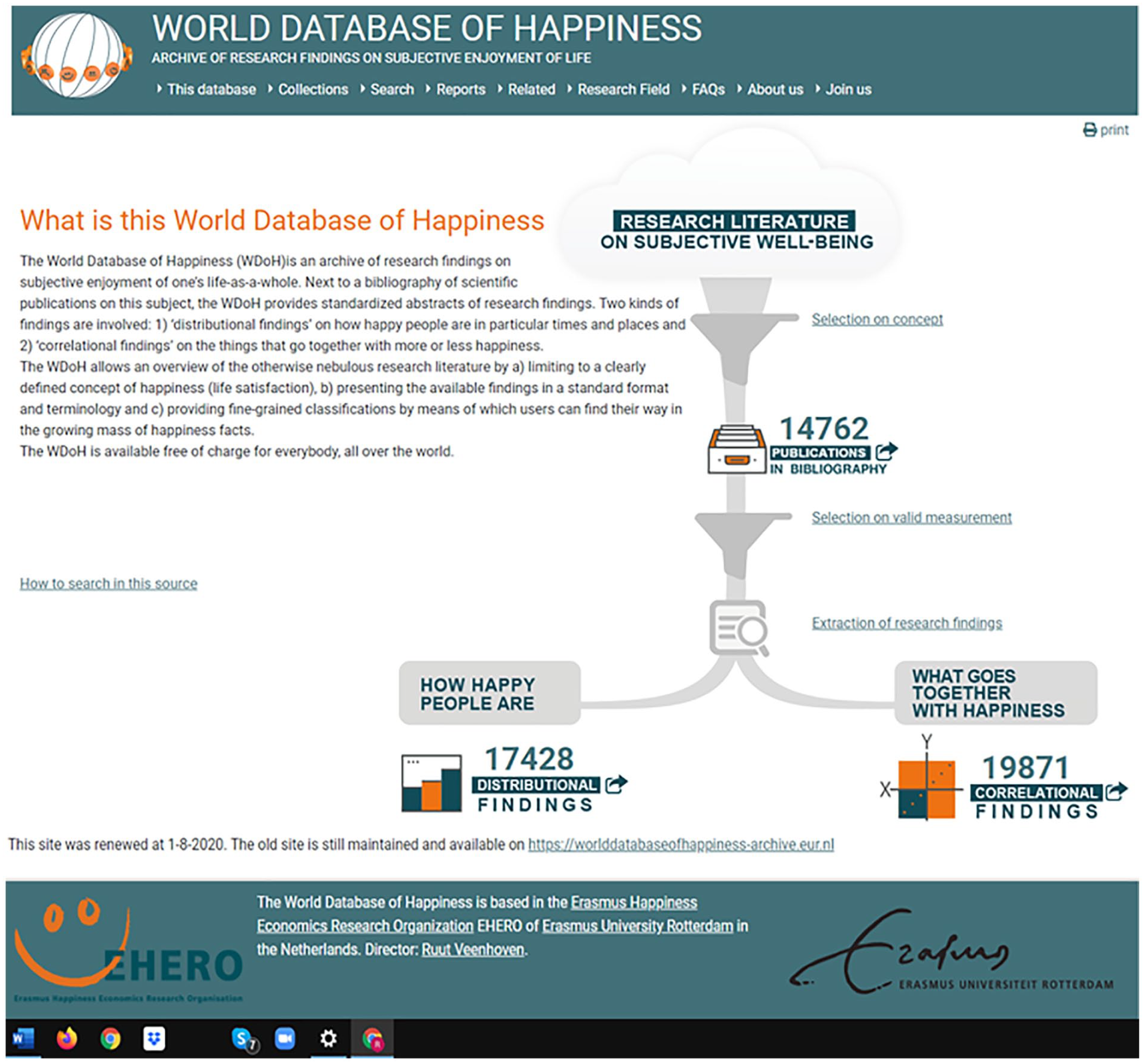
Start page of the World Database of Happiness, showing the structure of this findings archive.
We used this WDH to gather the available research findings on happiness and consumption. Below we describe how these findings were selected, summarized, classified, and stored in that finding archive and how we present them in this article.
Gathering publications
Scientific publications on happiness, defined as life satisfaction, have been harvested on a continuous basis by the WDH team since 1980, using techniques described in detail in Chapter 3 of the introductory text to the Bibliography of Happiness (Veenhoven, 2020a). Over the years, many research reports have been entered in the Bibliography of Happiness (cf. Figure 1), among which several studies that contained information on the relationship between happiness and consumption, sometimes as side results of studies that aimed at other things. Recently, we completed the collection in this subject category on the basis of a focused literature search on this subject, using different key words and combining several bibliographical sources. Together, 292 publications were listed in the subject section of Publications on Happiness and Consumption by January 2018. Not all publications on consumer well-being are included in this selection. For example, the otherwise interesting study by Nicolao et al. (2009), in which “happiness with a purchase” is measured and not the consumer’s satisfaction with their life after such a purchase, has been omitted from the analysis. Rigorous selection on a clear concept, in our case a demarcated definition of happiness, is required for a fruitful research synthesis.
Selection of studies and findings
In addition to this initial selection of publications on concept, the WDH technique involves two further steps for selecting studies. First, publications are selected that report the results of quantitative empirical investigations; qualitative studies, theoretical treatises, or literature reviews are not included in the finding archive. From these research reports a selection is made of reports on studies in which a measure of happiness is used that fits the concept of happiness as defined above in section “Concept.” All measures of happiness ever used in empirical research have been examined for fit with our concept of happiness as reported above in section “Difference with wider notions of well-being” (Veenhoven, 2020d). Selected studies are then inspected for the findings yielded, distributional findings on how happy the respondents are, and correlational findings on factors that explain variation in happiness between people. Some studies have used multiple measures of happiness, only one of which fits our conceptualization. In this case, only the findings obtained using that specific measure are entered in the WDH.
Standardized describing the findings
Each of the selected findings is described on a separate electronic finding page, using a standard format, a well-defined technical terminology, and standardized English (see Veenhoven, 2020c; Chapter 3). An example of such a page on “Happiness and Consumption” is provided in Appendix A. This standardization is required to enable accurate comparisons of the research findings and prevent confusion due to different presentations in the original research reports, such as dissimilar tabular formats and technical terms.
Classifying and storing the findings
The finding pages are subsequently sorted by population and method and in the case of correlational findings also by subject, using a detailed subject classification, interlinked with related subjects. One of these subject categories is correlational findings on Happiness and Consumption (Veenhoven, 2020f). The finding pages are entered in an electronic archive and made available on the internet, where they can be easily found in searches, such as on subject, population, research technique, and bibliographic details.
The above process of data treatment is summarized in the flow diagram shown in Figure 2.

Flow diagram of data processing.
Presenting the findings in this article
The technique of a findings archive gives us a new way of displaying research results in a review paper. Quantitative research findings can be simply summarized using a sign or a number, which is linked to the full detail in an online finding page in the WDH. This enables us to present a large number of findings in a few tabular overviews. This novel way of reporting is explained in more detail in section “Format of This Review.”
Aims of this research synthesis
Using the WDH collection of research findings on consumption and happiness, we scrutinized the available data on the relationship between consumption and happiness, addressing the following questions:
How much spending is optimal for happiness?
What kinds of consumption add most to one’s happiness and what kinds least?
Does the relationship between consumption and happiness differ across people, time, and places?
If so, what patterns for consumption yield the most happiness for whom?
Why literature on consumption and wider well-being is not included
There is a large literature on effects of consumption on human well-being. Part of this literature is theoretical and speculates on the effects of consumer behavior and the consumer society on happiness, such as the seminal works “The Joyless Economy” by Scitovsky (1992), “The Overspent American” by Schorr (1999), and “Income, Consumption and Subjective Well-being: Towards a Composite Macromarketing Model” (Ahuvia & Friedman, 1998). In this article, we do not test these views. We focus on observed relationships. Our sole theoretical perspective is in our conceptual focus on happiness in the sense of life satisfaction.
There is also a considerable strand of empirical research on of the association between consumption and domain-related quality of life, such as consumer satisfaction (e.g., Lee et al., 2002; Malhotra, 2006). Much of this literature has been reviewed in a special issue on “Consumer Well-Being (CWB)” edited by Sirgy, Lee, and Ratz in 2007. Although consumer satisfaction is related to happiness as defined in section “Happiness Research,” this literature is largely about different things and consumer satisfaction should not be conflated with life satisfaction. In this regard, consumer satisfaction can be regarded as a domain satisfaction (Veenhoven, 2020e), that is, satisfaction with a part of life instead of satisfaction with one’s life-as-a-whole. 3
Method
In January 2018, the WDH Bibliography of Happiness listed 161 scientific publications in which the subject “Consumption” is a main topic; 99 of these publications report empirical findings in which an acceptable measure of happiness has been used. The research findings reported in these publications are entered in the WDH Collection of Correlational Findings (Veenhoven, 2020b), in the subject categories, Happiness & Consumption, Happiness & Possessions, and Happiness & Home Ownership. Together this yielded 379 “findings” (January 2018). 4
Of these 99 studies, only 29 focused on consumption in the first place, while consumption was a side issue in 70 studies on happiness. Most studies were conducted in rich countries, 73 in the upper income countries, 14 in upper middle-income countries, two in lower middle-income countries, and five in low-income countries; three studies were based on samples of the world population. With respect to period, 10 studies date from the 1970s, 19 from the 1980s, another 19 from the 1990s, 38 from the early 2000s, and 10 from the 2010s. The bulk of the 379 findings concerns same time correlations; only eight findings are based on longitudinal data and three on experimental studies.
Format of This Review
We applied a new review technique that will look unfamiliar to the reader and for this reason the method section of this article is longer than usual. This method takes advantage of two technical innovations: (a) The availability of an online finding archive, in this case the WDH, which holds standardized descriptions of quantitative research findings, presented on separate finding pages with a unique internet address. (b) The change in academic publishing from text printed on paper to text on screens, into which hyperlinks to online information can be inserted. We call this “link-facilitated research synthesis.”
Presentation of findings
We report all statistical relations observed, irrespective of the size. Positive relations are indicated using a +, negative correlations using a −sign. Statistical significance is reported using a
Aspects of consumption
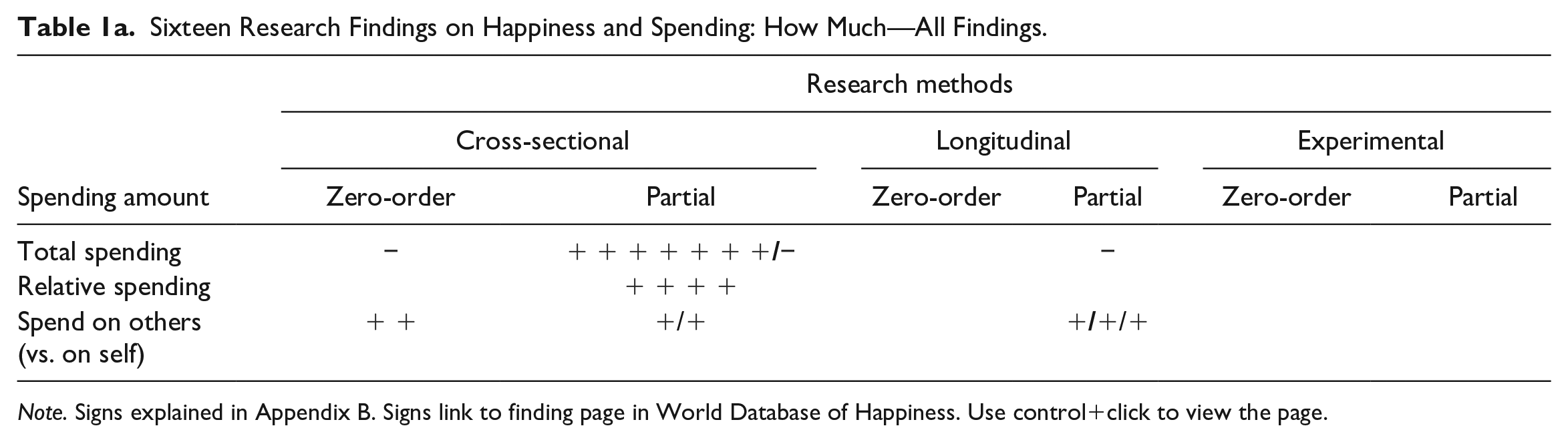
We first examined the amount of spending (Table 1a). Next, we considered what people buy, distinguishing several kinds of consumer purchases (Tables 2a–d). Finally, we considered two kinds of consumption in particular: ownership of one’s house (Tables 3a–b) and ownership of a car (Tables 4a–b). Our classification of aspects of consumption was driven by the findings available and not by a preconceived theory.
Sixteen Research Findings on Happiness and Spending: How Much—All Findings.
Note. Signs explained in Appendix B. Signs link to finding page in World Database of Happiness. Use control+click to view the page.
Nine Research Findings on Happiness and Spending: How Much—Split by Populations.

Note. Signs explained in Appendix B. Signs link to finding page in World Database of Happiness. Use control+click to view the page.
Forty-two Research Findings on Happiness and Spendings: On Various Categories of Outgoings—All Findings.

Note. Signs explained in Appendix B. Signs link to finding page in World Database of Happiness. Use control+click to view the page.
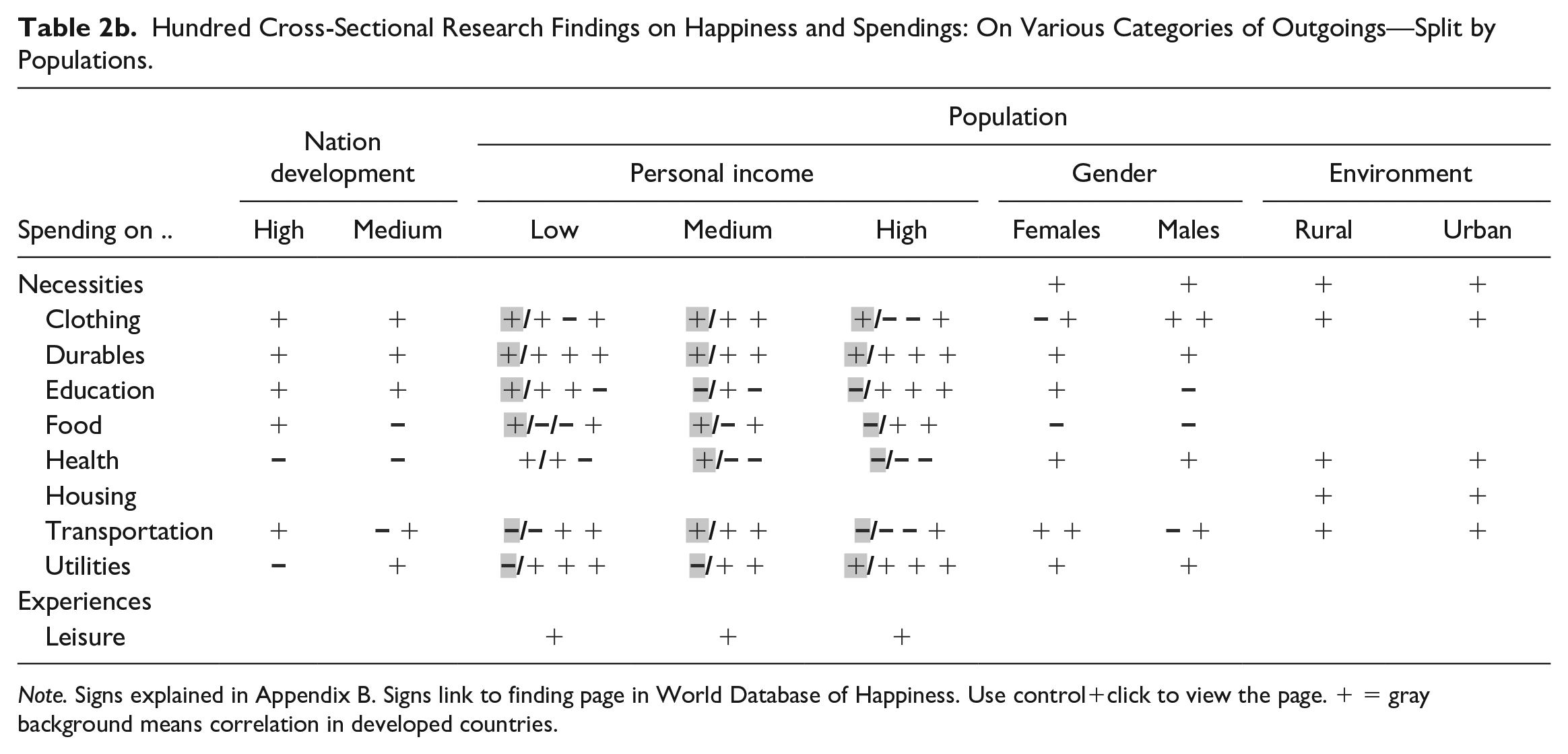
Hundred Cross-Sectional Research Findings on Happiness and Spendings: On Various Categories of Outgoings—Split by Populations.
Note. Signs explained in Appendix B. Signs link to finding page in World Database of Happiness. Use control+click to view the page. + = gray background means correlation in developed countries.
Six Research Findings on Happiness and Consumer Expenses: Retrospective Reduction of Expenses on ….

Note. Signs explained in Appendix B. Signs link to finding page in World Database of Happiness. Use control+click to view the page. + = gray background means correlation in developed countries.
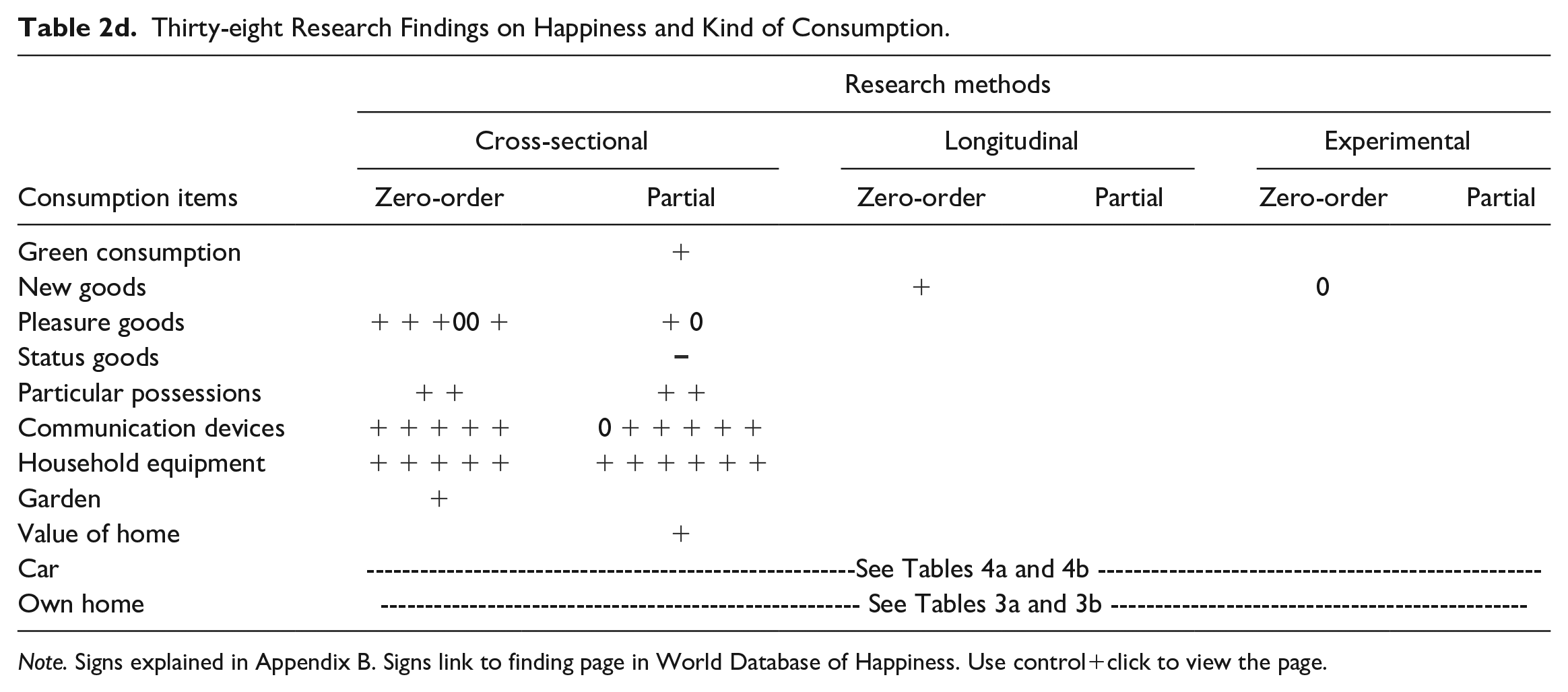
Thirty-eight Research Findings on Happiness and Kind of Consumption.
Note. Signs explained in Appendix B. Signs link to finding page in World Database of Happiness. Use control+click to view the page.
Seventy-five Research Findings on Happiness and Home Ownership—All Findings.

Note. Signs explained in Appendix B. Signs link to finding page in World Database of Happiness. Use control+click to view the page.
Forty-six Research Findings on Happiness and Home Ownership—Split by Populations.

Note. Signs explained in Appendix B. Signs link to finding page in World Database of Happiness. Use control+click to view the page.
Twenty-four Research Findings on Happiness and Car Ownership—All Findings.

Note. Signs explained in Appendix B. Signs link to finding page in World Database of Happiness. Use control+click to view the page.
Twenty-four Research Findings on Happiness and Car Ownership—Split by Populations.

Note. Signs explained in Appendix B. Signs link to finding page in World Database of Happiness. Use control+click to view the page.
Populations
As we wanted to know what patterns of consumption are optimal for what kinds of people; we specified by population studied in Tables 1b, 2b, 3b, and 4b. This examination of differences between types of people was again driven by data availability.
Research methods
We distinguished between three methods used to gather data: cross-sectional studies, in which relationships between consumption and happiness are assessed at a specific point in time; longitudinal studies, in which changes in happiness following chances in consumption are assessed; and experimental studies, in which the (causal) effect of induced changes in consumption on happiness is assessed. These methodological differences are presented horizontally in most tables, except Table 2b, which is limited to cross-sectional findings. We also distinguished raw (zero-order) correlations from partial correlations that resulted from a multivariate analysis. 5 Note: several studies report both raw and partial correlations; in such cases, the same finding page appears in different columns of the tables of this review.
Advantages and disadvantages of this new review format
The advantages of this way of presenting the findings are (a) an easy overview of the main trend in the findings, in this case many
The disadvantages are (a) that much detail is not directly visible in the
Why not a regular meta-analysis?
In this article, we summarized the quantitative research findings in
As the aim of this article was to present an overview of all the available data, it was no option to limit ourselves to the few comparable findings. There are also advantages in our way of schematically presenting each of the findings over condensing many findings in a few numbers, such as an average effect size.
The novel review technique we use is well suited for the meta-analysis of observed effect sizes and has been applied in a meta-analysis of research of the observed correlations between private wealth and happiness (Jantsch & Veenhoven, 2019). When more and better data become available in the future, regular meta-analysis will also be possible for this subject of consumption and happiness.
Differences with traditional reviewing
Authors of traditional reviews must often cite selectively, as they cannot mention all the available data in the limited space available in a printed journal article. This involves the risk of “cherry picking.” Traditional reviews rely heavily on references to the research reports read by the reviewer, which typically figure in a long list at the end of the review paper that the reader can check in theory but seldom does. As a result, traditional reviews are vulnerable to interpretations made by the reviewer and methodological variation can easily escape the eye. A related difference is that traditional narrative reviews focus on interpretations advanced by the authors of the research reports they read, typically in the context of a theory, while in this quantitative research synthesis, we focus on the data actually presented in the reports. 6
There are also differences implied in the use of a focused finding archive, such as the WDH. The conceptual focus of traditional reviews on subjective well-being is often loose, covering fuzzy notions rather than the sharp defined concept of happiness as used here. This blurs the view on what the data read. A related difference is that in traditional reviews of happiness research, it is often assumed that the name of a questionnaire corresponds to its conceptual contents. Yet, several “happiness scales” measure other phenomena than happiness as defined in section “Demand for Information on Effects of Consumption on Happiness.” The finding-archive technique requires more conceptual rigor, if only, to keep the number of entries manageable.
Results: The Amount of Consumption
Are frugal people happier than big spenders, as some critics of our consumer society suggest? The studies that have examined happiness in relation to the amount of spending are summarized in Table 1a.
Spenders Happier
Only two studies have been conducted to assess the relation between total spending and happiness. The most informative of these studies is a research done among the general population in Germany, in which a positive correlation was found between the amount of consumer spending and happiness, even after controlling for household income. This result fits the findings on specific expenditures presented in section “Daily Expenses and Happiness,” where it shows that more consumption is associated with greater happiness. The only negative relation between spending and happiness was found among psychiatric patients (Table 1b). As income was not controlled for in this study, it may simply mean that poor patients are less happy than rich patients.
This association between spending and happiness has not yet been assessed in follow-up studies. However, a comparison between “downshifters” and “non-downshifters” does not show greater happiness among people who say they have voluntarily reduced their consumption in the past 10 years.
Relative Spending
Research shows that spending more than comparison groups is associated with greater happiness. The four studies on this matter controlled for many income-related variables, such as education and employment, but none of the studies controlled for income.
Spending on Others is Related to Greater Happiness
Not all spending is consumer spending, such as spending on other people. One longitudinal study on the spending of a bonus shows that spending on others yielded more happiness than spending on oneself.
Results: Consume What?
What kind of consumption brings the greatest happiness? Below, we will first consider daily expenses (section “Daily Expenses and Happiness”) and then delve into two major consumer decisions: the purchase of a house (section “House Ownership and Happiness”) and car (section “Car ownership and happiness”).
Daily Expenses and Happiness
The available findings on the relations between daily spending and happiness are presented in Tables 2a to 2d. The picture is mixed, but positive signs prevail, suggesting that more consumption is better for happiness. We sorted expenditures into “necessities” and “experiences” admitting that the distinction is not always clear; for instance, expenditures on “food” can be driven by necessity and by an urge for luxury. The distinction reveals a more consistent pattern of correlations in the latter category than in the former.
Expenditure on necessities
In this section, we focus on the findings on expenditures on necessities and happiness.
Mixed relation between happiness and expenditures on clothing
The presentation of all findings in the upper row of Table 2a shows considerable variation. The correlation appears to be higher in richer countries and within countries stronger in higher income groups, which indicates that spending relatively much on clothing serves more than sheer necessity needs.
Surprisingly, spending on clothing is related to greater happiness among males, but with less happiness among females. Reverse causality may be involved here, unhappy women being more likely to invest in nice clothing than unhappy men.
High expenditures on communication are associated with less happiness
The only study in which this issue was addressed found less happiness among Germans who spend a relatively large amount on communication. This cross-sectional finding does not mean that spending on communication will make you unhappy. It seems more plausible that isolated-unhappy people spend more on communication. Still, these unhappy people could have been even be less happy if they had spent less on communication.
More expenditure on durables associated with more happiness
People who spend relatively large amounts on durables, such as furniture and tools, tend to be happier than people who expend more on disposables. This pattern appears in different countries and populations and suggests that investment in things will bring the most happiness. Yet again, reverse causation may be involved, happy people being more inclined to prefer safety, whereas unhappy people buy experiences to keep up morale.
More expenditure on education is associated with greater happiness
A similar pattern appears in the case of education expenditure, the higher the relative spending on this purpose, the happier people tend to be. This relation is most pronounced in the lower income brackets in transition nations. Surprisingly, the (small) correlation is positive among females, but negative among males.
A causal effect of education on happiness must be in the educational process, as the long-term benefits of education have not yet materialized. Again, reverse causality may be involved with happy people being more inclined to invest in education.
Expenditure on food is associated with greater happiness
Correlations with relative expense on food tend to be small, but positive. The relation is most pronounced in the lower income bracket in medium-developed nations. Cuts in expenditure on food due to economic decline relate negatively to happiness in medium-developed nations, but not in high-developed nations (Table 2c), which suggests that food is more a necessity in the former than in the latter conditions.
Expenditure on health care is associated with lower happiness
It will be no surprise that unhappy people spend more on health care, as bad health tends to make you unhappy and involves costs for doctors and medicines. What does surprise is that this negative correlation persists when self-rated health is controlled. This may mean that unhappiness gives rise to more health care consumption.
Cuts to medical expenses due to income decline are also more frequent among the unhappy, even when current income is controlled (Table 2c). As health was not controlled in this study, this may mean that damaged health causes lowered happiness. In addition, it is possible that unhappy people are more prone to income loss.
Less happy with higher expenditures on housing?
One study in Canada observed a negative correlation between happiness and the percentage of one’s income spent on housing. Income was not controlled in this study, so the correlation may merely reflect an effect of poverty. Another intervening variable may be house ownership, which tends to go with greater happiness as we will see in section “House Ownership and Happiness.”
Mixed minor relations between happiness and expenditure on transport
The correlations between expenditure on transport and happiness are small and variable. Positive correlations appear in medium-developed nations in all income brackets. Much will depend on the kind of transportation used; below, in section “Car ownership and happiness,” we will discuss the relation between car ownership and happiness.
Mixed relations of happiness with expenditure on utilities
The correlation of happiness with relative expenditure on utilities tends to the negative in highly developed nations but is positive in medium-developed nations. No further differences appear across income and gender categories.
Expenditure on experience
There is a lot of research on the relation between happiness and hedonic experiences, such as listening to music, eating out, and holiday travel. In this review, our focus was on expenditure and findings on this matter are scarce as yet.
Art buyers are happier
The only study on this subject observed higher happiness among buyers of art, at least on one of three happiness indicators. As income was not controlled for, this could be a mere reflection of buying power.
Expenditure on leisure is associated with greater happiness
The few observed correlations between leisure expenditure and happiness are positive and similar across income categories. This may mean that leisure expenditure buys happiness, but again this correlation can be due to reverse causality.
Less expenditure on alcohol is associated with less happiness
Cuts in expenditure on alcohol due to income loss correlate with lower happiness, even when current income is controlled. This correlation is most pronounced in developed nations. If not due to a greater tendency of the unhappy to economize on alcohol, this finding suggests that drinking adds to happiness. From this perspective, the difference with medium-developed countries may be found in the lower incidence of problem drinking.
Less luxury hardly hurts
Cuts in expenditure on luxury do not reduce happiness in most nations. A small negative correlation was found in Mongolia.
House Ownership and Happiness
Let us now turn to major consumer decisions, the most important for most people being, whether or not to buy a house. To date, the relation between happiness and home ownership has been addressed in 55 empirical studies, the results of which are summarized in Table 3a. Splits of the same findings are presented in Table 3b.
Homeowners are happier
Among the cross-sectional findings summarized in Table 3a, all the bivariate associations are positive. This pattern appears in comparisons of owners versus nonowners and of owners versus renters. These findings can mean that the home ownership adds to happiness but may also mean that happy people are more inclined to buy their house. Next to full house ownership, there are several kinds of partial ownership, such as time-limited ownership (redemption), joint ownership with others, usufruct, and the right to use a house free of charge. The correlation with happiness of these ownership modalities has been addressed in two cross-sectional studies, the results of which are summarized in the lower part of Table 4a. These findings show again that home ownership tends to go with greater happiness.
Checks for spurious correlation
Positive zero-order correlations can be misleading, for instance, if homeowners are more often married and their greater happiness can be driven by marital status. Such spurious effects can be neutralized using multivariate analysis. The column “partial” in Table 4a shows the partial correlations with home ownership that remain after control for such variables. Most of these partial correlations are positive.
In seven cases the correlation between home ownership and happiness has disappeared and in four cases a partial correlation is negative. A closer look at these divergent findings reveals that in six of the 11 cases satisfaction with life domains has been controlled, 7 which is likely to have wiped out the correlation with satisfaction with life as a whole (happiness). In two cases control has changed the picture. Both studies were done in the United States, one among the general public, which controlled for age and socioeconomic status 8 and one among women, 9 which additionally controlled for family situation and average income in the neighborhood.
Follow-up studies
Longitudinal research designs are more suited to rule out spurious correlations and can help us to identify reverse causation. Three longitudinal findings are available on the topic of home ownership and all three show that a change to home ownership is typically accompanied by a rise in happiness.
Experiments
Experimental studies provide the best evidence for causality, and two such studies show a positive effect of home ownership on happiness. One was done among low-income Americans who participated in a home ownership program involving soft loans. 10 One and a half years after purchase of their home, these people had become happier than a matched control group who still rented their house. Likewise, in a legalization program among illegal land occupants in Brazil, 11 an experimental group who came to own their homes became happier than a control group, despite the fact that they now had to pay tax on their property.
Comparison across populations
The effect of home ownership on happiness may not be the same for everybody and for that reason we checked for differences in the populations studied. The splits we performed are summarized in Table 3b. The first thing that strikes the eye is that the pattern of positive associations is similar across highly developed and medium-developed nations. Specification by populations within nations shows a positive correlation between the happiness of adolescent students and the house ownership of their parents. 12
A different pattern was observed among elderly people. All the nonpositive findings reported for this age category come from a five-country study by Mollenkopf et al. (2004), which involved too many controls as reported above. Hence, these findings can be ignored. The only study among aged people that used acceptable control variables 13 found a positive relationship between home ownership and happiness. Finally, the findings among people living in rural areas suggest at first sight that home ownership does not matter in these conditions, but again we are dealing with one of many control variables in the five-country Mollenkopf study, which can be ignored.
Car ownership and happiness
Another major consumer decision is the buying of a car. The findings on the relationship between car ownership and happiness are summarized in Tables 4a and 4b.
Car owners are happier
Nearly all the bivariate coefficients in Table 4a are positive and this suggest that owning a car adds to happiness. Again, these bivariate findings may be misleading. People who own a car are usually better off financially than people who do not and may be happier for that reason. Therefore, the partial correlations reported in the next column are more informative. The findings in this column are more mixed. A closer look at the finding pages reveals that much depends on the control variables used, control for income wipes much of the correlation away, and additional control for gender and marital status sometimes changes the sign to negative. This may mean that the correlation is spurious, but again, overcontrol may have wiped away true effects. For instance, if car ownership adds to your chances on the marriage market, control for marital status will disguise a positive association with happiness.
Longitudinal data can tell us more about causality (when appropriate methods are applied). The only finding of this kind shows that a change in car ownership is related to a change in happiness, which suggests that getting a car adds to happiness, but this is not really proven. Evidence must come from more sophisticated follow-up studies or from experimental studies in which the effect of induced car ownership on happiness is followed. For the time being, we can at best say that car ownership seems to boost happiness.
Happier with more cars
The bivariate correlations between numbers of cars owned and happiness are positive. The more cars a family has, the happier the family members are. When controlling for income, the happiest people are those with two or three cars in their household, but no more than that. When controlling for more variables, such as age, gender, and having children, the positive relationship between number of cars and happiness disappears and even turns to negative.
Equally happy with an economy car?
The bivariate correlation suggests that expensive cars add more to happiness than cheap ones, whereas owners of a junk car are no happier than people who do not possess a car. However, these correlations may reflect an effect of income rather than that of car ownership. Control for household income suggests that owning an economy car brings the most happiness but it can also be that happy people settle more often for a cheap car.
Heterogeneous relationship between car ownership and happiness
The influence of cars on happiness may vary across persons and situations and such differences appear in specifications. The few findings on this topic are presented in Table 4b. As yet, all the findings come from developed nations. The only negative finding comes from a study in a Kibbutz in Israel in 1979. We can imagine that private car ownership met with social rejection in this specific egalitarian context. One study split by gender and found a small positive correlation among males and a slight negative link among females with respect to happiness and car ownership. Not surprisingly, car ownership matters less for the happiness of people living in urban areas, than in rural areas. This difference has been found in Eastern Germany, Hungary, and Italy.
Discussion
In this article, we explored a new strand of consumer research, using a novel presentation method of “link-facilitated research synthesis.” The aim was to see what patterns of consumption produce the most happiness for what kind of people. What have we learned?
What We Know Now
Consumption is related to happiness, at least some kinds of consumption are. Although most of the correlations are small and insignificant, we did see several substantive links. When interpreted as denoting a causal effect, some findings suggest that a “Calvinist” or conservative consumption style tends to foster happiness. This appears in the findings on spending on durables and education. The observed correlation between house ownership and happiness can also be seen as a fruit of solid spending. Yet, we also found links between experience consumption and happiness.
Contrary to claims by critics of consumerism, we did not find much evidence of consumption reducing happiness. Owning a car does not seem to lower happiness. Some counter-intuitive findings reported in section “Daily Expenses and Happiness” are (a) spending on clothing is associated with greater happiness among males, but with less happiness among females; (b) high expenditure on communication is associated with less happiness; (c) the expected negative correlation between health expenditure and happiness persists when self-rated health is controlled; (d) spending less on alcohol is associated with lower happiness levels; (e) less luxury has only a limited relationship with happiness. An unexpected finding reported is section “House Ownership and Happiness” was that home ownership is most related to happiness among people with poor mental health. A suggestive finding reported in section “Car ownership and happiness” was that driving an expensive car does not go with greater happiness. All this requires further research.
What We Do Not Know Yet
The available studies on consumption and happiness do not show to what extent the correlations between consumption and happiness stem from a causal effect of consumption on happiness; only in the case of house ownership, there is some causal evidence.
We are still largely in the dark about the relationship between happiness and the use of goods and services purchased, such as in the above-mentioned case of car ownership and happiness. This aspect of consumption is intertwined with wider lifestyle and time-use issues. We can learn more about consumption’s effects on happiness using the methods of multiple moment assessments, such as the experience sampling method (ESM) or day reconstruction method (DRM; see, for example, Burger et al., 2020 on the relationship between lottery play and happiness for a study that uses multiple moment assessment).
This review focuses on what the relationship between consumption and happiness is, which is what consumers need to know to make informed decisions. This information will be more convincing if they also understand why particular kinds of consumption add or detract from happiness. Such effects are likely to differ across products, people, and situations; some will involve different psychological processes, such as need gratification, social comparison, as well as identification. For that purpose, we need studies that focus on particular products and particular consumers, as is common practice in marketing research.
Why So Many Blank Spaces?
The number of research findings on consumption and happiness is small, in particular when compared with the large body of research literature on consumer satisfaction with products and services. Another striking observation is that the few available studies are not very sophisticated: Most of the findings are cross-sectional, the columns for longitudinal and experimental studies in the tables are largely empty and the tables with specifications also show many blank spaces. Why is this the case?
We follow Stanca and Veenhoven (2015) who note that one of the reasons seems to be theoretical short-sightedness. Many mainstream economists still equate consumption with happiness in general and consumer satisfaction in particular. These economists are unaware of the above noted difference between expected and experienced utility and do not see the difference between needs and wants, nor do they know that happiness depends more on meeting the former than the latter. (Veenhoven, 2009)
Another reason is in commercial self-interest. Producers are interested in selling their products in the first place. They spend a lot of money on marketing research to get a better picture of what consumers expect will make them happy and on advertisements to influence these expectations and link to their products. Whether these products actually add to a consumer’s happiness is not the producer’s prime concern. Although there is a considerable body of research on consumer’s experienced satisfaction with products and services, there is little research on the effect of using products on satisfaction with life, not even in sectors where wider life satisfaction is evidently at stake, such as in the case of life insurances or residential care. This lack of research is part of a wider market failure. As there is limited dependable information on the long-term consequences of big consumer purchases on happiness, this could explain why there is no market competition on happiness effects and hence no product development in this direction.
The market is unlikely to solve this problem; governments and consumer unions are in a better position to press for more research on the effects of consumption on happiness. Scientists can also make a difference by informing the public about what kinds of consumption are conducive to happiness.
Lines for Further Research
How can we further expand our current body of knowledge? We have learned that more cross-sectional studies will not provide much more information. Thus, the focus should be on longitudinal studies that allow a view on changes in happiness following changes in consumption. One way to obtain follow-up data is to insert questions on consumer choice in ongoing large-scale longitudinal studies in which happiness is measured, such as the Australian HILDA, the British “Understanding Society Survey” and the German Socio-Economic Panel (GSOEP). 14 Another option is to add questions on happiness to ongoing follow-up studies on consumption. One can think here of longitudinal studies on broad consumer behavior or particular kinds of consumption, such as the U.S. National Consumer Panel 15 or the Quebec Longitudinal Study on Nutrition and Aging. 16
The most informative research will be experimental studies, in which consumption change is induced externally and subsequent effects on inner happiness are traced, such as in the above-mentioned examples of subsidized house ownership (Rohe & Stegman, 1994) and the natural experiment with compulsory health insurance (Keng & Wu, 2014).
Next to such descriptive studies on what effects consumption exerts on happiness; we need more research on how consumption affects happiness; in other words, we need to understand the causal mechanisms involved.
Concluding Remarks
It is worth knowing what patterns of consumption generate the most happiness for what kinds of people under which circumstances. As yet, the available research findings leave us little wiser about these topics. Data are still scarce and scattered, and causal effects have not been established; only in the case of house ownership does the available data show a positive causal effect on happiness. This review demonstrates that our question of what kinds of consumption adds most to the happiness for what kind of people can be answered; we just need more high-quality research before we can give good and personal advice to people based on academic research.
Footnotes
Appendix A
Appendix B
Meaning of Signs Used in Tables.

| + = positive correlation, not significant |
| 0 = direction of correlation not reported and not significant |
| − = negative correlation, not significant |
| ++ = positive correlations with two different measures of happiness |
| −/+ = positive and negative correlations obtained with different sets of control variables |
Note. All signs involve a link to a finding page with full detail in the World Database of Happiness Use control+click to view the page.
Acknowledgements
The authors would like to thank the editor and two anonymous reviewers for their constructive comments, which enabled us to describe the new method of research synthesis applied more clearly.
Authors’ Note
Revisions June 2019, Resubmitted October 2019; Revision October 3, 2020. Clean version Reduction of overlap with text in earlier publications by the author December 2020, further reduction of overlap with earlier publications by the author.
Declaration of Conflicting Interests
The author(s) declared no potential conflicts of interest with respect to the research, authorship, and/or publication of this article.
Funding
The author(s) received no financial support for the research, authorship, and/or publication of this article.
