




Abstract
Systems thinking has often been suggested (and sometimes been applied) to improve the development and implementation of regulation (“regulatory governance”). But what are the pros and cons of this approach to regulatory governance? Following the logic of meta-research, a systematic and replicable process of synthesizing research findings across a body of original research, this article presents an evidence synthesis of academic literature on systems thinking for and in regulatory governance. Through a staged approach, an initial body of 757 articles are analyzed. The article presents the main findings from the evidence synthesis, presents the gaps in our knowledge, and suggests a future agenda for research on systems thinking for and in regulatory governance.
Introduction
Examples of government-led regulation failing to achieve its intended goals are common around the world. The more high-profile instances occur when poor-performing regulation and under-regulation result in catastrophe, such as the Dhaka garment factory collapse in 2013 in Bangladesh, the Deepwater Horizon oil spill in 2010 in the USA, or the Global Financial Crisis of 2007 to 2009. And, indeed, at the time of writing this article the first debates that “the regulatory state is failing us” in fighting COVID-19 have begun (Friedersdorf, 2020). In response, calls are frequently made for the reform of regulatory systems (European Commission, 2008; New Zealand Productivity Commission, 2014; Obama, 2011; OECD, 2005). But what to change about a regulatory system to make it work better?
The outcome of regulatory governance (its design, implementation, and enforcement) is often the result of a complex interaction of many elements—which combine into a system. Changing just one part of a regulatory system may have little impact on its overall performance, or worse result in even larger problems in the system elsewhere. Adopting a systemic perspective on regulatory governance could offer a useful way to address these observed deficiencies (Cairney, 2012; Hendry & King, 2015; Listorti et al., 2019; McGee & Jones, 2019; Perez, 2008; Stewart & Ayres, 2001). In a nutshell, systems thinking (including systems science and systems theory) is a broad class of analytical tools and approaches that aim to map, explore, and interrogate the behavior and outcomes of (complex and/or adaptive) systems (Beer, 1995 [1972]; Checkland, 1999; Luhmann, 2013; Meadows, 2008). For this reason, it seems warranted to explore the systems thinking literature to gain a better understanding of the concepts and ideas it holds that may be applicable to studies of regulatory governance, and to explore the regulatory governance literature to gain a better understanding of the extent to which these concepts and ideas are already being taken up.
This article first presents a narrative review of the system thinking literature to identify the concepts and ideas that may have analytical or practical value for regulatory governance scholarship (Section 3: A genealogy of systems thinking). From there, it presents an evidence synthesis of the peer-reviewed academic literature on systems thinking applied to regulatory governance (Section 4: Evidence synthesis). Evidence syntheses are gaining traction in the social sciences, including in public policy and public administration studies (of which regulatory scholarship is a subfield; van der Heijden, 2021b). They fit a broader trend of meta-research or metascience: “an approach in which science turns the lens of scrutiny on itself” (Schooler, 2014, p. 9). This article is particularly aimed at answering questions about the knowledgebase of systems thinking in and for regulatory governance. It asks: What central concepts and ideas from systems thinking are applied in regulatory scholarship? How broadly are central concepts and ideas from systems thinking applied in regulatory scholarship? What insights in regulatory governance have emerged from the application of central concepts and ideas from systems thinking are applied in regulatory scholarship? What gaps remain in the application of central concepts and ideas from systems thinking in regulatory governance scholarship?
Gaining insight on the extent to which and how systems thinking is applied in regulatory governance scholarship is relevant if we wish to synthesize the knowledge created through studies of systems thinking applied to regulatory governance and to draw lessons that may be assumed to hold across a broad range of settings—perhaps even beyond the samples and real-world situations included in the original studies (Brady & Collier, 2004; Larsson, 2009). It is also relevant if we wish to understand whether and to what extent the knowledge that has been created answers the questions posed by those who introduced theories and concepts essential to systems thinking and regulatory governance, reflects the reality described by them, and has value to those working on the day-to-day design and delivery of regulation (Creswell & Miller, 2000; Gorin, 2007).
In what follows, the article presents the methodology underlying the evidence synthesis, and a brief genealogy of systems thinking to highlight its relevance for regulatory governance (and for public policy more generally). Following from that overview, the five main themes that emerged from the evidence synthesis are discussed: regulation in a functionally differentiated society, regulation as a (cybernetic) system of control, regulation as a system of stocks and flows, ethical challenges, and epistemic challenges. The article concludes with a summary of the main findings from the evidence synthesis and research agenda for future research on systems thinking in and for regulatory governance.
Evidence Synthesis Methodology
To gain a broad understanding of systems thinking and how it applies to regulatory governance, a narrative review was carried out of 48 foundational texts on systems thinking (books, chapters, and journal articles) that apply or discuss systems thinking in the context of public policy in general and regulatory governance in particular. This narrative review is at the basis of the systems thinking genealogy in the section that follows; and, it has informed the process of sourcing and analyzing the articles for the evidence synthesis proper (Gough et al., 2012). The 48 foundational texts were sourced from Scholar Google and were identified by their citation count—Supplemental Appendix A gives an overview of these foundational texts.
The evidence synthesis builds on peer-reviewed journal articles on systems thinking for and in regulatory governance published in English before 2020. In a first step, articles were sourced from the Web of Science database in the disciplines economics, law, political science, and public administration using a keyword search (Gough et al., 2012; Heyvaert et al., 2017). The keyword searches were: “system* thinking” AND (“regulatory governance” OR “regulatory poli*” OR “regulatory practice” OR “regulatory design”). In addition, articles were sourced from the databases of top-15 journals for regulatory scholarship through a keyword search. The keyword searches were: “complex system*” OR “adaptive system*” OR “system* theory” OR “soft system*” OR “dynamic system*” OR “system* think*” AND regulat*. The asterisk (*) operates as a wildcard—for example, the term “system*” allows the search to find “system,” “systems,” “systematic,” “systemic,” etc. The journals included in this search are: Regulation and Governance, the Journal of Public Administration, Research and Theory (JPART), Law and Policy, Public Administration, Governance, the Journal of Policy Analysis and Management, Public Administration Review, Public Management Review, the Policy Studies Journal, Policy Sciences, Politics and Society, Administrative Science Quarterly, Social and Legal Studies, the Journal of Law and Society, and the International Journal of Law in Context. After removing duplicates, this initial search resulted in a set of 757 peer-reviewed journal articles.
In a second step, all abstracts of these articles were read to identify those publications that explicitly engage with regulatory governance—including regulatory policy, regulatory design, regulatory delivery, regulatory practice, regulatory regimes, regulatory enforcement, and compliance with regulation (note: three articles could not be accessed). Articles that met this criteria were text scanned for the use of systems thinking terminology. This step resulted in 59 articles articles that have a central focus on a regulatory topic and use systems thinking terminology. In a third step, all 59 articles were read to trace those that explicitly engage with systems thinking and systems science. This step resulted in a set of nine articles that explicitly apply ideas and concepts from the systems thinking literature to a regulatory topic. As a reliability test, a check of the original 757 articles was carried out by randomly selecting one in four of these and fully reading the articles selected (providing a confidence level of 95% with a margin of error of 6%). Of a total of 190 articles randomly read, only three were traced that engage with the systems thinking literature and have a central focus on a regulatory topic—these three articles overlap with those identified in the stepwise selection process. This supports the limited number of articles traced in the third step (note: it is not uncommon to trace only a very small number of topical articles in a systematic review process such as the one undertaken here (Gough et al., 2012; Heyvaert et al., 2017).
In a fourth step, the set of nine articles was read in full. Notes (including the key insights reported, the area of study, and the type of research project undertaken) were kept in a working document. This working document was then coded, explored and analyzed using Atlas.ti (a computer program that supports the systematic analysis of complex data) to gain insight into the “repetitiveness” and “rarity” of insights reported (Bearfield & Eller, 2008; Sutton et al., 2016). A full set of codes used is available in Online Appendix B. It should be noted that the initial focus of the review on publications in the top-15 journals for regulatory scholarship will have somewhat skewed the set of source publications underlying this review; and, the review has not systematically explored how scholars of systems thinking and systems science have engaged with regulatory governance (i.e., the focus was on the application of systems thinking in regulatory governance scholarship, not on the engagement with regulatory governance in the systems thinking scholarship).
Source material of the stepwise selection of peer-reviewed journal articles are available from the author. Please note, to some readers, the final set of articles that is systematically analyzed in this evidence synthesis (n = 9) may come across as very small. It is, however, not unconventional for an evidence synthesis to trace a (very) large number of articles based on a key-word search, but find that only a handful of these truly engage with the topic of inquiry (Cooper et al., 2019; Gough et al., 2012).
A Genealogy of Systems Thinking: Indicating Its Relevance for Regulatory Governance
Capturing the genealogy of systems thinking is all but easy. Conventional (scientific) methods for unpacking and understanding historical developments often fall short of capturing the non-linear emergence of different worldviews and feedback mechanisms that have affected the strains of systems thinking over the last century. Keeping in mind these limitations, this section presents key-development in systems thinking that are relevant to better understand the findings from the evidence synthesis presented in the section that follows (for more extensive “evolutionary” discussions of systems thinking, see among others Geyer & Rihani, 2010; Ison, 2017; Luhmann, 2013; Mingers, 2015; Ramage & Shipp, 2009; Sawyer, 2005).
The Cartesian Systematic Dissecting of Complexity
With the development of Western science during the Enlightenment (17th and 18th centuries), scholars became increasingly interested in deductive reasoning and methods. Through René Descartes and his followers, a reductionist view of science made inroads. It replaced the more holistic understandings of how the world operates that dominated pre-Enlightenment science (Russell, 2004 [1946]; Scruton, 1994). The Cartesian view holds that to understand how things work (to find the “truth” or to find causality), “the way to proceed was to successively split up entities into their component parts until ultimate components were reached, at which point ultimate explanations were possible” (Mingers, 2015, p. 29). The sciences have applied this Cartesian reductionist view of systematic dissecting of complexity with great success. It has provided major breakthroughs in areas ranging from astrophysics to molecular physics, and from structural engineering to social engineering. Nevertheless, the Cartesian view is not without shortcomings. The central assumptions it makes are that: (i) “a component part is the same when separated out as it is when part of a whole” (Checkland, 1999, p. 12) and (ii) “the whole is the sum of the parts, no more and no less” (Geyer & Rihani, 2010, p. 13). By the turn of the 20th century, scholars began to notice that these rules do not always apply (Kuhn, 2012 [1962]). Scientists studying biological, societal, and other “living” systems found that this mechanistic, or clockwork, understanding of the world often could not explain why the whole system performed as observed (Eppel & Rhodes, 2018; Guimaraes Pereira & Funtowicz, 2015; Pycroft, 2014).
Early Systems Thinking: Inquiry Into Emergence
Emergence is the term used to describe the behavior of a system as a whole that cannot be observed in or reduced to the component parts of the system (Sawyer, 2005). More formally: “Emergent properties of an entity are properties possessed only by the entity as a whole, not by any of its components or by the simple aggregation of the components” (Mingers, 2015, p. 30). This philosophical concept is central to systems thinking and logically gets us to a widely acknowledged definition that systems are “complexes of elements standing in interaction” (von Bertalanffy, 1969, p. 33). Studying emergence is central to understanding how a system achieves stability (or fails to achieve it) and how it maintains that stability over time (Parsons, 2012 [1951]). In the first half of the 20th century, scholars have been quite successful in studying emergence in closed systems (systems in which no elements enter or leave the system). However, it quickly became clear that most living systems, such as society and its (sub)systems, are open systems (von Bertalanffy, 1969); systems where elements (e.g., information, people, resources, and excess) flow between the system and its environment (Nobles & Schiff, 2004; Ramage & Shipp, 2009).
With the insight that most living systems are open systems, scholars increasingly began to include the impact of a system’s environment on the system’s behavior, and they became particularly interested in understanding the boundaries between system and environment (Luhmann, 1995). Another element of great interest is that of stability and change within open systems (Pycroft, 2014). Because of their characteristics, open systems are likely to be in a state of dynamic equilibrium (ebb and flow) rather than steady or fixed equilibrium (a characteristic of closed systems). A system that is in dynamic equilibrium can (sometimes easily and sometimes quickly) be pushed out of balance by elements within or outside the system. Given the dynamic nature of open systems, small changes in the elements of a system or its environment may affect the overall behavior of the system in unexpected ways (Ramage & Shipp, 2009). In other words, open systems often show nonlinear behavior in which “a small change in initial conditions can lead to a radical change in a later state of the system . . . or, inversely, a large change in initial conditions might not lead to any significant change in later states of the system” (Sawyer, 2005, p. 16). Non-linear behavior cannot be explained by the behavior of the individual elements of a system (Dekkers, 2015).
Further Advancements: Inquiry Into Functionally Different Societal Systems
Open systems thinking also acknowledges that the environment of one system is often another system or even a set of other systems: “Every change in a system is a change in the environment of other systems; every increase in the complexity in one place increases the complexity of the environment for all other systems” (Luhmann, 1995). This insight raises a range of other questions, as illustrated by the work of Niklas Luhmann (1995, 2004, 2013). Luhmann (1995, 2004, 2013) observed that since the 19th century society has become functionally differentiated. In Luhmann’s (1995, 2004, 2013) view, a multiverse of “function systems,” such as law, economy, politics, religion, and science, operate side by side, having replaced previously stratified societal structures in which characteristics such as class, family, and region were fundamental. All function systems have a unique mode of communication and logic, and one single system cannot replace, coordinate, or dominate the other. For example, the economic system uses money as its mode of communication and seeks to ease the transfer or movement of goods and services, but it cannot replace the function of law which established the legality of ownership of those goods and services. Each of these function systems operates with a specific set of binary codes that reduces the complexity within the system. The legal system uses the binary coding of legal/illegal; the science system uses true/false; the economic system uses profitable/non-profitable, and so on. The differences between function and coding in these systems result in challenges. For example, translating the legal coding of legal/illegal to the science coding of true/false or the economic coding of profitable/non-profitable is difficult (for highly accessible introductions to Luhmann’s work, see King & Thornhill, 2003; Nobles & Schiff, 2013).
Luhmann and scholars building on his work (e.g., Teubner, 1987, 1997, 2001) conceptualize these function systems as self-producing, autonomous, and self-referential—or autopoietic (for extensive discussions, see Dekkers, 2015; Mingers, 2015). The notion of autopoiesis is relevant for at least two reasons: First, because of their internal logic and modes of communication, social systems, and subsystems are very difficult to influence with rules external to those systems (Burns & Flam, 1987; Luhmann, 1995). Second, systems are considered circular because the rules (including penalties and rewards) that steer the behavior of a system are produced and reproduced by that system—thus, durable systems are capable of keeping internal mutations and external enactment at bay (Dekkers, 2015; Mingers, 2015). Of the different strains of systems thinking, Luhmann’s is certainly not the easiest to grasp (for highly accessible introductions, see King & Thornhill, 2003; Nobles & Schiff, 2004, 2013). Still, scholars observe that the work of Luhmann and those expounding on his earlier observations are especially relevant to modern regulatory governance (and public policy more generally; Brans & Rossbach, 1997; Dekkers, 2015; Perez, 2011). The concepts of system-specific communication, logic, and coding, may help to understand better why certain state-led regulatory interventions fail, for example, when they encounter “trans-systemic incompatibilities” (Perez, 2008, p. 291); or succeed when they allow for “structural coupling” of systems, overcoming the challenges in logic, coding, and language used between different systems (Luhmann, 2013; Nobles & Schiff, 2013). Many of these scholars argue for acknowledging that state-led regulation is unable to steer society’s functional systems, and at best can be used to establish general rules (“meta-regulation”) for reducing and resolving the trans-systemic incompatibilities of logic and coding (Burns & Flam, 1987; Simon, 2017).
Parallel and Later Systems Thinking: Inquiry Into Feedback Loops
Advances in cybernetics, the study of communication and automated control, strongly influenced the work of Luhmann and his followers (Luhmann, 2013; Mingers, 2015). Other strains of open systems thinking also have their roots in cybernetics but have evolved in a slightly different direction. Notable examples include Donella Meadows (2008) and Peter Senge (2006). To Meadows and Senge, systems thinking is helpful to understand why some systems achieve (dynamic) equilibrium and others do not, and how we might have some influence on the behavior of systems. In Meadow’s words, “System thinkers see the world as a collection of stocks along with the mechanisms for regulating the levels in stocks by manipulating flows” (Meadows, 2008, p. 25). In this model of systems thinking, the role of feedback is of central importance (Dekkers, 2015; Haynes, 2018; Ramage & Shipp, 2009). Feedback is not necessary for a system to exist, but it is essential for it to adapt and flourish (Von Bertalanffy, 1967). Scholars often distinguish between two broad feedback mechanisms. The first is balancing or stabilizing feedback (sometimes referred to as negative feedback). This form of feedback aims to direct the system toward equilibrium by correcting for imbalances. For example, if the level (stock) of noncompliance with regulation goes up (flow) in a sector, the responsible regulatory agency may provide feedback in the form of decision to increase the number of its inspections; increase the stringency of inspections; increase the number of fines issued; or increase the severity of fines. The second form of feedback is reinforcing or amplifying feedback (sometimes referred to as positive feedback). For example, the changed perception about the costs of complying with regulation in a sector may result in firms seeking to cut corners, which may ultimately result in an increased level of noncompliance in the sector. This may further change perceptions about compliance-costs, causing more firms to cut corners, resulting in even higher levels of noncompliance (Van der Heijden, 2016). Positive feedback causes imbalance in the system and is often the cause of too much outflow or inflow, though sometimes this form of feedback is desirable.
Mapping the various stocks, flows, and feedback loops of a complex system can give tremendous insight into the dynamics of that system (Meadows, 2008; Senge, 2006). Systems often show highly complex or competing forms of feedback having a nonlinear, and sometimes circular, impact on the stability of the system as a whole (Pycroft, 2014; Ramage & Shipp, 2009). The difficulty then is to limit the impact of unwanted reinforcing or amplifying destabilizing feedback. Systems scholars are particularly vocal about the risk of time-delays that decisionmakers face when seeking to influence feedback loops (Meadows, 2008; Stroh, 2015). Any intervention needs time to achieve its desired effect, and further instability is likely when the intervention is not given time or is too vigorous to begin with. “Aggressive action often produces exactly the opposite of what is intended. It produces instability and oscillation, instead of moving you more quickly toward your goal” (Senge, 2006, p. 91).
Other Advancements: Questioning the (Ontological) Reality of Systems
In sum, systems thinking had become an accepted approach for studying complexity, dynamics, and adaptation in various areas of society, including public policy by the end of the 20th century. But criticism was expressed also. Scholars were increasingly expressing critique to the understanding that systems “exist out there” (Archer, 2003; Giddens, 1984). They were also increasingly pointing out that systems thinking faced limitation when used to “engineer” solutions for societal problems (Checkland, 1999; Sawyer, 2005). Responding to such critiques, a new strain of systems thinking emerged that considers that systems do not “exist” in the world but they are helpful as heuristic devises that help to study the world (Ison, 2017; Mingers, 2015). This strain is often captured under the notion of soft systems thinking. Here “soft” is not (only) meant to mean “societal” or “human,” but also to indicate that the problems systems thinking seeks to address are often unstructured and ill-defined (Wilson & van Haperen, 2015). Central research themes in this strain of systems thinking are the reflexivity of humans and the different worldviews (the different meanings and senses that people bestow upon the systems they are part of) that individuals hold (Warren et al., 2019; Wilson & van Haperen, 2015). Because social systems are “characterized by self-reflecting agents who try to understand the social systems they themselves are in” these soft systems lack the predictability of technical and mechanical systems (Teisman & Klijn, 2008, p. 290). Adherents to this model are particularly critical of attempts to model social systems by using a “representative agent” approach—as is often done in, for example, economic cost-benefit analyses (Eppel & Rhodes, 2018; Sawyer, 2005; Watts, 2011).
Stafford Beer (1995 [1972]) and Peter Checkland (1999) are central figures in this school of systems thinking. Checkland (1999) maintains that approaching systems thinking in this manner is helpful because it allows for “modeling purposeful ‘human activity systems’ as sets of linked activities which together could exhibit the emergent property of purposefulness” (p. A7). Looking at systems in this manner allows, at the very least, for learning why a specific behavior or outcome emerged in a (human activity) system, and could possibly present an opportunity to steer emergent behavior or outcome toward a desirable state (Beer, 1995 [1972]). This strain of systems thinking acknowledges “that the nature of the problem cannot be understood separately from its solution. Policy responses cannot therefore be “designed,” but represent a way of navigating through the problem” (Stewart & Ayres, 2001, p. 83). Approaches such as the Soft Systems Methodology (Warren et al., 2019; Wilson & van Haperen, 2015) and the Viable System Model (Espejo & Reyes, 2011; Hoverstadt, 2008) provide tools to map, explore, and interrogate (social) processes and organizations (“systems”), and work toward improving them. A related strain of soft systems thinking seeks to bridge these insights with earlier paradigms (Geyer & Rihani, 2010).
Summing Up: The Relevance of Systems Thinking for and in Regulatory Governance
This genealogy has scratched the surface of the rich systems thinking literature that has emerged over the last 100 years or so. It demonstrates that systems thinking is not static, nor is it a single approach to reducing the complexity of regulatory governance we see around us. Thinking in systems can mean many things when applying it to regulatory governance: regulation “as” systems, regulation “of” systems, regulation “through” systems, regulation “in” systems, regulation “between” systems, and so on. Systems thinking gives the tools and concepts to look at regulation in a systematic and systemic matter—that is, to look at the parts and to see the whole. Likewise, it helps to think about regulatory governance as being complicated and complex, and sometimes both. Often regulatory governance is made up of many parts that influence the outcome in a predictable a linear manner (complicated but not necessarily complex), but sometimes the outcome emerges in an unpredictable and non-linear manner (complex but not necessarily complicated).
Equally important, systems thinking helps to analyze regulatory governance in novel ways. Thinking about society as having functionally different systems requires us to consider what language or coding will resonate with those we seek to target through regulatory governance. Thinking about regulatory governance as a system of stocks and flows requires us to consider the risks of oscillation that may result from a specific regulatory intervention. Thinking about systems as a heuristic tool requires us to be modest in what we can achieve through regulatory reform and accept that sometimes we can only learn how to do better a next time (Beer, 1995 [1972]). Embracing systems thinking as a tool for regulatory governance in this manner also fits well with very recent developments in systems thinking (Geyer & Rihani, 2010; Sawyer, 2005). These hold that we should not radically distinguish between order or chaos in regulatory governance, but rather think in terms of partial order. Sometimes phenomena are complex and show nonlinearity, and sometimes they are merely complicated yet predictable. In regulatory governance, there likely is room for “old school” reductionism coupled with more recent holism as practiced in systems thinking.
Evidence Synthesis
We now have a good understanding of the breadth and depth of systems thinking and the contribution it can make to regulatory governance. It is therefore time to focus on the research questions that drive the evidence synthesis: What is known about systems thinking in and for regulatory governance? What is the basis of this knowledge? Broadly speaking, regulatory scholarship does not shy away from using systems thinking terminology. The initial set of 757 peer-reviewed journal articles in top regulatory journals and the broader academic literature is some indication of its currency in this field.
Outside these peer-reviewed journals systems thinking is applied to regulatory governance also. For examples, a series of recent books on regulatory governance build explicitly on (parts of) the broad systems thinking literature. In Outbreak: Foodborne Illness and the Struggle for Food Safety (2019), Timothy Lytton seeks to better understand the interaction of government regulation, civil liability and private governance in the field of food safety regulation. The book carefully unpacks the complex system of food safety regulation in the United States. Many of Lytton’s ideas draw their insight from the work of systems thinkers such as Donella Meadows. Likewise, in Meta-regulation in practice: Beyond normative views of morality and rationality (2017), Fiona Simon builds on Niklas Luhmann’s systems theory to understand better how meta-regulation (here understood as government regulation of industry self-regulation) has played-out over 17 years in the Australian retail energy industry. To give a final example, in their edited volume Algorithmic Regulation (2019), Karen Yeung and Martin Lodge show how the growth of information technology and, in particular, big data has resulted in a renewed interest in cybernetics for regulatory governance. This thinking draws directly on the ideas of Stafford Beer (see also O’Reilly, 2013).
That having been said, when looking at the structured process of selecting peer-review articles for the inclusion in the evidence synthesis (Section 2, above) it becomes clear that systems thinking terminology is frequently mentioned by regulatory scholars, but often in passing or as a vaguely defined umbrella term. Likewise, the core publications in the systems thinking canon are frequently cited in regulatory governance scholarship, but often without clear engagement with these publications. Table 1 presents the key findings from the evidence synthesis.
Central Findings from the Evidence Synthesis.
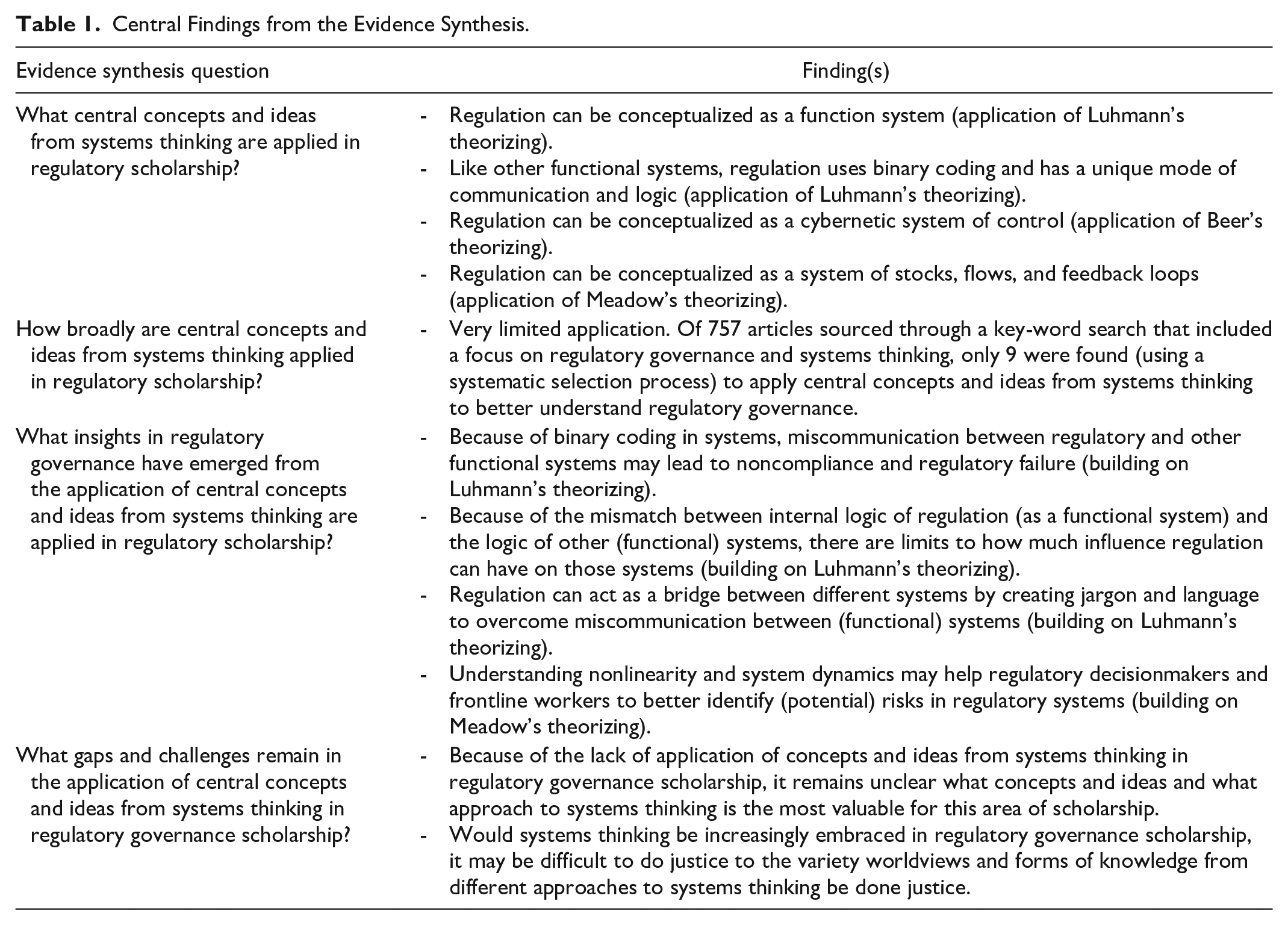
In short, systems thinking has seen very little application in regulatory scholarship. This reflects conclusions by others that systems thinking is often mentioned but has seen very little application in academic studies of public policy and administration (see, e.g., Dekkers, 2015; Eppel & Rhodes, 2018; Klijn, 2008). With this in mind, the following sections further unpack the key findings from the evidence synthesis clustered in five broad and somewhat overlapping themes.
Findings on Regulation in a Functionally Differentiated Society
Niklas Luhmann’s work is the most cited in the publications included in the evidence synthesis. Seven of the nine articles identified take inspiration from Luhmann’s theory of systems thinking (Aalders & Wilthagen, 1997; Born & Goldschmidt, 1997; Cohn, 2001; Lawson, 2011; Perez, 2008; Sargent, 2015; Verschraegen, 2018). These articles address three specific themes that can broadly be summarized as: “To regulate is to perform a social act of intentional communication” (Born & Goldschmidt, 1997, p. 26). First, scholars illustrate how miscommunication between systems may result in noncompliance and regulatory failure. The binary code of law often does not allow for capturing the nuanced and often fuzzy reality that regulators face (Sargent, 2015). Noncompliance can be expected when the rational-legal language and concepts used in law and in regulation do not reflect or resonate with those used in the economic, environmental, or societal areas they seek to address (Aalders & Wilthagen, 1997; Born & Goldschmidt, 1997). Such noncompliance is systemic rather than merely an unwillingness to comply on the part of regulatees. A typical example is “creative compliance” when regulatees comply to the letter but not the intention or spirit of the law (Cohn, 2001).
Second, scholars use this strain of systems thinking to illustrate the limits of external, state-led regulatory governance to regulate various areas of society (Perez, 2008). Function systems such as the economy, science, and religion, as well as their subsystems such as market areas and firms, come with an inherent internal logic, objectives, structure, culture, rewards, punishments, and criteria to establish expertise. Law and regulation are unable to determine and directly steer the activities of these systems because it cannot specify the form and interpretation of all relevant aspects. Therefore, according to these scholars, regulatory governance can only—or at best—negotiate and influence the self-reglatory tendencies and processes in the various areas of society (Aalders & Wilthagen, 1997; Verschraegen, 2018).
Third and final, scholars stress the role of regulation, regulatory agencies, and regulatory practitioners in bridging the various functional systems and subsystems of society. Regulation allows for embracing the fuzziness of human interactions and transactions, and helps finding alternative paths toward compliance and legality—both in the drafting of regulation (Cohn, 2001) and in day-to-day regulatory practice (Aalders & Wilthagen, 1997). Also, regulation can help to create jargon, concepts, and tools to bridge those of different (sub)systems with those of the legal system. For example, licensing a firm’s internal self-regulatory regime bridges the logic of the economic system and the logic of the legal system. For the regulator, the question then is not about distinguishing between profitable/nonprofitable (as a firm would do) or legal/illegal (as a lawyer would do), but according to the standard of acceptance/rejection of the firm’s self-regulatory regime (Lawson, 2011).
Findings on Regulation as a (Cybernetic) System of Control
The other strains of systems thinking discussed in this article (see Section 3) have seen very limited application within the pages of the top-15 journals for regulatory scholarship. One of the remaining two articles, written by Karen Yeung, discusses the notion of algorithmic regulation. In her article, Yeung does not provide findings or evidence of how algorithmic regulation has improved regulatory governance. Instead, Yeung presents a taxonomy of eight different forms of algorithmic systems “based on how these systems are configured in relation to each of the three components of a cybernetic system: that is, at the level of standard-setting (whether behavioral standards are “simple”/fixed or “complex”/adaptive), information gathering and monitoring (reactive or pre-emptive), and behavior modification (automated or recommender systems)” (Yeung, 2018, p. 518). The article is a valuable read for those interested in the use of big data and information technology in regulatory governance. Yeung maps a range of debates in this area and discusses concerns about the legitimacy of algorithmic regulation, its accountability, redistributive powers, ideologies, authority, and its capacity to affect the lives of individual citizens. Strictly speaking, however, the article does not provide evidence of how systems thinking has helped or hindered regulatory practice in a real-world situation.
Findings on Regulation as Systems of Stocks and Flows, Nonlinearity, Dynamics, and Feedback
The final article identified assesses the use of systems dynamic computer modeling in analyzing potential outcomes of regulation. Systems dynamic computer modeling builds on central ideas from systems thinking such as stocks and flows, nonlinearity, dynamics, and feedback. This article discusses the impact of an HIV testing law and related regulation in New York (Martin et al., 2015). While this was the only systems modeling article found in the top-15 journals for regulatory scholarship, real-world examples from regulatory governance sometimes appear in more specialized modeling journals (e.g., Arango, 2007; Carden et al., 2019). Systems dynamic computer modeling allows for exploring different implementation scenarios to prepare for different “what-if” outcomes. For example, this study found that under different implementation scenarios the initial surge of newly diagnosed HIV cases would differ, but in the long run all scenarios resulted in roughly similar patterns. Such knowledge is useful in the planning and budgeting stages, by helping regulators anticipate when and how much trained staff is required over the different stages of implementation. Moreover, by comparing various possible HIV testing regulations, it became clear that specific indicators were better predictors for and representations of the performance of the HIV testing law and regulation than others. This insight is relevant because the model helps decisionmakers and frontline workers understand what condition(s) to monitor closely. Keep in mind, because of nonlinearity and dynamics, a small change in a condition may have a big impact over time. It is therefore helpful to know what conditions may trigger such non-linear behavior.
Epistemic Challenges of Systems Thinking in Regulatory Governance
A main epistemic challenge for those interested in applying systems thinking to regulatory governance is to embrace the “right” approach to systems thinking (Mingers, 2015). That gets us to one of the paradoxes of systems thinking. Systems thinking helps to reduce and give insight into complexity (Eppel, 2017), but systems thinking itself is a highly complex activity. Mapping and analyzing regulatory systems requires collecting and processing considerable amounts of data and knowledge. So, can such knowledge help us changing the regulatory systems we are facing? Systems thinkers are generally sceptical about our ability to influence the specific behavior or direction of systems simply by “knowing” the system. In the words of Stafford Beer, “[i]nstead of trying to organize it in full detail, you organize it only somewhat; you then ride on the dynamics of the system in the direction you want to go” (1995 [1972], p. 55). Or, to cite Donella Meadows, “one of the most frustrating aspects of systems is that the purposes of subunits may add up to an overall behaviour that no one wants” (Meadows, 2008, p. 15). Put differently, even if all the constituent parts of a regulatory system are known, it may still be fully out of the regulators’ control.
Relevant insights for regulatory governance also emerge if we briefly move beyond the evidence synthesis and reflect on the set of literature underpinning the narrative review (Section 3). The consensus among systems thinkers is that there is little point in just changing one element of a system (Meadows, 2008). The change of a single element in one part of the system will likely trigger an unanticipated change elsewhere (Windholz, 2018). Likewise, a lack of knowledge or data from the system as a whole easily results in unnecessarily forceful or hasty changes and may result in undesired outcomes or oscillation within the system (Senge, 2006; Stroh, 2015). Finally, even when a system appears to be performing well, there still is a risk that it is stuck in a cycle of suboptimal performance (Geyer & Rihani, 2010; Miller, 2015). In such instances, any direct change to the system may result in a worsening of performance in the short term but, in the long run, more optimal performance may be possible. Therefore, it is necessary that we engage in ongoing critical assessment of the regulatory systems we work in and work with—both those that work well and those that do not.
Ethical Challenges of Systems Thinking in Regulatory Governance
The ethical challenges discussed in the literature closely relate to these epistemic challenges. The first set of challenges is obvious. Because systems thinking acknowledges and calls for embracing different worldviews and different forms of knowledge, those practicing systems thinking for and in regulatory governance will face dilemmas of weighing, balancing, and merging these worldviews and forms of knowledge. It is likely that, at some point in the systems thinking process, a decision must be made to give more weight to some worldviews and forms of knowledge than to others. Yet, doing so gives more power to some in the regulatory system while taking it away from others (Ramage & Shipp, 2009; Windholz, 2018). The second set of ethical challenges considers related choices. Different approaches to systems thinking ask different questions of systems and, thus, provide different solutions to deal with systemic challenges. The initial choice of which approach to follow may result in similar power imbalances as choices over what worldview and forms of knowledge to use. In this way, systems thinking for and in regulatory governance can be easily politicized. Likewise, the initial choice of a specific systems thinking approach will have impact on whether systemic solutions that result from it lean more toward collective or individual welfare, long or short term gains and losses, vested special or general interests, and so on (Martin et al., 2015; Stroh, 2015). A final set of ethical challenges identified in the literature revolves around the risk that embracing systems thinking (its jargon and concepts) may be done to merely justify a lack of action to change matters. More problematically, systems thinking can quite easily be abused to absolve oneself or one’s organization from responsibility for a problem—topics that will sounds familiar to regulatory scholars and practitioners alike. To recap, systems thinking emphasizes complex interactions of several parts of a system and how these affect the system’s behavior and performance (Beck, 1992; Burns & Flam, 1987). That, ironically, leaves no individual (or organization or group) to blame when the system malfunctions, yet everybody partially at fault (Lytton, 2019).
Summing Up: The Knowledge on Systems Thinking for and in Regulatory Governance
While the findings presented here provide relevant insights, they fall short in addressing pressing questions of what forms of systems thinking help improve regulatory governance, and where and why those forms are most insightful. Scholars are highly interested in systems thinking as an approach to study regulatory governance, but to-date not much empirical research has been carried out to understand the value of systems thinking to improve regulatory governance. Despite all the calls for “thinking in systems” in and for regulatory governance by policymakers, practitioners, and scholars, we have little evidence that thinking in systems will improve regulatory performance. In addition, committing to systems thinking should not be done light-heartedly. Carrying out a systems analysis of regulatory governance requires a substantial investment of time and resources. Deciding on what systems thinking strain to follow will be equally time and resource intensive, and likely politically challenging. However, without taking these steps seriously there seems to be little point in applying systems thinking to regulatory governance in general or a regulatory problem in particular.
Conclusion and Future Research Agenda
Following the logic and tools of meta-research, this article has synthesized a body of literature that engages with systems thinking for and in regulatory governance. What follows is a summary of the main findings from the narrative synthesis and evidence synthesis, and a research agenda for the use of systems thinking for and in future regulatory governance scholarship.
Conclusions
Three broad conclusions can be drawn from the narrative review and evidence synthesis. First, while thinking in and of systems comes naturally to many people, systems thinking (as explored in this article) is often difficult work. There is no single approach to systems thinking, nor are there shortcuts for “quick” systems thinking. Systems thinking is a meta-discipline (Checkland, 1999). When calls are made to apply systems thinking to a regulatory problem, effectively a call is made to consider the collection of parts that relate to that regulatory problem, their interaction, and the emergent behavior they produce. A call for systems thinking is not a call for a specific approach to understanding a regulatory problem, nor a call for a specific approach to address it. A call for applying systems thinking to a regulatory problem can just as well be a call for a systematic analysis of a complicated regulatory problem, as a call for a systemic analysis of a complex regulatory problem. Still, as this article has indicated, there are broad strains of systems thinking that scholars, policymakers, and regulators may wish to follow (or even combine) when calling for systems thinking for or of regulatory governance. To name a few, a regulatory problem may be approached from the “communicative” systems thinking strain introduced by Luhmann and others, and question whether the logic and language and of (government) regulation resonates with that of the actors and environment it seeks to influence (King & Thornhill, 2003; Luhmann, 2013). Likewise, a regulatory problem may be approached from the “stocks and flows” systems thinking strain advanced by Meadows, Senge, and others, and explore the feedback loops, delays, and nonlinearity that affect the regulatory problem (Meadows, 2008; Senge, 2006; Stroh, 2015). Alternatively, a regulatory problem may be approached from the “soft” systems thinking strain developed by Beer, Checkland, and others, and question the human understanding of that very problem itself (Beer, 1995 [1972]; Checkland, 1999; Wilson & van Haperen, 2015).
Second, while systems thinking is often presented as a non-reductionist approach that helps inform understanding about “the whole,” the holism and wholeness that systems thinking aims for should not be conflated with how these terms are understood in other meta-disciplines. At the end of the day, systems thinking as discussed in this article aims to simplify complexity (in a replicable and transparent manner), and is interested in understanding dynamics and change (Sawyer, 2005). But despite all its ambitions, systems thinking cannot get around using the reductionist tools and approaches it so much seeks to avoid. Various schools of systems thinking work with bounded sets of concepts and ideas to map, explore, interrogate, and give meaning to a complex problem at hand. They include, but are not limited to: boundaries, to define what is relevant and what is not; feedback, to delineate influences from with the system and influences outside of it; delays, to understand how quickly a system can react to a disturbance through a balancing feedback loop or how it may delay or speed up an amplifying feedback loop; emergence, to describe the behavior or properties of the system that cannot be reduced to its parts; dynamic equilibrium, to highlight that a system is subject to ongoing change and inflow and outflow are required to keep it in balance; and, non-linearity, to highlight that the extent to which the behavior or properties of a system have changed do not necessarily reflect to extent to which a part or parts of a system have changed. Finally, systems thinking acknowledges that, because of people’s self-consciousness, the workings of a system or interaction between parts of a system cannot be taken for granted as an outsider to that system or that interaction (Mingers, 2015). Still, at some point those applying systems thinking for and in regulatory governance must make decisions about which worldviews and knowledge to include in their regulatory systems analysis and which to leave out.
Third, among the main strengths of applying systems thinking to regulatory governance is that it challenges the idea of an ordered public administration that can achieve desired outcomes through highly specialized units and branches (Geyer & Rihani, 2010). Systems thinking does away with seeking the cause of a problem or solution to it in a specific administrative unit or branch, or parts of these. Systems thinking asks for a broad and deep understanding of identified problems and suggested solutions so that the solution is not going to make the situation (say, a current regulatory problem) worse in the long run. If applied well to regulatory governance, systems thinking may help to increase the flexibility, adaptability, and resilience of regulatory agencies and the regulatory sector as a whole (Meadows, 2008). Ultimately, ongoing application of systems thinking to regulatory governance may add a tendency of learning and inquiring to the day-to-day practice of development, implementation, and enforcement of regulation (Checkland, 1999). That is: an ongoing questioning of whether the regulatory system performs as we would like it to perform; an ongoing learning from day-to-day practice; and an ongoing inquiry into how we can improve performance even further.
Research Agenda
It is essential to be aware of the possible mismatch between the rhetoric on the value of systems thinking for and in regulatory governance and the application of this approach in regulatory scholarship and practice. As in other areas of regulatory governance (Van der Heijden, 2021a), there is considerably more theorizing on how systems thinking may improve the (cost-)effectiveness of regulatory governance (i.e., utilitarian motivations for its application) and its transparency and accountability (i.e., political or moral motivations for its application) than there is evidence that these expectations are met. The narrative review has indicated an ongoing and substantial interest in systems thinking for and in regulatory governance; the evidence synthesis has indicated that we know little about how, where, and with what effects it is applied in regulatory practice. This logically results in a call for more empirical (and perhaps fewer normative and rhetorical) studies on the value (or lack thereof) of systems thinking for and in regulatory governance.
Because of the limited application of systems thinking in regulatory governance scholarship, it remains unclear if some central concepts from the systems thinking literature are more valuable than others for regulatory governance scholarship. This also leaves it an open question how well these central concepts travel across different areas of regulatory governance. Once we create a larger(empirical) knowledge base than currently available on the application of systems thinking for and in regulatory governance on the ground, we can begin to understand, for example, whether and how promising examples of systems thinking can be successfully transplanted from one location to the next; whether and how synergies can be created between systems thinking as an approach to regulatory governance and other approaches, such as or risk-based thinking or smart regulation; and how we can safeguard that improvements (to be) made by systems thinking for and in regulatory governance will not be undone as the result of changes in political leadership. Another promising area for future research is to improve our understanding of which design and implementation strategies and mechanisms are effective for achieving such synergies and entrenchment. In short, many research gaps remain and these provide good starting points for future research—Table 1, above, highlights a few of these.
To conclude, crucial improvements have been made on our understanding of systems thinking and how it may aid regulatory governance (and public policy more generally). We do, however, not have many examples of how systems thinking is applied in regulatory development and reform, let alone have access to a strong evidence base of its performance in improving regulatory governance. The increasing calls for systems thinking in regulatory reform are less benign than they seem at first glance—simply because the normative calls for and intuitive appeal of systems thinking for and in regulatory governance lacks a strong evidence base. Also, applying systems thinking requires a good dose of realism and reflexivity when mapping, exploring, and analyzing regulatory governance through a systems thinking lens. It is less easy to think in systems and talk of systems than it appears to be at first glance. It is critical to be exceptionally clear about what we mean when talking in or of systems—and the literature synthesis in this article reminds us to ask ourselves and others what we and they mean when using systems thinking jargon.
Footnotes
Declaration of Conflicting Interests
The author declared no potential conflicts of interest with respect to the research, authorship, and/or publication of this article.
Funding
The author disclosed receipt of the following financial support for the research, authorship, and/or publication of this article: The author wishes to thank the New Zealand Government Regulatory Practice Initiative (G-REG) for their financial support.
