




Abstract
Family migration is a common integration process for rural migrants in contemporary China. However, discussions on intra-household decision making in dual-earner migrant families are limited. This study aims to address this gap. The data set from the Rural Urban Migration in China (RUMiC2008–2010) is employed to explore the determinants of household decision making. In addition, logit regression is performed to estimate the probability of wives acting as head of the household under different specifications, and the Blinder–Oaxaca–Fairlie decomposition is utilized to discuss gender differentials in decision-making responsibilities. Income and migration duration differentials between a wife and husband have important influences on the probability of being responsible for household decision making. The squared terms of wives’ and husbands’ income have inverted effects. The gender gap between household decision makers can be largely attributed to structural factors rather than observable characteristics, though bargaining power acts as the main contributor in explained parts. Bargaining theory can account for the probability of wives becoming the household decision maker, and the claim of the specialization approach is also confirmed. Gender inequality among household decision makers is largely attributed to structural factors, such as cultural/social norms, obstacles, or gender discrimination. The establishment of long-term effective mechanisms to improve employment quality for female migrants, the supply of basic public services, and protection of women’s legal rights in the household should be strengthened in the future to elevate the status of female migrants.
Introduction
Family decision-making power is widely regarded as related to a woman’s family status, but women are often perceived as the powerless gender (Zuo, 2017). Previous studies conducted in rural China indicate that wives have a lower status compared with husbands in terms of household decision making (Hare, 1999; Y. Li, 2000; MacPhail & Dong, 2007), that is, husbands have overwhelming superiority in major household affairs, including large family purchases and decisions on important family issues (Zuo & Bian, 2001). Meanwhile, evidence shows that women with high educational attainment and market wages are likely to participate in household decision making (Carlsson et al., 2009; C. Cheng, 2019; MacPhail & Dong, 2007; Zuo & Bian, 2001). Moreover, joint decision making on major family affairs is becoming increasingly common among married couples (Carlsson et al., 2012; Zuo, 2017).
However, discussions on intra-household decision making in dual-earner migrant families are limited. Family migration is a common integration process for rural migrants in contemporary China. A considerable number of rural migrants move with their spouse and children (Connelly et al., 2011; Wang et al., 2019). According to the Nationwide Monitoring Survey Report on Migrant Workers conducted by the National Bureau of Statistics (NBS) of China (2015), the rural migrant population reached 168.21 million in 2014, 21.27% of who migrated with their entire family. The National Migrants Population Dynamic Monitoring Survey, which was conducted by the National Health and Family Planning Commission of China, confirmed that the average size of migrant families in 2015 was 2.61 persons, and more than half of migrant families live in the same house with three or more individuals (National Health Commission of China, 2016). Family migration has obviously changed the employment and socioeconomic statuses of rural women (Y. Li, 2000). Most female rural migrants engage in wage employment or self-employment, and a report on the Third Survey on Chinese Women’s Social Status—which was jointly launched by the All-China Women’s Federation (ACWF, 2010) and the NBS—revealed that 87.9% of female rural migrants participate in paid employment.
Migration may improve rural women’s nonagricultural employment abilities and extend their roles within the family, thereby strengthening their bargaining power in household decision making. The rise of family migration in China presents an excellent opportunity to explore this issue in a specific context. However, the determinants of household decision making and gender differentials in migrant families are under explored. To fill this gap, this study use the Rural Urban Migration in China (RUMiC2008–2010) to explore the determinants of household decision making in rural migrant families in China.
This study extends the determinants of household decision making to internal migrant families in the Chinese context and addresses three main issues:
Who is responsible for household decision making in a Chinese rural migrant family?
What is the main determinant of household decision making: bargaining power or specialization?
What are the main determinants of gender differentials in decision-making responsibilities: bargaining power or structural factors?
Theoretical Framework and Hypotheses
Theoretical Framework
Household decision making is a complex phenomenon that is widely discussed in theoretical frameworks drawn from economics, sociology, communications, family studies, and women’s studies (Qualls, 1987). This study employs bargaining theory and the specialization approach to address the role of bargaining power and specialization in household decision making.
Bargaining theory is an important model for explaining the unequal distribution of family resources and power between men and women (Bolt & Bird, 2003; Fafchamps et al., 2009; Fiala & He, 2017; Van Aelst, 2014). Bargaining theory allows differentials between spouses to affect household decision making and claims that the allocation of household resources depends on the relative bargaining power of each household member (Flinn et al., 2018). Family members can bargain with others when making household decisions. The cooperative approach of bargaining theory argues that household decision making depends mainly on the “breakdown position” or “threat point” (Chiappori et al., 1993; Manser & Brown, 1980; McElroy & Horney, 1981), which is affected by the contributions of family members. Therefore, family members who substantially contribute to the household resources will be granted considerable bargaining power and dominate family resource allocation (Sen, 1990).
Household decision making is also related to the specialization pattern in a family. The specialization approach emphasizes comparative advantages in the labor market work and household work. A wife/husband is expected to gain market production advantages to specialize in the labor market work, while his or her spouse specializes in household work (Bonke et al., 2008; Hersch & Stratton, 2000; Juhn & McCue, 2017). In traditional household specialization, the “breadwinning husband and housekeeper wife” is portrayed as the status of the historical comparative advantages of men and women in the labor market. The specialization approach also points out that specialization changes as comparative advantages evolve, that is, if wives gain advantages in the labor market, then the specialization pattern should become less gendered (Becker, 1981). Meanwhile, individuals who earn substantially will likely transfer decision-making responsibilities to their spouse, as their own time is too valuable (Bertocchi et al., 2014).
With bargaining theory and the specialization approach framework, we will explore the determinants of household decision making in rural migrant families. In terms of bargaining, wives can obtain bargaining power from their control over family resources. Meanwhile, the specialization approach highlights comparative advantages between couples and claims that individuals may prefer to delegate their decision-making responsibilities to their spouse even when gaining strong bargaining power.
Hypotheses
Studies on household decision making are mainly conducted by exploring the husband–wife decision-making process (Davis, 1976). A rich array of studies on household decision making using bargaining theory demonstrate that income and education are major components of bargaining power, which can determine whether the wife or the husband will be responsible for household decision making (Bertocchi et al., 2014; Doss, 2013; L. Li et al., 2021; Oreffice, 2014; Yusof, 2015).
Income and education are captured as the main components of bargaining power, and numerous studies reveal that income can significantly affect household decision making. Attanasio and Lechene (2002) used data from Progresa, which was a welfare program that has been conducted in rural Mexico since 1998, to investigate the impact of income on the power of wives in making household decisions. The authors found that the relative income share of women significantly affects their household decision-making power. Specifically, wives whose income share are larger than that of their husband hold greater power in making family decisions. The same conclusion was derived by Schneebaum and Mader (2013), who employed data from the 2010 European Union Survey on Income and Living Conditions and indicated that wives are more likely to be responsible for decision making if they earn between 150% and 299% more than their partner (Schneebaum & Mader, 2013). Bertocchi et al. (2014) used the data from the Bank of Italy Survey of Household Income and Wealth (1989–2010) to explore the main determinants of household decision making. The authors found that the probability of a wife being responsible for making economic and financial decisions increases when her personal traits such as age, education, and income are similar to or higher than those of her husband. Fonseca et al. (2012) obtained similar conclusion by analyzing the data from the RAND American Life Panel. Specifically, the authors determined that the education gap between a husband and wife is an important factor influencing household decision making, and a wife with high educational attainment tends to frequently plan the household finances. Moreover, husbands and wives with nearly similar educational attainment participate equally in making financial decisions. Using a random survey of 672 Malaysian urban households, Yusof (2015) concluded that education contributes positively in giving women substantial control over household finances and decision making. Recently, Ngenzebuke et al. (2018) explored household decision making in rural Burundi and showed that husbands’ education is positively associated with asset-related decision making. Moeeni (2019) also got the positive evidence that “females” bargaining power increases with their education attainments from the Iranian Households’ Income and Expenditures Surveys (HIES).
Migration duration is also related to household decision making. Migrants may obtain increased employment abilities and skills as they become familiar with a local society (Borjas et al., 1992). Thus, migrants with a long-term migration duration will have improved labor market outcomes, such as high work probability or wages (Nguyen, 2019), which may induce strong bargaining power in the family decision-making process.
The patriarchal family system and cultural norms of rural China originate from the country’s small-scale peasant economy, and Confucian ethics profoundly influence rural societies (Hu, 2015; Zuo, 2009). Husbands are often the head of the household, thereby engaging in productive activities and delegating the responsibility of handling internal family affairs to their spouse (Attané, 2012; Evans & Strauss, 2011; Zumbyte et al., 2018).
In the last decade, an increasing number of women engaged in rural-to-urban migration, which significantly broadened their concept of life and enhanced their nonagricultural employment abilities (Yang et al., 2018). Female migrants gradually elevated their weak position and shed traditional household roles by acting as important economic resources in their families and gained substantial bargaining power by engaging in nonagricultural activities (Hu, 2016).
In line with the above evidence, we propose the following assumption:
Few empirical studies pay attention to household decision making based on the specialization approach. A study on households in sub-Saharan Africa revealed that as women’s income increases, they provide substantial family financial support, which may weaken their control over their own income (Staveren & Odebode, 2007). The allocation of decision-making responsibilities may depend on the dominant specialization pattern in a family. In highly specialized families where a spouse specializes in labor market work, while the other mainly handles intra-household affairs, women will assume responsibility for household decision making owing to their comparative advantages in dealing with family affairs. As women’s bargaining power increases, their chances of becoming head of the household may increase. Employed women are likely to spend more time handling family finances and less time dealing with other family matters. Some women are likely to delegate their decision-making responsibilities to their husband. Therefore, the probability of employed women making decisions is lower than the probability of women specializing in home production making decisions (Bertocchi et al., 2014):
Data Sources and Method
Data Source
The data used in this study is from the RUMiC, which consists of a group of researchers from the Australian National University, University of Queensland, and the Beijing Normal University and supported by the IZA Institute of Labor Economics. The RUMiC was established to investigate the impacts of internal migration within China and provides rich information on household roster and personal characteristics, education and training backgrounds, employment situations, household head information, and household income and expenditure during a migration period.
The RUMiC covers 15 cities in the nine largest provinces in China that receive and deploy migrants, namely, Bengbu, Chengdu, Chongqing, Dongguan, Guangzhou, Hefei, Hangzhou, Luoyang, Nanjing, Ningbo, Shanghai, Shenzhen, Wuhan, Wuxi, and Zhengzhou (see Figure 1).
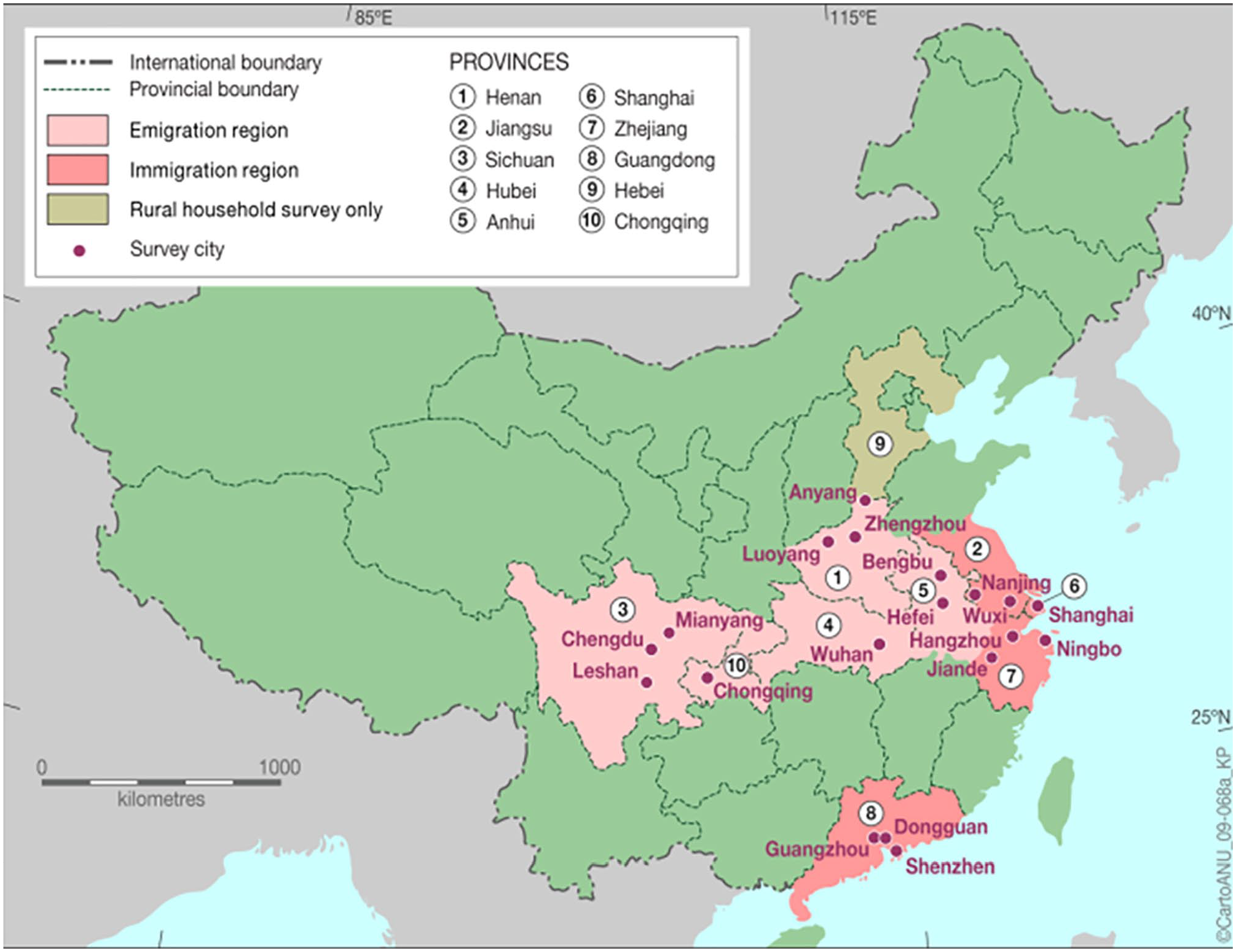
Sampling map.
Fieldwork began in 2008, and five waves have since been conducted. Approximately 5,000 migrant households are included in each wave, only parts of which could be tracked (Akgüç et al., 2014). The attrition rate for the first (2008) and second waves (2009) is 64%. In the subsequent waves, the attrition rate gradually decreases, which is 52% from the second (2009) to the third wave (2010). We obtained permission to use only three waves—that is, the RUMiC2008, RUMiC2009, and RUMiC2010—for our estimation. After missing samples and outliers are deleted, we obtain 3,929 valid migrant household samples, including approximately 215 households tracked in the three waves, 583 households tracked in two waves, and the rest of the households tracked in only one wave.
Variables and Measures
In the RUMiC, rural migrants are defined as rural laborers who move from rural areas to urban destinations within China. Internal migrants currently work in the surveyed cities but lack a local urban hukou.
The outcome used in this study is female household head. A wife responsible for family decision making is set to 1, and 0 otherwise. The focal variables considered in this are income, education, and migration duration, which represent bargaining power. Income is determined from average monthly overall income from a current primary job. The overall income of wage earners is the sum of their wages, bonuses, allowances, and compensation in kind, and overall self-employed income is the net income. Educational achievement is defined as the years of formal education completed by the rural migrants. The migration duration is calculated as years from the first migration to the survey time. Following Bertocchi et al. (2014), the square terms of income, education, and migration duration may have nonlinear influence on family decision making, which suggests that wives/husbands with a large bargaining power may actually prefer to delegate. Thus, the squared terms of these variables also represent a signal for specialization. The within-couple trait differentials are calculated by the income, education, and migration duration gap between a wife and husband.
Additional controls capture women’s personality traits and employment status. “Strong-minded” is used as a dummy personal trait variable, which equals 1 if a wife reports herself as a strong-minded person. A wife solely supporting the family is defined as “only the wife has paid work, whereas the husband is unpaid-employed.” The employment status of a wife is divided into three groups, namely, paid-employed, unpaid-work, and unemployed, where paid-employed includes two groups, that is, self-employed and wage employed.
Descriptive Statistics of Variables
Table 1 presents the summary statistics of the main variables used in this study. Among the sample households collected from the 2008 to 2010 RUMiC, 1,157 (29.45%) are headed by a woman. This proportion is slightly lower than the proportion in urban families recorded in the 2010 Chinese census but higher than the proportion in rural families. 1
Descriptive Statistics.
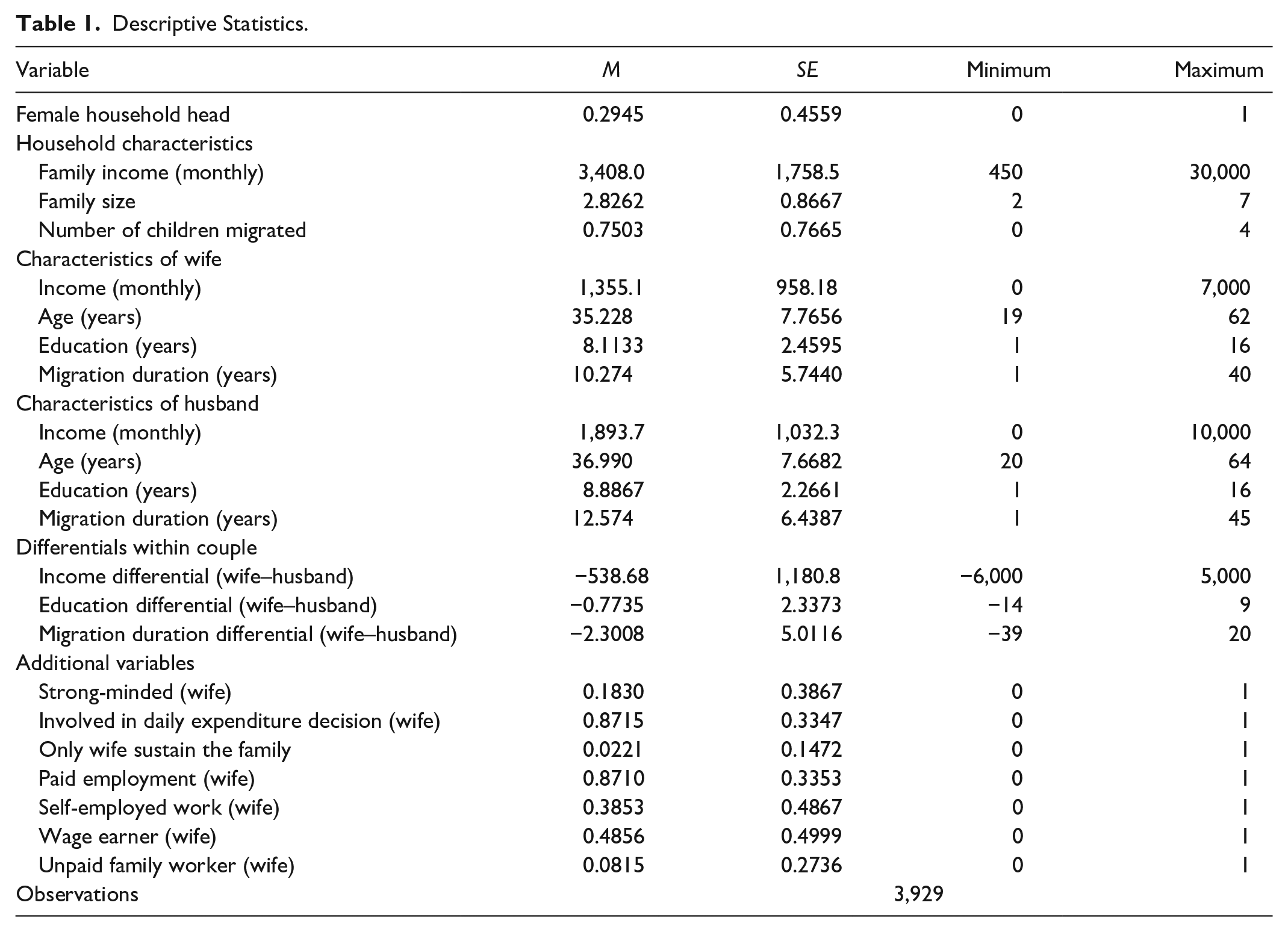
In terms of income, wives earn approximately RMB 538.6 less than their husband. However, the wage differential distribution shows that wives who earn more than their husbands comprise 44% of the sample. In terms of education, more than half (65%) of the wives in the sample have nearly similar or higher educational attainment than their husbands. As for migration duration, approximately 48% of the wives have similar or longer migration duration than their husband. An increase in wives’ income, education level, and migration duration may improve their accumulation of human capital and economic contribution to their family.
The descriptive statistics of the other explanatory variables indicate that migrant families have an average monthly household income of RMB 3,408.0 and a household size of approximately three people, with approximately 0.75 children migrating with their parents. Husbands generally earn RMB 1,893.7 monthly, whereas wives earn only RMB 1,355.1. The average years of education of husbands and wives are approximately 9 years, which implies that most of them completed the compulsory 9-year education requirement. The husbands and wives in the sample also have average migration duration of 12.5 and 10 years, respectively.
Estimation Strategy
This study applies the following logit model to estimate the probability of wives acting as head of the household:

where
Four groups of logit models are employed to estimate the benchmark models (Models 1–3), including main household and individual characteristics, and the within-couple differential estimations incorporate the income differential, education differential, and migration duration differential (Models 4–6). Logit models with additional controls are also used for the robustness checks (Models 7–10). Logit models are likewise employed across generations and migration status groups to discuss the heterogeneous effects (Models 11–14).
The wife in a migrant family may have a lower status compared with her husband in terms of household decision making. What are the main determinants of gender differentials in decision-making responsibilities? The Blinder–Oaxaca–Fairlie decomposition is applied to address such concerns. Following Flinn et al. (2018) and Fonseca et al. (2012), the specific decomposition equation is presented as follows:

where pf represents the average probability of females heading the household, and pm is the average rate of male household heads. H(xiβ) is the logit equation, and xi represents the control variables, including individual characteristics (income, age, education, and migration duration), employment status (self-employed, wage earner, unpaid family worker, and unemployed), household characteristics (family income, family size, and number of children who also migrated), and wave and city dummies. Nf and Nm represent the sample size of female and male rural migrants, respectively. β* represents weight, which refers to the coefficient of being a household head without structural constraints or discrimination.
Results
Benchmark Results
The benchmark results are presented in Table 2. Three sets of regressions are conducted to explore the influence of household and individual factors on household decision making. Model 1 incorporates only wives’ and husbands’ characteristics (Column 1). Model 2 adds household characteristics and wave and city dummies to the estimation (Column 2), and Model 3 incorporates the squared terms to explore the potential nonlinear influence of bargaining power (e.g., square of education, income, and migration duration).
Determinants of Female Household Head: Benchmark Estimation.

Note. Robust standard errors in parentheses. The reference category is Year 2008, City15: Chengdu.
p < .1. **p < .05. ***p < .01.
The results of the three estimations indicate that wives with substantial bargaining power, such as high income, education, and migration duration, are likely to be the household head. Accordingly, increasing the bargaining power of husbands will weaken the probability of wives being responsible for household decision making.
Within-Couple Differential Estimations
The benchmark model considers only the effect of absolute bargaining power, whereas the effect of relative bargaining power is unclear. Accordingly, we incorporate the within-couple differentials in education, income, and migration duration into the benchmark model to test H1. The results of the three regressions are presented in Table 3.
Determinants of Female Household Head: With-Couple Differentials Estimation.

Note. Robust standard errors in parentheses. The reference category is Year 2008, City15: Chengdu.
p < .1. **p < .05. ***p < .01.
The differential estimations in the three models (Models 5–7) show that as income and migration duration differentials increase, the likelihood of wives becoming the household head increases. Nevertheless, the education differential is not significantly associated with the probability of becoming the household head.
Robustness Checks
In this section, we add the personal traits and employment status into the model for the robustness checks. The logit model is applied for the estimation, and all the additional controls are incorporated based on Model 6. Model 7 incorporates the “strong-minded” personal trait as a proxy for decision ability to correct omitted errors. Model 8 discusses the effect of a wife supporting the family alone and wives’ employment status, which is categorized as paid-employed and so on. Self-employed, wage employed, and unpaid family workers are included in Models 9 and 10.
Regardless of the controls added in the benchmark, the results of the robustness checks from the four models (Models 7–10) consistently confirm our main conclusion that income and duration differentials are significantly positive with the increasing likelihood of wives becoming the household head (Table 4).
Robust Checks: Additional Controls.

Note. Robust standard errors in parentheses. The reference category is Year 2008, City15: Chengdu.
p < .1. **p < .05. ***p < .01.
Heterogeneous Effect
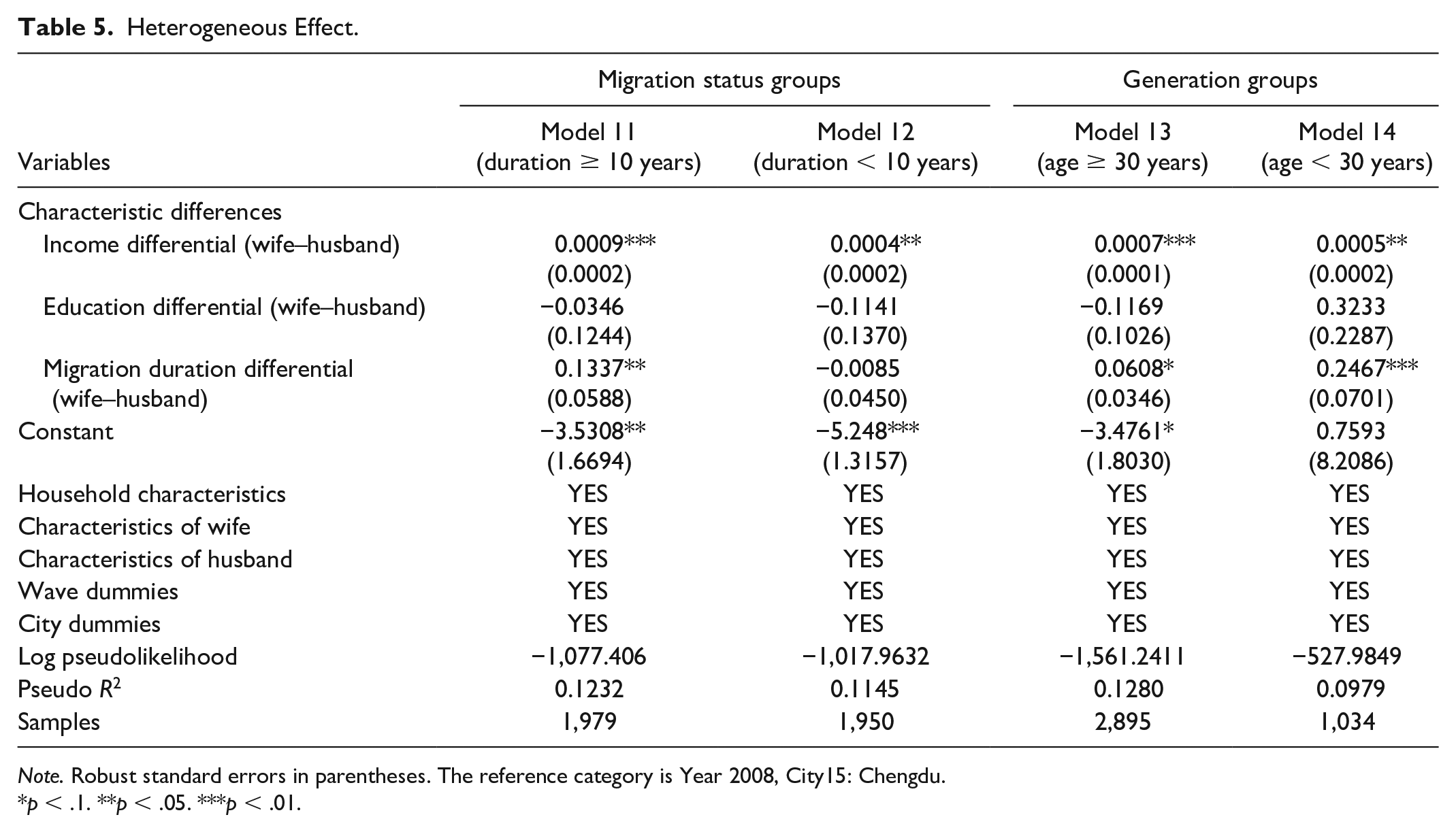
The effect of bargaining power on probability of becoming the household head may vary across different generations and migration statuses. We divide our samples into several subgroups to explore the heterogeneous effects. Migration status includes two groups, namely, long-term migrants, in which wives’ migration duration is more than 10 years, and short-term migrants, with migration duration of less than 10 years. The generation groups are divided according to age. Female migrants more than 30 years of age are defined as the old generation, and those below 30 years of age are viewed as the new generation.
Estimation is performed through logit regression. The results of the subgroups are presented in Table 5. Evidence from the subgroup regressions supports the main conclusion that income and duration differentials are positively associated with the probability of being responsible for household decision making, except for Model 12.
Heterogeneous Effect.
Note. Robust standard errors in parentheses. The reference category is Year 2008, City15: Chengdu.
p < .1. **p < .05. ***p < .01.
Blinder–Oaxaca–Fairlie Decomposition
Bargaining power and specialization play an important role in determining household decision making. However, the issue that decision-making responsibilities may vary depending on gender and the contributions of bargaining power to the gender gap remains unclear. The Blinder–Oaxaca–Fairlie decomposition is employed to address these concerns.
This pools samples of wives and husbands to identify and discuss the gender gap between decision makers. Three logit regressions are employed for the estimations. The subgroup regressions in Models 16 and 17 present a clear signal that bargaining power play a positive role in determining household decision making. The results presented in the first column of Table 6 indicate that husbands are more likely than their counterpart to become the household head. Moreover, the marginal effect demonstrates that the probability of husbands becoming the household head is 30.67% higher than the probability of wives becoming the household head (the marginal effect is not reported in Table 6 for brevity).
Determinants of Household Head: Wife and Husband Pooled.

Note. Robust standard errors in parentheses. The reference category is Year 2008, City15: Chengdu.
p < .1. **p < .05. ***p < .01.
Next, we utilize the Blinder–Oaxaca–Fairlie decomposition to assess the contribution of bargaining power. The results of the Blinder–Oaxaca–Fairlie decomposition in Table 7 reveal that only 14.25% of the gap can be explained by observable characteristics. Among the explained determinants, the contribution of bargaining power captured as income, education, and migration duration is 52.97%; thus, bargaining power acts as the main contributor in the explained parts. However, the gender gap remains largely unexplained, and the contribution of the unexplained parts is 85.75%, which is nearly 5 times more than that of the explained parts.
Decomposition of the Gender Differentials in Decision Maker.

p < .1. **p < .05. ***p < .01.
Discussion
The results of the benchmark regressions and differential estimations indicate that the likelihood of wives becoming the household head is positively related to women’s increasing bargaining power in rural migrant families. As income and migration duration differentials increase, wives are highly likely to become the household head. This result is consistent with bargaining theory, which insists that a positive link exists between bargaining power and possibility of being responsible for household decision making (Anderson et al., 2017; Basu & Maitra, 2020). This finding demonstrates that the wives who are at an advantage position in income and migration experience would increase their resources to the household, which can enhance their bargaining power and affect the household outcome closer to their preferences (L. Li et al., 2021). Moreover, the high socioeconomic status would promote women’s social integration, which can promote the egalitarian gender attitudes enhancing women’s abilities to participate in the household decisions (C. Cheng, 2019). Nevertheless, the education differential has no significant effect on the probability of becoming the household head. This is inconsistent with the previous evidence that the women with higher education attainments are more likely to be the dominant household decision maker (C. Cheng, 2019; L. Li et al., 2021; Moeeni, 2019). There are two potential reasons why this may happen. First, most of migrants have completed the Nine-Year Compulsory Education in China, but few of them got advanced degree after the compulsory education (Su et al., 2018). Thus, the educational differential between a husband and wife was so small (0.7735 years in present study) that it produces no significant effect. Second, rural migrants often work in the secondary urban market linked with unstable, insecure, and low-wage job (Stainback & Tang, 2019), and most of them are employed as unskilled workers (S. Li, 2010), where the education background would exert limited influence on improving their socioeconomic status.
The results of Model 3 show a nonlinear relationship between bargaining power and the probability of becoming the household head. For instance, a wife’s income could significantly increase her chances of becoming head of the household, whereas her income squared shows a negative effect. Similarly, a husband’s income exerts a negative effect, whereas his squared income demonstrates a positive impact. These findings are consistent with those of Bertocchi et al. (2014), which proposed an inverted-U relationship between a wife’s income and probability of becoming the household head. This result posits that if a spouse has comparative advantages in the labor market, then he or she will likely transfer his or her decision-making responsibilities to his or her spouse.
Interestingly, all the additional controls demonstrate the expected effect, that is, if a wife is strong-minded, and then she will likely become the household head (Model 7). This finding is consistent with that of Flinn et al. (2018), which revealed that personality traits are significant determinants of household decision making. The results of Model 8 indicate that if a wife solely supports her family financially, then her chances of becoming the decision maker will increase substantially. This finding may be ascribed to the fact that a person who controls strong economic resources can secure strong bargaining power and a high position in his or her family (Antman, 2014). Wives’ employment status also has a significant effect on their chances of becoming the household decision maker. If a wife is paid-employed, she will likely become head of her household (Model 9). Furthermore, if a wife is self-employed or wage employed, probability of becoming the household head is higher than that of unemployed and unpaid female family workers (Model 10). These findings are consistent with those of previous studies, such as Antman (2014) and Majlesi (2016), which confirmed that the advantages of the employment status of wives can help them play a dominant role in household decision making.
In addition, the migration duration differential in Model 13 demonstrates a negative and insignificant effect, which implies that migration duration exerts a positive effect only on long-term migrants but has no significant effect on short-term migrants. A potential explanation for this result is that with long-term migration, female migrants may obtain improved labor market outcomes (Nguyen, 2019), which can enhance their bargaining power. Conversely, short-term migration provides few advantages to acquire strong bargaining power. Several notable differences exist across the generation groups. The effect of the income differential is important to the old generation, whereas the education differential effect is strong in the new generation. These findings reveal that migration duration is an important determinant for female migrants of the new generation for obtaining bargaining power. A potential explanation for this finding is that the new generation and old generation have different migration motives. “Earning money” is not the only reason for members of the new generation to migrate. However, most of them are willing to learn new skills and settle permanently in local cities (Yue et al., 2010). Conversely, old-generation rural–urban migrants are generally target earners and likely earn money to subsidize their origin rural household. If their target is attained, then they may choose to return to their hometown (Z. Cheng et al., 2014; Liu et al., 2012).
The decomposition reveals that the gender gap between household decision makers can largely be attributed to structural factors rather than observable characteristics. The results also imply that structural factors, such as cultural/social norms, obstacles, or gender discrimination, exert a strong effect on household decision making. Structural factors are related to asymmetrical social norms, the social gender recognition system, or gender structural constraints in traditional Chinese society. The patriarchal family system and cultural norms of China originate from its small-scale peasant economy, and Confucian ethics profoundly influence rural societies (Zuo, 2009). Even in urban destinations, the behaviors of rural migrant couples are influenced by gender-specific norms. A wife is overburdened in a male-dominated job market and women-centered family. In addition, most young men delegate the responsibility of handling internal family affairs to their spouse. However, men generally perceive that dividing such responsibilities equally with their wife will generate unsatisfactory results and thus reduce the family decision-making power of their wife to maintain their own status in the family (Pimentel, 2006). In a male-dominated society, regardless of whether wives contribute more resources than her husband to the family, she may be prohibited from gaining or sharing relative power in household affairs (Xu & Lai, 2002). Therefore, rural migrants are deeply influenced by patriarchal cultural norms. Despite wives having improved bargaining power, they will remain influenced by traditional culture, where men are treated as breadwinners and women are merely housekeepers. Wives have few chances to use their strong bargaining power to gain increased decision-making power in the household. Moreover, she frequently follows the decision of her husband merely to show that she is unwilling to fight for power in the household.
In summary, this finds that the household decision-making in China’s rural migrant family is related with bargaining power such as income and migration duration differentials within a couple. Hence, H1 is partially confirmed. The findings also show an inverted-U relationship between a wife’s income and probability of becoming the household head, and H2 is proved. Those results also reveal that personal trait and employment status are identified as major factors that affect the female rural migrants’ likelihood to be the dominant decision maker. The decompositions demonstrate that structural factors, such as social or cultural norms and gender discrimination, are the main constraints for the couple to share the intra-household decision making equally.
Our research has several limitations. First, we only explore the determinants of the probability of women becoming the household head, while concise decision-making events are not discussed owing to limited information on the household decision-making process. Decision making in a household is related to a wide array of activities, including consumption, investment, health care, children’s education, and other housework. Household decision making can also be regarded as multiple-person joint decisions.
Second, this mainly focuses on exploring correlations; thus, the causality discussion is limited though a personality trait is added as a proxy for decision ability to correct omitted errors.
Third, without related information, the regression could not capture the effects of marriage duration, extra-household social relations, threat of divorce, and gender ideologies, which are also important determinants of household decision making.
Conclusion
Income and migration duration differentials between a wife and husband exert important influences on the probability of being responsible for household decision making. Specifically, the probability of wives becoming the decision makers increases when their income and migration duration are higher than those of their husband. This finding indicates that bargaining theory can account for the probability of women becoming the household head. The estimation also confirms that the squared terms of wives’ and husbands’ income have inverted effects, which implies that if a wife/husband gains comparative advantages in the labor market, then he or she will likely transfer his or her decision-making responsibilities to his or her spouse. This finding is consistent with the claims of the specialization approach.
However, females remain at a disadvantaged position in the household decision-making process. The Blinder–Oaxaca–Fairlie decomposition demonstrates that the gender gap between household decision makers can be largely attributed to structural factors rather than observable characteristics, though bargaining power acts as the main contributor in the explained parts. Structural factors, such as cultural/social norms, obstacles, or gender discrimination, play a crucial role in shaping household decision making.
This recommends that the government and nongovernment organizations should take steps to speed up a solution to improve rural women bargaining power. These findings offer several policy implications.
First, we should establish a long-term effective mechanism to guarantee equal employment opportunities for female rural migrants and strengthen the protection of female migrants’ labor rights to improve the quality of employment. Such policies can generate far-reaching consequences within the household resource allocation.
Second, relaxing hukou restrictions will enable female migrants to settle in cities permanently. Local governments should promote basic public services for permanent residents, especially equal educational opportunities for migrant children, which can solve the problem of left-behind children and enhance the labor participation of female migrants.
Third, the protection of women’s legal rights in the household should be strengthened. The ACWF should assume the task of liberating female rural migrants from traditional societal norms and involving them in a social revolution to promote their overall status and welfare in Chinese society. Activities can include offering advice on legal and social matters and career and education training and providing training to promote cultural and ethical progress, thereby encouraging the establishment of civilized behaviors and equal and harmonious families and advocating family virtues.
This only explores the direct relationship between bargaining power and the probability to be the dominant decision maker, whereas the causal effect should be discussed in the future. While intra-household decision making is a complex process, the concrete decision matters such as housing or other major purchase, child’s education, and other vital decision events in the rural migrants’ family should be taken into account.
Footnotes
Declaration of Conflicting Interests
The author(s) declared no potential conflicts of interest with respect to the research, authorship, and/or publication of this article.
Funding
The author(s) disclosed receipt of the following financial support for the research, authorship, and/or publication of this article: This article is funded by the National Social Science Fund of China (grant number 17BJY044&18ZDA081) and the Fundamental Research Funds for the Central Universities (grant no. 19JNQM16).
