




Abstract
This study detected and analyzed changes that took place in students’ attitudes toward their future education and occupation after completion of the 3-year orientation to work–life through Grades 7 to 9 in different regions in Finland. The changes in the correlations of attitudes were seen as both precursors and consequences of the students’ engagement in the work–life orientation (WLO) program. The changes were postulated not to correlate with the respondents’ region and parents’ education. The empirically measured changes in students’ attitudes served as indicators of the efficacy of WLO. Efficacy referred to the power of WLO to produce effects in the form of changes in attitudes toward educational and occupational choices. Consequently, tentative hypotheses were formed to be tested through empirical observations (measurement points) of WLO. WLO was expected to positively affect student motivation and to guide idiographic decision-making concerning personal goals. Using an alpha level of .05, an independent samples test was conducted to evaluate whether independence, flexibility, and self-direction differed significantly in the measurement groups. For the WLO effect sizes (ES) estimation and for the comparison of the groups, Cohen’s ds were calculated. WLO had a small to medium effect on independence and flexibility, and a near zero effect on self-direction. No notable regional differences in the variance of the students’ attitudes were detected although the social environments differed considerably with regard to industrial structure. The statistically significant proportional differences between the parents’ educational levels did not correlate with the efficacy of WLO.
Introduction
The Finnish basic education system incorporates a specific program called the work–life orientation program (WLO), which aims to provide students with data and information on their possibilities for further education and occupation. WLO is seen as a curriculum-based intervention of a structured and guided learning process in connection with a network consisting of school personnel, homes, peers, and employers. WLO follows the principle of penetrability in which it forms an integrated learning task through all nine grades of basic education. It coincides with career choice advice in guidance counseling in schools and is integrated into school work in the schools and thus involves not only the participants, but also the community, families, and peers.
Family socioeconomic status (SES) is one of the components in WLO. Levels of educational achievements of parents form one category of structural components of the family and they are linked with other structural variables of the family (Sewell & Shah, 1968). Past studies have indicated that the level of SES can be a result of various other factors than a primary cause (Jeynes, 2007) and factors mediating and moderating SES have been understudied (Roubinov & Boyce, 2017).
WLO has work experience periods that are arranged during the school year. These periods are reviewed by guidance counselors with the help of student and employer feedback.
The following represents work–life orientation implementation at local school system level in three school systems: Halikko-School Board (2004), Salo City School Board (2004), and Turku City School Board (2004):
Seventh grade: 1-day orientation to parents’ or acquaintances’ work and occupations
Eighth grade: 1-day orientation to an enterprise
Ninth grade: 1-week orientation to work–life (work experience).
The objectives of Turku (Turku City School Board, 2004) include the following:
The advancement of study skills;
Social maturation of the student;
Development of knowledge and skills needed in setting life goals;
Endorsement of ethnic and gender equality.
The main aim of this article is to study whether the changes that took place in students’ attitudes toward their future education and occupation after completion of the 3-year orientation to work–life were affected by two family background variables: region and parents’ education. Two separate waves of intervention were analyzed in two studies. In both waves, the first measurement took place in the seventh grade and the second measurement in the ninth grade. The two measurement points were further disjointed by the work–experience period, which lasted from 1 to 2 weeks, depending on the municipality and the school. The students examined in this article followed an implementation structure in which the work experience periods were held in the ninth grade.
The empirically measured changes in students’ attitudes served as indicators of the efficacy of WLO. Efficacy in this article refers to the power of WLO to produce effects in the form of changes in attitudes toward educational and occupational choices. Education should involve effectiveness, efficiency, and efficacy. Educational effectiveness, in a broad sense, refers to processes that interact to shape learning and create student outcomes within educational institutions and cause-and-effect relations that are important for education. Common inputs in a simple production model are school resources, teacher quality, and family attributes; and the outcome is student achievement (Hanushek, 2008). School efficiency comprises a research tradition in which the processes of schooling and their effect on student achievement are analyzed. In this tradition the emphasis lies on developing and testing the results of different (Kirjavainen, 2009). Efficiency studies include those that use cross-sectional data and compare methodological approaches (Mizala et al., 2002; Sengupta & Sfeir, 1986), studies on inefficiency differences, and tests of the relationship between test scores and spending on instruction (Deller & Rudnicki, 1993; Heshmati & Kumbhakar, 1997). Panel data (multidimensional data) have been used by Barrow (1991), Johnes and Johnes (2009), and Greene (2005a, 2005b).
Variable-centered research studies individuals on the basis of separate variables and the focus is on different types of goals or goal orientations and their relationships with other variables (Tuominen-Soini, 2012). Variable-centered models can recover complex interactive patterns using product terms, and this approach has the advantage of preserving the continuous nature of the data (Bauer & Shanahan, 2007). For a deeper theoretical and methodological discussion, and research on variable-centered and person-centered approaches and their major strength and weaknesses, see, for example, Bauer and Shanahan (2007). A variable-centered approach was used in this study.
Students’ personal orientations toward choices for future education and occupation involve complex interactions between people, context, and the environment. Students’ innate abilities are important for understanding the efficacy of education although the definition of these innate abilities lacks clarity (see Hanushek, 2003). All this evidence leads to the conclusion that understanding students’ choice processes regarding educational and career paths is important. Few studies have been published that report on attitudes in the context of work experience education in Finnish basic education, so evidence of the efficacy of WLO as a school-based intervention is scant.
In sum, the purpose here is to investigate the effects of an educational-vocational intervention, WLO, on the attitudes of students, affecting their independence, flexibility, and self-direction regarding continued education and choice of occupation. Two background variables are studied: (a) geographic region and (b) parents’ educational level. By gathering and analyzing data, and making interpretations and conclusions, the author hopes to contribute to the regional assessment of the efficacy of WLO and thus bring new information about links between family SES and their impact on the efficacy of WLO.
Theoretical Framework
Self-determination theory (SDT) is a macro theory of motivation in student engagement (Reeve, 2013). Deci and Ryan’s (1985, 2002) SDT argues that self-determination is a quality of human functioning that involves the experience of choice (Deci & Ryan, 1985). Deci and Ryan (1985) conceptualize self-determination as the capacity to choose and that these choices exist not only as a capacity but also as a need. For regulation types in the SDT, see Ünlü & Dettweiler, 2015. For current meta-analysis of the SDT, see Van den Broeck et al., 2016.
Ajzen (1985, 1987, 1988, 1991, 2002) presented a theoretical model—the theory of planned behavior (TPB)—as an extension of the theory of reasoned action (TRA; Ajzen, 2012; Ajzen & Fishbein, 1980; Fishbein & Ajzen, 1975). The TPB was developed as a systematic explanation of volitional behavioral engagement, based on a set of belief-related perceptions, the deliberate formation of intentions, and their enactment (Hagger & Chatzisarantis, 2009). The TPB extended the TRA to include measures of control belief and perceived behavioral control (PBC). In the reasoned action approach, behavioral, normative, and control beliefs provide the respective bases for attitudes toward behavior, subjective norms, and PBC. These factors jointly account for a great deal of variance in behavioral intentions (Ajzen, 2012). The PBC construct accounts for significant amounts of variance in intention and behavior, independent of TRA variables (Armitage & Conner, 2001). TPB postulates that, as a rule, intentions to perform a behavior follow from favorable attitudes toward it and plans are translated into actions (Ajzen, 2005). The TPB has been used to identify key beliefs regarding educational interventions (de Leeuw et al., 2015) and has been defended in the debate over the domains of attitude and subjective norm measurement (Ajzen, 2015; Armitage, 2015; Conner, 2015; Sniehotta et al., 2014).
According to Ajzen (2005), the expectancy-value model of attitude (Ajzen 2005; Fishbein & Ajzen, 1975) is structurally similar to the theory of affective-cognitive consistency and holds the perspective that a person’s salient beliefs are assumed to be immediate determinants of their attitude (Fishbein, 1963; Fishbein & Ajzen, 1975). Eccles (Eccles & Wang, 2013) further developed the Eccles et al. expectancy-value model of achievement behaviors in which affect is seen as both a precursor and consequence of engagement. Ajzen (2005) argues that the evaluation of any object follows reasonably from the beliefs we hold about the object and leads to the formation of attitudes toward behavior. A behavioral belief is a subjective probability that performing a behavior will lead to an outcome that is evaluated (Ajzen 2005). Expectancy value has been used in school settings for analyzing youth’s academic motivations and intentions (Ball et al., 2016). In this article, the expectancy-value model was used to provide a method with which to assess attitude correlation and the direction of change and its intensity.
The utility of the SDT in educational settings has been established (Reeve, 2002). Statistically significant correlations have been evident among the perceived autonomy support and self-determined constructs of the SDT and among the attitude, subjective norms, PBC, intention, and health-related behavior constructs of the TPB (Hagger & Chatzisarantis, 2009). The TPB has received considerable attention in the literature. According to a database of 185 independent studies published up to the end of 1997, the TPB accounted for 27% and 39% of the variance in behavior and intention, respectively (Armitage & Conner, 2001). Empirical evidence has supported the connections among the components of the expectancy-value model and its extensions (Voelkl, 2013).
Understanding the variables or factors underlying student motivation and desire to engage in and regulate their academic behaviors has long been of interest to educators (Cleary & Zimmerman, 2013). Work readiness skills can also be developed within family (Turner & Lapan, 2013). In career counseling, social environments of individuals have a role; shared common experiences in the neighborhoods give students a look at the previous cohorts and a glimpse of their own futures (Kidd, 2006). The approach chosen in this article relates to (a) general causality orientations to students’ regulatory styles, (b) expected behavioral outcomes of WLO, and (c) behavior-specific individual differences. Consequently, two students’ background variables, namely, (a) different geographic regions and (b) education levels of students’ parents are tested in relation to the variables of Independence, Flexibility, and Self-direction through empirical observations (measurement points) of WLO. Figure 1 depicts a student’s self-regulatory system in the choice of future education and occupation in relation to the scope of this article.

Student’s self-regulatory system for choices regarding future education and occupation in WLO.
Design of Present Study
Research Problem
This article studies the efficacy of WLO in affecting student attitudes toward continued education and occupation in different parts of Finland. The study consists of two studies, Study A (intervention Wave A) and Study B (intervention Wave B). The evaluation of educational effectiveness, in this case, efficacy, is performed in the form of effect indicators of unobserved theoretical constructs, which explain the observed covariation between the items and define the underlying beliefs. To evaluate the efficacy of WLO, latent attitude attributes are raised and their correlation with educational and vocational choices and the predictive power is explicated. Effect sizes (ES) are statistically estimated. The findings are validated by investigating the consistency of the results in regard to the social environments of the schools and students in question in two different studies. The research question is as follows:
Research Ethics
Ethics in scientific research raise questions concerning ethical misconduct and ethically questionable conduct, including allegations of plagiarism, fraud, violations of the law, exploitation of subordinates, and discrimination (Resnik, 2005). The general principles of the “Helsinki Declaration” (see Holm, 2019) were followed, taking this type of research into consideration. The three most important principles followed in this research were the principles of informed consent, anonymity, and confidentiality (Gallagher, 2009). The principles of The European Code of Conduct for Research Integrity (2017) were also adhered to throughout this study.
Science’s increasing dependence on business and industry has generated ethical conflicts between scientific values and business values, raising concerns about the funding of science, peer review, scientific openness, the ownership of knowledge, and the sharing of knowledge (Resnik, 2005). In this article, I approach research ethics as standards of conduct within an ethical and regulatory framework (see Panicker, 2012). The ethical framework includes the ethical questions raised by Resnik (2005) in the regulatory framework, compliant with the regulations regarding the research of students as human participants in basic education schools. Resnik (2013) presents a list of norms or principles for research, which I followed as general guidelines in this article. These are honesty, objectivity, carefulness, confidentiality, fair credit, respect for colleagues and students, respect for human research subjects, respect for the law, stewardship of resources, and social responsibility. Honesty was followed in data analysis and interpretation; no improper statistical techniques or image enhancement technologies were used to deceive or mislead the reader. Informed consent was used in a school research setting. The students, parents, school administrators, and school personnel were amply informed about the research and its purpose. All necessary permits and authorizations to conduct the surveys in the schools were acquired following the due administrative processes of the participating school systems and the schools.
The survey included the following assurance: “Your answers have no effect on your grading. Individual answers will be kept private, and your answers are relayed directly to the researcher.” Students were encouraged to answer the questions openly and thoughtfully. The respondents and their guardians, and the participating schools, were provided with the opportunity to obtain appropriate information about the nature, results, and conclusions of the research (Sommers & Miller, 2013). This was assured by both the test design and the information provided to the participants. Letters of information were sent to the guardians before the surveys.
Steps were taken to guarantee this article’s the data safety. The three main safety measures were (a) confidentiality, (b) integrity, and (c) usability. Confidentiality meant that the data were kept confidential and the rights to use, analyze, and relay the data were not compromised or offended. Integrity meant that the data were not falsified, were comprehensive and up to date, not internally contradictory, correct, and usable. Usability required that the data, and the system to gather the data and to use them, were available at the required time and through the required method for those who needed it. The data were protected appropriately, using an encrypted data server located in Finland, and the data storage media were password protected. I followed the decrees of the Personal Data Act (1999).
The findings made on the basis of the study contain no ethical dilemmas concerning their possible implementation in education. Mapping students’ self-direction and orientation profiles poses no ethical problems when adequately understood and used as tools for enhancing and supporting learning in WLO.
Instrument Development
The respondents answered the survey questions related to the curriculum and WLO. Four survey forms were prepared in the native language of the respondents, which was Finnish. Two Questionnaires were for the seventh-grade respondents and two Questionnaires were for the ninth-grade respondents. The instrument measured the efficacy of the WLO program in relation to student perceptions and expectations, beliefs, and the possible changes in the respective indicators and included data on respondents’ background factors. Study B was conducted to see whether the impacts in Waves A and B had the same direction, and whether the mean differences in them were similar. The results of the study in Wave B were used to assess the overall and regional generalizability of the findings in Wave A.
The author approached question development through the question-answer process. The following were considered: (a) the comprehension and interpretation of the question being asked, (b) the retention of relevant information from memory, (c) integrating this information into summarized judgment, and (d) reporting the judgment by translating it into the response options offered (de Leeuw et al., 2015). In Wave A, the ordering of some of the items was different to diminish possible memory effect in the ninth-grade Questionnaire because the respondents were the same students. Question order or questionnaire context effects can considerably affect how respondents answer survey questions (Glenn, 2005). The respondents in Wave B were not the same students. The questionnaires used in Wave A were modified for Wave B accordingly.
The background factors had risen from the students’ life spaces and spans through the use of Super’s life span, life space theory (Super, 1980, 1990, 1994; Super et al., 1996), which was complemented with a proximal-level social context. The respondent background factors relevant for this article were geographic region of the school and parents’ level of education. Support from family bolsters the development of self-efficacy beliefs and positive outcome expectations and the transformation of interests into goals and actions (Kenny & Medvide, 2013). Father’s or guardian’s education and mother’s or guardian’s education were chosen on the basis of the hypothesis regarding their correlation with students’ choices of education and occupation.
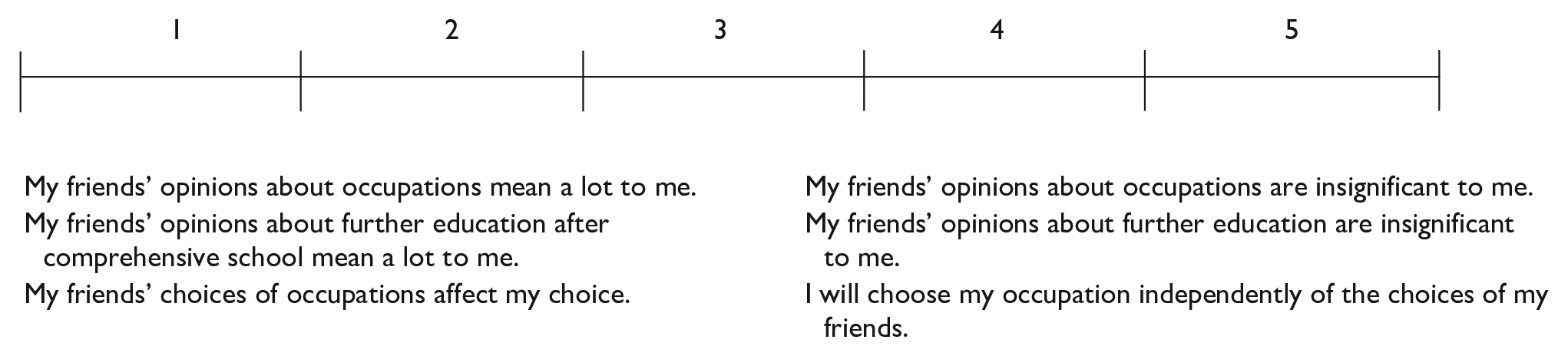
The second group of attributes was constructed from the domains of self-determination, self-regulation, and motivation in relation to peer influence, supervision, familiarity and instruction, and external reward motivation. Self-determination, self-regulation, and intrinsic and extrinsic motivation were explored and examined for the purpose of recognizing and understanding the salient attitudes in the variance of the choices regarding education and occupation. A bipolar 5-point Likert-type scale was used to explore variable properties and their opposites. Empirical research with the expectancy-value model has generally supported bipolar scoring of belief strength (Ajzen & Fishbein, 2008). The survey questions were not labeled in the survey stage to avoid the linguistic bias typical to nonfactual questions (Oppenheim, 1992). The respondents answered a multi-item semantic differential to obtain a relatively direct indicator of attitude (Ajzen, 2005). The survey items were arranged into attitude scales (Oppenheim, 1992).
Data reduction revealed three factor domains of independence, self-direction, and flexibility whose survey items were labeled during statistical analysis and data processing (Oppenheim, 1992) as follows: Independence
Flexibility

Self-direction

The surveys were completed under teacher supervision as self-administered questionnaires at school to improve response reliability. The questionnaires were administered to the students in the classrooms during guidance counseling instructional classes or some other suitable instructional classes. This design had two main aims: First, that the students could obtain technical help with the internet survey and information regarding the research, and second, that the test situations were part of the ordinary school day. It was hoped that this would improve the rate and quality of the responses by ensuring a high response rate and minimum interviewer bias, while permitting necessary explanations, but not the interpretation, of the questions (Oppenheim, 1992). The sampling frame was stratification using stratifying samples for schools (Kline, 2000). These were geographic location: mixed city (town) and rural schools; school system: comprehensive school; and the organizational structure of the WLO program: seventh and ninth grade. The sampling was purposive stratified sampling. The Korvatunturi, Posio, and Keminmaa schools were situated in northern Finland and the other schools were in southern Finland.
The respondents were given the following questions to answer with regard to their family SES: School and class Father’s/guardian’s level of education is (choose the present highest level) Comprehensive school Vocational school or general secondary school University or institute of higher education Mother’s/guardian’s level of education is (choose the present highest level) Comprehensive school Vocational school or general secondary school University or institute of higher education.
Procedure and Participants
The data were drawn from the surveys designed by the author of this article. Data collection was done through internet surveys by self-administered questionnaires. The survey instrument was used for following attitude changes and evolution of the same students longitudinally in Study A. The assessment of Study B followed the general format of Study A, with the exception that the respondents in the Time 1 and Time 2 observations were not the same students. Consequently, I did not use longitudinal analyses methods in Wave B. This made it possible to study two samples, one before WLO and the other after WLO, but with different respondents. Thus, the focus was on finding out whether the results of Waves A and B had (a) the same direction, and whether (b) the mean differences in different regions of Finland were similar. Again, two surveys were carried out: The first before Group 2 had participated in the 1-week work experience period (Time 1), and the second (Time 2) after Group 3 had finished the period (see the appendix for groups and measurement points).
The aims of data collection were met, as evidenced by a small number of missing data and inadequate answers in the surveys’ raw data. The sampling frame was stratification, using stratifying samples for schools (Kline, 2000). These were geographical location: mixed city (town) and rural schools; school system: comprehensive school; and the organizational structure of the WLO program: seventh and ninth grades. The sampling was purposive stratified sampling.
The data for Wave A were drawn from four municipalities in southwestern Finland: Somero, Turku, Halikko, and Salo. In Wave B, the data were drawn from Halikko in the Province of Western Finland, the Korvatunturi School in Savukoski, the Posio and Keminmaa Schools in the Province of Lapland, and from the Pukinmäki School in Helsinki in the Province of Southern Finland. The respondents in Group 1 (Time 1 and Time 2) in Wave A were the same students minus the loss during the 3-year observation period, which was small.
Wave A was conducted during the spring term of the school year 2010–2011. At this time point, the sample consisted of 649 students (341 girls and 308 boys, with a mean age of 16.0 years). The consolidated municipal school district of Salo (Salo, Halikko, and Perniö) had an enrollment of 577 students, and 525 answers were received from these districts (90%). Turku City had an enrollment of 1,337, and 124 answers were received (9%).
Wave B was conducted in Spring 2013, and this group had 253 respondents. In the observation, 89% of the age cohort in Halikko, 76% in Keminmaa, 46% in Posio, 60% in Pukinmäki, and 44% in Savukoski completed the survey. The mean ages of the respondents in the two respective observations were 16.0 and 16.1 years.
Table 1 presents the summary of the participants, aims, measures, and data analyses of these studies.
Summary of Participants, Aims, Measures, and Data Analyses.

Note. ANOVA = analysis of variance.
Validity of the Studies
The validity of this article was approached through investigating both its external and internal validity. This involved taking into account the test design and its generalizability, the theoretical framework and the constructs used, the measuring instrument, the circumstances during the observation points, and the intended object of the measurement process (Ouakrim-Soivio, 2013).
It was considered necessary that the different types of validity were explicated in context (WLO), following the tradition of null hypothesis significance testing (NSHT). The use of NSHT is considered controversial, but when applied with good judgment it can be an effective aid to the interpretation of experimental data (Nickerson, 2000). The validity types were introduced in the context of the reliability and validity of the self-developed measuring instrument, although it can be argued that the modern validity theory questions the existence of different types of validity, and approaches validity from the most suitable viewpoint set by the test, experiment, or research design (see Messick, 1989). The definition of validity has thus changed from the mere investigation of the validity of the measuring instrument to investigating the validity of the results, their interpretation, and their use for the purpose for which the measuring instrument was originally designed (Ouakrim-Soivio, 2013). In this study, I followed a rational hypothesis, based on theory and empirical testing, linked through the theoretical framework of construct (concept) validity with the test results and their relations (Messick, 1995).
Fishbein and Ajzen (1975) argue that beliefs, attitudes, and intentions are interrelated but conceptually distinct concepts that must be independently assessed. The complex dynamic interrelation of the guidance and control process is evident. This also places constraints on the convergent and discriminant validity of this article when making direct causal interpretations based on the evidence of results in Wave A. The challenges are thus recognized and addressed in this research through an approach that uses traditional linear models to test hypotheses concerning interaction. This approach, however, has the potential to fail to capture the configuration of factors that jointly explain behavioral process (Bauer & Shanahan, 2007).
Reliability and validity assessments were carried out using a method in which the test used in Wave A was repeated for different students in different regions in Finland 5 years after the implementation of Wave A. Consequently, the study in Wave B investigated the convergent validity of the measuring instrument and the regional generalizability of the results of Wave A in regard to the two background variables. In convergent validity, the results point in the same direction and correlate with each other (Kane, 2006).
Data Analyses in the Studies
The aim of these two studies was to explore changes in students’ affective entry characteristics in conjunction with three latent variables. In both waves (A and B), the measurement points (Times 1 and 2), respectively, were before and after WLO. In these studies, the measured variables, except the family SES, were held constant and the implementation of WLO followed national curriculum. The methods used to analyze the findings were adjusted accordingly to reflect the two designs. Thus, the author argues that the use of a longitudinal study design in Wave A in concurrence with a nonlongitudinal design in Wave B does not violate the reliability and validity of the findings in this article.
Variable mean differences were used as effect indicators. Effect indicators (reflective indicators) are linear functions of an unobserved theoretical construct that explains the observed covariation between the items (Hennessy et al., 2012). In the choice process, attitude–behavior relation is present (see Ajzen & Fishbein, 2000; Fishbein, 2004). Students’ affective entry characteristics form the effect indicators for this study. They are a set of unidimensional items that reflect the operation of the latent variable: attitude toward target behavior (Hennessy et al., 2012), in this case, attitudes toward choices of education or occupation.
A self-developed measuring instrument with person-based survey questionnaires was designed, piloted, and validated to explore students’ attitudes, the objects of these attitudes, and their intensities. The psychometric test design followed a general application viewpoint in which the test was determined by its use, in this case, testing individual beliefs of a purposive stratified sample in a specific time- and locality-specified context. The rationale behind using a self-developed measurement instrument was to provide an instrument deducted from the incorporation of theories to assess time-, target-, space-, and location-specific control perceptions in the context of WLO.
The Spearman–Brown prophecy formula was used during the design and piloting phase of the measuring instrument to predict full-test reliability. The self-developed instrument was administered twice to the same respondents in Wave A, and so it is possible that differences in motivation and memory could have had some effect on the results (Rust & Golombok, 1999). However, a 3-year time difference reduced these effects. In Wave B, this effect was not present because of the nonlongitudinal test design. Face, content, and construct validity were warranted with regard to both test designs.
The survey data (Study A) was subjected to statistical analyses using SPSS Version 17.02 and PASW 18.03. First, factor analyses were used to estimate factor loadings of the respondents’ background factors and their beliefs. Second, multivariate analysis of variance and repeated measures in general linear modeling were used for multivariate modeling and comparison of the variables during the WLO. Third, multiple regression analysis was used to study how change in one variable was associated with change in another variable. In Study A, the students’ personal, social, and informational background variables were explored in factor analysis, using maximum likelihood analysis with direct oblimin rotation as the method of extraction. This type of factor analysis was chosen to explore the variable domains in the WLO derived from the integration of the SDT and TPB. Based on the a priori attitude structure used in this study, and after consulting the scree plot, a three-factor solution was chosen.
In Study A, the data reduction had revealed three factor domains, which were labeled descriptively as Independence, Flexibility, and Self-direction. The reliability, Cronbach’s alpha (internal consistency), of the three variable scales was .70 for the items in Independence, .60 in Flexibility, and .60 in Self-direction. Pearson correlations (two-tailed) of the variables were significant at the .01 level for the respective three factors. For factor-level analysis, the mean variables of sum for Independence, Flexibility, and Self-direction were computed.
In Study B, the survey data were subjected to statistical analyses using IBM Statistics SPSS Version 24. The temporal stability of the measured attitudes and the constructs were subjected to Independent samples t testing. Cohen’s d values were calculated as indicators of the ES.
Independence, Flexibility, and Self-Direction
The test design for Study B confirmed that the two groups were independent of each other. The assumption of normality was tested. Skewness, kurtosis, histograms, and the normal Q-Q plots of the data were examined. Skewness and kurtosis were <1. The visual inspection of the data revealed no violation of the normality assumption for an independent samples t test.
Using an alpha level of .05, an independent samples test was conducted to evaluate whether independence, flexibility, and self-direction of the two groups (Times 1 and 2) in Wave B differed significantly. The test was statistically significant for independence and flexibility, t(477.00) = −3.43, p < .05, t(461.73) = −2.13, p < .05, but not significant for self-direction, t(477.00) = −.82, p > .05. The 95% confidence intervals for the respective variables were [−.43, −.11], [−.30, −.01], and [−.17, .07]. The means and standard deviations of the respective variables were M1 = 3.85, M2 = 4.12, SD = .85, .87; M1 = 3.19, M2 = 3.24, SD = .67, .65; and M1 = 2.48, M2 = 2.64, SD = .86, .75. The findings were concurrent with the findings of Wave A (Friberg, 2013b).
For the WLO ES estimation and for comparison with the evidence of Wave A, Cohen’s ds were calculated in Wave B. The test design in Wave A had been that of a repeated measure providing paired data and thus the paired design (Cumming, 2012) was used in the calculations (Table 2). The design of Wave B was the two-independent-groups design, so this (Cumming, 2012) was used in calculations. Tables 3 and 4 present Cohen’s ds in comparison. ES serves as an index of the degree of departure from the null hypothesis and as a determinant of power or the required sample size (Cohen, 1988). In interpreting the effects of WLO, I used Cohen’s relative reference value d = .2 as a small ES, d = .5 as a medium ES, and d = .8 as a large ES (Cohen, 1988). In Waves A and B, WLO had a small to medium effect on independence and flexibility, and a near zero effect on self-direction.
WLO Effect Size on Independence, Self-Direction, and Flexibility: Wave A.

Note. Mdiff is M at Time 1 minus M at Time 2. Sav is standardizer for d in paired design. WLO = Work–life orientation; CI = confidence interval; LL = lower limit; UL = upper limit.
WLO Effect Size on Independence, Self-Direction, and Flexibility: Wave B.

Note. Mdiff is M at Time 1 minus M at Time 2. SP is the pooled difference. WLO = Work–life orientation; CI = confidence interval; LL = lower limit; UL = upper limit.
Proportion of Parents’ Education in Groups 1 to 3.

Note. Group 1 = Wave A. Group 2 = Wave B, Time 1. Group 3 = Wave B, Time 2. z score test for two population proportions. p < .05, two-tailed.
An examination of the variable means of the samples indicated slight development in independence and flexibility in Waves A and B as suggested by the strength and direction of change shown in Figures 2 and 3. The growth of independence and flexibility can be interpreted to signify the efficacy impacts of WLO, as evidenced by the consistency of the results and their convergent validity. Due to the complexity of efficacy measurement, consideration must be given to the interpretation that the detected changes in independence and flexibility represent age-related factors that jointly explain the behavioral processes concerned. Wave A covered a relatively short life span and temporal developmental period, and the respondents were from a specific region in Finland, which should be considered when making assumptions regarding the predictive power and generalizability of the findings. Regional differences with regard to the industrial structure of the school regions in Waves A and B differed considerably as shown in Figure 4.

Wave A: Change in independence, flexibility, and self-direction.

Wave B: Change in independence, flexibility, and self-direction.

Industrial structure by province.
There existed statistically significant differences in parents’ education-level proportions in Waves A (Group 1) and B (Groups 2 and 3) as seen in Table 4. However, no single pattern of family SES with regard to parents’ education emerged supporting the correlation between parents’ education and changes in independence, flexibility, and self-direction in WLO, which would link parents’ education and the three variables in question. In past studies, mother’s and father’s education and their involvement has been suggested to play a role in children’s educational aspirations (Ellis & Lane, 1963; Kahl, 1953; Krauss, 1964; Legutko, 1998; Mulroy et al., 1998; Sewell & Shah, 1968).
The results in Waves A and B have the same direction, and the mean differences in the two studies are similar, irrespective of the differences in geographic regions and parents’ education. The consistency of the ES of WLO on independence, flexibility, and self-direction in Studies A and B reinforce the validity of the evidence.
Limitations of the Studies
This research has limitations that must be taken into consideration when generalizing the research results. There was an uncontrolled loss of respondents in Wave A in Turku and, in Wave B, in Keminmaa, Savukoski, and Posio. In Turku, the loss of respondents compared with the total numbers of students was high. This is explained by the fact that just one school of the municipal school system participated in the studies. There was a 54% loss in Posio and in Savukoski. The case losses were in the number of the total population of the students in the respective municipalities, and the losses did not happen between the measurement points. These losses affect the representativeness of the samples and somewhat weaken the statistical evidence derived from the samples.
In the Turku case, Luostarivuoren koulu was chosen solely because of its willingness to participate in the research. It followed the general comprehensive school curriculum, like the other schools in this research, and its student population did not differ from those of the other schools. In all, I may conclude that no systematic loss took place and there was no selective dropout (Wolke & et al, 2009) that would lead to biases or erroneous conclusions.
Furthermore, in longitudinal survey designs (Study A), many intervening variables may influence the effects, and the longitudinal survey designs tend to be somewhat weaker in terms of causal attribution (Oppenheim, 1992). Changes in attitudes are also multicausal and cumulative, and found correlations as such are no proof of causality (Oppenheim, 1992). As presented earlier in this article, Wave A had covered a relatively short life span and temporal developmental period, and the respondents were from a specific region in Finland, which should be considered when making assumptions regarding the predictive power and generalizability of the findings.
Using a self-developed measuring instrument is always somewhat risky because its reliability and validity has not been tested among large numbers of people (Ouakrim-Soivio, 2013), which was the case in this study. Furthermore, in future studies on the efficacy of WLO, questions should address and control the background variables related to the effects of the social maturation of the students during the elapsed three school years. However, eliciting students’ beliefs in the context of WLO justified the use of the self-developed instrument in this research. The instrument produced consistent results for 1,807 cases. The psychometric reliability of the test was that of internal consistency, and a minimum of .70 of internal consistency reliability (Kline, 2000) was reached. The test instrument was specifically designed for the case of WLO and it proved to be functional in this context.
Discussion
Main Findings
The research question asked whether the implementation of WLO had different effects in different school environments in Finland and whether the differences between the education of the parents correlated with the efficacy of WLO. No notable regional differences in the variance of the students’ attitudes were detected although the social environments differed considerably with regard to industrial structure as presented in Figure 4. In addition, the statistically significant proportional differences between the parents’ educational levels (presented in Table 4) did not correlate with the impacts of WLO in Waves A and B. The outcomes of WLO in Waves A and B had the same direction, and the mean measured differences in independence, flexibility, and self-direction in different regions of Finland were essentially similar and not linked to family education level. The ES in Studies A and B were similar. Interestingly, self-direction proved to be a robust stable factor in both studies.
Conclusion and Recommendations for Future Research
Results in this study suggest that WLO program experiences have efficacy, although moderate in statistical terms, in changing students’ attitude domains of independence and flexibility toward future education and occupation. Noteworthy is that students’ background factors of region and guardians’ education were not linked to the WLO outcomes for independence, flexibility, and self-direction. In both waves of the WLO, the implementation of WLO followed the national curriculum, which warranted the structural components of WLO to be constant.
Personal attributes are indicators and facilitators of learning. They bridge affection, cognition, and conation with factual knowledge, conceptual knowledge, procedural knowledge, and metacognitive knowledge. Making educational and occupational choices comprise reasoned actions, which guide and control student behavior. Making these choices also involves metacognition. Metacognition consists of (a) knowledge about cognition, and (b) control, monitoring, and regulation of cognitive processes (Anderson et al., 2001). Proust (2013) defines metacognition as a set of capacities through which an operational subsystem is evaluated or represented by another in a context-sensitive way. In metacognition, evaluation is performed through monitoring-based adaptive control, including higher forms of control and a form of epistemic context-sensitivity. This suggests that metacognition is an ingredient of cognitive or mental agency (Proust, 2013).
Metacognition plays a critical role in learning and involves activities such as planning how to approach a given learning task, monitoring comprehension, and evaluating progress toward the completion of a task (Larson, 2009). Knowledge and understanding of person-based characteristics thus help educators direct their attention toward the individual backgrounds of students and the outcomes of WLO programs. This increases the efficacy of the educational-vocational intervention in regard to the knowledge, attitude, and skills needed for setting life goals. Affecting PBC through any intervention will be difficult if perceived control is based on personal experience and it may require actual behavioral rehearsal as an intervention component (Yzer, 2012). Improving students’ metacognition plays a role in the possible interventions, particularly as the results of this study suggest no correlation of region and family education with students’ independence, flexibility, and self-direction.
Self-direction turned out to be a relatively stable factor in both Waves A and B. The results of self-direction assessments could even predict achievement in tertiary education (see, for example, Hailikari, 2009; Honkanen, 2011). Self-directive supportive learning environments, at school and outside it, are needed for aiding self-direction both as a process and a personal attribute in WLO. Self-directive learning environments recognize the context as an active image of an alterable state. Attitudes involved in WLO are alterable. Self-direction in the choice of future education or occupation is a construct that requires understanding of cognitive and affective connections within the WLO environment and adult-student and peer relationships. Further research in understanding the role of self-direction with regard to choosing further education and occupations is needed. Furthermore, it is plausible to deduce that further research in self-direction is relevant when guiding students in remote learning.
Practical and Theoretical Implications
As substantiated in this article, self-guidance is a determinant in planned behavior, and attributes of self-determination and self-efficacy are present in future education orientation. This has implications for educational-vocational interventions, which strive to individualize educational paths. It further underlines the importance of facilitating students’ self-, educational-, and occupational awareness. Promoting learners’ control of self-determination and self-efficacy during transitional periods is essential. The findings highlight the relevance of pedagogical measures in helping students learn how to monitor and evaluate their own beliefs. Self-knowledge is a facilitator in learning, and awareness of one’s own cognition and thinking enables individuals to be more adaptive to different tasks (Pintrich, 2002).
If WLO was in use in general upper secondary schools, it could open new possibilities for secondary school students to individualize their study paths. The learning experiences and increased metacognition during WLO could make students choose new or extra subject matter courses that support their orientations, or drop certain courses from their individual study paths. Self-direction and orientation assessments could be used for building predictive models based on the students’ background factors to map, direct, and support individual choice paths in all levels of formal education.
The author argues further that research data could be used for supporting students’ self-directed learning skills and tasks in individual distance and remote learning through guidance counseling in educational institutions.
Footnotes
Appendix
Groups and Measurement Points in Waves A and B.

| Pilot study | Measurement point | |||
| October–November 2007 | ||||
| Pilot group: Basic education |
Time 1 Ninth grade, N = 129 |
|||
| Studies | Measurement points | |||
| March–May 2008 | March–April 2010 | March–May 2013 | March–May 2013 | |
| Group 1: Basic education |
Time 1 Seventh grade, N = 669 |
Time 2 Ninth grade, N = 649 |
Time 1 | Time 2 |
| Wave A | Wave A | |||
| Group 2: |
Seventh grade, N = 236 | |||
| Wave B | ||||
| Group 3: |
Ninth grade, N = 253 | |||
| Wave B | ||||
Declaration of Conflicting Interests
The author(s) declared no potential conflicts of interest with respect to the research, authorship, and/or publication of this article.
Funding
The author(s) received no financial support for the research, authorship, and/or publication of this article.
