




Abstract
A student self-determination profile of occupational and educational choices was examined through the concepts of Locus of Causality and Locus of Orientation. Research questions associated with respondents’ certainty of occupation and orientation to vocational education were answered. The tested hypotheses were as follows: (a) Independence, initiative, self-guidance, choice of discussion forums, and gender are related to certainty of future occupation choice and choice of vocational education; (b) certainty of occupation relates to choosing vocational education; (c) negatively biased media lessens interest in vocational education; and (d) vocational education choices are related to gender. A survey of ninth-grade students in Finnish comprehensive school was conducted after implementation of a work-orientation program defined in the national comprehensive school curriculum. At the local school system level, 649 subjects of the mean ages of 16.0 years participated in an Internet survey in two school districts in southwestern Finland in 2008. The variables were inserted in Linear Multiple Regression Analysis in IBM SPSS. The means of vocational school choice and certainty of occupation, and vocational school choice and negative media image were compared in SPSS means. An independent-samples t test for vocational school choice and sex was conducted. Statistically significant regression models of loci of orientation and locus of causality were found. The more the respondents were certain of their occupation choice, the more they expressed their secondary education orientation to be vocational school. When students discussed their choices less at home, their orientation to vocational education weakened. A negative media image was not associated with vocational school choice in this data. The measured means for girls’ and boys’ orientations to vocational school did not show statistically significant differences.
Guidance counseling and work−life orientation form an integration of disciplines and day-to-day school activities in the first six grades of comprehensive education in Finland. Through Grades 7 to 9, guidance and work−life orientation are given during class hours specified for these purposes and in individual guidance sessions between students and guidance personnel. The objectives and goals are set at the national level, but they are specified and localized at the municipal level in the school systems. The national educational policy guiding work−life orientation (National Board of Education, 2004) lists two main purposes for work−life orientation. The first is to bring schools and the surrounding society closer, and the second is to facilitate student’s choices for future career and educational choices. The individual student choice processes of the latter goal are the focus of this research paper as they are not only of primary interest to educators but are also of interest to educational policy makers in shaping formal education for today and tomorrow.
Following is a brief description of the structure of work−life orientation at the local school system level in the three participant school systems of this research paper: Halikko School Board, 2004; Salo City School Board, 2004; Turku School Board, 2004.
seventh grade: 1-day orientation to parents’ or acquaintances’ work and occupations
eighth grade: 1-day orientation to an enterprise
ninth grade: 1-week orientation to work−life (work experience).
Finnish municipalities are authorized to add specific local objectives to the general objectives decreed in national educational policy. The objectives of Turku include (Turku City School Board, 2004) the following:
the advancement of study skills
social maturation of the student
development of knowledge and skills needed in setting life-goals
endorsement of ethnic and gender equality.
In this paper, work−life orientation is approached from the perspective of an individual’s choice process in one major transition period during primary education. Young people have a choice of entering the world of work, or choosing to continue their education in either general or vocational education. The goals and objectives of work−life orientation indicate that students’ choice processes comprise cognitive, affective, and psychomotor objectives.
In actualization of cognitive and affective skills, intrinsic and extrinsic motivation could be theorized to complement each other. Deci and Ryan (1985) showed that self-determination is important in the development and exercise of extrinsic and intrinsic motivation. Intrinsically motivated people perceive the locus of causality to be internal (Deci & Ryan, 1985). To understand an individual’s choice patterns, it is also relevant to take into account the conception of student motivation emphasizing the interaction of individual and contextual factors (Tapola & Niemivirta, 2008).
Kirjavainen (2009) has named family background, referring to the Coleman report (Coleman et al., 1966) as one of the key inputs in the educational process (see also Bandura, 1995; Bouchey, 2004; Jacobs, Chhin, & Bleeker, 2006). Thaler and Dahmen (2009) have pointed out that youth-relevant media about jobs plays a key role in the socialization and educational decision processes of pupils at the secondary school level. Gender has been shown to influence occupational and educational choices (see Dornbusch, Ritter, Leiderman, Roberts, & Fraleigh, 1987; Eccles, 1994, 2009; Eccles & Watt, 2008; Lueptow, 1981; Siegel, 1973).
National educational policies become contextual factors in school reality as do incentives and restrictions concerning school systems with their actors and individual students. Changes made in the Finnish educational policy in the early 21st century and demands from the business sector and labor market have increased the popularity of vocational education among basic level graduates (Statistical Yearbook of Finland, 2011). Local differences exist in different regions of the country. One could estimate that the ninth-grade cohort is split roughly into half on the national level, give and take 10%, between choosing general or vocational education. On a national level, 91% of ninth-grade graduates continued education, 45% in vocational education, and 55% in general secondary education (Statistical Yearbook of Education, 2011). At school, individual conative issues such as intentions and goals, plans and commitments meet the demands and expectations of educational policy. These conative issues are discussed with guidance counselors, peers, and people at home. In addition, the media also influences young people by presenting opinions and background information on possible choices of occupations and education.
In this study, I assumed that distinctive patterns of causality and orientation would emerge at the end of the Finnish comprehensive school ninth-grade work-orientation program. This program is implemented to guide students in their occupational and educational orientations. The emergent structures would guide conation (cf. Bandura, 1997; Miller, 1991) resulting from the variance of factors in self-regulation, self-efficacy, and self-determination and in relation to certainty of occupation choice and choice of a future occupation path. Self-regulation refers to self-generated thoughts, feelings, and actions that are planned and cyclically adapted to the attainment of personal goals (Zimmerman, 2000). Self-regulation involves self-efficacy. Self-efficacy consists of beliefs about one’s capabilities to organize and implement the actions necessary to attain designated performance of skill for specific tasks (Zimmerman, 2000).
The a priori content categories in this research paper were as follows: (a) respondent evaluation of a self-directing factor constructed from the three attributes of independence, initiative, and self-guidance; (b) respondent evaluation of an occupation choice discussion forum; (c) respondent evaluation of certainty of choice of occupation; (d) respondent evaluation of secondary education choice, and (e) respondent evaluation of image dependence. Respondent evaluation is defined here as an affective student response in relation to a survey item (cf. Fishbein & Ajzen, 1975).
This paper aimed to answer the following four research questions:
Research Question 1: Do students’ evaluations of independence, initiative, self-guidance, and choice discussions forums relate to certainty of future occupation and choice of vocational education at the end of the ninth grade?
Research Question 2: Does certainty of occupation relate to the choice of vocational school as the secondary school educational choice?
Research Question 3: Does negatively biased media relate to choosing vocational school as the form of continued education?
Research Question 4: Are there gender differences evident in a choice of vocational school as the path of secondary education?
The hypotheses to be tested were as follows:
Hypothesis 1: Independence, initiative, self-guidance, choice of discussion forums, and gender are related to certainty of future occupation choice and choice of vocational education.
Hypothesis 2: Certainty of occupation relates to choosing vocational education.
Hypothesis 3: Negatively biased media lessens interest in vocational education.
Hypothesis 4: Gender is related to choice of vocational education.
Distinctive patterns of causality and orientation were assumed to exist at the end of the ninth-grade work-orientation program.
Method
Participants
The observations were made in three Finnish municipal school districts of Halikko, Salo, and Turku. These municipalities were chosen from subregional units 022 and 023 (for further statistics, see Statistics Finland, 2010) to survey a sample of the implementation of national work-orientation goal setting in southwestern Finland. One school was in Halikko, three were in Salo, and one was in Turku. The survey was conducted during spring term 2010. The survey covered all the ninth-grade school units in the two first mentioned municipalities and one of the eight schools in Turku. The consolidated municipal school district of Salo (Salo, Halikko, and Perniö) had an enrollment of 577 students, and 525 answers were received (90%). The city of Turku had an enrollment of 1,337, and 124 answers were received (9%). The sample consisted of 649 students in the ninth grade (mean age of 16.0 years).
Materials and Procedure
For this study, 6 of 28 bipolar statements were chosen. The questions were presented in the native language of the students (Finnish) and were translated into English for this paper by the author. Agreement was used as the answering format in a five-step bipolar dimension. Gable (1986), after reviewing research on the number of question steps, has concluded that, “on the basis of research reported, the reliability and validity issues seem to be best served through the use of from five to seven response categories” (p. 5). Attention was paid to practical and empirical considerations (see Cronbach, 1946; Gable, 1986). All categories of the response continuum were labeled, and horizontal verbal labels were chosen considering the ages of the respondents and the number of formal school years, nine plus school years.
Procedure
The content validity phase of the survey, which included item review to test the rationale of the measuring instrument, had been done by two school superintendents, two comprehensive school principals, and four guidance counselors in the fall of 2007. A pilot study had been conducted in the Halikko school district (n = 129) during the fall semester of 2007.
The Webropol surveys were conducted after the pupils had participated in the 1-week work−life orientation module and had begun studies in the ninth grade. These surveys were answered under teacher supervision at school. The a priori content categories, students’ expressed certainty of the choice of occupation, and vocational school as the choice of continued education were the dependent variables. Certainty of occupation was proposed to form a model in conjunction with a student self-directing factor, Self-Direction, constructed from three attributes of independence, initiative and self-guidance, and the variable choice discussion forum. Self-Direction had emerged in factor analysis. The method in the extraction was Maximum Likelihood With Direct Oblimin Rotation. Vocational school as the choice of continued education was expected to form a model with certainty of future occupation and choice discussion forum. Respondents’ sex was included as a background factor (cf. Block, 1964) in both models. Variable means comparisons were made. The three attribute variables of Self-Direction and the bipolar variable structure of the survey questions for this paper are presented in Table 1.
The Attributes of Self-Direction Factor and the Variables of Discussion Forums, Certainty of Occupation Choice, and Vocational School Choice.

Note. Scale interval in all attributes is integral 1. The polarities and their respective item coding are reversed from the original survey order except in Item 7.
Results
The survey data were subjected to statistical analyses using IBM SPSS version 20.The data (missing list wise) were examined for its preliminary technical properties using Linear Multiple Regression Analysis (Table 2).
Psychometric Properties of the Three Attribute Variables of Self-Direction Factor, Choice Discussion Forum, Certainty of Occupation, Vocational School Choice, Image Dependence, Sex, and the Variable Correlations.

Note. The range of answers was in all cases 1.0-5.0 except in gender that was defined as girl = 1 and boy = 2. Image dependence refers to negatively biased media.
Correlation is significant at the .05 level (two-tailed).
Correlation is significant at the .01 level (two-tailed).
The distributions of the measured variables (univariate) did not show severe problems of distributional assumptions (skewness > 2; kurtosis > 7) and thus met the univariate normal distribution assumption (see Table 2). I examined the correlation matrix of the variables in the three domains to see whether weak interitem dependency existed, or too high correlations would indicate multicollinearity. Neither existed. Cronbach’s alpha (internal consistency) of the scale was .7 for the items in Self-Direction, which formed the independent attitude variable structure in this study.
To check whether the regression assumptions were not met, attention was paid to possible unusual or influential data, including outliers, leverage, or influence (Regression Diagnostics, 2012). This was done examining variable scatterplots and box-plots, histograms for standardized residuals, leverage values, and Cook’s D in SPSS. Based on the analyses, I deemed statistical data manipulation unnecessary and decided to continue with Linear Multiple Regression Analysis to study how change in one variable (X) is associated with change in another variable (Y) (Hinkle, Wiersma, & Jurs, 2003).
Method of Analysis
In the first regression analysis, independence, initiative, self-guidance, home discussions, and gender were entered in Linear Multiple Regression Analysis as an independent (predictor) variable to predict the influence on the dependent (criterion) variable of certainty of occupation (Model 1). The regression method was Enter (the simultaneous method) as no strong theoretical expectations existed. In the second analysis, certainty of occupation, home discussions, and gender were entered as independent variables to predict the influence on vocational school choice (Model 2). The regression method was Enter.
The means of vocational school choice and certainty of occupation, and vocational school choice and negative media were compared in SPSS means. Cell statistics for the scale means, standard deviation, variance, kurtosis and skewness, and ANOVA table, and a test for linearity were obtained and analyzed for vocational school choice by certainty of occupation and by negative media. An independent-samples t test for vocational school choice and gender was also conducted.
Influence on Certainty of Occupation (Model 1)
Using the Enter method, a significant model emerged, F(5, 623) = 11.401, p < .0005, adjusted R 2 = .076 (see Table 3 and Figure 1).
Variable Influence on the Certainty of Occupation: Linear Multiple Regression Model 1.

Note. CI = confidence interval; LB = lower bound; UB = upper bound; VIF = variance-inflation factor.
p < .05.

Model 1: Normal P−P plot of regression standardized residual.
Influence on Vocational School Choice (Model 2)
Using the Enter method, a significant model emerged, F(3, 629) = 21.634, p < .0005, adjusted R 2 = .089 (see Table 4 and Figure 2).
Variable Influence on Vocational School Choice: Linear Multiple Regression Model 2.

Note. CI = confidence interval; LB = lower bound; UB = upper bound; VIF = variance-inflation factor.
p < .05.
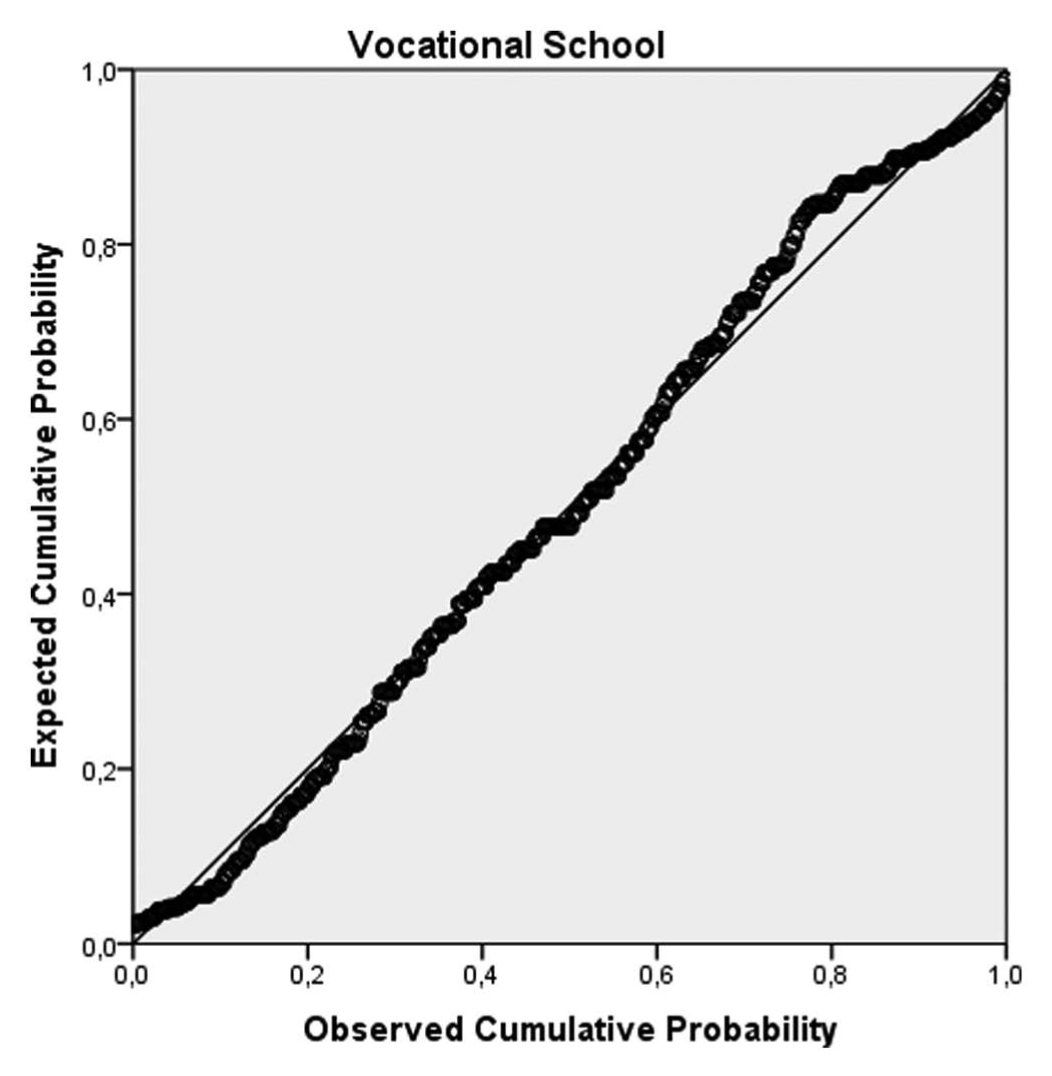
Model 2: Normal P−P plot of regression standardized residual.
Vocational School Choice Associated with Certainty of Occupation
The between-groups result was statistically significant (p < .05 level), df = 4, F(11, 9), p = .000. Linearity was df = 1, F(45, 5), p = .000. Measure of association was R (.259) and R 2 (.067). See Figure 3 for a graphic representation.

Graph of the means of vocational school choice and certainty of occupation.
Vocational School Choice Associated With Negatively Biased Media
The between-groups result was not statistically significant (p < .05 level), df = 4, F(0, 43), p = .790. Linearity was df = 1, F(0, 07), p = .797. The measure of association was R (.010) and R 2 (.000).
Vocational School Choice and Gender
The conducted independent-samples t test did not show statistically significant difference between the means of girls’ (n = 336) and boys’ (n = 302) answer means (2.92; 3.13; SD = 1.46; 1.32) and vocational school choice (p = .051, df = 636). Equal variance was assumed (p < .05 level, confidence interval [CI] = 95%).
Discussion
Hautamäki et al. (2012) had concluded in their evaluation report on secondary school students’ competencies that a need existed for improving guidance counseling and developing a professional identity in secondary education. This expressed need opened up questions for locating internal and external factors orientating students in relation to their occupational and educational choices. Guidance counseling and work-orientation programs in the Finnish comprehensive primary level school curricula are the principal educational tools to help the student in his or her choice path during the first 9 years of formal education. Guidance counseling and work-orientation helping students in their personal growth have been present in the comprehensive school primary level work−life orientation for three decades and should have a transfer effect in answering the following questions: What are my intentions and goals and what am I going to do after graduating from comprehensive school? In an individual’s life, occupational choice and development have been shown to be of special importance (Bandura, 1995).
Work-orientation specifically serves two purposes: It facilitates students’ choices for future career and helps to bring school and society closer. Close school–home relations and cooperation are also expected to be established during work-orientation, and gender equality is designated to be promoted.
Kirjavainen (2009) had named family background, referring to the Coleman report (Coleman et al., 1966) as one of the key inputs in the educational process (see also Bandura, 1995; Bouchey, 2004; Jacobs et al., 2006).Students discuss their plans at home and these discussions should be integrated with guidance efforts at school.
Based on research literature, gender was expected to be involved in choice patterns (see Dornbusch et al., 1987; Eccles & Watt, 2008, 2009; Lueptow, 1981; Siegel, 1973). Earlier in this paper, students had also been hypothesized not to be immune to media influence as external stimuli. Thaler and Dahmen (2009) had pointed out that youth-relevant media about jobs played a key role in the socialization and educational decision processes of pupils at the secondary school level that was hypothesized to relate to choice processes. Self-regulatory efficacy beliefs had been shown to causally influence human regulatory processes (Zimmerman, 2000). Pintrich (2000) had further expressed a need for models of self-regulated learning that included motivational and cognitive processes. Self-regulated learning is involved in directing and orientating occupational and educational choices.
This paper aimed to answer research questions about locus of causality and locus of orientation in occupational and educational choice processes. Response interactions with independence, initiative, self-guidance, home discussions, gender, and certainty of occupation choice and vocational school as secondary education choice were tested. The relation of media image dependence and vocational school choice was explored.
The two regression models, influence on certainty of occupation (locus of control) and influence on vocational school choice (locus of orientation; see page 4, paragraph 1 and Figures 2 and 3) proved to be statistically significant. The variables used in the models were correlated (Table 2). The power of the predictors was rather low, which should be taken into account when drawing conclusions from the overall predicting power of the models.
Two attributes of the factor Self-Direction, independence and initiative, were found to predict certainty of occupation. From this finding, one can conclude that students who expressed stronger personal evaluations of these attributes were more certain of their potential occupations. The more the respondents were certain of their occupation choice, the more they expressed their secondary education orientation to be vocational school. When students discussed their choices less at home, their orientation to vocational education weakened. In other words, according to the data, school-based guidance counseling concerning vocational education was not the only forum where students tested their intentions, goals, and plans. The data in this study gave tentative evidence for the existence of a conative behavioral pattern in which home discussions seemed to strengthen the students’ certainty of occupation and orientation to vocational secondary education. Findings related to home discussions ran parallel with earlier mentioned research (Kirjavainen, 2009) where family background was pointed out to be one of the key inputs in the educational process (see also Bandura, 1995; Bouchey, 2004; Jacobs et al., 2006).
A negatively biased media image did not relate to vocational school choice in this data. It is reasonable to consider possible response bias in psychometrically measuring opinions (cf. Kline, 2000). The poles of this survey item were “A negative picture given in media (internet, television, print) lessens my interest towards that profession” to “The picture given of the profession in the media is insignificant to me.” The original survey had also included an item with the poles “A positive picture given in media (internet, television, print) increases my interest towards that profession” to “The picture given of the profession in the media is insignificant to me.” These two questions had been set apart from each other to avoid a possible proximity effect. The latter item had been excluded from the items included in this study because of the interest in surveying possible negative media image effects. This interest had risen during the content validity phase of the study. The descriptives for the two bipolar survey items were respectively n = 636, n = 641; M = 3.61, 3.00; SD = 1.00, 1.06; and variance = .99, 1.13; and the item characteristic curves of these two curves were about the same, which would tentatively support a nonbiased item structure. If the reliability demand for the item were satisfied, it could be hypothesized that the combined impact of home and guidance counseling helps the students to cope with external negative media image of occupations.
Respondents’ gender proved to be a slightly significant predictor in Model 1 and a nonsignificant predictor in Model 2. The means for girls’ and boys’ measured orientation to vocational school did not show statistically significant differences. The choice pattern was gender neutral in this data at the end of the ninth grade.
I argue that the finding of this study underlines the overall importance of school guidance counseling during the work−life orientation program and in part supports the general need for improving guidance counseling (cf. Hautamäki et al., 2012). The linear relationship between students’ initiative and home discussions showed that students showing weaker as well as strong initiative seemed to rely more on the support structure of home than school. Students whose behavioral pattern leans more toward that of formal external support of orientation in occupational choices need cohesive external support at school. If left alone to cope with the external stimuli, this could overemphasize the effect of home. To put it in simple terms, by improving the effectiveness of work-related guidance counseling and strengthening school−home or home−school interaction, the efficacy of work−life orientation can be improved in the comprehensive school.
Deci & Ryan (1985) have shown self-determination to be important in the development and exercise of extrinsic and intrinsic motivation. To improve the efficacy of work−life orientation in the Finnish comprehensive education, this study revealed a need for continuing research on the different profiles of the loci of orientation and causality of the students’ occupational and educational choices. We need to know more of the association of supportive variables (locus of control) and orientating (locus of orientation) variables. Belief formation and affective evaluation prepare the students for leaving the comfort zones of home and present school. The synthesis of cognition and affection leads to renewing one’s relation with occupations and possibilities of secondary education. Work−life orientation provides place, time, and support for this process in a supportive school environment.
Footnotes
Declaration of Conflicting Interests
The author(s) declared no potential conflicts of interest with respect to the research, authorship, and/or publication of this article.
Funding
The author(s) received no financial support for the research and/or authorship of this article.
Author Biography