




Abstract
This research analyzes Muslim treatment of other religions in Medieval Bengal from 1204 to 1757 CE with a special reference to Muslim rulers and Sufi saints. The study is based on historical content analysis using a qualitative research design. The study shows the Muslim sultans and Mughals in the medieval period played a vital role in promoting interreligious harmony and human rights in Bengal. In addition, the Muslim missionaries and Sufis served as a force against religious hatred in society. The Muslim sultans and Mughals applied liberal and accommodative views toward non-Muslims. They did not force non-Muslims to accept Islam. Muslims and non-Muslims were integrated society, and they enjoyed full socioeconomic and religious rights. Moreover, Sufis conducted various approaches toward Muslims and non-Muslims as well. They promoted the message of equality and moral conduct among the diver’s faiths of the people. They also applied liberal, syncretic, and accommodative attitude in attracting non-Muslims to Islam in Bengal. The study concludes that most rulers were sympathetic and cooperative in dealing with the people of other religions.
Introduction
Societal integration is a top priority in Islam as it considers all humanity as a single-family called the ummah (Elius et al., 2019; Khair et al., 2012). For this reason, Islam prohibits intervention in the rituals of other religions and asks to preserve their customs, beliefs, and property (Nor et al., 2018). Historically, whenever Muslims ruled, non-Muslims were welcome and enjoyed the right of residence (Nor, 2012). There are numerous examples of Muslim rulers providing religious freedom to non-Muslims (Nor et al., 2018).
Bengal, although geographically distant from the heartland of the Islamic world, both east and west, is one of the largest linguistic groups among Muslims as Bangladesh has 90% of the population following Islam, and at the same time there are millions of Muslims living in West Bengal of India. Islam is not only the religion of the majority of Bengali-speaking people but also their predominant culture (Siddique, 2008). Muslims ruled Bengal more than five and a half centuries beginning with Ikhtiyar al-Din Muhammad Bakhtiyar Khilji’s (a military general of Qutb Uddin Aibak of Turkic origin) arrival in 1204 until the East India Company’s take over in 1757 by defeating the last Nawab of Bengal, Siraj-ud-Daulah (Siddiq & Habib, 2017). The Medieval Bengal (1204–1757 CE) is not present Bangladesh and the West Bengal of India only, it also included parts of Tripura, Bihar, Assam, and Orissa where Bengali is the mother tongue (Rahman, 2018).
The medieval Muslim rule in Bengal was a civilization based on tolerance, harmony, social liberalism, and human welfare (Siddiq & Habib, 2017). The rulers prioritized social cohesion. Every person was considered an equal citizen of the society, not based on ethnic or religious identity, but on his or her humanity (Siddiq & Habib, 2017). During this period, learned Sufis who arrived from the Arabian Peninsula, Persia, Iraq, northern India, and Central Asia had a profound influence in the society because of their missionary activities. They contributed tremendously to reducing religious hatred as well as promoting peace and harmony (Al-Masud et al., 2017). The Islamic egalitarian principles appealed to society in preventing untouchability, and there was creative interaction between Muslims and Hindus in the medieval period (Dey, 2013). Islam established itself in Bengal because of its accommodative nature developed by the Sufis or Pirs, who absorbed the local traditions into the egalitarian values of Islam (Roy, 1983 quoted in Alam, 2013).
The question is what the main issue or problem that we need to address in this study and why the issue is a significant one to be discussed. The present West Bengal and some places in Bangladesh are having some interreligious intolerance issues lately due to the political and social reasons. Many conflicts are occurring among the religious groups in India for several times. For example, the riots between Hindus and Sikhs happened in 1984, Hindus-Muslim in 2002, Hindus-Christian in 2008 (Chakraborty, 2017; United States Department of State [USDOS], 2018; Wilkinson, 2006), Hindus-Muslim conflicts in Jammu and Kashmir (Elius et al., 2019). In addition, the current issuance of the Citizenship Amendment Bill by the Indian government has triggered the citizenship eligibility issue of many Muslims living in Assam, West Bengal, and other parts of India as well (Biswas, 2019; Deka, 2019; Kronstadt, 2018; Perrigo, 2019). This Citizenship Amendment Bill has caused many problems between Indian Muslims and non-Muslims.
Similarly, the religious minorities in Bangladesh are also facing some interreligious intolerance in some places in the country (Muhammad & Abdul Rahim, 2017) such as attacking Christians in 2001 (BBC News, 2001), eviction from the lands owned by Hindus in between 2001 and 2006 (Shakil, 2013), and setting fire in the Buddhist temple in 2014 (Unrepresented Nations and Peoples Organization [UNPO], 2014). Such violence and conflicts are triggering many social, political, and religious issues among the community of both countries.
Therefore, it is a dire need to study the history of the Muslim leadership in those areas and their methods of keeping the community in the most satisfying level of harmony and tolerance. More importantly, it will show the proof of living in harmony and peace within the community regardless of their religion, race, and culture. The research is also required in such an issue to show that the community deserves their religious and moral rights to observe at a level that it should not harm the other religious community by maintaining the common ground within a various religious group. Thus, this study demonstrates how the medieval Muslim rulers contributed to establishing peaceful coexistence and interreligious harmony in Bengal. It includes the liberal approaches of Sufi saints, who are regarded as the prime agents for the Islamization in Bengal.
Method
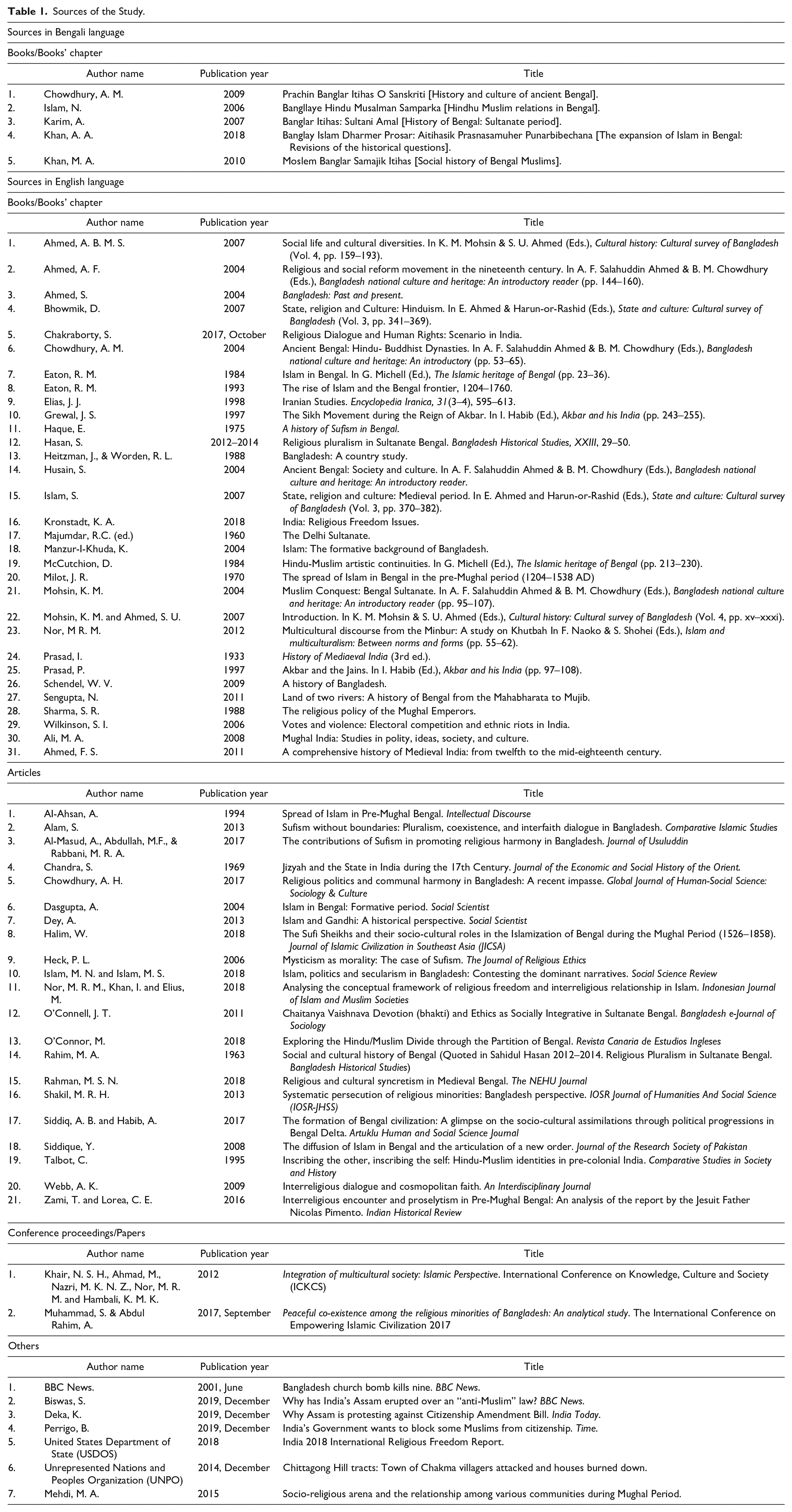
The study endeavors to understand the interreligious relationship in Medieval Bengal from the conquest of Ikhtiyar Uddin Muhammad Bakhtiyar Khalji in 1204 to the defeat of the last Mughal ruler Nawab Siraj-ud-Daulah in 1757. In this research, the qualitative method has been conducted to in-depth study (Khan et al., 2018). Data are collected from books, including Bangla and English, articles, published lectures, conference proceedings, and online sources to understand the conditions of interreligious relations in the medieval period in Bengal. Either primary or secondary data or both together can be used for the content analysis of the qualitative method (Elius et al., 2019; Harris, 2001). Therefore, in this study, processing and analyzing data is conducted in a descriptive qualitative approach (Vaismoradi et al., 2013). Through the analysis, the researchers highlight only three stages of Muslim rule in the medieval period in Bengal. In the first stage, from 1204 to 1338, Bengal was governed by the representatives appointed by the Delhi Sultanate (Eaton, 1984; S. Islam, 2007; S. Ahmed, 2004). In the second stage, from 1340 to 1576, independent sultans ruled Bengal, with some becoming the emperor of India. The third stage (Mughal and Nawabi period) was from 1576 until the East Indian Company’s takeover of Bengal in 1757 (S. Islam, 2007). And, finally, Sufis’s contributions in promoting peace and interreligious harmony in the Medieval Bengal are also considered for the study. Thematic analysis is most commonly used in qualitative research (Joffe & Yardley, 2004). So, the data achieved from the different sources are classified mainly into three themes: the Sultanate period, the Mughal Period, and Sufis’s contribution in these both periods. The identification of sources for the study is provided in Table 1.
Sources of the Study.
An Overview of Bengal
In ancient times, Bengal was not known by a fixed or single name (Husain, 2004; N. Islam, 2006). There was no such name as Bangla or Bangladesh (Mohsin & Ahmed, 2007). Different parts of Bengal were known by different names (N. Islam, 2006) such as Pundra, Barendra, Gaur, Karnasubarna, Rarh, Vanga, Samatata, and Harikela (Alam, 2013; A. M. Chowdhury, 2009; N. Islam, 2006). Pundra consisted of the northern territories of Bangladesh and parts of the Indian province of West Bengal. Gaur and Rarh are mainly parts of present West Bengal, whereas Vanga denotes the large portion of present Bangladesh. Samatata and Harikela are also parts of present Bangladesh (A. M. Chowdhury, 2004). In the Ramayana and Mahabharata, the name Vanga is found several times (Hasan, 2013). During the conquest of Bengal by Bakhtiyar Khalji, there was no country named Bangala (Karim, 2007). When the European merchants came in contact with Bengal, they knew the land as Vanga or Bengala (Karim, 2007). In 1778, Hallhed published a grammar book on the Bengali language, which he named “the grammar of the Bengal language” (N. Islam, 2006). In India, the first Jesuit missionary, Francis Xavier mentioned the term Bengal as Bengala in his letter in 1548 (Hasan, 2013; Zami & Lorea, 2016). Shahanara Husain (2004) mentions that the Bengal region came to be known as Vangla or Bengal during the medieval period. Similarly, Sengupta (2011) also explains that the name of Bengal came from “Bangala” or “Vangla” is used for the place which gradually includes the entire province between Bihar in one side and Kamrup in another side.
Sultan Shamsuddin Ilias Shah, who united the three regions of Bengal under his independent sultanate, earned the title “Shah-i-Bangala” (S. Ahmed, 2004; A. M. Chowdhury, 2009; Hasan, 2013; Mohsin, 2004). Abdul Karim (2007) added that Sultan Shamsuddin Ilias Shah had been known as “Shah-i-Bangala,” “Shah-i-Bangalian,” and “Sultan-i-Bangala.” In the Mughal period, this land was known as “Subah Bangala” (S. Ahmed, 2004; A. M. Chowdhury, 2009). In 1905, when Lord Curzon partitioned Bengal into two, the western part was named Bengal and the eastern part Eastern Bengal (Karim, 2007). Historically, Bengal was extended to cover specific areas of neighboring regions, including Arakan in Myanmar and West Bengal, Tripura, Assam, Bihar, and Orissa in India, along with Bangladesh (Siddique, 2008). Therefore, the Bengal refers to an ethnic group of people who are residing around West Bengal of India and in Bangladesh. The following map (Figure 1) shows the geographical area of Medieval Bengal.

The geographical area of Bengal.
Muslims in Bengal
The Muslim population in Bengal comprises two composite identities—the immigrant Muslims and the converted Muslims. The Muslim immigrants are mainly Arabs, Persians, Turks, Mughals, and Afghans (A. B. M. S. Ahmed, 2007; Mohsin & Ahmed, 2007; Schendel, 2009). The converted Muslims are from the local Hindu and Buddhist populations (Mohsin, 2004; Mohsin & Ahmed, 2007). During the eighth century, when the growth of Islam reached India, it expanded to Bengal (S. Ahmed, 2004). The conquest of Nadia, the capital of the last Sena empire of Bengal, by Ikhtiyaruddin Muhammad Bakhtiyar Khalji (1204–1205 CE; Eaton, 1984; S. Islam, 2007), opened the gate of Bengal for Muslim immigrants (Alam, 2013). Abdul Karim (2007) mentions that from the time of Bakhtiyar Khalji, the number of immigrant Muslims increased. Muslims of different nationalities entered Bengal as administrators, soldiers, preachers, teachers, traders, physicians, artisans, masons, and fortune seekers (A. B. M. S. Ahmed, 2007; Mohsin & Ahmed, 2007). These people ultimately settled in Bengal (Mohsin, 2004).
Muhammad Akram Khan (2010) mentions that the conquest of Islam started with the province of Sind since the time of Umar, the second caliph of Islam, and the ultimate success came by Muhammad bin Kassem in 712. Arabs had set up trading contact with Bengal especially with the coastal reasons long before conquering its territories (Alam, 2013; M. N. Islam & Islam, 2018; Karim, 2007; A. A. Khan, 2018; Mohsin, 2004). That is why the mention of Bengal was found in the writings of Arab geographers from the sixth to 13th centuries. Arab coins were found in archeological excavations in Paharpur and Mainamati of Bangladesh (AI-Ahsan, 1994; Hasan, 2013; A. A. Khan, 2018).
From the beginning of the 13th century to the middle of the 18th century, whenever the Muslims held political power in Bengal, they were mainly from “Turko-Afghan, Abyssinian, Mughal, and Persian origins” (Ahmed, 1994; A. B. M. S. Ahmed, 2007). Later on, many other immigrants from Central Asia and upper India settled in Bengal (Mohsin, 2004). During the Turkish Sultanate, a considerable number of the Turks settled in Bengal. They were a major element of the Muslim immigrants of Bengal and had a notable contribution toward the sociocultural development of Muslims in Bengal. Ultimately, they assimilated with other Muslims of Bengal (Mohsin & Ahmed, 2007). Sultan Shamsuddin Ilias Shah brought many Abyssinian slaves during his rule. In the later stage of the Ilyas Shahi Dynasty, these people became very powerful and ruled Bengal for several years (1487–1493 CE). The Afghans formed a substantial presence among the Muslims of Bengal and also ruled Bengal for a period (Milot, 1970; Mohsin & Ahmed, 2007). When the Mughals conquered Bengal, the Afghans merged with other Bengali Muslims (Mohsin & Ahmed, 2007).
Muslim Treatment of Other Religions in the Sultanate Period
During the Sultanate period, the state took the policy of promoting harmony and peaceful coexistence among people of various religions (Milot, 1970). The majority population of India is still Hindus while having the long leadership period by many Muslims in the region, which indicates that non-Muslims had religious freedom, and they were not forced by the Muslim rulers to accept Islam (Eaton, 1993). Muslims and non-Muslims were integrated society in Bengal, where they enjoyed full socioeconomic and religious rights (S. Islam, 2007; Rahman, 2018). Shahidul Hasan (2012–2014) elucidates that the Sultans of Bengal adopted liberal policies so that people of other religions can comfortably live together in peace. In their administration, sultans appointed many non-Muslims throughout their period. O’Connell (2011) mentions that although the rulers were Muslims, their non-Muslim subjects were illustrious in learned professions, business, and revenue collection. Many of them held key positions in the government. Zami and Lorea (2016) maintained that Muslim sultans adopted a broad-based policy toward the people of other religions, which resulted in a powerful landlord (zamindar) system among the Hindus. Mohsin (2004) held that the importance of vernacular language and patronization to local scholarship was given. Shah Noorur Rahman (2018) mentioned that Hinduism and Islam existed and thrived during this period. Sirajul Islam (2007) analyzed that the Sultanate state was theoretically a Muslim state, but practically it was a mixture consisting of Muslims, Hindus, Buddhists, and others. An example of Muslims’ respect for other religions is the building complex in the vicinity of the tomb of Ghiyasuddin Azam Shah. This contains graves, a tomb, and a mosque. An engraved sculpture of Vasudeva was found in the rear on the boundary of the complex. Besides, pieces of Shivalinga are located in the front and back of the mosque. If religious intolerance existed among the Muslims, they would have removed such Hindu images from places of religious importance (Hasan, 2012–2014).
The reign of Alauddin Husain Shah (1494–1519 CE) is regarded as a golden period in Bengal for his liberalism and tolerance toward the Hindus, where he allowed many vital positions to be led by Hindus. Husain Shahi Bengal emphasized on strengthening the foundation of the state based on sympathy and support regardless of religions and creed (Majumdar, 1960). Among the important features of his reign, hurting the sensibilities of other religions could not be imagined (Dasgupta, 2004). In addition, Alauddin Husain Shah’s wazir (prime minister) was a Hindu. Also, Rupa and Sanatana (two Hindu brothers) assumed the position of dabir-i-khas (the Sultan’ secretary) and sakarmalik (state minister) (Hasan, 2012–2014). His liberal policy toward other religions helped Chaitanya’s propagation of Vaishnavism in Bengal. Vaishnavism emerged as a new religious order during his rule (Hasan, 2012–2014; Milot, 1970). An epic named Manasa Mongal was also composed during his reign (M. A. Khan, 2010). More importantly, the people of every society praised Sultan Alauddin Husain Shah for his liberalism. Even the notable Hindu poet, Vijaya Gupta, mentioned him as one of the incarnations of Krishna (Hasan, 2012–2014).
Richard Eaton (1984) maintains that during the rule of Ilyas Shahi Dynasty, especially in the restored period from 1433 to 1486 and the Husain Shahi Dynasty from 1493 to 1538, a unique Bengali Muslim culture developed. He added that the sultans of this period allowed Bengali culture expressed in religion, literature, language, and architecture to flourish and incorporated them with Islamic styles drawn from Central Asia, North India, and the Middle East. Historian M. A. Rahim (1963) is quoted in Shahidul Hasan (2012–2014) that Ilyas Shah rewarded many Hindu zamindars, military officers, and chiefs for their service to the state. Akbar Ali Khan (2018) mentions that sultan Ilyas Shah appointed many Hindus in his army during the period from 1339 to 1358. He also appointed a Hindu named Shaha Deva as the commander of his army. Salahuddin Ahmed (2004) explained that during the Muslim rule in Bengal, non-Muslims, particularly the Hindus, benefited more than the Muslims.
Akbar Ali Khan (2018) mentions that Muslim rulers did not impose Islamic rulings upon the people of other religions in Bengal and argues that even after 300 years of Muslim rule, many powerful Hindu zamindars controlled different parts of Bengal. for example, Pratapditya in Jessore, Kandarpa Narayana, and Ram Chandra in Barishal, Lakkhan Manikya in Noakhali, Binod Ray in Manikgong. The Augustinian preacher Manorick visited Bengal in 1640 and saw that the Christians violated Islamic law by eating pig’s meat and drinking wine, and some Muslims filed a case against them. However, the Mughal Emperor Shah Jahan did not punish them. Zami and Lorea (2016) state that in the late 16th Century, Ralph Fitch met Isa Khan, one of the Baro Bhuyans (12 landlords and warrior chiefs) and mentioned him as one of the best friends of the Christians.
Hasan (2012–2014) and Milot (1970) extend that most Muslim rulers in North India imposed poll tax (jizyah) upon the Hindus. However, the Sultans of Bengal never imposed it on their non-Muslim citizens. Sharma (1988) mentions that during the Sultanate period, in many cases, the amount of jizyah was based on the agreement between the rulers and the people. It was not always an added amount because it could have been settled within the existing revenue sources. The amount of jizyah was still individually assessed. There was no fixed amount for everybody.
Muhammad Akram Khan (2010) found that various attempts had been taken for the resurrection of Hinduism, which was possible only because of the patronization of the Muslim sultans of Gaur. Muslim sultans’ contribution was enormous toward the development of Hindu religious literature (Milot, 1970). For example, Sultan Jalaluddin Mahmud Shah honored the Sanskrit poets and scholars of his time (Hasan, 2012–2014). Sultan Nasiruddin patronized the translation of Mahabharata, the great epic of Hinduism, into Bengali (M. A. Khan, 2010). During the period of Sultan Husain Shah and Nasir Uddin Nusrat Shah, Vaishnavism flourished in Bengal. Many Vaishnava verses, including Sri Krishna Vijaya, were composed by Maladhar Basu (M. A. Khan, 2010). They patronized the translation of many Sanskrit books into Bengali, including the Manasa Vijaya, Krishna Mangala, and Padma Purana (S. Ahmed, 2004).
Sharma (1988) mentions that the position of Hindus during the Muslim rule in India was much better than that of many European countries whose faiths were different from the rulers. The policy of Muslim sultans was to create an atmosphere of cooperation and equal opportunity for all regardless of their religion. Their attitudes were always liberal in dealing with non-Muslims, which helped establish harmonious interreligious relations and peaceful coexistence. The majority of the scholars maintain that Muslim rulers in the Sultanate period showed respect and tolerance to other religions. However, there were some challenges and criticism that some Muslim rulers have been faced. For example, Dulal Bhowmik (2007) asserts the Muslim rulers not only destroyed Hindu temples but also built mosques with temple-stones. He mentions that stones curved with the Hindu gods and goddesses were used in building the Zafar Khan mosque, the Adina Mosque, and the tomb of Sultan Jalaluddin at Eklakhi. He, however, also mentions that toward the end of the Sultanate era, the attitude of the rulers changed. The sultans also built new temples and donated untaxed land for maintaining them and were tolerant of the religious practices of the Hindus (Bhowmik, 2007).
Muslim Treatment of Other Religions in the Mughal Period
The Mughals did not have a strategy to promote Islam in Bengal. Many Hindus received patronage from the state (Schendel, 2009). Anyone with quality and skill was able to assume a high position in the state (Siddiq & Habib, 2017). Bhardwaj (2011) maintains that the Mughals appointed their officials from different religious communities. Dulal Bhowmik (2007) says that there was a profound growth of Hinduism during the period of Emperor Akbar’s liberal administration. Richard Eaton (1984) also mentions that Mughal rule in the 17th century Bengal reflected the religious freedom of Emperor Akbar. He also states that the Mughal general Islam Khan Chishti acknowledged the political incorporation of Bengal with Mughal India and did not engage in religious conversion in any way.
Akbar Ali Khan (2018) elaborates that General Islam Khan Chishti punished one of his lower rank officers for converting Hindus to Islam. There is copious evidence that many Hindu teachers visited Emperor Akbar and shared their religious thoughts with him. Sharma (1988) mentions that Akbar provided equal opportunity in discussing their ideas with him. Abû’1-Fazl, the highly intellectual figure, was associated with Emperor Akbar’s court and used to organize dialogue among scholars of different religions (Webb, 2009). Pushpa Prasad (1997) elucidates that people from many religions and ideologies, including Sufis, jurists, philosophers, Shia, Sunni, Jain, Charbaka, Brahmin, Jew, Zoroastrian, and so on, used to visit Akbar and share their views. Akbar also contributed immensely to Sikhism. It is said that Akbar visited Guru Amar Das and requested him to accept the favor. Although the Guru declined to receive any favor, Akbar granted several villages in and around the city of Amritsar in the name of the Guru’s daughter (Grewal, 1997). This is currently the most important pilgrimage site for the Sikhs.
Akbar established a translation department that was assigned the responsibility of translating Hindu religious books into Persian. A lot of Sanskrit literature was translated into Persian and Arabic. He ordered to translate the famous Hindu religious scriptures, that is, Atharva Veda, the Mahabharata, the Ramayana, and the Harivamsa into Persian (Sharma, 1988). Akbar appointed people from various religions in his administration. He also appointed ministers from the Jain community. The prominent Jain scholars, that is, Singh and Jai Chand Suri, worked in the court of Akbar (Sharma, 1988). There were also three representatives from the Portuguese Christians in his court. He built innumerable temples in many famous places of Hindu pilgrimage as well as several churches during his reign. Several Jain temples were also built in Shatrunjaya and Ujjain (Sharma, 1988). Akbar increased state sponsorship to non-Muslim individuals and institutions (Grewal, 1997). There was a profound growth of Hinduism during this period (Bhowmik, 2007).
Mughal Emperor Humayun also helped develop other religious traditions. He provided a grant of 300 acres of land for maintaining Jangamvadi Math of Banaras in Uttar Pradesh (Sharma, 1988). During the rule of Emperor Jahangir, a confrontation occurred between Muslims and Christians. Jahangir himself came forward to save the Christians (Zami & Lorea, 2016). In the reign of Nawab Murshid Quli Khan (1700–1727), nearly three fourths of the zamindars and a great number of small landlords of Bengal were Hindus. The Nawab had introduced the tradition of recruiting Bengali Hindus in the state service on a large scale (Ahmed, 1994; S. Ahmed, 2004). Hindus were employed in all branches of secretariats. The chief Qanungos (land record-keeping officer) were Krishna Narayana and Darpa Narayana (Karim, 2004). During this time, nearly all big zamindars were Hindus, and 75% of Talukdars and small zamindars were Hindus. Some Hindus also held the high posts of Diwan and Naib-Nazim (Karim, 2004). Sirajul Islam (2007) elaborates that “many Muslim zamindars were replaced by Hindu mustadids (officers).”
In the time of Nawab Shuja-ud-Din, Alam Chand was the dewan (the chief revenue officer) and also a member of the advisory council (Karim, 2004). Nawab Alivardi Khan and his successor Siraj-ud-daulah trusted their high-ranking non-Muslim officers (S. Ahmed, 2004). During the period of Nawab Alivardi Khan, the distinguished Hindu officers were Ummid Rai, Durlabhram, Janakiram, Gokul Chand, and Biru Dutta. In the time of Nawab Siraj-ud-daulah, Omi Chand, and Nand Kumar and Rajballabh got prominence because of his liberal attitude to non-Muslims (Karim, 2004). Salahuddin Ahmed (2004) mentions that in Bengal, the Hindus had a privileged position during the rule of Muslims. Aristocratic titles were conferred upon them as “Rajas, Maharajas, and Seths” by the Muslim rulers. Akbar Ali Khan (2018) maintains that during the rule of Muslims in Bengal, Hindus were benefited more financially than Muslims. That is why when the British came into the power of Bengal, they saw that most of the zamindars were Hindus (McCutchion, 1984). Although the rulers were Muslims, there was no practical record of political coercion to embrace Islam during Medieval Bengal (S. Ahmed, 2004; A. M. Chowdhury, 2009). It is argued that if the conversion to Islam was political pressure, then Muslims should have been the majority in Delhi, Agra, and Ganga–Jamuna region because the Muslim sovereign power had ruled those areas for nearly 600 years (A. M. Chowdhury, 2009; Eaton, 1993). Akbar Ali Khan (2018) elaborates that in Bengal, the regions with Muslim majorities were far from the Muslim ruling power. For example, the Muslim population in the remote districts such as Bogra, Noakhali, and Pubna are distant from the capitals of Muslim rulers such as Maldaha, Dhaka, or Murshidabad.
There were also special financial facilities for those newly converted to Islam. As Akbar Ali Khan (2018) mentions, people who converted to Islam from the low caste of Hinduism continued their previous profession even after they became Muslims. They did not get any special favor from the state. Maurice O’Connor (2018) mentions that the message of egalitarianism attracted people to Islam. There is also disagreement regarding religious tolerance against some rulers in the Mughal period. For example, Emperor Aurangzeb is accused of imposing jizyah lavishly upon the non-Muslims to compel them to accept Islam. However, it is also mentioned that in the case of crop failure, jizyah was exempted from non-Muslims (Chandra, 1969).
In addition to the above, there were many other Muslim rulers in different parts of India, including current Pakistan, and Kashmir. The famous Delhi sultanate was ruling the Delhi territory between 1206 and 1526 (Mehdi, 2015). Ala ud-Din Khalji and Muḥammad Tughlaq were among the Sultanate rulers who established a homogeneous ruling class by appointing Hindus in the administrative class (Ali, 2008). Kashmir was notably ruled by Zain-ul-Abidin from 1420 to 1470, who also revoked jizyah from Hindus and supported Hindu learning (F. S. Ahmed, 2011). The future research can be conducted for these regions comparing Bengal with other parts of India.
Sufi Treatment of Other Religions
Sufism is a significant dimension of religious and cultural expression in Islam (Elias, 1998). It often refers to Islamic mystical theology and philosophy (Al-Masud et al., 2017, p.105; Elias, 1998; Heitzman & Worden, 1988). Rahman (2018) states that Sufism provides a mystical way of life for Muslims. Amit Dey (2013) says that the Sufis emphasize individual religious experience through a process of training between an experienced mystic leader—pir, murshid or sheikh, and disciple or murid. Heck (2006) mentions that Sufism has played a significant role in the formation of Muslim morality through universal kindness to all living beings. By and large, Sufis are regarded as spiritual guides and are also known as Pirs or Darbis or Fakirs (Heitzman & Worden, 1988).
Generally, Sufis reached Bengal in the mid-11th century (Al-Masud et al., 2017) and spread such that there was no city or village of Bengal except that a Sufi had settled (Alam, 2013; Al-Masud et al., 2017). Some of the Muslim saints (Sufis) who came from Arabia and Persia to different parts of Bengal before the establishment of Muslim rule in the region include Baba Adam Shahid, Shah Sultan Rumi, Shah Sultan Mahiswar Mokhduh Shah Dowla Shahid, and Mokhdum Shah Gajnawi in Netrokona, Bogra, Pabna, Bikrampur, and Bardaman (AI-Ahsan, 1994; Hasan, 2013; A. A. Khan, 2018).
In Medieval Bengal, Sufis contributed significantly to the formation of Islamic culture (A. M. Chowdhury, 2009; Halim, 2018; S. Islam, 2007; Karim, 2007). In the Sultanate period, the majority of Sufis came from Turkey, Central Asia, and Persia (S. Islam, 2007). Al-Masud et al. (2017) mention that throughout the medieval period, Islamic scholars and Sufi saints continuously came to Bengal from Arabia, Iraq, Iran, Yemen, Central Asia, Khurasan, and Northern India.
Sufis applied various methods and approach toward Muslims and non-Muslims as well. One of the most common and influencing approaches was taken by Sufis providing a Langarkhana (free kitchen for giving food to those in need) in the Khanqah (the abode of Sufis). People belonging to all religions, cultures, and creeds used to visit Khanqahs for their spiritual healing. This enabled the Sufis to reach ordinary people and advocate their spiritualism (Siddiq & Habib, 2017). Sanjay K. Bhardwaj (2011) mentions that the Islamic culture was patronized through the mosque or dargah and was predominantly influenced by Sufism.
Another significant approach by Sufis’ was their liberal views, which attracted people of different religions (Haque, 1975; Rahman, 2018). Sufis preached against religious hatred and fanaticism and worked for unity among the people of Bengal (Al-Masud et al., 2017). The majority of scholars think that Sufis contributed the most toward the Islamization in Bengal (Alam, 2013; A. H. Chowdhury, 2017; Halim, 2018; S. Islam, 2007; M. N. Islam & Islam, 2018; A. A. Khan, 2018). Their interpretation of Islam’s unqualified faith in strict monotheism, brotherhood, human equality, and accountability attracted local people who were oppressed and suppressed by the practice of the caste system and strict religious regulations (S. Ahmed, 2004; A. M. Chowdhury, 2009; Halim, 2018; Mohsin, 2004).
The spreads of equality and morality by the Sufis was also among the influencing factor that impressed many people. Manzur-I-Khuda, (2004) highlights that the Sufis advocated the message of equality and moral conduct which impressed people and lead them to embrace Islam during the 15th and 16th centuries. He also explains that Sufis, such as Shah Jalal, Jalaluddin Tabrizi, Shah Makhdum, Shah Mahisawar, and others, came to Bengal with the teachings of the Qur’an and the Sunnah. They verbally preached Islam, but their pious and straightforward life inspired many conversions to Islam (Halim, 2018). Abdul Karim (2007) states that the Sufis also established khankah and madrasah for teaching and learning Islam.
Sufis promoted a syncretic and accommodative attitude in charming non-Muslims to Islam. Sirajul Islam (2007) says that the Sufis had a syncretic approach in attracting non-Muslims to Islam. They did not insist that newly converted Muslims forsake their previous practices at once and inspired them to observe minimum Islamic injunctions. O’Connor (2018) maintains that after converting to Islam, new Muslims also displayed a higher degree of syncretism. Asim Roy (2001) states that syncretism is central to the identity of Muslims in Bengal. Again, Roy (1983) is quoted in Alam (2013): “Islam got on its feet in Bengal because of its accommodative nature developed by the Sufis or Pirs, who absorbed the local traditions into the egalitarian values of Islam.” Sri Ram Sharma (1988) mentions that under the rule of Muslims in India, Hindus attended the ceremonies of many Muslim festivals. In the same way, many Muslims attended similar festivals in the Hindu states. The same approach was also applied to Christians in the region.
Discussion
The Bengal, in the era of the Sultanate and Mughal, has a significant rule in the society where many of the Muslim leaders tried to balance the diversity of religions and cultures. Muslims ruled Bengal for more than five and a half centuries (Siddiq & Habib, 2017). The Muslim leaders left some exemplary works during their time to maintain harmony and peace in the multireligious and cultural society. Since the beginning of Islam in India, where the Arab traders are used to come to South India and later introduced Islam to the people, they always showed respect and harmony to the other religions. I. Prasad (1933) noted that the religious affairs of Hindus were not interfered by Muḥammad Bin Qasim when he came to India. The traditional local courts (panchayats) were operational at that time.
In the Sultanate period, history proves that Muslim leaders were more accommodating and appreciating the other religions and faiths. The non-Muslims were appointed as officers, secretariat, zamindars, and so on in the government and administration sectors (O’Connell, 2011). Many Hindus were given the status of a powerful landlord (zamindar; Zami & Lorea, 2016). The highest position like wazir (prime minister) was a Hindu during Alauddin Husain Shah’s time, and the position of dabir-i-khas (the Sultan secretary) and sakarmalik (state minister) was also held by Rupa and Sanatana (two Hindu brothers; Hasan, 2012–2014). The Hindu poet Vijaya Gupta considered Alauddin Husain Shah as one of the incarnations of Krishna because of his all noble work for the people’s different faiths and cultures (Hasan, 2012–2014). As for religious development, the Sultanate period did not differentiate between a Muslim and a non-Muslim in terms of receiving their religious rights (Majumdar, 1960). The Tomb of Ghiyasuddin Azam Shah is an example of having such integration among the multireligious community (S. Islam, 2007). The Islamic rulings were not forced to the people, which can be seen through having many non-Muslim zamindars and other higher positions holders all around the Bengal area. The non-Muslim scriptures and Sanskrit books were translated into the Bengali language by the support of the Sultans such as Mahabharata, Manasa Vijaya, Krishna Mangala, and Padma Purana (S. Ahmed, 2004; M. A. Khan, 2010). Muslim rulers also helped to build new temples and provided the Hindu community untaxed land for the use of religious activities (Bhowmik, 2007).
Like the Muslim rulers during the Sultanate period, the Mughal rulers were also being kind and welcoming to anyone regardless of their religions. The non-Muslims hold higher rank and position in the governance and administration of the Mughal rulers. The position like dewan (the chief revenue officer) and member of the advisory council was given to the non-Muslims (Karim, 2004). Nawab Alivardi Khan and Siraj-ud-daulah also appointed many non-Muslims for higher positions in their time. The Bengal has seen the growth and development of religions other than Islam in the era of the Mughal period. The Hinduism, Sikhism, and Christianism have their peace to practice their religions and to spread the religious messages to the community. The development of the religions was taken place in many ways, for example, the translation of religious scriptures such as Atharva Veda, the Mahabharata, the Ramayana, and the Harivamsa into Persian language (Sharma, 1988). In addition, Akbar assigned a translation department to translate many religious scriptures into Persian and Arabic languages. He granted several villages in the name of Guru Amar Das (Grewal, 1997). Akbar also built many temples and churches during his time providing sponsorship to non-Muslims. The Emperor Humayun also provided various support to the non-Muslims granting land for Jangamvadi Math of Banaras and being balanced to control Muslim and Christian conflict.
The Bengal Muslim leaders did not impose jizyah (poll tax) on non-Muslims. However, there are some claims against some rulers among Muslims who imposed such tax on non-Muslims such as Emperor Aurangzeb who imposed jizyah lavishly upon non-Muslims (Chandra, 1969). Chandra (1969) also highlighted that that jizyah was exempted from non-Muslims in the case of crop failure. Therefore, the high positions of the non-Muslims in the Sultanate and Mughal period and the support for the non-Muslims provided by the Muslim rulers show the integrity of the diversity among those leaders and other peoples and more specifically the level of harmony and tolerance among multireligious society during the Medieval Bengal.
Regarding the treatment of Sufis with non-Muslims, the Sufis were not involved in the leadership of the state, nor were they influencing the leadership except spreading their message with the ultimate level of peace and harmony (Manzur-I-Khuda, 2004). The Sufis’s method in spreading their message did not bother non-Muslims; rather, it impressed them to follow their practice (Halim, 2018). Being open to all the community members regardless of their religions and races made their way more natural to reach all levels of people to communicate and understand their values and accommodate them with a peaceful message and mutual respect (Alam, 2013). The spread of morality and equality among the community led the Sufis’s approach more welcomed and appreciated by the different faiths of peoples. Some researches support this study; for example, Eaton (1993) mentioned that Muslim rulers in Medieval Bengal applied liberal views toward non-Muslims to keep peace and religious coherence among divers’ faiths and cultures. Al-Masud et al. (2017) stated that Sufis had liberal views in promoting Islam and religious harmony in Bengal. Sirajul Islam (2007) described that the Sufis had a syncretic and accommodative approach in attracting non-Muslims to Islam.
Finally, the study shows that ensuring better treatment by the rulers to their minority group, be it Muslims or Hindus or any other religions or races, will bring prosperity and balance to the society. The adoption of harmony and tolerance will lead to peace and smoothness in the life of the people. Thus, the Muslim majority in Bangladesh shall provide the rights of non-Muslims to practice their religious obligations, and at the same time, the Muslim minority in India shall receive their religious rights and be allowed to carry out the obligations and duties. Both majority and minority, Hindus or Muslims should believe and treat others as a citizen of a country to have equal right regardless of their faith, religion, culture, and race.
Conclusion
The research concludes that throughout the Muslim rule in Medieval Bengal, a tradition of religious tolerance and interreligious harmony prevailed. Social cohesion was the priority of the rulers. Every individual was considered an equal citizen of the society irrespective of their religious or ethnic identities. The Muslim sultans and Mughals in the medieval period applied liberal and accommodative strategies toward non-Muslims in Bengal. The rulers significantly contributed to the development of religious literature of non-Muslims and did not prevent them from propagating their religion. They also patronized the institutions of all religions. Although a very few examples of religious intolerance can be found, these cannot be generalized that medieval Muslim rulers were intolerant of non-Muslims or were unjust to them as the vast majority of them showed equal treatment of Muslims and non-Muslims in every aspect of their life. Again, the Muslim Sufis played a vital role in mitigating hatred and establishing peace among the people of Bengal, irrespective of their religion. They promoted liberal, syncretic, and accommodative views in attracting non-Muslims to Islam. Their simple life and humanitarian activities impressed people of all religions and helped establish interreligious harmony in Medieval Bengal. So, it is assumed that if the examples of medieval Muslim rulers and Sufi saints are followed today, religious antagonism and hatred will be mitigated, and a real environment of interreligious harmony will be established.
Footnotes
Declaration of Conflicting Interests
The author(s) declared no potential conflicts of interest with respect to the research, authorship, and/or publication of this article.
Funding
The author(s) disclosed receipt of the following financial support for the research, authorship, and/or publication of this article: This study is supported by UMRG Grant RP035C-17HNE.
