




Abstract
This study aims to formulate an integrated mentoring model by involving multi-stakeholder collaboration for small and medium enterprises (SMEs) in the creative economy sector. More specifically, this study tries to identify the mentoring aspects required by SMEs in the creative economy sector and to formulate a mentoring strategy that fits their actual needs by involving multi-stakeholders. The background for the study is the lack of attention toward mentoring issues for SMEs in Banyumas Regency, Central Java, Indonesia. This qualitative research approach is conducted with a case study using SMEs’ creative economy in Banyumas Regency, Central Java, Indonesia. The data are collected by in-depth interviews and focused group discussions with creative economy actors. We analyze 25 informants representing three main subsectors of the creative economy, namely, culinary, fashion, and craft, creative economy activist and local government agency. A qualitative data analysis was made, and the results show that an integrated mentoring model comprises substantial aspects, namely, (a) marketing development, (b) business permit and legal business entity, (c) social media and information technology, (d) financial management and intellectual property protection, and (e) internationalization of market and entrepreneurship development. For more effective mentoring, the stakeholder’s participation is imperative. This article shows that the coordinated role and capacity of stakeholders may encourage flows of current experience, knowledge, and entrepreneurial spirit into the SMEs’ creative economy. Therefore, the findings of this study contribute to an understanding of multi-stakeholder involvement for SMEs in the creative economy sector through an integrated mentoring approach.
Keywords
Introduction
In the past two decades, the creative economy has received considerably high attention from scholars. Hartley et al. (2015) mention that the creative era has replaced the previous ones, namely, the information, industrial, and agricultural eras. In line with the booming utilization of internet and digital technology, the creative economy, which relies on ideas and knowledge, has rapidly developed and replaced the conventional and traditional economy. People believe that the creative economy may become more environmentally friendly, resilient, and promising for better economic development.
Creative industries also contribute to gross domestic product (GDP) growth because of their most rapidly growing sectors of global economy and global trade. In the era of globalization, new technologies, information technology, and the export of creative goods have been growing in the past 15 years by approximately 12% per annum in developing countries (Glantz, 2019). The empirical evidence shows that developing countries gain more benefits from trading creative products than developed countries. In 2012, the developing countries received a total world export of 57%, whereas developed countries only received 42% (United Nations, 2015). However, the impacts of the creative economy are still dominated by large creative industries (Evans, 2009). This fact shows that in both developing and developed countries, even when there are more economic actors engaged in small and medium enterprises (SMEs), many of them are still powerless.
Although having a less essential role in global economy, the SMEs’ contribution to the national economy has been well proven by a number of studies (Alauddin & Chowdhury, 2015; Arunagiri et al., 2015; Gregory et al., 2002; Hironaka et al., 2017; Karadag, 2015; Khan & Khalique, 2014). The provision of wages for workers, export-import activities, increasing poverty, and economic growth are considered SMEs’ important roles in developing the national economy. In Indonesia, the national creative economy agency has reported that the creative economy sector had a significant increase in the past 3 years by IDR852 billion (2015), IDR894 billion (2016), and IDR990.4 billion (2017; Okezone, 2017). Despite the impressive performances, the data released by the Ministry of Cooperatives and Small and Medium Enterprises demonstrate that around 70% to 80% of SME actors have failed to develop and compete. The main causes include lack of mentoring programs in the field of marketing and partnership (Liputan6, 2018).
To face the global economic competitions, especially due to the opening of Association of Southeast Asian Nations (ASEAN) Economic Community’s (AEC) wider marketing access, the SMEs in the creative economy sector are greatly demanded to improve the quality of their products and services. Thus, government’s pro-populist policies in the form of mentoring programs are greatly required by those SMEs. Unfortunately, the mentoring programs held by the central and local governments are still inadequate, and the SMEs’ development seems to be stagnant with a slowing trend (Republika, 2016).
At the local level, especially in Central Java, SMEs’ creative sectors face several problems from the production to distribution process. Thus, the need of mentoring programs is highly demanded to enhance knowledge and business management. The mentoring programs are also highly demanded by the Central Java SMEs. Data show that the number of SMEs in Central Java has grown positively to 89,990 units per year on average during 2010–2017 (Handayani et al., 2018). However, the competitiveness of SME products in Central Java is still relatively low (Handayani et al., 2018). Included in their shortcomings are their monotonous brands and branding, uninteresting packaging, and low quality of products (Kompas, 2018).
The same situation is found in Banyumas Regency, Central Java. Although the number of SMEs in Banyumas reached 214,329 businesses (98.97%) in 2017, they still have to deal with low technical skill, weak entrepreneurship, and limited business management knowledge (Suliyanto et al., 2013). Given these circumstances, assistance for SMEs in Banyumas Regency is crucial. At least, there are three required mentoring aspects needed by SMEs in Central Java, namely, marketing access, product standardization, and financing (Suara Merdeka, 2017).
As a matter of fact, mentoring models at the central and local levels have already been implemented by the government through the establishment of an Integrated Business Service Center (IBSC; in Indonesia, known as Pusat Layanan Usaha Terpadu [PLUT]), since 2013. Other mentoring models that have been applied are partnership schemes with large retailers and cooperative assistance in business financing. Other mentoring programs through corporate social responsibility (CSR) have also been held by state-owned enterprises and private sectors in Indonesia. However, the SMEs have never been engaged with the existing mentoring programs. Thus, the SMEs seem to be having difficulties in marketing their products in modern stores.
Mentoring programs are greatly essential for the development of SMEs to improve their business performance and to transfer knowledge from the experienced entrepreneurs (Crompton, 2012; Kent et al., 2003; Shah et al., 2016) to improve management capabilities (Crompton, 2012; Turok & Raco, 2000) and the economic growth driving force (Peel, 2004). Although extensive research has been carried out on mentoring for SMEs, no single study exists that takes a multi-stakeholder’s role into account in a mentoring model. Pauw and Chan (2018) emphasize the importance of a multi-stakeholder partnership (MSP) for enabling SMEs to adapt with environmental change. Through MSPs, SMEs are able to gain financial and knowledge resources to improve their awareness of adaptation. Furthermore, Best et al. (2019) point out that multiple actors from different contexts can maximize multiple resources to improve the competitive advantage for those who collaborate. In this sense, a multi-stakeholder’s role in the mentoring approach is a way to improve SMEs’ capacity to address competitive business challenges.
In addition, multi-stakeholder involvement is also unclear in particular how to synchronize a legitimate multi-stakeholder’s role in collaborative activities like mentoring (Fitria, 2012; McKevitt & Marshall, 2015). In the public sector, even the multi-stakeholder approach is considered to stimulate innovation, but empirical evidence shows that it cannot become a panacea to address the lack of innovation (Godenhjelm & Johanson, 2018). Therefore, involving the role of a multi-stakeholder in collaborative activities is a challenging issue in designing a mentoring model. If each party works partially for providing mentoring based on their respective resources and expertise, their role is not effective to improve competitiveness of SMEs’ business development in the creative economy sector.
Based on the identification of problems, the purpose of this study is to formulate an integrated mentoring model for SMEs in the creative economy sector through involvement of the role of a multi-stakeholder. The study particularly tries to identify the mentoring aspects required by the SMEs in the creative economy sector and to come out with the most proper mentoring strategies to the actual needs of SMEs in the creative economy sector. Thereafter, this study is intended to provide an understanding of how to synchronize the role of a multi-stakeholder in an integrated mentoring approach for the development of SMEs in the creative economy sector.
Theoretical Background
This section describes the theoretical foundation of the integrated mentoring model from an MSP theory. According to Momen (2020), MSP is a current type of collaborative governance system that involves various stakeholders, such as civil society, governments, international organizations, media, and academic or research institutions in sharing their perspectives, information, technology, and financial resources to find out a shared solution. MSP theory argues that complex problems require collective action from various stakeholders (Momen, 2020). In line with political change toward democracy, relationship among government, private sector, and citizens have shifted from hierarchical to horizontal patterns. Therefore, MSP is a potential approach to address more complex social issues faced by the government and other parties.
Proponents of MSP believe that collaboration among stakeholders will provide a joint learning in creating new knowledge (Dorado et al., 2009; Huxham & Hibbert, 2004). Various innovations and more intensive collaboration between the parties that work together will also be generated through MSP. Motivation of cooperation that underlies the stakeholders will ultimately create more valuable output.
An MSP makes it possible for people to gain many resources from partner engagement. Clarke and MacDonald (2019) found three types of capital, such as financial/physical capital, organizational capital, and human capital. The role of stakeholders in bringing these capitals will improve the local community in terms of better capacity, creating a new internal process, and developing a new external process. Therefore, these three capital types are critical for a community to address local sustainable development challenges.
In the context of a mentoring program, the role of a multi-stakeholder contributes to improving desired public services needed by citizens. At the SMEs’ level, involvement of multi-stakeholder in a mentoring program will integrate various resources for sustainable capacity building. The SME actors do not only receive knowledge and skill transfer from stakeholders, but they are also enabled to jointly work with experienced stakeholders to improve their business competitiveness. Therefore, an integrated mentoring program will create a collaborative mentoring design involving various stakeholders in creating innovative and creative solutions to improve local business capacity.
In this study, integrated mentoring is one supporting mechanism required by SMEs to empower their businesses. Through mentoring, experts or experienced business actors may share their experiences and expertise with the start-up business actors. In the past, poor mentoring has been a crucial problem faced by SMEs, especially start-ups. Consequently, only few start-up SMEs are able to survive their early years (Hasbullah et al., 2014). Even where there was a mentoring program, the implementation tended to focus more on their efforts to maintain the economic stability than to encourage economic development (Bank Indonesia, 2006).
One mentoring model organized by the government is the IBSC (in Indonesia, known as PLUT). This model provides mentoring services to SMEs in five service types: permit, human resource development, finance, production, and marketing. These five service types are the answers to the technical problems that have become the inhibiting factors for the development of SMEs. However, the research conducted by Arifin (2017) has found that the consultants working for the IBSC (PLUT) were not completely well accepted by the SME actors. The capacity of PLUT consultants was even poorly trusted in providing the mentoring to PLUT. The other factor inhibiting the PLUT mentoring model was the attitude of SME actors, which is not open related to their turnover. They were afraid of the taxation issues that might disclose their turnover.
There were other weaknesses of the existing mentoring model found in the study conducted by Hasbullah et al., (2014). They included (a) no ideal business mentoring model reference, (b) no incentive and appreciation for the business incubator managers, and (c) limited operational funds in the management of business incubators. These circumstances have led SMEs to lack competitiveness.
The other obstacle is the weakening support from stakeholders. This was the case found by Fitria (2012), stating that the mentoring performed by the business party to its SMEs’ partners was deprived of the local government’s support. Even if the support was provided, it was usually limited to one aspect, such as exhibition. On the contrary, the business party is unable to provide mentoring for all aspects required by the SMEs’ partners. Thus, the SME actors feel the impact of unclear directions in managing their businesses. The related parties even tend to work independently without a clear collaboration to synchronize the stakeholders’ roles.
From the results of the mentoring study, it is concluded that
A mentoring approach has not been well implemented in an integrated manner, either in terms of content or the involvement of other actors as the mentors.
The mentors’ roles are mostly performed by the consultants whose social capacity has not been well recognized by the SME actors.
Lack of stakeholders’ wider involvement in mentoring model; resources may be greatly transferred to the SMEs and add social networking for SMEs.
The actual mentoring model used by government and private agencies seems to face difficulties to empower the SMEs. These difficulties reflect the need of an alternative mentoring model integrating comprehensive support from various actors for the development of creative economy SMEs. Therefore, an integrated mentoring model means one mechanism providing a share of experience and expertise through a collaboration of various mentors to improve the technical and managerial capacity of SME actors.
An integrated mentoring model is interpreted as a collaboration of multi-stakeholder to incorporate their experience and expertise to help sort out the SMEs’ problems. Within the context of the creative economy, collaboration of multi-stakeholders includes academia, business, government, community, and media or Penta Helix (Muhyi et al., 2017). These multi-stakeholders can facilitate resource flows to SMEs such as current knowledge and technology, social and media support, entrepreneurial spirit, pro-business policy, partnership, and market information.
The concept of Penta Helix is relevant to creative economy sectors as it is used to encourage innovation (Sturesson et al., 2009). Compared with other economy sectors, the creative economy relies on creativity, ideas, and talent as the main business capital. This sector is challenged to promote innovative efforts to increase competitive advantage. Thus, the Penta Helix approach is demanded by the creative economy SMEs to gain external resources for improving their technical capacity in producing innovative and creative products.
In the view of an MSP theory, Penta Helix plays a strategic role in synergizing all elements in creating a shared solution. Syafari (2018) identified Penta Helix actors consisting of local governments, private corporations, civil society groups, community figures, and mass media. Their role in mentoring local creative economy is apparent to be effective for empowering local creative actors.
Method
This research aims at formulating an integrated mentoring model for the SMEs in the creative economy sector by involving the role of multi-stakeholders. To obtain an expected model, this research identified best criteria based on the perspectives of SME actors. Discussion with creative economy actors, consisting of SME actors, government agency, and SME activists, about appropriate mentoring aspects led us to make an in-depth exploration of four main questions based on an MSP theory. (a) What are common problems experienced by SME actors? (b) How are SME actors’ perspectives of mentoring model based on their actual needs? (c) Who are potential stakeholders supporting SME actors? (d) What are the potential roles of stakeholders in supporting mentoring programs? In terms of potential roles of stakeholders, we refer to five strategic goals for improving competitiveness and innovative SMEs developed by ASEAN (Strategic Action Plan for SME Development, 2015), namely, (a) promoting productivity, technology, and innovation; (b) increasing access to finance; (c) enhancing access to market and finalization; (d) enhancing policy and regulatory environment; and (e) promoting entrepreneurship and human capital development. The creative economy actors’ perceptions and opinions on mentoring aspects were deeply explored to interpret the obtained mentoring experiences and model (see Appendix). Thus, to understand an expected mentoring model in a creative economy context, this study employed a qualitative case study approach (Yin, 2009) rather than a quantitative approach.
The case of inadequate mentoring programs in Banyumas Regency was chosen as SMEs in the creative economy sector demonstrate low competitiveness of SMEs products. Although development of SMEs shows a positive trend in terms of quantity, SME actors need mentoring assistance in marketing, product quality, and access to capital (Suara Merdeka, 2017). In addition, some existing mentoring programs do not involve multi-actors in improving the competitiveness of SMEs in creative economy sectors. In fact, by using stakeholder’s assistance, SMEs will gain various services to improve their capability. This context illustrates that there is a strong need for SMEs to get a comprehensive service of mentoring from various competent stakeholders. Therefore, a qualitative case study approach is more appropriate in this study.
Denzin and Lincoln (2017) describe that qualitative research emphasizes the social construction aspects of reality. Qualitative research methods seek to uncover the sociocultural meaning and experience of the subject of research on a non-numeric phenomenon. Case study was used to investigate deeply various actors’ perspectives regarding the mentoring model needed by them. As a type of qualitative research, the case study explores the complexity and uniqueness of a particular model (e.g., the mentoring model) from multiple viewpoints (Simons, 2009).
This research used in-depth interviews and focus group discussions (FGDs) with creative economy actors. They represent those involved in fashion, culinary, product design, TV and film sectors, as well as the activists of creative economy communities (CECs) and regional bureaucracies, such as the local development planning agency, industrial and trading agency, manpower, cooperatives, and SME agencies. FGD has been conducted to confirm the mentoring model that the SME actors need. After conducting interviews, creative economy actors were invited to review the interview results to obtain a proper model of mentoring.
The main tool of data analysis in qualitative approach is the researchers themselves instead of other tools. In the process of data analysis, the role of researcher is essential to interpret data. Researchers collect and interpret data from FGD and in-depth interviews from mentoring model perspectives. Data are then analyzed by an MSP theory focusing on strategic roles of Penta Helix actors in providing mentorship services to improve the capacity of SME actors.
To obtain more reliable and valid data, this research only collected data from informants directly involved in creative economy activities. We also selected those who well understood the development of SMEs in the creative economy sector as informants. Such triangulation of various data sources is used to confirm the process of data validity. Therefore, results of the research have a high degree of trust if they have been verified by triangulation of different sources but exhibit the same results. Table 1 below provides the information about the number of informants in each creative economy sector.
Number of Informants.
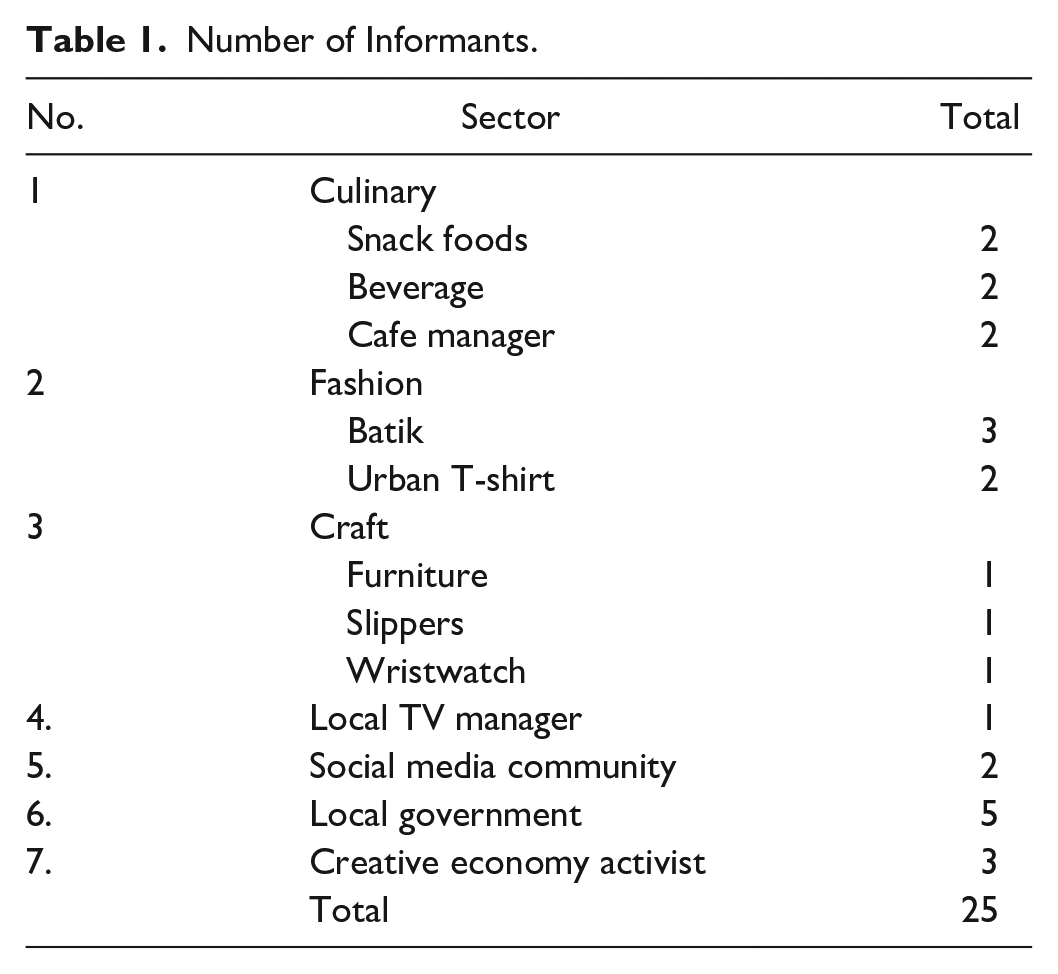
The cited words and expressions from the informants in this qualitative report were presented in the form of statements to help the scientists claim, outline thoughts, enlighten understandings, encourage feelings, and stimulate reactions (Sandelowski, 1994). This research used one type of data presentation to report any information obtained from the data analysis. The quotations then show the research findings.
Results
Actual Need of Mentoring
Authors attempted to build an integrated mentoring model based on the Penta Helix model as a way to boost the performance of SMEs in the creative economy. Among actors involved in multi-stakeholder collaboration was academia, business, government, community, and media. Through the Penta Helix model, this study points out the role of Penta Helix actors in mentoring SMEs.
From our interview with the SME actors, a common problem was found in business and finance management due to the lack of human resources. In terms of market orientation, most of the entrepreneurs lack confidence, given their weak competitiveness and innovation. Nevertheless, some of them claim that their products have good quality exports such as batik and coconut sugar, which have reached the European market. Another great obstacle is the lack of marketing strategies, especially start-up SMEs that are only satisfied with their distribution in the local market.
Furthermore, based on the results of FGD with the informants, there are some important aspects to include in the mentoring model: (a) financial management, (b) marketing, (c) protection of intellectual property rights, (d) legal business entity, (e) utilization of information technology, and (f) business permit. These five aspects are expected to integrate into a mentoring program for SME actors, so they have adequate capacity to run their business.
Financial management mentoring
The SMEs’ failure in their business development is mainly due to poor financial management (Karadag, 2015; Mbroh & Quartey, 2015). Many SMEs have inadequate knowledge of financial management. Thus, it impacts business efficiency and effectiveness. Besides, lack of financial management capacity was found to be an issue for SME actors to manage the bank’s loan funding. The following quotation is taken from the discussion with two SME informants: SMEs require the financial management capacity in the accounting, starting from simple bookkeeping to efficiently and effectively manage funds. The problem is caused by the unevenly distributed capital disbursement. It is probably related to the SMEs’ financial management. It seems to be unfair as there are some stagnant and poor running business activities. The capital access may be well facilitated, especially those with smooth business activities, even the bank itself offers the capital funding. (DT, 61 years old, a creative economy actor in craft sector, May 16, 2018) Due to the most required product selection problem, HR management should be well considered. Training should be continuously and sustainably held in well and appropriate orders. Education and training should understand the management experienced by the SME actors. At the beginning, anything should be simple. Do not discuss the balance sheet. Making the bookkeeping, buying the raw materials, understanding the production costs should be adequately assisted. It is just simply to understand since the SMEs are still in small scale. (TB, 32 years old, a creative economy actor in craft sector, May 16, 2018)
Financial management is an activity that includes (a) how to obtain working capital, (b) how to use and allocate funds, and (c) how to manage assets owned (Detiknews, 2017). SMEs usually do not have good financial management capabilities. In the FGD discussion that we held, SMEs still manage finances conventionally, which then leads to other problems, such as (a) difficulties to calculate profits from business activities, (b) difficulties to develop business, and even (c) feeling that their business is not making a profit.
Marketing mentoring
Marketing has a critical connection with the SMEs’ performance (Ebitu et al., 2015). Production will not provide the economic value if the production may not be accepted by the market. Thus, the marketing aspect determines the SMEs’ sustainability.
The research shows that SME actors in the creative economy require mentoring in marketing aspects. Although the SME actors have participated in training programs to improve product quality, their efforts may become meaningless if the product market is not yet known. Knowledge on the market is greatly required by the SME actors to distribute products needed by the costumers. The following quotations are taken from the interview conducted with a creative economy actor related to the need of marketing mentoring: In my opinion, marketing mentoring is highly necessary. The manufacturing techniques have already followed the education and training held in Surabaya. We can create and have advanced training in Sidoarjo. However, the problem is to market our products in national markets. Although in 1997, we have successfully introduced our product in Sumatra markets, our products find them difficult to continuously remain along with the time. (DT, 61 years old, a creative economy actor in product design sector, May 16, 2018) It is necessary to improve people’s interest to develop SMEs and their entrepreneurship, such as those with creativity in entrepreneurship. I do not need to be in contact with MEA. What I need is information about the market share of the ASEAN communities. It means the more national products interested by the ASEAN communities. (TB, 32 years old, a creative economy actor in craft sector, May 16, 2018)
From the field research, we found that the problem of marketing was a problem for SMEs in Banyumas. For example, “Sofa O,” which had been enthusiastically welcomed by the people in Banyumas as a creative product, suddenly did not attract customers after 3 months of operation. In fact, they considered that the market is still open and have sufficient product stock. Finally, the inability to read the market stopped their business for a few months.
Intellectual property mentoring
Most bureaucratic procedures and expenses were considered as problems for SMEs to effectively deal with their intellectual property rights (Sukarmijan & Sapong, 2014). Thus, SME actors tend to protect their intellectual property rights although they do not really understand the importance of intellectual property rights (Kitching & Blackburn, 1998). Our informants have also considered that intellectual property right mentoring is highly necessary to perform. The following quotations represent their needs on mentoring in the field of intellectual property rights: Dablongan Clothing is one local business which has successfully developed at the national and international level by selling Banyumas’ typical characteristics. However, its typical characteristics are still inadequate to survive because the widely stretching Banyumas’ typical characteristics do not get a specified protection that it is highly vulnerable to be imitated or used by other people/companies. The problems faced by this clothing business when developing a creative economy are related to the unavailability of design and intellectual property right protection. Dablongan clothing in the recent years find it difficult to submit a permit related to its design and intellectual property right protection. Such condition may threaten the results of Dablongan Clothing creativity. (AF, 37 years old, a creative economy actor in fashion sector, August 25, 2018) An intellectual property right needs protection. Yet, our concentration emphasizes more on the maximum sales. Intellectual property right is not applicable when selling is not working. The important thing is never be in the comfort zone. It is much better but to build creativity. The punishment used when violating the design copying rules is still at the level of social punishment. (WD, 38 years old, a creative economy actor in fashion sector, May 16, 2018) In my opinion, mentoring is greatly necessary, especially for the copyright purposes. The problem is that we seem to well understand about the copyright matters, yet we actually do not know anything, moreover related to trademark establishment. We heard trademark establishment is costly that eventually we don’t think that it is important. We still focus on product development. For example, the mentoring is highly necessary to open our knowledge as we have just started our business. (RS, 18 years old, a creative economy actor in culinary sector, September 13, 2018)
For SMEs, intellectual property rights have not been considered an important issue. The idea of creativity that emerges from business actors is considered a normal thing and is even easily imitated by other business actors. Imitating other types of business actors becomes habitual. As a result, newly grown businesses, such as “patterned shirts,” can be easily emulated by other businesses that offer more competitive prices. Finally, patterned T-shirts will go out one by one because of new business actors. It will be different if the business actor has intellectual property rights for their product. By these intellectual property rights, new businesses will not easily replicate the business.
Legal business entity mentoring
Nurhalim (2014) has conducted a study on business entities of SMEs throughout Indonesia; the findings show that SMEs have problems obtaining their proper legal entity and require assistance from the other parties. It is also experienced by some SMEs in our study. Some informants have expressed their opinions on the issues as follows: Mentoring for legal entities is greatly necessary. SMEs with clear legal entities may have positive impacts on their capital and tender accesses. (WD, 38 years old, a creative economy actor in fashion sector, May 16, 2018) In my opinion, the legality of business entities is mainly required by the established business actors. Those who have just started a business like us do not even think about it. However, SMEs in general greatly require such mentoring. (RS, 18 years old, a creative economy actor in culinary sector, September 13, 2018)
From the findings in the research, creative business people have not considered business legality as important as managing business documents. Some of the reasons that arise include (a) uncertainty on whether their business will develop, (b) there is no provision of funds for the management of permits, and (c) the difficulty of managing business licenses. This condition is contrary to the reality in the field where the government tries to facilitate licensing and to free up some financing components in licensing.
Information technology mentoring
One small business weakness is related to its ability to utilize the information technology (Organisation for Economic Co-operation and Development [OECD], 2009). Some studies show that the utilization of information technology may increase small businesses’ competitive advantage (McCann & Barlow, 2015; Schubert & Leimstoll, 2007; Tarutė & Gatautis, 2014). The importance of information technology mentoring is expressed by several informants as follows: Each SME requires an official website to be recognized by both regional and international Buyers. However, SMEs require the supports from IT staff to regularly fill the web content, update, and respond to the questions of potential buyers. Thus, training on website making is greatly required. (DT, 61 years old, a creative economy actor in craft sector, May 16, 2018) Innovation in marketing should utilize the existing technology, running a business should always be optimistic and never feel satisfied with the existing conditions. For creative sectors, Banyumas is still left behind when compared to the other regions. (WD, 38 years old, a creative economy actor in fashion sector, May 16, 2018) A creative atmosphere should be well established among the communities, for example, Balinese jogger T-shirt. It is the product of one SME in Bali that is highly prestigious. To encourage the Banyumas products to have high competitiveness in a local area, social media may be utilized to promote Banyumas SMEs’ products. (UL, 42 years old, a creative economy actor in TV sector, May 16, 2018) We can actually use social media, yet the promotion still uses our personal social media accounts instead of those on our personal behalf. To create more interesting contents, the design-like pamphlet is necessary to be uploaded in social media. Our limited ability in making the design eventually inhibits our promotion to introduce our products. In addition, a small number of followers keep us using our personal social media accounts. A more effective use of IT and social media requires mentoring, especially on how to create more interesting content, more attractive sentences and designs. (RS, 18 years old, a creative economy actor in culinary sector, September 13, 2018)
Business permit mentoring
The legal and regulatory systems in developing countries are inhibiting factors in the development of SMEs (Bilal & Al Mqbali, 2015). Thus, the bureaucracy that has the authority to issue business permits tends to be normative instead of having a service-providing orientation. This issue has also appeared in our discussion with the informants. The following quotations related to the need of SMEs in the creative economy sector to obtain the technical assistance in terms of the issuance of a business permit: The SMEs in the creative economy sector should be continuously mentored to have a business permit (in Indonesia, known as Surat Izin Usaha Perdagangan/SIUP). However, we do not need it since we have already had a higher permit. However, SIUP is usually for the administrative requirements when cooperating with the other parties. Technology-based creative industries may not be separated from the permit. SMEs want to continuously develop, but they are inhibited by the administrative conditions, which are less supportive and eventually become obstacles. (UL, 42 years old, a creative economy actor in TV sector, May 16, 2018) Mentoring during the process of business permit management is also required. During this time, we do not have any idea about the business permit, etc. We still focus on product development and return on capital. (RS, 18 years old, a creative economy actor in culinary sector, September 13, 2018)
From various discussions, we found the weakness of two-way communication between policy makers and business actors. There are prominent factors that are the cause of the lack of communication, such as the number of SMEs in Banyumas that are not comparable with the service units. In fact, the government as a policy maker has a big role in helping businesses to develop their business.
Designing an Integrated Mentoring Model: Multi-Stakeholder Collaboration
In this study, mentoring is intended to share the business experience of mentors with SME actors. Meanwhile, skill development is intended to share certain skills by mentors with SME actors. With a multi-stakeholder perspective, the mentoring model for creative economy actors needs to involve the stakeholders from five strategic actors, or Penta Helix, namely, creative community, social media community, business actors, bureaucracy, and academia. By integrating these five strategic actors, mentoring will not just become the responsibility of one actor, like in the present case (Fitria, 2012; Hasbullah et al., 2014).
The integrative approach used in the model in this article assumes that all stakeholders are already available in the existing SMEs’ development, yet not integrated in an optimal collaboration. Thus, there must be collaboration within SMEs’ development by involving the local governments, universities, SME players, and community networks. During this time, those parties have actually existed, but they tend to go on their own and do not have an integrated working program. The following are quotations from the interviews with the creative economy activists in explaining the need for collaboration among various parties in the mentoring activities: The existing approach is not really correct, including the government approach or researchers on SMEs as social charity objects. SME is a business object to implement not socially but professionally. We must have a business plan, a strategic plan, and steps to develop. Government is stupid while people are smart, as they are superior in creative economy. There is a mentoring termination. The main point is not positioning the government as the superior one but as a supporting sub-system. So, as the SME actors’ supporters, mentoring and workshop is 70%, we still need a clear incubation for the SMEs. How can we talk about MEA (ASEAN economic community) if we still have problems with human resource ability, and then we talk about creative SMEs from those individuals with commitments? Actors’ and stakeholders’ real actions are greatly required, not only their input and suggestions. Business actors, governments, academics, media, and communities should work together and establish communication due to their interconnected relationship. (AP, 32 years old, a creative economy activist)
The government and universities frequently consider the formula in running the training for SME actors as a big step. However, for some SMEs, it does not have a big impact. The business actors argue that training should not only be conducted in centralized places, such as meeting rooms, but also be held in the business spaces owned by the SME actors: Training should be formally categorized based on the business classifications that it is easy for mentoring, especially for the mentors when providing assistance at business locations that they may know the best and most appropriate solutions. I feel highly inferior when I have to come to a nice place as my business scale is still small. (TB, 32 years old, a creative economy actor in craft sector, May 16, 2018)
In a collaborative model adjusted to the SMEs’ goals to have higher competitiveness at ASEAN level, the SME stakeholders should well understand five programs required by the SMEs: (a) productivity improvement, technology, and innovation; (b) financial management development; (c) market access and internationalization enhancement; (d) ability improvement to protect their intellectual property rights; and (e) entrepreneurship improvement and human resource development for the creative economy actors. Those five programs are expected to be able to encourage the development of SMEs in the creative economy.
In the integrated mentoring model, the research provides a specific role for each stakeholder (see Figure 1). The implemented roles should be in accordance with the capacity provided by the stakeholders. Thus, although mentoring is only imposed on one particular actor, it is the responsibility for all during the mentoring processes.
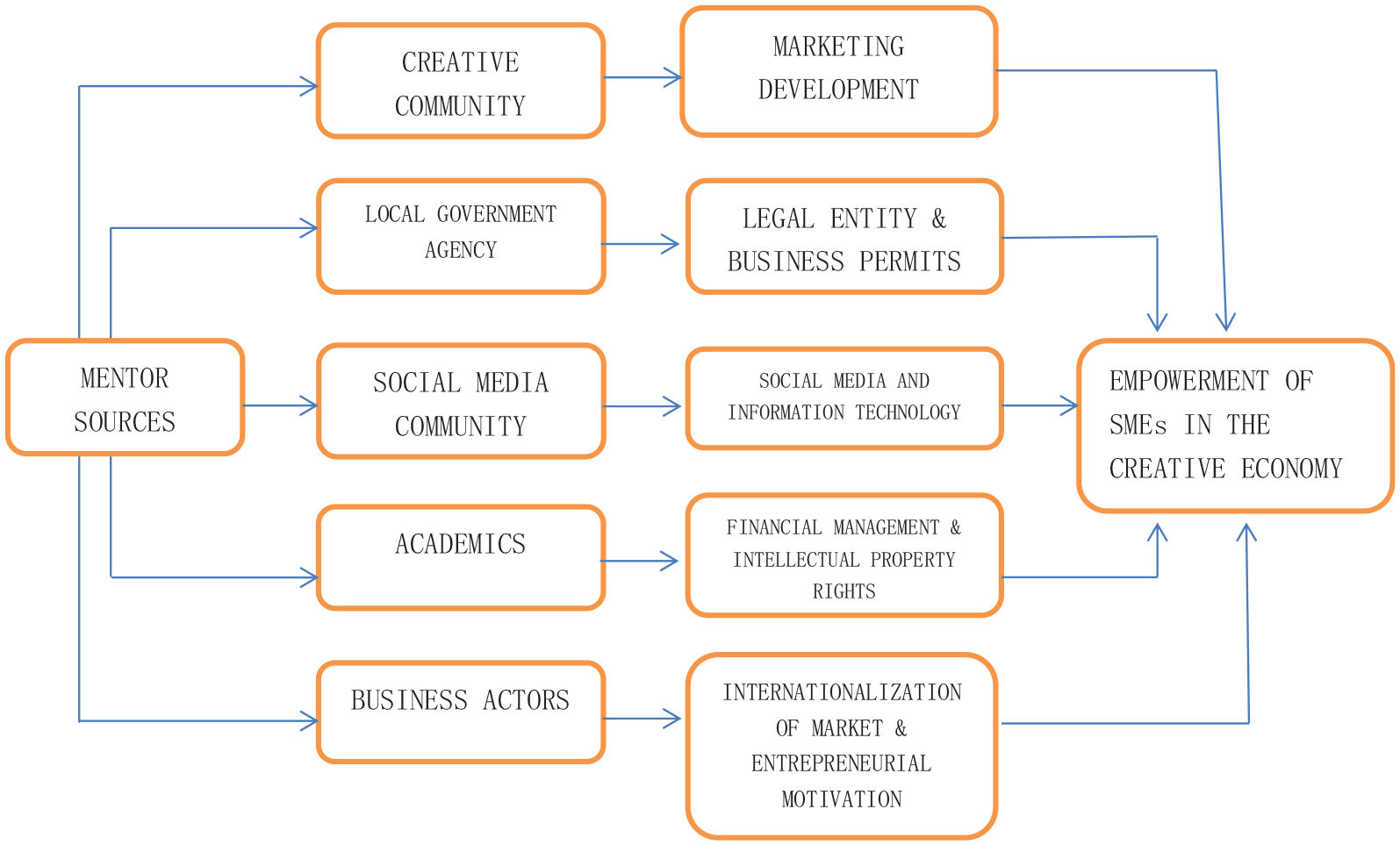
An integrated mentoring model to empower SMEs in the creative economy sector.
Based on our interview, the roles of the multi-stakeholder in our integrated mentoring model for SMEs are as follows.
First, creative community: Creative community is a community in which the creative economy actors gather and exchange ideas. This community has an essential role for the development of human resources, innovations, and marketing. The development of human resources may be conducted through discussions and exchanging experiences related to their creative economy activities through which innovations and market expansions are made.
Product marketing and promotion are some other problems faced by SMEs. During this time, SMEs tend to market and promote their products in both local and international markets. Meanwhile, SMEs have financial limitations to market and promote their products when compared with large businesses, which usually have a lot of funds to promote their products. The weaknesses in marketing and promoting products make the SMEs unable to optimally develop. Moreover, in the recent global competition, many SMEs are powerless to compete with overseas products, which easily come into local markets.
Second, local government agency: Since the Indonesian independence in 1945, SMEs have not yet become the government’s major concern until recent years. This is proven with the absence of government regulations at the level of law regulating the SMEs until 2008. The absence of strong legal regulations (in the form of laws) has resulted in the inhibited development of SMEs. However, there are several policies and rules issued by the government agencies related to the SMEs, which have been used as references for the supervision and development of SMEs.
The Indonesian government’s poor attention to SMEs is caused by the central government’s dominant role in national economy that is supported by a centralized government system. In this centralized system, the local government basically becomes the implementer of the central government’s policy and has no autonomy to develop its own regional potentials. Through some state-owned enterprises (known as Badan Usaha Milik Negara [BUMN] in Indonesia), the government has an important role to develop several economic sectors, such as manufacturing, trade, and services. Meanwhile, due to state revenues, state-owned companies exporting oil and gas have made some significant contributions to the country. Thus, SMEs are placed in a minor position against state-owned companies.
During this time, the local government has taken its role in the licensing process and skills training. In this model, local governments, however, are encouraged to have roles not only in the licensing legality process but also in the process of obtaining the business permit.
With the development of information technology, the influence of social media activists is increasing in the community. Social media activists are usually able to promote products in ways that are unique and more acceptable to society. For example, they highlight the local wisdom aspects of SME products, the entrepreneur’s personal profile, and personal testimonials relating to product quality. By cooperating with social media activists in empowering local SMEs, the products will be more easily recognized, not only at the local level but also at national and international levels.
Third, social media community: The social media community is a community that is highly concerned with the development of SMEs through social media. This community has the role of helping SMEs adopt the information technology development and to introduce SME products to wider communities.
Fourth, academics: Academics may provide their assistance to SMEs through financial management training and help SMEs obtain their intellectual property rights. Most SMEs in Indonesia fulfill their financing needs by relying on individuals’ savings, through loans from relatives or friends, or by borrowing money from a money lender (known as rentenir in Indonesia). Financing sources are generally not reliable in a sustainable manner. Meanwhile, to obtain loans from formal financial institutions, such as banks, most SMEs still do not meet the requirements. Thus, intervention from third parties is necessary to help SMEs overcome their financial difficulties. Academics may help SMEs to access banking financial services through financial management training.
Fifth, business actors: Business actors may help SMEs by encouraging their entrepreneurship growth to reach international markets. By having wider networks and market information, SME actors may have potential buyers. During this time, the inhibiting problems for SMEs in the creative economy are related to how to maintain their business for a long-term period. Through business actors’ mentoring, the entrepreneurship mentality may be well developed as the experienced business actors share their experiences in facing critical situations to sustain their businesses.
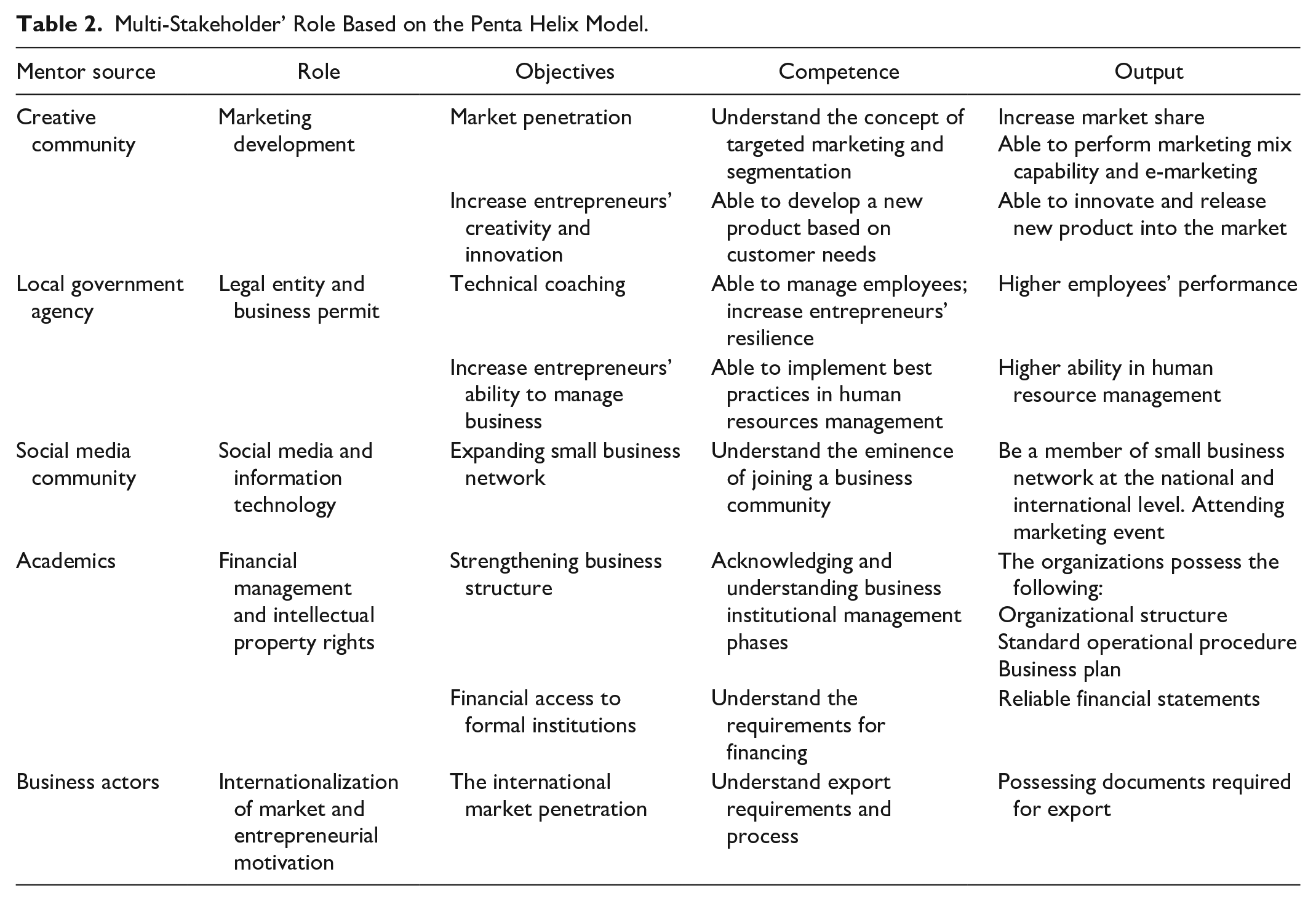
Based on our interviews, we summarize involvement of multi-stakeholders as mentor sources in an integrated mentoring model based on their role, objective, competence, and output. Table 2 shows that the role of a multi-stakeholder in an integrated mentoring model is very critical to improve output performance of SME actors in the creative economy sector. Their competences will help SME actors gain knowledge and skill transfer as well as networking. Therefore, the role of a multi-stakeholder should be considered in mentoring programs.
Multi-Stakeholder’ Role Based on the Penta Helix Model.
Based on our discussion with creative economy activists and local government agencies, an integrated mentoring model should be managed by a creative hub organization. This organization becomes a business incubator facilitating the process of empowering SMEs and developing new creative products. The business incubator provides business facilities and infrastructure, business development and management, and technology support.
In our study context, we found a CEC established in 2018. The CEC has a main function to create policy direction to support the development of the local creative economy. As membership of CEC represents various elements consisting of creative community, bureaucrats, business people, academics, and journalists, it can be an effective way to involve potential stakeholders in the creative hub organization.
The legitimacy of CEC is strengthened by the regent’s decree. Budget allocation is also provided by the regent to support programs planned by the CEC. Uniquely, the head and vice head of the CEC come from representation of creative community. This fact shows that the local government trusts the creative community actors to lead the CEC. One of the main reasons is that the creative community has more experience than bureaucrats in understanding the creative economy sector and in having more networks with other stakeholders. With the advantages of the creative community leaders, the CEC is believed to be able to attract external resources to support an integrated mentoring model. Therefore, dependency on a government budget to finance an integrated mentoring model will be reduced in the long term.
The CEC as a nonprofit, nonpolitical institution also aims to support and help realize a creative economic ecosystem and to develop creative industries based on local resources in Banyumas Regency. CEC activities absorb the aspirations of the creative community, controlling and providing recommendations to policy makers to provide regulations that support the development of the creative economy industry. In addition, the CEC also plays a role in strengthening the networks between communities/creative actors in Banyumas Regency and the national and international creative communities. Some of these CEC activities show how the role of the CEC as a Penta Helix embodiment institution works and acts multisectorally, with multi-actors in favor of the interests of the creative community in the region.
Based on the mapping and identification of creative economic conditions in the regions, the CEC provides policy recommendations to local governments as a legal umbrella. Through mapping the positions and conditions of micro, small, and medium enterprises (MSMEs), both conventional and creative, sufficient data are obtained to be used as a reference for indicators, measurements, targets, and work targets that will become action-based mentoring. It is hoped that the Penta Helix assistance model will seek to produce output in the form of a local policy-based framework to obtain legitimacy and regulatory support, and to target regional budget allocations in every creative economic development activity. In this integrated mentoring process, SME financial management can be assisted by the local government budget (APBD) through assistance from relevant agencies, as well as from aspirational funds from the Regional People’s Representative Assembly (Dewan Perwakilan Rakyat Daerah [DPRD]). In addition, financial resources are also obtained through increased collaboration with creative economy stakeholders, such as CSR funds.
Discussion
The main aim of this study is to formulate an integrated mentoring model for SMEs in the creative economy sector through involvement of the role of multi-stakeholder. To obtain an integrated mentoring model based on SME actors’ views, we analyzed the mentoring need expected by SME actors based on strategic goals of SMEs development and potential roles of multi-stakeholders in supporting the development of SME capacity. In this section, we discuss findings based on the case study to support our integrated mentoring model.
The analysis of a multi-stakeholder’s role in an integrated mentoring model, as illustrated in Figure 1, points out that development of SMEs in creative economy sectors should integrate the actual needs of mentoring proposed by SMEs with the potential capital sources provided by stakeholders. The weakness of SMEs in facing a competitive market has been seen from its lack of technical skills, weak entrepreneurship, and lack of knowledge in business management. Our study indicates that there is a strong demand from SMEs to get an integrated mentoring program to improve their business capacity, including financial management, marketing, protection of intellectual property rights, legal business entity, utilization of information technology, and business permit.
As presented by Clarke and MacDonald (2019), a partnership with a multi-stakeholder will bring various resources to the participants. These resources can be utilized by participants to improve their capacity. In the context of the creative economy sector, engagement of multi-stakeholders in mentoring activities will address market competitive challenges faced by SMEs. Therefore, these actual needs of SMEs should take mentoring programs into account.
Previous research pointed out that poor mentoring has led to failures of SMEs to improve the capacity of SMEs and to survive market competition (Arifin, 2017; Bank Indonesia, 2006; Hasbullah et al., 2014). In addition, SMEs gain poor support from local government (Fitria, 2012). Even if support is provided, the government or private programs carry out only partial mentoring, such as exhibition or access to loans. The existing parties tend to work independently without efforts to integrate their resource for empowerment of the creative economy SMEs. Based on the findings of data analysis, this study suggests that development for SMEs in the creative economy sector should integrate the power of Penta Helix (academia, business, government, community, and media) into one ecosystem. These actors can play the role of mentor to transfer their respective knowledge, experience, skill, and expertise to the SMEs. Through such an integrated mentoring model, the SMEs in the creative economy sector can improve their technical capacity and entrepreneurial spirit to respond competitively in the creative economy market.
Our findings show that Penta Helix actors have potential roles as mentors for SMEs. Their competence can be used to improve knowledge and capacity of SME actors and encourage them to produce innovative and creative products. Our study is in agreement with the previous studies that have confirmed the advantages of a multi-stakeholder’s role in promoting an innovation (Momen, 2020; Sturesson et al., 2009), creating new knowledge (Dorado et al., 2009; Huxham & Hibbert, 2004), and a shared solution (Syafari, 2018).
In general, our mentoring model integrating mentor sources with the actual need of SME actors provides fresh insights into the multi-stakeholder involvement mechanism for improving the competitiveness of SMEs in the creative economy sector. Our model helps government, business, and creative communities to collectively address complex mentoring problems faced by SMEs in the creative economy sector. The importance of collective action through Penta Helix in mentoring activity has been in line with the findings of Sudiana et al. (2020) who used Penta Helix framework for development of innovation-based companies. They found that the collective action of Penta Helix is expected to assist start-ups during the initial stage of their business development.
Conclusion
This study contributes to an understanding of multi-stakeholder involvement in mentoring programs as a mechanism to integrating their competences into the actual mentoring needs of SMEs in a creative economy context. Based on MSP theory, we have proposed an integrating mentoring model to illustrate the potential role of Penta Helix actors in sharing their experience, knowledge, and entrepreneurial spirit to the SMEs’ creative economy. Our findings have exhibited that the MSP model can be adopted in a mentoring approach to address the actual needs of SMEs in the field of financial management, marketing, protection of intellectual property rights, legal business entity, utilization of information technology, and business permit. These actual needs should be taken into an integrated mentoring program account to improve the business capacity of SME actors.
The results of this study also confirm that the role of Penta Helix actors in mentoring the SME actors is adjusted to their respective experience, knowledge, and expertise. The local government can play a role as mentor to facilitate the SMEs actors in gaining a business permit and legal entity. The university or academics in our study can assist the SMEs to get intellectual property rights and to improve their financial management capacity. The business actors may share their experience and expertise with the SMEs to enhance entrepreneurial motivation and access to the international market. The creative community can guide the SMEs to increase their marketing capacity. Finally, the social media community is able to help SMEs to promote the utilization of social media technology for wider market development of creative economy products.
To ensure sustainability of MSP in an integrated mentoring model, this study proposed a creative hub organization. Interviews with creative economy activists and local government agencies revealed the function of a creative hub organization as a business incubator and a provider of business facilities and infrastructure, business development and management, and technology support. In addition, the existence of a CEC representing various stakeholders might attract more external resources and support for sustainable mentoring programs.
In conclusion, this study has a limitation due to the small numbers of informants to promote an integrated mentoring model. Future research should take more creative economy actors from various subsectors (such as design, film, video and photography, interactive games, advertising, fine arts, and information technology) to gain a more generalized integrated mentoring model.
Footnotes
Appendix
Declaration of Conflicting Interests
The author(s) declared no potential conflicts of interest with respect to the research, authorship, and/or publication of this article.
Funding
The author(s) disclosed receipt of the following financial support for the research, authorship, and/or publication of this article: We would like to gratefully thank the Ministry of Research, Technology, and Higher Education of the Republic of Indonesia for funding this second-year research grant (2018).
