




Abstract
The importance of location decisions has been assessed vigorously by a number of studies but these studies have not been able to examine the impact of this variable on the performance of Women-owned small and medium scale enterprises (WSMEs). This paper examined the influence of location decision on the performance of WSMEs. The study adopted a quantitative approach and used a number of methods such as field observations, reference to relevant literature and a questionnaire survey of 58 WSMEs for the study. The study used principal component analysis (PCA), simple mean and standard deviation to analyze the data. The result of the study showed that 41.10% and 29.14 of the WSMEs had experienced a significant increase and relative increase in the performance of their enterprises based on their location while 14.59% of the respondents had not experienced changes in the performance of their enterprises. The PCA result also showed that availability of traditional/economic factors of location (24.97%), infrastructural (21.32%), agglomeration and economies of scale (12.38%), personal interest (9.50%), and Government policy (8.06) were the factors that influenced the location of WSMEs in the study. Location is therefore, an important variable in citing WSMEs.
Introduction
Women-owned small and medium enterprises are manufacturing, service and processing enterprises that contribute to the employment of the teeming unemployed youths and also strengthen the manufacturing sector of the economy (Obioma, 2017). These enterprises according to Nwosu et al. (2019) “have allowed the women to add to the economic welfare of their families as well as the livelihood of the rural poor.” This makes it strategic in achieving the targets of SDGs 5 and target 7. In Nigeria, evidence has shown that 35% of Nigeria women entrepreneurs own and run small scale enterprises in the Nigeria industrial sector (Iyiola & Azuh, 2014). These enterprises by size have a maximum asset base of between 5 and less than 50 million excluding working capital and an employee base of between 10 and 49 workers (Nwokocha, 2014; Nwokocha & Madu, 2020; Nwokocha & Nwankwo, 2019).
The importance of WSMEs in economic growth and their importance to local, regional and national economic development policies in many parts of the globe including Nigeria gives added relevance to enquiries into the location decisions of SMEs (Arauzo-Carod & Viladecans-Marsal, 2006) and its influence on their performance. This is because the decision on where to locate a business determines the availability and utilization of input materials, their collection points, processing point and transfer of outputs to the market. It also determines the accessibility of raw material, labor, market, transportation etc which vary in their significance and influence on the SMEs. The importance of location decisions has been assessed vigorously by a number of studies (Arauzo-Carod & Viladecans-Marsal, 2006; Badri, 2007; Ghobakhloo, 2018; Lall & Chakravorty, 2005; Ogbu, 2014; Paluzie et al., 2002; Rikalovic, 2015). These studies as laudable as they are have not been able to assess the influence of this variable on the performance of WSMEs. This paper therefore seeks to examine the influence of location decision on the performance of WSMEs by posing the following questions
What factors influence the location decision of WSMEs in the study area?
What is the influence of location decision on the performance of WSMEs in area?
Literature Review
The importance of women in the creation and running of enterprises cannot be over emphasized. According to Ramadani et al. (2015) the establishment of firms by women allows them to make use of their experience, knowledge and skills to reduce the effect of discrimination against women in the labor market. It will also create alternative employment opportunities for women enabling them to balance work and their family demand, while improving family welfare and social cohesion. Salganicoff (1990) cited in Ramadani et al. (2017) found that women’s uniqueness such as loyalty to the company, worry for other family members, compassion to the needs of others are fundamental for a positive outcome of succession in family businesses. The work of Ramadani et al. (2015) also found that freedom to make certain vital business decisions; profit and money are some of the factors that stimulate women’s interest in entrepreneurship. Women make important contributions to entrepreneurial activity and economic development (Hechevarría et al., 2019; Kelley et al., 2017). This can be found in the area of job creation and increase in GDP (Ayogu & Agu, 2015), This has a positive effect in reducing poverty and social exclusion (Rae, 2015 cited in Cardella et al., 2020). Ariffin et al. (2021) also suggested that the establishment of policy interventions and programs to encourage grassroots women entrepreneurs is very important and vital, particularly in the area of helping the unemployment issues and poverty reduction initiatives among economically challenged regions.
However, the decision on where to locate a firm is not taken in isolation, but is related to other considerations such as the locational factors, scale of operation, combination of factors and market conditions. Locational factors are vital in the setup of firms and industries in a place. This is because the combination of these factors determines the firm’s ability to effectively utilize the factors of production. In view of this, a number of authors have examined the roles of these locational factors in the location of firms. For instance, Von Thünen (1826) cited in Ferreira et al. (2016) examined location from the point of estate rents where he assessed the role of distance as an important factor of location in determining the level of rents payable for land. While Marshall (1890) studied the economies of agglomeration and the industrial district, Weber (1929) cited in Friedrich (1929 attributed a firm’s ability to minimize its cost of production to location which he identified to be either the least cost transportation location, least cost labor location or the interplay of forces of agglomeration and de-agglomeration. In the same vein, Hoover (1948) in his work analyzed market spatial divisions and industries’ agglomeration were he found that transportation cost influence and shape the locations of industries. Lösch (1940) in his studies also found that scales of markets become homogeneous as demand and transport costs appear proportional to the distance to be covered.
Furthermore, in recent times, the work of Badri (2007) found that 10 factors are critical in the location of industries. These factors are transportation, labor, raw materials, markets, industrial sites, utilities, government attitude, tax structure, climate, and community. Lall and Chakravorty (2005) in their studies argued that “the spatial inequality of industry location is a primary cause of spatial income inequality in developing nations.” According to the study, “local industrial diversity is the one factor with significant and substantial cost-reducing effects that makes new private-sector industrial investments in places such as India biased toward existing industrial and coastal districts, whereas state industrial investments (in deep decline after structural reforms) are far less biased toward such districts.” On the other hand, Martin and Rogers (1995) showing the importance of infrastructures as a factor that influence the location of industries in a region found that “firms tend to locate in countries with better domestic infrastructure (trade integration), high levels of international infrastructure as well as strong returns to scale.” These factors increase industrial relocation due to differentials in domestic infrastructure or capital endowments. The study also showed that “regional policies which finance domestic infrastructure in a poor country lead firms to relocate in this country while regional policies which finance international infrastructure in a poor country will lead firms to leave this country.”
Lee et al. (2013) in his studies found that “on-site attractions, safety and security systems as well as external access are the major factors in determining industrial tourism attractiveness.” The study showed that, while the observation of production process is an essential and important component of tourism factories, the provision of transport services and on-site restaurants constitutes a supporting role in enhancing industrial tourism attractiveness. According to Leitham et al. (2000) “the importance of road transportation to firm location vary according to the origin of the firm- local relocation, foreign inward investors and branch plant.” The study showed that the importance of road networks to location choices varied considerably between business groups, with branch plant rating motorway networks the highest of any of the other groups. This however, is in contrast with overseas sourced branch firms which rated road networks as largely unimportant, being outweighed primarily by considerations of workforce and premises.
Similarly, the work of Ferreira et al. (2016) found that “location decisions depend on the sector of activity, type of area (urban vs. rural) and the characteristics of the entrepreneur. The study showed that firms involved in knowledge creation business services prefer to locate in urban areas while from institutional point of view, firms prefer to locate in rural areas.” The work of Rahman and Kabir (2019) also found that “SME location choice was influenced by a combination of location specifics which include personal, and community factors. This is such that the personal factors are prioritized over other factors in location selection, while the cluster formation or localization of SMEs depends on only location-specific factors.” In the area of firm performance, Agwu and Emeti (2014) opined that “firm performance is the total wellbeing of business entities in terms of results measurable against resources committed to achieve predetermined goals making it a primary dependent variable in the field of strategic management” In view of this, Gupta and Chaturvedi (2017) stated that “the aim of strategic management revolves around the provision of answers to the ultimate question of why some enterprises perform better than the others despite their being faced with the same business environmental challenges.” In spite of the importance of firm performance, there is hardly a consensus about its definition, dimensionality, measurement, and what limits advances in research and understanding of the concept (Bature et al., 2018). In the light of this, many studies according Nwokocha and Madu (2015) “measure firm performance with a single indicator and represent this concept as one-dimensional, even while admitting its multidimensionality” (Nwokocha & Madu, 2015).
Most research works on the performance of SMEs have tilted toward the effects of strategic structures such as subcontracting and alliance on the performance of SMEs. For instance the work of Aun (2014) showed that there is a positive correlation between strategic alliance and firm performance. The study which analyzed firm performance using financial indicators (profitability and sales) showed that strategic alliance has positive relationship on sales and profitability of firms. Furthermore, Kuzminykh and Zufan (2014) using a panel level data to examine the influence of alliance membership on firm performance (turnover, total assets, and number of employees) found that there is a strong influence of an alliance membership on turnover and total assets, and relatively strong influence on the number of employees in allied companies.
Similarly, Talebi et al. (2017) using three indicators of performance—financial, functional, and effectiveness, found that there is a significant and positive relationship between the dimensions of strategic alliances, including new opportunities, entrepreneurial and innovative capabilities, social capital, and internationalization of business, and competitive advantage with the performance of SMEs in Iran. Nwokocha and Madu (2020) also found that strategic alliance cumulatively led to increases in sales growth, growth in profit, labor productivity etc. In the area of subcontracting Oladimeji et al. (2020) found that performance elements (cost reduction, production enhancement, market expansion and risk sharing) have both individual and combine effect on subcontracting. The work also stated that “subcontracting has a positive and significant effect on Multinational firm’s performance.” Nwokocha et al. (2019) also found that subcontracting assistance received by small and medium scale enterprises from large scale industries aid innovation and performance in SMEs.
From the foregoing, it has been established that a number of works have been done in the area of industrial location, factors influencing the location of both large, medium and small scale enterprises and the performance of SMEs. Most studies on this topic however did not show the effect of these factors on the performance of WSMEs. This paper therefore seek to examine the effect of location and factors of location on the performance of WSMEs in Nigeria
Theoretical Framework
Location theories according to Rahman and Kabir (2019) analyzes “how economic and human activity relate to geographical space and attempt to identify factors influencing location decision of individual firm and emerging location pattern of industries under specific context.” This study however was built on Hayter (1997) Neoclassical or economic approach, Institutional and Behavioral approaches to the location of industrial activities. This is because of its multidimensional perception to the location of industrial concerns on the earth surface.
Neoclassical approach—The neo-classical approach is based on the assumptions of “economic man” and “isotropic space” (Weber, 1929; Predöhl 1928 cited in Rahman & Kabir, 2019). This approach which is based on cost reduction specify that firm owners have complete information about location decision framework and operate rationally based on cost benefit analysis in choosing location. The Neoclassical approach concentrated on the location of firm activities which were targeted at achieving profit maximization and reduction of operational costs. The proponents of this theoretical approach were Afred Weber, Toard Palander and Losch.
For instance, Weber’s (1929) theory also known as the least cost theory focused on the location of industries principally in terms of spatial variations in cost structure. This was governed by the economic rational to optimize and maximize both profit and cost of production. To achieve this, industries are to be located where costs are minimum. In other words, industries would be located at the point of least cost in response to three general location factors namely; transport costs, labor costs, and inter-regional factor of agglomerative or de-agglomerative forces (Ogbu, 2014). The theory indicated where a given type of industrial plant would be located in relation to its raw materials and market demand. The theory also used material index to determine either raw material or market locations of industrial plants, and labor coefficient method to measure the importance of labor in location decisions.
The institutional approach—The institutional approach on the other hand examined the importance of firms finding locations suitable to the institutional surroundings for meetings (Arauzo-Carod & Viladecans-Marsal, 2006; Fulton, 1971; Galbraith, 1985). According to Rahman and Kabir (2019), “institutional approach stipulates that the flexible production structure results in extended social division of labor and generates many specialized sub-sectors.” This process consequently induces a forward looking externalization of production structure through network of processes and firms which again leads to localization/locational convergence.
Behavioral approach—This theory looks at the situation of economic uncertainty and paucity of information. In this approach, the factors of location are not identical and therefore veer between different geographic areas (Arauzo and Manjón 2004 cited in Rahman & Kabir, 2019). It deals more with the “Satisficer” factor or bounded rationality. This factor unlike the economic factor is born out of the need to satisfy the needs and wants of the business owner and not necessarily for profit maximization. One of the proponents of this approach is Melvin Greenhut’s.
The Malvin Greenhut theory of industrial location according to Hayter (1997) ‘‘assessed the placement of industrial firms on the surface of the earth from the perspective of uncertainty or sub-optimal behavior, where no two private promoters running the same kind of industrial plant will evaluate alternative locations using the same standard of maximum profit”. This paradigm makes the psychological income or satisficer idea particularly applicable in industrial location. Whether the criterion is profit maximization or a non-economic aim, some industrial plants look for sub-optimal economic behavior where decisions that are not the best are made. In other words, certain location choices may not be driven by economic considerations but rather by the need to meet the needs and wishes of the industrialist rather than necessarily maximizing profit. This is typical of SMEs, who generally base their site decisions on the owner’s background and experience (birthplace and personal similarity), in addition to their financial situations. Table 1 lists the techniques and the relevant location considerations.
Location Approaches and Associated Location Factors.

Source. Adapted from Hayter (1997).
Material and Method
This research was situated in Enugu State Nigeria as was shown in Figure 1.

Enugu State Nigeria.
This is due to the booming activities of small, medium and large scale enterprises which have made the area an emerging market economy as was discussed elsewhere in Nwokocha (2020). This study adopted a survey design based on quantitative approaches. This was used to obtained information using a questionnaire. The quantitative approach was achieved through the use of ordinal type questions. The study using a purposive random sampling technique, selected 58 WSMEs from 1,366 SMEs in five manufacturing subsectors identified from the industrial directory of the study area. These WSMEs were selected based on the fact that they were owned and controlled by women in the study area. The distribution of selected WSMEs is shown in Table 2.
Manufacturing Sub-Sector of Nigeria.

Source. Author’s computation.
Data were collected from primary and secondary sources. While field observation and questionnaire survey formed the primary sources of data collection, published and unpublished sources formed sources of secondary data. The questionnaire used for this study was distributed through direct delivery technique. The questionnaire was used to collect data from WSMEs owners. It had a five-point Likert-type scale as well as open-ended questions. The respondents rated each item by stating the level of agreement ranging from strongly disagree to strongly agree for all the variables. Open questions also examined the effect of location on the performance of WSMEs in the study area.
The performance of WSMEs was measured by the degree of satisfaction of the enterprises on financial and non-financial outputs for a period of 4 years (2014–2018). The financial indicator adopted by this study is sales growth and growth in profit while the non financial indicators are growth in market share, increase in workers number and labor productivity. Performance variables were treated as ordinal scale of 1 = Significantly decreased, 2 = Relatively decreased 3 = Static, 4 = Relatively increased, and 5 = Significantly increased.
Validation and Reliability Analysis of Study Variables
The instrument used for this study was validated by three experts from the Department of Geography and Economics. It was trial tested in a pre-study of 20 WSMEs operating in the study area. The data for the reliability test were collected by the researcher and the internal consistency of the instrument determined by Cronbach alpha reliability co-efficient. The instrument was modified based on the response obtained from the enterprises. This was done for the location variables and the performance variables. Cronbach alpha co-efficient used for this study was .70 and above.
Cronbach Alpha Reliability for Factors of Location
A pilot test was conducted to analyze the factors of location of women owed enterprises in the study area. This was done using a five-Likert scale of 1—Never, 2—Little, 3—Some What, 4—Much, and 5—Great Deal. The location factors had 29 variables from the questionnaire as was indicated in Table 3.
Cronbach Alpha Reliability for Location Factors.

Source. Author’s computation.
(Any value less than .40 is rejected).
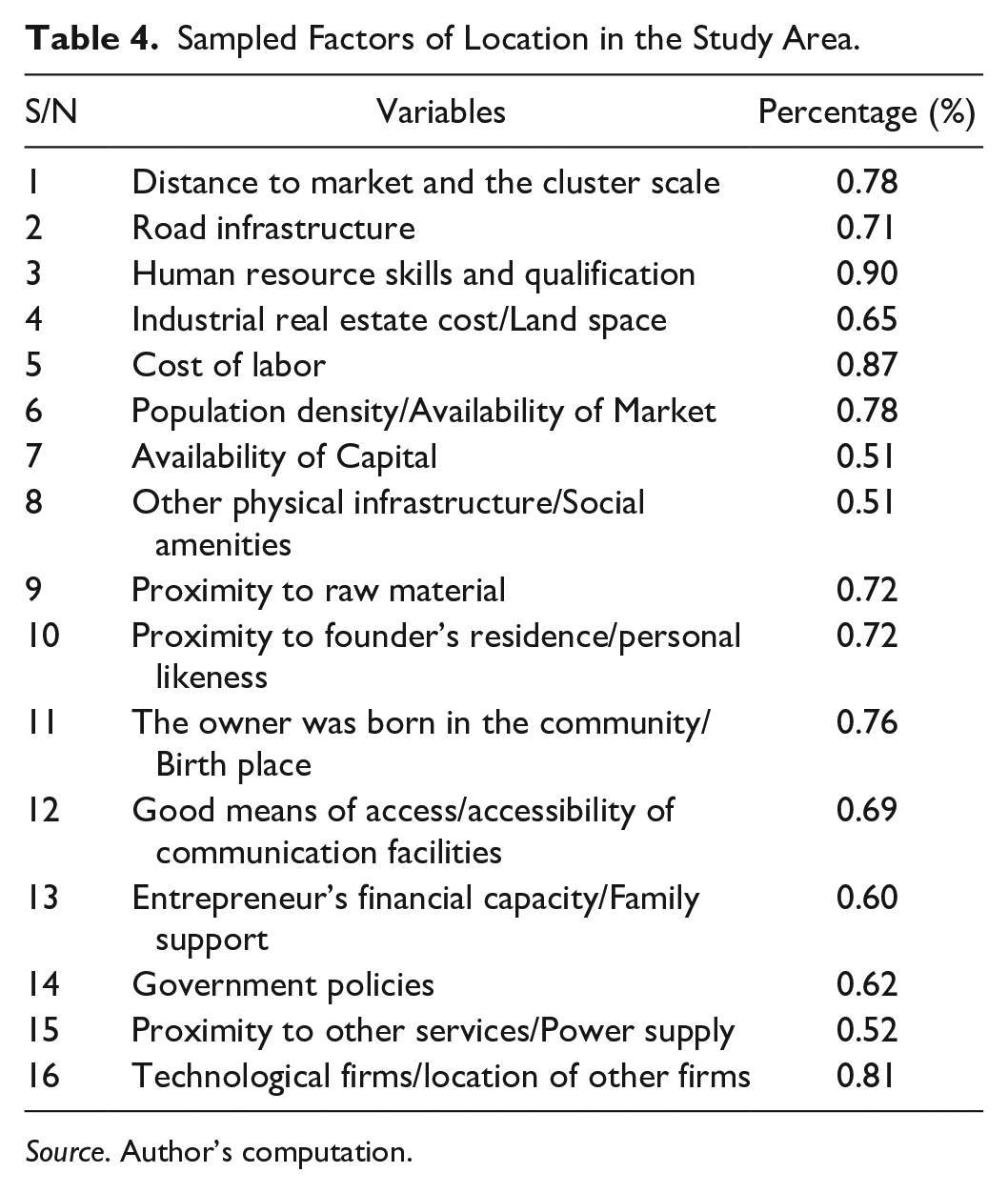
The table showed a factor loading of between 0.51 and 0.81 from 29 measurement items. The table also showed that 13 items were below the acceptable factor loading of 0.40. Consequently, the Cronbach’s Alpha coefficient for the 29 measurement items was .92 and this signified that the instrument had a high level of consistency, and good for use in data collection as was shown in Table 4.
Sampled Factors of Location in the Study Area.
Source. Author’s computation.
Methods of Data Analysis
A number of statistical techniques were used in analyzing the data generated from this study. Principal Component Analysis (PCA) was used to examine the factors of WSMEs locations. This method was used to ascertain the underlying dimensions defining the factors of WSME location in the study area. The variables studied are—availability of raw materials, accessibility of market, location of other WSMEs, potentials for linkage, accessibility of funds, accessibility of transportation, cost of living, government policies, availability of land space, availability of power, presence of social amenities, personal likeness of a location, family support/finance, Birth place of the industrialist, and availability of communication facilities. These variables were investigated in the field through the aid of a questionnaire.
Simple mean and standard deviation was used to analyze the impact of location on the performance of WSMEs in the study area. This was used to ascertain the mean response of the performance variables used in the study.
Result
Factors Influencing the Location of WSMEs in Enugu State Nigeria
A number of factors influence the location of WSMEs. While traditional factors such as raw material, market and transportation still pay critical roles in the location of industries, their dominance have been reduced by the social, economic, and political demands of the contemporary world. This is also because of the emergence of other factors such as family support, education, government and community policies which overtime have been found to exert equal influence in the location of industries across space. Based on field observation, a number of factors were found to have influenced the location of WSMEs in Enugu State. These factors were synthesized based on the responses of the WSME owners who were asked to rank these variables on a five point likert-type scale ranging from 1 = “not at all important” to 5 = “very important” based on how they affect the location of the enterprises.
From the analysis, the study found that availability of market, power supply, raw material and transportation contributed more to the location of WSMEs in the area. These factors together contributed to 64% of the factors of WSME location in the area. While availability of market had a response rate of 18%, power supply, raw material and transportation had a response rate of 16%, 15%, and 15% respectively as was shown in Table 5.
Percentage Distribution of Factors of WSMEs Location in Enugu State.

Source. Author’s computation.
Availability of market from our observation involved the setting up of WSMEs in high population area where demand for products are high. From the field observation, places with high population had more demands for goods and services prompting the concentration of WSMEs in such areas. This can be found in areas such as Udi, Enugu North, Enugu south and Nsukka. These locations accounts for 32.65% of the population of the study area.
Similarly, availability of power supply was also found to be a significant factor of WSME location in the study. This was due to its ability to power machines and equipments used by these enterprises in their production activities. From the field, power supply in the area was accessed from two sources. These sources are the Enugu State power Distribution Company (EEDC) and Alternative power supply sources (Generator sets, Listas etc). The study found that 72.7% of the surveyed WSMEs relied mostly on alternative power sources such as power generator sets, while 27.3% made use of power supplied from Enugu State Power Distribution Company. This variation was largely due to the instability in power supply which has made WSMEs such as food processing, cloth making, domestic plastics and fabricated aluminum enterprises with heavy need for energy to rely on generator sets to power their machines.
The results also showed that transportation/road infrastructure had an important influence on the location of women owed SMEs in the area. This is because it determines the movement and distribution of both raw materials and finished products from the point of manufacture to the point of consumption. From our field observation, 100% of all the raw materials and finished products of the surveyed WSMEs were moved by road. This is due to its flexibility and ability to connect interior places easily more than any other form of transportation. This means that WSMEs would locate in areas where they have easy of movement either to access their enterprises or to move their finished products.
Furthermore, Raw material was also found to have an important influence on the location of WSMEs in the study. Raw material here includes the availability of natural raw materials and semi processed raw materials. While 15% of the WSMEs used natural raw material, 85% of them used semi processed raw materials. WSMEs involved in the use of natural raw materials include Food processing enterprises such as Sachet and table water while those engaged in semi processed raw material include clothing, and domestic plastics enterprises. In view of this, WSMEs from our observation are located in areas where they have easy access to these raw materials in the area.
Other factors as were indicated in Table 5 contributed altogether 36% of the factors of WSMEs location in the area. These factors from the analysis signified that the location of WSMEs in the area are not determined solely by market, transportation, power and raw material but are determined alongside other non traditional factors.
Considering the multiple nature of these location variables, Principle Component Analysis was used to reduce their multiplicity. This was done in order to eliminate ambiguity that arises in the explanation and management of the variables. In this study, 16 variables were found to have influenced the location of WSMEs in the area.
Using PCA, the 16 variables were collapsed and rearranged into smaller and more homogenous groups with each group defining the underlying dimension. The significant loadings were considered from the threshold of ±0.60 as was shown in Table 6.
Principal Component Analysis of Factors (Variables) Influencing the Location of WSMEs in Enugu State.

(*) Significant loading exceeding ±0.60.
Source. Author’s computation.
With reference to Table 6 the Principle Component Analysis produced 5 components outputs which together described 74.65% of the total variance leaving 25.35% unexplained. The analysis showed that component 1 had significant loading on four variables namely X1—availability of raw materials, X2—accessibility of market, X4—accessibility of labor and X9—industrial real estate cost with component loadings of 0.83, 0.91, 0.89, and 0.80 respectively. It explained 24.97% of the total variance with an Eigen value of 3.63. Component II has significant loading on three variables namely; X3—Road infrastructure/Accessibility of transportation, X11—Availability of power supply and X12—Other physical infrastructure (schools, housing, water supply, shopping destinations, hospitals, recreation, and entertainment venues) with component loading of 0.84, 0.95, and 0.95. The underlying dimension as represented by these variables is influence of infrastructure as a factor of WSMEs location.
Component III from the table had significant loading on three variables namely X6—Distance to market and the cluster scale with component loading of 0.61, X8—Location of other firms with component loading of 0.70 and X10—Availability of human resource skills with component loading of 0.72. This component highlights the influence of agglomeration and economies of scale on location of WSMEs. Component IV with an Eigen value of 1.28 and explaining 9.50% of the total variance of the PCA had significant loading on two variables X13—Personal likeness of an area and X15—Birth place of the WSMEs owners. This highlights the influence of personal likeness and birth place of the WSME owners as location factors. Component V highlighted one variable, X6—Government policies as been significant and strategic in the location of women-owned small and medium scale enterprises. The five factors identified as the underlying dimensions, their relative contribution and cumulative percentage are summarized on Table 7.
Relative Contribution of the Underlying Dimensions of the Location Variables in the Study Area.

Source. Author’s computation.
Effect of Location on the Performance of WSMEs
The result of this analysis revealed that, 41.10% and 29.16% of the respondents had experienced significant increase and relative increase in the performance of their enterprises while 14.59% of the respondent had not experienced changes in the performance of their enterprises. The result also showed that 10.90% and 4.28% of the respondents had experienced significant decrease and relative decrease in the performance of their enterprises as was indicated in Table 8.
Impact of WSMEs Location on Their Performance.

Source. Author’s computation.
Discussion
The result of the PCA analysis has showed that five sets of factors influence the location of WSMEs in Enugu State Nigeria. These factors are Traditional/Economic factors of location, Infrastructural facilities, Economies of scale, Personal interest, and Government policies. These factors individually determine were WSMEs are located in the area. The result of the study showed that traditional economic factors have been significant in the location of WSMEs in the area. These factors explained the location of industries principally in terms of spatial variations in cost structure. The decision to choose these factors by WSMEs is governed by the economic rational to optimize and maximize cost of production as well as profit. The study also highlighted the influence of agglomeration and economies of scale on location of WSMEs. This showed that WSMEs are attracted to locate together because of the benefits they would secure from each other in the region. This also explains the influence of economies of scale as a factor of WSMEs location in the area. The study also showed that the location of women-owned enterprises was influenced by the availability of infrastructural facilities. These infrastructural facilities include road infrastructures, power supply and other physical infrastructures such as schools, water supply etc. the location of WSMEs were also influenced by personal likeness and birth place of the women. These factors which are known as the “Satisficer” factors or bounded rationality explains the Melvin Greenhut theory of satisficer concept or psychological income which holds that location decisions are born out of the need to satisfy the needs and wants of the WSME owners and not necessarily for profit maximization. The finding corroborates the work of Badri (2007) which found that location of firms can be influenced by other factors other than the traditional factors of industrial location. This result also showed that there is no disparity in the location factors considered by men and WSMEs in locating their enterprises. The result of the study also showed that the location of WSMEs influences their performance. With a total average mean response of 2.54 and a standard deviation value of 0.72, the study showed that the respondents agreed that the location of WSMEs has influenced their performance in the study area. This can also be validated by the performance variables which had an average mean score of 2.00.
Implication of Study and Conclusion
Women make important contributions to entrepreneurial activity and economic development. This can be found in the area of job creation and increase in GDP. This has the capacity to reduce poverty and social exclusion of women in the society. Consequently, the importance of WSMEs in economic growth and its importance to local, regional and national economic development policies in many parts of the globe gives added relevance to the enquiries into their location decisions. This is because the location of WSMEs determines the availability and utilization of input materials, their collection points, processing point, transfer of outputs to the market and profit maximization. This study having shown that a number of factors influence the location of WSMEs in the study-traditional factors, infrastructural facilities, economics of scale, personal likeness and government policies and having also shown that the location of WSMEs have influenced the performance of the enterprises—sales growth, profit growth, product success, growth in market share, and labor productivity, this study therefore recommends that women entrepreneurs should consider location and locational variables in citing their enterprises. This is based on the fact that these factors have the potentials to influence the performance of their enterprises either positively or negatively.
Footnotes
Acknowledgements
I wish to thank an eminent scholar Mr Christopher Emmanuel Nwankwo for his constructive and priceless suggestions which lead to the development of this paper. I also want to express my gratitude to Prof. I.A. Madu and Prof. T. C Nzeadibe for their wise counsels, which made it much easier for this work to be finished. I also want to express my gratitude to the Department of Geography, University of Nigeria Nsukka for providing the platform for this research.
Declaration of Conflicting Interests
The author declared no potential conflicts of interest with respect to the research, authorship, and/or publication of this article.
Funding
The author received no financial support for the research, authorship, and/or publication of this article.
