




Abstract
Researchers employ science fiction and fantasy in public engagement, advocacy, and education as significant sources of insights to identify public interests, inspire public policy, and influence future science. These uses of science fiction as a source that is expected to reflect public interests are undermined if the examples employed by researchers are interpreted differently by the intended audience or beneficiaries of research. We surveyed the public to identify their definitions and discovered a categorization based on clearly defined features. These align with some academic theories but differ from postmodern approaches as the analysis suggests science fiction can be defined categorically. The empirical survey data are consistent and demonstrate an unmistakable distinction between popular definitions of science fiction and fantasy. Our theoretical analysis implies some definitions may be confused by evaluating secondary “fuzzy” characteristics as if they were fundamental features of the genre. We suggest Wittgenstein’s family resemblances, between subjects associated with the genre at any specific time, should be interpreted as an ephemeral grouping validated by correlation with enduring core features, rather than definitive. On the basis of the common themes identified from the survey responses and a critique of existing genre models, we suggest the classical concept of techne may best describe the empirical essence of science fiction. Researchers intending to employ science fiction for applications that have an influence in the public realm may wish to consider this when designing their research.
Keywords
Introduction: The Need for a Popular Definition
A recent review found science fiction is increasingly used as source material for research with intentionally public relevance and consequences (Menadue & Cheer, 2017). Common themes are public engagement (Carpenter, 2016; Hansen, 2004; Larsen, 2011; McIntire, 1982; Milner, 2009; Toscano, 2011; Van Dijck, 1999; Wilsing & Akpinar-Wilsing, 2004) and how science fiction reflects public concerns and interests (Bina et al., 2016; Guerra, 2009; Hollinger, 1999; Hull, 2005; Kohlmann, 2014; Kotasek, 2015; Menadue, 2017b, 2018b; Nerlich et al., 1999; Parrinder, 2009; Schwartz, 1971). The importance of effective science communication is evident if we consider examples such as anti-vaccination activism (Nyhan et al., 2014) and climate change denial (Maibach et al., 2012). Because uses of science fiction to inform, illustrate, and educate are based on familiarity and analogy, impact relies on a common understanding of the genre—or messages may be unnoticed or misinterpreted. Efforts to inform governmental policy or directions for future cultural and social action by presenting public interests derived from science fiction risk being misdirected if they do not identify appropriate sources.
The review was published in a multidisciplinary journal, and a definition of science fiction beginning with the cloning motif found in the Sumerian Epic of Gilgamesh was used to encompass all 43 works reviewed. This generalization was not queried by the editor or peer reviewers. Researchers did not share a common theoretical background and, in the majority of cases, were not specialists in science fiction studies. The majority of papers did not provide any definitions of science fiction and this implies that “science fiction” was assumed to be universally comprehended without need for definition. Specialist approaches to genre definition, from a theoretical research tradition, omit the phenomenological experience of the contemporary audience. The survey Science Fiction and Fantasy: Your Opinions (Menadue, 2017a) was designed to address this phenomenological gap and discover popular expectations of science fiction and fantasy narratives. The findings from that survey underpin our theoretical argument.
Science fiction has been described as “a crucial and popular mode, even the mainstream mode, of thinking about life in a modern technoscientific world” (Weiner et al., 2018, p. 7) and, in popular forms, can provide remarkable insights into cultural perspectives and assumptions (Menadue, 2019b). Supporting the general relevance of thought experiments inspired by science fiction requires researcher and audience to share an understanding of the genre. It is problematic for a researcher to assume a universal perspective if the intended audience or beneficiaries of research do not share it. In a formal educational setting, when discussion can be held with students, this is less problematic. Some potentially valuable science fiction texts might be excluded nonetheless if considered out of scope by academics. The Epic of Gilgamesh and Lucian’s True History offer examples of the rich history of thought experiments and themes associated with science fiction that might be considered noncanonical.
There are scenarios where definitions may have greater impact—consider if researchers lobby for public expenditure on specific scientific research based on analysis of science fiction works that do not accurately reflect the public interest. Olivia Bina, Sandra Mateus, Lavinia Pereira, and Annalisa Caffa did this in a paper intended to influence European Union (EU) policy on science-funding priorities (Bina et al., 2016). The works the researchers included as indications of public attitudes are a hit list of the finest critical examples of the science fiction canon, including Verne’s Paris in the Twentieth Century, Forster’s The Machine Stops, Zemyatin’s We, Godard’s Alphaville, Le Guin’s The Lathe of Heaven, and the Tarkovsky film of Lem’s Solaris. Much as science fiction academics might weep over the fact, contemporary audiences are largely, perhaps even blissfully, unaware of these works. As our survey discovered, aesthetic measures of significance to researchers do not sufficiently identify public interests.
A more popular selection might speak to public concerns more effectively. Responses to a recent survey (Menadue, 2016) indicate Isaac Asimov, Ursula Le Guin, Robert Heinlein, Neil Gaiman, Philip K. Dick, Anne McCaffrey, Frank Herbert, Iain M. Banks, Lois McMaster Bujold, and Arthur C. Clarke are the 10 most popular authors of science fiction today, in that order. Only Dick and Le Guin feature in Bina’s catalog. In the field of futures studies, we find similarly rarefied works employed to identify the broader significance of the genre—the 20 “recommended SF authors” listed in Ian Miles’s (1993) “Stranger Than Fiction: How Important Is Science Fiction for Futures Studies?” include only two of the most popular choices. Paul Raven’s admirable call for the use of science fiction narratives as a tool for researching energy futures (Raven, 2017) relies heavily on concepts drawn from critical posthumanist Donna Haraway, whose work, sf or otherwise, was not mentioned in any of the 923 responses to the 2016 survey. This may not resonate with a public audience who could be affected by the recommendations arising from such research. In his analysis of cultural paradigms expressed in science fiction, Alan Clardy acknowledges, “Images of the future are presented to popular culture not as academic studies, but as stories in various literary and cinematic forms” (Clardy, 2011, p. 37), but his examples are dominated by historic works; The Handmaid’s Tale being the only example that has strong currency today. There are, however, examples of researchers who draw upon more popular works. Natalie Collie (2011) evaluated The Matrix and Bladerunner alongside works by William Gibson and Lang’s Metropolis to indicate public expectations of future urban spaces. Lindy Orthia’s (2019) fan survey found that Doctor Who had “a significant impact on some people’s education and career choices, their views on science’s place in society, and the ways they think about solving problems and the future” (p. 13). The validity of this approach is evidenced by the similarity of findings from an earlier sf fan survey which identified how popular consumption “inspires scientific comprehension and positive attitudes to science and . . . has the potential to positively change new readers’ attitudes toward science” (Menadue & Jacups, 2018, p. 10). These are significant reasons for attempting to identify the scope of what constitutes “science fiction” in the popular imagination.
Terminology Used in This Paper
We will discuss science fiction genre theory and how it contrasts with popular definitions derived from survey responses. For clarity, we will distinguish between sources of definition to avoid potential confusion. The term Fiction of Estrangement (FoE) is applied inclusively to historic academic approaches to classifying sf in any form—an acknowledgment that the battered crown of sf definition is generally to be found on the “cognitively estranged” head of Darko Suvin, following his landmark work on genre analysis (Suvin, 1979)—and it is an easily remembered acronym. The terms science fiction and fantasy will refer to nonacademic classifications of these works, including those of authors, publishers, retailers, and editors. The term sf will be applied generically to all science or fantasy fiction, including academic and nonacademic perspectives.
Method
Our approach applies two strands to the problem of definition: evaluation of science fiction genre theory and analysis of the responses to an audience survey. We synthesize these to draw our conclusions.
Theoretical Approaches to Science Fiction
Work that significantly predates the 20th-century origins of the name has been identified with science fiction and Mary Shelley’s (1818, revised 1831) is commonly cited. Brett Rogers and Benjamin Eldon Stevens point out that Shelley’s “subtitle” The Modern Prometheus “further implies that Frankenstein will share with Greco-Roman literature and with mythology more generally an interest in the question of how ‘technology’ of different types helps define human culture and, through it, our relationships to the natural world” (Rogers & Stevens, 2015, pp. 1–2; Weiner et al., 2018). Hugo Gernsback’s (1916) employment of the awkward neologism “scientifiction” in Electrical Experimenter was the first “modern” attempt to classify this emerging genre. The easier-to-enunciate “science fiction” became commonly used within a decade. The diverse content of sf is demonstrated in research that samples content from sf magazines (Menadue, 2017b, 2018a, 2018b) and identifies sources that might be dismissed from the science fiction canon on a stylistic or literary basis. This indicates a difference between popular and canonical definitions. We find a science fiction audience in our survey that provides a simple categorical definition and contrast this with scholarly definitions. There is a recognized irony that, in our argument for resolution of complex theory into a simpler form, we find it necessary to offer yet another theoretical approach.
The shock of the new and poetry of the old
Modern “science fiction” emerged when science was “the new,” a wide range of exciting possibilities reflecting broad human interests (Cheng, 2012). John W. Campbell, editor of Astounding Science Fiction (ASF) between 1937 and 1971, called for technological science fiction, and articles on scientific topics appeared in ASF. Robert Heinlein, a writer who was too successful to be intimidated by Campbell’s edicts (Heinlein, 1989), notably described the genre as “speculative fiction” in a 1947 essay: There is another type of honest-to-goodness science fiction story that is not usually regarded as science fiction: the story of people dealing with contemporary science or technology. We do not ordinarily mean this sort of story when we say, “science fiction”; what we do mean is the speculative story, the story embodying the notion “just suppose”— or “What would happen if—.” In the speculative science fiction story accepted science and established fiefs are extrapolated to produce a new situation, a new framework for human action. As a result of this new situation, new human problems are created—and our story is about how human beings cope with those new problems. (Heinlein, 1991, p. 5)
Heinlein described the human experience of science as an origin of “new possibilities” in the early 20th century. This accords with analysis of responses to the Science Fiction and Fantasy: Your Experiences survey (Menadue & Jacups, 2018), which discovered statistically significant correlations between readers’ experiences of science, scientists and science fiction, and “newness” of thought and action. This aligns with a prevalent FoE genre concept: Suvin’s “novum” (1979). Classification of a form of literature by association with “newness” is much older, however. Aristotle’s definition of poiesis (as “creative production”—not to be confused with the more narrowly defined modern use of “poetry”) could be describing science fiction: A poet’s object is not to tell what actually happened but what could and would happen either probably or inevitably. The difference between a historian and a poet is not that one writes in prose and the other in verse—indeed the writings of Herodotus could be put into verse and yet would still be a kind of history, whether written in metre or not. The real difference is this, that one tells what happened and the other what might happen. For this reason poetry is something more scientific and serious than history, because poetry tends to give general truths while history gives particular facts. By a “general truth” I mean the sort of thing that a certain type of man will do or say either probably or necessarily. (Aristotle, 1451a–1451b, trans. 1926)
We identify a similar concept in Lucian of Samosata’s True History (c.200 AD), as Sigmund C. Fredericks (1976) suggested, even if it is self-purportedly not “true,” the True History is certainly “cognitive” in its overall intention. Lucian’s satire, even at its most facile, is intellectual rather than moral or social. It is satire of, and about, ideas. (p. 52)
Fredericks says Lucian provides us with “matter of fact and empirically reasonable” explanations that are not fantastical, despite claiming the story is a fiction (p. 53) and aligns this with Suvin’s description of science fiction as “a factual reporting of fictions” (Suvin, 1972, p. 374). Other classical studies have identified strong and enduring themes that connect to science fiction. Samuel Cooper (2018) argued that “Aristophanes’ Clouds poses serious questions concerning science, theology, and the potency of the past that continue to reverberate in the work of SF writers such as Lem and Dick” (p. 90). A common conceptual thread connects the plausible representations found in classical texts and those of much more recent science fiction. Cooper’s (2018) thoughts neatly echo the empirical findings of our survey: Regardless of how bizarre the fictional world may be, or how seemingly unlikely as a model of the future, it shares at least this minimal equation of potential scientific knowability and potential existence with the implied reader’s normal world. Fictions that reject this equation are generally classified as fantasy, which readers of SF may also enjoy but will read and interpret according to different criteria. (p. 89)
Samuel Delany’s distinctions of “subjunctivity” in The Jewel Hinged Jaw echo Aristotle, defining content types as “could have happened,” “could not have happened,” and “have not happened,” alongside the historical “this happened” category of journalism—analogous to written history (Delany, 2009, pp. 31–36). Aristotle’s description of “what might be” is similar to Heinlein’s description of speculative fiction, and we argue this is not coincidental but reflects the historic and enduring human experience of mental and physical creativity.
Aristotle’s emphasis on “general truths” of poetry as a speculative literature, compared with “particular facts” of history, implies naturalistic distinctions. Visions of the future are thought experiments about what might be real, or possible. Suvin’s (1972) statement that “SF takes off from a fictional (‘literary’) hypothesis and develops it with extrapolating and totalizing (‘scientific’) rigor-in genre” (p. 374) reflects this. This contrasts with history and applied science, some of which—including Orwell’s intrusive electronic surveillance in 1984, mobile phones, spaceflight, cloning, and killer robots—has materialized from the unreal, but not unrealistic, thought experiments of science fiction. When this occurs, fiction becomes fact: Aristotle’s “history,” falling away from the core of science fiction. As Jean Baudrillard (1991) observed of the Apollo missions, once we have observed men sent to the moon in a small metal box with a bathroom, this is no longer the stuff of science fiction. Baudrillard emphasizes science fiction has an imaginative role beyond the presentation of the realities of human technological advancement. The “de-orbiting” of “real” science from science fiction may modify the “fuzzy set” of concepts and technologies associated with the genre over historical periods and the relevance of older texts as examples of current interests may be limited by content becoming “fact” rather than remaining “science fiction.” Postmodern discussions of the genre argue these changes are evidence of nondefinition, but we consider they are consistent with a core-defining characteristic. We find that public expectations of science fiction are founded on a seemingly innate comprehension of “the epic of the struggle surrounding the transformation of the cosmos into a technological regime” that Istvan Csicsery-Ronay (2008) has termed the “technologiade” (p. 217).
There are many approaches to defining science fiction. Roger Luckhurst (2006) noted Bruno Latour had appropriated “scientifiction” as his own neologism. This indicates, ironically, that the early 20th-century failure of this term enables it to be “rediscovered” as an alternative to the value-laden labels of “science fiction” or “speculative fiction”—the first colored by Campbell’s technology focus, the latter by association with British “New Wave” writers of the 1960s and 1970s. In The Jewel Hinged Jaw, Samuel Delany (2009) dismissed “speculative fiction” entirely, consigning Heinlein and the New Wave to a merely “historical reference” (p. x). Resurrecting Gernsback’s awkward term is unrealistic, but the problem of competing “value-laden” terminology adds to the difficulties of genre classification. Discovering a popular definition of science fiction is a way of clarifying the real values of the genre as it is understood by a general audience. This may improve the effectiveness of research that employs sf analogies or sources to communicate with people who are not conversant with academic perspectives.
Writers versus readers
Professional authors often focus on specifics. Stanislaw Lem stated, “it is the premise of SF that anything shown shall in principle be interpreted empirically and rationally. In SF there can be no inexplicable marvels, no transcendences, no devils or demons—and the pattern of occurrences must be verisimilar” (Lem et al., 1973, p. 28). Philip K. Dick talked about possibility: Take psionics; take mutants such as we find in Ted Sturgeon’s wonderful MORE THAN HUMAN. If the reader believes that such mutants could exist, then he will view Sturgeon’s novel as science fiction. If, however, he believes that such mutants are, like wizards and dragons, not possible, nor will ever be possible, then he is reading a fantasy novel. Fantasy involves that which general opinion regards as impossible; science fiction involves that which general opinion regards as possible under the right circumstances. (Dick, 1999, pp. xiii–xiv)
Editor and writer Frederik Pohl could not accept “fuzziness” in distinctions between science fiction and fantasy: . . . science fiction is not, is positively not, fantasy . . . there is a tendency . . . to lump the two genres together. Bookstore proprietors, librarians, and casual readers have long blurred the differences in their own minds. What is worse is that in recent years the distinction has been made fuzzier still, even by some of the very institutions that were originally set up to defend sf against all other kinds of writing. For example— 1. The trade union of the people who write the stuff, the Science Fiction Writers of America, has changed its name to the Science Fiction and Fantasy Writers of America [SFFWA] . . . . the academic wing of the field . . . routinely gives to works of fantasy the same attention once given only to science fiction . . . Science-fiction [conventions] . . . habitually give comparably equal time to the other genre. (Pohl, 1997)
Pohl’s definition is perhaps symptomatic of the “ghetto effect” described by Wolfe and Weil in their consideration of the genre placement of Harlan Ellison (Wolfe & Weil, 1990), but other writers also express strong opinions. Margaret Atwood declared—countering Ursula Le Guin—that she does not write science fiction at all (Atwood, 2011). Public audiences identify such “shy-fi” authors as dissembling. All 24 comments below Atwood’s article define her work, alongside Orwell’s 1984, or Huxley’s Brave New World, as science fiction. Reader “Mmmrrrggglll” argues, “It’s the community and its reaction to—and from—the wider world that gives it its names/ tags/ colloquialisms not the oddly narrow stereotypes of a single member of that community—albeit a relatively powerful one” (n.p.).
Assertions, including Pohl’s affirmation that science fiction is categorically not fantasy and Atwood’s claim that her work is not science fiction (because she says so), call for a more objective classification, shared by a statistically significant number of people. Pohl could have been reassured that our findings suggest SFFWA members have a very clear concept of the difference between science fiction and fantasy—in close accord with both him and Lem: Science fiction is “positively not fantasy.” It is an expression of explicable scientific and technological rationalism.
The significance of style
Horace Gold (1950), editor of Galaxy Magazine, wrote this manifesto on the back cover of the first issue: Jets blasting, Bat Durston came screeching down through the atmosphere of Bbllzznaj. He cut out his super-hyper-drive for the landing . . . and at that point, a tall, lean spaceman stepped out of the tail assembly, proton gun-blaster in a spacetanned hand. Hoofs drumming, Bat Durston came galloping down through the narrow pass at Eagle Gulch. He spurred hard for a low overhang of rimrock. . . and at that point, a tall, lean wrangler stepped out from behind a high boulder, six-shooter in a sun-tanned hand. Sound alike? They should-one is merely a western transplanted to some alien and impossible planet. If this is your idea of science fiction, you’re welcome to it! YOU’LL NEVER FIND IT IN GALAXY!
Gold implied the content of competitor magazines was ersatz, impersonating authentic science fiction by word substitution, and promised that Galaxy would provide something new. Ironically, vocabulary appears to be a strongly defining characteristic of science fiction and fantasy (Figures 2 and 3).
Le Guin (1973) argued the significance of style in her essay From Elfland to Poughkeepsie. Le Guin’s examples of poor writing identify sf borrowing from corporate and political melodrama—excruciatingly familiar to anyone sitting through the interminable council meetings and trade delegation plotting of the Star Wars prequels. Le Guin emphasizes the importance of written style, which we might expect to influence genre differentiation, but respondents appear to focus on genre-neutral features to assess the value of a story (Figures 1 and 7). It may be that inclusion of certain concepts or terms is sufficient for genre definition, independent of the rich experimental narratives of writers such as Samuel R. Delany (Alterman, 1977). This is a significant problem if researchers employ critically acclaimed works as indicators of public interest in preference to more popular works. Works by Zemyatin, Godard, or Forster are clearly important, but inferring popular interests on the basis of literary acclaim may be misleading. As Aristotle suggested, “the difference between a historian and a poet is not that one writes in prose and the other in verse” (1451a): The genre is not identified by style. Farah Mendlesohn (2002, p. 124) made the case that “the genre must be considered as more than a collection of texts aspiring to be recognized for their literary excellence,” arguing science fiction’s historical value as a cultural artifact is overshadowed by emphasis on style. Our findings support this view.

Perceived content, style, peer, and marketing influences.
Theoretical approaches to fantasy, especially those embedded in classical reception studies, suggest the fantasy genre may inherit a form that does have a certain style (Weiner, 2017). Modern fantasy shares characteristics with the tales of antiquity and can be linked to an ancient divide between probable and improbable fiction: Socrates divided “audiences into two kinds: those who have time for ‘the improbable’ and those who (wisely?) prefer the ‘probable’” (Rogers & Stevens, 2017, p. 5). Analysis of stylistic contrasts between genres is beyond the scope of this study, but survey results indicate style does not significantly influence separation of science fiction from fantasy. This does not deny that genres feature different stylistic forms—but respondents do not consider style to be a necessary defining feature.
The fiction of estrangement
Academic definitions address three general categories: concept, context, and content. We have already highlighted context and content, but conceptual approaches are dominated by Darko Suvin’s statement in 1977 that “SF is distinguished by the narrative dominance of a fictional novelty (novum/innovation) validated both by being continuous with a body of already existing cognitions and by being a ‘mental experiment’ based on ‘cognitive logic’” (Suvin, 2010, p. 67). Suvin proposed “cognitive estrangement” as a quality which categorically defines science fiction (Suvin, 1979). Suvin followed Bertolt Brecht and the Russian Formalists, particularly Viktor Shklovsky (Suvin & Tatsumi, 1985), sharing their focus on estrangement, and Suvin’s usage approximates the ostraniene of Shklovsky. Suvin’s definition might be considered a subclassification of Tzvetan Todorov’s (1975) all-inclusive description of the fantastic, but we find in our investigation that science fiction and fantasy are commonly used and specifically employed terms, and it seems sensible to respect Suvin’s assumption of difference. The meaningfulness of Suvin’s definition to a general audience has been questioned by other researchers in the field. Carl Freedman observed that Suvin includes Brecht but excludes Star Wars and Star Trek from the science fiction canon and this distinction makes little sense to the nonacademic (Freedman, 2000).
Science fiction in postmodern genre theory
We identify a problem in postmodern approaches to genre definition of obliterating the very object of their study, affecting the value it might add to real-world circumstances. Genres risk becoming arbitrary when they are divorced from the objects they are describing. As examples, Mark Bould and Sherryl Vint (2009) argued in “There Is No Such Thing as Science Fiction” that genres are never, as frequently perceived, objects which already exist in the world and which are subsequently studied by genre critics, but fluid and tenuous constructions made by the interaction of various claims and practices by writers, producers, distributors, marketers, readers, fans, critics and other discursive agents. (p. 48)
John Rieder (2010) in “On Defining SF, or Not: Genre Theory, SF, and History” suggested that comparative, mutable, genre definitions located in factors and influences are not definitions at all, reinforcing this perspective.
John Rieder’s (2010) detailed postmodern academic analysis of science fiction includes Wittgenstein’s “family resemblances” and Lofti Zadeh’s notion of the “fuzzy set” (uncited) as ways of describing genre (p. 195). Rieder draws on Kincaid’s interpretation of Wittgenstein to claim sf has “no essence; no single unifying characteristic and no point of origin,” asserting that sf is a “mutable” (p. 193) cultural construction: “whatever we are looking for when we look for science fiction” (pp. 201, 203). Rieder claims that the genre does not derive “from the qualities of the object itself” (p. 203), but is the “rhetorical act” of “labelling” (p. 200). Science fiction is not a “set of texts” but a matter of “using texts” (p. 197) and, paraphrasing Damon Knight (p. 193), states, “we can simply point to a story and say it is sf” (p. 201). In a painstaking effort to avoid saying anything that might be remotely construed as “essentialist,” Rieder implies that no identifying features exist in the texts themselves. Combined with insistence that the “rhetorical act” of “labelling” is decisive, the act of definition becomes tantamount to, and as meaningless as, pointing at a naked emperor and claiming that he is wearing science fiction. In parallel, we have found in the field of critical posthumanism, as well as ultimately undermining the possibility of coherent meaning itself, postmodern interpretations are used to advocate for human futures at a species level from analysis of science fiction that are increasingly divorced from more popular interpretations (Menadue & Giselsson, 2019). Postmodern approaches are problematic if we wish to employ science fiction to communicate to an audience who have a well-defined and consistent understanding of the genre.
Rieder refers to Wittgenstein’s supposed “anti-essentialism” (p. 95), which, in postmodernist terms, equates with the relativistic view that there is no “referent”: no common world, truth, or experience to which language refers. However, philosophers have presented convincing evidence that Wittgenstein was not a relativist (Barrett, 1991; Coliva, 2010; O’Grady, 2004; Putnam, 1995), particularly in the terms conceived by postmodern theorists. A return to a more contextualized reading of Wittgenstein is required. O’Grady argues that Wittgenstein may have been a conceptual relativist, but although we may conceive the world through concepts, and different language groups may have different concepts, this does not deny that the “world-in itself” exists—nor, most importantly, that truth exists (O’Grady, 2004, p. 332). Similarly, Kate Soper observes that, although inevitably conceived through our cultural understanding, the natural world still exists. As she drily comments, “it is not language that has a hole in its ozone layer” (Soper, 1995, p. 151).
O’Grady (2004), Barrett (1991), and Coliva (2010) affirmed that Wittgenstein insisted on a common humanity that our language structures spring from our common “form of life” (Wittgenstein, 1986, PI 241). That we can understand foreign languages is evidence of this: “The common behavior of mankind is the system of reference by means of which we interpret an unknown language” (Wittgenstein, 1986, PI 206). Wittgenstein held that it is our common human condition, our “basic physical, emotional and intellectual features which we share with all humans” (O’Grady, 2004, p. 328), which forms our language structures. Wittgenstein’s famous remark that “if a lion could speak, we could not understand him” (PI, II: 190) illustrates this commonality: We do not share this human “form of life” with animals (O’Grady, 2004, p. 328). Human beings, however, do share “one picture of the world” which is “universal” (Coliva, 2010, pp. 21–22).
Analogous to defining genre, consider Wittgenstein’s discussion of the word “game.” He refers to subsets or categories of game that can be defined as having one thing in common: ball games and board games, played with either a ball or a board, respectively. A category, concept, or definition does not preclude the possibility of singular, defining features. Our everyday understanding of a board game or a ball game is not undermined because these may not have things in common with each other, or even other games, nor is the definition simply contained in the name itself. We call it a board game because of the action of playing a game on a board. It is a helpful description of something that exists, rather than an arbitrary classification. Similarly, science fiction and fantasy fiction are subsets within the overarching category of fiction, which, as the survey demonstrates, contain defining features that appear to conform to a notion of universality.
In The Future of Eternity, Casey Fredericks makes a compelling argument for aligning science fiction with an enduring human preoccupation with the mythological and investigating and rationalizing our expectations and experiences of the unknown. He suggests science fiction is an “integrated way of viewing ourselves in the context of the universe, as much as it is a body of literature and film and TV” (Fredericks, 1982, p. 177). We argue it can be identified with our “form of life” as members of the human species.
Rieder refers to “similarities,” “themes,” and “repetition” within science fiction, but having insisted that the genre cannot be defined “from the qualities of the object itself” (p. 203) is shy of saying what these might be. He concludes, Definition and classification may be useful points of departure for critical and rhetorical analysis, but . . . the project of comprehending what sf has meant and currently means is one to be accomplished through historical and comparative narrative rather than formal description. (p. 206)
We argue, however, that the “fuzzy sets” of similarities and themes associated with historic and contemporary science fiction are attracted into more or less enduring orbits around the genre by family resemblance to specific and essential characteristics of the core. For the genre of science fiction to remain meaningful, similarities and family resemblances must refer to something within the object, the science fiction text, and we find that the definitive core of science fiction is drawn from a feature of human experience that is independent of the changing fashions of the historical narrative.
Techne
Our investigation indicates the fundamental characteristic of human experience that we identify within science fiction can be described by the classical conflation of science and technology embodied as techne. Richard Parry (2014) stated, “Aristotle refers to techne or craft as itself also epistêmê or knowledge because it is a practice grounded in an ‘account’ —something involving theoretical understanding” (n.p. Nicomachean Ethics 1139b15). Parry describes the separation of these in Western philosophical and scientific traditions into the applied and the theoretical aspects of the human world, and clarifies that “some of the features of this contemporary distinction between theory and practice are not found in the relation between epistêmê and technê.” For the Greeks, episteme and techne had common characteristics. Techne describes a way of doing and being, which incorporates knowledge and skill, actual and theoretical, experiential and potential. Later, Galen (130–c.201 AD) identified the human hand, the experiential human mechanism of physical creation, as enabling us to make tools that could be used to extend the artistic, creative, and imaginative capacity of humans beyond their physical limitations, including writing about such things: With these hands of his, a man weaves himself a cloak and fashions hunting-nets, fish-nets and traps, and fine-meshed bird-nets, so that he is lord not only of animals upon the earth, but of those in the sea and the air also . . . being also a peaceful and social animal, with his hands he writes laws for himself, raises altars and statues to the gods, builds ships, makes flutes, lyres, knives, fire-tongs, and all the other instruments of the arts, and in his writings leaves behind him commentaries on the theories of them. (Galen, 2003, p. 18, trans. 1968)
Galen encapsulates the human physicality of techne as an integration of applied knowledge and imagination. More recently, Bernard Stiegler (1998) has described “technics” in Technics and Time as “the horizon of all possibility to come and of all possibility of a future” (p. ix). He calls it “a process of concretization” (p. 22) and says that we should admit “the technical dynamic precedes the social dynamic and imposes itself thereupon” (p. 67).
Science fiction is recognized through our human experience of techne, which precedes an intuitive understanding of the subject. The ease with which readers can identify science fiction is not because this is an arbitrary action, but because science fiction is easily identified by core features that are instantly recognizable. Science fiction, as thought experiments about scientific, technology-focused, and plausible worlds, may be a sociocultural manifestation of the enduring human experience of techne since and before the philosophers of ancient Greece added it to the lexicon. We use techne to describe the core of the categorization of science fiction, not only because it can be justified by philosophical debate but because it also mirrors the findings of our survey (in “The World Outside Text: The Survey” section). We suggest that techne is the essence of science fiction. The visible historical narratives of sf genre are merely the material through which this core, this “star” of essence, sweeps: collecting and discarding family members as it proceeds.
The World Outside Text: The Survey
Established theoretical genre definitions do not appear to have been previously subjected to independent evaluation based on a survey of the general public, who are the beneficiaries of applied research that employs science fiction concepts and content. The Science Fiction & Fantasy: Your Opinions survey (Menadue, 2017a) was created with the intention to do this empirically.
Sample characteristics
Online promotion generated a statistically significant sample of 232 unique, globally distributed, responses to the survey, gathered between November 11, 2016, and May 5, 2017. Most respondents were English-speaking North Americans, Western Europeans, Australians, and New Zealanders. North American responses increased markedly following promotion of the survey on the Facebook page of the SFFWA, indicating professional participation. Demographics of the respondents revealed a broad spread of ages from 18 to 79 years, 55% female and 44% male gender identification, and a dominance of tertiary educated respondents. Very similar demographics were observed in the previous Science Fiction & Fantasy: Your Experiences survey (Menadue, 2016; Menadue & Jacups, 2018).
Survey results and discussion
Only two survey respondents employed FoE concepts. Two further respondents referred to Samuel Delany’s classification of science fiction by “subjunctivity” (Delany, 2009, pp. 31–36) and three referred to Clarke’s Third Law (Clarke, 1968) that “any sufficiently advanced technology is indistinguishable from magic” to justify fantastical elements found in science fiction stories. Qualitative examination of the remaining 97% of responses found definitions based on the presence or absence of specific content (Table 1), which suggested statistical evaluation by word frequency and category would be a suitable approach to generate meaningful results. The categorization of content was frequently couched in terms of plausibility or lack of plausibility: presence of explanations or lack of explicable content. A remarkable lack of equivocation indicated that the definitions were categorically polarized.
Examples of Responses to Genre Definition Questions.
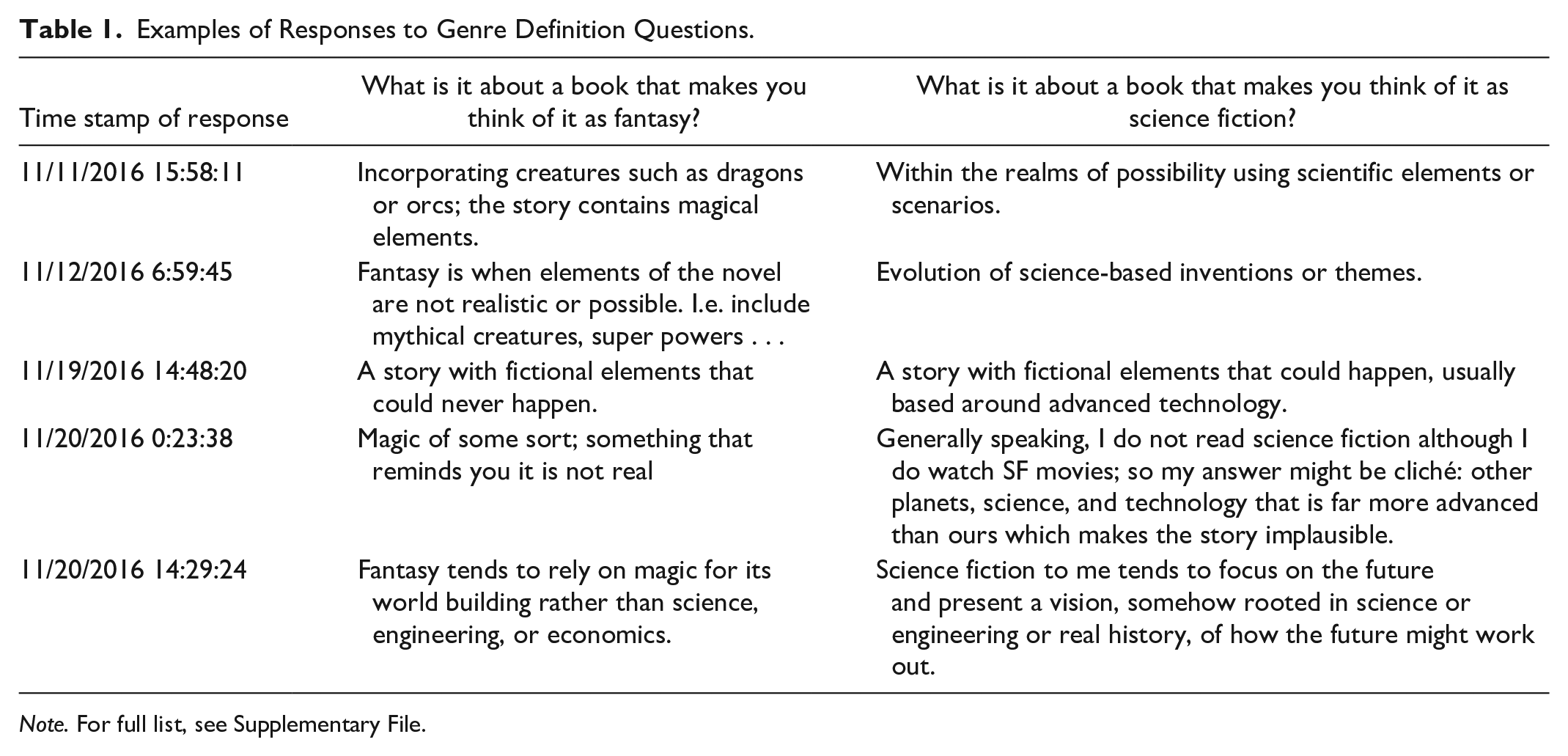
Note. For full list, see Supplementary File.
We asked questions about the influence on genre definition of content types, style and structure, peer influence, and marketing (Figure 1). Responses were largely ambivalent except for the assertion that peer opinions have limited effect. Responses to questions on assessing quality of fiction were not genre specific (Figure 7), but responses to direct questions on what makes a story fantasy or science fiction identified exclusive differences in content. This contrast suggests that respondents do not cognitively evaluate contextual or conceptual factors when determining genre. Identification of a specific genre is founded on content categorization.
Free-text responses to the questions, “What makes a story science fiction?” and “What makes a story fantasy?” used distinctive vocabulary (Figures 2 and 3, Tables 1–3). “Science” and “technology” are categorical indicators for science fiction (Figure 2, Table 2) and the word magic dominates descriptions of fantasy literature (Figure 3, Table 3). To avoid skewed results caused by self-referencing, uses of the terms science fiction and fantasy as genre labels were filtered out. Statistical classification of the terms used to distinguish science fiction and fantasy demonstrates overwhelming consistency, with the presence of magic associated with fantasy and the combination of science and technology being a universal indicator for science fiction (Figure 4; see Supplementary File for data table). Word clouds of the 20 most frequently occurring terms in free-text responses (Figures 2 and 3) illustrate the strength of discrimination between fantasy and science fiction. Antithetical phrases such as “no magic” or “no science content” are amalgamated into single terms (e.g., “unmagical” and “unscientific”) to enable proportional visibility. For categorization analysis, responses were sorted to identify the presence and context of the 30 most frequent words employed in responses to each definition and the results consolidated by stemming (e.g., “magical,” “magic,” “magic-based” would all be categorized as “magic”). In Figure 4, classification tree branches are at presence or absence (including negative statements) of terms found in any of 464 responses: 232 “what makes it fantasy,” 232 “what makes it science fiction.” Seventeen nonresponses were received to both questions. Sixteen of the most frequent words were shared between science fiction and fantasy definitions, generally by contrast (e.g., “science fiction does not contain magic” or “fantasy is based on magic”). This classification tree potentially had 44 nodes based on the 30 most frequent words in response to each question. We found that including the ages of respondents as a possible factor did not change the results.

What makes a story science fiction?
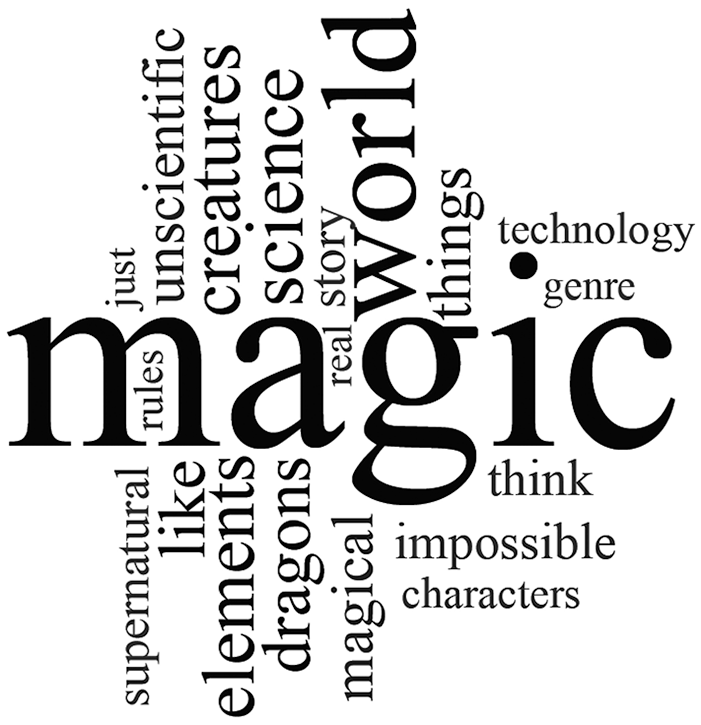
What makes a story fantasy?

Classification tree demonstrating confidence levels of categorization of science fiction or fantasy based on descriptors.
Ten Most Commonly Occurring Words Used to Define Science Fiction (by Word Counts of Raw Data), Excluding Genre Labels.

Ten Most Commonly Occurring Words Used to Define Fantasy (by Word Counts of Raw Data), Genre Labels Excluded.

Note. “Technology” and “science” appeared in the responses as negative values, used by the respondents to describe what fantasy is not. These were included as negatives in the categorization tree analysis.
The hybridization control test: Dune
To test whether the distinction between genres was polarized (definitive) or on a continuum (fluid), respondents were asked to discuss a narrative that could be expected to defy a simple definition—and explain the reasoning behind their choice. Frank Herbert’s Dune (Herbert, 1965) was chosen for two reasons. Dune contains science and technology that may be plausible or actual, such as atomic power, alongside content that is impossible according to our current scientific understanding, such as instantaneous travel (by drug-induced “folding” of space) and mystical powers of prophecy. Dune is also a very well-known and popular work. Dune is not defined as purely science fiction according to the Likert-type scale responses (Figure 5), and initial word frequency analysis of text responses suggested that classification into science fiction or fantasy is, indeed, not clear for this novel (Figure 6).

Likert-type scale classification of Dune as science fiction or fantasy.

Defining Dune (100 most frequent words shown).
Qualitative examination of the free-text responses provided a more nuanced perspective, however, and identified a standard technique used by respondents to explain where the novel sat on the Likert-type scale—involving itemized classification of content as either science fiction or fantasy, but not both. Some respondents employed Clarke’s Third Law to explain the ostensibly fantastic elements: They argued that plausible explanations converted impossible fantasy into possible science fiction. The genetic engineering of humans into organic computers seems plausible in a society that has banned thinking machines. The powers of the messianic central character arise from special properties of the spice, harnessing the Fremen’s fanatical devotion, which has been seeded by Bene Gesserit social engineering. Those who found these elements to be impossible or implausible rated Dune toward the fantasy end of the scale, whereas those who provided a plausible explanation scored the work more strongly as science fiction.
When explaining their Likert-type scale positioning of Dune, respondents did not introduce new “science-fantasy” terminology. Instead, they classified the content of Dune by the same terms they used to distinguish between these genres, split into sets of individual science fiction or fantasy elements. Dune provides evidence that respondents apply the classification in Figure 4 to individual elements of narrative to determine the genre category. The Likert-type scale positioning is determined by the proportion of science fiction to fantasy content. This is not evidence for a blurry continuum of the sort despised by Frederik Pohl. Works such as Dune may intertwine the threads of family resemblances of science fiction and fantasy, but the core distinguishing features of science fiction are unchanged: science, technology, and possibility—there is no evidence here for an arbitrary third genre of “science fantasy.”
Significance of style and aesthetics
Responses to Q.16 and Q.17 (Figures 2 and 3) found definitions were not correlated with story quality (Figure 7). Answers to three closely related questions, “What makes a good story?” “What makes a bad story?” and “What do your favorite books have in common?” all identify characterization as the dominant factor. Terms used to define science fiction and fantasy are notably absent. This suggests that categorization of science fiction and fantasy is unrelated to literary quality.

What makes a good story? What makes a bad story? What do your favorite books have in common? (combined).
Word frequencies
Word frequency (Tables 2 and 3) and classification tree (Figure 4) analysis of responses demonstrate specific discrimination between science fiction and fantasy through content filters of magic, science, technology, and plausibility. The overwhelming lack of complex, theory-based, responses found in qualitative inspection of the responses suggests a quantitative and categorical analysis is appropriate and implies respondents were providing personal, intuitive definitions regardless of knowledge of academic theory. This was found to be so whether the respondent occupation was “genre-professional” (e.g., writer, editor) or not, again adding substance to the argument that these responses are not inspired by theoretical definitions. This lack of prevarication by respondents who can be regarded as “expert respondents” is especially significant, as we will discuss.
Evidence of fuzzy sets
A fuzzy set is composed of items that are not defined by purely binary conditions but exhibit degrees of membership (Zadeh, 1965). These, alongside family resemblances, appear to augment our core categorization of science fiction and fantasy rather than providing sources for definition in themselves. A combination of methods illustrate and support the rigor of our analysis: word clouds, classification analysis, and Likert-type scales to illustrate personal perspectives (Figures 2–4) and external influences (Figure 1). The frequency of specific words found in free-text responses provides statistically significant evidence for binary categorization. In apparent contrast, Likert-type scale indications of the influences of content, style, peer, and market are not polarized. In some cases, the responses indicate almost complete ambivalence, with both means and medians close to the center point of the response scale (Figure 1, showing results from Q. 9, 10, and 12 of the survey, Menadue, 2017a). The apparent “fuzziness” of these responses is indicated by a lack of extreme responses to scaled questions. A control case—defining Dune—was employed to enable falsification of the hypothesis by identifying nonbinary categorizations that might refute a strict demarcation of science fiction and fantasy. Of 224 responses to this question, there were 43 responses of (1) definitely science fiction and four that it was (10) definitely fantasy. As noted from analysis of respondent explanations of their evaluation of Dune, there was no indication that content hybridization caused any confusion in classification of science fictional elements. Research has found avoidance of end-of-scale, gravitating toward the ends, and bias caused by the direction of positive, negative, and neutral points on the scale can affect Likert-type scale responses (Coertjens et al., 2012; Croasmun & Ostrom, 2011; Hartley, 2014; Lantz, 2013; Thissen-Roe & Thissen, 2013). As we are looking for evidence of any nonbinary explanation in free text, however, scale biases are not relevant. Family resemblances contribute significantly to the ability of respondents to easily classify a range of different works and a variety of content and external phenomenological experiences are associated with science fiction and/or fantasy. These appear to form fuzzy sets around the core criteria. This explains the fact that respondents were able to provide a variable scaled response to some questions, without compromising a clearly categorical classification.
Statistical robustness
The statistical robustness of the responses is extraordinary and indicative of the power of multidisciplinary methods in the digital humanities (Menadue, 2019a). We carried out a statistical comparison between the categorical distinction between science fiction and fantasy found by the survey and a hypothetical model based on arbitrary distinctions (i.e., a null hypothesis that answers would gravitate toward an even distribution in use of terms). Even if we ignore the significance of “science” as a response in case this might be predicated by the nature and wording of the survey, this does not have a significant impact on the results (Figures 8 and 9). The occurrence of “technology” and “possibility” as defining terms is so exclusively focused on science fiction that this provides a clear indicator that we have identified a human way of looking at the world that informs the classification of science fiction rather than a historical snapshot of a variable process, especially when we consider the demographic spread of responses includes people who are relatively new to the genre as well as those who have many decades of experience, yet when we included age as a potential factor in the analysis, it did not change the categorization tree.

Bayesian analysis of technology classification.

Bayesian analysis of plausible classification.
The power of a statistically significant finding is more strongly affected by consistency between responses than by population size. The survey findings are statistically significant because of this lack of variation in responses, which indicates that the findings accurately reflect the opinions of any potential respondent who shares similar demographic characteristics (i.e., people who are interested in science fiction, across a broad range of ages). As the aim is to identify a popular perspective on a specific genre, this might be reasonably assumed to be comprehensive within the survey limitations given below.
Bayesian analysis of the exclusive association of “technology” with science fiction compared with a supposition of arbitrary association (Figure 8) demonstrates an infinitesimal likelihood that this is a false positive (Bayesian factor of 2e + 11, that is, it is 200,000,000,000:1 that this is an error, based on all 43 respondents out of a sample of 232 who employed “technology” in their definition exclusively applying this to science fiction).
For the smaller sample size that included “possible or plausible” terms to define science fiction (Figure 9), the odds are 453:1, or less than 0.25%, that this is a statistical error.
Postmodern perspectives on genre of a kind typified by Rieder (2010) and Bould and Vint (2009) suggest a hypothesis that as sample size increases, the distribution of responses would become increasingly random—as each participant is understood to be an individual making a decision that is in some sense arbitrary. This tendency would be visible during any historical sampling period if a “fuzzy set” of associations was the key to definition, as this would vary between individuals. We also might expect significant differences in the opinions of respondents of different ages if the characteristics of the genre are fluid over time. We find, however, a consistency in categorization and an exclusivity of “technology” being associated with science fiction across more than 60 years of respondent experiences (a previous survey found the vast majority of the science fiction audience started reading science fiction by the age of 15; Menadue, 2016; Menadue & Jacups, 2018). This finding strongly suggests this is not a “snapshot” constrained by historical circumstance, but indicates a more permanent, underlying phenomena.
Survey conclusions
Science fiction and fantasy genre definitions are predominantly influenced by a consistent association with techne. This contrasts with postmodern FoE definitions, but resonates with classical interpretations and genre analysis undertaken by Suvin and Csicsery-Ronay, among others, that focus on plausibility and technology. The distinction was so sharply defined that the word magic was a categorizing factor in 94% responses to the question, “What makes (a work) fantasy?” and the presence of the word science (independent of labels for the genre) was a 96% indicator for science fiction. Positive association of the word technology corresponded uniquely (100% match) with categorization as science fiction.
A lack of responses including theoretical models from a survey population reasonably assumed to comprise a significant number of “expert” respondents suggests the genre is recognized without deep analysis. This finding is independent of aesthetic considerations and indicates researchers cannot reliably identify more general interests solely from examples acclaimed for their literary values. This circumvents definitions based on qualitative standards alone or purely theoretical structures, including some FoE research. Empirical evidence suggests the survey respondents are defining genres by how clearly content resonates with simple, enduring, core features. The influences of marketing and peers, alongside contemporary fashions in narrative subject, are members of the fuzzy sets of associations. Rather than arbitrary, marketing categorization may simply be defined by essential distinctions shared by the marketers.
Whether a story is deemed “good” or “bad” has qualitative characteristics which focus on characterization and appear independent of genre (Figure 7). Fewer than 3% of respondents employed theoretical distinctions to differentiate between science fiction and fantasy, although a significant number of respondents are industry professionals. The presence of a plausible narrative influences the classification of a work as science fiction, however, and the formal narrative structure implied by this (perhaps in contrast to a more “free” style that may be associated with fantasy) may be an indicator that influences categorization. To analyze this feature in more depth is beyond the scope here, but may provide the basis for further studies.
When asked to explain classification into science fiction and fantasy, free-text responses are variable in depth and complexity, but key word content is remarkably similar (Figures 1–4, Tables 1–3). These findings indicate a genre core that is orbited by fuzzy sets of family resemblances—aliens, space ships, dragons, quests—but not defined by them. For science fiction, these may include current and future concepts drawn from science and technology, contrasting with the “magical” core of fantasy.
Analysis of survey data readily identifies a popular categorization of science fiction and fantasy that does not demand lengthy discussion of the aesthetic value or sociological basis of content. Content categorization defines science fiction and fantasy empirically. This is the clearest, least equivocable and most verifiable means of identifying popular comprehension of these genres.
Survey limitations
Research on the characteristics of online surveys finds a comparatively low dropout rate and more complete data responses compared with postal surveys, but inherent influence by self-selection (Dolnicar et al., 2009). Martine Van Selm and Nicholas Jankowski have discussed how targeting specific online communities can be an effective method of harvesting survey responses and specifically for what Walter Swoboda et al. (1997) described as “expert interrogations” (p. 243), also highlighting the cost-effectiveness of this approach and the openness of responses that is encouraged by anonymity (Van Selm & Jankowski, 2006, p. 437). Van Selm and Jankowski (2006) acknowledged technological limitations and being unable to control the pattern of respondents due to lack of control over survey dissemination (p. 438). The survey was only available in English, as were the survey instructions and promotion, which reduces the responses by nonnative speakers of English and influences survey dissemination—this means the results cannot be determined to speak for sf audiences from all cultural backgrounds, but is clearly applicable to an Anglophone audience, albeit one that includes respondents who are nonnative English speakers spread across the globe.
Complex media engagement practices, involving two-way interactions, are found in online audiences, and this is considered to make online survey design and application challenging and unlike pretechnological research paradigms (Livingstone, 2013; Yun & Trumbo, 2000). Overcoming limitations of the characteristics of online surveying (Callegaro et al., 2015) can only be reduced by multimodal and methodical sampling beyond the resources available to this study. It should be noted, however, that the survey sought the opinions of people who are familiar with the genre, and consequently the meaningfulness of the responses is less likely to be affected by limited population sampling. The “expert interrogations” highlighted by Swoboda et al. apply particularly strongly to this survey as perhaps half the responses came from people visiting the Facebook page of the Science Fiction and Fantasy Writers of America (based on time-coding of responses compared with the time when the survey was posted on the SFFWA Facebook page), but we found no significant difference between definitions given by professionals and those of other respondents. Evidence suggests that authors are often not especially interested in complex analysis, as will be indicated in the following synthesis.
Synthesis of Theory and Survey
Drawing on both theoretical and survey analysis, the classical concept of techne—the acknowledgment of the existence of an empirically based world, upon which the thought experiments and theories of science fiction are based—provides an explanation for the easy popular classification of science fiction. The core of this categorization is sharply defined, rather than being subject to a fluid and mutable historiographic process that is particularly problematic if we employ genre for real-world research outcomes. We suggest it is techne that is the historically continuous core of science fiction, around which themes, motifs, and tropes orbit.
Figure 10 illustrates how this core of techne is orbited by subject matter and concepts that may at any one time make up elements of the family of resemblances comprising the totality of science fiction, without being themselves truly definitive. The core of techne persists through time (the vertical arrow) even though fashions in science fiction and real-world contexts of technology and science—from bone tools through to artificial intelligence—may change. Specific science fiction instances—such as Wells’s time machine, or Kubrick’s (1968) HAL—are linked to changing fashions, or even technology, and are members of fuzzy sets associated with science fiction.
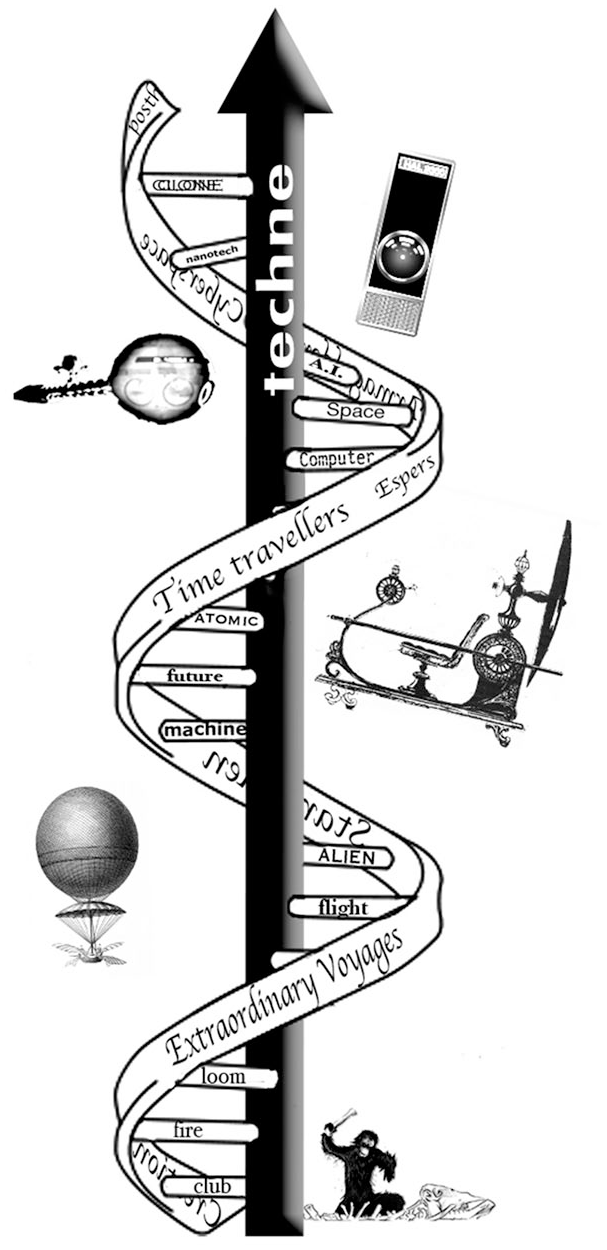
“Techne-fiction.”
The academic definition of genres is the continuing subject of debate and has inspired diverse FoE theories. We suggest that the proliferation of academic theories is fed by a focus on transient features of the genre, the fuzzy set of concepts and technologies that are associated with science fiction at any particular time through family resemblance, which obscure the empirical core of science fiction that general audiences find definitive. In contrast to pure research, applied research requires this more democratic definition if it is intended to identify public interests through the medium of science fiction. Wittgenstein’s notion of family resemblances can explain the collection of “things” that surround the core category classification, as well as the unproblematic retroactive classification of pre-sf work, as the family provides a way of identifying related content—not merely a set of clearly defined rules. But it appears that underlying the way of understanding there is a continuous, historical, presence, which explains why these categories exist. The specific terms correspond well to techne for what is commonly described as science fiction, and magic for fantasy.
Some authors have reflected on the gap between the straightforward interpretations they may make of their own work and the complexity that is added by academics. This may be reflected in the lack of theoretical explanations by members of the SFFWA. Philip K. Dick (1980) seemed to have considered that his science fiction was less complex than it might appear to critics: One time I read in a distinguished book of criticism on sf that in my novel The Man in the High Castle the pin which the character Juliana used to hold her blouse together symbolized all that which held together the themes, ideas, and subplots of the novel itself − which I hadn’t known when I wrote that section. But what if Juliana, also not knowing it, had removed the pin? Would the novel have fallen apart? Or at least come open in the middle and exposed a whole lot of cleavage (which was why her boyfriend insisted she put on the pin in the first place (n.p.))?
J. G. Ballard was less whimsical when he styled academic criticism as the “apotheosis of the hamburger,” unrelated to the origin or intention of writing, or the perspective of the reader (Ballard, 1991, p. 11); Kurt Vonnegut reportedly dismissed his status as an author of science fiction because critics had mistaken the genre for “a urinal” (Weiner, 2017, p. 41); and we have seen how categorically Pohl and Lem described their work. Perhaps the opinions expressed by writers are underpinned by the overwhelming clarity of the popular definition. The intention here is to provide a genre classification that reflects a shared cultural understanding that is not inherently complex. A definition that can be used by interdisciplinary researchers to hold together research deliberately aligned with public interests and expectations, using science fictional safety pins that are suitable for this purpose.
The empirical data from our survey analysis seem to confirm that the science fiction genre exists and is real and historically enduring. Popular definition does not depend upon abstracts, which feature in some FoE definitions, and the public recognize the categories independently of analytical or aesthetic considerations. This contrasts with definitions based on qualitative standards or postmodern reduction. The empirical evidence suggests the survey respondents are defining genres from a core of essential features, which are orbited by family resemblances and fuzzy sets. Marketing and peer opinions are included in this orbit, and marketing categorization may be influenced by shared distinctions understood by the marketers, rather than being entirely arbitrary. The focus of the respondents on science and technology provides us with a characteristic of human experience that identifies science fiction.
Techne is empirical in the sense that science fiction refers to the experience of the existence of an empirically based world, and the survey of science fiction readers finds clear and practical categories that separate science fiction from fantasy literature. The difference between science fiction and fantasy is decided by mutually exclusive characteristics of the narrative and science fiction is easily recognized.
Conclusion
The people who consume and enjoy sf are their own arbiters of definition and provide robust categorization based on simple indicators. The categorization of works such as Dune (Herbert, 1965) and the use of the term “science fantasy” rely upon clearly defined categories of science fiction and fantasy to describe a combination, rather than creating something distinguished by its own terminology. This reinforces our findings that the genre cores are very clearly separated in the minds of individuals. Engaging the public in applied research that borrows from science fiction calls for a common understanding. Accepting a popular comprehension of the genre supports successful research outcomes in communication, advocacy, and pedagogy that employ science fiction to effect results. Effective use of science fiction in research that is intended to resonate with the public, or claims to represent the public interest as revealed through a science fiction lens, should consider the persistent cores—science/technology for science fiction, and magic for fantasy—that reflect “the people’s choice,” to determine the relevance of works for inclusion or exclusion, rather than relying solely on FoE definitions. The application of postmodern approaches to definition, selection, and interpretation is especially problematic in this regard.
We suggest that the core characteristics of science fiction and fantasy, of technology and magic, have been reflections of a human way of thinking about the world for recorded history. This is the human embodiment of techne, as the phenomenological experience of what it is to be human in an experiential, physically consistent, but humanly modified and shaped world. This in-built comprehension of techne drives the genre categorization of fictional works. Wittgenstein’s “family resemblance” is a twisted thread wound around a persistent core of real and specific characteristics. As John Frow (2006), concluding his work Genre, suggests, “Through the use of genres we learn who we are, and encounter the limits of our world” (p. 144). We would suggest that who we are, and the limits of our world, are fixed in certain specific dimensions and this is reflected in our recognition of science fiction as techne. It is a “techne-fiction” of plausible unrealities, inspired by the tool-using possibilities that came from the evolution of an opposable thumb. In the act of hurling his bone club into space, Kubrick’s ape in 2001: A Space Odyssey reveals not only the dawn of technology but also the dawn of science fiction.
Supplemental Material
TS_Category_Data – Supplemental material for An Empirical Revision of the Definition of Science Fiction: It Is All in the Techne . . .
Supplemental material, TS_Category_Data for An Empirical Revision of the Definition of Science Fiction: It Is All in the Techne . . . by Christopher Benjamin Menadue, Kristi Giselsson and David Guez in SAGE Open
Footnotes
Declaration of Conflicting Interests
The author(s) declared no potential conflicts of interest with respect to the research, authorship, and/or publication of this article.
Funding
The author(s) received no financial support for the research, authorship, and/or publication of this article.
Ethical Approval
Ethics approval was granted by the university human research ethics committee on October 19, 2015 (Approval No. H6299).

Supplemental Material
Supplemental material for this article is available online.
References
Supplementary Material
Please find the following supplemental material available below.
For Open Access articles published under a Creative Commons License, all supplemental material carries the same license as the article it is associated with.
For non-Open Access articles published, all supplemental material carries a non-exclusive license, and permission requests for re-use of supplemental material or any part of supplemental material shall be sent directly to the copyright owner as specified in the copyright notice associated with the article.
