




Abstract
This article describes findings from an online survey Science Fiction & Fantasy: Your Experiences, launched in November 2015 and closed 1 year later, which received 909 unique responses. The survey identified characteristics of readers of science fiction, their knowledge and experiences of works, authors, and subgenres. It examined their attitudes to science and science fiction and their judgment of the similarity between real and fictional scientists. Contrary to declining reading habits, the science fiction and fantasy audience read consistently high volumes of books, as well as watching genre TV and film. We discovered that reading science fiction and fantasy may have a role in sustained, and cognitively beneficial, adoption of reading by young people and is complementary to other forms of consumption, rather than competitive. Science fiction was also found to be an important influence on the perception and acceptance of science by the public. Implications of this are that science fiction and fantasy are now a normal part of life for a wide range of people, and science fiction has a positive influence on popular interpretation, acceptance, and support of scientific endeavors. These results support earlier work that suggests science fiction is a valuable research tool for public engagement with science.
Keywords
Introduction
Science fiction and fantasy have been argued to be part of a mutable continuum of speculative genre fiction (Rieder, 2010). Since Darko Suvin’s (1979) landmark study Metamorphoses of Science Fiction: On the Poetics and History of a Literary Genre, it is now common in science fiction studies to use the term science fiction to refer to any speculative fiction—whether it might otherwise be considered science fiction, fantasy, or another form—which embodies novelty and estrangement, the sources of cognitive dissonance. Suvin’s description is more explicit than earlier genre theory which presented science fiction as a subset of fantasy (Todorov & Berrong, 1976), and Suvin suggested that there are special characteristics of science fiction that can be used to isolate it from other forms of fiction. Suvin stated that “SF is distinguished by the narrative dominance of a fictional novelty (novum / innovation) validated by cognitive logic” (Suvin, 1979, p. 63). This definition is inclusive across genres and may include narratives that would be classified specifically as science fiction or fantasy by members of the public and exclude others that do not meet the theoretical requirements. For the purposes of our analysis, we take the position that “science fiction” refers to a broad range of texts, but for readers this cannot be assumed, and consequently the survey title includes both “science fiction” and “fantasy.”
Existing theoretical, or academic, definitions may not reflect popular readership, as they do not necessarily present reader perspectives, which influence the response given to survey questions. A recent survey (Menadue, 2017a) identified that the popular definitions of science fiction and fantasy are very sharply defined compared with the academic discussion, and the findings indicate that in the imagination of readers of science fiction it is not considered to be a subset of fantasy literature but a companion by contrast. Classification tree analysis found that in placing a work in a specific genre, the word “magic” occurred in 94% of responses to the question “what makes it fantasy,” and the word “science” occurred in 96% of responses to “what makes it science fiction,” and “technology” occurred in 100% of responses that did not include the word “science” (Menadue & Giselsson, 2017; Menadue & Guez, 2017). Responses that refer to science fiction or fantasy in this survey are founded on a popular understanding of these genres, and although the survey title and some questions combine science fiction and fantasy, we consider it would be clear to respondents what they consider to be “science fiction,” rather than “fantasy” when answering questions about how science fiction is related to various topics.
In its relationship with science, science fiction has been described as a “cultural wallpaper” (Aldiss & Wingrove, 1986, p. 14) that has an impact on our vision of science and technology, and the directions in which we pursue scientific progress (Kirby, 2010; Stableford, 1979). Moreover, Miroslav Kotasek (2015) states, “In today’s cultural situation it is almost impossible to have clearly defined borders between scientific ‘concepts and terms’ and their ‘vulgar’ usage in everyday discourse” (p. 64). Science fiction has also been found to reflect and track cultural change (Menadue, 2017b, 2018a, 2018b), and the relationship between science and science fiction is one that is becoming more relevant to research as science fiction is increasingly used to enhance research outcomes across many disciplines, most especially for education and advocacy (Menadue & Cheer, 2017).
Reader surveys have been conducted by science fiction magazines since 1948 (Adams & Wallace, 2011; Campbell, 1949, 1958; Carnell, 1955, 1964; Hamilton, 1954; Van Gelder, 2003). Generally, these surveys are a form of targeted marketing, focusing on obtaining demographics, and other useful market research assessments. Analysis has been made of some early surveys, including the comparative demographics of convention attendees (Bainbridge, 1980; Berger, 1977). The most recently cited magazine survey was by John Adams and Sean Wallace for Lightspeed in 2011; it focused on quantifying advertising market segments and technology purchasing habits. The historic surveys portray a demographic dominated by young male readers (93.3% male in 1949, average age 29 years) but trending toward more balanced gender and age ratios over time (92% male and 30.8 years in 1963, 67% and 40 years in 2003 and, 59% and 43.5 years in 2011: significant figures are given from original survey data). It should be noted that these surveys tend to favor subscribers or buyers of these magazines and may not represent the demographics of a broader science fiction audience.
To date, no publication has addressed a general online survey of this population in the literature, and the importance of gathering empirical information on a demographic group that has been theorized to have a significant influence on the pursuit and success of science is clear. As science fiction concepts and real science overlap, it is especially important to investigate the characteristics of the science fiction audience and their attitudes toward science. This information may aid researchers in improving the design of research that includes science fiction as an enabling tool, to enhance the connection between researchers and the public.
Research Aims
The aims of the survey were to seek answers to the following questions:
The demographic characteristics of the science fiction and fantasy audience.
How respondents perceive that science fiction is influencing attitudes to real science. what are their own perspectives on the benefits science fiction generates for science, how do they think science fiction might affect other people’s attitudes to science, and do science fiction representations of scientists differ from the perceptions they have of real scientists.
Are there significant correlations between the characteristics of respondents, their answers regarding the science fiction genre, and attitudes toward science and scientists.
The Survey
The Science Fiction & Fantasy: Your Experiences survey was designed to gather information on who the readers of science fiction and fantasy are today, their attitudes toward science and scientists, and their reading preferences. To this purpose, the survey included questions on reading habits and genre preferences, attitudes toward science, and demographics. This survey was intended to augment and extend the results of prior surveys and elicit a wider range of responses to assess the relationship between people’s science fiction experiences and real-world science. As well as providing information of use to researchers who employ science fiction to assist in achieving their research aims, it will add to the body of survey work in the tradition of large-scale general, and noncommercial, genre-focused surveys such as the Lord of the Rings International Audience Research Project (Barker & Mathijs, 2006), and Berger’s work on convention attendees (Berger, 1977).
The combination of science fiction and fantasy in the survey title, and for some survey questions, is related to the fact that the peak writers body is the Science Fiction and Fantasy Writers of America (SFFWA, italics added), which does not discriminate in the usage of the terms, bestows its Nebula Awards on writers who are considered to be in either category, and was expected to be the source of a significant number of survey respondents. It was considered prudent to not anticipate a clear separation between science fiction and fantasy in the marketing and presentation of this survey, and for a subsequent survey (Menadue, 2017a), which explicitly addressed genre definitions. At the time of preparation, and without empirical evidence, it was not known to what extent the public make a distinction between science fiction and fantasy, or what reasons they might give for doing so.
Method
This article reports on the characteristics of a self-selecting audience on their attitudes to science fiction and science. The survey sought to address the research questions, and present findings alongside demographic characteristics to better identify and describe the attitudes and preferences of respondents.
Design
The survey comprised 57 questions, in three successive sections: reading preferences; attitudes to science, science fiction, and fantasy; and respondent demographics. The full questionnaire for the survey, and the survey data, are available in an online research data repository (Menadue, 2016). Ethics approval was granted by the university human research ethics committee on October 19, 2015, approval No. H6299.
Completion of the survey was not mandatory: Questions could be missed, and respondents could exit prior to completion. Information was collected on reading values, preferences and volume of reading, reading habits of other members of the household, general consumption of other science fiction media, self-perception of manual and mental agility, strength of personal opinions, and history of reading science fiction. Questions were also asked on attitudes to science, and demographic information was collected on age, country of residence, first language spoken, gender, education, employment status, income satisfaction, and relationship status. The survey questions were both closed, employing 5-point Likert-type scales, ranges (for age-related questions), and open-ended questions prompting free text responses—this article only reports findings from closed and ranged questions. Further questions asked for respondent attitudes toward science as well as how they imagined science fiction might influence the attitudes of other people. Survey questions were accompanied by an explanation for each question, which were informally written to encourage respondents to complete the entire survey. The survey was written in English and no translations were provided.
One question asked if there was a difference between how “grounded” scientists in science fiction were, compared with real-world scientists. A deliberately neutral term was used for this question to reduce response bias, as an alternative to one of the value-laden terms such as “mad,” “eccentric,” or “absent-minded” that are often applied to real or fictional scientists. This question was problematic, as attempts to make it general included several broadly related terms. The question in full was, “Do you think scientists in science fiction seem more grounded and understandable than scientists in real life?,” and the ends of the Likert-type scales were labeled with I think real scientists are more understandable at 1 and Yes, I can relate to them more easily at 5. This question was intended to gain an impression on the part of the respondent rather than a very specific response to this question, but the clustering of responses around the center might reflect an insufficiently clear phrasing of this question, even though data analysis indicated meaningful correlations between the variance present and other factors.
Procedure
The survey Science Fiction & Fantasy: Your Experiences was posted online on November 16, 2015, aimed at attracting a sample of science fiction readers. It was promoted via email, personal recommendations, and social media, including targeting Facebook pages dedicated to science fiction and fantasy fans, readers, and writers. These included direct posting in Facebook groups with membership in the hundreds, to the SFFWA closed group, for which a request to post was necessary. The SFFWA Facebook page has over 43,000 followers, and the timing and frequency of survey responses following posting with the SFFWA indicated that a majority of respondents may have come to the survey via that link. Survey responses were collated on November 17, 2016.
Data Storage and Analysis
Survey data were collected using Google Forms and exported as comma-separated values for statistical analysis. The questionnaire and anonymized results of the survey are stored in a public research data repository (Menadue, 2016).
Spearman’s correlation tables were created using GraphPad Prism version 7.00 for Mac. We report only correlation coefficients above 0.20 with a p value < .01. Significant relationships between questions on attitudes to science and all other questions, and significant correlations related to age and gender are presented separately. Correlations have been omitted for clarity where the logic of the relationship is obvious and of no clear significance (e.g., a strong correlation between geographical location and native language, a correlation between enjoying science fiction and reading large numbers of science fiction books).
Findings
Sample Characteristics
After the survey closed, a total of 909 survey responses were collected. As the questions were not mandatory, there are variations in response numbers, as shown in the tables. Due to a significant number of respondents neglecting to answer one or more questions, the analysis includes all responses given to each question rather than filtering for those in which respondents answered all survey questions. The mean age of respondents is 42.3 years and the gender balance favors female respondents, who make up 54.5% of the total. Mean, median, and mode ages were lower for females than males (Table 1).
Demographic Characteristics of Survey Participants.

Respondents are globally distributed, with 42.8% of responses coming from North America. Most respondents (81.7%) report their first language as English, the remainder are distributed between 15 different languages including a cluster of 1.1% Finnish speakers. The majority of respondents (82.4%) have a university-level education, and 72.2% of the sample are employed or self-employed. The measure of attitude toward personal income indicated that the majority (88.6%) are neutral about, or satisfied with, their financial circumstances. The majority of respondents (70.5%) also reported being in a relationship with someone. Other questions are separated into two groups: responses concerning reading habits (Table 2), and those regarding science and scientists (Table 3).
Background Questions on Reading and Other Activities.
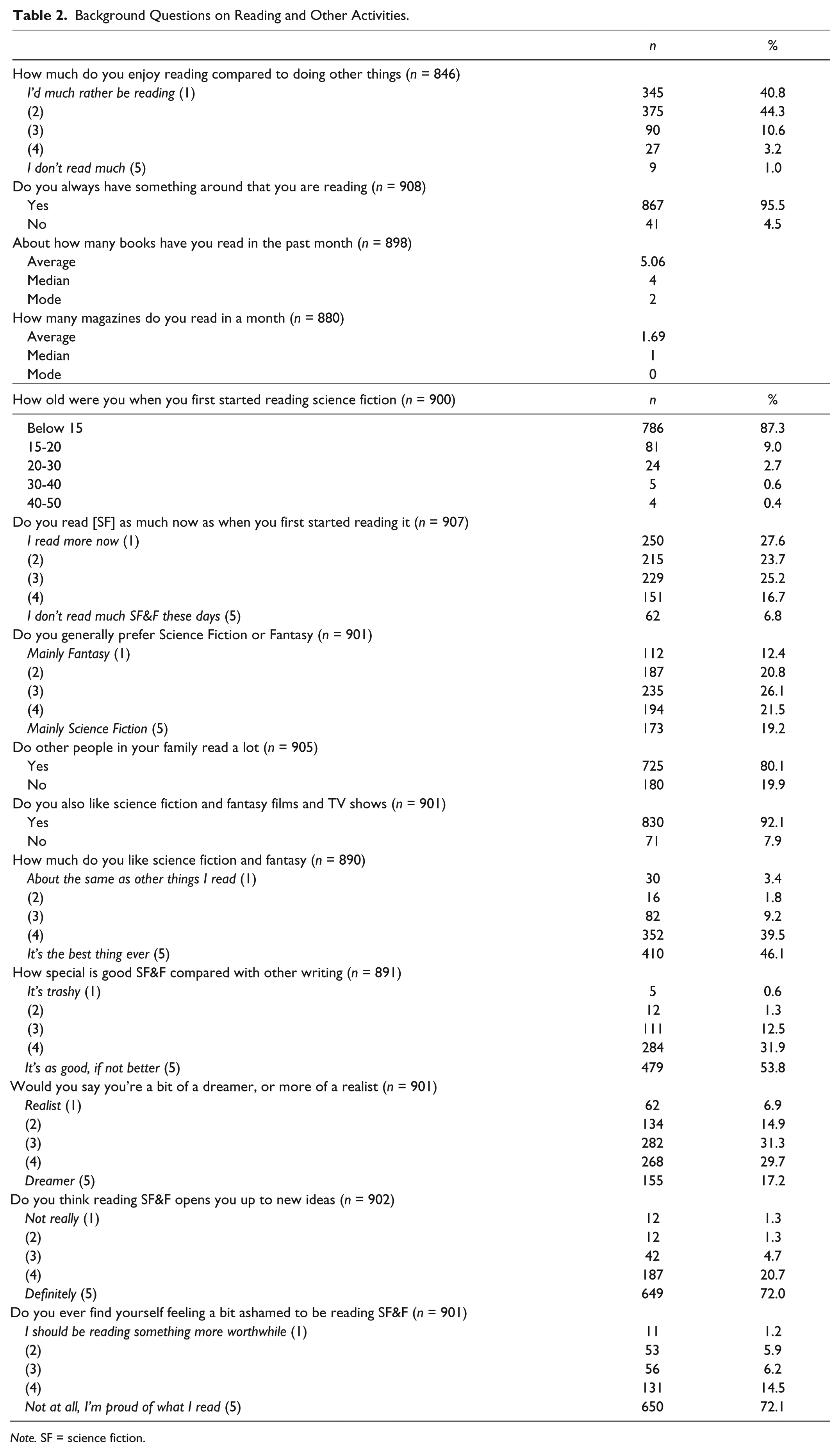
Note. SF = science fiction.
Attitudes to Science.

Note. SF = science fiction.
Reading habits and self-identification
Respondents prefer reading to other activities, with 85.1% reporting a preference for reading. Almost all (95.5%) stated that they are always reading something, with the average respondent reading five books per month and between one and two magazines. Most readers (87.3%) had started reading science fiction before the age of 15 years, and 76.5% read as much or more now as when they started. Genre preferences between fantasy and science fiction are generally spread evenly, with a small preference for science fiction among older and male respondents. Most (80.1%) come from families of readers, and 92.1% also watch science fiction and fantasy films and TV shows. Science fiction and fantasy are the preferred form of literature for 85.6%, and the same proportion state that science fiction and fantasy are as good as or better than other forms of writing. Respondents describe themselves as “dreamers” more than “realists,” 72.1% are proud to be seen reading science fiction, and 84.3% believe that life experience and learned skills are more important than education. Respondents perceive themselves as having good manual skills and to be very good at puzzle-solving. Many believe that they are very good to excellent at learning new manual skills and learning new and unfamiliar ideas. Most respondents consider themselves to be open to all sides of an argument (84.8%) rather than relying primarily on their own opinions. There was a very strong positive response to the suggestion that science fiction opens readers up to new ideas in general. This is believed by 92.7% of respondents.
Attitudes to science and scientists
Responses to questions on science and scientists are presented in Table 3. Significant relationships discovered between questions on attitudes to science and all other questions, and significant correlations related to age and gender, are presented as Spearman’s correlations in Tables 4 and 5. The number of respondents to each question in Tables 4 and 5 is identical to that for the corresponding entries in Tables 1 to 3.
Spearman’s Correlations: Attitudes to Science and Scientists.

Note. SFF = science fiction and fantasy.
Spearman’s Correlations: Consumption Habits.

Note. SFF = science fiction and fantasy.
Respondents agree that there is a positive relationship between science and science fiction: 68.6% believe that science fiction helps them relate to science in general, 62.0% believe that reading science fiction makes them more likely to believe in real science, and 53.2% believe that the people who doubt science would be more positive about it if they were to read science fiction.
Spearman’s correlations between the positive responses to science and familiarity with science fiction are clustered together with moderate interactions. There are, however, only very weak correlations between scientists in science fiction and real scientists being comparatively more or less “grounded” and other responses (Table 4).
Other Findings
There is a moderate correlation between both age and gender and preferences for science fiction or the specific fantasy subgenre, with older males more likely to prefer science fiction rather than fantasy (Table 5), and older respondents generally read more than younger ones.
Discussion
The survey generated a significant response, with 909 forms completed between November 2015 and November 2016. The survey was far-reaching, with responses given from 21 geographical locations, and 18.3% of participants do not speak English as a first language, suggesting a diverse range of respondents. The survey responses indicate that the science fiction audience has a more balanced gender and age profile today than is indicated by previous surveys. The average reader is in their 40s, employed and in a relationship, with female respondents tending to be younger than males. A significant majority of respondents report being educated to university level or above. This reinforces previous audience data that found “astonishing” high levels of education among fans (Berger, 1977, p. 236). A similar proportion of respondents, however, also believe that life experience and learned skills are more important than education, suggesting a more balanced perspective than one focused on academic attainment.
Respondents watch science fiction films and TV shows as well as read science fiction literature, self-assess as more likely to be good at puzzles than physical skills, and are interested in and positive about real science. More strongly than this, however, they think that reading science fiction makes them receptive to new ideas in general.
Although there are correlations between support of real science and the benefits of science fiction as a form of pursuit, there are only very weak correlations with scientists in science fiction and real scientists being comparatively more or less “grounded.” This contrasts with the findings of a previous study, focused on children’s literature, that indicated representations of science fiction scientists are negative and unrealistic (Van Gorp, Rommes, & Emons, 2014). The findings of this survey may suggest that negative representations of fictional scientists have a limited impact on the attitudes toward scientists expressed by the adult science fiction reader. The use of the term grounded rather than a more clearly prejudicial term may have influenced a less radical response to this question than might otherwise be expected, and could explain why the correlation is weak.
The response to the question about whether science fiction opens the reader to new ideas is more positive than responses to questions regarding the relationship between science fiction and science. This suggests that readers absorb more from science fiction than ideas about science, and science fiction content is expected to discuss a wider range of “new” subjects. This is consistent with science fiction theories that are not constrained by a science focus—such as Darko Suvin’s definition of the genre.
Respondents report strong preferences for reading compared with other forms of activity, with 40.8% reporting an absolute preference for reading. This is combined with a high average monthly volume of books (5.06). Almost all (96.3%) respondents started reading science fiction before age 20, and 76.5% reported reading the same or more as when they started. This pattern of consistent high-volume lifetime reading contrasts with general reading surveys in Australia, America, and the United Kingdom, the geographical locations from which the majority of responses to the survey originated. American readers report reading nine books per year in the 18- to 29-year-old age category and 13 for older readers (Scardilli, 2014). Jacqueline Manuel and Don Carter, in their comprehensive review of current and historical reading practices of a population of native English speaking teenagers in Australia (Manuel & Carter, 2015), found that since 1952, year 7 to year 12 teenager reading averaged between 1.6 and 2.0 books per month, and in their own 2006-2010 survey that reading volume is remarkably consistent between the 1950s and the present. Monthly book reading by respondents to the science fiction experience survey is more than twice these values. Manuel and Carter (2015) also found that science fiction was not especially popular with teens, ranking 6 out of 12 for boys (42%) and 8 out of 12 for girls (12%). Fantasy was the first preference for girls and second preference for boys (p. 123). They further describe a body of research that discovered a positive link between reading volume and academic success. Both reading volume and the presence of self-selected or selection-guided reading options influence this effect. Consequently, the above-average reading volume reported in the science fiction and fantasy experience survey may be related to the high levels of educational attainment of the sample population, with 82.4% reporting a university education. This compares to 46% of the United States population, 50% of Australians, and 46% of the U.K. population (Organisation for Economic Co-Operation and Development, 2017). The survey analysis ignores non-science fiction and fantasy reading habits, and total reading volume may be even higher than reported here. Research carried out in the United Kingdom on childhood literacy also indicates that reading levels are low compared with those found in our survey (Clark, 2014).
In the survey, reading was in addition to interest in science fiction in TV and film, and this suggests that the reading of science fiction is complementary to other forms of genre consumption, rather than competitive. These findings indicate a population that is not following a more recent trend of declining reading that is particularly concerning to some educationists, as Sandra Stotsky has described in “What American Kids Are Reading Now” (Stotsky, 2016), and the significant impact of literacy upon quality of life has been discussed elsewhere (Dugdale & Clark, 2008). We were surprised to find no strong Spearman’s correlations between family reading and the reading habits of respondents. There were extremely weak correlations between family reading, geographical location (0.13), native language (0.12), and gender (0.1) but no other categories. A previous review of the literature on home and family influence on reading has indicated that socioeconomic status (SES) has a significant influence on reading habits, but also that home literacy levels have a limited impact on childhood reading motivation regardless of SES, a result that intrigued Linda Baker, Deborah Scher, and Kirsten Mackler who have called for further research into these effects (Baker, Scher, & Mackler, 1997, p. 73). In their exhaustive examination of the relevant literature, Baker et al. (1997) state “we cannot determine whether certain factors were more important than others in contributing to leisure reading” (p. 74). It is suggested that influences on reading practices are not easily disentangled. In this instance, however, we seem to have found strong statistical evidence that respondent’s perception of the volume of reading exhibited by other family members has little influence on their own reading habits and experiences.
A method for increasing literacy among young people might be simply to encourage them to read science fiction and fantasy, perhaps as an alternative to employing more complex and time-consuming behavioral interventions to the same ends (Cockroft & Atkinson, 2017). One approach to addressing declines in reading has been to recommend a more popular, public investigation of reading characteristics to identify the issues that exist (Albalawi, 2015). As a contribution to this effort, this survey seems to identify one reading group that is not in decline.
Survey Limitations
There are several study limitations of note for this study. Research on the comparison of characteristics of online surveys compared with survey by mail have found that online surveys exhibit a comparatively low dropout rate and more complete data responses but are similarly subject to self-selection variation (Dolnicar, Laesser, & Matus, 2009). Martine Van Selm and Nicholas Jankowski have identified the value of specific online communities in generating survey data, and specifically for what Walter Swoboda, Nikola Mühlberger, Rolf Weitkunat, and Sebastian Schneeweiß termed “expert interrogations” (Swoboda, Mühlberger, Weitkunat, & Schneeweiß, 1997, p. 243; Van Selm & Jankowski, 2006, p. 437). Selm and Jankowski (2006) also identify the cost-effectiveness of this approach and the benefits of anonymity in encouraging frank responses, but also acknowledge the limitations associated with technological access, and the risk of “losing sight” of the respondents (p. 438) due to lack of control over the dissemination of the survey—we might consider the cluster of 1.1% of respondents to our survey who reported from Finland to be an example of this effect, rather than reflecting a true geographical proportionality of science fiction readers. The survey was written and promoted in English only, which restricts the opportunities for responses by nonnative speakers of English and will impact survey dissemination patterns.
An online survey cannot reflect the attitudes of a broader segment of a science fiction audience who are not regular users of the Internet or are not followers of social media. The complexity of interactive media engagement exhibited by online audiences has been theorized to make analysis by online survey both particularly challenging, and despite superficial similarities, unlike previous audience research paradigms (Livingstone, 2013; Yun & Trumbo, 2000). These limitations of the technical resource and response characteristics of online surveying (Callegaro, Lozar, & Vehovar, 2015) can only be reduced by multimethod sampling beyond the resources available to this study.
A potential additional limitation is that responses collected as free-text, or open questions regarding the science fiction genre, are not reported here. The richness of these data is yet to be explored and will be the topic of a future article.
Conclusion
The audience identified in this survey is characterized by openness to and belief in science, consistently high-volume reading, and a very high level of education. Respondents are sympathetic toward science and scientists, and believe that reading science fiction inspires scientific comprehension and positive attitudes to science and that reading science fiction also has the potential to positively change new readers’ attitudes toward science. Respondents watch TV and film science fiction and fantasy as well as reading, and the volume of books read by respondents is high in comparison to the findings of general reading surveys and appears to be independent of their family reading habits. Reading is also complementary to other forms of participation with genre rather than competitive. It has been found elsewhere that science fiction and fantasy are popular among younger readers and that self- or guided-selection of reading creates the most educational benefits from reading. Open acceptance, and encouragement, of science fiction and fantasy reading at a young age might therefore improve the adoption of persistent and high-volume reading habits that are of benefit to cognitive development and academic success.
This is the first article to describe the findings of a general online science fiction and fantasy audience survey that was not distributed by a science fiction publisher, and adds to the literature by providing a more neutral and broad reaching account of the interests and attitudes of this audience than might be found in surveys with a more commercial intent. Previous work has discovered the increasingly important role science fiction has gained in the fields of education and advocacy and how it responds to the evolution of cultural change. The gathering of popular opinions and attitudes based on empirical data adds to the resources available to researchers who intend to integrate science fiction into their research. Researchers may be able to use a more accurate knowledge of what science fiction and fantasy audiences think about science to increase the effectiveness of the applications of science fiction in research contexts.
Footnotes
Acknowledgements
We would like to thank Todd Vandermark, Web Editor, Science Fiction and Fantasy Writers of America, for his kind assistance in promoting our survey.
Declaration of Conflicting Interests
The author(s) declared no potential conflicts of interest with respect to the research, authorship, and/or publication of this article.
Funding
The author(s) disclosed receipt of the following financial support for the research, authorship, and/or publication of this article: Menadue is the recipient of an Australian Postgraduate Award for his research. This research did not receive any specific grant from funding agencies in the public, commercial, or not-for-profit sectors.
