




Abstract
This article aimed to uncover the foci, themes, and findings of research literature that utilized science fiction content or concepts to describe and illustrate human culture. To capture a representative range of research, the PRISMA process was applied to database searches across a range of disciplines, not restricted to science fiction journals. Findings revealed that science fiction literature has been used in research across disciplines including theology, semantics, natural sciences, and education. Two characteristics of the use of science fiction in research became evident in the review: its role as a tool for advocacy and cultural insight and its effectiveness as an aid to learning and teaching. An unclear boundary between real science and science in the public imagination is problematic for research success, but the purposeful integration of fictional representations of science (both natural and social) into the research story has demonstrable benefits. To address the limited application of objective methodologies, adoption of increasingly robust quantitative analysis into research in the fields of literature and culture is recommended. This would assist in bridging the two cultures divide between the humanities and natural sciences.
Introduction
Culture has been defined as “the symbolic, ideational, and intangible aspects of human societies. The essence of a culture is not its artifacts, tools, or other tangible cultural elements but how the members of the group interpret, use, and perceive them” (Banks & Banks, 2004, p. 8), or, more simply, as knowledge and behaviors shared within groups of interacting individuals (Useem, Useem, & Donoghue, 1963). For the purposes of this review, we accepted that the search terms employed would capture the definitions of culture that were understood by the authors of the sources we discovered. These sources indicated that science fiction has become prominent in social and cultural research that is not purely focused on science fiction content, but which uses science fiction to complement research across a broad range of disciplines and research activities.
Science fiction is significant in studies of human culture as it is an ancient and enduring form of literature that has been part of what Brian Aldiss called our “cultural wallpaper” since the origins of recorded history (Aldiss & Wigmore, 1986, p. 14). Adam Roberts suggested that science fiction begins with the “voyages extraordinaires” of the Ancient Greeks (Roberts, 2005, p. vii), but we might go back a millennium further to the Sumerian creation story, with the supreme god Marduk “cloning” mankind from the blood and bone of the renegade god Kingu (Enûma Eliš, 5.26). Science fiction became an increasingly significant genre for literary study after Darko Suvin’s (1979) epochal publication of Metamorphoses of Science Fiction, which raised the profile of science fiction as a legitimate field of academic enquiry (Hassler, 1999). Suvin’s work has become a core text around which the study of science fiction circulates, and it has been used accordingly as the limiting date for this review.
The complexities of the relationship between science fiction and human realities are manifest. From a literary-critical perspective, Carl Freedman described science fiction as the most legitimate genre for academic study, placing it above all other forms of literature for its analytical potential (Freedman, 2000). From the human perspective, science fiction has grown from a more or less plausible science focus in the early 20th century to adopt more sociological and cultural factors over time. By the 1960s and 1970s, science fiction generated by the “British New Wave” reflected dramatic changes in contemporary culture, especially political aspects of gender, conflict, and freedom of expression. Driven by the need to provide some sort of manageable interpretation of an increasingly complex and unstable social and intellectual reality, it absorbed and softened the impact of that complexity by depicting possible futures as being similarly iconoclastic and haphazard (Greenland, 1983). It has even been argued that the intermingling of science fiction and fact regarding the creation of artificial intelligences and synthetic humans permeates our culture so deeply that it influences our existential relationship with God (Geraci, 2007).
Science fiction questions the role, relevance, costs, and benefits of current and future technologies, and presents ideas that can influence public opinion. Brian Stableford claimed that science fiction could determine the worldview of individuals, by the modification of attitudes to the significance of current and future science and technology (Stableford, 1979). Marshall Tymn agreed that as a literature, science fiction equips us to accept change as natural and inevitable (Tymn, 1985). As change is a natural outcome of applied scientific research, science fiction has been employed as a tool by researchers to provide metaphors, analogies, and models that describe the findings of their research (Bina, Mateus, Pereira, & Caffa, 2017; Hansen, 2004; Kotasek, 2015; McIntire, 1982; Toscano, 2011). Human acceptance of change is difficult and resists authoritative statements of fact, as has been identified in applied psychological and sociological studies (Nyhan, Reifler, Richey, & Freed, 2014; Prochaska, DiClemente, & Norcross, 1992). Science fiction is an effective agent for change, and, as Stableford (1979) has suggested, it also has a “directive effect” on people’s interpretations of science. Ann Rigney described how Kurt Vonnegut’s widely read 1969 science fiction novel Slaughter-House Five has educated readers about the scale and impact of the bombing of Dresden, despite the dubious accuracy of Vonnegut’s depiction compared with historical records (Rigney, 2009). This is an example of how science fiction can overwrite the cultural memory of historic events and has become “centrally relevant in many explorations of contemporary culture” (Hollinger, 1999, p. 1).
This “cultural wallpaper” exerts influence on society, which is persistent, and pervades the work of researchers in both the humanities and the natural sciences. Sheila Schwartz suggested that science fiction “is not only a bridge between the two cultures of science and the humanities; it is a bridge between all cultures as it summarizes and expresses the nightmare fears, myths, and inescapable concerns of all people today” (Schwartz, 1971, p. 1044). Science fiction narratives also provide a historical record of changes over time in social and cultural values that can be used to map these to their original contexts (Menadue, 2017). A deeper understanding of the relationship between research, culture, and science fiction is necessary, and the application of science fiction as a tool in the context of research should be encouraged. There is evidently a relationship between science, science fiction, and the cultural imagination, and the significance of this relationship should be assessed; however, reviews of academic literature on this subject were not located.
The purpose of this literature review was to provide an overview of the research relating science fiction to culture across a range of academic disciplines, and was not limited to science fiction studies. This review aimed to uncover the breadth and depth of the relationships between science fiction and human culture that have been expressed in peer-reviewed research that
investigated the uses of science fiction by researchers who described possible causal or correlational relationships between science fiction content, culture, and society; and/or
employed science fiction concepts as analogies to explain or illustrate cultural activity.
Selected journal articles and book chapters indexed in four online databases were analyzed. A limitation of the study was that nonindexed publications were excluded, and consequently, older and more specialized publications were underrepresented. The objectives of the review were to report the focus of research, theme of research, and summary findings. To add objective rigor to the study, the reviewing team included members from multidisciplinary backgrounds.
Method
A PRISMA 1 process was applied to identify papers and book chapters from JSTOR, PubMed, SCOPUS, and Web of Science databases. To ensure all relevant research literature was identified, an advanced search strategy was undertaken with librarian consultation, described in Figure. 1. We included articles and book chapters published in English. Reviews, editorials, and conference papers were excluded.
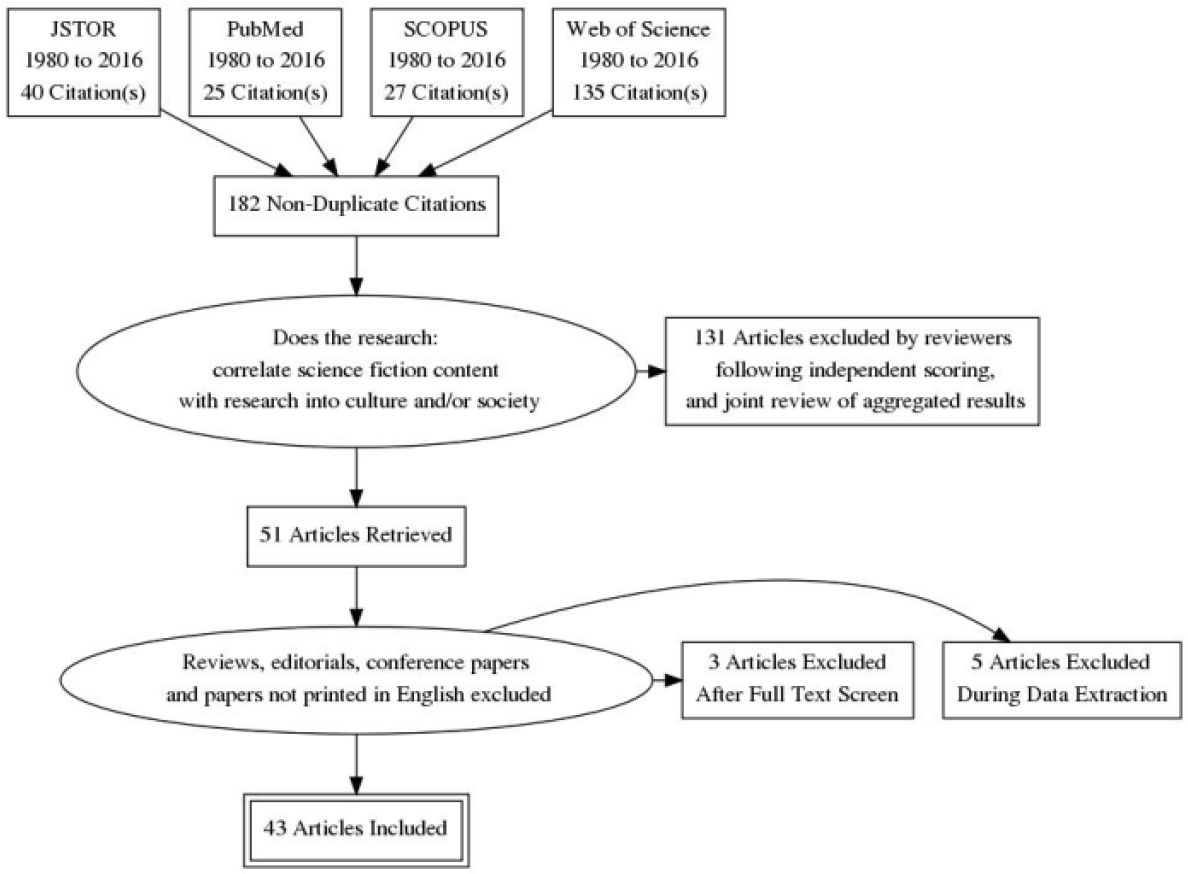
Flowchart of the selection of relevant articles using the PRISMA model.
The scope of sources to investigate was based on publications between 1980 (following Suvin’s Metamorphoses) and 2016. Web of Science Social Sciences Citation Index (SSCI) and Arts & Humanities Citation Index (A&HCI), SCOPUS, and PubMed databases were searched using the following search terms:
Web of Science SSCI and A&HCI: Title Search = litera* AND (science AND ficti* AND cultur*)
SCOPUS: Title Search, Abstract, Key Words = science AND Key Words ficti* AND Key Words = litera* AND Title, Abstract, Key Words = cultur*
PubMed: ((litera*) AND science) AND ficti*) AND cultur*
JSTOR: (((abstract:(science) AND abstract:(cultur*)) AND abstract:(litera*)) AND abstract:(ficti*))
Abstracts of retrieved publications were scanned for content that included overt or strongly implied themes related to science fiction and culture. Abstracts with no clear links between science fiction and cultural topics or with only peripheral references to science fiction and culture were excluded.
Selected abstracts were distributed among the coauthors and an independent reviewer for validation according to three selection criteria:
Did the publication
relate science fiction (SF)content or concepts to society or culture,
employ science fiction to illustrate culture or society, or
employ science fiction to illustrate, promote or otherwise advance science?
For each criterion, reviewers individually assigned a value from zero to three to each paper by examining the title and abstract content only. Total scores were aggregated. Papers receiving a score of six or more points out of the nine available across all categories, or three points in any one category were selected for full reading, which examined the research focus, research themes, data sources, methodology, and research findings.
Themes were classified into major headings using an iterative methodology of reduction from initially broad and descriptive themes to a list of summary themes.
Results and Discussion
The use of controlled vocabulary thesauri or subject headings varies across databases. For example, SCOPUS, as an indexing database, may include subject headings originating from a source database. Often however, documents from the humanities and social science fields in SCOPUS contain only author keywords. Authors choose keywords representing what they regard as the most significant descriptors of the content of their work (Névéol, Dogan, & Lu, 2010). This may result in duplication, as keywords are commonly terms appearing in the abstract (Mack, 2012; Strader, 2011). Furthermore, limitations on the number of keywords an author can nominate during the manuscript submission process, and whether these keywords/phrases are determined from a controlled vocabulary or using natural language influences keyword selection (Peh & Ng, 2008). Author selection of keywords affects retrieval patterns, indicating authors should carefully consider their target reading audience when self-selecting keywords.
Considering these factors, we searched across the selected databases using a combination of terms for title, abstract, and keywords. Our decision to restrict search parameters enabled more focused retrievals; however, a limitation of this method is that some papers published in journals with a science fiction focus may not have been retrieved. Performing full-text searching results in a greater number of retrieved documents but this can be at the expense of relevance (Beall, 2008). Researchers should, therefore, carefully consider search structure, working within individual database features to create an efficient search strategy that helps achieve their research objectives.
The study characteristics from each reviewed article are summarized in Table 1. The data from the selected articles come from 34 journals across 15 disciplines, and include results published in English of analysis of primary sources from eight countries, including material from Brazil, Russia, and Holland. Only four papers were published before 2000: two in the 1990s and two in the 1980s (Jameson, 1987; McIntire, 1982; Nerlich, Clarke, & Dingwall, 1999; Van Dijck, 1999). The prevalence of more recent works was due to the search methodology, which excluded hand searching, investigating works cited in the selected papers, or gray literature, rather than a reflection on the proportional volume of publications in this field over the period.
Study Characteristics of Each Reviewed Article.

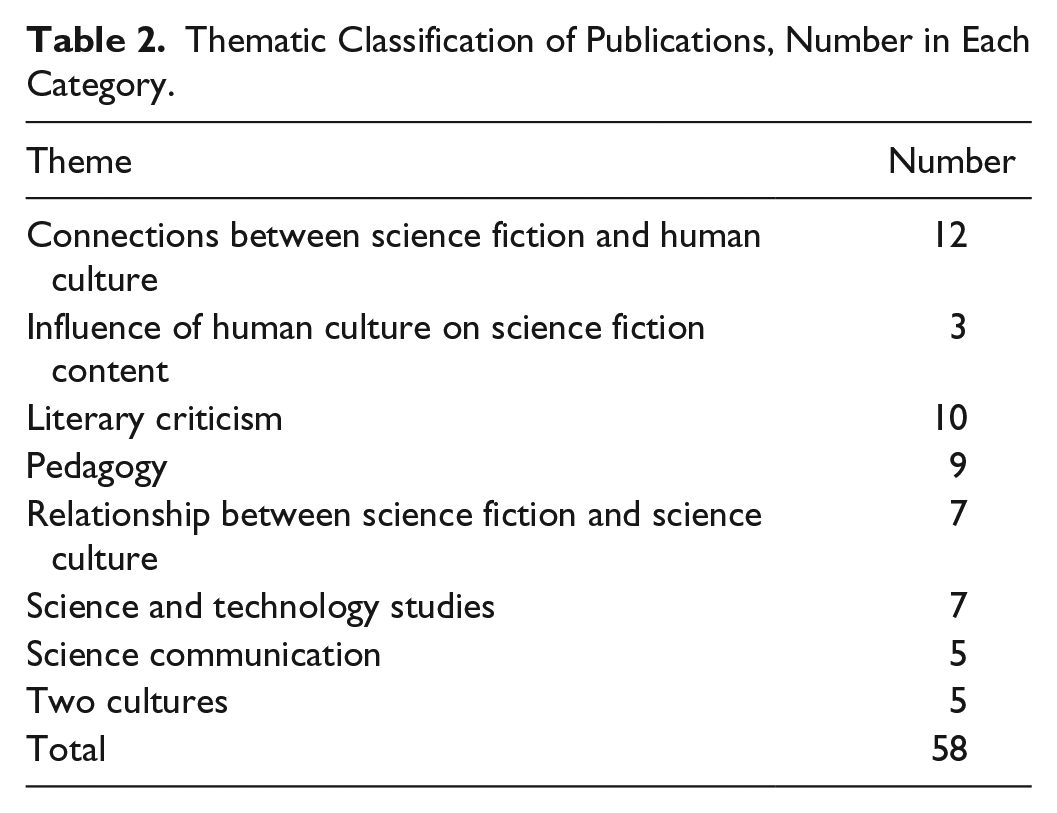
The thematic classification of texts is shown in Table 2. The total is greater than the number of publications as 15 papers were classified as having two balanced themes.
Thematic Classification of Publications, Number in Each Category.
Thematic Analysis
Cultural themes dominated the content of the publications (Table. 2). The “two cultures” debate initiated by the British novelist and polymath C. P. Snow (1961), regarding the perceived cultural gap between the natural sciences and humanities, was explicitly addressed in five papers (Brandau, 2012; Erren & Falaturi, 2009; Fendt, 2015; Hull, 2005; Miller, 2011) but was implicit in a majority of the works examined. Among cultural themes, there were clear distinctions between research examining the relationship between science culture and science fiction, which examined the influence of human culture on science fiction content, and the research that focused on connections between science fiction and human culture. The first two of these themes are bidirectional—science fiction can influence science and scientists (Dunnett, 2012; Hansen, 2004; Steinmuller, 2003), science can influence science fiction (Guerra, 2009; Kohlmann, 2014), and this relationship can be reciprocal (Coyer, 2014; Jonsson, 2013; Strauss, 2015). The theme of “connections between science fiction and science culture” indicated a less directive association: Observations of congruence rather than influence were specifically noted in nine papers (Banerjee, 2003; Geraci, 2007; Hull, 2005; Jameson, 1987; Jonsson, 2013; Kohlmann, 2014; Kotasek, 2015; Parrinder, 2009; Shaddox, 2013).
The primary discipline-specific themes were literary criticism and pedagogy, appearing in 10 and nine publications, respectively (see Table 2.). Two of the literature papers were focused on traditional close reading of specific texts (Lin, 2013; Piper, 2013). Literary criticism is an expected theme in a review of publications on fiction; pedagogy, however, was not a search term and consequently the prevalence of the use of science fiction in education and for educational purposes was a significant finding. This varied from classroom education employing science fiction texts and media as aids to learning (Larsen, 2011; Toscano, 2011; Wilsing & Akpinar-Wilsing, 2004), to observations on how science fiction has served as popular, informal, education on a range of topics; leading to both positive (Coyer, 2014; Hansen, 2004; Jonsson, 2013; Strauss, 2015) and negative outcomes (Banerjee, 2003; Geraci, 2007; Hull, 2005; Jameson, 1987; Jonsson, 2013; Kohlmann, 2014; Kotasek, 2015; Parrinder, 2009; Shaddox, 2013; Van Gorp, Rommes, & Emons, 2014), to recommendations on the use of science fiction as an effective educational medium or resource (Erren & Falaturi, 2009; McIntire, 1982; Milner, 2009; Van Dijck, 1999).
The majority of the remaining papers were classified under the closely related, but distinct, themes of science and technology studies (Bainbridge, 2004; Brandau, 2012; Fendt, 2015; Maguire, 2013; Schwartz, 2013; Sielke, 2015; Slaughter, 2014) and science communication (Carpenter, 2016; Nerlich et al., 1999), which were also connected to pedagogy in three papers (Hansen, 2004; McIntire, 1982; Toscano, 2011). The two explicitly communications-themed papers were concerned with the melodramatic and negative effect of use of science fiction tropes in media representations of science. The two papers approached this from different methodologies and came to differing conclusions. Carpenter concluded from participant observation within nongovernment organizations focused on campaigning against “Killer Robots” that tropes used from science fiction (e.g., Terminator, RoboCop) were effective as inducements to draw people into more fruitful debate about politically sensitive research policy, whereas Nerlich, Clarke and Dingwall found media associations of cloning with stories such as Frankenstein and Brave New World had a very negative and damaging effect on public perceptions of research. Their findings could be interpreted as illustrating that negative “diegetic prototypes” (Kirby, 2010) can be employed for sensationalist purposes. Carpenter’s participant observation confirmed positive outcomes arising from the appropriation of fearful film tropes for the purpose of attracting interest in open debate of their subject matter. Nerlich et al. examined literary and media examples, more than film, and these tended to be darker and more negative—promoting fears about emerging science. The “directedness” of the authorship of these narratives is manifest: positive from expert research advocates, negative from less well informed, and sensationally invested, news media. Carpenter’s paper illustrates what Jan Schwarz styles as “storylistening” (Schwarz, 2015. p. 512). The organization uses popular narratives to embody the fictional in the factual debate on robotic futures, and creates a compelling hybrid for the engagement of the public. This builds an “alternative mode of knowing” (p. 512), in which the public will discuss the factual science due to their interest in the fictional narrative, and the organization can learn more from the public. The alternative mode retains the human significance of the fictional versions, enabling future research design to include measures to address these human concerns. Science and technology studies-themed papers tended to be more abstract; all the authors except Bainbridge examined specific aspects of science appearing in historic literature that can be related to theory. Bainbridge’s paper, being a forward-looking description of the potential to employ advances in technology to aid the convergence of natural sciences and humanities, was focused on applied science. To achieve this, Bainbridge advocated using systematic semantic systems to integrate research cultures that are currently isolated. He demonstrated the practicality and effectiveness of this systems-based approach by applying it in this paper, employing quantitative analysis to support qualitative evaluation of the theory across multidisciplinary frameworks. Two other papers also utilized quantitative methodology, to apply science fiction to the interpretation of cultural change (Rabkin, 2004), and to drive innovation policy (Bina et al., 2017). The remaining papers employed qualitative or mixed methods.
The six publications that have not yet been mentioned (Ginway, 2005; Hills, 2003; Hrotic, 2014; Idema, 2015; Newell & Lamont, 2005; Rutten, Soetaert, & Vandermeersche, 2011) exhibited foci or approaches that were either very specific or not readily classifiable. Ginway discussed science fiction from the developing world, specifically Brazil, making observations on the specificity of science fiction themes and mythology to cultural values, which are valuable in demonstrating this entanglement from a perspective outside of the English-speaking tradition. Hills and Hrotic both examined modern developments in science fiction writing that reuse historic literary and cultural traditions: Hrotic suggested current disappointment in science explains the success of Steampunk literature, which hearkens back to the scientific optimism of the Victorian era, and Hills discussed Kim Newman’s reuse and exploration of classic science fiction and horror literature (Dr. Jekyll and Mr. Hyde, Dracula) as a means of exploring modern culture in historic literary environments already very familiar to readers. The only paper with gender as a critical subject was Newell and Lamont’s discussion of pre-1970s science fiction by female writers from a feminist perspective, although Hills also discussed gender concepts as regard to Newman’s “queering” of the Jekyll and Hyde story. Idema concluded that futuristic, “hard” science fiction could be read as a mode of thinking with science about the future of human life. Rutten, Soetart, and Vandermeersche employed rhetorical models of analysis to describe science fiction as a “satire for living”—particularly with regard to fictional dystopias: Theirs is the only paper that applied this approach.
Discussion
There were two prominent applications of science fiction that became evident in the close examination of the publications reviewed. The first was the power of science fiction as a tool for scientific and social advocacy and cultural insight: Erren and Falaturi said that science fiction might be used “to smuggle scientific facts into the consciousness of a scientifically illiterate public” and Kotasek concluded that as society depends upon the influence of our models of reality, so science fiction has a role in “constructing such cultural and social systems also to implicate the genre as a cultural, social, and political institution.”(p. 76) Nerlich, Clarke, and Dingwall agreed, “the general public uses metaphors to talk about human dignity and autonomy, and they reach back not to philosophy books but to sci-fi novels and films to underpin their arguments.”(p 1.13) Bina used science fiction for “a form of forward-looking technique” that might have a significant role in influencing real-world policy. The clearest statement of this position was made by Van Dijck:
Science Fiction, throughout the centuries, has been a significant cultural tool for comprehending and evaluating the scientific, moral and social consequences of new technologies . . . besides projecting a possible future, science fiction often entails criticism of present technological or social arrangements. (p. 9)
The second major application was in the enhancement of learning and teaching. Research undertaken on this subject demonstrated a broad range of applications and was predominantly positive when the use of science fiction as a pedagogic tool was integrated purposefully into the curriculum. Toscano notably employed science fiction to educate students about good technical scientific writing: the most efficient combination of pedagogy and communication that was found in this review. The exception was Van Gorp’s study, which was focused on passive, observational, learning absorbed by the subjects from the representations of science through fictional representations of science and scientists across a range of media. This was found to lead to negative or inaccurate views of science and scientists. In contrast, however, Hansen’s analysis of comic book portrayals of science in the 1940s suggested that media representations could have positive impacts. In a formal, directional, context, the pedagogical applications are varied and have a measurable beneficial impact. Therefore, classroom use of science fiction provides valuable tools to both encourage interest in science and to inspire scientists, but passive absorption of science fiction concepts that cross over into real science is more problematic.
Considering the demonstrable impact of research applications of science fiction content and concepts, the small number of quantitative methodologies found in the review is significant, as is the variable quality of their implementation. Bainbridge provides a cogent and well-structured methodological example of the potential for science fiction to be an insightful and meaningful tool, and employs quantitative methodologies to analyze chaotic and granular data of the sort that is found in cultural studies. The strength of Bainbridge’s multidisciplinary research in semantics is evident in the consistent quality of his methodology. Rabkin’s study included the intent to remove qualitative selection bias by engaging a pool of researchers from the field of literature to apply content categories to stories so that they could then be analyzed quantitatively. Yet, predefinition of coding categories appears to have constrained the freedom of analysis. For example, a strong correlation between the categories of genre form “alien contact” and genre content “alien” was one of the “provocative results” (p. 466) described in the findings, but such a correlation is naturally predicated at a one-to-one ratio in science fiction narratives. The study findings would arguably have been strengthened by identification of the statistical insignificance of this correlation by members of a multidisciplinary research team. Bina et al. applied iterations of subjective criteria to identify films and novels that were analyzed mathematically to create new suppositions, but the methodology is not described in replicable detail, and may have been subject to confirmation bias arising from the use of online databases to validate the selection. Using quantitative tools to analyze research findings in fields that have traditionally been dominated by qualitative methods is constrained by access to expertise. During the design and execution of the project, engaging experts from outside of the author’s own specialism may improve the application of quantitative methodology to humanities research. The application of techniques such as data and text mining, robust statistical and structured methodological analysis, to studies that are traditionally located in the humanities would support the convergence between the arts and sciences, and the breaking down of the perceived gap between them that was highlighted by Snow in 1961. For analysis of literary content to become a credible tool in broader research contexts, a stronger focus on the use of quantitative, replicable, methodologies is to be recommended.
Conclusion
Science fiction has been used as a metaphor and as an illustration of human culture by researchers in fields that are not restricted to studies of science fiction literature. As such, there are indicators that science fiction is employed as a lens through which human culture may be viewed to discover new interpretations. These may be relevant to cultural, social, scientific, and literary studies, and support efforts at improving science communication, and especially science education. Researchers described the effectiveness of popular science fiction in capturing the imagination of the public, and creating unrealistic portrayals of science and scientists. This has both positive and negative impacts on science communication, and may even affect priorities in science funding. It seems that in the public imagination, science fiction is closely linked to real science, and this can be problematic for the dissemination of research. Rather than ignoring these links due to their fictional origins, it is necessary to engage with the public to learn about their hopes, fears, and expectations of science, and to consider how science fiction may be employed for diegetic purposes. Raising awareness among scientists of the significance of these factors may build researcher capacity for successful science communication. Convergence of research between the humanities and natural sciences may be one route to supporting and encouraging more positive communication with the public, the credibility and efficacy of interdisciplinary science, and consequently more efficient and beneficial outcomes of research. This convergence should be driven by the increased application of structured and quantitative methodologies to the analysis of science fiction, and other traditionally humanistic forms, now that the technology exists to do this effectively and rapidly, to reduce the researcher bias in selection and interpretation of sources that is at the heart of the rejection of humanistic approaches by natural scientists. This breakdown of barriers is especially important when we consider the human, cultural perspective that can be added to hard sciences by this method, and how this may affect the effectiveness of science communication and the reputation of science in the minds of the public. The time is now for the integration of hard science methodology into the humanities.
Footnotes
Authors’ Note
Christopher B. Menadue developed the initial concept and performed database searches. Menadue took the lead role in data analysis and drafted the article. Both authors edited and revised the draft article and approved the final article. Richard Lansdown, Komla Tsey, and Susan Jacups provided editorial input.
Declaration of Conflicting Interests
The author(s) declared no potential conflicts of interest with respect to the research, authorship, and/or publication of this article.
Funding
The author(s) disclosed receipt of the following financial support for the research, authorship, and/or publication of this article: Menadue and Cheer are both recipients of Australian Postgraduate Awards for their PhD candidatures.