




Abstract
This study investigates the mediating role of life management strategies to see how information processing styles indirectly influence subjective well-being. Participants were 440 university students (female = 202, male = 238) ranging in age from 18 to 50 years from all levels and all majors from universities in Quchan, Iran. In a nonexperimental design and by using path analysis, we found that selection, optimization, and compensation fully mediated the relationship between information processing styles and subjective well-being. Our proposed model fitted well to the data and could account for a significant proportion of variance in satisfaction with life, positive affects, and negative affects’ scores (42%, 51%, and 35%, respectively). These results provide empirical evidence that rational information processing style is a defining factor for planning, and its impact on subjective indicators of well-being operates indirectly and through life management strategies. This model, with a more active approach, has implications for both theory and practice in psychotherapy.
Keywords
Introduction
Living a better life has always been a concern for human beings. Through focusing either on external objective factors or internal subjective constructs, philosophers and psychologists from all walks have tried to explain the sense of well-being. The bottom-up approach is built on the notion that well-being is influenced by individuals’ age, income, social status, and other objective circumstances, whereas the top-down approach puts its emphasis on personality, cognitive processes, and moods as internal factors (Diener & Lucas, 2000). Theories in this latter approach view subjective well-being (SWB) as evaluations of life based on overall satisfaction (the cognitive component) and balance between positive and negative affects (the affective component) (Kim-Prieto et al., 2005). SWB is also closely related to one’s relationships and social life (Heintzelman & Diener, 2019), SWB, therefore, could be defined as “a complex set of perceptions and experiences that color the moments, days, and lives in which individuals live” (Ryan, 2015, p. 1). Moods and emotions are together referred to as affect and represent evaluations of the events that occur in one’s life. Satisfaction with life is a judgment made by individuals based on a long-term assessment of their lives (Diener & Lucas, 2000).
From a top-down perspective, cognitive-experiential self-theory (CEST; Epstein, 2008) suggests that cognitive factors and mental representations play an important role in SWB. CEST assumes that many of the most important schemas (see, for example, Shahghasemi, 2017) in an individual’s implicit theory of reality are derived from relationships with significant others, but it differs in regarding the need for relatedness as only one of four basic needs (Epstein, 1998). According to CEST, the way we view the world is constructed by the way we process the information we receive (Norris & Epstein, 2011). Information processing style, or as some say, cognitive style, has been defined as “the way in which people process and organize information and arrive at judgments or conclusions based on their observations” (Hunt et al., 1989, quoted in Leonard et al., 1999, p. 407). Various theoretical models suggest that positive feelings and thoughts often co-occur with special information processing style and a significant body of research has been created based on this notion (Norris & Epstein, 2011; Pacini & Epstein, 1999; Shirzadifard, 2012). However, the mechanisms through which information processing style is associated with SWB have not been adequately documented. That is, most studies in the area have shown reciprocal correlation and often direct effects (Epstein, 2008; Norris & Epstein, 2011; Pacini & Epstein, 1999). Thus, from this perspective, the question of “how” still requires more research.
Our main focus here is to examine the possible paths through which one feels subjectively well. CEST suggests that a total evaluation of life or a current emotional experience can be an immediate consequence of how the situation is interpreted. Nevertheless, the state of being well (or ill) may not be a direct outcome of such perceptions or interpretations. People plan based on available resources. They act to reach their desired gains, so their satisfaction with life and the emotional balance depends on the strategies they employ.
Another line of inquiry into well-being and its causes originated from the selection, optimization, and compensation (SOC) model. The model of SOC includes three processes of action regulation as regards to successful aging and life management: Selection refers to the setting and prioritization of objectives, based on personal motives and desires (elective selection) or due to perceived loss of internal or contextual resources (loss-based selection). Optimization includes the obtainment, improvement, and coordinated utilization of individual means to pursue important selected objectives. Compensation involves the acquisition and examination of alternative individual means or the use of external or technological aids to substitute lost means (Müller & Weigl, 2017). Baltes and Baltes (1990) proposed the SOC model which applies to different domains of human functioning. In this regard, one set of relevant outcomes is known to represent subjective indicators of well-being.
SOC model assumes that the availability of goal-relevant resources does not necessarily result in well-being. That is, people differ in using SOC to invest the resources toward their gains across their lifespan (Freund, 2008). For example, Teshale and Lachman (2016) studied a sample of 145 adults aged 22 to 94 to examine whether variation over 7 days in everyday SOC was associated with happiness. They were also interested in the role of age differences in this relationship, the moderating effects of health, and lagged effects. On days in which middle-aged and older adults and those participants with lower health used more SOC, they also said they enjoyed greater happiness. Lagged effects indicated lower happiness which in turn led to greater subsequent SOC usage.
Theoretically, and as is supported by firm empirical evidence (Gestsdottir & Lerner, 2007; Opitz et al., 2012; Prenda & Lachman, 2001; Wrosch et al., 2003), the SOC model explains how SOC may foster SWB. However, dynamic processes such as goal setting and planning are themselves influenced by more fundamental antecedents (Prenda & Lachman, 2001). Only some demographic factors such as age (Prenda & Lachman, 2001), gender, education, and income (Bowers et al., 2011; Prenda & Lachman, 2001) have been considered in this regard and psychological components (e.g., information processing style) are often ignored. In other words, despite consistent arguments that see information processing style as an underlying factor (Epstein, 2008; Pacini & Epstein, 1999) scholars have not clearly examined its influence on life management strategies. Accordingly, the question of “who plans?” (Prenda & Lachman, 2001) is raised again.
Putting the propositions of CEST and SOC together, we may conclude that the association between information processing styles and SWB can be mediated through SOC. Here, information processing components are seen as inherent qualities (Friedman & Scholnick, 1997). CEST may provide insight into cognitive functions underlying SOC. A fundamental assumption in CEST as a dual-process theory is that human information processing involves two independent, parallel, and interactive conceptual systems: one that is intentional, logical, slow, analytic, verbal, relatively affect free, which operates primarily at the conscious level, and the other which is emotional, holistic, automatic, preconscious, association-based, nonverbal, that is intimately associated with affect (Epstein, 2008; Pacini & Epstein, 1999). These two systems namely Rational and Experiential information processing styles characterize the way people approach, organize, and interpret their thoughts, feelings, and behaviors.
Intentional meta-cognitive representation, reasoning analytically, and organizing the steps into a logical sequence (which are known as rational processes) are crucial to contextualizing and developing a hierarchical goal system (selection). Acquiring and refining goal-relevant means (optimization) and changing resource allocation (compensation) require rational processing and control of heuristics. Researchers have shown that cognitive potentials such as problem representation (Friedman & Scholnick, 1997), strategic thinking, conscious meta-cognitive, and meta-strategic control (Larson & Hansen, 2005) can be associated with SOC usage.
As noted above, the information processing style is an underlying factor in outcomes like SWB, but its influence is implemented through a sequence. Recent theories include more dynamic concepts such as goal setting and planning as mediating factors. Individuals with the rational processing style are more likely to identify an appropriate number of goals, thereby guiding attention and organizing behaviors (SOC), which in turn leads to more positive affects and more favorable cognitive evaluations of life. In contrast, people who experientially process information may not be able to analyze the steps toward the aim. They are likely to have preconscious perceptions that prevent planning and experience negative affects and maladaptive evaluations of life as a result. In short, when the rational processing is predominant, the three SOC components are maximally applied and provide flexible options for adaptation.
The modeling procedure allows us to test how the conceptual model might fit empirical data. We use path analysis to consider direct, indirect, and total effects. This way we can show how S, O, and C strategies are influenced by information processing styles and how they predict SWB components in turn. Based on previous research we reviewed above, we hypothesized that higher scores for rational information processing and lower scores in experiential information processing would be predictive of life management. We assume that SWB components are not directly influenced by information processing styles, but, they are affected by the mediating role of SOC. Figure 1 represents the hypothesized model.

Hypothesized model. Minus (−) on the connectors mean negative relation is assumed.
Method
Participants
Participants were 440 university students (female = 202, male = 238) ranging in age from 18 to 50 (M= 23.065 and SD= 4.620) at all levels and all majors from universities of Quchan, Iran. Requirements for participation were as follows: (a) being currently studying (not graduated), (b) having no history of psychological disorders, and (c) not identified as a supper senior or dismissed student. Table 1 represents participant demographic information.
Demographic Characteristics of Sample.
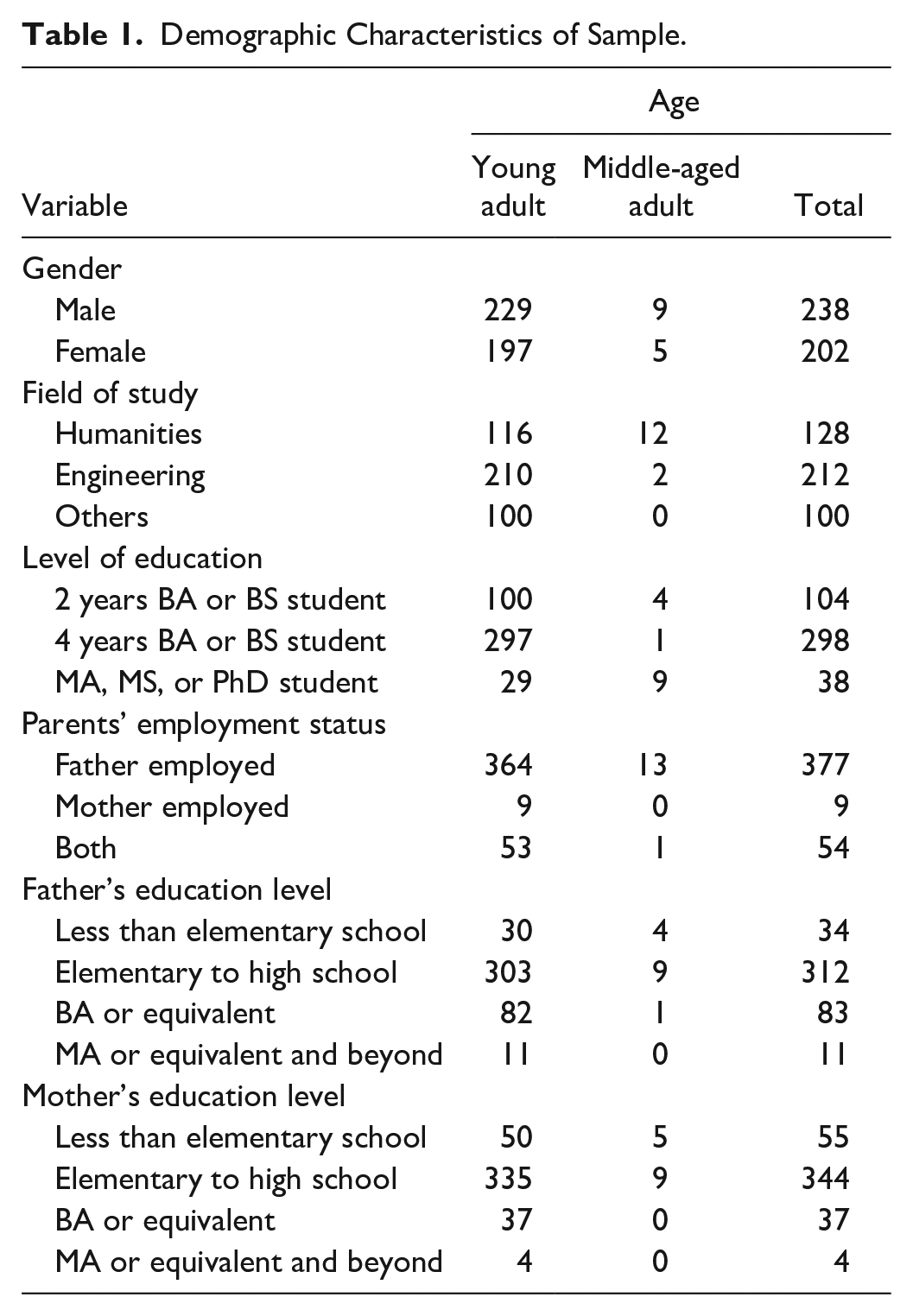
A pilot study was conducted before the main research and showed no significant differences in variance of SWB among three subgroups, namely, behavioral sciences, engineering, and science students. SWB scores’ variance was not different between boys and girls. Despite the homogeneity of variances of subgroups, we used proportionate stratified sampling to reach greater precision, guard against an unrepresentative sample, and to ensure that we obtain sufficient sample points to support a separate analysis of any subgroup (Levy & Lemeshow, 2008).
Procedure
We announced our study to all students on University’s website and also we posted our ads on university boards; with the permission of instructors and university authorities, we also were allowed to take 2 min of some class times describing our project. Participants were volunteers and we tried to avoid performing any kind of pressure, whether formal or social, on students to participate. Among those who accepted to participate, 10% changed their mind during the procedure, delivered unfilled questionnaires, or, did not meet our criteria. No gifts, honorarium, and so on, were given to students in return for their participation. Data were collected in classrooms, lobbies, or self-service halls where students received the form after they were shortly briefed and accepted to participate. We notified that participation was completely optional and their disagreement would not affect their grades or other academic results. The students were unknown to the researchers and questionnaires were anonymous. All respondents answered the questionnaires in the presence of the researchers.
Proportional random sampling formula considering the variance ratio of SWB scores (from the pilot study) in each subgroup, α level = .05, z score = 1.96, and N = 16,560 yielded a sample size ≥408. We also did a power analysis using G*Power 3.1.9.2 (Faul et al., 2009) for an F test with the following settings: α level = .05, 1-β = .95, effect size = .05, and the number of predictors = 5. Critical F was 2.24 with actual power greater than .95 and sample size = 402. Our final sample size (440) provided actual power of .96 for critical F = 2.35, α level = .04, 1-β = .96.
Measures
Rational-Experiential Inventory (REI-A20)
Rational-Experiential Inventory (REI-A20; Pacini & Epstein, 1999) was originally a 40-item inventory (REI), which included four subscales (10 items for each): Rational Ability, Rational engagement, Experiential Ability, Experiential Engagement. Shirzadifard et al. (2018) revised and shortened the original form for an Iranian population. The adapted version is a 20-item inventory with two main scales (10 items for each) of rational (“I have no problem thinking things through carefully”) and experiential (“I like to rely on my intuitive impressions”). Respondents score each item on a 5-point Likert-type scale, which ranged from 1 = completely false to 5 = completely true. Many studies have reported good evidence for the validity and reliability of the REI (Shirzadifard et al., 2018; Shirzadifard, 2012). The two scales in this study showed good internal consistencies (rational: α = .74; experiential: α = .72).
SOC Questionnaire
The SOC measure (Freund & Baltes, 2002), which includes 48 items (12 items in each subscale of Elective Selection, Loss-Based Selection, Optimization, and Compensation), is for use with an adult population. Each item consists of two statements, one describing behavior reflecting “S,” “O,” or “C,” and the other describing a non-SOC-related strategy. Participants decide which statement is more similar to how they would behave in case. Freund and Baltes (2002) reported adequate psychometric characteristics for SOC. As evidence shows, this questionnaire has reliable scores and allows for valid inferences. Cronbach’s alphas of the SOC measures within the present data set (see Table 2) indicate that the four scales have good internal consistency.
Means Standard Deviations, Cronbach’s Alpha, and Correlation Coefficients Among Variables.

Note. N = 440.
p ≤ .05. **p ≤ .01.
SWB scales
SWB was assessed through the Satisfaction with Life Scale and the Positive and Negative Affect Scales. The Satisfaction with Life Scale (cognitive evaluation of a person’s well-being) is an adaptation of Cantril’s (1965; cited in Andrews & Robinson, 1991) Self-Anchoring Scale, which asks respondents to rate their life overall these days from 0 = worst possible life overall to 10 = the best possible life overall. According to Andrews and Robinson (1991), this measure has been used extensively worldwide, usually providing satisfactory psychometric properties. In this project, therefore, a pilot study with 40 participants was carried out with the questionnaire of well-being. Participants in the pilot phase also participated in the main survey and correlations of scores in the test were reported as the index for test–retest reliability. Its reliability in this study was evidenced by strong test–retest correlation (R = .84, n = 40) with a 2-week interval. The affect scale (see Mroczek & Kolarz, 1998) asks respondents to indicate how much time during the past 30 days have been spent with negative feelings (“so sad nothing could cheer you up,” “nervous,” “restless or fidgety,” “hopeless,” “that everything was an effort,” and “worthless”) and positive feelings (“cheerful,” “in good spirits,” “extremely happy,” “calm and peaceful,” “satisfied,” and “full of life”), on a scale ranging from 1 = none of the time to 5 = all the time. Many scholars worldwide have reported satisfactory psychometric properties for these scales (Shirzadifard, 2012). In the present research internal consistency, as assessed by Cronbach’s alpha, was .78 for the Positive Affect and .72 for the Negative Affect.
Results
Before the main analyses, obtained data were analyzed in an exploratory manner to identify outliers and verify the normality of distributions. Univariate and multivariate outliers, considering leverage, Cook’s D, and Mahalanobis distance indices, were removed from the data set. In all, four single-variable outliers and two multiple-variable outliers were removed. The missing data were not more frequent than 1% for each Item. Given the random pattern of missed cells, we replaced them with the series mean. Mean, standard deviation, and Cronbach’s alpha (with exception of single-item satisfaction with life scale) were also calculated for each measure (see Table 2).
The zero-order correlations among variables are presented in Table 2. According to our results, satisfaction with life and positive affects correlated positively with rationality but negatively with experientiality. In contrast, negative affects were negatively associated with rationality. There were no significant relations between negative affects and experientiality.
As we hypothesized, information processing styles are associated with the extent to which one uses “S,” “O,” and “C” strategies. Rational information procession related positively to the elective selection, loss-based SOC. Experiential processing was negatively related to elective selection, loss-based SOC.
Correlation analyses also confirmed what we predicted about the relation of elective selection to satisfaction with life, positive affects, and negative affects. The loss-based selection was positively related to satisfaction with life, positive affects, but it had a reverse relationship to negative affects. A similar pattern of relations was seen between optimization and compensation to SWB components.
We based our model on the assumption that SOC is a key mediator in the relation of information processing styles and SWB. A path analysis was conducted to test the hypothesized model using Amos™ 18 (Arbuckle, 2009).
Solutions were generated using maximum likelihood estimation and bootstrapping based on 500 samples. The proposed model provided a good fit for the obtained results, with a χ2 = 9.14, p = .17, df = 6, χ2/df = 1.53, adjusted goodness for fit index (AGFI) = .97, comparative fit index (CFI) = .99, normal fit index (NFI) = .99, relative fit index (RFI) = .97, and root mean square error of approximation (RMSEA) = .03 (Arbuckle, 2009). Model included covariance of the residual variance between SOC. Inspection of the modification indices revealed that no modifications to the model were necessary. We also studied an alternative model with direct effects of information processing styles and SOC components on SWB. Model fit indices including χ2 = 105.562, p = .000, df = 8, χ2/df = 13.19, AGFI = .74, CFI = .94, NFI = .94, RFI = .71, and RMSEA = .17 indicated a poor fitness. Moreover, direct effects in the alternative model were not statistically significant: rationality to satisfaction with life (γ = .07, p = .08), rationality to positive affects (γ = .02, p = .65), rationality to negative affects (γ = −.04, p = .26), experientiality to satisfaction with life (γ = −.02, p = .56), experientiality to positive affects (γ = −.02, p = .49), and experientiality to negative affects (γ = −.04, p = .11). Weak direct effects from information processing styles, when being included together with “S,” “O,” and “C” as predictors of SWB, serve itself as an evidence in favor of a fully mediated model (Figure 2).
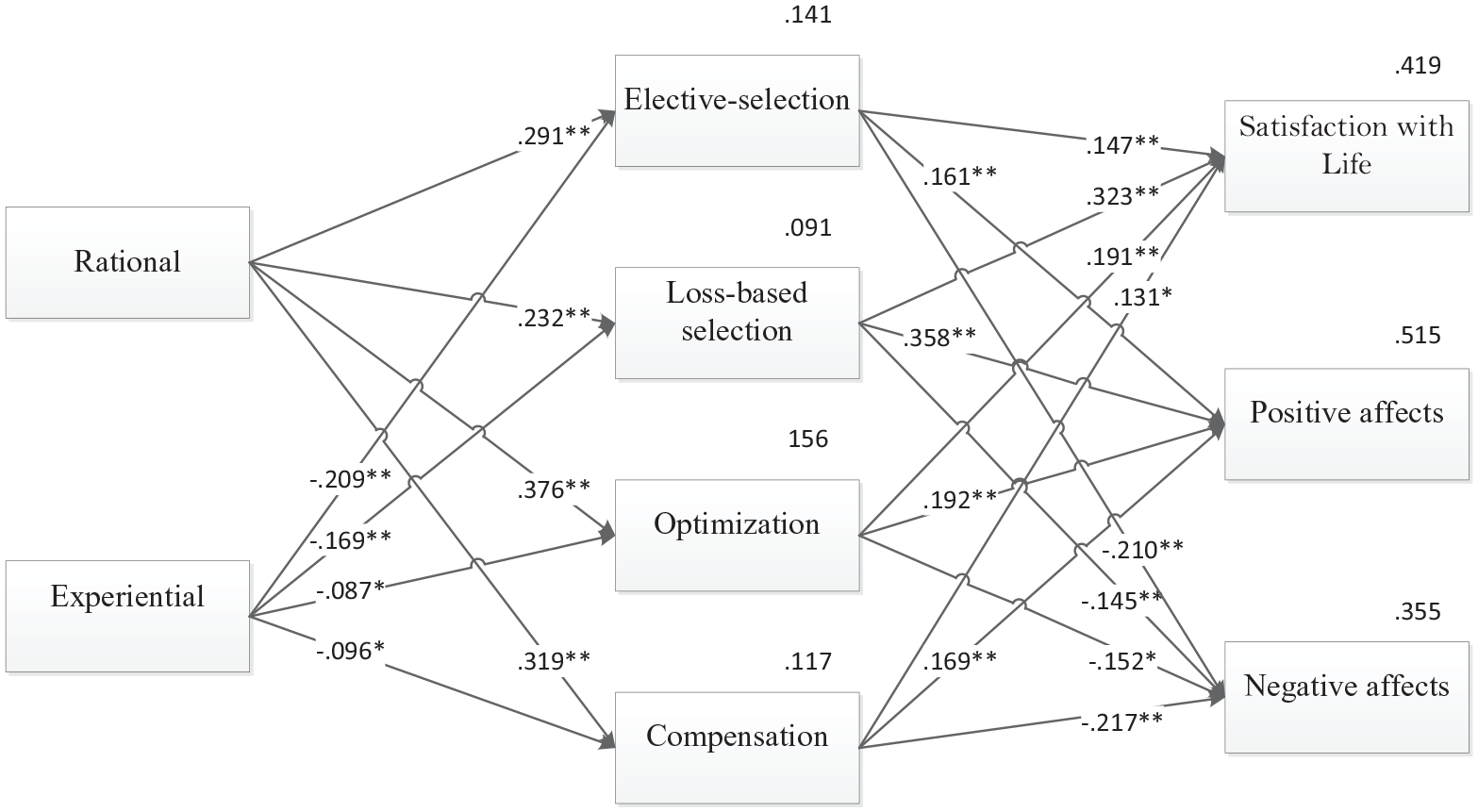
The model of relationships between information processing styles, SOC, and SWB. N = 440. Standardized regression coefficients are tagged to the connectors. The coefficients on rectangles represent squared multiple correlations. For competing models, direct paths were shown to be nonsignificant, and hence we concluded that all paths were indirect involving significant mediators.
Rationality and experientiality accounted for variance of elective selection (R2 = .14), loss-based selection (R2 = .09), optimization (R2 = .16), and compensation (R2 = .12). Satisfaction with life (R2 = .42), positive affects (R2 = .51), and negative affects (R2 = .35) were also accounted for by information processing styles and SOC. These R2 effect sizes show the amount of variance in each dependent variable determined by the variables included as predictors. It is possible though to predict 42% of one’s level of positive affects considering his or her way of processing information and the level he or she uses SOC strategies. Table 3 includes squared multiple correlations, 95% bias-corrected confidence interval, and α lever for each.
Squared Multiple Correlations with 95% Confidence Interval (CI) for Endogenous Variables.

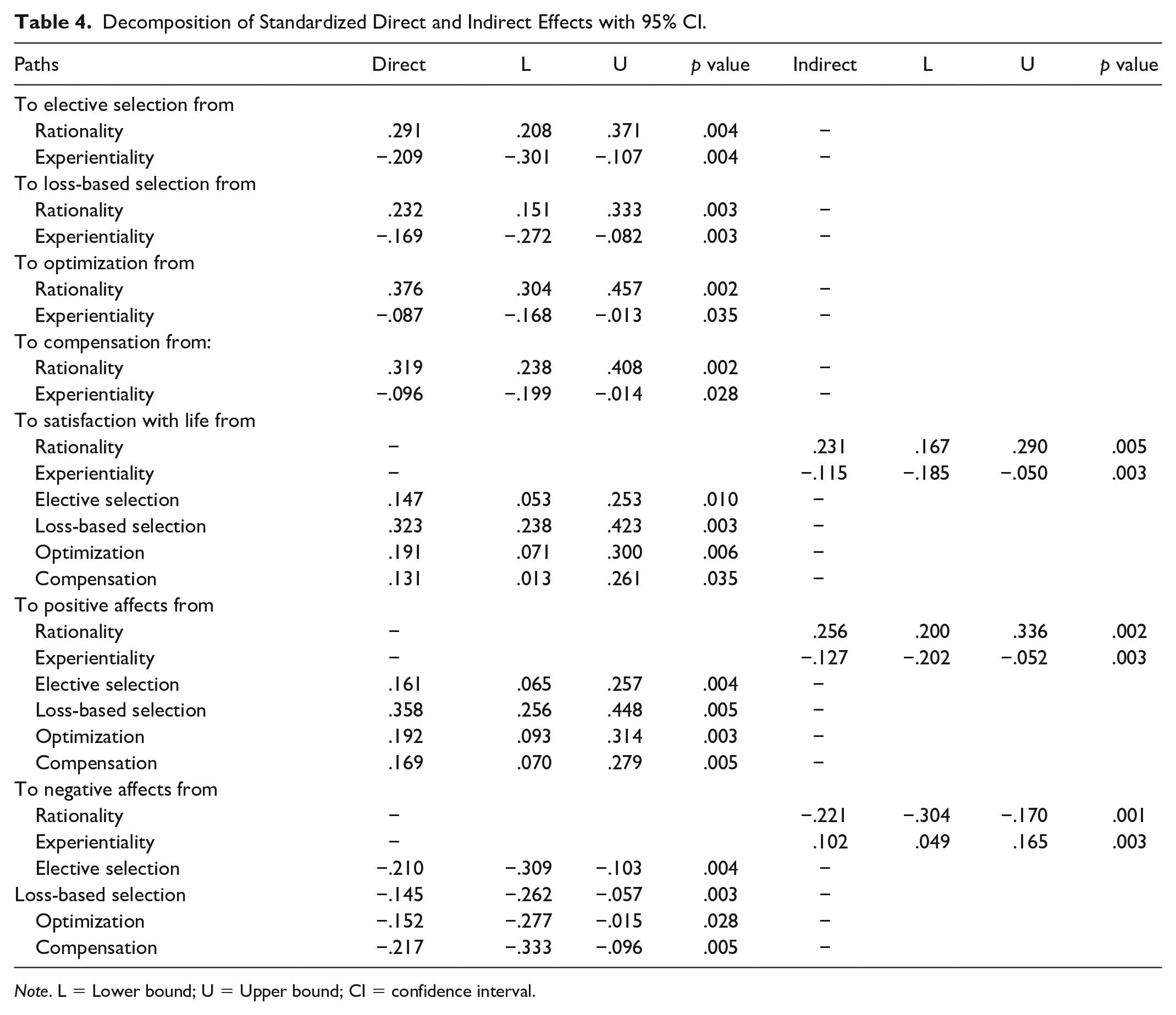
The decomposition of the direct and indirect effects of the variables is listed in Table 4.
Decomposition of Standardized Direct and Indirect Effects with 95% CI.
Note. L = Lower bound; U = Upper bound; CI = confidence interval.
Since any predictor had either direct or indirect effect on a given criterion variable, total effect which is simply sum of direct and indirect effects is nonsense here. According to our results, rationality could positively predict levels of elective selection (γ = .291, p = .004), loss-based selection (γ = .232, p = .003), optimization (γ = .376, p = .002), and compensation (γ = .319, p = .002). In contrast, experientiality predicted elective selection (γ = −.209, p = .004), loss-based selection (γ = −.169, p = .003), optimization (γ = −.087, p = .035), and compensation (γ = −.096, p = .028) reversely. It is notable that regression weights of experientiality on optimization and correlation were significant at p ≤ .05.
Satisfaction with life was positively predicted by elective selection (β = .147, p = .010), loss-based selection (β = .323, p = .003), optimization (β = .191, p = .006), and compensation (β = .131, p = .035). Positive affects were also positively influenced by elective selection (β = .161, p = .004), loss-based selection (β = .358, p = .005), optimization (β = .192, p = .003), and compensation (β = .169, p = .005). SOC components could also predict negative affects reversely: elective selection (β = −.210, p = .004), loss-based selection (β = −.145, p = .003), optimization (β = −.152, p = .028), and compensation (β = −.217, p = .005). β coefficients of compensation to positive affects and optimization to negative affects were significant at p ≤ .05.
We were especially interested in indirect effects of information processing styles on SWB components. Rationality had indirect positive affects on both satisfaction with life (γ.β = .231, p = .005) and positive affects (γ.β = .256, p = .002). It also indirectly influenced levels of negative affects (γ.β = −.221, p = .001). In contrast, experientiality was a negative indirect predictor for satisfaction with life (γ.β = −.115, p = .003) and positive affects (γ.β = −.127, p = .003). As we had expected, experientiality could positively predict negative affects through SOC components (γ.β = .231, p = .005). Significant indirect effects of rationality and experientiality on satisfaction with life, positive affects, and negative affects through SOC indicated that SOC plays an important mediating role.
Discussion
In this study, we built our model based on the notion that SOC strategies would mediate the effects of information processing style to SWB. The results of the path analysis confirming a fully mediated model supported the hypothesis. This is the unique contribution of our study that provides, for the first time, empirical evidence for the theoretical explanation of how information processing styles may make a difference in SWB through strategies one uses to gain his or her desired objectives.
Correlation coefficients coupled with the regression weights in the path analysis supported the positive effect of rational style and negative effect of experiential style on all four strategies of SOC. Rational processing style had stronger (β = .232 to .376) effect on all SOC components than did experiential processing style (β = −.096 to −.209). Yet both styles were significant predictors of SOC.
We could not find empirical investigations on the relationship between information processing and SOC; yet, some researchers have studied other cognitive factors. Freund and Baltes (2002) showed hierarchic thinking style (distinguished by Sternberg) is positively correlated to SOC components, whereas the monarchic style was associated only with ES. Schmeichel and Demaree (2010) indicated that higher working memory capacity leads to more engagement in self-enhancement after negative feedback. Both working memory and simultaneous processing involved in reasoning are related to life management (Friedman & Scholnick, 1997). Our findings regarding information processing style were totally in this vein but against Prenda and Lachman (2001) whose study showed the lack of predictive ability of both memory span and reasoning for SOC.
Some researchers support the idea that the experiential processing style would positively correlate to positive outcomes. Norris and Epstein (2011), for instance, indicated the relation of an experiential thinking style to the objective favorable attributes of creativity, aesthetic judgment, humor, and intuition. Here, in contrast, we found negative effects of experientiality on SOC components (directly) and SWB indicators (indirectly). It may seem confusing at first but a closer look at the nature of positive outcomes in this study and those mentioned by Norris and Epstein (2011) clarifies that the negative relation of the experiential processing style to SOC, and therefore SWB, does make sense.
SOC is a part of intentional self-regulation (Gestsdottir et al., 2009) which involves the conscious control of goal-directed thought and action. It requires self-evaluations, capturing directions for future actions, a sense of personal future, and internalization of standards (Jelicic et al., 2007). “S,” “O,” and “C” strategies are conscious steps toward a goal based on rational representations, perceptions, and reactions to the context. The process-oriented rational information processing style allows selecting and sequencing some actions. It is only the reason-oriented nature of rationality that makes one able to contemplate a problem and realize the discrepancy between a goal and a present state to refine goal-relevant means or the goal set itself. We think it is quite explicit that a rational information processing style helps using SOC strategies but how about experiential processing style?
Experiential information processing is self-evident and often stereotypical. It acts in a preconscious, holistic, automatic, intuitive, and crudely integrated manner (Epstein, 2008; Klaczynski et al., 1998). The outcome-oriented nature of experientiality prevents planning conscious steps toward an end. It has a very limited ability to think abstractly to structure a hierarchic goal set. It is against proper redirecting or changes following disproving evidence as it needs repetitive or intense experience to be changed. The experiential processing style is pleasure–pain oriented and toward immediate action to gain what feels good (Norris & Epstein, 2011) at the moment and therefore may not suggest reactions suitable for a favorable but delayed goal. Accordingly, we see the negative relation of experientiality to SOC components in line with both CEST and life management theory. Conversely, although creativity is not considered as a component of SWB, positive outcomes such as favorable attributes of creativity, humor, and intuition (Norris & Epstein, 2011) do not require rational processing and do not share the characteristics of SOC strategies.
Back to the question “who plans?” our results, built on the premises of CEST, answers “the one who is more rational and less experiential.” Some previous studies have suggested that age (Prenda & Lachman, 2001), gender, education, and income (Bowers et al., 2011; Prenda & Lachman, 2001) determine planning. We argue that the preferred information processing style would also make a difference. Coexisting rational and experiential systems serve as adaptive systems, each with its limitations (Epstein, 2008). Rational information processing is crucial for the application of SOC in ill-structured real-world planning. So those with a prominent experiential system most probably produce nonstrategic reactions to situations (Friedman & Scholnick, 1997). They may not regulate their lives intentionally and use less effective management strategies. They would fail in anticipation of contingencies, monitoring, and using flexible strategies (Larson & Hansen, 2005).
We also showed that all SOC components are positive predictors of satisfaction with life and positive affects but negative predictors of negative affects. These findings are in good cohesion with past studies. Studies have repeatedly confirmed the positive association between SOC and measures of mental well-being, social competence (Buckner et al., 2009), life satisfaction (Freund & Baltes, 2002; Prenda & Lachman, 2001), sense of purpose in life (Jelicic et al., 2007), positive emotions (Freund & Baltes, 2002), subjective indicators of successful development (Bowers et al., 2011; Gestsdottir & Lerner, 2007), and personal growth (Freund & Baltes, 2002). It is also evidenced that SOC strategies correlate negatively with substance use, delinquency (Gestsdottir & Lerner, 2007), problematic development, depressive symptoms (Gestsdottir et al., 2010), sexual risk-taking (Jelicic et al., 2007), depression, drinking, smoking, and bullying (Gestsdottir et al., 2009).
SOC model from an action-theoretical framework (Wiese et al., 2002) emphasizes the agency of human beings to show how they actively and intentionally regulate their lives. Intentional self-regulation (Gestsdottir et al., 2009) is the ability to select goals, optimize resources to achieve the goals, and compensate against weaknesses. These skills relate to contribution to family, community, and self (Freund & Baltes, 2002). Given the vast array of unexpected contextual changes, a person must effectively use SOC to maximize the adaptive integration of changes (Wiese et al., 2002). This is crucial for a sense of satisfaction and a positive emotion toward the existing situation (Gestsdottir et al., 2010). These regulations reduce failures by focusing on reachable goals that converge with environmental demands, individual capacities, and personal desires. As some social or personal factors can make a given goal unattainable, disengagement to the goal and reengage in alternative goals (LBS) will be in favor of a sense of SWB (Wrosch et al., 2003).
To answer the question “How” information processing style may contribute to well-being, we should consider a more active individual–environment interaction. Each person presented with a combination of expected and unexpected events has his interpretation, which may be rational. The preferred processing style determines the interplay of acting in situations and managing resources to gain the most pleasure and the least failure. So, as we showed (through a fully mediated model) information processing style does not directly influence satisfaction with life and happiness, it rather indicates how people manage their sources toward a sense of satisfaction and emotional balance by making rational choices and taking proper actions.
We claim that our results may provide empirical evidence for the fruitfulness of the action-theoretical approach of the SOC model to expand the explanations of CEST for individual differences. Through combining CEST and SOC theories, underlying paths to well-being are more clearly understood. Recent conceptualizations include more dynamic processes to understand the causes of human behavior. SOC strategies that optimally contribute to adaptive development can be learned by individuals. Dynamic models can provide a set of more active regulations to improve strengths and compensate for shortages. This understanding is equally important in terms of practical implications in psychotherapy and effective interventions. The information processing style is also flexible when one is aware of its nature and knows how to intentionally handle it (Klaczynski et al., 1998). Thus, learning more rational cognitive processing facilitates more usage of the three SOC components, thereby providing a vast variety of options for well-being.
Limitations
One limitation of the present study is the cross-sectional nature of the data. The university student sample recruited in this research provides limitations for generalization of the results to the wider society. Cultural variation may be a source of methodological problems as the SOC measure was originally developed in Germany and it may not apply in the same way among Iranian participants. Self-report measures may provide socially desirable answering instead of representing the real response. The problem might become more grave with the experiential processing scale in which wording of the items in the Persian version may not completely correspond to those of the English one. Future research should look deeper into the relation of information processing style and SOC through longitudinal or controlled experimental designs. Such studies would be critical to identify and clarify the mechanisms that may be involved in the relationship between intentional self-regulation and SWB.
Moreover, based on previous research, we were convinced that Persian is a highly complicated and mystic language which has structural difference with English, and hence, the word-by-word translation would not be suitable if we wanted to convey the meaning of the sentences. Therefore, while trying to stay faithful to the original inventory, we broke and reworded some sentences to make them “Persian,” and hence, more understandable to our participants (to see more on linguistic adaptations, see Dickinson & Tice, 1977).
Another limitation of our study is the SOC questionnaire shows a relatively low reliability (fewer than 0.70) for some subscales. Therefore, when talking about the relationships concerning subscales, we have to be careful of possible measurement errors.
These were some of the limitations of the current study. But in sum, the present structural model for explaining well-being is more efficient than models that show linear relationships. Moreover, this model can provide more flexible and intervening explanations.
Footnotes
Declaration of Conflicting Interests
The author(s) declared no potential conflicts of interest with respect to the research, authorship, and/or publication of this article.
Funding
The author(s) received no financial support for the research, authorship, and/or publication of this article.
