




Abstract
This study investigates the psychometric properties of a well-set form of the Rational-Experiential Inventory (REI) for adolescents (REI-A20). Participants were 746 Iranian high school students (412 males, 334 females), selected through multistage sampling method. After subjecting our data to principal components analysis (PCA) and parallel analysis (PA), we found a two-factor structure corresponding to rational and experiential processing. Both rational and experiential scales of the REI-A20 exhibited good internal consistency. These two factors accounted for 37% of the variance. The fit indices of confirmatory factor analysis (CFA) confirmed the cross-validity of the inventory. Rationality, but not experientiality, was significantly related to better school performance, elaboration, organization, and metacognitive strategies. Males scored significantly higher on rational scale, but there was no difference between females and males in scores on experiential scale. This new inventory has reliable scores, and allows for valid inferences in assessing individual differences in adolescents’ preference for the rational and experiential information-processing styles.
Keywords
Introduction
Cognitive psychologists and social psychology researchers know that people make decisions and respond to situations by employing two different but complementary processes (Chaiken & Trope, 1999). Although in all situations, behavior is determined jointly by two ways of processing, one way is often predominant. Predominance of one processing style depends on a variety of factors, including the importance of the decision, the information one has about the situation, past experiences, the extent of emotional involvement, and most importantly, the individual’s preference for relying on one system more than the other (Epstein, 2003; Epstein, Pacini, Denes-Raj, & Heier, 1996). Some people produce more heuristic and less logical responses, while others rely more extensively on logical rules, weigh options, and think through each problem thoroughly and objectively (Epstein, 2008). Research has shown that many people often ignore objective evidence, such as base rates or conjunction principles, and rely instead on heuristics, such as availability and representativeness (for a review, see Fiske & Taylor, 1991; Nisbett, Krantz, Jepson, & Kunda, 1983). Our decisions, the way we see the world, and our personality are shaped by the way we process information (Epstein, 2003; Pacini & Epstein, 1999). For example, people who prefer to process information objectively and logically may be more interested in science, and intuitive processing of information may lead one to be more superstitious (Epstein, 2008).
In psychology, the question of whether human beings represent and process information in two different modes has been investigated for over a century (Evans, 2003; Kahneman & Frederick, 2002; Riding & Rayner, 1998). In recent years, dual-process theorists have argued that human reasoning involves two distinct processing systems: one is quick, effortless, associative, and intuitive, and the other is slow, effortful, analytic, and deliberate (Alter, Oppenheimer, Epley, & Eyre, 2007; Chaiken & Trope, 1999; Evans, 2008; Evans & Over, 1996; Stanovich, 1999). These two processing modes are variously referred to as “first-signal” and “second-signal” systems (Pavlov, cited in Epstein et al., 1996), “implicit” and “explicit” (Reber, 1993), “system 1” and “system 2” (Stanovich, 1999), “heuristic” and “analytic” (Evans, 1989; Tversky & Kahneman, 1983), “associative” and “rule-based” (Sloman, 1996), “nonverbal” and “verbal” (Paivio, 1986), “experiential” and “rational” (Epstein, 1983), “heuristic” and “systematic” (Chaiken, 1980; Petty & Cacioppo, 1981), to name a few (see a review in Osman, 2004; Smith & DeCoster, 2000). The dual-process models generally agree upon the characterizations of the two processing models (Schroyens, Schaeken, & Handley, 2003; Stanovich & West, 2000); however, there are three main differences among these models: They differ to some extent in their focus on the role of motivation versus ability, their explanation of the logical and temporal relations between the two processing modes, and the extent to which they believe there is an evaluative distinction between these two processing modes (Smith & DeCoster, 2000).
Epstein (1983, 1994) and Kirkpatrick and Epstein (1992) have developed a social-cognitive theory of personality known as the “cognitive-experiential self-theory” (CEST). This theory is the only dual-process theory that places two modes of processing in a global theory of personality (Pacini & Epstein, 1999). A fundamental assumption in the CEST is that there are two independent, parallel, interactive conceptual systems of information processing that jointly contribute to what we think, feel, and do; they are the experiential system and the rational system, which operate by different principles (Epstein, 2003). According to the CEST, the rational system is intentional, logical, slow, analytic, verbal and relatively affect-free, and operates primarily at the conscious level, while the experiential system is rapid, emotional, holistic, automatic, preconscious, association based, nonverbal, and intimately associated with affect (Epstein, 1990, 1991, 1993, 2003). People are not always aware of the existence of the two modes because they operate almost synchronously, and only when their results are different do their different qualities become apparent (Denes-Raj & Epstein, 1994; Pacini & Epstein, 1999).
As Epstein (2003) argues, if people process information in two ways, then it is reasonable to suspect that there are differences in the efficacy with which people employ each system. The important question is how to measure each system. Many theorists have proposed and discussed two systems of processing (as noted before), but there has been a lack of sufficient scales to measure individual differences in information-processing styles in adolescents (Epstein et al., 1996; Handley, Newstead, & Wright, 2000). According to the CEST, there are tangible individual differences in the degree of reliance on each mode. To assess these differences, Epstein and his colleagues (1996) developed a self-report measure named the “Rational-Experiential Inventory” (REI), which consists of two scales: Need for Cognition (NFC) for rationality and Faith in Intuition (FI) for experientiality (Epstein et al., 1996; Pacini & Epstein, 1999). The NFC is a shorter version of Cacioppo and Petty’s (1982) scale with the same name, and the FI scale is a new scale constructed by Epstein and his colleagues (1996). The REI as developed by Epstein et al. (1996) contains 31 items: 19 NFC items and 12 FI items. The REI has been refined several times since its introduction.
Pacini and Epstein (1999) developed the most recent version of the REI with 40 items. It includes subscales of ability and engagement for both rational and experiential scales (10 items for each subscale). This version is an improvement on the old version; limitations of the old version have been eliminated. In the old version, scales did not have parallel content, the NFC scale’s internal consistency (α = .87) was higher than the FI scale’s (α = .77), there were social elements in FI items but not in NFC items, and scales were unbalanced in the number of items per scale, and in the number of negatively and positively worded items (Pacini & Epstein, 1999).
The REI has been used widely in recent years. Many researchers have tried to adapt the scale to different populations (Bjorklund & Backstrom, 2008; Handley et al., 2000; Marks, Hine, Blore, & Phillips, 2008; Witteman, van den Bercken, Claes, & Godoy, 2009). Others have used it to investigate the relationship of information-processing style to a variety of variables; for example, it has been shown that rationality is more strongly and directly associated with ego strength, openness, conscientiousness, favorable basic beliefs about the self and the world, openness to experience, conscientiousness, open-minded thinking, superior reasoning, academic achievement, and school performance, while it was most strongly and negatively related to neuroticism, conservatism, and lack of superstitious beliefs. Moreover, experientiality is most strongly and directly associated with extraversion, agreeableness, favorable relationship beliefs, emotional expressivity, superstitious beliefs, and poorer reasoning, and most strongly and inversely related to categorical thinking, distrust of others, and intolerance (Bertrams & Dickhauser, 2009; Epstein, 2003; Epstein et al., 1996; Pacini & Epstein, 1999; Karsai, 2009; Marks et al., 2008).
Some researchers have also examined the factor structure of the REI. They have shown that the factor structure is reliable (test–retest and Cronbach’s alpha), and have demonstrated its validity (construct validity and convergent validity) for assessing individual differences in information-processing styles (Bjorklund & Backstrom, 2008; Handley et al., 2000; Marks et al., 2008; Pacini & Epstein, 1999; Witteman et al., 2009). Consistent with the assumption of the CEST, a majority of studies have found the rational and experiential scales of the REI to be uncorrelated (Handley et al., 2000; Pacini & Epstein, 1999). A study reported by Pacini and Epstein (1999) in the United States showed a reliable factor structure for rational versus experiential information processing. The distinction between ability and engagement was strong on the Rationality scale but not on the Experientiality scale. Many others have reported a two-factor structure for REI (e.g., Handley et al., 2000, in England; Marks et al., 2008, in Australia; Bjorklund & Backsrom, 2008, in Sweden; Witteman et al., 2009, in The Netherlands; Pacini & Epstein, 1999, in the United States). Reported Cronbach’s alphas for the scales are high and consistent across studies (Handley et al., 2000; Marks et al., 2008; Pacini & Epstein, 1999; Witteman et al., 2009).
Epstein (2003) argues that two different processing systems may lead to different feelings, thoughts, and behaviors. He also emphasizes that these two information-processing styles are valuable moderator variables for understanding behavior (Epstein, 1994, 2003). It is clear that a measure that has reliable scores and allows for valid inferences is needed to assess thinking styles. As noted before, there are some good measures for assessing individual differences in cognitive systems, and the REI is one of the most popular ones.
The REI has proven to be a well-suited scale for measuring individual differences among adults. The question to be answered is whether its psychometric properties are appropriate for adolescents in other countries with different cultural contexts. Thus, our main research focus is a methodological problem: the application of the adult version of the REI in an adolescent population. Some researchers who have used the REI in their projects have reported reliability problems in their studies of adolescent participants (see, for example, Klaczynski, Fauth, & Swanger, 1998). In Fartash’s (2011) study using the adult version on high school students in Iran, nine items were removed because of low factor loading. For this and other reasons, we think there is a considerable need to develop a scale to investigate information-processing styles of adolescents. It should be noted that Marks et al. (2008) developed a measure named the “REI-A” for Australian adolescents. After feedback from adolescents in pilot group interviews, they reworded some items of the original REI (Pacini & Epstein, 1999) to make them more comprehensible for participants. The new measure had two scales of rationality and experientiality.
The purpose of this study was to investigate the factor structure and psychometric properties of a shorter version of the REI for adolescents (REI-A20). In line with the CEST, these two systems are independent; hence, there might be people who are high on both, low on both, or high on one and low on the other (Epstein, 1998). The new measure is, thus, assumed to have independent scales of rationality and experientiality.
According to Epstein (1983, 1990, 1991, 1993, 1994, 2003), rational and experiential systems may lead to different outcomes in real life. We further predict that the scores on the rational and experiential scales will relate differently to academic performance. Academic performance is the extent to which a student, teacher, or institution has achieved their short- or long-term educational goals (Ward, Stoker, & Murray-Ward, 1996). Cumulative grade point average (GPA) and achieving educational degrees such as a high school diploma or bachelor’s degree are seen as measures of academic performance. As noted before, in the rational system we have reasoning, concrete rules, and conscientiousness; additionally, the rational process develops through an active mode of knowledge seeking, particularly through formalized education (Epstein, 1994). Conversely, experiential processing involves intuitive, holistic thinking that is fast, primitive, and associated with emotionality, interpersonal relationships, and a higher capacity abstract thinking. The experiential process develops through life experiences. The old and new versions of REI indicate that rational system is positively associated with academic achievement, and the relationship between the experiential system and academic achievement is negative (Epstein et al., 1996; Karsai, 2009). Based on previous scales, we anticipate that the rational system is positively related to academic achievement, and that it can be considered a valid construct for the REI-A20.
Self-regulated learning is a multidimensional construct; those who learn in self-regulated mode are affectively, cognitively, and behaviorally engaged in their learning processes (Pintrich & de Groot, 1990). Therefore, those learners who are highly self-regulated are mainly described as committed participants who successfully employ various different methods to control their learning experiences; for instance, they hold constructive motivational beliefs about their capabilities and the value of learning, maintain adaptive emotional profiles while fulfilling academic assignments, organize and rehearse information to be learned, monitor their information processes, and look for help when they do have difficulties in understanding. Academic self-regulation needs conscious and active awareness, coordination of the processes of cognitive and metacognitive thought, and selection of appropriate strategies directed at achieving learning goals (Duncan & McKeachie, 2005). We predict, based on special characteristics of each processing style, that rationality will correlate with greater use of cognitive strategies than experientiality. Studies also show that rationality relates to deep approaches, and experientiality relates to surface-based approaches to learning (see, for example, Handley et al., 2000). Here, we examine the association between the REI-A20 and learning strategies, as well as construct validity.
Most studies (Handley et al., 2000; Pacini & Epstein, 1999; Sladek, Bond, & Phillips, 2010; Witteman et al., 2009) have shown a gender difference in processing styles among adults: Males tend to score higher on the Rationality scale, whereas females tend to score higher on Experientiality. These results should be regarded cautiously because not all studies have reported these differences (Epstein et al., 1996; Handley et al., 2000). This is why we investigate this subject in this study and ask the following: Is there a difference between girls and boys in terms of their reliance on one of the two systems?
Method
Participants
Participants were 746 high school students (412 males, 334 females) aged between 14 and 18 (M = 15.63, SD = 0.62) from 29 high schools in Tehran, Iran. We gathered data from two independent samples: The first sample consisted of 610 students (325 males, 285 females), and the second included 136 students (87 males, 49 females) from the same population. The sample group was selected randomly via the multistage sampling method. Students chosen with this method then decided if they were willing to participate in our study. Overall, the questionnaire completion procedure took approximately 25 min. To nullify extraneous variables that could potentially affect our study, we employed a sample method that helped us choose our participants from different majors, ages, levels of academic performance, IQ, and so on.
Instruments
REI
The REI (Pacini & Epstein, 1999) is a 40-item inventory that includes two main scales: Rationality (20 items) and Experientiality (20 items). Each scale contains two subscales: Ability (10 items) and Engagement (10 items). Hence, there are four subscales: Rational Ability, which refers to high or low levels of ability to think logically, as in “I have no problem thinking things through carefully”; Rational Engagement, which refers to levels of enjoyment of thinking in an analytic manner, as in “Thinking hard and for a long time about something gives me little satisfaction”; Experiential Ability, which refers to reports of a high or low level of ability in intuitive thinking, as in “I can usually feel when a person is right or wrong, even if I can’t explain how I know”; and Experiential Engagement, which refers to enjoying or not to enjoying intuitive thinking, as in “I like to rely on my intuitive impressions.” Respondents scored each item on a 5-point Likert-type scale, which ranged from 1 = completely false to 5 = completely true. Pacini and Epstein (1999) reported that this scale has a good internal consistency (Rationality, α = .90; Rational Ability, α = .83; Rational Engagement, α = .84; Experientiality, α = .87; Experiential Ability, α = .80; Experiential Engagement, α = .79), and many others have shown similar results (e.g., Handley et al., 2000). Many studies have reported good evidence for the REI’s validity (see, for example, Handley et al., 2000; Marks et al., 2008; Pacini & Epstein, 1999; Witteman et al., 2009).
Motivated Strategies for Learning Questionnaire (MSLQ)
We measured students’ strategies of learning using four subscales: a 12-item Metacognition subscale (students’ use of metacognitive strategies), a four-item Rehearsal subscale (reciting or naming items from a list to be learned), a six-item Elaboration subscale (to build internal connections among different parts of content), and a four-item Organization subscale (clustering, outlining, and selecting the main ideas of a passage). All four subscales were adapted from the MSLQ (Pintrich, Simith, Garcia, & McKeachie, 1993), which in regard to self-regulated learning is one of the most widely used measures. We can use the 15 MSLQ subscales in individual or collective forms (Duncan & McKeachie, 2005). Hejazi, Rastegar, Gholamali Lavasani, and Ghorban Jahromi (2009); Hejazi, Rastegar, and Ghorban Jahromi (2009); and Hejazi, Rastegar, Karamdost, and Ghorban Jahromi (2008) used confirmatory factor analysis (CFA), and confirmed the factor structure of the MSLQ in Iran. In these studies, Cronbach’s alphas for the subscales were .69 to .84. In this study, the internal consistency coefficient for each subscale is at an acceptable level (Metacognition: α = .63, Rehearsal: α = .64, Elaboration: α = 70, and Organization: α = 64).
Academic performance
Final GPA was used as an academic performance measure. Students were from different majors; thus, we standardized the scores. Final grades in Iran range from 0 to 20.
Procedure
This study is an exploratory study which aims to show the factor structure of the REI-A20. To do so, we did our research in three steps:
First, we translated the REI into Persian, and two translators independently translated it back into English. We compared all retranslated items carefully with those of the original form to make sure that items are acceptably equivalent to English. We further conducted a pilot study (65 students from the same population who participated in this study) to determine if there were items confusing to the students. Moreover, we asked students to talk about their comprehension of the items, and then used this information to refine translated items to make them more comprehensible. We briefly instructed students on how to complete the answer sheet, and had them complete their sheets in the classroom in a single session lasting approximately 30 min. We also asked students to report their GPAs for their previous semester. Second, we divided participants randomly into two groups (Group A, N = 305; Group B, N = 305). Data gathered from Group A were subjected to principal components analysis (PCA), and data from Group B were used to conduct CFA. We also ran correlation and group differences tests. Finally, data from the second sample were subjected to correlation tests between the REI-A20 and MSLQ scales (for further detail about our questionnaire, please see Appendix I).
Results
To investigate the factor structure of the new measure (the REI-A20), as our first objective, we conducted a PCA extraction method, followed by orthogonal (varimax) rotation. The initial scale was a 40-item version of the REI, which is primarily designed to assess individual differences in information-processing styles. We recoded items that were reverse scored prior to the analysis. As scree test and traditional parallel analysis (PA) showed a two-factor structure, we extracted two factors in the next analysis. We used PCA with PA, using permutations of the raw data (Steger, 2006) to find the true number of factors. We employed a syntax developed by O’Connor (2000) to subject the data to PA of random permutations of the raw data. Table 1 presents the first six factors and the percentage of variance explained by each. The K > 1 heuristic shows that these REI-A20 scores have five factors, but we know that this rule overestimates the number of factors (Zwick & Velicer, 1986; as cited in Steger, 2006). In contrast, PA supports a two-factor structure. As Stevens (1992) suggests, items loaded below 0.40 and items with low communalities were removed, and the 10 best loaded items on each factor were selected. Then, PA, again, showed that the 20 remaining items consisted of two factors.
Eigenvalues and Amount of Variance Explained for the REI-A20, As Well As the Eigenvalues Derived by a Traditional PA.

Note. REI-A20 = Rational-Experiential Inventory for adolescents; PA = parallel analysis.
The eigenvalues produced from random data approximate a normal distribution. A majority of applications have used mean eigenvalues. Glorfeld (1995; cited in Steger, 2006) showed that using eigenvalues at the 95th percentile of the distribution leads to less overextraction than using mean eigenvalues. It has been said that using average eigenvalues is analogous to setting the Type I error rate. Glorfeld (1995; cited in Steger, 2006), who took it that PA has revealed a slight inclination to overestimate the number of factors, proposed that using the 95th percentile of eigenvalues produced from the random data is more conservative. The eigenvalues that are drawn from actual data are compared with those from 100 randomly produced data; factors from the actual data with eigenvalues higher than the corresponding eigenvalues from the random data are kept. Therefore, the first actual eigenvalue is compared with the first random eigenvalue, the second actual eigenvalue is compared with the second random eigenvalue, and so forth. We can easily make this comparison by merely studying the numbers. Investigation of the results in Table 1 reveals that only the first two actual eigenvalues are higher than those generated by PA (for both average and 95th percentile criteria), and therefore we keep them.
Juxtaposing actual and randomly generated eigenvalues can prepare a clear visual comparison of the results. Figure 1 demonstrates a plot of the eigenvalues from the REI-A20 along with 95th percentiles and the mean of the eigenvalues for the random data that were produced in the fashion we explained here. PA would show keeping the two factors whose actual eigenvalues are above the lines representing the randomly generated eigenvalues.

Plot of actual versus randomly generated eigenvalues.
We extracted two factors and used varimax rotation with Kaiser normalization. Following varimax rotation, these two factors clearly reflected rational and experiential information-processing styles. The Kaiser–Meyer–Olkin measure of sampling adequacy (KMO = 0.82) and Bartlett’s test (= 1,539.515) were acceptable and significant (p < .01). Table 2 presents the item composition of the scales together with their factor loadings. The determinant for the matrix was not 0, so there is no computational problem with the factor analysis. The first factor accounted for 20%, and the second factor accounted for 17% of the variance in the item set. Both values are greater than those reported by Pacini and Epstein (1999) with the adult measure (19% and 15%, respectively). The two scales showed good internal consistency (rational: α = .83; experiential: α = .76).
Rotated Component Matrix of REI-A20.

Note. Items with a minus sign (−) are reverse scored. Extraction method: Principal components analysis. Rotation method: Varimax with Kaiser normalization. REI-A20 = Rational-Experiential Inventory for adolescents.
We used CFA with the maximum-likelihood method (using Amos 16) to confirm extracted factors and investigate the cross-validity of the scale. To this end, the two-factor model (based on data from Group A) was examined using data from Group B. As shown in Table 3 (Model B), all model fit indices indicate very good fit. Fit indices for Model A (based on data from Group A) are also presented in Table 3, so that we can compare the models for the two groups. The results show that the chi-square values for these two groups (χ2 = 178.08, 160.15) are not significant. Relative chi-squares for the two groups (χ2
Indicators of the Model Fitness.

Note. ECVI = expected cross-validation indices; RMSEA = root mean square errors of approximation; CFI = comparative fit indices; GFI = goodness-of-fit indices; AGFI = adjusted goodness-of-fit indices.
Correlation tests showed (see Table 4) that the rational and experiential scales were not significantly correlated (r = −.09), supporting the view that these constructs are independent, in line with the CEST (Epstein, 1994). We also examined the correlation between academic performance (reported GPAs of the last term final exams) and scores on the two scales. As presented in Table 4, experientiality is not related to academic performance (r = −.08). However, as we predicted, rationality is positively and significantly associated with academic performance (r = .23, p < .01).
Means, Standard Deviation, and Correlations of the Rationality, Experientiality, and Academic Performance (N = 305).

p < .01.
Correlation tests on data from the second sample are presented in Table 5. Rationality is significantly associated with Elaboration and Metacognitive Self-Regulation (p < .01) as deep strategies of learning. Organization also correlated with rationality but at the p < .05 level. No significant relationship was found between rational and rehearsal (as a surface strategy of learning) scales. In contrast, experientiality was not associated with other scales in this research.
Means, Standard Deviation, and Correlations of the Rationality, Experientiality, and MSLQ Subscales.

Note. N = 136. MSLQ = Motivated Strategies for Learning Questionnaire.
p < .05. **p < .01.
To examine gender differences in cognitive styles, we used a t test for two independent groups. The results showed that there was no difference between girls and boys in terms of their experientiality scores (t = 0.18), while scores on Rationality scale were significantly different (t = 3.19, p < .01); boys scored significantly higher than girls (Table 6). Effect size (d = 0.019) for this variable is too small (Cohen, 1992), despite the fact that the difference was significant.
Means, Standard Deviation, and t Test for the Equality of Means.
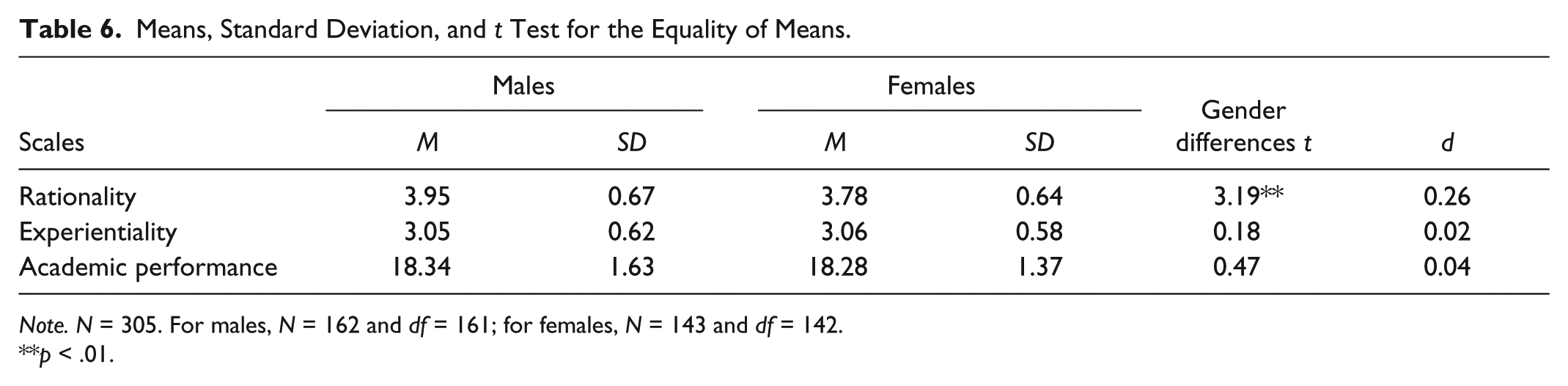
Note. N = 305. For males, N = 162 and df = 161; for females, N = 143 and df = 142.
p < .01.
Discussion
The REI (Pacini & Epstein, 1999) is a valuable measure to assess individual differences in information-processing styles in adult populations. Many researchers have used this scale to investigate a variety of variables in personality (Pacini & Epstein, 1999), communication (Berger & Lee, 2007), health psychology (Saher & Lindeman, 2005), and decision-making domains (Bartels, 2006). Almost all these researchers have indicated that the REI has good psychometric properties in adult populations. However, there is not enough evidence to show that it is a well-suited measure for adolescents, so it may not be developmentally suitable for use in adolescent studies (Klaczynski et al., 1998; Marks et al., 2008).
The main purpose of this study was to examine the factor structure of a new measure of dispositional reliance on, and preference for, two information-processing styles in adolescent populations. The analyses conducted in this regard showed that this new measure contains two independent factors. Using PCA and PA, we showed that this new measure contains two scales, which correspond to rational and experiential processing. Factor analysis of the items indicated that rationality and experientiality are independent, but there was not a clear separation between Ability and Engagement subscales. Factor analysis failed to produce separate factors corresponding to ability and engagement; thus, they were related enough to be combined into an overall scale. Internal consistency indicators were high and comparable with those reported elsewhere by an adult sample, and higher than those reported by an adolescent sample (Klaczynski et al., 1998).
To validate the extracted model, we employed the cross-validation method. The main purpose of this method was to confirm repeatability and generalizability of the results of the model examination from the test sample to the learning sample. The learning sample is a group that is randomly selected from the population. We conducted a CFA on the data from the learning group (Group B) to examine the fitness of the new model. According to the results, there is a good fit between data and the examined model. It showed clearly that the model is valid and confirms the factor structure obtained from PCA.
There are not many studies that have tried to relate rationality and experientiality to academic performance. We were interested in investigating the correlation of these scales to educational performance. Correlation tests indicated that rationality, but not experientiality, is positively and significantly associated with academic performance; this result supports the idea that rationality is related to better performance in academic settings. As noted by Epstein (1994), Sladek et al. (2010), and Sinclair and Ashkanasy (2005), processing systems are influenced by a range of situational and dispositional factors. Similar to other educational systems, the educational system in Iran is based heavily on reasoning and logical principles; thus, it is reasonable to expect rational scores to be related to better academic performance in such a setting. This result, in line with previous findings, clearly supports the construct validity of the two factors (Bertrams & Dickhauser, 2009; Epstein et al., 1996; Karsai, 2009). Analyses also showed that rational processing is related to use of learning strategies, but experientiality is not associated with these strategies. The rational system is characterized by effortful information processing, demanding higher levels of cognitive resources and the conscious appraisal of events (Epstein, 2003). These characteristics lead to more intensive use of metacognitive and cognitive strategies.
We employed a t test to analyze gender differences in information-processing styles. The results showed that girls’ and boys’ means on the Experientiality scale were not significantly different, but the rationality scores of boys were significantly higher than those of girls. We found that the effect size for rationality was too small to be seriously considered here. Thus, this result should be treated cautiously. We believe that information-processing styles are influenced by characteristics of the context, and that our transitional society emphasizes achievement for both genders, so gender differences are decreasing. Some researchers have already reported different means, while others failed to find any differences in processing styles among boys and girls.
As noted before, information-processing style has become an important factor in studies on adolescents’ problems. We reviewed some studies that have shown an association between cognitive processing styles and coping mechanisms (Compas, Connor-Smith, Saltzman, Thomsen, & Wadsworth, 2001), depression (Pacini, Muir, & Epstein, 1998), and other problems. Thus, it is important to have a well-suited scale to assess adolescents’ preference for rational and experiential styles.
These results lead us to conclude that the REI-A20 has good psychometrical properties, and it can be used to measure different information-processing styles among adolescents. It would be very informative to investigate its relationship to other measures with the same content. It is also interesting to relate this measure to other personality and cognition measures, as did Pacini and Epstein (1999), who used the original REI. Two scales in this new measure are not balanced in terms of negatively and positively worded items, and it is a problem that requires a solution in the future research.
It seems that schools should pay more attention to students’ processing styles to modify the content of tasks and styles of teaching. Based on our findings, rational processing is positively related to cognitive and metacognitive strategies; this suggests that encouraging the use of these strategies may lead students to process information more rationally.
Footnotes
Appendix I
Declaration of Conflicting Interests
The author(s) declared no potential conflicts of interest with respect to the research, authorship, and/or publication of this article.
Funding
The author(s) received no financial support for the research, authorship, and/or publication of this article.
