




Abstract
There have been 35 presidential extensions across 24 countries in Africa from 1960 to 2022, done through four categories of extension mechanisms. Most extensions occur in francophone countries, where heads-of-state govern for up to four decades and beyond, propped up by French foreign policy pacts or bilateral defense agreements which station French bases that ward of insurrections against perennial presidents. This has gestated political discontent and festered conflicts in francophone territory, to the point of being conflict-prone and terrorist enclaves. In the process, francophone Africa has attracted US drone bases for supposed counterterrorism, while Wagner mercenaries have taken up roles in countries where French Legions failed and departed. As a result, African countries have become willing or unwilling actors in the foreign policy agendas of the French, Americans, and Russians whose legions they host. Meanwhile, the African Union has the institutional frameworks to address the phenomenon of presidential extensions, but the political will is not forthcoming because the AU Assembly itself consists of several incorrigible presidents who are governing in extensions and do not want change.
Plain Language Summary
The purpose of this article is to share the results of a mapping conducted on presidential extensions across Africa. The presidential system of government is the most practised globally, usually with term limits. Extensions to term limits have become rife in Africa, which prompted this mapping to explore the phenomenon and investigate the issue. It turned out that the phenomenon dates from the 1960s independence wave when the first crop of African presidents emerged. Coincidentally, the majority of presidential extensions turned out to be in francophone states, which also prompted further investigation as to why. All data has been generated by exploring the political histories of African countries, which revealed 35 extensions across 24 countries that have experienced an extension of the duration of their head-of-state beyond the maximum term(s) stipulated when they first took office. The implications are quite clear that the French connection plays a major foreign policy role in the pervading trend of extensions within francophone Africa which has become prone to conflict as a result. Also notable is the beneficiary link to the US in terms of drone base locations. However, the potential for the African Union’s existing institutional framework and the continent’s justice mechanisms to troubleshoot the trend of controversial constitutional referendums and their related presidential extensions depends very much on the political will of the Assembly of Heads-of-State and Government. A serious thought at the extent to which Africa is prepared to look within itself for the solution to redressing presidential extensions is required.
Keywords
Introduction
Across the globe, each continent has peculiar issues that impact on politics, peace, and security continentally and intercontinentally. They range from: guns and shootings in North America; to drug cartels in South America; population handling in China and India; security cooperation in Europe and annexations of the former Soviet Union; wars in the Middle East; indigenous communities in Australasia; and melting ice in Antarctica. One pervading issue for Africa appears to be presidential extensions, which began from when the continent’s first crop of presidents emerged during the independence wave of the early 1960s, to date. A byproduct of the phenomenon is tactical replacement by their offspring. This research investigated the political histories of all countries on the African continent and explored cases, patterns, and mechanisms of presidential extensions from 1960 to 2022, to examine how they impact on politics, peace, and security, along with the ensuing international and intercontinental links. The research further explored to what extent the continent’s existing institutional frameworks could address the issue.
Presidential Extensions in Africa
The presidential system of government is the most practiced internationally, with at least 80 countries adhering to two maximum presidential terms, and as few as 12 adhering to one-term presidencies (Young, 2014). The convention or norm is for a president to leave office once their maximum term or mandate expires, and may be re-elected non-consecutively, as has occurred with United States (US) president Grover Cleveland, Russian president Vladmir Putin, Congo-Brazzaville president Denis Sassou Nguesso, Nicaraguan president Daniel Ortega, and Brazilian president Lula da Silva. However, the anomaly of consecutive presidential extensions has featured quite often in African politics, with the francophone countries dominating.
Although recent scholarship has highlighted the increasing trend of African presidents exceeding their term limits (Carter, 2016; Frére & Englebert, 2015; McKie, 2017; Mueller, 2013; Posner & Young, 2018; Reytjens, 2016, 2020; Vandeginste, 2015; Yarwood, 2016), these studies have exclusively been about presidential extensions through constitutional referendums, followed by elections which the incumbent won, mostly from the 1990s.
This research goes further and catalogues the total range of extension mechanisms by African heads-of-state, from the 1960s independence wave to the current period. Altogether, there have been 35 extensions across 24 countries from 1960 to 2022. Table 1 sets out the results of the mapping conducted from January to July 2022. The table brings out four main categories of extension mechanisms over the specified period. The categories of extensions generated by the mapping are: (a) heads-of-state who began with one-party-systems and extended their tenures by subsequently allowing multiparty elections which they duly won, such as Equatorial Guinea and Gabon; (b) those who began with republican constitutions but suspended them and simply carried on ruling by decree, such as Niger and Sierra Leone; (c) those whose maximum terms expired but amended constitutions to extend the term limits or age limits, such as Côte d’Ivoire, Guinea, Algeria, and Uganda; (d) and those who practiced peculiar internal parliamentary procedures for extending presidential terms, such as Angola (under Eduardo dos Santos) and Egypt (under Hosni Mubarak). The table lists in alphabetical order all the 24 countries that have experienced an extension to term limits in one form or another by a head-of-state over the 62-year period.
A Mapping of Presidential Extensions by Heads-of-State in Africa 1960–2022.
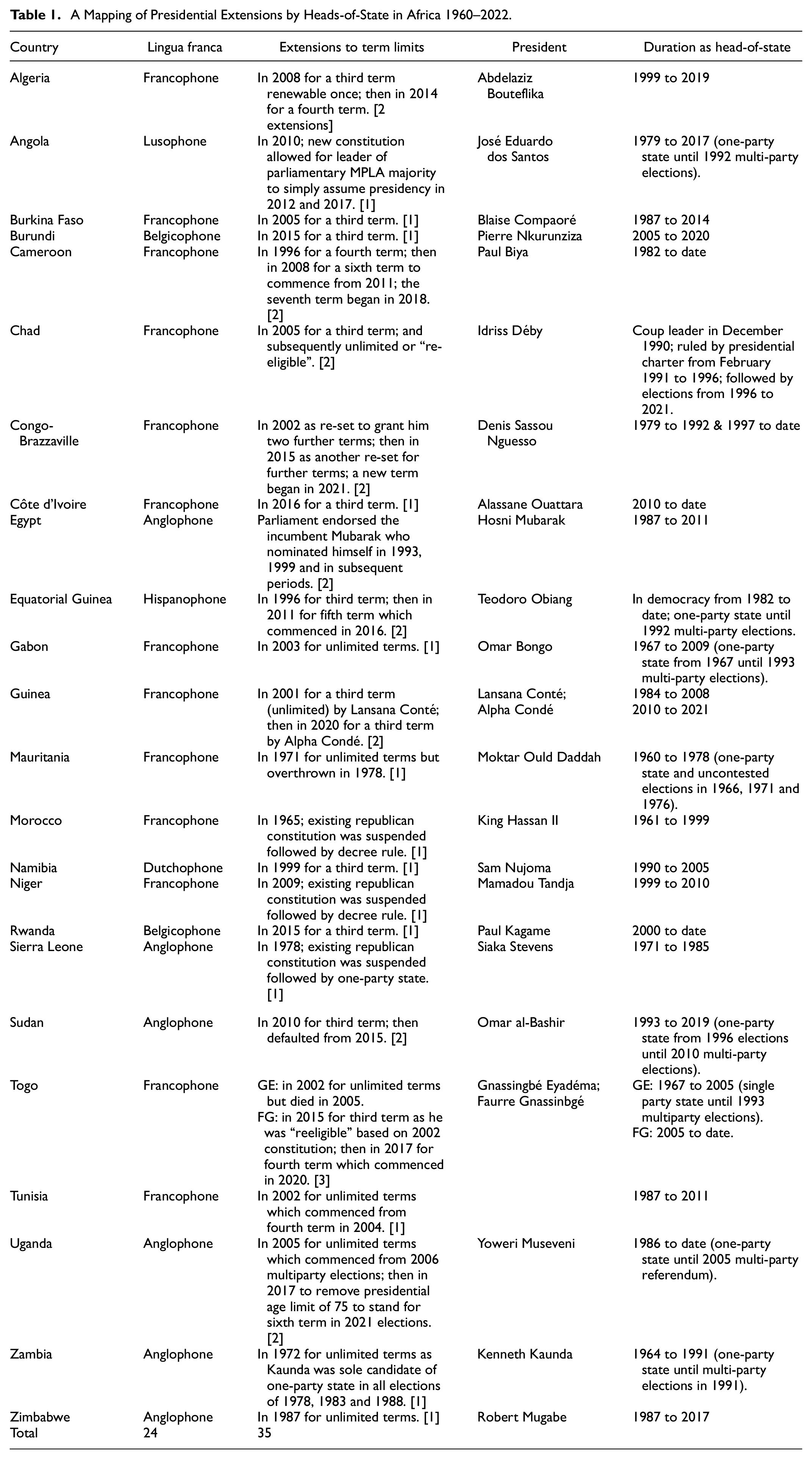
One notable finding from the mapping is that, majority (13 or 54%) of the 24 countries are francophone, while six are Anglophone, two are Belgicophone, and one each is Dutchophone, Lusophone, and Hispanophone, as shown in Figure 1. Presidential extensions have been so predominant and persistent among francophone African countries that, all African presidents currently governing in extension to term limits are francophone, except for Uganda which is Anglophone and Equatorial-Guinea which is Hispanophone. Moreover, in all five most recent francophone presidential elections (Guinea, Côte d’Ivoire, and Togo during 2020, Chad, and Congo-Brazzaville during 2021), the incumbent secured their extensions through controversial constitutional referendums, followed by elections which they went on to win (Amoah, 2023). It is usually the case “that incumbents who run often win at the election” (Reytjens, 2020, p. 275).

Presidential extensions chart.
Noticeably, France which is the former colonial power did not adhere to term limits until 2008. Hence, this research went further to explore any existing arrangements between France and its former colonies in Africa which underpinned the francophone majority trend of presidential extensions. This article elaborates with three detailed examples of presidential tenures in Gabon, Congo-Brazzaville, and Togo, which highlight how presidential extensions have occurred in practice, and the role of the former colonial power. The research identified certain impacts, patterns, or effects associated with francophone African countries that have experienced presidential extensions. The impacts are discussed in the section which follows the three cases.
Subsequently, this research explored existing institutional frameworks of the African Union which could address the trend of presidential extensions. Three institutional bodies examined are the Assembly of the African Union (AU), its newly merged political and security departments now known as the Department of Political Affairs, Peace, and Security (PAPS), and its justice department or the African Court of Justice and Human Rights (ACJHR). All three bodies can contribute toward addressing the broad range of extension mechanisms generated from the mapping, in particular constitutional amendments and extension referendums.
What Underpins the Francophone Trend?
Notable examples of the francophone trend of presidential extensions and instances of its byproduct, starting with the longest-served presidents to date, are: Omar Bongo of Gabon (42 years in office), whose son Ali Bongo replaced him after his passing in 2009; Paul Biya of Cameroon (41 years and counting); Denis Sassou Nguesso of Congo-Brazzaville (40 years and counting); Gnassingbé Eyadéma of Togo (38 years), whose son Faurre Gnassingbé replaced him after his passing in 2005 and was elected into a fourth presidential term in 2020; Ben Ali of Tunisia (34 years); Felix Houphouët-Boigny of Côte d’Ivoire (33 years), in a country where the current president Alassane Ouattara was re-elected into a third term in 2020; Idriss Déby of Chad (31 years), whose son Mahamat Déby replaced him after his passing in 2021; Blaise Compaoré of Burkina Faso (27 years); and Abdelaziz Bouteflika of Algeria (22 years). All these and many more not listed here are francophone.
As a result of French foreign policy toward its former colonies, francophone African states signed bilateral defense and technical assistance agreements with France at independence. These agreements allow for stationing French special forces and military facilities in the respective countries to intervene against coups or insurrections that threaten the heads-of-state (Bienen, 1982, p. 156; Lellouche & Moisi, 1979, pp. 110–118), and explains why they manage to remain in power for so long. As already mentioned, France was itself not adhering to presidential term limits until 2008, and the post-colonial foreign policy arrangements between France and its former colonies made the latter obsequious to France. The few heads-of-state who were not obsequious were unsupported by France, as has been the case for Guinean heads-of-state since Ahmed Sekou Toure led the country as the first colony to leave the French empire in 1958, or Laurent Gbagbo of Côte d’Ivoire (Englebert & Tull, 2008, p. 133; Inhofe, 2011), or Thomas Sankara of Burkina Faso (Diallo, 2018), or Francois Bozizé of Central African Republic (British Broadcasting Corporation News [BBC], 2012). Except for Guinea and Mali that did not sign the defense agreements, all other francophone African states (Benin, Burkina Faso, Cameroon, Central African Republic, Chad, Congo-Brazzaville, Côte d’Ivoire, Gabon, Madagascar, Mauritania, Niger, Senegal, Togo) signed (Lellouche & Moisi, 1979, pp. 111–115). These agreements have influenced the peace and security arrangements in these countries in one way or another over the years, and still do.
While the peculiar relationship between francophone Africa and the French Metropole is clear, non-francophone presidential extensions are ad hoc, and have no foreign policy doctrine influencing them from a former colonial power or external source. In the two current non-francophone examples (Uganda and Equatorial Guinea), the presidents simply extended their term limits once they deemed themselves as “destined to rule for as long as it takes them to address some strategic politics that they feel destined to resolve or have calculated for themselves to resolve” (Amoah, 2019, p. 2). In Uganda, Yoweri Museveni and his National Resistance Movement articulated that they do not believe in presidential term limits, because Museveni’s continual leadership has been necessary to address long-term problems such as getting rid of the Lord’s Resistance Army and its rebel leader Joseph Kony which took over 20 years to accomplish (The Observer, 2015). In Equatorial Guinea, Teodoro Obiang Mbasogo has appointed his son Teodoro Obiang Mangue as his vice president, while Article 45(2) of the constitution states that the vice-president becomes president in the latter’s absence. Hence the succession plan for his son has been constitutionalized.
There have been some token exceptions, and a few real ones too. In 2000, Compaoré of Burkina Faso reduced duration of the presidential term from 7 to 5 years, even though he stayed in office until he was forced out in 2014. In 2015, Nguesso of Congo-Brazzaville reduced the duration from 7 to 5 years but remains in office. In 2016, Macky Sall of Senegal also reduced the duration from 7 to 5 years, even if Senegal’s 5-year term existed previously between 2001 and 2008 before shifting upward to a 7-year term between 2008 and 2016. Senegal’s downward revision in 2016 reflects Sall’s personal wish not to hang on at the presidency for too long, although the constitutional council made sure he served out the full 7-year term from 2012 to 2019 before he was legitimately re-elected into his remaining 5-year term of 2019 to 2024.
Regarding the substantive exceptions, in 2006, the Nigerian parliament objected to Olusegun Obasanjo’s attempted presidential extension. In 2008, Abdoulaye Wade effected a constitutional amendment in Senegal which introduced a third presidential term, but was prevented from reaping its fruits by a sound rejection at the 2012 presidential election when he lost in the second round. In 2014, citizens in Burkina Faso rejected the attempt by Compaoré to extend his term limits and marched into the parliament building to disrupt the National Assembly’s proceedings underway to legitimize the attempted extension. From 2015 to 2018, civil society in Democratic Republic of Congo (DRC) resisted Joseph Kabila whose two maximum terms expired in December 2016 but wanted to remain in office (Amoah, 2021, p. 317). These are the few odd cases where incumbents have been unsuccessful in their attempts to extend term limits. Otherwise, the prevailing trend is that incumbents often have their way, and stay on, especially in the francophone countries. In response, the military coup in Guinea of September 2021 abruptly ended the third term of Alpha Condé who forcibly extended his presidency through a highly contested constitutional amendment which allowed him to stand and win the October 2020 elections. One difference between Guinea and the four other recent presidential elections which were all extensions (Côte d’Ivoire, Togo, Chad, and Congo-Brazzaville) is that, the latter have the benefit of French military support providing security to shore up their respective heads-of-state.
Examining the tenures of three francophone presidents in Gabon, Congo-Brazzaville, and Togo would elaborate on how the peculiar relationship between France and francophone African states works in practice and impacts on politics, peace, and security, while showing how the tactical presidential extensions have occurred.
Examples of Francophone Long-Term Presidents and Their Term Limit Extensions
Omar Bongo Ondimba (Gabon)
President Omar Bongo Ondimba governed Gabon for 42 years from 2 December 1967 until he died in 2009. Throughout his presidency, he governed with the help of the permanent French military base which consistently quelled attempts to remove him from power, especially from 1990 (Amoah, 2011, p. 142; Bienen, 1982, p. 156). From 1967, the country was a one-party state with his Gabonese Democratic Party (PDG) in charge, until rigorous opposition politics led to a new constitution from March 1991 which ushered in the first multiparty elections in 1993. He micro-managed his presidency, so that he was also the Minister of Defense from 1967 to 1981, Minister of Information from 1967 to 1980, Minister of Planning from 1967 to 1977, Minister of Interior from 1967 to 1970, and Prime Minister from 1967 to 1975. It was not until the December 1979 elections that he gave up some ministerial positions including being Prime Minister. In the 1993 multiparty elections, Omar Bongo just managed to scrape through with a 51.4% win, which was immediately followed by opposition strikes, and subsequently a government of national unity brokered by the Paris Accords of November 1994 that also failed to work. The subsequent 1996 and 1997 legislative and municipal elections re-sparked multiparty politics and regained lost momentum for the PDG, but the mayors elected in the major cities such as Libreville were all opposition mayors. However, by a number of co-optations and buy-offs, Omar Bongo managed to consolidate enough power to get him re-elected as president in 1998.
Subsequently, in 2003, Omar Bongo amended Gabon’s constitution and imposed an unlimited number of presidential terms, so that he got re-elected to a third consecutive 7-year term from 2005, during which he died in office. Opposition parties therefore saw Omar Bongo’s passing in 2009 as a chance to change the status quo. But against the heavily tilted playing field, and French military support for his son Ali Bongo Ondimba, the opposition parties were unable to turn the tide in the August 2009 election that got him also elected with less than half (42%) of the vote in a single round. At the time of the 2009 elections, most francophone African countries (including Gabon, Togo, Congo-Brazzaville, Cameroon, and Guinea under Lansana Conté) practiced the first-past-the-post electoral system which allowed just one round of elections. Ali Bongo Ondimba was therefore sworn in on 16 October 2009. He subsequently managed to scrape through a tightly fought election in 2016, of which the true result remains unknown, and was not endorsed by the European Union Election Observer Mission (EUEOM) that was on the ground (Amoah, 2020, p. 75). Ali Bongo therefore tried to follow his father’s footsteps and ran for a third term in August 2023 to declare himself the winner of what was a highly improbable election result. However, he was deposed in a coup that was staged as soon as the election result was announced on 30 August. The French special forces stationed in Gabon to defend sitting heads-of-state did not intervene, perhaps because the coup was led by Ali Bongo’s own presidential guard, compounded by the raging context of anti-French sentiments brewing from four preceding coups in Mali, Guinea, Burkina Faso, and the penultimate one in Niger just a month prior to the Gabonese coup.
Denis Sassou-Nguesso (Congo-Brazzaville)
President Denis Sassou Nguesso has governed Congo-Brazzaville for a period totaling 40 years in two separate presidential periods, from 1979 to 1992 and from 1997 to date. He was re-elected in 2021 with 88.4% of the vote as announced by the constitutional court, in a country where the opposition is of no real consequence—opposition politics is drastically weakened and functions only as a token. Nguesso’s first presidency covered a span of 14 years. Since his second coming in 1997, he has implemented two constitutional referendums to reset the clock for presidential term limits. The first referendum in 2002 introduced two maximum 7-year terms which expired in 2016. However, before the 2016 expiry, another constitutional referendum in 2015 introduced a new 5-year term to commence from 2016. Article 65 of the 2015 constitution stated that the term was renewable twice, which means he could run thrice from 2016.
In February 2021, the Catholic Bishops issued a statement expressing “serious reservations” about the electoral roll for the 2021 presidential elections, the independence of the electoral commission, and an 8 pm curfew imposed for election day (Atemanke, 2021). The Catholic Church’s subsequent request to deploy over 1,000 election observers on election day was denied (Al Jazeera, 2021). Election period curfew and internet shutdowns (Sahara Reporters, 2021) made it impossible for any independent real time collation of results by anyone else apart from the government. Observer participation was extremely minimal. Key international observer groups such as the EU EOM did not bother to send teams to the country (AfriPost, 2016). Unlike Guinea and Gabon, Congo-Brazzaville is not likely to experience a coup against Nguesso who has total grip on power, with the support of France, just as it occurred under his predecessor President Fulbert Youlou in the 1960s (Lellouche & Moisi, 1979, pp. 117–118).
Gnassingbé Eyadéma (Togo)
President Gnassingbé Eyadéma governed Togo for 38 years from 1967 to 2005. In 2020, his son President Faurre Gnassinbgé began a fourth presidential term in a country where he is heavily protected by security arrangements including French special forces. Constitutional amendments in May 2019 changed the electoral arrangements from the first-past-the-post system inherited from France which was practiced by most francophone African countries, to a two-round system that would allow for a second round if an absolute majority was not obtained in the first. First-past-the-post allowed any presidential candidate to win by the most marginal of votes and by the least voter turnout imaginable in a single round. Also included in the 2019 constitutional amendments was the re-introduction of two-term limits which had been abrogated in 2002 by former president Gnassingbé Eyadéma when he imposed Article 59 of the 1992 constitution to simply state that “he was reeligible” (Constitute, 2007). A vigorous campaign from August 2017 by political parties and civil society groups for the two-term limit to be applied retroactively failed—it would have disqualified Faurre Gnassingbé as a fourth-term candidate in 2020.
It will be recalled that Faurre Gnassingbé is the son of Gnassingbé Eyadéma who died on 5 February 2005. With the help of France, he was sworn in as president by the National Assembly the next day after Gnassingbé Eyadéma’s passing, even though Article 65 of the 1992 constitution at the time required the President of the National Assembly to assume the vacancy (Constitute, 2007). He was then nominated as the head of his father’s Rally of the Togolese People on 25 February 2005, and subsequently as the party’s presidential candidate. He won the 2005, 2010, and 2015 elections, the last of which gave him a controversial third term in office, as he was simply “reeligible” according to Article 59 of the 1992 constitution. New protests from August 2017, principally about the controversial third term, moved Faurre Gnassingbé to approve plans for amending Article 59 to reintroduce the two-term limit. However, he insisted that the change should take effect from 2020 instead of retroactively. The not-so-independent electoral commission could not conduct an election whereby the powerful incumbent would lose, as has been the tradition over several decades with his father Gnassingbé Eyadéma. Faurre Gnassingbé could potentially be president-for-life, as he is obsequious to France, as was also the case during the governing decades of his father.
Impact of Presidential Extensions on Francophone African Countries That Have Experienced the Phenomenon
Conflict-Prone Francophone Territory
One clear pattern is the impact on peace and security. A good glance over the continent today (as shown in Figure 2) will reveal that most of the recent or ongoing conflicts occur along a peculiar horseshoe of francophone next-door neighbors—Côte d’Ivoire, Guinea, Mali, Niger, Chad, CAR, and Cameroon. Burkina Faso in the loop has been under attack because of the jihadist spill-over from Mali and experienced a military takeover in January 2022 due to the former president’s failure to sufficiently equip its military to engage the jihadist onslaught. The leader of the January coup was also overthrown in September by another military coup for the same reason. Togo and Côte d’Ivoire which protrude southward from Burkina Faso have also recently emerged from civil war scenarios. Togo experienced a period of wild protests and constitutional unrest from August 2017, leading up to the February 2020 presidential elections in which Faurre Gnassingbé ran for a fourth term. Côte d’Ivoire experienced a civil war in the wake of the controversial 2010 elections which ushered in current president Alassane Ouattara.

Horseshoe of conflict countries in Sahelian West and Central Africa.
Francophone African countries appear to be constantly in conflict, political turmoil, or demonstrating high potential for conflict. As discussed in detail with the three lengthy presidential tenures of Bongo, Nguesso, and the Eyadémas (and many more not discussed in this article for lack of space), the reasons are embedded in the existing French policy of defense agreements coupled with its political influence which nurtures the political contexts and engenders conflicts (Lellouche & Moisi, 1979, pp. 110–118). The ensuing protective arrangements for francophone presidents underscore the conflict-prone syndrome generated by prolonged presidencies and controversial constitutional amendments which gestate political discontent and fester conflicts. Other ongoing conflicts on the continent, such as Boko Haram in Nigeria, Islamist militants in Mozambique, civil war in South Sudan, rebel militias in eastern DRC, and Al Shabaab insurgencies in Somalia, have totally different reasons for their occurrence, and are not francophone.
French Disengagements Resulting in Wagner Engagements
Within the conflict-prone francophone territory also lies a pattern of French disengagement or withdrawals from specific counterterrorism assignments in Mali, CAR, and Burkina Faso, and their replacement by Wagner Group mercenaries to fill the vacuum. Hence, there appears to be a competition for military space between the Western Atlantic Alliance (Hoffmann, 1981) and Russia’s Wagner Group that has official roles in several African states, including CAR, Mali, Burkina Faso, Libya, South Sudan, Sudan (Bax, 2021), Mozambique (Warsan, 2019), Botswana, Burundi, Chad, Comoro, Congo, Equatorial-Guinea, Guinea-Bissau, Madagascar, and Nigeria (Jones et al., 2021).
Although Wagner has taken up military roles in Mali, CAR, and Burkina Faso where the French Legions have been withdrawn, Wagner’s broader incursions across Africa symbolize a re-emergence of Cold War competition between the Atlantic Alliance and Russia. It will be recalled that there was fierce superpower competition for African alliances during the Cold War, which forced most African states to join the Non-Aligned Movement just to avoid being mis-labelled for siding with the US, the Soviet Union or neither, to avoid retribution for alignment or the lack thereof. In part, this explains the stiff reluctance from some African countries to align with either NATO or Russia in the 2022 War in Ukraine. Also contextual to the current competitive development, is the historical and contemporary French element to the conflict zones in the Sahel, West and Central Africa, with recent theatres of operation in Chad, Côte d’Ivoire, CAR, Mali (Henke, 2019, p. 134), and Burkina Faso. Previous theatres of operation included Cameroon, Congo-Brazzaville, Mauritania, Niger, and Gabon (Lellouche & Moisi, 1979, pp. 117–118).
France has recently faced three counterterrorism assignments from which its forces have withdrawn, even if exiting also allowed Wagner’s entry into the fray. Those three assignments can be discussed here briefly. One was in the notorious PK5 and PK13 districts of Bangui in CAR, where the French withdrew from Operation Sangaris in October 2016 (Amoah, 2019, p. 94). Another was in Mali, where France retreated in 2021, due among other things to a fundamental policy disagreement not to negotiate with the jihadists whereas the Malian junta wanted to negotiate with the terrorists (Radio France International News [RFI], 2020). Hence, France echoed the traditional hard-line position that “with terrorists, we do not discuss. We fight” (Pinault, 2020), while the hosts decided to have talks with the jihadists. The third instance is in Burkina Faso which shares a border with Mali, and where the Burkinabe military faces enormous challenges to protect its vast northern stretch which hitherto had no terrorist encounters but is now ravaged by the intense jihadist spill-over from the Malian conflict (The Defense Post, 2021a). Here also, the new Burkinabe ruling junta made clear that it had no qualms with bringing in Wagner to assist and ordered French troops to leave.
In CAR, the Wagner Group gained salience when government troops, MINUSCA, and Western partners were challenged with the rebel advancement and blockade against Bangui during the December 2020 election period of mounted insurgencies to oppose the re-election of president Faustin-Archange Touadéra. We note that “a combination of UN peacekeepers, Wagner personnel and Rwandan soldiers repelled the attack” (Bax, 2021), with extra specialist support from Rwanda. France had already retreated from Operation Sangaris in October 2016, 6 months into Touadéra’s presidency, and as MINUSCA would be unable to handle the tough turf on its own, some other foreign legion had to be invited to assist, hence Wagner.
In Mali, the current military junta led by President Colonel Assimi Goita and his trusted defense minister Colonel Sadio Camara (both of whom are Russian-trained), had been in secret discussions with Wagner for a while. This became the subject of intense speculation at the UN General Assembly in September 2021 when their prior discussions with the Russian mercenaries became apparent. With the imminent arrival of the mercenaries, the US cautioned the Malian authorities in mid-December 2021 against doing business with Wagner (The Defense Post, 2021b) but the warning was too little too late, as Wagner deployments in Mali occurred a few days afterward before Christmas (France 24, 2021).
In Burkina Faso, the French military contingent reduced its size due to the broader withdrawal of Operation Barkhane from the subregion. Wagner was already offering protection for Burkinabe government sites such as Ouagadougou airport, and Russian mining interests (Lyammouri & Eddazi, 2020, p. 4) including three gold mines under Nordgold (Mining Review Africa, 2019). However, the new military junta which came into power in September 2022 considered a more substantial counterterrorism role for Wagner and ordered the departure of the remaining French contingent on 22 January 2023 (Al Jazeera, 2023; France 24, 2023).
Francophone Layout as Preferred Location for US Drone Bases
Another impact or pattern is the strategic benefit of the francophone layout to the US in terms of drone base locations. Of the 13 US drone bases in Africa, eleven are in francophone countries, apart from Ethiopia and Somalia. The US has operated three drone bases in Niger, two in Djibouti, and one each in Burkina Faso, Cameroon, Chad, Mauritania, Seychelles, and Tunisia. Identifiably, Niger, Burkina Faso, Cameroon, Chad, Mauritania, and Tunisia are all countries with a history of presidential extensions. It appears easier to gain cooperation with a francophone country to host a US drone base or military facility than their anglophone counterparts, even if the latter happens to be in serious threat such as Nigeria under Boko Haram rampage. For example, there is no US base in Nigeria. Instead, there is the periodical offer of help from The White House (2014). An attempt by the US in 2018 to establish a military base in neighboring anglophone Ghana was robustly resisted by citizens, while the minority in parliament also walked out against the Status of Forces Agreement.
The furore which the prospect of a US base in Ghana’s capital Accra generated across the nation was quite astonishing and rare, in both content and intensity of public interest. This kind of public reaction had not quite gripped the nation before. The era of social media might have contributed to its intensity and engagement of the issues, but it was rare nevertheless, and created its own drama over an appreciable period. The result was a US logistics hub and warehouse base with a hangar next to Kotoka International Airport (Williams, 2019) instead of the envisaged military base. There was no drama next door in Côted’Ivoire where the new International Academy for the Fight Against Terrorism was built by France in 2021, and where France already has an established military presence.
Although the US is the senior partner (Heimann et al., 2021, p. 386) of the Atlantic Alliance (Kolodziej, 1980, p. 116), historically, “a certain decentralization of roles” (Hoffmann, 1981, p. 109) has meant that France’s footprint in Africa became enlarged. The vicissitudes of international politics, along with the tussles of balancing global power (Art, 2003; Walt, 1985) and other imperial ambitions, have reflected on the protean nature of the Atlantic Alliance over time (Kolodziej, 1980, p. 104). Hence, it is widely known that the strategic partnership between US and France has had its ups and downs (Eznack, 2011: Heimann et al., 2021). The characteristics of the relationship range from, co-operation at the “horseshoe” (Gharekhan, 2006) on operations such as the 2011 military intervention in Libya (Amoah, 2019, pp. 122–123, 136), to the Global War on Terrorism, with periodic tensions and disagreements across decades (Kolodziej, 1980, pp. 109, 114). Despite the rocky US-France relationship and its tensions, the pattern is clear that the French layout in Africa has benefitted the US in terms of drone base locations.
Even though legionnaires are “foreigners who are neither citizens nor subjects of the state whose military they serve” (Grasmeder, 2021, p. 147), francophone African countries have become foreign policy actors (Bienen, 1980) of the foreign legions they host. We note that drone bases constitute a form of legion presence. Apart from the French layout benefitting the US in the form of drone bases, or benefitting Wagner where France has withdrawn its troops, we also note that at least four of the UN peacekeeping missions in Africa are in francophone countries, with France serving as the “pivotal state” (Henke, 2019, p. 130) of each mission: (a) UN Mission in Chad (MINURCAT); (b) MINUSCA in CAR; (c) UNOCI in Côte d’Ivoire; and (d) the dissolved MINUSMA in Mali which operated with G5 Sahel countries including Burkina Faso. Three of these cases (Chad, Côte d’Ivoire, Burkina Faso) each have a history of presidential extensions. In effect, African hosts of foreign legions have become foreign policy actors in one way or another, willingly or not willingly, for the Atlantic Alliance or other superpowers. Regardless of Wagner entering the fray because of French withdrawals or whatever else, Wagner incursions are tantamount to African militaries being Russia’s foreign policy actors inadvertently or otherwise, just as for the preceding foreign powers.
Addressing Presidential Extensions
There are two mechanisms that can work either separately or in tandem to address the trend of constitutional referendums which extend presidential term limits. First, the Assembly of Heads-of-State and Government at the helm of the AU, and its subregional equivalents, could veto extensions to term limits, backed by a legitimate institutional framework in place for this to work. Second, the African Court of Justice and Human Rights (ACJHR) could act as the referral institution or final arbiter on national presidential term limits, so that the constitutional courts of AU member states would comply with ACJHR decisions. The ACJHR could effectively institutionalize the veto against presidential term limits for the Assembly to work with it. The AU currently does not veto extensions to term limits, nor is the ACJHR currently adjudicating over the numerous controversial constitutional extensions by incumbents, let alone the electoral disputes which arise from the controversial elections to endorse such extensions.
Incumbents now pay close political attention to the central collation of electoral votes because of the emerging trend that failure to do so could prove costly. Recent research shows that incumbents tend to win a presidential election when in control over the electronic aggregation exercise, and lose when not in control. This has been proved by research on the presidential elections in Gabon, Gambia and Ghana in 2016, and Kenya in 2017 (Amoah, 2020). The trend has also been corroborated by further research on the presidential elections of DRC in 2018, and Malawi and Guinea-Bissau in 2019, where again, political control over the electronic vote aggregation ensured victory in the cases of DRC and Guinea-Bissau, but defeat in Malawi where the incumbent lost control over the vote aggregation exercise (Amoah, 2021).
Due largely to political control over vote aggregation, it is only twice in African politics that an incumbent win has been overturned. The first instance was the 1 September 2017 ruling by the Kenyan Supreme Court which nullified the presidential poll of 8 August 2017, and the second instance was the 3 February 2020 ruling by the Malawian High Court which nullified the presidential poll of 21 May 2019. Even so, the Kenyan government quickly used its parliamentary majority to remove the Supreme Court’s responsibility to adjudicate on the repeat election, and rigged the revote which occurred on 26 October 2017 (Amoah, 2020, pp. 80–83). The Malawian revote on 23 June 2020 unseated the incumbent President Peter Mutharika. In effect, it is only once in African politics that overturning an incumbent win resulted in unseating the incumbent (Amoah, 2021, p. 318).
A closer look at the continent’s institutional framework and capabilities points out that the African Peace and Security Architecture (APSA) is not fully ready to intervene in all situations that require intervention, partly due to funding issues (African Union [AU], 2017). Furthermore, the AU’s policy to suspend member states when military juntas overthrow elected governments is not coherently implemented. Mali, Guinea, Sudan, Burkina Faso, Niger, and Gabon were suspended for their respective coups in May, September and October 2021, September 2022, July and August 2023. However, Chad was not suspended in April 2021 when Mahamat Déby undemocratically took the reins of government after the passing of his father Idriss Déby. Suspended member-states do not fully respect sanctions imposed on them, especially as the AU and subregional bodies do not exercise the capability to troubleshoot presidential extensions and other forms of impunity that generated the coups in the first place. Juntas have come to a view that they can get away with coups if they can ride the initial storm with continental and subregional authorities. The Economic Community of West African States’ (ECOWAS) sanctions against Mali in January 2022 (ReliefWeb, 2022) were duly lifted in July 2022. Similar sanctions against Guinea and Burkina Faso (ECOWAS Authority, 2022, p. 7) were lifted after the juntas presented their action plans for return to civilian rule. Equally, the respective regional and subregional sanctions against Niger and Gabon are wont to be lifted in due course. In large measure, sanctions have been viewed as punitive rather than corrective, for example, Nigeria cutting off electricity supply to neighboring Niger following the latter’s July 2023 coup which deposed its French puppet-president. Many have wondered whether the electricity sanction was meted out at the behest of France, as it generated substantial economic losses to Niger and ECOWAS.
A further look at institutional capacities reveals that the AU’s Continental Early Warning System (CEWS) has been inefficient, because continental authorities do not troubleshoot the controversial presidential extensions and their subsequent election victories which generate political discontent and fester conflicts. The AU’s Peace and Security Council and the Department of Political Affairs have now been merged into one super department (PAPS) with two new directorates—one assigned to conflict management, and the other assigned to governance and conflict prevention to oversee democracy, elections, and constitutionalism. However, the new and untested PAPS has not yet vetoed extensions to term limits, and the ACJHR has not commenced adjudicating on extension referendums or related electoral disputes. Hence the potential remains for conflicts to arise in francophone territory which has already proved to be conflict-prone.
Despite the growing anti-French sentiment across Africa, there does not yet appear to be a definitive end in sight to French interference, as occurred in Togo in 2005 when Faurre Gnassingbé was imposed upon the Togolese at the passing of his father Gnassingbé Eyadéma (Amoah, 2019, pp. 21–22), or Gabon in 2009 when Ali Bongo was imposed upon the Gabonese at the passing of his father Omar Bongo (Amoah, 2019, pp. 15–16), or Chad in 2021 when Mahamat Déby was imposed upon Chadians at the passing of his father Idriss Déby (Massala, 2021).
Although the restructured PAPS now has a troubleshooting institutional framework, it appears hamstrung by the AU hierarchy with presidents at the helm. From 2003 to 2008, the first substantive AU Commissioner or Chair of the AU Commission (AUC) was a presidential figure in the person of Alpha Konare who is a former president of Mali, but an incident subsequently changed this. In 2005, Konare procedurally challenged the authority of AU Chair Olusegun Obasanjo and president of Nigeria by making an announcement without consulting the latter over an electoral dispute in Togo. AUC Chair Konare had announced Zambian president Kenneth Kaunda to negotiate the Togolese crisis while Obasanjo was simultaneously in discussions to find a solution to the same crisis (Biafra Nigeria World News [BNW], 2005; News24, 2005). One would have thought that liaising the operations of the two offices could suffice as a solution, but instead, the AU subsequently never appointed a presidential figure to chair the AUC again, and downgraded the position to foreign minister level or equivalent. In the AU hierarchy, foreign ministers serve under the Assembly of Heads-of-Government. The current AU Commissioner Moussa Faki Mahamat is a former prime minister and foreign minister of Chad, and his two predecessors since Konare have been foreign ministers: Jean Ping was the AUC’s head from 2008 to 2012 and former foreign minister of Gabon, while Nkosazana Clarice Dlamini-Zuma was the AUC’s head from 2012 to 2017 and former foreign minister of South Africa.
Therefore, the AUC which oversees PAPS, and PAPS for that matter, have their own tactical maneuverings to circumvent in order to get the Assembly to veto presidential extensions in a continental institution where the Assembly has so far been incorrigible (Amoah, 2019, p. 229) for the simple reason that many of the Assembly’s current members are culprits of presidential extensions themselves. Perhaps the Assembly needs to re-appoint a presidential figure to the role of AU Commissioner or be amenable to progressive change without a high-profile AU Commissioner to drive that change. Also, it would be beneficial for the AU to set up the much-needed foreign policy department to handle, among other things, neocolonial foreign military existence or interferences on the continent, instead of leaving AU member states to the divide-and-rule tactics of foreign powers. The AU appears to be the only continental body which does not have a designated foreign policy department and is always caught napping when superpowers bite and gnaw at its member states, as happened to Libya in 2011. The lack of an AU foreign policy department to coordinate policy positions across the African continent gives leeway for Africa’s country representatives at the UN Security Council to vote against African interests when it really matters, such as when Nigeria, South Africa, and Gabon voted for UNSC Resolution 1973 (2011) that led to regime change in Libya (Amoah, 2019, pp. 123–125, 134–136).
Conclusion
This article has discussed extensively and reaches the following conclusions. First, presidential extensions in African politics are not an emerging phenomenon as recent scholarship suggests. Rather, the practice has ensued right from the independence wave of the early 1960s, and with that of Central African Republic in July 2023, now totals 36 across 25 countries to date, through the four main extension mechanisms discussed. Second, francophone countries dominate in the trend of presidential extensions, perhaps because France itself was not adhering to term limits until 2008 and therefore has no qualms with its African allies perpetuating the anomaly. More substantially, the francophone dominance in African presidential extensions, results from the fact that French foreign policy pacts signed with its former colonies dictated bilateral defense and technical assistance agreements, which stationed French bases in francophone African states, to prop up African heads-of-state who governed for several decades in gross violation to term limits.
Third, the impacts are, that francophone countries especially have become conflict-prone and terrorist enclaves. They have also attracted US drone bases as foreign legions, as well as Wagner mercenaries where the French failed or departed. This has resulted in African countries becoming actors of the foreign policy agendas of the French, Americans, and Russians whose legions they host. Fourth, and most alarming is the fact that the AU has the institutional frameworks to address the issue of presidential extensions and its concomitant potential to gestate political discontent and fester conflicts, but the political will to do so is not forthcoming because the Assembly is incorrigible and harbors several presidents currently governing in extensions. It would take a strong initiative from African intellectuals, civil society, the military, and country Councils on Foreign Relations to mount enormous pressure on the Assembly to become amenable to effecting or allowing the necessary changes at the AU and across the continent.
Footnotes
Acknowledgements
I thank FLIA staff for their research assistance, and colleagues at the Centre for Public Authority and International Development (CPAID) for their helpful comments to my presentation at the 2022 grant workshop.
Declaration of Conflicting Interests
The author declared no potential conflicts of interest with respect to the research, authorship, and/or publication of this article.
Funding
The author disclosed receipt of the following financial support for the research, authorship, and/or publication of this article: I am grateful for the constructive comments of the reviewers. The author acknowledges ESRC-GCRF Research Grant ES/P008038/1) at the Firoz Lalji Institute for Africa (FLIA).

Data Availability Statement
Data sharing not applicable to this article as the full data generated appears within the article.