




Abstract
Consumers on social commerce platforms can easily access product information, but these platforms have not attracted potential consumers in emerging economies. Studying the social factors (social support, social presence, and relationship quality) and mooring effects (conformity and personal experience) in social commerce environments is essential for understanding consumers’ intentions. This study examines the role of social factors by integrating mooring effects as moderators in the Chinese model, where fear for the reliability of consumers’ comments is a concern. Quantitative data are collected from Chinese cities (N = 303) and analyzed through partial least squares–structural equation modeling. The findings demonstrate the validity of social factors and enjoyment. Mooring effects positively influence shopping intentions, and system and service quality positively influences relationship quality and shopping intentions. Finally, mooring effects positively moderate the relationship between social presence, social support, and consumers’ intentions. The findings have theoretical understanding and practical implications.
Introduction
With the sudden development of Web 2.0 technologies, the concept of social commerce is becoming more critical (Mikalef et al., 2017). Social commerce podiums offer a prospect for customers to connect with sellers, share their views, and make particular purchasing decisions (Qualman, 2012). From the social commerce perspective, a key objective of businesses is to stimulate consumers to make decisions through social affiliation generated on social commerce platforms; such decisions assist organizations in locating valuable business ventures (Lin et al., 2017). The concept of social aspects such as social presence, social support, and relationship quality are primarily related to social commerce research (Han et al., 2016). Social presence plays a crucial role in consumers’ purchase intentions, which lack any head-on contact between consumers and sellers. In contrast, a higher level of social support and interaction between consumers and sellers can provide more statistics to consumers, and further allow the consumers a feeling of closeness, which in turn develops more positive attitudes toward their purchasing intentions (Jiang et al., 2019). Also, a high level of relationship quality can play a vital role in the formation of an actual relationship between consumers and sellers, which can, therefore, contribute to shaping consumers’ intentions toward social commerce buying. Accordingly, social factors leverage social commerce platforms to support interpersonal interaction, and its unique aspects (e.g., anywhere and anytime) provide diverse prospects for consumers to make better purchase decisions (Lin et al., 2017). Thus, developing robust relationships with consumers is essential for businesses to remain successful in the social commerce environment.
Several scholars have attempted to explore the fundamental dynamics of consumers’ purchasing intentions using different theories, for example, gratification theory (Han et al., 2015) and Stimulus–Organism–Response (SOR) model (Zhang et al., 2014). Some of the studies emphasize the cognitive aspect of behavior (Wang et al., 2015), while others examine aspects related to satisfaction and post-purchase behavior (Kuo & Wu, 2012; Seesupan & Narakorn, 2018). On the contrary, it is undecided which social factors will increase consumers’ purchasing intentions. Many consumers have a deep wish for social interaction in such a way that sellers or consumers encircle them. This, in fact, their desire for a logic of social presence, of experiencing others as expressively present (Hassanein & Head, 2007). Earlier studies have debated the significant role of social presence in developing consumers’ trust (Lu et al., 2016). M. Shin et al. (2019) found that 3D (three-dimensional) sound from live concerts plays a critical role in enhancing the hearers’ sense of being with a recitalist (i.e., social presence). Nevertheless, it does not serve the drive in the perspective of social interaction, where users need not only to communicate with robots but also with members of the society to share information and motions. This study will bridge this literature gap by examining the influence of social presence on consumers’ purchasing intentions. With this information, firms can specially perform social presence services for refining consumers’ purchasing intentions.
In the prevailing body of marketing literature, the quality of a relationship can be measured by using different factors like trust, satisfaction, and commitment. These aspects of relationship quality have a substantial impact on consumers’ purchasing intentions (Tajvidi et al., 2017). Consumers’ trust is an inner experience, which varies with the professed environments (Hajli, 2014), because higher levels of relationship significantly affect trust, thus leading toward more positive purchasing intentions (S. Kim & Park, 2013). Satisfaction is a customer’s general emotional assessment regarding the actual performance of a supplier, while commitment is related to the efforts to maintain a relationship between seller and buyer. Prior studies have discussed the significant role of relationship quality in an online purchase (Rafiq et al., 2013; Tajvidi et al., 2017). Although scholars have made an attempt to recognize the role of relationship quality in the traditional online purchase environment, there remains a lack of research on how the relationship quality affects consumers’ purchasing intentions.
In the social commerce environment, individuals and businesses share their experiences more freely through social platforms, supporting potential consumers in their online purchase decisions. Prior studies have examined the role of social support in health, sociology, and psychology (Hajli, 2014; Hajli & Lin, 2014), but after the inception of Web 2.0 tools, it is now welcomed in business studies. The availability of online social support on social platforms may influence consumers’ purchasing intentions. Moreover, mooring effects such as personal experience and conformity may constrain consumers’ purchasing intentions. The current study investigates the direct and moderating impact of mooring factors on consumers’ purchasing intentions. That can help online sellers to comprehend shoppers’ purchasing intentions, thereby allowing them to turn social interactions into sales and profits.
By considering the facts mentioned above, this study explores consumers’ purchasing intentions in the Chinese scenario, where lack of trust in the reliability and validity of comments from other consumers are considered growing concerns about the success of social commerce. To bridge this research gap, we propose a theoretical framework by integrating social factors, for instance, social presence, social support, and relationship quality, with mooring effects as moderators. We utilize partial least squares–structural equation modeling (PLS-SEM) to test the suggested study structure.
This study provides some essential contributions to prevailing marketing literature. First, a comprehensive theoretical framework is proposed to gain valuable insights into the variables, which are considered responsible for shaping consumers’ purchasing intentions. Second, it contributes to the prevailing body of literature relating to the conceptualization of the concept of social presence, relationship quality, social support, and the moderating role of mooring effects in the framework of social commerce. Third, this article tests through PLS-SEM the collective influences of social factors, mooring effects, enjoyment, and system and service quality on consumers’ purchasing intentions.
Theoretical Framework and Literature Review
Social Commerce
The idea of social commerce is deep rooted in the prevailing body of marketing literature (Hajli et al., 2017; Jiang et al., 2019). Social commerce consists of three critical pillars: business activities, social media–based technologies, and social connections (Huang & Benyoucef, 2013). The online environment enables sellers to launch their online pictures, videos, and pages to connect with customers in numerous ways. Consumers’ involvement is a crucial feature of social commerce (Park et al., 2007). Numerous firms have intense competition for an increase in sales and better reputations through social commerce platforms. These platforms, such as WeChat, Weibo, and Redbook, provide several channels of C2C (consumer to consumer) and B2C (business to customer) links to both sellers and consumers. A profound study of businesses through social commerce platforms can help us to recognize better this new way of doing business.
Social Factors
User engagement and dependence on social commerce activities increase over time (Jiang et al., 2019). Social commerce is a multidimensional notion whose components can be different in different scenarios (Hajli, 2015; Tajvidi et al., 2017). However, studies investigating factors influencing consumers’ purchasing intentions are scarce (Hajli et al., 2017; Ko, 2018). For instance, Mikalef et al. (2017) elucidate the role of features present on social commerce podiums in consumers’ purchasing intentions. Ko (2018) examines the role of commercial and social desire to purchasing intentions. Similarly, Hajli et al. (2017) examine the association between consumers’ trust and their purchasing intentions, and explain a mechanism for elucidating this relationship. Higher levels of social presence, social support, and relationship quality might directly or indirectly influence consumers’ purchasing intentions. By considering the significance of the discussion as mentioned earlier, this study provides a holistic overview of social aspects (for instance, relationship quality, social presence, and social support) and contributes to the existing body of literature through the incremental role of social support that affects the social presence and relationship quality, besides affecting purchasing intentions directly. Social support brings warmth and understanding that can give psychological satisfaction to the individual (Tajvidi et al., 2017). Psychological comfort brings relationship stability and social sustenance (Seesupan & Narakorn, 2018).
Moreover, social commerce based on online interaction relies heavily on posts and virtual support that may assist users in an intangible way, which includes emotional and informational support (Hajli, 2014). The role of social presence in social commerce can be hypothesized as follows: When social presence is present in social platforms, it is usual for the community participants to share nonviable particulars and suggestions as a leeway of sharing information and other helpful behaviors. When a user feels that others are caring and helping by disclosing critical data, then acquiring and sharing useful information and experiences with other users become obligatory (Lu et al., 2016). This sense of sharing and caring enhances the importance of social presence at both ends, which might further strengthen the relationship quality. The literature provides evidence of the coexistence of the association between social support and relationship quality (Hajli, 2015; Tajvidi et al., 2017), but a gap exists in terms of mutual interaction between relationship quality and social presence.
Social support
Social support is social care that a group or an individual gets from shoppers or sellers. Social support theory elucidates how social relations affect individuals’ emotions, behaviors, and cognitions (Lakey & Cohen, 2000; Tajvidi et al., 2017). Social support has been widely studied in the context of sociology, health care, and psychology. From the perspective of social commerce, it can be bifurcated into two types: (a) informational and (b) emotional. “Informational support is defined as providing messages, in the form of recommendations, advice, or knowledge that could be helpful for solving problems while emotional support denotes to providing messages that involve emotional concerns such as caring, understanding, or empathy” (Liang et al., 2011, p. 72). These supports are the key modules of social interaction between consumers and sellers. An example of this is social networking websites like Ctrip, where users regularly update their travel experiences by creating content.
In the perspective of a virtual social atmosphere, social support decreases information disproportionateness, which could play an important role in increasing businesses social presence through social platforms and developing relationships between sellers and consumers. The higher the level of perceived social support will lead to more positive attitudes. Hence, social support from other consumers plays a crucial role in social presence, relationship building, and consumers’ purchasing intentions.
Social presence
Social presence plays a vital role in the purchase through social commerce platforms, which lacks head-on contact between sellers and consumers (Cyr et al., 2007). The study proposes that social presence bridges the gap between the level of intimacy among members and perceived distance by consumers, which depends on media richness. Earlier studies used social presence theory to elaborate the social side of social commerce. Social presence enlightens the ability of a communication channel to deliver social signals, for instance, socially-rich messages or virtual agents (Gefen & Straub, 2004; Hess et al., 2009). In the context of media entertainment, social presence plays a significant mediational role in the online purchase environment (M. Shin et al., 2019). Moreover, from a social commerce perspective, the social presence of businesses allows consumers to acquire more information and exchange experiences with others, which helps them in developing relationships and making purchase decisions.
Relationship quality
The notion of relationship quality is derived from the theory of relationship marketing (Dwyer et al., 1987; Möller & Halinen, 2000). Relationship quality is well defined as the strength of a relationship and is used to strengthen the relationship between buyer and seller (Hennig-Thurau et al., 2002; Tajvidi et al., 2017). Relationship quality is a notion having multidimensions like commitment, trust, and satisfaction.
Commitment is the desire to keep a strong relationship with sellers (Tajvidi et al., 2017). Relationship commitment plays a significant role in building a long-term relationship between buyers and sellers. Trust is a crucial subject in social commerce, defined as a “willingness to rely on an exchange partner in whom one has confidence” (Moorman, 1993, p. 82). Trust in businesses indicates the creditworthiness of online sellers (Gefen et al., 2003; Hajli, 2014). Satisfaction is a consumer’s overall assessment of the performance of a seller (Tajvidi et al., 2017). Building a relationship with consumers has a substantial effect on their purchasing intentions (Hajli, 2014) because relationship quality is one of the most critical perceptions in relationship marketing (Doma, 2013; Rauyruen & Miller, 2007). The connection between seller and consumer is dependent on the sellers’ services and how well the sellers develop a healthier relationship with consumers. Therefore, we recommend that relationship quality plays a vital role in swaying consumers’ purchasing intentions.
Enjoyment
Consumers’ different activities (i.e., purchase) through social commerce platforms generate emotions, which directly or indirectly influence their purchase behavior (Pappas et al., 2016). Previous studies considered feelings as a unidimensional concept and discussed the relationship between different categories of emotions (e.g., pleasure, anger) and consumers’ purchasing intentions (Csikszentmihalyi, 1975; Kuo & Wu, 2012). In recent years, scholars have found that emotions consist of a multidimensional concept, comprised of both positive and negative views (Liu et al., 2016; Scherer et al., 2013). In the context of social commerce environments, these two types are interrelated. Still, their relationship does not directly or indirectly affect the increase or decrease in the level of another example (i.e., positive or negative). Moreover, positive emotions always increase consumers’ purchasing intentions, while negative emotions reduce consumers’ purchasing intentions (Pappas et al., 2016). Kuo and Wu (2012) find that consumers may face both positive and negative emotions at diverse times. For example, consumers may feel negative emotions when sellers offer low-quality products but at the same time may feel positive emotions because of the brand name or their previous experience (Pappas et al., 2016; Penz & Hogg, 2011). In social commerce environments, consumers’ positive emotions are highly interactive and enjoyable. Thus, we argue that through social commerce platforms, sellers can evoke consumers’ positive sense of enjoyment.
System and Service Quality
To perform commercial activities through social commerce platforms, consumers use social networking sites (SNS). The design and quality of a webpage play a vital role in the success of social commerce. Earlier studies have focused on the functions and perception of the webpage and their influence on e-commerce purchasing intentions (D. Li et al., 2006; Liang et al., 2011). By following Delone and McLean’s (2004) model to measure consumers’ purchasing intentions, we opted to measure webpage design and quality in social commerce platforms through system and service quality. They define system quality as “the degree to which a website possesses desired capabilities such as availability, reliability, and response time” and service quality refers to “the degree to which a user evaluates supports and services delivered by the service provider via the website.” Information quality is linked to social support. The in-depth study of webpage quality and design can help us in better understanding social commerce platforms’ success and can guide managers or scholars.
Mooring Effects
Shifting from traditional to social commerce purchase is a complex decision. The hindrances, which involve personal or situational elements, may hamper the consumers’ shifting process. Petty and Cacioppo (1986) and Maclnnis et al. (1991) suggest that personal ability and motivation are critical antecedents for persuasion and information processing. Accordingly, consumers will process perceived information according to their motivation and ability to elaborate data. Specifically, because of flux in consumers’ skills and motivation, different consumers process the same information in different ways. Therefore, social factors may directly or indirectly influence consumers’ purchasing intentions; flux in consumers’ aspects may moderate the influence of these factors on consumers’ shopping intentions. Jung et al. (2017) and I. C. Chang et al. (2014) propose that mooring factors signify consumers’ features. Hence, we consider consumers’ ability and motivation as two significant mooring factors of consumers’ purchasing intentions.
Conformity is generally used to indicate consumers’ motivation (Burnkrant & Cousineau, 1975). In the perspective of social commerce, social platforms provide a different kind of social features and interactions (Alshibly, 2014). The fame of social platforms has improved the recognition of social commerce (C.-Y. Li & Ku, 2018). Social interactions and information shared by individuals or businesses help consumers in their purchase decisions through social commerce platforms. Mainly, conformity ensuing from peer influence is the most significant aspect in consumers’ decision making (Lascu & Zinkhan, 1999; C.-Y. Li & Ku, 2018). Thus, we propose that conformity plays a substantial role in influencing consumers’ purchasing intentions.
Moreover, personal experience in the current study discusses the consumers’ experience of online purchases. Personal experience decreases the level of uncertainty in the online purchase environment. Based on personal experience, consumers may have the ability to select the right product, service, or purchase channel. By following the context-specific nature of this study, we regarded the personal experience as a mooring effect to make our study model more robust. Earlier studies have investigated the role of expertise in trust-based consumers’ decision making (D. J. Kim et al., 2008), buying groceries (Campo & Breugelmans, 2015), and their social network approach (Yoon, 2012). An individual with an online purchase experience has confidence in the seller and delivery process (Campo & Breugelmans, 2015). Thus, we propose that personal experience plays a vital role in developing consumers’ purchasing intentions.
Hypothesis Development
This study includes eight constructs in the research model: social presence, social support, relationship quality, enjoyment, and system and service quality, followed by conformity, personal experience, and purchasing intentions. Seven hypotheses (H1a, H2, H3b, H4, H5b, H6a, and H6b) investigate the direct influence of the constructs on consumers’ purchasing intentions; H1b and H1c will study the direct impact of social support on social presence and relationship quality. At the same time, H3c will test the effect of social presence on relationship quality. Moreover, H5a will test the direct impact of system and service quality on relationship quality. In addition, H7a–H7b and H8a–H8b will check the moderating role of conformity and personal experience in social presence, social support, and consumers’ purchasing intentions. Based on these literature-backed assumptions, the study proposes a model, and Figure 1 shows the model of this study.

Proposed study model.
In social commerce, a support received from others plays an important role. This kind of support can enhance interaction between consumers through social platforms and also stimulate motivation. For example, inner motivation enhances interaction between consumers and motivates them to share product information, services, and experiences with friends and family (Jiang et al., 2019). Consumers with worthy social support experience are ones to share their personal experiences with others. Therefore, the sharing of purchase information with other consumers develops a supportive environment, which leads to consumers’ even stronger purchasing intentions. Thus, we suggest the subsequent hypothesis:
Moreover, the higher the level of social support will make it easy for consumers to understand and learn more from other consumers. For instance, the involvement and interaction between consumers in online mediums provide ample facts, such as the quality of a product, personal experience, and advice from other consumers. Prior studies indicate that social support increases relationship quality (Liang et al., 2011). Thus, we argue that a higher level of social support encourages a warm, personal relationship and develops a sense of social presence. Hence, we draw the next hypothesis:
Furthermore, social support generated in the online environment is likely to improve satisfaction, commitment, and trust in consumers. Consumers’ interaction in the online environment has a significant positive effect on their commitment, which in turn enhances trust in the online network (Casaló et al., 2008; Hajli, 2015). Previous studies indicate that people need to have social interaction with peers, which improves their level of commitment with peers (Hajli, 2015). The availability of social support provides trust and satisfaction to consumers (Tajvidi et al., 2017). Also, individuals’ social interaction influences their commitment level with others (Hajli, 2015). It indicates that substantial social support activities in the virtual environment will affect consumers’ behavior and willingness to interrelate with others to increase the relationship quality. In this vein, we assume that higher social support leads to higher relationship quality. Hence, the study proposes the following hypothesis:
Enjoyment is a substantial element swaying consumers toward the use of hedonic platforms (Hew et al., 2018). As social commerce platforms are online social networks, consumers’ enjoyment related to the use of these social platforms will positively affect their purchasing intentions. Previous studies indicate the significance of enjoyment in online social networks (Zhou et al., 2015) and mobile technology (Hew et al., 2018). Thus, we believe that more enjoyment in social commerce platforms will lead to consumers’ positive purchasing intentions. Accordingly, we suggest the following hypothesis:
Businesses presence through social platforms can significantly influence consumers’ desire and form a sense of emotional closeness, leading to enjoyment (Han et al., 2015). For instance, consumers who experience social dealings with other shoppers may feel more passionately satisfied (Zhang et al., 2014). Other than playing a role in consumers’ usage intentions in the online atmosphere (Hew et al., 2018), more social presence has a significant influence on enjoyment in an online social atmosphere (such as an online purchase; Hew et al., 2018; Ning Shen & Khalifa, 2012). Therefore, we believe that a more social presence will lead toward more enjoyment. Hence, we hypothesize the following:
In addition, prior studies on electronic commerce showed that businesses presence through social platforms plays a key role in impelling online consumers’ behavioral intentions (Qiu & Benbasat, 2005), for example, trust and behavioral intentions (Gefen & Straub, 2004). From the social commerce perspective, social presence provides numerous opportunities to consumers for social interaction through social commerce platforms, such as WeChat and Facebook. Therefore, consumers perceiving a higher social presence will be more likely to share/receive product knowledge and personal experiences with/from others, which in turn develops stronger purchasing intentions. So, we proposed the following hypothesis:
Relationship quality is an effective and optimistic approach to the competence and goodwill of others. It is a useful variable because it is placed on qualities such as commitment, satisfaction, and trust that have an active emotional and informational component (Hajli, 2014; Rashid et al., 2019). From a social commerce perspective, a more significant social presence plays a key role in forming relationships between consumers and sellers. To develop a healthy relationship between sellers and consumers, sellers can back consumers to contact and communicate with them via diverse modes, so that they can feel their existence. This kind of perceived existence makes customers have an intellect of presence and closeness (Han et al., 2016); such dealings play a significant role in conveying an intellect of social presence (C.-M. Chang & Hsu, 2016; M. Shin et al., 2019), which in turn develops a strong relationship between consumers and sellers. Therefore, the next hypothesis is suggested:
The stronger the relationship among consumers and sellers, the more chances there are that consumers will continue to interact with the same sellers. From a social commerce perspective, when the quality of the relationship among customers and the social commerce podium is healthy, consumers are more trusting, satisfied, and committed to the services provided by the sellers, and happy to use the same platform to interact with peers (Hajli, 2014; Hajli & Lin, 2014; Rashid et al., 2019). Therefore, consumers will be willing to keep a healthy relationship with the sellers to purchase excellent quality products/services (Hajli, 2015; Nikbin et al., 2016). For consumers, who are also buyers, a social commerce platform is not only a podium for social interaction but also a podium to share/obtain product knowledge, recommendations, and information. So, this study takes up that good relationship quality will increase consumers’ purchasing intentions. Henceforth, the next hypothesis is suggested:
A well-designed system permits consumers to use social commerce platforms for the solution of their issues, while good service quality can affect consumers’ cognitive and affective reactions. High-quality social commerce platforms will make customers feel that the platform is a handy vehicle for social interaction (Liang et al., 2011). Prior studies indicate the role of system and service quality on consumers’ usage intentions in online social platforms (Kwon et al., 2014). In this vein, the current study assumes that a sound system and service quality will lead toward consumers’ positive purchasing intentions. Hence, we suggest the next hypothesis:
A handy social commerce platform can better satisfy consumers’ fundamental need for social interaction and trust in the sellers’ performance (Hew et al., 2018). That will improve the relationship quality among consumers and sellers, providing online purchase services. Therefore, system and service quality may influence the relationship quality with sellers (Liang et al., 2011). So, we make the following hypothesis:
Purchase decisions involve looking for and internalizing social values (C.-Y. Li & Ku, 2018). From a social commerce perspective, consumers can share their personal opinions or observations (C.-Y. Li & Ku, 2018). Consumers motivated by conformity look for others’ suggestions and so intend to take on social purchase. Considering these facts shows that consumers who adapt incline to use social commerce platforms because they can learn about products and services through other consumers’ opinions, and also employ their experience and knowledge when making an online purchase decision. Hence, we propose the next hypothesis:
Consumers’ personal experience plays a substantial role in the reduction of perceived risk related to online shopping (C.-Y. Li & Ku, 2018). Particularly, consumers having an online shopping experience show more guarantee in virtual purchasing due to the learning process. Consumers who have more information about altered products are ones to find healthier products (C.-Y. Li & Ku, 2018). Consumers share their online shopping experience with others through social networking sites. Besides the success and popularity of social networking platforms, consumers have more prospects to interrelate with others and make better online purchase decisions. Repetitive behavior reduces consumers’ risk perception and increases their knowledge, thus facilitating the sharing of information through social commerce platforms. Furthermore, experience plays a key role in the growth of consumers’ future behavior (Farah, 2017). Thus, we propose the subsequent hypothesis:
Consumers may prefer a majority opinion for better decision making because people consider that mass view is accurate. So, consumers with higher conformity are more likely to follow others’ opinions. Social commerce podiums offer prospects to consumers for social interaction. Consumers with higher conformity levels may rely on that the mass view is accurate and thus be likely to shop through social commerce podiums (C.-Y. Li & Ku, 2018). In social commerce, with higher level of conformity, the influence of social support and social presence on consumers’ purchasing intentions will be strengthened. Hence, we can hypothesize the following:
Cheema and Papatla (2010) explain that more experience reduces the reliability and significance of available online material. Experienced people have self-belief in deciding on their own, rather than based on others’ information. Notably, experienced consumers may rely on their choice-related knowledge, instead of knowledge available on social commerce platforms (Campo & Breugelmans, 2015; C.-Y. Li & Ku, 2018). Thus, consumers’ personal experience may weaken the noteworthy impact of social support and social presence on consumers’ purchasing intentions. So, we suggest the following hypothesis:
Method
Measures
A structured questionnaire considered for the study and all scales uses the 7-point Likert-type scale (i.e., 1 = strongly disagree to 7 = strongly agree). The items are adapted from prevailing studies, to keep a point of rationality. Notably, the elements for enjoyment and system and service quality are adapted from Hew et al. (2018). The items for the relationship quality constructs are borrowed from Hajli (2014). Moreover, the scale items for mooring factors are adapted from Bernard and Makienko (2011) and J. Kim and Park (2011). Specifically, questions of social, support, social presence, and purchasing intentions are borrowed from Jiang et al. (2019). Sources and construct items are presented in Table 1.
Convergent Validity of the Measurement Model.

Note. AVE = average variance extracted; CR = composite reliability; SS = social support; Enj. = enjoyment; SP = social presence; RC = relationship quality–commitment; RS = relationship quality–satisfaction; RT = relationship quality–trust; SSQ = system and service quality; CO = conformity; PE = personal experience; PI = purchasing intention.
Administration of Survey
We initially conducted a pilot survey to confirm the construct validity and reliability. We send out 50 questionnaires and received 43 valid responses. The means, standard deviation, factor loading, and Cronbach’s alpha values were found to be significantly high, and this motivated further investigation. After these analyses, we confirmed the final version of the questionnaire. The authors were fluent in English and Chinese and translated the English version of the survey into local language before translating it back into English to test the accurateness of translation. This translation approach was adapted according to the recommendations of the translation committee (Van de Vijver et al., 1997). This bilingual methodology guaranteed that the interpretation was precise and substantial in both languages. The details of the pilot test are shown in Table 2.
Pilot Test Results.

PI = purchasing intention.
The data were gathered through questionnaires in diverse towns of China, that is, Shanghai, Guangzhou, Beijing, Nanjing, Hefei, and so on, from March 2019 to April 2019. The survey was accomplished with the assistance of research students who knew of data gathering. The target people included those who were close by universities and purchase malls—the viability of targeting these people based on the following reasons. First, there are several variations in demographic constructs like income, age, and living area in this study, which provide us a certain level of confidence that the results of this study can be generalized to other people similar to this study. Second, several earlier studies recommended that people close to universities are students, and they look like the normal populace of internet users (Fang et al., 2016; J. I. Shin et al., 2013; Wu et al., 2014).
Moreover, respondents were first asked whether they had purchase experience of social commerce (e.g., peer-to-peer, group buying, and peer recommendations) through WeChat, Weibo, and Little Red Book (as these are the popular social commerce platforms in China). If they have an experience, we invited them to take part in the survey. To recall memory, respondents answered several questions like the name of the webpage last visited, type, and cost of the product they bought. We used 303 fully completed replies for this study. Table 3 indicates respondents’ particulars.
Demographics.

Results and Discussion
Multicollinearity
Multicollinearity is a critical issue for social scholars. Multicollinearity can be measured through the variance inflation factor in PLS-SEM (Kock, 2015). The values of this study are between 1.0 and 2.682, which is less than the threshold value of 3.3. Therefore, there was no severe concern of multicollinearity in our research. Moreover, Table 4 displays that the correlation among constructs was less than .90. Hence, all results confirmed that the common method bias (CMB) is not a major concern in this study (Pitafi et al., 2018).
Measurement Model and Discriminant Validity (N = 303).
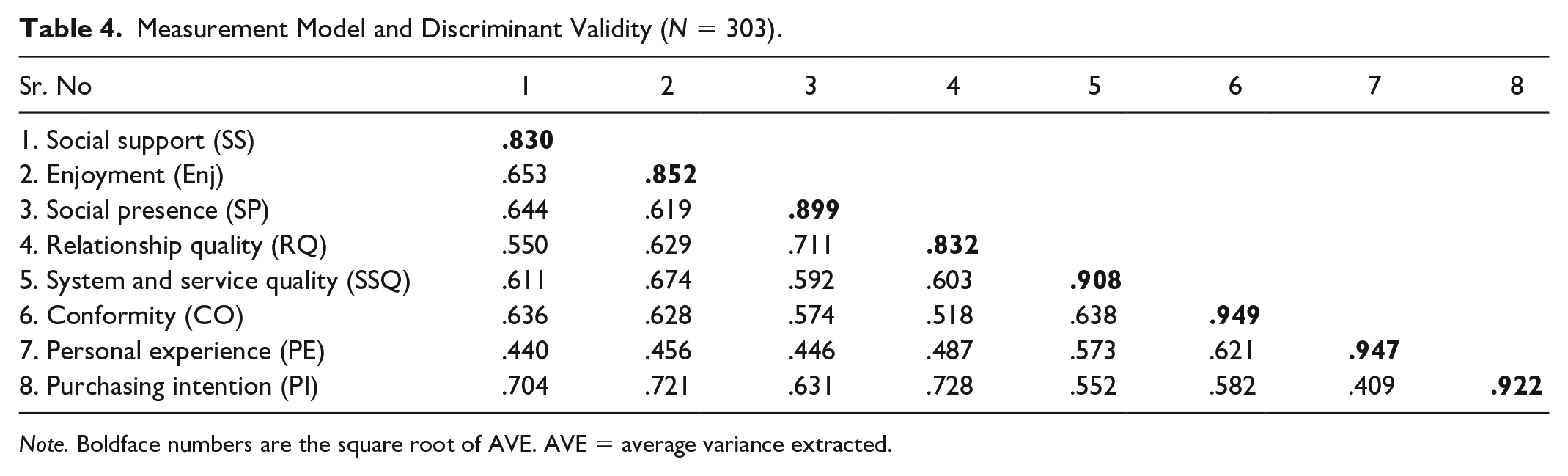
Note. Boldface numbers are the square root of AVE. AVE = average variance extracted.
Measurement Model
The current study measured the validity and reliability of all constructs through different sets of tests. The reliability of each multi-item variable was measured through Cronbach’s alpha test found above threshold value of .7, showing a higher level of internal consistency of variables. In contrast, Construct reliability was measured by the values of composite reliability (CR). Additionally, to confirm the convergent validity, the average variance extracted (AVE) was employed. The results show that the value of CR was above 0.7, and AVE exceeded the minimum threshold of 0.5. (Hair et al., 2012)
In the last, discriminant validity was measured by adopting Fornell and Larcker’s (1981) procedure.
Hypothesis Testing
The collected data were examined using Smart PLS. All the hypotheses were measured corresponding to the proposed study framework. The results showed that social support had a positive influence on consumers’ purchasing intentions, social presence, and relationship quality, validating H1a, H1b, and H1c with β = .298, t = 4.284, p < .001; β = .344, t = 5.013, p < .001; and β = .275, t = 4.357, p < .001, respectively. Likewise, H2 is validated by results with β = .360, t = 5.333, p < .001, which shows that enjoyment is significantly associated with consumers’ purchasing intentions. Moreover, the results confirmed that social presence is significantly associated with enjoyment (β = .419, t = 6.493, p < .001), consumers’ purchasing intentions (β = .179, t = 2.658, p < .05), and relationship quality (β = .213, t = 3.513, p < .001). They also confirmed that H3a, H3b, and H3c are supported. Similarly, H4 is validated by results with β = .150, t = 2.783, p < .05, which shows that relationship quality is significantly associated with consumers’ purchasing intentions. Furthermore, H5a and H5b are supported by findings with β = .451, t = 8.066, p < .01 and β = .287, t = 4.443, p < .01, respectively, which shows that system and service quality is significantly related to relationship quality and consumers’ purchasing intentions. Finally, H6a and H6b propose that conformity and personal experience are positively associated with consumers’ purchasing intentions with β = .253, t = 4.157, p < .001 and β = .199, t = 2.413, p < .01, respectively. Figure 2 and Table 5 indicate the results of hypothesis testing.

Results of model tests.
Structural Model Results (Hypothesis Testing).

Note. SS = social support; PI = purchasing intention; SP = social presence; RQ = relationship quality; Enj = enjoyment; SSQ = system and service quality; CO = conformity; PE = personal experience.
p < .05. **p < .01. ***p < .001.
Moderation
We evaluated the moderating effect of conformity. We considered the positive moderating effect of conformity on the association among social presence, social support, and consumers’ purchasing intentions. The result shows that conformity positively strengthened both relationships (H6a: β = .129, p < .05; H6b: β = .111, p < .05). Thus, H6a and H6b are supported (Figure 3).

Conformity strengthens the positive relationship between social support and purchasing intentions, and between social presence and purchasing intentions: (A) moderating effect of conformity on social support → purchasing intentions relationship and (B) moderating effect of conformity on social presence → purchasing intentions relationship.
Next, personal experience’s moderating effect was also evaluated. We considered the negative moderating effect of personal experience on the association among social support, social presence, and consumers’ purchasing intentions. The result shows that personal experience dampened both relationships (H7a: β = –.113, p < .05; H7b: β = –.143, p < .05). Thus, H6a and H6b are validated (Figure 4).

Personal experience dampens the positive relationship between social support and purchasing intentions, and between social presence and purchasing intentions: (A) moderating effect of personal experience on social support → purchasing intentions relationship and (B) moderating effect of personal experience on social presence → purchasing intentions relationship.
Importance-Performance Map Analysis (IPMA)
According to Ringle and Sarstedt (2016), IPMA is a useful analysis approach in PLS-SEM that extends the standard results reporting of path coefficient estimates by adding a dimension that considers the average values of the latent variable scores. Figure 5 shows the outcomes of IPMA.
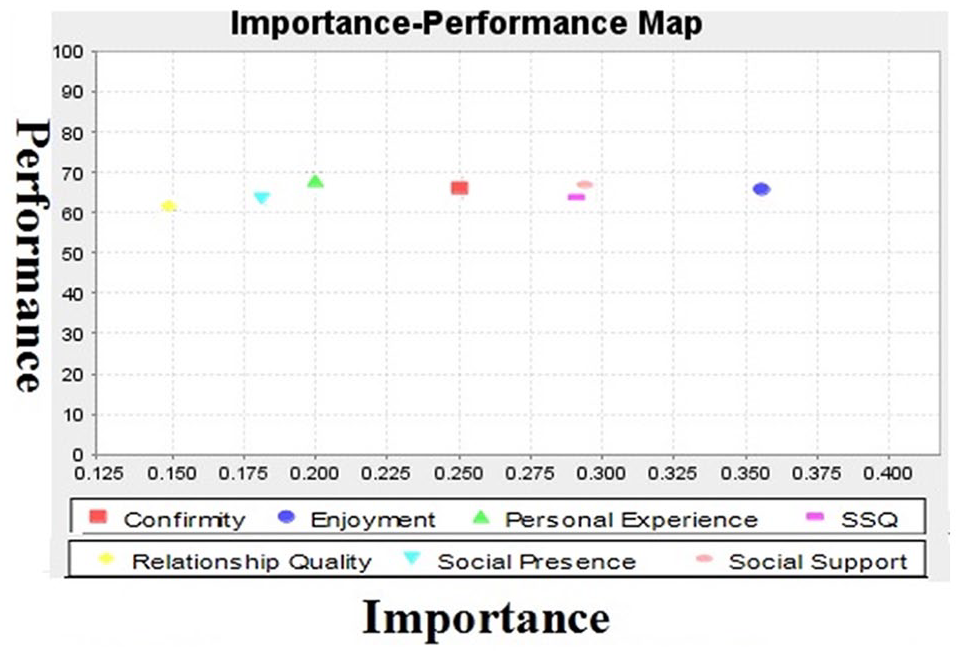
IPMA for consumers’ social commerce–based purchasing intention.
The x-axis represents the significance of a target construct, while the y-axis denotes the performance, which ranged from 0 to 100. This technique provides the significance of parts, which required to develop. The IPMA findings for consumers’ purchasing intentions indicate that enjoyment, relationship quality, social presence, social support, and system and service quality had a greater performance (average values) and significance (average values) for consumers’ purchasing intentions (enjoyment: 0.360, 65.677; relationship quality: 0.150, 61.007; social presence: 0.179, 64.154; social support: 0.289, 66.796; system and service quality: 0.287, 63.975; conformity: 0.253, 68.813; and personal experience: 0.199, 69.183). Accordingly, per unit increase in enjoyment, relationship quality, system and service quality, social presence, and social support, the performance of consumers’ purchasing intentions increased by 0.360, 0.150, 0.179, 0.289, 0.287, 0.253, and 0.199, respectively.
Discussion
Social commerce cannot endure without cognizing the consumers’ purchasing intentions development process (Ko, 2018). Thus, examining the role of most critical aspects leading to consumers’ purchasing intentions is essential for both scholars and managers. Outcomes from earlier studies on purchasing intentions have mostly botched to incorporate social elements and mooring effects; therefore, these studies cannot sketch a holistic depiction of the development mechanism of consumers’ purchasing intentions. This study investigated the role of social factors (i.e., relationship quality, social presence, and social support), enjoyment, and system and service quality, by integrating mooring effects as moderators in the model to explain consumers’ purchasing intentions. Our results prolong the current literature on social support, relationship quality, enjoyment, and system and service quality (Hajli, 2014; Tajvidi et al., 2017). We also extend the prevailing literature (Zhang et al., 2014) on social presence, by examining the direct relationship among social presence and consumers’ purchasing intentions. Furthermore, the statistical results confirm that personal experience negatively moderates the positive association of social factors (i.e., social presence and support) and consumers’ purchasing intentions.
First, the outcomes of this study validate the association among social support and consumers’ purchasing intentions. This outcome is consistent with earlier findings of Hajli (2014). As consumers try to obtain prepurchase product information through different sources (i.e., blogs, peers), they consider peer opinion to be more trustworthy than statistics provided by the company. Consumers always share their product knowledge and personal experience with other consumers through social interaction and support them in making purchase decisions, which in turn significantly influences their purchasing intentions. Furthermore, the results also confirm the positive relationship among social support and social presence. This result is aligned with the results of Jiang et al. (2019).
Moreover, the outcomes specify that the quality of social interaction in social commerce platforms is inclined by social support. This shows that a healthy, supportive relationship and interaction between consumers are the critical success elements of social commerce (J. Kim & Park, 2011). This result empirically supports the findings of Pisitsankkhakarn and Vassanadumrongdee (2020), and proposes that the social commerce environment can increase consumers’ relationships in terms of social support. Once consumers get assistance from other consumers, their level of trust, commitment, and satisfaction will increase toward a social commerce platform, which resultantly enhances consumers’ purchasing intentions.
Furthermore, the statistical results determine the significance of social presence on consumers’ purchasing intentions. This finding opposes the results of Kang and Johnson (2013) and Zhang et al. (2014). This is most likely due to the development of strong social bonds between consumers. Hence, it may evoke curiosity among consumers who look for valuable information and may stimulate them to chip in in social commerce. The outcomes endorse the significance of social presence on enjoyment and the role of enjoyment on consumers’ purchasing intentions. Also, the statistical outcomes of this study validate the proposed association among social presence and relationship quality. This result offers that an athletic association between sellers and consumers (Tajvidi et al., 2017) and an upper level of social presence (M. Shin et al., 2019) are the critical success elements of social commerce. Once consumers obtain accurate information from sellers through social commerce platforms, their level of commitment, satisfaction, and trust will increase toward those sellers, which resultantly enhances consumers’ purchasing intentions.
Another finding of the current study is the noteworthy impact of relationship quality on consumers’ purchasing intentions. This outcome is in accordance with Hajli (2014). Relationship quality will influence consumers’ purchase decisions, and better quality of a relationship will improve their social commerce–backed purchasing intentions. The social interactions between consumers provide support to peers and businesses as well. This social interaction improves the relationship quality, which in sequence affects consumers’ social commerce–backed purchasing intentions. A higher level of consumer trust, commitment, and satisfaction will increase consumers’ purchasing intentions.
In conclusion, improving the system and service quality is a critical aspect of social commerce. This outcome is aligned with Hew et al. (2018). Web 2.0 facilitates online social interactions. Social commerce webpages are the medium for interaction, and the quality of the medium can significantly influence the social interaction process. Good quality webpages can help consumers share information with peers more conveniently. Hence, improving service and system quality is significant for businesses.
Finally, conformity had a moderating and direct influence on the association among social support and social presence of firms, and consumers’ purchasing intentions. Consumers having a higher conformity level will lead to improved purchasing intentions. These findings are aligned with previous studies (Kang & Johnson, 2013; C.-Y. Li & Ku, 2018) and validate the concept that conformity is positively linked with consumers’ intentions to engross in social purchase events. Moreover, personal experience is positively associated with consumers’ purchasing intentions. This outcome is according to C.-Y. Li and Ku (2018) and confirms the idea that personal experience is positively associated with consumers’ purchasing intentions in social commerce environments. Also, personal experience showing negative moderating association between positive relationship of social factors and purchasing intentions. These findings negate the outcomes of a study conducted by C.-Y. Li and Ku (2018). Experienced consumers prefer to do product evaluation based on their knowledge rather than obtaining information from peers or businesses.
Implications, Limitations, and Future Scope
Implications
The research conclusions reveal the following theoretical understanding. First, this study considerably adds to the prevailing body of literature by hypothesizing the role of social support theory, social presence theory, relationship quality, mooring effect (i.e., conformity and personal experience), and other consequences of consumers’ purchasing intentions (i.e., enjoyment, and system and service quality), which provides a new aspect in social commerce research. The robust model (Figure 1) and statistical findings throw light on the use of social factors and mooring effects in developing the broader savvy of consumers’ purchasing intentions and their consequences. Several previous studies on social commerce have focused on other aspects, for example, regarding it as a predecessor to social desire or commercial desire (Ko, 2018), to the scheme of social commerce platforms (Mikalef et al., 2017), to computer-generated customer experiences and technological atmospheres (Zhang et al., 2014), and technology, management, and people. This study, however, move off from earlier studies by instituting its significant effect on social factors and mooring effects when used as a driving force in this respect. This will open a new window for scholars to examine consumers’ behavioral motives in social commerce framework.
Second, with the intention to better recognize the complexities of the influence of social factors on consumers’ purchasing intentions, the moderating impacts of conformity and personal experience have been studied. Although user or firm spawned content has several studies on consumers’ social exchanges, very few studies have discussed the role of conformity (C.-Y. Li & Ku, 2018). This study projects the acute significance of conformity in developing consumers’ purchasing intentions. The findings of this study back the significance and also answer the question that why it matters in social commerce framework. First, conformity, as a moderator, strengthens the influence of social support and social presence on consumers’ purchasing intentions (J. Kim & Park, 2011; C.-Y. Li & Ku, 2018). Thus, we significantly add to the social commerce literature by theorizing the moderating role of conformity on purchasing intentions and how this incorporates social support and social presence to influence consumers’ purchasing intentions.
Last, the conceptualization of personal experience as a moderating construct in consumers’ purchase intentions distinguishes this study from prevailing literature that has attributed personal experience as an antecedent to consumers’ switching intentions. For example, personal experience has been considered as an essential construct that influences consumers’ behaviors (Liu et al., 2016). Considered as attitudinal (Osei-Frimpong & McLean, 2018) and behavioral (C.-Y. Li & Ku, 2018), personal experience works as a moderator in consumers’ purchasing intentions, as recognized in this study. So, we add to the literature on social commerce by theorizing the moderating role of personal experience in purchasing intentions and how this integrates with social support and social presence to affect consumers’ purchasing intentions.
On the basis of the above findings and understanding, this study has vital implications for managers. First, by understanding the factors influencing consumers’ purchasing intentions, both national and multinational firms will be able to develop strategies to address consumers’ needs and improve their reputation. Businesses could improve the level of social support, social presence, and relationship quality with consumers to grow trust and increase brand status; for instance, sellers could bring sociability and enjoyment to consumers through the social environment. Second, the outcomes of this study suggest that businesses need to develop social platforms to enhance social presence and social support. These social platforms could provide opportunities for individuals to interact with peers and sellers, which in turn produce trust, satisfaction, and commitment.
Third, the outcomes of this study propose that conformity strengthens consumers’ purchasing intentions in social platforms; for example, businesses could design social platforms to provide social interaction opportunities because communication and coordination enhance consumers’ conformity levels. Fourth, this study suggests that personal experience weakens the influence of social factors on consumers’ purchasing intentions. Organizations cannot control consumers’ online purchase experiences but could improve them through online purchase platforms; for example, online sellers could provide product trials to encourage usage experience. Also, by following consumer preferences, businesses could customize their sale strategies; for example, through tracking consumers’ product search history, online sellers could provide product ratings and reviews to new consumers and one-click purchase to experienced consumers.
Moreover, our statistical results propose that social commerce service providers could handle the technological aspects and test the influence of these aspects on consumers’ experiences. Managers could increase the level of interactivity between consumers and social commerce platforms by providing less restrained and real-time interactions. To improve the sociability aspect of social commerce, managers could provide convenient and comfortable communication channels to develop healthy relationships. For example, managers could offer sociability tools, for instance, social games to develop consumers’ capacity to socialize and to enhance the pleasure of socializing. Notably, managers could group consumers according to their search preferences, to improve their virtual experiences.
Finally, managers and social sellers working in countries like China, where consumers’ readiness to practice social commerce is not high, need to be more aware. Mainly, social sellers should focus on making the purchase process on social platforms more comfortable and more reliable, and highlight its advantages. For instance, through promotional activities, social sellers could emphasize the importance of social commerce by focusing on the ease and usefulness with which consumers can achieve their shopping objectives.
Limitations and Future Scope
The current research has been subject to a few limitations, which can give rise to a call for prospective studies. First, the study is narrowed to consumers of social commerce in China. Future studies could consider a large number of social commerce users from diverse regions with diverse cultures, to obtain more results on consumers’ purchasing intentions. Second, this study used mooring effects (i.e., conformity and personal experience) as moderators. Future studies could consider some other mooring effects (e.g., habit and switching costs) as moderators. Furthermore, prospective studies could also study the relationship between enjoyment and satisfaction. Moreover, this study was conducted at a specific time and place, and it cannot pinpoint whether purchase intention changes over time or not. Furthermore, future studies could use the “Fuzzy-Set Qualitative Comparative Analysis” (fsQCA) better to understand the difference between a combination of predictors to explain higher and lower levels of purchasing intentions.
Footnotes
Declaration of Conflicting Interests
The author(s) declared no potential conflicts of interest with respect to the research, authorship, and/or publication of this article.
Funding
The author(s) received no financial support for the research, authorship, and/or publication of this article.
