




Abstract
This systematic review was based on the work of Arksey and O’Malley and presents the current research on social media use in North American basketball. Thirty-five articles were reviewed to (a) identify authors, concepts, research methods, and the results that have provided greater insight into the role of social media in sports; and (b) describe both the strategies underlying social media use according to user profiles and the new relationship that is emerging between social media and the world of sports. The review reveals the multifaceted nature of the issues that have emerged with the increasing use of social media in sports, and this is discussed within the framework of the model proposed by Jenkins.
Introduction
“Welcome to convergence culture, where old and new media collide” (Jenkins, 2006/2013, p. 22). This is how Jenkins theoretically connected social media to the emergence of a new culture in which content flows through multiple media platforms, the various media sectors cooperate, and the role of users is ever changing. According to Jenkins, this phenomenon is characterized by both “top down” and “bottom up” processes. The top-down processes refer to the new power associations within media organizations: By transforming economic and technological logics, social media has shaken up the traditional methods of producing content and meaning. The bottom-up processes refer to the public’s increasing familiarization with new resources and their growing power. Social media is thus personalized, offering users active participation and connectedness, which Jenkins (2006/2013) has described, respectively, as participatory culture and collective intelligence.
By offering new opportunities to social actors, social media quickly became distinguished as a determinant factor of convergence. The earliest forms of social media emerged in the 1990s as part of the democratization of the internet. Sales platforms such as eBay (1995), content publishers such as Blogger (1999), and instant messaging services such as MSN Messenger (1999) gave us our first glimpse of the new possibilities for social interaction. Yet, until Facebook in 2004, no blogging platform, discussion forum, chat platform, or even virtual community was described as “social” (Coutant & Stenger, 2012). From 2004 onward, however, the development of Web 2.0 intensified and social media grew in power. Web 2.0 facilitated “interconnection, participation, and collaboration through social media usage, interactions, and platforms” (Pedersen, 2014, p. 101), enabling companies such as MySpace and YouTube to exploit collective intelligence (O’Reilly, 2005). Within 14 years, social platforms such as Facebook, YouTube, Twitter, and Wikipedia have become media leaders, changing the way much of the world consumes information (Cavazza, 2014).
More theoretically, Proulx et al. (2011) defined social media as (translation) “media software that enables users to maintain a presence and communicate and interact online. These systems support and stimulate interactive exchanges, as well as interpersonal and group communication. By doing so, they affect the very nature of the exchanges” (p. 4). These forms of social media have a considerable influence on the way we interact, create, consume, and enjoy ourselves. Given their capacity to shape our everyday lives over the long term, they are clearly a major social development. Mangold and Faulds (2009) emphasized the complexity of social media, defining it as “a hybrid in that it springs from mixed technology and media origins that enable instantaneous, real-time communication, and utilizes multi-media formats (audio and visual presentations) and numerous delivery platforms (Facebook, YouTube, and blogs, to name a few)” (p. 359). Driven by user-generated content, social media potentially places considerable control and power in the hands of the average stakeholder (W. Coombs, 2012).
To illustrate the social phenomena brought about by the convergence culture, Jenkins (2006/2013) turned to the study of The Matrix, Survivor, American Idol, Star Wars, and Harry Potter franchises. The sports industry, like these industries, is a cultural attractor and cultural activator that brings together various media and dynamic communities. It contributes to and satisfies the standards of the new era we are entering: one whose starting point was the “digital revolution” (Gifford, 2012). Sports today use social media to involve the various actors in the (co)production and (co)presentation of content, ultimately becoming a circuit of expression where each participant works to support the activity of the others (Lévy, 1994). Indeed, social media is now an integral part of the sporting experience (Sanderson, 2011a). A good example is a mega-event such as the Olympic Games, which attracts an increasing number of comments, likes, and shares on platforms such as Facebook, Google-Plus, and Instagram (Rowe & Hutchins, 2014). Social media has a create-and-collaborate nature, and this has transformed the modern sports spectator from a passive audience member to an active contributor in the sports/media production complex (Bowman & Cranmer, 2014; Ritzer, 2015). Notably, the various sporting bodies have been forced to develop new strategies in this context. Although the use of neologisms such as mediasport and sportainment is certainly due to television (Wenner, 1998), the growth in vocabulary brought about by social media is worth considering.
North American sports have always been intrinsically linked to the media and have been pioneers in using new technological systems. As evidence, the collaborative study of Audencia et al. (2014) showed that 68% of Americans follow sports online and that 35% do so through social media. Basketball is a particularly striking example, standing out as one of the most innovative in blurring the boundaries between sports, media, and entertainment worldwide (Andrews, 2003). Although basketball is widely practiced beyond its borders, the North American model remains its nerve center. The National Basketball Association (NBA) is one of the leading sports leagues in the world and remains far ahead of other national leagues such as the Chinese Basketball Association (CBA) or international leagues such as Euroleague. Thus, the North American model seemed an appropriate choice to study social media in sports, rather than the International Basketball Federation (FIBA): The NBA exploits and showcases its own operations and even has a strong business development policy. Moreover, as basketball has grown, it has greatly benefited from close ties to the media. Although the role of other amateur and international bodies should not be overlooked, the NBA offers the best vantage point for observing the influence of social media and its uses. The emergence of the digital era and the democratization of the internet are two major factors in its success, especially outside the United States. In February 2016, the NBA announced that it had surpassed the symbolic milestone of 1 billion subscribers to platforms such as Twitter, Facebook, Instagram, and Sina, becoming the first sports organization in the world to reach this threshold (Official Release, 2016). In 2016, 24.2 million related tweets were sent during the NBA Finals and these tweets were viewed more than 8 billion times on Twitter and across the web (Twitter Data, 2016). In 2014, Formentin and Babiak also noted that the NBA had accumulated more than 15.5 million likes on Facebook and nearly 6.6 million Twitter followers. In 2017, it had nearly 34 million Facebook fans and more than 26 million Twitter followers.
The NBA also benefits from the strong presence of its players on social media. Among them is LeBron James, who was named Sportsperson of the Year for the second time (2012, 2016) by the influential American weekly magazine Sports Illustrated and is one of the most followed active athletes on Twitter, behind soccer superstar Cristiano Ronaldo (Fan Page List, 2017). This ubiquitous presence of social media has not left the scientific community indifferent, as demonstrated by the studies of K. A. Brown et al. (2012), Mocarski and Billings (2014), and Yuan et al. (2016). In addition, basketball is one of the most widely played and publicized amateur sports worldwide. The National Collegiate Athletic Association’s (NCAA) North American university championship is extremely popular in the United States. Gaines and Nudelman (2017) found that more U.S. schools participate in the NCAA championships for basketball than for any other sport. Moreover, it is broadcast by ESPN International in nearly 165 countries and in five languages. According to the Social Guide (2014) application, which specializes in audience research, the national semifinals generated nearly 1.8 million tweets seen by roughly 200 million followers. Indeed, basketball is one of the most popular sports in the world. In 2017, FIBA estimated that there were 450 million players worldwide (fiba.com).
In their review, Filo et al. (2015) noted that many studies have investigated the links between sports and social media. However, few have focused on the links between the different types of users and/or between the various media, and none have examined the place and role of social media through the prism of convergence. An investigation of how the key actors in North American basketball use the social media would, therefore, provide a better theoretical and empirical understanding of how social media users and the various media are linked in this new context. It might also offer researchers tools to better understand the changing relationships between the different actors and sports in the ongoing process of convergence.
Essentially, the objective of this review is to offer food for thought that complements the findings of sports media studies on the developments in big data and social media. It suggests that an epistemological shift is needed to understand the media and cultural movement that is currently underway, and it has taken North American basketball as a laboratory for examining this phenomenon. Interestingly, some scholars note that we are seeing another way of “doing” media (Jenkins, 2006/2013), whereas others believe that, using professional basketball as a privileged field of study, we are instead seeing how image and practice merge to give rise to a new relationship with sports and their mediatization (Andrews, 1996). Through a systematic study of the literature, this article thus seeks to shed light on this debate.
The review adopted Arksey and O’Malley’s (2005) model, which they defined as “a useful way of mapping fields of study where it is difficult to visualize the range of material” (p. 21). The method they proposed was adapted to this research and partially addresses the concerns about covering a rich and extensive literature (variety of stakeholders, paradigms, etc.) and pinpointing research sectors yet to be developed.
Method
A systematic review of the literature enables scholars to identify the nature and extent of the research data on a given subject (Grant & Booth, 2009). We used the five phases described by Arksey and O’Malley (2005) to identify the authors, concepts, and methods, as well as the results that provide in-depth data on the role of social media in sports. We also sought to understand the logic underlying the use of social media according to the user profiles and the corresponding relations with sport.
We originally intended to provide a thorough and detailed presentation of the data on our topic, but the method we had chosen in some cases limited or reduced the field of analysis. Our preliminary work, which took into account all major sports in the United States, revealed certain limitations. For example, quantitatively, the combined analysis seemed restrictive due to the high number of articles on this topic within a given period (2004–2018), and it was not sufficient to ensure that all data had been collected. We also observed a problem of a qualitative order because the processing mode and conclusions would be analyzed without the sports being distinguished in any way. Yet, each sport has specific features and operates with its own organizations. For these reasons, we chose to limit our review to basketball.
Phase 1: Formulating the Research Question
The original research question was the following: What do we know about how the actors/spectators of North American basketball use social media? This led to several other questions and our research question ultimately became the following:
Based on the premise that understanding social media and its effects implies partially understanding the strategies of those who use it, we distinguished among the various actors. We used Filo et al.’s (2015) definition of social media as the “new media technologies facilitating interactivity and co-creation that allow for the development and sharing of user-generated content among and between organizations (e.g., teams, governing bodies, agencies and media groups) and individuals (e.g., consumers, athletes and journalists)” (p. 166). On this basis, four major categories of social media users in the context of U.S. sports emerged: fans as ideal consumers (Hills, 2002), institutions as strategic organizations for communication actions, athletes, and journalists.
Phase 2: Identifying the Relevant Studies
The definition of social media that we chose guided the literature search. To identify the main studies, the following databases were consulted: Academic Search Complete, SPORTDiscus, Communication & Mass Media Complete, Sociological Abstract, and SCOPUS. The first three are affiliated with the library resource provider EBSCO Information Services and include nearly 17,000 indexed, abstracted, and peer-reviewed journals and magazines. Sociological Abstract offers approximately 1,800 serial publications and SCOPUS, nearly 21,500 peer-reviewed journals. These databases were chosen because they provide one or more sections in sociology relating to communication studies, sports science, and media science. Many publishing houses specializing in the distribution of academic journals were represented in this group; among them, Sage, Springer, Elsevier, and Taylor and Francis controlled nearly 50% of all journal articles published in 2016.
We used an advanced search mode with several keywords to query each database. Keywords were divided into four major themes: (a) sports, (b) media, (c) users, and (d) geographic zone. Each term was used in its various terminological forms (synonyms, plural/singular forms, spelling variations, and acronyms).
Beyond the generic term basketball, the “sports” category took into account “basketball” and the most important national and international basketball leagues. The terms used for the “media” and “users” categories were those used by Filo et al. (2015). Several conceptual variations were added, such as notions about social networking, online communities (Shilbury et al., 2014), and the various digital media that enable them to be used. The “geographic zone” category implies a spatial limitation to the sport under question. For this study, this category covered basketball only in North America (see Table A1 of the appendix).
Phase 3: Selecting the Studies That Met the Inclusion Criteria
Although our approach was essentially based on the work of Arksey and O’Malley (2005), several systematic reviews were also consulted (Park et al., 2013; Tant & Watelain, 2014) to help refine our inclusion criteria. Each article had to meet the following criteria:
(a) published in a scientific journal;
(b) peer reviewed;
(c) published between January 2004 and February 2017 (the start date corresponds to the appearance of Facebook in 2004, which some consider to be the key event in the democratization of the term “social media”; Coutant & Stenger, 2012);
(d) published in English;
(e) consisting of primary or secondary studies on the role or effects of social media;
(f) focused on specific users: fans, athletes, institutions, or journalists; and
(g) consisting of primary or secondary studies on North American basketball, its practices, and reception.
This methodological protocol was developed by four researchers, who referred to the initial results of a more general academic work. Only one researcher evaluated all the studies that had been selected according to the above criteria to maximize the reliability of the selection process. Each study was evaluated using a dichotomous scale to determine the presence or absence of each criterion. The identification and detailed analysis of the selected articles were supervised by the four authors (see Figure 1).
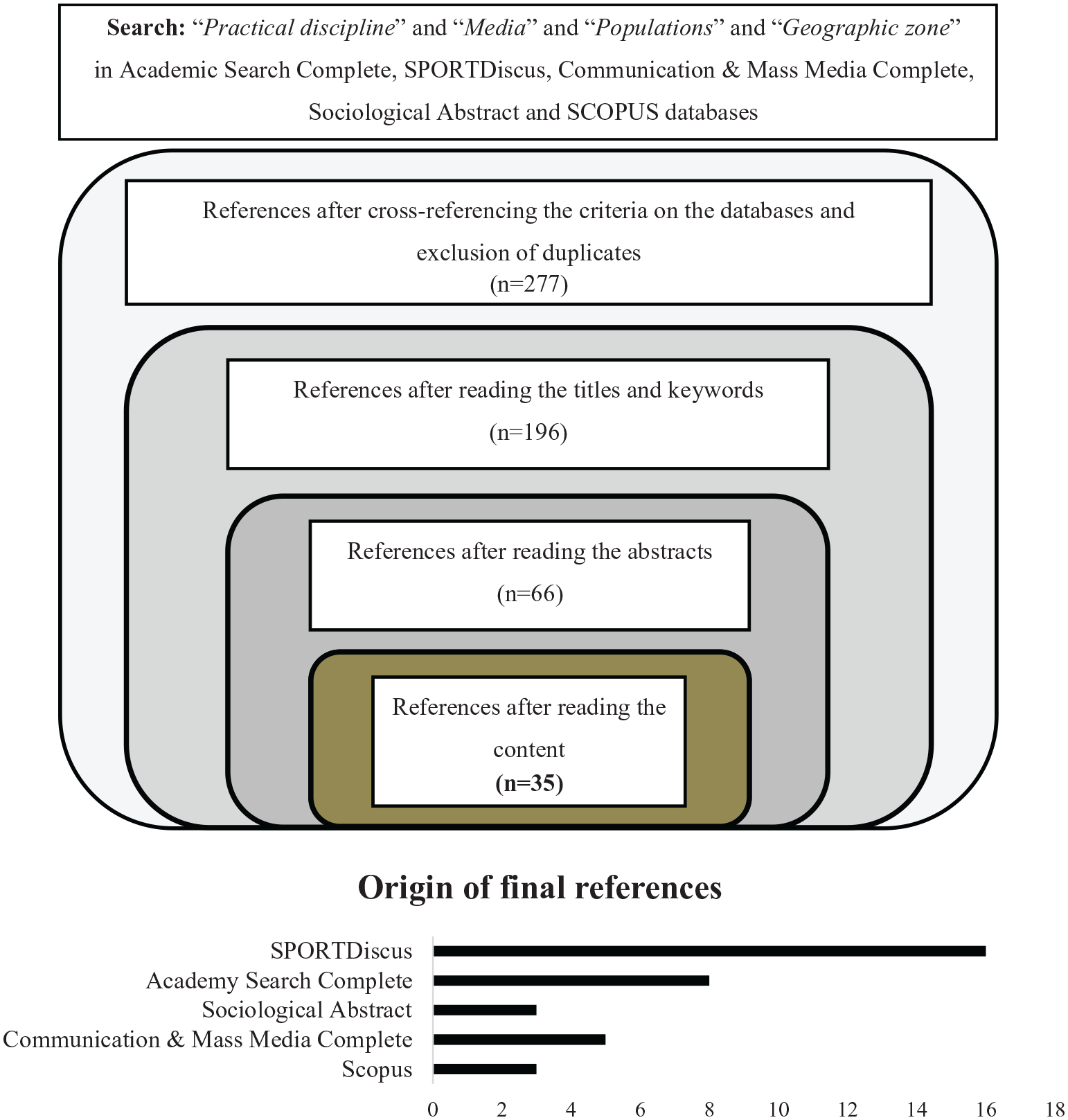
Identifying and selecting the referenced articles.
The articles were selected after cross-referencing the themes in each database (n = 277). In this step, duplicates were removed. The articles were then assembled based on the titles and keywords provided by the authors (n = 196). This grouping was based on a careful determination of the principal concepts underlying the research. A third sorting was carried out using the abstracts (n = 66). This step reduced the previous sample by two thirds, and in this sense was certainly the most decisive step. It was also a difficult step to carry out as the abstracts did not always reflect all the ideas presented in the texts. To conclude, the final choice of documents was based on an exhaustive study of their contents (n = 35). Attentive reading gave us a more detailed understanding of the studies and enabled us to differentiate them on the basis of content.
Phase 4: Extracting and Analyzing the Relevant Data
We used an inductive approach to extract the content of the selected documents and then grouped and categorized them according to themes. A summary table facilitated the data analysis. Data were systematically analyzed based on the author, year of publication, main concepts, study objectives, methodology and tools, and significant results.
Phase 5: Compiling, Summarizing, and Reporting
The interpretation phase was composed of two successive processes. The first was a quantitative process with the rigorous compilation of raw results to facilitate interpretation. The second was qualitative, with the objective of giving meaning to the raw data. Similar to Tant and Watelain (2014), we used Thomas’ (2006) general inductive analysis to create categories by thematic grouping. The final objective of this phase was to produce an inventory of the methodological approaches to ensure a thorough evaluation of the various social media and their uses in the context of North American basketball.
Results
In this section, we present our data on the themes. First, we describe the theoretical and practical grounds on which the studies were based. We then look more closely at the links between these grounds and the user profiles. Last, we present the results of our in-depth analysis of the research methods that have been used to study social media in the world of sports.
Categories of Analysis
The documents (n = 35) were subjected to a transparent content analysis. First, the articles were categorized to identify the objective basis for each work more easily. This differentiation was based on the field of research, the media mobilized, the institutional sport context, and the user profiles (Table 1).
References.
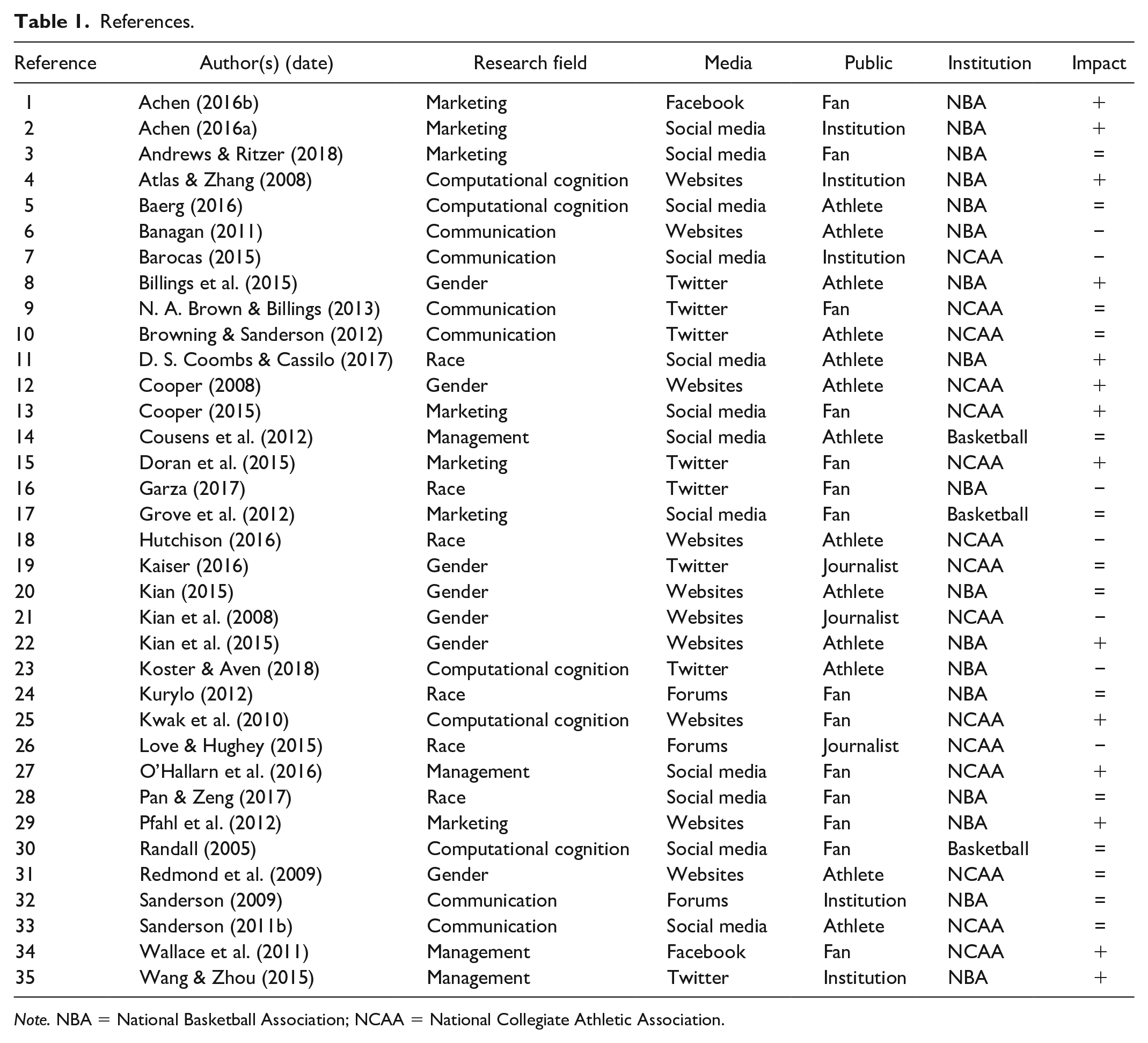
Note. NBA = National Basketball Association; NCAA = National Collegiate Athletic Association.
This approach helped us to distinguish the research logics. As noted, although the topic of social media suggests research in the field of communication (n = 6), other fields were identified. These included gender (n = 7), marketing (n = 7), and race (n = 6), as well as management (n = 4) and computational cognition (n = 5). It should be noted that gender designated all the nonbiological—and thus sociocultural—differences between men and women and included, for example, problems related to sexual orientation or gender identity. Here again, the heterogeneity of the issues addressed can be explained by the unprecedented opportunities for research on social media and its development.
Six types of media were identified. Accordingly, for the sake of clarity and to optimize results, Facebook (n = 2) and Twitter (n = 8) were not combined under the generic theme “social networks.” As these are distinct forms of media in the field of social media research, they were each given their own theme. It should be mentioned that studies in which the media could not be clearly identified (n = 3) and studies referring to a large group of media (n = 9) were included under the generic term social media (n = 12). Altogether, and taking into account forums (n = 3), it seems that the types of media were overall evenly distributed. Nevertheless, websites (n = 10) stand out as a medium that has been particularly prominent in studies on social media. This finding is undoubtedly due to the long-standing involvement of websites in the development of new forms of media and social interactions.
The articles were categorized according to context. The first category was deliberately general: basketball (n = 3) as a sport in its own right. The second category concerned the NBA (n = 17), and the third concerned the NCAA (n = 15).
Uses and Users
Based on the principle that “understanding social media and its effects implies partly understanding the strategies of those who use it,” we examined the positions of fans, sporting authorities, athletes, and journalists.
Statistically, fans (n = 14) and athletes (n = 13) were found in nearly three quarters of the examined articles on North American basketball in social media, well ahead of institutions (n = 5) and journalists (n = 3).
We then crossed the data from the four categories of analysis. We especially tried to clarify the meaning and roles of the user profiles based on the fields of study and the social media to which they were methodologically linked. We thus cross-referenced the data while retaining the user data as reference values. Although not exhaustive in terms of their description, attempts were made to successively reveal certain research trends.
First, the correlation between the media and the user profiles studied enabled the researcher to raise two points (see Figure 2).

Media according to user profiles.
The first is that most of the studies based on website searches (n = 9) seemed to have concerned athletes (n = 6). The second is that Twitter (n = 8) was the only platform on which all user profiles were present. This observation notably reminds us of the heterogeneity of the issues generated by this media format.
A qualitative analysis of the themes addressed according to user profiles yielded two interesting results (see Figure 3).

Fields of study according to user profiles.
The first is the finding that athletes had an important place in gender research (Billings et al., 2015; Cooper, 2008; Kian, 2015; Kian et al., 2015; Redmond et al., 2009). The second is that fans had a significant role in marketing research (Achen, 2016b; Andrews & Ritzer, 2018; Cooper, 2015; Doran et al., 2015; Grove et al., 2012; Pfahl et al., 2012).
These two observations indicate that specific users are of marked interest within certain fields of study. Thus, the question of gender is widely debated in the context of professional sports, whereas understanding fans and their experience remains a major challenge in marketing, particularly in terms of converting fans into consumers.
We examined the article contents to assess the media impact according to the user profile (see Figure 4). Many of the studies seemed to demonstrate a positive media impact (n = 14). This was particularly true of Achen (2016b), who showed, for example, that commitment to a network such as Facebook has a positive impact on fans’ relationship quality. Others, like Kian et al. (2008), reported a negative impact (n = 6) and denounced the articles on the web that construct narratives reinforcing a hierarchical gender order in sports. The other articles suggested a mixed influence (n = 15) on users. For example, Browning and Sanderson (2012) found that Twitter was a beneficial communicative tool for student athletes but that it also presented challenges.

Social media impacts according to user profiles.
We cross-referenced these results with those obtained for user profiles, and found that the first trend was the lack of positive impact these forms of social media have on journalists. Conversely, the second trend marked the absence of a negative impact in studies linking fans to media. These two trends suggest the logical basis for a study to determine a distinction in the effects of these new forms of media according to user profiles.
Analyses of Articles’ Research Methodology
Several types of evidence were identified in our literature review (Table 2). Most of the articles centered their approach on a case study (n = 15) or document search (n = 17), which technically includes an analysis of the content of webpages and social networks.
Data Collection Method.

Several articles used a variety of methodological tools in their studies (n = 12). This variety of approaches and the need for multiple tools suggest once again that the analysis of social media is an extremely promising area of research.
Moreover, the analysis of the article contents revealed a relatively balanced distribution between quantitative (n = 9), mixed (n = 11), and qualitative (n = 15) approaches (see Table 3). Similar to the research fields, the mixed method approaches were varied and demonstrated a potential that was both analytical and reflective.
Types of Data Analysis.

Basketball as an Experimental Laboratory for Social Media and Its Effects
In this systematic review, we examined the links between the use of social media and the emergence of new social and sports contexts. The more qualitative approach to the studies, therefore, seemed legitimate. The purpose was to analyze their general objectives and theoretical justifications to pinpoint the plausible consequences and issues arising from the use of social media. The broad range of disciplines could be viewed as convincing testimony of the social transformations suggested by Jenkins (2006) through his theory of convergence.
By using basketball as an experimental laboratory to describe and study social media, the authors were attempting to demonstrate the potentials of social media in the sports world. For the sake of clarity, only the most relevant elements were retained for this inventory of transformations inherent to the use of social media. The description of these results will thus be based on the themes covered by the inventory of articles.
Some of the studies included under the theme of communication demonstrated changes in individual and collective practices. N. A. Brown and Billings (2013) justified their approach on the basis of earlier studies such as that of Stephens and Malone (2009), who had pointed out that the internet had transformed people into active information seekers. This research approach recalls Zuckerman’s theories (1979), especially the notion of sensation seeking. Sanderson (2009) explored how audience labor performed via information and communication technologies (ICTs) helps sports organizations to monitor professional athletes. Other researchers have looked at other types of changes, particularly the ethical complications arising from social media. For example, Banagan (2011) asked “where the field of sports journalism currently sits” (p. 157), and Barocas (2015) hypothesized that the monitoring system encourages schools to engage in conduct that may violate the constitutional and legal rights of students.
Similarly, studies have warned us about the transformations due to the rapid development of social media, notably suggesting that race issues can become even more significant amid hypermediated, 24-hr news cycles (Hutchison, 2016). In this new context, unseen issues have especially emerged around efforts to determine the relationship between dominant racial meanings and racialized discourse (Garza, 2017; Love & Hughey, 2015). These observations are very similar to the new theories that revert to the notions of “subculture” (Hebdige, 1979) and “media-culture” (Maigret & Macé, 2005).
Social media has had an impact on some of the studies that have explicitly taken a gender-based approach. Considering sport as “a social institution that has a considerable impact on the shaping of gay and lesbian subjects” (Rowe et al., 2006, p. 150), the combination of gender and social media constitutes an unprecedented issue in itself. More specifically, by offering data that can be widely used and immediately accessed, social media is transforming the scientific view of the social status of gendered individuals.
In terms of management, the authors stressed the need for sports authorities to fit into the new context that social media has created. They confirmed the need for these organizations to develop strategies for optimizing performance. Cousens et al. (2012), for example, examined collaboration in community sports to understand how integrated networks can be used to drive sports participation. Wang and Zhou (2015) justified their work by pointing out that sports organizations are increasingly using social media to communicate with the public.
Marketing approaches have attempted to demonstrate the “value” of social media. Achen (2016a) based his study on the work of Ferrand et al. (2010) and showed that engagement with social media affects consumer purchases. Similarly, Pfahl et al. (2012) based their hypothesis on Dixon’s (2008) study and reiterated that the digital world is a strategic element for developing and executing offline and online efforts to achieve organizational goals.
Last, although they are more directly concerned with the implementation and development of social media, the cognitive sciences, especially computer science, are also attempting to gain a better understanding of the transformations and issues surrounding social media in a global context. As Atlas and Zhang (2008) pointed out about the new and growing role that the new media occupies in our lives, “Intelligent agents are designed and implemented for a variety of tasks in a diverse range of applications: managing e-mail, navigating and retrieving information from the Internet, online shopping, electronic business, monitoring stock prices or currency exchanges” (p. 83).
In addition to the evaluation techniques that the researchers used to identify the advantages and limitations of social media, the transformations inherent to the development of social media were also noted in most articles. And, although the idea here is to highlight these evolutions/revolutions in the context of basketball, it is clear that the authors perceived the sports context as a mirror of society. The more qualitative analysis in this review indeed reveals a belief in a social and sporting renewal whose evolving markers are the transformations in ways of thinking about and practicing sports. The available literature and the range of themes it embodies strongly suggest the plausible impact of social media and how it shapes the new social representations of basketball in particular and sports in general.
Epistemological Interest
As this scoping study shows, the current sports context has attracted researchers from several fields who are interested in investigating social media, its design and effects, and the issues surrounding it. Its “social” nature suggests the possibility of a broad range of research approaches. Indeed, the unprecedented challenges of these new technologies have prompted researchers in both the abstract and concrete sciences (Spencer, 1871) to take a closer look at the phenomena. Yet, this same “social” nature implies a wide heterogeneity of individuals, groups, and bodies. For this reason, the study of social media requires a comprehensive but differentiated approach, depending on the various audiences likely to be affected.
This review also indicates that the actors in basketball have changed. On a practical level, it appears that the various social media affect both the individual and collective behaviors of those who employ them. The analysis of the selected articles thus confirms the findings in other fields of study and those studies that have taken another sport as the framework for analysis.
Athletes
With social media now an integral part of the sports system, athletes have become users. Amateurs and professionals are now, more than ever, subject to the rules of these new forms of media and the idea of “unfiltered” messages. The growth in the number of platforms has democratized the means for publicly posting and sharing praise or rejection, most likely because the interactive media experience tends to intensify fans’ passions for athletes (Oates, 2009). In addition, studies have shown that the new interconnected technologies are capable of producing “a paradoxical sense of proximity” (Rowe & Hutchins, 2014, p. 14). Athletes can tweet at a fast pace to create positive exposure, engage fans, and increase their visibility because of the interactivity these technologies offer and the quick uptake by the sports industry (Kassing & Sanderson, 2010; Pegoraro, 2010, 2014; Pegoraro & Jinnah, 2012). Professional players should be distinguished from amateurs on this point. Although social media facilitates the interactions between fans and athletes, it is also an unprecedented promotional tool. In most cases, however, only professional players can create a viable business by signing sponsorship contracts or creating their own brands with the help of the world’s leading sporting goods manufacturers. Thus, social media is a timely means for athletes to share information and promote their products (Hambrick, 2012). This is indeed why players are increasingly being supported in how they communicate. However, the freedom granted by social media has also been the cause of missteps. This was particularly the case of NBA superstar Kevin Durant, who was discovered in 2018 to be behind the creation of an unofficial Twitter account critical of his former teammates. A year later, he became involved in a heated debate with a fan about his change of franchise. This example shows both the challenges and potential abuses when social media is overrepresented and overexploited as a communication tool. Social media, although it has greatly increased the fan base and prestige of many athletes, must be handled with care, or it can damage their image very quickly.
Institutions
As the status of fans has changed, sports institutions have adapted their communication strategies to ensure that sports remain an enriching experience. Many have applied a strategy of cross-pollination that takes into account “relations, collaborations and feedback between the different presences of the institution on the Internet: Web page, YouTube channel, presence on Facebook and Twitter and other social networks” (Peña et al., 2014, p. 155). Moreover, most arenas have their own Wi-Fi networks and skilled employees, which confirms that these sports infrastructures are full-fledged users of new media. Community managers have to master these technological tools, and some describe themselves as social media editors. Last, both nonprofit and for-profit institutions are tempted to control content and implement policies to limit any negative effects on their image (N. A. Brown et al., 2014). A notable example is the NBA itself, which has chosen to intervene directly in the foreign countries in which it is followed. Mainly through social media, it has particularly worked to develop official accounts of events and incidents as a way of managing or limiting unofficial versions that might tarnish its image. In France, for example, the position of community manager was created with the express purpose of offering authorized content to fans. Moreover, the NBA controls and enriches its sports universe through its Twitter account. It not only continuously adjusts its platforms but also usually adapts (translation, nationalization) and formats (structured, put into images, etc.) the content it offers to suit the expectations of the target audience. Unsurprisingly, this approach is intensive and requires considerable financial and human resources.
Journalists
The role of journalists has been transformed by the social media boom. In addition to changes in their presentation of and commentary on sports events, they have had to modify their methods of investigation. With the proliferation of new data sources, they now collect information mainly on the web and its various forms, which affects their information-gathering methods and ethics. Social media has blurred the traditional lines between the professional and personal relationships of sports journalists (Reed, 2011). Although blogs, websites, and social networks have become primary sources of information for new-generation reporters, their grasp of these systems has also modified their writing methods. The publication of journalistic content now transits via these digital tools. Many journalists have blogs, Facebook pages, or Twitter accounts in their name and thus extend the range of their discourse (Schultz & Sheffer, 2010; Sheffer & Schultz, 2010).
Fans
In 2010, Gregory noted that for those who follow sports, this is a great time to be a sports fan. People spend more time following sports and do so on multiple platforms simultaneously. As a “viable mechanism for people to display their fandom” (Sanderson, 2011a, p. 72), social media allows fan to become involved and participate (Clavio & Walsh, 2013; Peña et al., 2014). The studies on fan-based communities or parasocial interactions in a sports context (Gantz & Lewis, 2014) are indicative of this new social and cultural context. In his framework, Jenkins (2006) gives a privileged role to fans in convergence culture. They are, in his estimation, the most active segment of the media public, capable of forming a community and producing meaning rather than just consuming it. He refutes the old idea that the spectator is passive and argues that the web makes user activities visible, allowing scholars to consider social media more precisely as a legitimate factor in social evolution. In this new environment, fans are certainly the most productive area in the appropriation and transformation of content borrowed from mass culture. Audiences are capable of arriving at their own decisions about the meaning of media text (De Kloet & Van Zoonen, 2007; Hall, 1980). This phenomenon is particularly noticeable in a high-profile field such as basketball, in which the commitment of fans, alone or as a group, is not at all dictated. In fact, the most viewed video on YouTube in 2010 was a user-created video about NBA star Lebron James, which received nearly 7 million views (Chase, 2010).
More generally, the document analysis seems to have corroborated Jenkins’ finding of a convergence culture. Certainly, it confirms the reciprocal interactions between users. Various publics interact through the various media, which are interlinked in accordance with the wishes of these same publics. Journalists change their editorial strategies to satisfy the explicit expectations of their public. Fans mobilize on Twitter or Facebook and have the power to cause athletes and institutions to question their communication choices. Reciprocally, the athletes and institutions try to offer new experiences to the fans (Baloulli & Hutchinson, 2010). They invite them to share, comment on social networks, and vote for special events—all to obtain and maintain their moral and financial support.
Although social media is not the only direct influence on the advancement of media convergence, its interactivity legitimates its role in the progressive establishment of a new social and cultural order. This order is represented by the concept of transmedia, first suggested by Kinder (1991) and then popularized by Jenkins (2003). According to Jenkins, transmedia refers to a narrative that circulates from one medium to another. He showed that the entertainment industry, in which sports occupy a place in their own right, tends to integrate a multitude of texts to create a narrative that is so dense that it is too much for a single form of media. Thus, transmedia can be defined as a system resulting from the interaction and interconnection between publics and new modes of communication (Cailler & Lacroix, 2014). Having become essential in the current media field and offering an increasingly community-based reception, social media fully integrates this new logic and has led to a loss of coherence in traditional media (Tasente & Ciacu, 2011). Following a process that began with the promotion of animated series such as the Harlem Globetrotters (1970), the setting up of transmedia strategies and the key role of the new forms of media in this interactive process have been demonstrated by advertisements from companies such as Nike, which features stars such as Michael Jordan (1984); films such as Space Jam (1996) and television channels such as NBA TV (1999); the availability of advanced statistics on the web-like player tracking (2013); the commitment to video games from NBA Jam (1993) to NBA2K or NBA Live (2017); and the sheer number of videos such as “Top 10” on social networks.
Many authors have made a point of highlighting a narrative process arising from transmedia: storytelling. Theoretically debated since 1999, storytelling is the creation of a unified narrative that is established on the basis of several complementary forms of media. The idea is to use multiple forms of media through a variety of social actors to create a singular world (Jenkins, 2010). Therefore, it seems normal to place social media methodologically in a broader field of investigation by including it and its uses as recurring components in transmedia storytelling. North American basketball, especially the NBA as a diversified media and entertainment company where basketball is “the metaphorical heart” (Andrews, 2003, p. 279), has to disseminate its narrative through such media strategies. As Kian, Anderson, and Shipka demonstrated in their analysis of the comments on Jason Collins’ coming out, for example, institutions and athletes are ready for openly gay players. With regard to the same case, Billings et al. (2015) stressed that social media, especially Twitter, offered the opportunity for the public to collaborate in framing and disseminating the breaking news about Collins. Both these observations fuel the message of tolerance already disseminated by the NBA through other media sources. Following a televised press conference, NBA Commissioner Adam Silver was very pleased with the positive attitude surrounding the announcement by the first openly gay player in a major sports league in the United States (Beck, 2014).
Conclusion
It should be recalled that the principal aim of this article was to demonstrate the potential power of Arksey and O’Malley’s scoping review methodology and Jenkins’ conceptual framework of convergence for future social science research. The more specific objectives were to lay the foundations for a “multidisciplinary” approach and provide a framework for analyzing contemporary intermedia and interpersonal links. In addition, the practical knowledge revealed in the “Results” section should help to broaden the debate among tomorrow’s researchers, marketers, and other communications professionals by providing them with insights that may well change how the issues currently under discussion are viewed.
Although a systematic review is theoretically a rational and transparent method of identifying research on a specific subject, certain limitations should be noted. Providing an exhaustive inventory of research on any topic is a complex undertaking, given the large number of databases. Only five were searched for this review.
In addition, the language criterion was another limitation. Although experience suggests that most material published on North American basketball is written by English-speaking authors, the international growth of this sport and its major league suggests that researchers around the world may have studied and will continue to study the social media–sports relationship.
Although most of the studies included in this review were quantitative and the number of studies was relatively small, the review also included qualitative works. As Arksey and O’Malley (2005) pointed out, this “provides a narrative or descriptive account of available research . . . does not offer any clear means of synthesizing findings from different kinds of study design” (p. 30). Although doing so enabled us to see how researchers approached the topic and the avenues pursued, abandoned, or undeveloped by them, it did not inherently suggest new perspectives.
If we consider sports as the mirror and reflection of society (Genty & Sudre, 2014), the research to date has demonstrated the role and apparent effects of social media and the unprecedented issues it raises. As evidence of the relevance of this research, Sociology of Sport Journal (SSJ) devoted an entire issue to social media, including practical cases of various forms of blogging and gaming (Dart, 2009; Ferriter, 2009; Hutchins et al., 2009; Leonard, 2009; Plymire, 2009). Since then, several studies have attempted to provide an optimal framework for investigations into the new sociocultural challenges generated by these tools (Abeza et al., 2015, 2018). In addition, as this systematic review shows, North American basketball offers a privileged research laboratory concerning the interactive role of social media.
However, although the studies we analyzed gave us a better picture of some of the methods used to understand social media and a certain inventory of their role in basketball, the impact of social media cannot be fully grasped through a partial review of its uses. As Kwak et al. (2010) explained, “despite the growing interest in social media and user-generated content, both academics and practitioners are struggling to understand the value and consequences of social media” (p. 402). Most have focused exclusively on the links that social media establishes between various stakeholders (e.g., fans and athletes, institutions and fans), without mentioning the relationships they facilitate between stakeholders and other forms of media (e.g., television, cinema, video games).
This secondary research suggests new opportunities to further explore social media and sports using new methods. Although social media is independent and equipped with its own unity and cohesion, it fully acquires its meaning only by relying on other types of media to deliberately form a larger whole. On this basis, would it not be more accurate, regardless of the field of research, to consider all the interactions to determine their affordance? Although some areas remain to be explored, Jenkins’ model offers a theoretical basis that is rich in meaning in the current social media context. A discursive approach to his theoretical concepts enables scholars to view its role from a holistic perspective.
In light of this study’s initial objectives, Jenkins’ global analysis provides a new and broader look at the role and impact of social media in the sports world. The transpositions of media logics such as those of participation and collective intelligence seem to open up perspectives for relevant research in the sports sciences (Billings & Hardin, 2013; Raney & Bryant, 2006; Rivenburgh, 2002; Tomlinson, 1992). However, the scope of such research remains to be measured (Hay & Couldry, 2011) and its theoretical contribution has not yet been demonstrated. Yet, this model, because it is holistic, offers several analytical perspectives. Although the communication, marketing, and management sciences have taken an interest in the principles of interactivity (Witkemper et al., 2016), the issues of transmedia have remained isolated from the debates about race, gender, and social psychology. Also, it may be worthwhile to extend the study of transmedia practices to publics other than fans and media organizations.
Social media is available to many publics and it has many uses. In this regard, it might be fruitful to distinguish social media and its specialized uses according to social reception cultures. Along these lines, it may well be the moment for scholars to consider the phenomenon of Americanization, or at least globalization, in terms of sports practices (e.g., Andrews et al., 1996; Jackson & Andrews, 1996), but this time in the light of social media, as has been the case in other cultural sectors (D’Angelo, 2000).
Footnotes
Appendix
Keywords Cross-Referencing.

| Sports | Basketball/NBA/NCAA/AAU |
|---|---|
| Media | Social media/social network/digital media/Facebook/Twitter/Instagram/Snapchat/YouTube/App/blog/technology/smartphone/smart TV/tablets/networking/publishing/messaging/sharing/discussing |
| Users | Fan/supporter/athlete/sportsman/player/community/manager/stakeholder/institution/franchise/journalist/sponsoring |
| Geographic zone | United States/North America/America/Canada |
Note. NBA = National Basketball Association; NCAA = National Collegiate Athletic Association; AAU : Amateur Athletic Union.
Declaration of Conflicting Interests
The author(s) declared no potential conflicts of interest with respect to the research, authorship, and/or publication of this article.
Funding
The author(s) received no financial support for the research, authorship, and/or publication of this article.
