




Abstract
We explore how the research standards for hiring faculty in Saudi Arabia are compatible with effective practices in the field. Specifically, we examine the outcomes of recruiting practices for special education faculty in the United States, in addition to the worldwide production of special education research. A descriptive analysis was conducted, examining the educational backgrounds of 124 faculty members in top special education programs in the United States and 140 highly cited researchers in special education worldwide. Fewer than 10% of the faculty members and researchers hold special education degrees at all three levels of education (bachelor’s, master’s, and doctoral degrees). Recruitment practices in the United States and worldwide generally seem to differ from those used by Saudi universities. Implications for Saudi special education departments/programs are discussed.
Highlights
We examine the current practices for recruiting special education (SPED) faculty members.
Worldwide, highly cited research production in SPED comes from researchers with diverse educational backgrounds.
In the United States, 9% of SPED faculty hold degrees in SPED at three levels.
Faculty with various educational backgrounds in Saudi departments could advance the field of SPED.
A remarkable development in educational services provided to individuals with disabilities has been witnessed in Saudi Arabia over the last two decades. As a result, most students with learning disabilities receive services in regular schools. However, students with other types of disabilities typically attend separate SPED classes either in a regular school or separate special schools (Abaoud et al., 2020; Alhano, 2006; Alnahdi et al., 2017; Alnahdi et al., 2019).
The expansion of educational services for students with disabilities over the last decade has created an increased need for teachers majoring in SPED. This trend, in turn, has influenced a wave of position openings and proliferation of SPED departments in Saudi universities over the last 10 years. As the number of SPED departments has increased dramatically (Alnahdi, 2020), rising from three departments in 2004 (King Abdulaziz University, 2001; King Faisal University, 2004; King Saud University, 1984) to 23 departments in 2016 (Keller et al., 2016), there is a large demand to fill the positions in these departments with highly qualified academics. SPED departments and programs in Saudi Arabia provide preparation in a categorical area. That is, teachers are trained to educate students with a specific type disability (intellectual disabilities, learning disabilities, autism and developmental disorders, hearing impairment, or visual impairment).
The terms “students with disabilities” and “students with special education needs” (SENs) are used interchangeably in the legislation of the country. In the Saudi context, SENs is considered an alternative term to disability, showing a terminology influence from England, where the term SEN was officially coined in the Warnock Report (Wedell, 1981/2003, p. 107). To maximize clarity, we use both terms here according to the context.
SPED Faculty Members
Preparing faculty members is a fundamental issue, as faculty members are the cornerstone of universities (Austin & Wulff, 2004). When universities have successful faculty members, the return for universities and for society is significant (deBettencourt, 2014).
In SPED, high-quality faculty in higher education serve as a building block for the successful preparation of teachers working with students with SENs (Hardman & West, 2003). The process of selecting faculty members who will seek further professional development is very important. The lack of a proper selection of faculty members may negatively affect the services provided to people with disabilities (deBettencourt, 2014). Therefore, there is a need for explicit and effective policies and strategies to recruit faculty members.
To select effective faculty members, clarity about their roles and functions is needed. The available literature expresses diverse views about the expectations for faculty members, including knowledge, skills, attitudes, and professional competence (Bilal et al., 2019). Some scholars think that, especially in education, the traditional notion that doctoral education produces researchers is no longer sufficient (Anderson & Anderson, 2012). Taking a different approach, deBettencourt et al. (2016) summarized the main requirements for future faculty members in education as follows: (a) engage in increased publishing even though the primary mission is teacher preparation, (b) incorporate contemporary technology (e.g., use of iPads, course flipping) into teaching and research, (c) generate and secure grant funds, or (d) develop and deliver online coursework, modules, and professional development. (p. 123)
Smith et al., (2010) stated that faculty members should be able to “(a) generate new knowledge about effective practices, [and] (b) translate such research findings into teacher preparation programs’ curriculum” (p. 25). In addition, faculty members are expected to be lifelong learners and remain in touch with their field. Some might consider conducting research to be the main way to achieve this goal.
Although some authors acknowledge the current changes in the roles of faculty members (Austin & Wulff, 2004; Smith et al., 2010), there is a near-consensus that research and teaching are the most frequent activities performed by faculty members (Adams, 2002; Austin & Wulff, 2004; Cadez et al., 2017). There is a close relationship between teaching quality and the quality of research (Cadez et al., 2017; Stack, 2003; Stanton et al., 2009) but not necessarily between teaching quality and the quantity of research produced (Cadez et al., 2017). Some have indicated that job advancement relies heavily on research performance (Cadez et al., 2017), and Stanton et al., (2009) found that research and publishing make faculty members better teachers. In short, faculty are expected to be both good researchers and good teachers. Not accidentally, most Saudi universities increasingly motivate their faculty to be involved in research activities and publication. For example, they give a stipend for publishing articles in journals indexed in the Web of Science. Faculty members are expected to produce not only a large quantity of research but also high-quality research (deBettencourt, 2014).
Faculty members should have the skills to conduct quality research in addition to mastery of specific knowledge (Adams, 2002). Quality research can (a) allow faculty members to generate new knowledge and (b) help them prioritize evidence-based practices. In addition, the effects can spill over, improving both their teaching and the learning of students with disabilities and advancing the field of SPED (deBettencourt et al., 2016; Smith et al., 2010). Thus, the high quality of research is an important indicator of successful faculty members, and it can lead to quality teaching. Although it is difficult to define quality research, a practical way to evaluate the quality of research is the impact of the scholarship in academia, or the number of citations referring to the work of a scholar (Stack, 2003). This study focuses on researchers and scholars with high citation rates (Cadez et al., 2017).
The Selection of Potential Faculty Members for SPED
It is not easy to select and employ successful educators and impactful researchers in academia; the recruitment of future faculty members is a challenge in all disciplines. In fact, a shortage of SPED faculty members has been reported in many countries (Montrosse & Young, 2012; Smith et al., 2010; West & Hardman, 2012). There is a growing demand for faculty members in SPED because of the need to replace retired faculty and due to the growing interest in the field in many developing countries (Ametepee & Anastasiou, 2015; Anastasiou & Keller, 2017). Saudi Arabia, for example, has begun to pay greater attention to SPED services in the last two decades (Al-Mousa, 2010; Alnahdi et al., 2019), and as a result, there is an increasing need to attract and recruit academics to the SPED profession. However, until recent years, there has been a lack of SPED graduate programs in Saudi universities—the first master’s program in the country was developed in 2004, and the first doctoral program was developed in 2017.
SPED departments in Saudi Arabia have addressed the issue of faculty shortages in two ways. First, departments have attracted doctoral degree holders from neighboring Arab countries, such as Jordan, which was one of the few Arab countries to implement initiatives for establishing SPED doctoral programs. In addition, universities have hired doctoral degree holders from the mental health departments of Egyptian universities. Second, to fill the gap over the long term, universities have begun to recruit Saudis with bachelor’s and master’s degrees and prepare them to lead these academic departments. The main recruitment criteria are holding bachelor’s and master’s degrees in SPED and having achieved a high grade point average (GPA) in these degrees. The candidates selected by these SPED departments are expected to travel abroad and obtain a doctorate from Western universities, preferably in the United States or the United Kingdom. Then, in most cases, they return as full faculty members to Saudi SPED departments (see Figure 1).

Recruitment track in special education departments in Saudi Arabia.
Many Saudi universities require faculty members to have specialized in SPED at all three stages of their education (i.e., bachelor’s, master’s, and doctoral degrees). In other words, a common practice is to hire only SPED specialists. However, there is no research that directly or indirectly verifies the effectiveness of this approach. Opponents argue that by adopting this approach, universities are limiting the scope of their faculty members’ knowledge, as they cannot benefit from knowledge, skills, and advances in other relevant scientific fields. Thus, there is a question about the qualifications that SPED departments should consider in the Saudi academic community. Should they follow the usual recruitment approach? Or, for example, should they hire diverse candidates with a doctorate in SPED or a field that is relevant to the position?
It is important for the reader to become familiar with the process of recruiting faculty members and professional development in Saudi universities. In the Saudi context, graduates of SPED departments with bachelors’ or masters’ degrees who have achieved high grades are first selected and employed as permanent faculty. Then they are sent abroad to complete their postgraduate studies at the doctoral level in Western countries, most often to the United States or the United Kingdom.
Faculty recruitment policies are not independent of the expectations about future SPED policies. In designing policies for students with disabilities in the immediate foreseeable future, a very important factor seems to be the implementation of the Convention on the Rights of Persons with Disabilities (CRPD) (United Nations, 2006). Saudi Arabia ratified the CRPD in 2008 and, as of May 2019, has completed a full cycle of reporting and monitoring in accordance with the implementation of the CRPD (CRPD Committee, 2019). Article 24 of the UN CRPD recognizes the right of persons with disabilities to education, requiring that a state party “shall ensure an inclusive education system at all levels and lifelong learning” (United Nations, 2006, para. 1). Through the Concluding Observations, the last document in the monitoring process, the Committee on the Rights of Persons with Disabilities (henceforth CRPD Committee) forms policy recommendations for a state party. In the case of Saudi Arabia, the CRPD Committee recommends that the State party, through the Ministry of Education, take the measures necessary to transform the current education system into an inclusive education system at all levels and for all children with disabilities, and promote and ensure the provision of individualized accommodation and support staff in classrooms. (CRPD Committee, 2019, para 44, p. 10)
In its previous document, List of Issues, the Committee also recommended a more inclusive education system, and considered that “the compulsory training of all teachers on inclusive education and teaching of children with disabilities as an integral part of core teacher training in universities” would be more compatible with such a system (CRPD Committee, 2018, para 22, p. 4). Even though one could assume that the existing system of faculty preparation, which requires specialization in SPED at all three stages of their education (bachelor’s, master’s, and doctoral degrees) serves the current education system of low inclusion, it is not certain that this system could respond well to the needs of a future education system that involves a higher degree of inclusion. In an educational context that prioritizes inclusion for students with disabilities, a more diverse faculty workforce may be necessary.
This study aims to examine the educational backgrounds of highly cited academics both in the United States and worldwide. In a sense, the educational backgrounds of highly cited academics serve as an indirect yardstick for discussing the common approach to recruitment adopted by Saudi universities.
Two main sources of data were chosen to select highly cited academics: (a) faculty members in the top 10 SPED graduate programs in the United States (this turned out to include the top 11 graduate programs because there was a tie in the rank [see Table A2]) and (b) highly cited researchers (HCR) from across the world in the category of SPED on the Web of Science. Researchers and science policy makers have increasingly used data from the Web of Science as a reference for journals’ and scholars’ impact (Bordons et al., 2002). An underlying assumption of this study is that producing research with high impact, as measured by the number of citations, is a key indicator of successful faculty members and effective recruitment practices. This is supported by Stack’s (2003) finding that there is a “significant relationship between the quality of research (citations) and student evaluations of teaching” (p. 539), which is a second big factor for establishment as a successful scholar. In addition, we consider that the educational backgrounds of faculty in the top SPED programs in the United States could reflect effective recruitment practices. Here, we are studying the outcome of effective practices for recruiting SPED faculty and not the recruitment practices themselves. Thus, this study attempts to answer two research questions:
What are the educational backgrounds of faculty members in the top SPED graduate programs (FMTSEP) in the United States?
What are the educational backgrounds of HCR in the SPED category of the Web of Science?
Method
Data Sources
To answer the first research question about the FMTSEP in the United States, we used the U.S. News & World Report’s ranking of the top 10 SPED graduate programs in the United States as of December 2015; we eventually included 11 SPED graduate programs because of a tie for fifth position (see Table A2).
To answer the second research question, we selected HCR indexed in the SPED category of the Web of Science, specifically in the Social Sciences Citation Index (SSCI). The Web of Science’s subject category of SPED included 39 peer-reviewed journals as of December 2015 (see Table A1). Apparently, researchers from several fields contributed to the SPED category. The Web of Science data source provides information about the high-quality research that has been produced and only indirectly gives us insight into the worldwide recruiting practices of SPED departments/programs.
After obtaining information from the data sources and compiling two separate lists for HCR and FMTSEP, we collected information regarding their educational backgrounds. For this purpose, we searched the departmental websites and the personal sites of the scholars on the two lists.
Data Collection, Participants, and Classification Procedures
To answer the first research question, we used the U.S. News & World Report’s list of the top 11 SPED graduate programs in the United States as of December 2015 (Table A2). A search of the departmental webpages led us to create a list of 124 FMTSEP. Of the FMTSEP, 67% were female and 33% were male. Finally, the first author collected data regarding the educational backgrounds of the 124 FMTSEP.
To answer the second research question, the first author analyzed 46,402 documents indexed in the Web of Science, specifically those in SSCI, that is, all the documents within the SPED subject category of the database. These documents included the names of 64,375 researchers. In addition, these documents were cited 349,064 times as of December 21, 2015, when the researcher retrieved this information. The number of citations was chosen as a key indicator that the work had made a very significant contribution to the field, and 500 citations was set as the cut-off point. Researchers whose articles had 500 citations or more were included in the data set as HCR. In total, 140 participants met the inclusion criterion of 500 citations in the Web of Science. However, it was not feasible to obtain complete information about the educational background of some HCRs. For example, there were data on the doctoral level for 110 HCRs (see Table 2). Overall, there were 102 FMTSEP and 56 HCR with complete information regarding their three degrees (see Table 3).
Of the HCR, 24% were female and 76% were male, and 82% were associated with U.S. universities, 7% were associated with U.K. universities, and 11% were associated with universities in other countries. Second, we collected data regarding participants’ educational backgrounds by searching the departmental websites and the participants’ personal websites.
The educational backgrounds of the participants were organized into three categories (SPED, psychology, and other) (see Table 2). FMTSEP and HCR who had an SPED background had any degree in SPED, including specific disability categories (i.e., intellectual disabilities, learning disabilities, autism and developmental disorders, or hearing impairment). Psychology background was chosen as the second category because of the large number of psychologists among the participants. This category includes FMTSEP and HCR with any degree in psychology (i.e., educational psychology and clinical psychology).
Findings
FMTSEP
The data indicated that only 21% of the FMTSEP hold bachelor’s degrees in SPED, 26% hold bachelor’s degrees in psychology, and 53% hold degrees in other disciplines. In addition, 57% of the FMTSEP hold an SPED degree at the master’s level. Finally, 60% of the FMTSEP hold an SPED degree at the doctoral level (see Table 1).
Educational Background of FMTSEP at the Top 11 Special Education Graduate Programs in the United States.

Note. There was missing information regarding the bachelor’s and master’s degrees of the 124 faculty members. FMTSEP = faculty members in the top special education graduate programs.
HCR in SPED
Table 2 shows that 55% of the HCR faculty hold bachelor’s degrees in psychology, while only approximately 10% hold SPED bachelor’s degrees. Moreover, 52% of HCR faculty hold master’s degrees in psychology, and 33% hold SPED master’s degrees. At the doctoral level, 52% HCR faculty hold degrees in psychology, and 30% hold SPED degrees.
Educational Background of HCR.
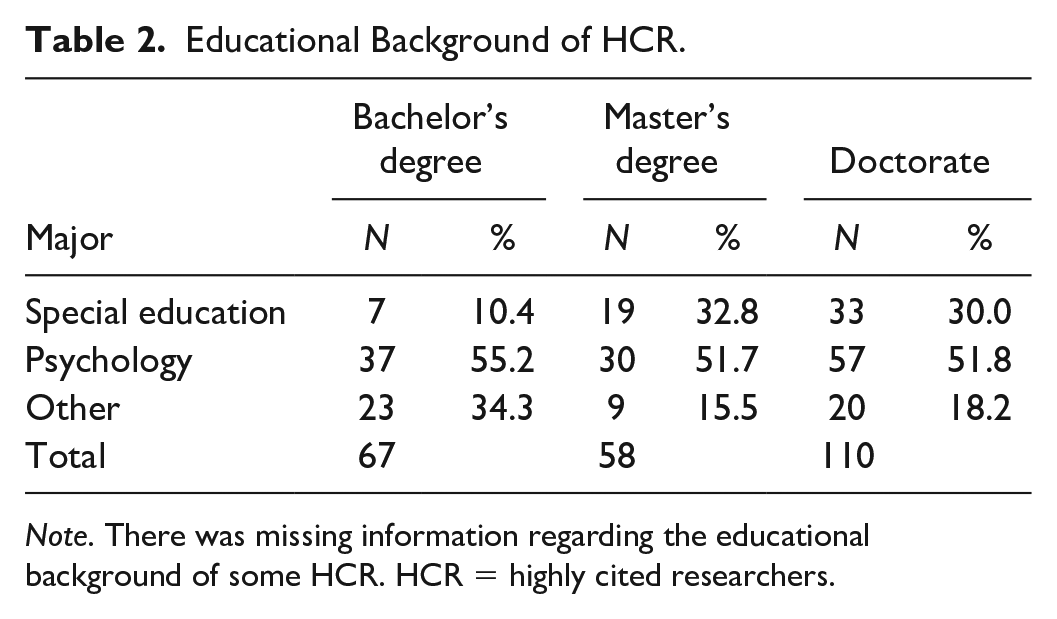
Note. There was missing information regarding the educational background of some HCR. HCR = highly cited researchers.
Top 20 HCR
If we restrict the analysis to the first 20 researchers in the list of HCR based on the number of citations, none hold SPED degrees at all three levels. However, three of the 20 researchers hold two degrees in SPED, and 12 of the 20 researchers hold one degree in SPED.
Background of FMTSEP and HCR at All Three Levels of Higher Education
Table 3 provides complete information about the educational backgrounds of the 56 HCR and 102 FMTSEP at all three levels of higher education. The table shows that fewer than 9% of the FMTSEP and only 4% of the HCR hold SPED degrees at all three levels. It is noteworthy that 22% of the FMTSEP and 54% of the HCR do not hold an SPED degree at any of the three levels.
Background of FMTSEP and HCR at All Three Levels of Higher Education.
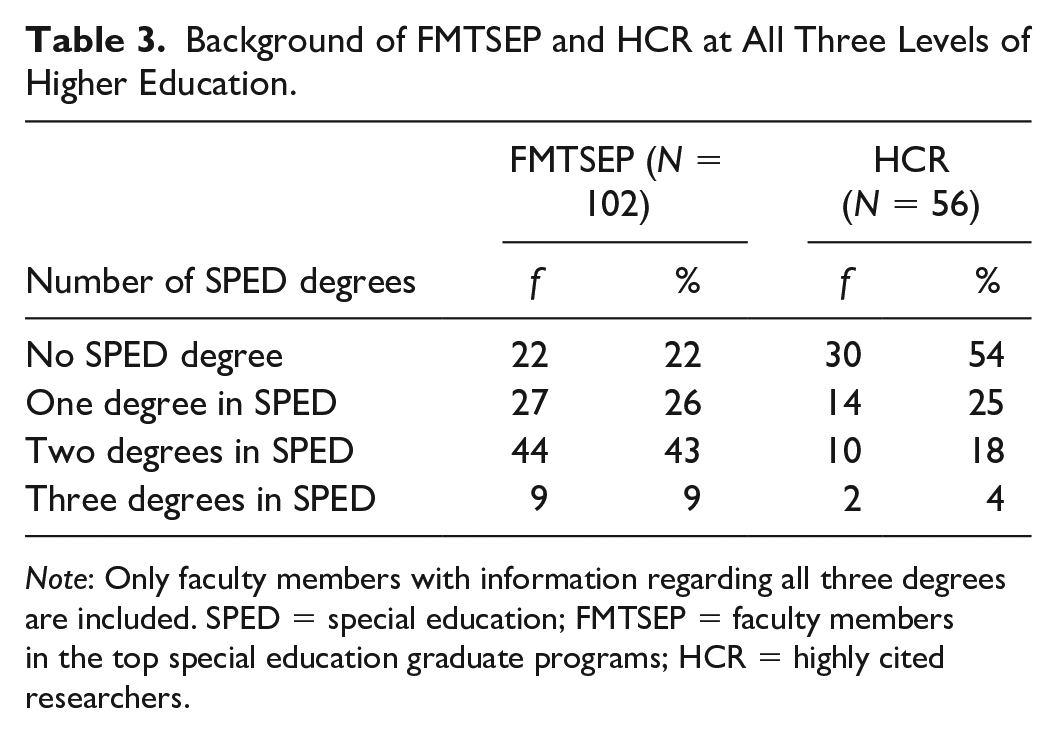
Note: Only faculty members with information regarding all three degrees are included. SPED = special education; FMTSEP = faculty members in the top special education graduate programs; HCR = highly cited researchers.
Discussion
The findings about recruitment practices for SPED faculty show that most of the FMTSEP and HCR began to study SPED at the graduate level. Only 21% of the FMTSEP and 16% of the HCR in this study hold bachelor’s degrees in SPED. In addition, the findings show that graduates with related degrees (e.g., psychology degrees) can be good potential candidates for SPED faculty members. Fewer than 10% of the FMTSEP hold an SPED degree at all three levels. Both these findings diverge from the common approach used by Saudi universities, which involves recruiting only those who already hold bachelor’s degrees in SPED.
All the HCR hold at least one degree in psychology or SPED, but only 4% of the HCR majored in SPED at all three levels of education. More than 60% of the HCR hold bachelor’s degrees in psychology. This finding may indicate the extent to which specialists in the SPED field benefit from the knowledge produced by faculty with diverse background knowledge.
Overall, the findings reveal a wide variety of disciplinary backgrounds among the FMTSEP and HCR. Most of them are scholars from a variety of psychology backgrounds; a bachelor’s degree specialization in psychology is most common among the FMTSEP and HCR. This indicates that expertise from other disciplines is probably important to the field of SPED and can benefit SPED departments and programs. This may also be true for other disciplines, such as health and social science, which have played an important role in the formation and development of the SPED field. In brief, diversity seems to be reflected in the recruitment practices for SPED faculty with high-impact research. This may not be accidental, as SPED programs in the United States have diverse needs to address in different areas of their program content and coursework, as well as a wide range of research areas and an increasingly diverse spectrum of faculty responsibilities (Anderson & Anderson, 2012; Smith et al., 2003).
The current advancements in technology and the enormous implications of advancements in SPED should be taken into consideration when recruiting faculty members; in other words, SPED departments should consider faculty members with certain degrees and training in technology fields. This is particularly relevant, given the importance many universities place on the integration of technology in teaching and the need to develop the related skills of teachers (Austin, 2002; Phuong et al., 2018). Technology and its uses are no longer secondary issues, and the presence of specialists with technical backgrounds could enrich SPED departments and programs.
Implications for Saudi Universities
A fundamental assumption of this study is that FMTSEP and HCR are examples of academics who are adequately prepared to be faculty members. The findings of this study indicate that they are specialists in a variety of disciplines related to SPED. This contrasts with Saudi universities’ recruitment approach, which requires SPED qualifications at all three levels of education (bachelor’s, master’s, and doctoral degrees). This approach, which limits faculty members in SPED to specialists only in SPED, could lead all faculty members to have the same academic background. This may limit the potential for creativity and innovation in Saudi SPED departments and the opportunities to obtain ideas from neighboring disciplines.
Perhaps the current system of faculty preparation is compatible with the existing situation, which involves a low level of inclusive education, mostly limited to students with learning disabilities (Alhano, 2006; Alnahdi et al., 2019). However, given the ratification of the CRPD by Saudi Arabia, during the first cycle of monitoring of the implementation of the Convention (2015–2019), there was a strong push for a less-rigid SPED system that would be integrated with the general education system (CRPD Committee, 2018, 2019). It is quite uncertain whether the current faculty preparation system in Saudi Arabia could respond to this need for higher levels of inclusion within the education system. As the demand for inclusive education continues to grow, it becomes imperative to recruit faculty with varied educational backgrounds who hold at least one of their three degrees (bachelor’s, master’s, and doctoral degrees) in areas such as psychology, literacy, mathematics, and science. Such a faculty workforce could be better situated to prepare a new generation of SPED teachers to work collaboratively with general education teachers in inclusive settings (deBettencourt et al., 2016). In addition, highly qualified faculty with diverse backgrounds could be involved in preparing general educators to instruct students with disabilities (Montrosse & Young, 2012).
We suggest that Saudi Arabia could consider recruiting faculty members with backgrounds in diverse but neighboring disciplines. The presence of such faculty members could contribute various insights to SPED departments. Importantly, recruiting faculty from diverse areas could enrich the quantity and quality of research, as well as teachers’ preparation in SPED departments and programs. Perhaps diversity in faculty recruitment may be more beneficial under certain conditions. For example, recruitment should consider candidates with: (a) previous experience teaching or working at a school and (b) qualifications that match the additional requirements for a specific position. This does not refute the suggestion to increase diversity in hiring, but instead enhances it by adding the element of pedagogical content knowledge, which values knowledge through experience, to hiring practices (Loughran et al., 2012).
Limitations
Several limitations of this study need to be considered. First, the list of researchers who published in journals listed on the Web of Science excludes researchers who published scientific work in languages other than English. However, the Web of Science is a prominent source of high-quality research from around the world, and this may minimize the impact of the limitation.
Second, we concentrated on examining whether faculty members hold SPED degrees, but we did not examine their qualifications in greater detail. The research approach was adequate for answering the research question, but a more detailed study and examination of the predictors of outstanding researchers and SPED faculty members should be considered in future research.
Footnotes
Appendix
Top Special Education Programs in the United States as of December 2015.

| Rank | Top special education (graduate) programs |
|---|---|
| 1 | University of Kansas, Lawrence |
| 2 | Vanderbilt University (Peabody), Nashville |
| 3 | University of Oregon, Eugene |
| 4 | University of Texas, Austin |
| 5 Tie | University of Florida, Gainesville |
| 5 Tie | University of Virginia (Curry), Charlottesville |
| 6 | University of Washington, Seattle |
| 7 | University of Minnesota, Twin Cities Minneapolis |
| 8 | University of Wisconsin, Madison |
| 9 | University of Illinois, Urbana-Champaign |
| 10 | Ohio State University, Columbus |
Declaration of Conflicting Interests
The author(s) declared no potential conflicts of interest with respect to the research, authorship, and/or publication of this article.
Funding
The author(s) received no financial support for the research, authorship, and/or publication of this article.
