




Abstract
It prominently figures that media discourse has acquired a vantage point during the past decades over churches and trade unions as an influential source of information that could drastically shape public opinion. This article indulges into evincing how print media tacitly pass on their subjectivity through the deployment of reporting techniques that are wittingly chosen. Thus, this article moves beyond the formal concepts of narratology into the realm of pragmatics to scrutinize the reporting strategies of media discourse as embodied in Israeli print media. It endeavors to find palpable answers to three core questions that hover around: the reporting techniques utilized, the reasons beyond their use, and the impact of their choice on the redefinition of narratology. In doing so, 20 straight news reports are, respectively, elected for analysis from Haaretz and Jerusalem Post running from 2006 onward and endorsing the model of Leech and Short in its second edition. The main findings prove that Israeli print media gain objectivity through the use of direct and indirect speeches and override it when it comes to the free versions of reported speech. Narratology, hence, in its classical view aneeds to be linked to pragmatics in order to come to grips with questions related to intentionality and accountability.
Keywords
Introduction
The first part of this article starts with setting the research context that encompasses a general overview about Israeli press, Israeli print media, and news report at the thematic level and approaches media discourse, narratology, pragmatics, and speech presentation at the theoretical level. The second part offers what is hoped to be the research methodology that elicits the corpus description, the selection criteria, and the procedure of the study. The third part reviews a number of findings and the last part looks at the possible discussions and contributions of the present study.
Research Context
This chapter compiles the thematic and the theoretical backgrounds of the study where the former pivots around Israeli newspapers, Haaretz and Jerusalem Post, and elucidates the structure and the scope of news reporting. The latter, however, deals with media discourse, pragmatics, narratology, and speech presentation. The chapter closes by shedding light on the research gap and the research questions of the study.
Thematic Background
This section is devoted to Israeli press with a special focus on Israeli print media. Haaretz and Jerusalem Post are to be commented on, along with a brief overview of the structure and scope of news reporting.
Israeli press
According to the Jewish Virtual Library, the taxonomy of Israeli press can be divided into Israel-broadcast news media, Israel-internet news media, Israel-magazine news media, and Israel-newspaper news media. To name a few among many, Israeli print media include Haaretz, Jerusalem Post, and Yedioth Ahronoth, while Israel Today, Challenge, and Al Sabr stand for Israeli magazines. Israeli written press goes back to the 19th century, with the publication of Halevanon in 1863. Israeli newspapers are five national ones written in Hebrew, English, and French and handle subjects about general interest and business. Apart from Maariv, which is written in Hebrew, nearly all newspapers resort to two languages: Hebrew, as it is the native language, and English or French as foreign ones. Jerusalem Post abides by English and French languages and it is a national one as the remaining newspapers.
Haaretz was first published in 1918 and it is considered as the oldest Israel daily newspaper. It is seen as having considerable influence among government leaders (Beckerman, 2005). Driven by its editor Hanoch Marmari, its circulation reaches 50,000 on weekdays and 60,000 on weekends and its pride lies in its op-ed page, which is closely followed by Israel’s decision makers (Jewish Virtual Library). The bottom line of Haaretz is that it is a newspaper “liberal on security, civil rights and economy, supportive of the Supreme Court, very critical of Netanyahu’s government” (Sheizaf, 2010).
Jerusalem Post, from another side, is an “Israeli English-language daily newspaper established in 1932 as the Palestine Post. It adopted its current name in 1950 and is the largest English-language daily in the country” (Encyclopedia Britannica). Jerusalem Post is targeted to public opinion and it was classified as “the principal public relations agency” (Frenkel, 1994). Its circulation is 25.000 on weekdays and 55.000 on weekends and it is widely read by journalists and Jews abroad, diplomats, and tourists giving it, thus, a degree of prominence in portraying Israel to the world (Chartrand, 1990). “Originally a left-wing broadsheet, the English-language Jerusalem Post experienced a marked shift to the right” (www.news.bbc.co.uk).
Scholars (Avraham, 2003; Korn, 2004; Rinnawi, 2007) have approached Israeli print media from different angles. Avraham looked for the role of media as mediator between several social institutions and between center and periphery, whereas Korn highlighted how Haaretz reported Palestinian casualties during the first year of the Palestinian uprising and how it consistently and reliably provided its reports. Rinnawi examined and compared Israeli print media coverage of the respective Palestinian populations in Israel and in the occupied West Bank and Gaza Strip during the Al Aqsa Intifada. Rinnawi attempted to provide a comprehensive inventory of the “delegitimization mechanisms” at work during the news production process in Israel.
However, there is a dearth of studies on the reporting strategies of Israeli print media from a pragmatic angle, which this article seeks to explore. The article also links narratology to pragmatics as a novelty when approaching media discourse.
News reporting
The major elements of news reporting may be narrowed down into three main axes: reporter, type, and ethic.
The reporter belongs to the world of journalism and he gathers “information in a variety of ways, including tips, press releases, and witnessing events. [He] perform[s] research through interviews, public records and other sources” (Verma, 2011, p. 1). The reporter, henceforth, prepares substantial information for audiences locally and internationally and each reporter has a specific area to focus on called a “Beat” or a “Patch” (Shrivastava, 2008).
News reportings are of several types; they can be investigative, court, specialized, fashion, political, or sports reporting. Verma (2009) suggests that straight news reports tend to be straightforward, factual, and conspicuous without drawing conclusions or offering opinions, whereas investigative ones go beyond the claims to see the extent to which they are valid.
Fairness is unavoidably the kernel of reporting ethics and it “means listening to different viewpoints and incorporating them into the journalism. It does not mean parroting lies or distortions to achieve the lazy equivalence that leads some journalists to get opposing quotes when the facts overwhelmingly support one side” (Gillmor in Green et al., 2016, p. 19).Fairness, thus, constitutes the basis of good journalism and journalists have to “strive to be fair in their reporting by not telling one-sided stories” (Detrani, 2011, p. 84).
A news report has three main parts: the headline, the first paragraph, and the remainder of the news story (Harcup, 2004). To make a news report luring enough, the reporter has to “grab the reader by the throat in the first paragraph, sink [his] thumbs into the [reader’s] windpipe in the second and hold him against the wall until the tag line” (O’Neill cited in Harcup, 2004, p. 107). Henceforth, complexity and ambiguity are frowned upon as “most news reports follow the ‘kiss and tell’ formula [which stands] either for ‘keep it short and simple’ or ‘keep it simple, stupid’” (Harcup, 2004, p. 108).
Theoretical Background
Having dealt with the thematic background of the study, the article lands on the theoretical part that encompasses media discourse, pragmatics, narratology, and speech presentation.
Media discourse
Media discourse can be defined as the reference “to interactions that take place through a broadcast platform, whether spoken or written, in which discourse is oriented to a non-present reader, listener or viewer” (O’Keeffe, 2012, p. 441). Put another way, media discourse can be viewed as “all the language we find used in the media that differentiates it from text, which refers only to the words or symbols, and from linguistics: traditional conceptions of language as set of rules such as grammar and phonology” (Matheson, 2005, p. 178). Media, henceforth, can recontextualize and transform other social practices like politics and government (Fairclough, 2003). This article seeks to prove how media exert manipulation and how audiences are “manipulated as well as manipulating” (Curran, 2002, p. 162).
The pragmatic paradigm
A plethora of theories are suggested for the study of media discourse, such as the Bell model (1991–1998) and the Ungerer model (2000). However, this article lands on the pragmatic model as “pragmatics is the study of the choices we make when we use language, the reasons of these choices, and the effects those choices convey ” (Crystal, 2018, p. 304). These facts make pragmatics extrinsically paramount to the present study as it will unpack areas of manipulation within the corpus selected. The pragmatic models for the study of media discourse are classified by Kulka and Hamo (2011) as follows:
A. Mediated political discourse dealing with the exploration of face and politeness in political contexts (Harris, 2001).
B. The study of specific speech acts in public and political discourse (Kampf, 2009).
C. The application of pragmatic models of coherence and meaning-making to the analysis of political interviews (Weizman, 2008).
D. The public mediated nature of discourse on television and radio highlights the need to attend to the impact of different discursive positions and roles, of both speakers and hearers, on discursive processes (Fetzer & Weizman, 2006).
E. The diversity of media talks draws attention to the context-sensitivity of pragmatic concepts such as maxims of cooperation (Tolson, 2006).
F. Public and mediated discourse offers examples of the strategic uses of pragmatic processes, such as deliberate violations of discursive norms (Tolson, 2006; Weizman, 2008).
G. The use of politeness as a discursive resource, rather than deferential behavior (Harris, 2001; Kampf, 2009).
The merit of the article is to extend the above mentioned list by adding the study of reporting strategies in print media from a pragmatic angle.
Narratology
As the article deals with reporting techniques deployed by the Israeli print media, a reference to narratology is deemed relevant to enrich the theoretical background of the study. Narratology emanates from narrative that means “anything that tells or presents a story (Jahn, 2017, N1). Narratology has its seeds in the work of De Saussure who sought to “understand how recurrent elements, themes, and patterns yield a set of universals that determine the makeup of a story” (Pradl, 1984, p. 1). Jakobson and Russian Formalists also had their influence on the study of narrative by unveiling how literary language differs from ordinary language (Pradl, 1984).
Wake (2013) elicits that “[n]arratology, which has roots in structuralism and which draws much of its terminology from linguistic theory, is the study of the ways in which narratives function” (p. 23). If we refer to the classical view of Plato on narratology, we may be confined to the concepts of “Diegesis” (narrator speaking as himself) and “Mimesis” (narrator speaking as if he were one of the characters), which refrain from the interpretation of print media texts. Consequently, I tend to merge narratology with pragmatics for the sake of broadening the scope of findings.
Speech presentation
Speech, in general, can be direct or indirect and the essential semantic difference between them “is that when one uses direct speech to report what someone has said one quotes the words used verbatim, whereas in indirect report one expresses what was said in one’s own words” (Leech & Short, 2007, p. 255). The difference lies in whether the other’s words are used verbatim or being altered by the narrator. These two kinds of reported speech have been traditionally called “oratio recta (direct quotation) and oratio obliqua (indirect quotation)” (Coulmas, 2011, p. 2). Oratio recta is about the exact words of the speaker and the original speech situation, whereas oratio obliqua “adapts the reported utterance to the speech situation of the report in indirect discourse” (Coulmas, 2011, p. 2).
There are certain layers between direct (DS) and indirect speeches (IS), which are described by Leech and Short (2007) as free direct speech (FDS), free indirect speech (FIS), and narrative report of speech acts (NRSA). Starting from FDS, Leech and Short discern that the sheer difference between DS and FDS is the fact that it is possible to remove either or both of these features [quotation marks and the introductory reporting clause], and produce a freer form, which has been called Free Direct Speech: one where the characters apparently speak to us more immediately without the narrator as an intermediary. (Leech & Short, 2007, p. 258)
FIS is at the crossroads of IS and DS as it “shares linguistic features associated prototypically with both the IS and DS forms” (Semino & Short, 2004, p. 11). FIS is called so because it avoids the use of quotation marks as well as the reporting clause. Pascal (1977, pp. 8–9) clarifies the difference between DS, IS, and FIS through the following examples:
A. DS: He stopped and said to himself, “Is that the car I saw here yesterday?”
B. IS: He stopped and asked himself if that was the car he had seen there the day before.
C. FIS: He stopped. Was that the car he had seen here yesterday?
As a comment to what has been labeled as NRSA, Semino and Short advocate that the “narrative report of speech acts (NRSA) category was thought by Leech and Short to be the hinge between speech presentation and narration (speech acts are both speech and actions)” (Semino & Short, 2004, p. 12). Given as such, NRSA is considered as a technique that “involves a narrator reporting that speech or thought has taken place but without offering any indication or flavor of the actual words used” (Simpson, 2004, p. 32). NRSA is elicited by Simpson through the following example: “she spoke of their plans for the day ahead” (Simpson, 2004), which depicts the narrator as taking a medial stance between narration and speech presentation.
To put it in a nutshell, Leech and Short (2007) classify speech presentation as in Table 1:
Classification of Speech Presentation.

Note. NRSA = narrative report of speech acts; IS = indirect speech; FIS = free indirect speech; DS = direct speech; FDS = free direct speech.
DS is considered as the norm and Leech and Short stress the fact that any movement to the left of the norm will be interpreted as a movement away from verbatim report and toward interference.
Research Gap
All through the formally developed data, it transpires that the article attempts to go beyond the formal concepts of narratology toward the realm of pragmatics to scrutinize the reporting strategies of media discourse as embodied in Israeli print media.
Research Questions
I seek to land on three major research questions in this article, which could be successively mentioned as follows:
Method
I confined the corpus to 20 straight news reports extracted from Haaretz and Jerusalem Post as both newspapers are written in English and their archives are easily accessible. For feasible reasons, the news reports are limited in number and they are hard news about politics. The choice of political reports is justified by the status quo of Israel as a major rival to its neighbors, mainly Lebanon, Palestine, and Iran, whereas the focus on straight news is for the sake of objectivity and reliance. The time span of reports runs from 2006 onward as this era witnessed Israel’s wars with Hezbollah and Gaza as well as Iran’s nuclear proliferation program.
Theoretically speaking, the model of Leech and Short (2007) in its second edition is endorsed as it is “the first to distinguish systematically between the presentation of speech and the presentation of thought in the novel” (Semino & Short, 2004, p. 9). The analysis of the corpus is mainly qualitative where types of reporting are to be manually detected as a first step. Data sorted out are to be thoroughly analyzed in line with the research questions set at the premise, as a final step. I also resorted to quantitative analysis, which is meant to validate the findings sorted out from the qualitative one. The frequency of the various types of reports is also manually detected.
Major Findings
Qualitatively speaking, DS is mainly implemented by Jerusalem Post where the reporter keeps the speaker’s own words between inverted commas and makes use of an introductory report clause as the following example shows:
US Vice President Dick Cheney
The reporter is respecting the norms of DS through the use of a stative reporting verb, a subordinating conjunction, and quotation marks. He tells the reader that this utterance is not “mine” and takes a totally objective stance toward what has been said. Simultaneously, the declaration of Clinton is reported verbatim as if to imply that what she has said does only belong to her:
She
The deployment of the reporting verb mainly oscillates between the initial and the final positions. Objectivity lies in the reporter’s resort to the initial position in which he conspicuously denotes right from the beginning that these words are not his; however, he sometimes overrides this total detachment when he backshifts the reporting verb.
The reader is informed that the quotation mentioned above belongs to Clinton only at the end, which may create a shade of intricacy and overlap. Another example that upholds the fact that the reporter backshifts the reporting verb revolves around Iran,
which may entail that when it comes to searing issues that are deemed threatening to Israel’s security, the reporter opts for the final position of the reporting verb.
Haaretz, simultaneously, does not seem as permissive as Jerusalem Post when dealing with the Iranian issue or Hezbollah. Objectivity is guarded through the utilization of the inverted commas in most of the reports but sometimes it is dashed through the position of the reporting verb or the subordinate clause as in the following sample:
Jerusalem Post and Haaretz do not rely much on IS in their construal of news reported. Few instances are detected as
Shortly after 9/11, George W. Bush
where the reporter focuses more on past events. Although the current events are about AIPAC conferences and Israel’s shaky relationship with its neighbors, the reporter refers back to the war in Iraq and the Nazi threat during world war. The reporter abides by the rules of IS where he backshifts all the modals in the past (could, would) and starts by an introductory report clause followed by the subordinating conjunction “that.” By doing so, the reporter’s presence becomes more prominent at the expense of the speaker’s. His interference in the course of events can be touched through the reporting verbs selected. Attributing the verb “decide” to Bush or “warn” to Churchill is an indication that the reporter is judging what has been uttered by those political leaders as such and, in doing so, he moves from narration to evaluation. He evaluates the speaker’s utterance as important as it advocates the previous one. Backshifting the verbs in the past and using introductory report clauses do not save the reporter’s attempt to be totally objective.
The various reporting techniques actuated by both newspapers could be presented in the following diagrams (Figures 1 and 2):

Various reporting techniques actuated by Jerusalem Post.

Various reporting techniques actuated by Haaretz.
It transpires, thus, from the above figures that both newspapers rely on DS, which is considered as the norm for Leech and Short (2007). Movements to the left of the norm (NRSA/IS/FIS) are clearly marked although with less degree than the DS. Movement to the right of the norm (FDS), however, nearly receives as much importance as the norm in Jerusalem Post and Haaretz. FDS is detected when miscellany of discourse and story takes place. Being presented without quotation marks and reporting verbs, both utterances are left mystified. The fact of not backshifting the present tense to the past tense or the plural person pronoun “we” to “they” places the reader in front of two discourses. Consequently, by hijacking the discourse being reported, this reported message fuses into and serves as evidence corroborating the ongoing discourse between the journalist and the readers, knowing that Iran and terrorism are under question.
Haaretz, for instance, utilizes various kinds of FDS that range from removing quotation marks to keeping them and omitting the introductory report clause. A close look at some instances that all deal with Livni’s opinions, unveils the overwhelming of discourse elements over the story’s. This intrusion of discourse into story may be explained by either the intrusion of the now of the narrator or the intrusion of the now of Livni, which is kept intact by the journalist. Livni’s decision of “a two-state solution” is being overtly discussed and propagated as it is deemed relevant to the reporter. Even the reporting verb is positioned in the medial and final places to make the discourse appear more than the character’s story. The quotation marks that serve as borderlines between the various layers of discourse are deliberately dropped.
Whenever there is a tendency to be closer to IS, there is a move away from the character’s consciousness to the narrator’s. FIS is, thus, “normally viewed as a form where the authorial voice is interposed between the reader and what the character says, so that the reader is distanced from the character’s words” (Leech & Short, 2007, p. 268). A few instances collected in Table 2 display the cunning uses of FIS to pass on value judgment on matters related to Israel’s security:
Use of Free Indirect Speech to Pass on Value Judgment on Matters Related to Israel’s Security.

Haaretz shows its adoption of Livni’s suggestion through the use of FIS (7). It all starts by implementing all the elements of IS by backshifting the reporting verb and mentioning the subordinating conjunction. Paradoxically, an element of discourse floats on the surface of the story “must.” Either the original “must” of the clause has come to the surface or it suits the journalist’s narrating to bring it to the present. This empathetic narration laid bare the reporter’s subjectivity and adoption of what has been reported. Similarly, (2) the modal “cannot” escapes the journalist’s attempt to be alienated and assures his commitment to what is uttered. Yet, (1) is left obscured as the reporter does not explicitly declare that this is an IS, rather, he mixes his cognitive center “it would be a shame” with that of the character’s in such a way to show his irony. It “is this distancing which allows FIS to be used as a vehicle for irony” (Leech & Short, 2007, p. 268). He considers the inability of the West to combat “militant Islamism” as weird especially when compared with “Nazism and Communism.” The same ironic aspect is grasped in (3) where the reporter indirectly questions Hamas’ participation in the previous elections. As this opinion toward Hamas is psychologically salient in the narrator’s mind, the reporting verb has been backshifted to a medial position. It is even backwarded in (4) to highlight Israel’s evident objective behind fighting. Ironically, the journalist displays that all Israel’s efforts are offered to America. The reporter depicts himself through the use of FIS as stating the obvious.
A hybrid style is employed in (5) where past and present intermingle. The journalist deceives the reader by reporting a given locution to abruptly twist the discourse through the present form “saves”. This free indirectness negotiates certain obvious matters (as Israel’s stance toward peace; 6) and colors, therefore, the journalist’s report with a certain ironic aspect.
NRSA serves to be as a “possibility of a form which is more indirect than indirect speech” (Leech & Short cited in Smith, 2014, p. 225). In such case, “the narrator does not have to commit himself entirely to giving the sense of what was said, let alone the form of words in which they were uttered” (Leech & Short cited in Smith, 2014, p. 225). The present study gathers some instances of NRSA in Table 3:
Instances of Narrative Report of Speech Acts.

NRSA offers a wider room for the journalist to comment on the speakers’ utterances. This fact is crystal clear in the choice of the reporting verbs (challenged, accused, warned, defended, urged, blasted, rejected, and assailed). These verbs carry certain value judgments as the reporter evaluates what has been said or done as violent (blasted), directive (warned), or challenging (challenged, defended). This strategic selection displays the reporter’s empathetic attitude to what is going on. He even uses adverbs (9) which overtly mark his involvement in the course of events and show his proximity to the character’s territory. The reporter, in both newspapers, moves from narration to argumentation. He argues that Santorum (8) is slamming Obama, and Romney (18) is assailing the reluctant administration. Evaluating the characters’ utterances as in (8), (14), or (18) evinces the tendency of the journalist to create a certain emotional drive on the reader. It may be due to journalism style that tends to create hot topics to lure readers to buy their products. Reporting verbs through NRSA are rendered as action verbs for the sake of titillating readers’ sentiments. The adverb “bluntly” in (17) is another evidence of discourse that pops up on the surface of the story. The journalist is evaluating more than narrating.
Quantitatively speaking, 55 news reports are manually detected in Jerusalem Post and they are divided as in Table 4:
Classification of News Reports in Jerusalem Post.
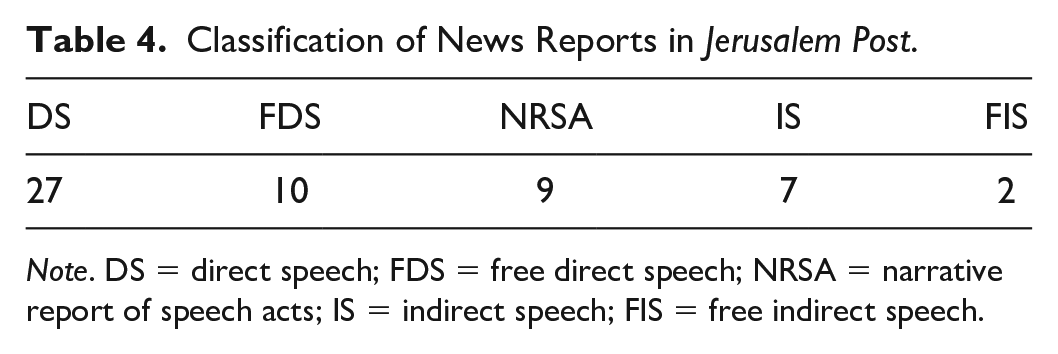
Note. DS = direct speech; FDS = free direct speech; NRSA = narrative report of speech acts; IS = indirect speech; FIS = free indirect speech.
The three major topics that are considered searing for the Israeli print media are Iran, Hamas, and Hezbollah. Hence, the frequency of each type of report is distributed according to the most alarming issue where objectivity and subjectivity on the part of the reporter intertwine. Table 5 palpably validates the formerly analyzed data at the qualitative level as it displays the subjective drive of the reporter through the deployment of the left side of the norm (DS).
Frequency Distribution of Each Type of News Report.

Note. DS = direct speech; FDS = free direct speech; NRSA = narrative report of speech acts; IS = indirect speech; FIS = free indirect speech.
Bold values indicate the subjectivity of the reporter (he relies on NRSA, IS and FIS when referring to Hamas).
Haaretz does not depart too much from Jerusalem Post in its implicit argumentation over issues deemed threatening to Israeli national security as it clearly implements NRSA, IS, and FIS (23 times out of 54; Table 6).
Implementation of NRSA, IS, and FIS by Haaretz.

Note. NRSA = narrative report of speech acts; IS = indirect speech; FIS = free indirect speech; DS = direct speech; FDS = free direct speech.
The major discrepancy that lies between Haaretz and Jerusalem Post concerns Iran, which is more foregrounded by Haaretz reporters. The latter cunningly referred to it through NRSA, FIS, and IS as Table 7 shows:
Discrepancy in News Reports Concerning Iran Between Haaretz and Jerusalem Post.

Note. DS = direct speech; FDS = free direct speech; NRSA = narrative report of speech acts; IS = indirect speech; FIS = free indirect speech.
Bold values indicate the subjectivity of the reporter (he relies on NRSA, IS and FIS when referring to Hamas).
DS is nearly deployed as much as NRSA in line with the Iranian matter, which proves that Haaretz is careless about objectivity when it comes to Israel’s national security.
The choice of the reporting verb in both newspapers oscillates between narrative verbs (said/told/stated/added/explained/declared/concluded) and argumentative verbs (warned/decided/opposed/challenged/accused/slammed/defended). Even the present tense is employed in a few cases (states/demands/says) to signal once again the tacit subjectivity when reporting events. The place of the reporting verb, however, differs in both newspapers (Figure 3). Jerusalem Post opts for the initial position in an attempt to seem more objective, whereas Haaretz creates shades of ambivalence through its selection of the final position.

Placement of the reporting verb in Jerusalem Post and Haaretz.
Discussion
All through the formerly enumerated data, I may discuss three major axes in line with the three research questions set at the premise. Out of 90 reports manually detected in the whole corpus, I have found that 49 reports abide by the norm (DS). Nineteen reports are also deployed at the right side of the norm (FDS), which encapsulate the attempt of reporters to achieve high amount of veracity. Overtly, Israeli straight news reports endeavor to present themselves as the objective print media that are considered as reliable sources of information. In doing so, they make use of DS, verbatim quoting, backshifting of the reporting verb, canonical choice of the reporting verb, colon and inverted commas, and the subordinating conjunction “that.” However, the 41 reports that carry tacit involvement on the part of reporters are adroitly infiltrated throughout the corpus. This covert subjective drive can be touched through the following:
The noncanonical use of the reporting verb in DS
e.g., It
The final position of the reporting verb to give prominence to the speaker’s utterance
e.g., “Relations between Israel and the U.S are unbreakable,”
Total absence of the medial position of the reporting verb in Jerusalem Post with just two instances in Haaretz. The medial position is meant to be a sharp reminder that the utterance does not belong to the reporter.
e.g., “U.S assistance,”
The choice of the reporting verb helps the reporter shift from narration to argumentation and evaluation.
e.g., The clause that discusses statehood
Reliance on FDS as it makes the character speak to readers more immediately.
e.g., The future that includes a nuclear Iran is a bleak one (Jerusalem Post, 2006)
e.g., Iran will obtain nuclear weapons if U.S president Barack Obama is re-elected for a second term, Republican candidate Mitt Romney said (Jeusalem Post, 2011)
The employment of FIS as a “vehicle for irony” because the reporter implicitly hijacks the character’s discourse.
e.g., It had been a mistake, he said, to permit Hamas to participate in the elections (Haaretz, 2006)
Mystification through the utilization of FIS
e.g., It would be a shame if, having defeated Nazism and Communism, the West was to succumb to militant Islamism (Jerusalem Post, 2008).
Reliance on the extreme left of the norm (NRSA) for more than 18 times out of 109 instances to argue and evaluate.
e.g., Romney
e.g., Obama
The examples mentioned above may tell that Jerusalem Post is likely to uphold a stance toward a “two-state solution” although references to that are implicitly inserted. What has been gained through the deployment of the norm (DS) to save its face as a renowned neutral newspaper has been overridden through its recurrent resort to the left side of the norm. Similarly, Haaretz seems to lose some elements of objectivity when it comes to the issue of Iran as it deviates to the extreme left of the norm, especially when dealing with Iran’s nuclear proliferation program.
As far as the third research question is concerned, I may opine on the role of narratology by claiming that the latter in its classical view as a formalist and a structuralist endeavor to theorize and define the nature of narrative is unable to come to grips with questions related to intentionality and accountability. Consequently, narratology needs to be revisited and redefined, knowing that this article proves that a micro-pragmatic approach to narratives feeds well the discipline of narratology in general.
Implications of the Study
The present article is significant as it draws attention to three major problematic issues. First, the nomenclature “straight news reports” seems to be elusive as it has been proved that the analysis of reporting techniques laid bare tacit value judgments and negotiations of power on the part of reporters. Second, a micro-pragmatic approach palpably displays its efficiency in detecting areas of subjectivity that are not supposed to be exposed to readers. Renowned print media, in general, seek objectivity to preserve their truthfulness with their corresponding readers. The manipulation of straight news reports poses a serious problem to print media ethics. Shall we still believe in straight news as partial news? Are media ethics so vulnerable that they could be easily transgressed and played with? Isn’t it legitimate/illegitimate that Israeli renowned print media opine on political matters and side with given political wings? To what extent can Israeli print media shape public opinion and be a suggestive power? Finally, I do assert that the model of Leech and Short (2007) in its second edition proves its reliability, knowing that it is considered as the first model to distinguish between the presentation of the speech and the presentation of the thought in the novel.
Conclusion
This research attempts to give a rigorous analysis of Israeli print media by expanding the theoretical lens for examining objectivity in news reporting. Narratology, merged with pragmatics, seemed to be effective in deconstructing the tacit values judgments of Jerusalem Post toward the “two-state solution” and Haaretz’s stance toward Iran’s proliferation nuclear program. Both newspapers sometimes deploy the free versions of DS and IS to pass on their personal views. Evaluation and argumentation occasionally occur through the resort to narrative report speech acts. The article shows the different narrational techniques used by both newspapers as well as the objective behind that. It also suggests a novel perspective of narratology when examining news reports in an attempt to redefine narratology and give it a wider scope of interest.
Footnotes
Declaration of Conflicting Interests
The author(s) declared no potential conflicts of interest with respect to the research, authorship, and/or publication of this article.
Funding
The author(s) received no financial support for the research, authorship, and/or publication of this article.
