




Abstract
This study explores the public discourse about Hong Kong’s future beyond 2047 through the lens of local press media during the first half of the “unchanged 50 years” since the handover. The data contains a number of 187 newspaper articles centered on the issue of 2047, extracted from 16 local news outlets in Chinese. Using qualitative and quantitative methods of content analysis, the study observes the development of media discourse over a long span of time and points out people’s major concerns about Hong Kong’s long-term future. It distinguishes three major discourses in terms of identity construction and modes of anticipation, and explores the links between future-oriented suggestions and real-world actions. As part of an ongoing research on Hong Kong’s future narratives, this study contributes to the research on social mentality during the first half of the “one country and two systems” and explores how the future is imagined and built through discursive practices.
Major publications
GUO Yufei (2018). Politique linguistique intérieure de la Chine: entre unité et diversité. Le débat autour du cantonais au début du XXI siècle. Paris : Editions l’Harmattan.
郭宇菲 (2022)《跨学科视角下的语言与身份认同:兼谈香港问题》. 香港:三联书店.
GUO Yufei (2018). Gouvernement, école et famille. L’Articulation entre perspective macro et micro-sociolinguistique dans la politique linguistique chinoise, Glottopol, 30 : 155-170. GUO Yufei (2015). Politique linguistique de la Chine:le débat du cantonais. Bulletin VALS/ASLA, 2015(3) : 69-80.
郭宇菲 (2021)《香港“两文三语”的历史与现状》[C], In 屈哨兵 (ed.)《粤港澳大湾区语言生活状况研究报告》 (ISBN: 978-7-100-19883-7), pp.22-31. 北京:商务印书馆.
Introduction
Future narratives, or anticipatory discourses (Scollon & Scollon, 2000), refer to discourses centered around the future. They are about how narrators locate themselves and others in the lived story, moral space and the future storyline in construction. Since imagination and conscious anticipation are shaped and shared through discursive interaction, future narratives not only raise public emotions and influence the group process but also have the potential of turning strategic ideas into collective actions.
The year 2022 marks the 25th anniversary of Hong Kong’s handover. When the principle of “one country, two systems” (hereinafter “1C2S”), later enshrined in the Sino-British Joint Declaration (hereinafter “the Joint Declaration”) and the Hong Kong Basic Law (hereinafter “the Basic Law”), promised that Hong Kong will retain its capitalism and way of life for 50 years upon the handover in 1997, it is not clear what will happen when the 50-year period expires. The only clue is the remarks of Deng Xiaoping, China’s former paramount leader, on different occasions in the late 1980s, saying that there won’t be a need to change the principle of 1C2S beyond 50 years.
What might happen to Hong Kong beyond 2047 from a legal perspective? Kenneth Ka-Lok (2004) and Morris (2005) viewed 1C2S as a transitory arrangement with an expiry date on June 30, 2047. On the contrary, Gittings (2011) argued that there is little space for fundamental changes of the Basic Law to take place in 50 years and the importance of 2047 has been overstated. Tu (2020) pointed to the existence of constitutional puzzles regarding the “unchanged for 50 years,” calling for the need to address the problems within the framework of the temporality of the Basic Law in a fast-paced world. Despite different opinions, it is generally agreed among legal scholars that even without radical changes in law, fundamental changes about how the law is applied might take place in or even before 2047.
Today, as the promised “unchanged 50 years” passed its midterm, the question of 2047 is looming large. Public surveys (e.g., Hong Kong Public Opinion Research Institute, 1994–2022; Path of Democracy, 2020) indicate that Hong Kong residents are largely in favor of the continuation of 1C2S beyond 2047, but they are also pessimistic toward the future. On one side, mainstream western media and academia take a dim view of Hong Kong’s future, even lamenting the death of 1C2S before 2047. One the other side, China’s propaganda is depicting a bright landscape where both economic prosperity and the current political framework will be maintained after 2047. What are the possible future scenarios in the eyes of local Hong Kong citizens? What constitute their concerns, visions, and hopes? How do their versions of imagined future participate in the construction of a real tomorrow through discourse?
It is well known that discourse has a big “D” and a small “d” (see Gee et al., 2015). Our study aims to explore the big “D” discourse- public narratives of Hong Kong’s future, through a study of small “d” discourse- the representation of Hong Kong’s 2047 in local media. The newspaper provides us with a platform to track and compare the reflective forms of discussion on a longitudinal basis. Since Hong Kong used to be one of Asia’s freest press hubs, it’s worth investigating how the issue of 2047 was represented and constructed in the local press media during the first half of the “unchanged 50 years,” a period where the freedom of speech was less constrained by political orders.
This study focuses on public discourse of Hong Kong’s 2047 through the lens of local newspapers, with three objectives in mind: (1) to observe the evolution of media discussions in context and major public concerns. (2) to study how identities, agency and actions are constructed through the chains of texts across time. (3) to explore the different ways that Hong Kong’s future is anticipated and how discourses articulate with real-world actions.
Literature Review
To date, there are few studies that focused on public discussions about Hong Kong’s future. Most Hong Kong discourse studies focused on identity construction and the development of localism during “critical moments” or through “salient public events,” which are also relevant to the present study.
Flowerdew has made the most systemic contributions to this domain. By studying the discourse of Chris Patten, the last British HK governor during the full 5 years of his governorship, he (Flowerdew, 1997) discovered a number of interwoven themes in Patten’s speech to form a coherent discourse of Hong Kong’s “myth.” Through comparison with Patten’s discourse, Flowerdew (2004) found that the discourse of Tung Chee-hwa, the first Chief Executive of the HKSAR has largely maintained Patten’s discourse of the “myth,” while adding some new elements like “knowledge-based economy” and Confucian values. Meanwhile, Flowerdew et al. (2002) also explored the discriminatory discursive practices of a Hong Kong-based English newspaper -South China Morning Post, with regards to the coverage of right-of-abode issue during January 1999 and August 2000, based on a CDA (Critical Discourse Analysis) approach combined with corpus linguistic methods.
Concerning the development of localism, Tang and Yuen (2016) traced the evolution of Hong Kong localist discourse from the D&G Incident in 2012 to the by-election of the Legislative Council in 2016. They discovered that Hong Kong localism, initially founded on the resistance against the influx of mainland Chinese people, has been aligning with broader political issues like Hong Kong’s future after 2047, showing a transformation of the conception of citizenship from a defensive one to a progressive one that advocates political participation and deeper civic engagement for wider sorts of rights.
Veg (2017) examined the discursive evolution of Hong Kong localism from 1997 to 2017, based on three historically “salient events,” namely, the June Fourth vigil, the anti-National Education movement in 2012, and the umbrella movement 2014. Similar to the discovery of Tang and Yuen (2016), Veg found that Hong Kong localism has shifted from an ethnic and cultural form of identity highlighting the difference between Hongkongers and mainlanders to a civic-based form of identification grounded in democratic and universal values. He made reference to Joshua Wong’s idea of a constitutional referendum on the future of post-2047 as an illustration that the localist activists no longer defined “Hongkonger” in terms of a reified identity but as a democratic community willing to share its vote.
In an essay, Eagleton (2020) discussed how Hong Kong’s post-2047 is discussed by some local young people, the then Chief executive Carrie Lam and China’s President Xi Jinping in the context of the mass protests during 2019. She made her own point by saying that the Extradition Bill of 2019 was a “tipping point” toward further integration with the ideology of the “one country” rather than “one country with two systems”.
So far, the discourse of 2047 has been regarded mostly as an integrated part of the localist discourse. Very few research looks into the views of Hong Kong citizens with different political inclinations and explores how their narratives changed overtime and mattered to realpolitik. That is what this study is set for.
Theoretical Underpinnings
In a news article, we can hear different voices: from the author, the main characters of the reported event, the interviewees, quotations from other texts, etc. Even in an opinion article, there are many voices hidden behind the one on the surface. How to extract “discourse” out of the embedment and entanglement of voices constitutes the most important and the most difficult task of the present study. The concepts of intertextuality, assumption, identity construction, and anticipation provide us with useful theoretical guidelines.
Originated in the thought of Mikhail Bakhtin and developed by Julia Kristeva, the term of intertextuality refers to the links between a chain of texts as well as the dialogic nature between the texts and the broader social context in which it is embedded (Gal, 2006; Hodges et al., 2015). In our study, we are intrigued to find out what triggered media attention on Hong Kong’s 2047 issue, what constitutes people’s main concerns over the issue of 2047 and how media discourse articulates with the changing socio-political context.
Intertextuality is linked to how texts generate, presuppose, imply, and maintain assumptions. According to Miller (2018), assumptions constitute the frames and the basic components of anticipatory activities, because imagination can only be elaborated on the basis of the underlying assumptions. In this paper, we will explore what assumptions are embedded in the recounting of past events and the imagined future.
Identity and agency constitute another important facet in future narratives. It is generally considered that Hong Kong people’s local identity, which emerged during the 1970s amid fast economic growth and the development of Hong Kong pop culture, contains ethnic and cultural-based identification as well as civic-based identification grounded in values (Veg, 2017). How do different future narratives position Hong Kong vis-a-vis China and the rest of the world? To what extent and in which ways can Hong Kong people participate in the future creation process of their homeland, according to different narratives?
Assumptions, identity, and agency make up the foundation for anticipation which concerns people’s ability to see and use the future (Miller, 2018). Drawing inspiration from Aristotle and Edelman (Dunmire, 2005), we will investigate people’s anticipations of Hong Kong’s 2047 through the epistemic and deontic axes. The epistemic axe is related to predictions about the future based on the author’s knowledge. It concerns what is supposed to happen in Hong Kong after 2047, including people’s judgments and predictions. The deontic axe is the modality of “ought to” or “should.” It is about what should happen in 2047. And we will focus on desires, hopes, convictions, and future-oriented suggestions.
Data Collection
Our data contains newspaper articles centering around the subject of 2047, extracted from a total of 16 local newspapers in the Chinese language via two databases- Wise Search and the newspaper database developed by the researcher’s working institute, 1 during the period of January 1, 2003 to July 10, 2021.
The initial plan is to collect data from as many Hong Kong’s Chinese newspapers as possible, within a span of time as long as possible. However, we had to adjust the scope of our research due to technical and pragmatic reasons. Though we wanted to make the year 1997 the starting point of our data collection, the capacity of the two databases only allowed us to trace back to 2003. We chose July 10, 2021 as the ending day of data collection, mainly due to the change in Hong Kong’s media landscape, as Apple Daily was shut down in mid-June of the same year. Since July 1, 2021 marks the 24th anniversary of Hong Kong’s return to China, we extend the deadline to 10 July 2021, supposing that some relevant articles will appear around the anniversary date.
At the preliminary stage, we searched articles containing both “2047” and “future (前途)” in any part of the text and obtained a total of 1,005 articles. However, by looking into the content, we discovered that many articles only mentioned the issue of 2047 as passers-by, which doesn’t match our research goals. Thus, we filtered the initial data by retaining only those with “2047” or “future” or “50 year” in the headlines and obtained a number of 187 validated texts.
Our research is essentially based on content analysis, using both qualitative and quantitative methods. Through two rounds of intensive reading, we established a coding scheme with a series of variants, including date of publication, newspaper, agent (either the author of the text or the main character covered by the news report), genre of text (opinion/news/editorial), keywords, visions toward 2047, emotion delivered (optimistic/pessimistic/neutral), etc. Microsoft Excel and Microsoft Access Database serve our basic tools for data compiling. Then, we started to extract discourses from the 187 pieces of data based on the theoretical tools mentioned above. The following parts illustrate our findings.
Media Discussions on the 2047 Issue: An Overview
Newspapers and Text Genres
The articles are categorized into different genres by their publishing media outlet, as illustrated in Table 1. Among the total amounts of 187 articles, 80 articles (taking up 42.8% of the total amounts) are categorized as “opinion,” 78 articles (41.7%) as “general news,” 24 articles as “important news” (12.8%) and 5 articles (2.7%) as “editorial.”
Distribution of Texts According to Genres and News Outlets.

Most of the articles are published by five news outlets, namely, Mingpao (a total of 48 articles), Wen Wei Po (29 articles), Apple Daily (29 articles), Hong Kong Economic Journal (21 articles), Ta Kung Pao (14 articles). In terms of political orientation, 2 Mingpao and Hong Kong Economic Journal are widely recognized as centrist or slightly pro-democracy, Wen Wei Po and Ta Kung Pao as pro-establishment, and Apple daily as anti-establishment. From Table 1, we can see that Mingpao’s coverage of 2047 issue largely outnumbered the other newspapers. Mingpao is an influential middle-class-oriented Chinese daily since the 1980s (Lee, 2018). Given its targeted reader groups, it can be inferred that Hong Kong’s middle class and intellectuals took a special interest in Hong Kong’s long-term future. 3
Evolution of Media Attention Across Time
As shown in Figure 1, Hong Kong media’s attention on 2047 has changed over time. In the early years of the post-handover period, the issue of 2047 seldom came under the media spotlight. Since 2008, however, a few data appeared: there are 6 relevant articles with the mentioned keywords in the headlines published between 2008 and 2014. The number suddenly climbed up to 21 in the year 2015, before surging to 103 in 2016 and swinging back to 13 in the year after. From 2017 to the mid of 2021, media attention on the subject remains at a moderate and steady level. Still, the number of articles outweighs the period before 2015.

Evolution of media exposure.
How is the chain of texts constructed over time? Our answer to that question is based on content analysis situated in the socio-political context. During 2003 and 2014, discussions about the 2047 issue mostly centered around economic issues, with a special interest in land leases and the destiny of Hong Kong dollar. The discourse turned “political” around the year 2015, with the term “2047” merged with a list of buzzwords at that time, such as “independence”(港独), “self-determination”(自决), and “localism” (本土主义). In 2016, the issue of 2047 became increasingly integrated into the discourse of localism and self-determination, with expressions like “doomsday of 2047” (2047大限) and “second chance in 2047” (2047二次前途) becoming loud under the media spotlight: In March 2016, Hong Kong University Students’ Union published a series of essays under the theme of “Statement of the Generation” (香港青年时代宣言). Almost simultaneously, the Civic Party, a pro-democracy political party founded in 2006, published the party’s Tenth Anniversary Manifesto, highlighting the value of local identity and calling on the residents to “re-think the possibilities of Hong Kong.” In a few days, the young activist Joshua Wong and several other people founded a political party named Demosistō (香港众志), with the proclaimed ambition to hold a referendum within 10 years to let Hongkongers decide Hong Kong’s fate beyond 2047. In parallel, a group of pan-democrats issued a joint statement on Hong Kong’s future, advocating the idea of “internal self-determination” (内部自决) after 2047. The discourse of self-determination then triggered a wave of counter-discourse, pushing the number of articles up to 103 within a single year in 2016. Media attention on the 2047 issue has cooled down since the end of the Legislative Council (LegCo) election in 2016. However, it was slightly on the rise again since 2020 in the wake of the Hong Kong National Security Law (hereinafter National Security Law).
To a great extent, the media discussions of 2047 were fueled by the call for self-determination propelled by controversies over Hong Kong’s electoral reform in 2014 and 2015, where the question about how to achieve universal suffrage in the 2017 election of Chief Executive (CE) became the central debate. Indeed, the electoral method of the Hong Kong’s CE and LegCo members has been a long-debated issue ever since the enactment of Sino-British Joint Declaration which preceded Hong Kong’s handover. While the pro-democrats were expecting “one man, one vote”(一人一票) in 2017, China announced its version of Hong Kong political reform on August 31, 2014, referred to as “the August 31 Decision”(831决定), which fell considerably short of the pro-democrats’ expectations and set off a 2-month occupation of several Hong Kong neighborhoods that came to be known as the Umbrella Movement.
Although the Umbrella Movement in 2014 hasn’t achieved its goal, Beijing’s “August 31 Decision”(831决定) did not become Hong Kong’s law, as local pro-democracy lawmakers blocked its approval in 2015. In the following year, the electoral campaigns for Hong Kong’s sixth LegCo took place, where several young activists ran for seats with the slogan of “self-determination in 2047.” In other words, the discourses of 2047 started to rocket amid growing tensions between the pro-Beijing camp and the pan-democrats as well as heated competition for local elections.
Thematic Areas
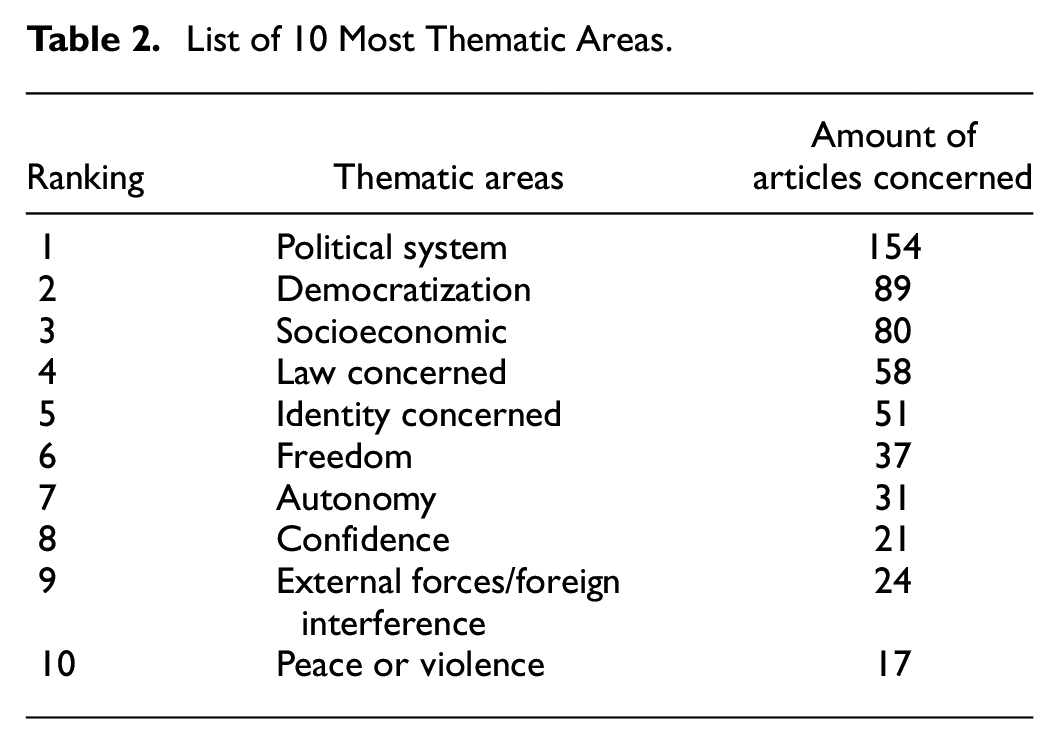
What are the common concerns associated with the year 2047 in people’s mind? We try to get a general picture by exploring the “keywords”-a number of recurring content-based terms or expressions, before regrouping them into different thematic areas. Table 2 shows the 10 most discussed thematic areas. As shown, most articles tend to associate the question of 2047 with the “political system,” that is, whether 1C2S will or should be maintained, or if there are other options such as “self-determination” or “independence.” The second most common theme is about “democratization,” which covers the issue of electoral reform, universal suffrage, the value of democracy, etc. The third most discussed field is related to socioeconomic issues, such as land lease, real estate, investment, economic development, social stability, livelihood, etc. The following part of the paper will present a clearer picture of how those fields are discursively constructed.
List of 10 Most Thematic Areas.
The Analysis of the Three Discourses
In terms of identity construction and the modes of anticipation, we extracted three distinctive discourses labeled as pro-establishment, middle-ground, and anti-establishment.
The Discourse of Pro-establishment
In the discourse of pro-establishment, Hong Kong is considered an inseparable part of China based on the law and history. The Hong Kong-China relationship is discussed in the frame of subordination and obedience. Any attempt to break it up is considered as doing harm to Hong Kong and the country, which is bound to fail. The following example is a speech pronounced by Wang Zhenmin, a professor of law appointed as the head of the Legal Department of Beijing’s Liaison Office in Hong Kong between 2015 and 2018, on the occasion of a luncheon with pro-establishment local lawmakers on September 22, 2016, in response to the rising localism and the calls for self-determinism.
Excerpt 1: HK-China relation as the whole and the part
4
Wang Zhen attended a luncheon themed on one country and two systems and made a speech on the Hong Kong-China relationship. He said that some people attributed the regression of Hong Kong to the development of the country. They tried to isolate Hong Kong by closing its door, even trying to cut the tie completely from its motherland. Wang said he was distressed to see these people doing harm to Hong Kong by all means. He also said ‘Hong Kong and the mainland form an integrated body. If Hong Kong gets sick, it’s the whole country that has to take medicine. However, even if Hong Kong’s turmoil causes a tiny damage to the nation, there will be a total disaster to Hong Kong. That will be an unbearable price for everyone to pay. 王振民昨出席一个有关一国两制的午餐会,就香港与中国的关系作主题演讲。他指有人将香港的衰落归咎于国家发展,试图将香港的门关上,将香港孤立起来,甚至完全与国家切割,不惜采取极端手段破坏香港,他对此感到痛心。他又称:「香港和内地是统一体,香港感冒、生病,要吃药的是整个国家。香港乱了,对于国家的损失可能是万分之一,但是对于香港这个局部,就是百分之百,是全部,是灾难,这是我们谁都无法承受的。」
As shown in the excerpt above, the Hong Kong-China relationship is figuratively compared to the part and whole of a human body, and the independentists are compared to a flu or some small sickness. It is warned that if a part of the body goes sick, the whole body will suffer. But it’s the part that will suffer the most.
Another rhetoric highlights the interest and benefit of 1C2S and argues from a business-like perspective. In the following excerpt, the author compares the economic situation of Hong Kong and the Mainland in the 1980s and nowadays. It is argued that China was very prudent when making decisions on Hong Kong’s arrangement during the pre-1997 negotiation because Hong Kong was like “a goose that can lay golden eggs.” Nowadays, with a shrinking economic contribution to the country and the worsening social instability, it would be very hard for Hong Kong to convince China to “renew the contract,” since the “price” is too high and the “interest” too low.
Excerpt 2 -HK-China relationship as business negotiators
5
In the past, the Central Government was very prudent when making decisions on HK- a goose that can lay golden eggs, with its GDP accounting for 25per cent of the national GDP. Now, the proportion falls to less than 3per cent. Nobody knows how much lower it could be as 2047 approaches. Under such conditions, the pro-democracy camp still proposes things that are inconsistent with the Central government’s standards. Do they believe they still have the potential to win the bargain? Or will they make things worse by irritating China, giving it the reason to turn the current 1C2S into 1C1S? 问题是过去中央对香港这只可以下金蛋的鹅会投鼠忌器,但当年香港的GDP 占全国的25%,下跌到目前的不足3%,到2047 年更不知道会跌到哪儿去。在这样的条件下,香港的泛民还提出跟中央不一致的标准,还会有叫价能力吗?会不会反过来成为,愈是泛民提出的,中央就更不买帐,弄巧反拙成为实施一国一制的理由。
There are several assumptions underpinning the pro-establisment’s views on Hong Kong-China relationship and Hong Kong’s future beyond 2047. First, Hong Kong’s high degree of autonomy is “granted”(赋予) by the Central government in the form of 1C2S through the Basic Law. It’s a privilege due to Hong Kong’s special history and should not be taken for granted. Whether Hong Kong would continue to enjoy the privilege after 2047 depends on whether the Central government is willing to give.
Second, Hong Kong residents are not entitled to self-determination, because the right of self-determination only belongs to the people from a sovereign state or from a colonized territory. Given that Hong Kong has been removed from the UN list of colonized territories since 1972, Hong Kong people don’t have the right to any form of self-determination, be it internal or external. The claim for self-determination is condemned for intentionally confusing the concept of “high degree of autonomy” (高度自治) with “self-determination” (自决), therefore misleading the readers. 6
Third, Hong Kong is considered a possible passageway for the infiltration of “foreign power”(境外势力), especially the US who seeks to “contain China” (遏制中国). Since Hong Kong is westernized in many ways compared to China’s mainland cities, it’s relatively easy for the US to find someone who speaks and works for the US’s interest, such are the activists claiming self-determination who are allegedly working in collusion with “Taiwan’s independentism” (台独势力) and “foreign power,” with the conspiracy to sabotage 1C2S and do harm to Hong Kong and China. 7 Therefore, if the US keeps “meddling with” (干涉) Hong Kong’s affairs, its intervention might eventually lead to the end of 1C2S in Hong Kong, since it is not rational for China to maintain a system that benefits the rivals at the price of its own interest. 8
Those assumptions lead to a predicted future scenario where Hong Kong will be governed either under the current framework of 1C2S or under “one country one system (1C1S)” referring to a total assimilation into China’s socialist system. In either way, it’s China’s central government who decides. Since 1C2S works for the best interests of both China and Hong Kong, Hong Kong people should convince China to continue with the granting of the “privilege” over 2047: they should work hard to maintain Hong Kong’s prosperity and social stability under China’s rule. Moreover, Hong Kong should prove its usefulness and loyalty to China by fully integrating into China’s overall development strategy and the grand narrative of the “great national rejuvenation”(中华民族伟大复兴). It is asserted that as long as the red line of “one country” is respected and the “two systems” benefit both parties, there is no reason for 1C2S to change beyond 2047.
The Discourse of the Middle Ground
In the discourse of the middle ground, Hong Kong’s position vis à vis China is framed as dependent yet different. It is generally considered that Hong Kong cannot develop independently without the support of China and that it won’t have real democracy without the approval of the Central government. However, Hong Kong is deemed as distinctive from mainland China in many aspects, including the rule of law, freedom of speech, a healthy civil society, the local identity, and the “core values.”
The discourse of middle ground is featured by a pervasive sense of insecurity and lack of confidence about the future as well as ambivalence between powerlessness and self-empowerment. It implies that China is undermining Hong Kong’s distinctiveness and hindering its democratic process by invoking a series of symbolic events, such as the “August 31 Decision” on Hong Kong’s electoral reform, Beijing’s “white paper” announcing “overall jurisdiction”(全面管治) over Hong Kong, the “disappearances” of the Causeway Bay books merchants, the pass of the Hong Kong National Security Law, etc. With growing tensions in the US-China diplomatic relations, it is worried that Hong Kong may become a victim of the purported “China-US cold war.” Those ideal concerns are intermingled with material ones, much of which is related to the validity of property rights and Hong Kong’s status as an international financial center.
The lack of confidence is embedded in discontent over the application of 1C2S as well as the desire for more democracy and more civic engagement in Hong Kong’s future building. It is assumed that Hong Kong people didn’t fully participate in the negotiations for Hong Kong’s post-1997 future, including the drafting of the Basic Law which didn’t meet Hong Kong people’s expectations for democracy. It is claimed that Hong Kong people should have a say in their own destiny in 2047 and make their voice heard, because “the pursuit of democracy and freedom is a fully justified cause that nobody can blame.” 9
However, the discourse also assumes a limited agency of Hong Kong people, arguing that Hong Kong people can only do things upon conditions. It is generally considered that Hong Kong’s future relies upon China’s decisions. That’s why the discourse of middle ground overtly dismissed the call for self-determination in 2047, which, in their eyes, is unrealistic and impractical. They also consider it naïve and useless for political activists to seek help from the international community, because Hong Kong has already been under China’s control since 1997 and it no longer has a third party to count on.
Meanwhile, the middle grounds also presuppose that China’s policies toward Hong Kong are contingent upon changing conditions. One cannot rule out the possibilities of change in “the big environment (大环境)” 10 by 2047. For example, much will depend upon decisions that have yet to be made by future generations of Chinese leaders in the coming years. Meanwhile, geopolitical factors, in particular the China-US economic cold war and the China-US-Taiwan relationship, will have an important role to play in China’s decision-making by 2047. Since Taiwan is generally considered the ultimate goal of the 1C2S, some authors assert that Hong Kong’s future relies upon China’s policies toward Taiwan amid a changing China-US power relationship. 11
These assumptions underpin their way of seeing the future, which is filled with hopes, uncertainty, and pragmatism. Ideologically inclined to “western universal values” and the “HK identity,” the middle grounds have demands for political democratization. However, they also cherish economic prosperity and social stability and wish to stay within the established system in the long term. In other words, their ideal version of Hong Kong’s 2047 is a continuation of 1C2S with improvements in democracy.
What can be done for the desired future? On the one hand, there is a sense of powerlessness and the need for protection from China. Some wish that Beijing can make a formal announcement about the maintenance of 1C2S over 2047, which will serve as “a pill of reassurance” (定心丸) 12 for Hong Kong people. Some pray for the non-decoupling of the US-China economic ties, so that “China might persuade the US to set Hong Kong free from the US-China competition, given mutual interest.” 13
On the other hand, there are calls for self-awareness and self-empowerment. While structural reform of the electoral system is desired, great emphasis is put on the role of communication and open discussions. It is often suggested that Hong Kong’s arrangement beyond 2047 should be openly discussed and negotiated among different stakeholders as soon as possible. The issue of land lease is particularly considered a problem in need of early discussion. In an article written by Johannes Chan Man-mun, former dean of law at the University of Hong Kong, the author suggests that Hong Kong’s status over 2047 should be clarified around the year 2027 in order to solve the land lease issue in a timely manner. 14
Besides the call for democracy and open discussions, the middle grounds think it important for Hong Kong people to make use of the privileged conditions under the current systems and focus on capacity building, such as “local reforms” (局部变革) and the preservation of Hong Kong’s core values and identity. 15 It is said that “time is on our side,” 16 but patience and preparations are also needed: only by getting itself well-prepared can Hong Kong seize the opportunity to strive for the desired future, under the conditions of changes in “the big environment.”
The Discourse of Anti-Establishment
In the discourse of the anti-establishment, the Hong Kong-China relationship is constructed in the frame of opposition and resistance. China is compared to “emperor,”“oppressor” “invader,” while Hong Kong’s democratic movement is compared to “resistance” or “revolutionary’ 17 It is said that “the August 31 Decision” has “relentlessly smashed” 18 (无情地压垮) Hong Kong people’s dream for democracy. The Hong Kong National Security Law brings “white terror” (白色恐怖), threatening the freedom of speech and human rights, trampling over judicial independence and social justice, routinizing police violence, and invalidating Hong Kong’s Principle Officials Accountability System’. 19 The Guangdong-Hong Kong- Macao Greater Bay Area is portrayed as a transitionary phase that prepares Hong Kong for “one country one system” in 2047. 20 The education of Putonghua and simplified Chinese character carries the conspiracy to “eradicate HK’s language, culture and local identity”(铲除香港语言文化和本土认同) 21 ; China’s cultural policies toward Xinjiang and Inner Mongolia are compared to “cultural blood transfusion”(文化换血) 22 targeted for assimilation, which will not exempt Hong Kong in the future.
In some articles, 23 the frame is slightly different: it’s not China but the Chinese Communist Party (CCP) that is in hostility to Hong Kong people. It is claimed that all ethnic Chinese people, wherever they were born and are living, as long as they believe in democracy and freedom, they are members of the same community against CCP, which is part of a wider international front against the ideology of communism. Therefore, Hong Kong’s future should always be viewed within an international perspective.
The discourse of anti-establishment often contains an explicit account of what constitutes the identity of Hong Kong people, which is quite different from the two other discourses where narratives of identity are hidden behind the depiction of the Hong Kong- China relations. It is asserted that Hong Kong people’s “subjectivity”(主体性), 24 grounded in values of freedom, rule of law, fairness, clean government, integrity and other local core values, have initially emerged under the British “conciliatory governance” (怀柔管治) 25 in the 1970s. They have been consolidated through the Joint Declaration and the Basic Law and reinforced through the “experiences of collective resistance”(共同的抗争经历) 26 against the mainland “Other,” embodied in a series of social movements since 2003. In other words, it is values rather than ethnicity that form the basis of Hongkongers (see Excerpt 3).
Excerpt 3- Discursive construction of the Hong Kong people
27
Hong Kong people and mainland people surely share common ties in blood, culture, and history, but Hong Kong people’s subjectivity is fundamentally about the endorsement of the core values of our city: any Hong Kong residents, no matter when they arrive in Hong Kong and as long as they identify with the land and the core value of Hong Kong, are considered Hong Kong people.
香港人与大陆人,固然拥有血缘、文化及历史上的共同渊源,但香港人的「主体意识」,根本体现在一种对我城核心价值的认同——任何香港居民,无论什么时候来到香港,只要认同香港这片土地、认同香港核心价值,就是香港人。
Embedded in such identity expressions are several assumptions. First, it is the Sino-British Joint Declaration other than the Basic Law that should be held fundamentally accountable for the way that Hong Kong is to be governed from 1997 to 2047. In other words, Hong Kong’s autonomous status is a commitment that China and the UK made to the international community. If China doesn’t stick to its promise, the UK and the larger international community have the responsibility to step in.
Second, Hong Kong’s return to China was based on the condition that China will eventually give Hong Kong full democracy, which means the election of CE and LegCo by “one person, one vote.” Given that China keeps “breaking the deal,” there will be no hope for democracy under China’s rule. Since the Sino-British Joint Declaration only “guarantees” Hong Kong’s autonomy for 50 years, Hong Kong people should think out of the box as the deadline of 2047 approaches.
Third, Hong Kong’s future should be determined by its people. It is claimed that Hong Kong people were excluded in the negotiation process to decide upon their city’s post-1997 destiny and that the Basic Law was drafted without the authorization of Hong Kong people. Hence, the year 2047 will be a second chance for Hong Kong people to regain their rights. The term “self-determination” is vaguely depicted as Hong Kong people’s intrinsic right to collectively decide upon the city’s political system and socioeconomic pattern through a democratic process.
These assumptions are the foundations of the imagination of Hong Kong’s future beyond 2047, which is considered wide-open. It is claimed that even at present, 1C2S only exists in name and has already been dead. If nothing is done, Hong Kong is doomed to become an ordinary Chinese city under “one country one system (1C1S)” after 2047, with no freedom, no human rights, no rule of law and good chances that huge prices are due for the extension of land leases over 2047. Therefore, Hong Kong people should break down the established rules and strive for “perpetual self-rule” (永续自治) 28 under a democratic system, which could be realized through self-determination in the form of a referendum.
To obtain the necessary conditions for self-determination, participation in the legislative council is deemed as a crucial step at the early stage of the anti-establishment discourse, that is, around the year of 2015 and 2016. It is claimed that by bringing the ideas into the legislative council, activists of self-determination can have their voices seriously heard and prepare for their goals by legislative means. 29 Meanwhile, Hong Kong people are called on to defend the “core values” and reinforce their agency in the whole society. It is said that a network of resistance should be built on the ground, where citizens from all sectors are mobilized to defend Hong Kong’s core values in their professional and private life. Activists should develop strong ties with local communities, rooting the idea of self-determination in the hearts of ordinary citizens. Meanwhile, Hong Kong should develop its economic power and cultural soft power in order to be self-sustainable from China.
With the publication of the National Security Law, more expectations are put on the “international front.” According to the suggestions, while local activists should keep fighting on the ground with adaptable tactics, Hong Kong expatriates should be more actively engaged in foreign lobbying, expanding the target audience from government officials to ordinary citizens 30 ; since Hong Kong’s democratic movement is deemed as part of a larger international battlefield against China’s communism, Hong Kong people should keep a close eye on China’s interactions with the western democratic world, in particular with the US. It is claimed that by the time the democratic forces win the China–US old war, Hong Kong’s freedom and democracy will be achieved overnight. 31 Meanwhile, Hong Kong expatriates should pay special attention to the transmission of Hong Kong culture, in particular its language, because language is considered important not only to identity maintenance but to the ongoing process of identity construction. 32
Discourse in Action
Elaborated in the previous section, the three discourses are summarized in Table 3 in terms of identity construction and modes of anticipation. It is worth noting that despite the differences shown in the table, the three discourses share something in common: Explicitly or implicitly, they all regard 1C2S as a policy of expediency that could be changed under conditions. “The big environment” is commonly taken into account, where China’s domestic politics and its relations with Taiwan and the US by 2047 are supposed to play an important role. In all three discourses, capacity building is highlighted as a means to achieve the desired end.
Discursive Construction of HK’s 2047 in Three Discourses.

How do future-oriented suggestions of different discourses figure in real-world actions? For the authors of pro-establishment, economic development, social stability, and deeper integration into China’s national strategy are the keys to securing Hong Kong’s place as China’s special administrative region under the principle of 1C2S. Those future-oriented suggestions are reflected in the lines of action of a newly elected local government, backed by an overwhelmingly pro-Beijing legislative council with a constant display of loyalty to the Central Government. In the inauguration speech and the first policy address, John Lee, the current Chief Executive of Hong Kong emphasized the city’s development as an economic and technological hub and pledged to tackle livelihood issues, such as access to housing and creating job opportunities for young people. He also placed social stability as the top priority, vowing to press on with the enactment of a local anti-subversion law under article 23 of the Basic Law for the coming years. So far, this pragmatic and “result-oriented approach” (以结果为目标) has won him certain popularity among Hong Kong citizens, as reflected by the latest opinion polls. 33 In the long run, economic development, social stability and further integration with the Mainland will be the theme of Hong Kong’s governance for the second half of the “unchanged 50 years” under 1C2S. It remains to be seen if that will lead to the expected results in 2047.
Discussion—the foundation of deliberative democracy, is what the middle ground emphasized as a way of consensus building and collective thinking. It seems to be proven effective in reducing social and political polarization in Hong Kong, as found in a study where researchers conducted a pilot experiment on Hong Kong citizens holding different political views on a given topic (Shen & Yu, 2021). However, in Hong Kong’s realpolitik today, whether there is still room for truly open and sincere dialogs becomes increasingly doubtful. Even if consensus can be reached within Hong Kong society, some scholars (ex., Gittings, 2011) warned that there is no guarantee that Beijing will accept it, given the historical experiences from the consultation process in the late 1980s and early 1990s which decided Hong Kong’s future beyond 1997. Moreover, open discussions might even make things worse if Beijing considers it a threat to its authority and uses it as an excuse to further constrain Hong Kong people’s existing rights and way of life.
In the rhetoric of anti-establishment, political participation by electoral means, resistance and capacity building both on the ground and from overseas are suggested as the future actions to be taken. Even though the claim for self-determination did help some activists win the LegCo election in September 2016, their “victory” was transient, as many were soon disqualified from taking office due to the oath-taking controversy. 34 Nowadays, the “parliamentary means” has come to a complete dead end, as Beijing imposed the Hong Kong National Security Law and the sweeping overhaul of Hong Kong’s election system allowing only the Beijing-acknowledged “patriots” to run for.
Local resistance of other kinds is faced with mounting pressure from the authority. In terms of freedom of speech, Hong Kong’s press freedom has plunged from 80th in 2021 to 148th in 2022, according to Reporters Without Borders. 35 Media outlets unafraid to openly criticize the Central government, including Apple Daily and Stand News, were shut down with ex-staff members arrested. Traditional outlets like Mingpao, generally recognized as centrist, have become increasingly restrained and self-censored. Social groups and student unions deemed as subversive are forced to dissolve. Protests and assemblies are either banned or largely constrained, including the annual commemoration of the June 4th Tiananmen event. Even euphemistic expressions of defiance can be seen as violating the invisible “redline,” such is the case of children’s picture book, 36 where the authors, using cartoons of goats and wolves to infer Hong Kong’s 2019 mass protests and other political events, were arrested and charged with sedition. Another example is the removal of the Pillar of Shame, 37 a famous statue erected in the University of Hong Kong since 1997 in commemoration of the June 4th Event. In short, the room for local pro-democracy movement has been largely narrowed down.
What about the building of the “international front” against China’s communist regime? According to some studies (ex., Fong, 2022; Lee, 2023), the 2019 protests have prompted the emergence and development of Hong Kong diasporic communities. The number of overseas activist groups is said to have quadrupled compared to the total amount before 2019 (Fong, 2022, p. 1068). Those groups are engaged in different kinds of collective mobilization and have the potential to complement each other in their resource and action. Some contributed to public diplomacy by organizing or participating in activities like protests, rallies, assemblies, social media advocacy, holding seminars, talks, exhibitions, and film screenings. Some focused on international lobbying, making use of their status and established networks to persuade foreign governments to sanction the Hong Kong and the Chinese governments. Although these diaspora communities are still at the preliminary stage of development, they have strong “moral” and “cultural” resources, as their call for the defense of Hong Kong’s autonomy, democracy and human rights resonate with western democratic countries (Fong, 2022). The rising China-US new cold war and the worsening China-UK relationship also make western media and politicians more sensitive to the demands and narratives of Hong Kong’s overseas activist groups. It is worth noting that recent waves of anger and frustrations in China caused by the government’s strict anti-Covid policies might inadvertently create some mutual understanding and connections among pro-democracy activists in Hong Kong, mainland China, and the pan-Chinese diaspora communities, further expanding the “international front” against China’s authoritarian regime. So far, it is still too early to tell how Hong Kong’s future will be influenced by dissident discourse and actions from overseas.
Concluding Discussions
This study explores how Hong Kong’s future beyond 2047 was discursively constructed through local press media from 2003 to July 10, 2021. It contributes to the study of social mentality in the first half of the “unchanged 50 years” and forms an integral part of the author’s ongoing research project on future narratives about Hong Kong.
The first part of the findings shows how discussions about the 2047 issue in local media have developed over time and what constitutes people’s major concerns about Hong Kong’s long-term future. The second part explores the characteristics of the three discourses and how they articulate with the broader sociopolitical context. In the last part of the study, we discuss how future-oriented suggestions in different discourses are embedded in and give shape to real-world actions.
Future narratives operate as an instrument of mind in the construction of reality (Jarva, 2014) and serve as a resource for collective mobilization. How discourse and action will further co-construct each other in shaping Hong Kong’s future remains an ongoing process. Under the National Security Law, traditional media in Hong Kong are becoming increasingly self-censored. Instead, social media like Facebook, Twitter, Telegram and the LIHKG, as well as overseas-based publications like 《如水》(Be water) and《自由港》 (Harbor of freedom) have become major platforms of social mobilization in Hong Kong’s pro-democracy resistance, connecting activists from home and abroad and contributing to the future building process. It would be instructive to investigate future narratives through those new media platforms as a continuation of the present study.
Research Data
sj-xlsx-1-sgo-10.1177_21582440241245188 – for Discursive Construction of Hong Kong’s Future Beyond 2047: A Press Media-Based Study
sj-xlsx-1-sgo-10.1177_21582440241245188 for Discursive Construction of Hong Kong’s Future Beyond 2047: A Press Media-Based Study by Guo Yufei in SAGE Open
Footnotes
Declaration of Conflicting Interests
The author declared no potential conflicts of interest with respect to the research, authorship, and/or publication of this article.
Funding
The author disclosed receipt of the following financial support for the research, authorship, and/or publication of this article:This work was supported by the National Social Science Fund of China under Grant [20CYY009].
Ethics Statement
There are no human participants in this article and informed consent is not applicable.
Ethical Approval
This study was performed in line with the principles of the Declaration of Helsinki. It does not contain any studies with human participants performed by any of the authors.
Declaration of Informed Consent
This article does not contain any studies with human participants performed by any of the authors.
Research Interest
Language, discourse, and identity in Hong Kong.

Availability of Data
I declare full availability of the data used for this study.
Supplemental Material
Supplemental material for this article is available online.
Notes
References
Supplementary Material
Please find the following supplemental material available below.
For Open Access articles published under a Creative Commons License, all supplemental material carries the same license as the article it is associated with.
For non-Open Access articles published, all supplemental material carries a non-exclusive license, and permission requests for re-use of supplemental material or any part of supplemental material shall be sent directly to the copyright owner as specified in the copyright notice associated with the article.
