




Abstract
Television is a penetrating medium, capable of creating false consciousness among the viewers. The present study examines the ideological constructions in Pakistani news bulletin headlines and their impact on the viewers. This research has explicated the ideological constructions through Fairclough’s framework for critical discourse analysis (CDA) by applying it to the electronic media news headlines and comparing three different Pakistani news channels. Extensive text as well as selective intertextual and sociocultural analyses have been carried out along with the assessment of the impact of news headlines on viewers through a questionnaire. The analysis of the news headlines reveal that Pakistani news headlines are infused with varying ideologies and power relations, while the responses of the viewers reveal their dislike for entertainment-oriented, exaggerated, unfair, and moderately informative headlines of news channels. It is hoped that current study would help in the promotion of media literacy among viewers and media authorities in Pakistan.
Introduction
It is a well acknowledged fact in contemporary society that people turn to different sources of information like print and electronic media to keep themselves updated with the happenings of the world especially concerning the matters of national and international politics, security, and events like war. Hence, there is a need of a vibrant mass media that can keep people aware of the political and social activities of the world. However, reviewing literature related to mass media reveals that media shapes the public perception by keeping intact its vested interest. Particular ideologies are propagated in the name of providing objective information to the public. Fairclough (2006a) argues that media discourse should be regarded as having complex and contradictory ideological constructions that are not always fixed but vary in their constructions. As a result, it becomes vital to have a deeper investigation of the ideologically invested meanings pertaining in mass media. For this reason, a comprehensive framework is required that could provide a deeper inquiry in the matters of ideology, power, and hegemony. Consequently, this research largely draws upon the critical discourse analysis (CDA) framework given by Fairclough that stresses on the three dimensional investigation of any “communicative event.” First level includes the close textual and linguistics analysis; second level includes the analysis of discursive practices, while the last level deeply studies the social practice and sociocultural phenomena. The purpose of this exploratory study is to advance the research on Pakistani electronic media’s news headlines, their framing, and examination of the role of ideology in their news constructions.
Different social, political, economic, cultural values and structures influence the mass media and in turn are influenced by it. Fairclough (1995) argues that media industry is under the control of certain institutions that hold political, cultural, and economic power. Tolson (1991) argues that sometimes the informational content on the media outputs is ideologically shaped. The purpose behind this ideologically driven information is to reproduce and strengthen the social relations of oppression and exploitation. Moreover, ideological constructions on the media are made naturalized and the audience perceives the “information” on media a part of their “common sense” knowledge. Thus, Fairclough (1995) claims that as media is capable of being manipulated by various institutions in the society, so it can never be said to represent a “reality” but merely the “representations of reality.”
Stressing over the importance of media analysis, Fairclough argues in favor of the investigation that traces out audience reception of the media texts. How audiences “read” different texts is equally important as the analysis of the existing ideologies inside the texts. He further argues that ideology is not explicitly stated in media discourses but one should always inquire to expose the ideological work that might have been done in any particular media. Moreover, the connection between language use and power often appears vague to the people, thereby making them vulnerable to be easily exploited or manipulated.
Free media is imperative for a flourishing democracy. It helps people to gather information that otherwise would be difficult to gather. Moreover, free media often serves as a watchful guardian for the people of any country. As to link mass media and ideology, there is an accepted recognition that media hold the power to manipulate the masses. Different media groups serve the vested interest of a certain “specialized class” of a society by propagating “false consciousness” among the viewers.
In Pakistan, media is regarded as the fourth pillar of the state after parliament, executive, and judiciary. Moreover, the right to have an access to information is well protected by the constitution of Pakistan that serves as a legislative framework for Pakistani media and outlaws anything against Islam, security of Pakistan, and morality. At present, we can see a lot of upheavals in Pakistani political and social scenario. Pakistan holds a key position in the global war against terrorism; however, the country is also facing many domestic conflicts. Likewise, Pakistani media is often charged by different sections of the society to spread false consciousness among the masses. For this purpose, research at hand attempts to reveal the implicated ideological constructions in Pakistani news bulletin headlines.
The context behind this research is provided by the news coverage of two major events in Pakistan by different news channels. The first major event is a 126 days long sit-in by the leading opposition party, Pakistan Tehreek-e-Insaaf, against the then Prime Minister of Pakistan Muhammad Nawaz Sharif. The other major event addressed in this research is the terrorist attack at Army Public School in Peshawar on December 16, 2014. In a much happening Pakistani society, media is regarded as the fourth pillar of the state after parliament, executive, and judiciary. Moreover, the right to have access to information is well protected by the constitution of Pakistan that serves as a legislative framework for Pakistani media and outlaws anything against Islam, security of Pakistan, and morality. Pakistani media has seen a massive evolution during the last 10 to 15 years. Since 2002, Pakistani media has flourished through the emergence of private Pakistani satellite channels. However, these channels are only accessible through the cable operators. The objectives of the present study are to trace out power relations, roles, and identities propagated through certain ideologies in Pakistani news channels’ headlines, susceptibility of listeners about the linguistic style of news headlines, and framing of the world in these headlines.
Theoretical Considerations
Research at hand gain its insights from the framework of CDA proposed by Fairclough (1989, 1992a, 1993). CDA of media texts involves the analysis of text, discourse practice, and sociocultural practice. Text analysis, according to Fairclough involves a deeper investigation of language forms. He classifies text analysis under four main headings; vocabulary, grammar, cohesion, and text structure. Furthermore, he argues for the analysis of three more concepts, which are considered as formal features of texts and they contribute more to the analysis of discourse practice. These concepts involve force of utterances, coherence of the text, and intertextuality of the text. Third level of analysis involves sociocultural analysis, which can be achieved by examining the power relations prevailing in any society. Analysis of the power relations further elaborates the hegemonic struggle of the people of that particular society. Moreover, imbalanced power relations will reproduce, restructure, or challenge the prevailing hegemonies (Fairclough, 2006a).
In his book, Media Control: The Spectacular Achievements of Propaganda, Noam Chomsky and Chomsky (2004) has extended the notion of media framing by suggesting two models of democracy that prevail in the world. According to the first model, democracy prevails when public is free to access the information and the means of providing information are open and equally accessible to everyone. Whereas, according to the second model of democracy, the means of information are carefully and firmly manipulated by the certain “specialized” class of any society. Mass media has expanded to such an extent across the globe that it has become like a self-sufficient entity, living for itself. Chomsky regards mass media as a primary source for propagating propaganda. In addition, Douglas Kellner (2003) argues that radio, television, film, and all other types of media culture are capable to construct one’s perception of oneself, identity, selfhood, ethnicity, nationality, sexuality, class, status, and all other related notions of being male and female. Media provides us with the vital sources needed to grade others in the categories of “us” and “them.” “They dramatize and legitimate the power of the forces that be and show the powerless that they must stay in their places or be oppressed” (Kellner, 2003, p. 9). Pamela J. Shoemaker (2006) argues about the commodification of news that is manufactured by the journalist and is capable to be sold, bought, and traded (Shoemaker, 2006). Moreover, multiple factors can influence the process of framing in media; some key factors could possibly be journalist’s personal value system, experience, editorial positioning, economic conditions, political climate, cultural conditions, and ideological frameworks prevalent in society. Hackett and Zhao (1994) has studied the coverage given to the anti-war narrative in the media which reveals that such voices are marginalized but ultimately succeed to make their way in the local newspapers. “The picture of world that is presented to the public has only the remotest relation to reality” (Chomsky, 2002, p. 182).
In his book, Media Discourse, Fairclough argues that media sets an agenda for the listeners and thus asserts its power. The power of media to shape peoples’ perception, beliefs, values, and social relations is undeniable. He further ascribes media to have “signifying power,” which is largely manifested in how media frames the news story and how language is manipulated. Therefore, the rationale behind the selection of CDA to investigate ideological construction of Pakistani news headlines is well articulated by the fact that CDA provides an interdisciplinary framework that helps in analyzing the broad categories of news. As summed up by Fairclough (1992), CDA of news media headlines helps in finding the answers to the questions that are addressed in the research. The major research question established for this research is, “How the ideological meaning is constructed in Pakistani news bulletin headlines?” On the contrary, minor research questions attempt to answer the questions such as “How the language is manipulated through the choice of words in Pakistani news headlines?” “How the impact of a message is enhanced by the way in which it is presented in news bulletin headlines?” “How is the world represented and framed in news headlines?” “What identities and relationships are set up for those involved in a news story?” and “How susceptible are the listeners to linguistic style of news?”
CDA has become a diverse area of study by the incorporation of multiple approaches and disciplines. Fairclough has elaborated his view of discourse by bringing together “linguistically oriented discourse analysis and social and political thought relevant to discourse and language, in the form of a framework which will be suitable for use in social scientific research, and specifically in the study of social change” (Fairclough, 1992, p. 62). Fairclough and Wodak (1997) argue that discourse is both socially constitutive and socially conditioned. According to Fairclough, members of the society are unaware of the webs of social structures, power relations, and nature of social practices, while their practices leave impact upon the social structures and social struggles around them.
Public perception of the media has always been vital for the researchers, as the public remain in direct contact with the media on a daily basis. In this regard, different researchers have carried out various researches using qualitative and quantitative methods. In 2009, The Pew Research Center (nonpartisan, American fact tank) has issued a study about the American public perception regarding ideological framing of television news. For this purpose, a survey was conducted from October 23 to October 26. According to the results, American audience voted for FOX news as the most ideologically driven network while channels like MSNBC, CNN, NBC, ABC, and CBS were also a part of the same research. In addition, David Machin and Joanna Thornborrow (2003) is of the opinion that discourses do not merely constitute communication through political speeches and news. Instead, they are manifested in the social and material culture that constitutes our lives such as entertainment media that includes movies, fashion, toys, music, and architecture. Semiotic resources of different genres are the gateway to multiple discourses which are further infused by power relations.
For Kress (2010), different semiotic resources offer different affordances so that they can be used to perform kinds of communicative tasks like a sound can be more effective than a written text. He argues that through semiotic analysis we can dig deeper into the communicative activity by disclosing discourses that are otherwise hidden in casual viewing. He cites the example of news items that frames any issue of Muslim community by showing the image of women in “Burqa” (Body Cover) to be a representative of “Muslimness.”
Method
To proceed with this research, a comprehensive methodology is established to maintain reliability and validity. The present study investigates ideological basis in Pakistani media’s news headlines and aims to determine their impact on the listeners. For this purpose, qualitative and quantitative analyses are carried out. Qualitative analysis is carried out by following Fairclough’s framework that focuses mainly on textual analysis, considering the variables of lexical choices, cohesion, style, bias, and rhetoric in the 9 p.m. news headlines of ARY News, GEO News, and PTV News. In total, 608 headlines have been analyzed. Moreover, snow ball sampling technique of survey is used to collect responses from 100 respondents through an online questionnaire, which is developed to gauge the impact of 9 p.m. news headlines on viewers’ minds. For qualitative analysis, analytical framework is provided by the version of CDA (Fairclough 1989, 1992a, 1993), which includes three different levels of analysis that are further linked with three complimentary dimensions of discourse, that is, text analysis, processing analysis, and social analysis. However, in this research, emphasis is given to linguistic analysis of text along with selective intertextual analysis and sociocultural analysis. For quantitative analysis, a questionnaire is developed to achieve the objective of inquiring the susceptibility of listeners to the linguistic style of news.
Data are gathered for the 9 p.m. news bulletin from three different Pakistani news channels, which include GEO News, ARY News, and PTV News. The 9 p.m. news bulletin is selected due to the fact that at this particular time, most families get a chance to sit together after their routine tasks and listen to the extensive and detailed news bulletin of the day. News headlines are transcribed by listening to the bulletin. Data have been collected for 20 days, starting from December 1, 2014, to December 20, 2014. Each news headline is taken as a unit for analysis. Furthermore, variables that help in analyzing the data through CDA include lexical choice, cohesion, style, bias and rhetoric.
Quantitative analysis is also carried out to gauge the impact of news’ content and presentation style on the viewers. Keeping in mind the notion of polls and survey in media-related researches, selection is made to make use of a survey method for collecting data. Analytical surveys help to find the current state of affairs and help to gather public opinion over any particular situation. Not only this, they further help to determine the relationship between media practices and their effect over media consumers.
For the present study, people aged from 21 to 31 years are selected as participants. Data are collected through an online questionnaire. The first question asks the respondents whether they listen to 9 p.m. Pakistani news bulletin or not. Only those questionnaires are included for analysis in which the respondents have answered “yes” for this question, which makes them 75 in total. Out of 75 respondents, 33 females and 42 males have responded to the questionnaire that makes their participation to 44% and 56%, respectively (see the appendix). Data are collected from these 75 respondents by using snow ball sampling technique.
Questionnaire has been filled by the respondents of the above mentioned age group after putting it on Facebook. Thus, results are collected online, which are further analyzed by making statistical diagrams using SPSS software. After analyzing qualitative data and quantitative data, both are linked to explain the main research question regarding construction of ideology in Pakistan news media headlines.
Findings and Implications
Considering this, headlines from the above mentioned news channels are analyzed on different grounds of vocabulary, cohesion, style (politeness, pathos, screaming, photos, sensationalism, undue exclamations, poetic exuberance, music), bias (selection, omission, placement, tone, choice of words), and rhetoric (alliteration, puns, exploring endings, allusions, metaphors).
The Subsidiary Question 1 addresses the manipulative nature of lexical items in the news bulletin headlines. It is observed that the media channels rely heavily on the vocabulary to manipulate their viewers. Figurative language is used to influence viewers’ perceptions. Their selection of words is prejudiced toward certain people, politicians, and world events. In most cases, manipulation is done through the organization of news events. They further exploit the viewer’s perception by incorporating emotions over rationality.
Their prejudice serves their vested interests and the channel’s internal policy. ARY News headlines hold an anti-government, anti-GEO, and anti-Indian stance, which is clearly expressed through their lexical choices. Through their lexical choices, ARY News has framed Imran Khan, the leading opposition figure, as the only heroic figure who would rescue Pakistani youth from all the other corrupt politicians. Phrases like “Go Nawaz Go” were continuously repeated in their coverage of Imran Khan’s sit-in. PML-N politician Rana Sana-Allah is presented as “Gullu Butt” (Gullu Butt is an intertextual reference to the PML-N’s so called party worker who was captured destroying public property by the media on June 17, 2014. Since then, almost every act of torturing the innocent citizens is referred to as “Gullu Butt-ism” by ARY). For instance, Lahore will remain closed tomorrow. If Gullu Butts like Rana Sana-Allah (Federal Law Minister) would be set free, then (we) will fight them.
Moreover, ARY News has condemned PML-N government by elevating Imran Khan’s sit-in through their coverage time as well as through their choice of words. The people who attended the PTI sit-in are glorified by using adjectives like “passionate youth.”
Tehreek-e-Insaaf workers participated fervently (in the sit-in) despite the cold weather. Females, kids, the old and the young, were all passionate and danced a lot on party songs and anthems.
Furthermore, in the 9 p.m. headlines of ARY News, the government is portrayed as “incapable,” “brutal,” and even “unwanted” through their lexical choices.
The government is reported as taking “revenge” and “punishing” ARY News specifically for exposing the incapacities of the railway ministry.
Reporting the truth has become a crime under Muslim League–N government.
Furthermore, anti-GEO rivalry is visible in the 9 p.m. headline bulletin of ARY News. Both are private news channels, having a sole purpose to disseminate information but they both are seemingly fighting an internal war against each other. On multiple instances, ARY News headlines portray GEO News and its owner, Mir Shakeel-ur-Rehman, in a negative way through the selection of derogatory word items like “GEO’s anti-judiciary poisonous mission.”
“Mir Shakeel-ur-Rehman and GEO are doing contempt of court. If there is a jungle’s law in Gilgit then why did they file an appeal there?” Chief Justice remarked on GEO’s anti-judiciary poisonous mission. Another court of Abbottabad has declared Mir Shakeel-ur-Rehman as an absconder.
Moreover, number of instances include the mention of “GEO’s blasphemy case,” which was intended to remind the people about the offense committed by GEO News against religious figures. These instances imply that news are not selected out of the newsworthiness but merely to propagate the channels’ agendas of manipulating peoples’ perception in their intended way. Therefore, reality is not depicted through the news but in fact it is constructed by the channels’ vested interests. Moreover, in the coverage of hard news, ARY News headlines strongly seem to unite peoples’ perception over military operations conducted by Pakistan Army against the terrorists. The glorification of army personnel is done to create an internal national cohesion and solidarity. Idiomatic expressions of Urdu language are used to construct the news. Referring to the military operation “Zarb-e-Azb,” it was reported that army jets have “rained fire” over the terrorist hideouts.
Earth contracts for terrorists while sky rains fire on them.
Over the incident of December 16, the terrorists were referred to as “beasts.”
School at Peshawar has undergone the most brutal terrorist attack in the history of Pakistan. Dressed up in FC uniform, the beasts opened up indiscriminate firing, putting children in a blood bath. According to DG ISPR, 141 people, including children were martyred. Asim Bajwa (DG ISPR) says seven terrorists were wearing suicidal jackets. Taliban have claimed the responsibility for the terrorist attack.
Moreover, terrorists are referred to as “killed” while army personnel as “Shaheed,” thus creating a clear demarcation between good and evil through lexical choices.
Six terrorists killed in a drone attack in South Waziristan. Al-Qaeda leader Umar Farooq is suspected to be killed as well. Terrorist attack on a check post in Khyber agency. Three officials are martyred while five terrorists are killed.
As far as GEO News is concerned, it has also explicitly used such lexical items, which revealed its partiality toward certain issues and personalities. Overall, the news items covered by GEO News holds an anti-Imran Khan, anti-judiciary, and pro-government coverage. In this regard, anti-judiciary coverage is limited to the coverage of the case against the owner of GEO News network, Mir Shakeel-ur-Rehman. Imran Khan is reported as “threatening” the government for his demands. Overall, acrimony is created for Imran Khan, his workers, and his political party during the coverage of his sit-in. The behavior of PTI workers is framed as rude and that they continued with their “legacy of ill manners.”
PTI workers have continued their legacy of ill manners. After forgetting the promises of their leaders, (they) have attacked GEO News. They harassed the female workers, and tried to get them out of the car by making them hostage.
In the semifinals of 2014 Hockey Champions Trophy, they reported Pakistan beating India using words like “on the Indian ground in front of the Indian crowd.”
Pakistan hockey team has got a huge victory in a significant match of an important tournament. They beat the Indian team on Indian soil in front of the Indian crowd.
Besides parallel structuring, lexemes are intentionally selected to show off the victory of Pakistan against India. India is represented as a “rival country” against which victory matters a lot for Pakistan regardless of the sport being played. In the second sentence, apart from parallel structuring, defeating the Indian team on their home ground and in front of their own spectators has been foregrounded. Therefore, one can conclude that this ideologically driven headline leads to the strengthening of “rival relations” with India and its people.
Tehreek-e-Insaaf and PML-N workers have turned Faisalabad into a battlefield. They punched each other and knocked each other down. After slapping, they hit each other with legs too. They also threw stones and shoes at each other. In these protests and clashes, one person has lost his life out of firing. Tigers and lions have also attacked each other with sticks.
Animal imagery is drawn in the last sentence that has somehow ridiculed the party workers of PTI and PML-N. Along with that, intertextual references are present in this headline. PTI workers are termed as tigers by PTI’s chairman, Imran Khan, whereas PML-N’s election symbol is of a lion, so for that reason, they are called lions. Clash of both parties’ workers is given detailed description in the headline. Lexical choices like “battlefield,” “punched,” “knocked,” “slapped,” “hit,” “competed,” “showed shoes,” and “attacked” hold highly negative and somewhat exaggerated connotations, which appear to mock the clash. However, the news of the person’s death during the clash is reduced and belittled by foregrounding other stories of the clash.
Anti-judiciary coverage can be seen in framing the news for the case against Mir Shakeel-ur-Rehman. A decision against the accused is termed as “unlawful” and the entire judicial process of Gilgit is criticized as “Jungle’s law in Gilgit.”
Jungle’s law in Gilgit! After the verdict of unlawful punishment was given from one court, another court has also started action against the same people with the same accusation.
Pro-government coverage is actually done by vilifying Imran Khan and his sit-in. This implies that the government’s greatest opposition leader is defamed in the news headlines which, in a way, works in favor of the government. Moreover, government voices are highlighted who speak against Imran Khan. Thus, Imran Khan and his political party are disfigured by their propaganda. As far as hard news are concerned, GEO’s 9 p.m. news bulletin is seen praising Pakistan Army and condemning the terrorists. Peshawar incident coverage sought to bring the nation together through the anti-terrorism ideology, which can be seen propagating through their coverage. Thus, GEO News coverage of 9 p.m. news bulletin tries to influence the viewers’ perception by fragmenting it to work in their own favor.
PTV dominates broadcast television in viewership because of its access all around the country. Unlike private TV channels, it is not dependent on the cable. As far as PTV News is concerned, biasness of the only state owned news network has worked in favor of the PML-N government. PTV News has long been criticized for its partial news coverage to please the ruling political party. In the same way, PTV News headlines have framed the news to satisfy the government’s agenda. Overall, PTV News headlines hold an anti-Imran Khan stance in its bulletin. Also, government authorities hold a major portion of the coverage, which means that only few other voices are reported. Imran Khan’s political struggle is belittled by highlighting the voices of government ministers and other opposition parties. His sit-in is referred to as “Nakami” (Failure), “economic terrorism,” “economic murder,” and “declaration of war against Pakistan” by different government ministers on PTV News 9 p.m. bulletin.
“80% of exports are executed from Karachi, Lahore and Faisalabad. Economic terrorism will never be tolerated”: Minister for Planning and Development, Ahsan Iqbal.
In this particular headline, PTV News is seen quoting the minister but in a way propagating its own agenda of aligning itself with the government and against the opposition leader, Imran Khan, by vilifying him. “Economic terrorism” is a loaded phrase, which a government minister has used for Imran Khan thus calling him “economic terrorist.”
“Intimidation of shutting down the country is synonymous to declare a war against Pakistan”: Chief Minister Punjab Shahbaz Sharif.
In the above example, one can see the choice of lexical items which again puts Imran Khan as a villain or even enemy of the state of Pakistan. “Declaration of war against Pakistan” is ideologically driven choice that sensitizes peoples’ perception regarding patriotism. Imran Khan’s protest is portrayed as a war against the country. He announced to shut down the country on December 16 to which Chief Minister of Punjab, who is from PML-N, has responded as encapsulated in the above headline. It is interesting to note here that PTV’s 9 p.m. news bulletin headlines are the chunks of “reported speech,” mostly from the government ministers, which implies that only one voice is given maximum coverage in the news bulletin.
Hat-trick of failures! Markets of Lahore remained open including Ichra, Gulberg, Allama Iqbal Town, Anarkali, McLeod Road, Islam Pura, Defence, Shah Alam along with Auto and Iron market of Lahore.
“Nakami” is an Urdu word that means “failure.” This is a deliberate word choice by the news channel to make it phonologically parallel to “tsunami” which is associated with Imran Khan, who coined this term to refer to a “political tsunami” that would sweep all the political parties. PTV News has derogated the political protest of Imran Khan by calling it as a failure and has framed the news of the protest as unsuccessful where Imran Khan claimed of shutting down the Lahore city. He is accused of creating chaos in the country which is paralleled with “poisonous death” for the country. Similarly, many other metaphors are also used by the government ministers to condemn Imran Khan, which are highlighted in PTV News bulletin of 9 p.m.. Furthermore, PTV News is regularly seen condemning India in news headlines related to Indian held Kashmir. Elections held in Indian Occupied Kashmir are framed as “so called elections.”
Thus, it can be argued that all the three channels manipulate the viewers’ perception by mirroring reality in the way that serves their vested interest. As a result, internal rivalry of news networks makes the viewers devoid of neutral and newsworthy coverage.
The second research question attempts to probe the style in which news items are presented in the headlines and the way in which style adds to their constructed ideological meanings. For this reason, the style is analyzed through the categories of politeness, pathos, screaming, photos, sensationalism, undue exclamations, poetic exuberance, and music. It is found out that mostly the selected news channels incorporate songs, music, animations, sensationalism, and pathos, which guide the viewer’s perception regarding the channel’s intended meanings.
ARY News is seen to start their news items regarding Imran Khan with his party songs. Participants of the sit-in are shown as dancing and devoted toward their leader, Imran Khan. Furthermore, anti-government slogans in the protests are given space by ARY News in the headline bulletin of 9 p.m. Apart from that, some news items use meaningful visual images, such as the coverage of Malala Yousafzai getting the Nobel Peace Prize. She is shown addressing the people present in the ceremony while her parents are shown having a proud and a radiant smile over their faces, which in fact intended to reflect the smile of each Pakistani. As far as coverage of hard news is concerned, ARY is seen using heavy music along with real fighting images and animations. Covering the incident of December 16, ARY News has played the poem “Lab pe aati hai dua ban ke tamanna meri” which is written by Allama Iqbal. It is a motivational prayer usually sung by Pakistani children in school assemblies. ARY News has played this poem at the background of the news items related to Peshawar attack, where school children were attacked by the terrorists. It creates the effect of sadness and pathos. Furthermore, sensationalism is created through the background music which the news channel plays during the flipping of news items. Along with that, nationalism is promoted by the use of strong visual images that reflect the alertness of Pakistan Army against the terrorists. Animations of drone attacks are made to show the bombing over the terrorists’ hideouts. Sometimes, real fight images are related with the news items to leave impressions over viewers’ minds.

Showing the alertness of Pakistan Army.

Showing the happiness of Malala’s parents.
As far as GEO News is concerned, it has made use of undue exclamations, sarcasm, sensationalism, pathos, songs, music, and poetic language to add the effect in the news items. Out of the three selected channels, GEO News is the one that incorporates songs the most. Sometimes, unnecessary news items are given coverage with unnecessary songs being played in the background during the headlines. Mostly, Indian songs are selected to be played in the background. One interesting feature that is peculiar in GEO News headlines is the official song of GEO News network, which they usually play over the country’s bad situation. However, they are also seen playing the happy version of the song while reporting the news of Malala Yousafzai receiving the Nobel Peace Prize. “Mr. Jeem” is their animated character who pleads their case in front of the viewers when their news anchor, Sana Mirza, gets attacked by PTI workers. National songs are played in the background for the news items related to Pakistan Army. However, covering the news of December 16 attack, sensationalism is created by showing an animated terrorist who enters a classroom and indiscriminately opens fire. Real noises of bullets are played as well. Disturbing images are used either in real or in animated form to add pathos or sensation in the news items. Terrorists’ voices are magnified by giving them space in the news bulletin headlines. Ethical considerations like what content should be aired and what must not be shown are less likely to be observed in GEO News. Fear of terrorists is created by showing them holding guns. One possible reason to explain sensationalism could be that it is practiced to increase the ratings of GEO News in general. Thus, excessive commercialism has put the news channels in a never ending race of hysteria and hype, which is affecting peoples’ perception of the reality.

Showing the real images of terrorists.
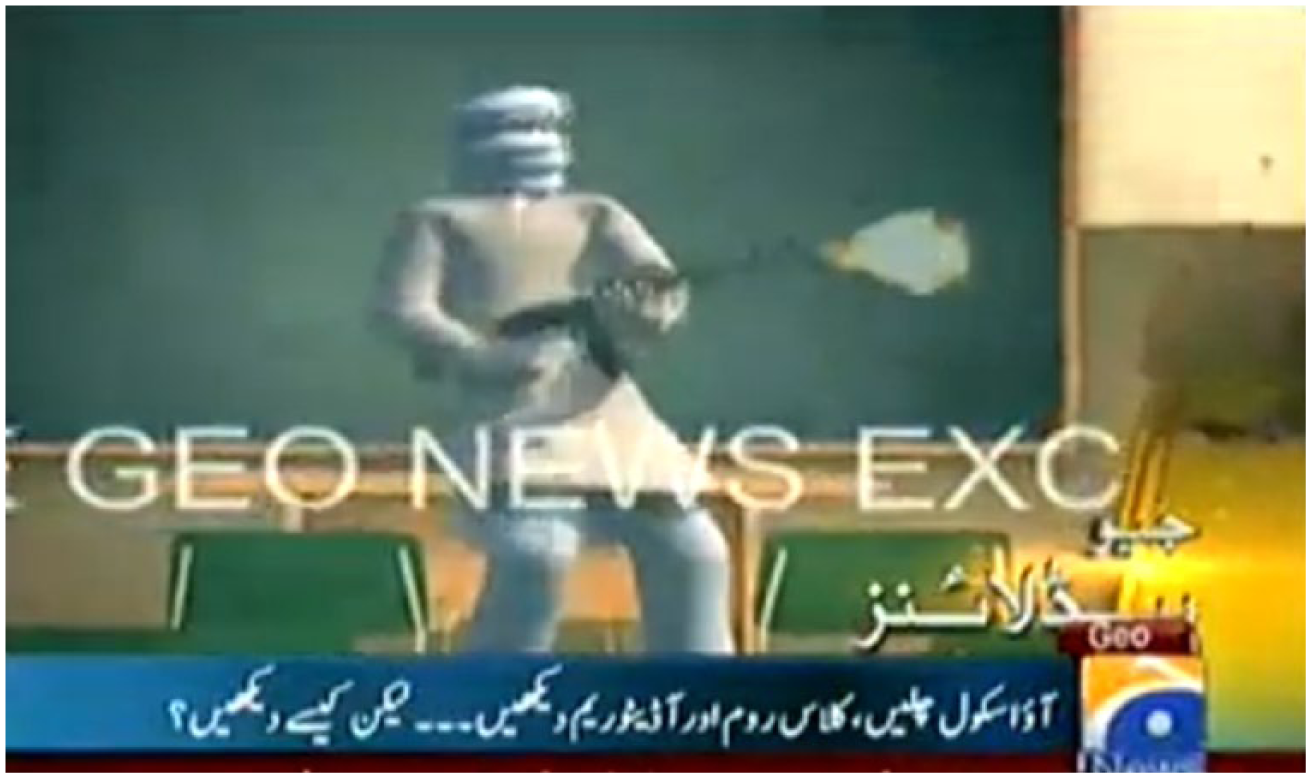
Showing the animated images of terrorists.
As far as style of PTV News headlines of 9 p.m. is concerned, it would be fair to term their style of news as traditional. PTV News makes no use of conspiracy theories, hype, sensationalism, pathos, music, and songs. Although their news coverage is one sided, it is not at all entertaining and dramatic. They start their bulletin with a saying of Prophet Muhammad (PBUH). Its purpose is to spread the message of unity among Pakistani Muslim viewers, as Pakistan holds an official status of “Islamic Republic.” After the “Hadees,” a quote of Quaid-e-Azam is telecast. Quaid-e-Azam Muhammad Ali Jinnah is the founder of Pakistan; therefore, his sayings serve as a reminder of nationalism to the viewers each day before 9 p.m. news bulletin. Furthermore, as the bulletin goes on-air, anchors start by saying “Bismillah al-Rahman al-Rahim” which in English means “Starting with the name of Allah, the Most Gracious, the Most Merciful.” The background of the news studio is kept relatively simple compared with GEO News and ARY News. News anchors on PTV News network narrate the news items by looking at the pages. No use of laptops or computers is seen. Thus, their news bulletin can be termed as having “no tension news” in terms of style of presentation and content.

Showing the PTV News studio.

Showing the Quaid’s quote.
The third and fourth research questions probe the way in which the world is represented and framed in news headlines of the selected news channels as well as the relationships and identities that are set up for those involved in a story. It is found out that all the three selected news channels present a different world to their viewers. Their framing of the news events clearly depicts their inclination toward certain political parties and politicians and other world happenings. Moreover, they set up varying identities for the same people and events in their news bulletins which reflect their partiality and biasness toward those involved in a story.

Showing the news channel preference of the viewers.

Showing the response of viewers regarding news reporting.
In the 9 p.m. news bulletin of ARY, they represent the country’s situation by blaming the PML-N government. The government is identified as unpopular and unwanted whereas the opposition leader, Imran Khan, is identified as a hero of the Pakistani nation. In addition, their blaming strategy targets their rival news channel as well, that is, GEO News. On regular basis, the news regarding GEO television and its owner are included for the purpose of degrading both of them. Sometimes, Imran Khan is shown criticizing GEO News in his sit-in as well. Furthermore, Imran Khan, the opposition leader, is reported more often in their headline bulletin than the government officials. Thus, in general, their news headlines are framed in a way that favors the opposing voices and belittles the government.
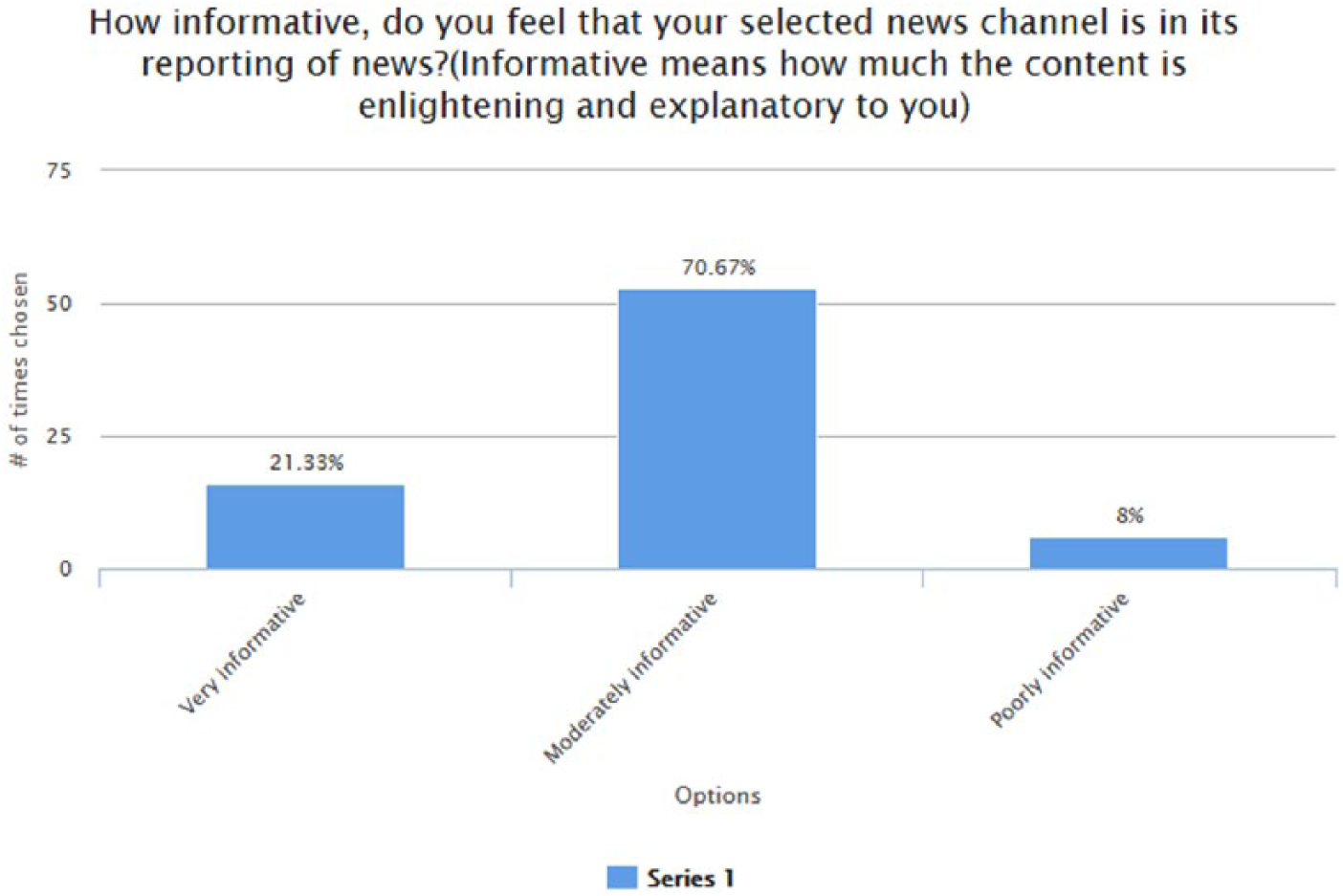
Showing the response of viewers regarding news information.

Showing the Response of Viewers Regarding Entertainment in the News.
Although GEO News headlines tries to accommodate all the prevailing voices including the opposition and the government, their partiality is still observable due to their immense criticism of the opposition leader Imran Khan and his political party. Thus, GEO News identifies Imran Khan as the one harming the country. One possible reason for their biased and sarcastic attitude toward Imran Khan could be that Imran Khan used to criticize GEO News during his protest in public by putting allegations over GEO News owner, Mir Shakeel-ur-Rehman. Furthermore, as far as hard news are concerned, GEO News is seen constructing a world of danger and sensation by employing songs, pathos, sounds of bullets, and loud music that it terrorizes the viewers. Most often, GEO News covers unnecessary news stories having no “newsworthiness.” The 9 p.m. headlines of GEO News deliberately attempt to cover at least one news story from India, either from their politics or from Bollywood. The reason for this deliberate choice could be an attempt to bridge the gap between the people of the two countries in their own way. GEO News network had earlier been seen bringing the two nations closer through their program “Aman ki Asha” (Hope for Peace).
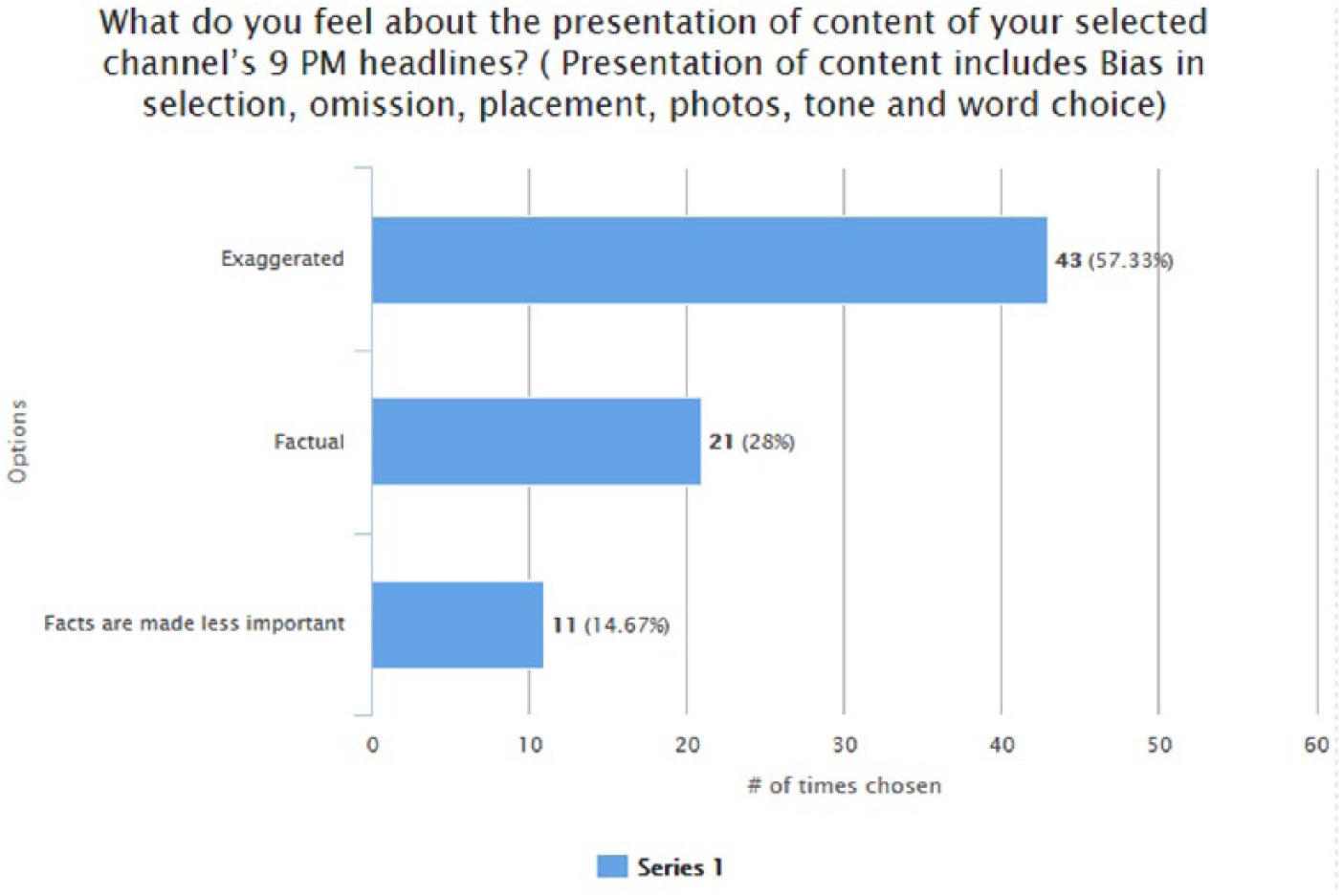
Showing the response of viewers regarding the presentation of content in news.
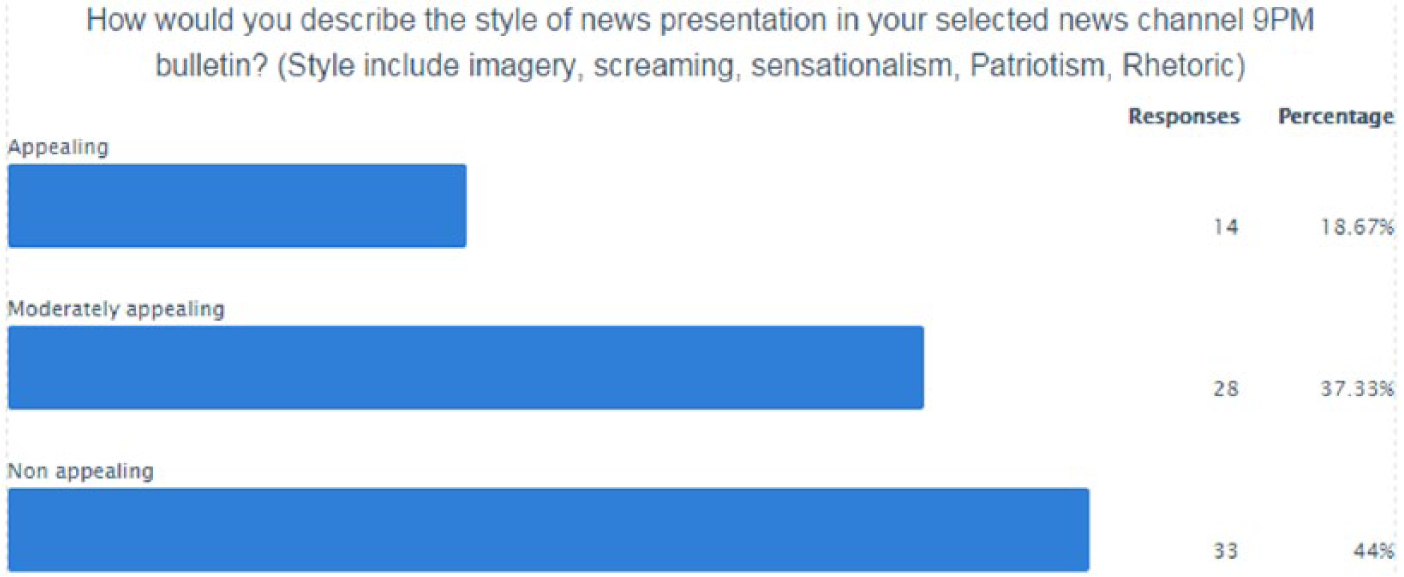
Showing the response of viewers regarding the style of news reporting.
Similarly, PTV News headlines are partial in framing the world too. Pakistan represented by them holds everything in harmony and order. Achievements of the government are reported extensively. Their news headlines are “no tension” news. PTV News headlines identify Imran Khan as their opposition and hold government closer by foregrounding their opinion. Their partiality is manifested by the selection of their sources. Mostly, their sources are government ministers. For this reason, their news headlines are often mocked by public as “Wazeernama,” which could be translated in English as “Ministers’ bulletin.” Moreover, in multiple instances, their headlines hold Imran Khan in contempt. His condemnation from various government officials is foregrounded on a daily basis. Interestingly, an important feature of their headlines is that they cover international happenings more than any other private news channel in the data. Thus, the inclusion of international news and news related to Kashmir issue is a distinctive feature of their 9 p.m. headlines bulletin, which is rare to see in private channels’ news headlines.
The fifth research question addresses the susceptibility of viewers regarding the linguistic style of news because the analysis of media texts requires an analysis of the reception of those texts by the audiences as well. It is found out that viewers hold the news channels’ coverage of the events in contempt. Thus, the impact of 9 p.m. news headlines upon the viewers is gauged through the questionnaire. The results yielded are interesting because most of the respondents criticized the private news channels for their entertaining yet less informative 9 p.m. news headlines. However, they opted to follow the same news channels for 9 p.m. headlines nonetheless. GEO News, ARY News, and SAMAA News hold the highest percentage for 9 p.m. headline bulletin in terms of viewership.
The respondents are aware of the unfair and less informative coverage of the 9 p.m. news headlines as 70.67% of the respondents marked the reporting of their selected channel as unfair and moderately informative.
Moreover, 54.67% of the respondents are of the view that news channels are highly entertaining in the presentation of 9 p.m. headlines.
Apart from this, 57.33% of the respondents have marked 9 p.m. news bulletin of different channels as exaggerated in the content that it reports.
Finally, 44% of the respondents have described the style of news presentation as “non-appealing.” Style includes parameters like imagery, rhetoric, and sensationalism. About 37.33% of the respondents in the sample describe it as “moderately appealing.” However, 18.67% of the respondents think that the presentation style used by their favorite news channels is “appealing.”
The last question in the questionnaire asks the respondents to give suggestions regarding the betterment of news coverage in Pakistani electronic media. The summary of the majority of the respondents’ suggestions is that Pakistani news media should learn to appear neutral, factual, and real in their coverage of news events. Media ethics should be promoted by uniting the people of the country instead of using news as a tool to keep up with their vested interests.
From their suggestions to the news media, it is quite clear that the respondents dislike the biased and entertainment-oriented headlines of the news channels. Furthermore, they have shown serious apprehensions regarding the impact of news media, which it is leaving upon the viewers’ perception and minds.
After going through the findings of subsidiary research questions, which answer the main research question of ideological constructions in Pakistani news bulletin headlines of 9 p.m., we can say that it is very less likely to find ideologically neutral news headline in Pakistani news bulletin of 9 p.m. Pakistani news channels create a different world for their viewers by propagating different ideologies, keeping their vested interests intact. A distinct world is created for the viewers by incorporating different strategies. Most prominent strategies that Pakistani media employs include varying lexical choices, incorporating different styles, and creating different identities of the same events and personalities. News headlines are generally accepted as the route toward reality. However, one can argue that they are just “mirrors” of reality, which are deliberately structured and articulated in a particular style that contributes toward the ideological constructions. Moreover, they are leaving detrimental impact on peoples’ perception, as people have condemned the way Pakistani news channels present national and international happenings.
Conclusion
News media carries an important place in a much happening Pakistani society. As discussed above, presentation style of the news, excessive commercialization, unprofessionalism, unethical and biased coverage, and lack of self-regulation are some of the main points raised by the respondents regarding Pakistani news headlines. Therefore, it becomes necessary for the media groups in Pakistan to make themselves accountable by acting upon the already existing internal legal frameworks. In Pakistan, media as a fourth pillar of the state is capable of diffusing the tensions and intolerance present in various sectors of the society. It is a social responsibility of the media authorities in Pakistan to bring social harmony and stability in the country by playing their positive role. Therefore, it is hoped that the media authorities in Pakistan will work to bring tolerance, harmony, peace, and stability in Pakistan by self-regulating their respective media networks. According to Fairclough (1995), CDA of any communicative event analyzes the relationship between the three dimensions that include text, discourse practice, and sociocultural practice. A much wider analysis of news channels is required to be conducted to find out whether the same analysis holds true in that case as well or not. Moreover, such analysis should be explicated to include all the three dimensions of text analysis, processing analysis, and social analysis for acquiring comprehensive results.
Footnotes
Appendix
Thank you for taking your time to fill in this questionnaire.
The purpose of this questionnaire is to explore the ideological constructions in Pakistani news bulletins to a greater depth by analyzing the content, form, and the style of its presentation on Pakistani news channels.
Filling out this questionnaire will not take more than 10 to 15 min of your time.
NAME: ________________ GENDER: ____________
Age group: 21-31
Declaration of Conflicting Interests
The author(s) declared no potential conflicts of interest with respect to the research, authorship, and/or publication of this article.
Funding
The author(s) received no financial support for the research, authorship, and/or publication of this article.