




Abstract
Currently, little is known about what works, or does not work, in occupational safety implementation efforts. The aim of this study is to (a) explore what works and what does not in scaling up an agricultural safety intervention, and (b) explore these findings in terms of the Consolidated Framework for Implementation Research. A total of 13 stakeholders were interviewed about their experiences with the National Rollover Protective Structures (ROPS) Rebate Program implementation. Nine of these individuals also participated in follow-up interviews one year later. A Grounded Theory Situational Analysis approach was used for data collection and analysis. Two themes emerged from the data. First, the implementation strategy has evolved inconsistently across stakeholders (a barrier to implementation). Second, stakeholder engagement in the implementation is a function of perceived feasibility and “small wins” (an opportunity for improving implementation efforts). Based on the results of this study, two areas of needed improvement to the National ROPS Rebate Program implementation strategy were identified: (a) appropriateness and feasibility of inner setting stakeholder engagement, and (b) receptivity of outer setting stakeholders and potential funders. These findings will be helpful for increasing the success of the implementation, and can also provide guidance to others working on large-scale implementation studies.
Keywords
Background
Why do implementation efforts succeed or fail? What factors decide this fate, and how do they result in the outcome? The Consolidated Framework for Implementation Research (CFIR) was built from 19 other implementation models and designed to answer those questions (CFIR Research Team, 2017; Damschroder et al., 2009).
Based in qualitative research, the CFIR was designed to describe not only what factors impact implementation outcomes, but also how they do so (Damschroder et al., 2009). The CFIR achieves this by explaining implementation efforts at several levels: characteristics of the individuals involved, inner setting, outer setting, intervention characteristics, and implementation processes. In addition, implementation outcomes and client outcomes were further described as supplements to understanding the CFIR (Proctor et al., 2011). Each of these domains, as they are labeled by the authors of the CFIR, are further described by specific constructs. Figure 1 shows these constructs and domains.
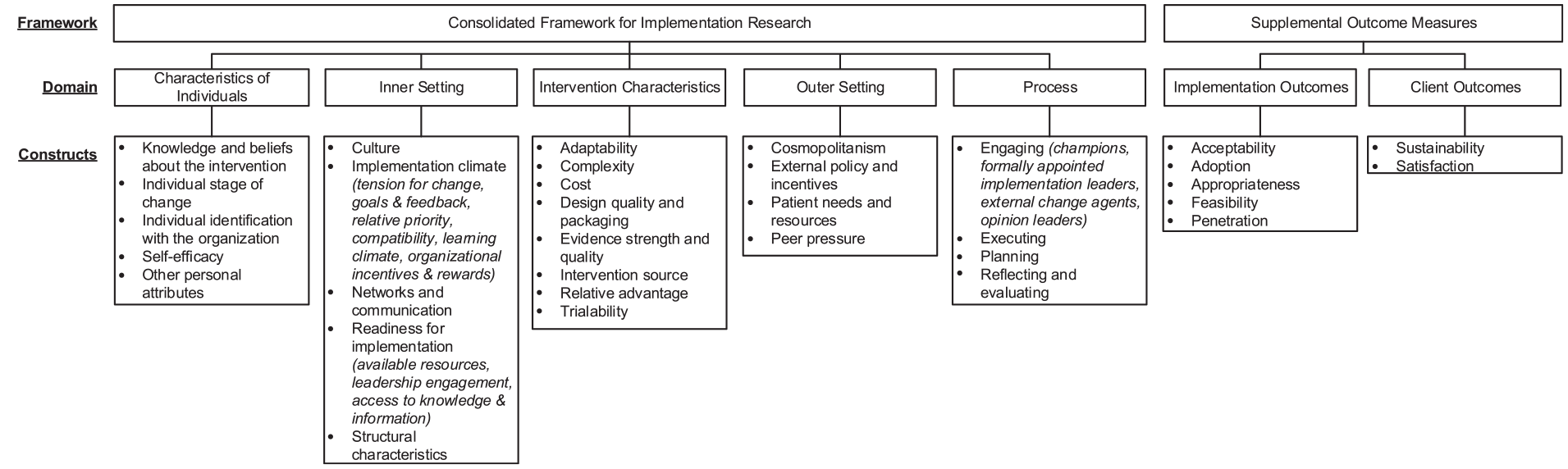
CFIR and supplemental outcome measure domains and constructs.
Although the CFIR’s use has been well-documented within clinical medicine, fewer studies have explored its utility in public health; even fewer have explored implementation efforts within occupational safety and health using the CFIR (CFIR Research Team, 2019; Kirk et al., 2016). Similarly, the overall literature surrounding implementation and other research translation efforts, which aim to put evidence-based interventions into wider practice, in occupational safety settings is also quite limited (Lucas et al., 2014; Schulte et al., 2017; Tinc et al., 2018a). The aim of this study is to (a) explore what works and what does not in scaling up an agricultural safety intervention, and (b) explore these findings in terms of the CFIR.
Agricultural Safety in the United States
In the United States, agriculture is among the most dangerous of occupations, leading to approximately 22 fatalities per 100,000 full-time workers annually (Bureau of Labor Statistics, 2019). This is in comparison to the all-worker fatality rate of just 3.4 per 100,000 full-time workers (Bureau of Labor Statistics, 2019). Although there are myriad dangers on farms, tractors account for the majority (40%) of these fatalities (M. L. Myers et al., 2008, 2009). Specifically, tractor overturns are to blame, despite the development of rollover protective structures (ROPS) in the mid-20th century (Cole et al., 2006; Murphy et al., 2010; M. L. Myers et al., 2009; J. R. Myers & Hendricks, 2009).
ROPS come in several forms and, when used with seat belts, are 99% effective in keeping tractor operators in a protected zone in the event of an overturn, therefore, preventing fatalities and serious injuries (Swenson, 2004). In 1985, industry standards in the United States were updated to increase the number of new tractors sold with ROPS (American Society of Agricultural and Biological Engineers, 2014). Despite this attempt, only 51% to 59% of tractors on U.S. farms are equipped with ROPS today (Loringer & Myers, 2008; Murphy et al., 2010). Rather, many tractors dating back to the 1960s when ROPS were first introduced were originally sold without ROPS, are still in use, and have yet to be retrofitted.
Internationally, tractor overturn fatalities have been significantly reduced in several countries using combinations of regulations, marketing, and monetary rebates (Day et al., 2004; Franklin et al., 2006; Springfeldt et al., 1998). Within the United States, however, farm-related regulatory actions are generally not supported by farm populations (Miller, 2012; Richardson, 2012; U.S. Department of Labor, Wage and Hour Division, 2012), therefore making ROPS regulations more challenging to pass.
Rather than attempting regulatory measures, agricultural safety researchers and stakeholders in the United States have attempted to encourage ROPS retrofits in other ways (M. L. Myers et al., 2005; Swenson, 2004; Tinc et al., 2015, 2016). One initiative, the ROPS Rebate Program (Northeast Center for Occupational Health and Safety, 2017), has been particularly successful in increasing the number of ROPS-equipped tractors on farms in states where it has been implemented.
The ROPS Rebate Program uses social marketing principles to reduce farmers’ barriers to retrofitting while simultaneously increasing and improving facilitators. Research conducted prior to the development of the program indicated that financial and time constraints, coupled with low perceived risk, were the main barriers farmers faced (J. R. Myers, 2010; Sorensen et al., 2006; Sorensen, May, Paap, et al., 2008). To combat these issues, program developers included a toll-free hotline (for identifying and ordering the correct ROPS kit) as well as 70% rebates toward the cost of purchasing and installing ROPS (Northeast Center for Occupational Health and Safety, 2017). In addition, targeted messages were developed, many of which took into account those factors that acted as motivators for farmers (e.g., tractors being driven by family members; Sorensen, May, O’Hara, et al., 2008; Sorensen, May, Ostby-Malling, et al., 2008).
In the decade since the ROPS Rebate Program was first launched in New York, the program has been expanded to six additional states (Vermont, Pennsylvania, New Hampshire, Wisconsin, Massachusetts, and Minnesota). Evaluations of efficacy and effectiveness have demonstrated that the program has provided life-saving benefits (at least 17 overturn events, in which a tractor operator was likely saved due to the ROPS, have been documented). In addition, cost-savings after program expenditures proved to be substantial with more than US$4 million saved in New York over the first 11 years of the program (M. L. Myers et al., 2018).
In 2014, the National Tractor Safety Coalition (NTSC), a multisector group comprised of researchers, farmers, manufacturers, ROPS experts, and government, insurance, media, agricultural, and health and safety organizations came together with a primary goal of reducing tractor overturn fatalities through the expansion of the ROPS Rebate Programs (Sorensen & Tinc, 2014; Tinc et al., 2015, 2016). Facilitated by a representative steering committee, the coalition provides the opportunity for the multisector agricultural stakeholders to share resources and knowledge to better achieve joint goals. The commitments made by the coalition reflected these goals and included collecting and disseminating improved injury and fatality measures, educating stakeholders about the dangers of tractor overturns, addressing manufacturing and technology issues related to retrofitting, and raising funds to support a National ROPS Rebate Program (NRRP).
Study Context: The National ROPS Rebate Program
In June 2017, the NTSC formally announced and began implementing the NRRP, a nationwide offering of the ROPS Rebate Programs, as described above (Tinc & Sorensen, 2017). The NRRP implementation is currently ongoing and includes (a) information, guidance, promotions, and fundraising through the NTSC; and (b) a media advocacy campaign to increase stakeholder support of the NRRP. Currently, at the national level, a small pool of funds exists for rebates; however, states that have recognized the importance of the NRRP can dedicate funding to their own farmers. Although no additional states (beyond the seven already mentioned) have secured allocated funds for rebate programs over the course of this study, eight have begun to develop plans for fundraising, thus, moving closer to implementation in those areas. Once fully implemented, the NRRP will provide all intervention components included in the original ROPS Rebate Programs, including ample funding across all 50 states. Because implementation is ongoing, this study focuses on two time-points during implementation, rather than time-points pre- or post-implementation.
Figure 2 illustrates how the study team has conceptualized the CFIR in terms of relevant stakeholders and components of the NRRP implementation. Using this model, this study seeks to utilize the CFIR to understand stakeholders’ experiences related to the implementation of the NRRP. By doing so, the study also provides insight into what works, what does not work, and why, in this implementation context.

Visualization of the NRRP implementation in terms of the CFIR.
Method
Study Participants
This study utilized purposive sampling, and, in that, maximum variation sampling. To ensure that the results of this study would reflect a diversity of perspectives related to the NRRP implementation, the following selection criteria were used (Table 1):
State progress toward funding: Participants residing in states representing the following levels of progress toward securing state-allocated funding were included: no known fundraising activity, some progress in fundraising, or previously obtained state-allocated funding.
Involvement in NRRP: Participants were selected based on their level of involvement with the NRRP implementation on the following levels: steering committee members, general NTSC members, and non-NTSC members.
Stakeholder group: The profession of participants was also taken into account: Individuals from agricultural safety organizations, insurance companies, manufacturing companies, the media, government organizations, and preexisting ROPS Rebate Programs were invited to participate.
Distribution of Interview Participants Based on State Funding, NRRP Implementation Role, and Professional Responsibilities.

Note. NRRP = National ROPS Rebate Program; ROPS = Rollover Protective Structures; NTSC = National Tractor Safety Coalition.
Progress toward funding is defined by the state in which the participant resides, not the participants’ individual activities. This status was determined based on emails and contact records held by program staff. bIndividual could not be reached for follow-up. cCanadian representatives were not included in the follow-up interviews. dIndividuals did not respond to interview requests.
Finally, representatives from agricultural safety organizations and ROPS manufacturers in Canada were invited to participate. As in the United States, Canada faces high rates of tractor overturn fatalities; approximately 17% of agricultural fatalities in Canada are due to tractor overturns (Injury Prevention Centre, 2016). Unfortunately, there has not yet been a successful, unified attempt to rectify this issue in Canada. As such, these participants were included to provide an outsider perspective.
Potential interviewees were contacted via email and invited to participate in the study, which involved two interviews approximately one year apart, beginning in October 2017. If the participant was agreeable, an interview time was scheduled. Out of the 16 individuals contacted, 13 chose to participate (Table 1). Participants, except for the Canadian interviewees, were contacted one year after the initial interview to schedule the follow-up interview. Canadian participants were excluded from the follow-up interviews, as the content of the interviews focused specifically on U.S. activities and engagement. Out of the 10 remaining individuals, nine participated in the follow-up interviews. Prior to all interviews, a copy of the interview guide was emailed to participants to allow them time to prepare for the interview.
Data Collection
The first round of interviews was collected between October and December 2017, and continued until saturation was reached (i.e., until no new ideas were discussed by participants and no new themes emerged from the data). Follow-up interviews were conducted in October 2018. Due to the varied locations of the participants, interviews were conducted over the phone and were recorded. Initial and follow-up interviews lasted an average of 30 min each.
Interview Guides and Emergent Study Design
The interview guides used in this study were developed based on previous work by the research team. In an initial study, CFIR constructs applicable to the NRRP implementation were identified by NTSC members (Tinc et al., 2018b). Subsequently, those CFIR constructs were measured using a survey that was distributed at four points beginning at the launch of the NRRP and continuing over an 18-month period (Tinc et al., 2019). Results of the surveys provided the basis for these interviews. For example, based on the CFIR survey results, questions related to the intervention cost were added to the interview guide. In addition, the semistructured design of the interviews allowed participants to further discuss their perspective and experiences related to the implementation of the NRRP.
After each interview, the authors would debrief and develop a summary of the content discussed in the interview. In using an emergent design, the interview guide was further developed during data collection. Thereby, data collected during the first round of interviews were used, along with the survey results (Tinc et al., 2019), to develop the guide for the follow-up interviews. In particular, the surveys and first interviews resulted in questions relating to motivation for stakeholder engagement and stakeholders’ perceptions of the NTSC steering committee (leadership engagement). Copies of the interview guides are included in the Supplemental Appendix.
Data Analysis
This study was conducted using a Grounded Theory Situational Analysis approach (Clarke, 2005). Situational Analysis is an inductive method that builds on Grounded Theory by providing structural guidance for categorizing and organizing coded data based on the environments in which a situation occurs (Clarke, 2005; Eriksson & Emmelin, 2013). By using a Grounded Theory Situational Analysis approach, participant feedback could be framed in terms of the various environments within which the NRRP implementation exists.
All interviews were transcribed verbatim and loaded into NVivo 12 for analysis (QSR International, 2018). Although diverse stakeholders were invited to participate in the study, it became clear during the interviews that these differences were not clearly aligned with particular positions related to implementation. Thus, all analyses considered the data as a whole, rather than comparing differences between stakeholders and their roles or positions relevant to the NRRP implementation.
Each transcript was coded line-by-line by the first author using an inductive approach. Codes were then organized into categories, or groups of related codes, for further analysis. Categories of codes were then organized based on the elements of situational analysis recommended by Clarke (2005): individual human, collective human, and nonhuman actors, human and nonhuman discursive constructions (i.e., ideas about how human and nonhuman actors exist in the situation), major issues and debates, and political, economic, temporal, sociocultural, and spatial elements. An example of this process is shown in Figure 3.

Examples of how codes generate categories and categories are defined within situational elements.
Once the situational elements were defined, “messy maps” (Clarke, 2005) were developed to visualize and understand the connection between categories in the different elements. Using the messy maps, as well as the coding structure and elements defined above, additional visualizations depicting various standpoints represented in the data, as well as the arenas and world impacting the NRRP implementation, were developed as recommended by Clarke (2005).
Although different questions were asked in the follow-up interviews, these questions largely served to clarify and expand upon responses from the first round of interviews, as previously described. Thus, the codes used to describe both sets of interview data were largely similar with no new maps or themes identified at this stage of data analysis. Instead, data from the follow-up interviews confirmed the findings from the first round of interviews.
Through the mapping and data analysis exercises described, two core themes emerged from these data (Figure 4). These themes incorporated a number of categories (shown in Figure 4), which represent the various situational elements described by Clarke (2005). Together, this map and the interview transcripts and codes provide an understanding of stakeholder experiences related to the NRRP implementation. The final results were agreed upon by all authors.

Final map showing how the core themes identified in this study emerged from the categories and situational elements presented in the data.
Ethical Considerations
This study was approved by the Mary Imogene Bassett Hospital Institutional Review Board (project #2015). Because the topics discussed in the interviews were not particularly sensitive and posed no risk to the participants, written consent was not required. However, verbal consent was obtained from all participants at the beginning of each interview.
Results
The two core themes developed in the analysis were that (a) the NRRP implementation strategy had evolved inconsistently across stakeholders, and (b) stakeholder engagement is a function of perceived feasibility and “small wins.” In understanding how the implementation strategy has evolved (Theme #1), the results of this study help us to understand what does not work in implementing the NRRP. Theme #2 helps us to understand what can move the implementation process forward (i.e., what works). These themes will be presented individually, examining the various situational elements relevant to each theme.
Theme #1: Implementation Strategy Evolved Inconsistently Across Stakeholders
As described, the 2014 strategy plan for implementing the NRRP focused on a cohesive, multisector, nationwide effort in which all stakeholders were expected to participate. In this strategy, the funding for the program was anticipated to fall under a hybrid model in which both national and state-allocated funds were used. However, participants in this study revealed a different reality and two distinct viewpoints about how the NRRP should be implemented: the NRRP as a support tool, and the NRRP as a centralized effort.
The NRRP as a support tool
In this view of the NRRP implementation, nonhuman discursive constructions focused on the NRRP as a support tool that state-based champions could use as part of their efforts to secure state-allocated funding for the NRRP. In this description, the NRRP provided resources such as printed materials, fundraising support, technical guidance, and, eventually, program administrative services.
I mean it comes down to the individual. I mean if we can get a champion within these associations, and that, that it, you know . . . bottom line what it boils down to it’s all about individual relationships and partnerships. And we have got to make, we have to continue to make those, you know, relationships, and foster those relationships and those partnerships. Because those are the ones who have the biggest impact in you know, making things happen. (Participant #8)
Along these lines, human discursive constructions presented in the data related to state-based champions as the sole NRRP implementers. While NRRP hotline staff were considered vital to the implementation, their role was considered to be supportive rather than centralized. NRRP hotline staff members were described as the leaders, but only in the sense that the NRRP model would otherwise not exist. The actions of state-based champions, however, were central to the implementation process and focused largely on educating nonfarming stakeholders and potential donors about tractor overturns and the NRRP with the intention of securing state-allocated funds.
Yeah, okay. I believe that there’s folks from the NEC who are just specifically focused on the ROPS Program and doing the administration and trying to get the waiting list, get people moved through that as much as possible. And then on the state-level, each state finds their funders whether it’s an organization or a business, an industry or insurance companies, or state funding, or some other source, and then they create that pool, and then have the administrators that can use the NEC and the National ROPS materials and resources that make that relevant for the statewide programs. (Participant #5)
In addition to human and nonhuman discursive elements and human actions, spatial, political, and economic elements come into play in this view of the implementation strategy. In terms of spatial elements, the stakeholders providing this understanding tended to dissociate themselves from the broader NRRP, both implicitly and explicitly, despite agreeing to participate in implementation of the program, as was previously described. Most appeared to have unintentionally dissociated themselves from the broader program, primarily due to a lack of understanding of what the NRRP was intended to be, as well as the purpose of the NTSC. Those explicitly dissociating themselves from the larger picture indicated that the national-level program was potentially damaging to local efforts, and thus could not be directly considered as part of the local implementation strategy. In both cases, NRRP materials and resources were used in support of the efforts.
The prevalence of a National Program . . . or trying to say that we are part of a National Program or there is a National Program tends to bring up questions about funding that can be detrimental to us. So it’s like if there is a National Program, why are people donating money to [state] to run a program? Why isn’t [state] part of the National Program? (Participant #3)
Similarly, political and economic elements came into play as stakeholders aligned with this view of the NRRP implementation focused on funding discussions, such as with their state legislators. The political and economic differences across states were thought to be influential on the implementation process.
Yeah, where I have thought obviously my enthusiasm would be if we could figure out how to replicate the kind of funding commitment that you guys have had in New York. Which to me, not exactly, but to me means that there is perhaps some state based commitment while at the same time my sense is that you’re developing philanthropic and other streams of funding to help support the initiative. I honestly don’t know how to do the government side in the state of [state]. (Participant #6)
The NRRP as a centralized effort
Unlike the view that the NRRP is a support tool, nonhuman discursive constructions for this view focused on the NRRP as a centralized and cohesive program that features a single pool of national-level funding. In this viewpoint, the human discursive constructions demonstrated that stakeholders tended to associate themselves and others with specific roles in the NRRP; few of which related to the implementation process. The NRRP hotline staff were described as central players solely responsible for implementation in this model. Stakeholders describing these scenarios viewed their own roles as integrated with the fully functioning NRRP, rather than the implementation process.
The problem is getting the coalition to start formulating their approaches and going after fundraising support in terms of uh, you know on their own. (Participant #2) Well, for me, it’s just hypothetical, I really don’t know the situation, but it seems like if people have this perception that you guys are doing a lot, then they’re just gonna step back and rely on you. And then they really don’t have boots on the ground in the state doing the promotion and talking to people directly about it. (Participant #5)
While this implementation viewpoint focused largely on human and nonhuman discursive constructions, temporal elements are also relevant. As mentioned, this view assumes that stakeholders are not a part of the NRRP implementation, and, thus, action comes at a later stage and only when directed by specific needs that are directly related to the individuals’ primary expertise.
My understanding is that uh, at [organization], we’re here to support the Program as in when there becomes a large demand for a specific ROPS that might not be readily available for the public, but we may be able to um, help with that situation. (Participant #1)
Theme #2: Stakeholder Engagement as a Function of Perceived Feasibility and “Small Wins”
Despite the overwhelming and unanimous verbal support for the program, not all stakeholders expressed engagement in the implementation of the NRRP. Over the course of the interviews, several situational elements came into play that together explain this disconnect.
Sociocultural standards dictate how people behave and think. In this study, this translates to a general argument that agricultural stakeholders can reasonably be expected to be supportive of initiatives, such as the NRRP, that have been shown to save farmer lives. This support can be seen through quotes in which stakeholders express their appreciation for the NRRP and agree that it would be beneficial to fully implement it.
I mean because if we covered every tractor out there, there would be a lot less you know, fatalities or even injuries from it. (Participant #10) So I think overall the program was well thought out and is having an important role. (Participant #11) I find everybody that I contact realizes safety is important. But I also know that we continue to have tragedies. (Participant #9)
Despite the sociocultural elements promoting general and unspecified support of the NRRP implementation, the human discursive constructions presented in the data demonstrated the denial of personal responsibility for the NRRP implementation by several stakeholders. Under this implementation viewpoint, the NRRP hotline staff, American Farm Bureau Federation, various levels of government, and two key champions (both of whom serve on the NTSC steering committee and are university-based engineers) serve as implementation leadership and are implicated as responsible for the implementation.
I think that leaders that influence the National is John May and Julie Sorensen and the folks there out of the NEC. I think they have been champions across the whole nation, as far as talking to the people to invest in it. (Participant #7) If ever you’re thinking of implementing this system in Canada you would have to work with them or also to work as a, how could I say, health subsidy to them. And I’m not sure that it would work in Canada in terms of gathering . . . of gathering money from organizations as you do in the US, one because it is already taken by the public government in Canada. (Participant #13)
In addition to human discursive constructions, nonhuman discursive constructions of the situation indicate that the purpose of the NRRP is unclear, as is the administration of it. On its own, this point is extremely important, and serves as a theme in itself, as previously described. As a result of the varying viewpoints related to the purpose of the NRRP, it becomes unclear who the NTSC is, and what the Coalition’s role is in implementing the NRRP.
I think it’s just that I don’t understand the purpose of the coalition perhaps. And so it’s . . . and that maybe again part of this transition but it’s hard for me to see how I can contribute because I . . . I don’t really know . . . I don’t have a firm understanding in what the purpose of the coalition is. (Participant #3)
The discursive constructions, both human and nonhuman, help us understand the stakeholders’ conscientious decisions about the implementation; however, given the contradiction in these discursive constructions, they do demonstrate some level of doubt over the implementation strategy. Looking further into the data, this doubt comes from a variety of situational elements that relate back to perceived feasibility, including economic, political, and spatial elements, as well as major issues and debates.
From an economic standpoint, stakeholders repeatedly expressed concern over the difficultly in securing funding for the program; however, few had actually attempted fundraising. In some respects, the concern over fundraising also related to political elements influencing implementation. Although many indicated that political support for the NRRP is needed to obtain funding and move forward with the implementation, few knew of politicians who knew of and supported the NRRP. Furthermore, concern was raised that while the NRRP should be presented as a bipartisan issue, that any political conversation about it could easily result in disagreement between politicians and their supporters, thus derailing the effort.
It seems like everything that I’ve tried to do, and not this strictly, you know related to agriculture safety, seems like funding is always . . . like the first hurdle. (Participant #9) It’s a sense of . . . collective sense of distrust between . . . almost in a sense of a tribe. If you’re not one of us you’re against us type thing. I don’t know. If one political party supports it, then the other one’s going to bash it because it’s opposite of what they want. They’ll flip-flop on that whole issue. If you’re for this then I’ve got to be against it. I don’t know why in the culture we see today and on the news and in interaction with different people you see a very big divide and a lack of a sense of civility between people that discuss issues and working for the common good but it’s like we’ve separated off. (Participant #7)
In addition to the economic and political elements impacting implementation, several stakeholders also referenced spatial elements: perceived local barriers to launching the NRRP. Often, these perceptions focused on the lack of need or desire to have the NRRP in a particular region. Thus, the bigger picture of the NRRP was often ignored in favor of local solutions to agricultural safety and health challenges.
Um, but down here in the South given . . . I mean you just don’t see any rollover issues because of the terrain. It’s more flat, and so um you don’t just hear about the fatalities down here as you might see, you know, in the Northeast, or up in the Northwest. So I am only trying to promote it from that perspective. I mean if that counts as an involvement. (Participant #8)
In an effort to remain involved, despite feelings of limited feasibility, several stakeholders referenced the need to continue education with farmers surrounding the topic of tractor overturn fatalities and ROPS. This is despite research demonstrating that education relating to this and other agricultural issues is often ineffective in creating change on its own (Hagel et al., 2008; May et al., 2006; Rautiainen et al., 2008, 2010).
They see the fair number of activities like this so “let’s do a ROPS promotion or let’s educate this, educate that.” (Participant #2) I think it’s good, um, if nothing else it raises the awareness. There’s a big social media component and uh, that can raise awareness. (Participant #12)
Despite the doubt expressed over the feasibility of implementing the NRRP, and the limited engagement by stakeholders, temporal elements related to the NRRP and implementation had the potential to reduce doubt and increase engagement and enthusiasm. Stakeholders who had witnessed firsthand the impacts of either tractor overturn fatalities or the NRRP were more likely to actively engage in the NRRP implementation in whatever way they felt able and depending on their view of how the NRRP should be implemented (i.e., the NRRP as a support tool, or a centralized model). Thus, the presence of “small wins,” especially those that were local to stakeholders, were important to engaging stakeholders.
It encourages me to participate more. I think if I could capture one of those close calls or incidences where they retrofitted and there was an incident and it saved them. I think if I could capture that, if I could capture that and make that, I don’t want to say—this is kind of selfish—but I want to put it as a poster child type thing. (Participant #7)
In some instances, where stakeholders had witnessed these small wins, but had not yet been able to take action, some level of guilt was observed, suggesting that additional barriers were still in place.
Yeah, it’s just hard to be real supportive. I just feel like I kind of let it down, the Council down, the Coalition, sorry. (Participant #4)
Discussion
In the following sections, we link the identified themes with the CFIR framework. Across the themes identified from participant interviews, many CFIR domains and constructs can be seen. Within Theme #1 (implementation strategy developed inconsistently across stakeholders), structural characteristics (inner setting) and engaging (process) are the most important to consider. This theme highlights two distinct viewpoints of the NTSC: one of which focuses on the NEC as the inner setting and all other stakeholders as outer setting, and one that places local, state-based champions in the inner setting with the NEC in the outer setting. These models are then reliant on engaging leadership and champions, respectively. Both viewpoints contradict the intended implementation structure, which places both the NEC and all members of the NTSC in the inner setting. These viewpoints also relate to individuals’ identification with the organization (characteristics of individuals) and cosmopolitanism (outer setting), as both of these constructs relate to individuals’ willingness or ability to cooperate with the NTSC in implementation activities.
In the first viewpoint, which involves local, state-based champions, design quality and packaging (intervention characteristics), as well as available resources and access to knowledge and information (both inner setting), also become relevant. These constructs all relate to the champions’ ability to identify and access quality resources to assist them during the implementation process. This model can be beneficial, as it demonstrates interest in and support for the program by local partners who are more likely to be known by funders. While this can be helpful, there is also a greater likelihood of inconsistent messaging between the NRRP hotline staff and the local champions if they are not in close communication.
The second viewpoint, which relies on the NEC to implement the NRRP, also highlights the role of self-efficacy (characteristics of individuals) in implementing the program. This is shown in the data by stakeholders expressing their concerns for participating in implementation activities that are outside of their primary expertise (e.g., fundraising). While this model allows for the most consistent messaging, it can be more difficult for hotline staff to connect with potential funders outside of their own state or region, thus hindering fundraising efforts. In addition, this model raises several logistical challenges, including time and financial resources of the hotline staff.
Theme #2 (stakeholder engagement as a function of perceived feasibility and “small wins”) relates to all CFIR domains. Immediately, this theme relates to engaging implementation leadership and external change agents (process) as primary stakeholders impacting the implementation. Similarly, external policy and incentives (outer setting) are related, in that policy issues related to the NRRP play a major role in this theme. The cost of the NRRP, evidence strength and quality, and relative advantage (intervention characteristics) all contribute to stakeholders’ perceptions of the NRRP. In addition, several inner setting constructs (structure, networks and communication, and tension for change) further impact stakeholders’ perceptions of how the NRRP works and how they can be involved in the implementation. This then relates to the individuals’ identification with the organization, individual stage of change, and other personal attributes (e.g., guilt), which are all characteristics of individuals.
Despite progress toward full implementation of the NRRP, this goal has not yet been reached. The results of this study highlight what is going well, and not so well, and therefore what is likely needed to improve implementation of the NRRP. In general, two areas needing improvement were identified: (a) appropriateness and feasibility of inner setting stakeholder engagement, and (b) receptivity of outer setting stakeholders and potential funders.
Based on the feedback collected during these interviews, inner setting stakeholder engagement may benefit from task-oriented stakeholder roles, tailored communications, and the engagement of localized champions. The current implementation model, which places both the NRRP hotline staff and all NTSC members in the inner setting, was shown to be too general based on these interviews. Stakeholders often expressed confusion over their roles, and felt that they did not have clear guidance or tools to move forward. Thus, by having clear roles and responsibilities for each member of the inner setting and tailoring project communications to those roles, it is likely that stakeholders will feel more able to participate. This includes both stakeholders who can provide assistance and guidance across all states (e.g., engineering support, fundraising guidance), as well as state-based champions who can work directly with potential funders. By modifying the current structure of the NTSC in this way, all members of the inner setting would have a clear role that they are comfortable in, and the overreliance on others to implement the NRRP would be reduced. In addition, this modification would align better with the intended purpose of contextual inner settings, which are reserved for active roles in the implementation process (CFIR Research Team, 2017; Damschroder et al., 2009; Dopson & Fitzgerald, 2005).
In addition to benefiting the implementation team, such modifications would also provide the foundation for local, state-based champions to take the lead on interesting outer setting stakeholders and potential funders in the NRRP. This, in turn, can help improve how these outer setting individuals view the NRRP, as local and known program promoters may be viewed as more trustworthy information sources (Lobb et al., 2018).
Strengths and Limitations
A strength of this study is that several steps were taken to increase the trustworthiness (credibility, dependability, transferability, and confirmability; Graneheim & Lundman, 2004) of the data collection, analysis, and presentation. First, credibility was increased by inviting stakeholders representing various perspectives and roles to participate in the interviews, thus widening the experiences captured. Second, follow-up interviews were conducted to determine how experiences changed over time, thus improving the dependability of this study. Third, every effort was made to thoroughly describe the context of this study to enhance transferability. Finally, confirmability was increased by including a diverse research team with varying connections to the NRRP.
As with most qualitative studies, the sample size was quite small, thus limiting the diversity of responses. In addition to including as many viewpoints as possible, interviews continued until saturation was reached. As described, an additional quantitative study focused on measuring changes in CFIR constructs over the implementation period was also conducted (Tinc et al., 2019).
Conclusion
The results of this study focus largely on the feasibility of the current NRRP implementation strategy, compared with strategies that may prove to be more feasible and successful. By addressing the key “sticking points” presented by participants, it is likely that improvements can be made to increase the overall success of this implementation project. Similarly, other researchers and practitioners attempting their own large-scale implementation studies are likely to benefit from these findings, as they provide guidance in navigating some of the challenges that may present.
In the future, it would be beneficial to compare progress made during this 18-month study period with that of a comparable period after the implementation strategy has been modified. In this way, the research team will be able to confirm the success level of such modifications.
Supplemental Material
Interview_Guides – Supplemental material for Stakeholder Experiences Implementing a National ROPS Rebate Program: A Grounded Theory Situational Analysis
Supplemental material, Interview_Guides for Stakeholder Experiences Implementing a National ROPS Rebate Program: A Grounded Theory Situational Analysis by Pamela J. Tinc, Julie A. Sorensen and Kristina Lindvall in SAGE Open
Footnotes
Acknowledgements
Many thanks to those who provided assistance in completing this study. First, Rebecca Meininger, Deborah Dalton, Jose Flores, and Amanda Roberts from the Northeast Center for Occupational Health and Safety and Jossy John from the Bassett Medical Center Research Institute for their transcription work. Second, Malin Eriksson (Umeå University) and Rachel Washburn (Loyola Marymount University) for their advice and guidance in conducting a Grounded Theory Situational Analysis. Third, Anne Gadomski (Bassett Medical Center Research Institute) and Lars Weinehall (Umeå University) for their assistance with study design and review of the manuscript. Finally, thanks to all who participated in this study.
Declaration of Conflicting Interests
The author(s) declared no potential conflicts of interest with respect to the research, authorship, and/or publication of this article.
Funding
The author(s) disclosed receipt of the following financial support for the research, authorship, and/or publication of this article: This work was made possible with funding from the National Institute for Occupational Safety and Health (Grant #5U01OH010967).

Supplemental Material
Supplemental material for this article is available online.
References
Supplementary Material
Please find the following supplemental material available below.
For Open Access articles published under a Creative Commons License, all supplemental material carries the same license as the article it is associated with.
For non-Open Access articles published, all supplemental material carries a non-exclusive license, and permission requests for re-use of supplemental material or any part of supplemental material shall be sent directly to the copyright owner as specified in the copyright notice associated with the article.
