




Abstract
A company’s CSR attitude depends on the ethical values embraced and formally espoused by its Board and/or senior management. The response of corporates to natural disasters has proved to be beneficial for both for-profit organizations as well as society. There are several instances in the developed world where businesses played a leading role in both attempts to curb natural disasters as well as in helping people who suffered due to such disasters. However, in the developing world, the need for corporate participation in natural disaster mitigation is enhanced by the scarce resources of the relevant governmental agencies. Corporates can offer a helping hand in several ways, but perhaps one of the more effective steps is to spread awareness and knowledge about handling the various aspects of the disaster. Drawing from the available literature and underpinning the business ethics theories, this study aimed to explore business responses in Pakistan to constraint the Covid-19 pandemic. The study employs a two-step quantitative content analysis on Facebook as a research method. The findings are that the three selected industries (finance, telecommunication, and petroleum) remain more committed to their marketing efforts than paying due regard to the genuine need of spreading awareness and educating masses on protection against and/or handling Covid-19 pandemic. The public reaction to such less than adequate steps taken by the corporates provides a potent reminder of what people truly expect from corporates and how firms need to be more proactive toward response to a natural disaster.
Introduction
Corporations are becoming increasingly conscious of their role as a citizen of the societies they operate in. Attention to corporate social responsibilities is no longer seen as a departure from the principal economic objective of maximizing the shareholders’ wealth. The prevalent pragmatic views among management scientists decree that allocation of resources for the general well-being of the society is an investment in itself that generates returns to the company, albeit indirectly, in almost the same manner as do investments in commercial projects. Safdar A Butt writes in his book Corporate Social Responsibility (second edition, 2015) that investment in corporate social responsibility (CSR) projects can and does produce returns in excess of the cost, thereby creating value for the company and its shareholders.
A company’s CSR attitude depends on the ethical values embraced and formally espoused by its Board and/or senior management. Businesses have discovered over the past two centuries that ethics is not just good for the business. It is, in fact, good business. Ethical conduct has the reputational benefits and the potential of better financial performance arising out of trust and faith reposed in the company by its business associates, suppliers, and clients alike and motivational influence on employees’ loyalty to the company.
A large number of formal definitions are available for the term business ethics. For example, it has been defined as the application of principles of doing the right thing, in the right way, for the right reason (Butt, 2016), and as a right or wrong behavior (Lewis, 1985). This concept of right or wrong is determined by societal norms and values (Staub, 2013). Theoretical ethics, sometimes referred to as normative ethics, delineates right from wrong (Butt, 2016). For-profit organizations adopt many ethical practices. These include CSR, donations, pro-environmental measures, and sustainable ways to conduct business (Giannarakis, 2014; Liu & Zhang, 2017). Despite the apparent conflict between engaging in ethical practices and the profit-maximizing agenda of the companies, several reasons induce firms to incorporate these practices, for example, reputation management as a gesture of goodwill and pressure from the external as well as internal stakeholders (Amran et al., 2015). One of the reasons for inflated stakeholders demand is the integrated world on social media platforms; this can influence the profit streams of the businesses (Argyris & Monu, 2015). Hence, ethical practices and profit-making agenda are no longer considered separate or contradictory objectives.
Regardless of the debate in the literature about which agenda is genuinely superior, businesses have been engaged in CSR practices to portray their image as responsible and ethical entities (Pérez, 2015). Business ethics theories such as normative theories have been used as a theoretical foundation for empirical investigation of ethics-oriented practices of for-profit firms. In the developed world, anecdotal evidence indicates a significant increase in businesses’ adoption of ethical practices. For instance, in the USA after Hurricane Sandy, the large local firms established mobile grocery stores to help the local community. Social media proved to be an active communication channel to connect with dispersed stakeholders during Hurricane Sandy (Stewart & Gail Wilson, 2016). Social media has proven to facilitate coordination, accuracy, and security (Gao et al., 2011).
Likewise, social media can prove to be an effective platform in countries with dense populations, especially at an outbreak of a natural disaster. The spread of transferable diseases resembling SARS, Influenza, and Ebola requires a group effort to contain such viruses. Businesses can play an effective role in the containment of the disastrous impact of natural diseases through well-framed strategies. These strategies include awareness campaigns, donations, and financial support to small and medium enterprises and the general populace. The role of large businesses becomes much more important in developing countries, where resources are scarce and population density is high. Pakistan falls in the category of densely populated countries and has limited resources to combat the economic effects of natural disasters. The role of virtually every organization, regardless of its stature as a for-profit or non-profit, can be crucial to mitigating a natural disaster in such a densely populated country.
This study using stakeholder theory as a theoretical underpinning, aims to analyze the response of businesses in Pakistan to curb the spread of COVID-19 through social media. This study aims to answer the following research question:
How Did Firms Respond on Social Media to Mitigate Covid-19 in Pakistan?
Deriving from the arguments in the available literature, business responses were analyzed through their Facebook pages. The user’s engagement was also analyzed through a Facebook metric. Content analysis was performed on the firm’s websites and Facebook pages to categorize responses into proactive and reactive. A comparison of Covid-19 related posts and marketing posts showed that firms posted more to promote their products than to focus primarily on Covid-19 awareness. However, several measures were taken on different platforms by Pakistani firms to help generate awareness among the public to contain the spread of Covid-19.
The background of natural disasters and why businesses respond to disasters in pre and post-disaster times are discussed in the forthcoming sections. The background section is followed by an explanation of the theoretical foundation of business ethics. The roots of stakeholder theory and its empirical investigation in various study settings are discussed because they provide theoretical support for this study. Building upon the theoretical foundation extracted from the stakeholder theory, this study used the content analysis research method on Facebook pages of the sample firms to analyze business responses followed by the implications and limitations. The conclusion of this study is presented in the last section.
Background
A disaster is defined as “a serious disruption of the functioning of a community or a society involving widespread human, material, economic or environmental losses and impacts, which exceeds the ability of the affected community or society to cope with its resources” (UN International Strategy for Disaster Reduction (UNISDR, 2009, p. 9). Disasters can be man-made or by the act of nature. A natural disaster is defined by the council of Australian Governments in 2004 as follows: “. . . a serious disruption to a community or region caused by the impact of a naturally occurring rapid onset event that threatens or causes death, injury or damage to property or the environment and which requires significant and coordinated multi-agency and community response. . .”
There can be various types of natural disasters: infestations by insects, wildfires, volcanic eruptions, and epidemics (Bellemare, 2015). For the purpose of this study, which is based essentially on the consequences of a pandemic (Covid-19), it is important to distinguish between a natural and a man-made disaster clearly.
The threats posed by natural disasters are (more) challenging and catastrophic due to increased economic activity, growth in population and environmental changes (Swiss Re, 2013). These threats have added disaster management as an essential domain for various businesses. The available literature on the Scopus database from 1974 to 2014 regarding natural disasters is replete with health and medical sciences. The literature on responses regarding natural disasters and business administration is relatively scarce (Park et al., 2013). While natural science and engineering discipline research on natural disasters accounts for 10% to 15%, research in social sciences has been more intense on investigating the impacts of natural disasters, that is, 20%. In the accounting discipline, the research accounts for less than 4%. The majority of the studies in the business administration domain examined the post-disaster impact on management (Hall et al., 2016). The studies in accounting literature have mostly investigated the disaster relief steps taken by the organizations (Hall, 2010). This indicates a considerable research gap on the ethical responses of businesses toward natural disasters. Before proceeding to the reaction of business against a natural disaster, a fundamental question needs to be answered, that is, why companies must respond ethically to natural disasters befalling the societies served by them?
Business Response Toward a Disaster
Businesses have always faced pressure to showcase their ethical standards. CSR practices are an example of a reputation enhancement technique (Pérez, 2015). Several scholars have based their argument on the legitimacy theory that CSR disclosures are a dialog mode between an ethical organization and its stakeholders (Colleoni, 2013). This dialogic communication is facilitated by social media platforms (Reilly & Hynan, 2014). These online communication platforms have generated the concept of e-reputation. The active participation of stakeholders on these platforms has pushed for-profit corporations to act responsibly toward their impact on the subsequent society (Dutot et al., 2016). Thus, firms use these platforms to demonstrate their commitment to ethical practices.
There are two possible strategies that a business firm can opt-in this regard: proactive (anticipatory) and reactive (responsive). The proactive approach calls for the anticipation of a potential natural disaster and assessment of response by the organization, while a reactive approach is more about contributions toward rebuilding after the damage caused by a natural disaster becomes visible. Either way, businesses being a vital part of society can play a significant role (see Table 1).
Possible Business Responses Toward a Natural Disaster.

Source. Adapted from McKnight and Linnenluecke (2019).
Reactive and Anticipatory Responses of a Business
A firm’s reaction toward a disaster can be dependent on its size. Small and Medium enterprise’s financial conditions may be devastated due to natural disasters such as floods. This lands them in the category of affected parties and seriously impairs their ability to play any role in helping the rest of society. This notion is consistent with the findings of Davlasheridze and Geylani (2017). They reported that SMEs were unable to make any short-term efforts required to mitigate the impact of a flood. However, large firms can develop a disaster strategy laid out inclusive of short-term and long-term efforts required to mitigate a disaster.
Larger firms can assess the risk before the onset of a disaster. It is known as the anticipation strategy. Following a risk assessment, firstly, firms tend to analyze the possible damages associated with the calamity arising out of, say, a power disruption and/or technology failure. Secondly, they estimate the resources and capabilities needed to prevent or recover from the effects of the natural disaster (McKnight & Linnenluecke, 2019). An example of natural disaster preparedness includes the capabilities developed by Walmart and Walgreens to ensure business continuity and supply to the stakeholders (Martin & Williams, 2013). Similarly, Waffle House prepared the necessary resources and capabilities to cater to the hurricanes (Ergun et al., 2010).
Stakeholder Theory
Stakeholder theory is formulated on the deontological claims of business ethics theory. The quintessential core of stakeholder theory resonates with the argument provided by Carroll (1999): “To appreciate the concept of stakeholders, it helps to understand the idea of a stake. A stake is an interest or share in an understanding - a stake is also a claim. A claim is an assertion to a title or a right to something.”
A firm needs to understand the preferences of its various stakeholders. Exclusive focus on the interest of only one stakeholder (namely shareholder) can be detrimental to its sustainability. An awareness has developed over the past hundred or so years that it is essential to maintain a balance between the expectations (from the company) held by the different classes of its stakeholders such as employees, suppliers, customers, and the society at large. Perhaps the most significant component of stakeholders is the “society” (Butt, 2012), whose sustainability has implications for each business organization. Responses to natural disasters fall in this segment of the responsibilities of a firm toward the society it operates in.
Stakeholder theory has been critically evaluated since its inception. The available literature has been categorized into three subsets: normative, descriptive, and instrumental (Donaldson & Preston, 1995). The descriptive aspect of stakeholder theory embodies the identification of the stakeholder relevant to an organization (Wallis, 2006). It focuses on the classification of varied stakeholders. Likewise, it also focuses on organizational practices such as information disclosure, decision-making, and stakeholders’ engagement (Antonacopoulou & Méric, 2005). To illustrate, the organization manages the stakeholders’ expectations by adopting sustainability practices (Sangle & Babu, 2007). These organizational practices lead to clues toward the instrumental aspect of stakeholder theory. Instrumental stakeholder theory is different from descriptive stakeholder theory because its primary objective is to analyze the impact of stakeholder management on corporate goals (Mathur et al., 2008). On the contrary to descriptive and instrumental stakeholder theory, normative stakeholder theory revolves around the moral justifications of purposes of the businesses (Reed, 1999). The normative approach of stakeholder theory leads to ethical consideration.
Despite many criticisms on the theoretical foundations of stakeholder theory, it has been empirically investigated in various studies settings. Since the inception of the CSR concept and stakeholder theory, there have been three common perspectives associated with them. Some scholars view them as a subset of each other (Garriga & Melé, 2004); some have competing views about their relationship (Brown & Forster, 2013). Lastly, they have been identified as complementary to each other (Russo & Perrini, 2010). Most scholars use an integrated stakeholder theory as a theoretical underpinning for their studies (Hörisch et al., 2014). Integrated stakeholder theory combines all three types to be intricately linked with each other (Freeman et al., 2010).
Business ethics, natural disasters, and social media
The concept of business ethics emerges from the notion that businesses are part of the society they operate in (Goel & Ramanathan, 2014), and like human individuals of society must follow a set of norms and values. Similarly, a business has ethical responsibilities to fulfill (Sroka & Szántó, 2018). Since the inception of the stakeholder concept, there is a constant debate in the literature on how an organization must treat its stakeholder and vice versa. This is embedded in the fundamental concept of reciprocal morals (Goodstein & Wicks, 2007). They indicate that both stakeholders and the firm are responsible for their actions. This dual focus is built upon the fabric of ethics (Goodstein & Wicks, 2007). The roots of this firm-stakeholder interaction can be observed in various theories such as stakeholder theory, CSR ethics, and organizational citizenship behaviors (Waddock, 2002).
Since the advent of social media platforms, for-profit firms interact with the stakeholders through these platforms in times of natural disasters. Some firms in the US introduced the concept of mobile CSR. It was aimed to interact with the stakeholders to share information and build meaningful relationships. The outcome of these mobile CSR practices showed an improved relationship between the stakeholders and the organization (Cheng, Jin et al., 2019). Such kinds of prompt social interactions through social media platforms can register a massive impact before and after a natural disaster.
The first vastly witnessed natural disaster on social media platforms was Japan’s earthquake, followed by a Tsunami in 2011. Within hours a vast number of photos and videos started circulating on social media platforms. Handheld devices have played a critical role in the popularity and use of social media platforms (Kingston, 2012). Hence, social media has provided the opportunity to communicate with a diverse set of groups. Its role in the time of natural disasters has proven to be constructive. Communication through social media platforms proves to be faster and efficient than traditional media. For example, in the floods of Bosnia and Herzegovina 2014, social media played a critical role in the flood threats and their mitigation (Matar et al., 2016). Many government agencies use social media to communicate with the masses during a natural disaster because it is easier to communicate with the colossal population instantly and simultaneously. Officials in the federal government of Pakistan use Twitter to inform the public about necessary precautions and measures (Ittefaq, 2019).
Social media platforms help in the generation of awareness pre and post-natural disasters. Houston et al. (2015) have proposed a social media-disaster framework in which social media can be used to identify, prepare, detect, and warn disasters. This has resulted in a new domain termed crisis informatics (Palen & Hughes, 2018). In the contemporary era of industrial revolution 4.0, better tools are available to analyze information through open data. Social media data can be effectively mined to gather relevant information. Wang and Ye (2018) have suggested using social media data with census data to manage a natural disaster successfully. Social media platforms help spread awareness, but it has also proven to be a useful tool in the psychological well-being of the affected individuals (Neubaum et al., 2014).
Natural disasters: A South Asian perspective
A quarter of the world’s population calls South Asia home. South Asia is also referred to as the third world. Third world countries have a meager amount of resources to rebuild and mitigate a natural disaster. This region has also been exposed to frequent natural disasters from the past few decades, mainly due to climate change. For instance, the Pakistan earthquake in 2005 posed significant damage to the nation. All the non-profit, for-profit and government agencies had to pool their resources for reconstruction and rehabilitation of the affected community. Although it is understood that it is the responsibility of government agencies to cater to natural disaster management (Norris et al., 2008), for-profit organizations have better outreach and resources in an affected community to respond to a natural disaster. These organizations have a huge infrastructure, which can be vital for the resilience development of a community. Examples of such infrastructure include Telecommunication, Banking, Transportation, and utility sectors (Herbane, 2010).
In the light of stakeholder theory, legitimacy concerns and philanthropic efforts, for-profits organizations must play their part in anticipatory and reactive responses toward a natural disaster. The responsiveness of businesses is also vital in contemporary technological advancement. Social networking sites are actively used to target stakeholders. Cheng, Chen et al. (2019) have investigated the use of social networking sites in the context of the 2017 Jiuzhaigou earthquake in China. The results indicated a positive relationship between stakeholders and the organization due to CSR efforts communicated on social networking sites.
In South Asian countries, Pakistan is one of the most populous countries. The total population of Pakistan is nearly 200 million (The World Bank, 2019). The spread of the Covid-19 outbreak in Pakistan poses a great danger of promptly affecting a large section of the population. With the meager resources at hand, it will be nearly impossible for Pakistan to restraint the spread of Covid-19. Holistic efforts are required that includes all the sectors and stakeholders in the country. For-profit firms can play a vital role in situations like these to limit the spread. These firms have infrastructure and outreach to the maximum possible stakeholders, primarily through social media platforms. WHO has provided some examples of Covid-19 responses for other organizations to follow. For example, Microsoft and Starbucks have ensured the financial security of their employees. Moreover, Google and Amazon are innovating ways to support small and medium enterprises to survive in the crisis (Brewer, 2021). The regulatory body in Pakistan, that is, SECP, has encouraged firms to reallocate their CSR budgets to mitigate Covid-19. The companies must formulate proactive strategies to ensure employees, customers and community safety (EY Global, 2020). Hence, deriving from the gap in available literature and stakeholder theory as theoretical underpinning, this study aims to analyze Pakistani firms’ proactive and reactive responses to curb the Covid-19 outbreak.
This study aims to analyze the response and behavior of business firms during the outbreak of Covid-19 in Pakistan. The tool used for measuring this response is postings made by the firms on their Facebook and websites—and the general public’s reaction to such postings. We take the premise that if a significant percentage of postings made by a firm during the pandemic is related to pandemic (e.g., precautions, awareness), it denotes a higher social response by the firm. At the same time, public reaction to such postings, by way of likes, comments and/or shares, shows the extent of public appreciation of the firm’s use of social media as a public service tool. We aim at tracing the weightage of Covid-19 related postings and pure marketing-related postings to exhibit the importance attached by an industry to the pandemic—and at the same time, demonstrate the intensity of public reaction thereon. We believe that the relationship between these two measures has implications for the formulators of CSR policies in the reported industries.
Methods and Procedures
Most businesses opt for social media as a convenient communication platform (Meikle, 2016). Facebook is commonly used in Pakistan (Masiha et al., 2018). The usage of Facebook during the Covid-19 pandemic has increased by almost 6.94% (Jahangir, 2020). Given the focus on Facebook usage, this study relies on the purposeful sampling technique to answer the research question. We selected only those industrial sectors as a sample of this study with maximum and quick reach to the society at large through Facebook. These include Financial Services, Telecommunication and the Petroleum industry of Pakistan. Their combined outreach, represented by the number of followers on Facebook, stood at 35.3 million until the commencement of this study.
There are 165 million cellular subscribers in Pakistan; this accounts for 78.16% Teledensity (Telecom Indicators, 2020). This illustrates that the telecommunication sector alone has access to more than half of the population of Pakistan. The financial services sector, specifically the banking sector, is regarded as the best performer in Pakistan. This industry has reported revenues before tax around 187 billion Rs. This sector is also one of the sectors with robust resources and infrastructure to communicate with stakeholders. The overall percentage of followers of these three industries alone is 21.2%. It is sizeable and efficient to meet the purpose of this study. Hence, all the firms listed in the Financial Services, Telecommunication and Petroleum industry of Pakistan were included in the sample of this study (see Table 2).
Sector Representation of the Sample.

This study follows a two-step quantitative content analysis method. Quantitative content analysis is defined as “a research technique for the systematic, objective, and quantitative description of the manifest content of communication” (Berelson, 1952, p. 18). This content analysis process involves the segmentation of communication content into units. Each unit is then categorized and analyzed accordingly (Abitbol & Lee, 2017). Content analysis was manually performed on the websites and Facebook pages of the sample firms to identify the proactive and reactive business responses in the mitigation of Covid-19. A checklist was adapted from “Oxford Corpus” to identify the Facebook posts related to Covid-19. This checklist is based on the words collected from December 2019 to March 2020 by the Oxford Corpus to identify the words denoting virus and related aspects. The checklist keywords words are as follows:
Coronavirus, SARS, virus, human-to-human, respiratory, outbreak, flu-like, quarantine, Covid-19, pandemic, infect, epicenter/epicenter, self-isolate, nCoV, epidemic, infected, distancing, lockdown, self-isolation, sanitizer/sanitizer, ventilator, non-essential, self-quarantine, PPE, disinfect. Additional keywords were added in the checklist recommended by the experts that validated the content analysis checklist. Those are: precautions, safe, stay at home, hygiene, touch, distant/social distance, and disinfectants.
After identifying Facebook posts related to Covid-19, the second step aimed to measure the engagement on the Covid-19 related posts. The user’s engagement was measured following Bonsón and Ratkai (2013). They proposed a metric aimed to measure popularity (likes), commitment (comments), and virality (shares) among Facebook users. The metric and its related formulas are shown in Table 6. The purpose of adopting the Bonsón and Ratkai (2013) metric was to thoroughly assess the measures adopted in the wake of the Covid-19 epidemic—this being represented by the number of likes/comments and shares received on each Covid-19 related post, vis-à-vis other marketing-related posts. It is concurrent with the aim of this study. For the analysis of the proactive response of the firms, their websites were checked for any press releases before the outbreak in Pakistan, that is, till February 2020. For reactive responses, Facebook pages were analyzed in terms of posts related to Covid-19 outbreak in the month of March 2020 and user’s engagement on the posts.
The unit of data collection was Facebook posts on the official pages of the sample firms for the month of March 2020. The data for the number of posts related to Covid-19 was collected to analyze the frequency of communication to aware, warn and guide the public in mitigating the Covid-19 pandemic. The responses were categorized into anticipatory (proactive) and reactive responses. This was done to have a critical insight into the role played by Pakistani firms to curb the spread of Covid-19. The content analysis was performed manually. The Facebook posts related to Covid-19 were identified by the two researchers separately. Then both coding sheets were matched for any discrepancies in the identification of Covid-19 Facebook posts. After confirmation of the absence of discrepancies in the identification of Covid-19 Facebook posts, the researchers moved toward main data collection.
Findings and Discussion
Proactive Measures
Unfortunately, there were no prominent proactive measures taken by the Pakistani public firms. It was only after a massive number of cases were reported in the country that the Securities and Exchange Commission of Pakistan (SECP), the country’s corporate regulator, released guidelines to companies, suggesting a diversion of a reasonable proportion of their CSR budgets toward containment of COVID-19. Due to the nature of this virus and considering the fact that the whole world was virtually taken by surprise, it is understandable that the business sector took no proactive measures in Pakistan. On the other hand, the reactive response has been quite encouraging. This study is confined to analysis of only the social media reactions. Pakistan has a very high philanthropic rating globally (Amjad & Ali, 2018), and this was duly lived up to in the case of Covid-19 as well.
Reactive Measures
The Pakistani for-profit organizations have responded through various channels to attest that the message reaches a maximum number of stakeholders. The firms used Facebook to spread awareness about the epidemic to inform the maximum number of people about measures to be adopted. This is done to ensure a collective effort toward breaking the chain of the outbreak. Table 3 demonstrates an accumulative number of posts on Facebook pages of the sample firms. The likes function on Facebook indicates the popularity of a post (Bonsón & Ratkai, 2013). The researchers expected the number of COVID-19 related posts to be higher than the marketing-related posts, but it was proved otherwise. The number of likes on marketing-related posts is higher than COVID-19 posts. It appears that stakeholders engaged more in the marketing-related content. A similar trend can be observed for the number of comments and shares on Covid-19 related posts and marketing posts. Compared to Covid-19 related posts and marketing posts, the number of posts, likes, comments, and shares for both Covid-19 and marketing is lower.
Content Analysis of Facebook Posts.

There can be various possible explanations for a higher number of posts related to marketing as compared to Covid-19. First, the marketing-related content that aimed to provide discounts was also indirectly a measure to encourage stay a home policy and enjoy the deals at home. Second, according to the normative theory, an organization opts for the norms that are approved by society (Cialdini et al., 2006). A similar set of findings are also reported by other studies that aim to analyze social media platforms for engagement on CSR related posts. For instance, Lodhia et al. (2020) also found limited use of social media platforms for sharing the information related to sustainability practices and CSR. This notion is also corroborated by El-Bassiouny et al. (2018), that all social media posts do not generate the same level of stakeholder engagement. Second, the general perception that prevails about CSR is that these are philanthropic activities adopted by large companies in Pakistan (Sajjad & Eweje, 2014). The empirical evidence also resonates with the significant positive relation of firm size and CSR disclosure (Syed & Butt, 2017). Another necessary explanation is that CSR or sustainability reporting is not yet a mandatory part of corporate reporting in Pakistan (Javaid Lone et al., 2016). Perhaps, this is why the primary focus of the sample firms in this study is not on the philanthropic or CSR disclosure on Facebook but the marketing of their products. However, it is also worth noting that the sample firms did play their part through Facebook to generate awareness about Covid-19 mitigation.
Nevertheless, Table 3 also demonstrates the average likes, comments, and shares per post. They are higher on Covid-19 related posts as compared to the marketing-related posts. This shows that the efforts of the sample firms to mitigate or at least create awareness about Covid-19 have penetrated the masses. There can be another explanation of the higher number of likes, comments, and shares on Covid-19 related posts that the Facebook users in Pakistan appreciate the messages communicated by the sample firms. Further, it can be observed in Table 3 that the percentage of marketing-related posts is way higher than the Covid-19 related posts. It reinstates the fact that the sample firms in Pakistan were focused on their marketing strategies rather than prioritizing the awareness campaign for the containment of Covid-19.
According to the sector representation, each sector of the sample played its part in the containment of the outbreak. There are pieces of evidence in the literature for currency (and coins) as a carrier and source of transmittable diseases and pathogens (Sharon & Sethu, 2017). To prevent the spread through all types of currencies, the banking sector of Pakistan displayed timely and responsible behavior. For instance, the currency was disinfected and quarantined before its circulation in the market (refer to Table 4). Appropriate measures were instituted at most bank branches to curtail the spread of this virus. The Telecommunication sector ensured the “stay at home” message reaches all the subscribers through calling tones and messages. The petroleum sector lagged in similar COVID-19 related measures. All the aforementioned measures show that Facebook acts as a platform where firms can create awareness, call for action and share relevant information during the Covid-19 pandemic. This is also endorsed in a recent study by Abuín-Penas et al. (2020). They found out that during Covid-19, social media proved to be an effective platform to raise awareness and trickle down a positive impact on society.
Examples of Covid-19 Posts on Facebook.

The statement is translated from Urdu to English.
The awareness campaign is important in a society where the literacy rate is relatively lower than half of the world. People living below the poverty line is also an added hurdle to create awareness that is quickly absorbed. For this purpose, a clear distinction can be seen in the approaches of Telecommunication and Financial sectors. Apart from utilizing Facebook as a communication channel during the outbreak, the Telecommunication and Financial services sector took several other measures to help spread awareness. However, the petroleum sector has only utilized Facebook to play its role in the awareness campaign. Table 5 demonstrates the measures taken by each sector regarding the Covid-19 outbreak in Pakistan. A similar study conducted in Indonesia recently showed that under the umbrella of CSR, many measures are executed to mitigate Covid-19. The CSR activities include community development, internet quota, mobile devices and staple goods packages for those affected by Covid-19 and in general (Rosilawati, 2021). These steps have helped the government and regulatory bodies to curb the spread of Covid-19.
Other Measures.

The second step of content analysis of the Facebook posts aimed to analyze the user’s engagement on Covid-19 related posts. This was done following Bonsón and Ratkai (2013) metric shown in Table 6. The popularity of the posts was measured through the number of likes on Covid-19 related posts. In Table 6, the P1 value shows that the users liked 70% of the Covid-19 posts. The value for C1 shows that 53% of the users commented on the Covid-19 Facebook post. At the same time, the virality represented by the share function on Facebook has the lowest number of Facebook posts shared (V1). A substantial difference can be seen in the values of P2 in comparison to C2 and V2. Further, the values for P3, C3 and V3 indicate an accurate picture of how much the actual followers interacted on the Covid-19 Facebook posts. Bonsón et al. (2020) found that government also uses social media platforms to promote their cities but not for CSR promotion. Similarly, profit-earning firms disseminate more information related to marketing rather than CSR. From the perspective of social media users, Cho et al. (2017) found that the users engage more on the marketing-related posts than the CSR posts. Perhaps, this reflects the cynicism of the public. The engagement metric results of this study also show a lower level of engagement on the Covid-19 Facebook posts.
Stakeholder Engagement on COVID-19 Facebook Posts.
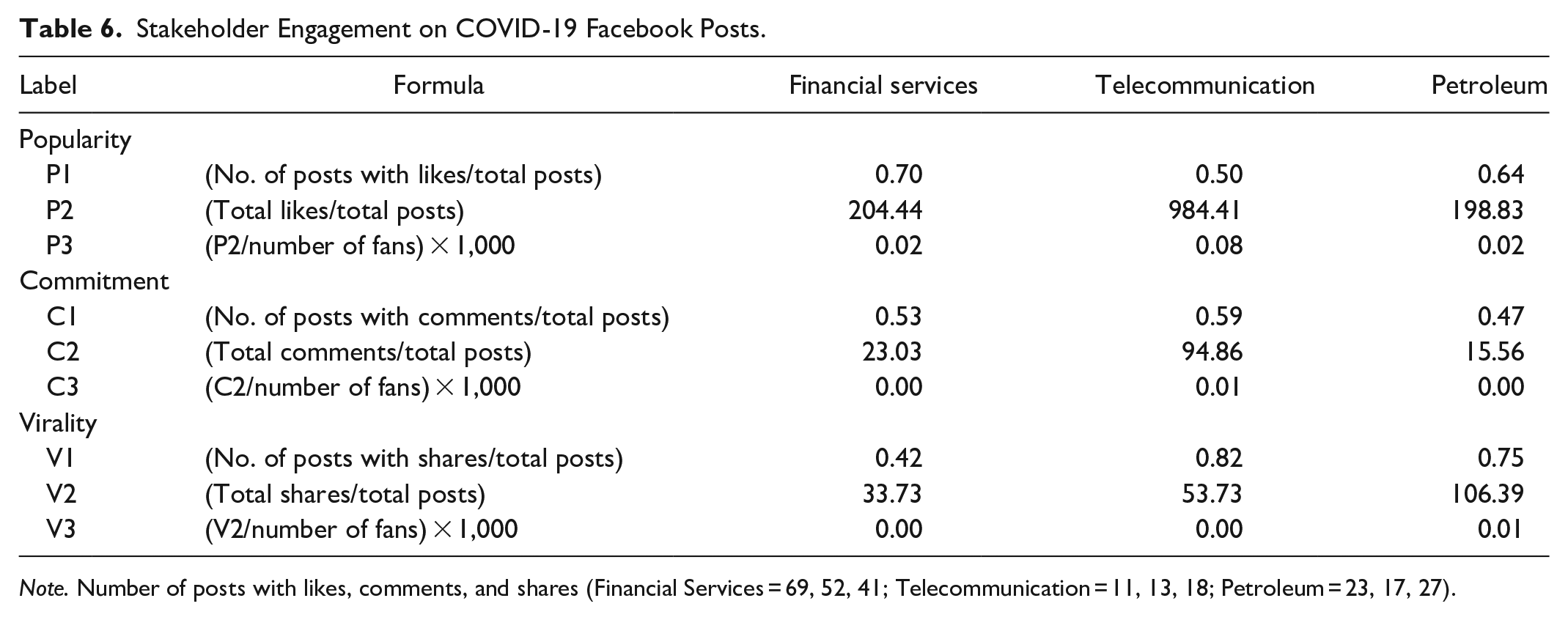
Note. Number of posts with likes, comments, and shares (Financial Services = 69, 52, 41; Telecommunication = 11, 13, 18; Petroleum = 23, 17, 27).
Social media has played an important role in communication and engagement with the stakeholders regarding sustainability and CSR practices (Bellucci & Manetti, 2017; Lodhia, 2018). The empirical evidence in the literature demonstrates that social media platforms can be effectively used for CSR activism (Boyd et al., 2016). In the developed world, the concept of CSR and sustainability are well established; however, Pakistan, which belongs to the developing world order, has yet to mature the concept of CSR (Ali et al., 2017).
In Pakistan, the determinants of CSR practices include pressure from foreign investors, international regulatory bodies (WHO, UNICEF, IMF) and international media (Ali et al., 2017). This study anticipated the response of Pakistani firms as more proactive in nature rather than reactive under the umbrella of CSR. However, Facebook pages have revealed a relatively low response toward the COVID-19 outbreak from the companies and the users. More research is needed on the factors causing a dawdle to prevent the Covid-19 outbreak in Pakistan. Moreover, culture as a determinant of business ethics values needs to be investigated.
Implications
This study is motivated by the outbreak of COVID-19. This is a unique situation for Pakistan because there have not been any major plagues or airborne infections in the past. Several actions can be applied to fill the research gap in the literature. First, ethical norms in the South Asian region are certainly different from other parts of the world. A comprehensive analysis of the strength of the ethical norms is required to clearly distinguish the determinants of the ethical norms accepted by firms in Pakistan. Second, the role of stakeholders in pressurizing a business firm to adopt CSR practices and their disclosures is not a well-searched area in Pakistan. Lastly, the gap in the literature can be filled by empirical investigation of why CSR disclosure is not mandatory in Pakistan.
The analysis of businesses responses toward the Covid-19 outbreak in Pakistan has revealed several deficiencies. First, for the policymakers, this study highlights the necessity of CSR disclosures as a mandatory part of corporate reporting in Pakistan. Moreover, CSR reporting is in line with Global Reporting Initiative (GRI, n.d.) standard guidelines. This will allow transparency and accountability of CSR practices by the Pakistani firms. Resultantly, collaborative efforts from businesses and society will occlude the spread of the deadly virus. Secondly, business firms must carefully balance their social communication, dividing due weightage between messages relating to the prevailing cause and general marketing messages. It may be inferred that during a pandemic like Covid-19, the number of general marketing messages should be reduced in favor of messages on the social issue at hand, and more steps can be taken to motivate user engagement on posts related to natural disasters. An alternative would be to blend their messages to achieve the twin objective of spreading social awareness and marketing. Third, the financial sector of Pakistan needs to educate its clients about the need to curtail physical visits to branches and rely more on the use of plastic money (Debit or Credit card). The banks have done this during the Covid-19 era, but this needs to promote as a new norm. Fourth, the financial, telecommunication, and petroleum sectors have vast access to society—this imposes an additional responsibility on them to promote awareness campaigns aggressively. Fifth, the analysis of all the business responses is essential to measure their effectiveness. Sixth, it is not just the Covid-19 epidemic. The South Asian region has seen several natural disasters from the past few decades due to changing global climate and plunging resources (Seidler et al., 2018). For proactive measures, the formulation of possible strategies and measures by Pakistani businesses before natural disasters occur. Lastly, the findings of this study in an unprecedented situation, that is, the outbreak of Covid-19, indicate a necessity of a proactive approach toward natural disaster management.
Conclusion
This study attempted to examine the response of Pakistani for-profit firms to mitigate the spread of Covid-19 and analyze the user’s engagement on Covid-19 Facebook posts. The study was motivated by the scarce resources and high vulnerability of the general population in Pakistan to the exposure of Covid-19. Moreover, the study is based on theoretical arguments from the available literature that a business’s role in mitigating natural disasters is important. The study operationalized its objective by adopting content analysis on Facebook pages of the selected industry in Pakistan. The outcome of the data collected reveals a gap in the measures adopted by the selected industries. Despite gaps in measures, this study confirms that social media is an effective platform for quick communication between large community groups to generate awareness and share relevant information during the outbreak of Covid-19 in Pakistan. This study endorses that businesses in Pakistan must participate and disclose their CSR practices during a natural disaster, even if CSR disclosures are not mandatory by law and need to encourage the user’s participation on Covid-19 Facebook posts.
As depicted in Table 3, the public’s reaction to Covid-related posts was much greater than marketing-related posts. This denotes that the firms are paying not enough attention to the cause of Covid-19. At the same time, this indicates a state of mind of the general public that the firms should notice and analyze. An immediate suggestion that emerges in mind is for companies to try and incorporate Covid-19 related messages in their normal marketing related releases. This should yield advantages for both the issuers and recipients of the messages.
As expounded by various CSR theories, a display for the well-being of the society is aimed at extracting indirect economic benefits by a company. This can only happen if the public looks favorably at the ethical steps taken by a company concerning a social problem. We state that the conclusions drawn from Table 3 do not argue well for the three sectors included in the study. They need to be more effective and profuse in their Covid-19 related communications with the general public to enhance their reputation and reap benefits there-from.
Footnotes
Declaration of Conflicting Interests
The author(s) declared no potential conflicts of interest with respect to the research, authorship, and/or publication of this article.
Funding
The author(s) received no financial support for the research, authorship, and/or publication of this article.
