



Abstract
While environmental, social, and governance adoption (ESG) is growing, the sports sector is encountering distinct hurdles due to its economic intricacies and stakeholder complexities. A gap exists between ESG assessment and implementation, particularly in the translation of high-level principles into concrete operational strategies. Many clubs engage in ESG reporting or evaluations, but lack the actionable frameworks or internal capacity needed for effective execution. The aim of this study is to develop a practical ESG implementation roadmap tailored to the unique characteristics of professional sports clubs. Using the Delphi method, a three-round expert consensus process was conducted with 20 specialists from academia, clubs, corporations, the public, and media. The first round determined potential ESG factors, while the second and third rounds analyzed their relevance, importance, and feasibility using quantitative validity measures including the content validity ratio, convergence, and consensus. ESG strategies were categorized into three dimensions: environmental sustainability, social responsibility, and governance integrity. While the main environmental goals that emerge are waste management techniques and sustainable stadium operations, the social component emphasizes youth growth, diversity, and community services. The governance structure prioritizes transparency, anti-corruption initiatives, and stakeholder engagement. The transition from evaluation to action establishes a stakeholder-centric framework aimed at politicians, club administrators, and sports regulatory organizations to enhance sustainability, trust, and resilience.
Plain Language Summary
Throughout the world, numerous companies are making an effort to be more environmentally and socially responsible by adopting ESG principles—short for Environmental, Social, and Governance. Professional sporting clubs are particularly challenged to put these concepts into practice, though. As they engage with numerous individuals—fans, players, sponsors, local stakeholders, and governing bodies—it is not always straightforward to make clear-cut, uniform decisions enhancing everyone's welfare. This exercise sought to develop a usable guide that sporting clubs could adopt in an effort to incorporate ESG into everyday operations. In doing so, the researchers assembled 20 stakeholders from among universities, sporting teams, businesses, governmental institutions, and media outlets. They used the Delphi method, with the process consisting of three rounds of consultation with experienced individuals, to gather and develop ideas regarding what ESG would resemble in practice among sporting environments. The conclusions provide direction to clubs to act on. They provide methods to decrease waste and make arenas more sustainable, demonstrate how clubs can embrace youth and community initiatives, and emphasize fair and transparent decision-making. They are not purely hypothetical—they are intended to be implemented by club administrators, sporting authorities, and policymakers interested in making tangible changes. Through action rather than just words, this study brings sports clubs one step closer to being more sustainable, just, and reliable. It demonstrates that with the proper counsel from seasoned professionals, even multifaceted sectors like sports can foster greater relationships with society and work toward creating an improved world.
Keywords
Introduction
Environmental, Social, and Governance (ESG) framework, encompassing environmental impacts, social responsibility, and corporate governance practices is vital for assessing business sustainability. Initially grounded in the principles of socially responsible investment, ESG has evolved into a key corporate priority, influencing strategic decisions, investment selections, and regulatory frameworks (Richardson, 2009). The increasing need for corporate transparency and sustainability has prompted organizations to integrate ESG principles into their operations for meeting ethical requirements and for enhancing long-term value generation and risk management (Yu et al., 2020). Acknowledging its impact on financial performance and business stability, institutional investors and asset managers are increasingly incorporating ESG into their investment strategies (Gillan et al., 2021). Robust ESG practices generally result in increased investor confidence, diminished financial constraints, and enhanced brand reputation. Hence, ESG integration has emerged as a significant determinant of corporate performance (Cheng et al., 2014).
Furthermore, global regulatory bodies’ compulsory ESG disclosure regulations underscore the significance of transparent and uniform reporting (Eccles & Youmans, 2015). This shift underscores the fact that ESG, once a voluntary initiative, has evolved into a strategic necessity, particularly as corporations’ address climate change, social justice, and corporate ethics (Fink, 2020). ESG adoption results in improved company performance and stakeholder confidence outside of financial and legal concerns. Studies reveal that organizations utilizing ESG possess higher operational efficiency, innovative capability, and employee engagement (Ioannou & Serafeim, 2019). Furthermore, the worldwide spread of ESG reporting systems, including the UN Sustainable Stock Exchange Initiative, has motivated companies to disclose their ESG performance, thereby, promoting more responsible and sustainable business practices (United Nations Sustainable Stock Exchange Initiative, 2022).
Recently, sustainability issues have increasingly impacted global industries, including the sports sector, which has come under heightened scrutiny due to its environmental impact, social obligations, and governance standards. The functioning of professional sports organizations at the convergence of business, culture, and community, renders their adherence to ESG principles as not merely ethical but practical. In contrast to traditional sectors, sports organizations interact directly with extensive audiences and varied communities, thus exerting considerable influence in promoting sustainable and ethical governance (Sartore-Baldwin & McCullough, 2018). Major sporting events, such as the Olympic Games and the FIFA World Cup, have historically prompted concerns regarding environmental deterioration, community dislocation, and financial mismanagement (Alfrey, 2023; Fermeglia, 2017). Governance flaws witnessed in the case of prominent sports organizations, such as FIFA and the International Olympic Committee (IOC), underscore the need for more open and responsible decision-making processes (Esposito, 2016; Forster, 2016). Despite the operations of professional sports leagues being much smaller than those of the world’s governing bodies, these encounter similar ESG-related challenges, including financial sustainability, ethical leadership, and environmental responsibility (Tettamanzi et al., 2024).
While numerous strategic benefits of ESG adoption in professional sports exist, negative effects are fewer. First, ESG involvement enhances brand reputation; thus, companies that actively adopt ESG usually demonstrate more fan loyalty and sponsorship appeal (Lee & Rhee, 2023). In response to growing customer demand for sustainability, Premier League clubs have started tracking and sharing their carbon footprints (David, 2024). Second, robust strategies that integrate ESG can boost sports clubs’ long-term profitability and investor confidence, thereby enhancing their financial performance (Friede et al., 2015). Third, ESG adoption ensures adherence to shifting corporate governance rules and environmental laws, thus supporting risk control (Eccles et al., 2014). Professional sports clubs successfully promote social equity by interacting with local communities, encouraging inclusivity, and supporting social projects, including youth development programs and diversity policies (Ryu, 2021). With the growth of ESG worldwide, professional sports clubs must undertake responsibility of leading sustainability initiatives that appeal to communities, investors, and fans.
Given the growing importance of ESG in the sports sector, this study explored practical methods for implementing ESG initiatives within professional sports clubs. Although, numerous studies have undertaken impact assessment and ESG evaluation research, practical implementation strategies tailored to the unique dynamics of the sports industry are lacking. Previous studies have largely centered on conceptual exploration and performance evaluation (Bai et al., 2025; Kim, 2025; Kim & Baek, 2025), with limited emphasis on how ESG can be systematically executed by professional sports organizations. Moreover, studies tend to focus on specific national or league-based contexts, limiting their broader applicability. Delphi-based expert consultation, which is effective in other policy and strategy domains, remains underutilized in this field. To bridge this gap, this study employed Delphi method to collect expert perspectives and develop a structured framework for ESG activation. By providing professional sports clubs, a methodological approach for integrating ESG concepts into their operations, this study aims to enhance industry practices and scholarly discourse. This study distinguishes itself from prior research, as it is the first to apply the Delphi technique to formulate actionable strategies for implementing ESG in professional sports clubs. While this study aims to frame a comprehensive actionable ESG model employable across various leagues and sports, previous studies have focused on evaluating ESG performance or examining case-specific implementation in a single country or competition. By offering concrete strategies and structured implementation guidelines, this study offers a definitive and adaptable framework to professional sports clubs for integrating ESG into their operations, thus shifting the focus from ESG assessment to practical execution. By following a pragmatic methodology, this study institutionalizes ESG concepts in a structured and sustainable manner, contributing to academic discourse while also offering a valuable resource for sports clubs.
Literature Review
ESG Research in the Sports Industry
Integrating ESG principles into the sports industry has led to increased research on its implementation strategies, outcomes, and sector-specific challenges. Previous studies indicate that ESG management can enhance sustainability in sports organizations by augmenting stakeholder engagement and brand value (Myung, 2024). Recent studies have examined the factors influencing ESG adoption, particularly in professional sports clubs, where sustainable practices are affected by financial, legal, and reputational considerations. From a conceptual standpoint, Rogers’ (2003) diffusion of innovations theory provides a relevant lens to examine how emerging ideas such as ESG gain traction within organizations. The paradigm delineates numerous successive phases: awareness, interest generation, evaluation, implementation, and eventual confirmation. Each phase is shaped by perceived benefits, alignment with existing values, and peer dynamics. Considering that ESG remains a relatively novel and evolving framework in the realm of sports, it is plausible that many professional clubs are still situated in the early persuasion or exploratory phases. This theoretical view is reinforced by observable developments in practice. Premier League clubs, for instance, have started to voluntarily report their carbon emissions and sustainability measures, reflecting heightened pressure from regulatory bodies and stakeholder communities (David, 2024). Additionally, several football clubs have undertaken community-focused ESG initiatives, including youth engagement and diversity enhancement, in response to evolving fan and investor expectations (Ryu, 2022). Collectively, these examples indicate that although the full-scale adoption of ESG is still unfolding, a growing cohort of clubs has begun to appreciate its strategic potential and is actively embedding these principles into their institutional frameworks. This shift toward practical implementation is also evident in the context of infrastructure management.
In large multipurpose venues, where sustainable practices markedly diminish carbon footprints and enhance operational efficiency, research underscores the importance of integrating ESG into the management of sports facilities and event designs (Yan & Chi, 2024). Therefore, social responsibility in sports has evolved as a significant study area, specifically, in terms of the impact of ESG activities on fan engagement, team recognition, and volunteer initiatives. Furthermore, several scholars have examined the broader social influence of professional sports clubs on their surrounding communities. According to Inoue & Havard (2014), sports clubs act as community anchors that can shape civic identity and public values. Kim and Walker (2012) found that hosting major sporting events, such as the Super Bowl, can foster community pride and strengthen residents’ emotional connection to their city, contributing to broader social cohesion. These findings align with the notion that sports organizations serve not only as entertainment providers but also as vehicles for promoting inclusive growth and social development. Previous research indicates a positive correlation between ESG-driven initiatives and fan loyalty (Ryu, 2022). Studies focusing on governance in professional football reveal the positive impact of ESG performance on corporate transparency, financial sustainability, and the cultivation of intellectual capital within clubs (Manzari, 2024). The assessment of ESG practices in German professional football (Zülch et al., 2021) and benchmarking of Finnish football teams for their sustainability commitments (Gurung, 2022) exemplify diverse, nation-specific research methodologies for ESG implementation. Despite the valuable insights provided by these studies on ESG in sports, sector-specific implementation strategies tailored to the unique conditions of major sports leagues is lacking.
Method
Delphi Study Design
A key element for establishing the validity and reliability of the results in Delphi studies is the choice of research participants. A stringent criterion ensured a balanced representation of expert perspectives and preserved the rigor of participant selection. To capture a well-rounded perspective, experts from various backgrounds were included, as the knowledge and experience of participants directly affect the accuracy of research conclusions. First, participants were required to have worked in the industry or conducted studies associated with ESG for at least 5 years. This criterion guaranteed that the chosen specialists had a thorough comprehension and awareness of ESG dynamics, enabling a more knowledgeable conversation. Second, individuals with a history of academic misconduct, such as research fraud, plagiarism, or data manipulation, were excluded, augmenting the equity and integrity of the study. Third, priority was given to experts who had participated in a minimum of three previous Delphi studies as familiarity with the technique is expected to promote a more structured and comprehensive discourse from the experts. The aforementioned criteria resulted in the selection of 20 specialists across various ESG domains as study subjects. These specialists hailing from various sectors of the ESG ecosystem ensured a broad range of perspectives relevant to professional sports organizations. Table 1 presents the study participants’ demographic profile.
Research Participants’ Demographic Profile.
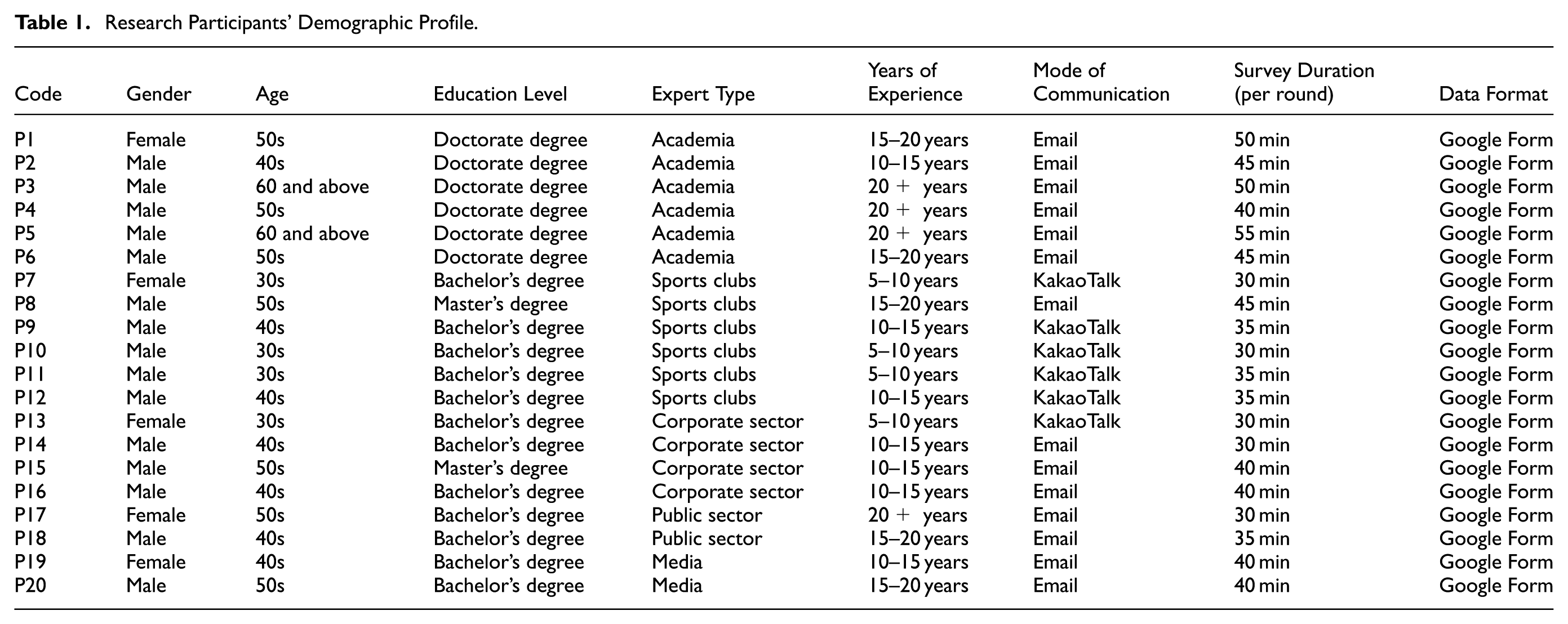
Before conducting the Delphi survey, prior approval was obtained from the Institutional Review Board (IRB) of a university to ensure ethical compliance. The IRB approval ensured the voluntary nature of research participation, validation of the ethical guidelines, and strict adherence of the research procedures based on the IRB guidelines. Special attention was paid to protecting the participants’ personal information and anonymity, which were carefully integrated into the research design from the outset. All participants provided written informed consent before participating in the survey, in accordance with the IRB-approved protocol. The Delphi survey was conducted remotely via email and KakaoTalk and consisted of three iterative rounds.
Data Collection Procedure
First Round: Extraction of Preliminary Factors
The primary objective of the first Delphi survey was to identify the preliminary factors. Before initiating the survey, the 20 participants were provided detailed information regarding the study’s purpose, Delphi methodology, expected outcomes, anonymity assurance, prohibition of proxy responses, and ethical considerations, via phone and email. This also included signing the IRB consent form. Upon the participants’ acknowledgment and agreement to these conditions, they were allowed to proceed with the survey. An open-ended questionnaire was employed, allowing experts to freely list at least five potential ESG strategies applicable to professional sports clubs. No prioritization was imposed at this stage; instead, the goal was to gather the maximum number of potential factors without restrictions.
Second Round: Evaluation of Factor Relevance
The second Delphi survey assessed the relevance of the identified factors. A closed-ended questionnaire was developed based on the results of the first round. Subsequently, experts evaluated the suitability of each factor using a binary response format (“Yes” or “No”). The primary objective of this round was to determine the relevance of each factor as a research variable.
Third Round: Assessment of Factor Importance
The third round evaluated the importance of the validated factors. Factors receiving majority agreement (50% or more) in the second round were included at this stage. To quantify their significance, a five-point Likert scale ranging from 1 (not at all important) to 5 (very important) was used. This final step quantified the ESG activation strategies, enhancing the reliability of the research findings.
Data Analysis
Lawshe’s (1975) content validity ratio (CVR) was used to assess the relevance of the survey items to the study’s objectives. CVR evaluates the appropriateness of an item based on the proportion of experts who consider it valid. Here, ne represents the number of participants who rated an item as “valid” or “important,” while N is the total number of participants. The minimum CVR threshold varies based on the number of participants, and only items meeting or exceeding this threshold are considered valid. The minimum acceptable CVR for a study involving 20 participants is 0.42 (Lawshe, 1975), which was applied in this research.
For ensuring dependability, convergence was assessed by evaluating how regularly the participants responded. Low variability and strong convergence are indicated by values of approximately 0. Previous studies show that a convergence value of 0.5 or lower indicates a suitable degree of response consistency. Convergence was computed as half the difference between the third quartile (Q3) and first quartile (Q1) values using the following formula:

Additionally, the degree of participant consensus was assessed. Consensus values of 0.75 or above are considered as reasonable degree of agreement based on prior research. Participants’ consensus increases as this value approaches 1. Consensus quantifies the degree of agreement in responses by subtracting the ratio of the interquartile range to the median value from 1 using the following formula:

Further, stability was evaluated to ascertain whether the response patterns remained the same throughout several Delphi cycles. For a stability of 0.5 or lower, the response pattern is considered to be sufficiently steady and further survey rounds are not required. Stability ratings between 0.5 and 0.8 indicate a modest degree of stability, whereas values greater than 0.8 imply that more Delphi rounds may be needed to reach higher consistency.
Establishing Validity and Reliability
Peer reviews and participant validation were performed to confirm the findings. For participant validation, Delphi experts faithfully examined the results to verify whether these reflected their views. Two or three researchers with field-based experience conducted peer reviews and closely evaluated the approach and results. Additionally, the research team provided two study participants and two outside experts with the analytical data, research process, and conclusions for assessment. They verified the suitability of procedures for factor extraction, elimination, and selection, without encountering any notable problems.
Results
The First Delphi Survey
The first Delphi survey represented the preliminary factor-extraction stage. An analysis of expert responses revealed the categorization of the identified factors into three major domains: environmental, social, and governance. An open-ended questionnaire was utilized to gather the responses from 20 experts. Finally, duplicate responses with a frequency of three or more were included (Table 2).
First Delphi Survey Questionnaire Results.

The Second Delphi survey
As mentioned previously, the second Delphi survey focused on suitability assessment. Based on the survey results, all 36 preliminary factors across the three domains received a higher proportion of positive (yes) than negative (no) responses. This shows that the experts found these factors to be generally suitable for inclusion in this study (Table 3).
Second Delphi Survey Questionnaire Results.

The Third Delphi survey
The third Delphi survey assessed the importance of the ESG factors retained from the second round by using a Likert scale and analyzing the CVR, stability, convergence, and consensus. While most factors demonstrated strong validity, four factors failed to meet the CVR threshold of .42 and were consequently eliminated. Specifically, in the environmental domain, the development of a green stadium certification system and sustainable transportation initiatives for fans and teams were excluded due to concerns that such initiatives fell outside the direct purview of professional sports clubs, making them less actionable. Similarly, in the social domain, the elderly health promotion program was excluded because professional sports clubs primarily focus on youth and community engagement rather than initiatives targeted at the elderly. In the governance realm, promoting diversity within club leadership was excluded because board appointments in professional sports clubs are typically performance-driven, making standardized diversity initiatives difficult to implement. Besides these four factors, all other factors demonstrated strong validity with CVR values above the threshold, high mean scores, and satisfactory levels of stability, convergence, and consensus (Table 4).
Third Delphi Survey Questionnaire Results.

Discussion
Environmental Sustainability
Waste Reduction
The adoption of ESG ideas in professional sports clubs increasingly underlines the significance of sustainability-driven activities, particularly, in waste reduction, carbon footprint minimization, and renewable energy adoption. This study’s results echo existing research, which emphasizes sports companies’ increased environmental obligations driven by growing regulatory pressures and stakeholder expectations (Myung, 2024). The significance of recycling programs and trash reduction projects was among the key agreement points among the study's professionals. Events, spectator activities, and facility upkeep of the professional sports teams generate large amount of waste, highlighting the need for organized waste management systems (Zülch et al., 2021). Research focused on European football clubs indicates that effective waste management programs improve financial efficiency and brand reputation, hence contributing to a club’s ESG performance (Manzari, 2024). Similarly, in our study professional sports stakeholders acknowledge waste reduction as a practical and necessary ESG strategy.
Lowering Carbon Footprints
Another ESG aspect strongly supported in case of professional sports clubs were the programs aimed at lowering carbon footprints, reflecting an industry-wide trend of lowering greenhouse gas emissions. Studies indicate that professional sports clubs adopting carbon-neutral practices gain higher fan involvement and sponsorship desirability, particularly among environmentally aware investors (Robak, 2024). Similarly, in this research, professionals emphasized upon offsetting travel emissions, lowering energy use, and employing environmentally friendly mobility options for teams and spectators. Although the importance of carbon reduction is widely recognized, some actions—such as incentives for fan transportation—have received less support because of their reliance on external infrastructure and regulatory collaboration (Diracca, 2021).
Utilization of Energy Sources
Another highly supported ESG action was the acceptance of renewable energy sources, with experts identifying on-site energy storage, solar panel installations, and power purchase agreements for green energy as feasible policies. Previous studies on German professional football have indicated that teams funding green energy initiatives save long-term money and appeal more to sponsorships (Gurung, 2022). Similarly, in our study experts acknowledged that incorporating solar and wind energy into stadium operations is a practical and impactful approach to sustainability. However, not all environmental policies have attracted significant consensus. For example, green stadium certification system and sustainable mobility incentives for teams and supporters were unable to satisfy the CVR criterion, demonstrating a lack of perceived practicality. These results are similar to other studies on sustainability in multi-use sports stadiums, which revealed that, although green certifications improve a company’s reputation, their application usually requires considerable initial investment and external stakeholder alignment (Yan & Chi, 2024). Similarly, initiatives encouraging fans to use low-emission transportation depend on urban infrastructure and government policies, limiting the direct influence of sports clubs (Russo & Mataruna-dos-Santos, 2024).
Thus, the environmental sustainability projects supported by professionals are in alignment with industry trends, thus underlining the need for waste reduction, minimizing carbon footprint, and utilizing renewable energy. Simultaneously, the absence of such projects emphasizes the pragmatic difficulties encountered by professional sports clubs in implementing comprehensive environmental changes. Future studies should investigate how to bridge the gap between goals and implementation, such that sustainability initiatives remain realistic and effective.
Social Responsibility
The larger ESG plans of professional sports clubs, including youth development, diversity and inclusion, and community involvement fundamentally rely on social sustainability projects. This study illustrates the significant role of sports clubs in promoting social well-being and strengthening moral values in their local areas. Clubs can enhance their public image, establish closer ties with nearby communities, and support general societal growth, through organized ESG projects. Youth development programs, which provide underprivileged young people access to sports training, mentoring, and personal development opportunities, are effective ESG realms in the social sphere. Studies indicate that professional sports clubs that organize social events have higher fan loyalty and community trust (Ryu, 2022). These initiatives help promote social mobility and educational progress; therefore, their long-term advantages extend beyond mere sports involvement. These findings resonate with broader research linking sustainability with community empowerment across sectors. For example, eco-conscious entrepreneurship in rural communities has demonstrated how localized environmental initiatives can foster societal equity and long-term resilience (Ahmad, 2019).
Furthermore, modern sports governance rely heavily on diversity and inclusion initiatives. Incorporating inclusive hiring policies, anti-discrimination laws, and gender equality projects is no longer considered discretionary ethical behavior; rather, it is necessary for sustainable operations. In an empirical study on European and North American sports organizations, diversity-driven teams and clubs showed improved organizational performance, higher stakeholder trust, and greater sponsorship appeal (Russo & Mataruna-dos-Santos, 2024). Moreover, to strengthen ESG compliance as a strategic need rather than public relations campaign, it is significant to develop policies based on investor needs and worldwide regulatory expectations (Gurung, 2022).
An important aspect of ESG in professional sports clubs is community involvement; this entails active support from local corporate collaborations, infrastructure development, and health projects, thus strengthening stakeholder networks. German professional football case studies show that sustainability-minded teams foster longer-term financial stability and closer fan devotion (Zülch et al., 2021). These results are consistent with those of corporate social responsibility (CSR) studies, which reveal that regularly active clubs promote goodwill and lower reputational risks and raise investor confidence (Myung, 2024).
In conclusion, the findings of this study demonstrate that social sustainability is a fundamental component in the long-term survival and performance of professional sports organizations rather than a secondary part of ESG. Clubs that proactively adopt and institutionalize social ESG indicators are more likely to maintain effective stakeholder relationships, navigate the rising expectations of sponsors, regulators, and fans, and accomplish consistent development.
Governance and Ethical Management
A cornerstone of ESG application, governance ensures ethical leadership, openness, and responsibility in professional sports clubs. Clubs that adopt strong governance policies are potentially more likely to maintain long-term credibility, draw investors, and improve general organizational sustainability with shifting regulatory needs and stakeholder expectations. These findings underline the need for robust governance structures in professional sports clubs, specifically with regards to openness in decision-making, anti-corruption rules, and the integration of numerous leadership viewpoints. The effective governance of sports clubs is highly dependent on transparency. Results show that companies having open financial disclosure policies and transparent decision-making procedures have greater stakeholder confidence.
Important elements of ESG management in professional sports include ethical management and anti-corruption rules. Frequently occurring governance problems in multinational sports leagues, such as FIFA and the IOC, has heightened the demand for more rigorous ethical control in club administration. Empirical studies show that clubs that set independent audit committees and adopt anti-corruption policies are more likely to avoid regulatory fines and preserve public credibility (Zülch et al., 2021). Notably, Sustainalytics ranked the Juventus Football Club as a low-risk company, which reflects the positive effect of good governance policies on ESG performance (Gurung, 2022).
Diversity in leadership and board independence are other vital components of governance. The results underline the need for varied representations in club leadership, supporting the idea that inclusive governance systems produce more balanced decision-making and improved financial results. Previous studies have found that the performance of clubs with autonomous and diverse boards is superior in terms of stakeholder relations and general governance effectiveness (Nishida & Demajorovic, 2024). Additionally, research on German professional football teams reveals that implementing sustainable governance practices for altering sports organizations’ decision-making structures is met with institutional constraints (Adam et al., 2025).
Ultimately, the results underscore that for professional sports clubs, ESG governance is a compliance and strategic need. Clubs that deliberately include leadership diversity, ethical management, and openness in their governance structures are more effective in negotiating financial, reputational, and legal difficulties. Future studies should investigate the long-term effects of ESG governance policies on financial performance and stakeholder involvement given the growing criticism of governance policies in professional sports.
Practical Implications
The practical implementation of ESG strategies in professional sports clubs requires a multi-faceted approach that aligns with operational realities while fostering long-term sustainability. Professional sports clubs can significantly reduce their environmental impact by including sustainability in stadium operations, merchandise, and fan involvement in the environmental field. Apart from installing solar panels and wind turbines in stadiums, clubs should investigate energy-sharing schemes with local communities, whereby the extra energy generated by the stadium is provided to the surrounding areas. Similarly, sustainable transportation projects may be expanded by collaborating with public transportation companies. This will allow fans to visit events with subsidized or free travel, thereby lowering emissions from personal vehicle use. In zero-waste venues, waste sorting is digitized using Artificial Intelligence (AI)-powered recycling bins. These reward spectators with incentives for correct disposal, representing another impactful tactic. Furthermore, clubs might also consider launching circular economy projects including a “closed-loop” merchandise campaign whereby used jerseys or fan gear are gathered, resold at a discount, and subsequently reused. Gamified eco-conscious loyalty programs, whereby participants gain points for utilizing sustainable transportation, buying environmentally friendly products, or helping with local clean-up efforts, may further assist in fan involvement.
From a social standpoint, professional sports clubs are great community anchors for promoting social inclusion, education, and well-being. An effective way to accomplish this is by creating “sports for all” inclusion hubs—where stadiums serve as multifarious community centers on non-game days, featuring free fitness programs, mental health seminars, and rehabilitation therapy for underprivileged groups, including the elderly and disabled. Clubs may also create athlete-led mentoring initiatives whereby players routinely interact with underprivileged young people under controlled leadership and career coaching guidance. Leveraging digital platforms to start virtual fan engagement activities could promote inclusivity by allowing international fans, especially those in underprivileged areas, to interact with players through live Q&A sessions, virtual training camps, or exclusive behind-the-scenes content, given the worldwide character of sports. Corporate-Non-Government Organization partnerships, where clubs work with non-profits to address urgent societal issues such as mental health awareness, gender equality in sports, and refugee integration via sports programs, are effective endeavors.
In the governance sphere, professional sports clubs must embrace transparency, accountability, and integrity to build trust among stakeholders. Blockchain-powered governance systems is one such transformational step. In these systems, important financial and operational decisions, such as player transfers, sponsorship deals, and boardroom resolutions are entered on a tamper-proof digital ledger available to fans and investors. Another significant step in governance constitutes improving the stakeholder representation. To accomplish this, clubs may establish fan advisory committees with voting rights on important strategic concerns, thereby ensuring more community participation in decision-making. To monitor compliance with anti-corruption measures, financial fair-play rules, and corporate social responsibility pledges, clubs should also establish independent ethics committees constituting outside specialists. By publishing real-time ESG performance dashboards, where sustainability targets, social impact projects, and financial disclosures are routinely updated and made available to the public, the sports clubs may enhance their transparency. Mandatory board rotation rules should help promote diversity in leadership by guaranteeing innovative ideas, thereby avoiding long-standing governance stagnation.
Conclusion
Many previous studies on ESG in sports have centered on high-level ideas or outcome-based evaluations, which often lack clear guidance for how clubs can apply these principles in everyday decisions. In response, this study sets out to develop a usable framework that supports the integration of ESG into the day-to-day operations of professional sports clubs. To accomplish this, the present study carried out a Delphi process involving 20 experts from various fields, including academics, team executives, corporate ESG officers, government staff, and media professionals. Over three survey rounds, participants helped identify and refine key ESG strategies that are specifically relevant to sports organizations. These were grouped into three main categories: environmental efforts (such as waste control and green stadium practices), social initiatives (like diversity and youth engagement), and governance systems (including transparency, anti-corruption, and communication with stakeholders). Each strategy was reviewed using well-established measures of validity and agreement to ensure it was not only relevant but practical.
The results offer sports professionals a structured set of actions they can realistically adopt, based on shared knowledge from experienced individuals across the ESG landscape. Unlike abstract policy models, this framework is designed with implementation in mind, tailored to the specific demands of sports organizations. In doing so, the study fills a critical gap in ESG literature—moving from what should be done to how it can actually be achieved. It also demonstrates the value of expert-led consultation in shaping practical guidance for sectors where ESG is still emerging. Overall, the findings show how sports clubs can go beyond symbolic ESG commitments and take steps that improve both organizational resilience and community well-being.
Limitations and Future Research
Although this study provides valuable insights into enhancing ESG practices in professional sports clubs, several limitations should be acknowledged. First, the study relied on expert opinions collected through the Delphi method, which may not fully capture the perceptions of broader stakeholder groups such as fans, athletes, and sponsors. Second, the qualitative nature of the study limits the generalizability of its findings to other sports contexts, leagues, or cultural environments. Third, while the study identified key ESG factors and implementation strategies, it did not include a quantitative validation of the proposed model. Finally, given the rapidly evolving ESG landscape and policy developments, the relevance of some findings may change over time. To address these limitations, future research can build upon this study’s findings in several ways.
Future research can build on this study’s findings in the following ways. First, a longitudinal study is required to assess the long-term impacts of ESG initiatives on brand value, fan involvement, and financial performance. While this study illustrates the transient benefits of ESG integration, a performance analysis across several seasons may provide additional evidence of its sustainability-related benefits. Second, by undertaking comparative analysis of other leagues, countries, and sports disciplines, contextual problems and successful strategies will become clearer. A comparative study may elucidate the ESG activities that are most effective across diverse contexts given the variations in cultural expectations, legal frameworks, and governance structures among nations. Third, it is essential to explore how emerging technologies facilitate the implementation of ESG principles. Technologies such as blockchain, artificial intelligence, and digital fan interaction platforms can enhance transparency, accountability, and social impact; however, their practical applications in ESG governance and reporting remain unexplored. Finally, further research on the perspectives of stakeholders, including athletes, fans, sponsors, and local communities, is necessary. This study focused primarily on expert perspectives; however, incorporating qualitative insights from other stakeholders will enhance the understanding of the objectives, challenges, and expectations associated with ESG operations in professional sports. By addressing these areas, future research can ensure that ESG policies promote sustainability, ethical governance, and social responsibility, thereby facilitating ongoing progress in professional sports.
To conclude, professional sports clubs can improve their sustainability performance as well as establish robust stakeholder trust, operational resilience, and long-term competitive advantage by including forward-looking and sensible ESG projects. By combining these ESG techniques, sports clubs will emerge as outstanding models of ethically, socially conscious, and ecologically sensitive businesses, thereby redefining sustainability in the sports sector worldwide.
Footnotes
Acknowledgements
The authors would like to thank the experts who participated in the Delphi process and contributed valuable insights to this study.

Ethical Considerations
This study was approved by the Institutional Review Board (IRB) of Kookmin University (Approval Number: KMU-202411-HR-441). All research procedures were conducted in accordance with the Declaration of Helsinki and relevant ethical guidelines. All participants provided written informed consent before taking part in the study. The consent process was conducted in accordance with IRB guidelines.
Funding
The authors disclosed receipt of the following financial support for the research, authorship, and/or publication of this article: This work was supported by the Ministry of Education of the Republic of Korea and the National Research Foundation of Korea (NRF-2022S1A5A2A01049332).
Declaration of Conflicting Interests
The authors declared no potential conflicts of interest with respect to the research, authorship, and/or publication of this article.
Data Availability Statement
The data is available from the corresponding author upon request and will be provided immediately.