




Abstract
Two-sided matching problems are common and crucial parts of human activity; the psychological behavior of agents is an important factor that should not be ignored in such problems. However, existing academic research has not considered the psychological behavior of agents in two-sided matching models. Therefore, this study develops a method for determining the most satisfactory results for agents on both sides of a matching problem that considers agents’ regret aversion behavior as measured using linguistic preference information. Initially, the preference utility and regret values are computed based on regret theory; then, the perceived utility values of each agent are obtained. This two-sided matching model has been established to maximize matching satisfaction without waste using the minmax method. Finally, a practical example is discussed to demonstrate the feasibility and validity of the proposed method.
Introduction
The concept of two-sided matching—which refers to finding optimal matches based on preference information from each agent for potential matching objects from two separate sets of agents—originated from Gale and Shapley’s (2013) research on marriage matching and college admissions. Two-sided matching is an emerging research area in the field of optimization and decision analysis for social problems, and has been comprehensively employed in practical applications to solve multifaceted problem. For instance, it has been used in economic management for seller matching (S. Chen et al., 2016), electronic transaction matching (Z.-Z. Jiang et al., 2016), knowledge service matching (X. Chen et al., 2016; Liu & Li, 2017), venture capital matching (Sørensen, 2007), enterprise post-employee matching (Azevedo, 2014; Bando, 2012), and supplier–score problems. Moreover, it has great importance for social problems, such as marriage (Alcalde, 1996; Ashlagi et al., 2014; Eriksson & Karlander, 2000; Gale & Shapley, 2013; Irving et al., 2008) and roommate (Aziz, 2013; Chung, 2000) matching, as well as education problems, as in intern–hospital (Roth, 1985; Roth & Peranson, 1997, 1999) and student-admission (Abdulkadiroğlu et al., 2005; Abdulkadiroğlu & Sönmez, 2003; Pais, 2008) matching.
To further develop and improve two-sided matching theory, scholars have carried out research from multiple perspectives, examining factors such as stability, fairness, satisfaction, Pareto validity, anti-operability, and psychological behavior. However, these studies were mainly carried out under two assumptions: those of perfect rational behavior by the matching subject and bounded rational behavior. The former assumptions hold that the behavior of the matching subject is completely rational and is based on the theory of expected utility. For example, the study of Gale and Shapley (2013) proves the existence of stable marriage and proposes a delay of accepting Gale–Shapley for one-to-one stable matching. The stability of gender equity in marriage matching has been studied and gender-equitable and stable marriage has been put forward (Klaus & Klijn, 2006; McDermid & Irving, 2014). Fan and Yue (2014) emphasized two-sided matching with the highest acceptable preference order, and developed a matching optimization model based on the lowest acceptable satisfaction degree. In contrast, Erdil and Ergin (2017) focused on the Pareto validity of two-sided matching using undifferentiated preference order information. Such research assumes that the behavior of match subjects is bounded rationality and is based on decision-making behavior theory. Currently, the availability of limited targeted methods has produced very few research results. For example, Yue and Fan (2013) used a two-sided matching method based on cumulative foreground theory and proposed a mechanism to solve two-sided matching with preference expectation under partially ordered good information, considering the psychological behavior of preference dependence and loss aversion. Furthermore, Fan et al. (2018) considered the psychological behavior of regret aversion and established a matching optimization model based on regret theory under uncertain preference order information.
In past studies, researchers have developed and extended two-sided matching theory; however, the complexity and uncertainty of matching environments and the fuzziness of human thinking make it difficult for match subjects to express their preferences as precise ordinal values. In contrast, subjects give preference information in linguistic forms. Two-sided matching based on linguistic preference information exists widely in real life. For example, in marriage matching, one party’s comprehensive evaluation of the other is often provided using linguistic preference information like, “excellent,” “good,” “medium,” and “poor.” Therefore, the study of two-sided matching under linguistic preference information has important theoretical significance and practical value. At present, two-sided matching based on linguistic preference information has attracted the attention of researchers from various fields. For instance, Qi (2016) bilateral matching with linguistic preference information, proposing a bilateral matching method based on binary semantics. Qi (2015) proposed a matching optimization model based on binary semantics, which is useful for solving two-sided matching problems with uncertain incomplete linguistic preference information. Although research has enriched and improved the theory of two-sided matching, few studies of two-sided matching have considered match subjects’ regret avoidance behaviors. In two-sided matching, the match subjects’ psychological perceptions of regret and joy are closely related to their satisfaction with the matching results. Specifically, the perceived utility of the matching subject consists of two parts: the utility value obtained by matching with the current match subject and the regret and joy values relative to the ideal match subject. Nevertheless, no study has yet considered the match subjects’ psychological perceptions of regret and joy. Moreover, few studies on two-sided matching have considered the match subjects’ regret avoidance behavior by introducing regret theory.
Therefore, to bridge this knowledge gap, this study aims to extend current research on two-sided matching under linguistic preference information by accounting for the match subjects’ psychological perceptions of regret and joy, and proposes a two-sided matching method that considers the match subjects’ regret avoidance behavior using regret theory. The proposed model is applied to the practical example of job recruitment; the case study confirms the effectiveness of the proposed model.
The remainder of this article is organized as follows: in our Materials and Methods, we present the concepts of linguistic term sets, regret theory, and two-sided matching; describe the two-sided matching problem; and detail a two-sided matching method that considers regret aversion. Our Results and Discussion section gives a practical example to illustrate the applicability and advantage of the proposed method. Finally, we point out several conclusions and suggest future work.
Materials and Methods
Related Concepts and Theoretical Foundations
In this section, several basic definitions and theories are discussed to enrich the foundations of this article.
Fuzzy linguistic term sets
Definition 1
Let
The set should be ordered:
There must be a negation operator: neg(
It should contain a maximization operator: max
The set must have a minimization operator: min
For example, a set of seven terms
For ease of computation, linguistic variable

According to Equation 1, a set of nine terms

Linguistic term set
Linguistic Terms and Corresponding TFNs.

Note. TFN = triangular fuzzy number.
Regret Theory
Regret theory is a comparatively new and important reasoning method that was initially proposed by Loomes and Sugden (1982) and Bell (1982). The term regret incorporates a utility function with negative impact over the realized outcome and positively depends on a best alternative given uncertain tendencies. Regret theory is a nontransitive technique that represents preferences as bivariate utility functions that consider feelings of both regret and joy. Regret theory provides justifiable reasoning for many phenomena that are not explained by expected utility theory. That is, regret theory can be said to address the shortcomings that exist in expected utility theory. Mathematical representations of regret theory can be written as below.
Let

where
Usually, power function
Two-Sided Matching
Let
Definition 2
A two-sided matching is a one-to-one mapping
if
if
if
where
Figure 1 shows an analysis of the two-sided matching problem that explains the linkages of three parties: side X, side Y, and the mediator. Usually, the mediator refers to the organization that plays the role of intermediary among other players and provides support to their decision-making system. The mediator performs a function through which parties X and Y obtain satisfactory results based upon the criteria that the parties have provided. In other words, the mediator assists parties X and Y to achieve their desired results. The intermediary tries to satisfy both parties’ demands and provide matching results that optimize both parties’ satisfaction. Figure 1 shows

Two-sided matching.
Two-sided matching problem description
Consider one-to-one two-sided matching with fuzzy linguistic preference information. The basic settings for two-sided matching problems can be written as follows:
The main objective of this article is to address the two-sided matching problem by finding the most satisfactory matches on both sides, considering DM’s regret aversion behavior using linguistic preference vectors
Two-sided matching that considers regret aversion
In the study, we propose a method for determining DMs’ regret aversion behavior in a two-sided matching problem. The study framework is illustrated in Figure 2. Initially, the linguistic preference variables are employed using TFNs; then, the TFNs are transformed into preference utility values using a utility function. The regret and preference utility values are then computed using regret theory, as well as a multiobjective optimization model. Finally, the two-sided matching results are obtained using a minmax method.
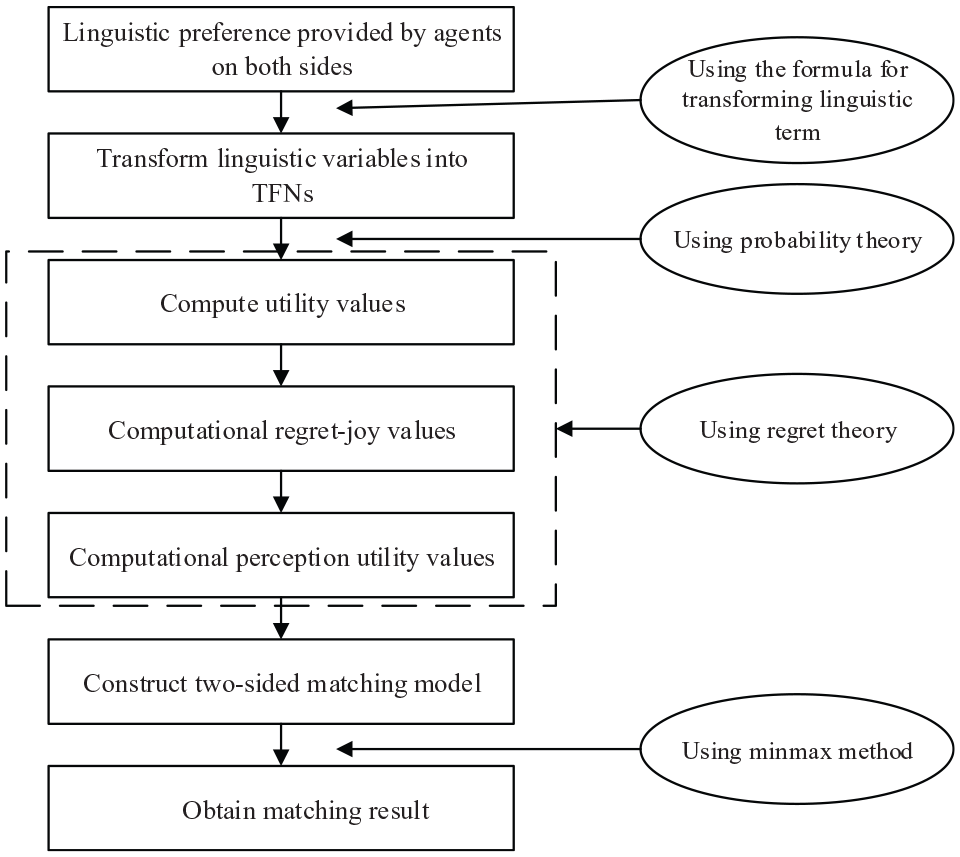
Framework for two-sided matching considering regret aversion.
Calculation of utility values
Munda (2012) and Yoon (1996) treat TFN

where
First, convert the fuzzy linguistic preference information of the agents on both sides into TFNs according to Equation 1. Let
Let

Let
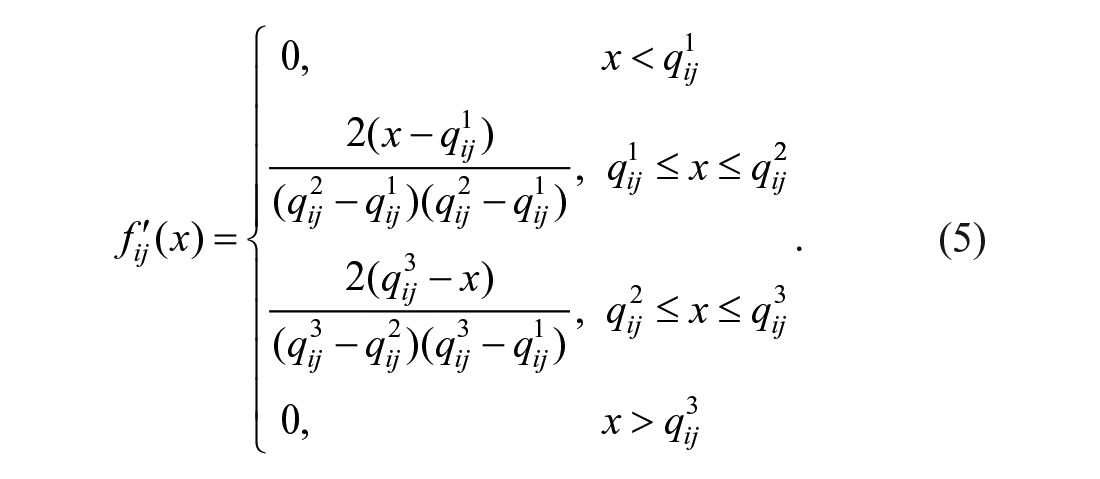
Let

where
Let

where
Calculation of regret-joy values
We employ an exponential regret–joy function from a previous study by Bell (1982), since the matching agents have risk aversion against regret and joy.

where ∆

Regret-joy function
When agent

where and
When agent

where
Calculation of perceived utility values
According to regret theory, when agent

In Equation 9,
Similarly, according to regret theory, when agent matches, the perceived utility of

In Equation 10,
Two-Sided Matching Model
Social exchange theory indicates that two-sided matching is essentially a resource exchange. Match satisfaction is one of the key metrics for assessing the quality of two-sided matching alternatives. The match success of agents on both sides mainly depends on the degree of their mutual satisfaction (higher satisfaction indicates easier matching). Considering the satisfaction and waste of matching, we establish the following two-sided matching multiobjective optimization model.





In the model, Equations 13 to 15 are objective functions. Equation 13 maximizes the general perceived utility of agent
Model Solution
The multiobjective two-sided matching optimization model Equations 13 to 18 can be solved by the minmax method, which was proposed by Zimmermann (1978). Let
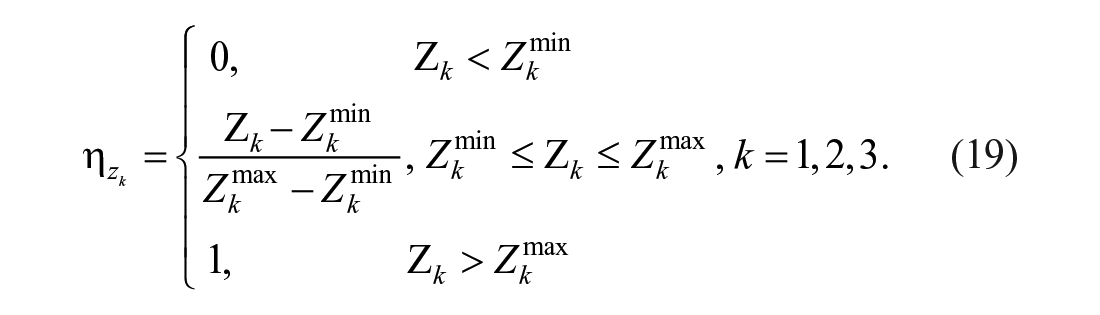
Then, the multiobjective two-sided matching optimization model based on Equations 13 to 18 can be converted into the following single-objective programming model based on Equations 19 to 24.





Equations 19 to 24 comprise a binary single-objective integer programming model. As per integer programming theory, the model must have an optimal solution. This study adopted Lingo (version 11.0), MATLAB 2014, and Cplex (version 9.0) to find this solution. Fuzzy linguistic two-sided matching was thus adopted, following several steps to take regret into consideration. The proposed solution for a two-sided matching problem based on regret theory with linguistic preference information criteria is given as follows:
Results and Discussion
During the job recruitment process, candidate–post matching is crucial and challenging for any organization. That is, it can be hard to select the right person for the right job. In this context, the method proposed in this study can be useful; therefore, in this section, we illustrate such an example to foster better understanding of the proposed model.
Company MT intended to fill vacancies for assistant manager posts
Linguistic Preference Information Obtained From the Department Managers About the Candidates.

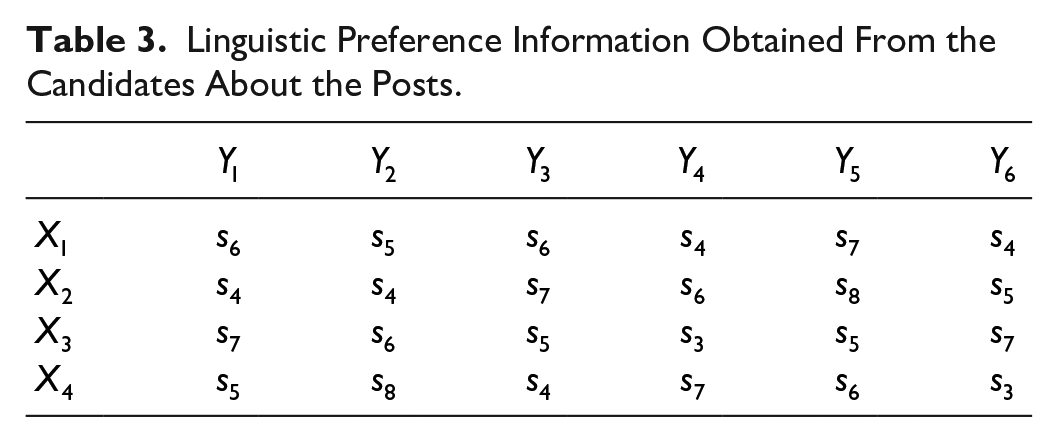
Linguistic Preference Information Obtained From the Candidates About the Posts.
Problem Analysis and Justification
Human resources are now the precious wealth of enterprises, and the problem of internal personnel and post matching is one of the most important contents of enterprise human resources management. The degree of matching directly affects the efficiency and production efficiency of the overall allocation of human resources, and then affects the competitiveness of enterprises. Reasonable and effective personnel and post matching can not only give play to the ability of employees, mobilize the enthusiasm of employees, but also bring higher and more long-term economic benefits to the enterprise. In recent years, the in-company person–post matching has been a hot topic for scholars. Most of the existing research literature assumes that the behavior of enterprise decision makers and employees is completely rational, and then establishes a two-sided matching model based on utility theory. However, the behavioral decision theory shows that in the process of person–post matching, the behaviors of enterprise decision makers and employees are bounded rational, that is, they are not in pursuit of utility maximization, and they often show psychological behavior characteristics such as loss avoidance and regret avoidance. Based on this, this article gives full consideration to the psychological behaviors of decision makers and employees in the process of job matching, introduces the regret theory into the person–post matching model, and proposes a two-side matching method based on the regret theory. This kind of bilateral matching method, which takes into account the psychological behavior of regret avoidance of both people and posts, is a completely rational person and post matching method, which is closer to the actual decision-making and has more guiding significance to the human resource management activities of enterprises and has practical application value.
Calculation Process
In summary, to solve the above problem of person–post matching and obtain the optimal matching result, the two-side matching method based on the regret theory proposed in this article is adopted. The following calculation process is shown in Figure 4. The specific calculation process and results are as follows:
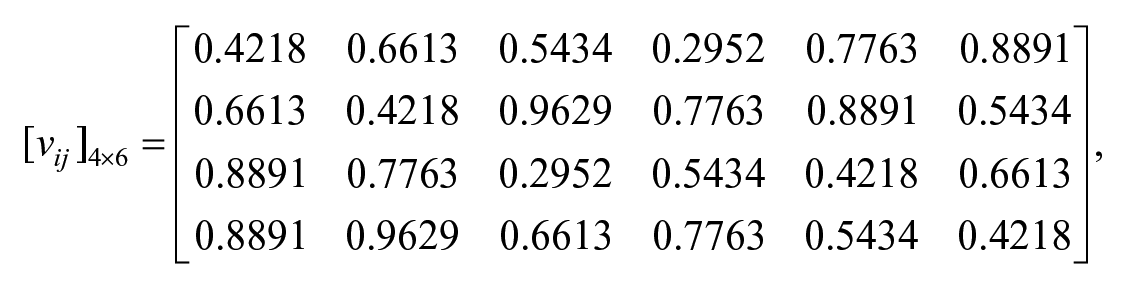
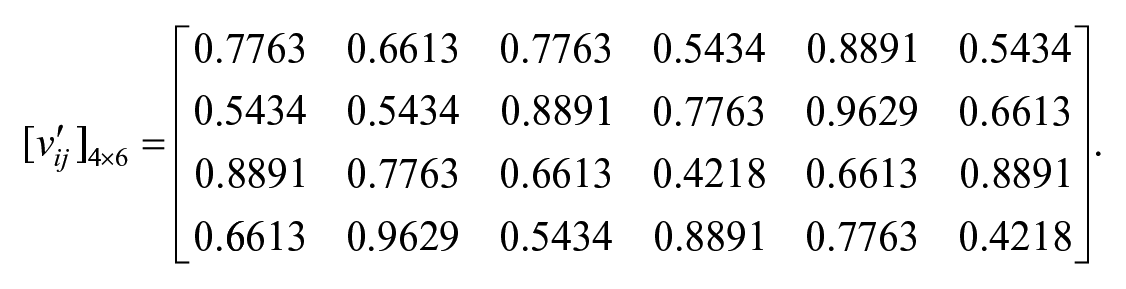
where


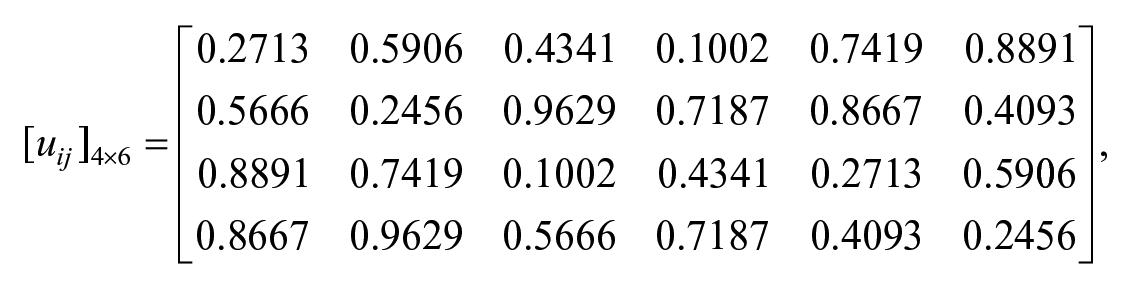
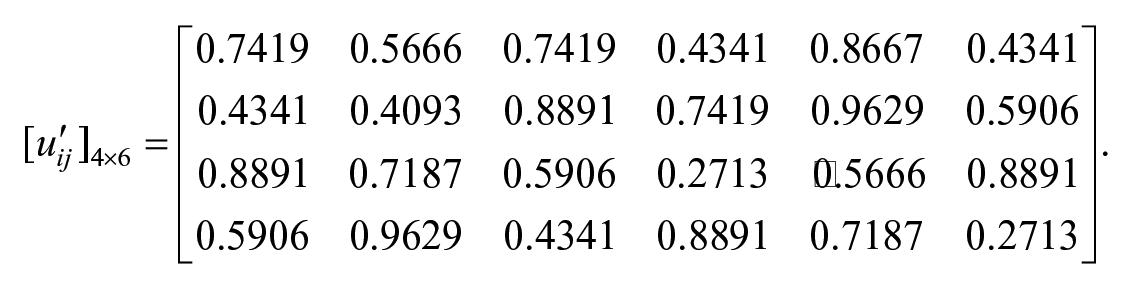


Framework for candidate–post matching.
Discussion
To explain the effectiveness of the proposed method, we compared our model results with those of existing models. Qi (2015) developed a two-sided matching model based on two-granularity incomplete and uncertain linguistic terms. The study solved multiobjective optimization model using a two-tuple weighted average method. Qi (2016) developed another matching optimization model using expected utility theory to maximize agent satisfaction on both sides, which was solved by a linear weighted method. However, this study had several limitations: the author did not consider the psychological behavior of regret aversion by DMs in two-sided matching, which should be considered to get more satisfactory results. In considering the psychological behavior of regret aversion among DMs in two-sided matching, our study converted linguistic information about regret aversion into TFNs to obtain a preference utility value according to the random character of TFN. Furthermore, it established a matching optimization model based on regret theory that maximized the satisfaction of DMs on both sides (perceived utility) without waste as an objective function solved using the minmax method.
Y. Jiang et al. (2017) focused on ordinal interval preferences for two-sided matching. Their study did not consider the rational behavior of DMs. In contrast, Qi (2016) emphasized the complete rational behavior of DMs. The study proposed a matching decision-making method based on expected utility theory that considered the behavior features of the matching agents as completely rational. In contrast, our study is unique and more realistic because we considered the behavior features of the matching agents with bounded rationality and established a matching decision-making method based on regret theory. We argue that our study is closer to reality and better reflects actual matching situations in its methodology. Moreover, the matching model proposed in this article not only considered match satisfaction, but also reduces waste in matching (matching the willing agents on both sides as much as possible, maximizing the utilization efficiency of discrete resources), whereas the matching model developed by Qi (2016) only accounts for matching satisfaction.
Furthermore, to solve the two-sided matching optimization model using the minmax method, we did not have to determine the weight coefficient of the objective function. Compared with the priority weight used by Zhang et al. (2017) and linear weighted solving method used in Qi (2016), in these studies, most weight coefficients are directly and subjectively provided by the intermediary, and the different weight coefficients lead to different match solutions. Therefore, a key feature of the proposed model is that it avoids the subjectivity of weight coefficient values and obtains an objective matching solution.
Conclusions and Future Research Directions
Conclusions
Two-sided matching is a common problem that is critical for a variety of human activities. The psychological behavior of DMs is an important factor in this process and should not be ignored. This study extends current knowledge by developing a novel two-sided matching model that considers the psychological behavior of regret aversion by DMs. In this study, linguistic preference information about regret aversion was converted into TFNs, which were used to obtain preference utility values according to the random character of TFNs. Furthermore, we established a regret-theory-based matching optimization model that maximized the satisfaction of the DMs on both sides (perceived utility) without waste as its objective function and solved it by the minmax method. This study’s approach is unique and reflects real-world matching situations because we considered the behavior features of the matching agents with bounded rationality and established a matching decision-making method using regret theory. Moreover, the matching model proposed in this article not only considered matching satisfaction, but also minimized match wasting.
Although many earlier studies had examined two-sided matching, this study is among the first to approach two-sided matching based on regret theory with linguistic preference criteria. This article sketches useful guidelines for managerial implications. We believe that managers can utilize the proposed model to select the right candidate for the right job. This study is comprehensive as compared with previous studies; however, there are still some limitations in two-sided matching that can be addressed in future research. We recommend that two-sided matching should be studied with matching algorithm designs from the perspective of satisfaction, fairness, and the stability of linguistic preference information.
Suggestions for Future Research
In this article, we have employed regret theory in evaluating and selecting persons by other persons based on a two-sided matching algorithm which combines psychological characteristics with human rationale behavior. Although we tried to make our study comprehensive, based upon the finding some future research directions are suggested. We would recommend to extend this research in future approaches toward including other aspects, like for example, linguistic preference information (mentioned by the Author[s] as well), or food preferences and ideologies. Such choices might extend contribution of this article toward two-sided matching algorithms which optimize decision-making in organizations not only on job satisfaction dimensions, but also on tolerance vs. conflict dimensions.
Footnotes
Declaration of Conflicting Interests
The author(s) declared no potential conflicts of interest with respect to the research, authorship, and/or publication of this article.
Funding
The author(s) disclosed receipt of the following financial support for the research, authorship, and/or publication of this article: National Natural Science Foundation of China (Grant No. 71873064), “Research on OFDI Driving Low-Carbon Upgrading of China’s Equipment Manufacturing Global Value Chain: Theoretical Mechanism, Implementation Path, and Performance Evaluation.” General Projects of Humanities and Social Sciences of the Ministry of Education (Planning Projects) (Grant No. 18YJA790085), “Performance Evaluation of OFDI Driving Low-Carbon Upgrading of China’s Equipment.”
