




Abstract
The study examines the role of a health-related promotional campaign launched in Pakistan in the context of advertising campaign to improve precautionary behavior toward dengue virus (PBDV). The focus of this study is to investigate the mediation of individual’s attention, information surveillance, elaboration, and also the moderation of demographic features (e.g., gender, educational level, and dengue affected survival) in the relationship between the exposure of dengue-related public service announcements (DPSA) and PBDV. Telephonic interview technique was used to establish a representative sample (N = 1,251) from Punjab (dengue-affected province of Pakistan) using a computer-assisted telephone survey software. The outcomes clarify the application of cognitive mediation model in the context of health communication. The findings revealed that individual’s attention and information surveillance have considerable mediating effects on PBDV and DPSA relationship. Surprisingly, however, there is no indirect effect of elaboration on PBDV. The findings provide practical recommendations to public organizations while designing health communication strategies.
Introduction
In November 2010, at the beginning of winter, the epidemic of dengue broke out in Pakistan. The outbreak was truly frightening, and by the end of 2011 more than 21,650 people were affected in Punjab, the largest province in Pakistan. Since 2010, 16,580 cases were reported, with 257 deaths in Lahore and more than 60 deaths in other parts of the country (World Health Organization, 2010). The outbreak made headlines in both electronic and print.
Communication experts such as Niederdeppe et al. (2013) have emphasized the necessity to depend on media to alert and encourage the people to take preventive measures to minimize the threat. Therefore, the government of Punjab has established the Epidemic Prevention and Control Program in early 2012 based on the statistics and effective communication during the outbreak. Besides improving health facilities, the program aims to raise public awareness and education through different communication contents. Not only that government agencies worked together closely with the media to release news t (Rasheed et al., 2013), the Punjab Government also launched a massive public service advertising campaign with the remarkable investment.
Wojdynski and Evans (2016) noted that advertising due to its persuasive nature and capability to get the attention of the masses can motivate the public in an effective manner. Furthermore, McAlister et al. (2016) also explained that advertisements are useful for grabbing attention, addressing cognitive needs, and finally behavioral changes. Moreover, there are many investigations such as M. Lee et al. (2015) which highlighted advertisement’s practical role in attitudinal and behavioral changes. On the other hand, established studies also suggested that to get improved effects of an advertisement it is necessary to consider the diversity of message receivers. Consequently, experts like K. Kim et al. (2014), because of the theoretic and applied discrepancy, also suggested conducting new studies based on receiver’s different localities and perspectives. One of the motives behind this study is to narrow the gap by examining the exposure of epidemic public service announcement in Pakistan.
Thus, it is useful to measure the outcomes of epidemic public service announcement by examining the underlying mechanism of individual’s attention, information surveillance, elaboration, and the role of demographic attributes (see Figure 1) (Gardner, 2015). This would certainly answer the question of how resource factors, depending on context, determine the precautionary behavior in times of an epidemic. Precisely, this study examines the role of public service announcement exposure on dengue virus in evolving the precautionary behavior.
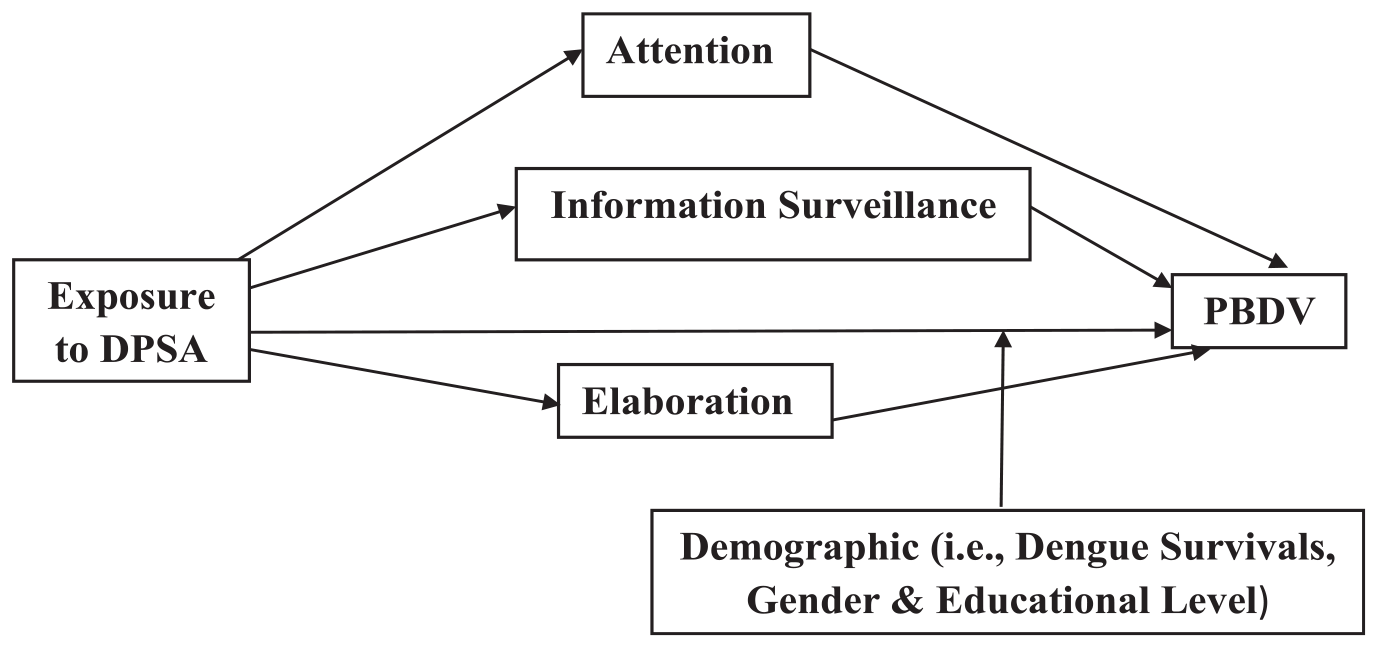
Theoretical model of dengue-related public service announcements exposure and precautionary behavior.
There is a wide range of related theories to measure certain dynamics of health behavior, namely the applied parallel response model (Leventhal, 1970), Protection Motivation Theory (Health Belief Model Rosenstock, 1974; Heuristic Systematic Model Chaiken, 1980; Elaboration Likelihood Model (Petty & Cacioppo, 1984), theory of planned behavior (TPB) (Ajzen, 1991), and cognitive mediation model (CMM; Eveland, 2001). Depending on context, these theories recognize several social (Lundgren & McMakin, 2018), environmental (Birkholz et al., 2014), and resource factors (So et al., 2019). The extant literature also clarified that health behavior change programs aim to identify these full range of factors prior to planning interventions including the role of media contents (Shi et al., 2018). Besides providing needed health precautionary knowledge, the media contents such as public service announcement, due to its persuasive nature, can strengthen health behavior change programs (Silk & Totzkay, 2019). Considering the context of current research, the CMM is the most applicable in nature (Jensen, 2011). Previous studies in health communication adopted this model to evaluate certain media content in the dynamics of health communication. One of the recent examples is the study by Ho, Peh, and Soh (2013) which elaborates the applicability of CMM to investigate how individual-level factors can theoretically mediate the impact of numerous inspirations on a community level of epidemic knowledge and intends to involve in cautionary measures.
This study contributes theoretically by considering health-related media exposure instrument as presented by Tan and Hornik (2014). For example, previous studies (see Fujimori & Uchitomi, 2009; Ho, 2012) considered other media tools such as the news and the rarely tested public service advertisement in the context of CMM. Thus, this study addresses the research gap by testing health-related public service advertisements. In addition, important elements such as the attention of individuals toward public service announcements and the evaluation of public service announcements in the context of attaining epidemic-related information and elaboration are included to better understand whether they mediate the exposure of public service announcement and the actual precautionary practices. Furthermore, inclusion of demographic attributes, more specifically dengue affected survival, provides interesting insight into the preferences of individuals. It also provides insight into the understudied samples from Punjab, Pakistan in the context of the public service announcements. Finally, by explaining all of the above inclusive queries, the advanced application of CMM and gratification theory from the perspective of the public service announcements can be developed. By doing so, the practices of public service announcement can be improved through content scheming.
Theoretical Background and Literature Review
The CMM and Health’s Media Exposure
Understanding the factors that influence the development of precautionary behavior as well as the antecedents of developing precautionary behavior (Sato et al., 2019; Yoo et al., 2018), especially from the awareness perspectives (M. Lee et al., 2015; Papagiannaki et al., 2019), have been common objectives in the health communication literature (Shi et al., 2018). To this effect, there are different outlines to study precautionary behaviors in context of media: the information seeking and the information processing by the individuals in question (Greyson & Johnson, 2016 ; Jiang & Street, 2017). In addition, the evaluation of health communication contents applied for developing precautionary behavior is one of the derivatives of measuring effectiveness of these contents (Crozier et al., 2018). It represents the individual perspective on key issues such as how do they process, and how do they seek information from these contents to develop precautionary behavior (Simons-Morton, 2012). In a nutshell, these two aspects to studying precautionary behavior provide better understanding about the strengths and weaknesses of media contents that contribute to the development of precautionary behavior, such as advertising (Shen et al., 2015). Thus, evaluating how health communication contents such as advertising and so on enhance the understanding about development of precautionary behavior (Yoo et al., 2018).
To this end, the CMM theory (Eveland, 2001) suggests that various motivations such as media contents can drive persons’ information processing through improved attention. Subsequently, attention will impact the quantity of information that persons will obtain from the media. The CMM comprehends three key theoretical statements: (a) motivations for media use drive media information processing behaviors during and after exposure to news media content, (b) media information processing behaviors are the direct determinants of learning from media, and (c) the effects of motivations for media use that have been described in past research are exclusively mediated by media information processing behaviors (Eveland et al., 2003).
Motivation is the momentum that impels people to commence and execute an intentional act (Deci & Ryan, 1985; Reiss, 2004). Motivation can often manipulate people’s view, understanding, feeling, and conduct (Reiss, 2004). While in cognitive model, the functions of motivations toward media usage can be grasped in the perspective of the notion presented in uses and gratifications model. The uses and gratifications undertake that media consumers are dynamic, in a way that their media usage is aspiration oriented and objective (Blumler, 1979). It also emphasizes that motivations propel media consumers to give attention to a content to gratify their desires. Put simply, media consumers cultivate prospects for their media usage and select a certain content to meet their motives (Katz et al., 1974).
In the CMM, Eveland (2001) recommended that individual’s motivation would influence how he or she pays attention in processing information obtained from news items, and how obtained information would modify information procurement. News attention is described as individual’s concentration on psychological endeavor. Albeit, news attention is a crucial however not an adequate antecedent to information procurement. Eveland (2001) also assumed that higher the degree of the individual’s news elaboration will result in more impact of news attention on knowledge procurement. Consequently, Eveland (2001) described news elaboration as “the process of connecting new information with other pieces of information stored in the memory, including prior knowledge, personal experiences, or the connection of two new bits of information together in new ways” (p. 573). Hence, news elaboration serves as cognitive activity, which enables individuals in increasing their capability of linking prior information through utilization of the stored information in their memory.
In a nutshell, by incorporating body of knowledge on uses and gratifications (i.e., Blumler, 1979), information processing (i.e., Perse, 1990), and media influences (i.e., Neuman et al., 1992), the CMM mainly underlines the significance of cognitive processing and the dynamic function of media consumers in the arbitrated knowledge procurement procedure. Therefore, one of the most suitable explanations of the current investigation is the process of individual’s deliberation toward information provided through advertising exposure (Clarke et al., 2013). The CMM acknowledged specific elements like attention, elaboration, and information surveillance to predict individual’s cognitive processing within the context of the provided information through media exposure (De Meulenaer et al., 2017). In sum, these elements explicit the response of individuals toward media content; however, in past studies, the model was examined in political communication (Christopher Beaudoin & Thorson, 2004).
Previously, CMM was considered to evaluate the perceived motives of individuals toward information seeking and to predict the related outcome of knowledge. However, in some of the recent studies, CMM is considered to investigate the health-related media exposures as well (Ho, Chen, & Sim, 2013; Ho, Peh, & Soh, 2013). Despite the examination of CMM, elements were measured in health-related media contents, but not in the case of the advertising exposure. Therefore, this new contextual extension of CMM diversifies the understanding toward other media content, particularly on how individuals deliberate their precautionary behavior. In addition, prior studies have observed the outcomes based on the constructs other than health media exposure as compared to this study which considered the relevant construct as the predictor. The said extension in CMM, alongside with measuring the precautionary behavior toward dengue virus (PBDV), can be helpful to understand the interpretation of individuals about health-related public service announcements. Thus, we examine the model presented in Figure 1 for this study.
Exposure of the Public Service Announcement
Exposure is conceptually defined as “the extent to which audience members have encountered specific messages or classes of messages/media content” (Slater, 2004, p. 168), and “the degree to which audience members have access to, recall or recognize the intervention” (Valente, 2001, p. 117). Exposure’s basic significance as a construct in health communication is clear and apparent. It is challenging to examine the influence of media content or message until scholars determine that respondents are subjected to the media content or message. Scholars (see Hornik, 2002) noted that “good evidence recommends variation in exposure is a more robust antecedent of health communication campaign success than variation in message quality” (p. 31). Hornik (2002) also indicated that insufficient exposure is the reason behind the failure of large health communication campaigns. Ergo, a higher frequency of health campaign messages such as public service announcement increases the chances to assess programmed exposure. Thus, exposure to the information in question is a basic facet of measuring effectiveness of health communication campaign.
In this study, exposure of advertisement is coined as the frequency of the advertisement disseminated with certain objectives to attain the attention of viewers which may lead toward certain changes in individuals ranging from attitudinal to a behavioral one (Duke et al., 2014). Several scholars (see Majeed & Razzak, 2011; Patrick Rau et al., 2014) are of the view that public service announcement is helpful in making individuals capable of recalling and recognizing the product/services. However, the most important element highlighted in the literature in this realm relies extensively on the repeated exposure. It definitely gives more chances to improve the cognitive reactions of individuals in the shape of positive interactive changes toward it, but always not the same case as elaborated by Schmidt and Eisend (2015). Different viewpoints were also offered, for instance (see Huhmann & Mott-Stenerson, 2008), there are certainly other factors like advertised content, timings, and its relevancy.
This concept is to give focus on the idea of the message as a vehicle in itself. Therefore, in this study, the content-based concept is considered, as in the case of the epidemic dengue, most of the public were aware of the message due to the magnitude of the tragedy. Whereas, considering the above argument, the audience could be more inclined toward such epidemic public service announcements. Thus, the main focus on health-related public service announcements has shifted from the entertainment to informational or educational, as observed in earlier studies (M. Lee et al., 2015). The same case is with the public service announcements where the objective is to mobilize people on certain issues of public interest (Wymer, 2010). Therefore, by examining the exposure of dengue-related public service announcement (DPSA), the selection of the construct can be derived from health-related media exposure variable. This would enable the current study to consider the most relevant construct for further explanation, its dynamics with an individual’s attention, information surveillance, elaboration, and PBDV.
Attention
Attention is studied in many studies as the main construct with the perspective of different media contents (Moorman et al., 2012). It is defined as the element of the consideration of any media content by its audience based on an individual’s involvement with the content (Soroa-Koury & Yang, 2010). Therefore, the interest of the audience is one of the crucial consequences of attention construct. The attention toward media contents can be highly dynamic in nature. Among the several explained natures of the attention of audience attracted toward the media in earlier studies (Carlson, 2015) were based on the contents factors like entertainment, information, the uniqueness of the message, and personal need. This element is directly related to the media audience on how much they are involved in the content/product and so on. Although it also deals with the features of the media contents, for instance, in the case of the advertising it is much related to the attractiveness of the public service announcement by individuals.
Exposure to the information taps whether an individual is exposed to a communication content or not (Jean Tsang, 2019), in contrast to the concept of attention, measures how much cognitive endeavor of attentiveness an individual is eager to the content (Kostyrka-Allchorne et al., 2019; Southwell et al., 2002). Overall recognition (attention) of an encoded exposure (message of the content) is assumed more as a definite recall of subject of the interference than indicating a memory track. Building on the conceptualizations of attention in literature, encoded exposure to the communication content necessitates adequate attention to make a memory track that allows an individual in identifying the interference (Nagler & Hornik, 2012). There are several models of marketing communication such as AIDA and ELM which explain the attention as the first step toward cognitive effects (Beaudoin, 2014; Terlutter & Capella, 2013). Most interestingly, this is also explained as crucial element to determine the effects of the media content. Specifically, in advertising theories, involvement of individuals is the antecedent of the outcomes related to the success of attitudinal changes, whereas attention is directly related to individuals’ involvement (Jurca & Madlberger, 2014). Therefore, in the scenario of the epidemic dengue public service announcements, it is interesting to know that how much attention does an individual take on such messages. Indeed, the construct of the attention is crucial to studying the cognitive effects of any public service announcement in defining further predilection of individuals.
Information Surveillance
Health information seeking signifies deliberate and vigorous endeavor to attain certain information in addition to the usual media exposure patterns and usage of interactive resources (So et al., 2019). It contains any sort of media content use or interpersonal communication regarding a particular health issue (Yee et al., 2019), therefore comprises actions such as watching a particular show regarding a health-linked cure, usage of internet in finding useful material regarding a specific health-related matter, or raising particular health care–associated question to a colleague. Information seeking patterns concept of the information surveillance can be the salient factor in the uses and gratifications theory. Fundamental to this concept is the idea of the inspiration or motivation of individuals to explain media usage pattern (Ho, Peh, & Soh, 2013). It includes the strengths of this idea which is connected to the necessity of media usage and the path which is connected to the procedures and schemes that give intensification to the needy-based actions (David, 2009). Inspiration can be clarified as the element which gives further push to act according to the requirement (Roberts, 2010). Most remarkably, it is supposed to be a common theme among needs, perceptions, and feelings as suggested by Chang (2005). Perhaps, the uses and gratification framework are frequently used to study why individuals access certain mass contents. Summarizing, the viewpoint has four key views: (a) the receiver is the dynamic and concerned with his or her goals, (b) inspirations help to clarify exposure of the media content and attention, (c) individuals have intents and prospects for media usage, and (d) individuals’ choice about the selection of the medium to attain their required purposes.
Information surveillance is considered as the most significant factor to determine the actual media usage of individuals. Research has verified several motives to explain the pattern of media usage among individuals (Omar, 2014). One of the utmost shared motives is information surveillance (e.g., Jensen, 2011). Information surveillance includes usage of media contents to attain information and has been termed as a need to cognitive that includes individuals’ exploration for attaining information. However, information can be related to several aspects of individuals’ own community and broadly related to the world (Appiah et al., 2013).
In addition, the other feature of information surveillance found in the literature is the anticipated interaction, which is also evoked as the “interpersonal utility” in several studies (Tokunaga, 2011). This feature allows the enrichment of this construct and makes it more diverse as it includes exploration for attaining the information for interactional purposes with his or her fellows. Another key feature it attains is guidance. It includes an individual’s usage of the media for the sake of information which can help individuals in decision-making process. For instance, behavioral guidance serves as a fundamental support in providing effective guideline to decision-making, especially how individuals feel about any issue (Trottier, 2012). Therefore, information surveillance is considered based on its multidimensional roles as explained in the previous studies. It ranges from effective guidance to information seeking of knowledge about society and interactions with other members. This study considers information surveillance to better understand how individuals evaluate the contents of public service announcements related to dengue epidemic.
Elaboration
Elaboration is the process of linking new information based on its novelty by individuals. They incorporate other existing information, knowledge, individual skills, and practices in their memory (E. J. Lee & Kim, 2016). This linking procedure includes the organization of new pieces of information in a new manner. Through this cognitive procedure, individuals can intensify his or her collection of facts and can be accessed to evaluate stimulus (Jensen, 2011). Therefore, it remains an extremely relevant subject for media researchers. In the past, this construct was explained in the media literature with a different perspective, such as the news to understand how individuals gauge information in the perspective of their own experience.
On the other hand, Beam (2014) noted that elaboration is considered as the factor which is directly related to information acquisition. E. J. Lee and Kim (2016) elucidated that individuals have a higher acquisition of information provided to them and thus elaboration of information will be positive. Consequently, a positive elaboration of information by individuals provides more chances to have behavioral actions. The CMM predicts that a surveillance motive will lead to a number of information processing behaviors, including elaboration on media content (Eveland et al., 2003). Therefore, considering this variable in this study can help to gauge its link with dengue-related precautionary behavior.
PBDV
Extant literature is replete with several existing approaches that explain the precautionary behavior of individuals (Servaes & Malikhao, 2010). In general, individuals are interested in keeping themselves away from any risk or threat (Papagiannaki et al., 2019). Individuals evaluate any threat from any source communicated to them and thus trigger the process of cognitive. Consequently, they would make a perception about the intensity of the damage through the informed threat or risk (Glik, 2007; Lundgren & McMakin, 2018). In addition, scholars such as Ishikawa and Kiuchi (2010) have elaborated this in two stages of assessments. The first stage involves the thinking process of individuals about possible threats. The second stage involves individuals’ deliberation to handle possible adoption of evacuation strategy. These assessments determine that the extent to which individuals would adopt safety motivation, for instance, their willingness to proceed a precautionary behavior (Ibuka et al., 2010). The best instructive way to define precautionary behavior is based on individuals’ perceived threat to the information provided to them.
As presented by Conner and Norman (2005), the framework of threat assessment procedure involves apparent vulnerability and apparent damage. It is described as the personal probability of a safety-related event, as in the case of dengue epidemic, and perceived damage as the consequences from a safety-related issue. Therefore, the perceived danger is an exceptional factor in adopting precautionary behavior. It involves practical actions against individuals’ safety (Ajzen, 2011). Thus, by considering PBDV as the outcome variable, CMM can be measured and examined in an apprehensive manner. By way of considering predictor variables like elaboration and attention, the study provides insight into precautionary behavior adoption toward dengue.
Hypothesis Development
Although intensive research has been done on health-related media contents and has improved over the past decade, it remains limited in its scope (De Meulenaer et al., 2017). The focus of these studies was the only partial explanation of the informational dynamics, however, limited in interpreting how, why, and when an individual gets the information (see Huh & Langteau, 2007). The hypothetical positions of such studies were also focused on the factors which can stimulate individuals to seek health risk–related information (Lundgren & McMakin, 2018). Yet, there are several studies which focus on interpreting the precautionary actions of individuals to minimize the risk of being infected from an epidemic (Weaver & Mays, 2013). For example, some studies focus on precautionary actions, such as avoiding the use of public transport or conditions in which individuals can be infected, while other studies examined economic outcomes (Andualem et al., 2013).
However, the selection of health media exposure contents was mostly limited to the news; while public service announcement remains unstated in the literature related to CMM. Health-related information has often been described as an attractive content for individuals, based on its nature in the past studies. Frightening situations where safety risks are involved are important views of individuals (Cook & Bellis, 2001). This characteristic, if merged with public service announcement in the form of DPSA, has the potential to drive more attention of the masses. Therefore, the scope is wide for such information to get the attention of individuals.
Theoretically, exposure to the media contents is also a basic component of communication theory. McGuire’s (2001) described that “conceptual sequential Communication-Persuasion Matrix” has its preliminary two stages exposure shadowed by attention. Meanwhile, the nature of information seeking, which is a well-established element in the previous theories such as uses and gratification, can act as a vehicle for health-related information (Cook & Bellis, 2001). Therefore, by adding the perspective cognitive process in our model, it is much noteworthy to interpret how individual intensified his or her collection of facts and how it can be accessed to evaluate any stimulus. Therefore, we hypothesize that:
Health communication activities are planned endeavors to inform, convince, and inspire the public to deliberate, and preferably embrace, endorsed health preventive behaviors (Silk & Totzkay, 2019). Most of health campaigns are designed to improve the recallability of individuals. Furthermore, these campaigns provide critical information about the preventive measures to alter individuals’ behaviors. (Crozier et al., 2018). To put it simple, the behavioral changes in individuals in the different context of health-related issue have been investigated like climate change, flood, and so on (Birkholz et al., 2014). Most of the studies conducted in the perspective of risk management and by nature were policy-oriented (Lundgren & McMakin, 2018).
However, several researches were conducted in the context of media exposure, and several other means of communication was also investigated such as news and so on (Bohensky & Leitch, 2014). In addition, there are very limited studies that considered precautionary behavior change as their focal variable. Studies which considered public service announcements are also available, although the constructs of such studies were mostly adopted from generalized advertising measures (see H. S. Kim et al., 2012; Wei et al., 2008). Thus, the consideration of the construct that directly relate to the health media exposure in the context of dengue epidemic can provide the opportunity to measure the association between DPSA and attention as stated below:
In addition, the direct path of the elements of CMM such as elaboration, information surveillance, and attention are new additions to the existing model. This extension in the CMM alongside with the mediating roles of its elements to determine precautionary behavior from dengue epidemic can extend the understanding of the process of individual’s deliberation. The hypnotized path starts from the DPSA, attention, elaboration, information surveillance and ends on the direct and indirect link to the mentioned factors with the PBDV. Integrated associations and notions from the perspectives of different theoretical models, that is, CMM, media exposure, uses, and information surveillance can interpret the crucial parts. Therefore, we present a certain hypothesis.
Literature has suggested the pivotal roles of demographic characteristics to determine certain behavioral outcomes (E. J. Lee & Kim, 2016; Singh et al., 2018). Advertising scholars have noted that through demographic characteristics, the study can benefit the field by providing interesting information about the advertisement’s recipient consumption patterns. This is vital to know that whether exposure to advertisements can differently affect across several demographic attributes such as gender or educational level. To this point, directions can be provided to managers by determining the effects of advertisement across demographics that whether they should use similar messages for their audience or to rely on audience-specific messages. Advertisement literature is replete with mix findings, whereby studies have reported different findings and indicated that contextual factors are dominated (Singh et al., 2018). Ergo, this study has also considered demographic characteristics of individuals and how demographic characteristics such as gender and so on, can moderate the relationship between DPSA and PBDV. In addition, by underpinning the demographic factor of dengue-affected people versus non-affected one has theoretical implications. For instance, do the dengue survivals differently process the risk information provided in DPSA. Drawing on above literature (e.g., E. J. Lee & Kim, 2016) on the role of demographic attributes in predicting several behavioral patterns we hypothesized that:
Method
Participants and Design
The study employed the survey method to predict the outcomes of the DPSA in context of the Pakistan. In doing so, participants were selected by conducting a representative survey of 1,251 residents of the Punjab Province. To ensure the internal validity, trained student interviewers conducted telephonic interviews from December 10, 2016, to January 13, 2017, using a computer-assisted telephone survey software. The study used random digit dialing (RDD) procedure to connect with households. Telephonic interview of available and agreed male or female households were conducted to get a heterogeneous sample. The interviews were conducted in Urdu (National Language of Pakistan) on an average of 15 min.
Furthermore, telephone ownership is widespread in Punjab, for instance, according to the official source of Punjab telecommunication authority, there are 20 million active cell phone users in Punjab currently. Furthermore, phone users are demographically very diverse. To this end, there are no socioeconomic factors that would limit access to a phone by certain segments of the population. Therefore, the data were collected through a populous survey by approaching the target sample. In addition, the sample size (n = 1,251) was appropriate representative of Punjab and was calculated by using the formula of Byrne (2016) which validates its representativeness and generalizability. Furthermore, it is also suitable for structural equation model in AMOS as explained by Hair et al. (2010).
Measures
Exposure of the DPSA
Exposure of the public service announcement was measured from six-item scale and is adapted from the work of the Health Media Exposure by Tan and Hornik (2014), on a 5-point scale varying from 1 (least) to 5 (most likely). Participants were questioned how probable they were exposed to the DPSA from the government offering services for the treatment of the dengue, precautions, and information related to the symptoms of the dengue virus.
Attention
Attention was measured by four-item scale. This scale is adapted from the work of Eveland (2001), on a 5-point scale varying from 1 (least) to 5 (most likely). Participants were questioned how probable they gave attention to the dengue virus–related public service announcements.
Information surveillance
Attention to the dengue virus–related public service announcements were measured from two-item scale. This scale is adapted from the work of Christopher, Beaudoin, and Thorson (2004) on a 5-point scale varying from 1 (least) to 5 (most likely). Participants were probed why they want to view the dengue virus–related public service announcements.
Elaboration
Elaboration was measured from three-item scale adapted from the work of Eveland (2001) on a 5-point scale varying from 1 (least) to 5 (most likely). Participants were questioned about their response to the DPSA.
Demographic variables
This study has considered three demographic characteristics, namely: educational level, gender, and dengue survival. These demographic variables were measured by using categorical items. Participants were requested to response about their gender, educational level, and dengue fever history.
PBDV
PBDV in consequence of the DPSA from the government of Punjab was measured from six-item scale. This scale is adapted from Ho et al. (2013), on a 5-point scale varying from 1 (least) to 5 (most likely). Participants were questioned how possible they acted in accordance with the dengue virus–related public service announcements. The advanced values on the PBDV scale indicate the advanced level of the precaution behavior from dengue.
Reliability of the scales was also measured by measuring Cronbach’s alpha. It is revealed that all five measures involved in the study are reliable as DPSA (α = .858), Attention (α = .844), Information (α = .706), Elaboration (α = .739), and PBDV (α = .702).
Results
The demographic analysis of the sample characteristics illustrates high level of diversity in the selected sample. Apparently, 34.1% of the sample was female and 65.9 were male. Moreover, based on the educational background of the sample, 29.5% were uneducated, 19.1% were from primary school, 8.8% were from middle school, 1.6% were matriculation students, 12% were intermediate, 5.6% were undergraduates, 9.2% were masters, 6.8% were MPhil, 0.4% were PhD, and 7.1% were from the Madrasah (Religious education; also see Table 1).
Demographic Characteristics.

After demographic analysis, we preceded for initial descriptive analysis which involved data screening and normality test, that is, skewness and kurtosis. All variables showed normal values of skewness and kurtosis test (see Table 2). The correlation matrix in Table 2 revealed significant correlation between variables (Christensen, 2005). Onward factor loading procedure (exploratory factor analysis (EFA) was adopted to explore the structure and Kaiser-Meyer-Olkin (KMO)-based normality of the five latent variables involved in the study. By using an extraction method of the principal component analysis and oblique rotation, it explained normality and significant Berlet’s test which recommends preceding the analysis.
Descriptive Statistics and Correlations..
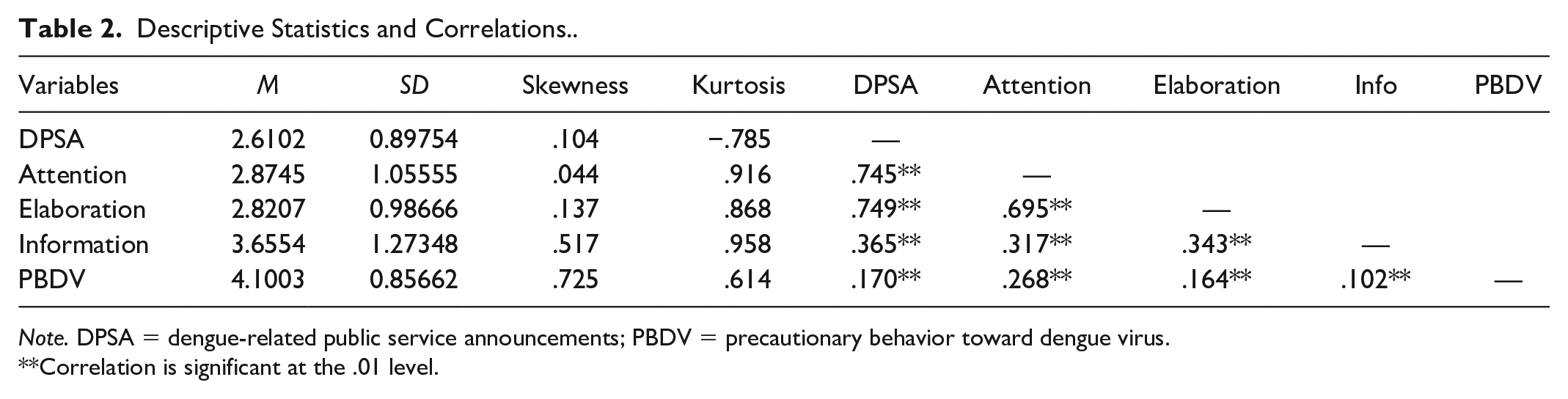
Note. DPSA = dengue-related public service announcements; PBDV = precautionary behavior toward dengue virus.
Correlation is significant at the .01 level.
Confirmatory Factor Analysis
Before proceeding with the hypothesis testing, confirmatory factor analysis (CFA) was performed on the AMOS. 23.0 version to witness the goodness of fit of the model. Perhaps, by adopting a mix of varied fit indices to track the validation helps to ensure model fitness. The outcomes specified that the measurement model based on five constructs that was properly designed as it showed χ2/df = 3.576, df more than 3-fold to chi-square consider as normal, standardized root mean square residual (SRMR) = .046 the fitness value is less than .08, goodness-of-fit index (GFI) = .952 ideal value is above .90, incremental fit index (IFI) = .961 crucial value is above .90, comparative fit index (CFI) = .945 crucial value is above .90, (root mean square error of approximation [RMSEA] = .056) acceptable value is less than .10 as recommended by Hairs et al. (2010). Furthermore, the item loadings are presented in Table 3. All five variables also revealed the discriminant and convergent validity as presented in Table 4.
Standardized Factor Loadings for the Latent Constructs (N = 1,251).
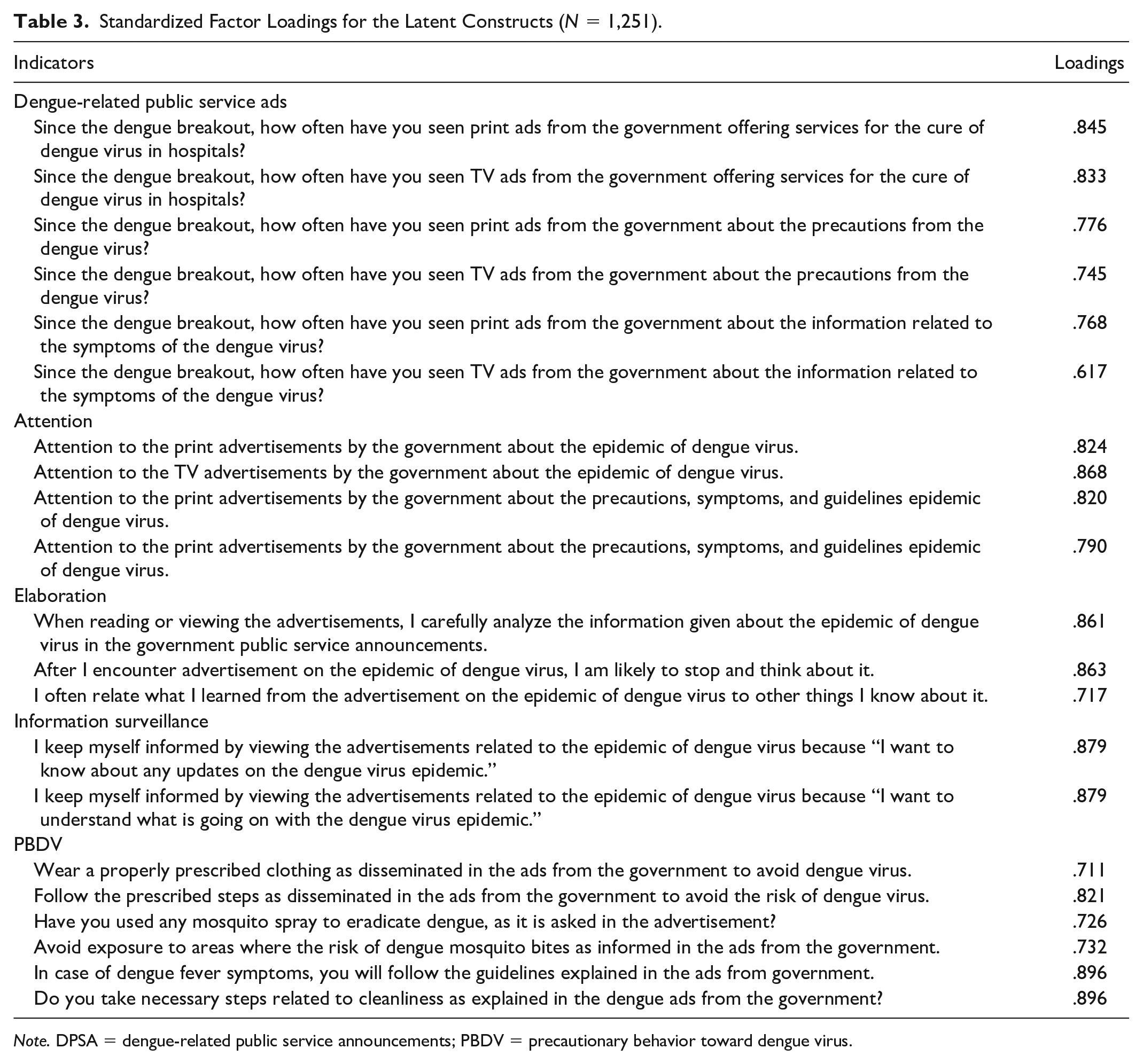
Note. DPSA = dengue-related public service announcements; PBDV = precautionary behavior toward dengue virus.
Discriminant and Convergent Validity.

Note. Values in parenthesis showing average variance extracted square. DPSA = dengue-related public service announcements; PBDV = precautionary behavior toward dengue virus; CR = composite reliability, AVE = average variance extracted.
= .05 and ** = .001.
Hypothesis Testing
First, the structural model based on the three mediation paths with the PBDV as the endogenous variable was tested on the AMOS. 23.0 version. The structural model based on five constructs mediation model revealed goodness of fit and acceptable values for the six fit indices as χ2/df = 3.274, SRMR = .063, GFI = .912, IFI = .903, CFI = .967, and RMSEA = .071. At the first stage, hypothesis testing results in Table 5 reveal about the direct relationship between the certain variables under the study. In H1, it was hypothesized that there is a positive influence of dengue public service announcement on attention. The results revealed that H1 is accepted as strong positive relationship exists between DPSA and attention as the β is .876 and significant at p < .001 (see Table 5). In H2, it was assumed that there is a direct positive connection between DPSA and information surveillance. The results revealed that H2 is accepted as a strong positive relationship exists between DPSA and information surveillance β = .518 and significant at p < .001 (see Table 5). In H3, it was expected that there is a positive influence of DPSA on elaboration. The results revealed that H3 is accepted as a positive connection exists between DPSA and elaboration β = .824 and significant at p < .001 (see Table 5).
Hypothesis Testing 1–7 and Regression Weights.
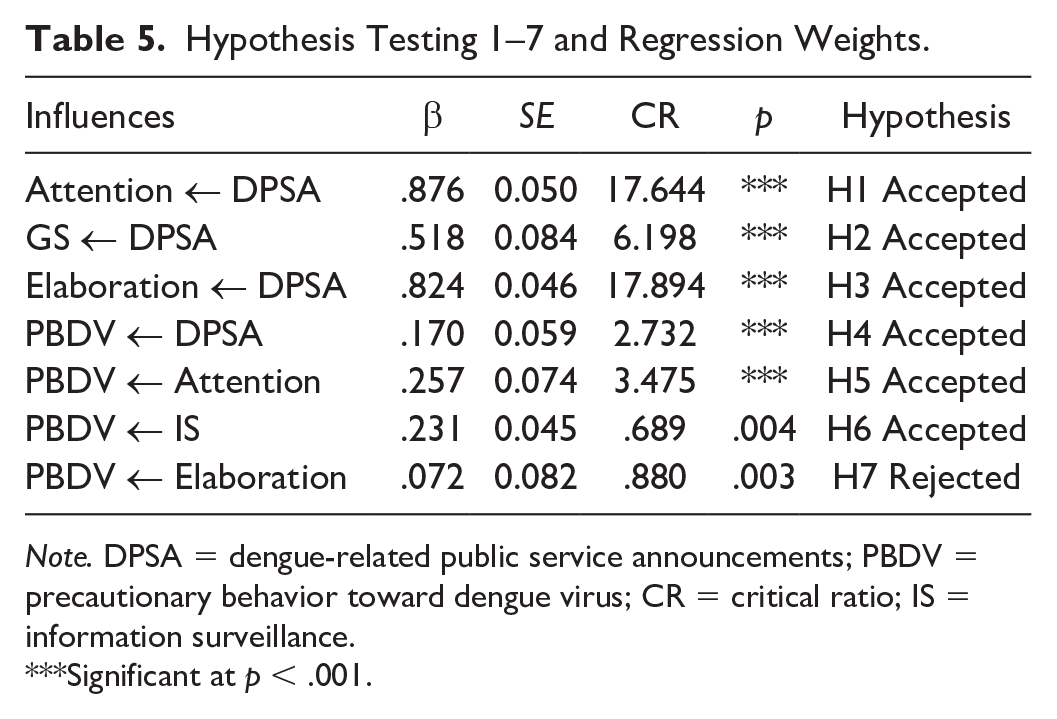
Note. DPSA = dengue-related public service announcements; PBDV = precautionary behavior toward dengue virus; CR = critical ratio; IS = information surveillance.
Significant at p < .001.
In H4, it was expected that there is a positive influence of DPSA on elaboration. The results revealed that H4 is accepted as there is a positive connection between DPSA and PBDV, β = .170 and significant at p < .001. However, it can be elaborated as a weak relation. In H5, it was expected that there is a positive influence of attention on PBDV. The results revealed that H5 is accepted as a positive link exists between attention and PBDV, β = .257 and significant at p < .001. In H6, it was expected that there is a positive influence of information surveillance on PBDV. The results revealed that H6 is accepted as a moderate positive link exists between information surveillance and PBDV, β = .231 and significant at p < .004. In H7, it was expected that there is a positive influence of elaboration on PBDV. Surprisingly, the results revealed that H7 is rejected as a very small amount of positive link exists between elaboration and PBDV, β = 0.072 and significant at p < .003.
Furthermore, to examine the mediation hypotheses, hierarchal linear modeling (HLM) bootstrapping steps, as directed by Preacher and Hayes (2008), were used. Overall, the model accounted for 71% of the variance in predicting PBDV based on 19 iterations. In H8, it was expected that the relationship between DPSA and PBDV is mediated by the attention which is tested in Model 1 (see Table 6). The results revealed that H8 is accepted as an indirect (mediated) effect of attention on the DPSA PBDV link exists as proposed in Model 1, β = .236 and significant at p < .001 (see Table 6). Whereas the direct effect of DPSA on PBDV is β = −.066 and clearly not significant at p < .436. Thus, interpreting these findings in line with the Hayes (2009) and Preacher and Hayes (2008) recommendations suggested there is full mediation of attention in between DPSA and PBDV.
Mediation Results Hypothesis Testing 8–10.
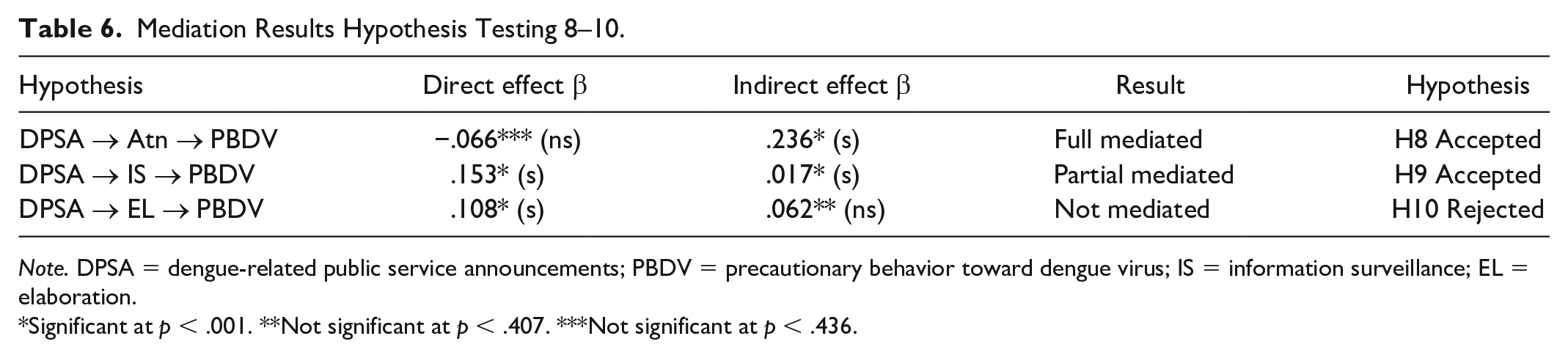
Note. DPSA = dengue-related public service announcements; PBDV = precautionary behavior toward dengue virus; IS = information surveillance; EL = elaboration.
Significant at p < .001. **Not significant at p < .407. ***Not significant at p < .436.
In H9, it was expected that the connection between DPSA and PBDV is mediated by information surveillance and is verified in Model 2. The results revealed that H9 accepted as information surveillance has an indirect (partially mediated) effect on the DPSA PBDV in Model 2, β = .017 and significant at p < .001. Whereas the direct effect of DPSA on PBDV is β = .153 and significant at p < .436 in this model can be explained as information surveillance partially mediates the link between DPSA and PBDV. In H10, it was likely that the linking between DPSA and PBDV is mediated by elaboration which was tested in Model 3 (see Table 6). The results do not support H10. It is rejected as elaboration has no significant indirect (mediated) effect on the relation of DPSA and PBDV as β = .062 and not significant at p < .407. Whereas in Model 3, the direct effect of DPSA on PBDV is β = .108 and significant at p < .001 can be clarified as there is no mediation of elaboration in the link between DPSA and PBDV.
Moderation of Grouping Variables of Gender and Education Results
We ran multigroup analysis on AMOS to test the moderating hypothesis H11. This permits us to examine our assumption that the educational level, dengue survival, and gender differences moderate the relationship between DPSA and PBDV. The multigroup analysis has the ability to observe the equivalence in all measurement as well as structural parameters of the factor model across multiple samples (Hussain et al., 2017). It comprises instantaneous CFAs in two or more samples, equates samples in the context measurement and structural models. A series of hierarchically nested models were tested with each pair of models in the sequence nested because a set of parameters are constrained to be equal across groups in the more restricted model but not in the less restricted model (Brown, 2006). In this study, we considered 10 levels of education, two levels of gender (male and female), and two levels of dengue survival (affected and non-affected). For this reason, we ran 10 grouping models for educational levels, two grouping models, respectively, for gender and dengue survival.
For the first demographic variable education results, it was found that the difference of the 10 educational groups influences on the DPSA-PBDV link was significantly different based on the chi-square-difference analysis of the unconstraint and constraint models (χ2 difference = 4.97, df difference = 2, and p = .034). The direct influence of the DPSA on PBDV for the uneducated individuals (β = .17), primary (β = .41), middle (β = .14), matriculation (β = .32), intermediate (β = .09), undergraduate (β = .32), Master (β = .52), MPhil, (β = .41), PhD (β = .53), and the Madrasah (Religious) educated individuals was (β = .25). All effects were significant and different which supported the H11.
For the second demographic variable dengue survival results, it was found that the difference of the two dengue survival groups influences on the DPSA-PBDV link was significantly different based on the chi-square-difference analysis (χ2 difference = 7.78, df difference = 4, and p = .001). The direct influence of the DPSA on PBDV for the dengue affected was (β = .51) and (β = .29) for the dengue non-affected and influences were significantly different which supported the H11. For the third demographic variable gender results, it was found that the difference of the two gender groups influence on the DPSA-PBDV link was significantly different based on the chi-square-difference analysis (χ2 difference = 6.48, df difference = 2, and p = .019). The direct influence of the DPSA on PBDV for males was (β = .31) and (β = .48) for females and influences were significantly different which supported the H11. These results clearly indicated that all demographic variables interact with the DPSA and intensify or diminish its influence on the PBDV.
Discussion
Theoretical Implications
The recent study contributes by examining the public service announcements related to the dengue epidemic in Pakistan. Specifically, the Punjab provincial government has disseminated a remarkable number of such public service announcements as part of the country’s epidemic control strategy. Although practical facts revealed that the government is successful in controlling the intensity of the dengue affecting people (Servaes & Malikhao, 2010), this investigation contributes by giving an insight into the media consumption pattern which exists among the people of Pakistan. This study has answered several queries related to the role of DPSA in developing PBDV. Results revealed that the attention of individuals is stronger in DPSA and PBDV link. Considering the existing construct about the health communication and the CMM which are applicable in nature (Jensen, 2011), the results of the study has contributed to the theoretical health communication literature by three ways.
First, the previous studies used several health communications related to theoretical backgrounds; however, most of these studies borrowed predictors from the predicting concepts from other news (see Hwang et al., 2007) instead of considering the media exposure as the predictor. Thus, this study theoretically advance the health communication literature by using appropriate health exposure–related concepts.Second, previously the factors of the CMM are replicated or the main predictors and outcomes of those studies narrate within it (e.g., Wise et al., 2009). However, some studies also examined some new outcomes related to the behavioral changes with other perspectives like risk management. Thus, the study contributes by considering relevant communication-related perspectives. Meanwhile by examining the complex pattern of the individual consumption related to the dengue public service announcements. Third, this theoretical implication can further develop a better understanding of the Pakistani context on how individuals perceive the epidemic-related public service announcements. Furthermore, measures like attention, information surveillance, and elaboration have given (Eveland, 2001) a better explanation of the consumption pattern of health-related public service announcements in the context of Pakistan.
It was expected that the exposure of the dengue public service announcements and precautionary behavior relation would be mediated by attention, elaboration, and information surveillance based on previous literature. However, results depicted a different scenario among the sample from Punjab (affected province from dengue). One of the most shared features of the sample was the factor of attention toward the DPSA; it was found that it is the strongest mediator to predict the precautionary behavior. However, the direct relationship between DPSA and PBDV was not significant in the attention-mediated model (see Table 6). Thus, this relationship intensifies by considering attention as the mediator. Attention revealed the strongest factor by having a strong relationship with DPSA, meanwhile with PBDV (see Table 5). In addition, it has been revealed that if individuals pay a lot of attention to health-related content on media like DPSA would possibly have better adoption of precautionary behavior.
Moreover, the factor of the information surveillance also improves the PBDV as it mediates its relationship with DPSA to a reasonable extent. Meanwhile, it has a strong direct link with DPSA (see Table 5), as foreseen in the literature. Thus, individuals’ information seeking and orientation toward health risk–related information during the epidemic can further improve the adoption level of precautionary behavior. The information surveillance has also been directly related to PBDV as it supports to improve the prediction of it. Elaboration was expected to be the strongest mediator in connection of DPSA and PBDV, however, was not found a significant mediator. Still, it has a strong relationship with DPSA, and at the same time have a weaker relation with precautionary behavior (see Table 5). Therefore, it can be concluded that elaboration, as suggested in some of the studies, have no direct strong relation with precautionary behavior. Therefore, in future studies, other factors can be considered in relation to elaboration and precautionary behavior. Results of the demographic variable educational level revealed that the influence of DPSA on PBDV varied across all 10 educational groups; however, higher educational level (e.g., master and above) among individuals showed higher influence of DPSA. For the second demographic variable dengue survival, results found that influence of DPSA for the dengue affected survivals was higher. Finally, results found that DPSA influence the females with higher intensity in contrast to males in developing PBDV. These results clarified demographic variables interact with DPSA in determining the PBDV.
Managerial Implications
Practically, this study also provides guidance for the future health-related campaigns on how much importance individuals give among the examined concepts, that is, attention, information surveillance, and elaboration. Hence, it will certainly be important in health-related campaigns through public service announcements to consider adding more appealing factors to get the attention of the people. The government epidemic control may consider factors like attention and use more appealing public service announcements. One of the reasons for such results may be comprehensive as the previous campaign of the Pakistan government was at a massive level and potentially more attention-grabbing. Therefore, in future, for the epidemic control, dissemination of epidemic-related public service announcements can be a useful tool. In addition, the addition of education and guidance materials with more intensity may determine more positive precautionary behavior. Results also revealed that information surveillance is also an important factor; however, demographics have also contributed in the development of PBDV. Among them, educational level and dengue affected survival showed that individuals PBDV intensify when it comes to their educational level. Therefore, DPSA could be disseminated on social media and other media outlets to get improved access which in turn intervene PBDV.
Limitation and Future Directions
This study is a predictive study which has identified several antecedents of the PBDV. However, future studies on epidemic public service announcement may use experimental designs and large sample size to clarify the causal effects. The study has addressed crucial demographic aspects such as gender and educational background. This has shed light on how gender and educational background interacts with the exposures of DPSA to determine precautionary behavior. However, future studies may also consider other imperative demographic characteristics by underpinning crucial questions that are vital to disseminate audience-specific advertisements.
Footnotes
Declaration of Conflicting Interests
The author(s) declared no potential conflicts of interest with respect to the research, authorship, and/or publication of this article.
Funding
The author(s) received no financial support for the research, authorship, and/or publication of this article.
