




Abstract
Maternal rejection may be associated with individual child characteristics. This relationship may vary across cultures. This study aimed to identify group differences in maternal rejection as well as child characteristics. We also explored the moderating role of culture in influencing the relations between child characteristics and maternal rejection. In total, 153 mothers with a child aged 3 to 6 years participated in the survey. Participants were from the East Coast of the United States (N = 48); Seoul, Korea (N = 65); and Japan (Tokyo and Saitama) (N = 40). American mothers perceived their children to be more active and extroverted than did Korean mothers, who perceived their children to be better at controlling their behavior than American and Japanese mothers. American mothers reported significantly higher levels of their children’s behavior problems than Korean and Japanese mothers. It was observed that culture moderated the relations between child factors (e.g., effortful control and internalizing problems) and maternal rejection. These findings suggest that culture influences the association between child characteristics (temperament and behavior) and maternal rejection.
Numerous studies report the important role of parental behaviors in predicting children’s physical and emotional well-being. These investigations demonstrated the relationship between parental acceptance-rejection and children’s developmental outcomes (E. Kim, 2008; Suchman et al., 2007; Tasoren, 2016). Children experiencing higher levels of parental warmth or acceptance have more positive outcomes including social competence, ego resilience, and engagement coping strategies (Ip et al., 2008; E. Kim et al., 2007; Swanson et al., 2011). In contrast, children who experienced love withdrawal or parental rejection are likely to have an impaired sense of self-esteem, aggression, defensive independence, poor academic achievement (Bradford et al., 2003; Khaleque & Rohner, 2002, 2012; Rohner & Britner, 2002; Rohner et al., 2003), and higher levels of stress (Doan et al., 2017).
Parental rejection as defined in interpersonal acceptance-rejection theory (IPARTheory) embodies four parental behaviors, namely, warmth-affection, hostility-aggression, indifference-neglect, and undifferentiated rejection (Rohner, 2016). Affection can be demonstrated physically (e.g., kissing and hugging) or verbally (e.g., praising and complimenting). Hostility refers to any behavior with the intention of hurting children physically (e.g., hit, kick, and scratch) or emotionally (e.g., curse, sarcasm, and belittling). Indifference refers to the physical and psychological unavailability of the parent. Undifferentiated rejection is defined as children’s belief that a parent (or other attachment figure) does not really love or care about them. Hughes et al. (2005) found that young children who feel rejected by caregivers have an increased likelihood of having an insecure attachment relationship. These rejected children tend to develop distorted mental representations of the self, significant others, and worldview and thus avoid new relationships out of a fear of intimacy with rejection sensitivity (Downey & Feldman, 1996).
Rohner (2016) proposed a sociocultural systems model that demonstrates how parental rejection stems from multilevel factors of ecological systems (familial, community, and sociocultural context)—specifically, what factors account for those with a cold, aggressive, or neglecting-rejecting parenting style. Parental rejection and other behaviors can be influenced by children’s characteristics such as their temperament and behavioral dispositions as well as individuals’ sociocultural attitudes and beliefs in their societies (religious beliefs; Rohner, 2016). Sociocultural systems involve bidirectional relations between parenting and child characteristics. This suggests that parental behavior may affect child personality or behavior bidirectionally, and these child factors may characterize how parents respond to their children (e.g., parental warmth or rejection). From the IPARTheory framework, we employed the child characteristics that shape, to a significant extent, the form and quality of parenting behaviors as predictors of maternal rejection. In other words, the attributes of interest for this study were the temperamental qualities and perceived behavior patterns of the child. Similarly, growing evidence supports child temperament and behavior as potential determinants of parenting beliefs, styles, and behaviors (Fish & Crockenberg, 1981; Russell, 1997). Several studies indicated that children with a temperamentally high activity level, high aggressive tendencies, or low attentional skills are predicted to experience less optimal parenting practices (Sanson & Rothbart, 1995). For example, children perceived by their parents as having irritable or fussy temperaments are likely to be spanked more than children with happy or cheerful temperaments (Day et al., 1998). Gershoff (2002) supports another possible cause of parental rejection, suggesting that negative parenting can be explained by shared genetic dispositions and child behavior. For example, children’s behavior problems such as antisocial behavior affect the types of parenting, and the children are at risk of being subject to their parents’ forceful and coercive techniques (O’Connor et al., 1998).
Most research on parental rejection has tried to identify adverse mental health consequences for both child and adult populations. Among the major antecedents, consequences, and other correlates of parental rejection in the United States and worldwide, cross-cultural studies have focused on parenting styles, psychological maladjustment, conduct problems, and substance abuse (Chen et al., 1998; Dumka et al., 1997; Kahrama et al., 2016; H. F. Myers et al., 1997). Although an impressive body of evidence exists for perceived rejection and its effects on children’s personality development and behavior, evidence for the antecedents thereof to clarify parents’ physically and psychologically hurtful behaviors is lacking. Many studies have attempted to confirm parental rejection as a predictor of mental health problems (e.g., depression, behavior problems, and substance abuse) in many countries worldwide (Erkman & Rohner, 2006; Kim & Rohner, 2002; Putnick et al., 2015; Steely & Rohner, 2006). However, a cross-cultural approach to examining the antecedents of parental neglect, lack of affection, or aggression has not been empirically tested in ethnically diverse populations.
The current study used a cross-cultural approach to investigate parenting associated with temperamental and behavioral characteristics of children, as their associations vary widely across culturally diverse settings. According to Harkness and Super (2006), parents hold their own cultural belief systems (parental ethnotheories) regarding the nature of children, development, and parenting. Influenced by cultural differences, these ethnotheories can be reflected in different parenting styles, variability in child characteristics, and variability in parental perceptions of child behavior. For example, temperamental and behavioral tendencies viewed as difficult in one country may not be considered challenging to manage within the cultural context of another (Harkness & Super, 1996). An investigation of cross-cultural differences in the early development of temperament in Japan, the United States, and Russia demonstrated that American children reported higher scores for the surgency factor (i.e., high-energy activation) than did Japanese and Russian children, whereas Japanese children tended to score higher on negative affectivity than the American and Russian children (Slobodskaya et al., 2013). In a related study, Krassner et al. (2017) examined the temperament of toddlers with East–West distinctions from Chile, Poland, South Korea, and the United States to test central hypotheses related to whether collectivist (e.g., Chile and South Korea)—individualist (e.g., Poland and the United States) contrasts affect toddlers’ temperament characteristics. Specifically, South Korean children received higher ratings for effortful control than did the U.S., Polish, and Chilean samples, but lower scores than the Chilean and U.S. samples for surgency. Likewise, a study addressing multicultural comparisons of preschoolers’ behavioral and emotional problems from 24 societies noted that individuals in Asian cultures tended to report more internalizing than externalizing problems. In particular, South Korea ranked third from the bottom for externalizing problems, but 11th from the bottom for internalizing problems (L. R. Rescorla et al., 2011). Taken together, cross-cultural literature on children’s temperamental and behavioral characteristics in relation to parenting has focused on comparing those with Western/Individualistic and Eastern/Collectivistic values (Triandis & Suh, 2002). Because some evidence shows that these two cultural groups have different beliefs and theories regarding childrearing (Bastian et al., 2012; Chentsova-Dutton et al., 2007; Uchida & Kitayama, 2009), in this study, we compared the parenting practices of Americans holding Western values with Asians, whose values are guided by different cultural norms. Caregivers in individualistic cultures are guided by independence-oriented parenting and likely to promote children’s emotional expression, as they value children’s individuality, authentic expression of emotions, and self-assertiveness to recognize their own needs (promotion focus). In contrast, Asian caregivers in collectivistic cultures are guided by interdependence-oriented parenting practices and tend to emphasize accepting children’s emotional states after negative events and encouraging the expression of “socially preferred” emotions as a way to help maintain social harmony (prevention focus; Greenfield et al., 2003; Keller et al., 2004; Miyamoto et al., 2014).
Considering that these different childrearing attitudes and thus the normativeness of parental behavior can be defined as cultural norms, Rohner (2004) proposed the need for cross-cultural research on parental rejection that examines parental behaviors as descriptive, not judgmental, or evaluative. Therefore, the primary aim of the study was to investigate how cultural contexts moderate the determinants of parental rejection in parenting practices. We attempted to identify predictor variables of maternal rejection by examining child characteristics (e.g., temperament and behavioral problems). Son et al. (2017) demonstrated cross-cultural differences in maternal perceptions of physical discipline and maltreatment among Americans, Koreans, and the Japanese. Specifically, it was hypothesized that Asian mothers would report a more permissive attitude toward harsh parental behaviors than American mothers because of cultural beliefs about corporal punishment pervasive in collectivistic East Asian societies.
The Present Study
In this study, we examined whether American, Korean, and Japanese mothers differ in their maternal rejection behaviors and associated factors (child temperament, child behavior problems) in the three countries. We focused on only mother participants. Because mothers’ and fathers’ parenting practices may play different roles at different times in children’s development (Parke & McDowell, 1998), we expected that mothers’ (rejecting) parenting style may be more predictable in children’s socioemotional outcomes than that of fathers, especially during early childhood. Accordingly, the research questions and hypotheses were as follows.
Our first main hypothesis was that the United States, Korea, and Japan would differ in child temperament, child psychosocial problems, and maternal rejection across cultures (individualistic vs. collectivistic cultures). Specifically, we hypothesized that children with Western values would report higher levels of surgency and externalizing problems compared with children with Asian values, whereas children and mothers with Asian values would report higher levels of negative affectivity, effortful control, internalizing problems, and maternal rejection than individuals holding Western values.
Our second main hypothesis was that associations between maternal rejection and child characteristics (child temperament and behavior problems) would be moderated by culture, because Western/individualistic culture (America) and Eastern/collectivistic culture (South Korea and Japan) hold distinctly different views about childrearing.
Method
Participants
The study was conducted in the East Coast of the United States (Massachusetts, New Hampshire, and Connecticut), South Korea (Seoul), and Japan (Tokyo and Saitama). The study participants were 153 mothers with a child aged between 3 and 6 attending an early childhood education institution: 48 were Americans (31.4%), 65 Koreans (42.5%), and 40 Japanese (26.1%). Regarding the participants’ children, 83 (54.2%) were boys, and the most common age was 5 years (n = 69, 45.4%). Table 1 provides participants’ demographic characteristics.
Demographic Characteristics of the Sample (N = 153).

Note. The total sample size for the study was N = 153 participants (Korean N = 65, American N = 48, Japanese N = 40). Weighted percentages are presented to account for missing data across respondent characteristics.
Procedure
To recruit participants in the United States, researchers contacted schoolteachers and sent electronic recruitment notices to them. The teachers then distributed the electronic notices through emails and online parenting forums to parents in Massachusetts, New Hampshire, and Connecticut. A link to the informed consent and electronic questionnaires was included in the electronic recruitment notice. Interested mothers were asked to click the link and guided to fill out the questionnaires. In Korea, researchers visited kindergartens in Gangdong District in Seoul and informed the directors of the study purposes. With the directors’ consent, a study announcement was posted at the school, and mothers who volunteered to participate completed the survey. In Japan, the researchers visited kindergartens in Saitama Prefecture to explain one-on-one the study purposes to the mothers of children attending the schools, and those who consented completed the survey. Of the 167 returned surveys, 13 were discarded because of incomplete responses and 154 included in the analysis.
Measures
The Korean versions of the Children’s Behavior Questionnaire–Very Short Form (CBQ-VSF), Child Behavior Checklist 1.5-5 (CBCL), and Parental Acceptance-Rejection Questionnaire (PARQ) as well as Japanese versions of the CBQ-VSF and CBCL had already been established in each country. Translation and back-translation procedures were used to develop the Japanese version of the PARQ. The translators were fluent in both English and Japanese. Cronbach’s alpha coefficients were examined to evaluate the internal consistency of the subscales of the CBQ-VSF, CBCL, and PARQ in the three ethnic groups (see Table 2).
Internal Consistency for Substantive Measures of each Ethnicity (N = 153).

Child temperament
Child temperament was assessed using Putnam and Rothbart’s (2006) CBQ-VSF. Globally, the CBQ is the most commonly used tool to assess child temperament (Allan et al., 2013). The scale, developed for children aged 3 to 7 years, is composed of 36 items rated by parents across the three domains of surgency/extraversion (SE), negative affectivity (NA), and effortful control (EC), each with 12 items. The SE scale represents an impulsive hedonic activation tendency and includes four facets: high activity level, high-intensity pleasure, impulsivity, and low levels of shyness. The NA factor is based on five subscales: anger-frustration, discomfort, fear, sadness, and low soothability. The EC scale represents self-regulatory capacity and is derived from four subscales: attentional focusing, inhibitory control, low-intensity pleasure, and perceptual sensitivity. Each item was measured on a 7-point Likert-type scale (ranging from 1 = never to 7 = very severe) with the additional response category “not applicable.” The internal consistency measures of the scale (Cronbach’s alpha coefficients) in this study were .61 to .75 in the three groups.
Psychosocial problems
Psychosocial problems were assessed using the CBCL developed by Achenbach and Rescorla (2000) to evaluate emotion and behavior in children aged 18 months to 5 years. The items were rated by parents or primary caregivers and measured on a 3-point scale where 0 was “no,” 1 was “sometimes,” and 2 was “very likely or frequently.” Various psychosocial behaviors are assessed in the scale, largely classified into two domains: internalizing problems (emotionally reactive, anxious/depressed, somatic complaints, and withdrawn) and externalizing problems (attention problems and aggressive behavior). Scores were computed for each of the two domains. Cronbach’s α coefficients ranged from .73 to .92 for internalizing and externalizing problems in the three groups. The raw scores for these scales were used in the analysis.
Maternal rejection
To investigate maternal rejection, Rohner’s (2005) PARQ was used. The scale consists of the four domains of coldness/lack of affection (20 items), hostility/aggression (15 items), indifference/neglect (15 items), and undifferentiated rejection (10 items). Each item was rated on a 4-point Likert-type scale (ranging from 1 = almost never true to 4 = almost always true). In this study, Cronbach’s α coefficient was .91 to .92 for the entire scale, and the domain-specific Cronbach’s α coefficients were .72 to .93 for the coldness/lack of affection, hostility/aggression, indifference/neglect, and undifferentiated rejection subscales in the three ethnic groups.
Statistical Analysis
SPSS Version 23.0 was used for the statistical analysis. Data analysis was conducted in the following four phases. First, the frequencies and percentages were computed to examine participants’ demographic background and general attributes. Second, Pearson correlation coefficients were computed to examine the relationships between variables. Third, a one-way analysis of variance (ANOVA) was performed to test for differences among the three countries. Then, Tukey’s test was used for the post hoc analysis. In all analyses, the alpha level of .05 was applied to all pairwise comparisons. In addition, the differences between the three countries in relation to the nominal background variables were examined using a chi-square test. Fourth, hierarchical regression analyses were performed to investigate whether ethnicity (the United States, Korea, and Japan) moderated the relationships between maternal rejection and child characteristics (child temperament, child behavior problems). To do so, we dummy-coded countries as country1 (the United States = 1, other countries = 0) and country2 (Japan = 1, other countries = 0). Among the demographic variables, only mothers’ employment and economic status showed between-group differences in maternal rejection. Thus, we controlled for these variables in the regression analyses.
Overall, we conducted hierarchical regression models in which maternal rejection was regressed onto child characteristics in the following steps. Demographic variables such as mother’s employment status and economic status were entered as controls in the first model step. Child characteristics (child temperament, psychological problems) and culture (moderating variable) were then added in the second step. The two-way interaction terms of the child characteristic variables (child temperament: surgency, negative emotion, effortful control/psychological problems: internalizing, externalizing) and moderator (i.e., Child Effortful Control × Culture) were entered in the third step. The regression model showed the moderation effects of culture on children’s effortful control and internalizing problems. Thus, we conducted a simple slope test (Aiken & West, 1991) to graphically verify the influence of the moderating variable on effortful control and internalizing problems.
Results
Descriptive Statistics and Group Differences
Descriptive statistics (mean and standard deviation) were computed for each variable. To test for differences between the countries (the United States, Korea, and Japan) for each variable, we conducted an ANOVA and then Tukey’s test as post hoc testing. Table 3 presents the results. Regarding children’s temperament, American mothers were more likely to perceive the child as having higher levels of surgency (high-energy activation) than Korean mothers, F(2, 151) = 3.24; p = .042, and Korean mothers were more likely to perceive the child as showing more effortful control than American and Japanese mothers, F(2, 151) = 4.64; p = .011. For children’s behavior problems, American mothers were more likely to report higher levels of internalizing behaviors, F(2, 149) = 3.51; p = .032, and externalizing behaviors, F(2, 149) = 5.30; p = .006. Finally, Korean and Japanese mothers were more likely to demonstrate maternal rejection than American mothers, F(2, 151) = 31.28; p = .000.
Means, Standard Deviations, and ANOVA Statistics for Factors Associated with Maternal Rejection (N = 153).

Note. K = Korean; A = American; J = Japanese.
p < .05. ***p < .001.
Correlations Among Variables
Pearson correlation coefficients were computed to examine the relationships among all study variables. Table 4 provides the results. Maternal rejection was positively correlated with negative affectivity (child temperament domain) and two children’s behavior problem domains (internalizing, externalizing; r = .181, p < .05; r = .178, p < .05). Maternal rejection was negatively correlated with effortful control for child temperament (r = −.209, p < .01).
Correlations Among the Variables.
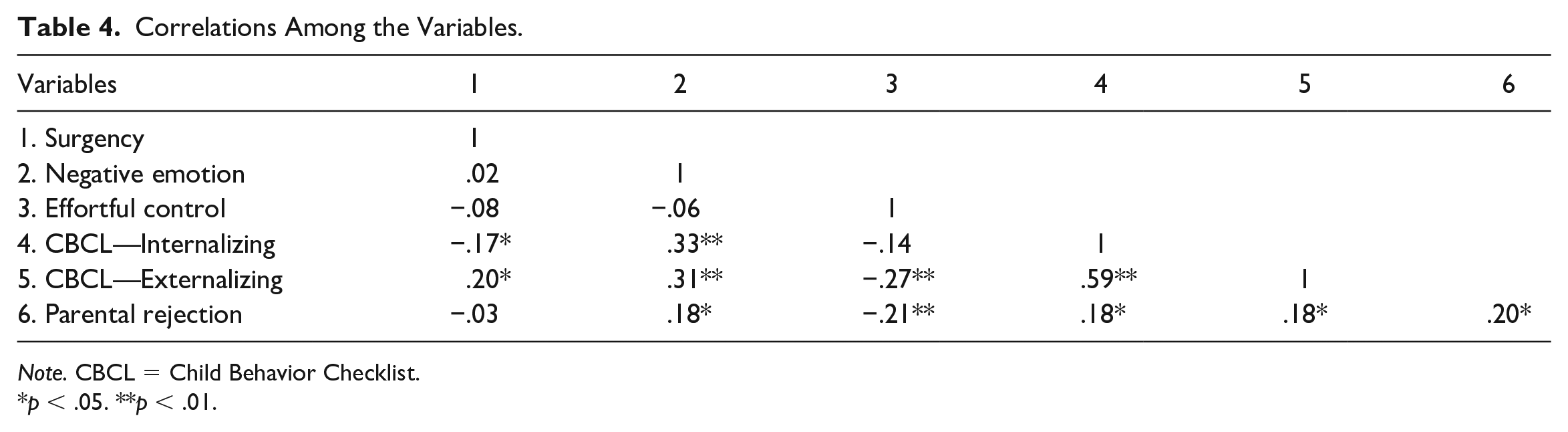
Note. CBCL = Child Behavior Checklist.
p < .05. **p < .01.
Hierarchical Regression Analyses
Hierarchical regression analyses were first conducted to examine whether child characteristics were associated with maternal rejection independent of individual (e.g., gender, income) and group differences (e.g., ethnicity). Next, moderation analyses were used to evaluate whether these patterns vary across ethnicity (the United States, Korea, and Japan). Following standard procedure, all predictors and moderator variables were mean-centered prior to the analysis. Maternal employment and socioeconomic status were treated as control variables in Step 1 of the regression. Step 2 contained each aforementioned variable (child temperament, child behavior problems) and country (moderating variable). Step 3 evaluated potential interactions between each predictor and the country variables. If an interaction term was statistically significant, thus showing the moderating effect of ethnicity, participants from each country were divided into an above-mean (+1 SD) and below-mean (−1 SD) group using the country’s mean to conduct a simple slopes analysis (Aiken & West, 1991) and to graphically verify the between-group difference to examine the influence of the moderating variable.
In Step 2 of the analysis, the influence of the independent variables on maternal rejection was examined controlling for employment and economic statuses. The results showed that all independent variables significantly influenced maternal rejection, except for surgency/extraversion (β = 0.07, p = .35) in child temperament. That is, significant predictors were children’s negative affectivity (β = 0.16, p < .05), effortful control (β = −0.24, p < .01), internalizing problems (β = 0.28, p < .001), and externalizing problems (β = 0.32, p < .001). Step 3 analyzed the moderating effect of ethnicity on the relationship between each predictor and maternal rejection. The results showed the moderating effect of culture on effortful control in child temperament and internalizing problems in child psychosocial problems. Table 5 details the results.
Regression Analyses Testing Country as a Moderator Variable of the Relationship Between Children’s Effortful Control, Internalizing Problems, and Maternal Rejection.

Note. Dummy variables: Country1 (the United States = 1, other countries = 0), Country2 (Japan = 1, other countries = 0).
p < .05. **p < .01. ***p < .001.
Child temperament: Effortful control
Culture negatively moderated effortful control in child temperament in the relationship with maternal rejection, independent of the influence of mothers’ employment and economic statuses (the control variables identified in the Step 1 model). Compared with Step 1 model, the explanatory power of Step 2 model into which children’s effortful control and country were additionally entered increased by 9.7% (F = 16.43, p < .001). Compared with Step 2 model, the explanatory power of Step 3 model into which the two-way interaction of the children’s effortful control and country was additionally entered increased by 2.2% (F = 12.70, p < .001). In Step 3 model, Children’s Effortful Control × Country1 was not significant (β = −.12, t = −.32, p = .75), although their Effortful Control × Country2 (β = −.88, t = −.18, p < .05) demonstrated the moderating effect of country2 in the absence of the moderating effect of country1. Figure 1 shows the results of the simple slopes analysis. It shows that the pattern of the influence of children’s effortful control on maternal rejection differed depending on the country (Korea vs. Japan), suggesting the moderating effect of culture between the two countries. Specifically, children’s effortful control and maternal rejection were significantly associated for Japanese mothers (β = −1.23, t = −3.53, p < .001), but not for Korean mothers (β = −.21, t = −1.21, p =.23). The findings indicate that Korean maternal rejection was high regardless of the level of the child’s effortful control, but for Japanese mothers, maternal rejection was markedly higher for those with children with low effortful control. That is, for Japanese mothers, the lower the child’s effortful control, the higher their maternal rejection. However, the maternal rejection level of Korean mothers differed little. Thus, the influence of mothers’ perception of their children’s effortful control was greater on Japanese than Korean mothers, suggesting that the former is more sensitive to effortful control in child temperament.

Moderating effects of ethnicity (Korean vs. Japanese) on the maternal rejection of children’s effortful control.
Child psychosocial problems: Internalizing
Regarding internalizing problems among child psychosocial problems, the moderating effect of country2 (Korea, Japan) was present in the relationship with maternal rejection independent of the influences of their employment and economic statuses. Compared with Step 1 model, the explanatory power of Step 2 model into which children’s internalizing problems, country1 (the United States, Korea), and country2 (Korea, Japan) were additionally entered increased by 11.8% (F = 18.07, p < .001). Compared with Step 2 model, the explanatory power of Step 3 model into which two-way interaction terms of children’s internalizing problems and country1 and country2 were further entered increased by 3.6% (F = 14.78, p < .001). Children’s Internalizing Problems × Country1 (β = −.81, t = 1.76, p =.08) was not significant, but Children’s Internalizing Problems × Country2 (β = 2.26, t = 2.83, p < .01) was significant, showing the moderating effect of country2 but not of country1. Figure 2 presents the findings of the simple slopes analysis. The figure shows that the relationship between children’s internalizing problems and maternal rejection differed depending on country (Korea vs. Japan), confirming the moderating effect thereof (Korea, Japan). The interaction between the child’s internalizing problems and maternal rejection was significant for Japanese (β = 2.40, t = 3.17, p < .01) and Korean mothers (β = .59, t = 2.49, p < .05). However, compared with the Koreans, the maternal rejection of Japanese mothers was higher when the child’s internalizing problems were high. That is, the extent of the increase in maternal rejection when children’s internalizing problems were high was much greater for Japanese mothers. Thus, the impact of a child’s internalizing problems is greater on Japanese than Korean mothers, suggesting that the former may be more sensitive to their children’s internalizing problems.

Moderating effects of ethnicity (Korea vs. Japanese) on the maternal rejection of children’s internalizing problems.
Discussion
The present study investigated the moderating role of culture on the relationship between child characteristics and maternal rejection. In general, our preliminary findings suggest that there are cultural differences in maternal rejection and relevant variables among American, Korean, and Japanese mothers. Next, the influence of children’s effortful control and internalizing problem on maternal rejection was moderated by country (e.g., Korea vs. Japan).
Cultural Differences for Each Study Variable
Differences in child temperament across the three countries
Of the domains of child temperament, surgency/extraversion differed between the United States and Korea. American mothers were more likely than Korean ones to perceive the child as active and responsive to external stimulation and to consider it positive. This finding is consistent with K. O. Lee’s (2004) observation in a validation study for the Korean version of CBQ. K. O. Lee (2004) compared her study findings with those on young American children by Rothbart et al. (2001), finding that compared with Korean children aged 4 to 5 years, American children scored higher for smile/laughter and approachability, which have to do with surgency, and lower in shyness. In addition, in this study, the three countries differed in effortful control, a domain of child temperament involving voluntary control in attentiveness and behavior. This demonstrates that Korean mothers are more sensitive in perceiving the child’s ability to focus and control than American and Japanese mothers. These results are in consensus with those of Krassner et al. (2017) which showed that the effortful control of South Korean toddlers was the highest. Their study compared and analyzed the characteristics of child temperament for toddlers in Chile, Poland, South Korea, and the United States. However, the results are inconsistent with studies that demonstrated the lower effortful control of toddlers from Japan, China, and other oriental countries compared with those from the United States (Ahadi et al., 1993; Slobodskaya et al., 2013). This shows that in terms of effortful control the fact that results of cross-cultural studies are not in accordance with the differences of the West and the East (Krassner et al., 2017) should be considered.
Temperament reflects the unique attributes with which children are born. However, in different cultures, different temperamental dispositions are considered desirable, and those considered undesirable are suppressed. Thus, the temperament attributes preferred in a culture emerge in the children growing up in that culture (Kohnstamm et al., 1989). As such, there are cross-cultural variations in temperament due to the conceptualization of different social standards, child nurturing standards, and desirable traits according to country (Krassner et al., 2017). Most studies on temperament are from the West. However, the number of scholars wanting to identify the differences between cross-cultural temperament to better understand the role of culture in creating individual differences is increasing. These scholars assume that culture affects the structuralization of experience (Krassner et al., 2017).
Thus, the findings of this study may be interpreted by contrasting the West (the United States), where individualism is emphasized, with the East (Korea and Japan), where collectivism is stressed. In the United States, where the development of an independent ego is emphasized in the individualistic culture, the formation of individual preferences, goals, abilities, and attitudes is emphasized (Y. H. Kim, 2015). Thus, positively perceiving a dynamic and lively disposition, presenting oneself with a smile and laughter, and actively approaching others are encouraged in the United States. In contrast, in the collectivistic culture of Korea, where individuals’ mutual responsibility to the group is emphasized and compliance preferred, organizing one’s behavior based on others’ beliefs, feelings, and behaviors rather than actively approaching others is encouraged (Y. H. Kim, 2015). Between-group differences in mothers’ perception of surgency/extraversion among the child temperament domains can be attributed to such cultural differences. Relative to American mothers, Korean ones believe that children’s active behavior and high responsiveness to external stimulation should be controlled, not positively regarded.
Differences in Children’s Psychosocial Behavior Problems Across the Three Countries
Similar to prior cross-cultural studies using CBCL, which reported different scores for children’s behavior problems according to different cultures (Oh et al., 2002; L. A. Rescorla et al., 2007; Weine et al., 1995; Weisz et al., 1993), between-group differences were also observed in children’s psychosocial behavior problems in this study. Overall, mothers’ perception of their children’s psychosocial behavior problems was highest for American mothers across the two domains: internalizing problems (depression/anxiety and somatic complaints) and externalizing problems (attention problems and aggressive behavior). These results are consistent with those demonstrating that psychosocial behavior problems were higher among American children than among Korean ones in a study that compared and analyzed the CBCL of children aged 1.5 to 5 years in 24 societies (L. A. Rescorla et al., 2007). Furthermore, although subjects’ age group differs, these results are also consistent with those of a study that compared the CBCL among children referred by a clinic aged between 6 and 18 years in Korea and the United States (Chung et al., 2013). In the current study, American mothers are the most sensitive to their children’s behavior problems and Japanese mothers the least sensitive (e.g., internalizing problem). These results are consistent with those of L. A. Rescorla et al. (2007), who compared the mean total problem score in the CBCL of children aged between 6 and 16 years among 31 countries. The study indicated that Japanese children had the lowest score for mean total problems in the CBCL among the 31 countries. Likewise, in the current study, Japanese and Korean mothers reported lower scores on children’s behavior problems than American mothers because it was suggested that some Asian parents may be reluctant to report their children’s problematic behaviors (L. A. Rescorla et al., 2007). A possible alternative explanation for these findings is that East Asian people (e.g., Japanese) tend to consider active disclosure of psychological problems and expression of negative emotions or internal conflict as a sign of weakness or shame (McGoldrick et al., 2005).
Differences in Maternal Rejection Across the Three Countries
As expected, the analysis conducted to test the differences in maternal rejection between the three countries showed it was lowest for American mothers and relatively high for Korean and Japanese mothers. The mean score of maternal rejection was higher for Korean than American mothers, even though Korean mothers were more likely to perceive the child as having effortful control (i.e., ability to control behavior and focus) in the present study. This finding is also inconsistent with the result that Japanese mothers were least likely to perceive their children’s behavior problems (e.g., internalizing problem). This seems to be due to the fact that cultural emphasis on children’s compliance and obedience to parental authority in Eastern families is more likely to lead to higher levels of parental strictness, firm control, and demand for obedience than Western families oriented to authoritative parenting (Ho et al., 2008). These findings suggest that the relationship between child characteristics and maternal rejection should be considered from a multidimensional perspective and the differences in the cultural context factored in.
Moderating Role of Culture
The practice of nurturing children may differ in value and meaning between cultural groups according to the context, which limits situation-specific behaviors (Stewart & Bond, 2002). Rohner (2016) suggested three subtheories in the IPARTheory. Of these, sociocultural systems subtheory contends that parental rejection occurs in the context of a complex ecology (e.g., family, community, and social culture). The purpose of this study was to analyze factors of the demographic background of sociocultural systems associated with maternal rejection. The results indicated that children’s gender and age as well as mothers’ age and education status did not show between-group differences in maternal rejection, but mothers’ employment and economic statuses did. This is consistent with the results of prior studies that demonstrated environmental influences such as financial instability in the family, parental age, and ethnicity as the most important predictors of harsh parenting strategies (Galovan et al., 2013; Y. Y. Lee, 2013; McGroder, 2000). Furthermore, previous research highlighted unemployment, adjusted income, and daily hassles as predictor variables of inappropriate discipline (Greenwald et al., 1997).
In the analyses, demographic characteristics such as mothers’ employment and economic status were included as predictors of maternal rejection to control for the effects of these variables. All variables excepting children’s surgency/extraversion were significantly associated with maternal rejection. These results concur with those from studies identifying the child’s temperament (Crockenberg, 1986) and behavior (Russell, 1997) as important predictors of parenting beliefs, styles, and behaviors. Furthermore, Rohner and Rohner (1980) argued that the term maternal rejection has identical meaning with emotional abuse, because parental rejection can be considered similar to child emotional maltreatment including hurtful words and cold and indifferent silence. Considering these perspectives, the results of this research are consistent with those of previous studies that a child’s “difficult temperament” increases the risks of child abuse and neglect (Black et al., 2001; Dubowitz & King, 1995; Harrington et al., 1998; J. E. B. Myers et al., 2002; Pianta et al., 1989).
To investigate the impact of cultural factors on the relations between child characteristics and maternal rejection, this study tested the moderating effect of culture. Contrary to expectations, between Korea and the United States, no moderating effect was found on the relationship between any of children’s temperament and behavior problems and maternal rejection, suggesting that each of these variables would be related to maternal rejection, regardless of whether the mother is Korean or American. This could be attributed to the fact that although Korea has a fundamental collectivist culture, it has been greatly affected by individualistic culture as it has rapidly modernized (Alfred, 1999). These findings demonstrated in other studies (e.g., Cheah & Park, 2006) suggesting that Korean mothers may increasingly incorporate both traditional and newly Westernized values in their parenting practices. In addition, 78% of the Korean mothers who participated in this study were aged in their 40s and less and had received education based on democratic beliefs.
However, for Korea and Japan, the moderating effect of culture was observed for some variables (effortful control and internalizing problems). Regarding the child’s effortful control, Korean maternal rejection did not significantly differ, regardless of a high or low perception of the child’s effortful control. In contrast, for Japanese mothers, maternal rejection markedly increased as the level of the child’s effortful control decreased. This shows that Japanese mothers are more sensitive than Korean ones to effortful control in the child temperament domains. In addition, for Korean and Japanese mothers, culture moderated internalizing problems among children’s psychosocial behavior problems. For Korean mothers, maternal rejection was slightly higher for those whose perception of their children’s internalizing problems was high. However, for Japanese mothers, the extent of the increase in maternal rejection was much greater for those whose perception of their children’s internalizing problems was high. The findings suggest that Japanese mothers are more sensitive to their children’s behavior problems than Korean mothers.
To summarize, children’s temperament and behavior problems were significantly related to maternal rejection and they are more powerful variables of maternal rejection for Japanese than Korean mothers. This is aligned with a self-reported study (Park & Okada, 2015) to compare buffering factors in the parenting practices of Korean and Japanese mothers. This study suggested that the inappropriate parenting behavior of mothers with young children was buffered by parenting efficacy among Koreans and parenting satisfaction among the Japanese. Specifically, Korean mothers are greatly interested in their role in understanding their children’s development and providing them with an adequate growing environment. This is also consistent with the finding in the current study that Korean mothers were most likely to receive parenting education on childrearing and discipline. In contrast to Korean mothers, Japanese mothers seem more interested in being satisfied with their role as a mother, as indicated in statements such as “parenting is one of the pleasures in life,” “parenting gives me the feeling that my child and I are of one mind,” and “being with my child makes me happy” (Park & Okada, 2015). Accordingly, considering the findings of this study, if a child cannot autonomously control himself or herself, he or she displays behavior problems such as depression and anxiety, or has psychosocial problems including those mentioned, Korean mothers tend to examine and try to understand the cause and appropriately respond to it, weakening the path to maternal rejection. However, maternal rejection increases among Japanese mothers, because they feel they are not of the same mind as the child and experience a low level of parenting pleasure.
Conclusion
It is the universal principle that perceived parental rejection during childhood tends to be highly linked to their psychological adjustment in both childhood and adulthood (Putnick et al., 2015). These negative consequences of parenting rejection seem similar across cultures, but predictors and correlates of rejection may differ cross-culturally. This is because even the similar characteristics and behaviors of the child are likely to be expressed, recognized, and interpreted differently by their parents depending on the culture (Ho et al., 2008). Maternal rejection experienced during infancy and childhood occurs in the context of a complex ecology (e.g., family, community, and social culture; Putnick et al., 2015; Rohner, 1986, 2004). Thus, we attempted to explore child characteristics related to maternal rejection through a multiple-level approach (Greenwald et al., 1997; Rohner, 1986, 2004) to the complex interaction of the child, family environment, and sociocultural factors.
As the findings show, culture may be an important element associated with maternal rejection. Among the three groups of mothers, the Americans were most sensitive to children’s behavior problems, but demonstrated the lowest level of maternal rejection. In the present study, Korean mothers were most likely to receive parenting education, showed great interest in child discipline, and had the highest perception of their children’s effortful control. Nonetheless, maternal rejection was higher among Korean than American mothers. Furthermore, Japanese mothers had the lowest perception of their children’s behavior problems, but scored highest for maternal rejection. Another significant finding is that the level of maternal rejection increased more for Japanese than Korean mothers if the perceptions of a child’s temperament (effortful control) and behavior problems (internalizing problem) were high. These results suggest that cultural background should be considered when we understand parenting behaviors in accordance with child characteristics.
This study is significant for the following reasons. First, the fact that children aged between 3 and 6 years have a higher tendency to clearly exhibit their behavioral and psychological health problems doubles the possibility that they will be exposed to maltreatment compared with children without these difficulties (Jaudes and Mackey-Bilaver, 2008). However, young children have received less research attention in terms of behavioral and temperament problems than children and the youth (Egger & Angold, 2006). In addition, cross-cultural studies focusing on children of preschool age are lacking (Liu et al., 2011). Therefore, this study is significant in that it is a cross-cultural study focused on young children. Second, this study is significant as it identified the factors related to maternal rejection from a multidimensional perspective (Rohner, 1986, 2004) to understand the nurturing activities of the mother in a broad system including the micro-system and macro-system.
However, the study has the following limitations. First, the sample size in the three countries was small and the demographic backgrounds differed across countries. Thus, it was difficult in the regression analysis to comprehensively consider predictors to test relative influence. Therefore, future studies should identify the relative influence of each predictor by using a larger sample. Second, various characteristics of mothers such as personality and pathological attributes can be considered in terms of maternal rejection. However, in this study, only child characteristics were examined. Accordingly, future research should examine the characteristics of mothers and test the influences thereof. Third, the study participants were upper-middle class people living in metropolitan cities in the United States, Korea, and Japan, making it difficult to generalize the study findings. Thus, future studies should include populations of various socioeconomic classes in the study sample. Fourth, mothers were the only participants in this study. Thus, we recommend that future studies also include fathers with young children to understand how fathers and mothers contribute jointly to children’s developmental outcomes in the family context. Last, the design of this study is cross-sectional and does not permit for direction of causal relationships. Because maternal rejection predicts children’s psychological problems among child characteristics (E. Kim, 2008; Li & Meier, 2017), future research employing longitudinal design is necessary to examine causality in the associations between child characteristics and maternal rejection over time.
Despite these limitations, our study suggests that it is necessary to understand maternal rejection in terms of the associations between child temperament, behavior, and cultural factors. Importantly, findings from the current study lay important ground work for examining potential moderating role of culture on relationship between child factors and mother’s rejecting behaviors. Considering multilevel factors of ecological systems (Rohner, 2016), we may develop and encourage culturally sensitive education programs regarding discipline in diverse cultural settings.
Footnotes
Declaration of Conflicting Interests
The author(s) declared no potential conflicts of interest with respect to the research, authorship, and/or publication of this article.
Funding
The author(s) disclosed receipt of the following financial support for the research, authorship, and/or publication of this article: This work was supported by the Sookmyung Women’s University Research Grants (1-1703-2026).
Ethical Standards
All procedures followed were in accordance with the ethical standards of the responsible committee on human experimentation (Sookmyung Women’s University SMWU-1605-HR-026-01), (Robyn Cruz and Terrence Keeney, Co-chairs, Lesley IRB 16/17-008).
Informed Consent
Informed consent was obtained from all patients for being included in the study.
