




Abstract
Liu Zi Jue, a traditional mind–body health technique, is highly regarded and has been widely spread nowadays due to its easy learning, easy operation, and demonstrable physical and psychological therapeutic value. However, due to the lack of understanding of its complex development process, practitioners and researchers are easily confused by different versions. This study identified the historical development of Liu Zi Jue systematically, and then divided it into three stages, including (a) the creation, which was a breathing regimen; (b) the transition, which became a therapeutic form of Vipassanā (insight meditation) and was identified as a new relationship between the six sounds and internal organs; and (c) the formalization, which became a comprehensive regimen that integrated Tu Na (breathing techniques in Qigong), mindfulness, Dao Yin (movement–breath–mind techniques, helping the stagnated Qi to flow smoothly), and natural and seasonal nurturing. Besides, future research directions are proposed.
Liu Zi Jue (six healing sounds), a kind of Qigong, combines breathing exercises of six different sounds, namely “Chui,” “Hu,” “Xi,” “He,” “Xu,” and “Si,” mind control, as well as slow and gentle physical movement to promote mind–body health and to extend lifespan (Larkey et al., 2009; H. L. Ma et al., 2016; Vanderbyl et al., 2017). When practicing, one can either stand or kneel and calm the mind, breathing peacefully into the cinnabar field (Dan Tian; the navel), and then apply one of the six sounds, or all of them in a specific sequence according to one’s particular needs. When intoning these sounds, one can either pronounce silently or vibrate the vocal cords subtly with a soft sound. Either way, each intonation includes inhalation and exhalation stages. For inhalation, one should first concentrate on the cinnabar field, and then inhale slowly. For exhalation, one should exhale gradually while intoning the sound(s). The time of exhalation is either equal to or longer than that of the inhalation. Both should be carried out naturally, and not prolonged by force. In addition, Liu Zi Jue can be practiced either on its own or coordinated with certain movements (Hu, 2009, p. 421).
Similar to Qigong, Liu Zi Jue has drawn on the essence of Taoism, Traditional Chinese Medicine (TCM), and Buddhism, and has been enhanced by many scholars over the course of its development. As a result, many versions exist in ancient and contemporary China. The practice tips and step-by-step descriptions of the most popular version nowadays can be found in Chinese Health Qigong—Liu Zi Jue (Chinese Health Qigong Association, 2007). In modern China alone, the number of Qigong practitioners is about 3.5 million, and, among them, the majority are middle aged and elderly, with women exceeding men by about three times (Cui & Yang, 2017). Easy to master and boasting demonstrable mind–body health value, Liu Zi Jue is highly regarded and has been widely spread across different cultures and successive historical eras (S. L. Lin, 2015, p. 68).
The related researches of Liu Zi Jue nowadays are mainly focused on its concept (Tang, 1993), sounded elements (Chai et al., 1999), and exercise techniques (Chinese Health Qigong Association, 2007, pp. 15–71; Ji, 2007, pp. 255–283), as well as its role in psychological (W. J. Li et al., 2014; Zheng et al., 2012, 2013) and physiological (S. J. Sun et al., 2011; Tang, 1993) regimens and in the treatment of diseases (H. Y. Chen et al., 2016; Ch. X. Ren et al., 2016; Xiao & Zhuang, 2015). More important, researchers have begun to pay attention to the effect of Liu Zi Jue on brain activity, to reveal how its beneficial effects on mind–body are mediated by neurophysiological processes (Henz & Schöllhorn, 2018). To date, few studies were carried out to examine its development process except for the exploratory research in The History of Chinese Regimen Thoughts (Zhongguo Yangsheng Xinlixue Sixiangshi), edited by F. Y. Wang (2015).
Furthermore, however, two mistakes were made by the researchers and practitioners due to the lack of knowledge regarding Liu Zi Jue’s history. On one side, the chronology of certain practice methods is not documented correctly. For example, some researchers believe that no body movements existed as part of Liu Zi Jue until the Ming Dynasty (1368–1644 C.E.) in ancient China (Chinese Health Qigong Association, 2007, p. 3; Leng, 2011, p. 82), despite the fact that Hu Yin (whose precise dates of birth and death are unknown) of the Tang Dynasty (618–907 C.E.) had earlier put forward the operative processes of Dao Yin (a traditional Chinese regimen combined with breathing exercise, Dao, and body movement, Yin, with the main effects of forcing the pathogenic Qi to leave the body) to practice with Liu Zi Jue. On the other side, the authenticity of some important related literature, as well as their authorship, have not been verified, and then resulted in misattribution errors. For example, many researchers consider that Health Formula (Weisheng Ge), a book on health and living a nourishing life, was written by Sun Simiao (581–682 C.E.), a TCM practitioner of the Tang Dynasty (Ru, 2011, p. 18), but it was actually written by Zhen Dexiu (1178–1235 C.E.) of the Southern Song Dynasty (1127–1279 C.E.). Overall, such mistakes not only prevented the further development of Liu Zi Jue, but also confused its practitioners and led to inefficient exercises. Hence, the methods of text analysis, theory analysis, and in-depth comparisons are used in the current study to delineate the historical development of Liu Zi Jue systematically, and the three stages—namely, creation, transition, and formalization—are defined explicitly for the first time.
Tao Hongjing and the Creation of Liu Zi Jue
During the period of the Northern and Southern Dynasties, Taoism evolved from folk religion to official orthodox religion, and became an important part of the triplicate complex religious system, namely, the oneness of Confucianism–Buddhism–Taoism (J. Y. Ren, 2001, p. 254). The development of Taoism promoted the development and dissemination of Taoist regimen. Tao Hongjing (456–536 C.E.), a leading figure of the Shangqing (Maoshan) School of Taoism during the Qi and Liang periods (479–557 C.E.), is proficient in TCM. He collected, selected, and summarized Taoist and TCM health-preserving theories and methods into his book Journal of Nurturing the Mind and Prolonging the Life (Yangxing Yanming Lu), which is now generally believed as the first officially recorded Liu Zi Jue (Chinese Health Qigong Association, 2007, p. 2; Hu, 2009, p. 421; L. Sun, 2015, p. 3; B. X. Wang & Zhou, 1989, p. 143; F. Y. Wang, 2015, p. 300). This book occupies an important position in the history of Chinese psychological regimens, attributable to the fact that it recorded a large number of therapeutic perspectives from the Qi and Liang periods and earlier, as well as comprehensively and systematically expounded the theories and methods of health preservation (Zhong, 2005, p. 371).
The Content of Tao’s Version of Liu Zi Jue
In a chapter titled “Moving Qi to Cure Disease” (Fuqi Liaobing) of Journal of Nurturing the Mind and Prolonging the Life, Tao cited The Book of Moving Qi (Fuqi Jing) and The Treatise of Eminent Physician (Mingyi Lun) and described the following (Tao, 2011): Qi circulation can be promoted by inhaling through the nose and exhaling through the mouth, which should be kept slightly closed and the breath prolonged gradually. This is called Chang Xi, which contains only one way for inhalation but six for exhalation, namely Chui, Hu, Xi, He, Xu and Si. (p. 92)
Therefore, Liu Zi Jue was regarded as a breathing technique including six sounds by Tao.
Tao corresponded the six sounds to different viscus. By intoning the corresponding sound, the operation of Qi, blood, and the meridian-collateral is affected. In this way, the diseased organ is cured and the function of five viscera is balanced. For example (Tao, 2011), Those with heart disease should practice Chui and Hu, to drive away cold and heat. Those with lung disease should practice Xu, to relieve swelling. Those who have spleen trouble should practice Xi, to eliminate stress. As for those who suffer from a liver disease, He will help to cure it. (pp. 95–96)
The corresponding relationship with viscera and bowels is the core idea of Liu Zi Jue and its premise of nourishing efficacy. According to the theory of the Five Elements that complement and balance each other, the kidney corresponds to the water, heart to fire, lungs to mental, liver to wood, spleen to earth. The counterbalance among the five elements is water restrains fire, fire restrains mental, mental restrains wood, wood restrains earth, and earth restrains water. Combining the above two laws, Tao’s Liu Zi Jue is practiced in the order of Five Elements counterbalance (see Figure 1). This provides a theoretical basis for its therapeutic effect.
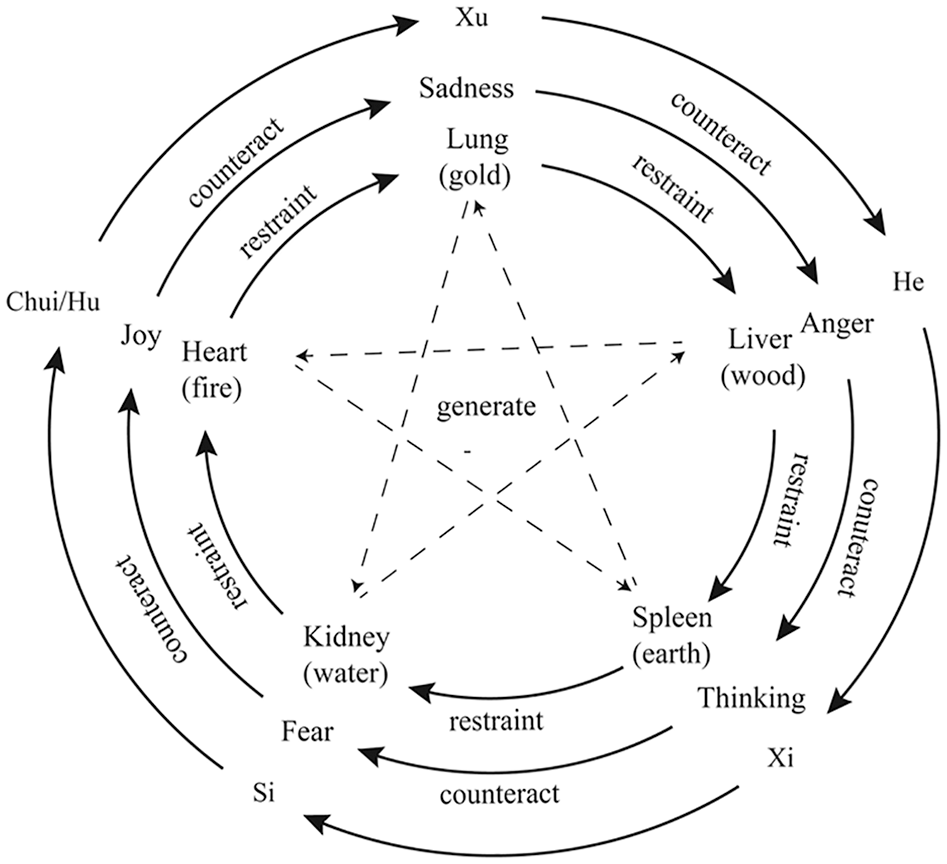
The corresponding relation between Tao Hongjing’s version of Liu Zi Jue and Five Elements.
However, Tao did not elaborate the internal basis of the correspondence between the six sounds and viscera. Tao may have integrated TCM theory and the Taoist highest principle, namely, “Dao follows its self as a rule,” and drawn inspiration from life experience, and then established the corresponding relationship: (a) according to TCM, the main function of the lungs is breathing (Yao, 2010, p. 104). When people exercise over the bearing capacity of the lungs, breathing becomes difficult, and they naturally pronounce Xu, commonly known as “Qi Chuan Xu Xu” (pant for breath). Therefore, Xu can regulate the lungs; (b) TCM advocates that good sleep can nourish the liver. As recorded in the Yellow Emperor’s Canon of Medicine (Huangdi Neijing), when you lie down to sleep, the blood goes to the liver (Yao, 2010, p. 104). If people do not get enough sleep, they usually yawn and naturally pronounce He. In this way, the sound He is associated with the liver; (c) the kidney and urinary bladder is related in TCM (Yao, 2010, p. 52). In China, parents of the older generation are used to make a sound Si when they train their infants to urinate (Y. Ma et al., 2018). Therefore, the sound Si can regulate kidney; (d) according to TCM, stomach–intestine–spleen belongs to the digestive system, and spleen is the main organ for digestion. When indigestion occurs, the abdomen will swell up (Yao, 2010, p. 339). Laughing dramatically, which is called “Xi Xi Ha Ha” (laughing merrily) in Chinese, can cause the belly to vibrate correspondently. So, the sound Xi is thought to regulate the spleen; (e) when an exhausted person needs to move, the person will pronounce “Hu Ci” with the heart beating fast. Thus, Hu is related to the heart.
Theoretical Basis
Tao did not explain the origin of Liu Zi Jue in his book. Because of the long history and lack of relevant historical material, we cannot find the real reason directly. However, it can be inferred that this viewpoint of health preservation through breathing came from Tu Na, and the viewpoint of regulating different viscera and bowels through intonation was originally espoused in the theory of “five viscera harmonizing pitch.”
Tu Na
Tu Na is a classical breathing technique of the Taoist regimen in Spring and Autumn and Warring States Period (770-221 B.C.E.). Deeply influenced by the notion of Laozi (Daodejing), that “Dao follows its self as a rule,” Taoism specified that genuine Qi (vital essence) was essential for life, while pathogenic Qi was an underlying cause of illness. Accordingly, an effective way to keep healthy was to eject the turbid Qi from inside the body, and then absorb the genuine Qi between the heaven and earth through breathing exercise.
Tu Na was first recorded in The Book of Wenzi of the pre-Qin Dynasty (from the 6th to the 3rd century B.C.E.), in a section titled The Origins of Tao (Dao Yuan), that one should “breath the Yin Qi and Yang Qi, exhale the old and inhale the new” (L. Q. Wang, 2000, p. 19). Also, it was recorded in The Book of Zhuangzi, in a section titled Sharpen the Mind (Ke Yi), that one should (Chuang-tzu, 2016), Breath in and out in various manners, exhale the old and inhale the new, walk like a bear, and stretch your neck like a bird to achieve longevity. This is the passion of the one who is skilled in maintaining physical health through Dao Yin, and the one who enjoys longevity as Peng Zu. (p. 456)
The above propositions regarded humans and nature as a system and pointed to a way to preserve health: One should absorb the genuine Qi, which was also referred to the fresh air and not the foul or waste air between heaven and earth, and then spit out the turbid Qi from inside the body (F. Y. Wang, 2015, p. 150). Ge Hong (284–364 C.E.) of the Eastern Jin Dynasty (317–420 C.E.) advocated that the highest state of Tu Na was the art of Tai Xi (fetus breathing), which required the practitioners to inhale gently through the nose, then hold the Qi (the air breathed in) in the body as long as possible, and finally exhale gently through the mouth (M. Wang, 1985, p. 149). The matters needing attention in practicing Liu Zi Jue proposed by Tao are basically consistent with that of Tai Xi introduced by Ge Hong. For example, (a) do not eat too much before practicing; (b) eat less greasy, raw vegetables, fat meat; and (c) maintain peace of mind (M. Wang, 1985, p. 149; Tao, 2011, p. 89).
Tu Na embodies the idea of harmony between people and nature in traditional health preservation. Its essence is to exercise the circulation and regulation system of the whole body through exercising the respiratory function (Zhong, 2005, p. 377). As a kind of Taoist Qigong, Tu Na shares its “three regulations”: mind regulation (Tiao Xin), body regulation (Tiao Shen), and breath regulation (Tiao Xi; Xia & Chen, 2009, p. 1782). These three factors interact with each other. A balanced state of internal Qi (vital energy) flow is necessary for optimal physical and mind health (Chow et al., 2012).
Analogous to Tu Na, when practicing Liu Zi Jue, the deep and soft airflow produced by abdominal breathing should be used to stimulate visceral vibration (Chinese Health Qigong Association, 2003, pp. 15–19). Besides, Tu Na distinguishes the speed of breathing and connects different ways of breathing with health preservation. Therefore, it is the embryonic form of Liu Zi Jue.
Five viscera harmonizing pitch
“Five viscera harmonizing pitch” (Wuzang Xiangyin, in which the five organs are related to the five pitches of traditional Chinese music; L. Sun, 2015, pp. 26–29; F. Y. Wang, 2015, pp. 233–234) is an important TCM theory, which first appeared in a section titled Plain Conversation (Su Wen) of Yellow Emperor’s Canon of Medicine. Based on the theory of the Five Elements (earth, Tu; mental, Jin; wood, Mu; fire, Huo; water, Shui) that complement and balance each other, the theory of “five viscera harmonizing pitch” expounds the mutual breeding and restriction relationship of the five viscera (spleen, lungs, heart, liver, and kidney), five musical notes or tones (Gong, Shang, Jiao, Zhi, and Yu), and five emotions (thought, anxiety, anger, joy, and fear; F. Y. Wang, 2015, pp. 233–234). For example, the spleen belongs to the earth of the five elements, Gong of the five musical tones, thought of the five emotions.
Scientific researchers have found the effectiveness of sound in diagnosing diseases. A sonocytology study published in Science found changes in vibratory frequency on the yeast cell wall from its growth to death, as well as when the cells were stimulated or had developed into the malignant phase (Pelling et al., 2004). In addition, music can also be used to treat mental illness. F. C. Lin et al. (2017) found that five phase music therapy plus acupuncture can improve the symptoms in patients with post-stroke depression.
Some scholars put forward that the mutual promotion and counteraction theory of emotionality (Qingzhi Xiangsheng) and the theory of the five viscera harmonizing pitch can be combined to regulate emotions (F. C. Lin & Wu, 2018). For example, if a person is angry, it is better to use “anxiety to counteract anger” and choose the tone of Shang, corresponding to sadness, to restrain anger. Experimental research has indicated that “sadness counteracts anger” (Zhan et al., 2015; Zhan, Wu, et al., 2017) and “anger counteracts rumination (thinking)” (Zhan, Tang, et al., 2017). These results provide support to the mutual promotion and counteraction theory of emotionality and its combination with the theory of five viscera harmonizing pitch.
As for the mechanism of the five phase music therapy, preliminary studies have found that five phase music can significantly increase the level of 5-hydroxytryptamine (5-HT) and noradrenaline (NE) in the brain of depressive mice, suggesting that music may play a role in preventing and treating depression by increasing the release of 5-HT in the central nervous system and increasing the concentration of NE in the hypothalamus (H. Y. Cheng et al., 2015). Zhang et al. (2013) found that the Gong of the five tones can upregulate the immune function, which has an auxiliary therapeutic effect on the syndrome of liver depression and spleen deficiency.
Analogous to five viscera harmonizing pitch, the mechanism for Liu Zi Jue to treat the malfunctioning of different organs can be inferred in that each pronunciation, caused by particular pressures of lips, teeth, throat, and tongue, stimulates the corresponding brain nerves, generates different emotions, and then affects the corresponding viscera.
Influence of Tao’s Version of Liu Zi Jue
Influence on traditional psychological regimen
Tao advocates the dual cultivation of Buddhism and Taoism and takes a holistic approach to well-being (F. Y. Wang, 2015, p. 297). In his Journal of Nurturing the Mind and Prolonging the Life, he adheres to the principle of both physical and mental cultivation and the methods of combing multiple methods by integrating Buddhism’s emphasis on mind–body cultivation with Taoism’s emphasis on the arts of necromancy (Zhong, 2005, p. 273; F. Y. Wang, 2015, pp. 321–324). As a kind of Tu Na, Tao’s Liu Zi Jue is mainly used for curing illness and promoting physical health. Even so, it laid the foundation for Liu Zi Jue to be used in mental health. The six sounds in Tao’s Liu Zi Jue is in the order of five elements counteraction. According to the mutual promotion and counteraction theory of emotionality, the five elements are related to the five emotions. In this way, the six sounds can be connected with the five emotions (see Figure 1), which lays the foundation for its function of mental preservation. Tao’s most important contribution to the traditional psychological regimen was that he expanded Liu Zi Jue from a physical health regimen based on the widely adopted sages’ ideas to a mental regimen.
Tao not only expounded the content and exercise methods of Liu Zi Jue for the first time, but also emphasized its health benefits and recorded that “practicing these breathing exercises can help individuals to recover from diseases and achieve longevity” (Tao, 2011, p. 96). His work laid the foundation for later generations to practice Liu Zi Jue. Moreover, in earnestly practicing what he recommended, Tao was “good at using the method of Bi Gu [inedia or fasting] and Dao Yin, and looks like a young man at the age of 80” (Z. Yang, 2004, p. 665). To a certain extent, this proves the regimen value of Liu Zi Jue.
Influence on the development and promotion of Liu Zi Jue
Tao’s book Journal of Nurturing the Mind and Prolonging the Life occupies an important position in the history of health preservation—and it greatly promoted the popularization of Liu Zi Jue. Since then, Tao’s Liu Zi Jue has been widely used in health preservation and treatment, mainly diseases of the viscera, and greatly influences the health preservation of later generations. For example, Treatise on the Origins and Manifestations of Various Diseases (Zhubing Yuanhou Lun), written by Chao Yuanfang, the first monograph on the causes, pathogenesis, and syndromes of various diseases in China, and Important Formulas Worth a Thousand Gold Pieces for Emergencies (Qianjin Yaofang), written by Sun Simiao, one of the classical works of TCM in China, all adopted Tao’s Liu Zi Jue. However, his core views, the corresponding relationship with viscera and bowels, unlike others of his observations and philosophies, were not fully inherited by posterity, but transformed by the dignitary Zhiyi (538–597 C.E.) in the Sui Dynasty (581–618 C.E.).
Zhiyi and the Transition of Liu Zi Jue
During the Sui Dynasty, the schools of Confucianism, Buddhism, and Taoism were, on one hand, at odds with one another, yet, on the other hand, they also learned from each other. Confucianism advocates health preservation through moral cultivation, Taoism emphasizes dual cultivation of physical and mental but mainly physical well-being, and Buddhism stresses the importance of the mind and advocates health preservation through meditation and circumcising (F. Y. Wang, 2015, p. 321, p. 345, and p. 365). Zhiyi, a Buddhist Tiantai monk, criticized the theory of “Dao follows its self as a rule” and the pursuit of longevity, but also took on some health-preserving methods from Taoism, especially Liu Zi Jue (Pan, 2006, pp. 456–457).
Two Different Kinds of Zhiyi’s Version of Liu Zi Jue
Zhiyi recorded Liu Zi Jue in both his books, The Essentials for Practicing Samatha and Vipassanā (Xiuxi Zhiguan Zuochan Fayao) and The Great Samatha and Vipassanā (Mohe Zhiguan), but the content was different.
The ninth chapter “Curing Disease” (Zhi Bing) of The Essentials for Practicing Samatha and Vipassanā noted that (Shi et al., 2014), Inner visualization or insight meditation can be performed using six Qi. These six breathing sounds are made through the lips and mouth. When practicing, one should think about the need and adapt it to treatment; at the same time, make a gentle and slight breath. As recorded: “The He sound is used for heart problems, the Chui sound for kidney problems, the Hu sound for spleen problems, the Si sound for lungs problems, the Xu sound for liver heat, and the Xi sound for triple energizer [upper, middle, and lower heat and fluid pathways in the body] disorders.” (p. 108)
However, the eighth volume of The Great Samatha and Vipassanā expounded a different relationship between Liu Zi Jue and the internal organs (Guan, 2007): The method of curing diseases using Qi, including Chui, Hu, Xi, He, Xu, and Si, mainly depends on changes in the positions of the lips, teeth, and tongue to make different sounds. During the practice, one must straighten the body, keep calm and relax, then slowly and quietly make the corresponding sound. At the same time, imagine that you are spitting out the pathogenic Qi from the organs through intoning the corresponding sound. If heat, you should use the Hu sound. If joints of the body hurt, you should use the Xi sound, which can also treat pathogenic wind. If suffering from dysphoria and flatulence, you should use the He sound. If resolving phlegm and retained fluid, you should use the Xu sound. If addressing fatigue, you should use the Si sound. The five viscera diseases treated by the six Qi produced by the six sound are, respectively, He for liver, Hu and Chui for heart, Xu for lungs, Xi for kidney, and Si for spleen. In addition, the six Qi can cure the disease of the same viscus. That is, Chui for cold, Hu for hot, Xi for pain, He for dysphoria, Xu for phlegm, Si for tiredness. (pp. 336–337)
It can, thus, be seen that the content in The Essentials for Practicing Samatha and Vipassanā was quite unlike Tao’s earlier explanations of the practice, while The Great Samatha and Vipassanā’s accounts were almost identical to Tao’s, except for the differing advice regarding Si or Xi for the kidney and Xi or Si for the spleen.
There are three possible reasons for these conflicting viewpoints. First, the Liu Zi Jue content as recorded in The Essentials for Practicing Samatha and Vipassanā is more faithful to Zhiyi’s viewpoint than it is in The Great Samatha and Vipassanā, even if the latter book was published before the former one (Dong, 2002, p. 100; Pan, 2006, p. 74). Such disparity could be because the former book was written by Zhiyi himself, whereas the latter was written by Guanding, one of Zhiyi’s disciples, who recorded the content of his master’s lectures in the Yuquan Temple of Jingzhou (Pan, 2006, p. 74). It is likely that a book written by Zhiyi would feature greater precision and accuracy of content than a transcribed text, hence, it is inferred that the Liu Zi Jue content recorded in The Essentials for Practicing Samatha and Vipassanā was more accurate than that in The Great Samatha and Vipassanā. Second, Guanding may have mistaken Tao’s views as quoted by Zhiyi for the views of Zhiyi himself when he wrote The Great Samatha and Vipassanā. Third, while practicing Liu Zi Jue, Zhiyi might have gained new insights and added this additional knowledge to The Essentials for Practicing Samatha and Vipassanā. In addition, Zhiyi also thought that there was some truth in Tao’s version of Liu Zi Jue, and continued to refer to it while lecturing in Jingzhou. Irrespective of the possible reasons behind the different ideas of the two books, it is clear that The Essentials for Practicing Samatha and Vipassanā version of Liu Zi Jue was more widely regarded and recognized by scholars than that of The Great Samatha and Vipassanā. The former was also further popularized through additional developments undertaken by Hu Yin, ultimately surpassing the prominence of Tao’s version. Accordingly, the next section focuses on a further analysis about the account of Liu Zi Jue in The Essentials for Practicing Samatha and Vipassanā.
Zhiyi’s Transformation of Tao’s Version of Liu Zi Jue
Zhiyi reinterpreted the Liu Zi Jue of Tao’s version in two areas in particular. One aspect of reinterpretation was that he changed the core point from “moving Qi” to “regulating mental activities,” which emphasized the importance of mindfulness in practice. Although Tao had counseled that one should concentrate the mind, keep it aligned to the viscera and the body, and use it to guide the operation of Qi and blood, he paid more attention to “moving Qi,” influenced by the early Taoist therapeutic idea that one should “dually cultivate the physique and the spiritual, and give priority to physique” (F. Y. Wang, 2015, pp. 297–298). In contrast, Zhiyi emphasized more “regulating mental activities” than “moving Qi,” influenced by the Buddhist tradition of remaining “nourishing heart oriented” (F. Y. Wang, 2015, p. 365). In this way, he advocated that one should “keep your mind where you are ill, then you can heal it” (Shi et al., 2014, p. 108) and regarded Liu Zi Jue as a kind of curative method of Vipassanā (Guan; insight meditation).
The Samatha and Vipassanā meditation (Zhi Guan; concentration and insight meditation), a meditation method unique to Buddhism, is the core of the Zhiyi’s Buddhist thought (B. Chen, 2015, p. 23; Ven. Agganyani, 2013, pp. 2332–2333). The aim of Samatha (Zhi) is to “deeply concentrate and calm down the mind by temporarily removing the mental hindrances, which leads to tranquility, relaxation, and mental peace” (Ven. Agganyani, 2013, pp. 2332–2333). Vipassanā (Guan) is seeing an object in a wisdom way, with which people can penetrate into the real nature of whatever they observe and see or, rather, understand things as they really are (B. Chen, 2015, pp. 22–23; Ven. Agganyani, 2013, pp. 2332–2333). In Vipassanā, strong mindfulness, a core aspect of the path to awakening in Buddhism, is needed to sharpen the mind to see the nature of reality and to be in the present moment directly with the respective experience (Harvey, 2015, p. 120; Ven. Agganyani, 2013, pp. 2332–2333).
As a Vipassanā meditation method, Liu Zi Jue requires the practitioner to reach the state of mindfulness, which is defined as an attentive state of mind (Tomasino et al., 2014). Research of electroencephalogram (EEG) in Liu Zi Jue reports a decrease in alpha activity after 15 min, followed by an increase after 30 min (Henz & Schöllhorn, 2018). The increase in alpha oscillations after Qigong meditation demonstrated a correlation with a relaxed and attentive mind in most studies (Henz & Schöllhorn, 2018; Qin et al., 2009). The state of internalized attention in Liu Zi Jue is reached by directing the focus of attentional processing internally due to the binding of breathing capacities (Henz & Schöllhorn, 2018). Besides, without complex movement configurations, Zhiyi’s version of Liu Zi Jue is a breathing technique, which makes it possible for practitioners to have attentional capacities to control breath (Henz & Schöllhorn, 2018). Thus, Liu Zi Jue can be regarded as a mindfulness training.
Mindfulness essentially means paying attention to the present moment and nonjudgmental acceptance (Kelly, 2016, p. 19; Shonin et al., 2015, p. 2). In terms of its psychotherapeutic applications, emerging evidence suggests that mindfulness-based interventions can enhance subjective well-being, and have applications for treating diverse psychopathologies and mental health disorders including mood disorders, anxiety disorders, posttraumatic stress disorder, schizophrenia, and so on (Ahmad, 2017; S. Cheng et al., 2018; Crain et al., 2017; Goldin et al., 2017; Xu et al., 2016). The therapeutic effect of mindfulness can explain the psychological health effect of the Liu Zi Jue to some extent.
Another aspect of reinterpretation was to creatively modify the correspondence between the sounds and the organs of Liu Zi Jue. The correspondence was converted from “Xu for lungs, He for liver, Si for kidney, Chui for heart heat, Xi for spleen, and Hu for heart cold,” as advocated by Tao, into “He for heart, Chui for kidney, Hu for spleen, Si for lungs, Xu for liver, and Xi for triple energizers.”
Influenced by Huisi, the master of Zhiyi, and the theory of skillful and flexible means (Shanqiao Fangbian) in Lotus Sutra (Fahua Jing), Zhiyi is good at using the exertion of Buddhist Sutra combined with other doctrines, and interpreting them spontaneously according to need, to construct his own religious ideology (Pan, 2006, p. 97, p. 119). It can be speculated that, due to the influence of dialectic differences, Zhiyi has made such an alteration. Tao, who was born in Moling, Danyang (now Nanjing, Jiangsu, China; Xia & Chen, 2009, pp. 2225–2226; Zhong, 2005, pp. 57–59), pronounced the six sounds of “Chui,” “Hu,” “Xi,” “He,” “Xu,” and “Si” in the standard pronunciation of Jinling (Mandarin combined by the Luoyang dialect and Wu dialect in Central Plains of ancient Chinese) or Wu dialect. However, Zhiyi, who was born in Huarong, Jingzhou (now the northwest of Jianli, Hubei, China; Pan, 2006, pp. 26–27), pronounced the six sounds in the standard pronunciation of the Chag’an or Jingzhou dialect. Contemporary experimental study found that the Wu dialect, but not the northern dialect or Mandarin, conforms to the pronunciation rules of Liu Zi Jue (Chai et al., 1999). Zhiyi may have realized this difference, so he made a transformation. However, Zhiyi only presented the results without mentioning the specific reason for such major modifications, which leaves a big mystery to posterity.
Hu Yin and the Formalization of Liu Zi Jue
Departing from Tao’s version of Liu Zi Jue, Zhiyi’s construal reinterpreted the corresponding relationships between Liu Zi Jue and different organs. However, the available notes on this transition were too rough, and the central basis of the transition was missing. Hu Yin, a female Taoist of the Tang Dynasty, made up for the omission by the TCM theories.
In the Tang Dynasty, Taoism and TCM became more closely intertwined. Many Taoists combined their own methods, such as Dao Yin, and the Yin-Yang and Five Elements theory, with the TCM theory, such as the natural and seasonal nurturing method and Zi Wu Liu Zhu, to guide health preservation. Hu Yin, as a representative of these Taoists (Gai, 1999), was proficient in TCM theory and advanced it as the theoretical basis of Liu Zi Jue, by advocating that, “Before we talk about the practice of Taoism, one should first illustrate the function of the viscera and bowels” (Hu, 2016b, p. 3). The further development of Liu Zi Jue undertaken by Hu Yin mainly consists of three aspects, as follows.
The Therapeutic Mechanism of Liu Zi Jue in Curing Diseases Was First Elaborated
Based on the succinct formula of Liu Zi Jue recorded by Zhiyi in The Essentials for Practicing Samatha and Vipassanā, except for transforming the “Xi sound for triple energizers disorders” to “Xi sound for gallbladder problems,” as well as the analyses of the lungs, heart, liver, spleen, kidney, and gallbladder in Yellow Emperor’s Canon of Medicine, Hu elaborated meticulously the internal basis of Liu Zi Jue to cure diseases of the viscera and bowels in her book The Nourishment and Diarrhea Picture of Five Viscera and Six Bowels (Huangting Neijing Wuzang Liufu Buxie Tu; J. Y. Wang & Hao, 1993).
Take the sound Si as an example. The section titled Suwen of Yellow Emperor’s Canon of Medicine recorded the characteristics of the lungs as follows (Yao, 2010): The lungs are the root of Qi, and the location of Po [inferior spirit]. The genuine Qi of the lungs can nourish the body hair and skin, and makes them dense and lustrous. And the lungs pertain to Taiyin [greater Yin] within Yang and relates to Qiuqi [Autumn Qi]. (p. 99)
Based on the above and the Five Elements theory, Hu described the therapeutic mechanism of sound Si for treating lung diseases (Hu, 2016a): Of the five sense organs, the lungs correspond to the nose. Only if the lungs are unobstructed can the nose distinguish flavor and odor. The lungs affect the skin and makes hair shiny and healthy. If the skin dries up and the hair falls out, the lungs must have some form of necrosis. The lungs belong to the west in terms of direction, the Dui in terms of the Eight Diagrams . . . The lungs belong to autumn in terms of the four seasons, the Geng and Xin in terms of the ten Heavenly Stems, Shen and You in terms of the twelve Earthly Branches, metal in terms of the five elements, Shang in terms of the ancient Chinese five-tone scale, white in terms of the five colors, and pungent in terms of the five tastes. The lungs are fishy in terms of the five smells, and makes people detest the fishy when the pathogenic Qi in heart come in. The lungs belong to justice of the five virtues, and anger in terms of the five emotions . . . The lungs govern the Shang, so the Si sound should be used to treat lung diseases. The Si sound can reasonably affect the Qi in the lungs, which belongs to justice of the five virtues, and treat the lung diseases. Therefore, anyone who has grievances should practice the Si sound to vent anger. This is the nature of truth. If one does not practice the Si sound, one will inevitably get disease. Hence, lung disease should be treated by Si sound. (pp. 3–4)
Hu believed that the nose governs lungs. When people are sad, depressed, and resentful, if they sound Si for long, they can release the turbid Qi in the lungs, which then makes them feel comfortable and healthy.
The opinion of Hu had been recognized by scholars of later ages, such as Zou Xuan of Yuan Dynasty, and Gong Tingxian of Ming Dynasty, and laid an important foundation for the further enrichment and development of Liu Zi Jue. However, the therapeutic mechanism, proposed by Hu, is based on practical experience, which is farfetched and rigid from the perspective of modern medicine. The treatment and health-preserving mechanism of Liu Zi Jue still needs to be explored by modern scientific means.
An experimental study using a computer meridian detection system not only found a significant difference of the electrical signal (μA) between the resting state and the pronunciation state, but also found that the five sounds can cause significant changes in the electrical signals of the five viscera. Specifically, Si affects lungs, He affects heart, Hu affects spleen, Xu affects liver, and Chui affects kidney (P. Li et al., 1996). Another study using a stereo interpretation SIS95 speech recognition system found that the six sounds have a certain range in energy distribution, which corresponds to the five viscera. Specifically, the frequency of He and Si ranges from 1,000 to 4,000 Hz, corresponding to heart and lungs; the frequency of Hu and Xu ranges from 2,000 to 5,000 Hz, corresponding to spleen and liver; and the frequency of Chui and Xi ranges from 3,000 to 7,000 Hz, corresponding to kidney and bladder (Chai et al., 1999). In this way, different stimulating effects of the five tones on the five viscera were revealed.
A Treatment Combination of Liu Zi Jue and the Natural and Seasonal Nurturing Method Was First Advanced
TCM advocates the method of regulating the mind and body by adapting to the changes of seasons, also known as the natural and seasonal nurturing method. Hu Yin integrated this method into Liu Zi Jue on the basis of content in Yellow Emperor’s Canon of Medicine. However, in The Nourishment and Diarrhea Picture of Five Viscera and Six Bowels, Hu arranged the chapters in the order of lungs, heart, liver, spleen, kidney, and gall bladder, rather than that of practicing Xu in spring, He in summer, Si in autumn, and Chui in winter. For example, the chapter of The Regimen Method of Lungs (Feizang Xiuyang Fa) in her book recorded that (Hu, 2016a), At sunrise of the first and fifteen day of the lunar calendar in autumn, you should sit to the west, tap your teeth gently together seven times, and swallow your saliva three times. Then, you should close your eyes, rectify your mind, and imagine that you are inhaling the western Qi and swallowing it seven times. Then, you should suspend breathing for the time of 70 breaths. The above is the key to regulating the spirit, invigorating Qi, and resting the soul. (pp. 4–5)
The above suggests that autumn is the best time to nourish the lungs and cure lung disease using the Xi sound. This opinion is a further development of Tao’s earlier recommendations of “Chui for cold weather, Hu for warm weather,” and reflects the concept of harmony between people and nature in the Taoist health ideology. The one-to-one correspondence between Liu Zi Jue and the four seasons as well as the abridged formula representing their relationship were not advocated by Hu, but first produced by Zhen Dexiu of the Southern Song Dynasty, subsequently supplied by Liu Wansu (circa 1120–1200 C.E.) of the Jin and Yuan dynasties (1115–1368 C.E.), and finally completed by Leng Qian (circa 1310–1371 C.E.) of the late Yuan and early Ming dynasties (F. Y. Wang, 2015, p. 311).
The impact of weather and climate on physical and mental health was not only emphasized in ancient China, but also by Hippocrates (2010), the father of Western medicine. In On Airs, Waters, Places, Hippocrates (2010) pointed out that doctors must first consider the impact of seasons and the warm or cold air on patients. Modern science has systematically and deeply studied the effects of weather and climate on human physiology, and found that weather and climate are closely related to cardiovascular, cerebrovascular, and many other diseases, as well as mortality (Altizer et al., 2013; Epstein, 1999; Hallett et al., 2004; Mills, 2005; Patz et al., 2005).
Weather can act on human senses, and affect an individual’s emotion. Adequate sunshine time, higher luminance, and lower air humidity could significantly reduce negative emotions and fatigue and increase positive emotions (Ciucci et al., 2011; Denissen et al., 2008; Kööts et al., 2011). Temperature and humidity can produce seasonal cumulative effects. A study of nondepressed patients found that aggression, anger, stress, and anxiety are significantly higher in winter than in summer, and women’s emotions are more susceptible to seasonal effects (Harmatz et al., 2000). That is to say, people’s dominant emotions are different in different seasons and weather conditions. This requires practicing particular sounds to adjust the mood.
The Operating Process of Dao Yin Within Liu Zi Jue Was First Expounded
Liu Zi Jue was just a simple breathing exercise before Hu. The idea of combining Dao Yin and Liu Zi Jue first appeared in a chapter titled “The Regimen Method of Conduction Exercise” (Yangsheng Fang Daoyin Shu) in the book Treatise on the Origins and Manifestations of Various Diseases (Zhubing Yuanhou Lun) by Chao Yuanfang (F. Y. Wang, 2015, p. 313). Then, Sun Simiao definitively combined Dao Yin and Liu Zi Jue in his book Important Formulas Worth a Thousand Gold Pieces for Emergencies (Qianjin Yaofang), in the section titled Cultivating Character (Yangxing). He recommended that “one should do Dao Yin exercises 360 times on the left and right sides, and then do the Liu Zi Jue exercise” (S. M. Sun, 1998, p. 583). However, both Chao and Sun elaborated combining Dao Yin and Liu Zi Jue too simply to be conducted effectively in practice.
Hu, the one advocating the integration of different regimens, such as medical therapy, food therapy, Dao Yin, Tu Na, the swallowing of saliva, and the light clicking of teeth, was the first to systematically elaborate the operating process of Dao Yin corresponding to Liu Zi Jue in her book The Nourishment and Diarrhea Picture of Five Viscera and Six Bowels (J. Y. Wang & Hao, 1993). For example, as recorded in the chapter The Conduction Exercise for Lungs (Fei Zang Daoyin Shu), the method of Dao Yin that matched the Si sound was introduced (Hu, 2016a): In the treatment of lung diseases with the Dao Yin method, you should maintain a front riding seat, lean with both hands, contract the body, bend the spine and move it up three times, so that you can dissipate the pathogenic wind in the lungs. Then, gently hit the back with fists three to five times for each left and right side, so that you can remove the wind toxin in the chest. A long time after the indehiscent air, close your eyes, and then swallow saliva three times and knock teeth three times. (p. 7)
Such movements are characterized by small ranges of motion and easy to learn, facilitating rapid dissemination. Meanwhile, from the viewpoint of mental health, Dao Yin can adjust breath through the mind, subsequently guide Qi to circulate in the meridian and collateral to regulate Yin and Yang, preserve the genuine Qi, and, finally, strengthen the role of nourishing mental and body health (X. H. Yang, 2014, p. 436). When exercising Dao Yin, one can combine self-awareness with self-correction of the body posture and movement, the flow of breath, and mindfulness. In such state, the natural self-regulation capacity is activated, the endogenous neurohormones are stimulated to balanced release, and a wide array of natural health recovery mechanisms evoked by the intentionally enhanced connection of the body and mind (Jahnke et al., 2010). Overall, the combination of Dao Yin and Liu Zi Jue has better therapeutic effects than Liu Zi Jue alone.
The method of integrating Dao Yin into Liu Zi Jue was subsequently incorporated by Li Fengshi of the Tang Dynasty in The Book of Qi Regulation (Tiao Qi Pian), Zou Xuan of the Yuan Dynasty in the book The New Book of Filial Care and Health Preserving for the Elderly (Shouqin Yanglao Xinshu), and Leng Qian of the late Yuan and early Ming dynasties in the book Life Cultivation Essentials (Xiuling Yao Zhi). Hence, Hu’s elaboration of Liu Zi Jue has an important impact on later research and practice of the regimen.
In the Northern Song Dynasty (960–1127 C.E.), the version of Liu Zi Jue advanced by Zhiyi and Hu was recorded in Complete Record of Sacred Benevolence (Sheng Ji Zong Lu) (Vol. 200), a book written by the royal physicians of the Emperor Huizong of Song (1082–1135 C.E.; Zhao, 1982, pp. 3268–3270). This indicated that the Zhiyi-Hu version had attained official recognition, which made it more popular than that of Tao, and ultimately became the mainstream opinion. After development for about six centuries, Liu Zi Jue was formally established. Later generations basically follow the Zhiyi-Hu version, except for the differing correspondences between the viscus and the Xi character (gallbladder vs. triple energizers, with the latter proving more popular—see Table 1).
Treatment Perspectives Regarding Liu Zi Jue.

Note. Adapted from F. Y. Wang (2015, p. 318). Copyright 2018 by F. Y. Wang. Reprinted with permission.
Both internal and external conditions might explain why the Zhiyi-Hu version of Liu Zi Jue is more widely accepted and applied than that of Tao. The internal factors have four aspects: (a) the direct correspondence between the six sounds and internal organs in the Zhiyi-Hu version was easier to understand than the notion of just applying two characters, Chui and Hu, to cure a single viscus (heart) disease in Tao’s version (F. Y. Wang, 2015, p. 319); (b) the Zhiyi-Hu version was elaborated more methodically with theoretical underpinnings of the TCM theory; (c) the Zhiyi-Hu version integrated Liu Zi Jue with Dao Yin and provided detailed practicing methods; (d) the Zhiyi-Hu version also combined Liu Zi Jue with food therapy, such as the dietetic restraint approach, omophagia therapy, and nutritional interdictions, which conformed to the Chinese tradition of the homology of medicine and food (F. Y. Wang, 2015, p. 319).
The external reasons for the popularity of Liu Zi Jue include the following: (a) it was officially endorsed in the Complete Record of Sacred Benevolence, which was not only conducive to dissemination at that time, but also to the inheritance of later generations; (b) the Liu Zi Jue practice of that time was preferred over other methods of health preservation espoused by scholar-bureaucrats (Ji, 2007, p. 16); (c) the dissemination of Liu Zi Jue among ordinary people was further enhanced by the well-developed printing and papermaking techniques of the Song Dynasty.
Development and Prospect
Development
The development of Chinese traditional regimen psychology was characterized by the evolution of layer-by-layer accumulation. Overall, in the area of psychological health, famous ideologists such as Confucius and Lao Tzu, as well as masterpieces such as Yellow Emperor’s Canon of Medicine, nearly reach a perfect state, which made it hard to surpass them by later generations. However, Liu Zi Jue proved to be an exception, because it achieved progressive development through successive historical periods (F. Y. Wang, 2015, p. 319; pp. 644–645). As a form of respiratory exercise consisting of six types of exhalation, the ideology of Liu Zi Jue can be traced back to the pre-Qin era and was founded in the Southern dynasties (420–589 C.E.). Then, Liu Zi Jue was transformed into a comprehensive technique that integrated the healing methodologies of Tu Na, mindfulness, natural and seasonal nurturing, and Dao Yin based on the TCM theory, and subsequently attained official validation in the Complete Record of Sacred Benevolence of the Southern Song Dynasty.
After the formal establishment, its development and application became increasingly popularized and refined. On one hand, the abundance of the pithy formulas concerning Liu Zi Jue, which is conducive to learning, memory, practice, and dissemination, greatly promoted its popularization. The Health Formula written by Zhen Dexiu of the Southern Song Dynasty recorded that (Zhao, 1982), In spring, breathe Xu to clear eyes, and in summer, breathe He to nourish heart. In autumn, breathe Si, and in winter, breathe Chui to make the lungs and kidney harmony. In all four seasons take long breath Hu, so the spleen can process food. Aspirate Xi to expel heat in triple energizers. (pp. 3268–3270)
Inspired by Zhen Dexiu, Leng Qian wrote the Disease-Removing Rhyme in Four Seasons (Siji Quebing Ge): In spring, breathe Xu to clear eyes and so wood can benefit your liver. In summer, reach for He so heart-fire can be inhibited. In fall, breathe Si to stabilize and gather metal, moistening the lungs. In winter, breathe Chui to calm kidney water. Aspirate Xi to expel heat in triple energizers. In all four seasons take long breaths, so the spleen can process food. And, of course, avoid exhaling noisily, not letting even your ears hear it. This practice is even better than divine elixir. (Leng, 2011, p. 97; L. Sun, 2015, p. 10)
Over time, Disease-Removing Rhyme in Four Seasons replaced Health Formula and became the only correct course through which to conduct Liu Zi Jue exercises (F. Y. Wang, 2015, p. 515). This effect was confirmed when both You Cheng’s The Health Formula of Immortal Sun (Sunzhenren Weisheng Ge) and Wang’ang’s Regimen without Medicine (Wuyao Yuanquan) adopted Disease-Removing Rhyme in Four Seasons.
In contrast, based on TCM theory, many dialectical applications derived from Liu Zi Jue, in turn, promoted its refinement. For example, Li Fengshi and other scholars combined Liu Zi Jue with solar and lunar months, and advocated that one should practice in sequence when in a solar month, and in reverse order when in a lunar month (K. J. Chen, 2000, pp. 1192–1193). Furthermore, based on the opinion that the five viscera had their own weaknesses and prosperities in different seasons, Liu Wansu considered that Liu Zi Jue practice should be taboo in different seasons, with “no Hu in spring, no Si in summer, no Xu in autumn, no He in winter” (Liu, 1983, p. 158). In addition, based on the Hu’s version of Liu Zi Jue, Zou Xuan, in the book The New Book of Filial Care and Health Preserving for the Elderly (Shouqin Yanglao Xinshu), in a section titled The Great High Jade Axis Six Healing Sounds (Taishang Yuzhou Liuzi Qijue), advocated three practice methods, namely, small, moderate, and large cycles. Zou Xuan also detailed the mechanical as well as the healing processes of Liu Zi Jue, and then uncovered their secrets (F. Y. Wang, 2015, p. 302; Zou, 2013, pp. 88–89). Overall, Liu Zi Jue experienced a progressive development, from a simple to complex course, and ultimately became a comprehensive regimen method.
During its progressive development through successive historical periods, Liu Zi Jue’s health function is constantly enriched by means of Dao Yin and the natural and seasonal nurturing method. As a mind–body health technique, integrating Taoism, Buddhism, and TCM, Liu Zi Jue mainly promotes physical and mental health in two ways. On one hand, five viscera are regulated by airflow vibration generated by the six sounds, thus, physical and mental health are further promoted. In contrast, emotions are mobilized by the six sounds, and then the corresponding viscera are stimulated, thereby promoting physical and mental health.
Research Prospect
To date, the theoretical analyses of Liu Zi Jue far exceed empirical tests. Although the practice has been applied to physical and mental health for more than 1,000 years, the empirical studies regarding its mechanism of nourishing the body and mind have just attracted the attention of researchers (e.g., Henz & Schöllhorn, 2018) and need further development. Future studies would benefit from the application of modern analytical technology and theories such as EEGs, event-related potential and functional magnetic resonance imaging, with a focus on the following underresearched issues and themes: (a) explore the corresponding relationship between the six sounds in Mandarin and the viscera and bowels. Tao’s Liu Zi Jue has a more reasonable and acceptable theoretical basis of TCM and Taoism. However, Zhiyi-Hu’s version is more widely accepted by the public. How to pronounce the Liu Zi Jue in each of these two versions in Mandarin? Which one has better mind–body health effect? Are there any other sounds, such as Ci, that can produce better effects? (b) reveal the physiological and psychological mechanisms of Liu Zi Jue that affect the viscera and bowels; and (c) explore the optimal movements to match Liu Zi Jue with the changing seasons.
Footnotes
Acknowledgements
We thank the editor and two anonymous reviewers for their constructive and thought-provoking comments on an earlier draft of this article.
Declaration of Conflicting Interests
The author(s) declared no potential conflicts of interest with respect to the research, authorship, and/or publication of this article.
Funding
The author(s) disclosed receipt of the following financial support for the research, authorship, and/or publication of this article: The work was supported by the Ministry of Education (MOE) Project of Key Research Institute of Humanities and Social Sciences at Universities (16JJD880026) and the 2017 Postgraduate Research & Practice Innovation Program of Jiangsu Province of China (KYCX17_1019).
