



Abstract
The extent to which intern students majoring in traditional Chinese medicine, potential future primary care physicians, experience compassion fatigue remains unclear. The study aimed to investigate the incidence, severity, and related factors of compassion fatigue among intern students majoring in traditional Chinese medicine. An cross-sectional survey study was performed between December 2021 and January 2022. We recruited 784 intern students majoring in traditional Chinese medicine from two junior traditional Chinese medicine colleges in Hunan province, China, using the convenience sampling method. Participants completed a self-designed questionnaire on participant demographic characteristics and the Compassion Fatigue Short Scale. Descriptive statistics, independent samples t-test, one-way ANOVA and multiple linear regression analysis were used to analyze the data. The results showed that among the 695 valid responses (88.6% response rate), the average score of the Compassion Fatigue Short Scale was 55.81, with a prevalence of high-risk overall compassion fatigue at 38.8%. Factors contributing to compassion fatigue included male gender, monthly expenses under 1,000 CNY (157.5 USD), over four night shifts monthly, and weak medical career intentions post-graduation. In conclusion, intern students majoring in traditional Chinese medicine suffered moderate levels of compassion fatigue. Emphasis should be placed on male medical intern students, those with limited monthly expenses, and individuals with weak intentions toward a medical career. Furthermore, proper scheduling and night shift management are crucial in clinical teaching to mitigate compassion fatigue among intern students. Future research is necessary to explore other factors associated with compassion fatigue among intern students, such as psychological factors.
Plain language summary
Compassion fatigue is severe physical and emotional exhaustion caused by prolonged exposure to others’ suffering or traumatic experiences. This study reveals that nearly 40% of intern students studying in junior traditional Chinese medicine colleges are at high risk of developing compassion fatigue, and factors associated with compassion fatigue include being male, having a monthly living expense below 1,000 CNY (approximately 157.5 USD), frequently working night shifts, and having uncertainty about their future in medicine. The study suggests that focusing on these students’ emotional health and adjusting their work schedules, especially by reducing night shifts, is essential to help alleviate this psychological burden.
Keywords
Introduction
Compassion fatigue (CF) is defined as a condition of exhaustion and dysfunction on biological, physiological, and emotional levels caused by prolonged exposure to others’ sufferings or the continual witnessing of individuals’ traumatic experiences (Figley, 1995, 2002a). This occupational health concern has attracted significant attention due to its detrimental influence on the quality of healthcare services (Ma et al., 2022; Parveen et al., 2017; Singh et al., 2020). CF consists of two components: secondary traumatic stress (STS) and burnout (BO; Bride et al., 2007; Rauvola et al., 2019). STS is triggered by indirect exposure to traumatic events, presenting symptoms similar to those of posttraumatic stress disorder but with distinct differences (Figley, 1995; B. Stamm, 1999). Meanwhile, BO refers to the reduced self-efficacy experienced by healthcare providers due to higher workload demands and increased perceived stress (Figley, 1995; Hegney et al., 2014; Rauvola et al., 2019; B. H. Stamm, 2010).
Healthcare professionals suffering from CF typically demonstrate reduced capacity for empathy or endurance of their patients’ suffering (Figley, 1995, 2002b). Research has underscored that if CF is not addressed in a timely and effective manner, substantial and lasting consequences may arise (Cocker & Joss, 2016; Grabbe et al., 2021). At the individual level, CF will evoke a spectrum of negative emotions, encompassing feelings of helplessness, frustration, exhaustion, anxiety, and depression, ultimately imperiling individual’s physical and mental well-being (Grabbe et al., 2021; Kahill, 1988; Wallace et al., 2009). At the organizational level, lasting CF will directly impair job performance, service quality, and doctor-patient relationships (Darr & Johns, 2008; Figley, 1999; Garrett, 1999; Gorman & Brooks, 2009). Furthermore, CF will also increase absenteeism and turnover of healthcare professionals, thereby exerting adverse effects on the overall functioning of the healthcare organization (Darr & Johns, 2008; Figley, 1999; Garrett, 1999; Gorman & Brooks, 2009; Rahman et al., 2022; Salmond et al., 2019). These adverse consequences that occur at the individual and organizational levels may worsen patient confidence in the national health system and increase overall health expenditures. In addition, the loss of healthcare professionals will also disrupt the continuity and accessibility of medical services, especially in rural and remote areas (Harry et al., 2024; Q. Liu & Guo, 2023; Mok et al., 2020). Therefore, CF is not only an issue within healthcare institutions but may also have implications for national socio-economic stability and development.
Globally, primary care physicians are significantly susceptible to CF or BO (El-Bar et al., 2013; Karuna et al., 2022; Račić et al., 2019). Research shows that physicians and nurses, especially those who work in rural and remote areas, face multiple pressures, including low income, insufficient clinical support and resources, and extensive administrative duties (McGrath et al., 2022; Morgan et al., 2011; B. H. Stamm et al., 2007). These pressures collectively increase the risk of suffering from CF or BO (McGrath et al., 2022). A systematic review involving 29 countries revealed that 32% and 65% of general healthcare practitioners suffer from moderate to high levels of BO (Karuna et al., 2022). However, the incidence of BO and STS among physicians who do not provide primary care is significantly lower than that of primary care physicians, ranging from 12% to 24% and 15.7% to 25.7%, respectively (Gribben, Kase et al., 2019; Gribben, MacLean et al., 2019; Kase et al., 2019; Sarosi et al., 2021; Weintraub et al., 2016).
Currently, although China’s primary healthcare system has made some progress in addressing the challenges posed by an aging population and a sharp increase in chronic diseases, it still faces a lot of issues such as the low educational level and qualifications of medical personnel, high attrition rate of rural doctors, the lack of ability of diagnosing and treating dubious and acute diseases, and fragmentation of health information technology systems (X. Li et al., 2017). In China, primary care physicians and other grassroots medical staff constitute only 29.6% of the healthcare workforce, yet they handle over half of the diagnostic and treatment tasks (50.7%; China Department of Planning, 2023), which places them in a high-pressure work environment over the long term. As these doctors are often the first point of contacting for patients, they also bear a relatively higher emotional burden, thereby challenging the present significant health security of primary healthcare physicians. traditional Chinese medicine (TCM) plays a crucial role in disease prevention, treatment of serious illnesses, and rehabilitation (Xi, 2017). Despite this, only 7.9% of national health technicians are practicing (assistant) physicians of TCM (China Department of Planning, 2023). Consequently, the government is actively forcing the integration of TCM with Western medicine and striving to incorporate TCM into the primary healthcare system (National Administration of Traditional Chinese Medicine, 2022; Xi, 2017). Additionally, the government is reinforcing policies to encourage medical graduates to work at the grassroots level, thereby accelerating the development of TCM personnel (National Administration of Traditional Chinese Medicine, 2022).
In the Chinese medical education system, the education and training of TCM at the associate degree level plays a crucial role, particularly in providing primary care services in rural and community hospitals (Ministry of Education of the People’s Republic of China, Ministry of Health, & State Administration of Traditional Chinese Medicine, 2002). The associate degree program for TCM discipline is a 3-year program, which predominantly enrolls students who are typically 18 to 19 years old. It includes fundamental theory courses in both TCM and Western medicine, theoretical and practical training for scientific research, and training courses for clinical skills, divided into two semesters per academic year, each lasting 19 weeks. After completing the first four semesters of theoretical studies on campus, students are assigned to finish at least 8 months of clinical practice within the national hospitals.
During clinical practice, intern students must finish the tasks of collecting patient histories, compiling clinical practice reports, and presenting cases, all of which are prerequisites for qualifying to take the licensing examination for assistant physicians. While clinical practice training offers students valuable opportunities to reinforce their theoretical knowledge and skills, it also imposes significant stress on inexperienced intern students (Edwards & Zimet, 1976; Rosenzweig et al., 2003). They face academic challenges and must be confronted with a high-stress work environment as well as patients’ traumatic experiences, similar to those encountered by licensed physicians (James & Chapman, 2009; Melincavage, 2011; Ralph et al., 2009). Additionally, TCM education programs emphasize “holism” and “flexibility,” requiring students to comprehensively consider physiological, psychological, and social environmental factors associated with patients and to adjust treatment plans flexibly based on specific circumstances (Y. P. Liu & Wang, 2023), which therefore not only improves diagnostic skills but also deepens emotional resonance, potentially increasing the risk of CF.
Currently, the issue of CF among physicians has attracted extensive attention both domestically and internationally. However, publications on CF among medical interns are relatively scarce, particularly among students studying in TCM colleges, which have been almost entirely overlooked (Arnold & Romary, 2023; Cavanagh et al., 2020; Tucker et al., 2017; Yin et al., 2016). According to a longitudinal study by Turker and colleagues, during a 1-year clinical internship, medical students experience a gradual decline in compassion satisfaction and a concurrent gradual increase in BO (Tucker et al., 2017). Besides, a cross-sectional study revealed that medical students exhibited significantly higher levels of STS compared to pharmacists, particularly those with limited exposure to trauma victims (Crumpei & Dafinoiu, 2012). Students in other medical specialties who share similar clinical environments with medical students also exhibit symptoms of CF (Cao et al., 2021; Han et al., 2017; Xie et al., 2020; Yi et al., 2022; Zhang, 2014). For example, a provincial survey of 972 nursing interns found a 97.8% prevalence of moderate BO and 55.3% for moderate STS (Cao et al., 2021).
Regarding the factors associated with CF, prior research has primarily focused on recruiting in-service nurses or mixed samples of medical professionals (Kabunga et al., 2021; Sorenson et al., 2016; van Mol et al., 2015). The majority of these studies have concentrated on demographic factors and job-related variables (Lluch et al., 2022; McGrath et al., 2022). However, data concerning intern students in junior TCM colleges, are considerably scarce, indicating an insufficient understanding of the related factors of CF within this group. This gap could lead to inadequacies in the design of preventative and intervention strategies. A survey demonstrated that female medical students from rural areas experienced higher levels of BO compared to their counterparts. Interestingly, this study did not find any association between BO and career intentions (Isaac et al., 2019). Furthermore, the available evidence indicates that a hospital’s prestige, field of specialization, and night shifts were linked to CF among nursing students (Han et al., 2017; Wang, 2020; Yi et al., 2022). Clarifying how these factors manifest among students who major in TCM will aid in the more effective design of targeted interventions, thereby enhancing the quality of education and clinical practice.
Elevated levels of CF and BO not only compromise the physical and mental health of students but also prompt them to contemplate discontinuing their medical programs and prematurely exiting the healthcare industry (Chachula, 2021; Chi et al., 2021; Drummond & Duguid, 1997; Lin & Lin, 2016; Marôco et al., 2020; Rudman et al., 2014; Rudman & Gustavsson, 2012). This exacerbates existing personnel shortages existing staffing shortages. The current paucity of research on CF among intern students majoring in TCM hinders our ability to effectively identify and address the challenges these future physicians may face during their education and practice. Therefore, it is imperative to comprehend the extent of CF among intern students majoring in TCM, identify high-risk groups, and examine the influence of the clinical working environment on these students. These insights can facilitate the formulation of effective strategies for preventing and alleviating CF in TCM students. The objectives of this study were (a) to investigate the prevalence and intensity of CF among intern students majoring in TCM and (b) explore its associations with socio-demographic variables and work-related characteristics.
Methods
Study Design
A cross-sectional survey study was carried out to investigate the prevalence and related factors of CF among intern students enrolled in two public junior TCM colleges in Hunan province, China.
Participants
The sample size was calculated using G*Power version 3.1.9.7 with a linear multiple regression model (Faul et al., 2009). For this calculation, we used a two-tailed test with a significance level (α) set at 0.05 and a statistical power (1-β) of 0.95, including 10 predictors. Two effect sizes (f2) were considered: 0.15 (medium) and 0.35 (large). Based on these parameters, the estimated minimum sample size required to detect a statistically significant difference ranged from 80 to 172. However, to ensure the representativeness of the research outcomes and minimize the potential impact of sampling bias, we opted to extensively invite students from all public junior TCM colleges in Hunan Province that offered programs in TCM to participate in our questionnaire survey. Ultimately, we enrolled 784 students majoring in TCM.
Potentially eligible participants were defined as students who: (a) were currently enrolled in a 3-year associate TCM program; (b) were actively undertaking a clinical internship lasting at least 8 months at a secondary hospital or a higher-level facility; (c) were qualified to sit for the Assistant Physician qualification exam; and (d) expressed their willingness to participate in this survey study and provided valid informed consents. Exclusion criteria included students who did not have direct, face-to-face patient contact during their ongoing clinical internship. Participants were recruited using a convenience sampling method, and questionnaires were distributed to eligible individuals between December 8, 2021, and January 24, 2022.
Measures
Socio-Demographic Characteristics Form
According to prior research on CF among medical and other healthcare students (Cao et al., 2021; J. N. Li et al., 2023; McArthur et al., 2017; Wang, 2020), we designed a socio-demographic characteristic collection form to gather the following information: gender, academic major (Chinese Medicine, Chinese Medicine Orthopedics, Acupuncture, and Tuina), place of residence (rural or urban), whether from a single-child family (yes or no), monthly expenditure (<1,000 CNY, ≥1,000 CNY), previous experience as a student leader (yes or no), internship hospital level (secondary or tertiary), number of night shifts per month (0, 1–4, >4), and career intentions.
Compassion Fatigue Short Scale
The 13-item Compassion Fatigue Short Scale (CFSS) was initially developed by Adams et al. (2006) to measure BO and STS separately. The total score of the CFSS ranging from 13 to 130, with higher scores indicating a higher risk of CF. The Chinese version’s psychometric properties were validated by B. Sun et al. (2016), and its factor structure remained consistent with the original CFSS. To further analyze the data, we categorized the scores from the CFSS into dichotomous variables, using the median of the total scores as the cutoff (Lou, 2012). Specifically, participants with a total CFSS score of 65 or higher, a BO subscale score of 40 or higher, or a STS subscale score of 25 or higher were identified as being at high risk for CF, BO, and STS. In the present survey study, the Cronbach’s α coefficient for the overall scale, BO subscale, and STS subscale was 0.95, 0.91, and 0.92, respectively.
Data Collection
We engaged full-time student counselors responsible for the day-to-day life management of intern students as research assistants to conduct the recruitment process. Following uniform training provided by the research team, these student counselors thoroughly elucidated the study’s objectives and procedures to all invited students. Once students consented to participate in the survey, student counselors shared the online questionnaire link generated by Sojump software (https://www.wjx.cn) through the widely used Chinese social media platform, WeChat. This study was approved by the Ethics Committee of a medical college (approval number: YX202212001). Before responding to the questionnaire, all participants were expressly informed that their participation was voluntary, their personal information would be handled confidentially, and they had the option to withdraw from the survey at any time. Students were mandated to review an electronic informed consent form on their mobile device or computer interface, which detailed the research’s objectives, potential risks, and benefits. They were granted access to the survey only after clicking the “Agree to Participate Voluntarily” button.
In order to enhance the response rate, several strategies were implemented in this study: Firstly, student counselors, who typically share a close rapport with students, were deliberately chosen as our research assistants (Shen, 2009); Secondly, each question in the questionnaire was set as a mandatory item to ensure data integrity; Thirdly, each WeChat account was restricted to a single submission to prevent duplicate surveys; Lastly, participants received a financial incentive of one USD upon completing the questionnaire. In the survey, questionnaires that demonstrated straight-lining (identical responses), incoherence (logically conflicting answers), or rush response to questionnaires (less than 5 min) were designated as invalid and subsequently excluded from analysis. A total of 784 intern students majoring in the TCM discipline accepted the invitation. Following thorough data inspection and screening, 695 questionnaires with valid data were ultimately included, resulting in a valid response rate of 88.6% (695/784).
Statistical Analysis
The data analysis was conducted using the Statistical Package for Social Science (SPSS, IBM) version 25.0. Descriptive statistics, including frequency, percentage, mean, and standard deviation (SD), were applied to summarize key characteristics of the participants. The Kolmogorov-Smirnov normality test showed that the distribution of CF scores was abnormal (z = 0.052, p < .001). However, for several reasons, independent samples t-test and one-way analysis of variance (ANOVA) were utilized to compare CF score means between groups. First, for large sample sizes, the results of the Kolmogorov-Smirnov test may not be entirely reliable. Small deviations from normality can yield significant results (Field, 2009; Öztuna et al., 2006), even though they do not affect the results of parametric tests (Ghasemi & Zahediasl, 2012). Second, in line with the central limit theorem, data in large samples tend to approximate a normal distribution, irrespective of the original distribution’s shape (Andy, 2009; Elliott & Woodward, 2006). Third, the histogram and probability-probability plot (P-P plot) suggested that the distribution of CF scores was approximately normal (Field, 2009; Peat & Barton, 2005; Figure 1).
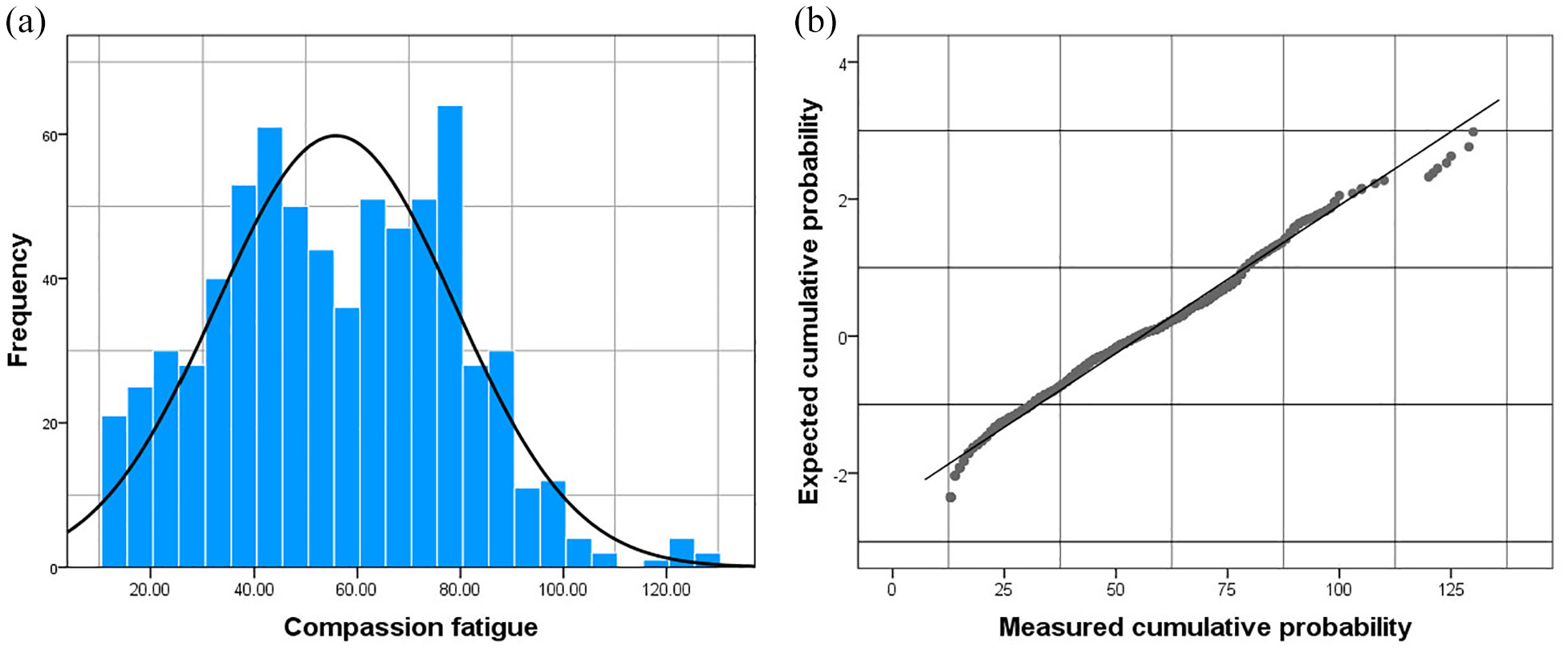
Normality examination for score of compassion fatigue based on histogram and P-P plot of standard residuals: (a) histogram of standard residuals and (b) P-P plot of standard residuals.
We undertook a multivariate linear regression analysis using the “enter” method to identify related factors and develop a predictive model for socio-demographic and work-related determinants (gender, monthly expenditure, number of night shifts per month, and career intentions) of CF. The significance of the regression equations and the goodness of fit were assessed using the F-statistic and adjusted R-squared, respectively. To check multicollinearity, we examined the tolerance value (TV) and variance inflation factor (VIF). If all analyses consistently indicate tolerance values (TV) >0.10 and variance inflation factors (VIF) <10, it signifies the absence of multicollinearity. A two-tailed p value of <.05 was considered statistically significant.
Results
Characteristics of Participants
The basic characteristics of all participants are detailed in Table 1. Out of the 784 questionnaires returned by participants, a total of 695 valid questionnaires were identified, resulting in a valid response rate of 88.6%. The majority of intern students majoring in TCM discipline were female (n = 520, 74.82%), not the only child in their families (n = 550, 79.14%), originated from rural areas (n = 491, 70.65%), and had a monthly expenditure of at least 1,000 CNY (157.5 $; n = 555, 79.86%). Approximately half of the participants majored in Chinese Medicine (n = 373, 53.67%) and had experience serving as student leaders (n = 417, 60%). Around 90% of the participants undertook their internships in tertiary hospitals (n = 626, 90.07%) and expressed an intention to practice medicine after graduation (n = 624, 89.78%). In the month preceding data collection, 51.22% of the participants had engaged in at least one night shift (n = 356).
The Distribution of Compassion Fatigue among Various Characteristics (N = 695).

Note. CF = compassion fatigue; SD = standard deviation.
t-test statistic. #one-way ANOVA statistic (F statistic).
The Status of CF, BO, and STS
The scores for CF, BO, and STS were 55.81 ± 23.19, 35.83 ± 14.38, and 19.97 ± 9.91, respectively. There were 270 (38.8%) participants reporting an overall CF score above 65, regarded as having high risk of CF. In addition, 42.9% of participants encountered clinically significant levels of BO, and 35.8% experienced similar levels of STS (see Table 2).
Distribution of Mean Scores for CFSS and its Subscales (N = 695).
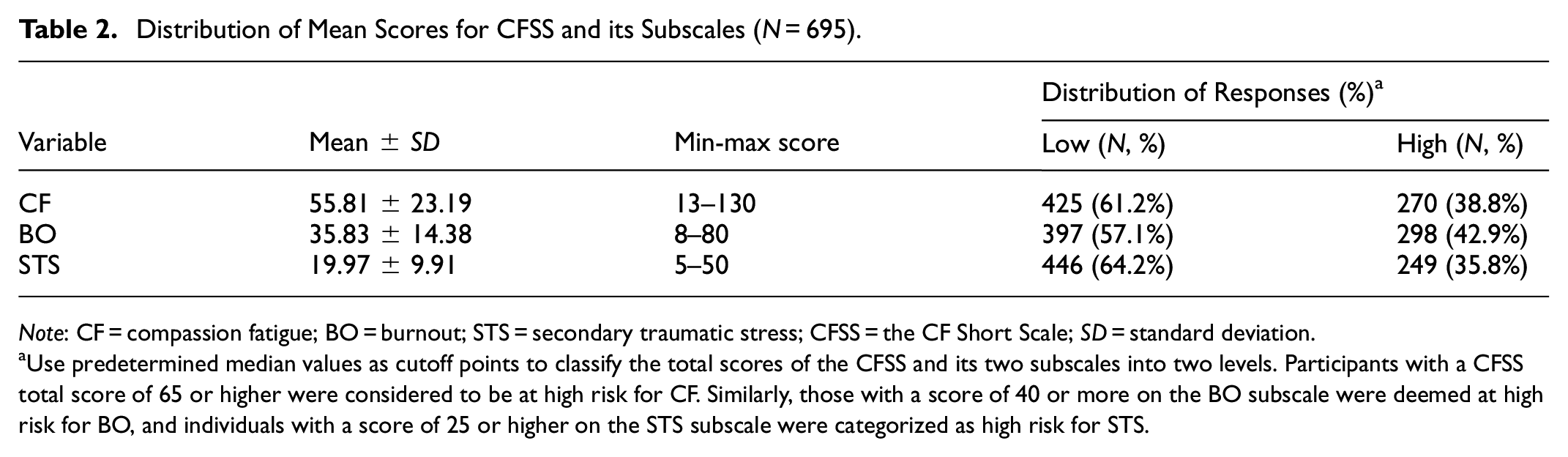
Note: CF = compassion fatigue; BO = burnout; STS = secondary traumatic stress; CFSS = the CF Short Scale; SD = standard deviation.
Use predetermined median values as cutoff points to classify the total scores of the CFSS and its two subscales into two levels. Participants with a CFSS total score of 65 or higher were considered to be at high risk for CF. Similarly, those with a score of 40 or more on the BO subscale were deemed at high risk for BO, and individuals with a score of 25 or higher on the STS subscale were categorized as high risk for STS.
Factors Associated With CF
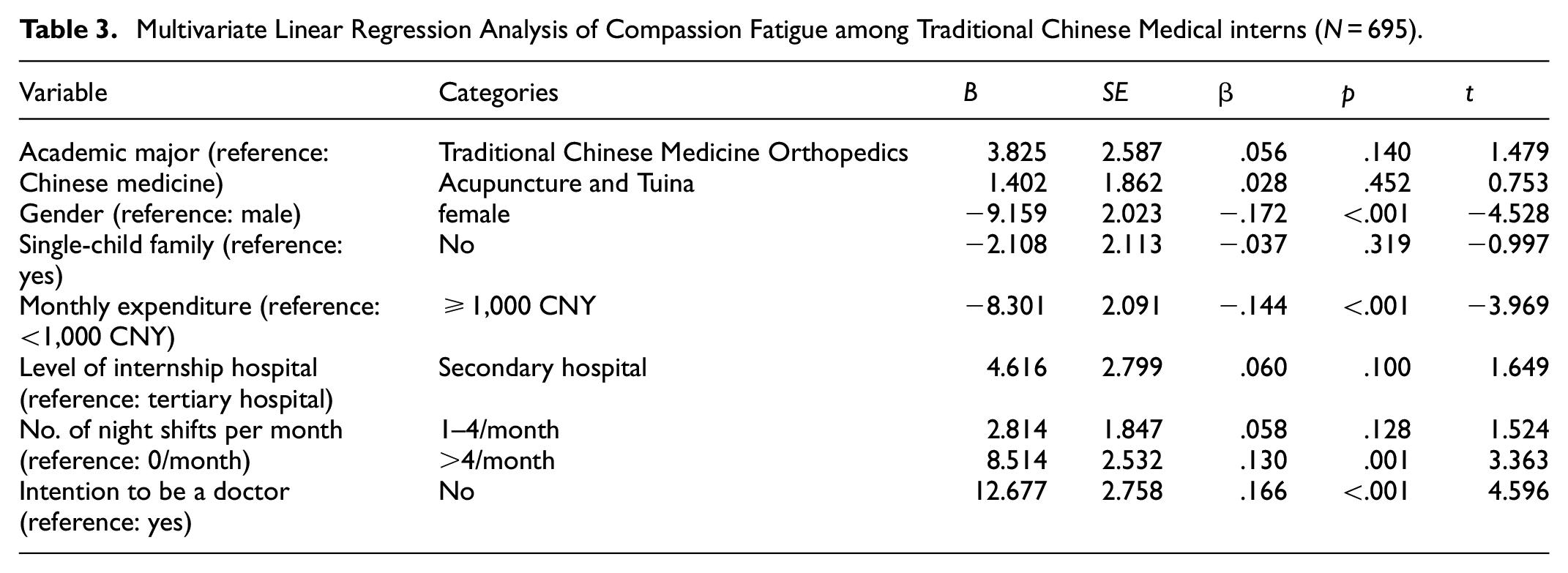
In univariate analysis, participants showed significant differences in their levels of CF across various sample characteristics, with the exception of residence and experience as student leaders. Male students who were born in single-child families, especially those interning in secondary hospitals with a specialization in Chinese Medicine Orthopedics, were more susceptible to experiencing CF. Furthermore, CF was less prevalent among students with higher monthly expenses, fewer monthly night shifts, and a post-graduation intention to pursue a career as a doctor.
Seven potential predictors (p < .05 in univariate analysis) were incorporated into a multiple linear model for further analysis. The final regression model included four factors: gender, monthly expenditure, the number of night shifts per month, and the intention to pursue a medical career after graduation (see Table 3). The Durbin-Watson value was 1.980, indicating the absence of residual autocorrelation. The TV ranged from 0.857 to 0.986, while the VIF fluctuated between 1.014 and 1.167, indicating the lack of multicollinearity among the independent variables. These key factors collectively explained 11.1% (R2 = .124, p < .001) of the variance in CF. The results demonstrated that these variables were significantly related to CF among intern students majoring in TCM.
Multivariate Linear Regression Analysis of Compassion Fatigue among Traditional Chinese Medical interns (N = 695).
Statistical Power Analysis
To further validate the robustness of our results, we conducted post hoc power analyses for the independent samples t-tests and one-way ANOVA used in our study. These analyses indicated that the current sample size (n = 695 valid responses) could detect the main effects of interest in our study with a power exceeding 97%.
Discussion
The results of the present study illustrated that intern students at Chinese junior TCM colleges commonly experience moderate levels of CF, with an average score of 55.81. Specifically, nearly two-fifths (38.8%) of these students were at high risk of CF. Compared to previous literature, CF appeared to be more severe in intern students majoring in TCM compared to nursing students (Chen et al., 2017; L. J. Li et al., 2022; L. L. Sun, 2020; Yi et al., 2022). This may be due to the requirement for intern students majoring in TCM to master and practice a variety of diagnostic and therapeutic skills such as facial diagnosis, acupuncture, and massage during their internships. These skills not only demand high precision and technique but also involve frequent interpersonal interactions, potentially exacerbating the interns’ psychological and emotional stress (Huang et al., 2021). In contrast, nursing students primarily focus on executing medical orders and providing basic care, involving potentially lower levels of technical and emotional investment.
Further analysis reveals that the level of CF among intern students majoring in TCM lies between those of resident doctors (17.1%) and junior physicians (54%; Huggard & Dixon, 2011; Markwell & Wainer, 2009). Resident doctors are responsible for specific clinical tasks such as diagnosing and treating patients in a professional and high-pressure environment, but they typically have well-defined roles and mature support systems. Conversely, junior doctors, who are at the early stages of their careers, often face the challenges of learning new clinical skills and managing complex patient interactions. Due to their lack of experience, their ability to manage stress may not match that of resident doctors, thus they may experience more severe CF. Although intern students majoring in TCM are deeply emotionally invested, their therapeutic activities primarily include preventive and wellness measures, which, compared to the urgent and complex cases handled by junior doctors, subject them to lower levels of stress (Huang et al., 2021). This may partly explain why their levels of CF are relatively lower. Additionally, this characteristic may also partially elucidate our findings that intern students majoring in TCM scored higher in occupational BO (42.9%) than in STS (38.8%), providing a new perspective on understanding CF among intern students majoring in TCM.
Based on our findings, among the factors examined, four variables were found to be associated with the onset of CF among intern students majoring in TCM. These variables include gender, monthly expenditure, number of night shifts, and career intentions. Firstly, male intern students majoring in TCM reported higher levels of CF compared to their female counterparts. This unexpected result contradicts some prior research involving practitioner samples (Weintraub et al., 2016, 2020; Wu et al., 2017). In fact, certain studies have even suggested that CF does not display gender variations among doctors (Bellolio et al., 2014; Huggard & Dixon, 2011; J. L. Gribben, MacLean et al., 2019; Sarosi et al., 2021). This disparity observed in our study may be attributed to traditional gender role expectations prevalent in many Asian cultures. Males are typically perceived as strong and independent, predisposed to addressing problems on their own (S. F. Liu, 2017; Shui et al., 2021). This mentality may deter men from seeking help when faced with stress, and the lack of appropriate avenues for emotional expression can lead to the repression of feelings, thereby increasing the risk of STS or CF (Fanos, 2007; Shi et al., 2022, 2023; Shui et al., 2021). Additionally, the percentage of male participants in our study was only 25.18%, and this gender imbalance may also influence the results. Therefore, we encourage future studies research designs to consider achieving a balanced gender ratio to more comprehensively explore how gender differences affect CF.
Secondly, intern students studying in junior TCM colleges with a monthly expenditure of less than 1,000 CNY reported a higher prevalence of CF than those with a monthly expenditure exceeding 1,000 CNY. Generally, economic capability determines consumption ability, and a lower monthly expenditure level represents more constrained consumption. In China, intern students studying in junior TCM colleges work the same hours as clinical supervisors and follow their work patterns. Although work hours and workload are not reduced, they are not remunerated. These unpaid positions place a greater economic burden on intern students with limited economic capability. A systematic review involving 36,266 trainee physicians indicated that financial burden was associated with a higher likelihood of BO/stress (Zhou et al., 2020). Based on these findings, we recommend that hospital managers pay more attention to intern students facing financial difficulties.
Thirdly, intern students studying in junior TCM colleges who had more than 4 night-shifts per month demonstrated a higher level of CF compared to those without night shifts. Our findings are consistent with Bellolio et al.’s (2014) research, which reported that resident physicians with an increased number of night shifts were at a higher risk of experiencing CF. An investigation into CF among healthcare workers in the United States revealed that night shifts were associated with increased occupational BO and reduced levels of compassion satisfaction (Smart et al., 2014). This result is not surprising, as an excessive number of night shifts can disrupt circadian rhythms, leading to sleep difficulties, increased fatigue, and decreased overall well-being (Angerer et al., 2017). Furthermore, night shifts themselves expose healthcare workers to greater stress and less emotional support compared to day shifts (Chang et al., 2007; Gallagher & Gormley, 2009). Therefore, it is advisable to establish appropriate frequencies for night shifts for interns. Support from the internship hospitals, educational institutions, and families is essential to alleviate the stress caused by night shifts and mitigate their adverse effects on interns.
Lastly, our study discovered that intern students who intended to remain in the medical profession showed lower levels of CF compared to those who aspired to pursue alternative careers. Clinical clerkship offers intern students studying in junior TCM colleges a unique opportunity to closely engage with physicians and develop a strong sense of professional mission. However, the clinical environment exposes students to the challenges of medical practice, including stringent clinical demands, high workloads, and inadequate psychological support (Isaacs et al., 2020). These challenges can contribute to a high prevalence of BO, symptoms of depression, and career regret, potentially leading individuals to question their choice of a medical career (Baghdadi et al., 2020; Dyrbye et al., 2020; Yang et al., 2021). Our findings demonstrated that students who made a deliberate and unwavering decision to pursue a career as physicians before their internships were less susceptible to these negative effects. A survey of 616 nurses indicated that those who willingly chose their profession manifested a stronger sense of professional belonging (Roney & Acri, 2018). Furthermore, Yilmaz et al. (2015) established a direct link between professional belonging and CF, which might partially explain the influence of career intentions on CF. As a result, it is advisable to implement targeted preventive measures for students with wavering intentions to become doctors to reduce the risk of CF.
Strengths and Limitations
This study is the first to investigate CF specifically among intern students majoring in TCM discipline, thereby filling a gap in the existing literature. Additionally, a large-scale survey ensured comprehensive data coverage and high representativeness. However, there are several limitations to this study. First, the cross-sectional design precludes demonstrating changes in CF over time or causal relationships between CF and the related factors. Future longitudinal studies could address these issues and explore the dynamic trends in CF throughout internships. Second, the generalizability of findings may be limited, not only to Western medical students but potentially to other healthcare disciplines with differing internship structures. Third, the chosen generic measurement tool might not fully capture the unique features faced by intern students in junior TCM colleges. Future research could explore tools more specific to the TCM discipline. Fourth, the identified factors explained only 11.1% of the total variance in CF, suggesting the influence of other variables. Future studies could investigate psychological and ethical variables, alongside social support and coping mechanisms, to gain a more comprehensive understanding of CF in this population.
Implications
This study highlights the vulnerability of intern students studying in junior TCM colleges to CF. Given their future roles in primary healthcare, particularly in resource-limited settings, supporting their well-being is crucial. Policymakers can prioritize financial aid programs to address economic hardship and consider workload reduction initiatives to lessen overall stress. Hospital and educational institutions can collaborate to establish confidential mental health services and regularly host career planning and coping skills workshops. Additionally, optimizing internship schedules by reducing unnecessary night shifts can significantly lessen intern burden.
While this cross-sectional study provides valuable insights, employing qualitative methods could offer a deeper understanding of how gender, economic status, and scheduling impact CF. Longitudinal studies tracking intern students transitioning from urban hospital to rural settings could illuminate how changing environment affect stress levels and coping mechanisms. A comprehensive understanding of these factors will inform the development of targeted support strategies and interventions, ensuring future TCM practitioners in primary healthcare are well-equipped to provide compassionate care while preserving their own well-being.
Conclusion
This study identifies a moderate level of CF among intern students in junior TCM colleges in China, with approximately two out of every five reporting a high risk of CF. Several factors, including male gender, lower monthly expenses, a higher number of night shifts, and a lack of intention to pursue a medical career after graduation, are associated with CF in this population. In conclusion, our study underscores the importance of addressing CF among intern students in junior TCM colleges. Given their roles as the future generation of TCM practitioners, effective interventions are crucial to mitigate the negative impact of CF on their well-being and professional development. Future studies should delve deeper into the identified risk factors and explore the development of targeted strategies to promote resilience and prevent CF in this population.
Footnotes
Acknowledgements
I would like to express my gratitude to all my teammate for their wonderful collaboration and to all the students who participated in this study spontaneously and voluntarily.

Ethical Considerations
The study was conducted according to the guidelines of the Declaration of Helsinki and approved by the Hunan Traditional Chinese Medical College Medical Ethics Committee (YX202212001). The collection and use of personal data in this study followed the Personal Information Protection Law of the People’s Republic of China.
Author Contributions
Conceptualization, Li-Juan Yi and Maria F Jiménez-Herrera; Data cura-tion, Li-Juan Yi, Haiyan Long, Jinbo Yuan, Haihua Yang, and Xu Tian; Formal analysis, Chensi He and Xu Tian; Investigation, Li-Juan Yi, Haiyan Long and Haihua Yang; Methodology, Li-Juan Yi, Haiyan Long, Jinbo Yuan, Xu Tian and Maria F Jiménez-Herrera; Project administration, Jinbo Yuan and Maria F Jiménez-Herrera; Software, Chensi He and Xu Tian; Supervision, Maria F Ji-ménez-Herrera; Validation, Maria F Jiménez-Herrera; Visualization, Li-Juan Yi and Chensi He; Writing—original draft, Li-Juan Yi; Writing—review & editing, Li-Juan Yi and Maria F Jiménez-Herrera.
Funding
The author(s) disclosed receipt of the following financial support for the research, authorship, and/or publication of this article: This research was supported by the 2024 Hunan Provincial Vocational College Education and Teaching Reform Research Project (Grant Number: ZJGB2024003), and the Innovation Team on Traditional Health-Preserving Exercises at Hunan Traditional Chinese Medicine College.
Declaration of Conflicting Interests
The author(s) declared no potential conflicts of interest with respect to the research, authorship, and/or publication of this article.
Data Availability Statement
Upon reasonable request, the raw data supporting the conclusions of this article can be accessed from the corresponding authors, without undue reservation.